
CS 378 Computer Game Technology AI Decision Trees
- Slides: 31
CS 378: Computer Game Technology AI – Decision Trees and Rule Systems Spring 2012 University of Texas at Austin CS 378 – Game Technology Fussell Don
Today AI Decision trees Rule-based systems
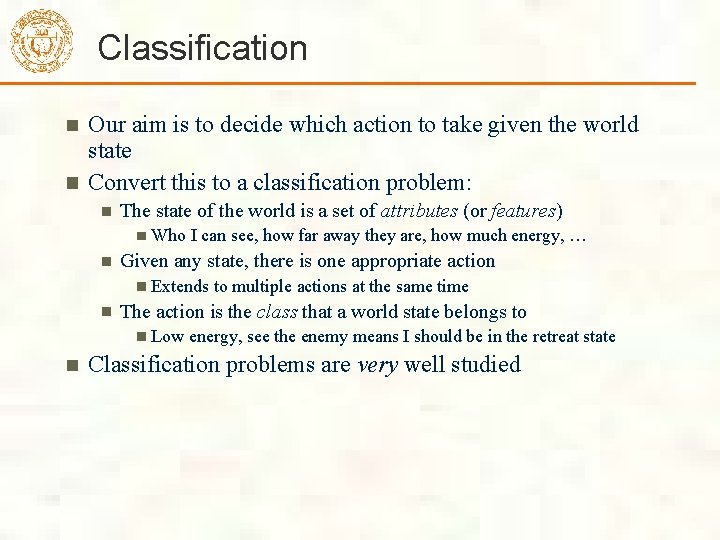
Classification Our aim is to decide which action to take given the world state Convert this to a classification problem: The state of the world is a set of attributes (or features) Who I can see, how far away they are, how much energy, … Given any state, there is one appropriate action Extends to multiple actions at the same time The action is the class that a world state belongs to Low energy, see the enemy means I should be in the retreat state Classification problems are very well studied
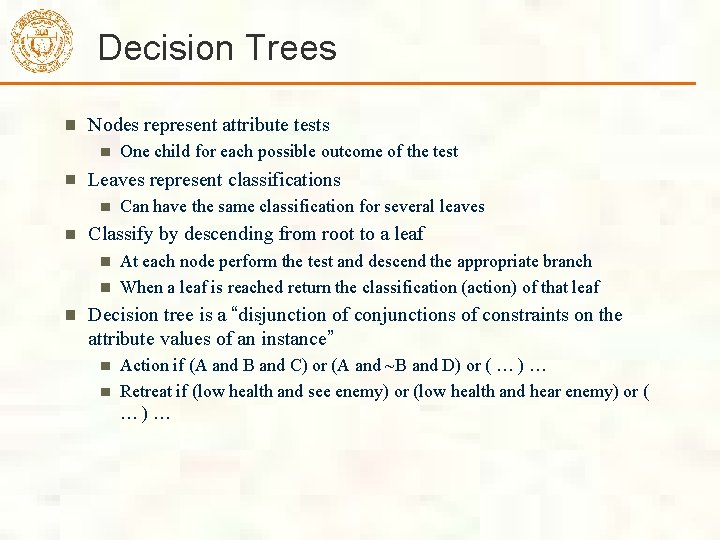
Decision Trees Nodes represent attribute tests One child for each possible outcome of the test Leaves represent classifications Can have the same classification for several leaves Classify by descending from root to a leaf At each node perform the test and descend the appropriate branch When a leaf is reached return the classification (action) of that leaf Decision tree is a “disjunction of conjunctions of constraints on the attribute values of an instance” Action if (A and B and C) or (A and ~B and D) or ( … ) … Retreat if (low health and see enemy) or (low health and hear enemy) or ( …)…
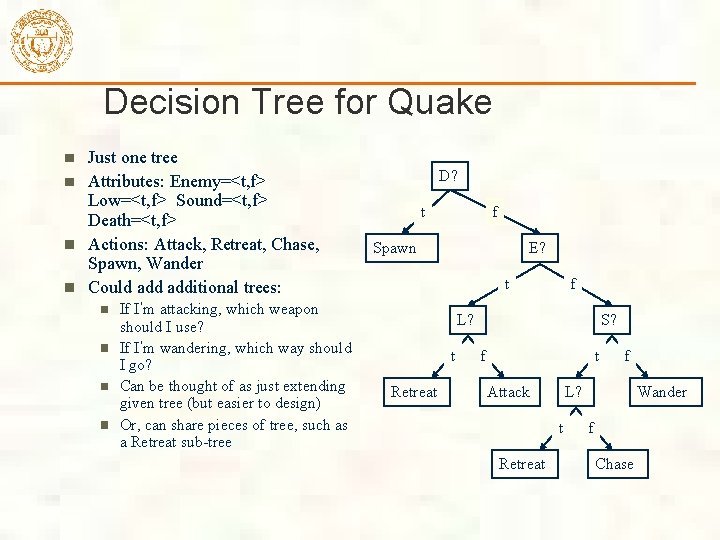
Decision Tree for Quake Just one tree Attributes: Enemy=<t, f> Low=<t, f> Sound=<t, f> Death=<t, f> Actions: Attack, Retreat, Chase, Spawn, Wander Could additional trees: If I’m attacking, which weapon should I use? If I’m wandering, which way should I go? Can be thought of as just extending given tree (but easier to design) Or, can share pieces of tree, such as a Retreat sub-tree D? t f Spawn E? t f L? t Retreat S? f t Attack L? t Retreat f Wander f Chase
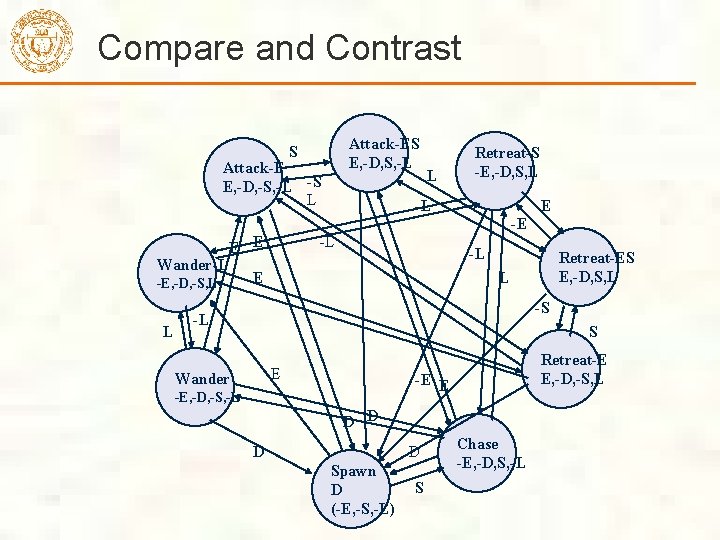
Compare and Contrast Attack-ES E, -D, S, -L S Attack-E E, -D, -S, -L -S L L Retreat-S -E, -D, S, L -L E -E Wander-L E E -E, -D, -S, L L -L -L E Retreat-ES E, -D, S, L L -S -L S -E Wander Retreat-E E, -D, -S, L -E E -E, -D, -S, -L D D Spawn D (-E, -S, -L) S Chase -E, -D, S, -L
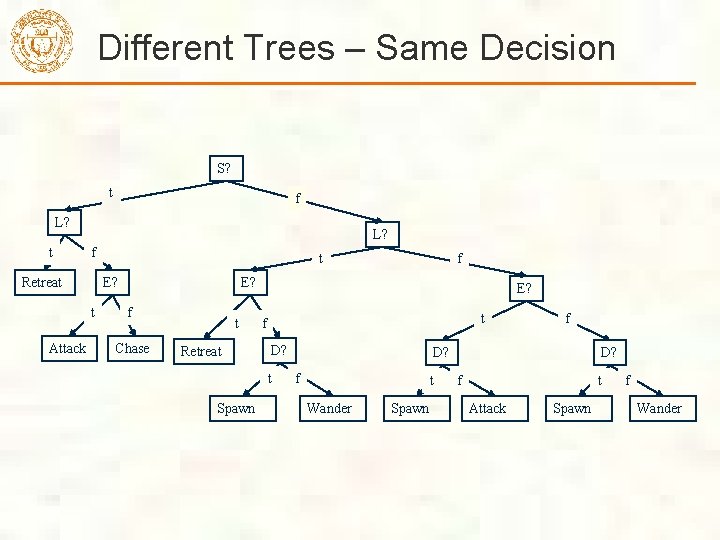
Different Trees – Same Decision S? t f L? t L? f Retreat E? t Attack t f E? f Chase t Retreat E? t f D? t Spawn f D? f t Wander Spawn D? f t Attack Spawn f Wander
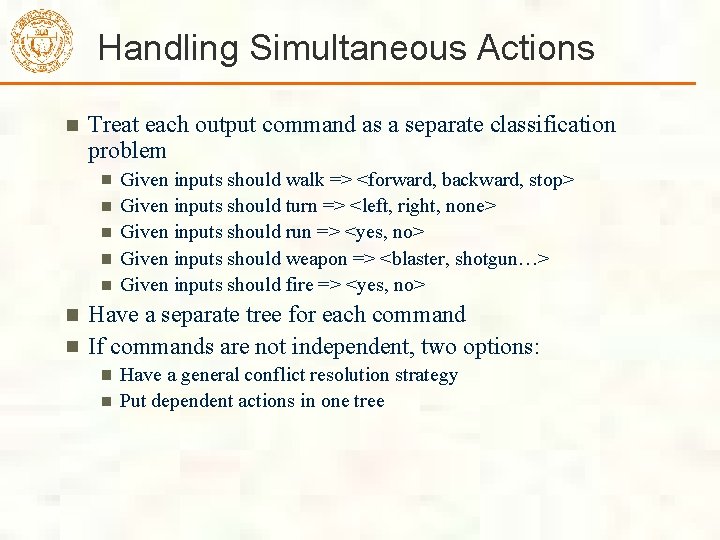
Handling Simultaneous Actions Treat each output command as a separate classification problem Given inputs should walk => <forward, backward, stop> Given inputs should turn => <left, right, none> Given inputs should run => <yes, no> Given inputs should weapon => <blaster, shotgun…> Given inputs should fire => <yes, no> Have a separate tree for each command If commands are not independent, two options: Have a general conflict resolution strategy Put dependent actions in one tree
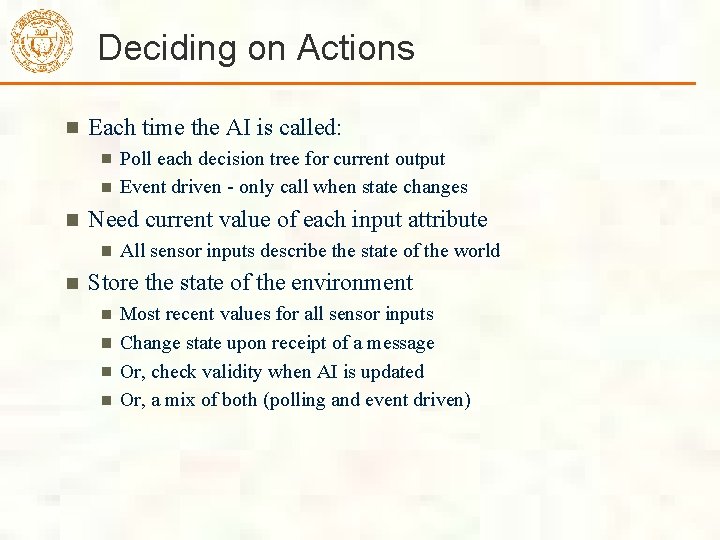
Deciding on Actions Each time the AI is called: Poll each decision tree for current output Event driven - only call when state changes Need current value of each input attribute All sensor inputs describe the state of the world Store the state of the environment Most recent values for all sensor inputs Change state upon receipt of a message Or, check validity when AI is updated Or, a mix of both (polling and event driven)
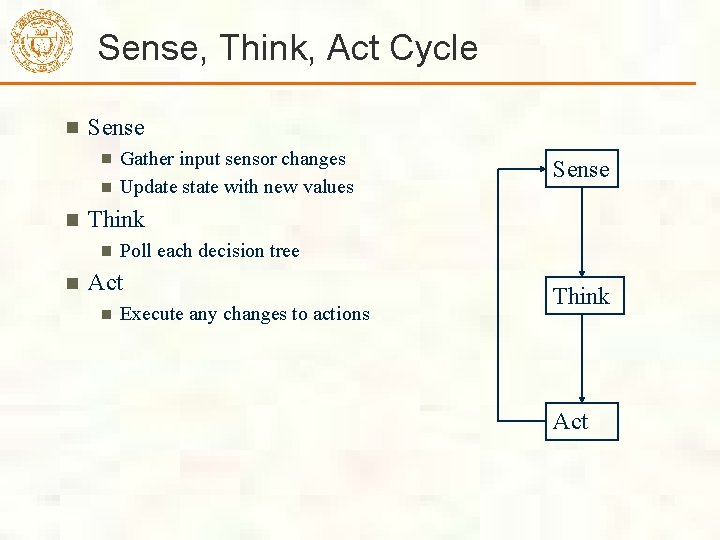
Sense, Think, Act Cycle Sense Gather input sensor changes Update state with new values Sense Think Poll each decision tree Act Execute any changes to actions Think Act
Building Decision Trees Decision trees can be constructed by hand Think of the questions you would ask to decide what to do For example: Tonight I can study, play games or sleep. How do I make my decision? But, decision trees are typically learned: Provide examples: many sets of attribute values and resulting actions Algorithm then constructs a tree from the examples Reasoning: We don’t know how to decide on an action, so let the computer do the work Whose behavior would we wish to learn?
Learning Decision Trees Decision trees are usually learned by induction Generalize from examples Induction doesn’t guarantee correct decision trees Bias towards smaller decision trees Occam’s Razor: Prefer simplest theory that fits the data Too expensive to find the very smallest decision tree Learning is non-incremental Need to store all the examples ID 3 is the basic learning algorithm C 4. 5 is an updated and extended version
Induction If X is true in every example that results in action A, then X must always be true for action A More examples are better Errors in examples cause difficulty If X is true in most examples X must always be true ID 3 does a good job of handling errors (noise) in examples Note that induction can result in errors It may just be coincidence that X is true in all the examples Typical decision tree learning determines what tests are always true for each action Assumes that if those things are true again, then the same action should result
Learning Algorithms Recursive algorithms Find an attribute test that separates the actions Divide the examples based on the test Recurse on the subsets What does it mean to separate? Ideally, there are no actions that have examples in both sets Failing that, most actions have most examples in one set The thing to measure is entropy - the degree of homogeneity (or lack of it) in a set Entropy is also important for compression What have we seen before that tries to separate sets? Why is this different?
Induction requires Examples Where do examples come from? Programmer/designer provides examples Capture an expert player’s actions, and the game state, while they play # of examples needed depends on difficulty of concept Difficulty: Number of tests needed to determine the action More is always better Training set vs. Testing set Train on most (75%) of the examples Use the rest to validate the learned decision trees by estimating how well the tree does on examples it hasn’t seen
Decision Tree Advantages Simpler, more compact representation State is recorded in a memory Create “internal sensors” – Enemy-Recently-Sensed Easy to create and understand Can also be represented as rules Decision trees can be learned
Decision Tree Disadvantages Decision tree engine requires more coding than FSM Each tree is “unique” sequence of tests, so little common structure Need as many examples as possible Higher CPU cost - but not much higher Learned decision trees may contain errors
References Mitchell: Machine Learning, Mc. Graw Hill, 1997 Russell and Norvig: Artificial Intelligence: A Modern Approach, Prentice Hall, 1995 Quinlan: Induction of decision trees, Machine Learning 1: 81 -106, 1986 Quinlan: Combining instance-based and model-based learning, 10 th International Conference on Machine Learning, 1993
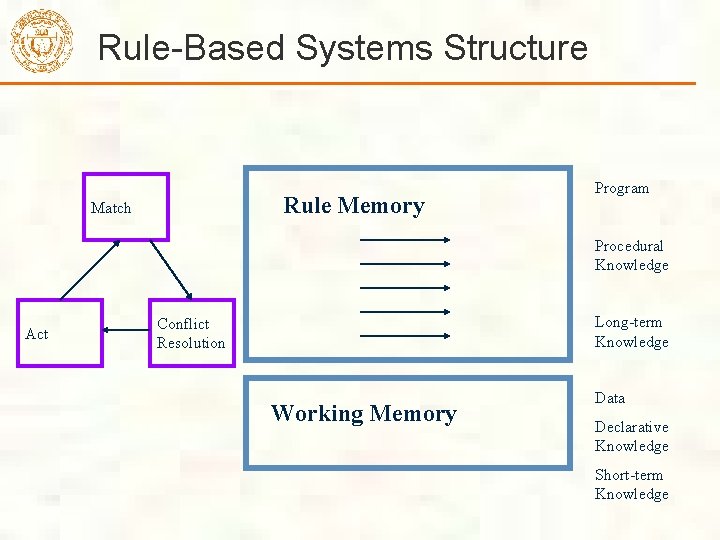
Rule-Based Systems Decision trees can be converted into rules Just test the disjunction of conjunctions for each leaf More general rule-based systems let you write the rules explicitly System consists of: A rule set - the rules to evaluate A working memory - stores state A matching scheme - decides which rules are applicable A conflict resolution scheme - if more than one rule is applicable, decides how to proceed What types of games make the most extensive use of rules?
Rule-Based Systems Structure Rule Memory Match Program Procedural Knowledge Act Long-term Knowledge Conflict Resolution Working Memory Data Declarative Knowledge Short-term Knowledge
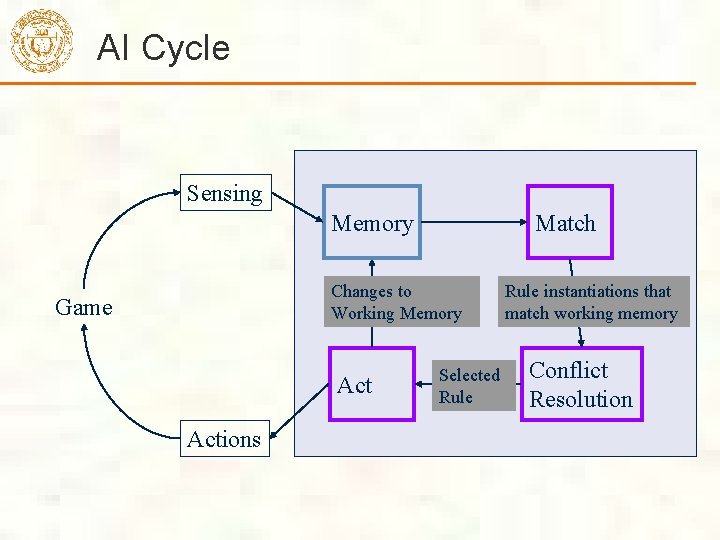
AI Cycle Sensing Memory Match Changes to Working Memory Game Actions Selected Rule instantiations that match working memory Conflict Resolution
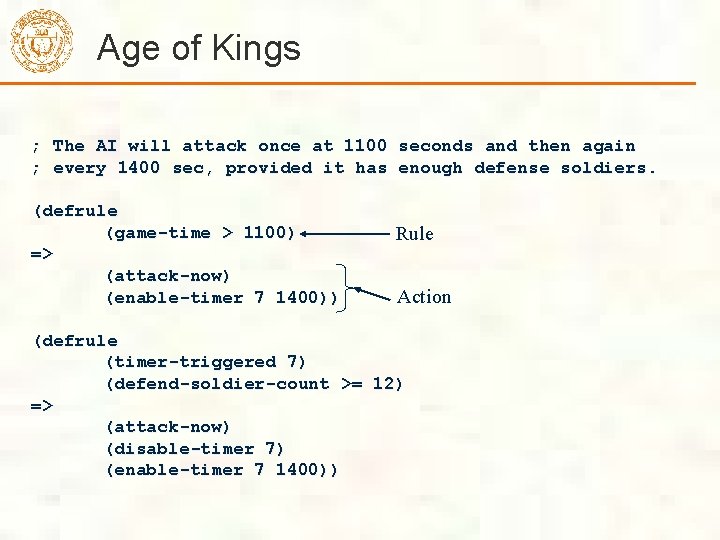
Age of Kings ; The AI will attack once at 1100 seconds and then again ; every 1400 sec, provided it has enough defense soldiers. (defrule (game-time > 1100) Rule => (attack-now) (enable-timer 7 1400)) Action (defrule (timer-triggered 7) (defend-soldier-count >= 12) => (attack-now) (disable-timer 7) (enable-timer 7 1400))
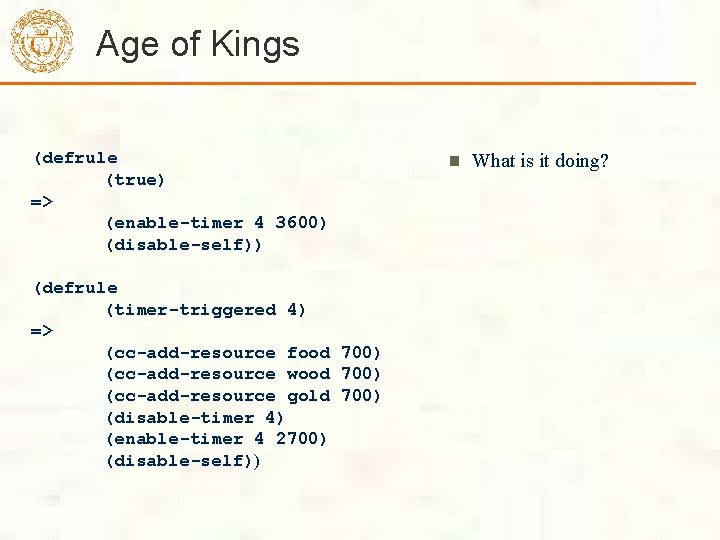
Age of Kings (defrule (true) => (enable-timer 4 3600) (disable-self)) (defrule (timer-triggered 4) => (cc-add-resource food 700) (cc-add-resource wood 700) (cc-add-resource gold 700) (disable-timer 4) (enable-timer 4 2700) (disable-self)) What is it doing?
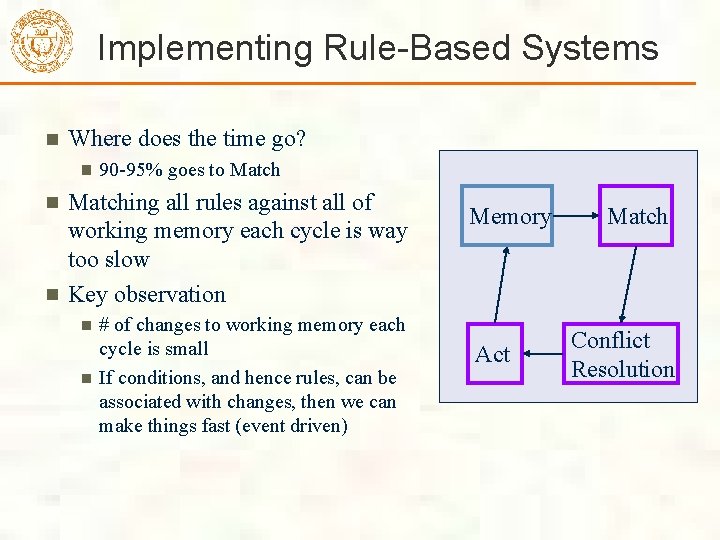
Implementing Rule-Based Systems Where does the time go? 90 -95% goes to Matching all rules against all of working memory each cycle is way too slow Key observation # of changes to working memory each cycle is small If conditions, and hence rules, can be associated with changes, then we can make things fast (event driven) Memory Act Match Conflict Resolution
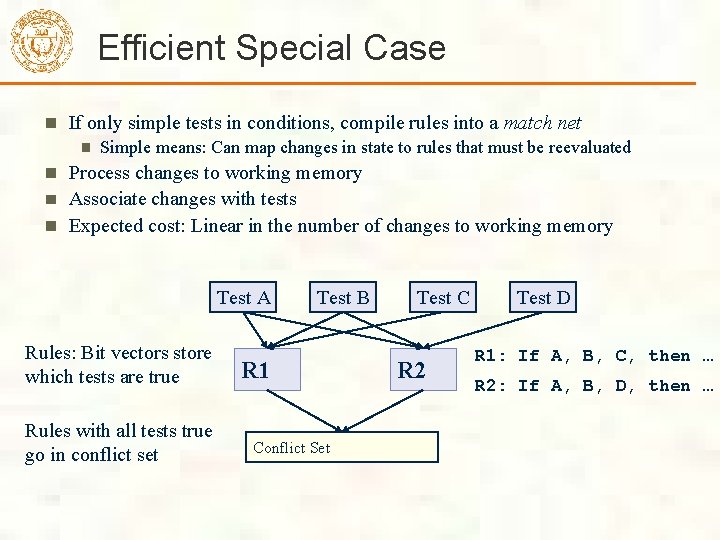
Efficient Special Case If only simple tests in conditions, compile rules into a match net Simple means: Can map changes in state to rules that must be reevaluated Process changes to working memory Associate changes with tests Expected cost: Linear in the number of changes to working memory Test A Rules: Bit vectors store which tests are true Rules with all tests true go in conflict set Test B R 1 Conflict Set Test C R 2 Test D R 1: If A, B, C, then … R 2: If A, B, D, then …
General Case Rules can be arbitrarily complex In particular: function calls in conditions and actions If we have arbitrary function calls in conditions: Can’t hash based on changes Run through rules one at a time and test conditions Pick the first one that matches (or do something else) Time to match depends on: Number of rules Complexity of conditions Number of rules that don’t match
Conflict Resolution Strategies What do we do if multiple rules match?
Conflict Resolution Strategies What do we do if multiple rules match? Rule order – pick the first rule that matches Makes order of loading important – not good for big systems Rule specificity - pick the most specific rule Rule importance – pick rule with highest priority When a rule is defined, give it a priority number Forces a total order on the rules – is right 80% of the time Decide Rule 4 [80] is better than Rule 7 [70] Decide Rule 6 [85] is better than Rule 5 [75] Now have ordering between all of them – even if wrong
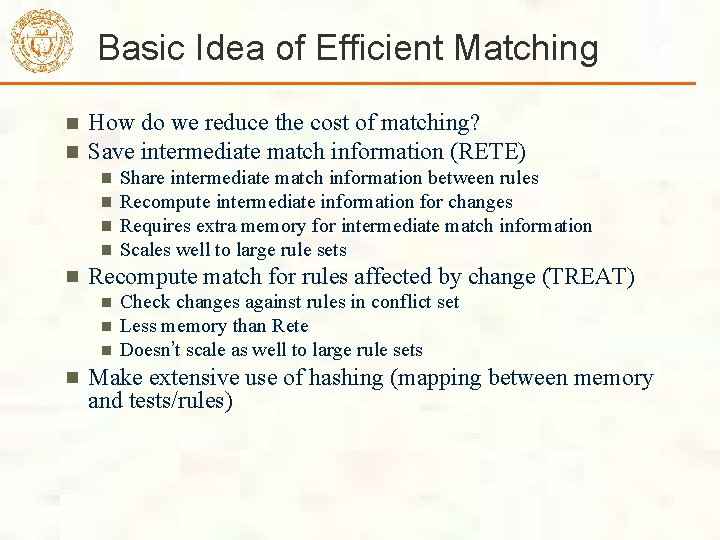
Basic Idea of Efficient Matching How do we reduce the cost of matching? Save intermediate match information (RETE) Share intermediate match information between rules Recompute intermediate information for changes Requires extra memory for intermediate match information Scales well to large rule sets Recompute match for rules affected by change (TREAT) Check changes against rules in conflict set Less memory than Rete Doesn’t scale as well to large rule sets Make extensive use of hashing (mapping between memory and tests/rules)
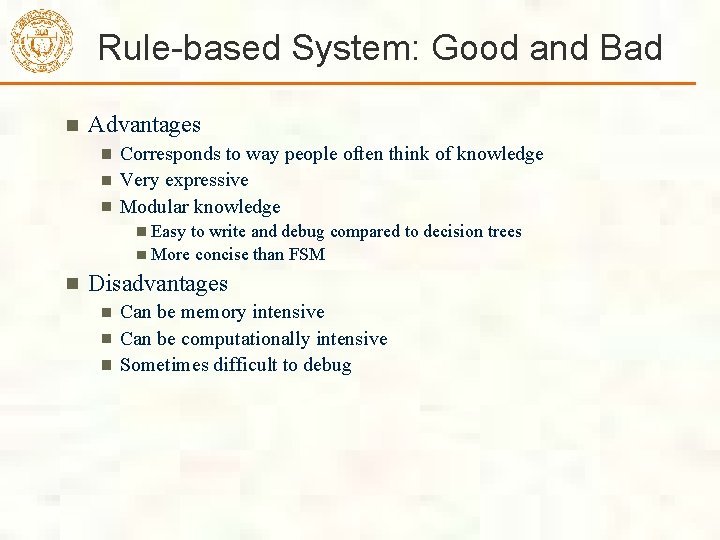
Rule-based System: Good and Bad Advantages Corresponds to way people often think of knowledge Very expressive Modular knowledge Easy to write and debug compared to decision trees More concise than FSM Disadvantages Can be memory intensive Can be computationally intensive Sometimes difficult to debug
References RETE: Forgy, C. L. Rete: A fast algorithm for the many pattern/many object pattern match problem. Artificial Intelligence, 19(1) 1982, pp. 17 -37 TREAT: Miranker, D. TREAT: A new and efficient match algorithm for AI production systems. Pittman/Morgan Kaufman, 1989