
CS 3700 Networks and Distributed Systems Overlay Networks

CS 3700 Networks and Distributed Systems Overlay Networks (P 2 P DHT via KBR FTW) Revised 10/26/2016
2 Outline q q Consistent Hashing Structured Overlays / DHTs
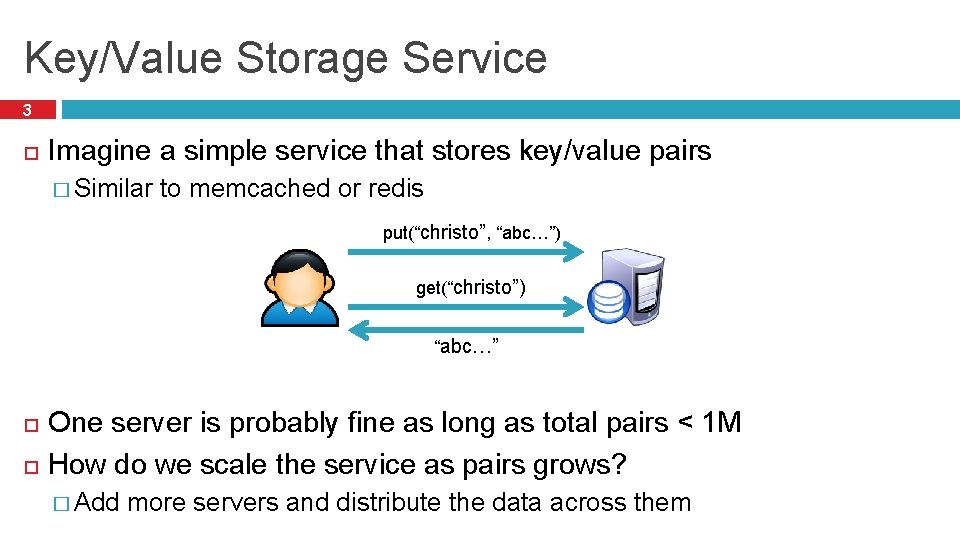
Key/Value Storage Service 3 Imagine a simple service that stores key/value pairs � Similar to memcached or redis put(“christo”, “abc…”) get(“christo”) “abc…” One server is probably fine as long as total pairs < 1 M How do we scale the service as pairs grows? � Add more servers and distribute the data across them
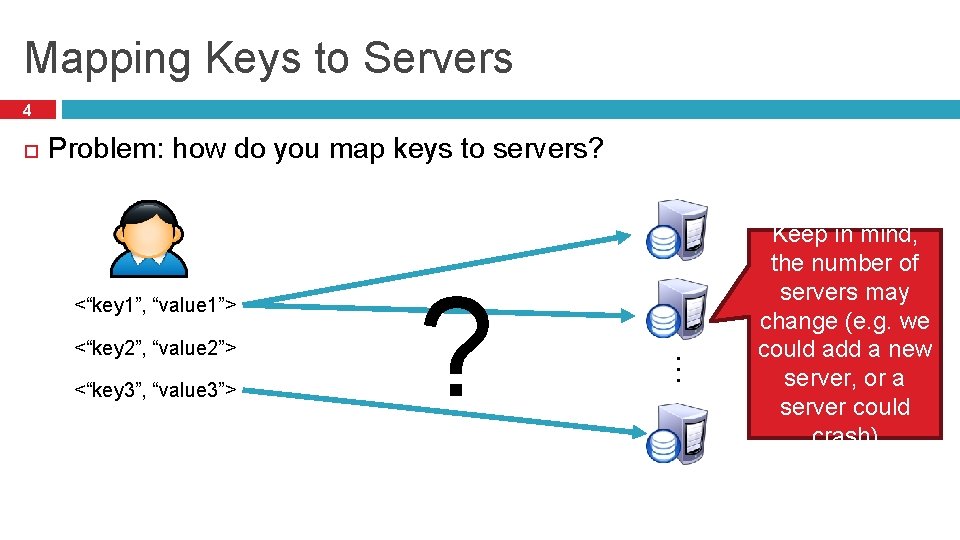
Mapping Keys to Servers 4 Problem: how do you map keys to servers? <“key 1”, “value 1”> <“key 3”, “value 3”> ? … <“key 2”, “value 2”> Keep in mind, the number of servers may change (e. g. we could add a new server, or a server could crash)

Hash Tables 5 Array (length = n) <“key 2”, “value 2”> <“key 1”, “value 1”> <“key 2”, “value 2”> <“key 3”, “value 3”> hash(key) % n array index <“key 1”, “value 1”> <“key 3”, “value 3”>
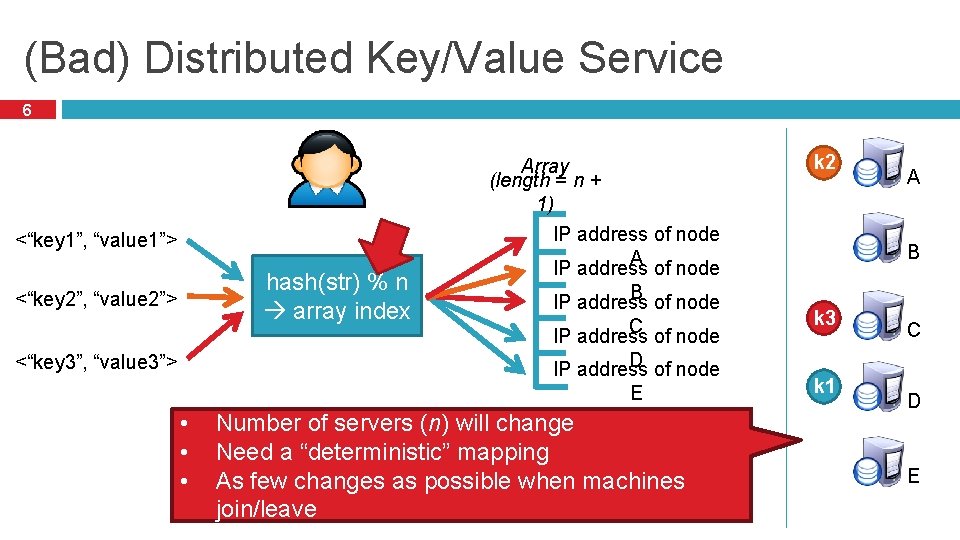
(Bad) Distributed Key/Value Service 6 Array (length==nn)+ 1) <“key 1”, “value 1”> hash(str) % n array index <“key 2”, “value 2”> <“key 3”, “value 3”> • • • k 2 IP address of node A of node IP address B B of node IP address C of node IP address k 3 D of node IP address E k 1 Number of servers (n) will change Need a “deterministic” mapping As few changes as possible when machines join/leave A C D E
Consistent Hashing 7 Alternative hashing algorithm with many beneficial characteristics � Deterministic (just like normal hashing algorithms) � Balanced: given n servers, each server should get roughly 1/n keys � Locality sensitive: if a server is added, only 1/(n+1) keys need to be moved Conceptually simple � Imagine a circular number line from 0 1 � Place the servers at random locations on the number line � Hash each key and place it at the next server on the number line Move around the circle clockwise to find the next server
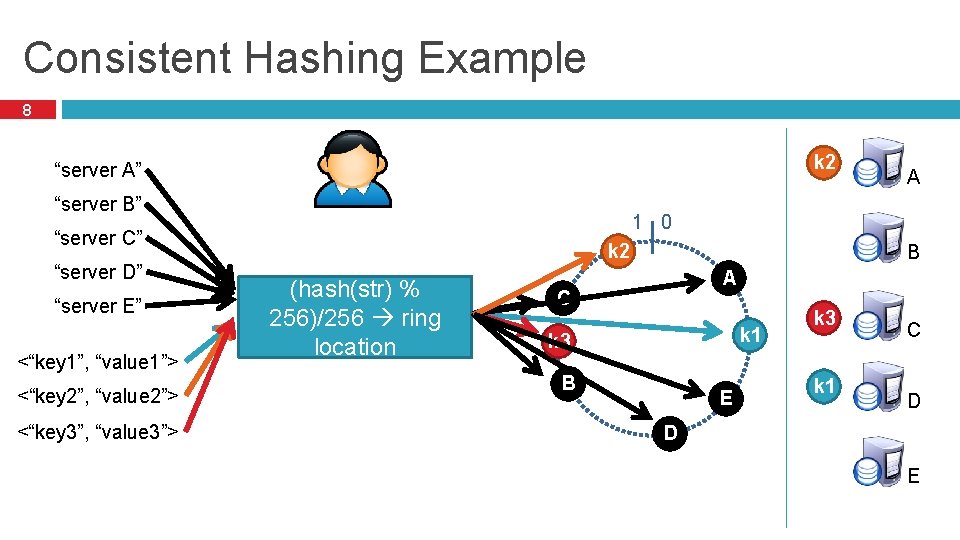
Consistent Hashing Example 8 k 2 “server A” “server B” 1 0 “server C” “server D” “server E” <“key 1”, “value 1”> <“key 2”, “value 2”> <“key 3”, “value 3”> A k 2 (hash(str) % 256)/256 ring location B A C k 1 k 3 B E k 3 k 1 C D D E
Practical Implementation 9 In practice, no need to implement complicated number lines Store a list of servers, sorted by their hash (floats from 0 1) To put() or get() a pair, hash the key and search through the list for the first server where hash(server) >= hash(key) � O(log n) search time if we use a sorted data structure like a heap O(log n) time to insert a new server into the list
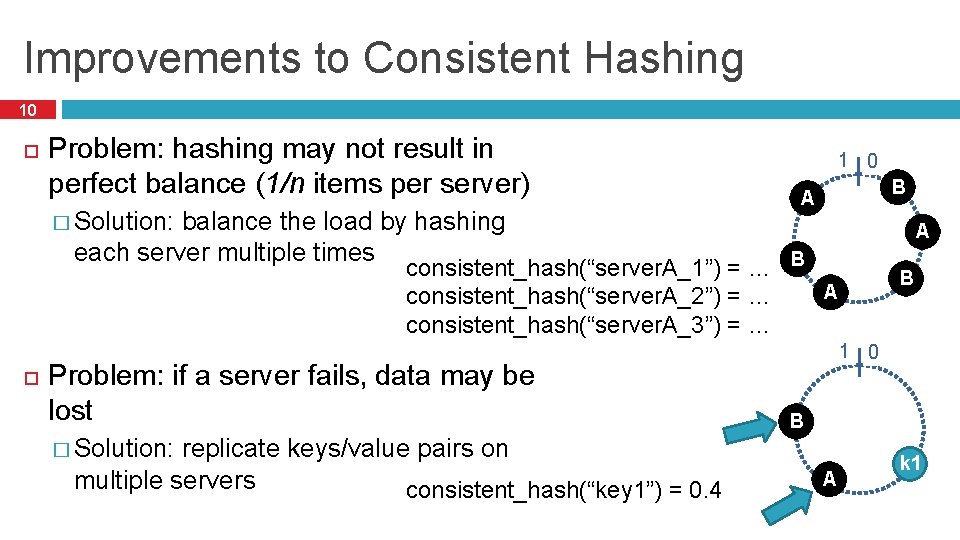
Improvements to Consistent Hashing 10 Problem: hashing may not result in perfect balance (1/n items per server) � Solution: balance the load by hashing each server multiple times 1 0 B A A consistent_hash(“server. A_1”) = … B A consistent_hash(“server. A_2”) = … consistent_hash(“server. A_3”) = … Problem: if a server fails, data may be lost replicate keys/value pairs on multiple servers consistent_hash(“key 1”) = 0. 4 B 1 0 B � Solution: A k 1
Consistent Hashing Summary 11 Consistent hashing is a simple, powerful tool for building distributed systems � Provides consistent, deterministic mapping between names and servers � Often called locality sensitive hashing Ideal algorithm for systems that need to scale up or down gracefully Many, many systems use consistent hashing � CDNs � Databases: memcached, redis, Voldemort, Dynamo, Cassandra, etc. � Overlay networks (more on this coming up…)
12 Outline q q Consistent Hashing Structured Overlays / DHTs
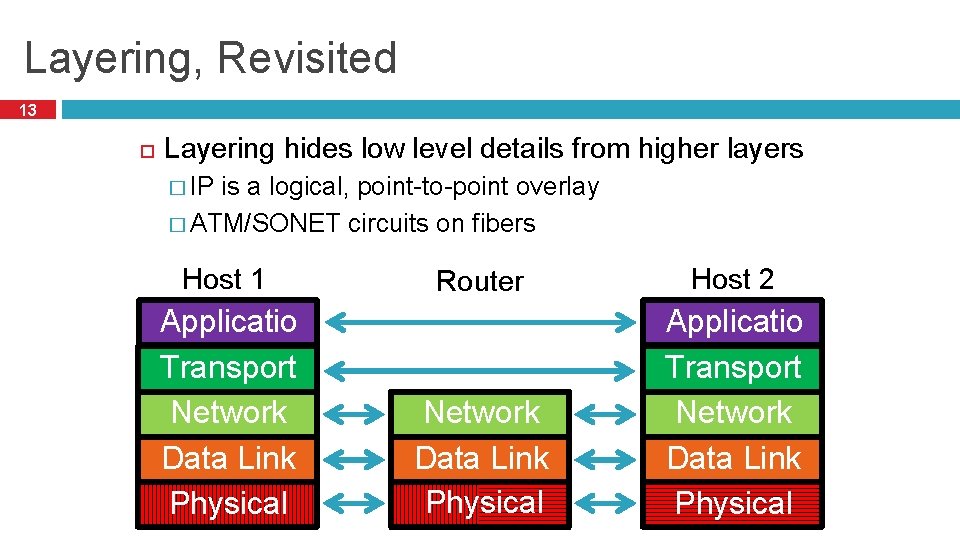
Layering, Revisited 13 Layering hides low level details from higher layers � IP is a logical, point-to-point overlay � ATM/SONET circuits on fibers Host 1 Applicatio n Transport Network Data Link Physical Router Host 2 Network Data Link Physical Applicatio n Transport Network Data Link Physical
Towards Network Overlays 14 IP provides best-effort, point-to-point datagram service Maybe you want additional features not supported by IP or even TCP � Multicast � Security � Reliable, performance-based routing � Content addressing, reliable data storage Idea: overlay an additional routing layer on top of IP that adds additional features
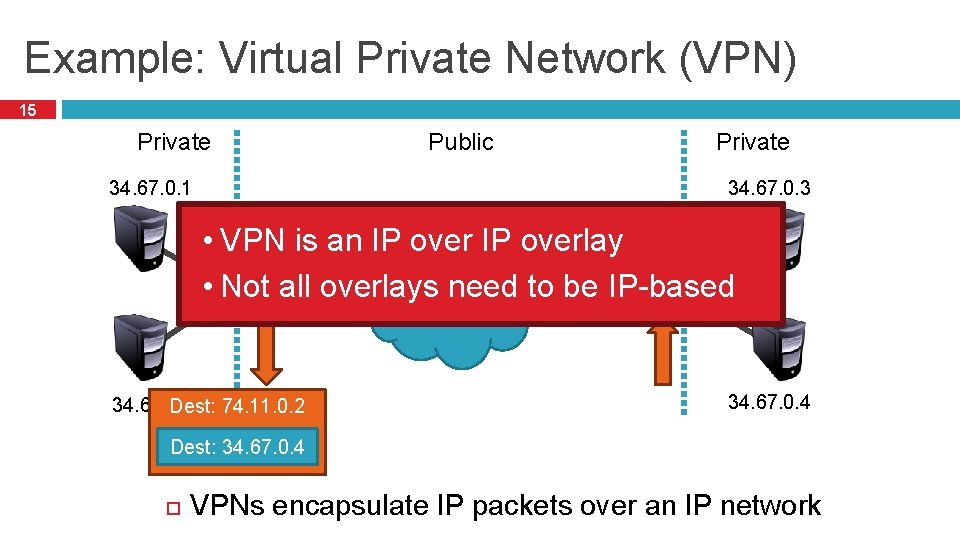
Example: Virtual Private Network (VPN) 15 Private 34. 67. 0. 1 Public Private 34. 67. 0. 3 • VPN is an IP overlay 74. 11. 0. 1 74. 11. 0. 2 • Not all overlays need to be IP-based Internet 34. 67. 0. 2 Dest: 74. 11. 0. 2 34. 67. 0. 4 Dest: 34. 67. 0. 4 VPNs encapsulate IP packets over an IP network
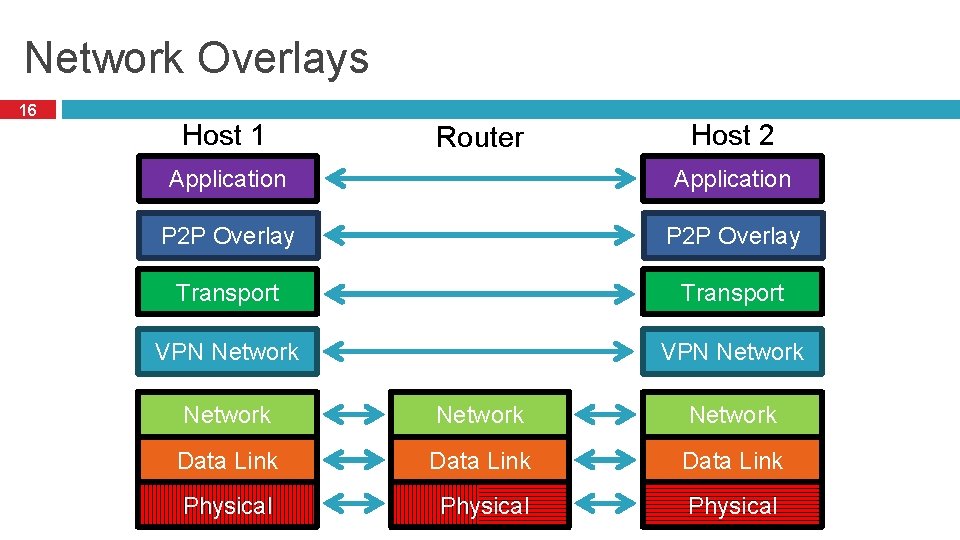
Network Overlays 16 Host 1 Router Host 2 Application P 2 P Overlay Transport VPN Network Network Data Link Physical
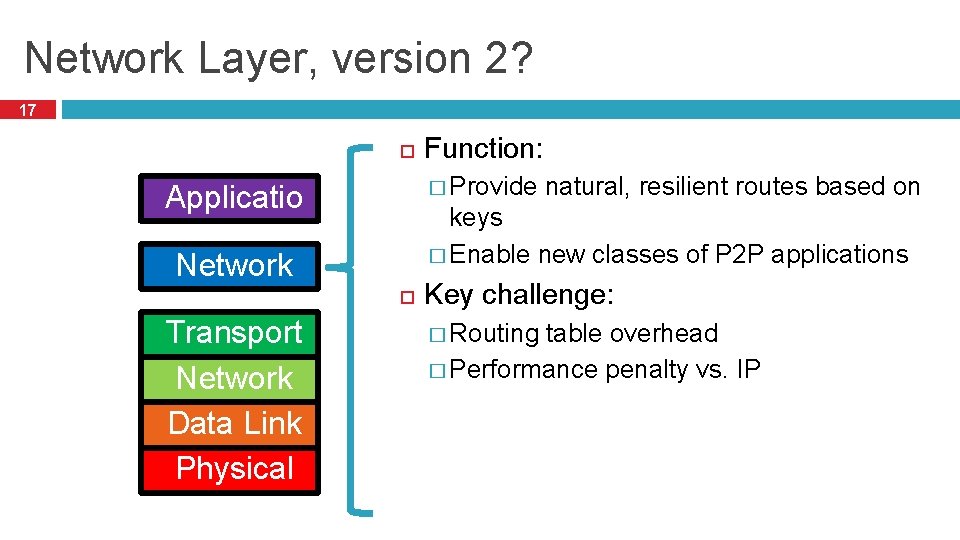
Network Layer, version 2? 17 � Provide Applicatio n Network natural, resilient routes based on keys � Enable new classes of P 2 P applications Transport Network Data Link Physical Function: Key challenge: � Routing table overhead � Performance penalty vs. IP
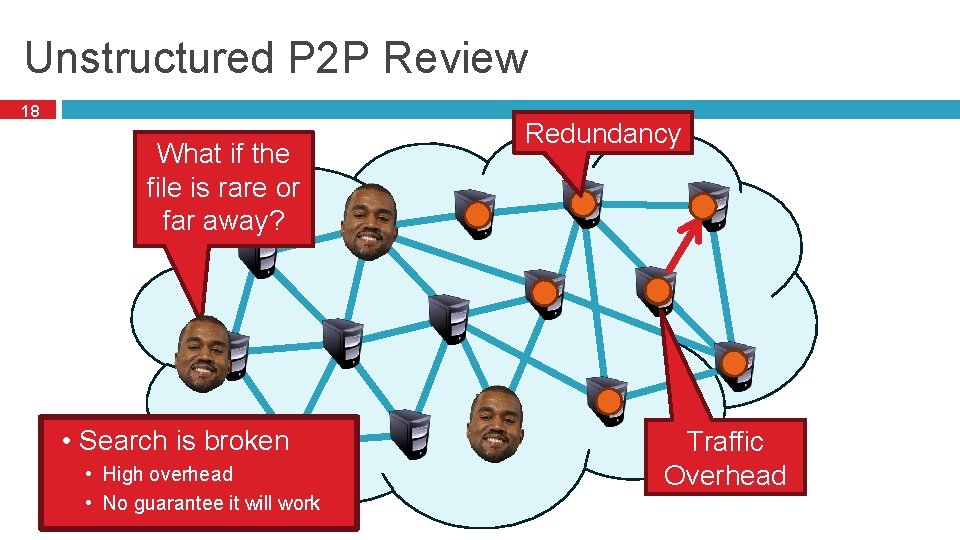
Unstructured P 2 P Review 18 What if the file is rare or far away? • Search is broken • High overhead • No guarantee it will work Redundancy Traffic Overhead
Why Do We Need Structure? 19 Without structure, it is difficult to search � Any file can be on any machine � Centralization can solve this (i. e. Napster), but we know how that ends How do you build a P 2 P network with structure? 1. 2. Give every machine and object a unique name Map from objects machines Looking for object A? Map(A) X, talk to machine X Looking for object B? Map(B) Y, talk to machine Y Is this starting to sound familiar?
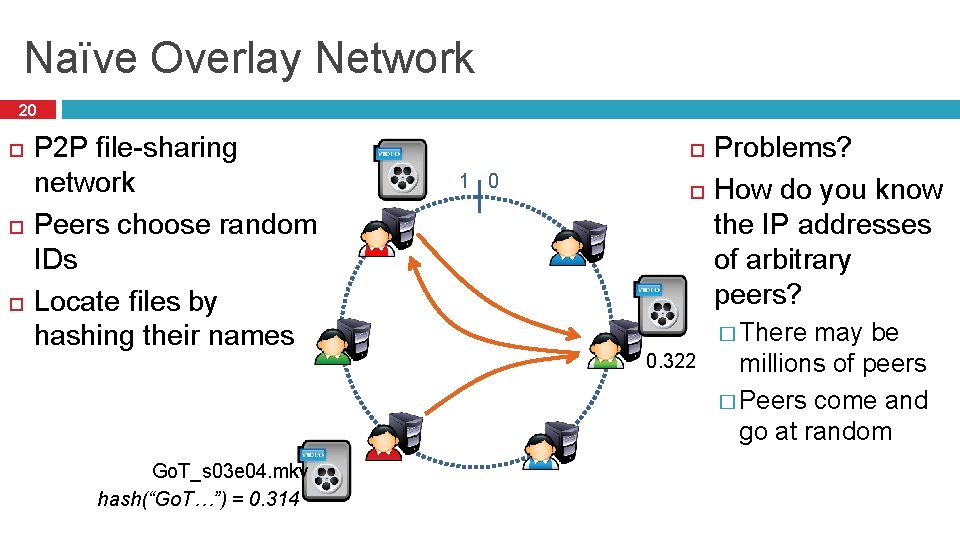
Naïve Overlay Network 20 P 2 P file-sharing network Peers choose random IDs Locate files by hashing their names Go. T_s 03 e 04. mkv hash(“Go. T…”) = 0. 314 1 0 Problems? How do you know the IP addresses of arbitrary peers? � There 0. 322 may be millions of peers � Peers come and go at random
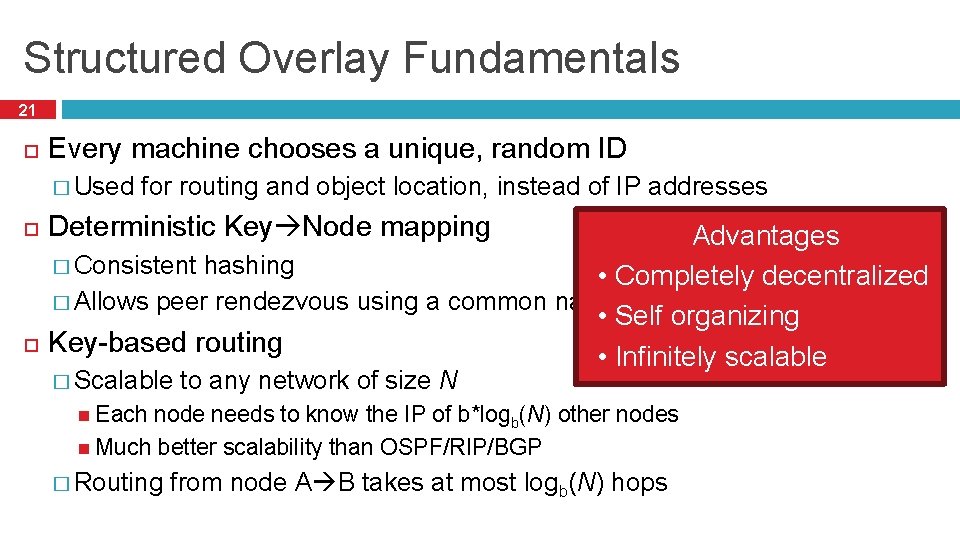
Structured Overlay Fundamentals 21 Every machine chooses a unique, random ID � Used for routing and object location, instead of IP addresses Deterministic Key Node mapping Advantages � Consistent hashing • Completely decentralized � Allows peer rendezvous using a common name • Self organizing Key-based routing • Infinitely scalable � Scalable to any network of size N Each node needs to know the IP of b*logb(N) other nodes Much better scalability than OSPF/RIP/BGP � Routing from node A B takes at most logb(N) hops
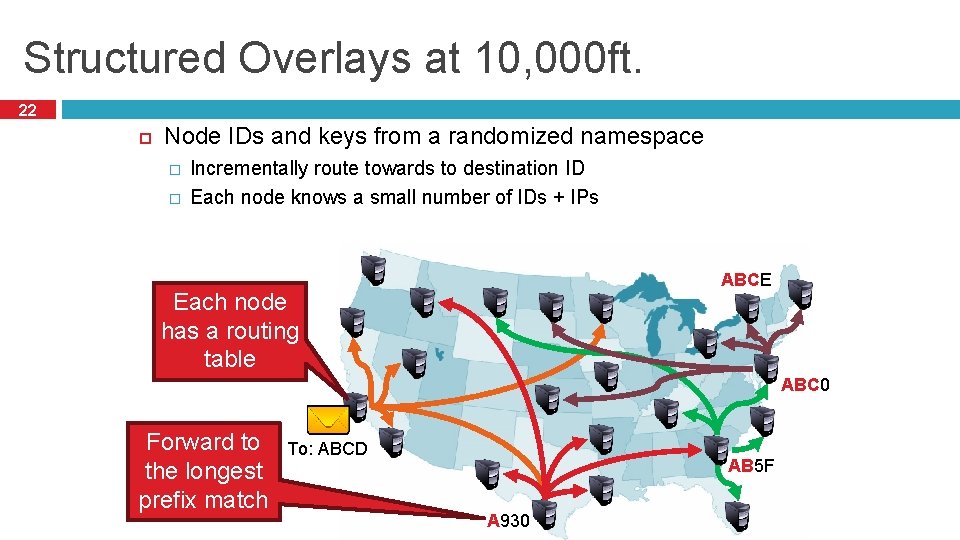
Structured Overlays at 10, 000 ft. 22 Node IDs and keys from a randomized namespace � � Incrementally route towards to destination ID Each node knows a small number of IDs + IPs ABCE Each node has a routing table ABC 0 Forward to the longest prefix match To: ABCD AB 5 F A 930
Details 24 Structured overlay APIs � route(key, Just msg) : route msg to node responsible for key like sending a packet to an IP address � Distributed hash table (DHT) functionality put(key, value) : store value at node/key get(key) : retrieve stored value for key at node Key questions: � Node ID space, what does it represent? � How do you route within the ID space? � How big are the routing tables? � How many hops to a destination (in the worst case)?
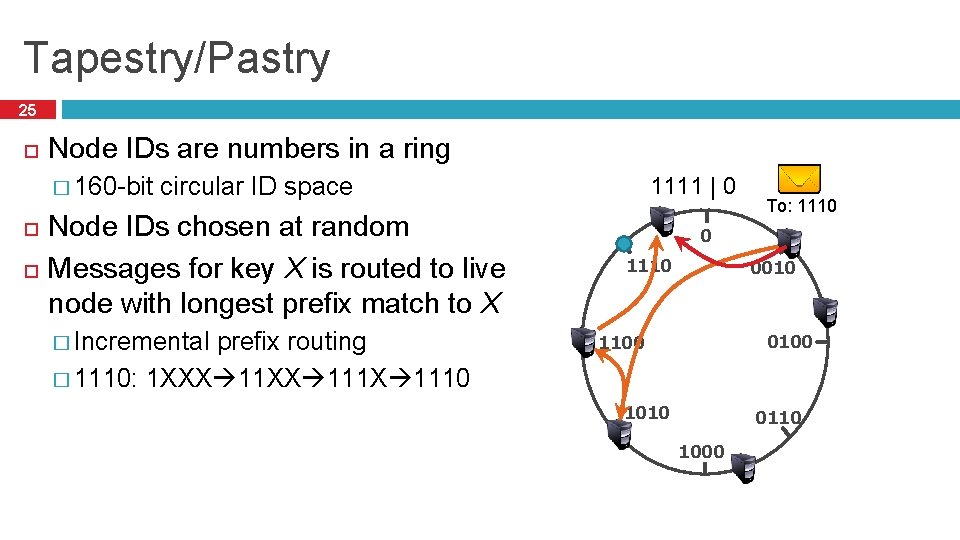
Tapestry/Pastry 25 Node IDs are numbers in a ring � 160 -bit circular ID space Node IDs chosen at random Messages for key X is routed to live node with longest prefix match to X � Incremental prefix routing � 1110: 1 XXX 111 X 1110 1111 | 0 To: 1110 0010 0100 1010 0110 1000
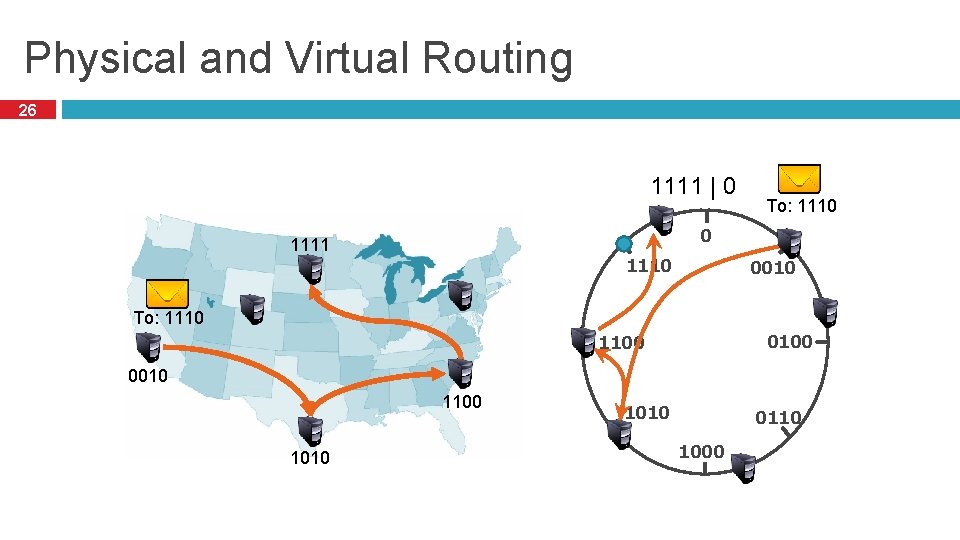
Physical and Virtual Routing 26 1111 | 0 To: 1110 0 1111 1110 0010 To: 1110 0100 1100 0010 1100 1010 0110 1000
Problem: Routing Table Size 27 Definitions: �N is the size of the network � b is the base of the node IDs � d is the number of digits in node IDs � bd = N If N is large, then a naïve routing table is going to be huge � Assume a flat naming space (kind of like MAC addresses) � A client knows its own ID � To send to any other node, would need to know N-1 other IP addresses � Suppose N = 1 billion : (
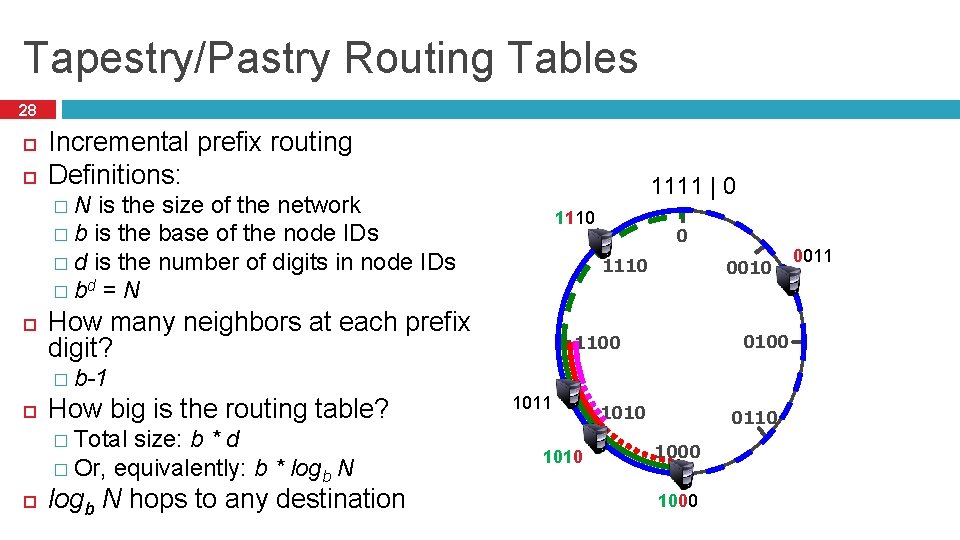
Tapestry/Pastry Routing Tables 28 Incremental prefix routing Definitions: 1111 | 0 �N is the size of the network � b is the base of the node IDs � d is the number of digits in node IDs � bd = N 1110 0 1110 How many neighbors at each prefix digit? 0010 0100 1100 � b-1 How big is the routing table? � Total size: b * d � Or, equivalently: b * logb N hops to any destination 1011 1010 0110 1000 0011
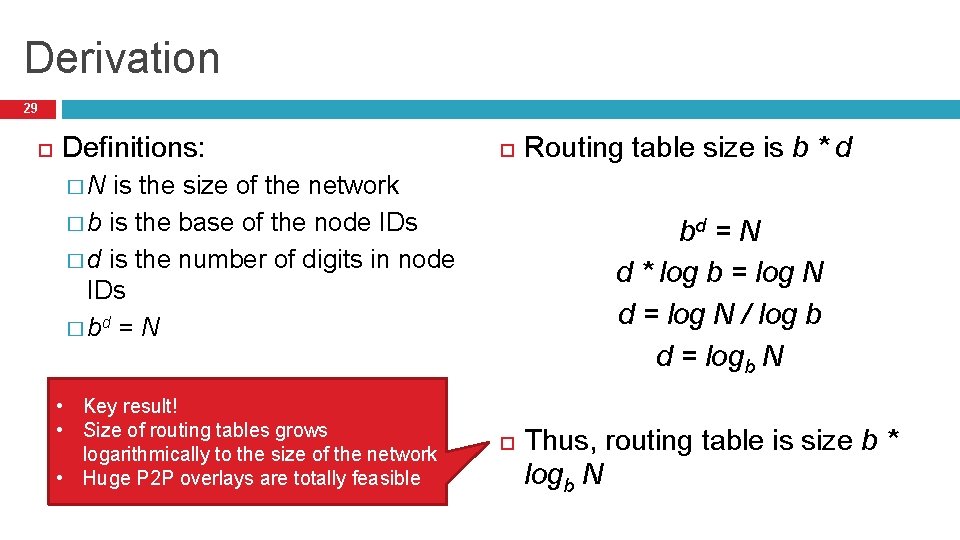
Derivation 29 Definitions: is the size of the network � b is the base of the node IDs � d is the number of digits in node IDs � bd = N Routing table size is b * d �N • Key result! • Size of routing tables grows logarithmically to the size of the network • Huge P 2 P overlays are totally feasible bd = N d * log b = log N d = log N / log b d = logb N Thus, routing table is size b * logb N
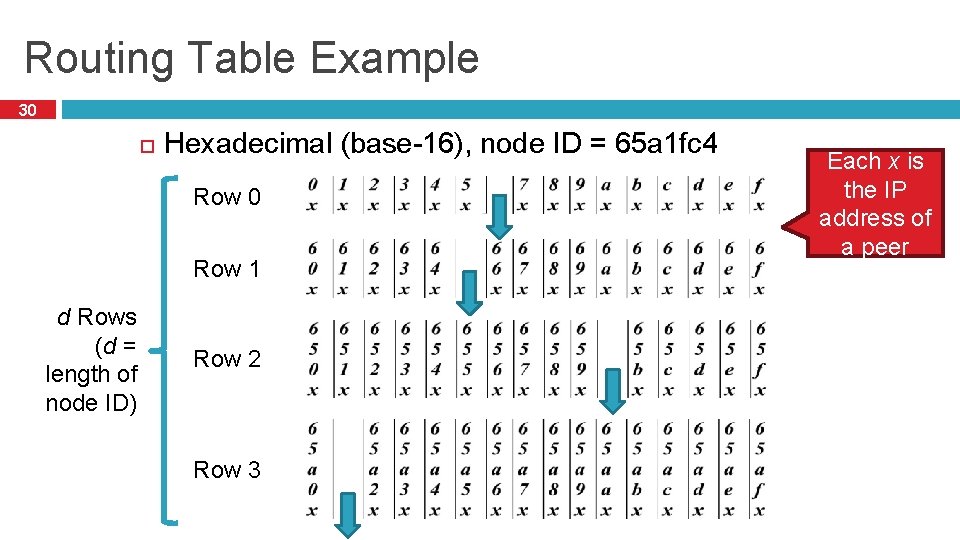
Routing Table Example 30 Hexadecimal (base-16), node ID = 65 a 1 fc 4 Row 0 Row 1 d Rows (d = length of node ID) Row 2 Row 3 Each x is the IP address of a peer
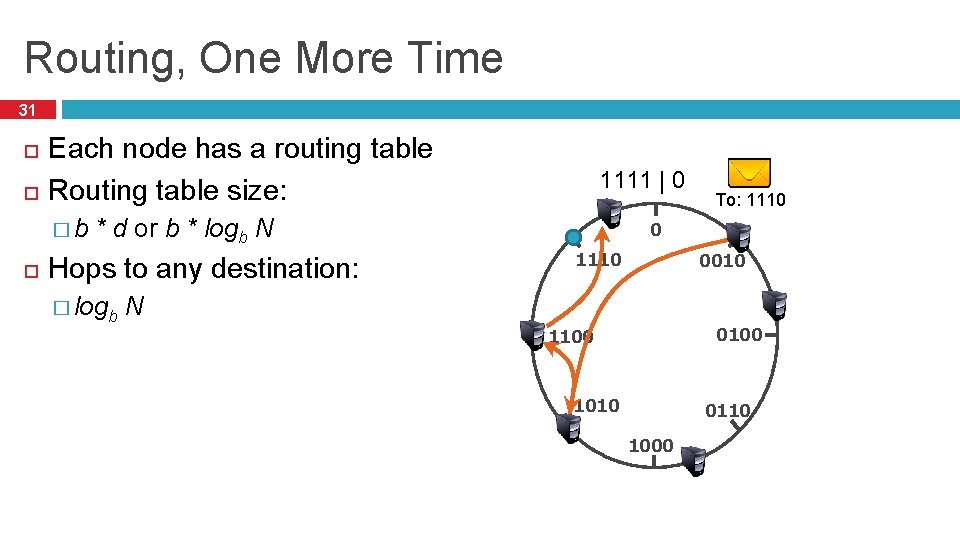
Routing, One More Time 31 Each node has a routing table Routing table size: �b 1111 | 0 * d or b * logb N Hops to any destination: � logb To: 1110 0010 N 0100 1010 0110 1000
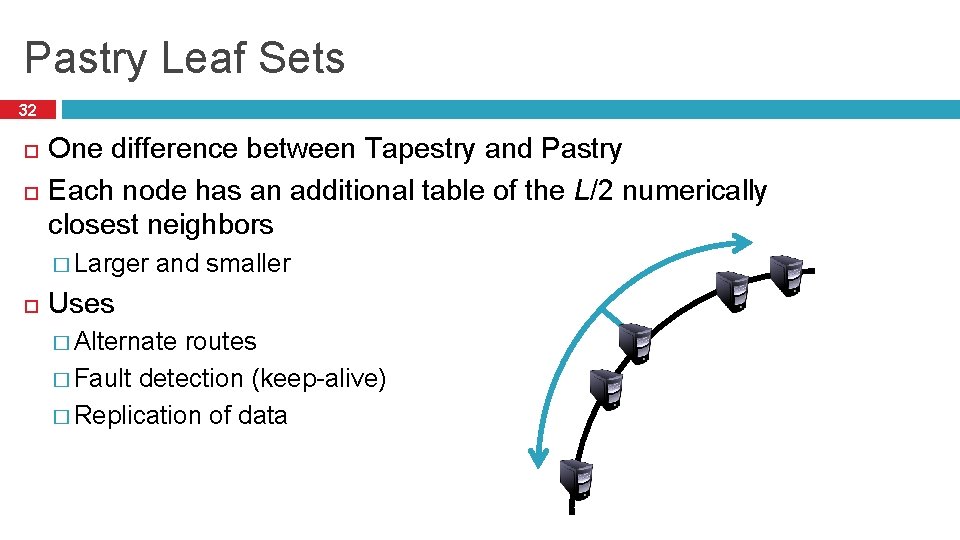
Pastry Leaf Sets 32 One difference between Tapestry and Pastry Each node has an additional table of the L/2 numerically closest neighbors � Larger and smaller Uses � Alternate routes � Fault detection (keep-alive) � Replication of data
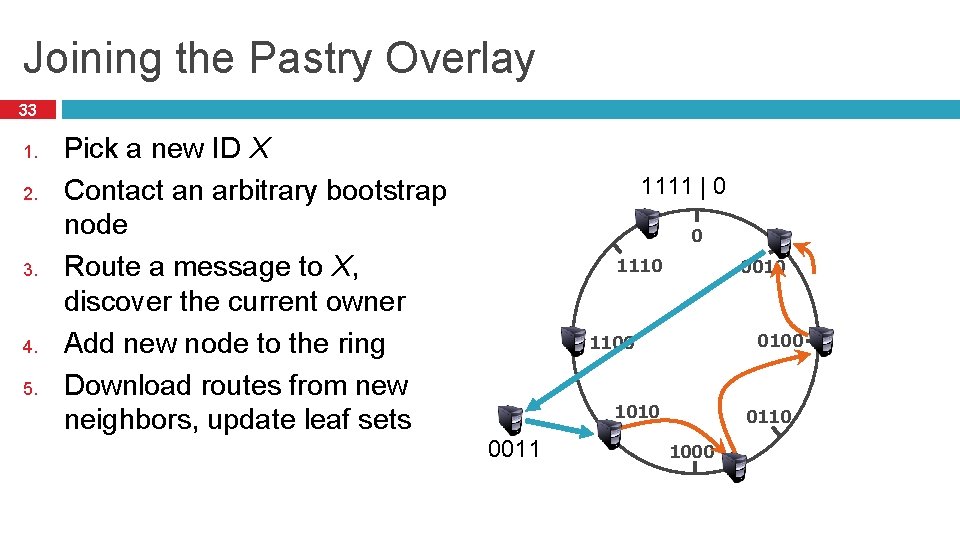
Joining the Pastry Overlay 33 1. 2. 3. 4. 5. Pick a new ID X Contact an arbitrary bootstrap node Route a message to X, discover the current owner Add new node to the ring Download routes from new neighbors, update leaf sets 1111 | 0 0 1110 0010 0100 1010 0011 0110 1000
Node Departure 34 Leaf set members exchange periodic keep-alive messages � Handles Leaf set repair: � Request local failures the leaf set from the farthest node in the set Routing table repair: � Get table from peers in row 0, then row 1, … � Periodic, lazy
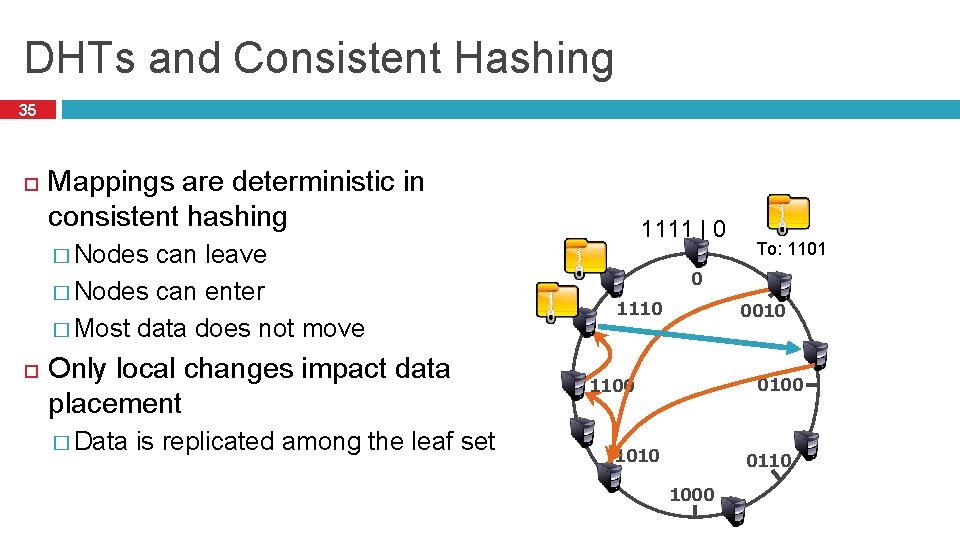
DHTs and Consistent Hashing 35 Mappings are deterministic in consistent hashing can leave � Nodes can enter � Most data does not move 1111 | 0 � Nodes Only local changes impact data placement � Data is replicated among the leaf set To: 1101 0 1110 0010 0100 1010 0110 1000
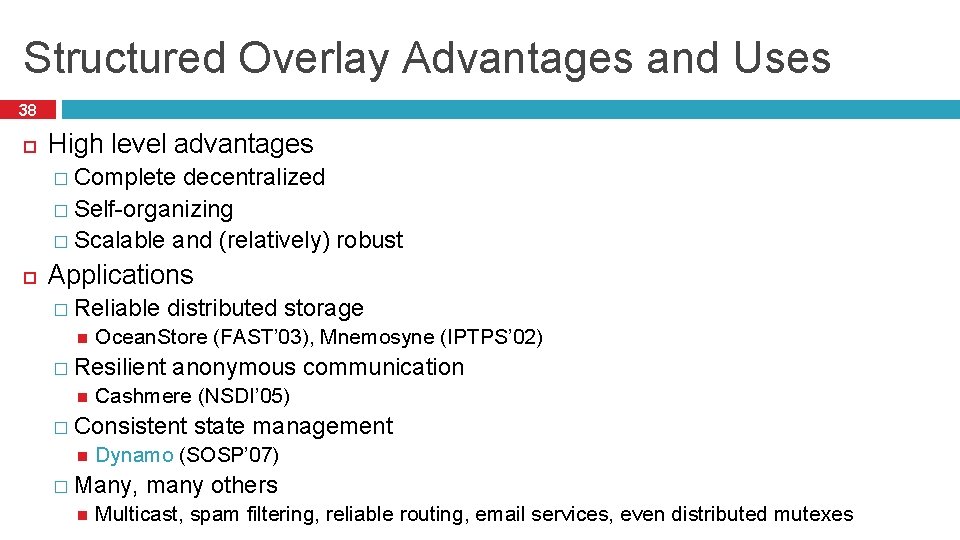
Structured Overlay Advantages and Uses 38 High level advantages � Complete decentralized � Self-organizing � Scalable and (relatively) robust Applications � Reliable Ocean. Store (FAST’ 03), Mnemosyne (IPTPS’ 02) � Resilient distributed storage anonymous communication Cashmere (NSDI’ 05) � Consistent Dynamo (SOSP’ 07) � Many, state management many others Multicast, spam filtering, reliable routing, email services, even distributed mutexes
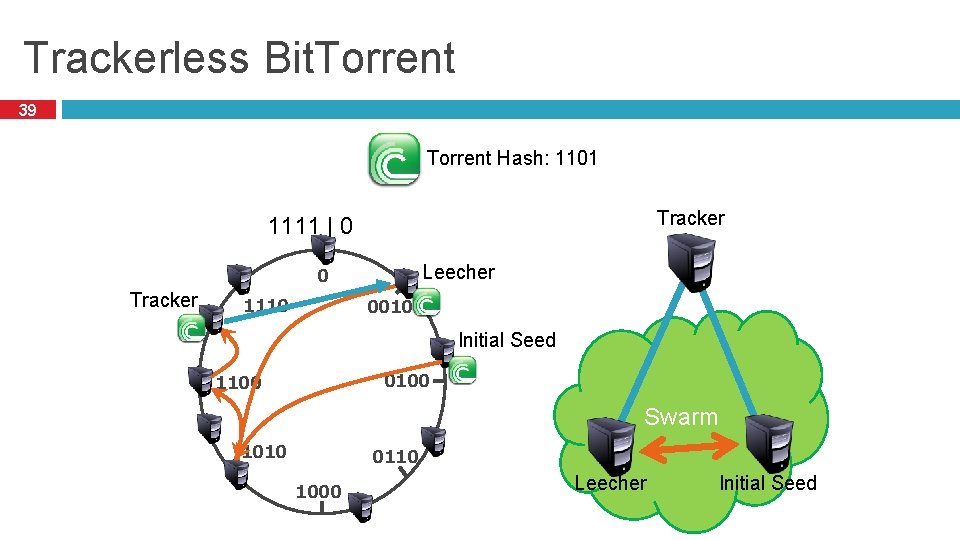
Trackerless Bit. Torrent 39 Torrent Hash: 1101 Tracker 1111 | 0 Leecher 0 Tracker 1110 0010 Initial Seed 0100 1100 Swarm 1010 0110 1000 Leecher Initial Seed
- Slides: 36