
CS 365 ARTIFICIAL INTELLIGENCE SEMANTIC IMAGE SEGMENTATION USING
![RANDOM FOREST: TRAINING Image taken from D. Phil. Thesis of F. Schroff[09]](https://slidetodoc.com/presentation_image_h2/c343ac5714c532a2c739608262a4fa9b/image-6.jpg "RANDOM FOREST: TRAINING Image taken from D. Phil. Thesis of F. Schroff[09]")

![REFERENCES • [1] F. Schroff, A. Criminisi, and A. Zisserman. Object Class Segmentation using](https://slidetodoc.com/presentation_image_h2/c343ac5714c532a2c739608262a4fa9b/image-26.jpg "REFERENCES • [1] F. Schroff, A. Criminisi, and A. Zisserman. Object Class Segmentation using")
- Slides: 26
CS 365 ARTIFICIAL INTELLIGENCE SEMANTIC IMAGE SEGMENTATION USING RANDOM FOREST CLASSIFIER • Mentor: Amitabha Mukerjee • Rohan Jingar • Mridul Verma
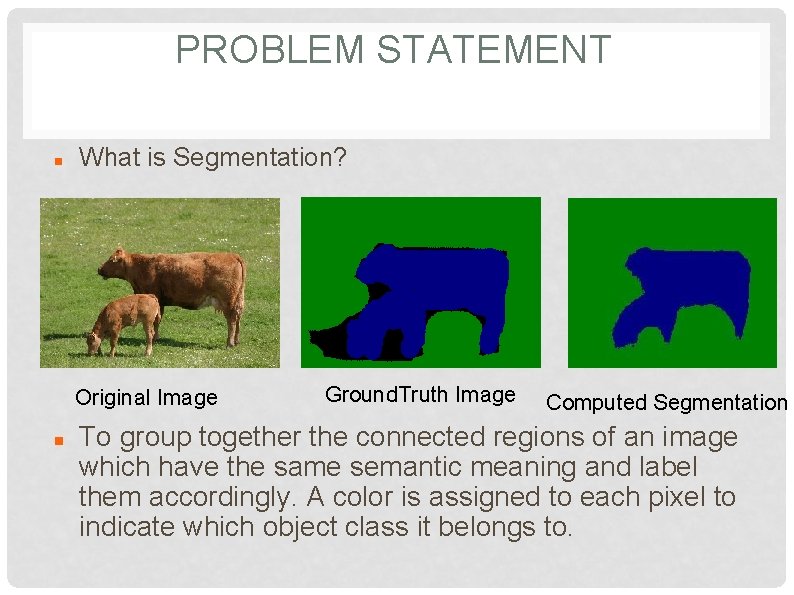
PROBLEM STATEMENT What is Segmentation? Original Image Ground. Truth Image Computed Segmentation To group together the connected regions of an image which have the same semantic meaning and label them accordingly. A color is assigned to each pixel to indicate which object class it belongs to.
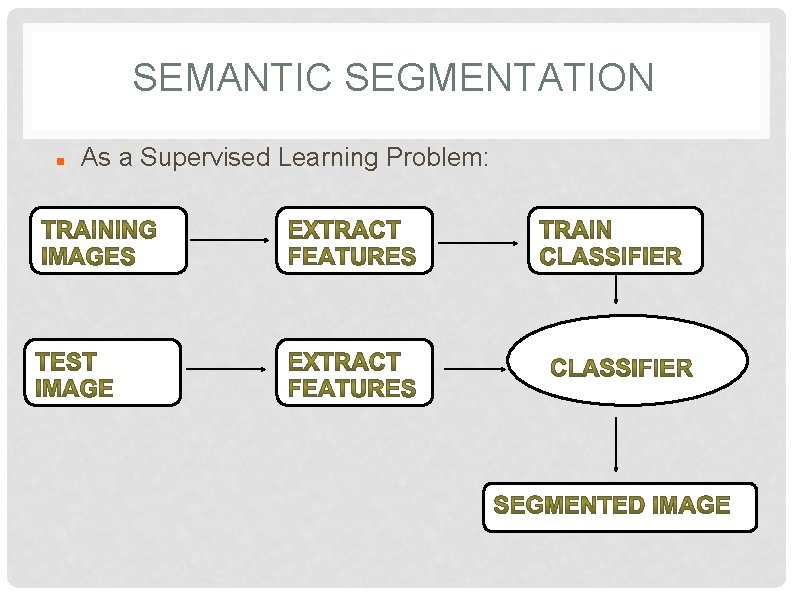
SEMANTIC SEGMENTATION As a Supervised Learning Problem:
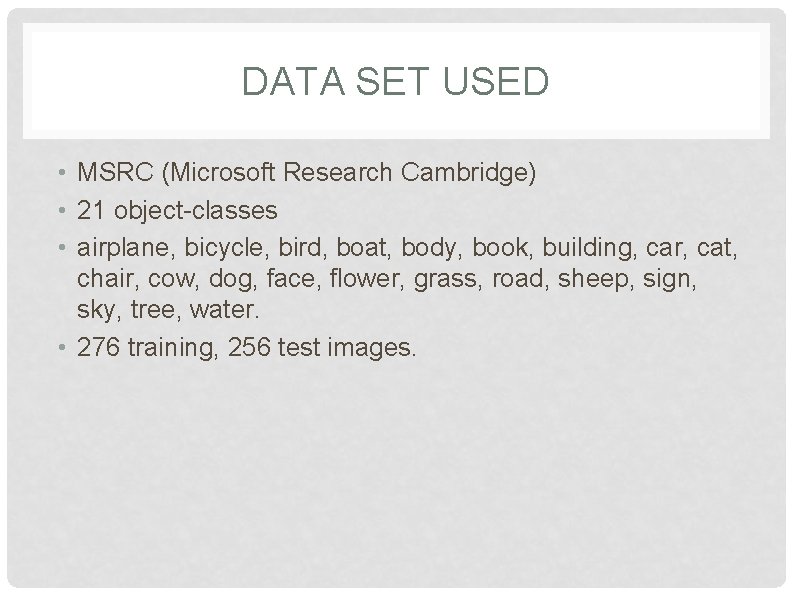
DATA SET USED • MSRC (Microsoft Research Cambridge) • 21 object-classes • airplane, bicycle, bird, boat, body, book, building, car, cat, chair, cow, dog, face, flower, grass, road, sheep, sign, sky, tree, water. • 276 training, 256 test images.
RANDOM FOREST A random forest is a set of n independently trained decision trees. Since they are independent they can be trained in parallel. Bagging: We inject randomness and independance into training by randomly sub-sampling the training data for each tree. The classification by a tree results in class posterior distribution of the test data point. We can combine the results of all the independent trees as: Product of Experts: take product of the individual probabilities. Here each tree can veto a class by assigning low a probability. Mixture of Experts: take average of the individual probabilities.
RANDOM FOREST: TRAINING Image taken from D. Phil. Thesis of F. Schroff[09]
RANDOM FOREST: PARAMETERS Number of decision trees: Performance increases if more trees are added to the classifier. However not much improvement is shown after ~20 decision trees. Pool of Node tests: #nf: No. of node tests randomly selected from P for each node. It influences the randomness. If #nf = 1, then no optimization. Type of low-level features used: texton histogram, RGB, HOG. This constitute the domain D for node test tp. Max. Depth of Each Tree: Deeper tree have better performance. But more depth can also lead to overfitting.
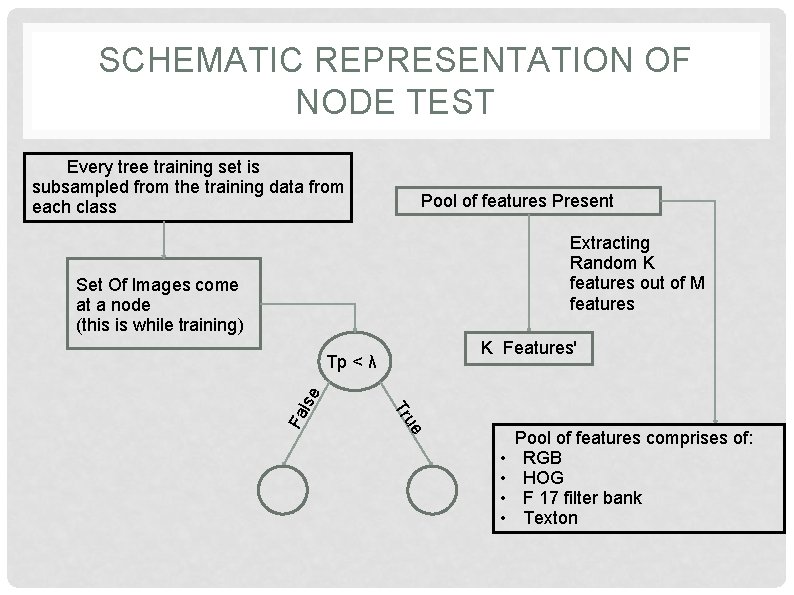
SCHEMATIC REPRESENTATION OF NODE TEST Every tree training set is subsampled from the training data from each class Pool of features Present Extracting Random K features out of M features Set Of Images come at a node (this is while training) K Features' Fa ue Tr lse Tp < λ • • Pool of features comprises of: RGB HOG F 17 filter bank Texton
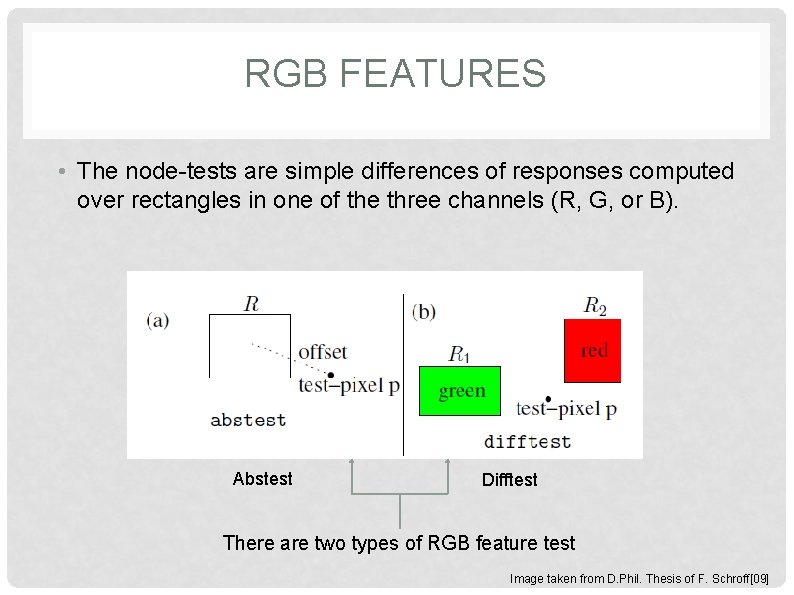
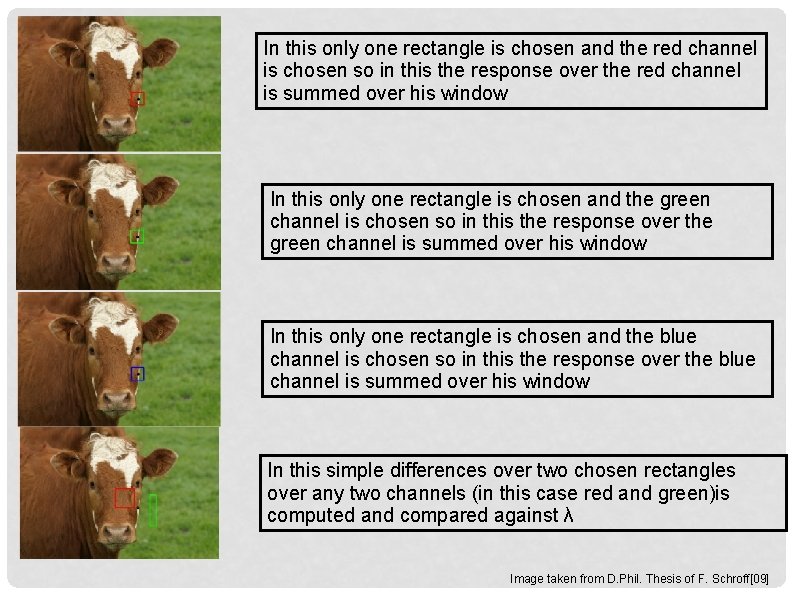
RGB FEATURES • The node-tests are simple differences of responses computed over rectangles in one of the three channels (R, G, or B). Abstest Difftest There are two types of RGB feature test Image taken from D. Phil. Thesis of F. Schroff[09]
In this only one rectangle is chosen and the red channel is chosen so in this the response over the red channel is summed over his window In this only one rectangle is chosen and the green channel is chosen so in this the response over the green channel is summed over his window In this only one rectangle is chosen and the blue channel is chosen so in this the response over the blue channel is summed over his window In this simple differences over two chosen rectangles over any two channels (in this case red and green)is computed and compared against λ Image taken from D. Phil. Thesis of F. Schroff[09]
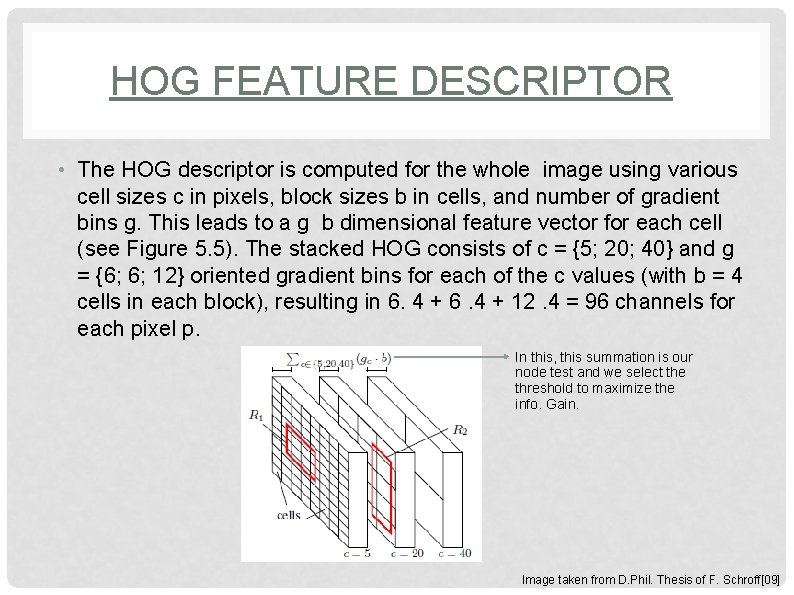
HOG FEATURE DESCRIPTOR • The HOG descriptor is computed for the whole image using various cell sizes c in pixels, block sizes b in cells, and number of gradient bins g. This leads to a g b dimensional feature vector for each cell (see Figure 5. 5). The stacked HOG consists of c = {5; 20; 40} and g = {6; 6; 12} oriented gradient bins for each of the c values (with b = 4 cells in each block), resulting in 6. 4 + 12. 4 = 96 channels for each pixel p. In this, this summation is our node test and we select the threshold to maximize the info. Gain. Image taken from D. Phil. Thesis of F. Schroff[09]
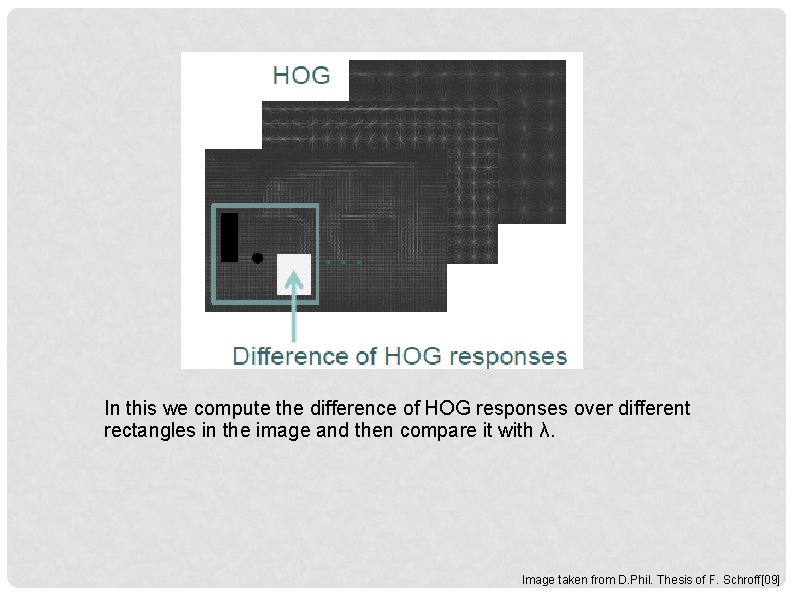
In this we compute the difference of HOG responses over different rectangles in the image and then compare it with λ. Image taken from D. Phil. Thesis of F. Schroff[09]
F 17 FILTER BANK • Filter bank made by combinations of Gaussians, first and second derivative of Gaussians and laplacian of Gaussians. • 3 G with �= [1, 2, 4] applied to each CIE Lab channel resulting in 9 filters. • 4 LOG with �= [1, 2, 4, 8] applied to L channel only resulting in 4 filters. • 4 G’ divided into two x and y aligned sets each with �= [2, 4]. These are also applied to L channel only resulting in 4 filters. • We use them as an additional cue in the same manner as the RGB features.
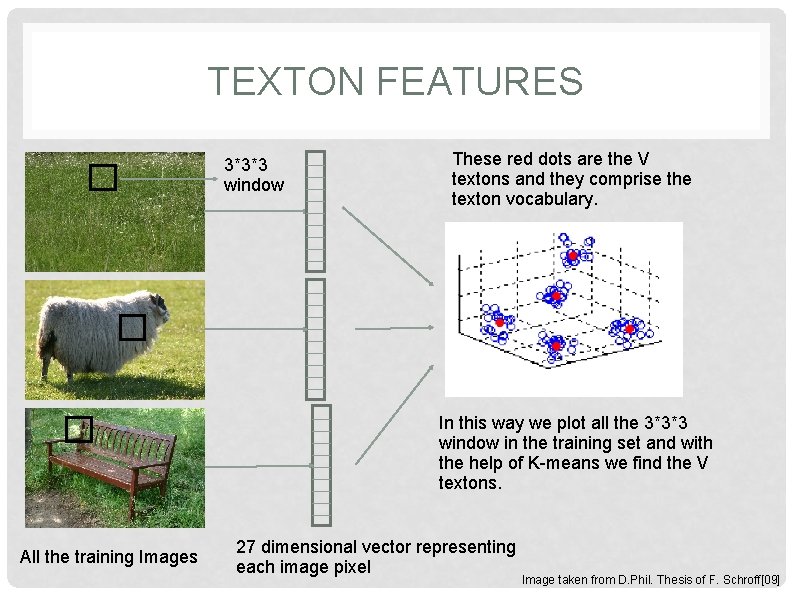
TEXTON FEATURES 3*3*3 window These red dots are the V textons and they comprise the texton vocabulary. In this way we plot all the 3*3*3 window in the training set and with the help of K-means we find the V textons. All the training Images 27 dimensional vector representing each image pixel Image taken from D. Phil. Thesis of F. Schroff[09]
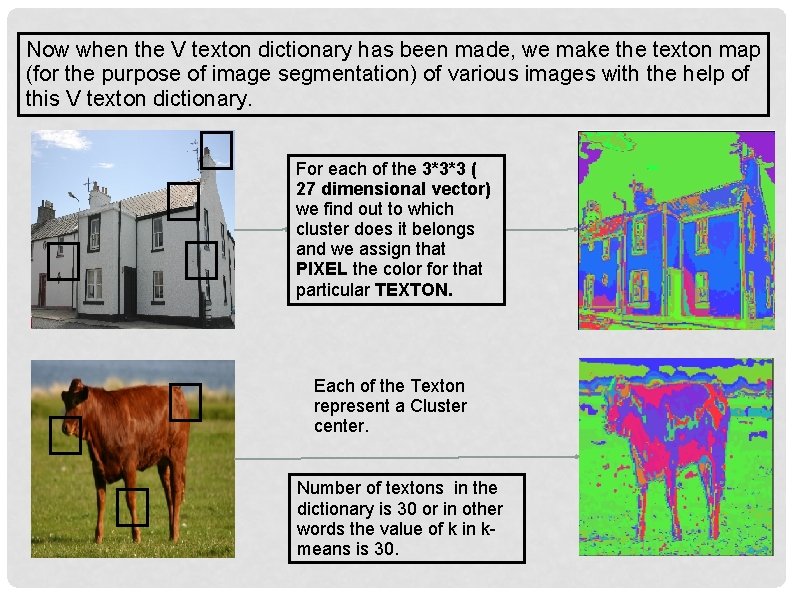
Now when the V texton dictionary has been made, we make the texton map (for the purpose of image segmentation) of various images with the help of this V texton dictionary. For each of the 3*3*3 ( 27 dimensional vector) we find out to which cluster does it belongs and we assign that PIXEL the color for that particular TEXTON. Each of the Texton represent a Cluster center. Number of textons in the dictionary is 30 or in other words the value of k in kmeans is 30.
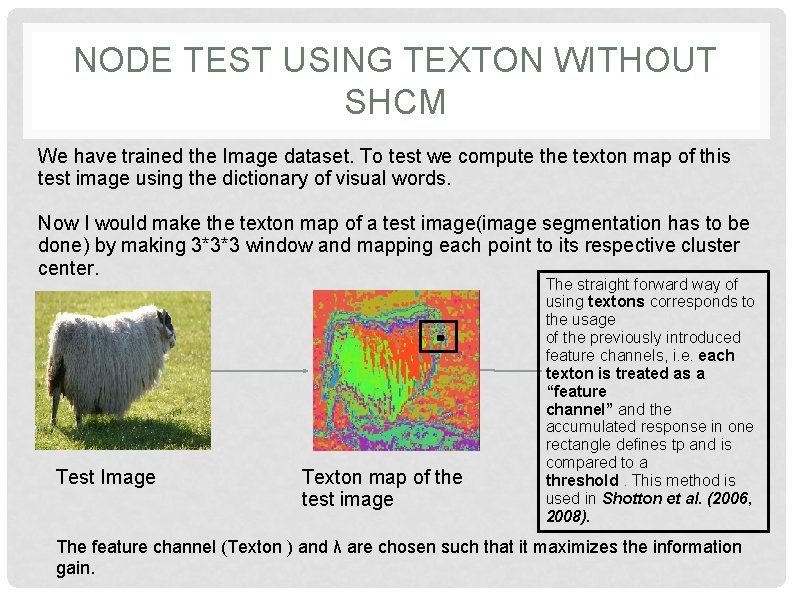
NODE TEST USING TEXTON WITHOUT SHCM We have trained the Image dataset. To test we compute the texton map of this test image using the dictionary of visual words. Now I would make the texton map of a test image(image segmentation has to be done) by making 3*3*3 window and mapping each point to its respective cluster center. Test Image Texton map of the test image The straight forward way of using textons corresponds to the usage of the previously introduced feature channels, i. e. each texton is treated as a “feature channel” and the accumulated response in one rectangle defines tp and is compared to a threshold. This method is used in Shotton et al. (2006, 2008). The feature channel (Texton ) and λ are chosen such that it maximizes the information gain.
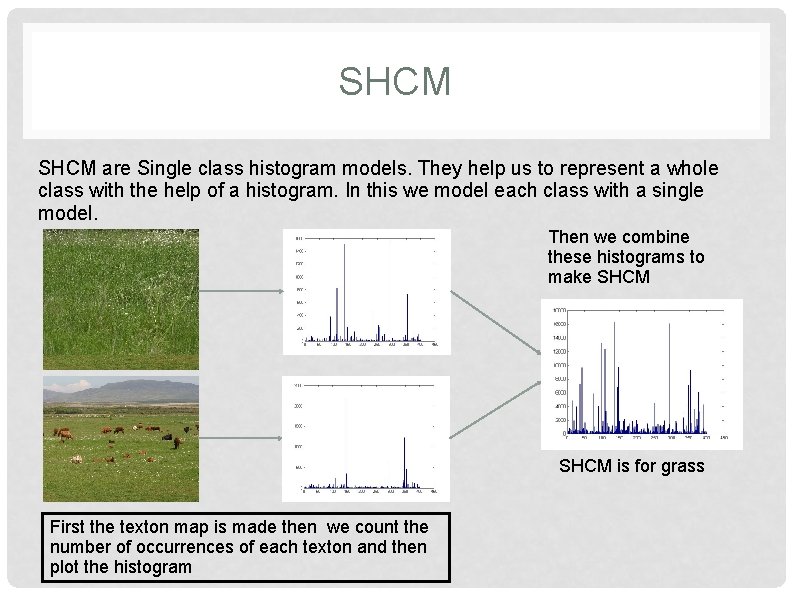
SHCM are Single class histogram models. They help us to represent a whole class with the help of a histogram. In this we model each class with a single model. Then we combine these histograms to make SHCM is for grass First the texton map is made then we count the number of occurrences of each texton and then plot the histogram
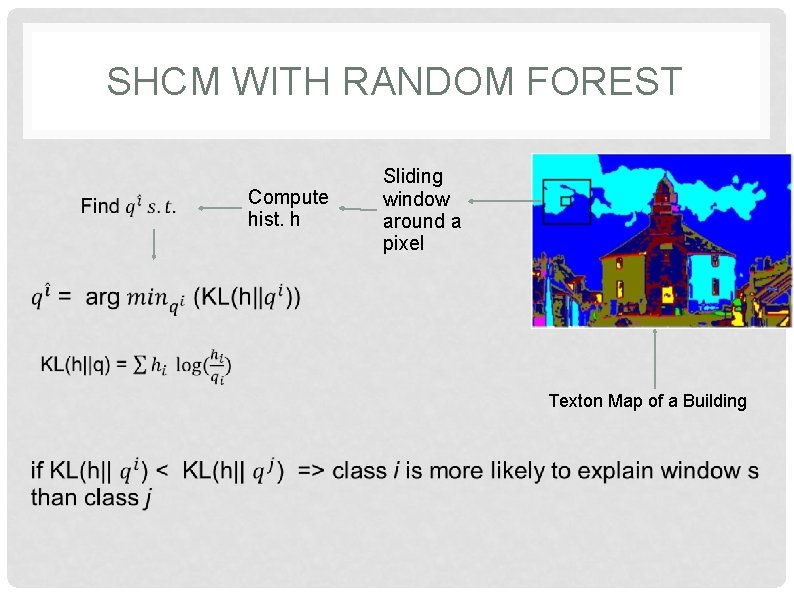
SHCM WITH RANDOM FOREST Compute hist. h Sliding window around a pixel Texton Map of a Building
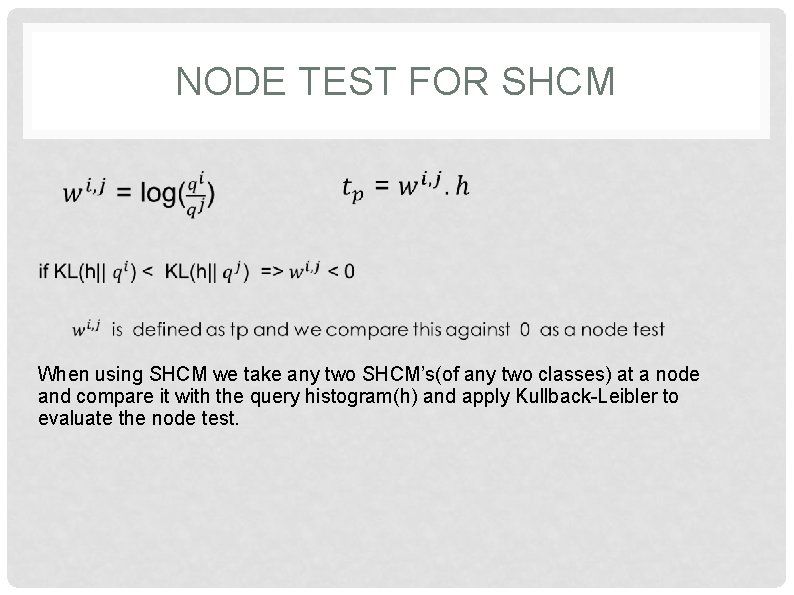
NODE TEST FOR SHCM When using SHCM we take any two SHCM’s(of any two classes) at a node and compare it with the query histogram(h) and apply Kullback-Leibler to evaluate the node test.
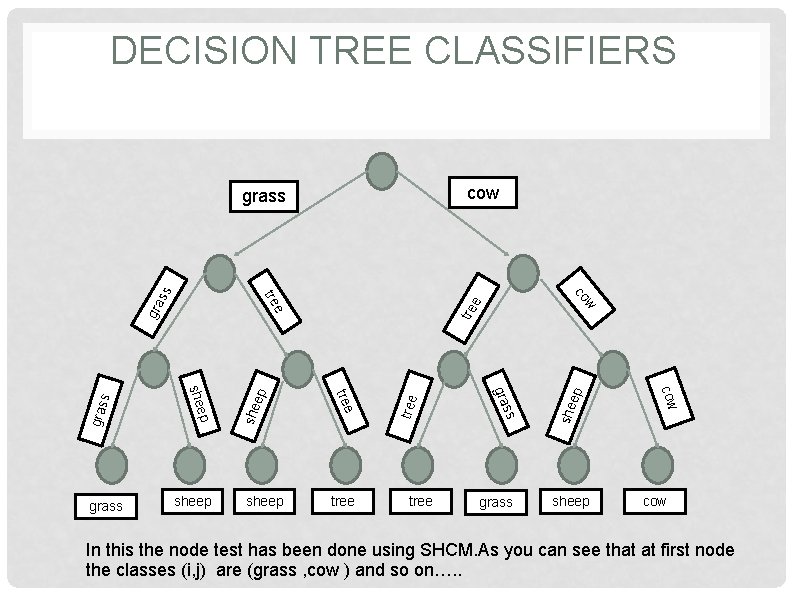
DECISION TREE CLASSIFIERS cow e grass she tree she ep tre gra s gras ep tree sheep cow tree ss sheep gra tree sheep w e p shee grass co tre ss grass cow In this the node test has been done using SHCM. As you can see that at first node the classes (i, j) are (grass , cow ) and so on…. .
WHAT WE ARE DOING? ? • The code available does not have Texton and SHCM implemented. • Till Now we have been able to successfully implement the algorithm for calculating the Texton map of various images and have also computed the SHCM model for each of the class. • Currently we are fusing SHCM into training of the Random Forest and soon will be using them for testing also.
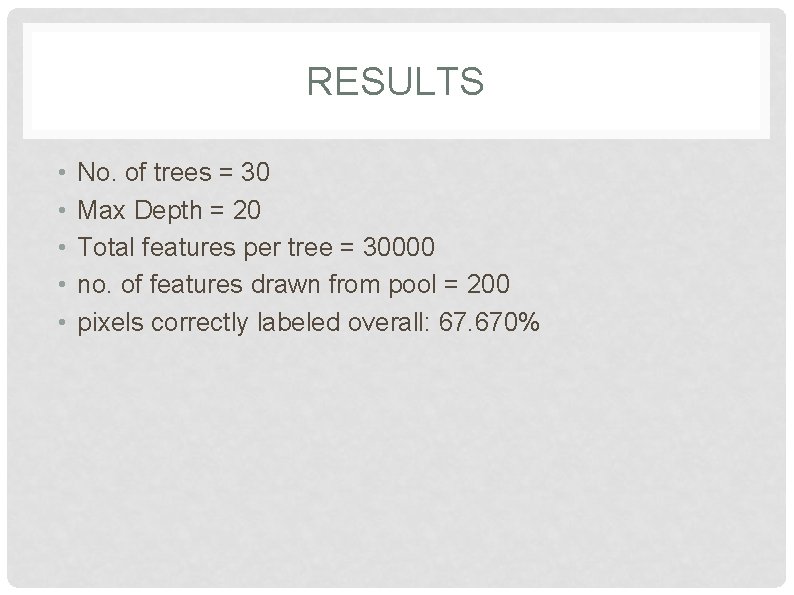
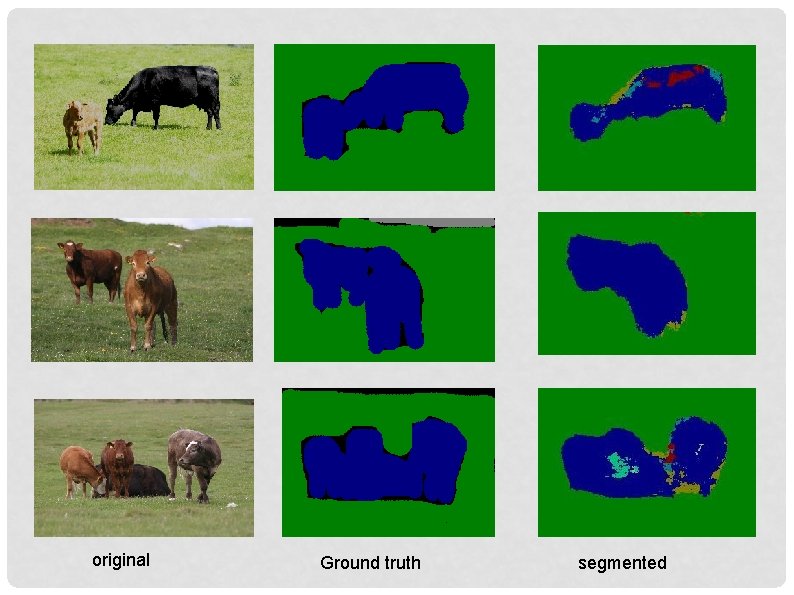
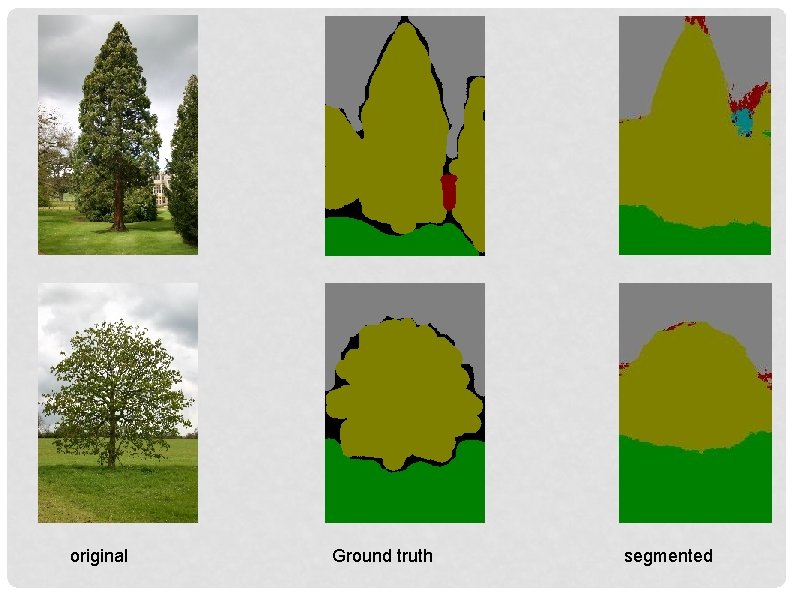
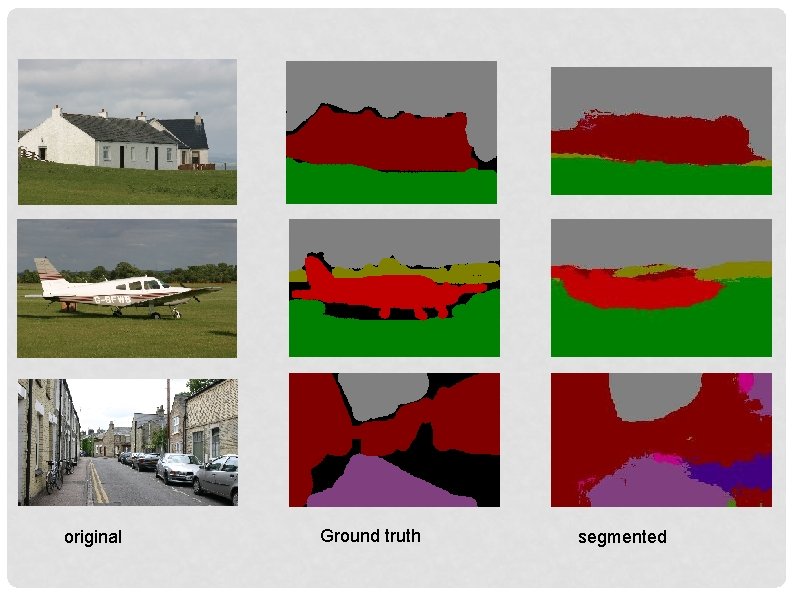
RESULTS • • • No. of trees = 30 Max Depth = 20 Total features per tree = 30000 no. of features drawn from pool = 200 pixels correctly labeled overall: 67. 670%
original Ground truth segmented
original Ground truth segmented
original Ground truth segmented
REFERENCES • [1] F. Schroff, A. Criminisi, and A. Zisserman. Object Class Segmentation using Random Forest, Proceedings of the British Machine Vision Conference (2008). • [2] J. Shotton, M. Johnson, and R. Cipolla, Semantic texton forests for image categorization and segmentation, in Proceedings of the IEEE Computer Society Conference on Computer Vision and Pattern Recognition, pp. 1 -8, Anchorage, USA, 2008. • [3] Matlab code by F. Schroff for training and computing the final segmentations.