
CS 361 S Overview of PublicKey Cryptography Vitaly
CS 361 S Overview of Public-Key Cryptography Vitaly Shmatikov slide 1
Reading Assignment u. Kaufman 6. 1 -6 slide 2
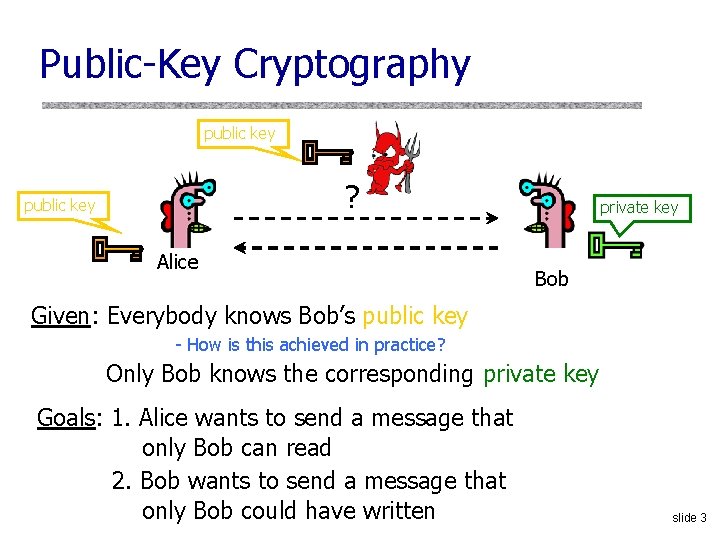
Public-Key Cryptography public key ? public key Alice private key Bob Given: Everybody knows Bob’s public key - How is this achieved in practice? Only Bob knows the corresponding private key Goals: 1. Alice wants to send a message that only Bob can read 2. Bob wants to send a message that only Bob could have written slide 3
Applications of Public-Key Crypto u. Encryption for confidentiality • Anyone can encrypt a message – With symmetric crypto, must know the secret key to encrypt • Only someone who knows the private key can decrypt • Secret keys are only stored in one place u. Digital signatures for authentication • Only someone who knows the private key can sign u. Session key establishment • Exchange messages to create a secret session key • Then switch to symmetric cryptography (why? ) slide 4
Public-Key Encryption u. Key generation: computationally easy to generate a pair (public key PK, private key SK) u. Encryption: given plaintext M and public key PK, easy to compute ciphertext C=EPK(M) u. Decryption: given ciphertext C=EPK(M) and private key SK, easy to compute plaintext M • Infeasible to learn anything about M from C without SK • Trapdoor function: Decrypt(SK, Encrypt(PK, M))=M slide 5
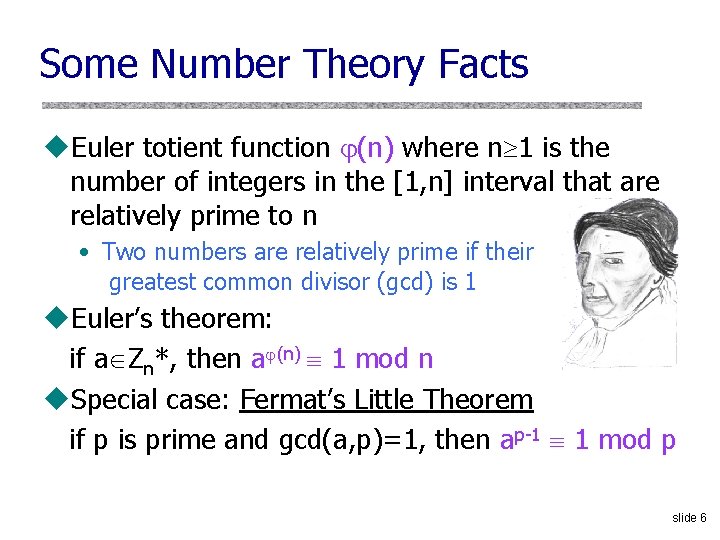
Some Number Theory Facts u. Euler totient function (n) where n 1 is the number of integers in the [1, n] interval that are relatively prime to n • Two numbers are relatively prime if their greatest common divisor (gcd) is 1 u. Euler’s theorem: if a Zn*, then a (n) 1 mod n u. Special case: Fermat’s Little Theorem if p is prime and gcd(a, p)=1, then ap-1 1 mod p slide 6
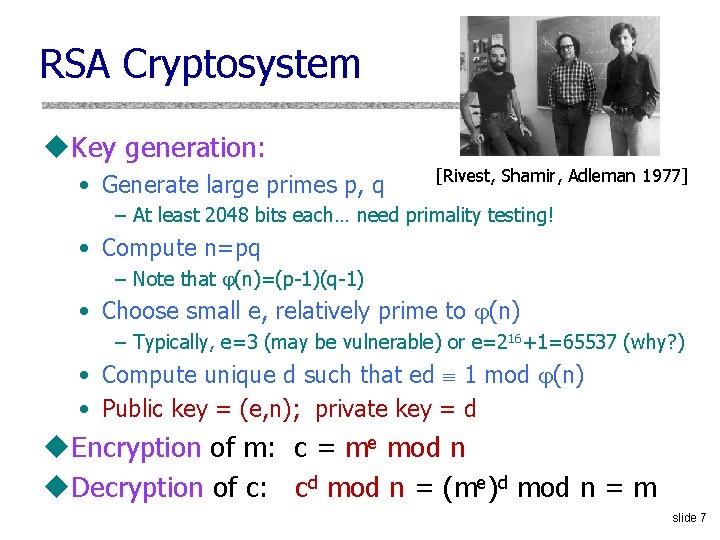
RSA Cryptosystem u. Key generation: • Generate large primes p, q [Rivest, Shamir, Adleman 1977] – At least 2048 bits each… need primality testing! • Compute n=pq – Note that (n)=(p-1)(q-1) • Choose small e, relatively prime to (n) – Typically, e=3 (may be vulnerable) or e=216+1=65537 (why? ) • Compute unique d such that ed 1 mod (n) • Public key = (e, n); private key = d u. Encryption of m: c = me mod n u. Decryption of c: cd mod n = (me)d mod n = m slide 7
Why RSA Decryption Works ue d 1 mod (n) u. Thus e d = 1+k (n) = 1+k(p-1)(q-1) for some k u. If gcd(m, p)=1, then by Fermat’s Little Theorem, mp-1 1 mod p u. Raise both sides to the power k(q-1) and multiply by m, obtaining m 1+k(p-1)(q-1) m mod p u. Thus med m mod p u. By the same argument, med m mod q u. Since p and q are distinct primes and p q=n, med m mod n slide 8
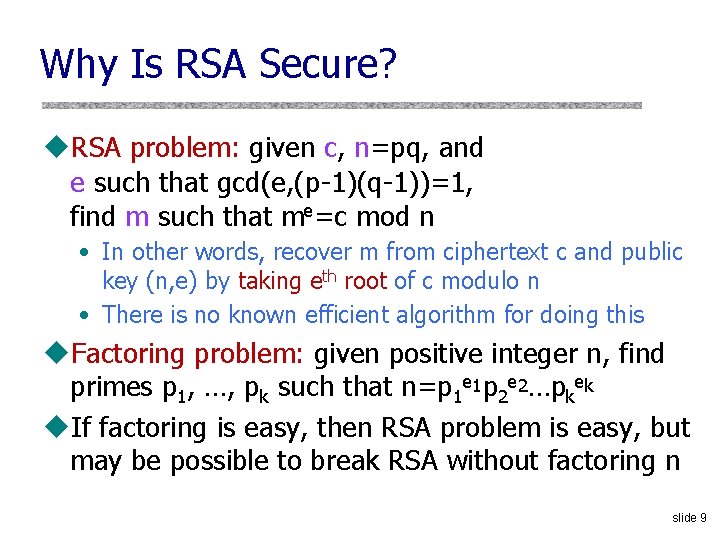
Why Is RSA Secure? u. RSA problem: given c, n=pq, and e such that gcd(e, (p-1)(q-1))=1, find m such that me=c mod n • In other words, recover m from ciphertext c and public key (n, e) by taking eth root of c modulo n • There is no known efficient algorithm for doing this u. Factoring problem: given positive integer n, find primes p 1, …, pk such that n=p 1 e 1 p 2 e 2…pkek u. If factoring is easy, then RSA problem is easy, but may be possible to break RSA without factoring n slide 9
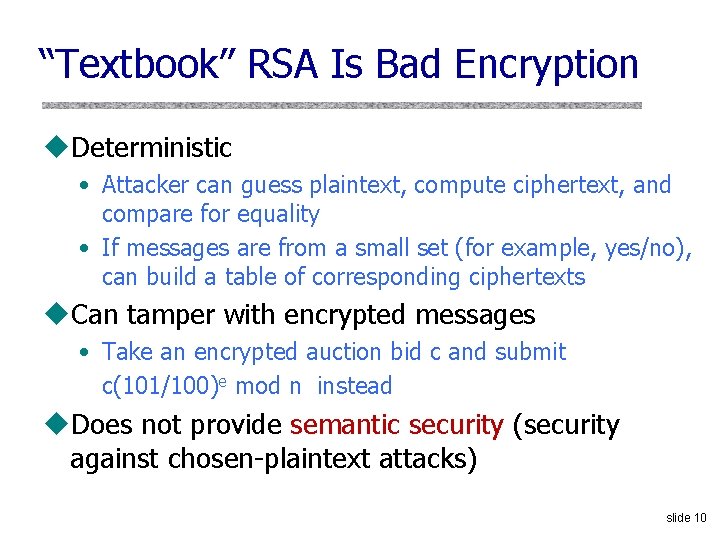
“Textbook” RSA Is Bad Encryption u. Deterministic • Attacker can guess plaintext, compute ciphertext, and compare for equality • If messages are from a small set (for example, yes/no), can build a table of corresponding ciphertexts u. Can tamper with encrypted messages • Take an encrypted auction bid c and submit c(101/100)e mod n instead u. Does not provide semantic security (security against chosen-plaintext attacks) slide 10
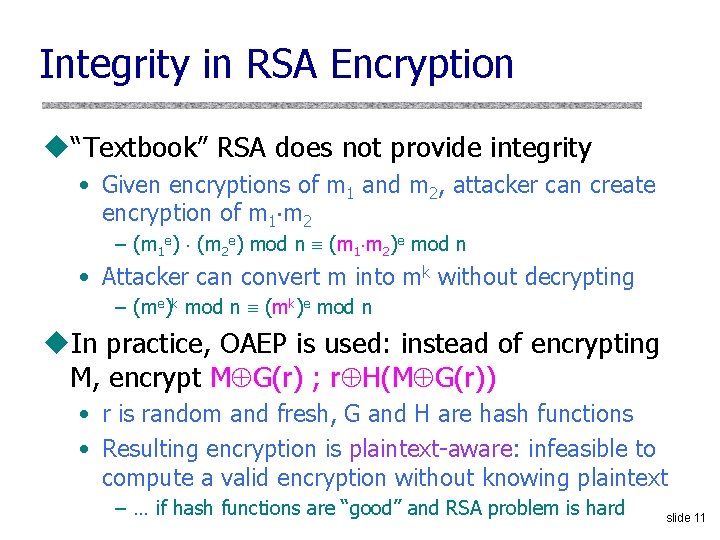
Integrity in RSA Encryption u“Textbook” RSA does not provide integrity • Given encryptions of m 1 and m 2, attacker can create encryption of m 1 m 2 – (m 1 e) (m 2 e) mod n (m 1 m 2)e mod n • Attacker can convert m into mk without decrypting – (me)k mod n (mk)e mod n u. In practice, OAEP is used: instead of encrypting M, encrypt M G(r) ; r H(M G(r)) • r is random and fresh, G and H are hash functions • Resulting encryption is plaintext-aware: infeasible to compute a valid encryption without knowing plaintext – … if hash functions are “good” and RSA problem is hard slide 11
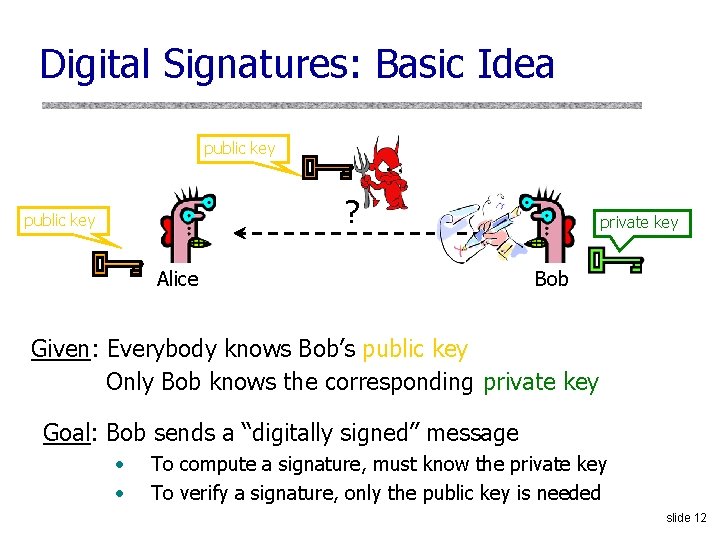
Digital Signatures: Basic Idea public key ? public key Alice private key Bob Given: Everybody knows Bob’s public key Only Bob knows the corresponding private key Goal: Bob sends a “digitally signed” message • • To compute a signature, must know the private key To verify a signature, only the public key is needed slide 12
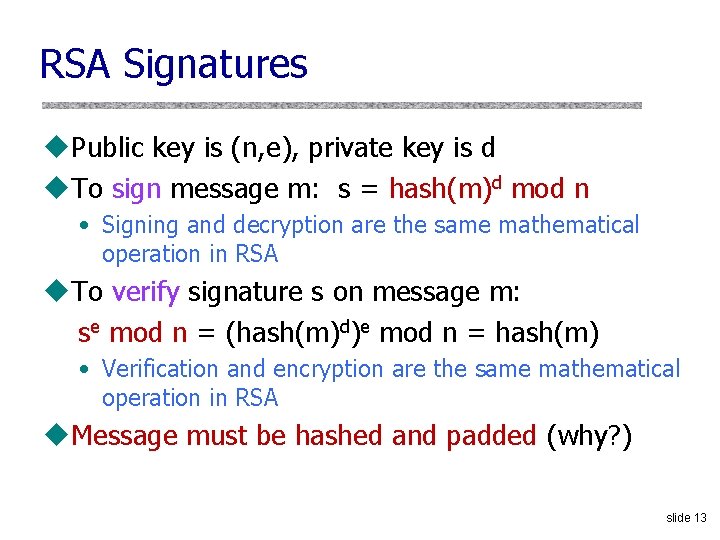
RSA Signatures u. Public key is (n, e), private key is d u. To sign message m: s = hash(m)d mod n • Signing and decryption are the same mathematical operation in RSA u. To verify signature s on message m: se mod n = (hash(m)d)e mod n = hash(m) • Verification and encryption are the same mathematical operation in RSA u. Message must be hashed and padded (why? ) slide 13
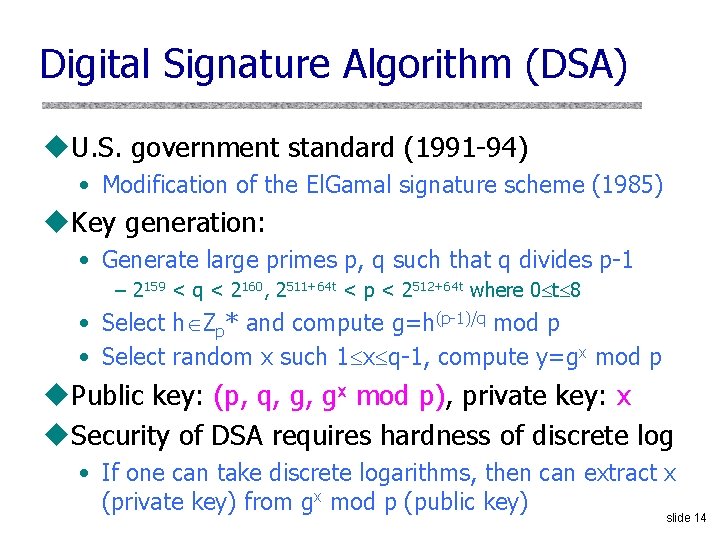
Digital Signature Algorithm (DSA) u. U. S. government standard (1991 -94) • Modification of the El. Gamal signature scheme (1985) u. Key generation: • Generate large primes p, q such that q divides p-1 – 2159 < q < 2160, 2511+64 t < p < 2512+64 t where 0 t 8 • Select h Zp* and compute g=h(p-1)/q mod p • Select random x such 1 x q-1, compute y=gx mod p u. Public key: (p, q, g, gx mod p), private key: x u. Security of DSA requires hardness of discrete log • If one can take discrete logarithms, then can extract x (private key) from gx mod p (public key) slide 14
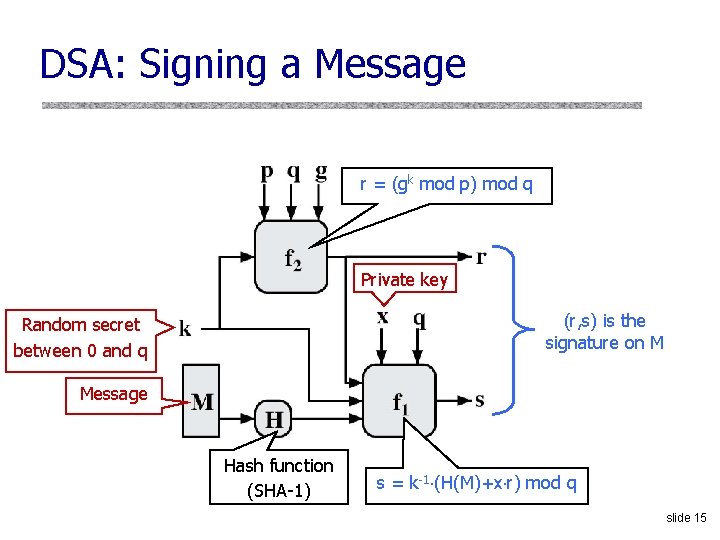
DSA: Signing a Message r = (gk mod p) mod q Private key (r, s) is the signature on M Random secret between 0 and q Message Hash function (SHA-1) s = k-1 (H(M)+x r) mod q slide 15

DSA: Verifying a Signature Public key Compute (g. H(M’)w yr’w mod q mod p) mod q Message Signature w = s’-1 mod q If they match, signature is valid slide 16
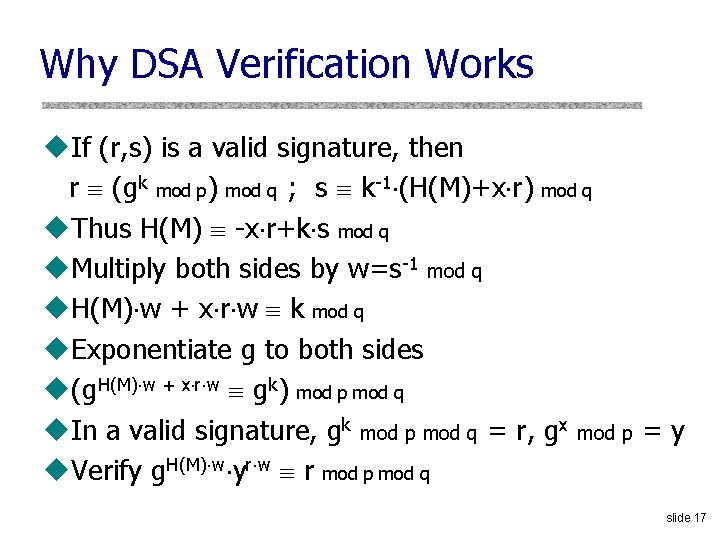
Why DSA Verification Works u. If (r, s) is a valid signature, then r (gk mod p) mod q ; s k-1 (H(M)+x r) mod q u. Thus H(M) -x r+k s mod q u. Multiply both sides by w=s-1 mod q u. H(M) w + x r w k mod q u. Exponentiate g to both sides u(g. H(M) w + x r w gk) mod p mod q u. In a valid signature, gk mod p mod q = r, gx mod p = y u. Verify g. H(M) w yr w r mod p mod q slide 17
Security of DSA u. Can’t create a valid signature without private key u. Can’t change or tamper with signed message u. If the same message is signed twice, signatures are different • Each signature is based in part on random secret k u. Secret k must be different for each signature! • If k is leaked or if two messages re-use the same k, attacker can recover secret key x and forge any signature from then on slide 18
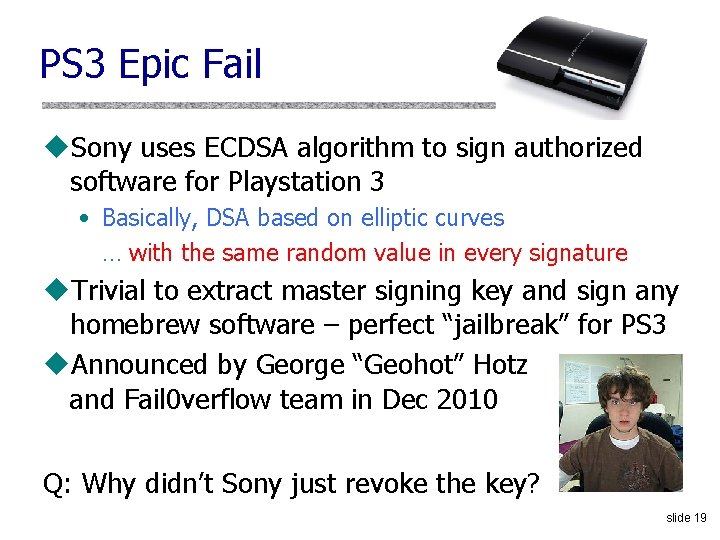
PS 3 Epic Fail u. Sony uses ECDSA algorithm to sign authorized software for Playstation 3 • Basically, DSA based on elliptic curves … with the same random value in every signature u. Trivial to extract master signing key and sign any homebrew software – perfect “jailbreak” for PS 3 u. Announced by George “Geohot” Hotz and Fail 0 verflow team in Dec 2010 Q: Why didn’t Sony just revoke the key? slide 19
Diffie-Hellman Protocol u. Alice and Bob never met and share no secrets u. Public info: p and g • p is a large prime number, g is a generator of Zp* – Zp*={1, 2 … p-1}; a Zp* i such that a=gi mod p Pick secret, random X Pick secret, random Y gx mod p gy mod p Alice Compute k=(gy)x=gxy mod p Bob Compute k=(gx)y=gxy mod p slide 20
Why Is Diffie-Hellman Secure? u. Discrete Logarithm (DL) problem: given gx mod p, it’s hard to extract x • There is no known efficient algorithm for doing this • This is not enough for Diffie-Hellman to be secure! u. Computational Diffie-Hellman (CDH) problem: given gx and gy, it’s hard to compute gxy mod p • … unless you know x or y, in which case it’s easy u. Decisional Diffie-Hellman (DDH) problem: given gx and gy, it’s hard to tell the difference between gxy mod p and gr mod p where r is random slide 21
Properties of Diffie-Hellman u. Assuming DDH problem is hard, Diffie-Hellman protocol is a secure key establishment protocol against passive attackers • Eavesdropper can’t tell the difference between the established key and a random value • Can use the new key for symmetric cryptography u. Basic Diffie-Hellman protocol does not provide authentication • IPsec combines Diffie-Hellman with signatures, anti-Do. S cookies, etc. slide 22
Advantages of Public-Key Crypto u. Confidentiality without shared secrets • Very useful in open environments • Can use this for key establishment, avoiding the “chicken-or-egg” problem – With symmetric crypto, two parties must share a secret before they can exchange secret messages u. Authentication without shared secrets u. Encryption keys are public, but must be sure that Alice’s public key is really her public key • This is a hard problem… Often solved using public-key certificates slide 23
Disadvantages of Public-Key Crypto u. Calculations are 2 -3 orders of magnitude slower • Modular exponentiation is an expensive computation • Typical usage: use public-key cryptography to establish a shared secret, then switch to symmetric crypto – SSL, IPsec, most other systems based on public crypto u. Keys are longer • 2048 bits (RSA) rather than 128 bits (AES) u. Relies on unproven number-theoretic assumptions • Factoring, RSA problem, discrete logarithm problem, decisional Diffie-Hellman problem… slide 24
- Slides: 24