
CS 345 A Data Mining Map Reduce Singlenode


- Slides: 24
CS 345 A Data Mining Map. Reduce
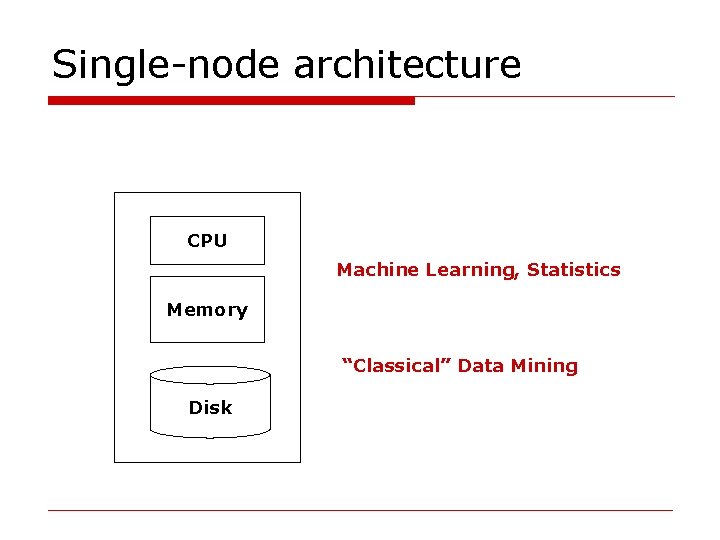
Single-node architecture CPU Machine Learning, Statistics Memory “Classical” Data Mining Disk
Commodity Clusters o Web data sets can be very large n o o Cannot mine on a single server (why? ) Standard architecture emerging: n n o Tens to hundreds of terabytes Cluster of commodity Linux nodes Gigabit ethernet interconnect How to organize computations on this architecture? n Mask issues such as hardware failure
Cluster Architecture 2 -10 Gbps backbone between racks 1 Gbps between any pair of nodes in a rack Switch CPU Mem Disk … Switch CPU Mem Disk Each rack contains 16 -64 nodes CPU … Mem Disk
Stable storage o o First order problem: if nodes can fail, how can we store data persistently? Answer: Distributed File System n n o Provides global file namespace Google GFS; Hadoop HDFS; Kosmix KFS Typical usage pattern n Huge files (100 s of GB to TB) Data is rarely updated in place Reads and appends are common
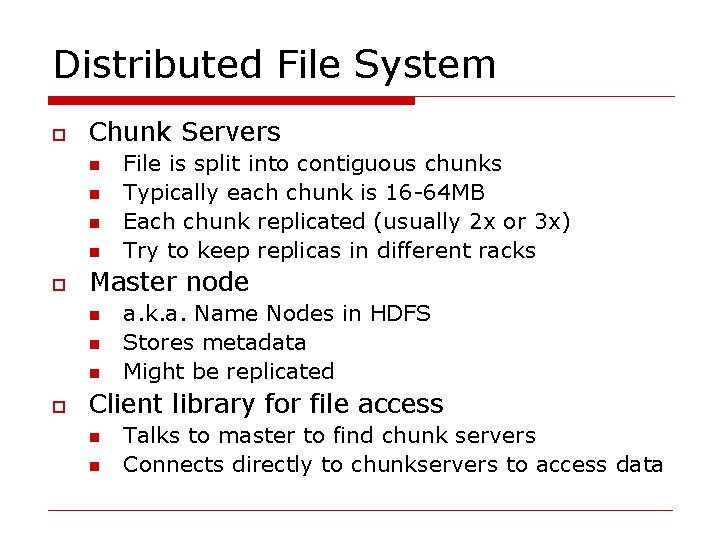
Distributed File System o Chunk Servers n n o Master node n n n o File is split into contiguous chunks Typically each chunk is 16 -64 MB Each chunk replicated (usually 2 x or 3 x) Try to keep replicas in different racks a. k. a. Name Nodes in HDFS Stores metadata Might be replicated Client library for file access n n Talks to master to find chunk servers Connects directly to chunkservers to access data
Warm up: Word Count o o o We have a large file of words, one word to a line Count the number of times each distinct word appears in the file Sample application: analyze web server logs to find popular URLs
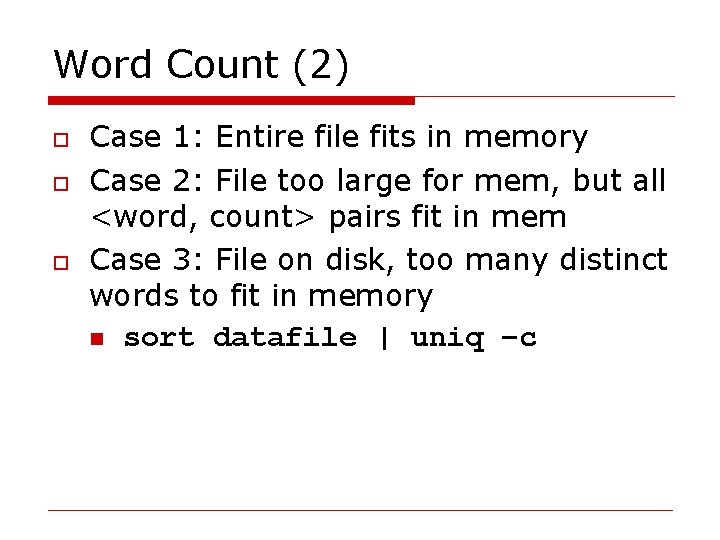
Word Count (2) o o o Case 1: Entire file fits in memory Case 2: File too large for mem, but all <word, count> pairs fit in mem Case 3: File on disk, too many distinct words to fit in memory n sort datafile | uniq –c
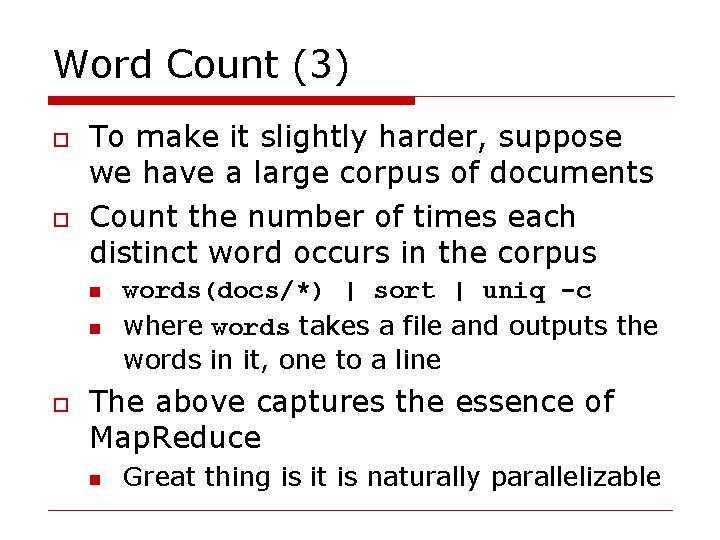
Word Count (3) o o To make it slightly harder, suppose we have a large corpus of documents Count the number of times each distinct word occurs in the corpus n n o words(docs/*) | sort | uniq -c where words takes a file and outputs the words in it, one to a line The above captures the essence of Map. Reduce n Great thing is it is naturally parallelizable
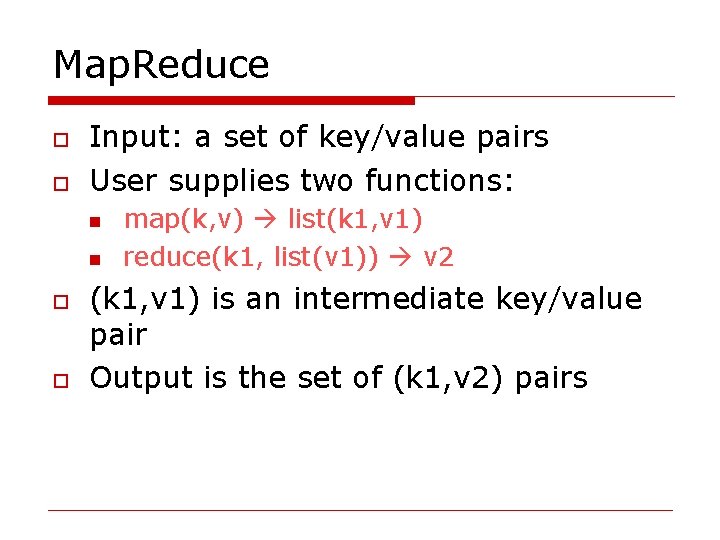
Map. Reduce o o Input: a set of key/value pairs User supplies two functions: n n o o map(k, v) list(k 1, v 1) reduce(k 1, list(v 1)) v 2 (k 1, v 1) is an intermediate key/value pair Output is the set of (k 1, v 2) pairs
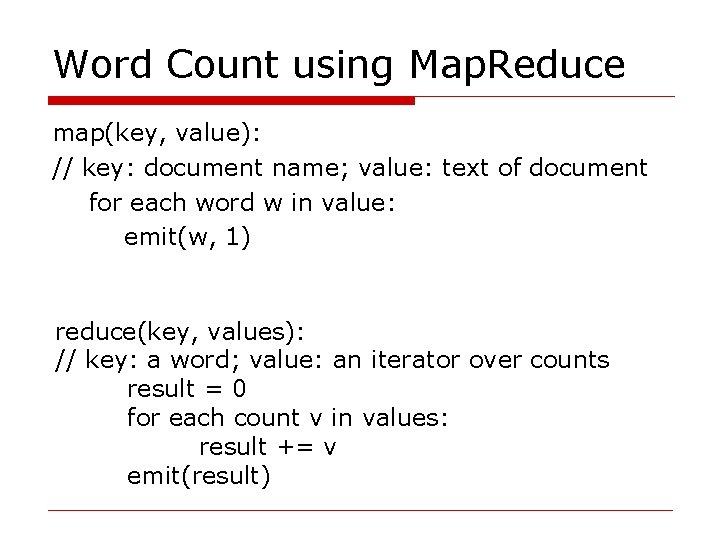
Word Count using Map. Reduce map(key, value): // key: document name; value: text of document for each word w in value: emit(w, 1) reduce(key, values): // key: a word; value: an iterator over counts result = 0 for each count v in values: result += v emit(result)
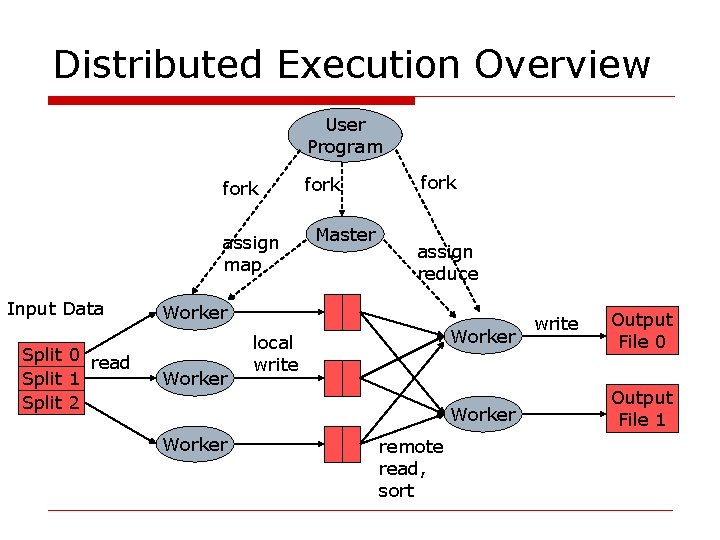
Distributed Execution Overview User Program fork assign map Input Data Split 0 read Split 1 Split 2 fork Master fork assign reduce Worker local write Worker remote read, sort write Output File 0 Output File 1
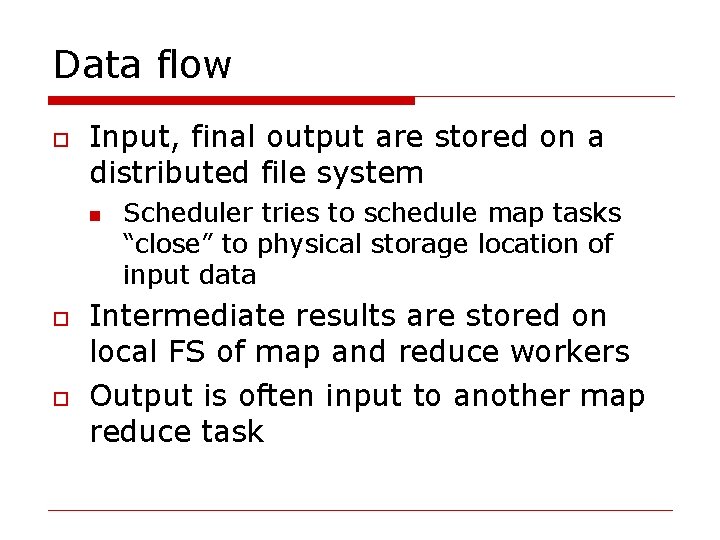
Data flow o Input, final output are stored on a distributed file system n o o Scheduler tries to schedule map tasks “close” to physical storage location of input data Intermediate results are stored on local FS of map and reduce workers Output is often input to another map reduce task
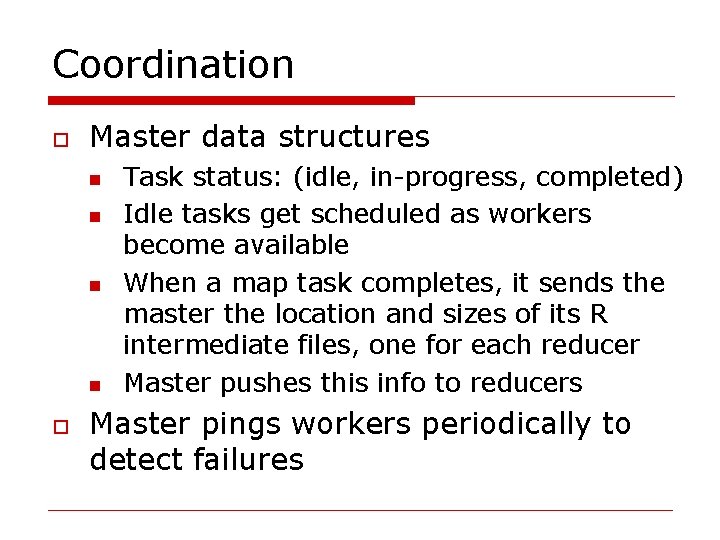
Coordination o Master data structures n n o Task status: (idle, in-progress, completed) Idle tasks get scheduled as workers become available When a map task completes, it sends the master the location and sizes of its R intermediate files, one for each reducer Master pushes this info to reducers Master pings workers periodically to detect failures
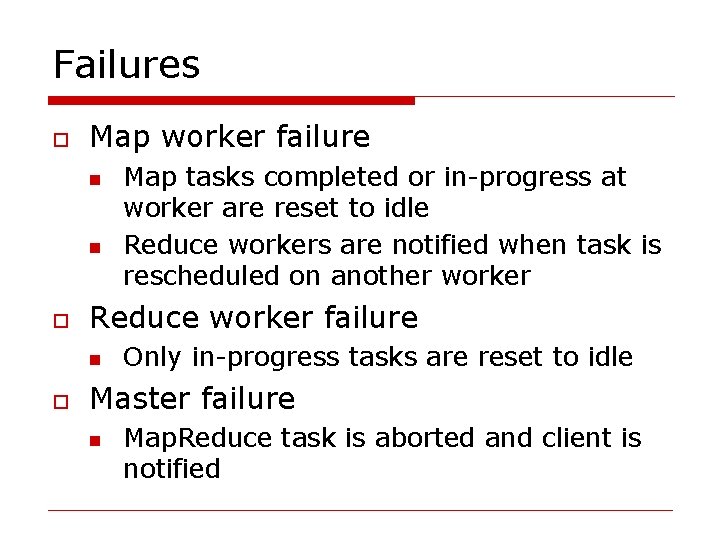
Failures o Map worker failure n n o Reduce worker failure n o Map tasks completed or in-progress at worker are reset to idle Reduce workers are notified when task is rescheduled on another worker Only in-progress tasks are reset to idle Master failure n Map. Reduce task is aborted and client is notified
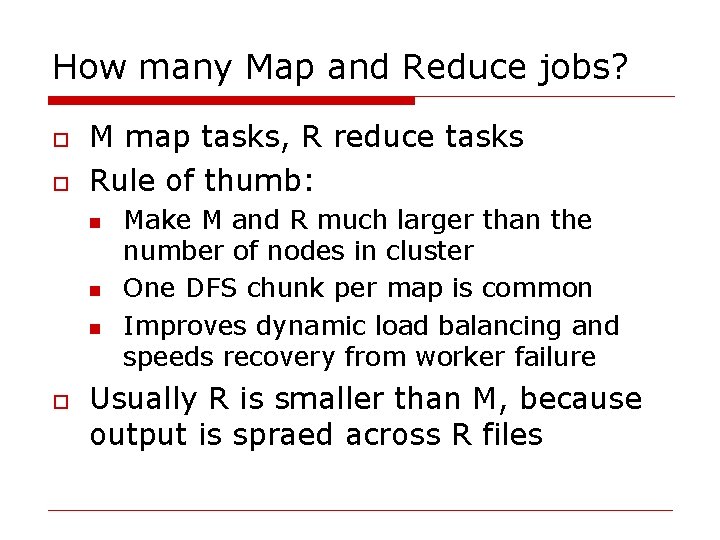
How many Map and Reduce jobs? o o M map tasks, R reduce tasks Rule of thumb: n n n o Make M and R much larger than the number of nodes in cluster One DFS chunk per map is common Improves dynamic load balancing and speeds recovery from worker failure Usually R is smaller than M, because output is spraed across R files
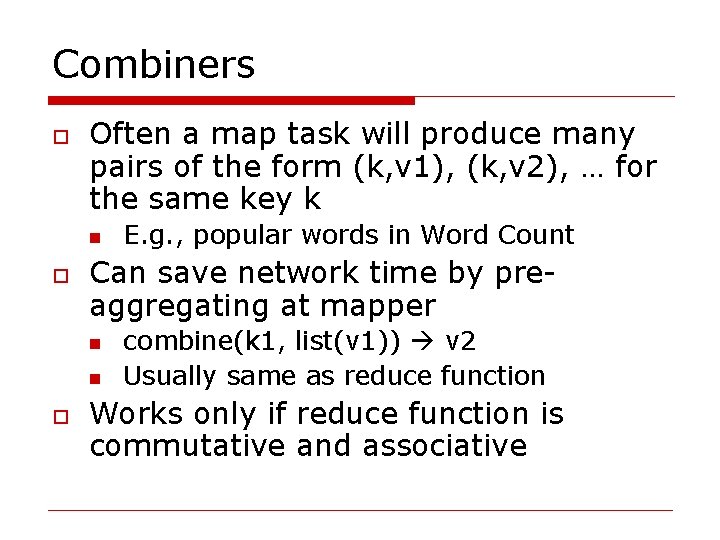
Combiners o Often a map task will produce many pairs of the form (k, v 1), (k, v 2), … for the same key k n o Can save network time by preaggregating at mapper n n o E. g. , popular words in Word Count combine(k 1, list(v 1)) v 2 Usually same as reduce function Works only if reduce function is commutative and associative
Partition Function o o Inputs to map tasks are created by contiguous splits of input file For reduce, we need to ensure that records with the same intermediate key end up at the same worker System uses a default partition function e. g. , hash(key) mod R Sometimes useful to override n E. g. , hash(hostname(URL)) mod R ensures URLs from a host end up in the same output file
Exercise 1: Host size o o Suppose we have a large web corpus Let’s look at the metadata file n o Lines of the form (URL, size, date, …) For each host, find the total number of bytes n i. e. , the sum of the page sizes for all URLs from that host
Exercise 2: Distributed Grep o Find all occurrences of the given pattern in a very large set of files
Exercise 3: Graph reversal Given a directed graph as an adjacency list: src 1: dest 11, dest 12, … src 2: dest 21, dest 22, … o o Construct the graph in which all the links are reversed
Exercise 4: Frequent Pairs o Given a large set of market baskets, find all frequent pairs n Remember definitions from Association Rules lectures
Hadoop o An open-source implementation of Map Reduce in Java n Uses HDFS for stable storage Download from: http: //lucene. apache. org/hadoop/ o
Reading o Jeffrey Dean and Sanjay Ghemawat, Map. Reduce: Simplified Data Processing on Large Clusters http: //labs. google. com/papers/mapreduce. html Sanjay Ghemawat, Howard Gobioff, and Shun. Tak Leung, The Google File System http: //labs. google. com/papers/gfs. html o