
CS 344 Introduction to Artificial Intelligence associated lab
CS 344: Introduction to Artificial Intelligence (associated lab: CS 386) Pushpak Bhattacharyya CSE Dept. , IIT Bombay Lecture 36, 37: Hardness of training feed forward neural nets 11 th and 12 th April, 2011
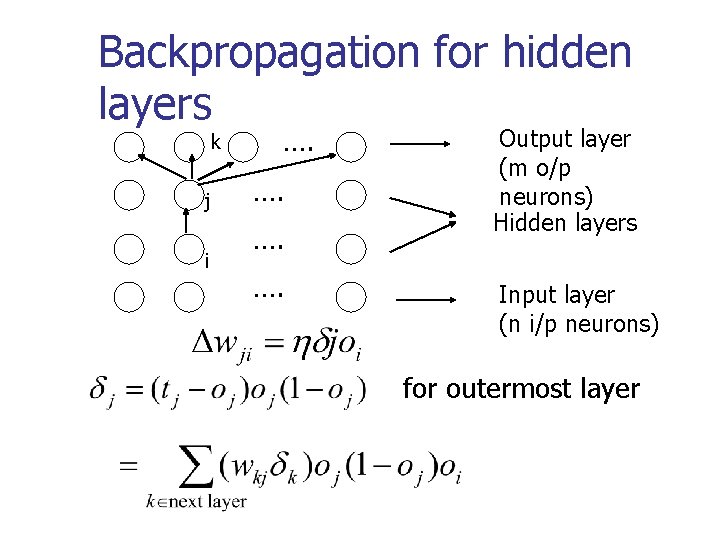
Backpropagation for hidden layers k j i …. …. …. Output layer (m o/p neurons) Hidden layers Input layer (n i/p neurons) for outermost layer
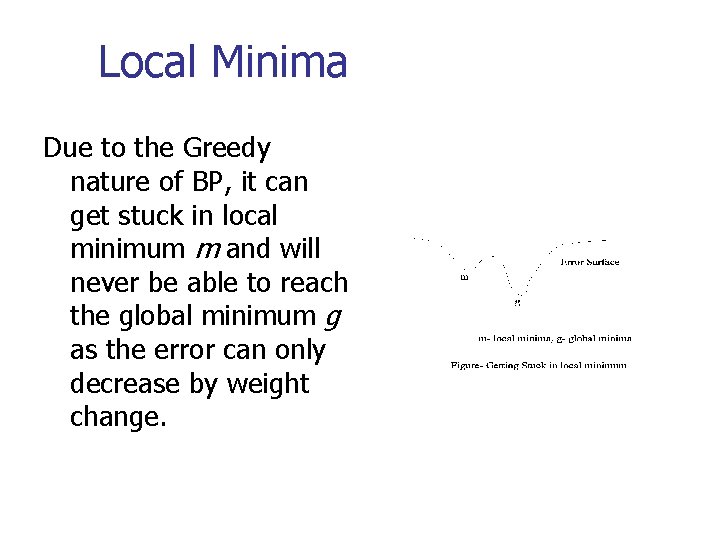
Local Minima Due to the Greedy nature of BP, it can get stuck in local minimum m and will never be able to reach the global minimum g as the error can only decrease by weight change.
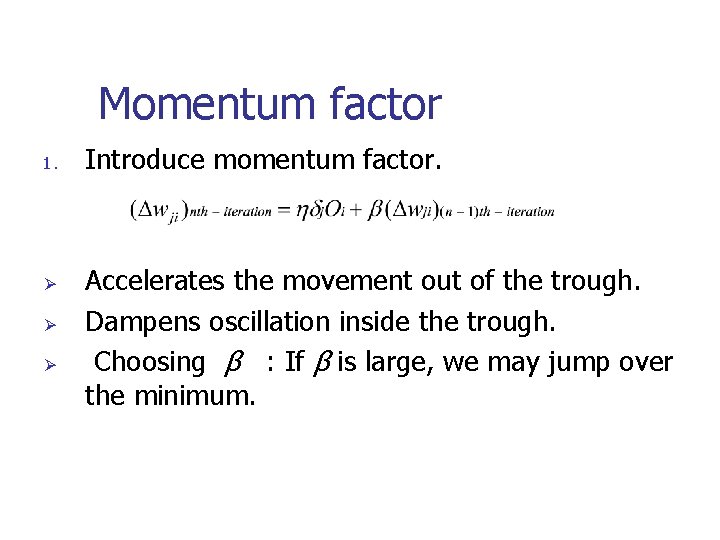
Momentum factor 1. Introduce momentum factor. Accelerates the movement out of the trough. Dampens oscillation inside the trough. Choosing β : If β is large, we may jump over the minimum.
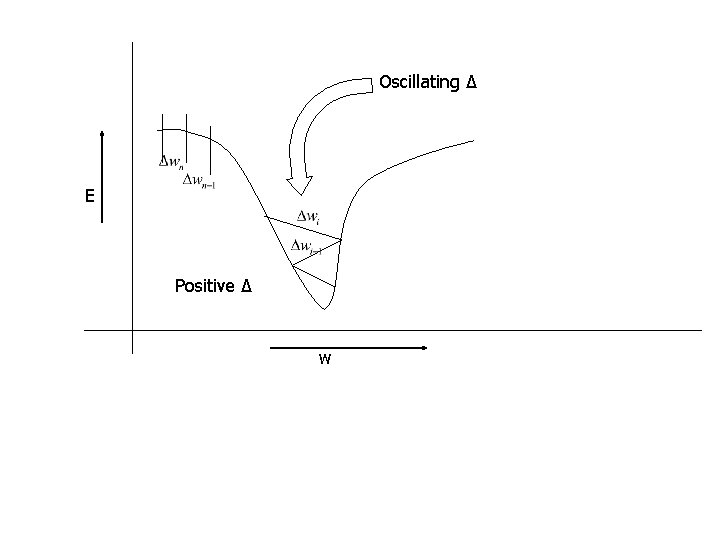
Oscillating Δ E Positive Δ w
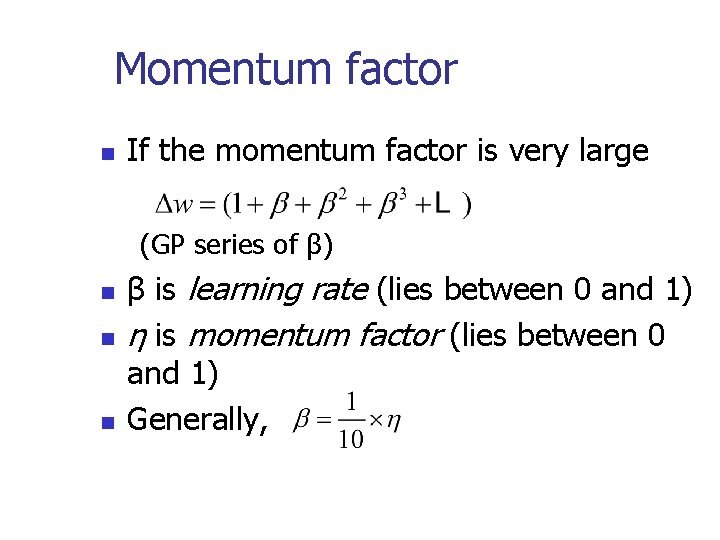
Momentum factor n If the momentum factor is very large (GP series of β) n n n β is learning rate (lies between 0 and 1) η is momentum factor (lies between 0 and 1) Generally,
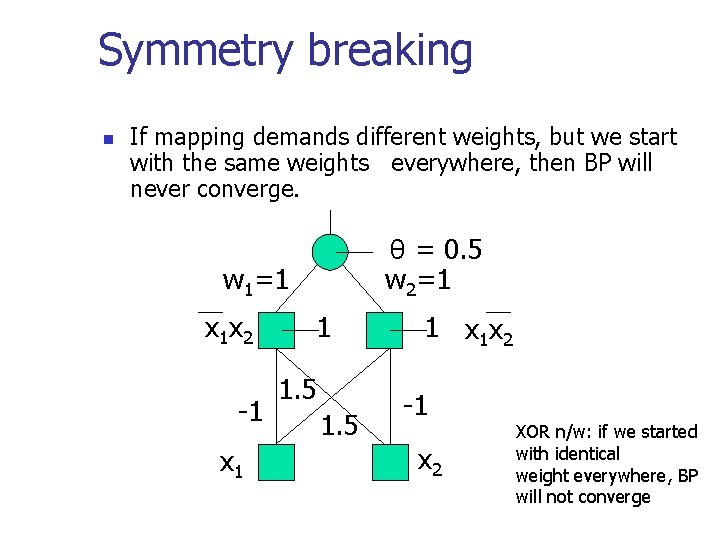
Symmetry breaking n If mapping demands different weights, but we start with the same weights everywhere, then BP will never converge. θ = 0. 5 w 2=1 w 1=1 x 2 -1 x 1 1 1. 5 1 x 2 -1 x 2 XOR n/w: if we started with identical weight everywhere, BP will not converge
Symmetry breaking: simplest case n If all the weights are same initially they will remain same over iterations
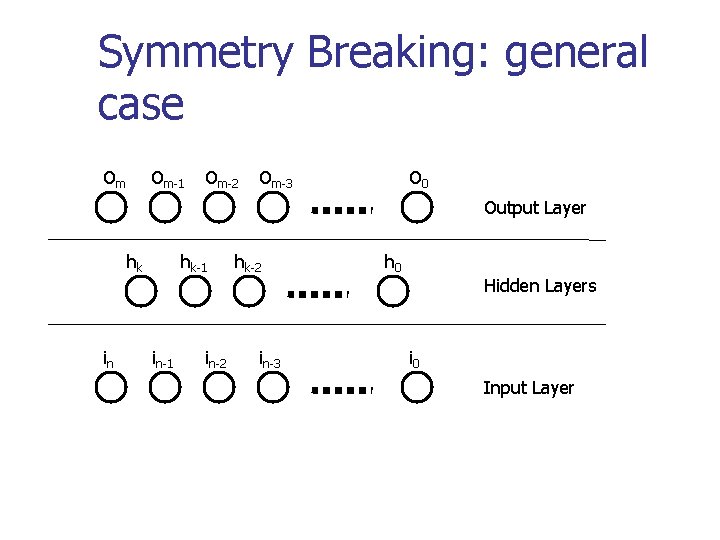
Symmetry Breaking: general case Om Om-1 Om-2 Om-3 O 0 Output Layer hk in hk-1 in-2 hk-2 in-3 h 0 Hidden Layers i 0 Input Layer
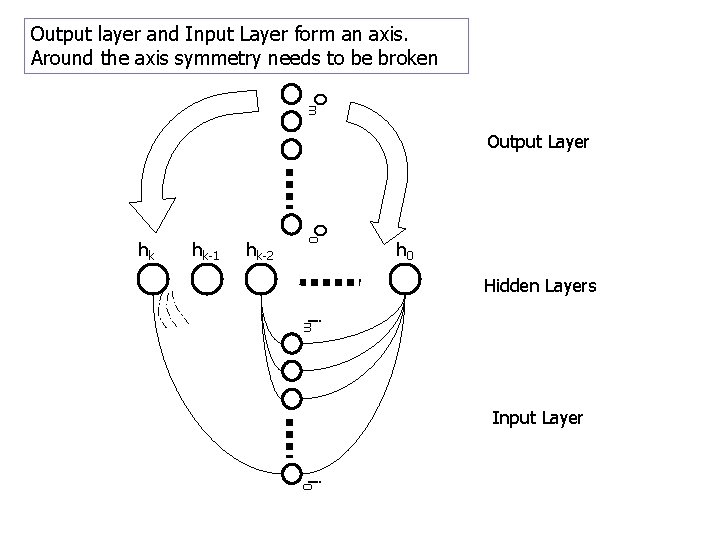
Output layer and Input Layer form an axis. Around the axis symmetry needs to be broken Om Output Layer hk-1 hk-2 O 0 hk h 0 Hidden Layers im Input Layer i 0
Training of FF NN takes time! n n n BP + FFNN combination applied for many problems from diverse disciplines Consistent observation: the training takes time as the problem size increases Is there a hardness hidden soemwhere?
Hardness of Training Feedforward NN n NP-completeness result: n n Avrim Blum, Ronald L. Rivest: Training a 3 node neural network is NP-complete. Neural Networks 5(1): 117 -127 (1992)Showed that the loading problem is hard As the number of training example increases, so does the training time EXPONENTIALLY
A primer on NP-completeness theory
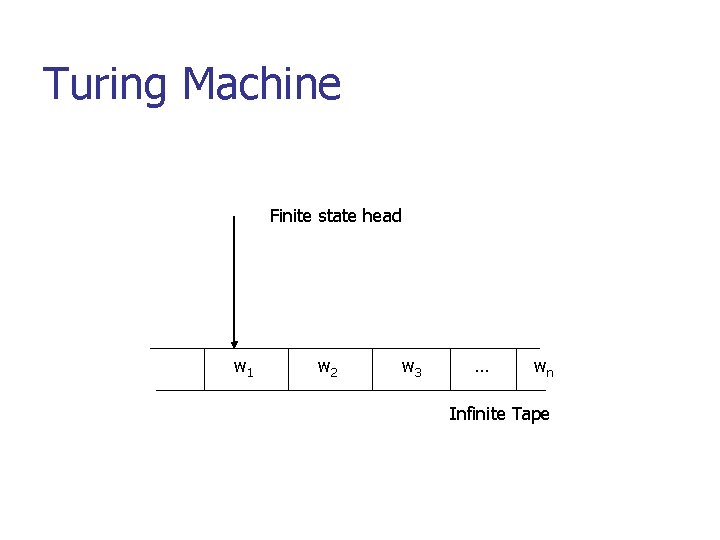
Turing Machine Finite state head w 1 w 2 w 3 … wn Infinite Tape
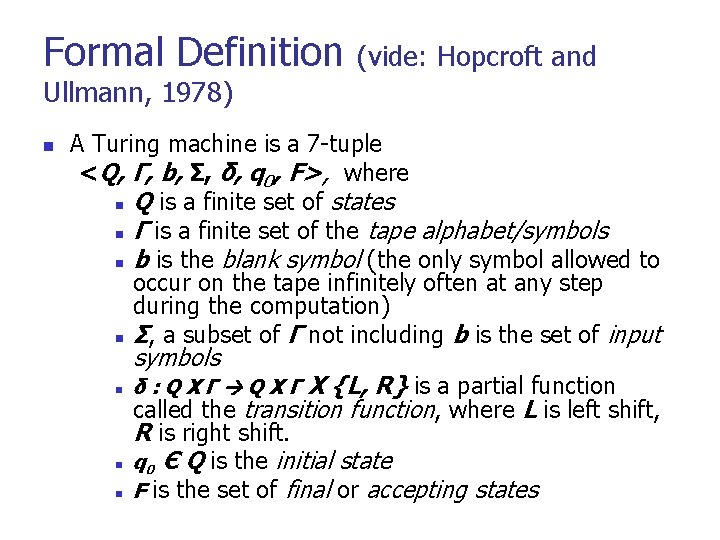
Formal Definition (vide: Hopcroft and Ullmann, 1978) n A Turing machine is a 7 -tuple <Q, Γ, b, Σ, δ, q 0, F>, where n Q is a finite set of states n Γ is a finite set of the tape alphabet/symbols n b is the blank symbol (the only symbol allowed to occur on the tape infinitely often at any step during the computation) n Σ, a subset of Γ not including b is the set of input symbols n n n X {L, R} is a partial function called the transition function, where L is left shift, R is right shift. q 0 Є Q is the initial state F is the set of final or accepting states δ: QXΓ

Non-deterministic and Deterministic Turing Machines If δ is to a number of possibilities δ : Q X Γ {Q X Γ X {L, R}} Then the TM is an NDTM; else it is a DTM
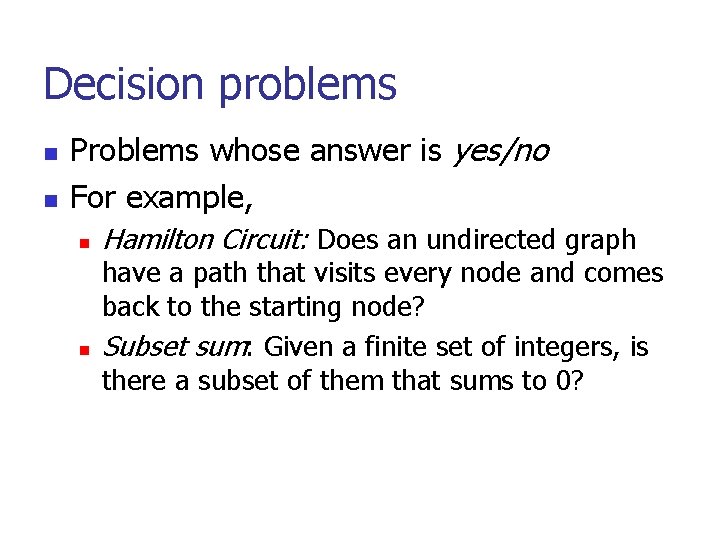
Decision problems n n Problems whose answer is yes/no For example, n n Hamilton Circuit: Does an undirected graph have a path that visits every node and comes back to the starting node? Subset sum: Given a finite set of integers, is there a subset of them that sums to 0?
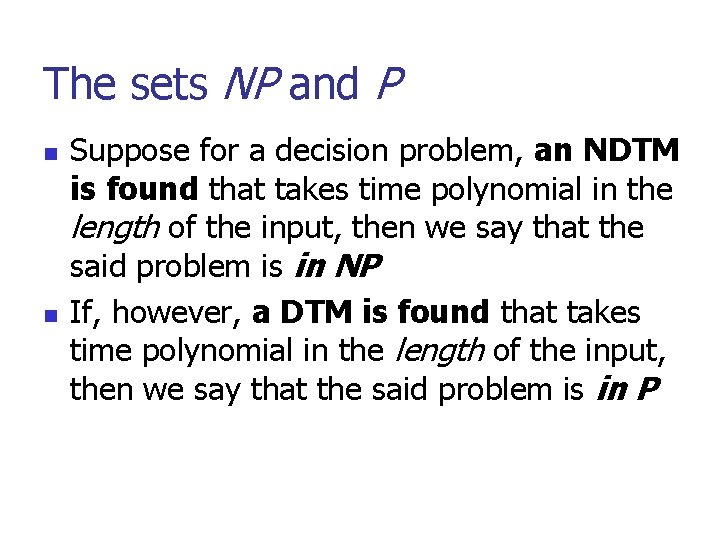
The sets NP and P n n Suppose for a decision problem, an NDTM is found that takes time polynomial in the length of the input, then we say that the said problem is in NP If, however, a DTM is found that takes time polynomial in the length of the input, then we say that the said problem is in P
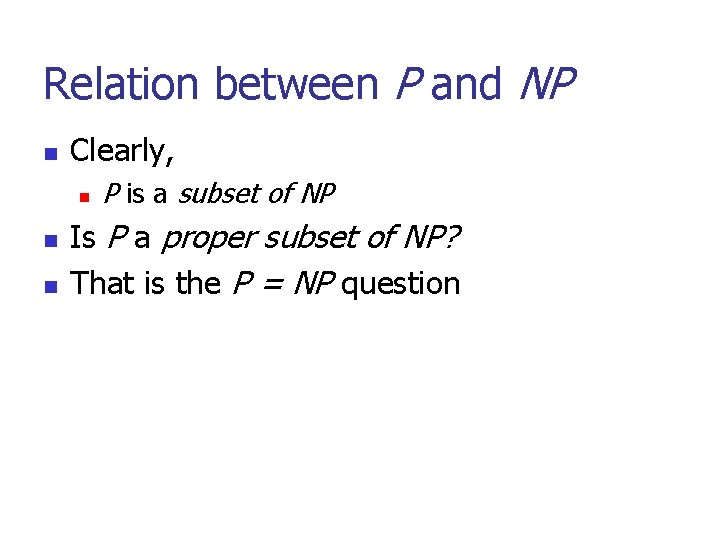
Relation between P and NP n Clearly, n n n P is a subset of NP Is P a proper subset of NP? That is the P = NP question
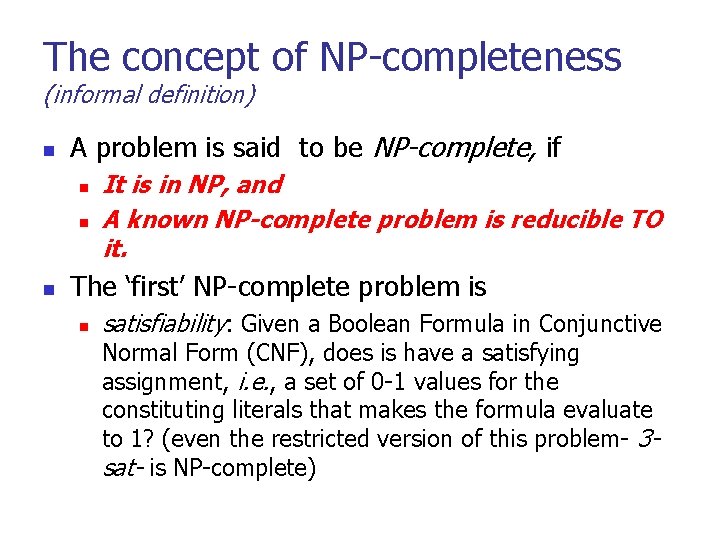
The concept of NP-completeness (informal definition) n A problem is said to be NP-complete, if n n n It is in NP, and A known NP-complete problem is reducible TO it. The ‘first’ NP-complete problem is n satisfiability: Given a Boolean Formula in Conjunctive Normal Form (CNF), does is have a satisfying assignment, i. e. , a set of 0 -1 values for the constituting literals that makes the formula evaluate to 1? (even the restricted version of this problem- 3 sat- is NP-complete)
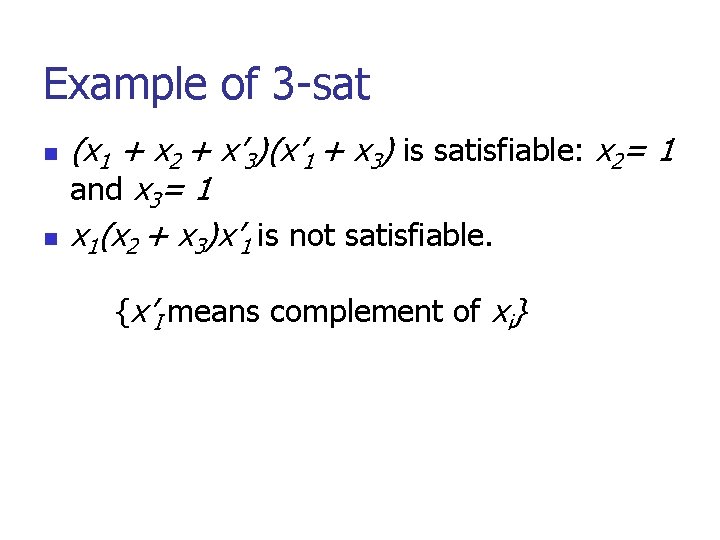
Example of 3 -sat n n (x 1 + x 2 + x’ 3)(x’ 1 + x 3) is satisfiable: x 2= 1 and x 3= 1 x 1(x 2 + x 3)x’ 1 is not satisfiable. {x’I means complement of xi}
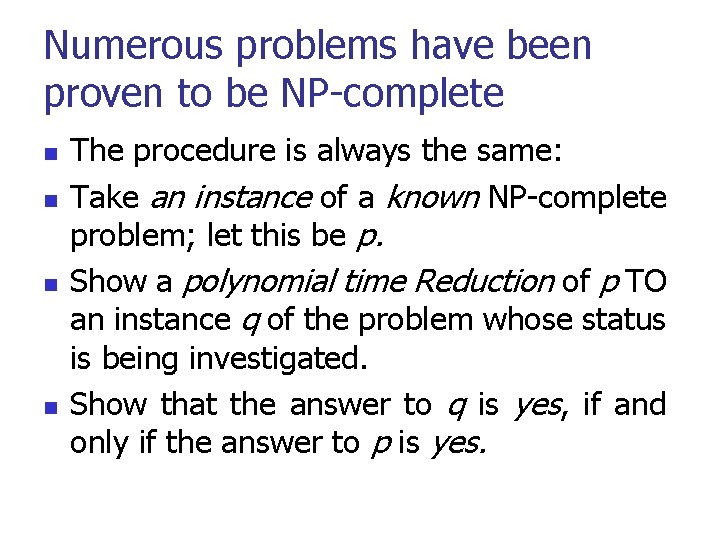
Numerous problems have been proven to be NP-complete n n The procedure is always the same: Take an instance of a known NP-complete problem; let this be p. Show a polynomial time Reduction of p TO an instance q of the problem whose status is being investigated. Show that the answer to q is yes, if and only if the answer to p is yes.
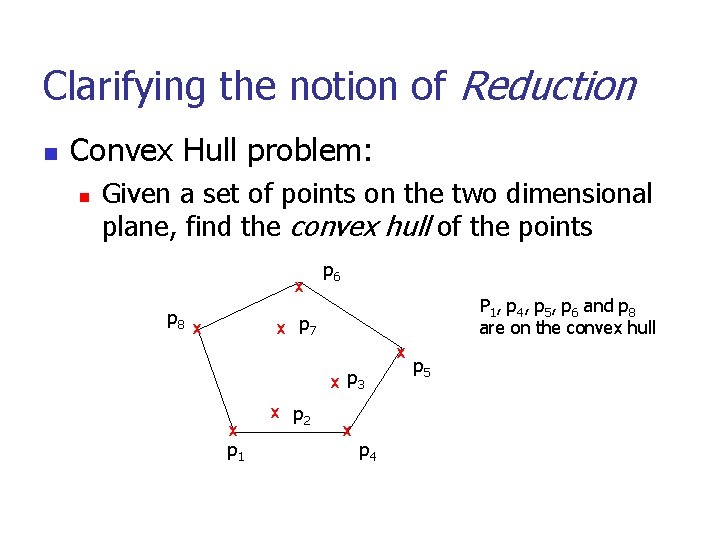
Clarifying the notion of Reduction n Convex Hull problem: n Given a set of points on the two dimensional plane, find the convex hull of the points x p 8 p 6 P 1, p 4, p 5, p 6 and p 8 are on the convex hull x p 7 x x x p 3 x p 1 x p 2 x p 4 p 5
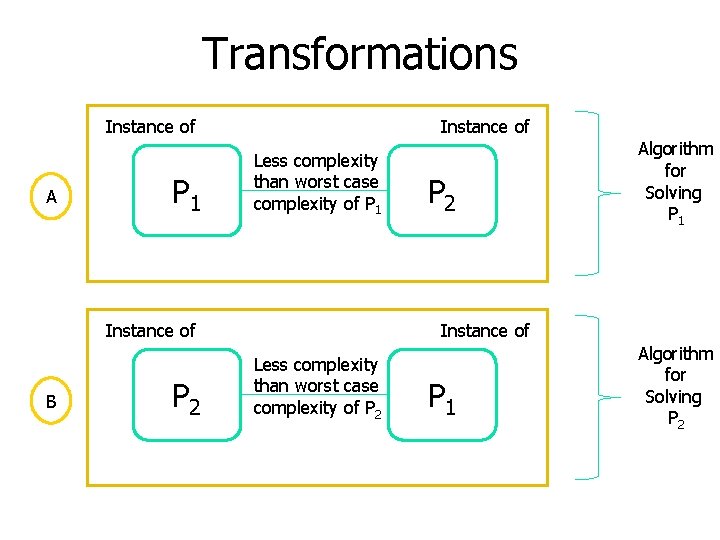
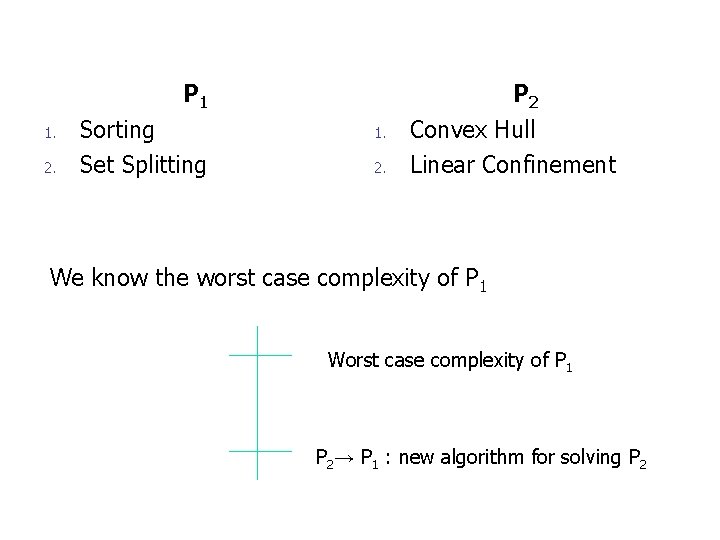
Complexity of convex hull finding problem n n We will show that this is O(nlogn). Method used is Reduction. The most important first step: choose the right problem. We take sorting whose complexity is known to be O(nlogn)
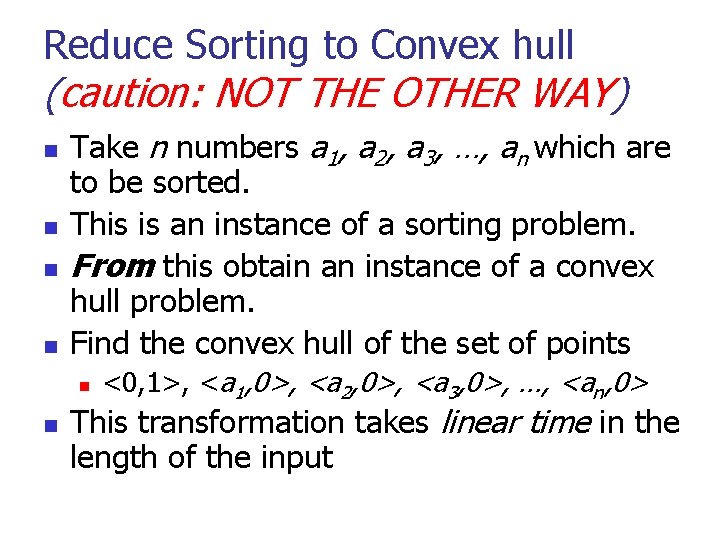
Reduce Sorting to Convex hull (caution: NOT THE OTHER WAY) n n Take n numbers a 1, a 2, a 3, …, an which are to be sorted. This is an instance of a sorting problem. From this obtain an instance of a convex hull problem. Find the convex hull of the set of points n n <0, 1>, <a 1, 0>, <a 2, 0>, <a 3, 0>, …, <an, 0> This transformation takes linear time in the length of the input
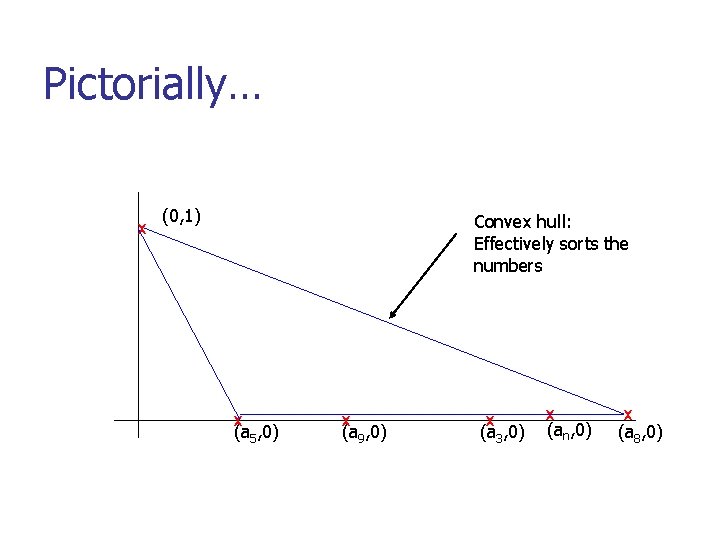
Pictorially… x (0, 1) Convex hull: Effectively sorts the numbers x (a 5, 0) x (a 9, 0) x (a 3, 0) x (an, 0) x (a 8, 0)
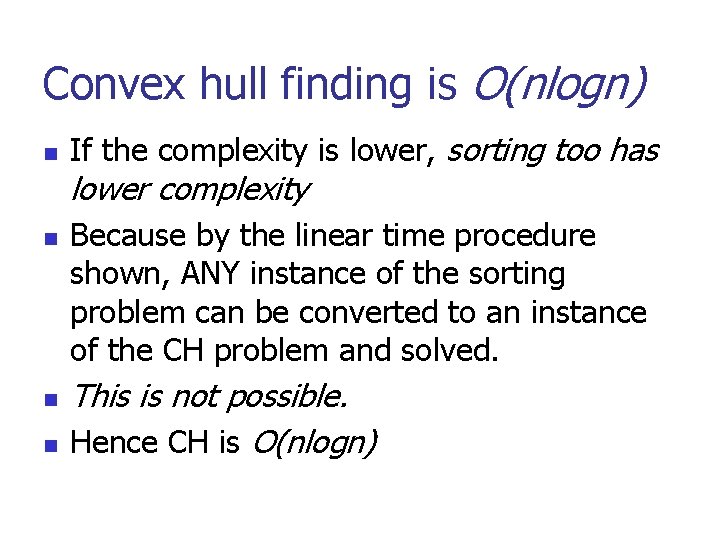
Convex hull finding is O(nlogn) n If the complexity is lower, sorting too has lower complexity n n n Because by the linear time procedure shown, ANY instance of the sorting problem can be converted to an instance of the CH problem and solved. This is not possible. Hence CH is O(nlogn)

Important remarks on reduction
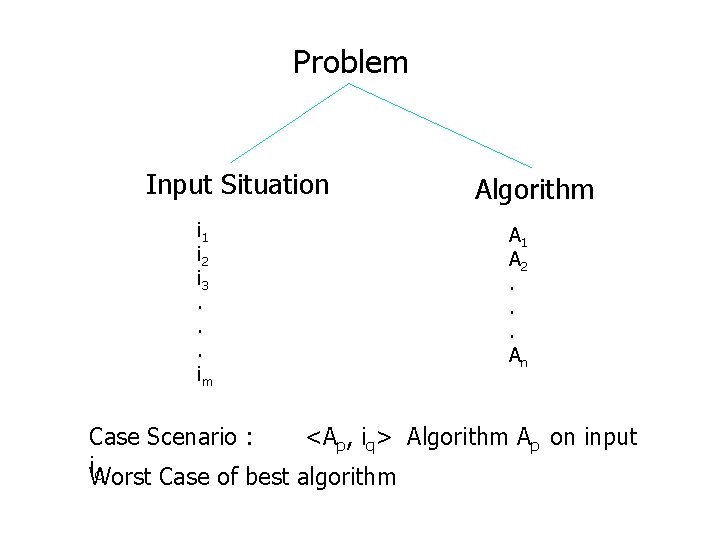
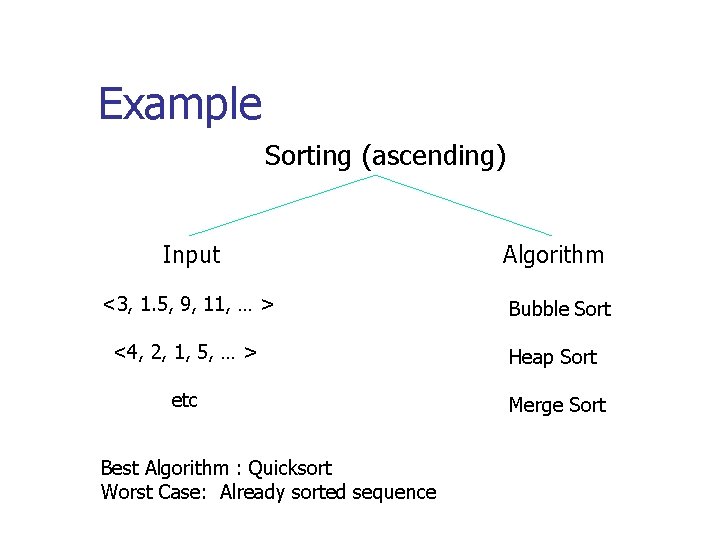
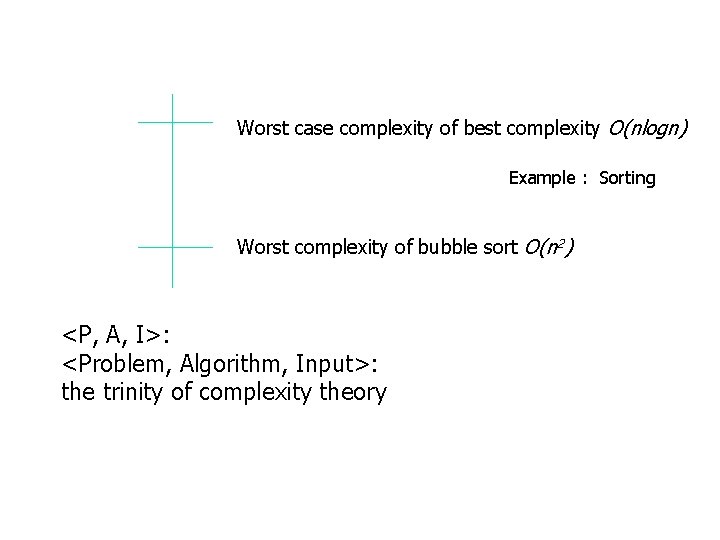
Problem Input Situation i 1 i 2 i 3. . . im Algorithm A 1 A 2. . . An Case Scenario : <Ap, iq> Algorithm Ap on input iq Worst Case of best algorithm
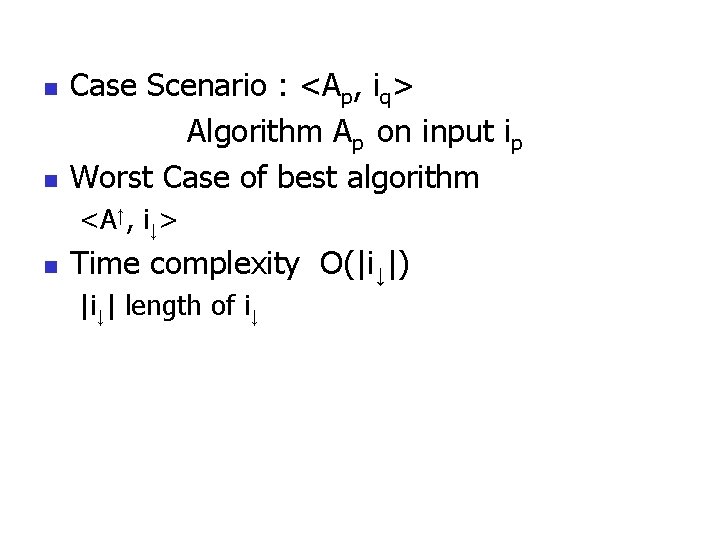
n n Case Scenario : <Ap, iq> Algorithm Ap on input ip Worst Case of best algorithm <A↑, i↓> n Time complexity O(|i↓|) |i↓| length of i↓
Example Sorting (ascending) Input Algorithm <3, 1. 5, 9, 11, … > Bubble Sort <4, 2, 1, 5, … > Heap Sort etc Merge Sort Best Algorithm : Quicksort Worst Case: Already sorted sequence
Transformations Instance of A P 1 Instance of Less complexity than worst case complexity of P 1 Instance of B P 2 Algorithm for Solving P 1 Instance of Less complexity than worst case complexity of P 2 P 1 Algorithm for Solving P 2
P 1 1. 2. Sorting Set Splitting P 2 1. 2. Convex Hull Linear Confinement We know the worst case complexity of P 1 Worst case complexity of P 1 P 2→ P 1 : new algorithm for solving P 2
n For any problem Situation A when an algorithm is discovered, and its worst case complexity calculated, the effort will continuously be to find a better algorithm. That is to improve upon the worst case complexity. Situation B Find a problem P 1 whose worst case complexity is known and transform it to the unknown problem with less complexity. That puts a seal on how much improvement can be done on the worst case complexity.
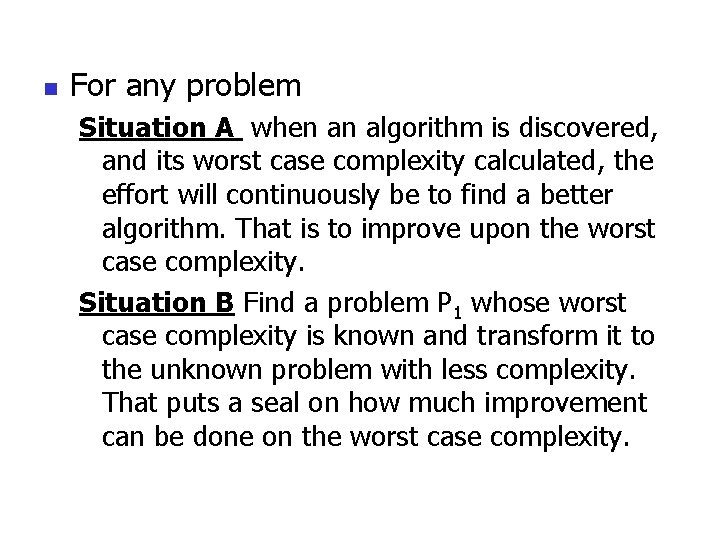
Worst case complexity of best complexity O(nlogn) Example : Sorting Worst complexity of bubble sort O(n 2) <P, A, I>: <Problem, Algorithm, Input>: the trinity of complexity theory
Training of 1 hidden layer 2 neuron feed forward NN is NPcomplete
Numerous problems have been proven to be NP-complete n n The procedure is always the same: Take an instance of a known NP-complete problem; let this be p. Show a polynomial time Reduction of p TO an instance q of the problem whose status is being investigated. Show that the answer to q is yes, if and only if the answer to p is yes.
Training of NN n Training of Neural Network is NP-hard This can be proved by the NPcompleteness theory n Question n n Can a set of examples be loaded onto a Feed Forward Neural Network efficiently?
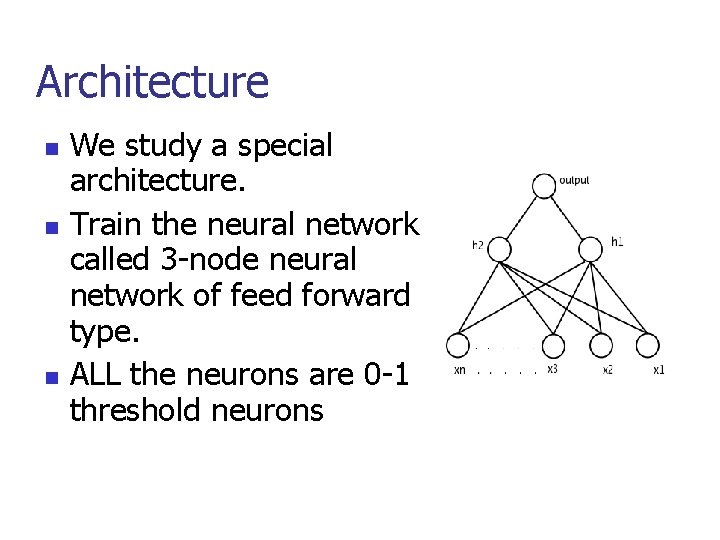
Architecture n n n We study a special architecture. Train the neural network called 3 -node neural network of feed forward type. ALL the neurons are 0 -1 threshold neurons
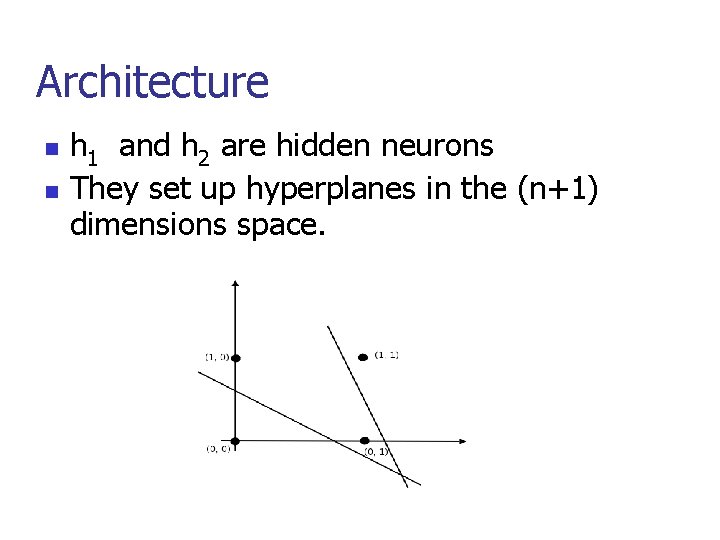
Architecture n n h 1 and h 2 are hidden neurons They set up hyperplanes in the (n+1) dimensions space.
Confinement Problem n n n Can two hyperplanes be set which confine ALL and only the positive points? Positive Linear Confinement problem is NPComplete. Training of positive and negative points needs solving the CONFINEMENT PROBLEM.
Solving with Set Splitting Problem n n Set Splitting Problem Statement: n n Given a set S of n elements e 1, e 2, . . , en and a set of subsets of S called as concepts denoted by c 1, c 2, . . . , cm, does there exist a splitting of S i. e. are there two sets S 1 (subset of S) and S 2 (subset of S) and none of c 1, c 2, . . . , cm is subset of S 1 or S 2
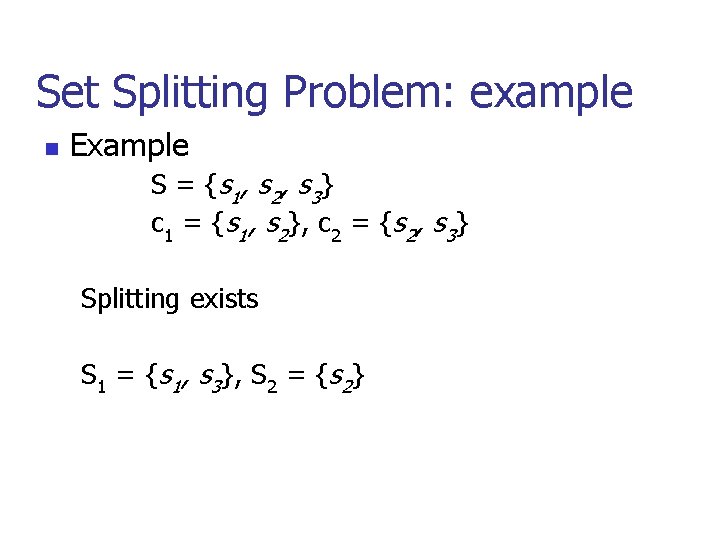
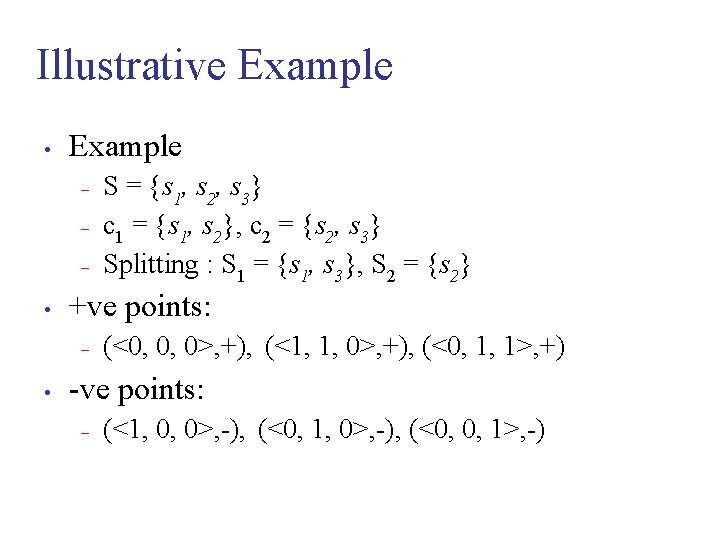
Set Splitting Problem: example n Example S = { s 1 , s 2 , s 3 } c 1 = {s 1, s 2}, c 2 = {s 2, s 3} Splitting exists S 1 = {s 1, s 3}, S 2 = {s 2}
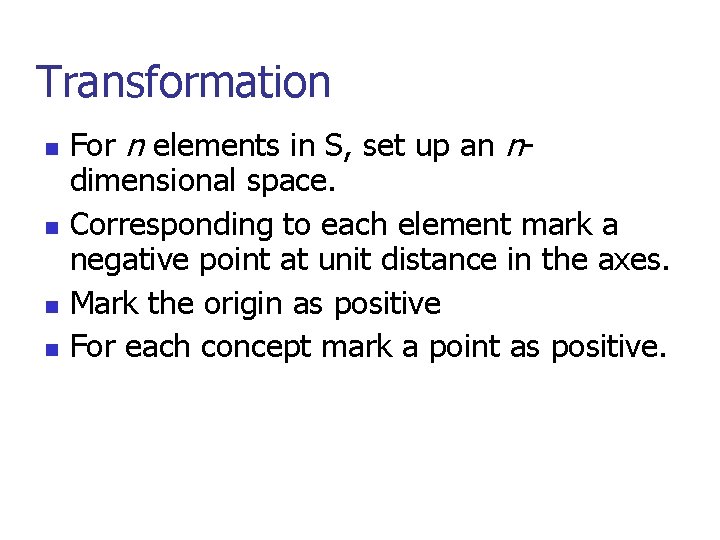
Transformation n n For n elements in S, set up an ndimensional space. Corresponding to each element mark a negative point at unit distance in the axes. Mark the origin as positive For each concept mark a point as positive.
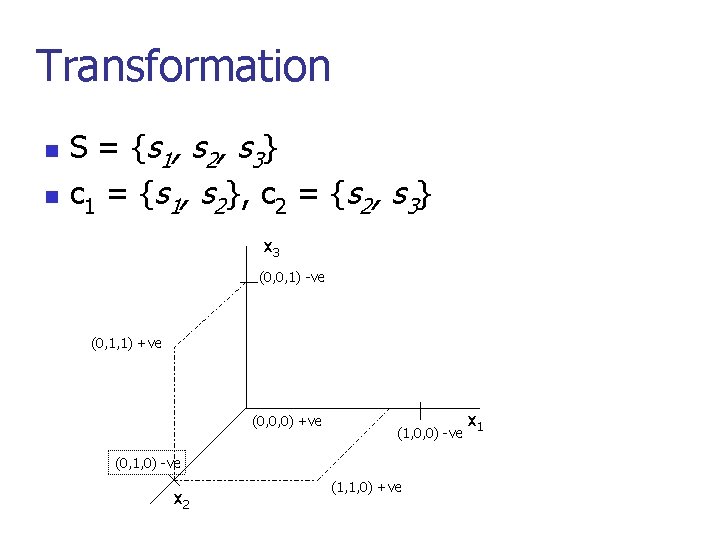
Transformation n n S = { s 1 , s 2 , s 3 } c 1 = {s 1, s 2}, c 2 = {s 2, s 3} x 3 (0, 0, 1) -ve (0, 1, 1) +ve (0, 0, 0) +ve x (1, 0, 0) -ve 1 (0, 1, 0) -ve x 2 (1, 1, 0) +ve
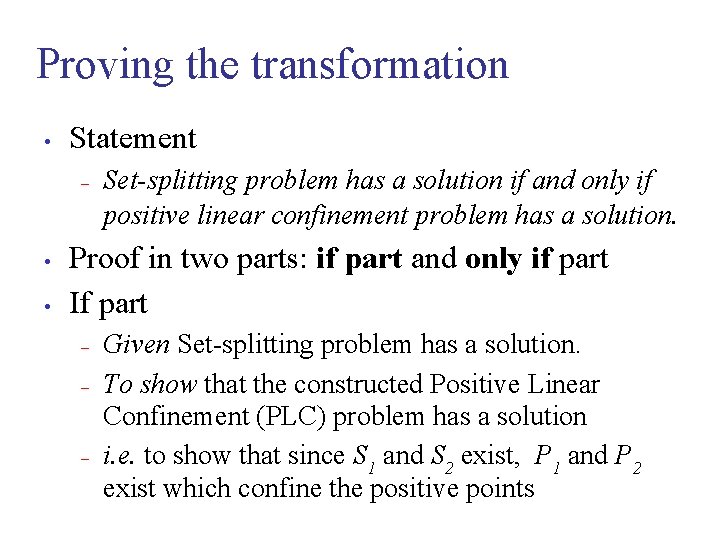
Proving the transformation • Statement – • • Set-splitting problem has a solution if and only if positive linear confinement problem has a solution. Proof in two parts: if part and only if part If part – – – Given Set-splitting problem has a solution. To show that the constructed Positive Linear Confinement (PLC) problem has a solution i. e. to show that since S 1 and S 2 exist, P 1 and P 2 exist which confine the positive points
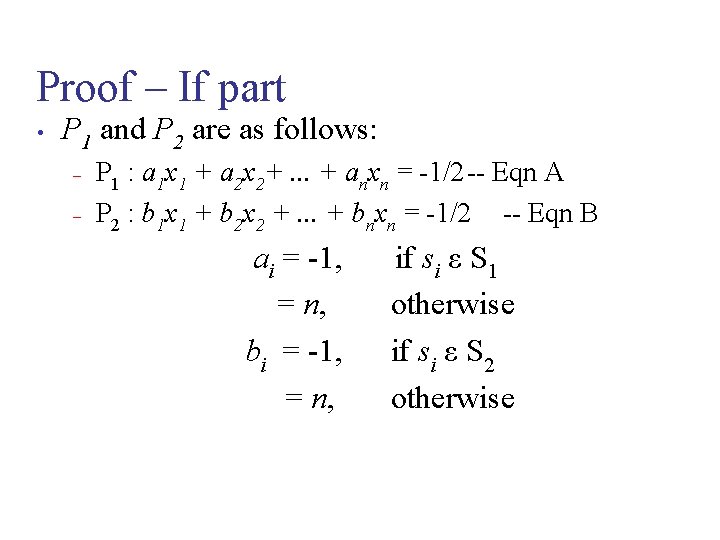
Proof – If part • P 1 and P 2 are as follows: – – P 1 : a 1 x 1 + a 2 x 2+. . . + anxn = -1/2 -- Eqn A P 2 : b 1 x 1 + b 2 x 2 +. . . + bnxn = -1/2 -- Eqn B ai = -1, = n, bi = -1, = n, if si ε S 1 otherwise if si ε S 2 otherwise
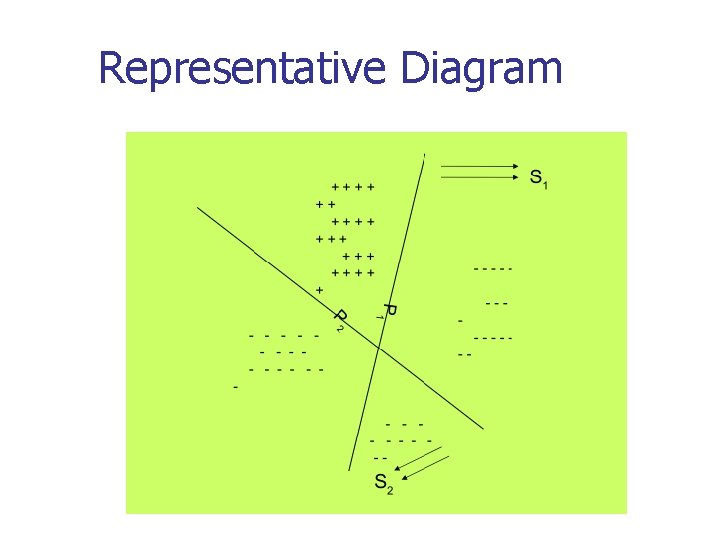
Representative Diagram
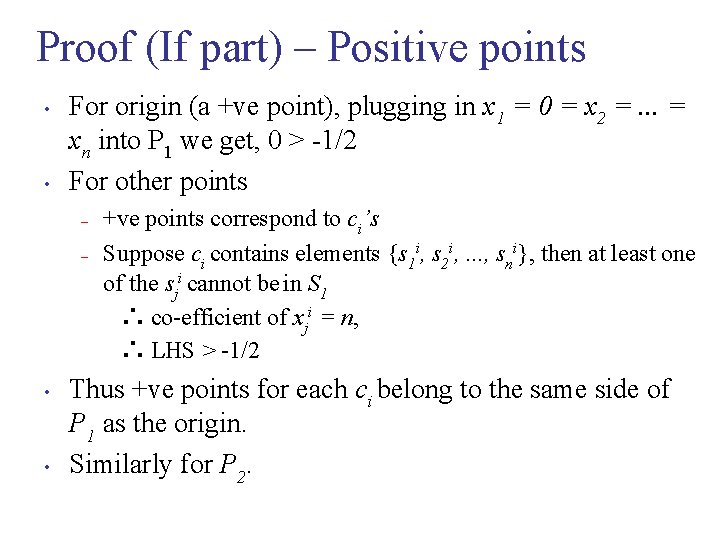
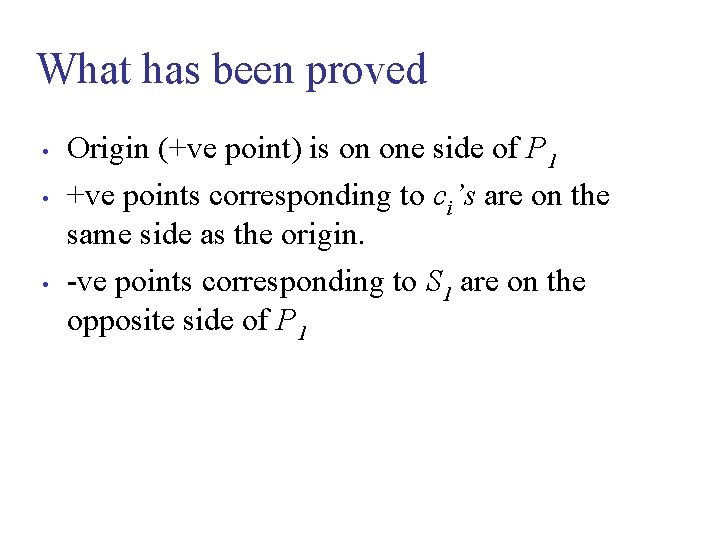
Proof (If part) – Positive points • • For origin (a +ve point), plugging in x 1 = 0 = x 2 =. . . = xn into P 1 we get, 0 > -1/2 For other points – – • • +ve points correspond to ci’s Suppose ci contains elements {s 1 i, s 2 i, . . . , sni}, then at least one of the sji cannot be in S 1 ∴ co-efficient of xji = n, ∴ LHS > -1/2 Thus +ve points for each ci belong to the same side of P 1 as the origin. Similarly for P 2.
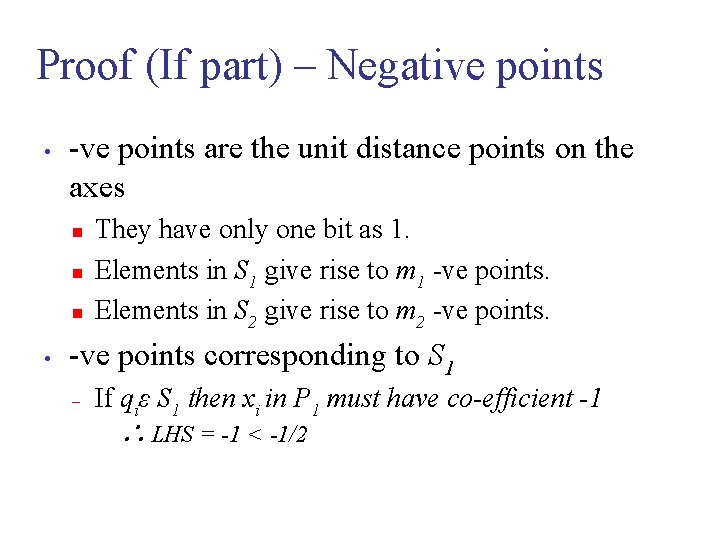
Proof (If part) – Negative points • -ve points are the unit distance points on the axes n n n • They have only one bit as 1. Elements in S 1 give rise to m 1 -ve points. Elements in S 2 give rise to m 2 -ve points corresponding to S 1 – If qiε S 1 then xi in P 1 must have co-efficient -1 ∴ LHS = -1 < -1/2
What has been proved • • • Origin (+ve point) is on one side of P 1 +ve points corresponding to ci’s are on the same side as the origin. -ve points corresponding to S 1 are on the opposite side of P 1
Illustrative Example • Example – – – • +ve points: – • S = {s 1, s 2, s 3} c 1 = {s 1, s 2}, c 2 = {s 2, s 3} Splitting : S 1 = {s 1, s 3}, S 2 = {s 2} (<0, 0, 0>, +), (<1, 1, 0>, +), (<0, 1, 1>, +) -ve points: – (<1, 0, 0>, -), (<0, 1, 0>, -), (<0, 0, 1>, -)
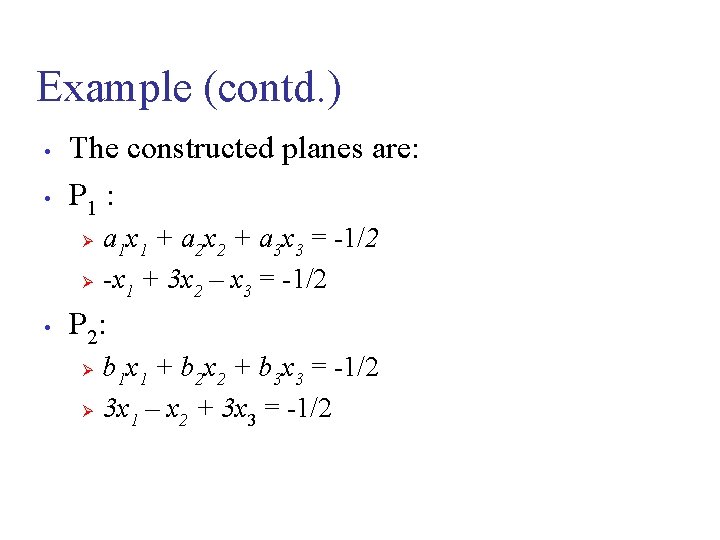
Example (contd. ) • • The constructed planes are: P 1 : • a 1 x 1 + a 2 x 2 + a 3 x 3 = -1/2 -x 1 + 3 x 2 – x 3 = -1/2 P 2: b 1 x 1 + b 2 x 2 + b 3 x 3 = -1/2 3 x 1 – x 2 + 3 x 3 = -1/2
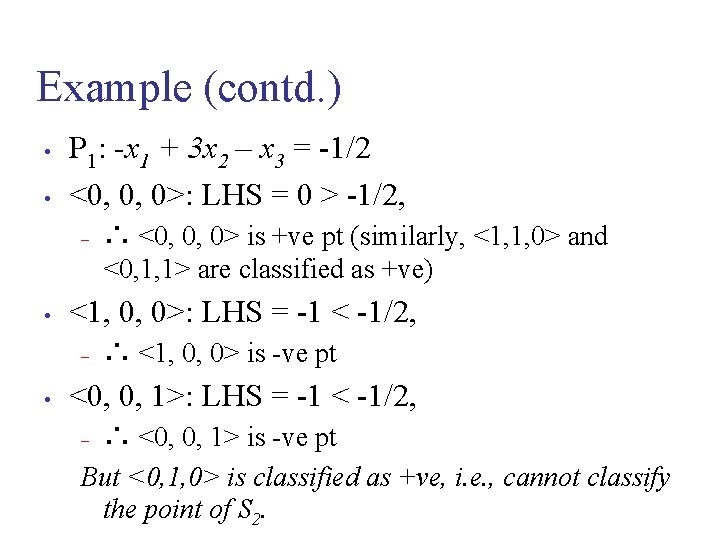
Example (contd. ) • • P 1: -x 1 + 3 x 2 – x 3 = -1/2 <0, 0, 0>: LHS = 0 > -1/2, – • <1, 0, 0>: LHS = -1 < -1/2, – • ∴ <0, 0, 0> is +ve pt (similarly, <1, 1, 0> and <0, 1, 1> are classified as +ve) ∴ <1, 0, 0> is -ve pt <0, 0, 1>: LHS = -1 < -1/2, ∴ <0, 0, 1> is -ve pt But <0, 1, 0> is classified as +ve, i. e. , cannot classify the point of S 2. –
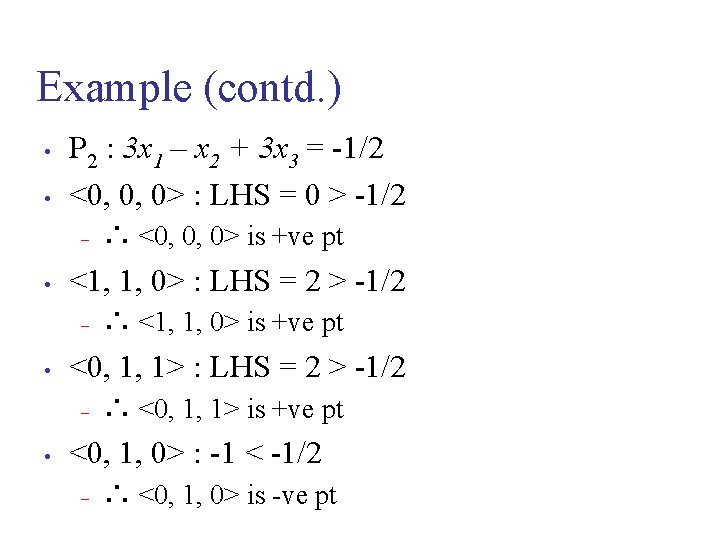
Example (contd. ) • • P 2 : 3 x 1 – x 2 + 3 x 3 = -1/2 <0, 0, 0> : LHS = 0 > -1/2 – • <1, 1, 0> : LHS = 2 > -1/2 – • ∴ <1, 1, 0> is +ve pt <0, 1, 1> : LHS = 2 > -1/2 – • ∴ <0, 0, 0> is +ve pt ∴ <0, 1, 1> is +ve pt <0, 1, 0> : -1 < -1/2 – ∴ <0, 1, 0> is -ve pt
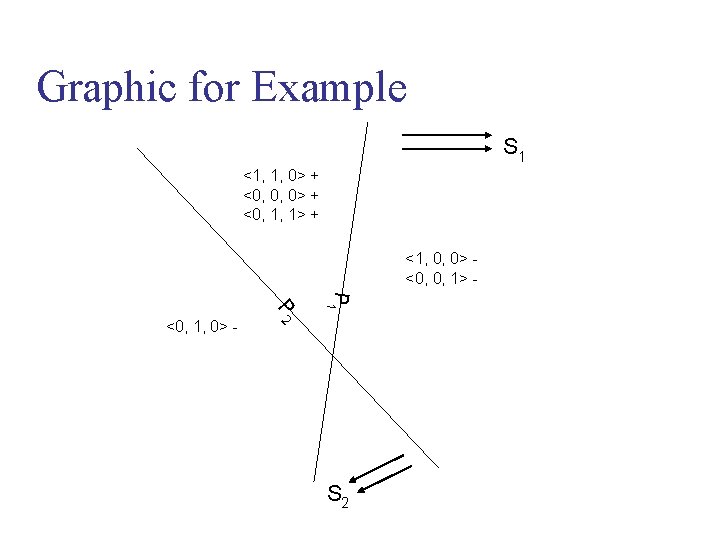
Graphic for Example S 1 <1, 1, 0> + <0, 0, 0> + <0, 1, 1> + <1, 0, 0> <0, 0, 1> - P 1 P 2 <0, 1, 0> - S 2
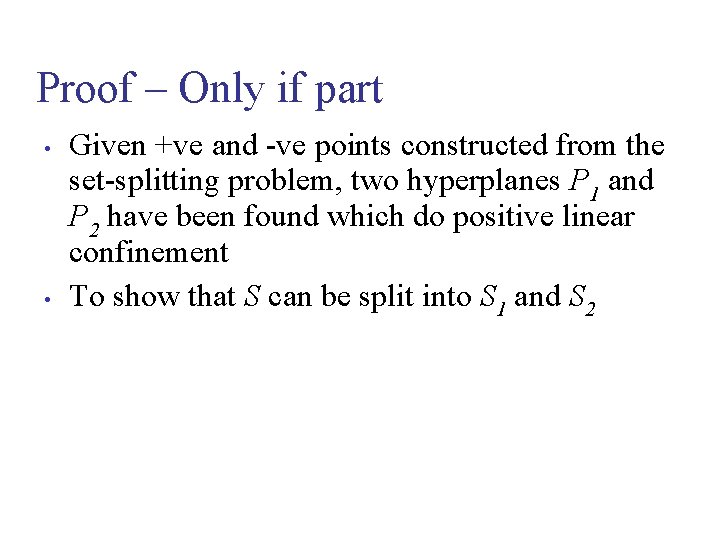
Proof – Only if part • • Given +ve and -ve points constructed from the set-splitting problem, two hyperplanes P 1 and P 2 have been found which do positive linear confinement To show that S can be split into S 1 and S 2
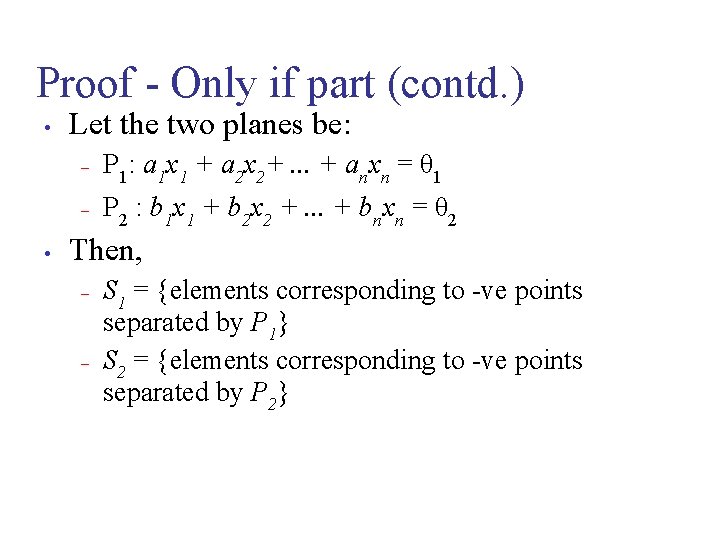
Proof - Only if part (contd. ) • • Let the two planes be: – P 1: a 1 x 1 + a 2 x 2+. . . + anxn = θ 1 – P 2 : b 1 x 1 + b 2 x 2 +. . . + bnxn = θ 2 Then, – – S 1 = {elements corresponding to -ve points separated by P 1} S 2 = {elements corresponding to -ve points separated by P 2}
Proof - Only if part (contd. ) • • • Since P 1 and P 2 take care of all -ve points, their union is equal to S. . . (proof obvious) To show: No ci is a subset of S 1 and S 2 i. e. , there is in ci at least one element ∉ S 1 -- Statement (A)
Proof - Only if part (contd. ) • Suppose ci ⊂ S 1, then every element in ci is contained in S 1 Let e 1 i, e 2 i, . . . , emii be the elements of ci corresponding to each element Evaluating for each co-efficient, we get, • a 1 < θ 1, a 2 < θ 1, . . . , ami < θ 1 -- (1) – But a +. . . + a > θ -- (2) 1 2 m 1 – and 0 > θ -- (3) 1 CONTRADICTION • • –
What has been shown • • • Positive Linear Confinement is NP-complete. Confinement on any set of points of one kind is NPcomplete (easy to show) The architecture is special- only one hidden layer with two nodes The neurons are special, 0 -1 threshold neurons, NOT sigmoid Hence, can we generalize and say that FF NN training is NP-complete? Not rigorously, perhaps; but strongly indicated
Summing up n Some milestones covered n n n n A* Search Predicate Calculus, Resolution, Prolog HMM, Inferencing, Training Perceptron, Back propagation, NP-completeness of NN Training Lab: to reinforce understanding of lectures Important topics left out: Planning, IR (advanced course next sem) Seminars: breadth and exposure Lectures: Foundation and depth
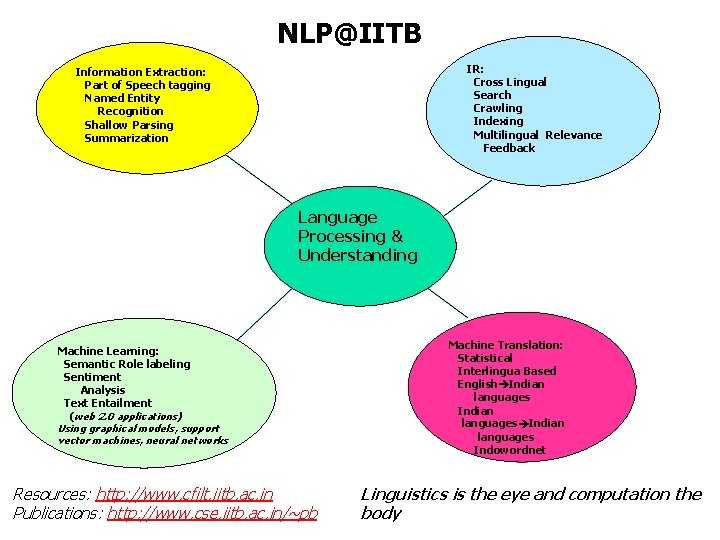
NLP@IITB IR: Cross Lingual Search Crawling Indexing Multilingual Relevance Feedback Information Extraction: Part of Speech tagging Named Entity Recognition Shallow Parsing Summarization Language Processing & Understanding Machine Learning: Semantic Role labeling Sentiment Analysis Text Entailment (web 2. 0 applications) Using graphical models, support vector machines, neural networks Resources: http: //www. cfilt. iitb. ac. in Publications: http: //www. cse. iitb. ac. in/~pb Machine Translation: Statistical Interlingua Based English Indian languages Indowordnet Linguistics is the eye and computation the body
- Slides: 63