
CS 336 Lecture 4 Inverted Files Signature Files


- Slides: 31
CS 336 Lecture 4: Inverted Files, Signature Files, Bitmaps
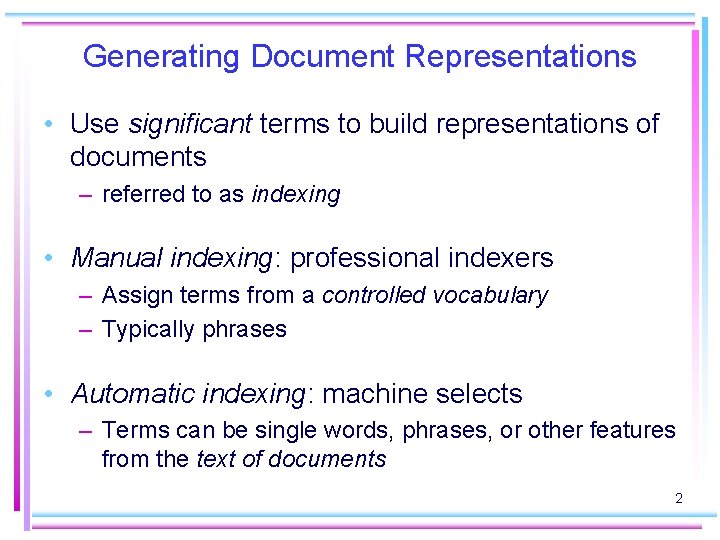
Generating Document Representations • Use significant terms to build representations of documents – referred to as indexing • Manual indexing: professional indexers – Assign terms from a controlled vocabulary – Typically phrases • Automatic indexing: machine selects – Terms can be single words, phrases, or other features from the text of documents 2
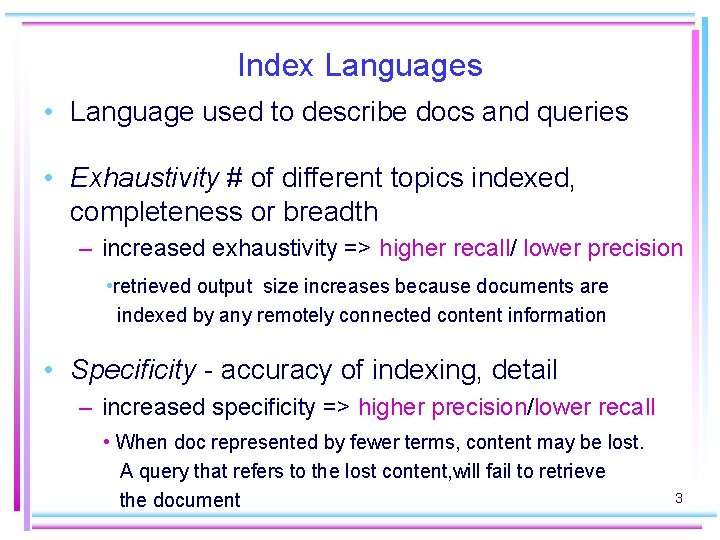
Index Languages • Language used to describe docs and queries • Exhaustivity # of different topics indexed, completeness or breadth – increased exhaustivity => higher recall/ lower precision • retrieved output size increases because documents are indexed by any remotely connected content information • Specificity - accuracy of indexing, detail – increased specificity => higher precision/lower recall • When doc represented by fewer terms, content may be lost. A query that refers to the lost content, will fail to retrieve the document 3
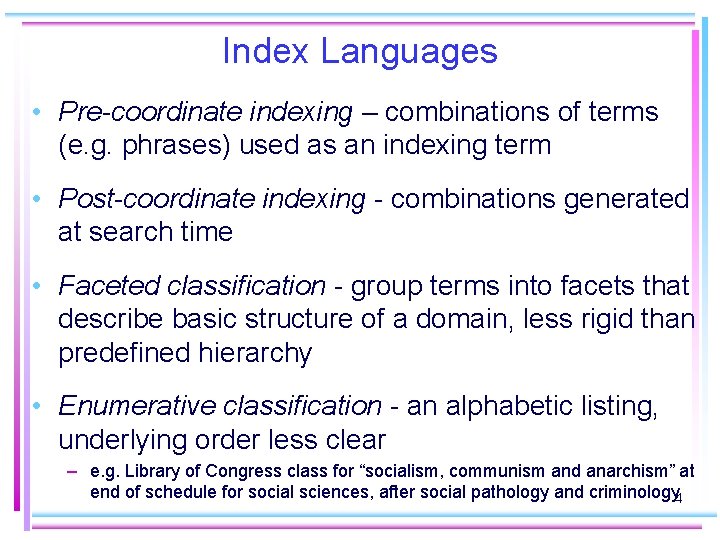
Index Languages • Pre-coordinate indexing – combinations of terms (e. g. phrases) used as an indexing term • Post-coordinate indexing - combinations generated at search time • Faceted classification - group terms into facets that describe basic structure of a domain, less rigid than predefined hierarchy • Enumerative classification - an alphabetic listing, underlying order less clear – e. g. Library of Congress class for “socialism, communism and anarchism” at end of schedule for social sciences, after social pathology and criminology 4
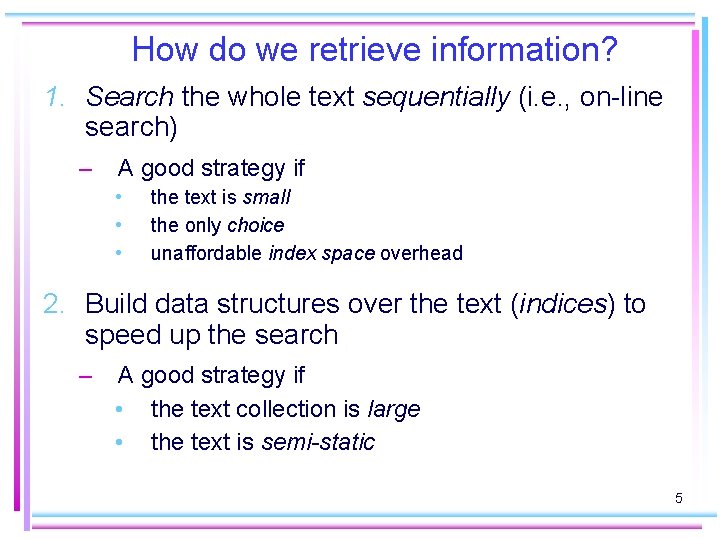
How do we retrieve information? 1. Search the whole text sequentially (i. e. , on-line search) – A good strategy if • • • the text is small the only choice unaffordable index space overhead 2. Build data structures over the text (indices) to speed up the search – A good strategy if • the text collection is large • the text is semi-static 5
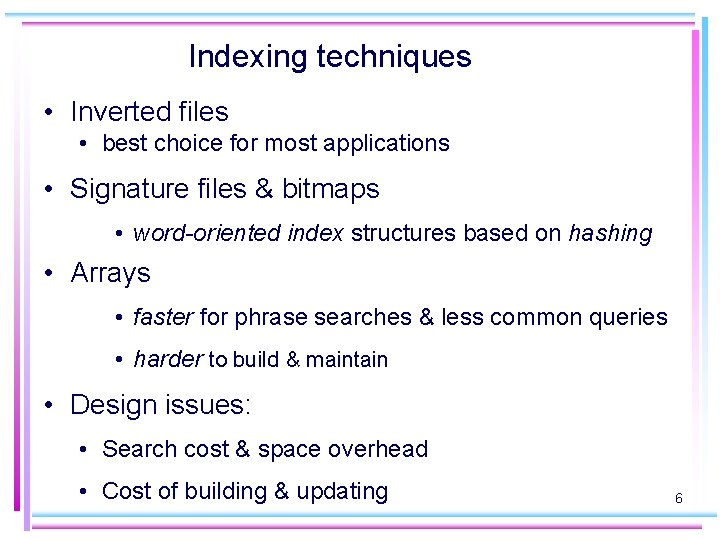
Indexing techniques • Inverted files • best choice for most applications • Signature files & bitmaps • word-oriented index structures based on hashing • Arrays • faster for phrase searches & less common queries • harder to build & maintain • Design issues: • Search cost & space overhead • Cost of building & updating 6
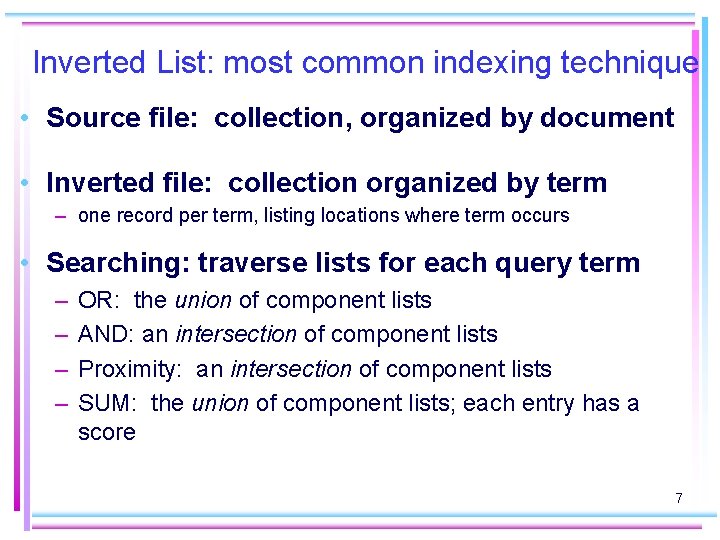
Inverted List: most common indexing technique • Source file: collection, organized by document • Inverted file: collection organized by term – one record per term, listing locations where term occurs • Searching: traverse lists for each query term – – OR: the union of component lists AND: an intersection of component lists Proximity: an intersection of component lists SUM: the union of component lists; each entry has a score 7
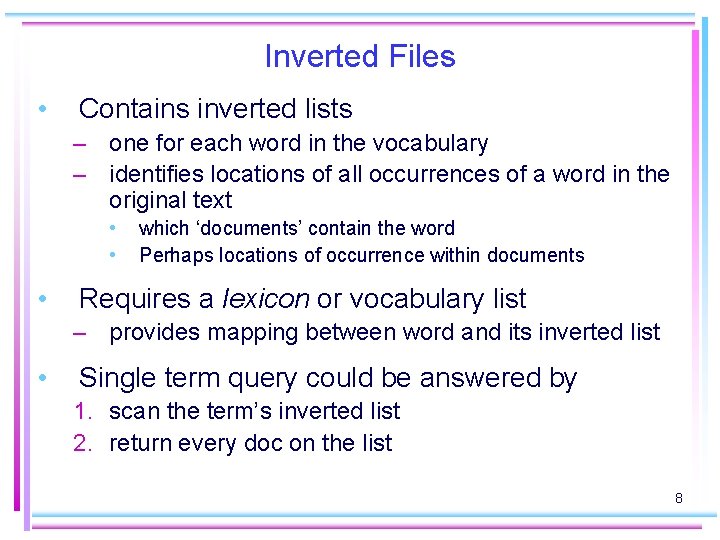
Inverted Files • Contains inverted lists – one for each word in the vocabulary – identifies locations of all occurrences of a word in the original text • • • which ‘documents’ contain the word Perhaps locations of occurrence within documents Requires a lexicon or vocabulary list – provides mapping between word and its inverted list • Single term query could be answered by 1. scan the term’s inverted list 2. return every doc on the list 8
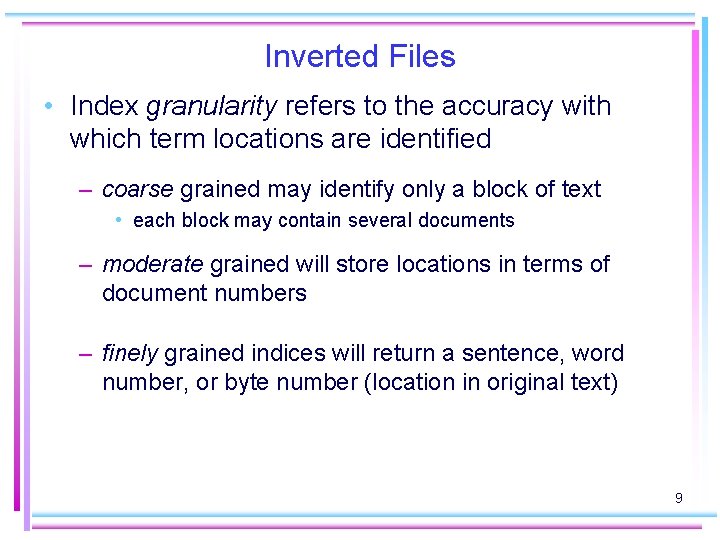
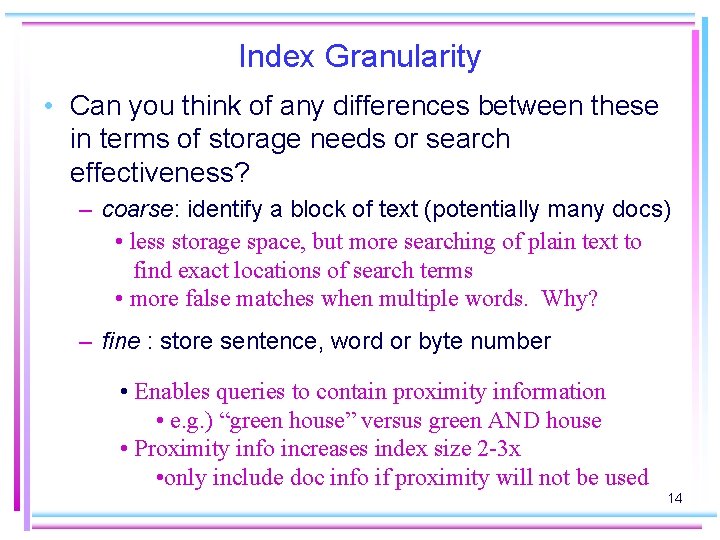
Inverted Files • Index granularity refers to the accuracy with which term locations are identified – coarse grained may identify only a block of text • each block may contain several documents – moderate grained will store locations in terms of document numbers – finely grained indices will return a sentence, word number, or byte number (location in original text) 9
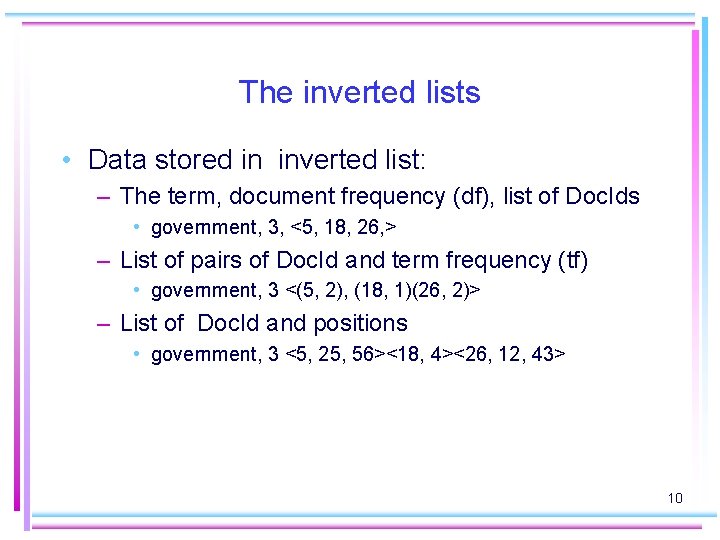
The inverted lists • Data stored in inverted list: – The term, document frequency (df), list of Doc. Ids • government, 3, <5, 18, 26, > – List of pairs of Doc. Id and term frequency (tf) • government, 3 <(5, 2), (18, 1)(26, 2)> – List of Doc. Id and positions • government, 3 <5, 25, 56><18, 4><26, 12, 43> 10
Inverted Files: Coarse 11
Inverted Files: Medium 12
Inverted Files: Fine 13
Index Granularity • Can you think of any differences between these in terms of storage needs or search effectiveness? – coarse: identify a block of text (potentially many docs) • less storage space, but more searching of plain text to find exact locations of search terms • more false matches when multiple words. Why? – fine : store sentence, word or byte number • Enables queries to contain proximity information • e. g. ) “green house” versus green AND house • Proximity info increases index size 2 -3 x • only include doc info if proximity will not be used 14
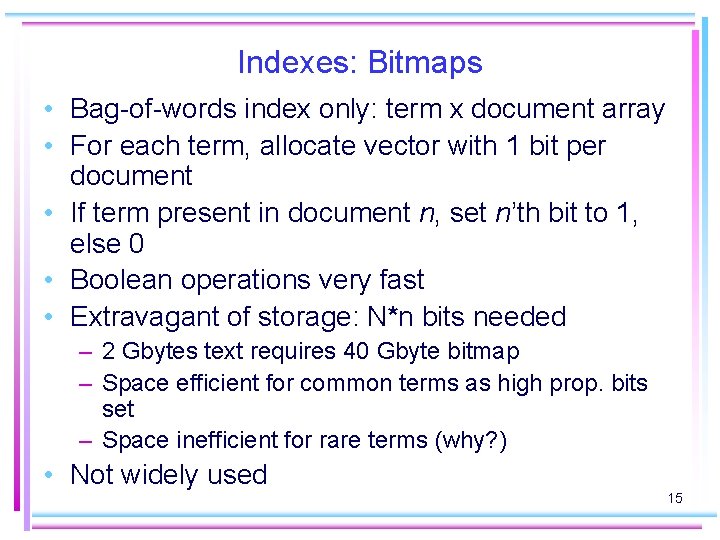
Indexes: Bitmaps • Bag-of-words index only: term x document array • For each term, allocate vector with 1 bit per document • If term present in document n, set n’th bit to 1, else 0 • Boolean operations very fast • Extravagant of storage: N*n bits needed – 2 Gbytes text requires 40 Gbyte bitmap – Space efficient for common terms as high prop. bits set – Space inefficient for rare terms (why? ) • Not widely used 15
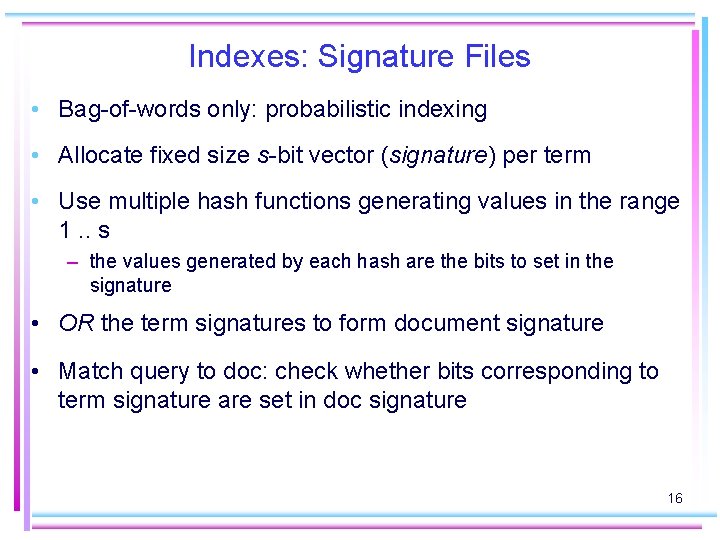
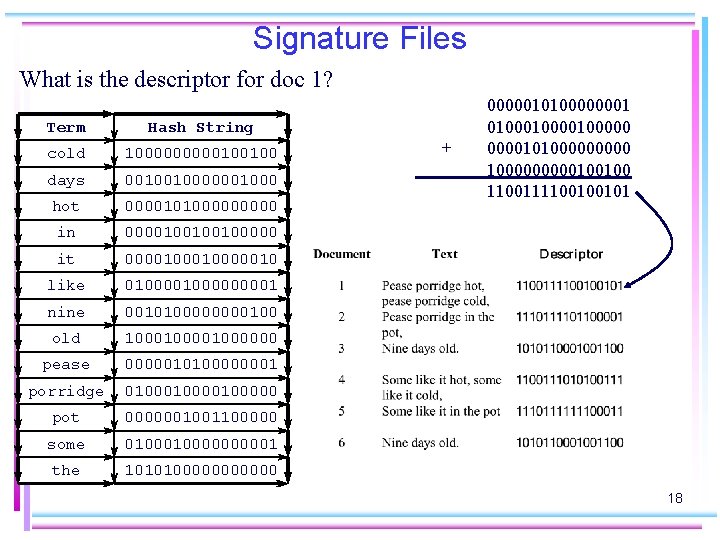
Indexes: Signature Files • Bag-of-words only: probabilistic indexing • Allocate fixed size s-bit vector (signature) per term • Use multiple hash functions generating values in the range 1. . s – the values generated by each hash are the bits to set in the signature • OR the term signatures to form document signature • Match query to doc: check whether bits corresponding to term signature are set in doc signature 16
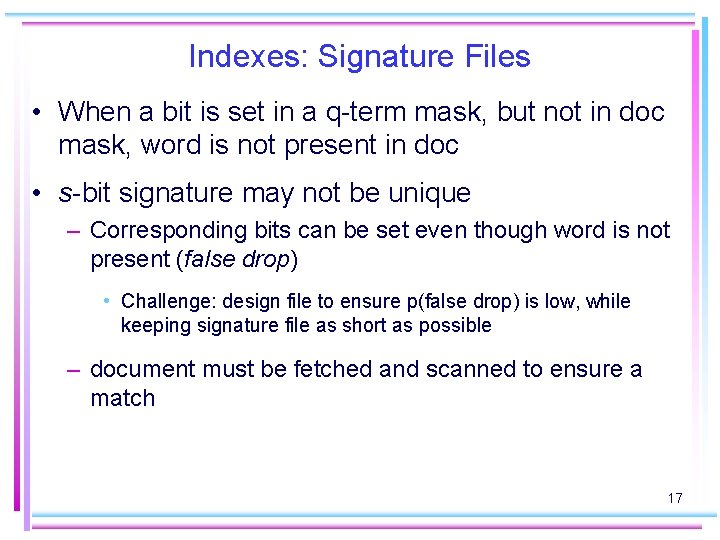
Indexes: Signature Files • When a bit is set in a q-term mask, but not in doc mask, word is not present in doc • s-bit signature may not be unique – Corresponding bits can be set even though word is not present (false drop) • Challenge: design file to ensure p(false drop) is low, while keeping signature file as short as possible – document must be fetched and scanned to ensure a match 17
Signature Files What is the descriptor for doc 1? Term Hash String cold 100000100100 days 0010010000001000 hot 000010100000 in 0000100100100000 it 000010000010 like 01000000001 nine 001010000100 old 100001000000 pease 0000010100000001 porridge 010000100000 pot 0000001001100000 some 010000000001 the 10101000000 + 0000010100000001 01000010000010100000100100 1100111100100101 18
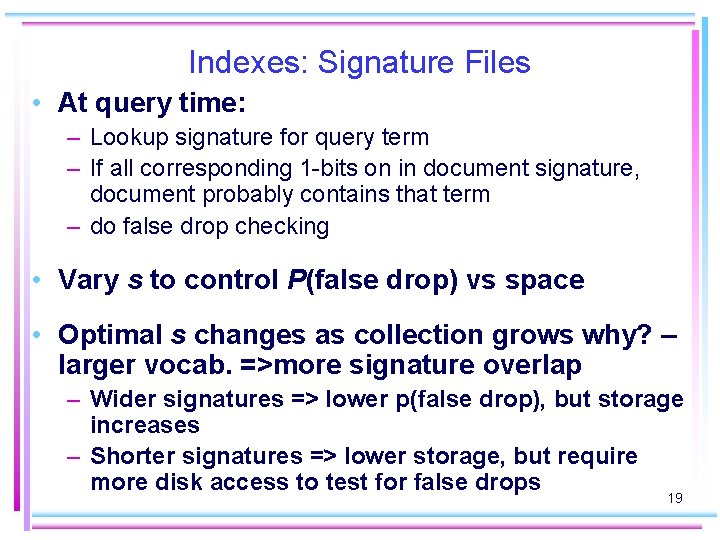
Indexes: Signature Files • At query time: – Lookup signature for query term – If all corresponding 1 -bits on in document signature, document probably contains that term – do false drop checking • Vary s to control P(false drop) vs space • Optimal s changes as collection grows why? – larger vocab. =>more signature overlap – Wider signatures => lower p(false drop), but storage increases – Shorter signatures => lower storage, but require more disk access to test for false drops 19
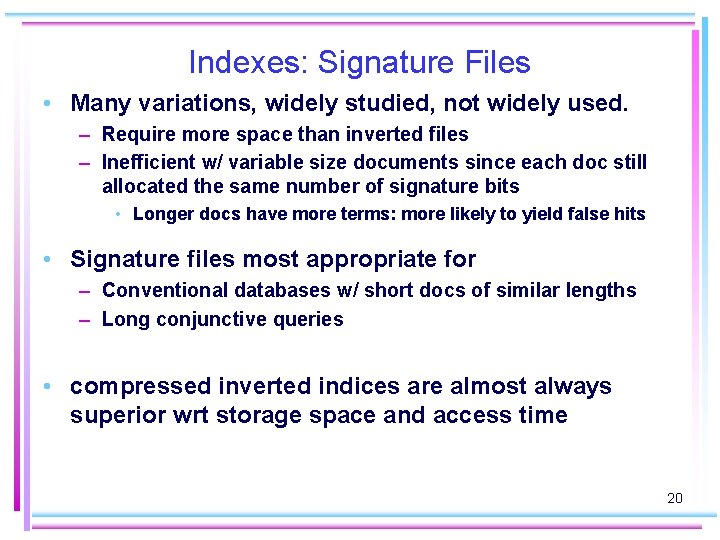
Indexes: Signature Files • Many variations, widely studied, not widely used. – Require more space than inverted files – Inefficient w/ variable size documents since each doc still allocated the same number of signature bits • Longer docs have more terms: more likely to yield false hits • Signature files most appropriate for – Conventional databases w/ short docs of similar lengths – Long conjunctive queries • compressed inverted indices are almost always superior wrt storage space and access time 20
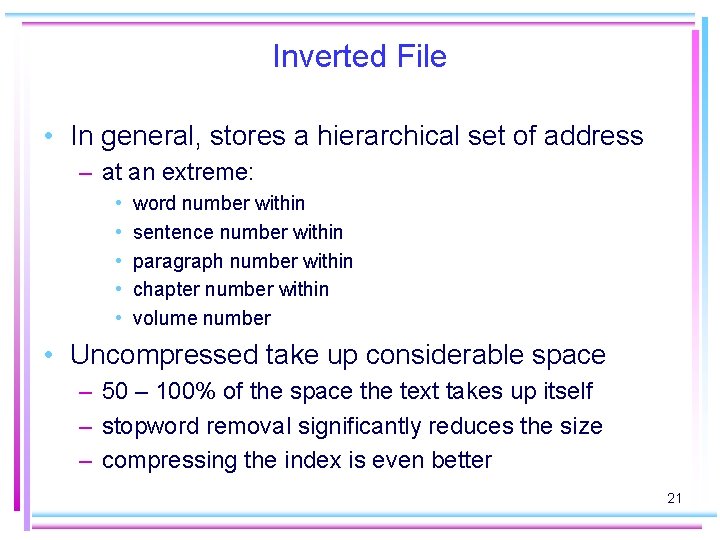
Inverted File • In general, stores a hierarchical set of address – at an extreme: • • • word number within sentence number within paragraph number within chapter number within volume number • Uncompressed take up considerable space – 50 – 100% of the space the text takes up itself – stopword removal significantly reduces the size – compressing the index is even better 21
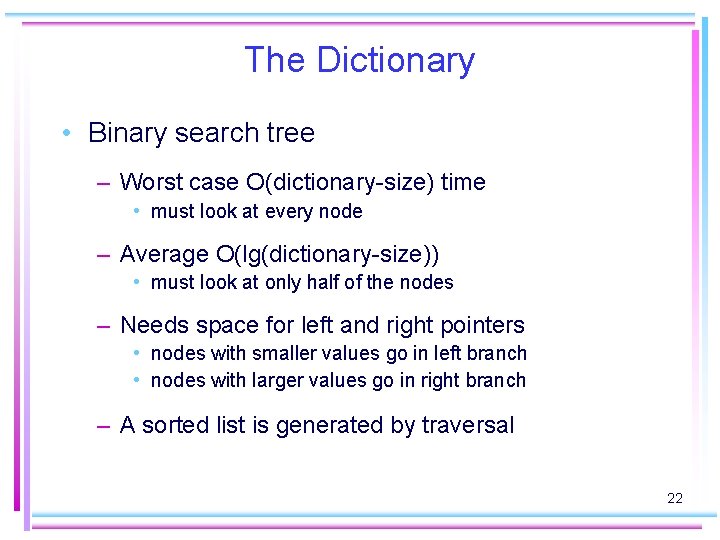
The Dictionary • Binary search tree – Worst case O(dictionary-size) time • must look at every node – Average O(lg(dictionary-size)) • must look at only half of the nodes – Needs space for left and right pointers • nodes with smaller values go in left branch • nodes with larger values go in right branch – A sorted list is generated by traversal 22
The dictionary • A sorted array – Binary search to find term in array O(log(sizedictionary)) • must search half the array to find the item – Insertion is slow O(size-dictionary) 23
The dictionary • A hash table – Search is fast O(1) – Does not generate a sorted dictionary 24
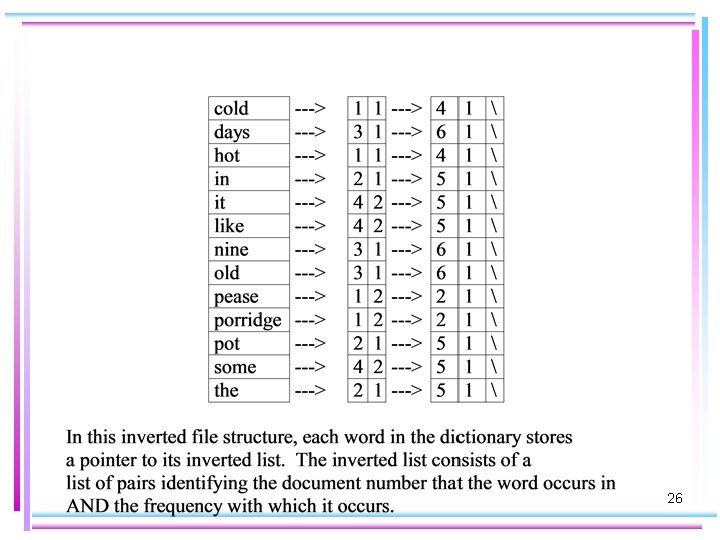
The inverted file • Dictionary – Stored in memory or – Secondary storage • Each record contains a pointer to inverted list, the term, possibly df, and a term number/ID • A postings file - a sequential file with inverted lists sorted by term ID 25
26
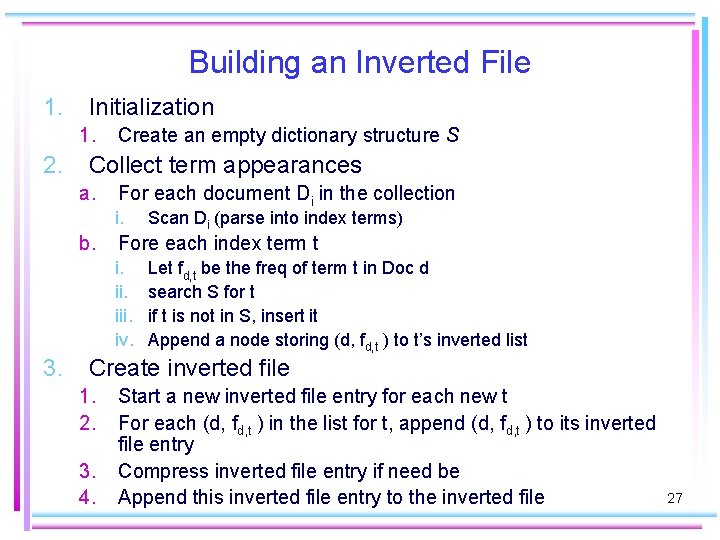
Building an Inverted File 1. Initialization 1. 2. Create an empty dictionary structure S Collect term appearances a. For each document Di in the collection i. b. Fore each index term t i. iii. iv. 3. Scan Di (parse into index terms) Let fd, t be the freq of term t in Doc d search S for t if t is not in S, insert it Append a node storing (d, fd, t ) to t’s inverted list Create inverted file 1. 2. 3. 4. Start a new inverted file entry for each new t For each (d, fd, t ) in the list for t, append (d, fd, t ) to its inverted file entry Compress inverted file entry if need be Append this inverted file entry to the inverted file 27
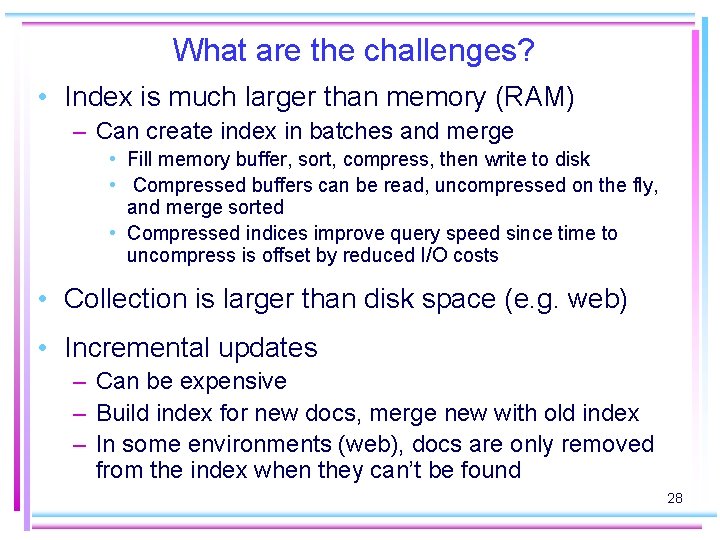
What are the challenges? • Index is much larger than memory (RAM) – Can create index in batches and merge • Fill memory buffer, sort, compress, then write to disk • Compressed buffers can be read, uncompressed on the fly, and merge sorted • Compressed indices improve query speed since time to uncompress is offset by reduced I/O costs • Collection is larger than disk space (e. g. web) • Incremental updates – Can be expensive – Build index for new docs, merge new with old index – In some environments (web), docs are only removed from the index when they can’t be found 28
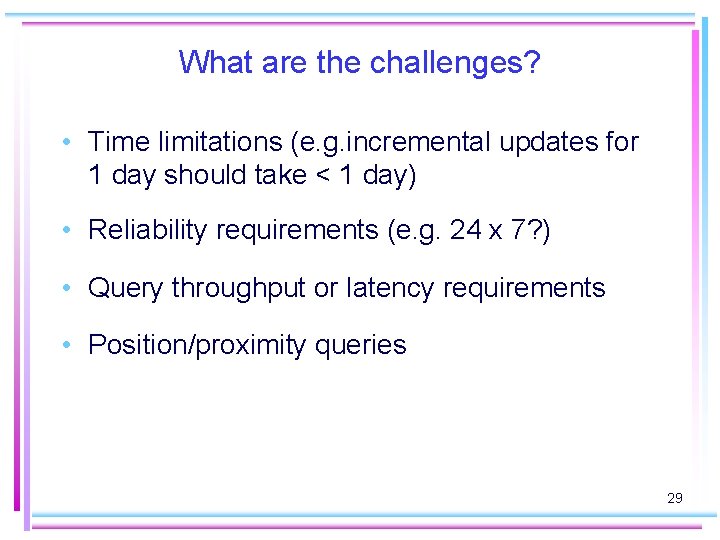
What are the challenges? • Time limitations (e. g. incremental updates for 1 day should take < 1 day) • Reliability requirements (e. g. 24 x 7? ) • Query throughput or latency requirements • Position/proximity queries 29
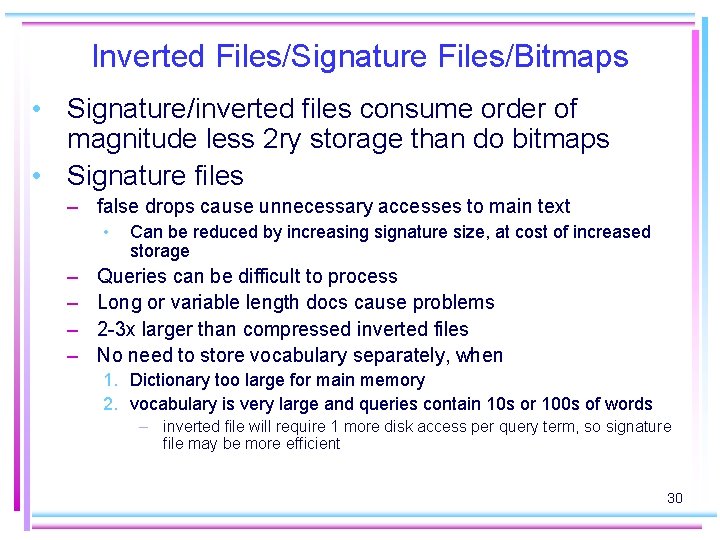
Inverted Files/Signature Files/Bitmaps • Signature/inverted files consume order of magnitude less 2 ry storage than do bitmaps • Signature files – false drops cause unnecessary accesses to main text • – – Can be reduced by increasing signature size, at cost of increased storage Queries can be difficult to process Long or variable length docs cause problems 2 -3 x larger than compressed inverted files No need to store vocabulary separately, when 1. Dictionary too large for main memory 2. vocabulary is very large and queries contain 10 s or 100 s of words – inverted file will require 1 more disk access per query term, so signature file may be more efficient 30
Inverted Files/Signature Files/Bitmaps • Inverted Files – As efficient for typical conjunctive queries as signature files – Can be compressed to address storage problems – Most useful for indexing large collection of variable length documents 31