
CS 333 Introduction to Operating Systems Class 9




- Slides: 77
CS 333 Introduction to Operating Systems Class 9 - Memory Management Jonathan Walpole q Computer Science Portland State University q q
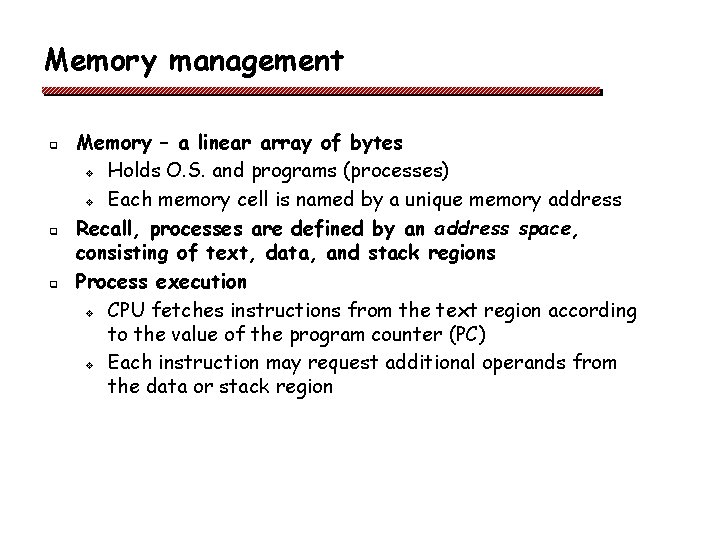
Memory management q q q Memory – a linear array of bytes v Holds O. S. and programs (processes) v Each memory cell is named by a unique memory address Recall, processes are defined by an address space, consisting of text, data, and stack regions Process execution v CPU fetches instructions from the text region according to the value of the program counter (PC) v Each instruction may request additional operands from the data or stack region
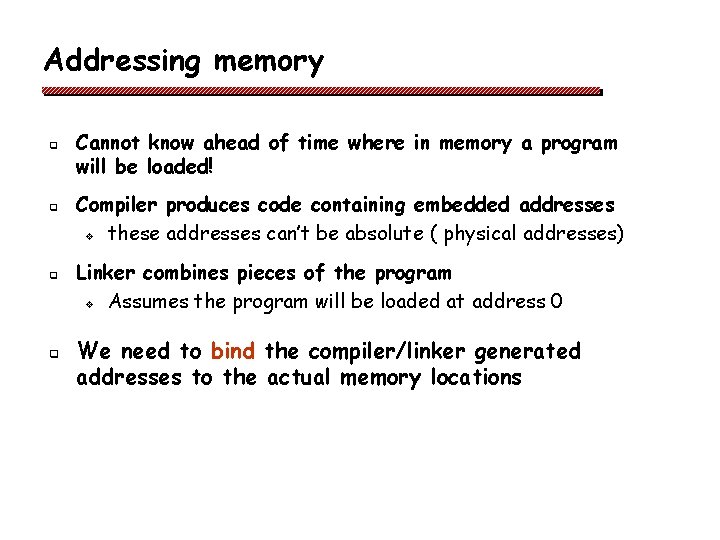
Addressing memory q q Cannot know ahead of time where in memory a program will be loaded! Compiler produces code containing embedded addresses v these addresses can’t be absolute ( physical addresses) Linker combines pieces of the program v Assumes the program will be loaded at address 0 We need to bind the compiler/linker generated addresses to the actual memory locations
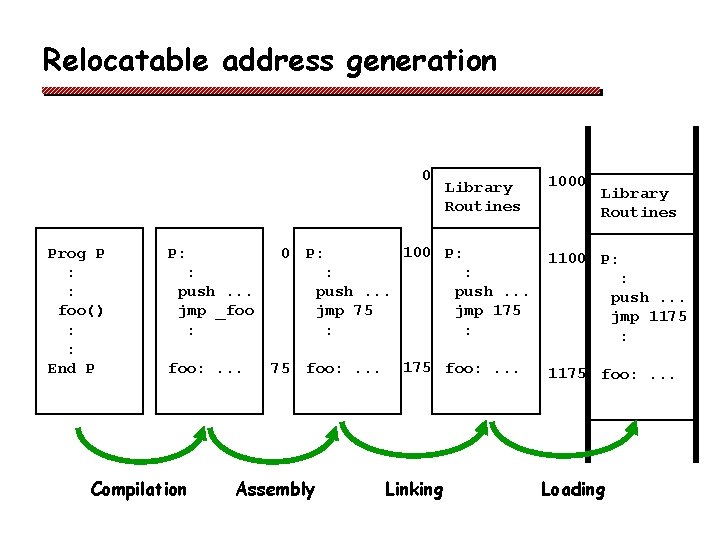
Relocatable address generation 0 Prog P : : foo() : : End P P: : push. . . jmp _foo : foo: . . . Compilation Library Routines 100 P: : : push. . . jmp 175 jmp 75 : : 75 foo: . . . Assembly 175 foo: . . . Linking 1000 Library Routines 1100 P: : push. . . jmp 1175 : 1175 foo: . . . Loading
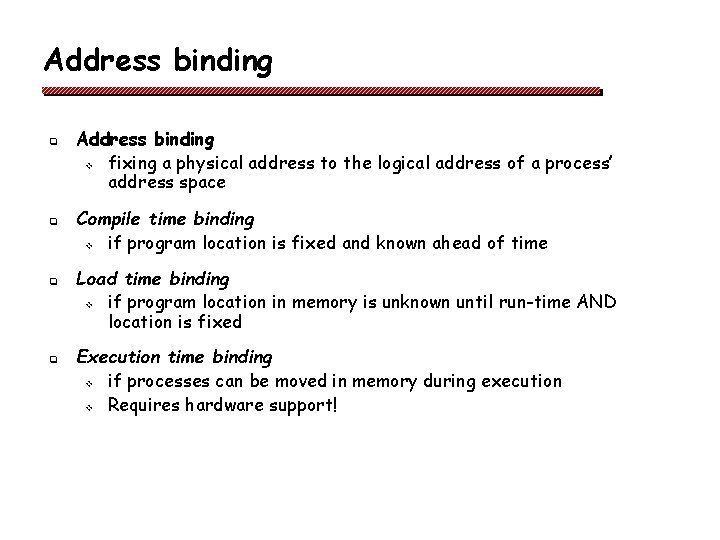
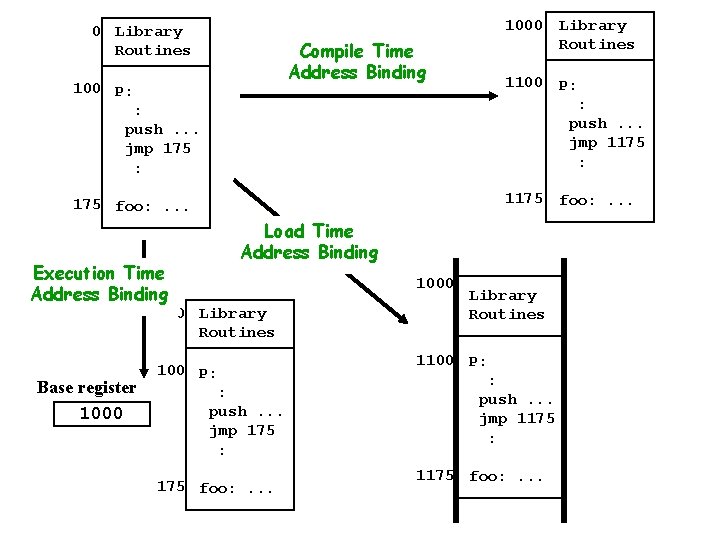
Address binding q q Address binding v fixing a physical address to the logical address of a process’ address space Compile time binding v if program location is fixed and known ahead of time Load time binding v if program location in memory is unknown until run-time AND location is fixed Execution time binding v if processes can be moved in memory during execution v Requires hardware support!
0 Library Routines Compile Time Address Binding 100 P: 1000 Library Routines 1100 P: : push. . . jmp 1175 : : push. . . jmp 175 : 1175 foo: . . . Execution Time Address Binding Base register 1000 Load Time Address Binding 1000 0 Library Routines 100 P: : push. . . jmp 175 : 175 foo: . . . Library Routines 1100 P: : push. . . jmp 1175 : 1175 foo: . . .
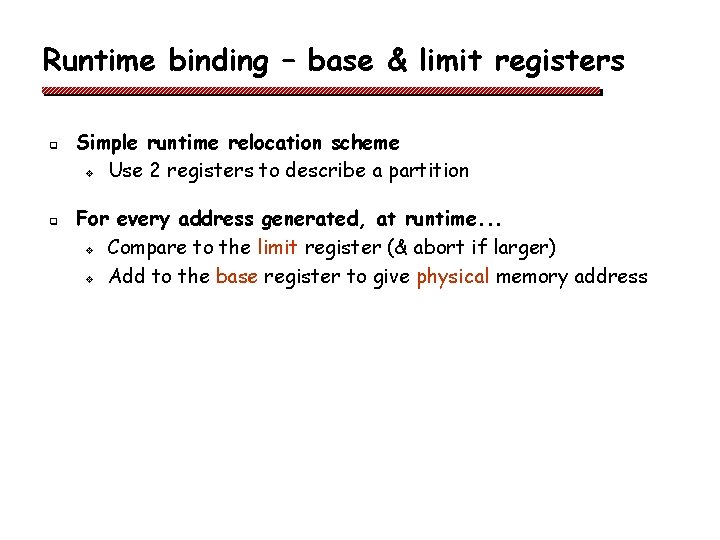
Runtime binding – base & limit registers q q Simple runtime relocation scheme v Use 2 registers to describe a partition For every address generated, at runtime. . . v Compare to the limit register (& abort if larger) v Add to the base register to give physical memory address
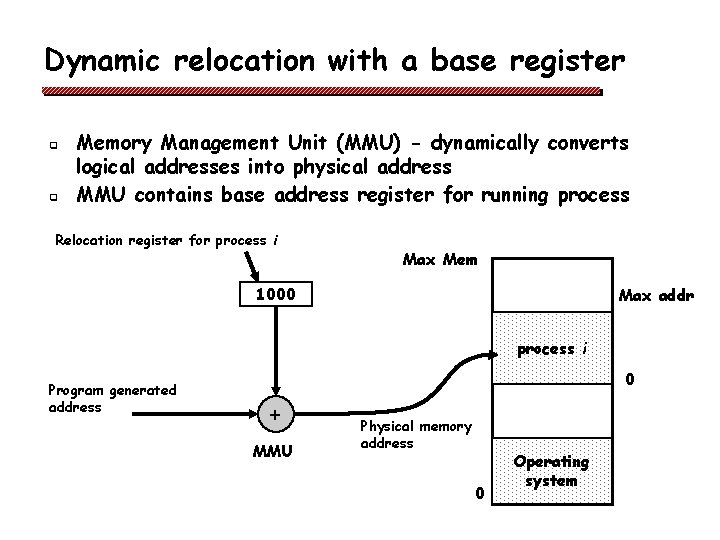
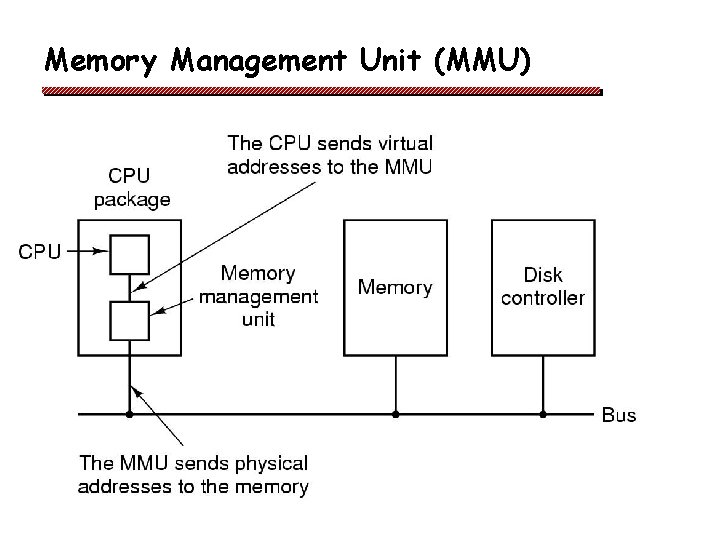
Dynamic relocation with a base register q q Memory Management Unit (MMU) - dynamically converts logical addresses into physical address MMU contains base address register for running process Relocation register for process i Max Mem 1000 Max addr process i Program generated address 0 + MMU Physical memory address 0 Operating system
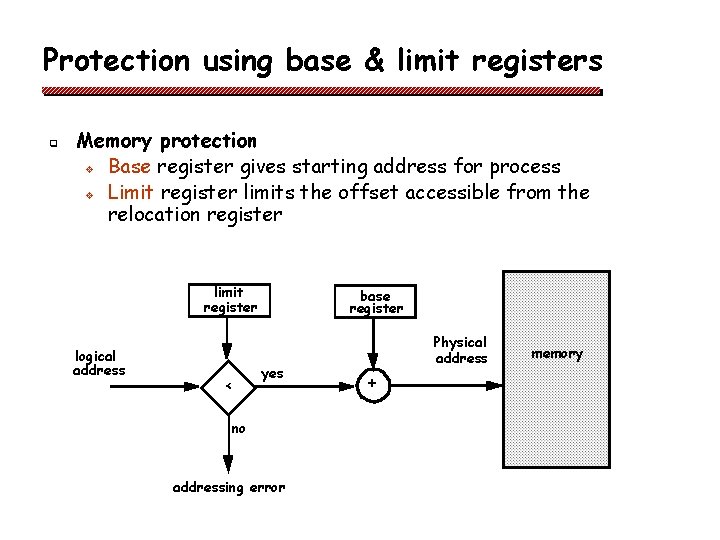
Protection using base & limit registers q Memory protection v Base register gives starting address for process v Limit register limits the offset accessible from the relocation register limit register logical address < base register yes no addressing error Physical address + memory
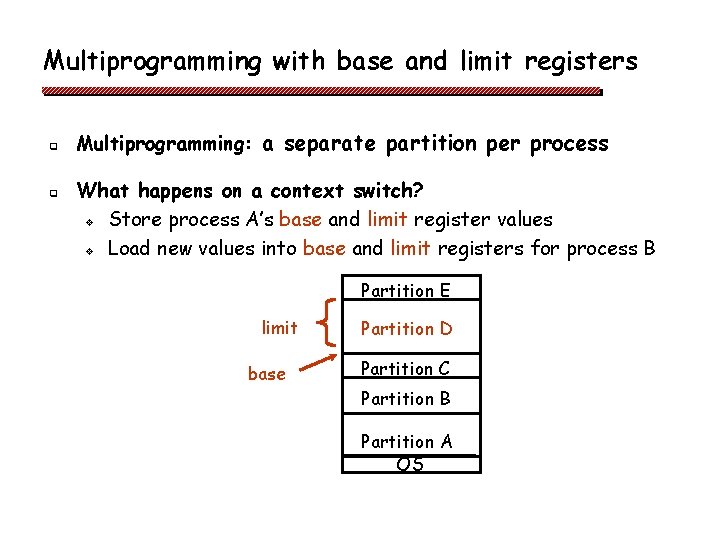
Multiprogramming with base and limit registers q q Multiprogramming: a separate partition per process What happens on a context switch? v Store process A’s base and limit register values v Load new values into base and limit registers for process B Partition E limit base Partition D Partition C Partition B Partition A OS
Swapping q q q When a program is running. . . v The entire program must be in memory v Each program is put into a single partition When the program is not running. . . v May remain resident in memory v May get “swapped” out to disk Over time. . . v Programs come into memory when they get swapped in v Programs leave memory when they get swapped out
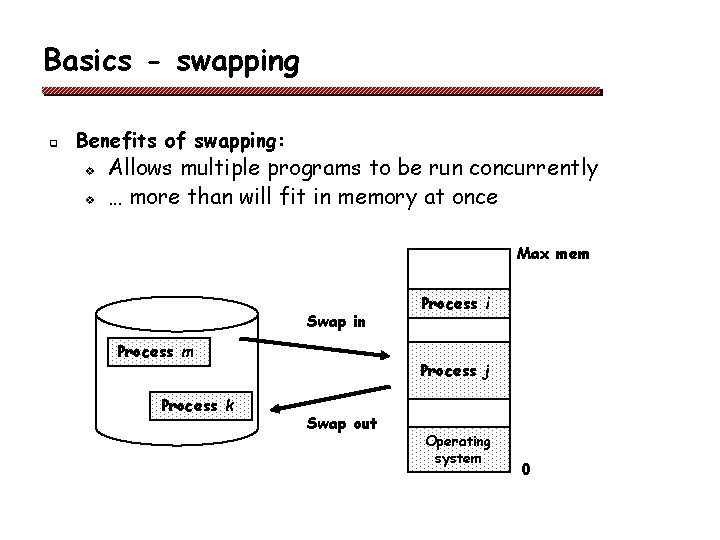
Basics - swapping q Benefits of swapping: v v Allows multiple programs to be run concurrently … more than will fit in memory at once Max mem Swap in Process m Process k Process i Process j Swap out Operating system 0
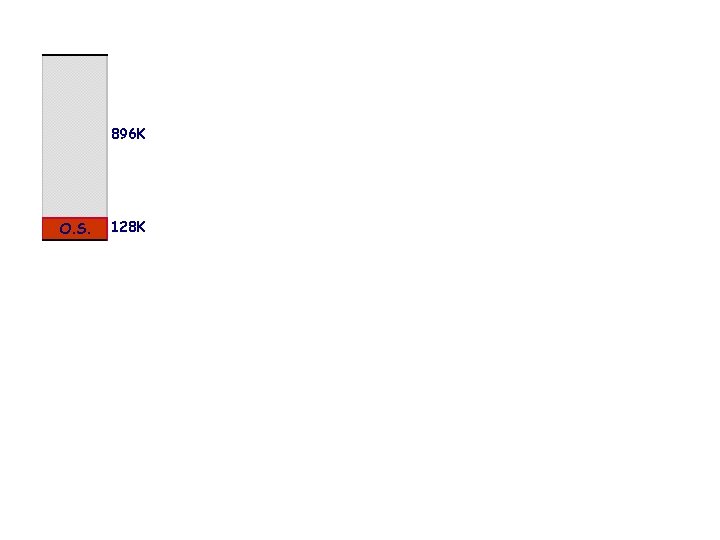
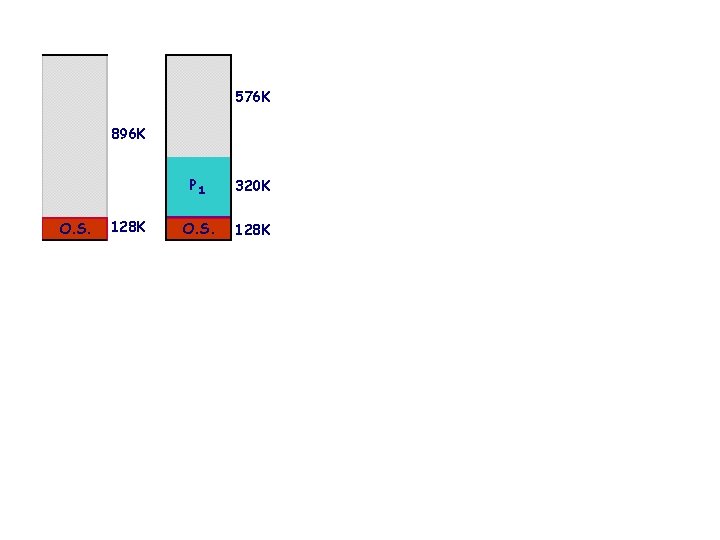
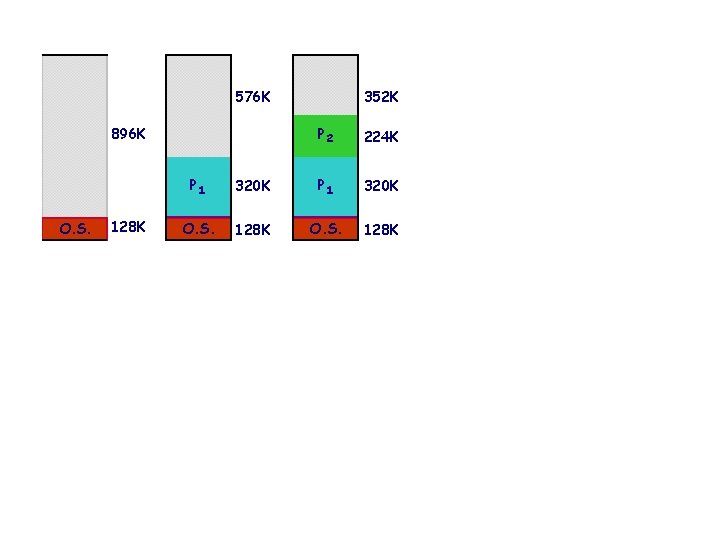
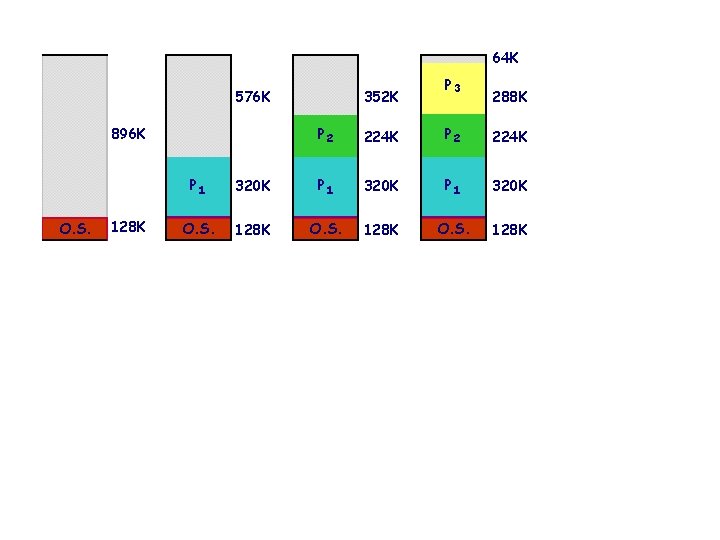
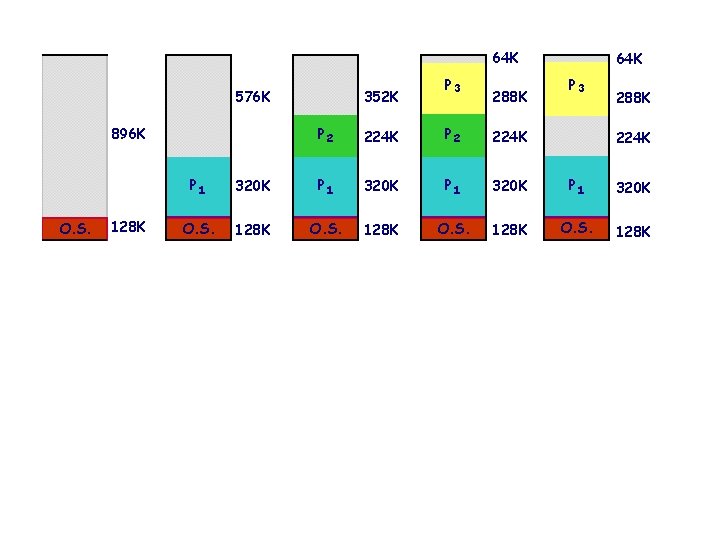
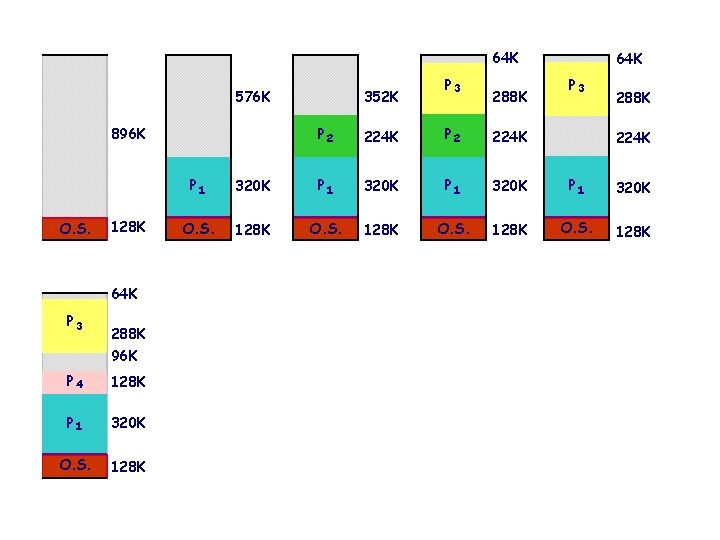
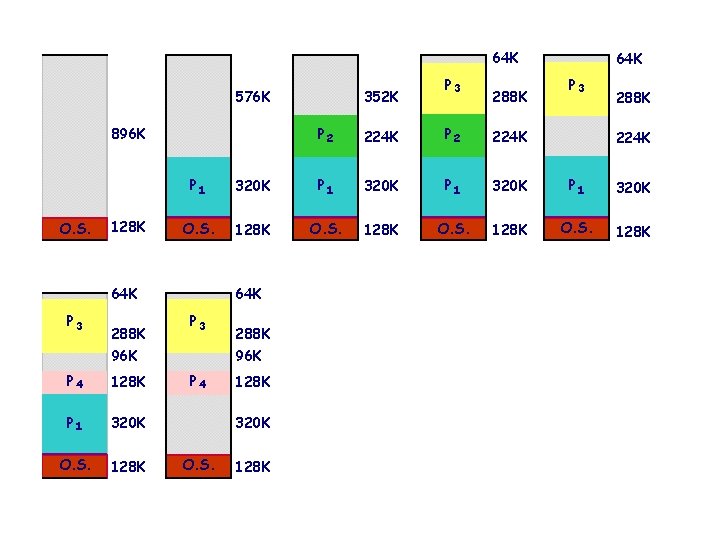
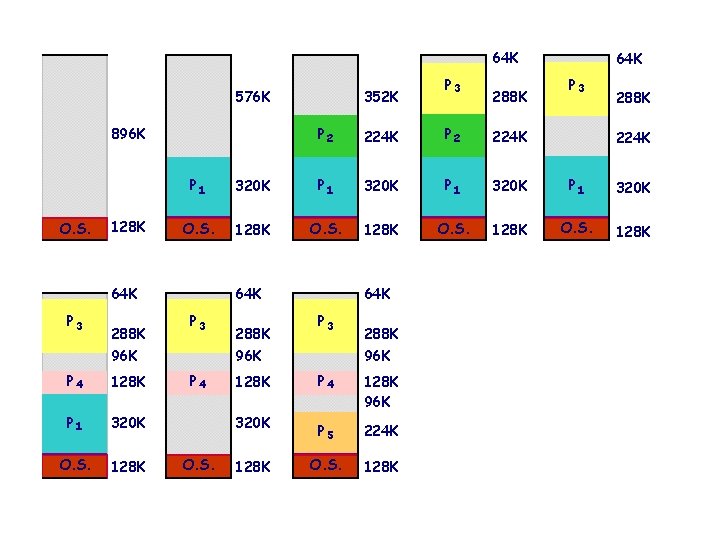
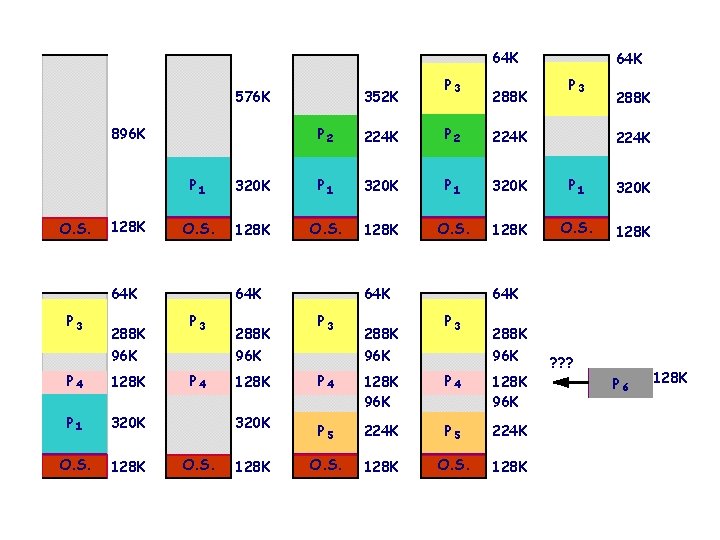
Swapping can lead to fragmentation
896 K O. S. 128 K
576 K 896 K O. S. 128 K P 1 320 K O. S. 128 K
576 K 896 K O. S. 128 K 352 K P 2 224 K P 1 320 K O. S. 128 K
64 K 576 K 896 K O. S. 128 K 352 K P 3 288 K P 2 224 K P 1 320 K O. S. 128 K
64 K 576 K 896 K O. S. 128 K 352 K P 3 288 K P 2 224 K 64 K P 3 288 K 224 K P 1 320 K O. S. 128 K
64 K 576 K 896 K O. S. 128 K 64 K P 3 288 K 96 K P 4 128 K P 1 320 K O. S. 128 K 352 K P 3 288 K P 2 224 K 64 K P 3 288 K 224 K P 1 320 K O. S. 128 K
64 K 576 K 896 K O. S. 128 K 288 K 128 K P 1 320 K O. S. 128 K 288 K P 2 224 K P 3 288 K 224 K 320 K P 1 320 K O. S. 128 K 64 K P 3 96 K P 4 P 3 P 1 64 K P 3 352 K 64 K 288 K 96 K P 4 128 K 320 K O. S. 128 K
64 K 576 K 896 K O. S. 128 K 288 K 128 K P 1 320 K O. S. 128 K 288 K P 2 224 K P 3 288 K 224 K 320 K P 1 320 K O. S. 128 K 64 K P 3 96 K P 4 P 3 P 1 64 K P 3 352 K 64 K 288 K 64 K P 3 96 K P 4 128 K 320 K O. S. 128 K 288 K 96 K P 4 128 K 96 K P 5 224 K O. S. 128 K
64 K 576 K 896 K O. S. 128 K 288 K 128 K P 1 320 K O. S. 128 K 288 K P 2 224 K P 3 288 K 224 K 320 K P 1 320 K O. S. 128 K 64 K P 3 96 K P 4 P 3 P 1 64 K P 3 352 K 64 K 288 K 64 K P 3 96 K P 4 128 K 320 K O. S. 128 K 288 K 64 K P 3 96 K 288 K 96 K P 4 128 K 96 K P 5 224 K O. S. 128 K ? ? ? P 6 128 K
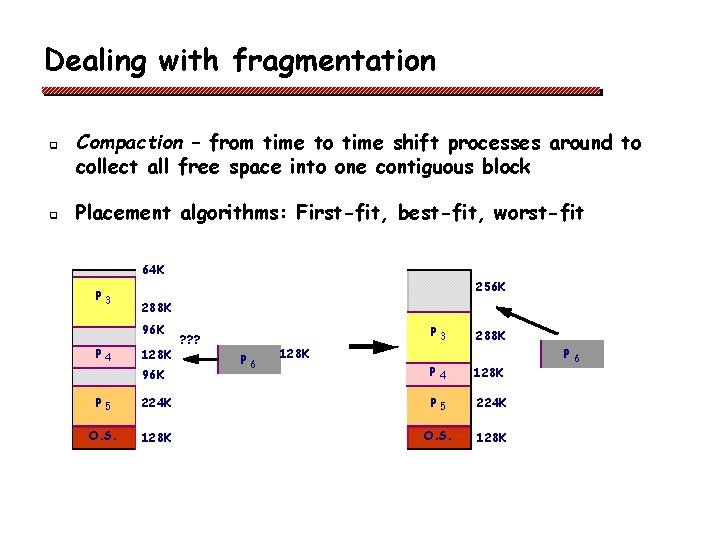
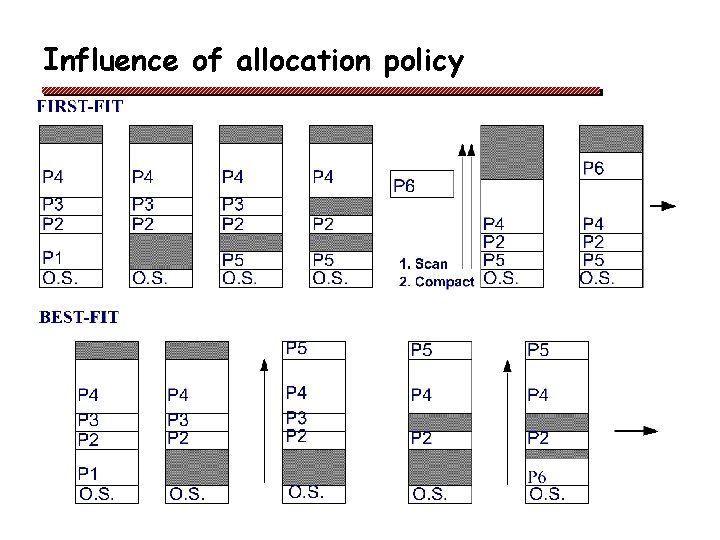
Dealing with fragmentation q q Compaction – from time to time shift processes around to collect all free space into one contiguous block Placement algorithms: First-fit, best-fit, worst-fit 64 K P 3 256 K 288 K 96 K P 4 128 K 96 K P 3 ? ? ? P 6 288 K 128 K P 4 128 K P 5 224 K O. S. 128 K P 6
Influence of allocation policy
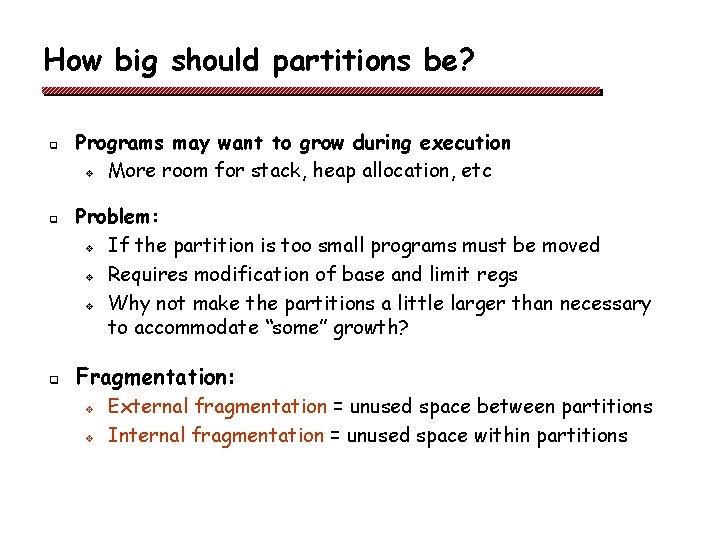
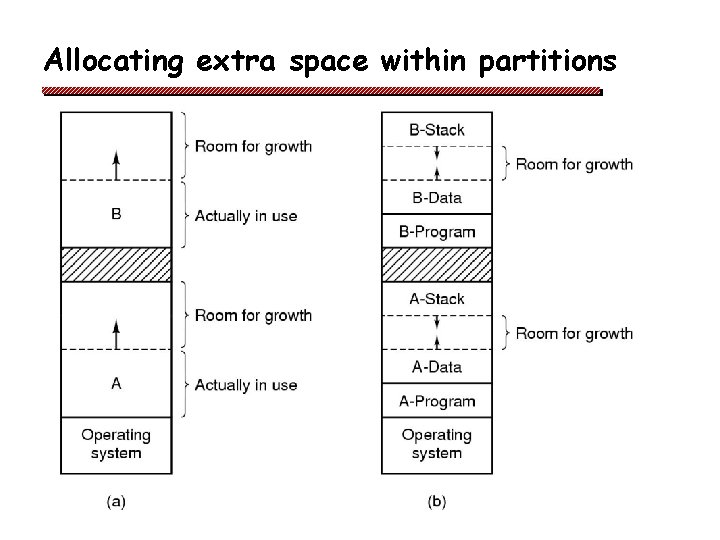
How big should partitions be? q q q Programs may want to grow during execution v More room for stack, heap allocation, etc Problem: v If the partition is too small programs must be moved v Requires modification of base and limit regs v Why not make the partitions a little larger than necessary to accommodate “some” growth? Fragmentation: v v External fragmentation = unused space between partitions Internal fragmentation = unused space within partitions
Allocating extra space within partitions
Managing memory q q Each chunk of memory is either v Used by some process or unused (“free”) Operations v Allocate a chunk of unused memory big enough to hold a new process v Free a chunk of memory by returning it to the free pool after a process terminates or is swapped out
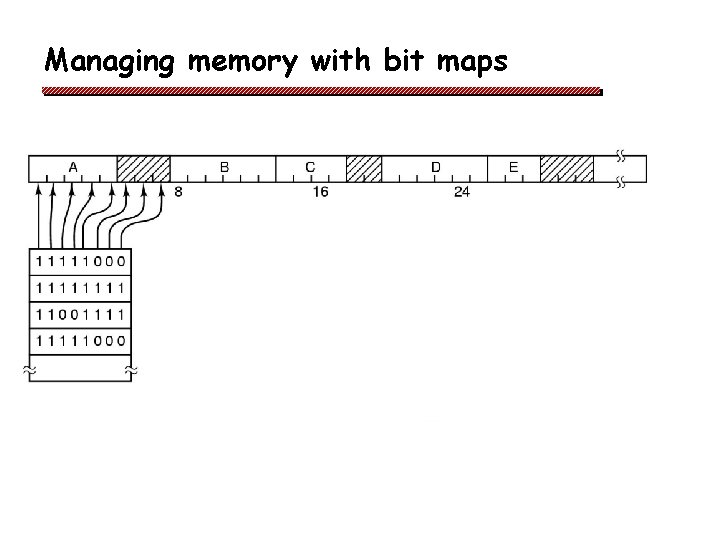
Managing memory with bit maps q q Problem - how to keep track of used and unused memory? Technique 1 - Bit Maps v v A long bit string One bit for every chunk of memory 1 = in use 0 = free v Size of allocation unit influences space required • Example: unit size = 32 bits – overhead for bit map: 1/33 = 3% • Example: unit size = 4 Kbytes – overhead for bit map: 1/32, 769
Managing memory with bit maps q
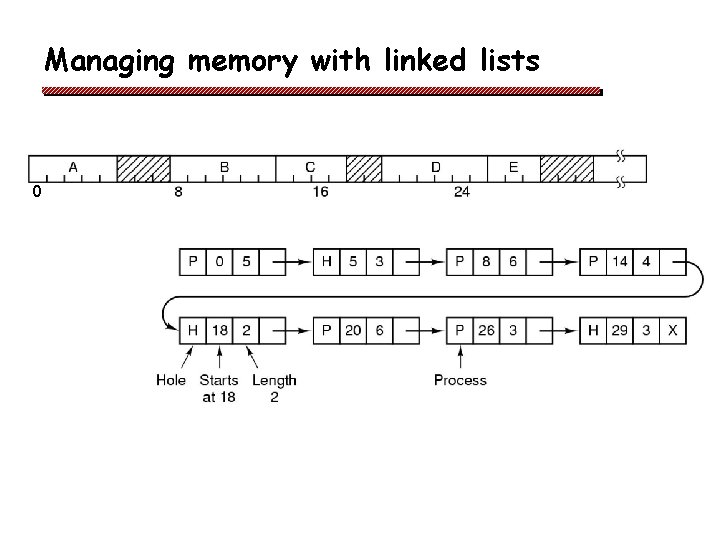
Managing memory with linked lists q q q Technique 2 - Linked List Keep a list of elements Each element describes one unit of memory v v Free / in-use Bit (“P=process, H=hole”) Starting address Length Pointer to next element
Managing memory with linked lists q 0
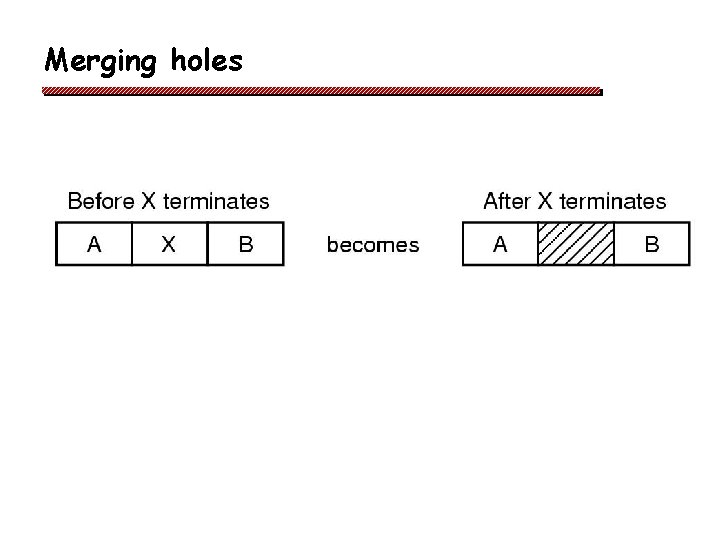
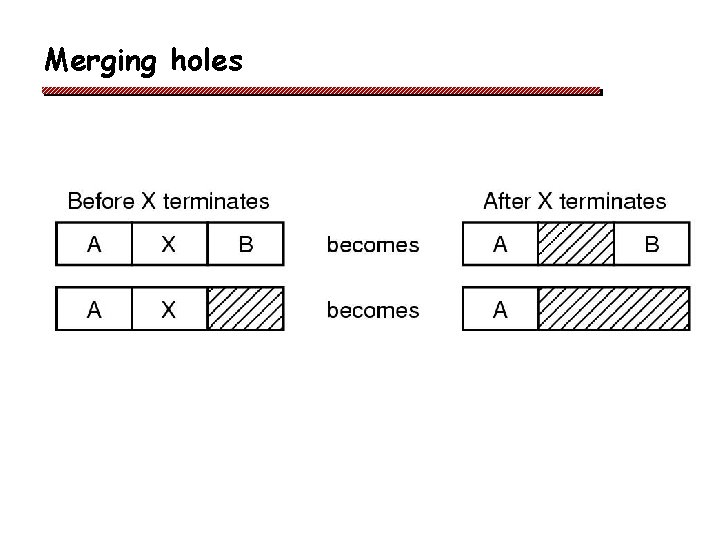
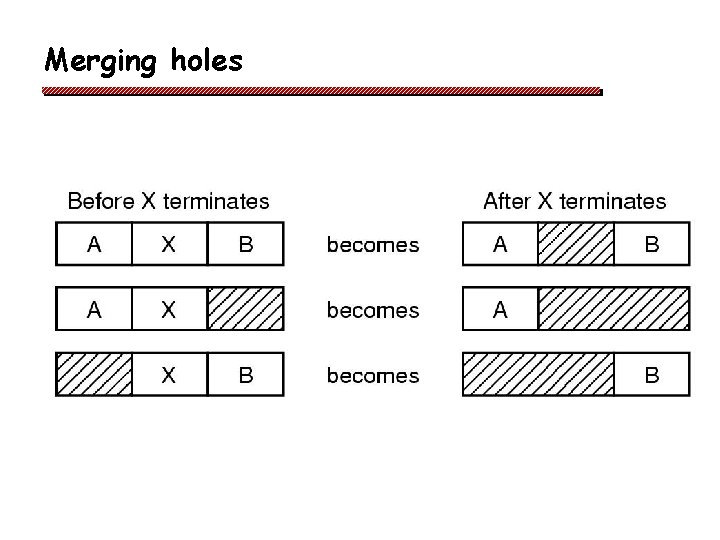
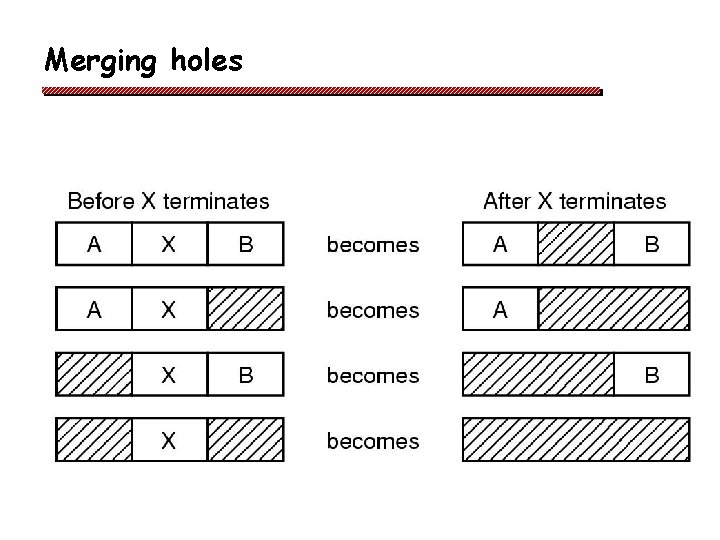
Merging holes q Whenever a unit of memory is freed we want to merge adjacent holes!
Merging holes
Merging holes
Merging holes
Merging holes
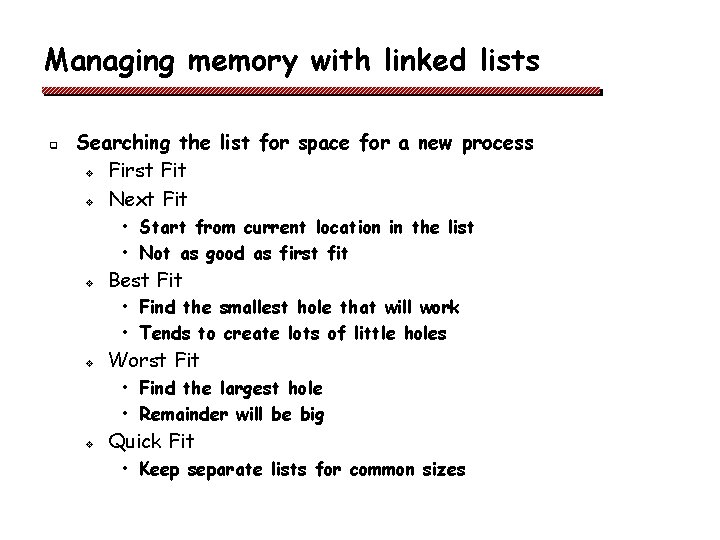
Managing memory with linked lists q Searching the list for space for a new process v First Fit v Next Fit • Start from current location in the list • Not as good as first fit v Best Fit • Find the smallest hole that will work • Tends to create lots of little holes v Worst Fit • Find the largest hole • Remainder will be big v Quick Fit • Keep separate lists for common sizes
Fragmentation q q q Memory is divided into partitions Each partition has a different size Processes are allocated space and later freed After a while memory will be full of small holes! v No free space large enough for a new process even though there is enough free memory in total v This is external fragmentation If we allow free space within a partition we have internal fragmentation
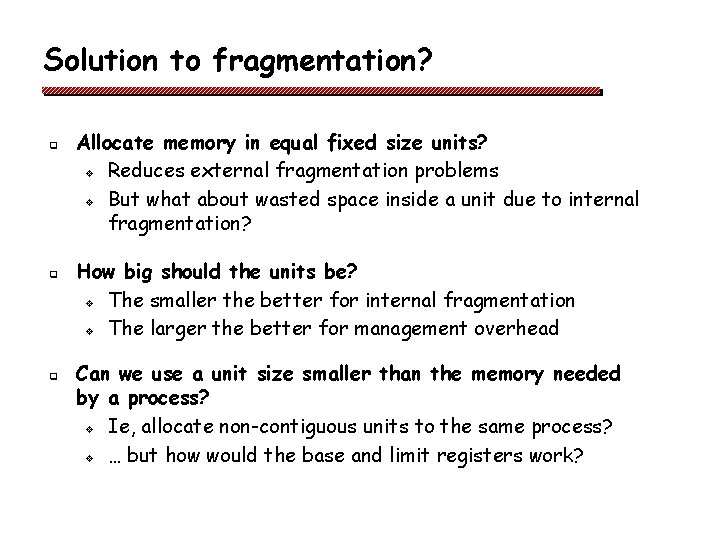
Solution to fragmentation? q q q Allocate memory in equal fixed size units? v Reduces external fragmentation problems v But what about wasted space inside a unit due to internal fragmentation? How big should the units be? v The smaller the better for internal fragmentation v The larger the better for management overhead Can we use a unit size smaller than the memory needed by a process? v Ie, allocate non-contiguous units to the same process? v … but how would the base and limit registers work?
Using pages for non-contiguous allocation q q q Memory divided into fixed size page frames n v Page frame size = 2 bytes v Lowest n bits of an address specify byte offset in page But how do we associate page frames with processes? v And how do we map memory addresses within a process to the correct memory byte in a page frame? Solution v Processes use virtual addresses v CPU uses physical addresses v hardware support for virtual to physical address translation
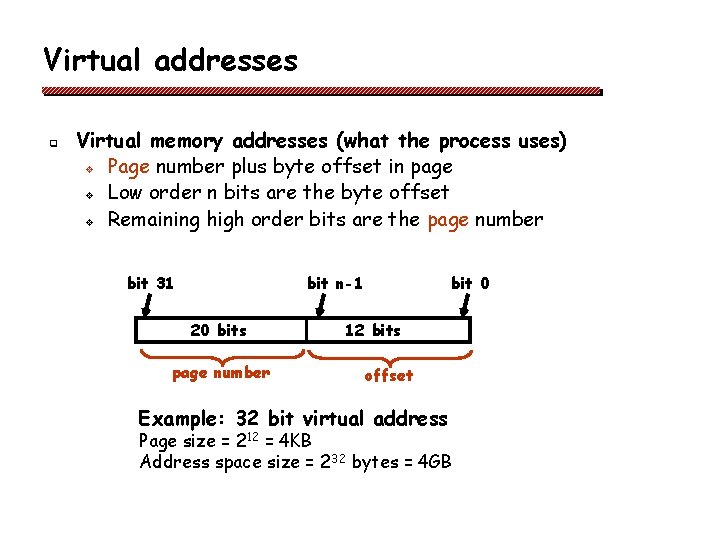
Virtual addresses q Virtual memory addresses (what the process uses) v Page number plus byte offset in page v Low order n bits are the byte offset v Remaining high order bits are the page number bit 31 bit n-1 20 bits page number bit 0 12 bits offset Example: 32 bit virtual address Page size = 212 = 4 KB Address space size = 232 bytes = 4 GB
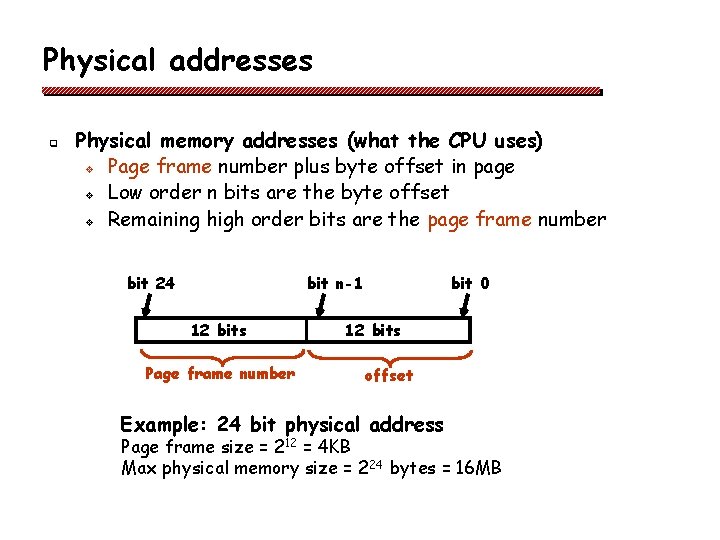
Physical addresses q Physical memory addresses (what the CPU uses) v Page frame number plus byte offset in page v Low order n bits are the byte offset v Remaining high order bits are the page frame number bit 24 bit n-1 12 bits Page frame number bit 0 12 bits offset Example: 24 bit physical address Page frame size = 212 = 4 KB Max physical memory size = 224 bytes = 16 MB
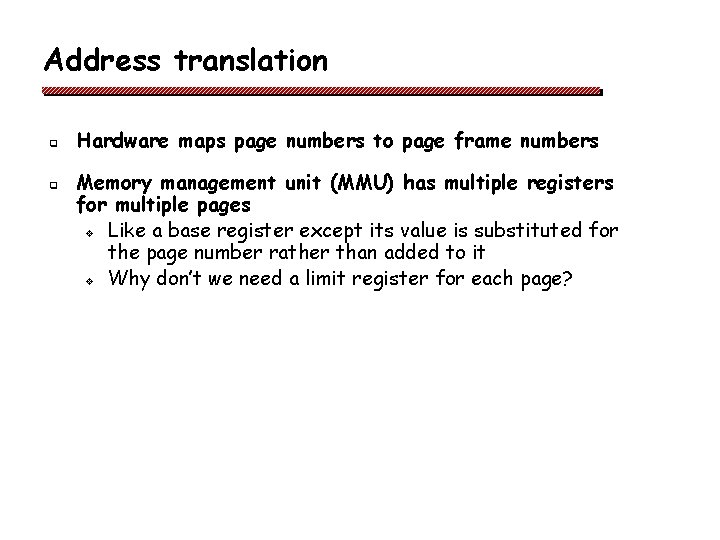
Address translation q q Hardware maps page numbers to page frame numbers Memory management unit (MMU) has multiple registers for multiple pages v Like a base register except its value is substituted for the page number rather than added to it v Why don’t we need a limit register for each page?
Memory Management Unit (MMU) q
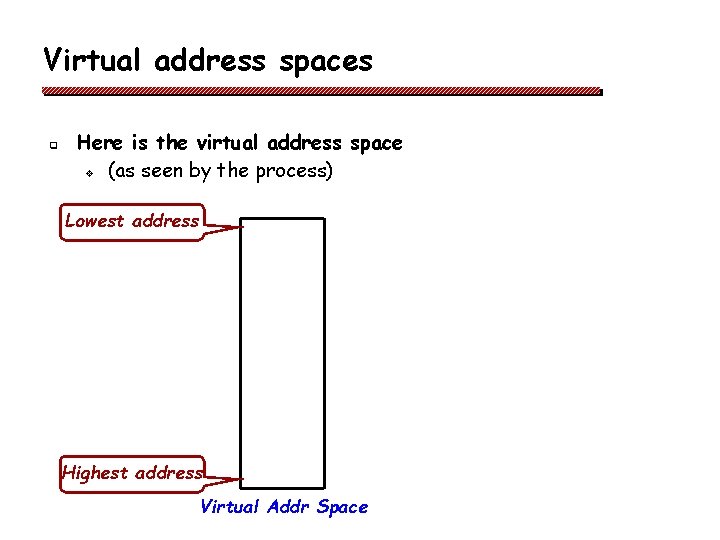
Virtual address spaces q Here is the virtual address space v (as seen by the process) Lowest address Highest address Virtual Addr Space
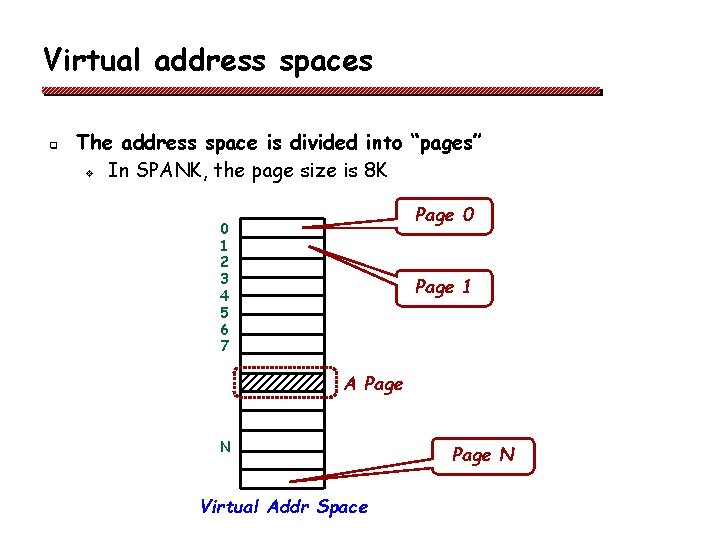
Virtual address spaces q The address space is divided into “pages” v In SPANK, the page size is 8 K Page 0 0 1 2 3 4 5 6 7 Page 1 A Page N Virtual Addr Space Page N
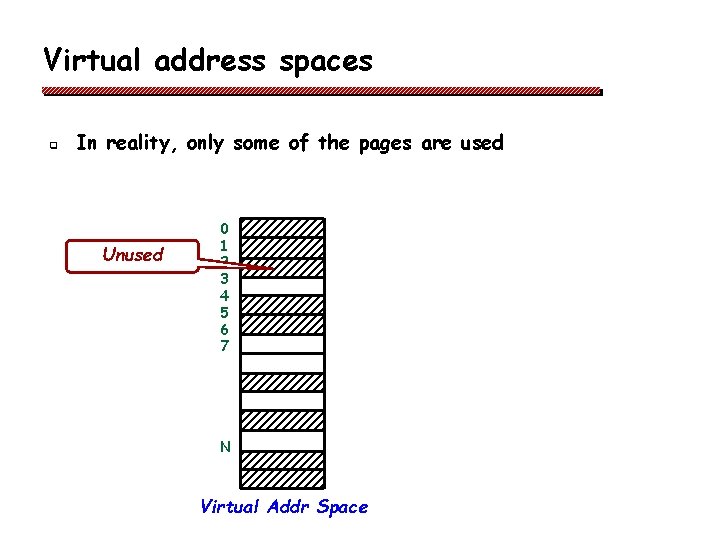
Virtual address spaces q In reality, only some of the pages are used Unused 0 1 2 3 4 5 6 7 N Virtual Addr Space
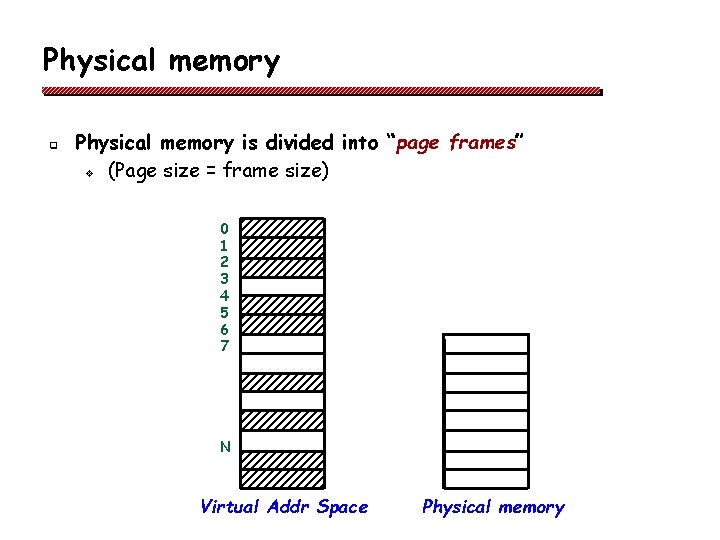
Physical memory q Physical memory is divided into “page frames” v (Page size = frame size) 0 1 2 3 4 5 6 7 N Virtual Addr Space Physical memory
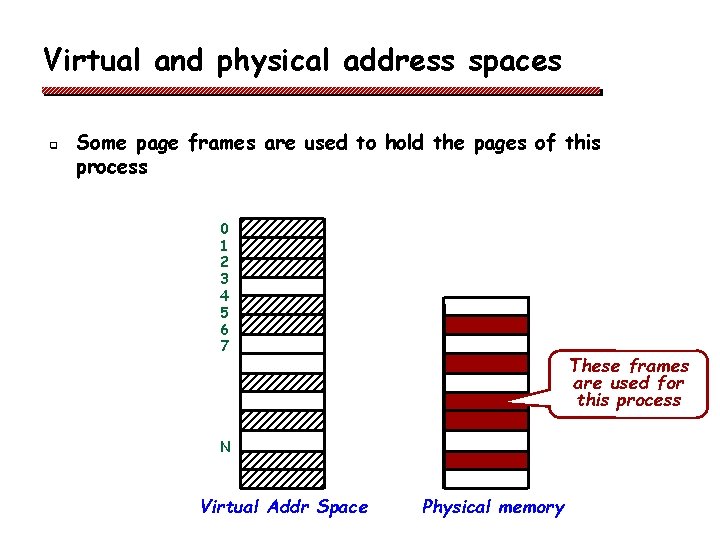
Virtual and physical address spaces q Some page frames are used to hold the pages of this process 0 1 2 3 4 5 6 7 These frames are used for this process N Virtual Addr Space Physical memory
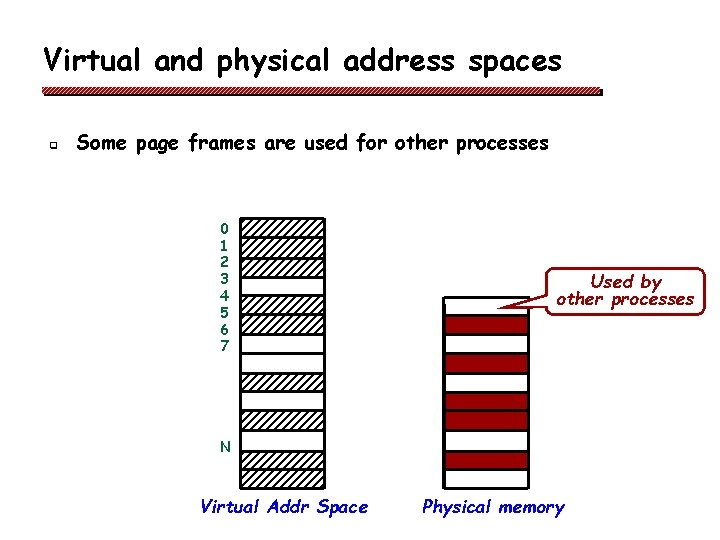
Virtual and physical address spaces q Some page frames are used for other processes 0 1 2 3 4 5 6 7 Used by other processes N Virtual Addr Space Physical memory
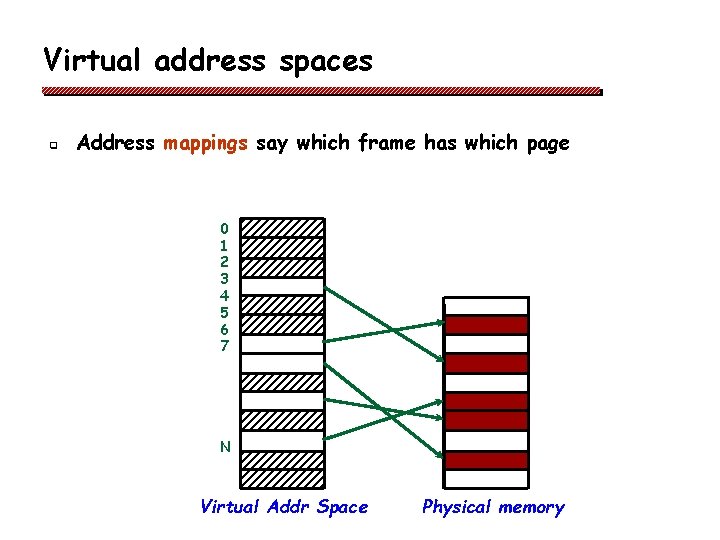
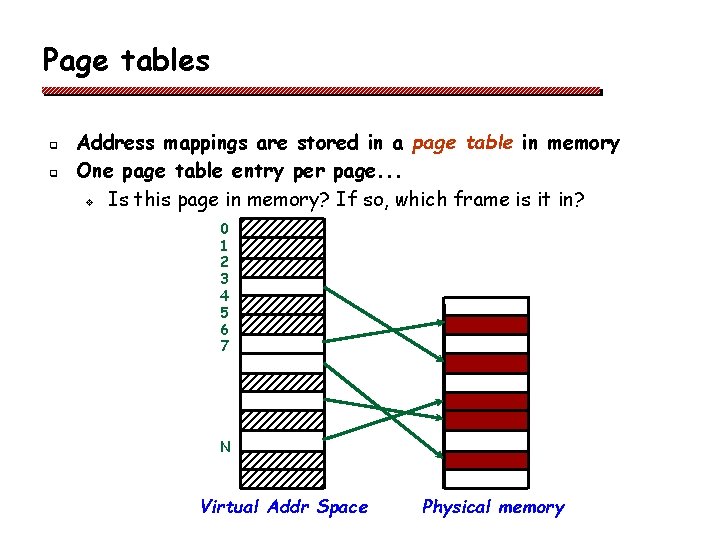
Virtual address spaces q Address mappings say which frame has which page 0 1 2 3 4 5 6 7 N Virtual Addr Space Physical memory
Page tables q q Address mappings are stored in a page table in memory One page table entry per page. . . v Is this page in memory? If so, which frame is it in? 0 1 2 3 4 5 6 7 N Virtual Addr Space Physical memory
Address mappings and translation q q q Address mappings are stored in a page table in memory v Typically one page table for each process Address translation is done by hardware (ie the MMU) How does the MMU get the address mappings? v Either the MMU holds the entire page table (too expensive) v Or the MMU holds a portion of the page table • MMU caches page table entries • called a translation look-aside buffer (TLB)
Address mappings and translation q q q What if the TLB needs a mapping it doesn’t have? Software managed TLB v it generates a TLB-miss fault which is handled by the operating system (like interrupt or trap handling) v The operating system looks in the page tables, gets the mapping from the right entry, and puts it in the TLB Hardware managed TLB v it looks in a pre-specified memory location for the appropriate entry in the page table v The hardware architecture defines where page tables must be stored in memory
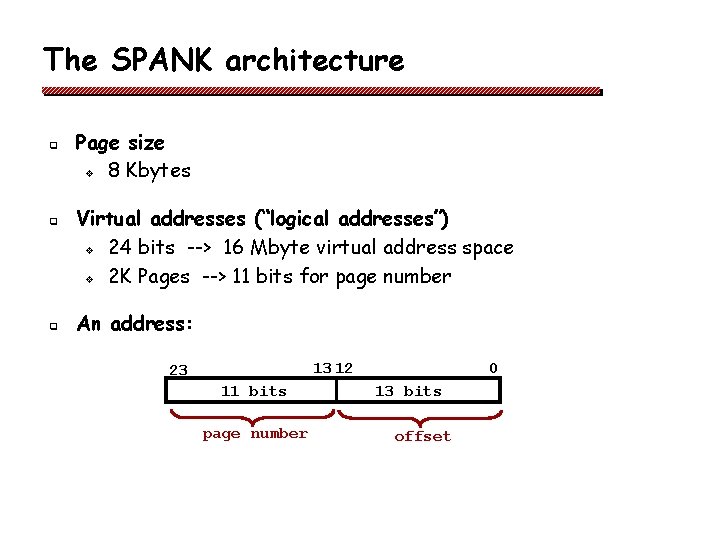
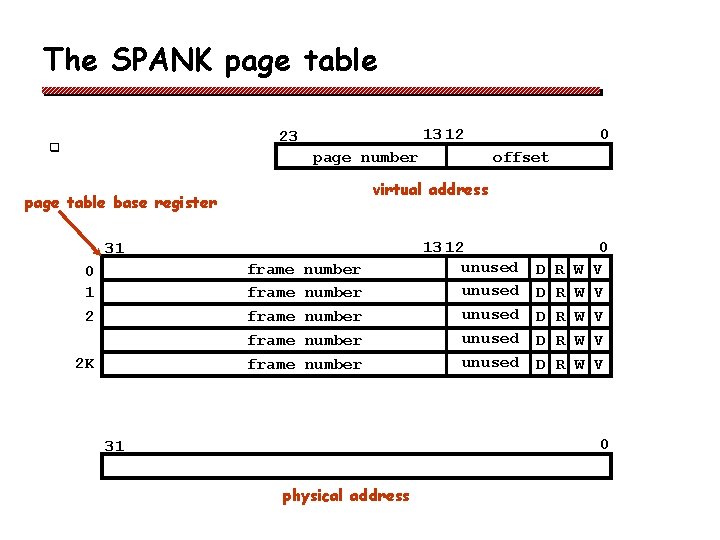
The SPANK architecture q q Page size v 8 Kbytes Virtual addresses (“logical addresses”) v 24 bits --> 16 Mbyte virtual address space v 2 K Pages --> 11 bits for page number
The SPANK architecture q q q Page size v 8 Kbytes Virtual addresses (“logical addresses”) v 24 bits --> 16 Mbyte virtual address space v 2 K Pages --> 11 bits for page number An address: 13 12 23 11 bits page number 0 13 bits offset
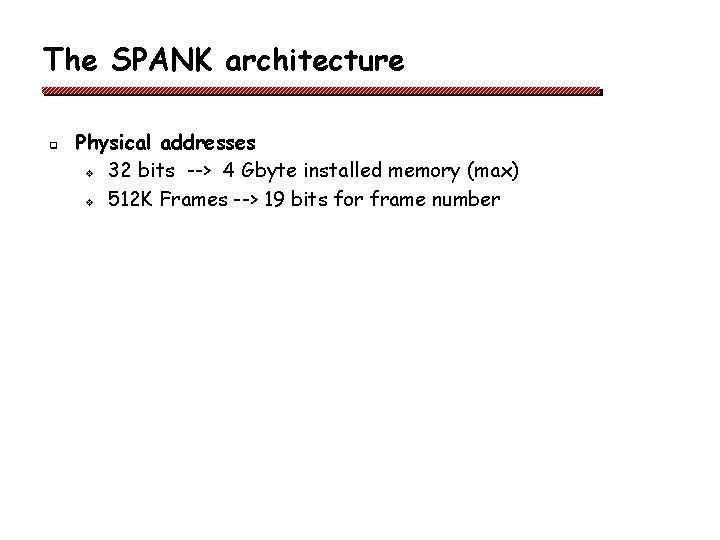
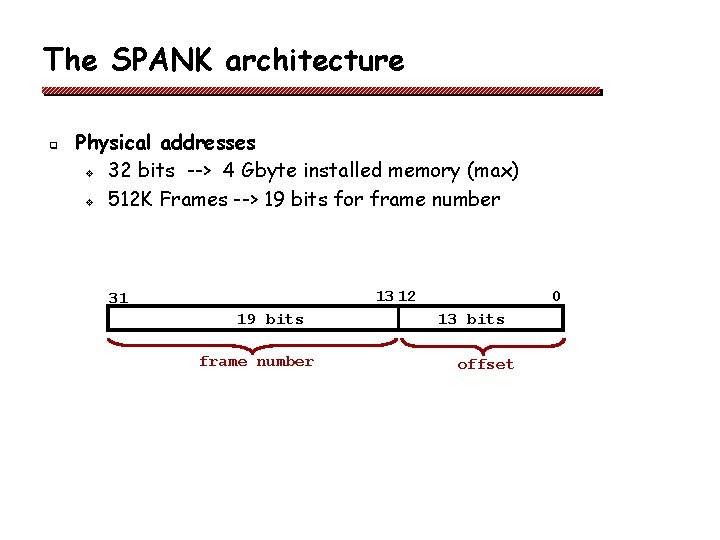
The SPANK architecture q Physical addresses v 32 bits --> 4 Gbyte installed memory (max) v 512 K Frames --> 19 bits for frame number
The SPANK architecture q Physical addresses v 32 bits --> 4 Gbyte installed memory (max) v 512 K Frames --> 19 bits for frame number 13 12 31 19 bits frame number 0 13 bits offset
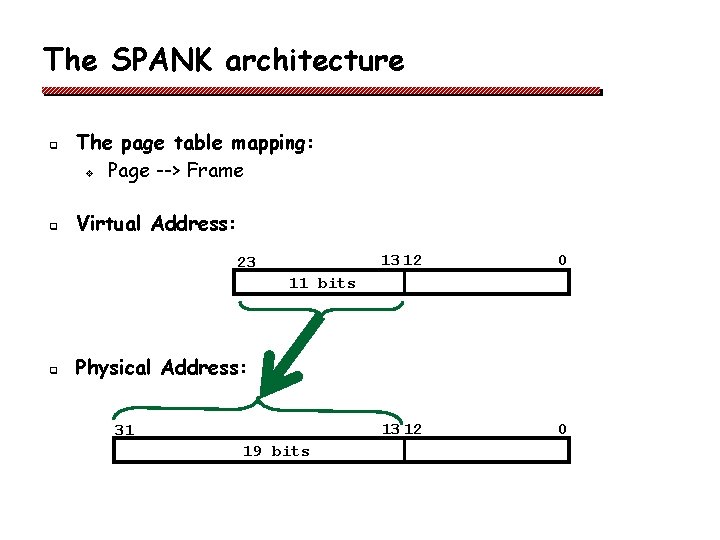
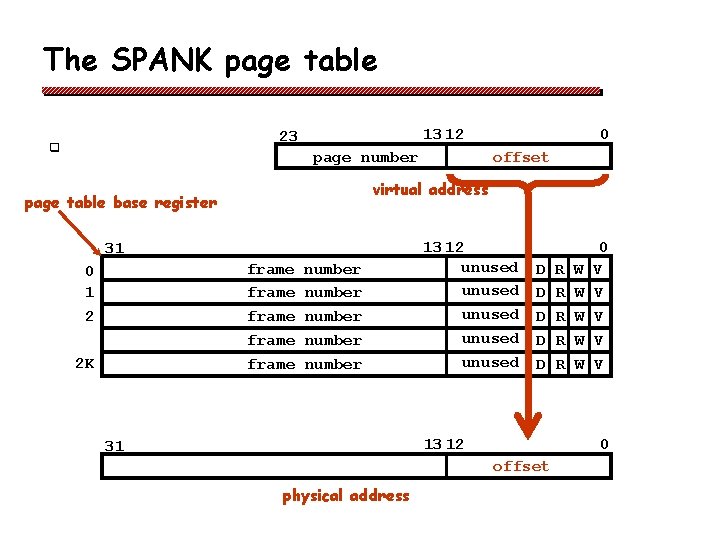
The SPANK architecture q q The page table mapping: v Page --> Frame Virtual Address: 23 13 12 0 11 bits q Physical Address: 31 19 bits
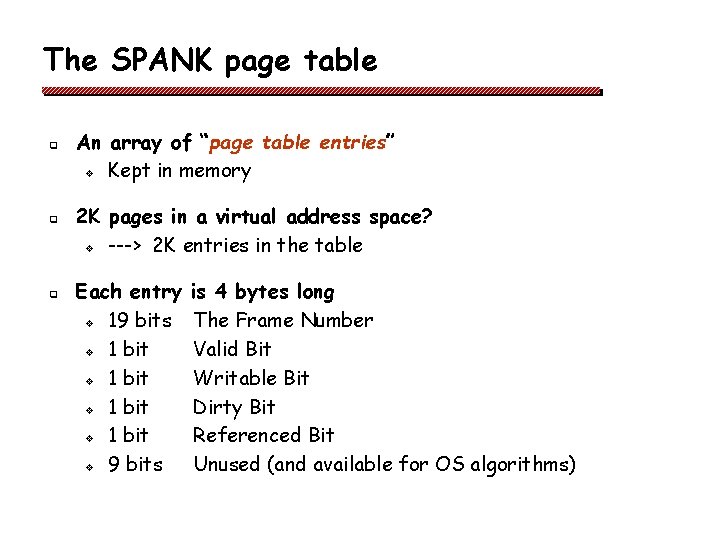
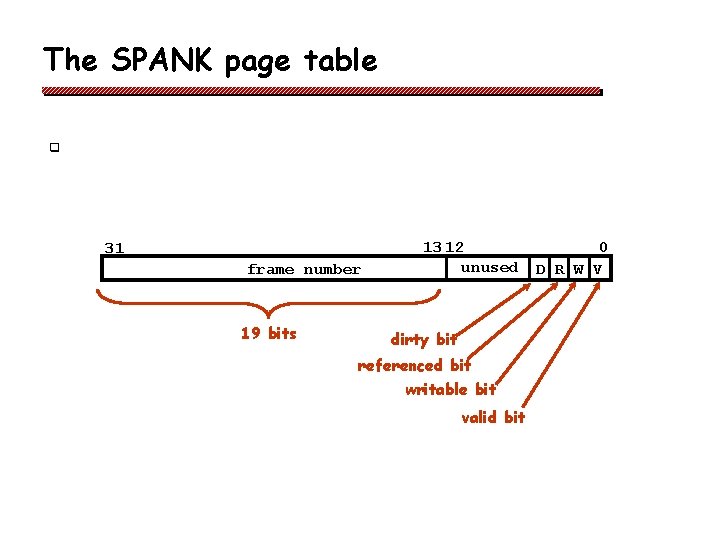
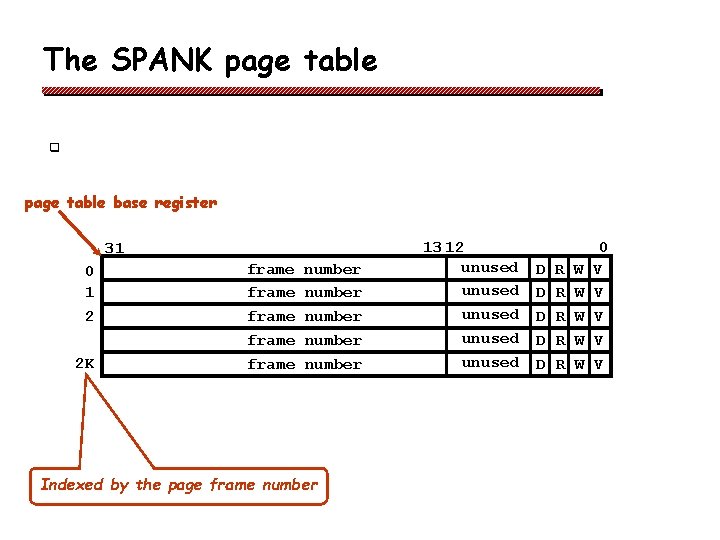
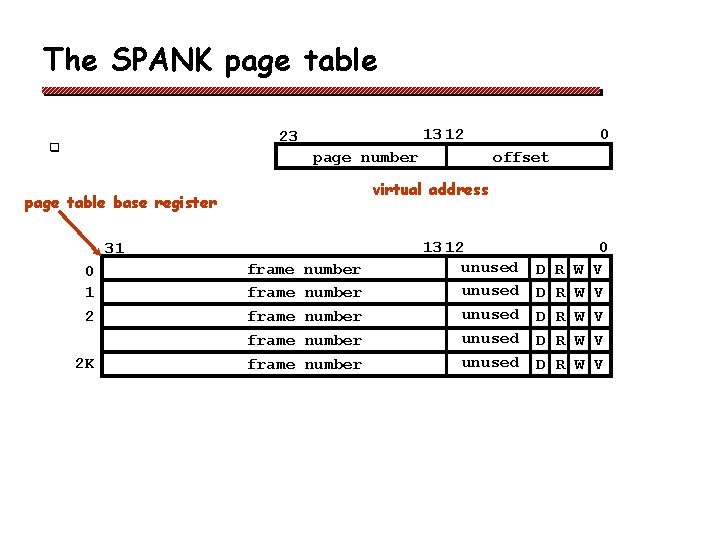
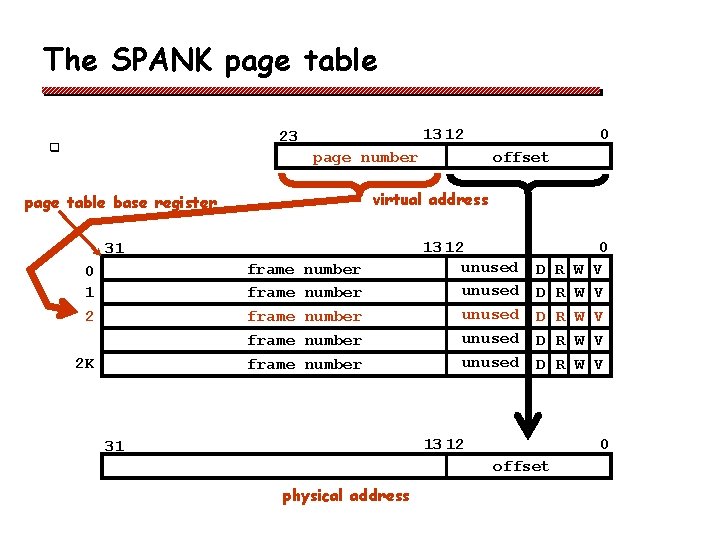
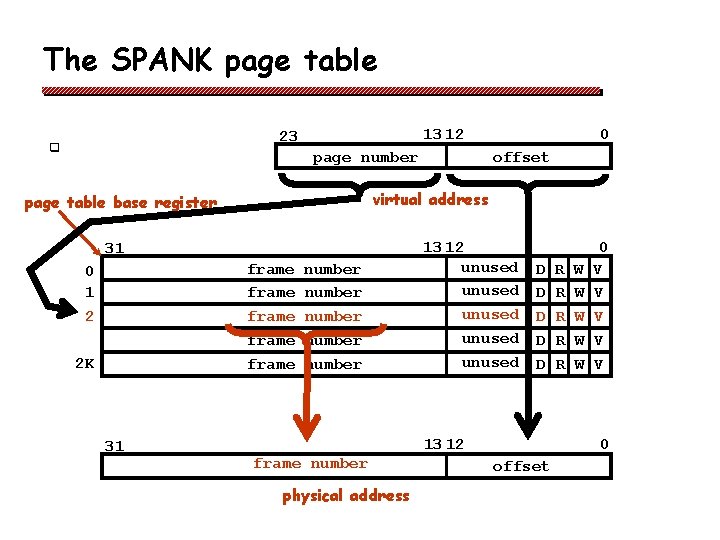
The SPANK page table q q q An array of “page table entries” v Kept in memory 2 K pages in a virtual address space? v ---> 2 K entries in the table Each entry v 19 bits v 1 bit v 9 bits is 4 bytes long The Frame Number Valid Bit Writable Bit Dirty Bit Referenced Bit Unused (and available for OS algorithms)
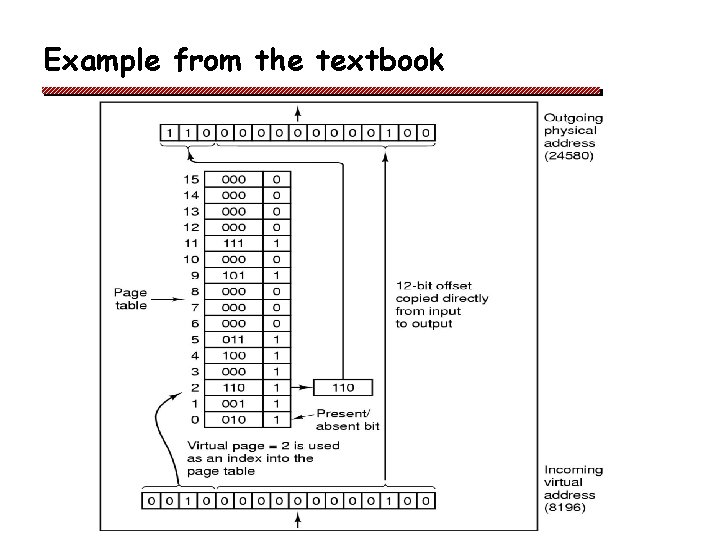
Example from the textbook
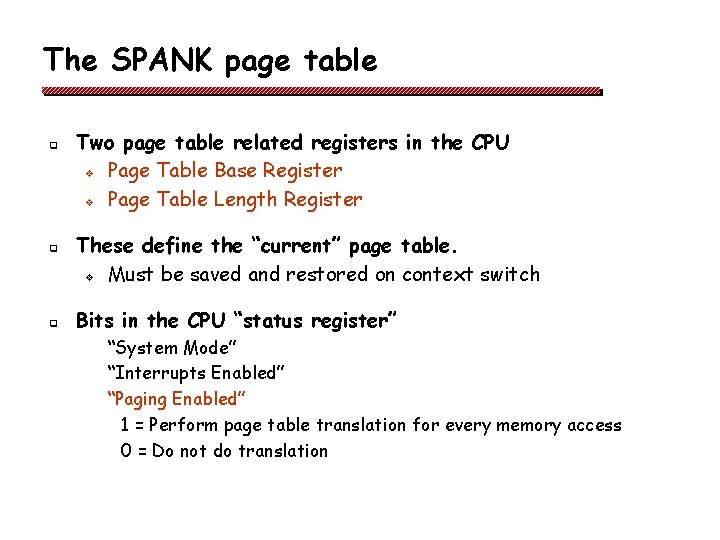
The SPANK page table q q q Two page table related registers in the CPU v Page Table Base Register v Page Table Length Register These define the “current” page table. v Must be saved and restored on context switch Bits in the CPU “status register” “System Mode” “Interrupts Enabled” “Paging Enabled” 1 = Perform page table translation for every memory access 0 = Do not do translation
The SPANK page table q 31 frame number 19 bits 13 12 unused dirty bit referenced bit writable bit valid bit 0 D R W V
The SPANK page table q page table base register 31 0 1 2 2 K frame frame number number Indexed by the page frame number 13 12 unused unused D D D R R R W W W 0 V V V
The SPANK page table 13 12 23 q page number 31 2 K offset virtual address page table base register 0 1 2 0 frame frame number number 13 12 unused unused D D D R R R W W W 0 V V V
The SPANK page table 13 12 23 q page number 31 frame frame 2 K offset virtual address page table base register 0 1 2 0 number number 13 12 unused unused D D D R R R W W W 0 V V V 0 31 physical address
The SPANK page table 13 12 23 q page number 31 frame frame 2 K offset virtual address page table base register 0 1 2 0 number number 13 12 unused unused D D D 13 12 31 W W W 0 offset physical address R R R 0 V V V
The SPANK page table 13 12 23 q page number 31 frame frame 2 K offset virtual address page table base register 0 1 2 0 number number 13 12 unused unused D D D 13 12 31 W W W 0 offset physical address R R R 0 V V V
The SPANK page table 13 12 23 q page number 31 frame frame 2 K 31 offset virtual address page table base register 0 1 2 0 number number 13 12 unused unused D D D 13 12 frame number physical address R R R W W W 0 V V V 0 offset
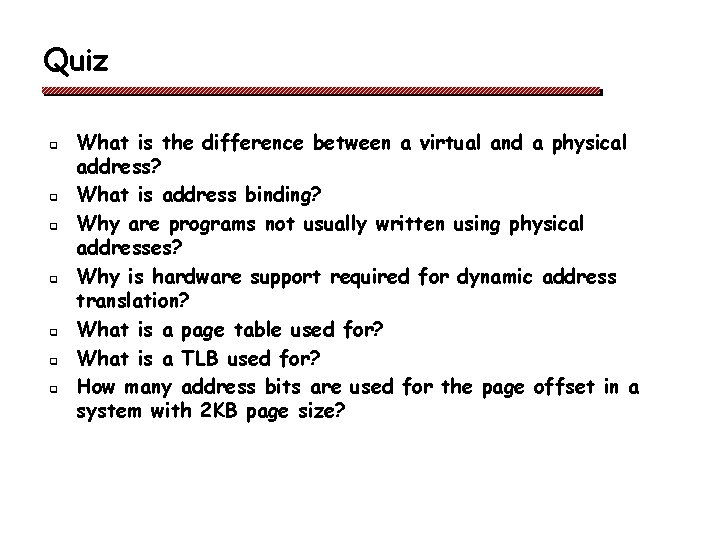
Quiz q q q q What is the difference between a virtual and a physical address? What is address binding? Why are programs not usually written using physical addresses? Why is hardware support required for dynamic address translation? What is a page table used for? What is a TLB used for? How many address bits are used for the page offset in a system with 2 KB page size?
Spare Slides
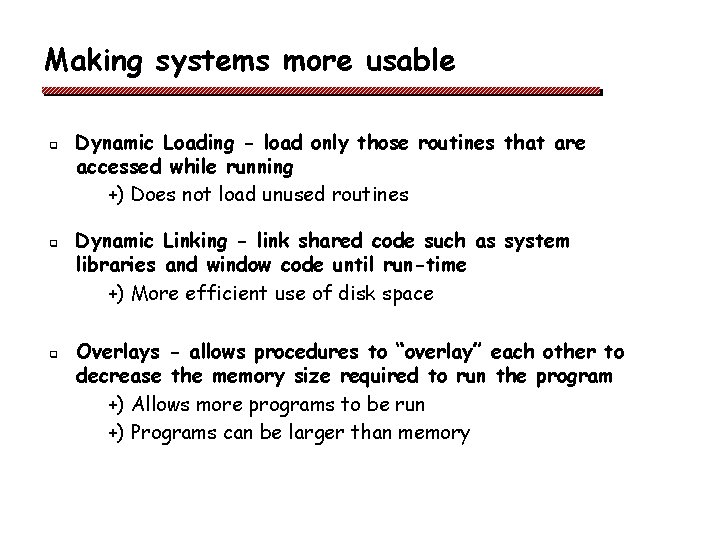
Making systems more usable q q q Dynamic Loading - load only those routines that are accessed while running +) Does not load unused routines Dynamic Linking - link shared code such as system libraries and window code until run-time +) More efficient use of disk space Overlays - allows procedures to “overlay” each other to decrease the memory size required to run the program +) Allows more programs to be run +) Programs can be larger than memory
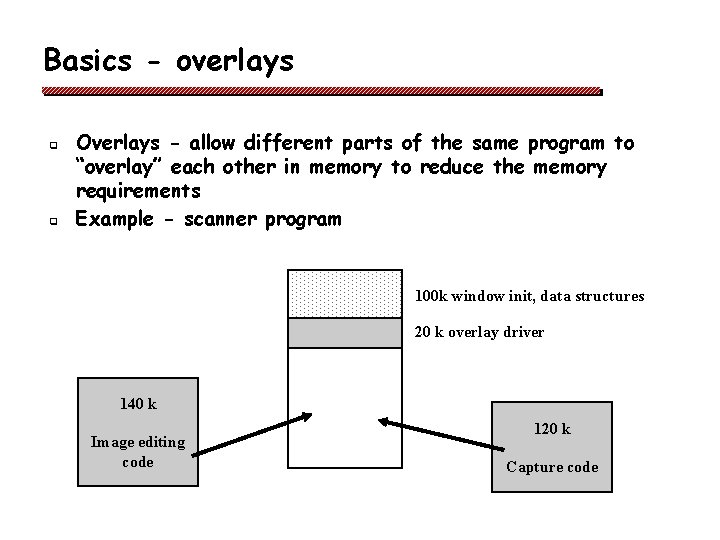
Basics - overlays q q Overlays - allow different parts of the same program to “overlay” each other in memory to reduce the memory requirements Example - scanner program 100 k window init, data structures 20 k overlay driver 140 k Image editing code 120 k Capture code
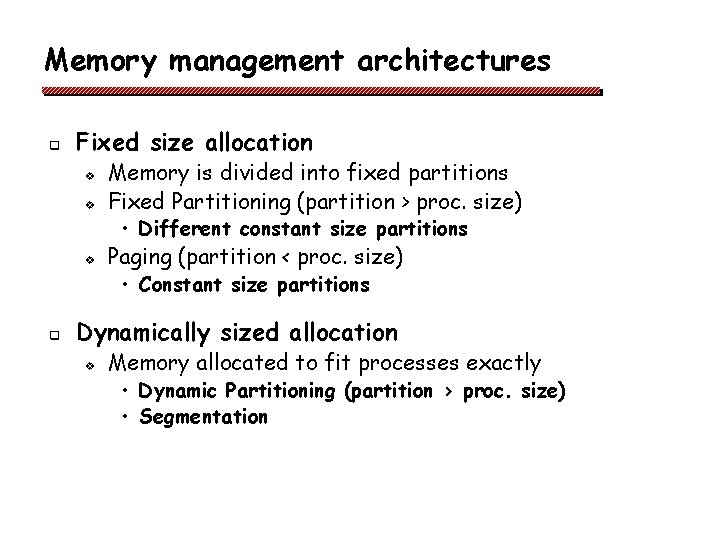
Memory management architectures q Fixed size allocation v v Memory is divided into fixed partitions Fixed Partitioning (partition > proc. size) • Different constant size partitions v Paging (partition < proc. size) • Constant size partitions q Dynamically sized allocation v Memory allocated to fit processes exactly • Dynamic Partitioning (partition > proc. size) • Segmentation
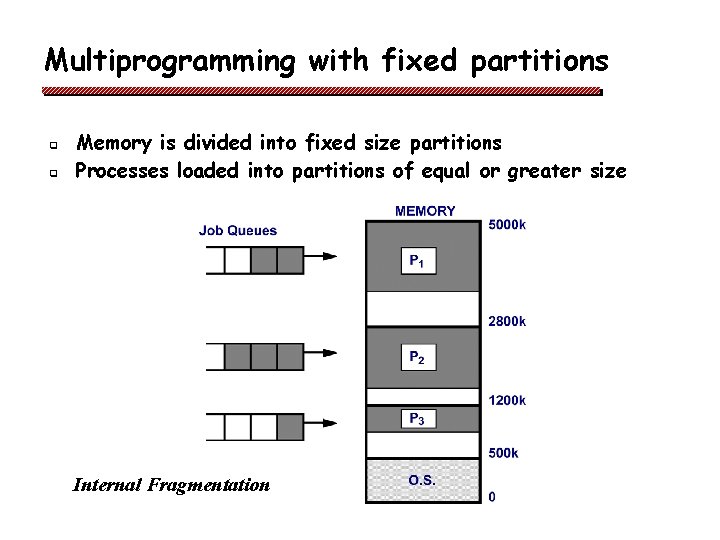
Multiprogramming with fixed partitions q q Memory is divided into fixed size partitions Processes loaded into partitions of equal or greater size Internal Fragmentation
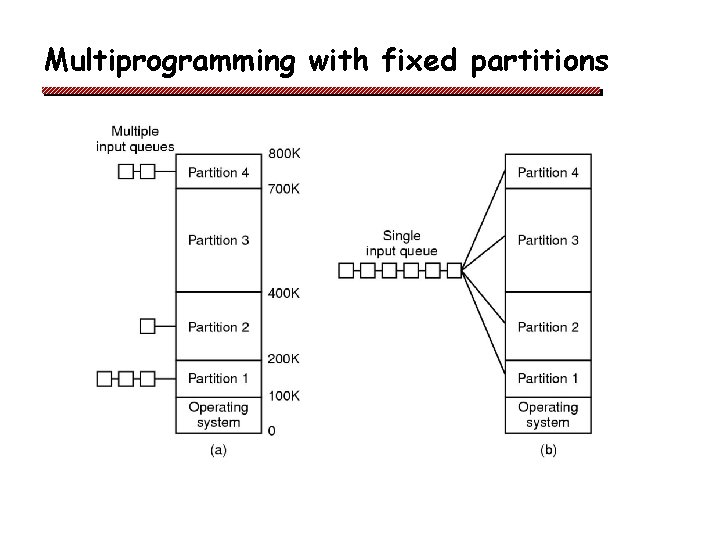
Multiprogramming with fixed partitions
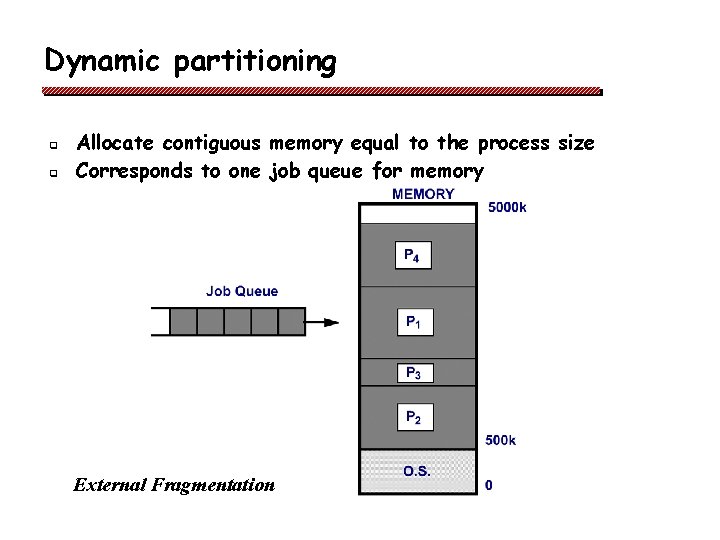
Dynamic partitioning q q Allocate contiguous memory equal to the process size Corresponds to one job queue for memory External Fragmentation