
CS 333 Introduction to Operating Systems Class 3

- Slides: 43
CS 333 Introduction to Operating Systems Class 3 – Threads & Concurrency Jonathan Walpole Computer Science Portland State University 1
The Process Concept 2
The Process Concept q Process – a program in execution v Program – description of how to perform an activity – instructions and static data values v Process – a snapshot of a program in execution – memory (program instructions, static and dynamic data values) – CPU state (registers, PC, SP, etc) – operating system state (open files, accounting statistics etc) 3
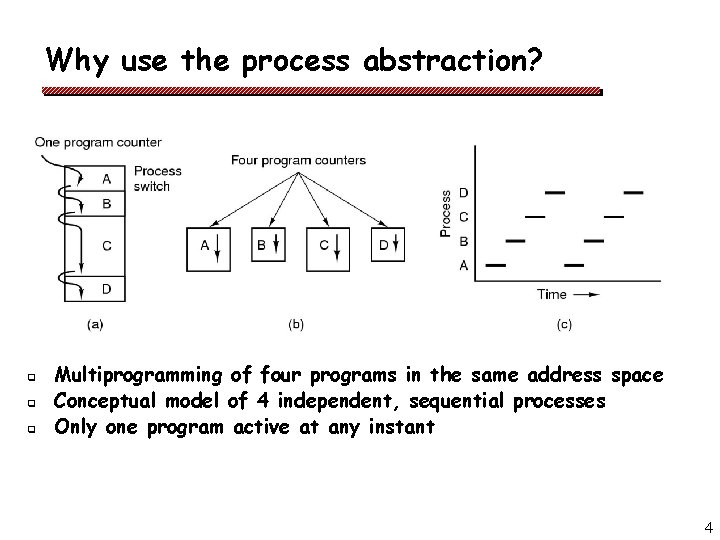
Why use the process abstraction? q q q Multiprogramming of four programs in the same address space Conceptual model of 4 independent, sequential processes Only one program active at any instant 4
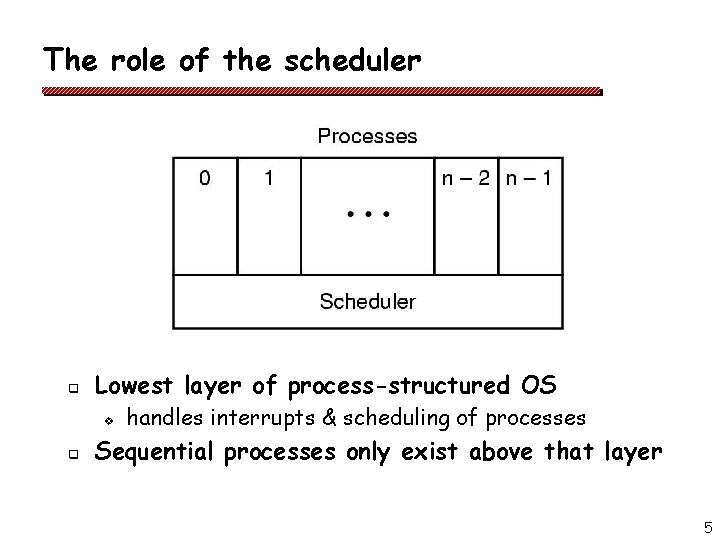
The role of the scheduler q Lowest layer of process-structured OS v q handles interrupts & scheduling of processes Sequential processes only exist above that layer 5
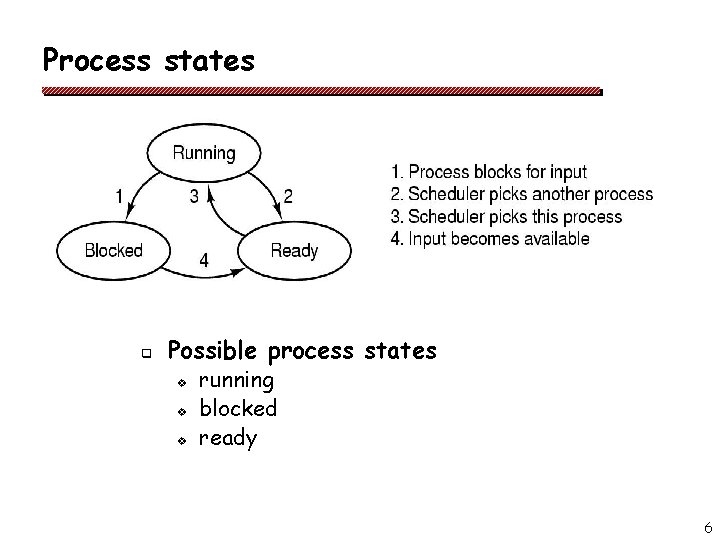
Process states q Possible process states v v v running blocked ready 6
How do processes get created? Principal events that cause process creation q System initialization q Initiation of a batch job q User request to create a new process q Execution of a process creation system call from another process 7
Process hierarchies q Parent creates a child process, v v q special system calls for communicating with and waiting for child processes each process is assigned a unique identifying number or process ID (PID) Child processes can create their own child processes v v Forms a hierarchy UNIX calls this a "process group" 8
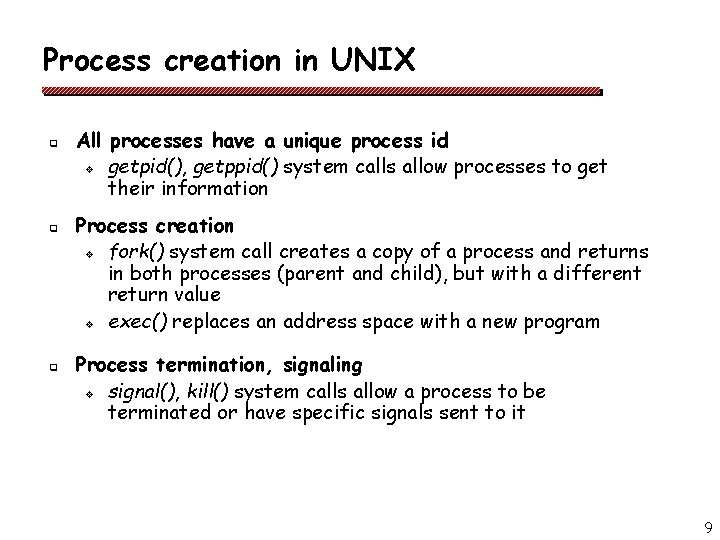
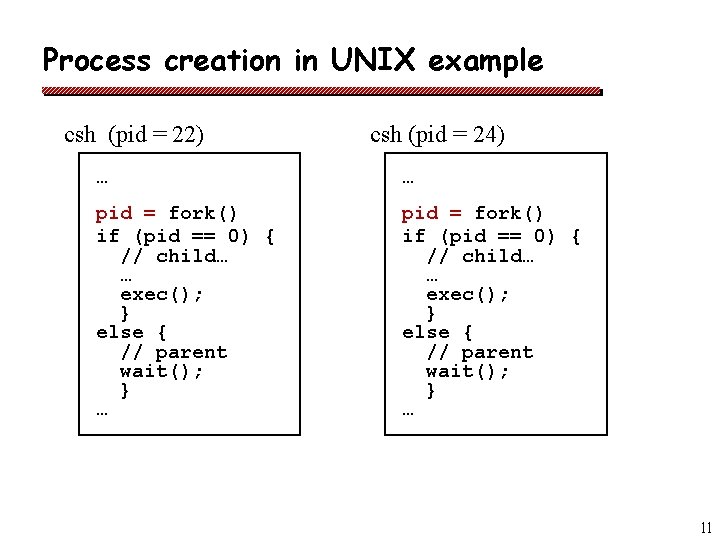
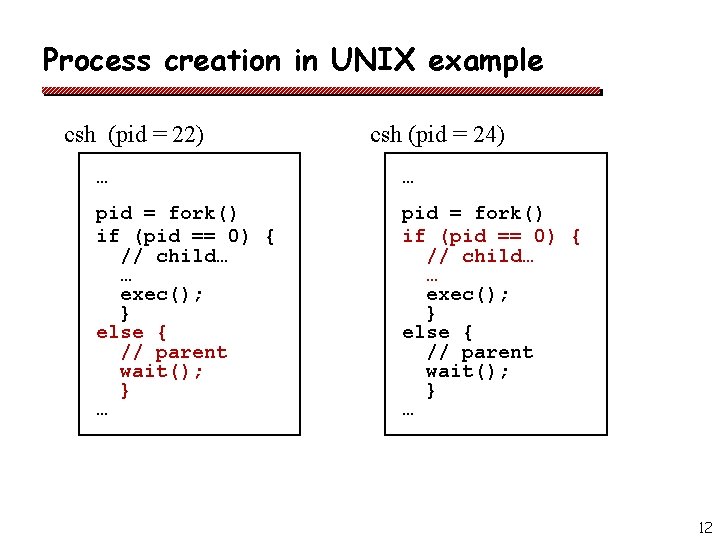
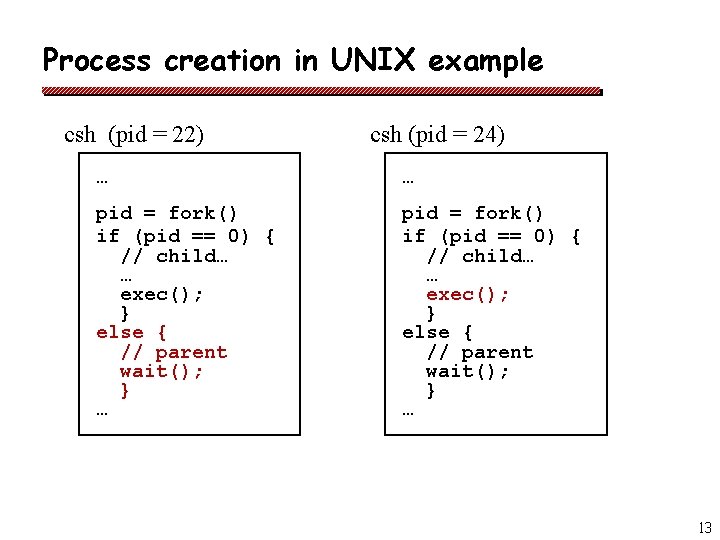
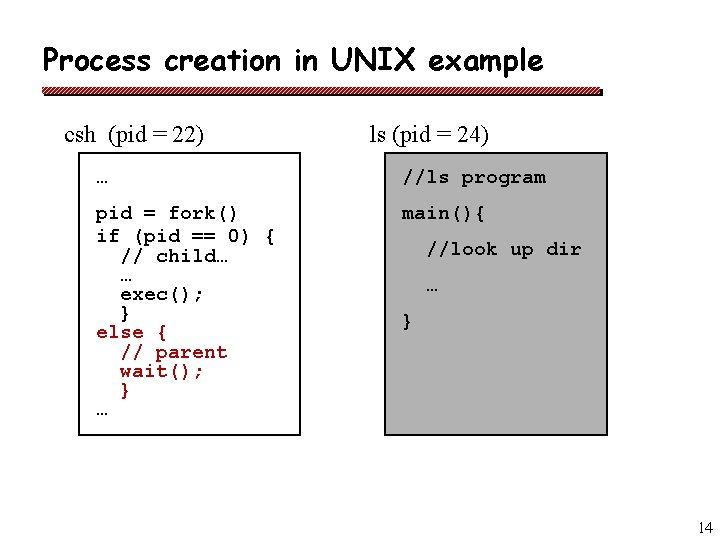
Process creation in UNIX q q q All processes have a unique process id v getpid(), getppid() system calls allow processes to get their information Process creation v fork() system call creates a copy of a process and returns in both processes (parent and child), but with a different return value v exec() replaces an address space with a new program Process termination, signaling v signal(), kill() system calls allow a process to be terminated or have specific signals sent to it 9
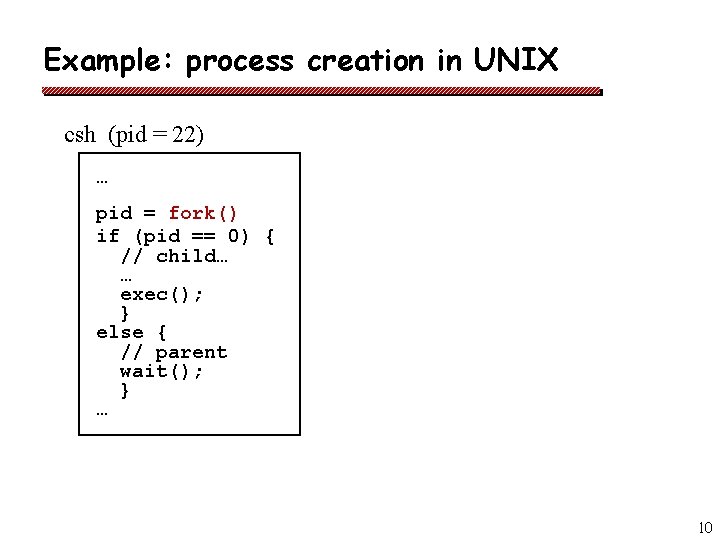
Example: process creation in UNIX csh (pid = 22) … pid = fork() if (pid == 0) { // child… … exec(); } else { // parent wait(); } … 10
Process creation in UNIX example csh (pid = 22) csh (pid = 24) … … pid = fork() if (pid == 0) { // child… … exec(); } else { // parent wait(); } … 11
Process creation in UNIX example csh (pid = 22) csh (pid = 24) … … pid = fork() if (pid == 0) { // child… … exec(); } else { // parent wait(); } … 12
Process creation in UNIX example csh (pid = 22) csh (pid = 24) … … pid = fork() if (pid == 0) { // child… … exec(); } else { // parent wait(); } … 13
Process creation in UNIX example csh (pid = 22) ls (pid = 24) … //ls program pid = fork() if (pid == 0) { // child… … exec(); } else { // parent wait(); } … main(){ //look up dir … } 14
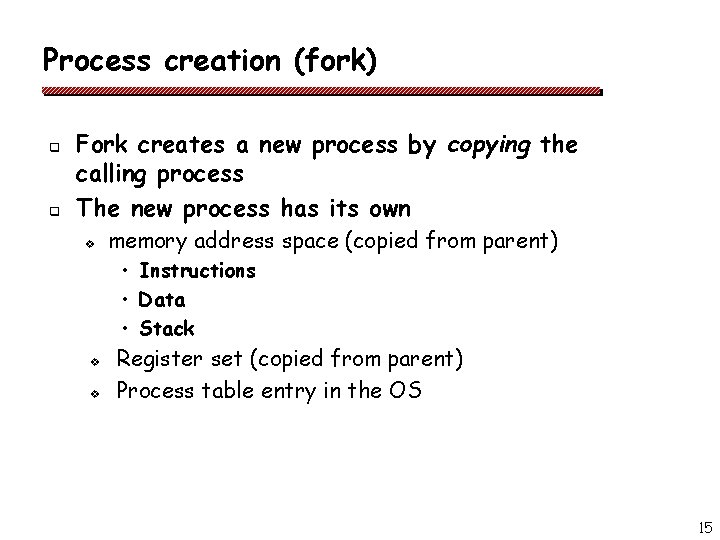
Process creation (fork) q q Fork creates a new process by copying the calling process The new process has its own v memory address space (copied from parent) • Instructions • Data • Stack v v Register set (copied from parent) Process table entry in the OS 15
Threads 16
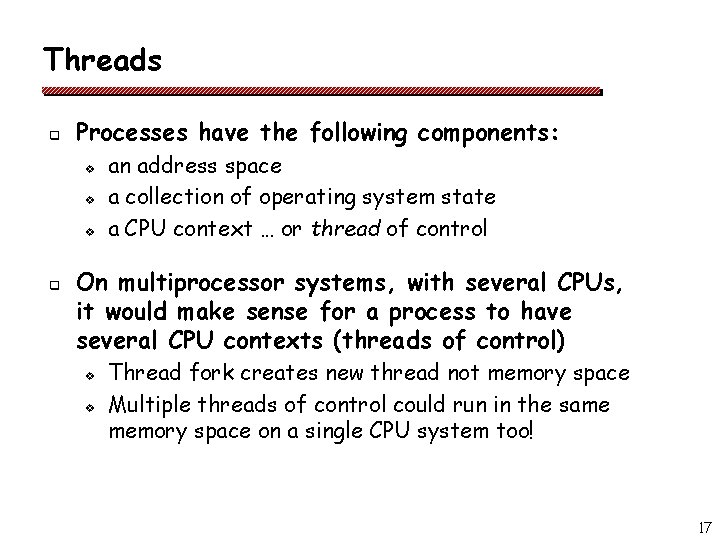
Threads q Processes have the following components: v v v q an address space a collection of operating system state a CPU context … or thread of control On multiprocessor systems, with several CPUs, it would make sense for a process to have several CPU contexts (threads of control) v v Thread fork creates new thread not memory space Multiple threads of control could run in the same memory space on a single CPU system too! 17
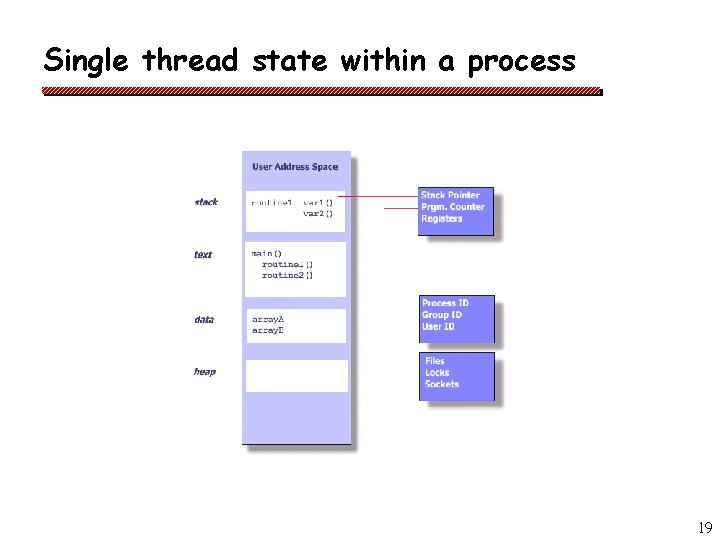
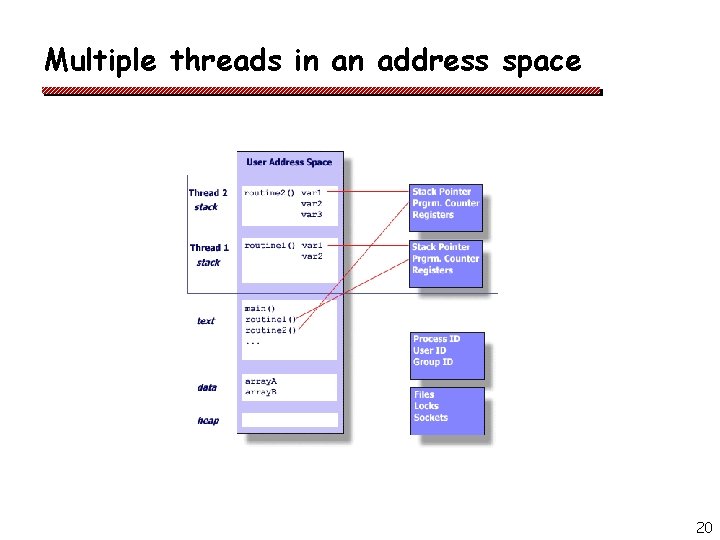
Threads q q Threads share a process address space with zero or more other threads Threads have their own CPU context v v q PC, SP, register state, stack A traditional process can be viewed as a memory address space with a single thread 18
Single thread state within a process 19
Multiple threads in an address space 20
What is a thread? q A thread executes a stream of instructions v q it is an abstraction for control-flow Practically, it is a processor context and stack v v Allocated a CPU by a scheduler Executes in the context of a memory address space 21
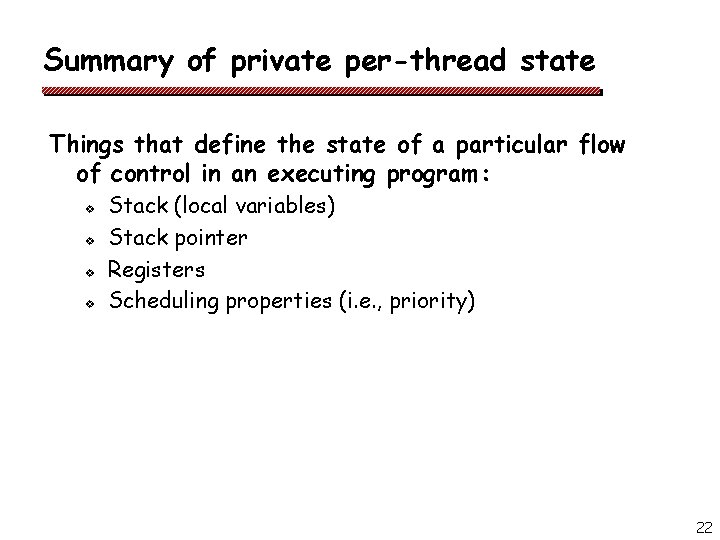
Summary of private per-thread state Things that define the state of a particular flow of control in an executing program: v v Stack (local variables) Stack pointer Registers Scheduling properties (i. e. , priority) 22
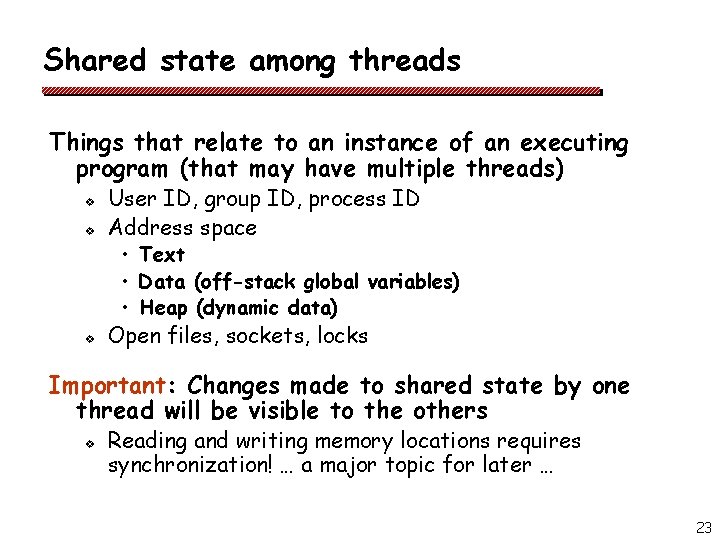
Shared state among threads Things that relate to an instance of an executing program (that may have multiple threads) v v User ID, group ID, process ID Address space • Text • Data (off-stack global variables) • Heap (dynamic data) v Open files, sockets, locks Important: Changes made to shared state by one thread will be visible to the others v Reading and writing memory locations requires synchronization! … a major topic for later … 23
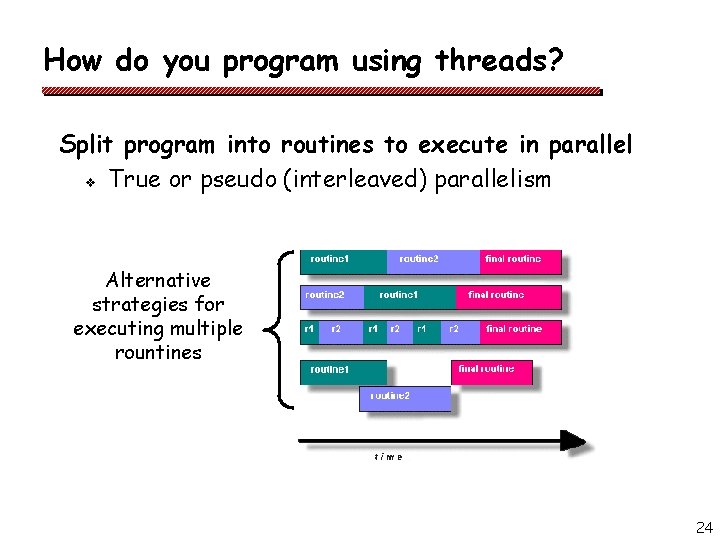
How do you program using threads? Split program into routines to execute in parallel v True or pseudo (interleaved) parallelism Alternative strategies for executing multiple rountines 24
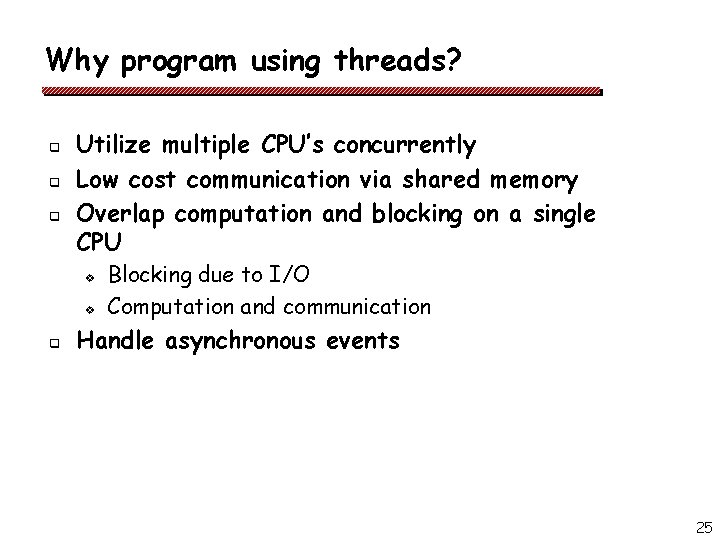
Why program using threads? q q q Utilize multiple CPU’s concurrently Low cost communication via shared memory Overlap computation and blocking on a single CPU v v q Blocking due to I/O Computation and communication Handle asynchronous events 25
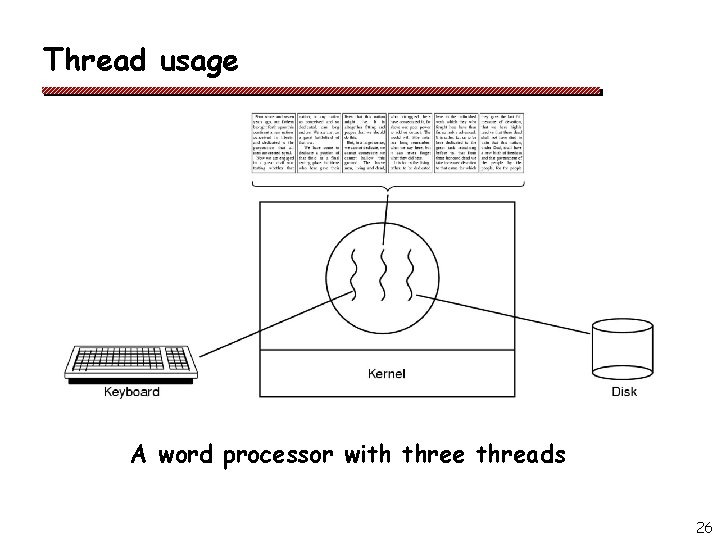
Thread usage A word processor with three threads 26
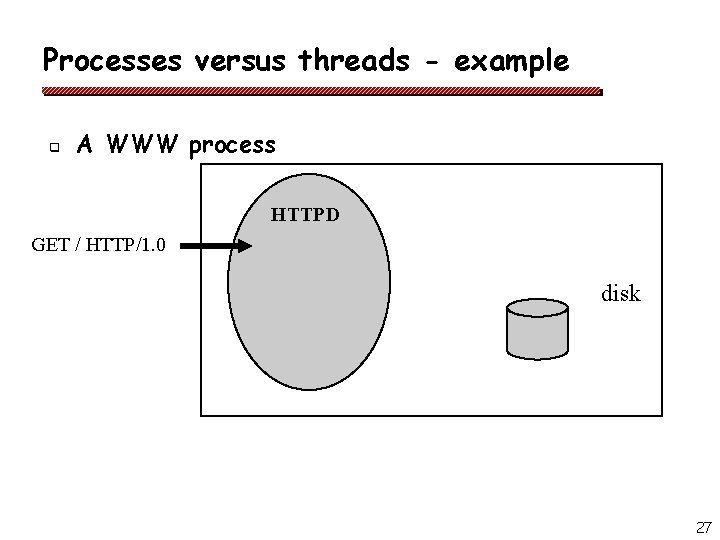
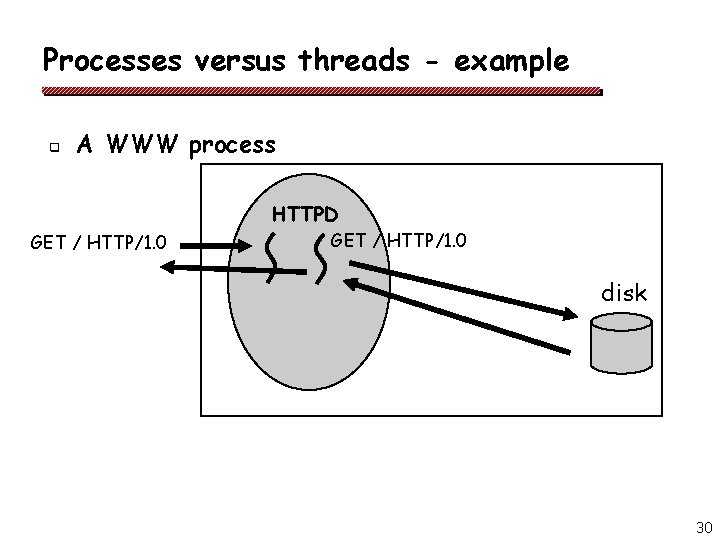
Processes versus threads - example q A WWW process HTTPD GET / HTTP/1. 0 disk 27
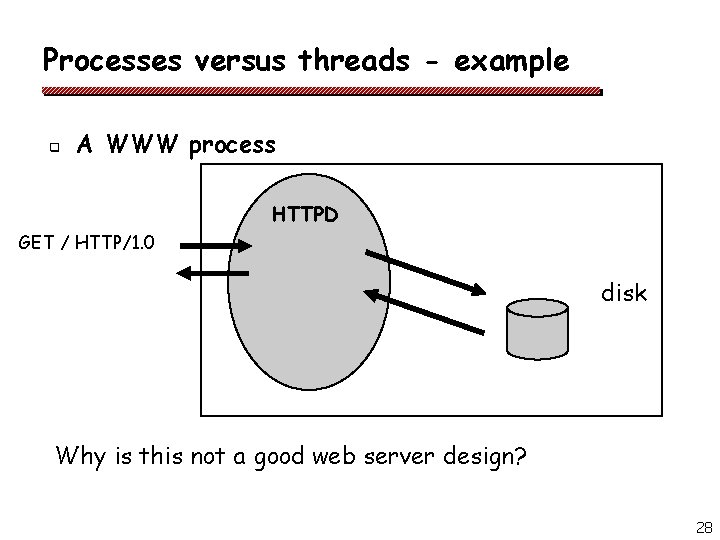
Processes versus threads - example q A WWW process HTTPD GET / HTTP/1. 0 disk Why is this not a good web server design? 28
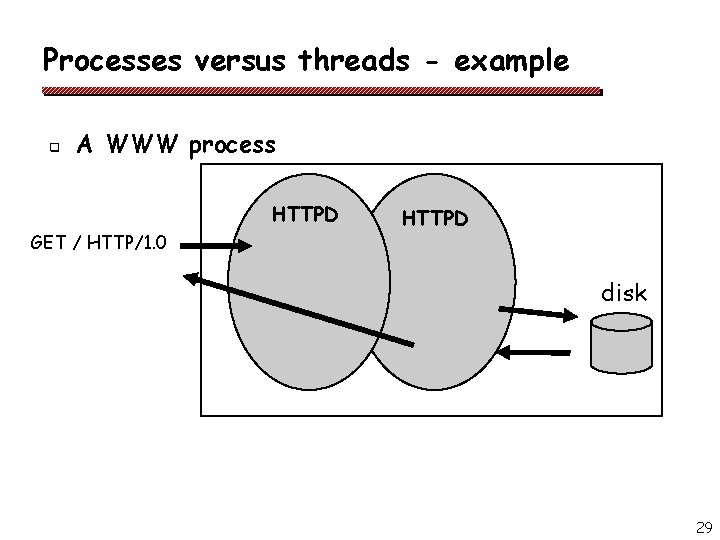
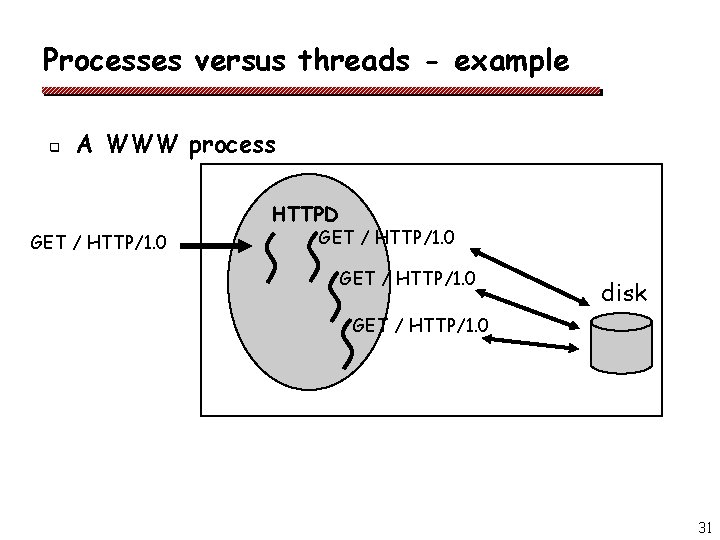
Processes versus threads - example q A WWW process HTTPD GET / HTTP/1. 0 HTTPD disk 29
Processes versus threads - example q A WWW process HTTPD GET / HTTP/1. 0 disk 30
Processes versus threads - example q A WWW process HTTPD GET / HTTP/1. 0 disk GET / HTTP/1. 0 31
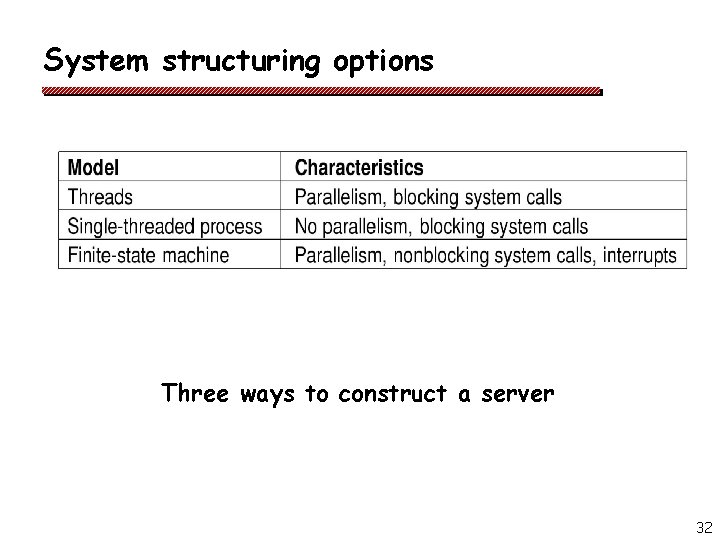
System structuring options Three ways to construct a server 32
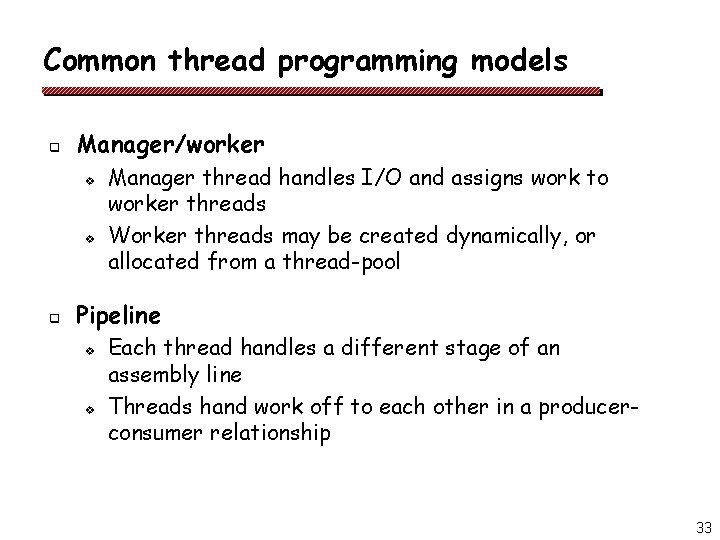
Common thread programming models q Manager/worker v v q Manager thread handles I/O and assigns work to worker threads Worker threads may be created dynamically, or allocated from a thread-pool Pipeline v v Each thread handles a different stage of an assembly line Threads hand work off to each other in a producerconsumer relationship 33
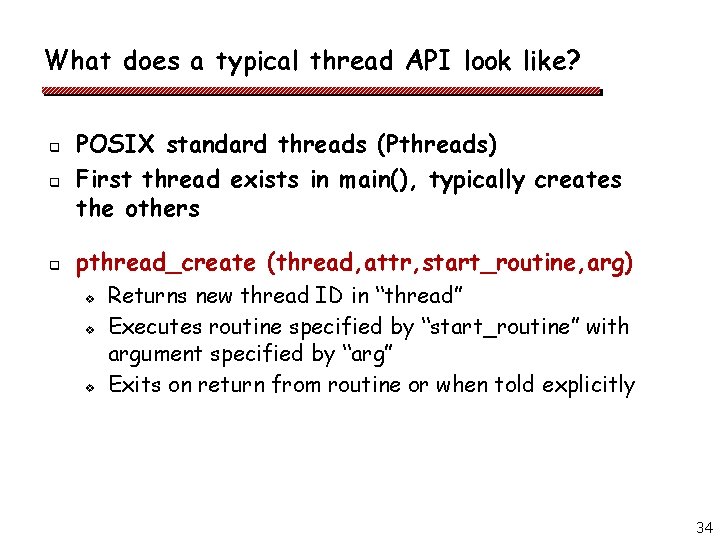
What does a typical thread API look like? q q q POSIX standard threads (Pthreads) First thread exists in main(), typically creates the others pthread_create (thread, attr, start_routine, arg) v v v Returns new thread ID in “thread” Executes routine specified by “start_routine” with argument specified by “arg” Exits on return from routine or when told explicitly 34
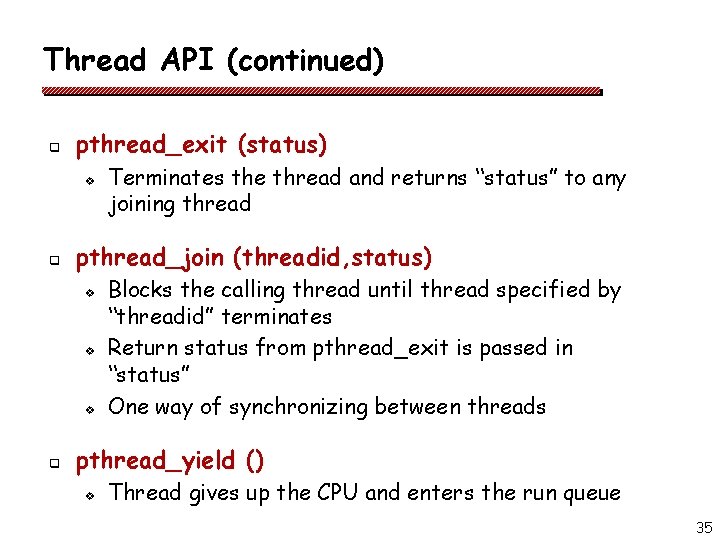
Thread API (continued) q pthread_exit (status) v q pthread_join (threadid, status) v v v q Terminates the thread and returns “status” to any joining thread Blocks the calling thread until thread specified by “threadid” terminates Return status from pthread_exit is passed in “status” One way of synchronizing between threads pthread_yield () v Thread gives up the CPU and enters the run queue 35
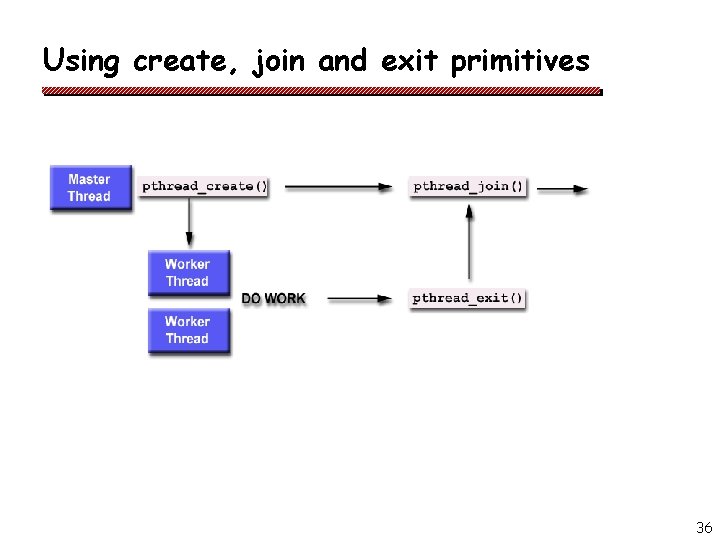
Using create, join and exit primitives 36
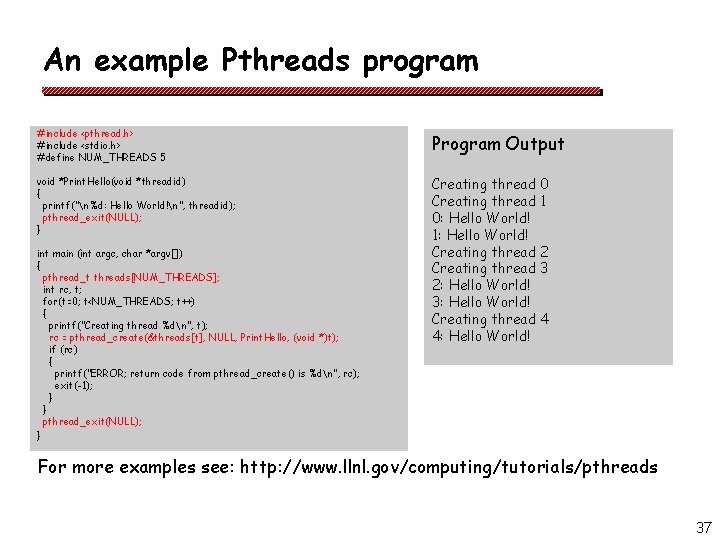
An example Pthreads program #include <pthread. h> #include <stdio. h> #define NUM_THREADS 5 Program Output void *Print. Hello(void *threadid) { printf("n%d: Hello World!n", threadid); pthread_exit(NULL); } Creating thread 0 Creating thread 1 0: Hello World! 1: Hello World! Creating thread 2 Creating thread 3 2: Hello World! 3: Hello World! Creating thread 4 4: Hello World! int main (int argc, char *argv[]) { pthread_t threads[NUM_THREADS]; int rc, t; for(t=0; t<NUM_THREADS; t++) { printf("Creating thread %dn", t); rc = pthread_create(&threads[t], NULL, Print. Hello, (void *)t); if (rc) { printf("ERROR; return code from pthread_create() is %dn", rc); exit(-1); } } pthread_exit(NULL); } For more examples see: http: //www. llnl. gov/computing/tutorials/pthreads 37
Pros & cons of threads q Pros v v v q Overlap I/O with computation! Cheaper context switches Better mapping to shared memory multiprocessors Cons v v Potential thread interactions Complexity of debugging Complexity of multi-threaded programming Backwards compatibility with existing code 38
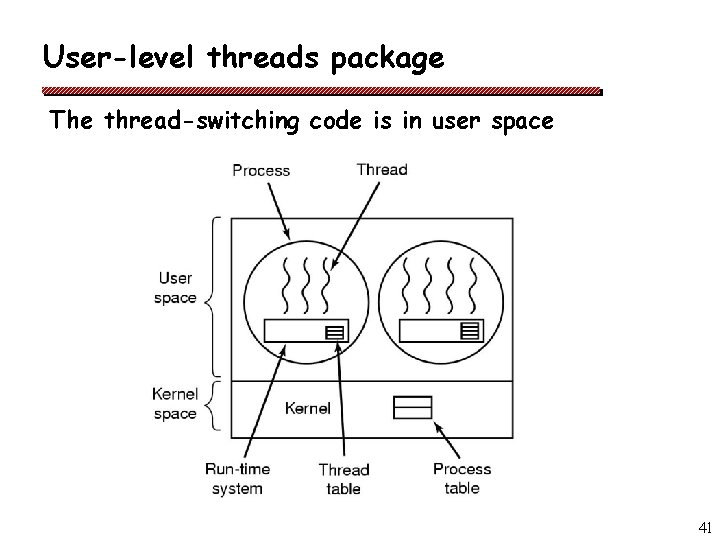
User-level threads q The idea of managing multiple abstract program counters above a single real one can be implemented using privileged or non-privileged code. v q Threads can be implemented in the OS or at user level User level thread implementations v v v thread scheduler runs as user code (thread library) manages thread contexts in user space The underlying OS sees only a traditional process above 39
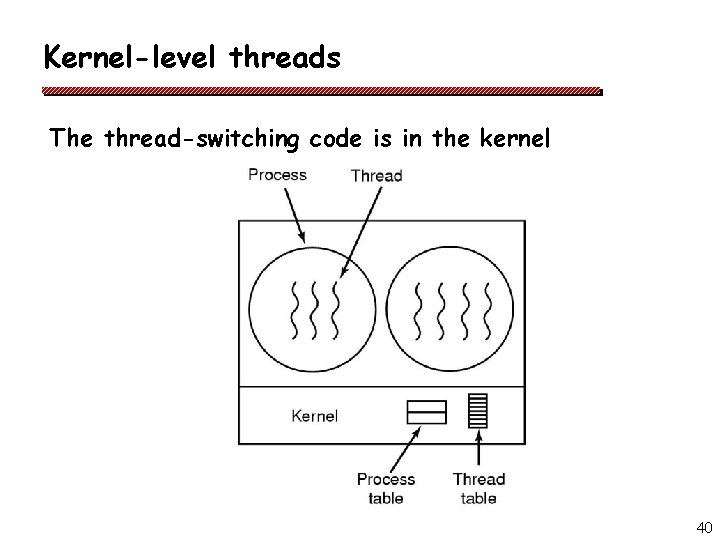
Kernel-level threads The thread-switching code is in the kernel 40
User-level threads package The thread-switching code is in user space 41
User-level threads q Advantages v cheap context switch costs among threads in the same process! • A procedure call not a system call! v q User-programmable scheduling policy Disadvantages v v How to deal with blocking system calls! How to overlap I/O and computation! 42
Quiz q q q What is the difference between a program and a process? Is the Operating System a program? Is the Operating System a process? v Does it have a process control block? v How is its state managed when it is not running? What is the difference between processes and threads? What tasks are involved in switching the CPU from one process to another? v Why is it called a context switch? What tasks are involved in switching the CPU from one thread to another? v Why are threads “lightweight”? 43