
CS 326 A Motion Planning http robotics stanford
CS 326 A: Motion Planning http: //robotics. stanford. edu/~latombe/cs 326/2002 Coordination of Multiple Robots
Two Main Approaches Decoupled Planning: Plan for each robot independently of the others and coordinate them later Several possible schemes Centralized Planning: Plan the motion of the robots in their “composite” configuration space
Planning with Moving Obstacles Dealing with moving obstacles require planning a trajectory t, i. e. , a path indexed by time t is conveniently represented in configuration x time space by a continuous curve whose tangent always projects positively along the time axis Obstacles map as forbidden regions in CT -space. Constraints on velocity constrain tangents to t. Constraints on acceleration constrain curvature of t
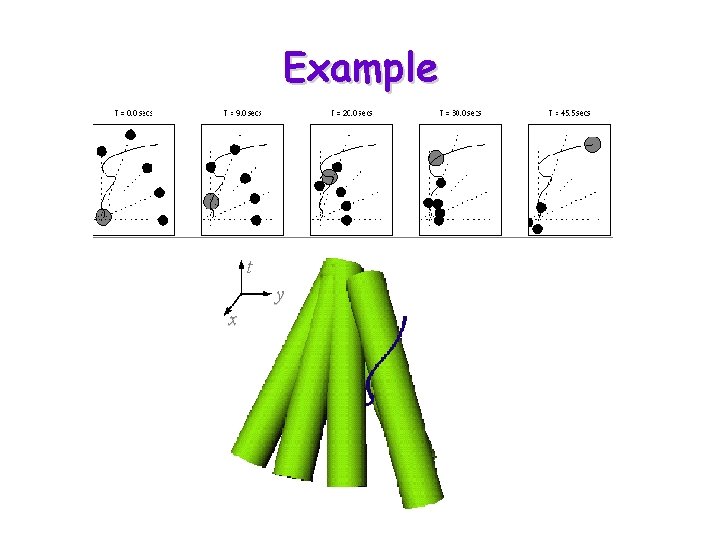
Example t y x
Coordination of Multiple Robots § Does not require explicit introduction of time (except if there are moving obstacles) § Only requires using the same parameter to index the paths of the coordinated robots § Using the same indexing parameter corresponds to fixing the relative velocities of the robots
Decoupled Planning § Pure velocity tuning: (1) Separately plan a path of each robot to avoid collision with (static) obstacles (2) Compute the relative velocities of the robots to avoid inter-robot collision (e. g. , coordination diagram)
Decoupled Planning § Pure velocity tuning: § Robot prioritization: - Plan path of a first robot in its C-space - Iterate: Plan trajectory of ith robot in its CT-space assuming that robots 1, …, i-1 are obstacles moving at some velocities
Centralized Planning § Plan collision-free path t in composite configuration C 1 x C 2 x…x Cp space of the p robots § Forbidden regions in composite C-space are all configurations where either a robot collide with an obstacle or two robots collide with each other § The projection of t into Ci is the path of the ith robot
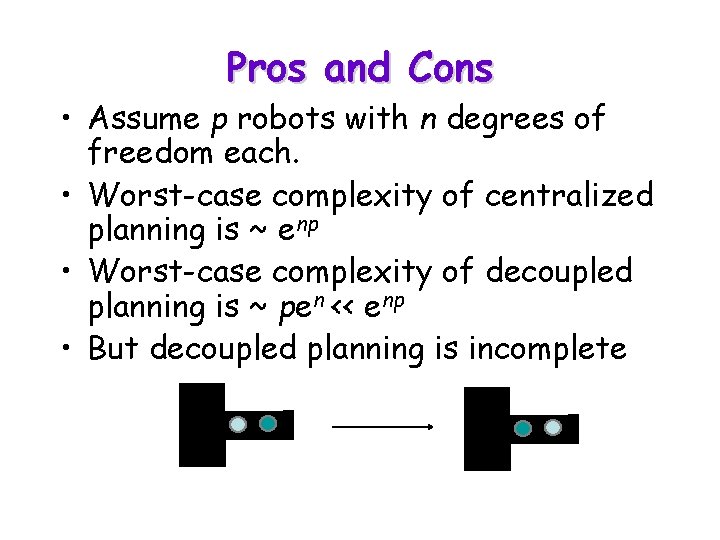
Pros and Cons • Assume p robots with n degrees of freedom each. • Worst-case complexity of centralized planning is ~ enp • Worst-case complexity of decoupled planning is ~ pen << enp • But decoupled planning is incomplete
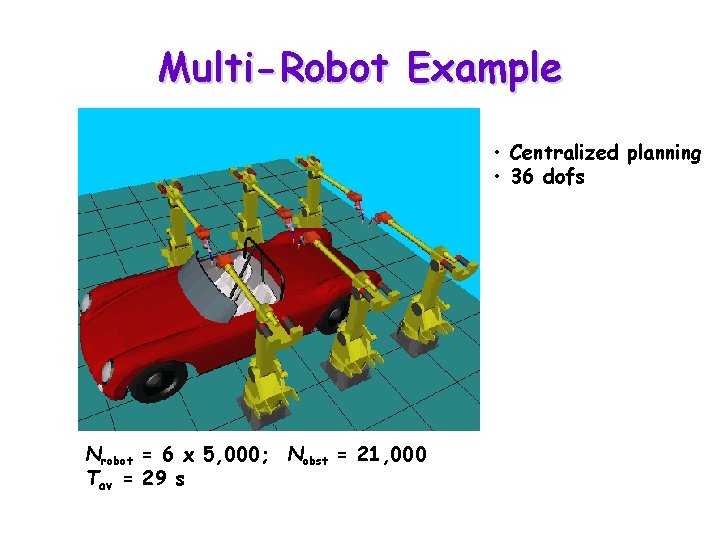
Multi-Robot Example • Centralized planning • 36 dofs Nrobot = 6 x 5, 000; Nobst = 21, 000 Tav = 29 s
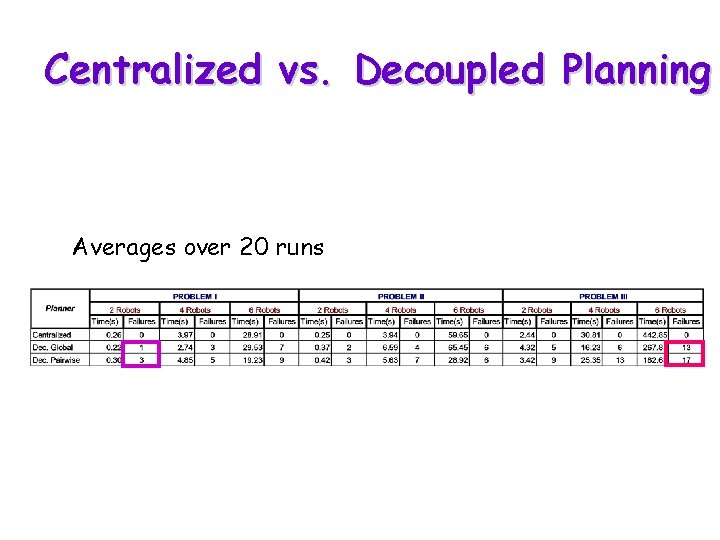
Centralized vs. Decoupled Planning Averages over 20 runs
- Slides: 11