
CS 3240 Chapters Variations on Turing Machines Mechanisms



- Slides: 28
CS 3240 – Chapters Variations on Turing Machines
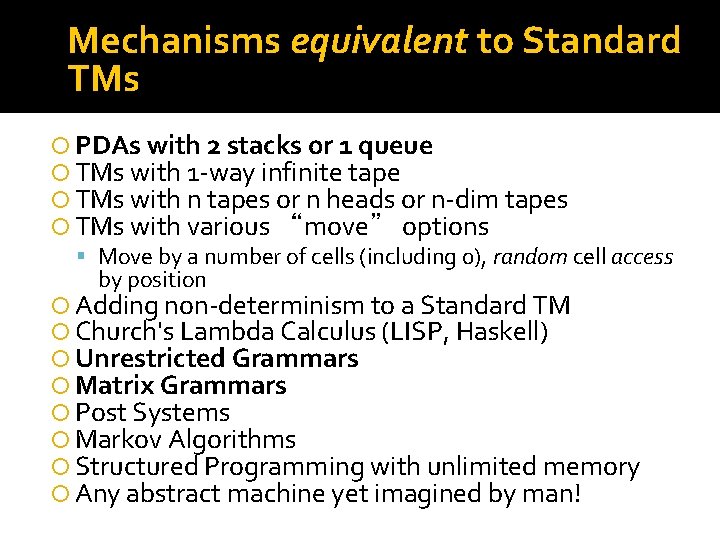
Mechanisms equivalent to Standard TMs PDAs with 2 stacks or 1 queue TMs with 1 -way infinite tape TMs with n tapes or n heads or n-dim tapes TMs with various “move” options Move by a number of cells (including 0), random cell access by position Adding non-determinism to a Standard TM Church's Lambda Calculus (LISP, Haskell) Unrestricted Grammars Matrix Grammars Post Systems Markov Algorithms Structured Programming with unlimited memory Any abstract machine yet imagined by man!
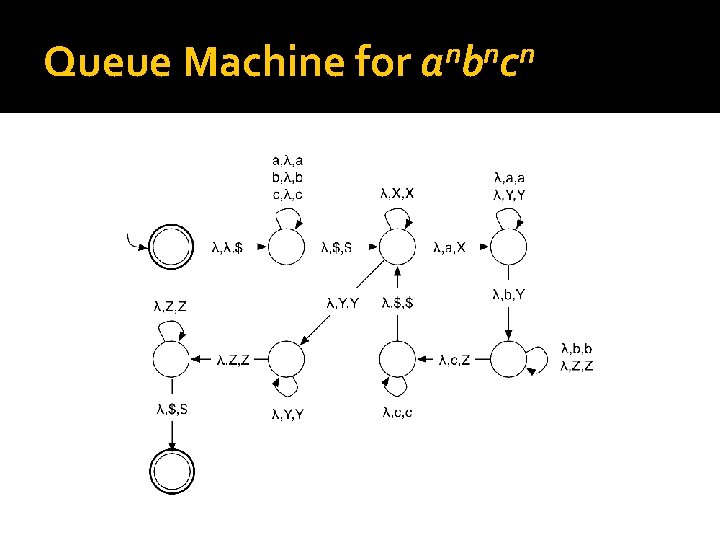
Queue Machines Queues pop at front, push at back 2 I/O points gives more flexibility Equivalent to a TM! Begin by pushing all initial data Can simulate “moving around” by cycling through the data circular shift via pop and push of same character use a delimiter character ($) to keep track of the start of data
Queue Machine for n n n abc
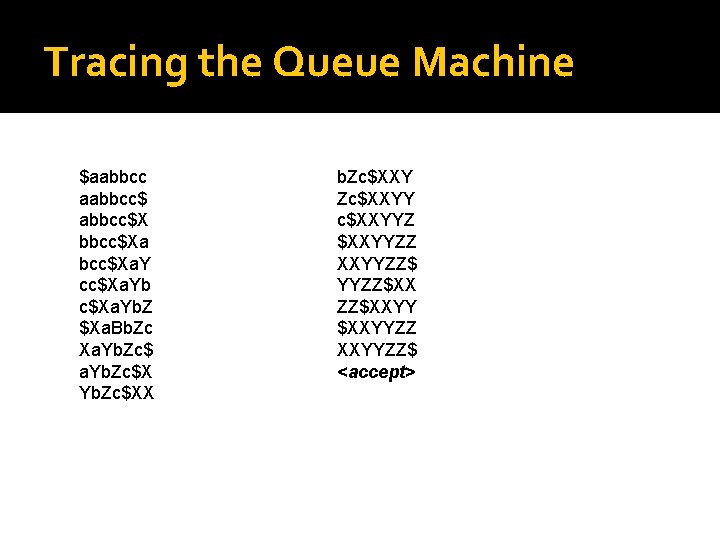
Tracing the Queue Machine $aabbcc$ abbcc$Xa bcc$Xa. Yb c$Xa. Yb. Z $Xa. Bb. Zc Xa. Yb. Zc$XX b. Zc$XXYYZ $XXYYZZ$ YYZZ$XXYY $XXYYZZ$ <accept>
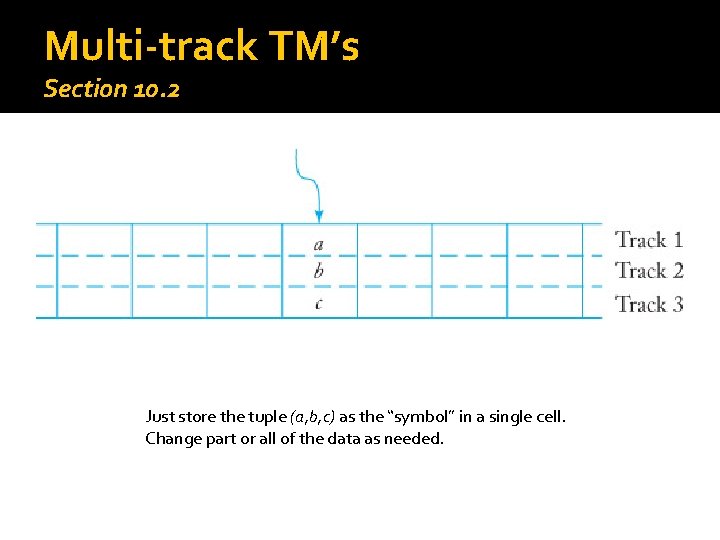
Multi-track TM’s Section 10. 2 Just store the tuple (a, b, c) as the “symbol” in a single cell. Change part or all of the data as needed.
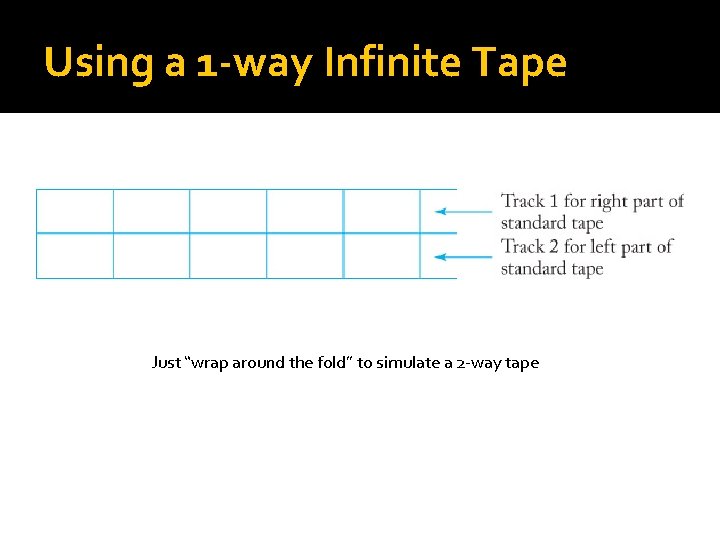
Using a 1 -way Infinite Tape Just “wrap around the fold” to simulate a 2 -way tape
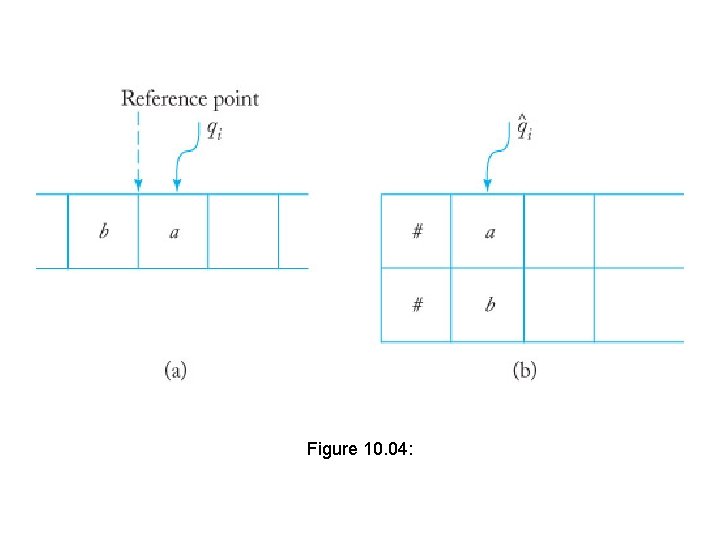
Figure 10. 04:
Figure 10. 05:
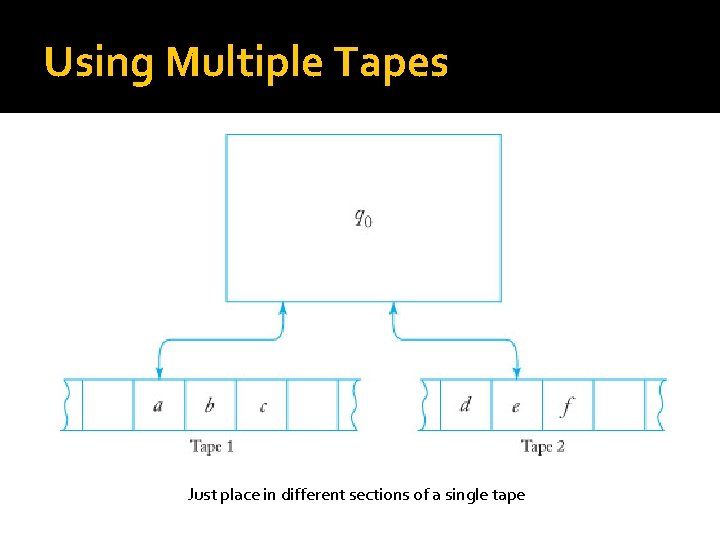
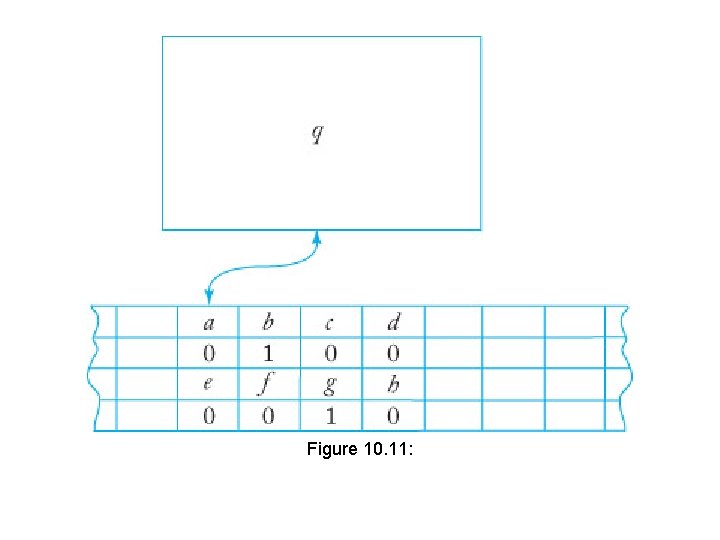
Using Multiple Tapes Just place in different sections of a single tape
Figure 10. 11:
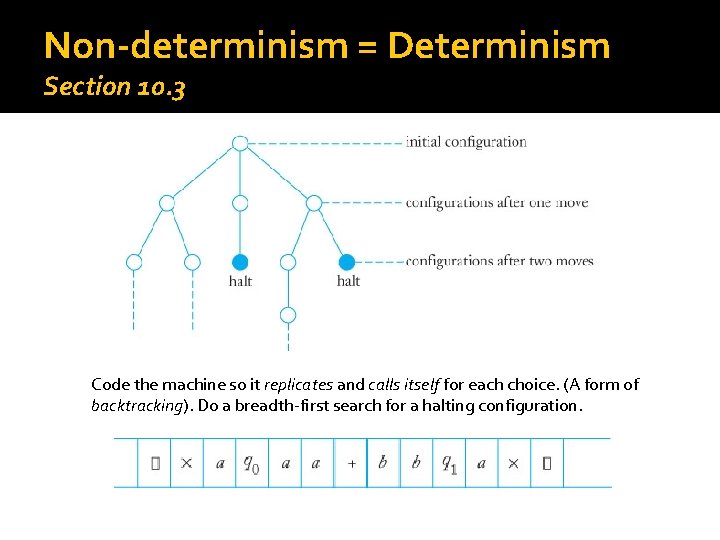
Non-determinism = Determinism Section 10. 3 Code the machine so it replicates and calls itself for each choice. (A form of backtracking). Do a breadth-first search for a halting configuration.
Special-Purpose Computers The TM we’ve seen so far have been “special-purpose computers” they implement only one algorithm, or they accept only one language But TMs can take another TM as input, and simulate (run) it “stored program computer” general purpose computer as we know it
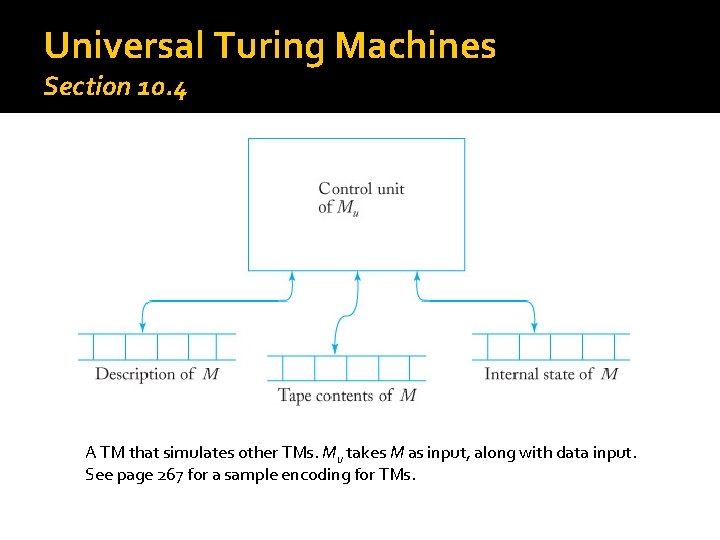
Universal Turing Machines Section 10. 4 A TM that simulates other TMs. Mu takes M as input, along with data input. See page 267 for a sample encoding for TMs.
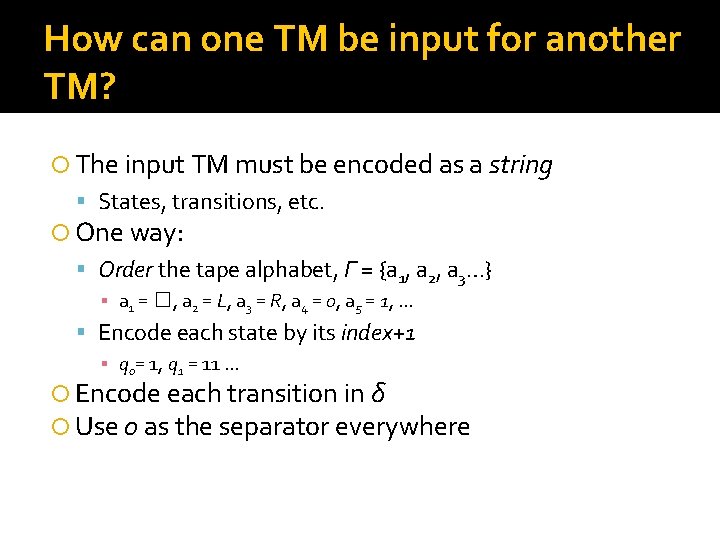
How can one TM be input for another TM? The input TM must be encoded as a string States, transitions, etc. One way: Order the tape alphabet, Γ = {a 1, a 2, a 3…} ▪ a 1 = ☐, a 2 = L, a 3 = R, a 4 = 0, a 5 = 1, … Encode each state by its index+1 ▪ q 0= 1, q 1 = 11 … Encode each transition in δ Use 0 as the separator everywhere
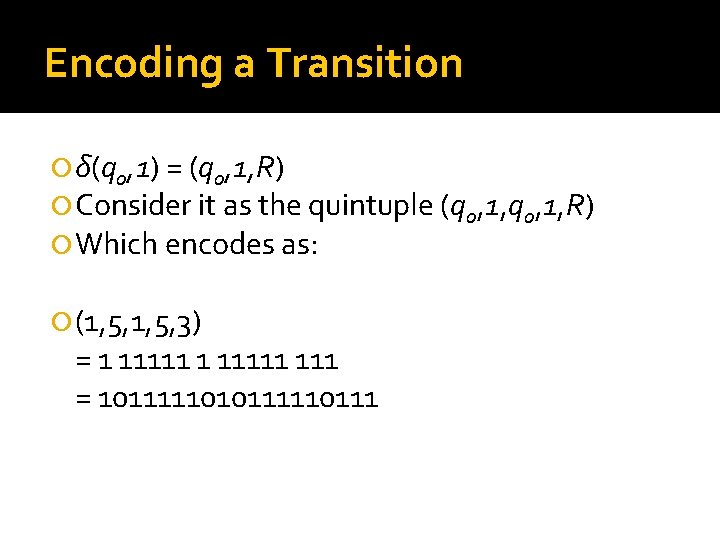
Encoding a Transition δ(q 0, 1) = (q 0, 1, R) Consider it as the quintuple (q 0, 1, R) Which encodes as: (1, 5, 3) = 1 11111 111 = 10111110111
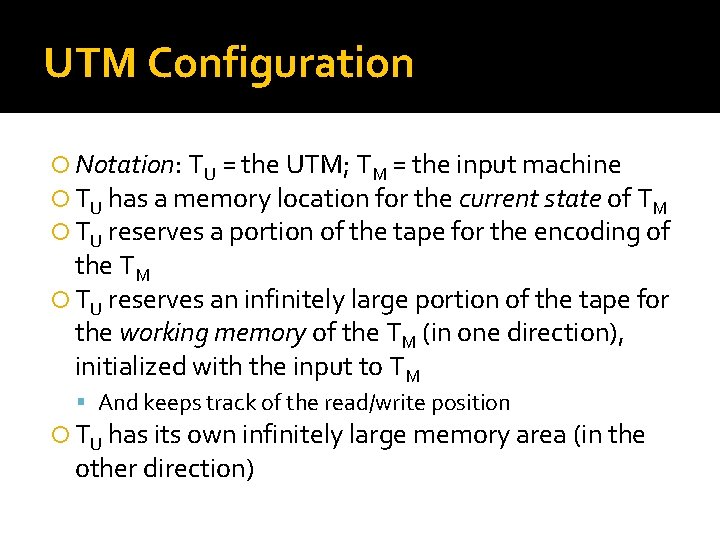
UTM Configuration Notation: TU = the UTM; TM = the input machine TU has a memory location for the current state of TM TU reserves a portion of the tape for the encoding of the TM TU reserves an infinitely large portion of the tape for the working memory of the TM (in one direction), initialized with the input to TM And keeps track of the read/write position TU has its own infinitely large memory area (in the other direction)
Just “Trust Us” We won’t investigate the inner workings of UTMs further We’ll just assume they exist (If they didn’t, neither would computers : -) What we will do is examine the consequences of the existence of UTMs especially the consequences of encoding TMs as strings
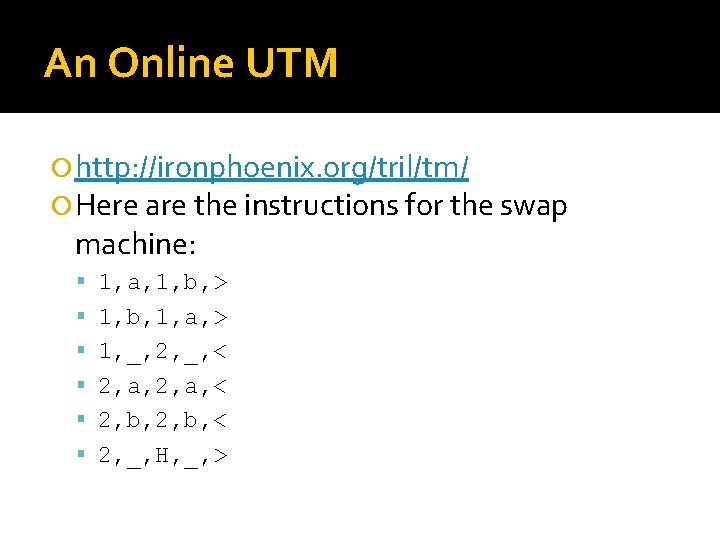
An Online UTM http: //ironphoenix. org/tril/tm/ Here are the instructions for the swap machine: 1, a, 1, b, > 1, b, 1, a, > 1, _, 2, _, < 2, a, < 2, b, < 2, _, H, _, >
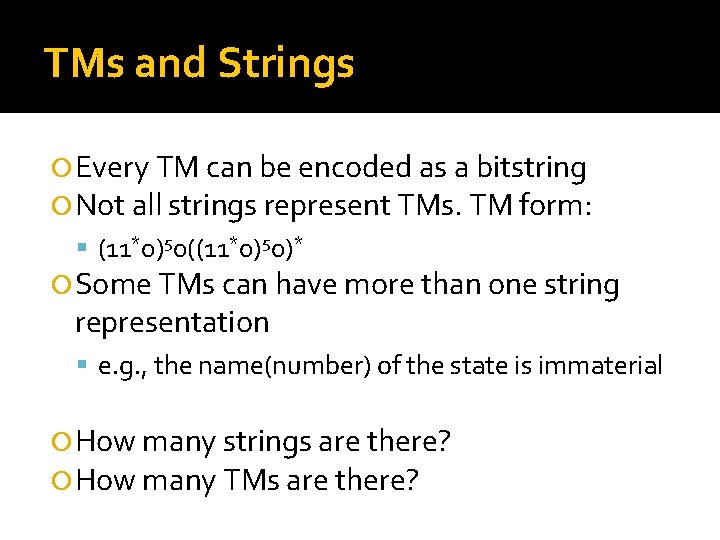
TMs and Strings Every TM can be encoded as a bitstring Not all strings represent TMs. TM form: (11*0)50((11*0)50)* Some TMs can have more than one string representation e. g. , the name(number) of the state is immaterial How many strings are there? How many TMs are there?
Countability Some infinite sets are countable like the set of positive even numbers {0, 2, 4, …} = {2 n | n ∈ N}; function: p(i) = 2 i There is a one-to-one mapping between the set’s elements and the Natural numbers Others are not countable: e. g. , the set of real numbers Consequence: |(0, 1)| = |(-∞, ∞)| !!!
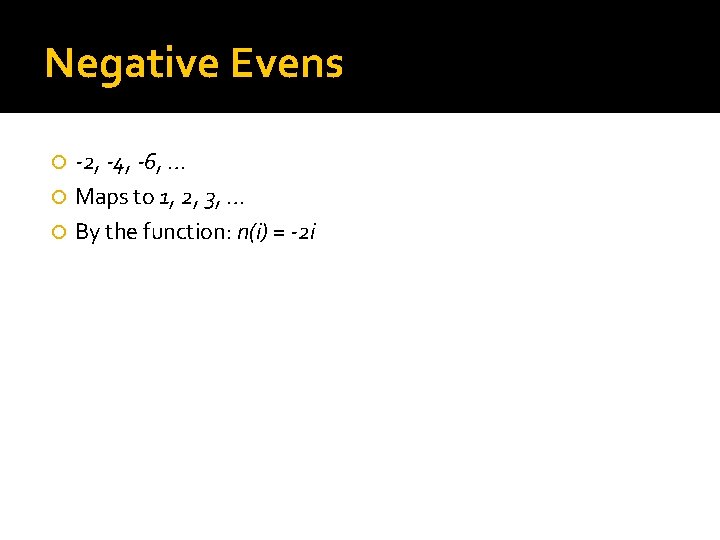
Negative Evens -2, -4, -6, … Maps to 1, 2, 3, … By the function: n(i) = -2 i
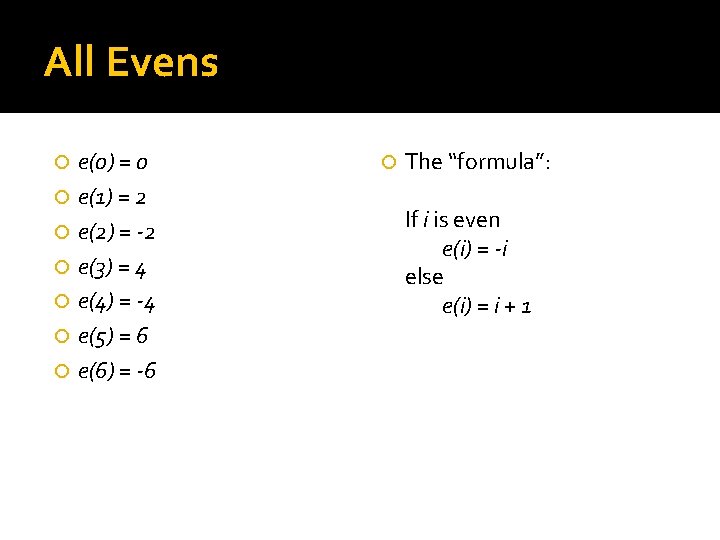
All Evens e(0) = 0 e(1) = 2 e(2) = -2 e(3) = 4 e(4) = -4 e(5) = 6 e(6) = -6 The “formula”: If i is even e(i) = -i else e(i) = i + 1
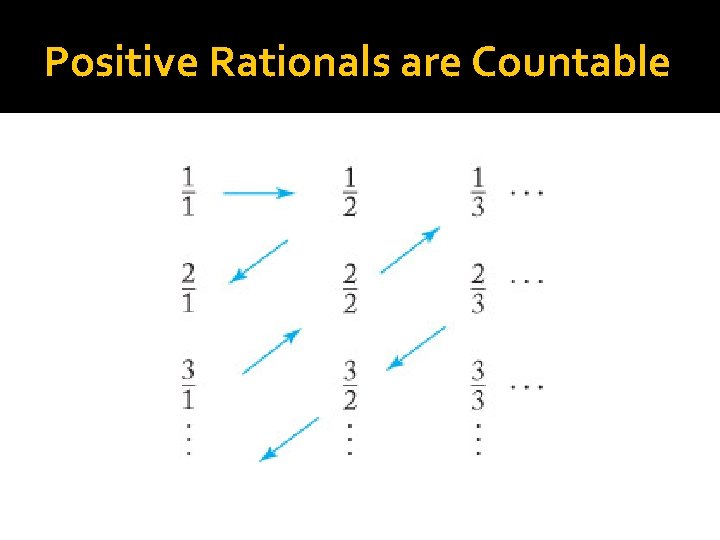
Positive Rationals are Countable
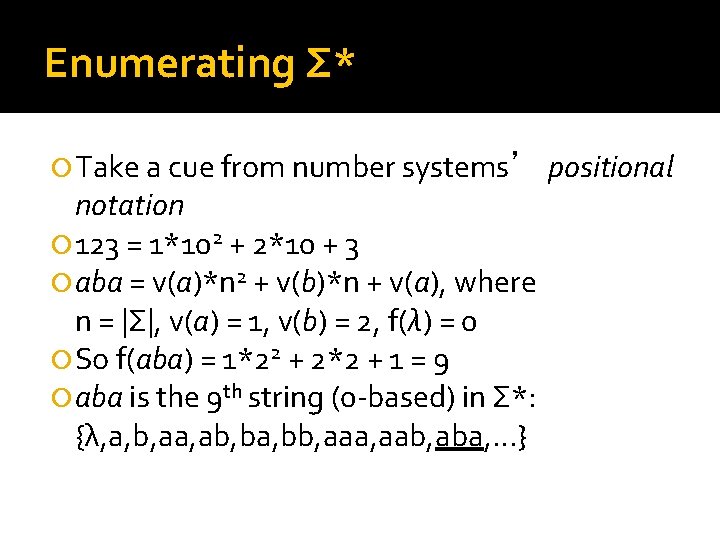
Enumerating Σ* Take a cue from number systems’ positional notation 123 = 1*102 + 2*10 + 3 aba = v(a)*n 2 + v(b)*n + v(a), where n = |Σ|, v(a) = 1, v(b) = 2, f(λ) = 0 So f(aba) = 1*22 + 2*2 + 1 = 9 aba is the 9 th string (0 -based) in Σ*: {λ, a, b, aa, ab, ba, bb, aaa, aab, aba, …}
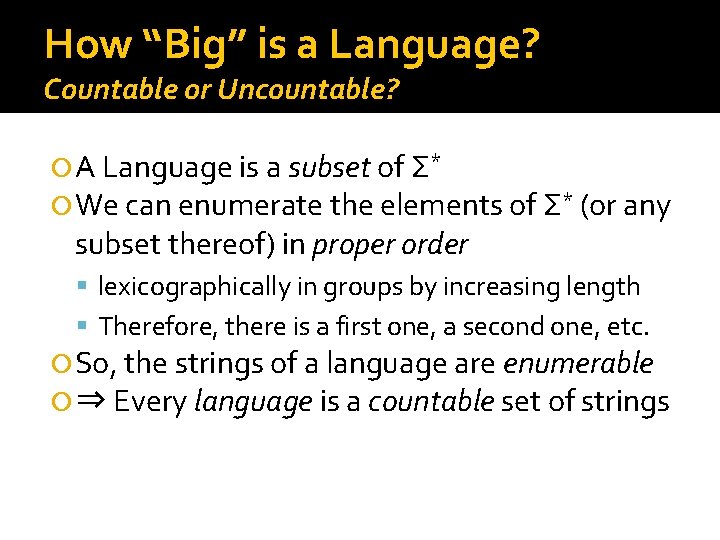
How “Big” is a Language? Countable or Uncountable? A Language is a subset of Σ* We can enumerate the elements of Σ* (or any subset thereof) in proper order lexicographically in groups by increasing length Therefore, there is a first one, a second one, etc. So, the strings of a language are enumerable ⇒ Every language is a countable set of strings
The Totality of TMs is Countable aka enumerable They can be arranged in a sequence ▪ TM 0, TM 1, TM 2, etc. Why? Because they can be encoded as strings Strings over any alphabet can be enumerated in proper order ▪ by length groups, lexicographically So there you have it!
Linear Bounded Automata Section 10. 5 Some TMs only need a fixed size of working storage never grows beyond (a factor of the) input size Example: anbncn Doesn’t expand working storage (remember? ) These are called Linear Bounded Automata LBA; they use end-markers: [<data goes here>] Why do we care? We don’t, much; will use briefly in Chapter 11