
CS 3204 Operating Systems Lecture 7 Godmar Back
CS 3204 Operating Systems Lecture 7 Godmar Back CS 3204 Spring 2007

Announcements • Project 1 Feb 20 (Tuesday) 11: 59 pm • You have formed groups by now – Some haven’t told me their group membership – please do so ASAP. • Reading: – Read carefully 1. 5, 3. 1 -3. 3, 6. 1 -6. 4 CS 3204 Spring 2007 12/19/2021 2
Project 1 Suggested Timeline • End of this week: Feb 2: – Have read relevant project documentation, set up CVS, built and run your first kernel, designed your data structures for alarm clock • Alarm clock by Feb 6 • Basic priority by Feb 8 • Priority Inheritance & Advanced Scheduler will take the most time to implement & debug, start them in parallel – Should have design for priority inheritance figured out by Feb 13 – Develop & test fixed-point layer independently by Feb 13 • Due date Feb 20 CS 3204 Spring 2007 12/19/2021 3
Concurrency & Synchronization CS 3204 Spring 2007
Overview • Will talk about locks, semaphores, and monitors/condition variables • For each, will talk about: – What abstraction they represent – How to implement them – How and when to use them • Two major issues: – Mutual exclusion – Scheduling constraints • Project note: Pintos implements its locks on top of semaphores CS 3204 Spring 2007 12/19/2021 5
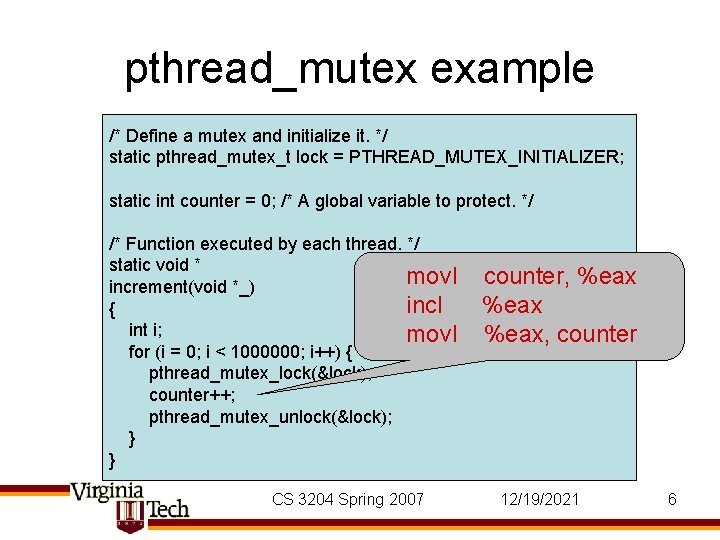
pthread_mutex example /* Define a mutex and initialize it. */ static pthread_mutex_t lock = PTHREAD_MUTEX_INITIALIZER; static int counter = 0; /* A global variable to protect. */ /* Function executed by each thread. */ static void * movl increment(void *_) incl { int i; movl for (i = 0; i < 1000000; i++) { pthread_mutex_lock(&lock); counter++; pthread_mutex_unlock(&lock); } } CS 3204 Spring 2007 counter, %eax, counter 12/19/2021 6
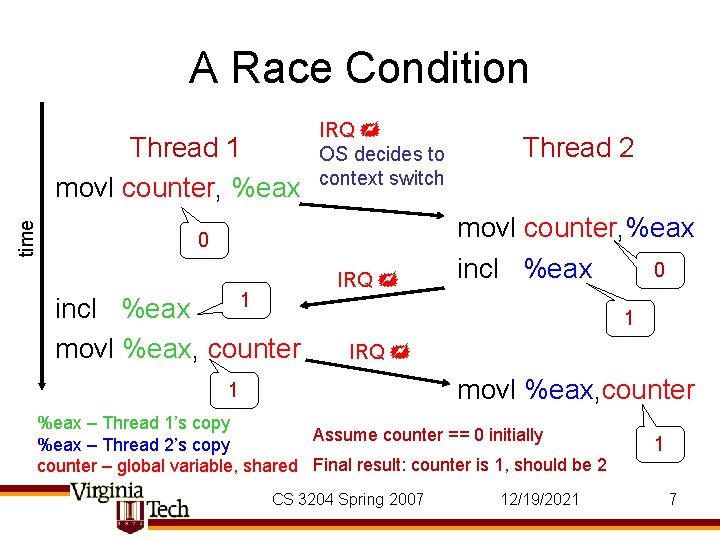
A Race Condition time Thread 1 movl counter, %eax IRQ OS decides to context switch 0 1 incl %eax movl %eax, counter IRQ Thread 2 movl counter, %eax 0 incl %eax 1 IRQ movl %eax, counter 1 %eax – Thread 1’s copy Assume counter == 0 initially %eax – Thread 2’s copy counter – global variable, shared Final result: counter is 1, should be 2 CS 3204 Spring 2007 12/19/2021 1 7
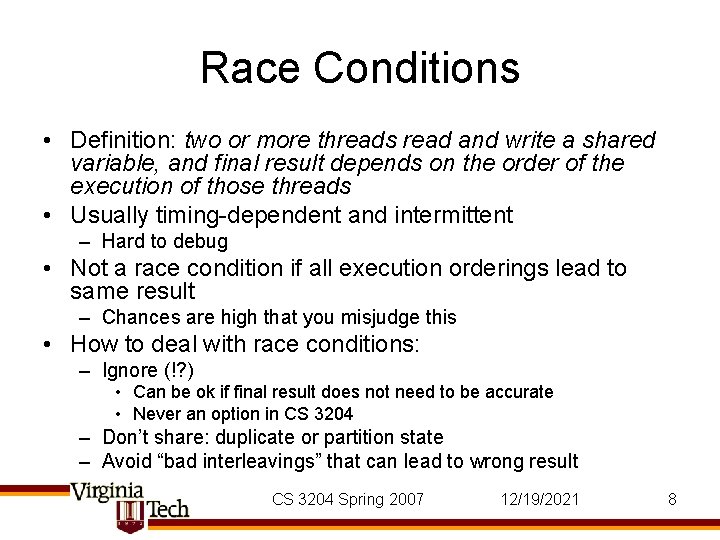
Race Conditions • Definition: two or more threads read and write a shared variable, and final result depends on the order of the execution of those threads • Usually timing-dependent and intermittent – Hard to debug • Not a race condition if all execution orderings lead to same result – Chances are high that you misjudge this • How to deal with race conditions: – Ignore (!? ) • Can be ok if final result does not need to be accurate • Never an option in CS 3204 – Don’t share: duplicate or partition state – Avoid “bad interleavings” that can lead to wrong result CS 3204 Spring 2007 12/19/2021 8
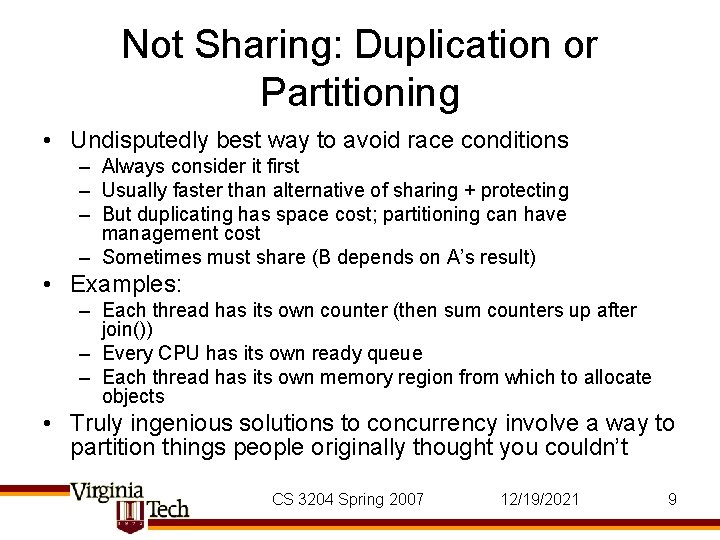
Not Sharing: Duplication or Partitioning • Undisputedly best way to avoid race conditions – Always consider it first – Usually faster than alternative of sharing + protecting – But duplicating has space cost; partitioning can have management cost – Sometimes must share (B depends on A’s result) • Examples: – Each thread has its own counter (then sum counters up after join()) – Every CPU has its own ready queue – Each thread has its own memory region from which to allocate objects • Truly ingenious solutions to concurrency involve a way to partition things people originally thought you couldn’t CS 3204 Spring 2007 12/19/2021 9
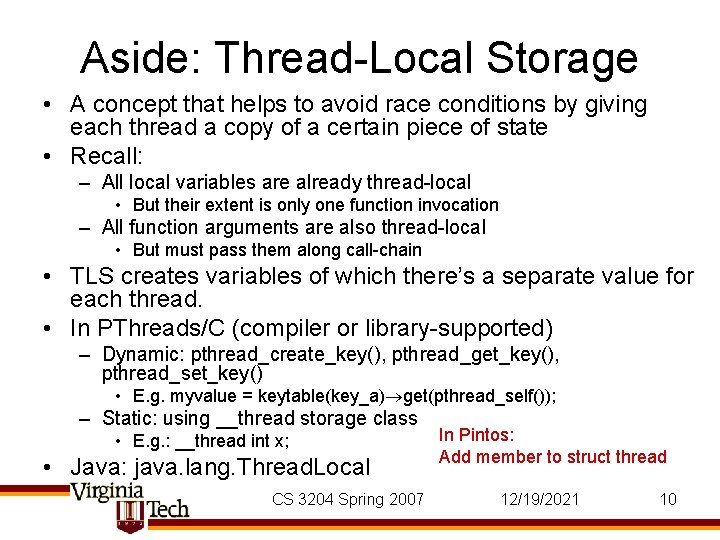
Aside: Thread-Local Storage • A concept that helps to avoid race conditions by giving each thread a copy of a certain piece of state • Recall: – All local variables are already thread-local • But their extent is only one function invocation – All function arguments are also thread-local • But must pass them along call-chain • TLS creates variables of which there’s a separate value for each thread. • In PThreads/C (compiler or library-supported) – Dynamic: pthread_create_key(), pthread_get_key(), pthread_set_key() • E. g. myvalue = keytable(key_a) get(pthread_self()); – Static: using __thread storage class • E. g. : __thread int x; • Java: java. lang. Thread. Local CS 3204 Spring 2007 In Pintos: Add member to struct thread 12/19/2021 10
Race Condition & Execution Order • Prevent race conditions by imposing constraints on execution order so the final result is the same regardless of actual execution order – That is, exclude “bad” interleavings – Specifically: disallow other threads to start updating shared variables while one thread is in the middle of doing so; make those updates atomic. CS 3204 Spring 2007 12/19/2021 11
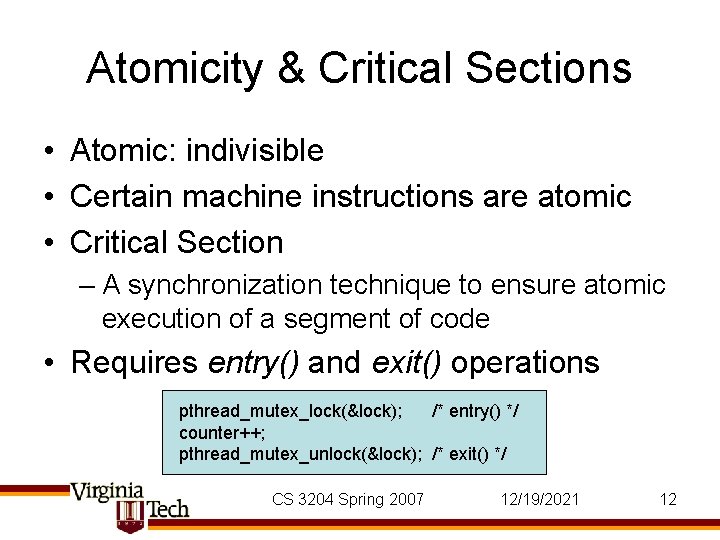
Atomicity & Critical Sections • Atomic: indivisible • Certain machine instructions are atomic • Critical Section – A synchronization technique to ensure atomic execution of a segment of code • Requires entry() and exit() operations pthread_mutex_lock(&lock); /* entry() */ counter++; pthread_mutex_unlock(&lock); /* exit() */ CS 3204 Spring 2007 12/19/2021 12
Critical Sections (cont’d) • Critical Section Problem also known as mutual exclusion problem • Only one thread can be inside critical section; others attempting to enter CS must wait until thread that’s inside CS leaves it. • Note: different from “all-or-nothing” meaning atomic has in database theory & practice – Does not necessarily imply that thread executes section without interruption, or even that thread completes section – just that other threads can’t enter it while one thread is inside it • Solutions can be entirely software, or entirely hardware – Usually combined – Different solutions for uniprocessor vs multiprocessor scenarios CS 3204 Spring 2007 12/19/2021 13
Implementing Critical Sections • Will look at: – Disabling interrupts approach – Semaphores – Locks CS 3204 Spring 2007 12/19/2021 14
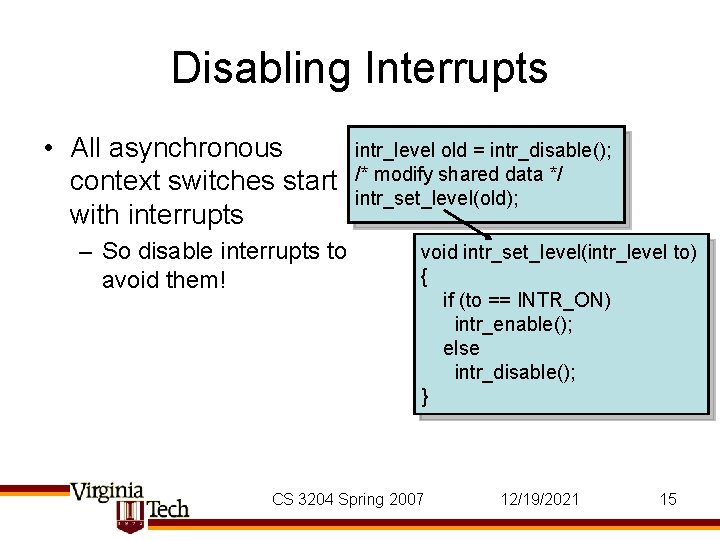
Disabling Interrupts • All asynchronous context switches start with interrupts – So disable interrupts to avoid them! intr_level old = intr_disable(); /* modify shared data */ intr_set_level(old); void intr_set_level(intr_level to) { if (to == INTR_ON) intr_enable(); else intr_disable(); } CS 3204 Spring 2007 12/19/2021 15
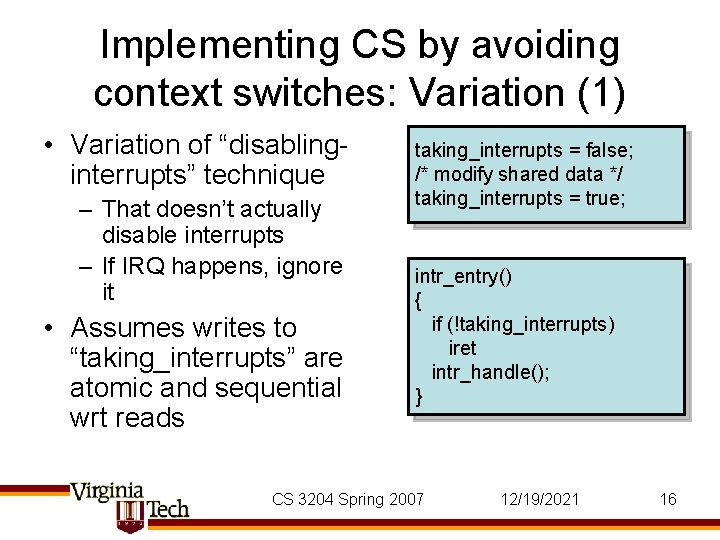
Implementing CS by avoiding context switches: Variation (1) • Variation of “disablinginterrupts” technique – That doesn’t actually disable interrupts – If IRQ happens, ignore it • Assumes writes to “taking_interrupts” are atomic and sequential wrt reads taking_interrupts = false; /* modify shared data */ taking_interrupts = true; intr_entry() { if (!taking_interrupts) iret intr_handle(); } CS 3204 Spring 2007 12/19/2021 16
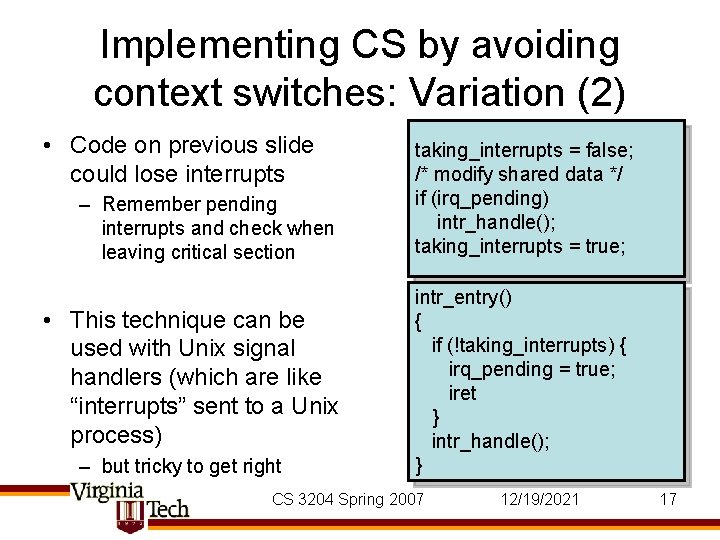
Implementing CS by avoiding context switches: Variation (2) • Code on previous slide could lose interrupts – Remember pending interrupts and check when leaving critical section • This technique can be used with Unix signal handlers (which are like “interrupts” sent to a Unix process) – but tricky to get right taking_interrupts = false; /* modify shared data */ if (irq_pending) intr_handle(); taking_interrupts = true; intr_entry() { if (!taking_interrupts) { irq_pending = true; iret } intr_handle(); } CS 3204 Spring 2007 12/19/2021 17
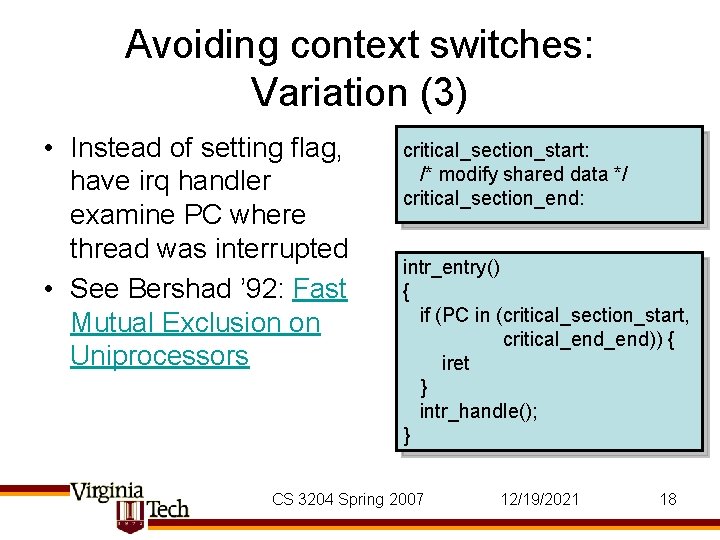
Avoiding context switches: Variation (3) • Instead of setting flag, have irq handler examine PC where thread was interrupted • See Bershad ’ 92: Fast Mutual Exclusion on Uniprocessors critical_section_start: /* modify shared data */ critical_section_end: intr_entry() { if (PC in (critical_section_start, critical_end)) { iret } intr_handle(); } CS 3204 Spring 2007 12/19/2021 18
Disabling Interrupts: Summary • • (this applies to all variations) Sledgehammer solution Infinite loop means machine locks up Use this to protect data structures from concurrent access by interrupt handlers – Keep sections of code where irqs are disabled minimal (nothing else can happen until irqs are reenabled – latency penalty!) – If you block (give up CPU) mutual exclusion with other threads is not guaranteed • Any function that transitively calls thread_block() may block • Want something more fine-grained – Key insight: don’t exclude everybody else, only those contending for the same critical section CS 3204 Spring 2007 12/19/2021 19
- Slides: 19