
CS 3204 Operating Systems Lecture 6 Godmar Back
CS 3204 Operating Systems Lecture 6 Godmar Back CS 3204 Fall 2006
Announcements • Project 1 due Monday Sep 25, 11: 59 pm • Project 1 help session slides online: • Group formation: – See http: //courses. cs. vt. edu/~cs 3204/fall 2006/gback/groups. txt for current list – Will only assign as a last resort. • Announcements: – Microsoft “Meet The Company” tonight Sep 7, 7 -9 pm Pamplin 2030 – Unix Crash Course by VTLUUG: • Monday Sep 11, 7 -9 pm Squires 236 • Tuesday Sep 12, 6 -8: 30 pm Squires 116 • Reading assignments: – Chapters 1, 2 – skim. Read carefully 1. 5. – Read carefully Chapter 3. 1 -3. 3 – Read carefully Chapter 6. 1 -6. 4 CS 3204 Fall 2006 3/7/2021 2
Project 1 Suggested Timeline • Today Sep 7: – Have read project documentation, set up CVS, built and run your first kernel, designed your data structures for alarm clock • Alarm clock by Sep 9 • Basic priority by Sep 13 • Priority Inheritance & Advanced Scheduler take the most time, start them in parallel – will take the most time to implement & debug • Due date Sep 25 CS 3204 Fall 2006 3/7/2021 3
Processes & Threads Continued CS 3204 Fall 2006
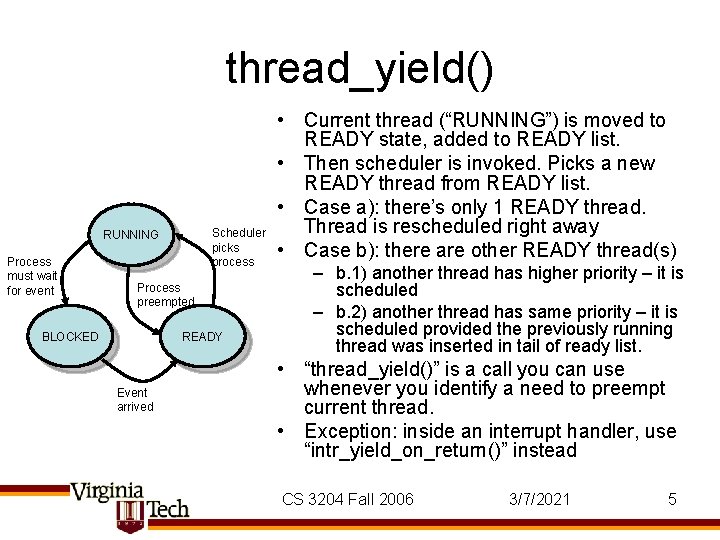
thread_yield() Scheduler picks process RUNNING Process must wait for event Process preempted BLOCKED READY Event arrived • Current thread (“RUNNING”) is moved to READY state, added to READY list. • Then scheduler is invoked. Picks a new READY thread from READY list. • Case a): there’s only 1 READY thread. Thread is rescheduled right away • Case b): there are other READY thread(s) – b. 1) another thread has higher priority – it is scheduled – b. 2) another thread has same priority – it is scheduled provided the previously running thread was inserted in tail of ready list. • “thread_yield()” is a call you can use whenever you identify a need to preempt current thread. • Exception: inside an interrupt handler, use “intr_yield_on_return()” instead CS 3204 Fall 2006 3/7/2021 5
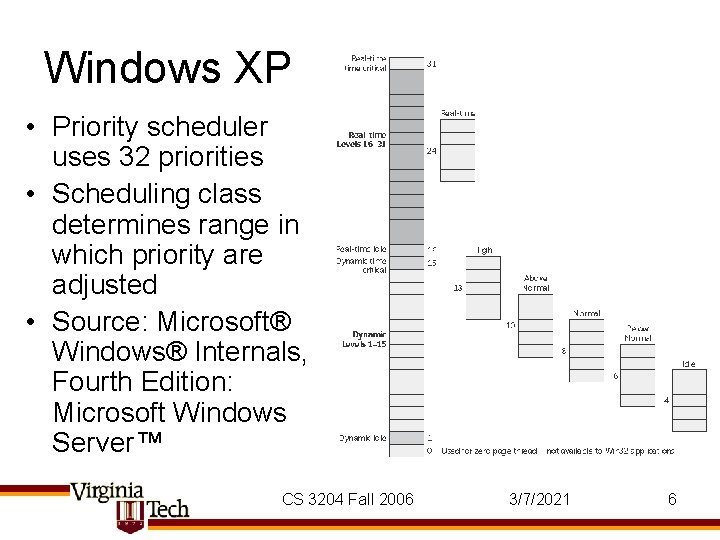
Windows XP • Priority scheduler uses 32 priorities • Scheduling class determines range in which priority are adjusted • Source: Microsoft® Windows® Internals, Fourth Edition: Microsoft Windows Server™ CS 3204 Fall 2006 3/7/2021 6
Process Creation • Two common paradigms: – Cloning vs. spawning • Cloning: (Unix) – “fork()” clones current process – child process then loads new program • Spawning: (Windows, Pintos) – “exec()” spawns a new process with new program • Difference is whether creation of new process also involves a change in program CS 3204 Fall 2006 3/7/2021 7
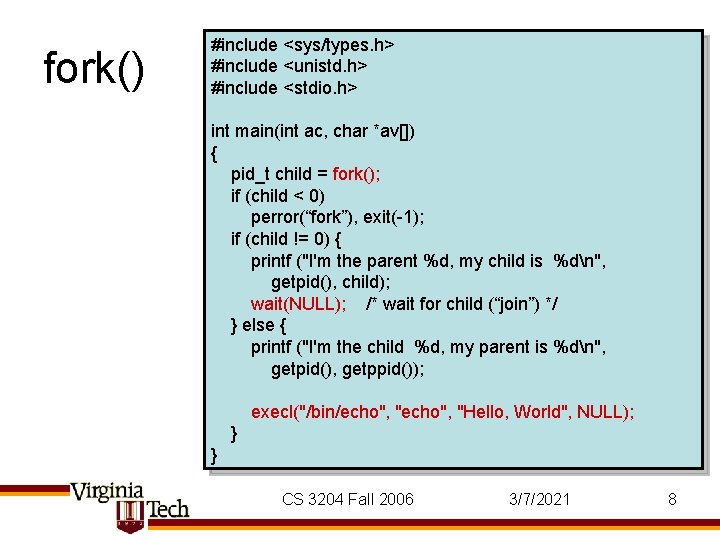
fork() #include <sys/types. h> #include <unistd. h> #include <stdio. h> int main(int ac, char *av[]) { pid_t child = fork(); if (child < 0) perror(“fork”), exit(-1); if (child != 0) { printf ("I'm the parent %d, my child is %dn", getpid(), child); wait(NULL); /* wait for child (“join”) */ } else { printf ("I'm the child %d, my parent is %dn", getpid(), getppid()); execl("/bin/echo", "Hello, World", NULL); } } CS 3204 Fall 2006 3/7/2021 8
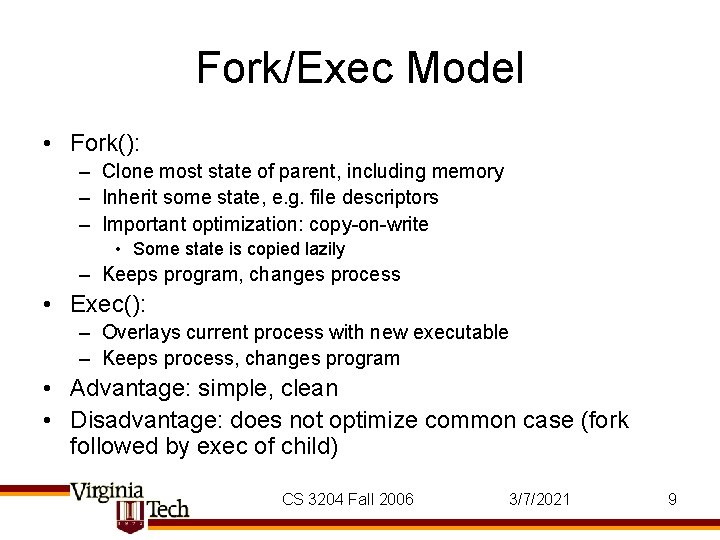
Fork/Exec Model • Fork(): – Clone most state of parent, including memory – Inherit some state, e. g. file descriptors – Important optimization: copy-on-write • Some state is copied lazily – Keeps program, changes process • Exec(): – Overlays current process with new executable – Keeps process, changes program • Advantage: simple, clean • Disadvantage: does not optimize common case (fork followed by exec of child) CS 3204 Fall 2006 3/7/2021 9
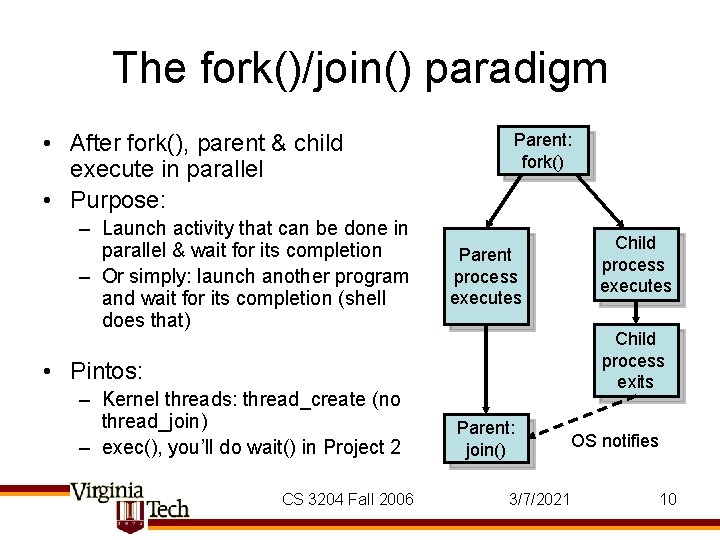
The fork()/join() paradigm • After fork(), parent & child execute in parallel • Purpose: – Launch activity that can be done in parallel & wait for its completion – Or simply: launch another program and wait for its completion (shell does that) Parent: fork() Parent process executes Child process exits • Pintos: – Kernel threads: thread_create (no thread_join) – exec(), you’ll do wait() in Project 2 CS 3204 Fall 2006 Child process executes Parent: join() 3/7/2021 OS notifies 10
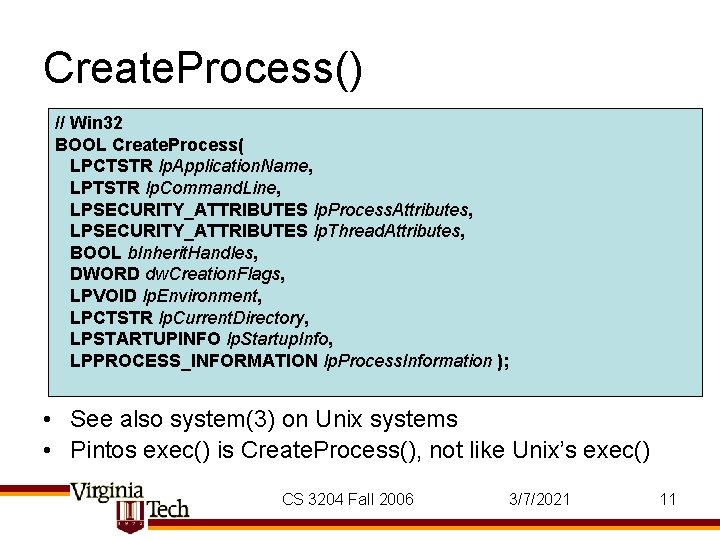
Create. Process() // Win 32 BOOL Create. Process( LPCTSTR lp. Application. Name, LPTSTR lp. Command. Line, LPSECURITY_ATTRIBUTES lp. Process. Attributes, LPSECURITY_ATTRIBUTES lp. Thread. Attributes, BOOL b. Inherit. Handles, DWORD dw. Creation. Flags, LPVOID lp. Environment, LPCTSTR lp. Current. Directory, LPSTARTUPINFO lp. Startup. Info, LPPROCESS_INFORMATION lp. Process. Information ); • See also system(3) on Unix systems • Pintos exec() is Create. Process(), not like Unix’s exec() CS 3204 Fall 2006 3/7/2021 11
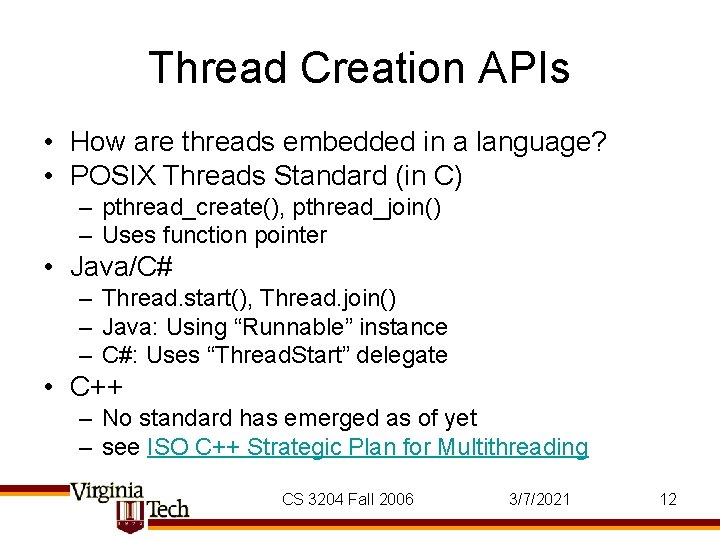
Thread Creation APIs • How are threads embedded in a language? • POSIX Threads Standard (in C) – pthread_create(), pthread_join() – Uses function pointer • Java/C# – Thread. start(), Thread. join() – Java: Using “Runnable” instance – C#: Uses “Thread. Start” delegate • C++ – No standard has emerged as of yet – see ISO C++ Strategic Plan for Multithreading CS 3204 Fall 2006 3/7/2021 12
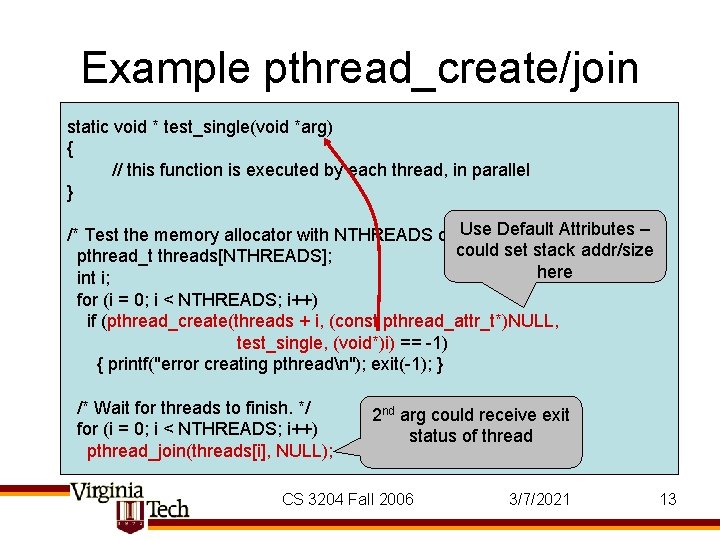
Example pthread_create/join static void * test_single(void *arg) { // this function is executed by each thread, in parallel } Use Default Attributes – /* Test the memory allocator with NTHREADS concurrent threads. */ could set stack addr/size pthread_t threads[NTHREADS]; here int i; for (i = 0; i < NTHREADS; i++) if (pthread_create(threads + i, (const pthread_attr_t*)NULL, test_single, (void*)i) == -1) { printf("error creating pthreadn"); exit(-1); } /* Wait for threads to finish. */ for (i = 0; i < NTHREADS; i++) pthread_join(threads[i], NULL); 2 nd arg could receive exit status of thread CS 3204 Fall 2006 3/7/2021 13
![Java Threads Example public class Java. Threads { public static void main(String []av) throws](http://slidetodoc.com/presentation_image_h/2a8812c1143322e64644e789390d59cd/image-14.jpg "Java Threads Example public class Java. Threads { public static void main(String []av) throws")
Java Threads Example public class Java. Threads { public static void main(String []av) throws Exception { Thread [] t = new Thread[5]; for (int i = 0; i < t. length; i++) { final int tnum = i; Runnable runnable = new Runnable() { public void run() { System. out. println("Thread #"+tnum); Threads implements Runnable – } could have subclassed Thread & }; overridden run() t[i] = new Thread(runnable); t[i]. start(); } Thread. join() can throw for (int i = 0; i < t. length; i++) Interrupted. Exception – can be t[i]. join(); used to interrupt thread waiting to System. out. println("all done"); join via Thread. interrupt } } CS 3204 Fall 2006 3/7/2021 14
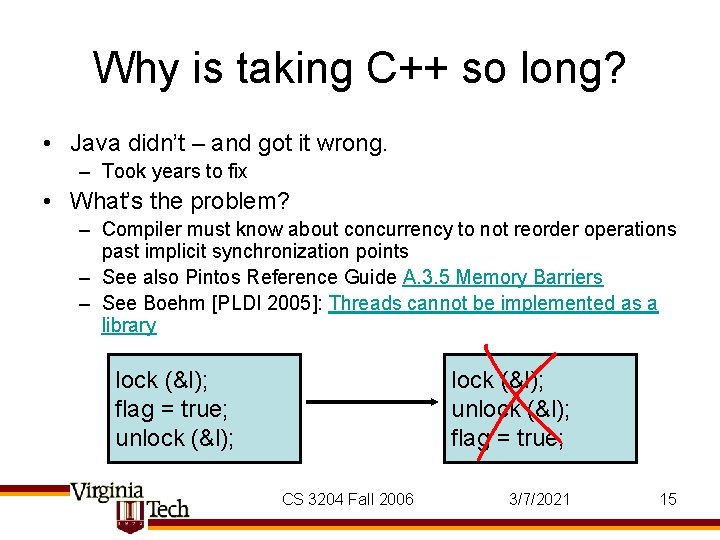
Why is taking C++ so long? • Java didn’t – and got it wrong. – Took years to fix • What’s the problem? – Compiler must know about concurrency to not reorder operations past implicit synchronization points – See also Pintos Reference Guide A. 3. 5 Memory Barriers – See Boehm [PLDI 2005]: Threads cannot be implemented as a library lock (&l); flag = true; unlock (&l); unlock (&l); flag = true; CS 3204 Fall 2006 3/7/2021 15
Concurrency & Synchronization CS 3204 Fall 2006
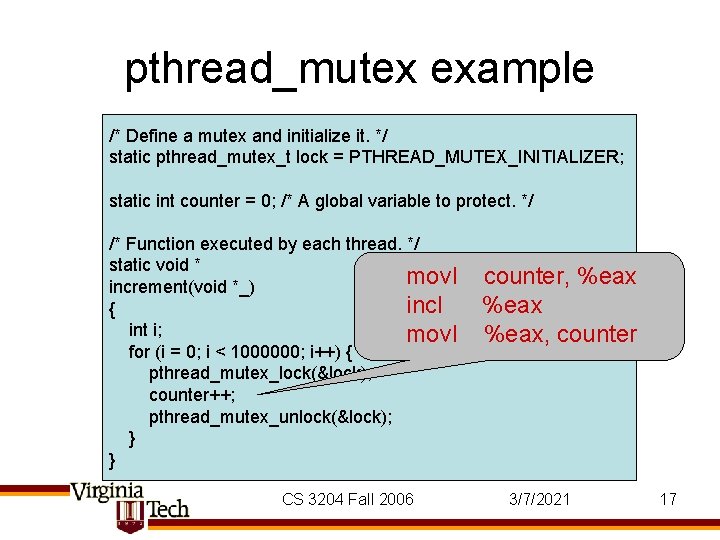
pthread_mutex example /* Define a mutex and initialize it. */ static pthread_mutex_t lock = PTHREAD_MUTEX_INITIALIZER; static int counter = 0; /* A global variable to protect. */ /* Function executed by each thread. */ static void * movl increment(void *_) incl { int i; movl for (i = 0; i < 1000000; i++) { pthread_mutex_lock(&lock); counter++; pthread_mutex_unlock(&lock); } } CS 3204 Fall 2006 counter, %eax, counter 3/7/2021 17
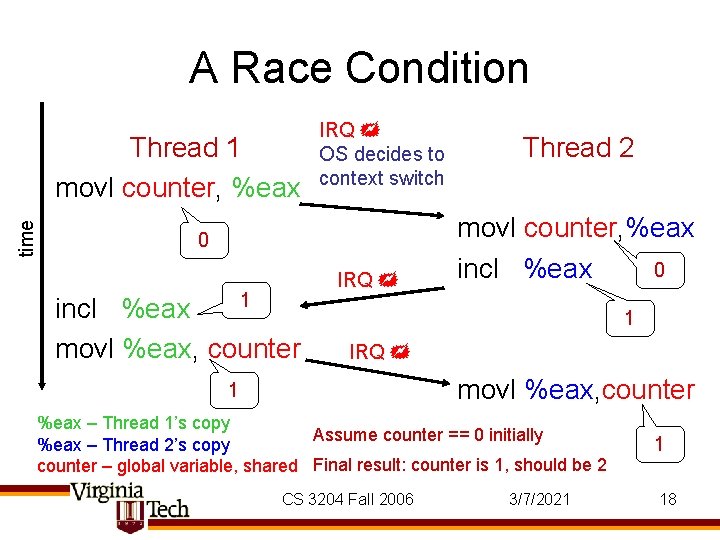
A Race Condition time Thread 1 movl counter, %eax IRQ OS decides to context switch 0 1 incl %eax movl %eax, counter IRQ Thread 2 movl counter, %eax 0 incl %eax 1 IRQ movl %eax, counter 1 %eax – Thread 1’s copy Assume counter == 0 initially %eax – Thread 2’s copy counter – global variable, shared Final result: counter is 1, should be 2 CS 3204 Fall 2006 3/7/2021 1 18
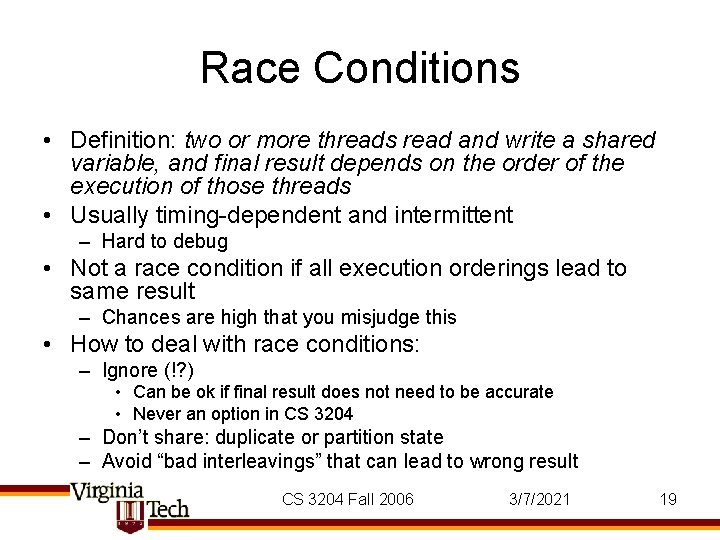
Race Conditions • Definition: two or more threads read and write a shared variable, and final result depends on the order of the execution of those threads • Usually timing-dependent and intermittent – Hard to debug • Not a race condition if all execution orderings lead to same result – Chances are high that you misjudge this • How to deal with race conditions: – Ignore (!? ) • Can be ok if final result does not need to be accurate • Never an option in CS 3204 – Don’t share: duplicate or partition state – Avoid “bad interleavings” that can lead to wrong result CS 3204 Fall 2006 3/7/2021 19
- Slides: 19