
CS 3204 Operating Systems Lecture 36 Godmar Back
CS 3204 Operating Systems Lecture 36 Godmar Back CS 3204 Spring 2006
Announcements • Project 4 due Wed, May 3, 11: 59 pm • Read section 11. 6 on RAID CS 3204 Spring 2006 9/12/2021 2
Filesystems Logging Filesystems Volume Managers Linux VFS CS 3204 Spring 2006
Logging Filesystems • Idea from databases: keep track of changes – “write-ahead log” or “journaling”: modifications are first written to log before they are written to actually changed locations – reads bypass log • After crash, trace through log and – redo completed metadata changes (e. g. , created an inode & updated directory) – undo partially completed metadata changes (e. g. , created an inode, but didn’t update directory) • Log must be written to nonvolatile memory CS 3204 Spring 2006 9/12/2021 4

Logging Issues • How much does logging slow normal operation down? • Log writes are sequential – Can be fast, especially if separate disk is used – Subtlety: log actually does not have to be written synchronously, just in-order & before the data to which it refers! • Can trade performance for consistency – write log synchronously if strong consistency is desired • Need to recycle log – After “sync()”, can restart log since disk is known to be consistent CS 3204 Spring 2006 9/12/2021 5
Physical vs Logical Logging • What & how should be logged? • Physical logging: – Store physical state that’s affected • before or after block (or both) – Choice: easier to redo (if after) or undo (if before) • Logical logging: – Store operation itself as log entry (rename(“a”, “b”)) – More space-efficient, but can be tricky CS 3204 Spring 2006 9/12/2021 6
Summary • Filesystem consistency is important • Any filesystem design implies metadata dependency rules • Designer needs to reason about state of filesystem after crash & avoid unacceptable failures – Needs to take worst-case scenario into account – crash after every sector write • Most current filesystems use logging – Various degrees of data/metadata consistency guarantees CS 3204 Spring 2006 9/12/2021 7
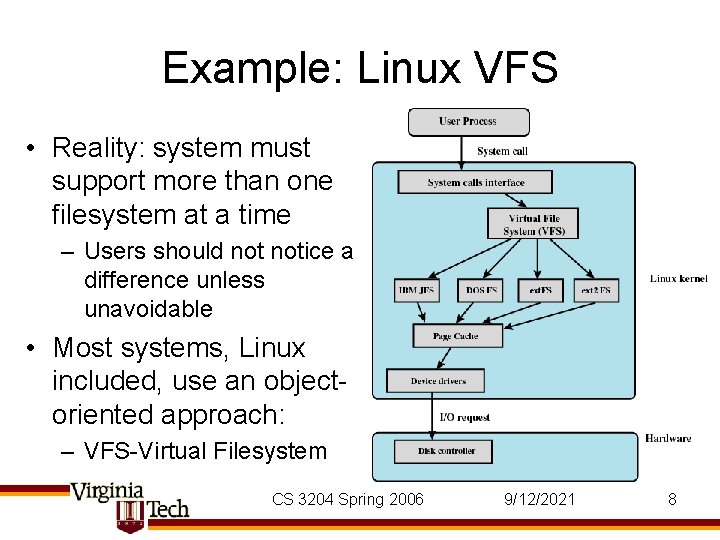
Example: Linux VFS • Reality: system must support more than one filesystem at a time – Users should notice a difference unless unavoidable • Most systems, Linux included, use an objectoriented approach: – VFS-Virtual Filesystem CS 3204 Spring 2006 9/12/2021 8
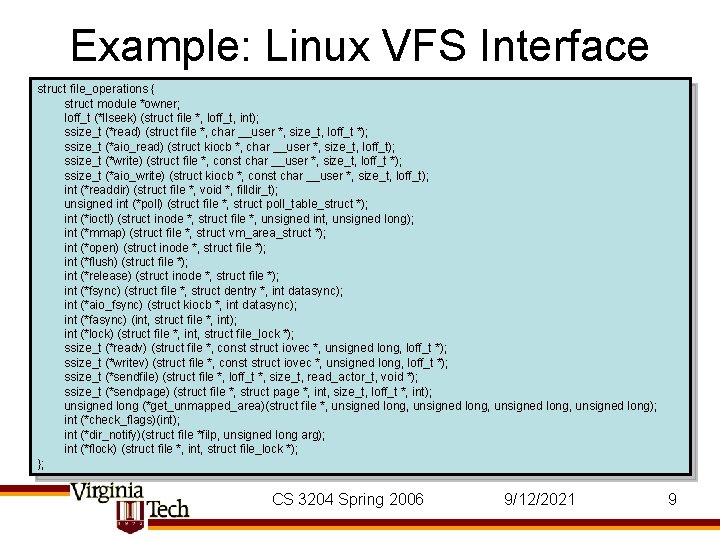
Example: Linux VFS Interface struct file_operations { struct module *owner; loff_t (*llseek) (struct file *, loff_t, int); ssize_t (*read) (struct file *, char __user *, size_t, loff_t *); ssize_t (*aio_read) (struct kiocb *, char __user *, size_t, loff_t); ssize_t (*write) (struct file *, const char __user *, size_t, loff_t *); ssize_t (*aio_write) (struct kiocb *, const char __user *, size_t, loff_t); int (*readdir) (struct file *, void *, filldir_t); unsigned int (*poll) (struct file *, struct poll_table_struct *); int (*ioctl) (struct inode *, struct file *, unsigned int, unsigned long); int (*mmap) (struct file *, struct vm_area_struct *); int (*open) (struct inode *, struct file *); int (*flush) (struct file *); int (*release) (struct inode *, struct file *); int (*fsync) (struct file *, struct dentry *, int datasync); int (*aio_fsync) (struct kiocb *, int datasync); int (*fasync) (int, struct file *, int); int (*lock) (struct file *, int, struct file_lock *); ssize_t (*readv) (struct file *, const struct iovec *, unsigned long, loff_t *); ssize_t (*writev) (struct file *, const struct iovec *, unsigned long, loff_t *); ssize_t (*sendfile) (struct file *, loff_t *, size_t, read_actor_t, void *); ssize_t (*sendpage) (struct file *, struct page *, int, size_t, loff_t *, int); unsigned long (*get_unmapped_area)(struct file *, unsigned long, unsigned long); int (*check_flags)(int); int (*dir_notify)(struct file *filp, unsigned long arg); int (*flock) (struct file *, int, struct file_lock *); }; CS 3204 Spring 2006 9/12/2021 9
Volume Management • Traditionally, disk is exposed as a block device (linear array of block abstraction) – Refinement: disk partitions = subarray within block array • Filesystem sits on partition • Problems: – Filesystem size limited by disk size – Partitions hard to grow & shrink • Solution: Introduce another layer – the Volume Manager (aka “Logical Volume Manager”) CS 3204 Spring 2006 9/12/2021 10
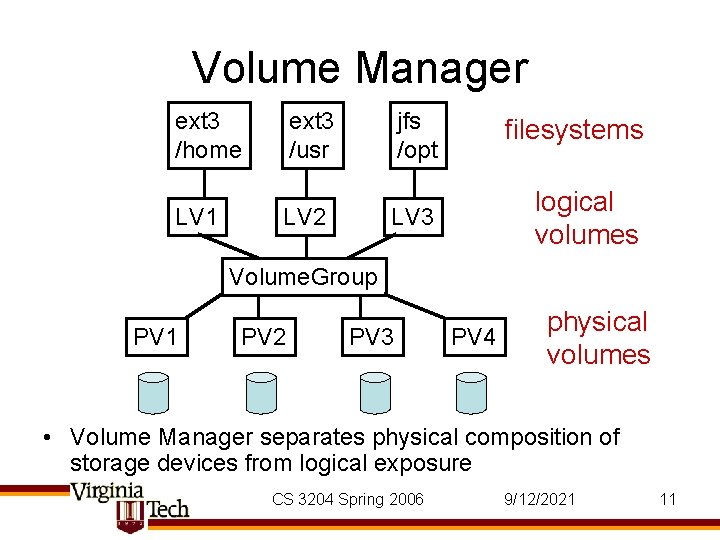
Volume Manager ext 3 /home LV 1 jfs /opt filesystems LV 3 logical volumes ext 3 /usr LV 2 Volume. Group PV 1 PV 2 PV 3 PV 4 physical volumes • Volume Manager separates physical composition of storage devices from logical exposure CS 3204 Spring 2006 9/12/2021 11
- Slides: 11