
CS 313 T ADVANCED PROGRAMMING LANGUAGE Computer Science
- Slides: 21
CS 313 T ADVANCED PROGRAMMING LANGUAGE Computer Science department Lecture 1 : Introduction
Lecture Contents 2 Course Info. � Course objectives � Course plan � Books and references � Assessment methods and grading � Course Material � Visual Studio � C# First program dr. Amal Khalifa, Fall 15
Course Objectives 3 By the end of this course the students will be able to: � Implement and modify C# programs based on object-oriented programming concepts such as classes, inheritance, polymorphism, overloading, indexers, and exception handling. � Develop windows applications using the. NET programming environment. � Use the ADO. NET Entity Data Model to establish connections with and manage Transactions of Databases. dr. Amal Khalifa, Fall 15
Course prerequisite 4 CS 111 D is the course prerequisite of CS 313 D. The notions and concepts that should be known are: Objects & Classes Composition Inheritance hierarchy Arrays and Array. List, Arrays of objects Polymorphism Abstract classes and methods Interfaces Exception Handling dr. MH, Autumn 17
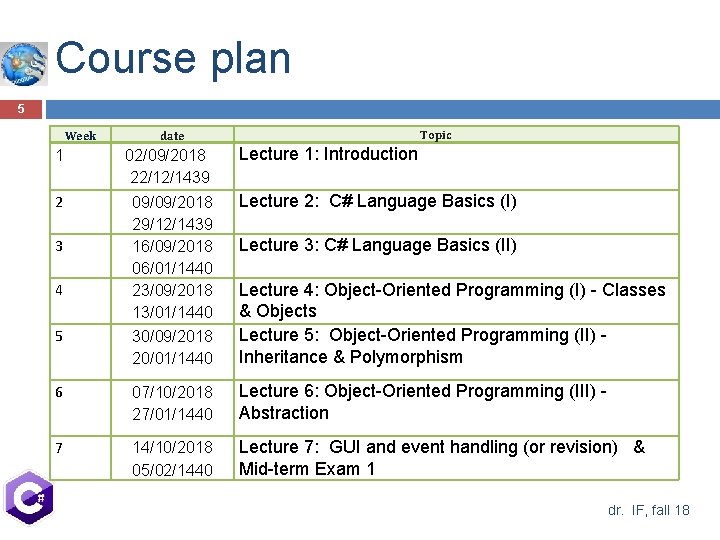
Course plan 5 Week Topic date Lecture 1: Introduction 1 02/09/2018 22/12/1439 2 09/09/2018 29/12/1439 16/09/2018 06/01/1440 23/09/2018 13/01/1440 30/09/2018 20/01/1440 Lecture 2: C# Language Basics (I) 6 07/10/2018 27/01/1440 Lecture 6: Object-Oriented Programming (III) Abstraction 7 14/10/2018 05/02/1440 Lecture 7: GUI and event handling (or revision) & Mid-term Exam 1 3 4 5 Lecture 3: C# Language Basics (II) Lecture 4: Object-Oriented Programming (I) - Classes & Objects Lecture 5: Object-Oriented Programming (II) Inheritance & Polymorphism dr. IF, fall 18
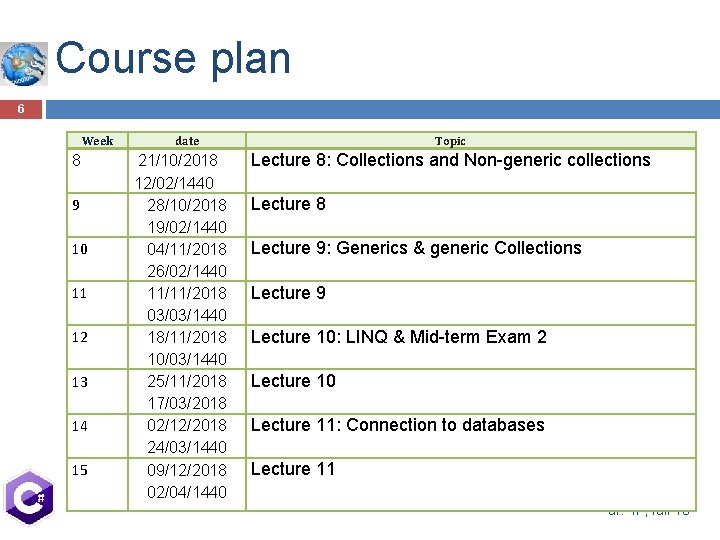
Course plan 6 Week 8 9 10 11 12 13 14 15 Topic date 21/10/2018 12/02/1440 28/10/2018 19/02/1440 04/11/2018 26/02/1440 11/11/2018 03/03/1440 18/11/2018 10/03/1440 25/11/2018 17/03/2018 02/12/2018 24/03/1440 09/12/2018 02/04/1440 Lecture 8: Collections and Non-generic collections Lecture 8 Lecture 9: Generics & generic Collections Lecture 9 Lecture 10: LINQ & Mid-term Exam 2 Lecture 10 Lecture 11: Connection to databases Lecture 11 dr. IF, fall 18
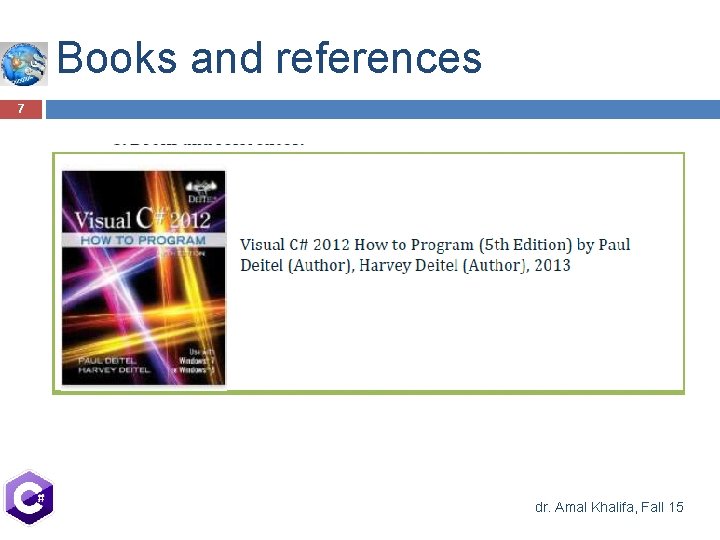
Books and references 7 dr. Amal Khalifa, Fall 15
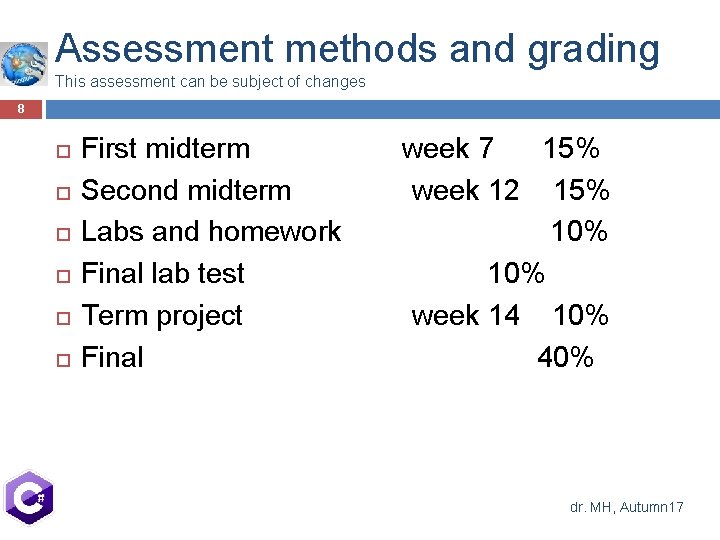
Assessment methods and grading This assessment can be subject of changes 8 First midterm Second midterm Labs and homework Final lab test Term project Final week 7 15% week 12 15% 10% week 14 10% 40% dr. MH, Autumn 17
Labs, assignments, Project 9 Lab handouts Weekly assignments Term project group work � Specific ideas � Evaluation criteria � Individual vs. group evaluation � dr. Amal Khalifa, Fall 15
Course material 10 Course material: � Blackboard system & blog � Activate your account!!! � emails, announcements, lecture notes, lab material dr. Amal Khalifa, Fall 15
11 The Visual Studio 2012 IDE enables you to write, run, test and debug C# programs quickly and conveniently. http: //www. visualstudio. com/ dr. Amal Khalifa, Fall 15
12 What is Computer Programming? Planning or scheduling a sequence of steps for a computer to follow to perform a task. Basically, telling a computer what to do and how to do it. A program: �A sequence of steps to be performed by a computer. � Expressed in a computer language. dr. Amal Khalifa, Fall 15
Computer Languages 13 A set of � Symbols (punctuation), � Special words or keywords (vocabulary), � And rules (grammar) used to construct a program. dr. Amal Khalifa, Fall 15
14 Evolution of Programming Languages differ in � Size (or complexity) � Readability � Expressivity (or writability) � "Level" closeness to instructions for the CPU dr. Amal Khalifa, Fall 15
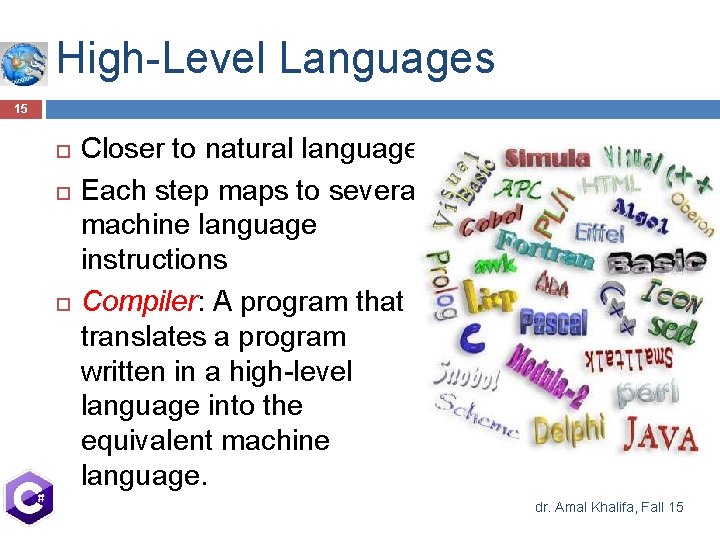
High-Level Languages 15 Closer to natural language Each step maps to several machine language instructions Compiler: A program that translates a program written in a high-level language into the equivalent machine language. dr. Amal Khalifa, Fall 15
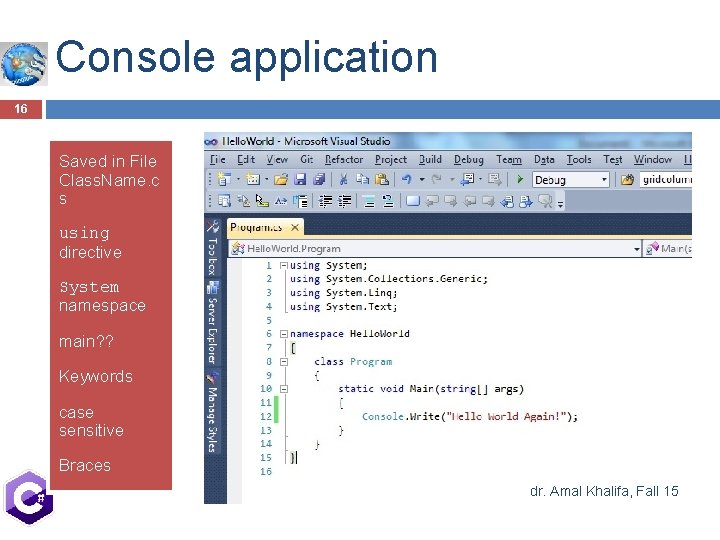
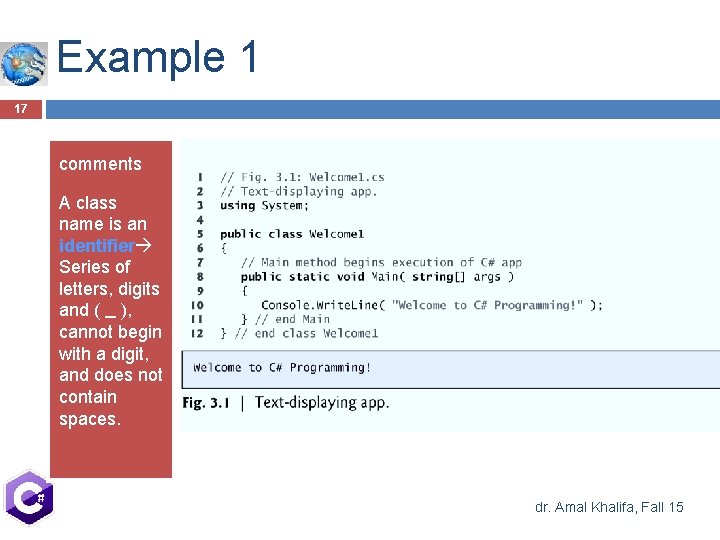
Console application 16 Saved in File Class. Name. c s using directive System namespace main? ? Keywords case sensitive Braces Strings dr. Amal Khalifa, Fall 15
Example 1 17 comments A class name is an identifier Series of letters, digits and ( _ ), cannot begin with a digit, and does not contain spaces. dr. Amal Khalifa, Fall 15
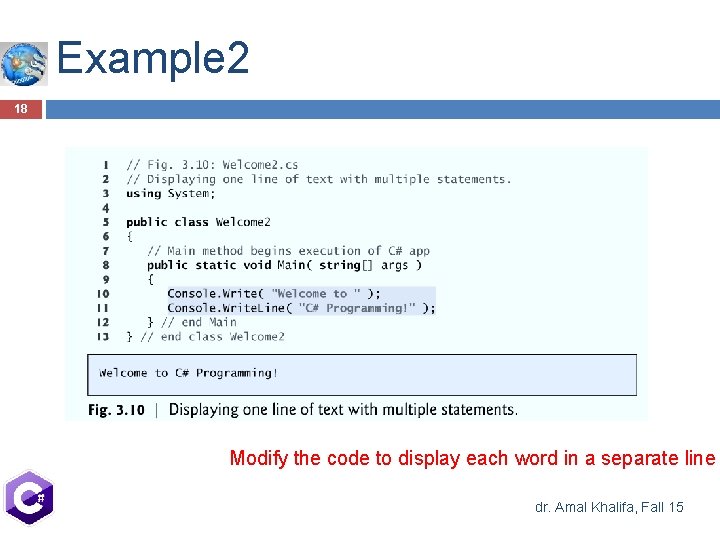
Example 2 18 Modify the code to display each word in a separate line dr. Amal Khalifa, Fall 15
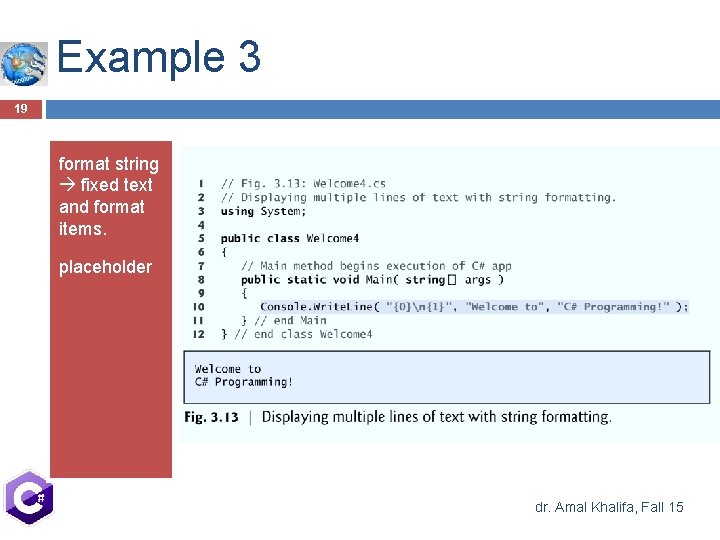
Example 3 19 format string fixed text and format items. placeholder dr. Amal Khalifa, Fall 15
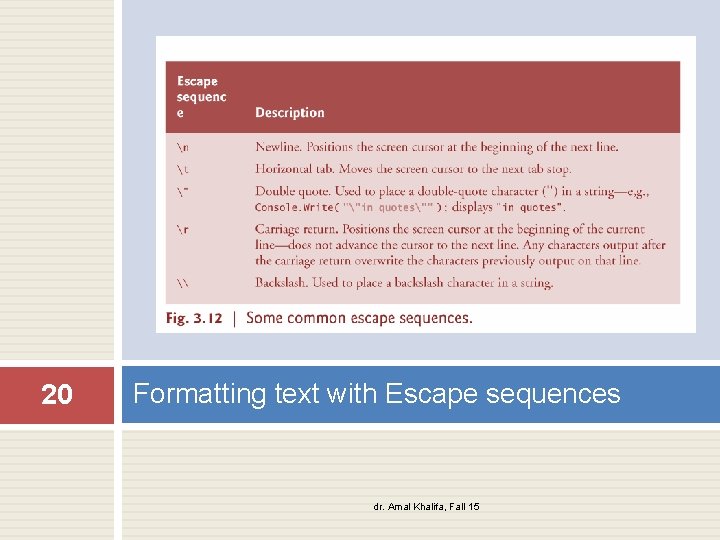
20 Formatting text with Escape sequences dr. Amal Khalifa, Fall 15
21 That’s all chapter 1 : pages 1 - 10 chapter 3 : 3. 1, 3. 2, 3. 4, 3. 5 dr. Amal Khalifa, Fall 15