
CS 303 E Elements of Computers and Programming
![List Slicing • List slicing format: list[start : end] • Span is a list](https://slidetodoc.com/presentation_image_h2/bb77e33d646790771084bfc61d727d65/image-5.jpg "List Slicing • List slicing format: list[start : end] • Span is a list")
- Slides: 29
CS 303 E: Elements of Computers and Programming Lists Mike Scott Department of Computer Science University of Texas at Austin Adapted from Professor Bill Young's Slides Last updated: June 15, 2021
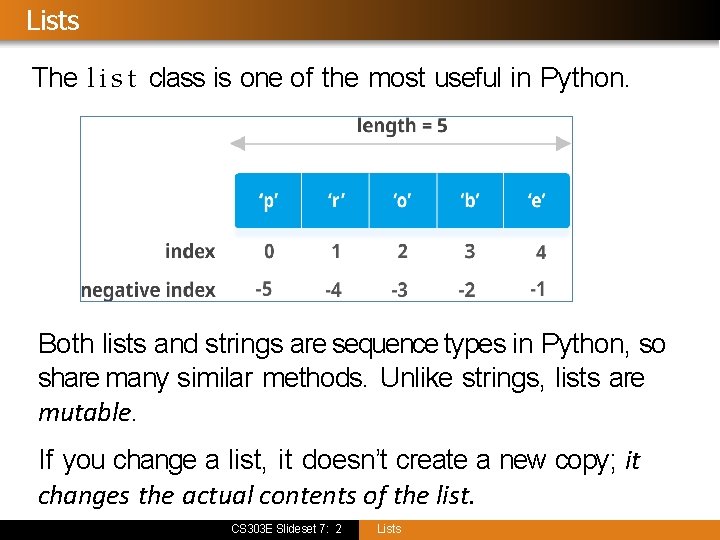
Lists The l i s t class is one of the most useful in Python. Both lists and strings are sequence types in Python, so share many similar methods. Unlike strings, lists are mutable. If you change a list, it doesn’t create a new copy; it changes the actual contents of the list. CS 303 E Slideset 7: 2 Lists
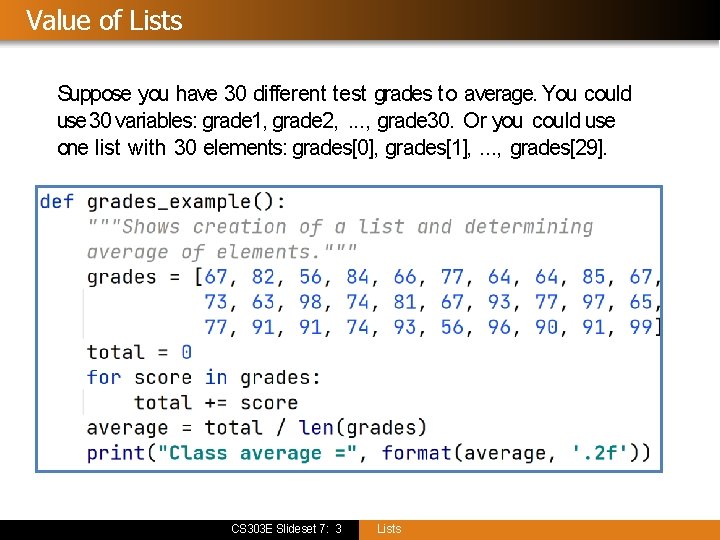
Value of Lists Suppose you have 30 different test grades to average. You could use 30 variables: grade 1, grade 2, . . . , grade 30. Or you could use one list with 30 elements: grades[0], grades[1], . . . , grades[29]. CS 303 E Slideset 7: 3 Lists
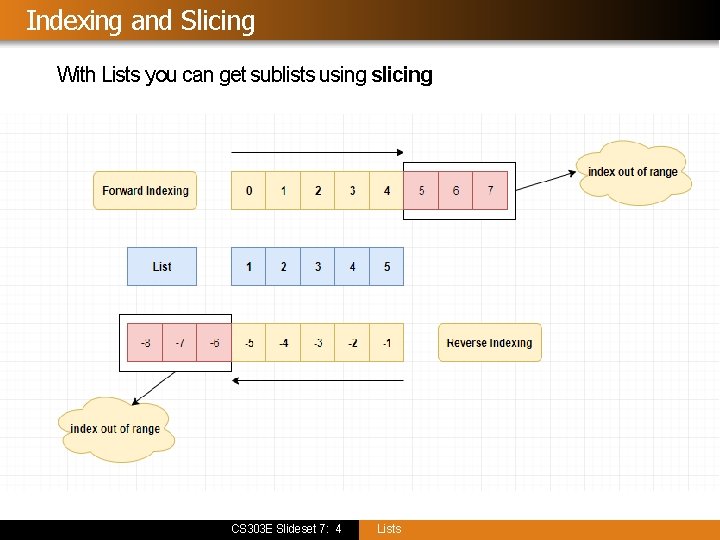
Indexing and Slicing With Lists you can get sublists using slicing CS 303 E Slideset 7: 4 Lists
List Slicing • List slicing format: list[start : end] • Span is a list containing copies of elements from start up to, but not including, end • If start not specified, 0 is used for start index • If end not specified, len(list) is used for end index • Slicing expressions can include a step value and negative indexes relative to end of list CS 303 E Slideset 7: 5 Lists
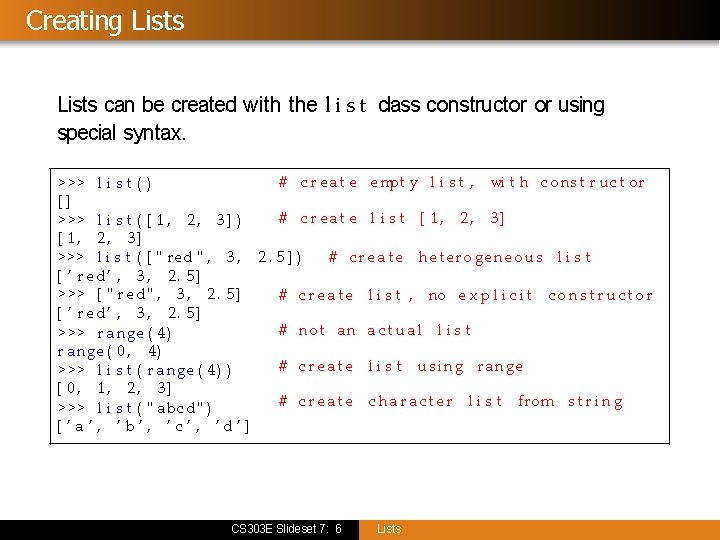
Creating Lists can be created with the l i s t class constructor or using special syntax. # c r e a t e e mpt y l i s t , wi t h c ons t r uc t or >>> l i s t ( ) [] # c r e a t e l i s t [ 1 , 2 , 3] >>> l i s t ( [ 1 , 2 , 3] ) [ 1 , 2 , 3] >>> l i s t ( [ " red " , 3 , 2. 5 ] ) # c r e a t e heterogeneous l i s t [ ’ r e d’ , 3 , 2. 5 ] > > > [ " r e d" , 3 , 2. 5 ] # c r e a t e l i s t , no e x p l i c i t c o n s t r u c t o r [ ’ r e d’ , 3 , 2. 5 ] # not an a c t u a l l i s t > > > r a nge ( 4 ) r a nge ( 0 , 4) # c r e a t e l i s t u s i n g range > > > l i s t ( r a nge ( 4 ) ) [ 0 , 1 , 2 , 3] # c r e a t e c h a r a c t e r l i s t from s t r i n g > > > l i s t ( " a bc d " ) [’a’, ’b’, ’c’, ’d’] CS 303 E Slideset 7: 6 Lists
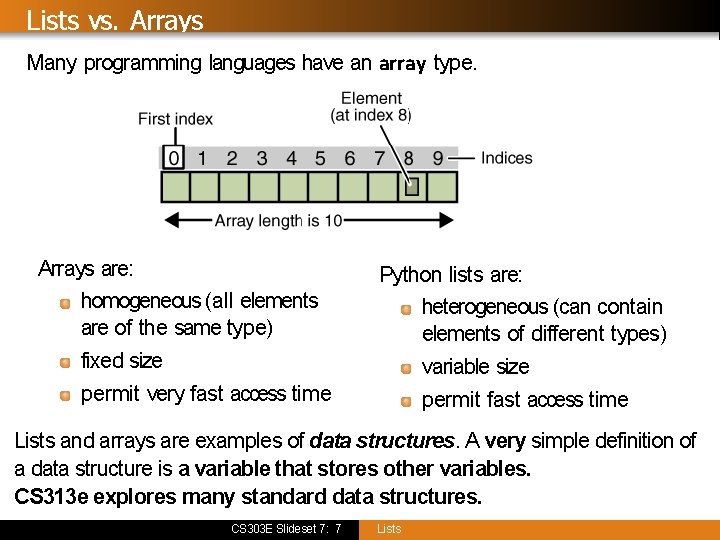
Lists vs. Arrays Many programming languages have an array type. Arrays are: homogeneous (all elements are of the same type) Python lists are: heterogeneous (can contain elements of different types) fixed size variable size permit very fast access time permit fast access time Lists and arrays are examples of data structures. A very simple definition of a data structure is a variable that stores other variables. CS 313 e explores many standard data structures. CS 303 E Slideset 7: 7 Lists
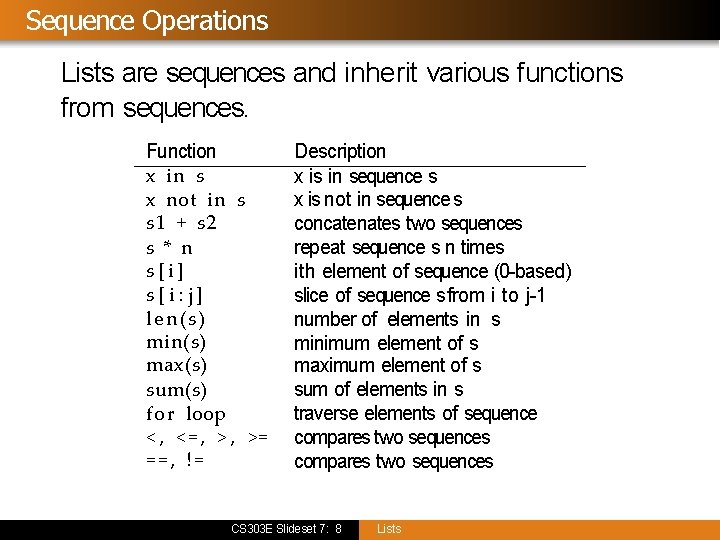
Sequence Operations Lists are sequences and inherit various functions from sequences. Function x in s x not in s s 1 + s 2 s * n s[i] s[i: j] len(s) min(s) max(s) sum(s) for loop < , < = , >= ==, != Description x is in sequence s x is not in sequence s concatenates two sequences repeat sequence s n times ith element of sequence (0 -based) slice of sequence s from i to j-1 number of elements in s minimum element of s maximum element of s sum of elements in s traverse elements of sequence compares two sequences CS 303 E Slideset 7: 8 Lists
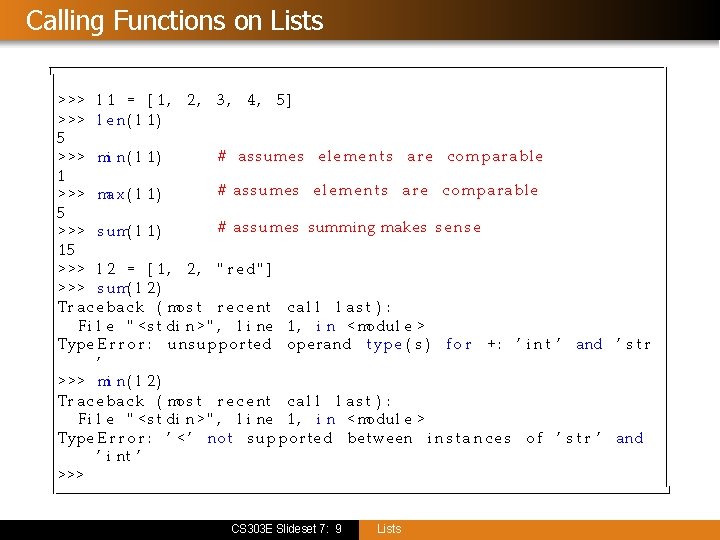
Calling Functions on Lists > > > l 1 = [ 1 , 2 , 3 , 4 , 5] > > > l e n( l 1 ) 5 # assumes e l e m e n t s a r e comparable > > > mi n ( l 1 ) 1 # assumes e l e m e n t s a r e comparable > > > ma x ( l 1 ) 5 # assumes summing makes s e n s e > > > s um( l 1 ) 15 > > > l 2 = [ 1 , 2 , " r e d" ] > > > s um( l 2 ) Tr a c e ba c k ( mos t r e c e nt c a l l l a s t ) : Fi l e " < s t di n > " , l i ne 1 , i n < modul e > Type E r r o r : unsupported operand type ( s ) f o r + : ’ i n t ’ and ’ s t r ’ > > > mi n ( l 2 ) Tr a c e ba c k ( mos t r e c e nt c a l l l a s t ) : Fi l e " < s t di n > " , l i ne 1 , i n < modul e > Type E r r o r : ’ < ’ not s u p p o r t e d between i n s t a n c e s o f ’ s t r ’ and ’ i nt ’ >>> CS 303 E Slideset 7: 9 Lists
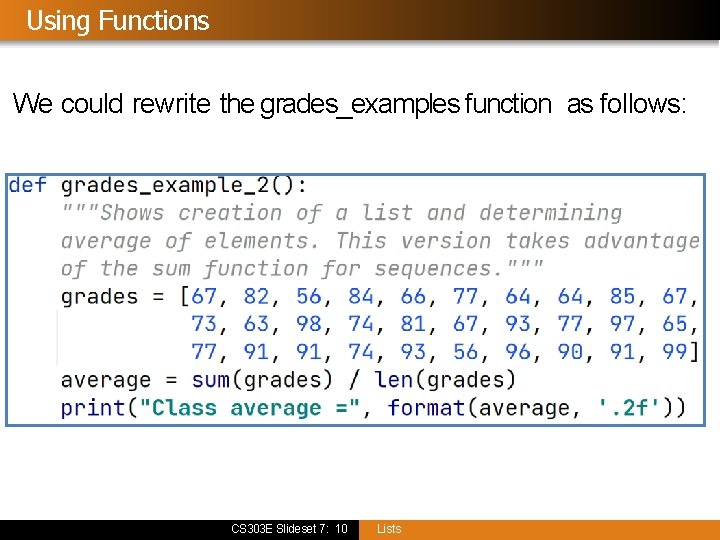
Using Functions We could rewrite the grades_examples function as follows: CS 303 E Slideset 7: 10 Lists
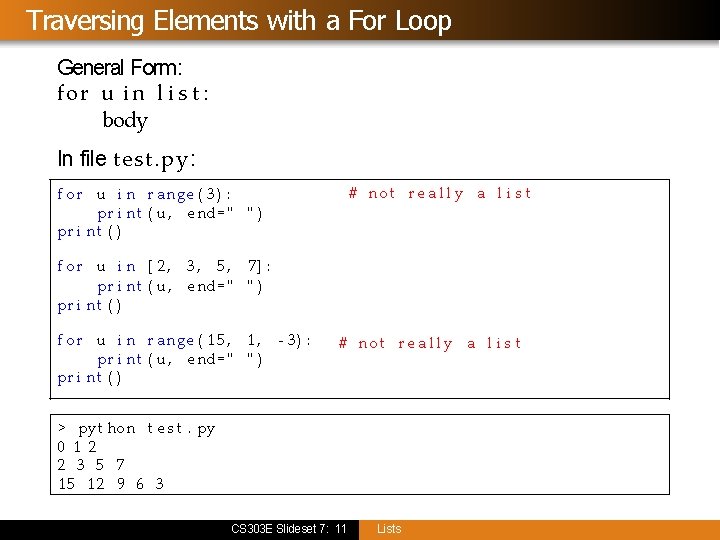
Traversing Elements with a For Loop General Form: for u in l i s t : body In file test. py: # not r e a l l y a l i s t f or u i n r a nge ( 3 ) : pr i nt ( u, e nd = " " ) pr i nt ( ) f or u i n [ 2 , pr i nt ( u, pr i nt ( ) 3, 5, 7] : e nd = " " ) f or u i n r a nge ( 15 , 1 , - 3) : pr i nt ( u, e nd = " " ) pr i nt ( ) # not r e a l l y a l i s t > pyt hon t e s t. py 0 1 2 2 3 5 7 15 12 9 6 3 CS 303 E Slideset 7: 11 Lists
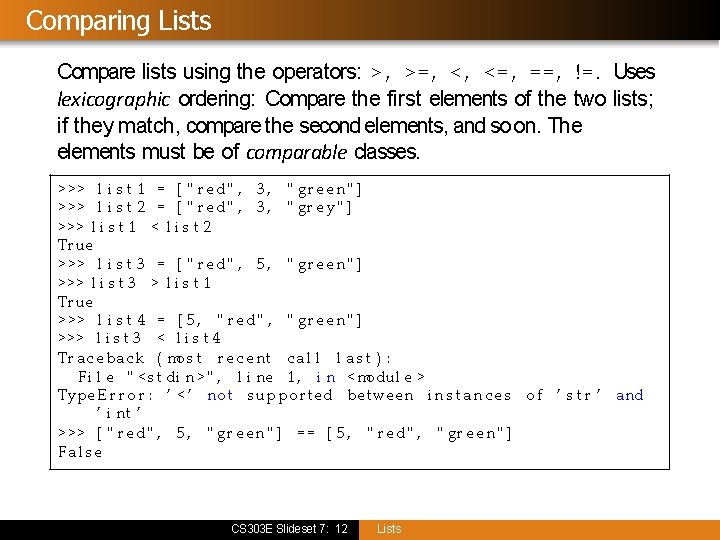
Comparing Lists Compare lists using the operators: > , > = , < = , = = , !=. Uses lexicographic ordering: Compare the first elements of the two lists; if they match, compare the second elements, and so on. The elements must be of comparable classes. > > > l i s t 1 = [ " r e d " , 3 , " gr e e n " ] > > > l i s t 2 = [ " r e d " , 3 , " gr e y " ] >>> l i s t 1 < l i s t 2 True > > > l i s t 3 = [ " r e d " , 5 , " gr e e n " ] >>> l i s t 3 > l i s t 1 True > > > l i s t 4 = [ 5 , " r e d " , " gr e e n " ] >>> l i s t 3 < l i s t 4 Tr a c e ba c k ( mos t r e c e nt c a l l l a s t ) : Fi l e " < s t di n > " , l i ne 1 , i n < modul e > Type E r r o r : ’ < ’ not s u p p o r t e d between i n s t a n c e s o f ’ s t r ’ ’ i nt ’ > > > [ " r e d " , 5 , " gr e e n " ] == [ 5 , " r e d " , " gr e e n " ] False CS 303 E Slideset 7: 12 Lists and
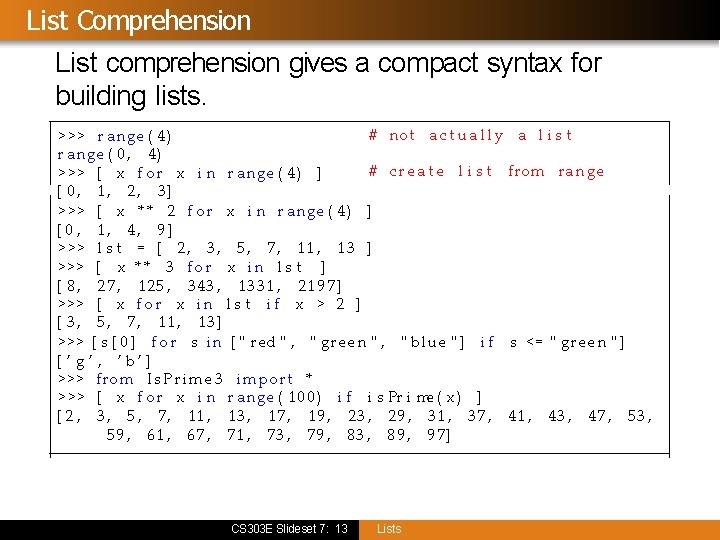
List Comprehension List comprehension gives a compact syntax for building lists. # not a c t u a l l y a l i s t > > > r a nge ( 4 ) r a nge ( 0 , 4) # c r e a t e l i s t from range > > > [ x f or x i n r a nge ( 4 ) ] [ 0 , 1 , 2 , 3] > > > [ x * * 2 f or x i n r a nge ( 4 ) ] [0 , 1, 4, 9] > > > l s t = [ 2 , 3 , 5 , 7 , 11 , 13 ] >>> [ x * * 3 f o r x i n l s t ] [ 8 , 27 , 125 , 343 , 1 3 3 1 , 2 1 9 7 ] >>> [ x f o r x i n l s t i f x > 2 ] [ 3 , 5 , 7 , 11 , 1 3 ] >>> [ s [ 0 ] f o r s i n [ " red " , " g r e e n " , " b l u e " ] i f s <= " g r e e n " ] [’g’, ’b’] >>> from I s P r i m e 3 import * > > > [ x f or x i n r a nge ( 1 0 0 ) i f i s Pr i me ( x ) ] [ 2 , 3 , 5 , 7 , 11 , 13 , 17 , 19 , 23 , 29 , 31 , 37 , 41 , 43 , 47 , 53 , 59 , 61 , 67 , 71 , 73 , 79 , 83 , 89 , 9 7 ] CS 303 E Slideset 7: 13 Lists
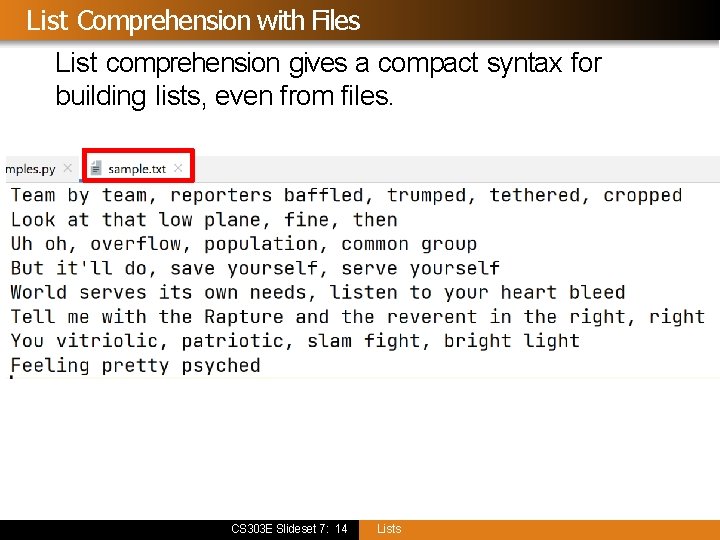
List Comprehension with Files List comprehension gives a compact syntax for building lists, even from files. CS 303 E Slideset 7: 14 Lists
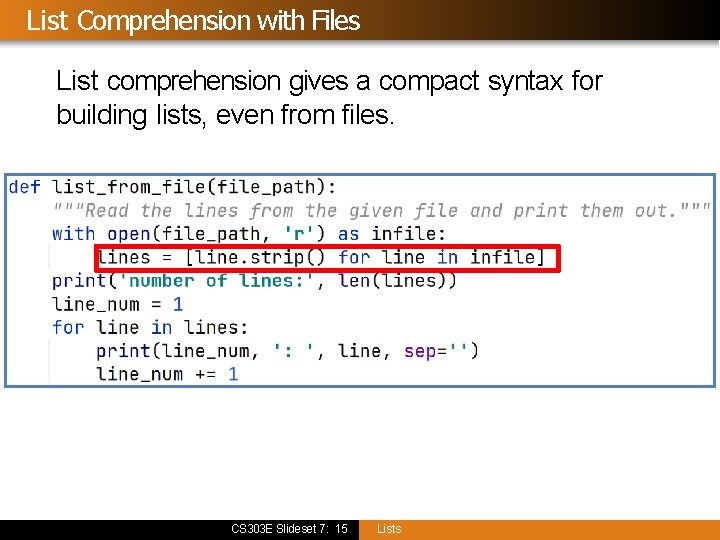
List Comprehension with Files List comprehension gives a compact syntax for building lists, even from files. CS 303 E Slideset 7: 15 Lists
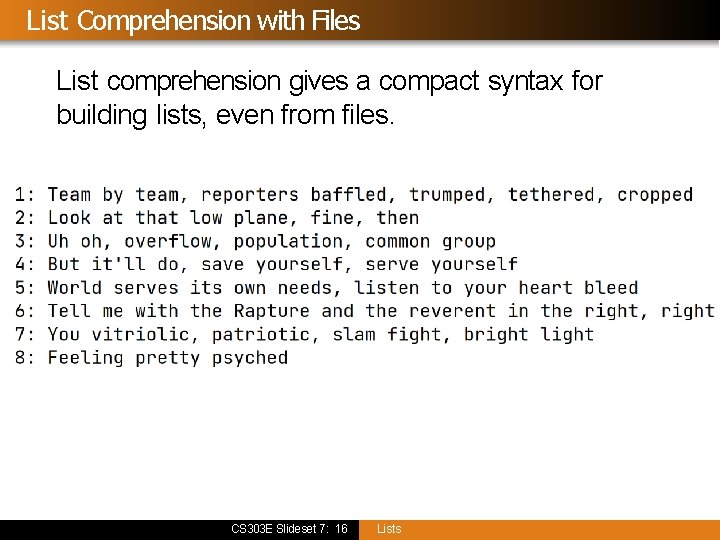
List Comprehension with Files List comprehension gives a compact syntax for building lists, even from files. CS 303 E Slideset 7: 16 Lists
Let’s Take a Break CS 303 E Slideset 7: 17 Lists
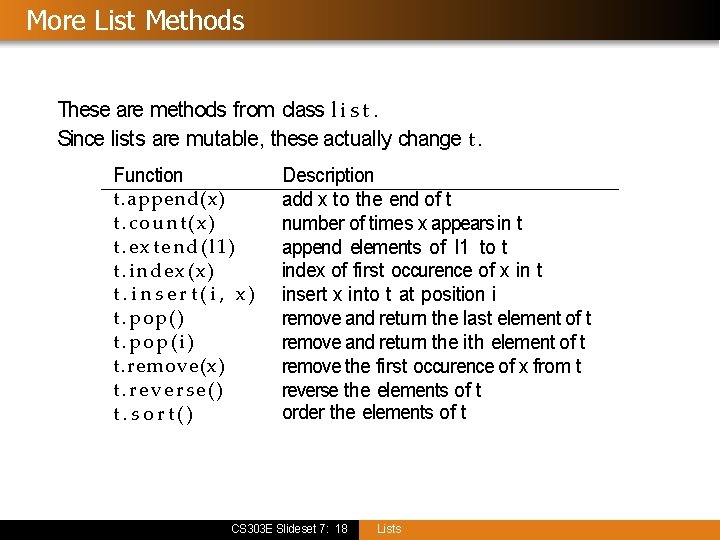
More List Methods These are methods from class l i s t. Since lists are mutable, these actually change t. Function t. append(x) t. count(x ) t. extend(l 1) t. index(x ) t. i n s e r t ( i , x) t. pop () t. pop(i) t. remove(x) t. reverse() t. sort() Description add x to the end of t number of times x appears in t append elements of l 1 to t index of first occurence of x in t insert x into t at position i remove and return the last element of t remove and return the ith element of t remove the first occurence of x from t reverse the elements of t order the elements of t CS 303 E Slideset 7: 18 Lists
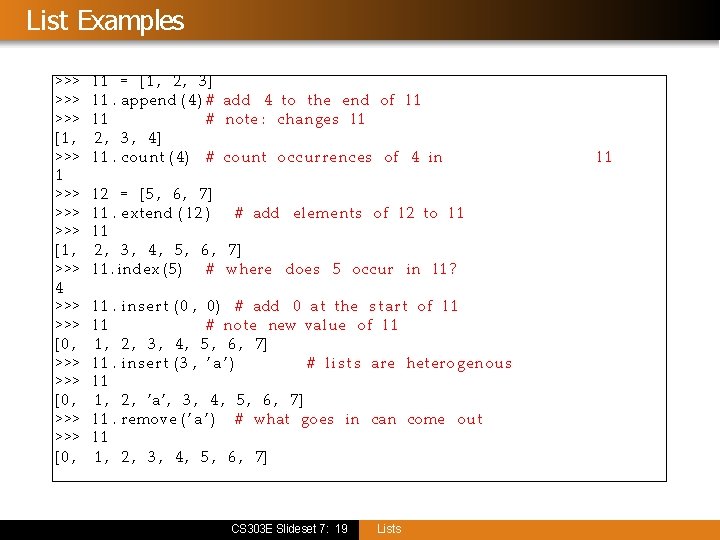
List Examples >>> >>> [1 , >>> 1 >>> >>> [1 , >>> 4 >>> >>> [0 , l 1 = [1 , 2 , 3] l 1. append (4) # add 4 to the end of l 1 # note : changes l 1 2 , 3 , 4] l 1. count (4) # count occurrences of 4 in l 2 = [5 , 6 , 7] l 1. extend ( l 2 ) # add elements of l 2 to l 1 2 , 3 , 4 , 5 , 6 , 7] l 1. index (5) # where does 5 occur in l 1 ? l 1. insert (0 , 0) # add 0 at the s t a r t of l 1 # note new value of l 1 1 , 2 , 3 , 4 , 5 , 6 , 7] l 1. insert (3 , ’ a ’ ) # l i s t s are heterogenous l 1 1 , 2 , ’a’, 3 , 4 , 5 , 6 , 7] l 1. remove ( ’ a ’ ) # what goes in can come out l 1 1 , 2 , 3 , 4 , 5 , 6 , 7] CS 303 E Slideset 7: 19 Lists l 1
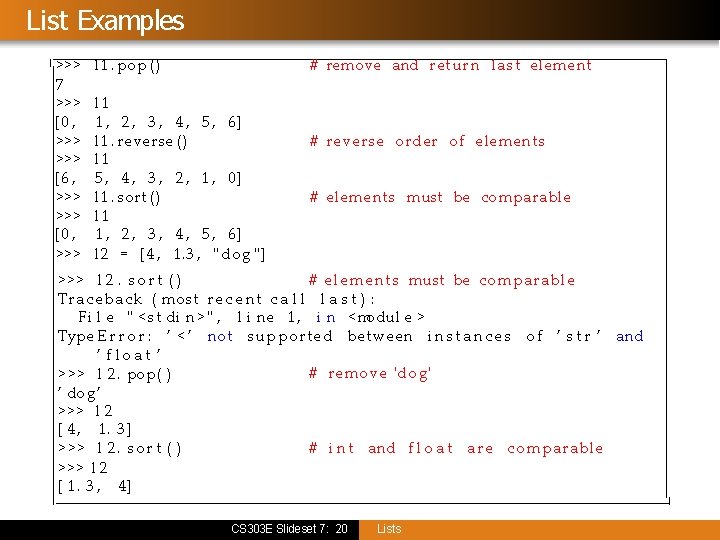
List Examples >>> 7 >>> [0 , >>> [6 , >>> [0 , >>> l 1. pop () # remove and return l a s t element l 1 1 , 2 , 3 , 4 , 5 , 6] l 1. reverse () l 1 5 , 4 , 3 , 2 , 1 , 0] l 1. sort () l 1 1 , 2 , 3 , 4 , 5 , 6] l 2 = [4 , 1. 3 , " dog "] # reverse order of elements # elements must be comparable >>> l 2. s o r t ( ) # e l e m e n t s must be comparable T r a c e b a c k ( most r e c e n t c a l l l a s t ) : Fi l e " < s t di n > " , l i ne 1 , i n < modul e > Type E r r o r : ’ < ’ not s u p p o r t e d between i n s t a n c e s o f ’ s t r ’ and ’ float ’ # remove 'dog' > > > l 2. pop ( ) ’ dog ’ >>> l 2 [ 4 , 1. 3] > > > l 2. s or t ( ) # i n t and f l o a t a r e comparable >>> l 2 [ 1. 3 , 4] CS 303 E Slideset 7: 20 Lists
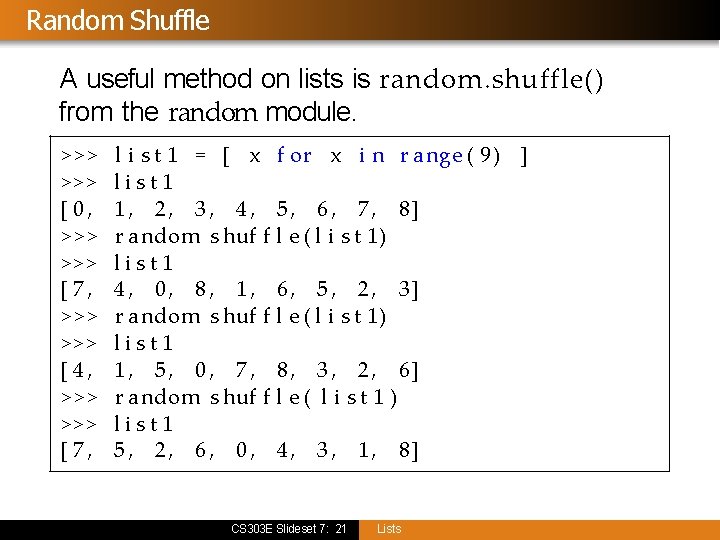
Random Shuffle A useful method on lists is random. shuffle() from the random module. >>> [ 0, >>> [ 7, >>> [ 4, >>> [ 7, l i s t 1 = [ x f or x i n r a nge ( 9) ] list 1 1 , 2 , 3 , 4 , 5 , 6 , 7 , 8] r a ndom. s huf f l e ( l i s t 1) list 1 4 , 0 , 8 , 1 , 6 , 5 , 2 , 3] r a ndom. s huf f l e ( l i s t 1) list 1 1 , 5 , 0 , 7 , 8 , 3 , 2 , 6] r a ndom. s huf f l e ( l i s t 1 ) list 1 5 , 2 , 6 , 0 , 4 , 3 , 1 , 8] CS 303 E Slideset 7: 21 Lists
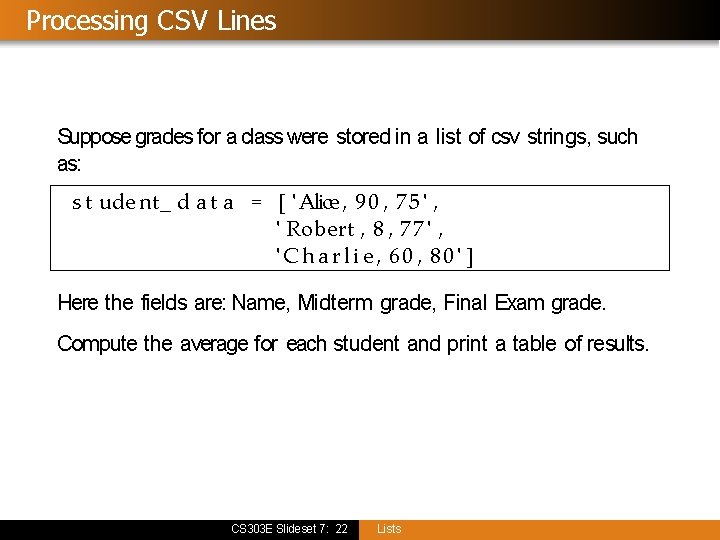
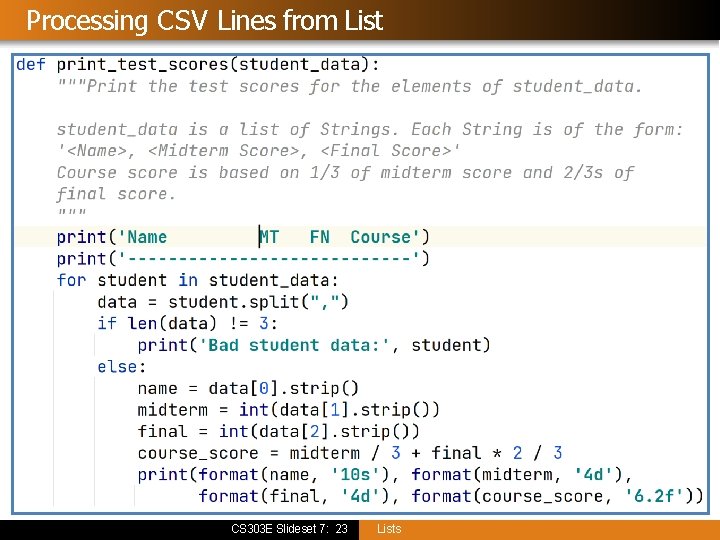
Processing CSV Lines Suppose grades for a class were stored in a list of csv strings, such as: s t ude nt_ d a t a = [ ' Alice , 90 , 75 ' , ' Robert , 8 , 77 ' , ' C h a r l i e , 60 , 80 ' ] Here the fields are: Name, Midterm grade, Final Exam grade. Compute the average for each student and print a table of results. CS 303 E Slideset 7: 22 Lists
Processing CSV Lines from List CS 303 E Slideset 7: 23 Lists
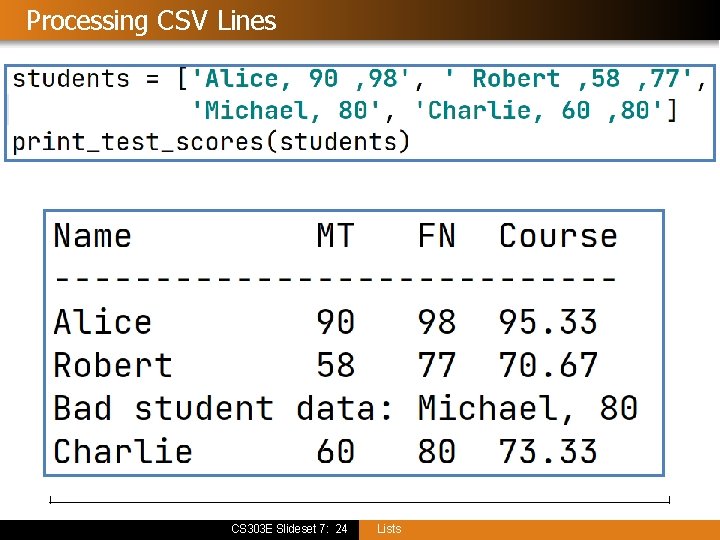
Processing CSV Lines CS 303 E Slideset 7: 24 Lists
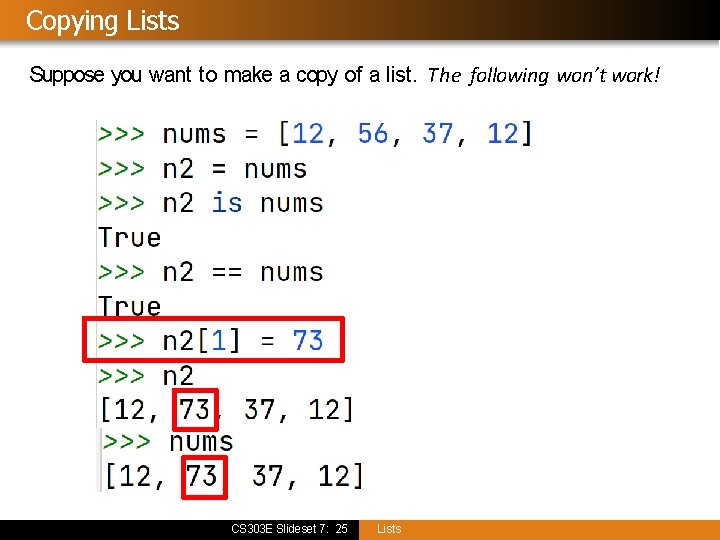
Copying Lists Suppose you want to make a copy of a list. The following won’t work! CS 303 E Slideset 7: 25 Lists
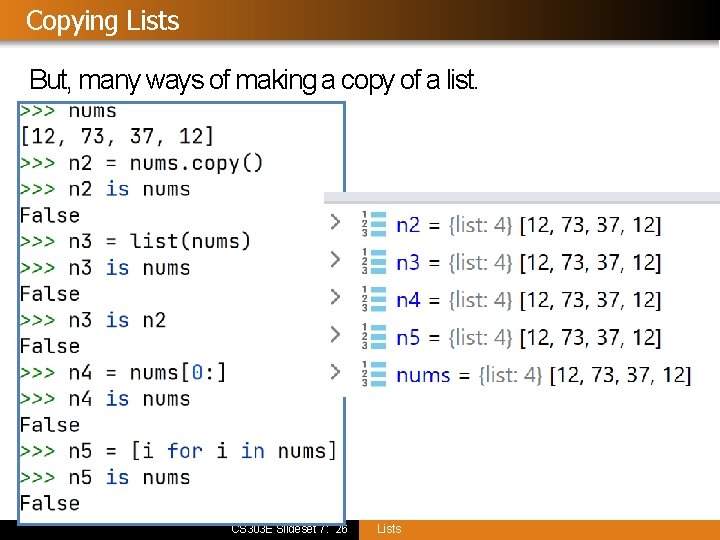
Copying Lists But, many ways of making a copy of a list. CS 303 E Slideset 7: 26 Lists
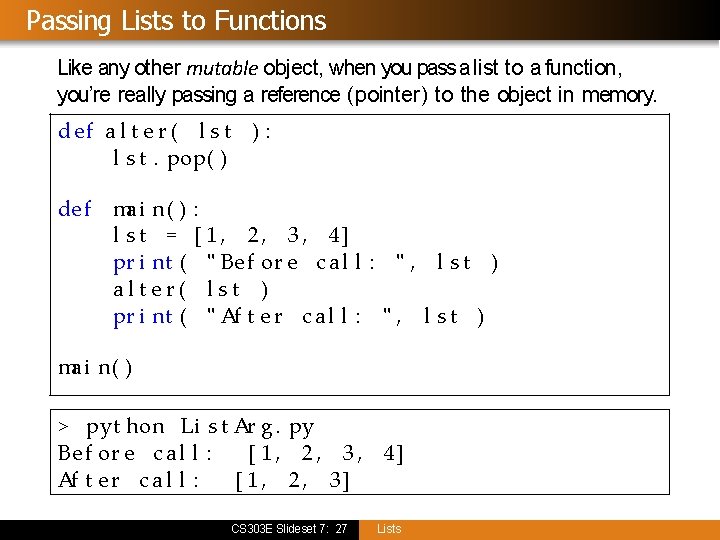
Passing Lists to Functions Like any other mutable object, when you pass a list to a function, you’re really passing a reference (pointer) to the object in memory. def a l t e r ( l s t ) : l s t. pop ( ) de f ma i n ( ) : l s t = [ 1 , 2 , 3 , 4] pr i nt ( " Be f or e c al l : " , l s t ) alter( lst ) pr i nt ( " Af t e r c al l : " , l s t ) mai n ( ) > pyt hon Li s t Ar g. py Be f or e c al l : [ 1, 2, 3, Af t e r c al l : [ 1 , 2 , 3] CS 303 E Slideset 7: 27 4] Lists
Let’s Take a Break CS 303 E Slideset 7: 28 Lists
Example Problems To get good at working with lists, we must practice! • Coding. Bat: https: //codingbat. com/python • List 1: first_last 6, same_first_last, max_end 3 • List 2: count_even, big_diff, has_22 • given list of ints or floats, is it sorted in ascending order? • get last index of a given value in list • given two arrays of ints, return an array that contains the difference between corresponding elements • change to be the max • are all the elements of a given list unique? In other words, no duplicate values in the list • given a list of ints place all even values before all odd values CS 303 E Slideset 7: 29 Lists