
CS 285 Usability Engineering The Design Process for
CS 285 Usability Engineering The Design Process for Usability defined: usability = efficiency + effectiveness + enjoyment CS 285 Design Process 2004/5 Uni. S Department of Computing 1

CS 285 Usability Engineering CS 285 Design Process 2004/5 Uni. S Department of Computing 2
CS 285 - The Design Process for Usability Design rules & guidelines Models of user in the design • cognitive models – users cognitive knowledge – users cognitive strategies • hierarchical models – order or sequence of processes, tasks • linguistic models – syntax & grammar • physical and device models – keyboard, mouse, speech CS 285 Design Process 2004/5 Uni. S Department of Computing 3
CS 285 - The Design Process for Usability Design of a User Interface needs be considered from different perspectives • functional perspective – hierarchy of tasks • usability perspective – aesthetic qualities Design use same methodologies as any Systems Analysis and Design process - Software engineering & HCI design CS 285 Design Process 2004/5 Uni. S Department of Computing 4
CS 285 - Software Engineering & Interface Design Software engineering “The development and use of principles, methods and tools to design and develop, economically and optimally, software systems that are aesthetically pleasing, efficient, reliable and usable for the purposes for which they were designed. ” Software engineering - process model for software development: • • • requirements analysis specification including usability design and construction project planning costs, time, scope systems and software task analysis design of data structures program structure etc. CS 285 Design Process 2004/5 Uni. S Department of Computing 5
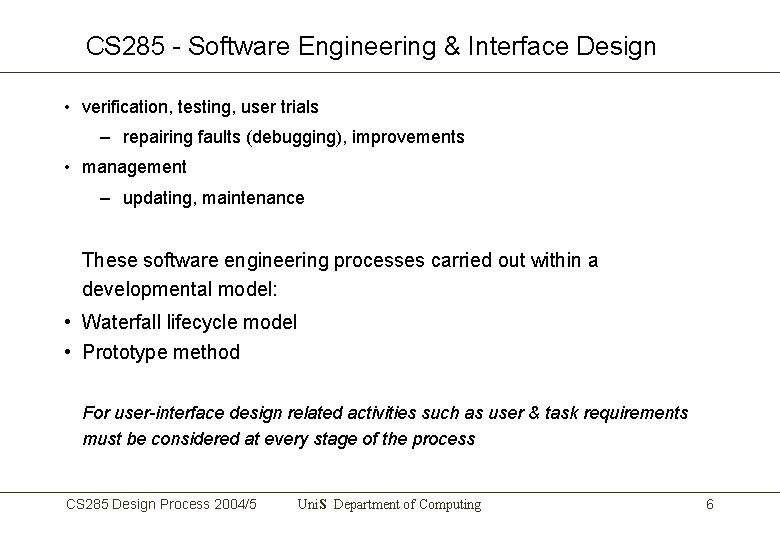
CS 285 - Software Engineering & Interface Design • verification, testing, user trials – repairing faults (debugging), improvements • management – updating, maintenance These software engineering processes carried out within a developmental model: • Waterfall lifecycle model • Prototype method For user-interface design related activities such as user & task requirements must be considered at every stage of the process CS 285 Design Process 2004/5 Uni. S Department of Computing 6
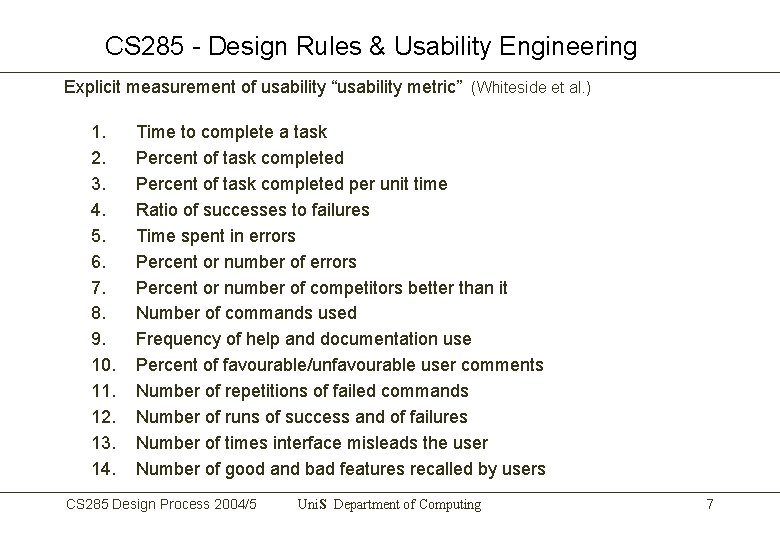
CS 285 - Design Rules & Usability Engineering Explicit measurement of usability “usability metric” (Whiteside et al. ) 1. 2. 3. 4. 5. 6. 7. 8. 9. 10. 11. 12. 13. 14. Time to complete a task Percent of task completed per unit time Ratio of successes to failures Time spent in errors Percent or number of competitors better than it Number of commands used Frequency of help and documentation use Percent of favourable/unfavourable user comments Number of repetitions of failed commands Number of runs of success and of failures Number of times interface misleads the user Number of good and bad features recalled by users CS 285 Design Process 2004/5 Uni. S Department of Computing 7
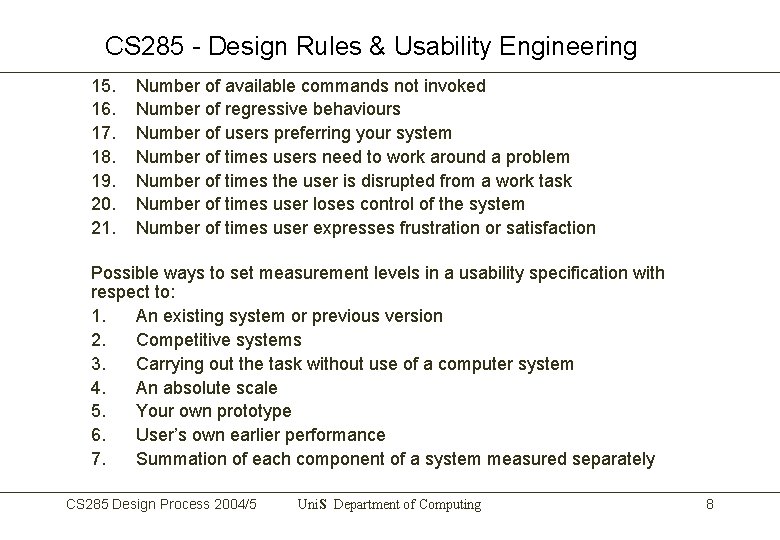
CS 285 - Design Rules & Usability Engineering 15. 16. 17. 18. 19. 20. 21. Number of available commands not invoked Number of regressive behaviours Number of users preferring your system Number of times users need to work around a problem Number of times the user is disrupted from a work task Number of times user loses control of the system Number of times user expresses frustration or satisfaction Possible ways to set measurement levels in a usability specification with respect to: 1. An existing system or previous version 2. Competitive systems 3. Carrying out the task without use of a computer system 4. An absolute scale 5. Your own prototype 6. User’s own earlier performance 7. Summation of each component of a system measured separately CS 285 Design Process 2004/5 Uni. S Department of Computing 8

CS 285 - Design Rules & Usability Engineering Problems with usability engineering • Measurement - only consider things that can be measured - may not be the most important for the user. • Specific users & situations may change the requirements CS 285 Design Process 2004/5 Uni. S Department of Computing 9
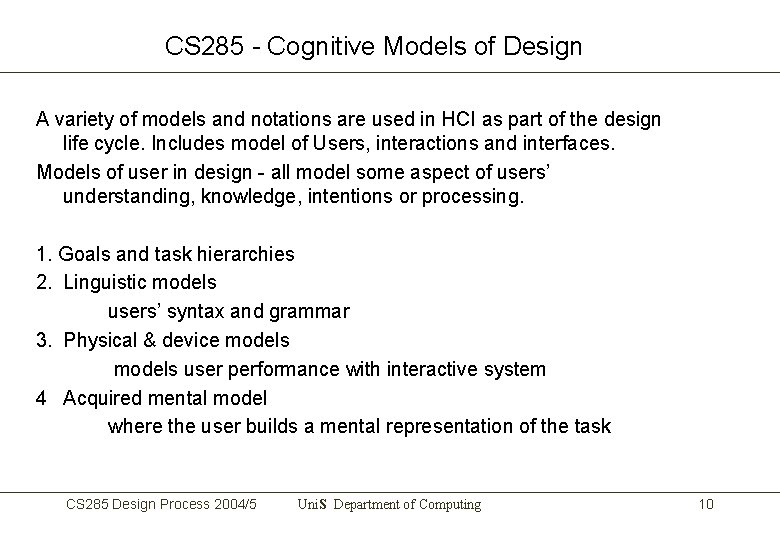
CS 285 - Cognitive Models of Design A variety of models and notations are used in HCI as part of the design life cycle. Includes model of Users, interactions and interfaces. Models of user in design - all model some aspect of users’ understanding, knowledge, intentions or processing. 1. Goals and task hierarchies 2. Linguistic models users’ syntax and grammar 3. Physical & device models user performance with interactive system 4 Acquired mental model where the user builds a mental representation of the task CS 285 Design Process 2004/5 Uni. S Department of Computing 10

CS 285 - Cognitive Psychology • • • Visual Perception resolution, visibility in poor light, flicker, colour reception (colour blindness) Visual Interpretation - constructs a model of the world comparing, transforming, enhancing, distorting, discarding information etc. 3 D to 2 D transformation - perspective gives depth clues interpret 2 D images as 3 D Animation - motion parallax Attention constraints - divided attention, selective, cognitive overload, emergency situation (can't do more than one thing at a time) Theories of Information processing and memory – little guidance on interface design except recall, recognition & limit length of menus (7) CS 285 Design Process 2004/5 Uni. S Department of Computing 11

CS 285 – Learnability • Learning – some concepts and vocabulary • Verbal information – know the vocabulary, name the components, facts and actions. Needed for discussion – talk about something • Concepts – abstract ideas of how things work • Verbal information + Concepts = Cognitive knowledge • Intellectual Skill – skill based on Cognitive knowledge • Cognitive Strategy – problem solving • Attitude – emotional intelligence • Motor Skills CS 285 Design Process 2004/5 Uni. S Department of Computing 12
CS 285 – Learnability • How does learning take place? • Active learning – Learning by doing – Trial and error • Learning by analogy – play tennis > play badminton • Learn form errors • Learn from being taught – makes use of above CS 285 Design Process 2004/5 Uni. S Department of Computing 13
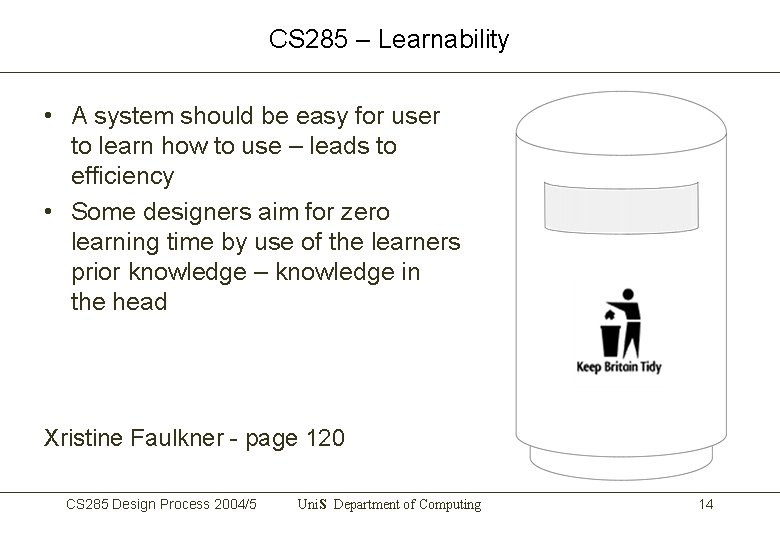
CS 285 – Learnability • A system should be easy for user to learn how to use – leads to efficiency • Some designers aim for zero learning time by use of the learners prior knowledge – knowledge in the head Xristine Faulkner - page 120 CS 285 Design Process 2004/5 Uni. S Department of Computing 14
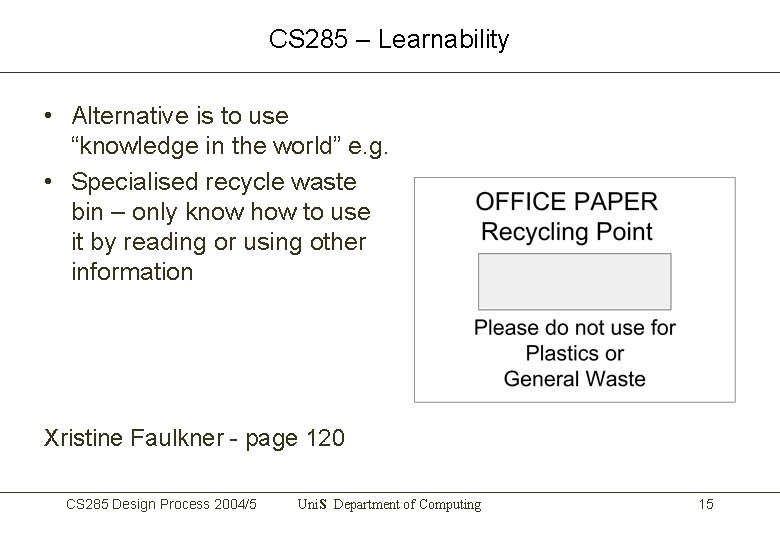
CS 285 – Learnability • Alternative is to use “knowledge in the world” e. g. • Specialised recycle waste bin – only know how to use it by reading or using other information Xristine Faulkner - page 120 CS 285 Design Process 2004/5 Uni. S Department of Computing 15
CS 285 – Learnability Metrics • • • The time required to learn the system The time to achieve a stated level of performance The time spent looking for information The time spent in on-line help The time spent dealing with errors The time required to maintain knowledge of the system • The time required to re-learn after a long break CS 285 Design Process 2004/5 Uni. S Department of Computing 16
CS 285 - Cognitive Psychology • • Empirical findings Motion must be realistic even at expense of resolution Audio effects enhance visual effects Empirical approach to design - Make an Intelligent guess and then test!! More systematic approach to design Mental Models: A mental model should lead to a prediction in a new situation - ‘run a mental model’ Mental model built up by previous experience, reasoning, extent of understanding, framework in which understanding exists, concepts CS 285 Design Process 2004/5 Uni. S Department of Computing 17
CS 285 - Cognitive Psychology • We need to know the user's Mental Models • their understanding of how a device works in terms of its internal structure and processes leads to us being able to instruct a user how to do. . • Wrong mental models lead to problems eg word processor vs text editor • Goals, sub-goals and Plans: • Goals > intentions > plans > assemble set of actions • Goals may change with experience and/or the interaction gain understanding as you go along may modify the goal • Need to know of the existence of actions that change the state or Mode (clearly state Mode on screen) CS 285 Design Process 2004/5 Uni. S Department of Computing 18
CS 285 - Cognitive Psychology • Errors • Mistakes - failure of intention - don’t realise mistake made - failure of action • Slips - accidental errors • Mode error - in the wrong state • Description errors - misinterpret information given or implied • Information flow - Visually rich interface can overwhelm or confuse make it well structured • Text • Graphics • Icons • Colour CS 285 Design Process 2004/5 Uni. S Department of Computing 19
CS 285 - Design • Meta knowledge - Tell users facilities exist and how to find them rather than make them remember how to use them • Direct manipulation interface - recognition rather than recall • Interface - abstract world • - virtual world • Interface - user must spend time to gain experience • Requirements Analysis - specify functionality of the system - leads to Detailed Specification - what the system will do • Task Analysis - how the system will do it • Start with User and then specify Tasks • Hierarchical Task Analysis - HTA Diagram CS 285 Design Process 2004/5 Uni. S Department of Computing 20
CS 285 – Design Documentation • Specify Interface - Screen Design • Objects - text, date, numbers, graphics, icons • Actions - type, move, select, delete etc. • Sequence of Actions • Specify Interface - State Transition Diagrams - Change in attributes values (state) - Carry out Cognitive Walkthrough • Build Prototype in Visual Basic • Carry out Evaluation/User Trials • Report - discuss all stages of design process • Diagrams - explain • Critique your design and methodology CS 285 Design Process 2004/5 Uni. S Department of Computing 21
CS 285 - Diagrammatic Notation used in design Diagrammatic Notations: • Data Flow Diagram – not relevant to interface • Structure Chart • Hierarchical Task Analysis - HTA • State Transition Networks or Statechart CS 285 Design Process 2004/5 Uni. S Department of Computing 22
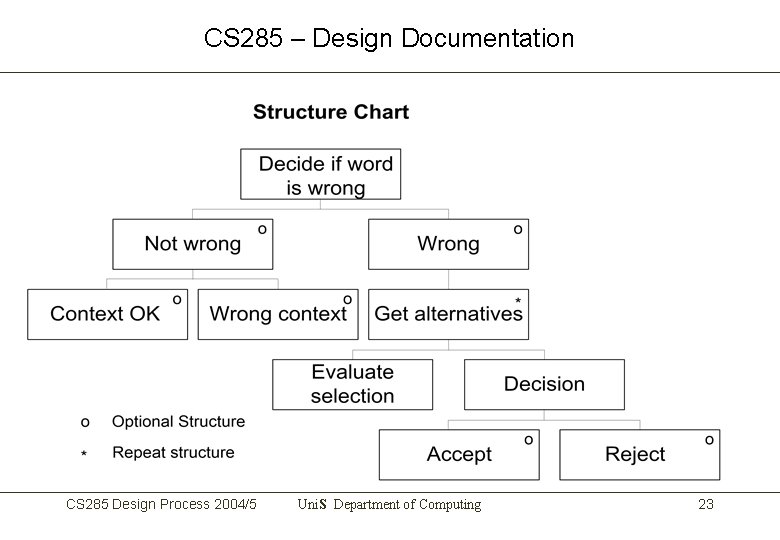
CS 285 – Design Documentation CS 285 Design Process 2004/5 Uni. S Department of Computing 23
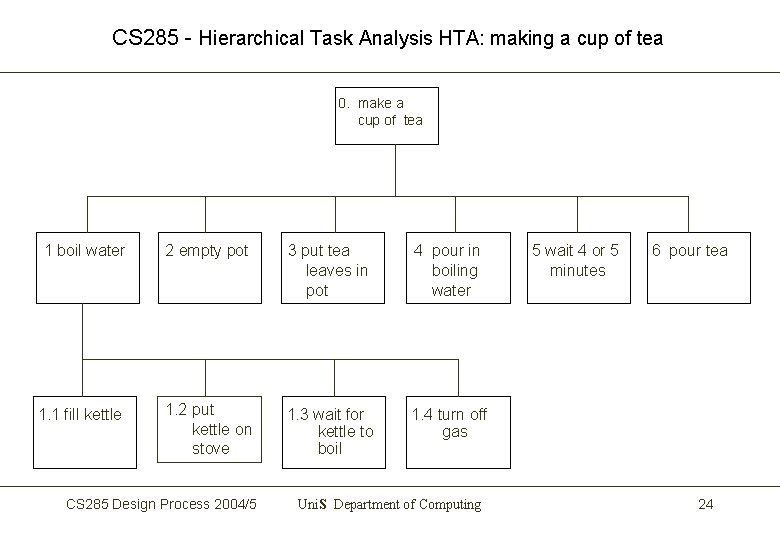
CS 285 - Hierarchical Task Analysis HTA: making a cup of tea 0. make a cup of tea 1 boil water 2 empty pot 3 put tea leaves in pot 4 pour in boiling water 1. 1 fill kettle 1. 2 put kettle on stove 1. 3 wait for kettle to boil 1. 4 turn off gas CS 285 Design Process 2004/5 Uni. S Department of Computing 5 wait 4 or 5 minutes 6 pour tea 24
CS 285 - State Transition Network or Diagram Microwave Cooker • • Intentionality - Cooking Conceptual Design - Entities and processes or behaviour time of day time to start cooking duration of cooking time possibility to interrupt and continue cooking …. etc. Semantic Design - User Operations documented by STN Transitions – Set clock – Set start time – Set duration – Set power etc. CS 285 Design Process 2004/5 Uni. S Department of Computing 25
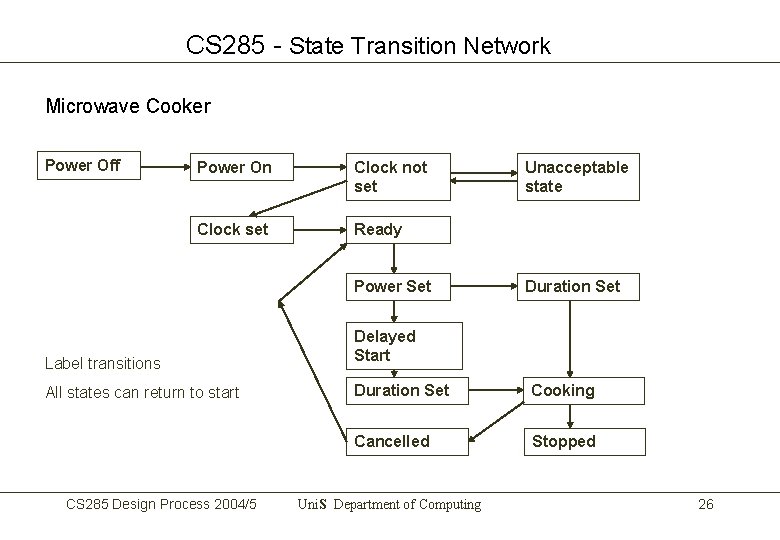
CS 285 - State Transition Network Microwave Cooker Power Off Power On Clock not set Clock set Ready Power Set Label transitions All states can return to start CS 285 Design Process 2004/5 Unacceptable state Duration Set Delayed Start Duration Set Cooking Cancelled Stopped Uni. S Department of Computing 26
CS 285 - State Transition Network or Diagram • • • Syntactic Design - Diagram of front panel of cooker (screen) All states are apparent to user (should be) All courses of action must be shown as transitions between states Feedback message for each transitions (good design) If state has more than one value decide if need a new state is needed – on/off could be the value of one state or designed as two states – Duration Set is duplicated - could be avoided • Benefits of FSN – Easily see missing transactions from diagram – Diagram will tell you which options in any menu are inactive CS 285 Design Process 2004/5 Uni. S Department of Computing 27
CS 285 – Role of Usability Engineer in Design Phase Participatory Design - user is involved in the whole design life cycle Number of methods to help convey information between user and designer: • Brainstorming • Storyboarding • Workshops • Pencil & paper exercise • Role playing CS 285 Design Process 2004/5 • Cognitive walk through • Heuristic evaluation • Review based evaluation • Model based evaluation Uni. S Department of Computing 28
CS 285 - Evaluation in the Design Phase Formative Evaluation – ongoing process Sumative Evaluation – at the end Review based Evaluation: compare design with other systems Model based evaluation Theoretical assessment using usability metrics e. g. ATM cash machine - calculate number of key strokes and time to withdraw cash CS 285 Design Process 2004/5 Uni. S Department of Computing 29
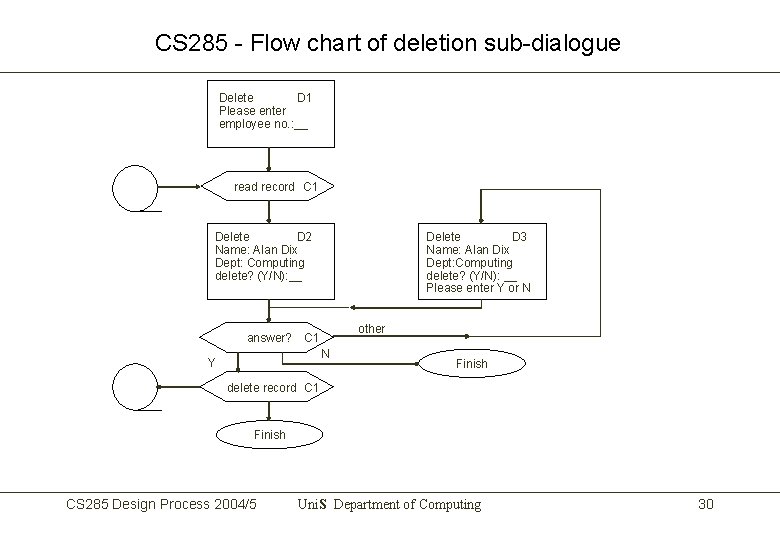
CS 285 - Flow chart of deletion sub-dialogue Delete D 1 Please enter employee no. : __ read record C 1 Delete D 2 Name: Alan Dix Dept: Computing delete? (Y/N): __ Delete D 3 Name: Alan Dix Dept: Computing delete? (Y/N): __ Please enter Y or N other answer? C 1 N Y Finish delete record C 1 Finish CS 285 Design Process 2004/5 Uni. S Department of Computing 30
- Slides: 30