
CS 276 B Text Retrieval and Mining Winter

CS 276 B Text Retrieval and Mining Winter 2005 Lecture 7
Plan for today n n Review search engine history (slightly more technically than in the first lecture) Web crawling/corpus construction n n Distributed crawling Connectivity servers
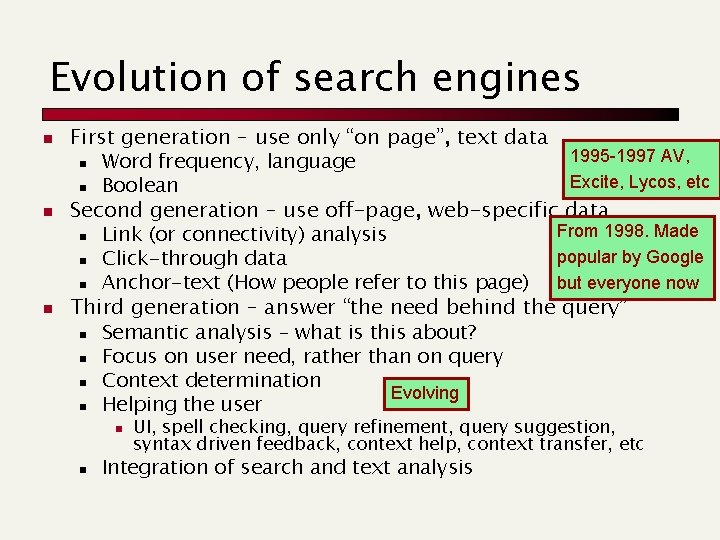
Evolution of search engines n n n First generation – use only “on page”, text data 1995 -1997 AV, n Word frequency, language Excite, Lycos, etc n Boolean Second generation – use off-page, web-specific data From 1998. Made n Link (or connectivity) analysis popular by Google n Click-through data but everyone now n Anchor-text (How people refer to this page) Third generation – answer “the need behind the query” n Semantic analysis – what is this about? n Focus on user need, rather than on query n Context determination Evolving n Helping the user n n UI, spell checking, query refinement, query suggestion, syntax driven feedback, context help, context transfer, etc Integration of search and text analysis
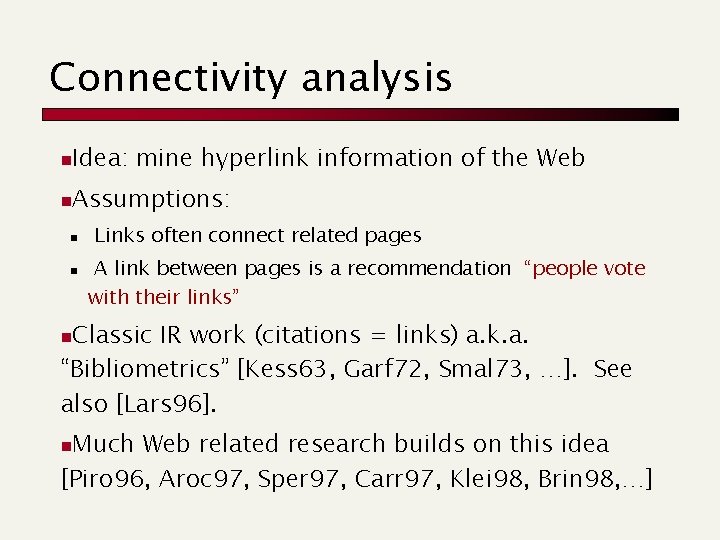
Connectivity analysis n Idea: mine hyperlink information of the Web n Assumptions: n n Links often connect related pages A link between pages is a recommendation “people vote with their links” Classic IR work (citations = links) a. k. a. “Bibliometrics” [Kess 63, Garf 72, Smal 73, …]. See also [Lars 96]. n Much Web related research builds on this idea [Piro 96, Aroc 97, Sper 97, Carr 97, Klei 98, Brin 98, …] n
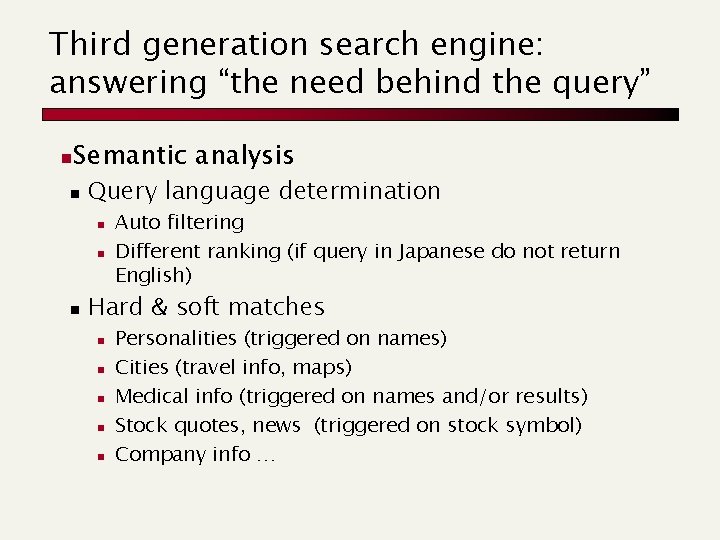
Third generation search engine: answering “the need behind the query” n Semantic analysis n Query language determination n Auto filtering Different ranking (if query in Japanese do not return English) Hard & soft matches n n n Personalities (triggered on names) Cities (travel info, maps) Medical info (triggered on names and/or results) Stock quotes, news (triggered on stock symbol) Company info …
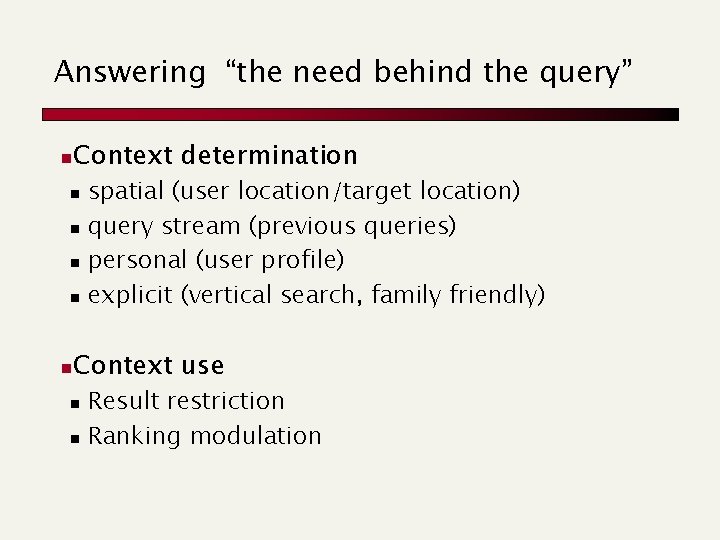
Answering “the need behind the query” n Context determination n n spatial (user location/target location) query stream (previous queries) personal (user profile) explicit (vertical search, family friendly) Context use n n Result restriction Ranking modulation
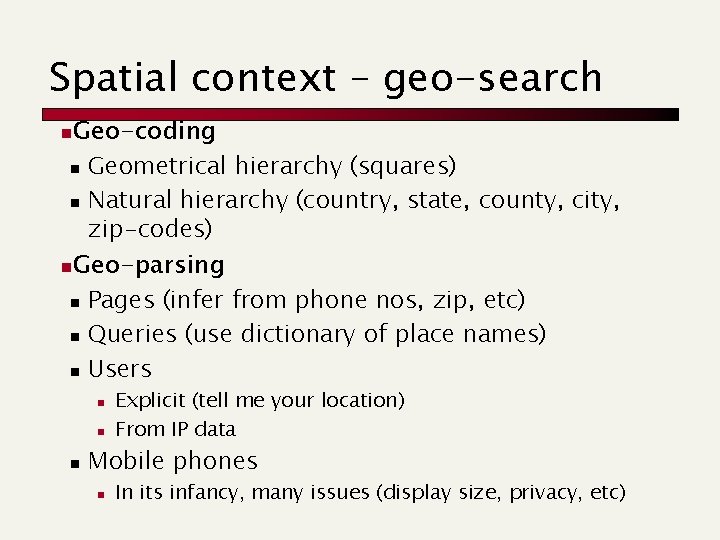
Spatial context – geo-search Geo-coding n Geometrical hierarchy (squares) n Natural hierarchy (country, state, county, city, zip-codes) n. Geo-parsing n Pages (infer from phone nos, zip, etc) n Queries (use dictionary of place names) n Users n n Explicit (tell me your location) From IP data Mobile phones n In its infancy, many issues (display size, privacy, etc)
Helping the user n n UI Spell checking Query completion …
Crawling
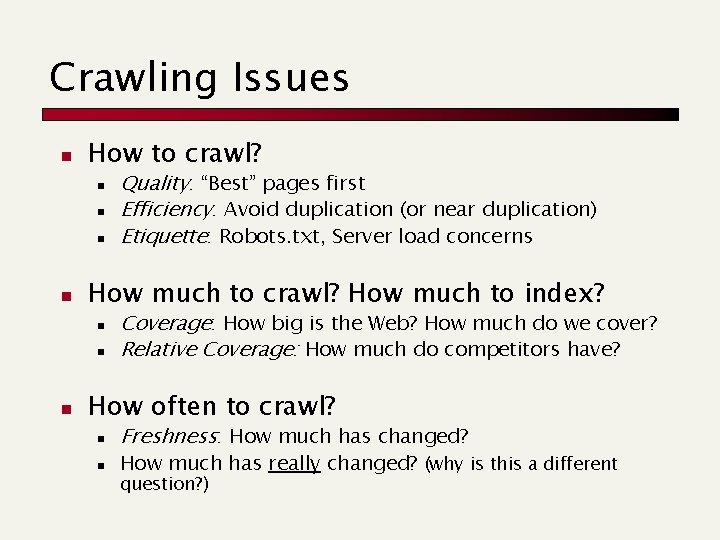
Crawling Issues n How to crawl? n n How much to crawl? How much to index? n n n Quality: “Best” pages first Efficiency: Avoid duplication (or near duplication) Etiquette: Robots. txt, Server load concerns Coverage: How big is the Web? How much do we cover? Relative Coverage: How much do competitors have? How often to crawl? n n Freshness: How much has changed? How much has really changed? (why is this a different question? )
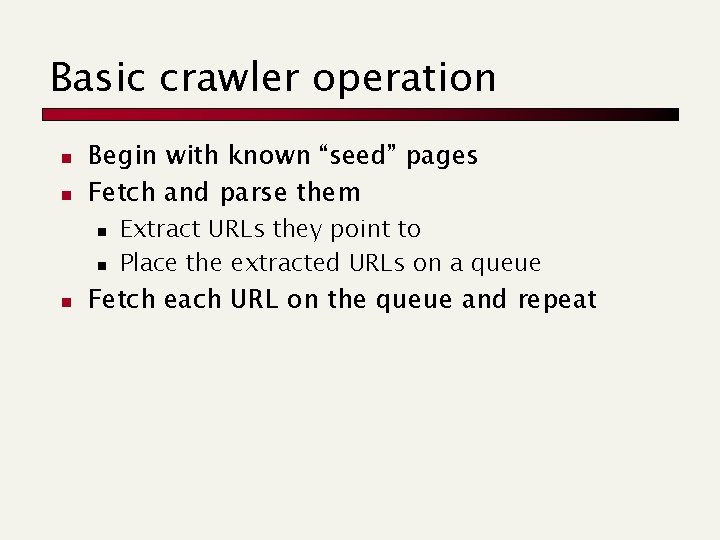
Basic crawler operation n n Begin with known “seed” pages Fetch and parse them n n n Extract URLs they point to Place the extracted URLs on a queue Fetch each URL on the queue and repeat
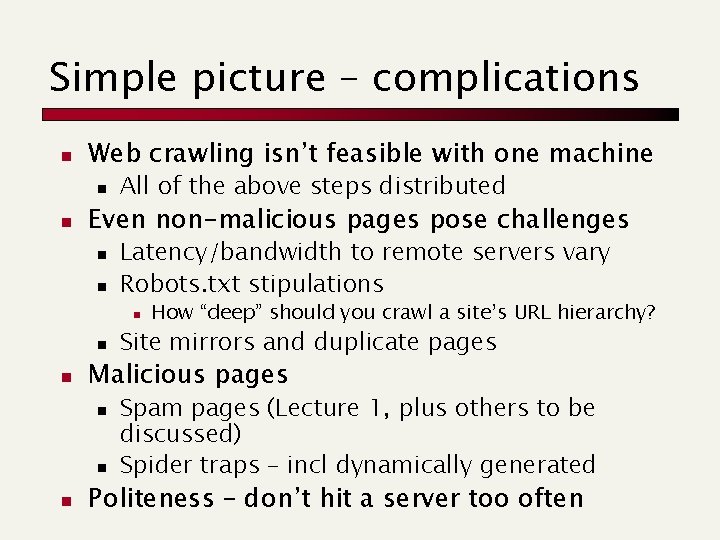
Simple picture – complications n Web crawling isn’t feasible with one machine n n All of the above steps distributed Even non-malicious pages pose challenges n n Latency/bandwidth to remote servers vary Robots. txt stipulations n n n Site mirrors and duplicate pages Malicious pages n n n How “deep” should you crawl a site’s URL hierarchy? Spam pages (Lecture 1, plus others to be discussed) Spider traps – incl dynamically generated Politeness – don’t hit a server too often
Robots. txt n Protocol for giving spiders (“robots”) limited access to a website, originally from 1994 n n www. robotstxt. org/wc/norobots. html Website announces its request on what can(not) be crawled n n For a URL, create a file URL/robots. txt This file specifies access restrictions
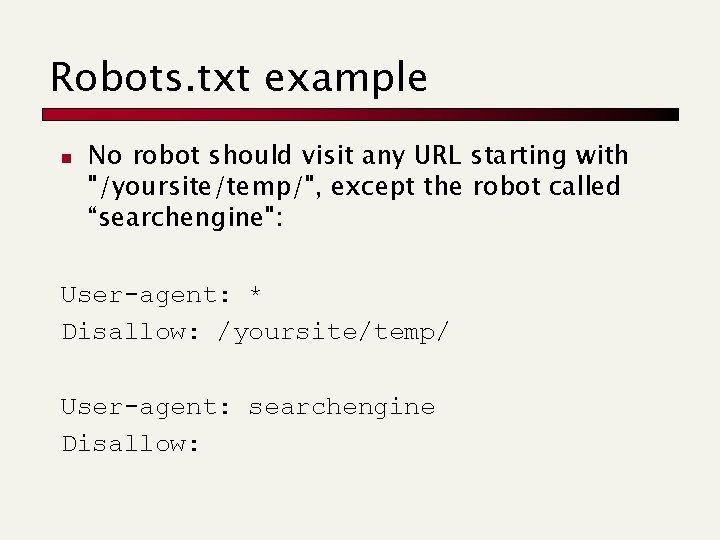
Robots. txt example n No robot should visit any URL starting with "/yoursite/temp/", except the robot called “searchengine": User-agent: * Disallow: /yoursite/temp/ User-agent: searchengine Disallow:
Crawling and Corpus Construction n n Crawl order Distributed crawling Filtering duplicates Mirror detection
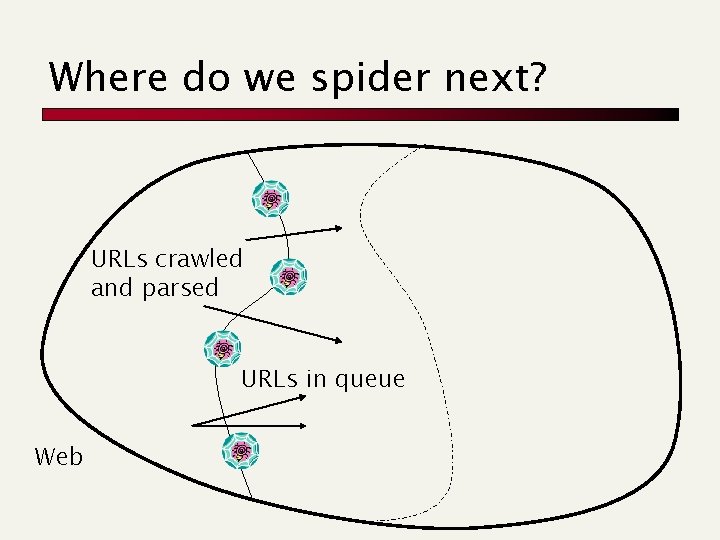
Where do we spider next? URLs crawled and parsed URLs in queue Web
Crawl Order n n Want best pages first Potential quality measures: n n Final In-degree Final Pagerank What’s this?
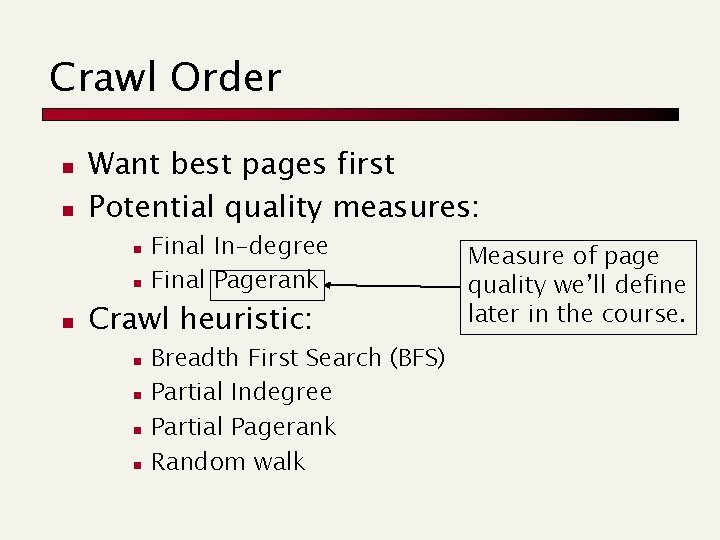
Crawl Order n n Want best pages first Potential quality measures: n n n Final In-degree Final Pagerank Crawl heuristic: n n Breadth First Search (BFS) Partial Indegree Partial Pagerank Random walk Measure of page quality we’ll define later in the course.
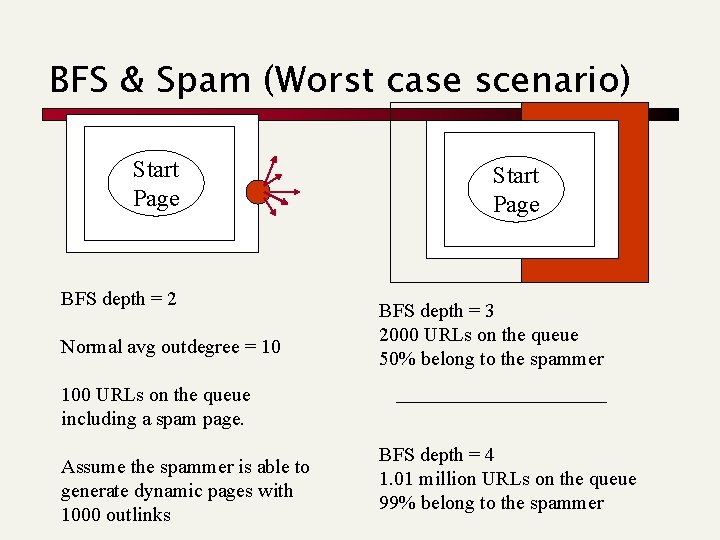
BFS & Spam (Worst case scenario) Start Page BFS depth = 2 Normal avg outdegree = 10 Start Page BFS depth = 3 2000 URLs on the queue 50% belong to the spammer 100 URLs on the queue including a spam page. Assume the spammer is able to generate dynamic pages with 1000 outlinks BFS depth = 4 1. 01 million URLs on the queue 99% belong to the spammer
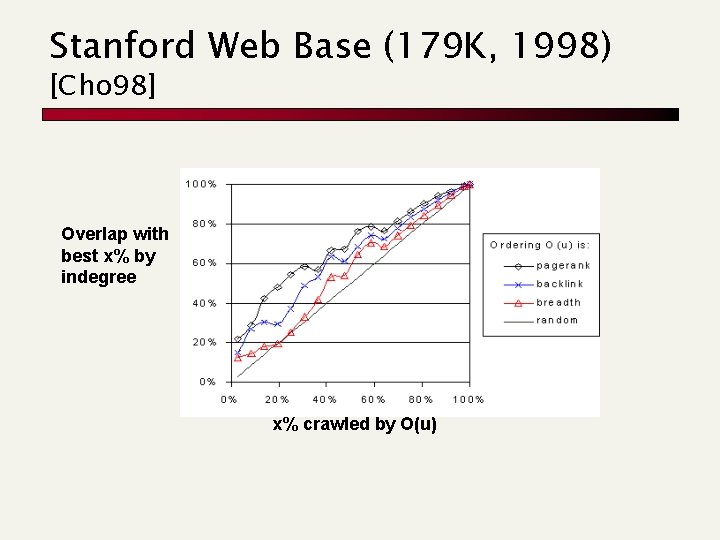
Stanford Web Base (179 K, 1998) [Cho 98] Overlap with best x% by indegree x% crawled by O(u)
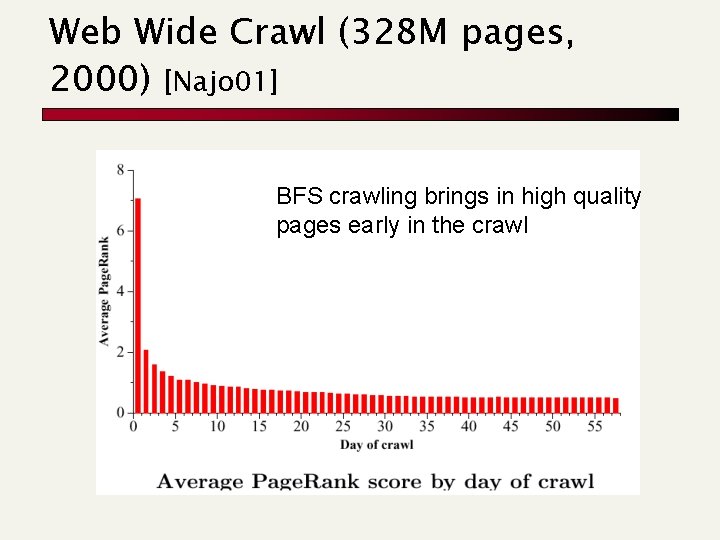
Web Wide Crawl (328 M pages, 2000) [Najo 01] BFS crawling brings in high quality pages early in the crawl
Queue of URLs to be fetched n n n What constraints dictate which queued URL is fetched next? Politeness – don’t hit a server too often, even from different threads of your spider How far into a site you’ve crawled already n n Most sites, stay at ≤ 5 levels of URL hierarchy Which URLs are most promising for building a high-quality corpus n n This is a graph traversal problem: Given a directed graph you’ve partially visited, where do you visit next?
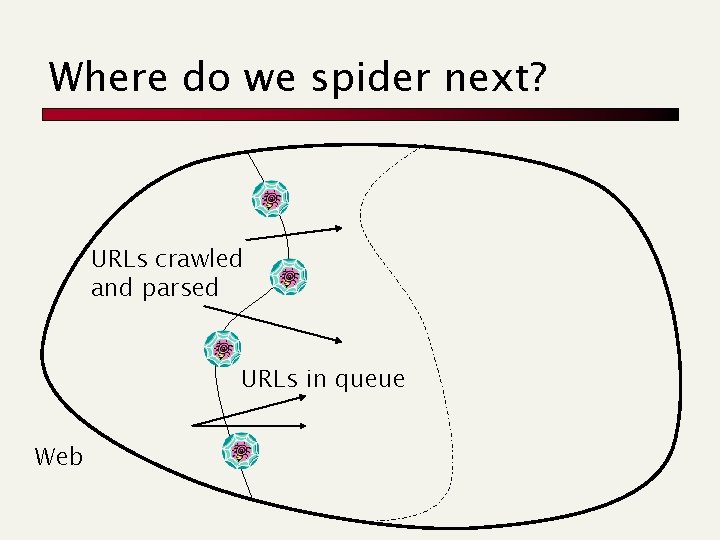
Where do we spider next? URLs crawled and parsed URLs in queue Web
Where do we spider next? n n Keep all spiders busy Keep spiders from treading on each others’ toes n n n Avoid fetching duplicates repeatedly Respect politeness/robots. txt Avoid getting stuck in traps Detect/minimize spam Get the “best” pages n n What’s best? Best for answering search queries
Where do we spider next? n Complex scheduling optimization problem, subject to all the constraints listed n n Scientific study – limited to specific aspects n n n Plus operational constraints (e. g. , keeping all machines load-balanced) Which ones? What do we measure? What are the compromises in distributed crawling?
Parallel Crawlers n We follow the treatment of Cho and Garcia-Molina: n n n Raises a number of questions in a clean setting, for further study Setting: we have a number of c-proc’s n n http: //www 2002. org/CDROM/refereed/108/index. html c-proc = crawling process Goal: we wish to spider the best pages with minimum overhead n What do these mean?
Distributed model n Crawlers may be running in diverse geographies – Europe, Asia, etc. n n Periodically update a master index Incremental update so this is “cheap” n n n Compression, differential update etc. Focus on communication overhead during the crawl Also results in dispersed WAN load
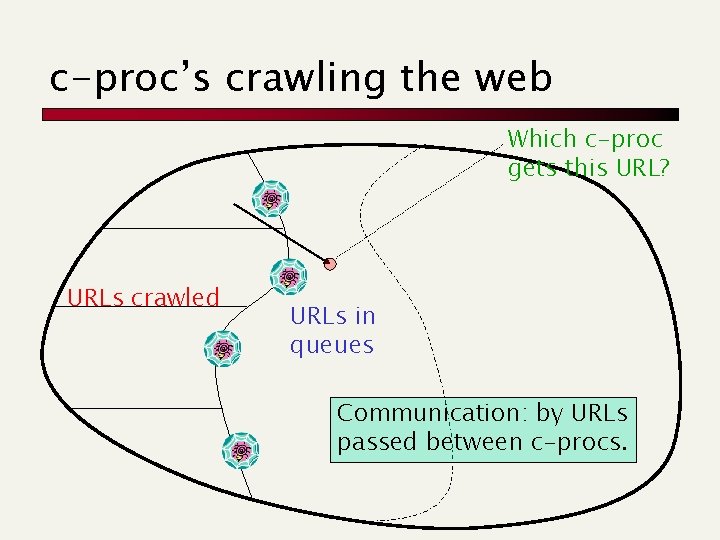
c-proc’s crawling the web Which c-proc gets this URL? URLs crawled URLs in queues Communication: by URLs passed between c-procs.
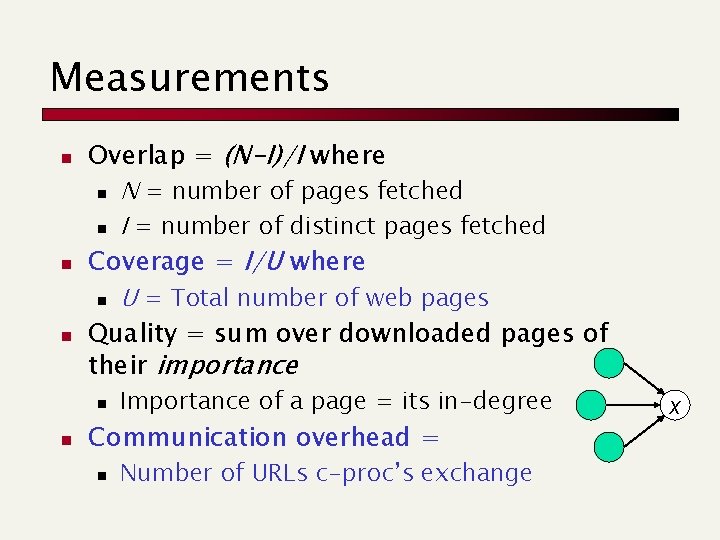
Measurements n n n Overlap = (N-I)/I where n N = number of pages fetched n I = number of distinct pages fetched Coverage = I/U where n U = Total number of web pages Quality = sum over downloaded pages of their importance n n Importance of a page = its in-degree Communication overhead = n Number of URLs c-proc’s exchange x
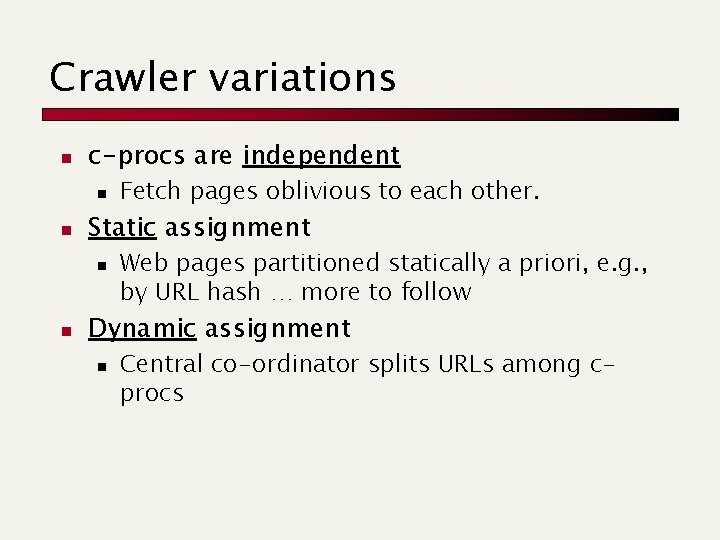
Crawler variations n c-procs are independent n n Static assignment n n Fetch pages oblivious to each other. Web pages partitioned statically a priori, e. g. , by URL hash … more to follow Dynamic assignment n Central co-ordinator splits URLs among cprocs
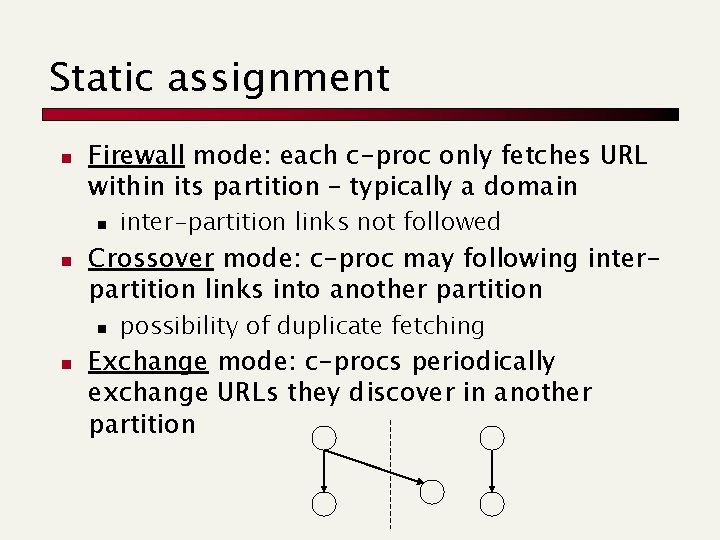
Static assignment n Firewall mode: each c-proc only fetches URL within its partition – typically a domain n n Crossover mode: c-proc may following interpartition links into another partition n n inter-partition links not followed possibility of duplicate fetching Exchange mode: c-procs periodically exchange URLs they discover in another partition
Experiments n 40 M URL graph – Stanford Webbase n n Open Directory (dmoz. org) URLs as seeds Should be considered a small Web
Summary of findings n Cho/Garcia-Molina detail many findings n n n We will review some here, both qualitatively and quantitatively You are expected to understand the reason behind each qualitative finding in the paper You are not expected to remember quantities in their plots/studies
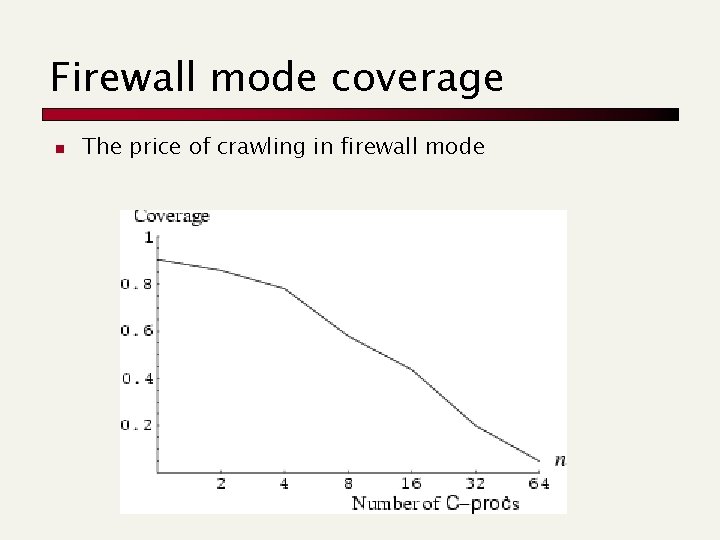
Firewall mode coverage n The price of crawling in firewall mode
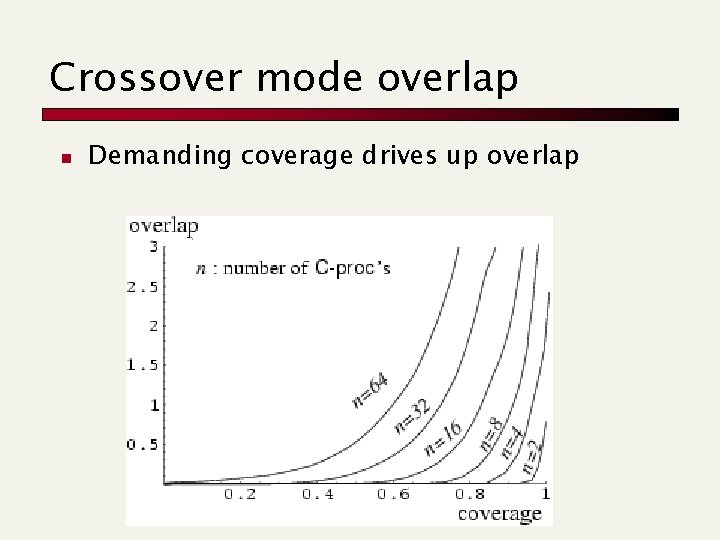
Crossover mode overlap n Demanding coverage drives up overlap
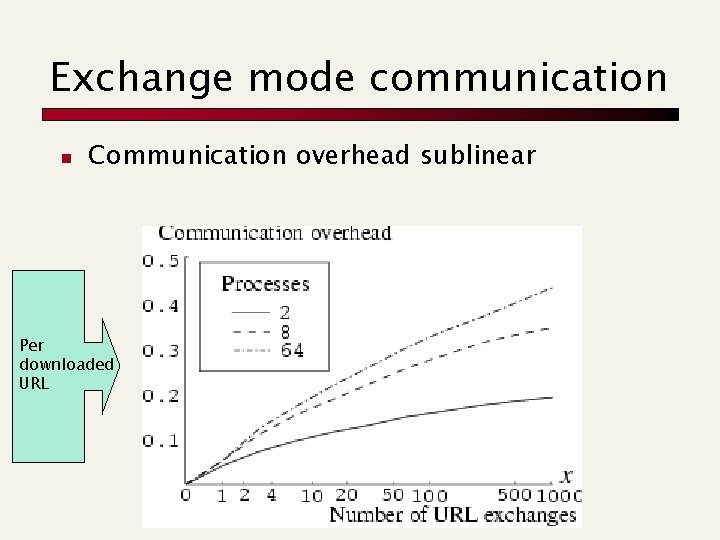
Exchange mode communication n Communication overhead sublinear Per downloaded URL
Connectivity servers
Connectivity Server [CS 1: Bhar 98 b, CS 2 & 3: Rand 01] n Support for fast queries on the web graph n n Which URLs point to a given URL? Which URLs does a given URL point to? Stores mappings in memory from n n URL to outlinks, URL to inlinks Applications n n Crawl control Web graph analysis n n Connectivity, crawl optimization Link analysis n More on this later
Most recent published work n Boldi and Vigna n n n http: //www 2004. org/proceedings/docs/1 p 595. pdf Webgraph – set of algorithms and a java implementation Fundamental goal – maintain node adjacency lists in memory n For this, compressing the adjacency lists is the critical component
Adjacency lists n n n The set of neighbors of a node Assume each URL represented by an integer Properties exploited in compression: n n n Similarity (between lists) Locality (many links from a page go to “nearby” pages) Use gap encodings in sorted lists n n As we did for postings in CS 276 A Distribution of gap values
Storage n Boldi/Vigna report getting down to an average of ~3 bits/link n n (URL to URL edge) For a 118 M node web graph
Resources n n n www. robotstxt. org/wc/norobots. html www 2002. org/CDROM/refereed/108/index. html www 2004. org/proceedings/docs/1 p 595. pdf
- Slides: 42