
CS 268 Computer Networking L3 BGP Outline BGP
CS 268: Computer Networking L-3 BGP
Outline • BGP • • ASes, Policies BGP Attributes BGP Path Selection i. BGP 2
Autonomous Systems (ASes) • Autonomous Routing Domain • Glued together by a common administration, policies etc • Autonomous system – is a specific case of an ARD • ARD is a concept vs AS is an actual entity that participates in routing • Has an unique 16 bit ASN assigned to it and typically participates in inter-domain routing • Examples: • • MIT: 3, CMU: 9 AT&T: 7018, 6341, 5074, … UUNET: 701, 702, 284, 12199, … Sprint: 1239, 1240, 6211, 6242, … • How do ASes interconnect to provide global connectivity • How does routing information get exchanged 3
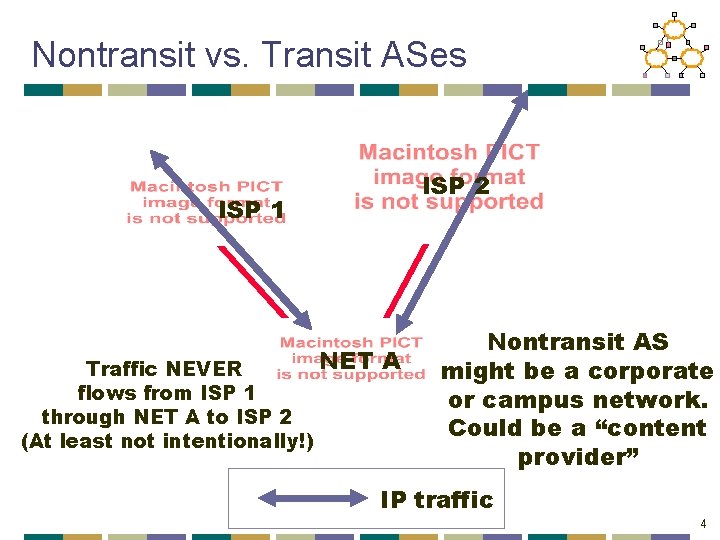
Nontransit vs. Transit ASes ISP 2 ISP 1 NET Traffic NEVER flows from ISP 1 through NET A to ISP 2 (At least not intentionally!) A Nontransit AS might be a corporate or campus network. Could be a “content provider” IP traffic 4
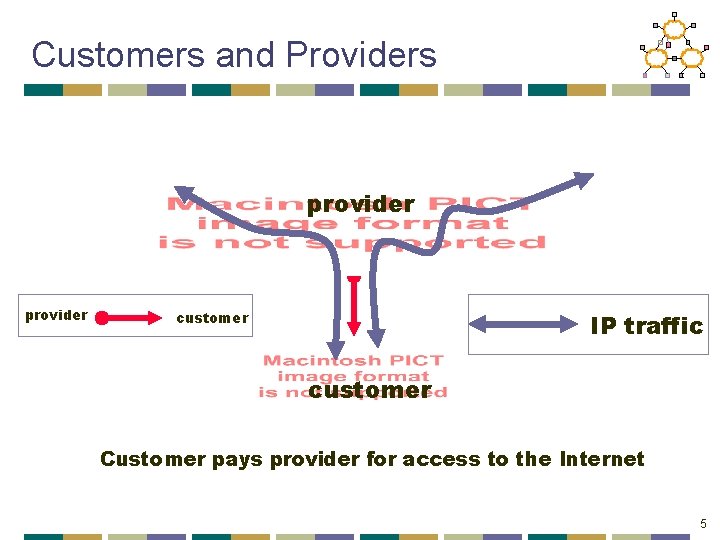
Customers and Providers provider customer IP traffic customer Customer pays provider for access to the Internet 5
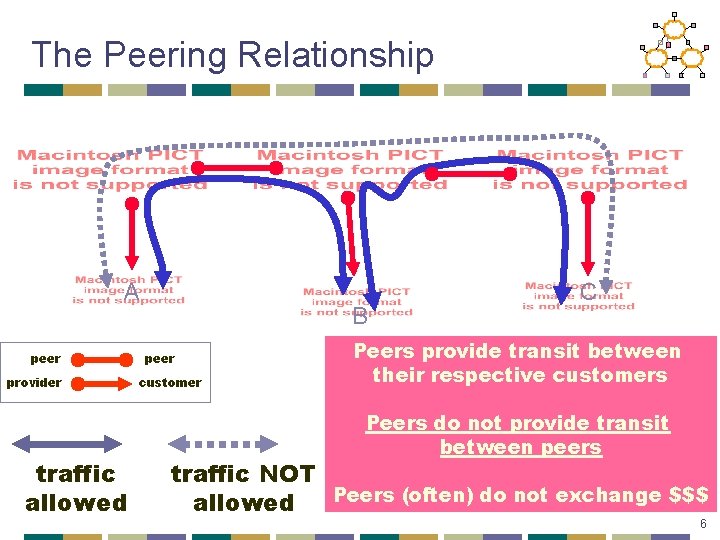
The Peering Relationship A peer provider traffic allowed B peer customer C Peers provide transit between their respective customers Peers do not provide transit between peers traffic NOT Peers (often) do not exchange $$$ allowed 6
Peering Wars Peer • Reduces upstream transit costs • Can increase end-to-end performance • May be the only way to connect your customers to some part of the Internet (“Tier 1”) Don’t Peer • You would rather have customers • Peers are usually your competition • Peering relationships may require periodic renegotiation Peering struggles are by far the most contentious issues in the ISP world! Peering agreements are often confidential. 7
Routing in the Internet • Link state or distance vector? • No universal metric – policy decisions • Problems with distance-vector: • Bellman-Ford algorithm may not converge • Problems with link state: • Metric used by routers not the same – loops • LS database too large – entire Internet • May expose policies to other AS’s 8
Solution: Distance Vector with Path • Each routing update carries the entire path • Loops are detected as follows: • When AS gets route check if AS already in path • If yes, reject route • If no, add self and (possibly) advertise route further • Advantage: • Metrics are local - AS chooses path, protocol ensures no loops 9
BGP-4 • • BGP = Border Gateway Protocol Is a Policy-Based routing protocol Is the EGP of today’s global Internet Relatively simple protocol, but configuration is complex and the entire world can see, and be impacted by, your mistakes. 1989 : BGP-1 [RFC 1105] – Replacement for EGP (1984, RFC 904) 1990 : BGP-2 [RFC 1163] 1991 : BGP-3 [RFC 1267] 1995 : BGP-4 [RFC 1771] – Support for Classless Interdomain Routing (CIDR) 10

BGP Operations (Simplified) Establish session on TCP port 179 AS 1 BGP session Exchange all active routes AS 2 Exchange incremental updates While connection is ALIVE exchange route UPDATE messages 11
Interconnecting BGP Peers • BGP uses TCP to connect peers • Advantages: • Simplifies BGP • No need for periodic refresh - routes are valid until withdrawn, or the connection is lost • Incremental updates • Disadvantages • Congestion control on a routing protocol? • Inherits TCP vulnerabilities! • Poor interaction during high load 12
Four Types of BGP Messages • • Open : Establish a peering session. Keep Alive : Handshake at regular intervals. Notification : Shuts down a peering session. Update : Announcing new routes or withdrawing previously announced routes. announcement = prefix + attributes values 13
Policy with BGP • BGP provides capability for enforcing various policies • Policies are not part of BGP: they are provided to BGP as configuration information • BGP enforces policies by choosing paths from multiple alternatives and controlling advertisement to other AS’s • Import policy • What to do with routes learned from neighbors? • Selecting best path • Export policy • What routes to announce to neighbors? • Depends on relationship with neighbor 14
Examples of BGP Policies • A multi-homed AS refuses to act as transit • Limit path advertisement • A multi-homed AS can become transit for some AS’s • Only advertise paths to some AS’s • Eg: A Tier-2 provider multi-homed to Tier-1 providers • An AS can favor or disfavor certain AS’s for traffic transit from itself 15
Export Policy • An AS exports only best paths to its neighbors • Guarantees that once the route is announced the AS is willing to transit traffic on that route • To Customers • Announce all routes learned from peers, providers and customers, and self-origin routes • To Providers • Announce routes learned from customers and selforigin routes • To Peers • Announce routes learned from customers and selforigin routes 16
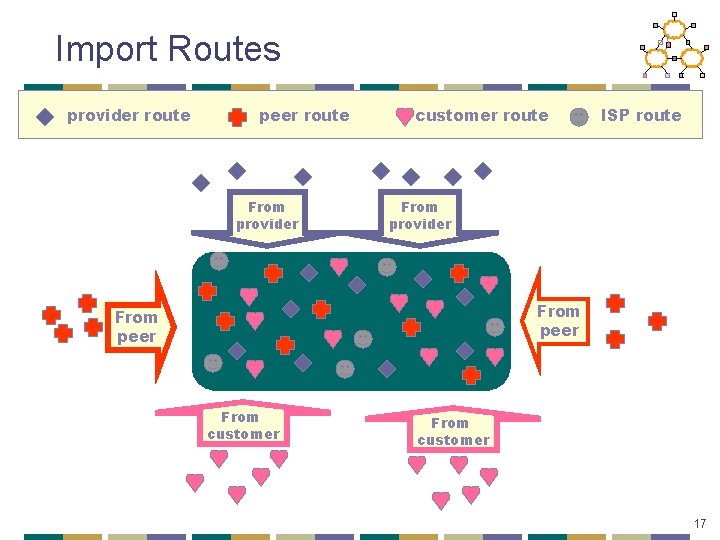
Import Routes provider route peer route From provider customer route ISP route From provider From peer From customer 17
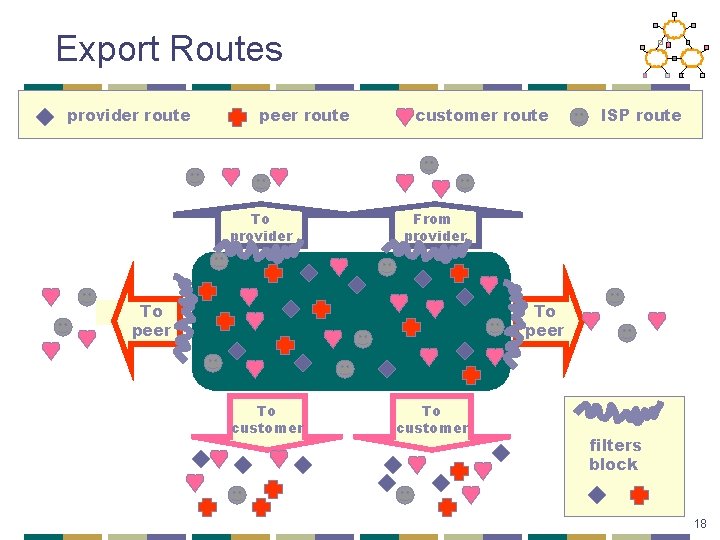
Export Routes provider route peer route To provider customer route ISP route From provider To peer To customer filters block 18
BGP UPDATE Message • List of withdrawn routes • Network layer reachability information • List of reachable prefixes • Path attributes • Origin • Path • Metrics • All prefixes advertised in message have same path attributes 19
Path Selection Criteria • Information based on path attributes • Attributes + external (policy) information • Examples: • Hop count • Policy considerations • Preference for AS • Presence or absence of certain AS • Path origin • Link dynamics 20
Important BGP Attributes • • Local Preference AS-Path MED Next hop 21
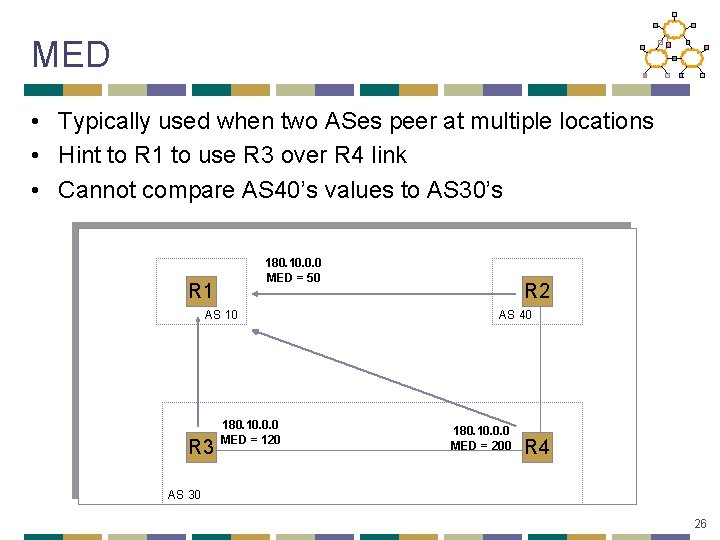
MED • Typically used when two ASes peer at multiple locations • Hint to R 1 to use R 3 over R 4 link • Cannot compare AS 40’s values to AS 30’s 180. 10. 0. 0 MED = 50 R 1 AS 10 R 3 180. 10. 0. 0 MED = 120 R 2 AS 40 180. 10. 0. 0 MED = 200 R 4 AS 30 26
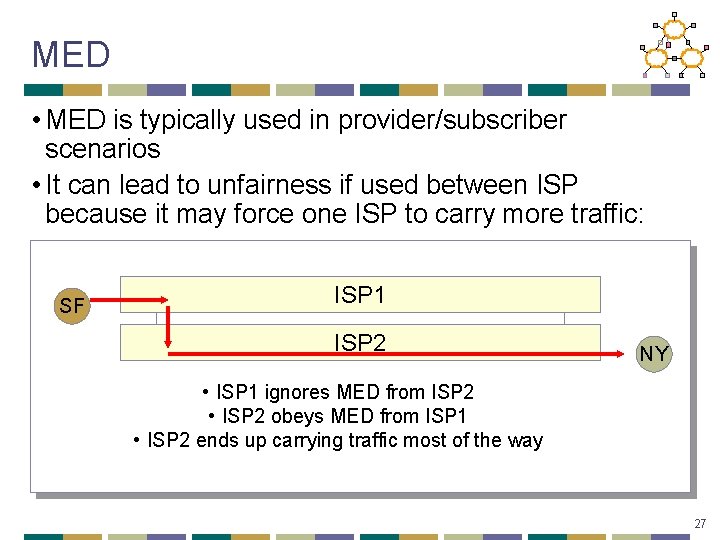
MED • MED is typically used in provider/subscriber scenarios • It can lead to unfairness if used between ISP because it may force one ISP to carry more traffic: SF ISP 1 ISP 2 NY • ISP 1 ignores MED from ISP 2 • ISP 2 obeys MED from ISP 1 • ISP 2 ends up carrying traffic most of the way 27
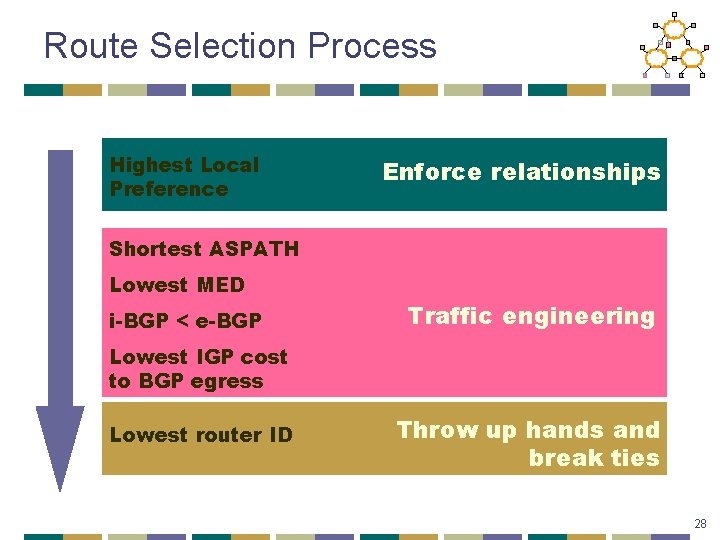
Route Selection Process Highest Local Preference Enforce relationships Shortest ASPATH Lowest MED i-BGP < e-BGP Traffic engineering Lowest IGP cost to BGP egress Lowest router ID Throw up hands and break ties 28
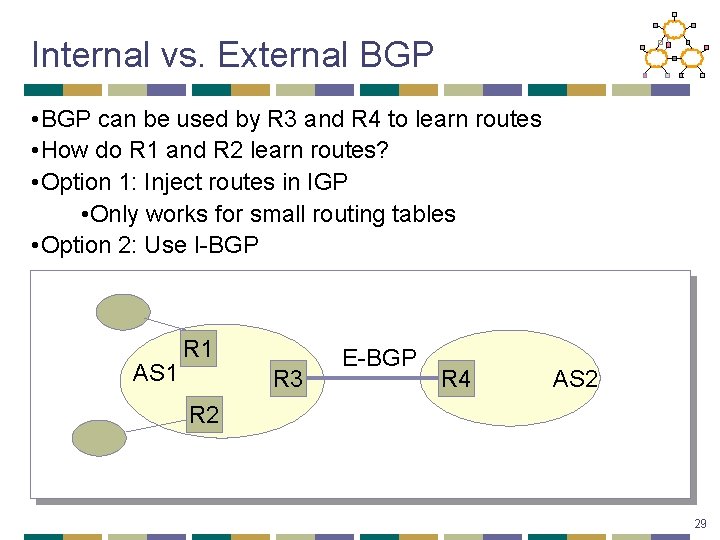
Internal vs. External BGP • BGP can be used by R 3 and R 4 to learn routes • How do R 1 and R 2 learn routes? • Option 1: Inject routes in IGP • Only works for small routing tables • Option 2: Use I-BGP AS 1 R 3 E-BGP R 4 AS 2 R 2 29
Internal BGP (I-BGP) • Same messages as E-BGP • Different rules about re-advertising prefixes: • Prefix learned from E-BGP can be advertised to I-BGP neighbor and vice-versa, but • Prefix learned from one I-BGP neighbor cannot be advertised to another I-BGP neighbor • Reason: no AS PATH within the same AS and thus danger of looping. 30
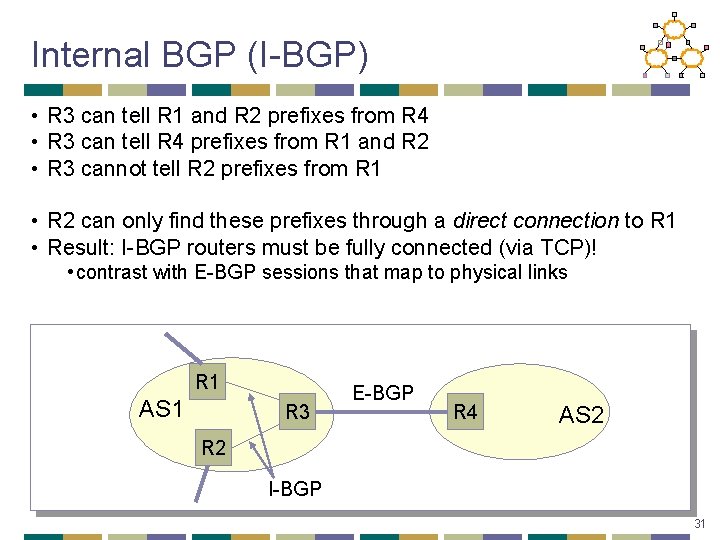
Internal BGP (I-BGP) • R 3 can tell R 1 and R 2 prefixes from R 4 • R 3 can tell R 4 prefixes from R 1 and R 2 • R 3 cannot tell R 2 prefixes from R 1 • R 2 can only find these prefixes through a direct connection to R 1 • Result: I-BGP routers must be fully connected (via TCP)! • contrast with E-BGP sessions that map to physical links R 1 AS 1 R 3 E-BGP R 4 AS 2 R 2 I-BGP 31
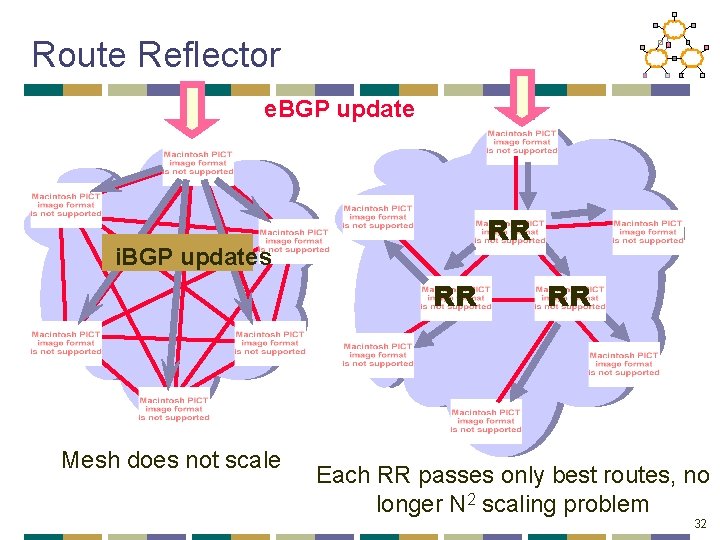
Route Reflector e. BGP update RR i. BGP updates RR Mesh does not scale RR Each RR passes only best routes, no longer N 2 scaling problem 32
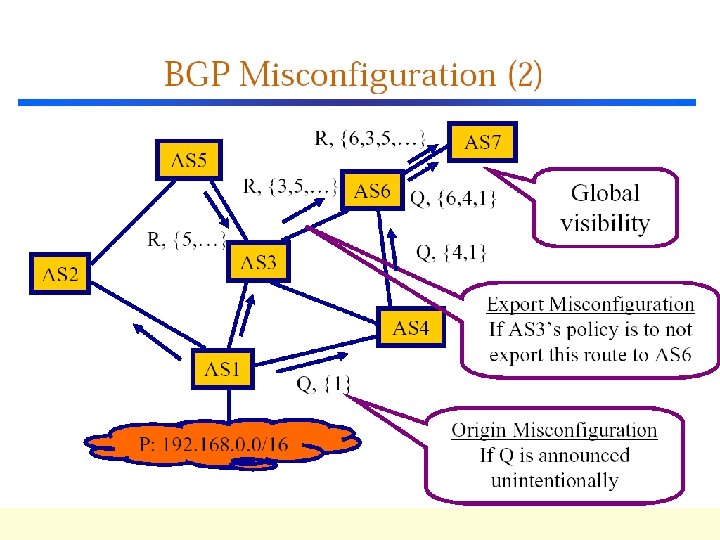
BGP Misconfigurations • Types of BGP misconfigurations • Origin misconfiguration • Export misconfiguration • Types of Impact of BGP misconfigurations • How to identify misconfigs? • Results • • How often? Impact level? Cause? How to avoid them? • Conclusion
BGP Misconfiguration • Configurations defined by local operational practices, not global standards • No universally accepted list of “Dos & Don'ts” • Rule of thumb: http: //www. riverstonenet. com/support/bgp/design/index. ht m • Misconfiguration: behavior unintended by the operator • Includes both slips (inadvertent errors) and mistakes (erroneous plan) • Focus on two broad classes of globally visible faults • Origin misconfiguration • Export misconfiguration
Other Types of Misconfigurations • Filter out routes that should be announced • Appears to users as failures • Two links connect to a neighboring AS, misconfigure to use the less-preferred link • Not easily identifiable from global BGP changes • Need information internal to ASes • OK to ignore no significant impact on connectivity
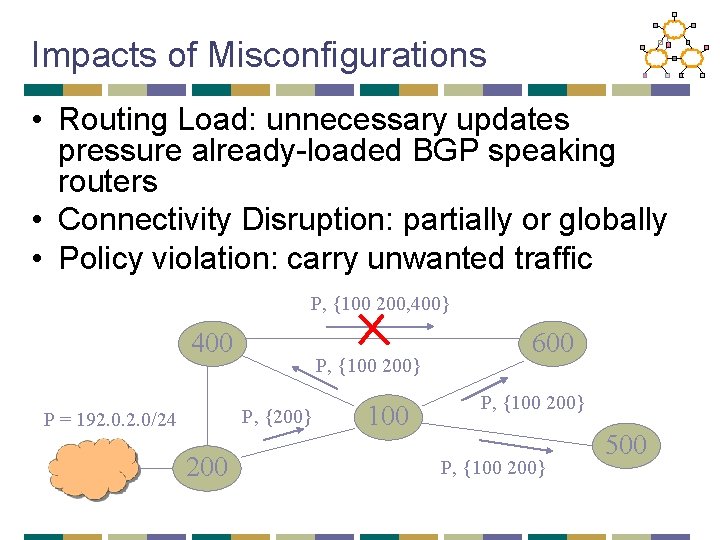
Impacts of Misconfigurations • Routing Load: unnecessary updates pressure already-loaded BGP speaking routers • Connectivity Disruption: partially or globally • Policy violation: carry unwanted traffic P, {100 200, 400} 400 P, {100 200} P, {200} P = 192. 0/24 200 100 600 P, {100 200} 500
Methodology • Analyze globally visible updates from 23 BGP speakers for 21 days [Route. Views] • Rich view of backbone routing • Ability to observe even very short-lived events • Identifying misconfigurations: • Internet Routing Registries (IRRs) are inaccurate or outdated • 30% inconsistent origins for Single Origin AS and 80% for Multiple Origin ASes • Instead use signature of misconfigurations in the update stream • Assume policy changes have similar signature but larger timescale, but failures and misconfigs are short
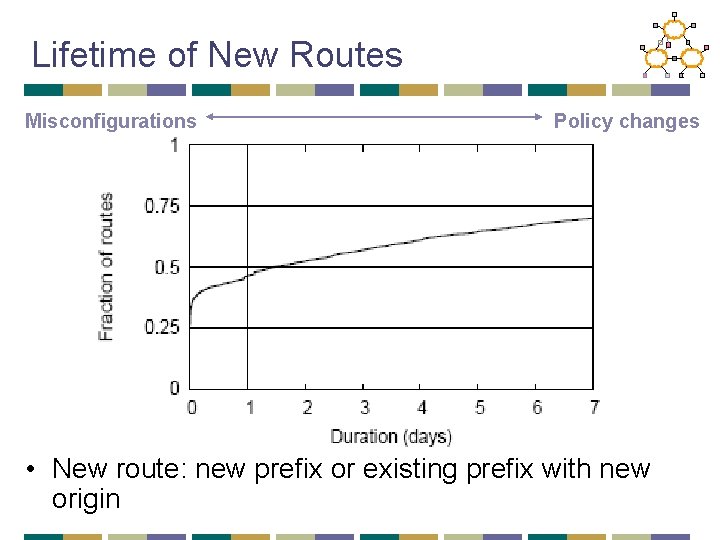
Lifetime of New Routes Misconfigurations Policy changes • New route: new prefix or existing prefix with new origin
Methodology (2) • Identify short-lived (< 24 hrs) changes as potential misconfigurations – Origin misconfiguration • Short-lived new route – new prefix or new origin for a prefix – Export misconfiguration • Short-lived AS-path that violates policy – Lower bounds on number of misconfigurations • Email verification through operators – Was it a misconfig? Connectivity disrupted? What caused it? • Use email responses to discover underlying causes • Test connectivity using public traceroute servers – Coarse independent verification of email responses
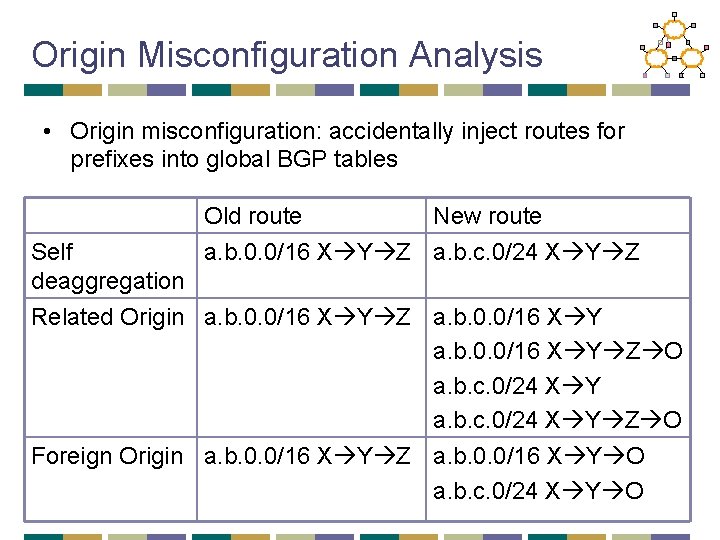
Origin Misconfiguration Analysis • Origin misconfiguration: accidentally inject routes for prefixes into global BGP tables Old route New route a. b. 0. 0/16 X Y Z a. b. c. 0/24 X Y Z Self deaggregation Related Origin a. b. 0. 0/16 X Y Z O a. b. c. 0/24 X Y Z O Foreign Origin a. b. 0. 0/16 X Y Z a. b. 0. 0/16 X Y O a. b. c. 0/24 X Y O
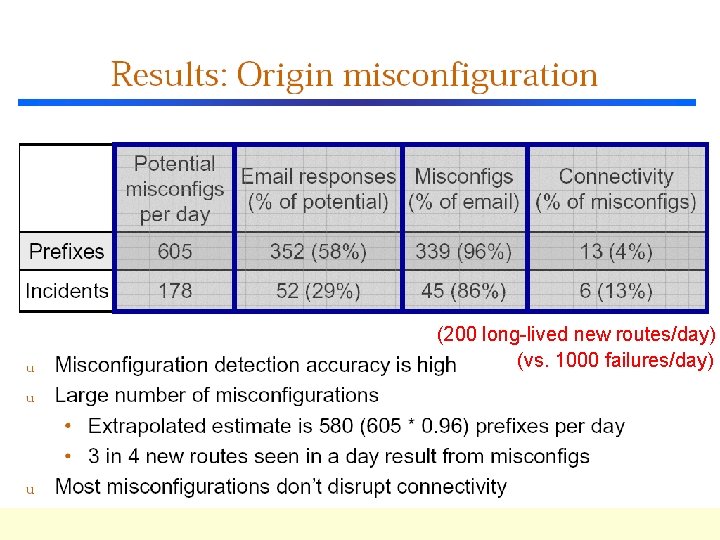
(200 long-lived new routes/day) (vs. 1000 failures/day)
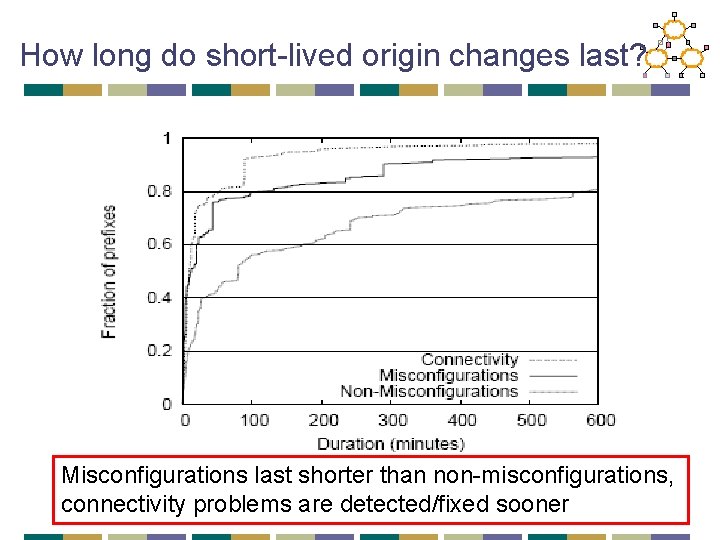
How long do short-lived origin changes last? Misconfigurations last shorter than non-misconfigurations, connectivity problems are detected/fixed sooner
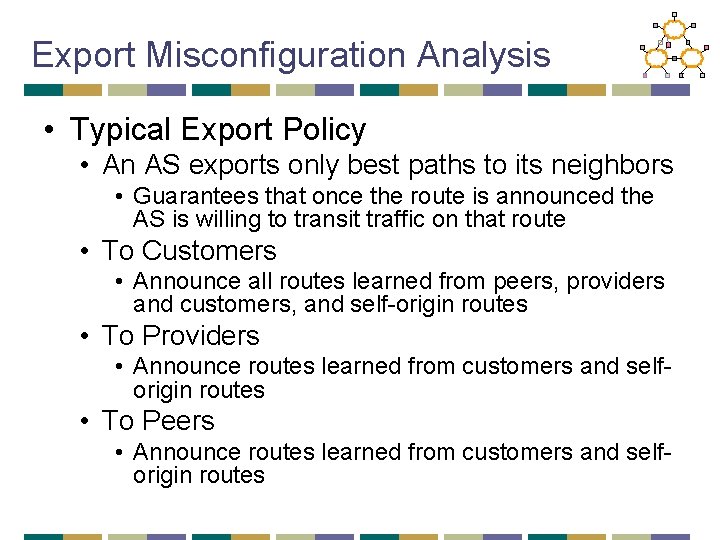
Export Misconfiguration Analysis • Typical Export Policy • An AS exports only best paths to its neighbors • Guarantees that once the route is announced the AS is willing to transit traffic on that route • To Customers • Announce all routes learned from peers, providers and customers, and self-origin routes • To Providers • Announce routes learned from customers and selforigin routes • To Peers • Announce routes learned from customers and selforigin routes
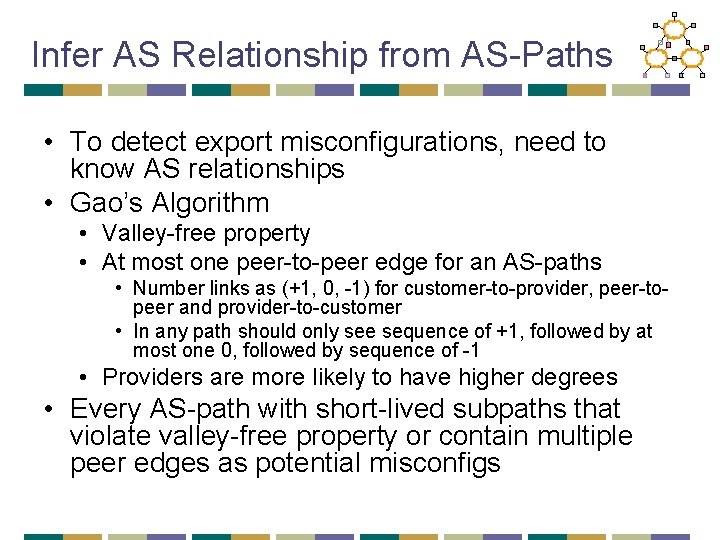
Infer AS Relationship from AS-Paths • To detect export misconfigurations, need to know AS relationships • Gao’s Algorithm • Valley-free property • At most one peer-to-peer edge for an AS-paths • Number links as (+1, 0, -1) for customer-to-provider, peer-topeer and provider-to-customer • In any path should only see sequence of +1, followed by at most one 0, followed by sequence of -1 • Providers are more likely to have higher degrees • Every AS-path with short-lived subpaths that violate valley-free property or contain multiple peer edges as potential misconfigs
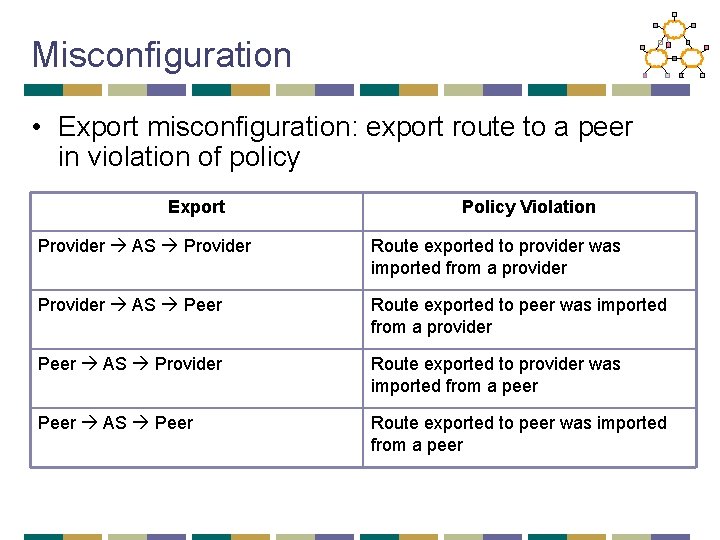
Misconfiguration • Export misconfiguration: export route to a peer in violation of policy Export Policy Violation Provider AS Provider Route exported to provider was imported from a provider Provider AS Peer Route exported to peer was imported from a provider Peer AS Provider Route exported to provider was imported from a peer Peer AS Peer Route exported to peer was imported from a peer
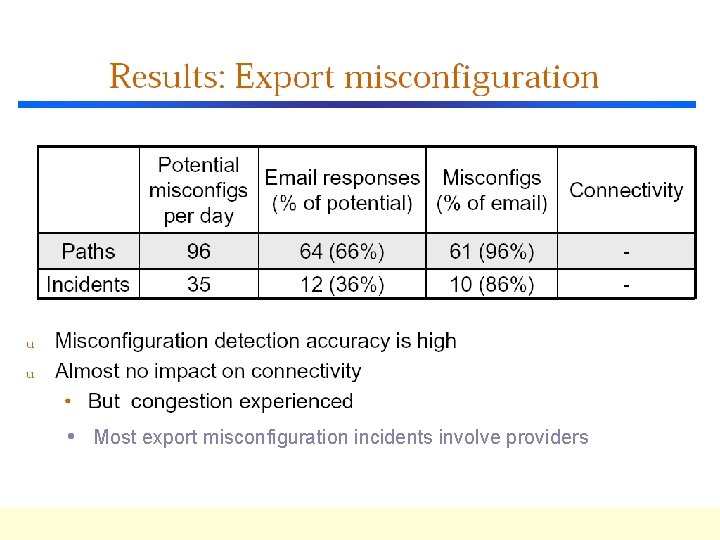
• Most export misconfiguration incidents involve providers
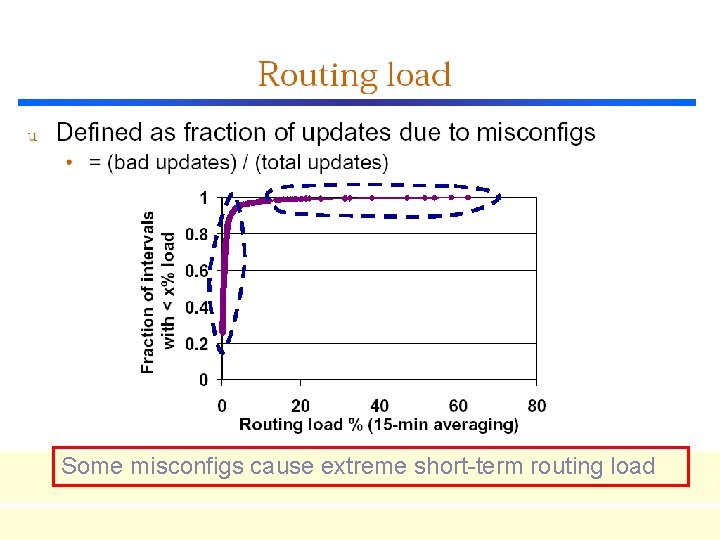
Some misconfigs cause extreme short-term routing load
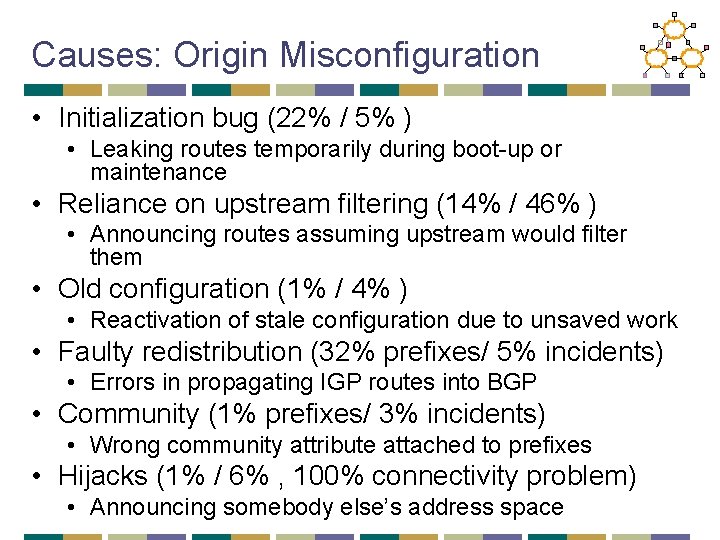
Causes: Origin Misconfiguration • Initialization bug (22% / 5% ) • Leaking routes temporarily during boot-up or maintenance • Reliance on upstream filtering (14% / 46% ) • Announcing routes assuming upstream would filter them • Old configuration (1% / 4% ) • Reactivation of stale configuration due to unsaved work • Faulty redistribution (32% prefixes/ 5% incidents) • Errors in propagating IGP routes into BGP • Community (1% prefixes/ 3% incidents) • Wrong community attribute attached to prefixes • Hijacks (1% / 6% , 100% connectivity problem) • Announcing somebody else’s address space
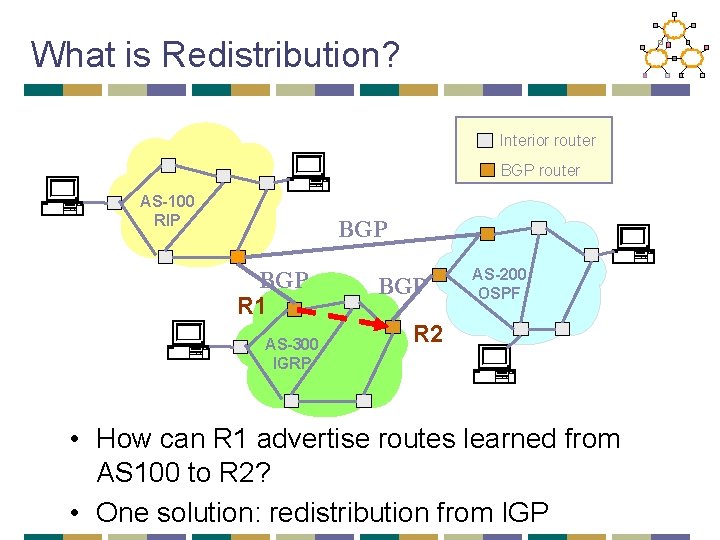
What is Redistribution? Interior router BGP router AS-100 RIP BGP R 1 AS-300 IGRP BGP AS-200 OSPF R 2 • How can R 1 advertise routes learned from AS 100 to R 2? • One solution: redistribution from IGP
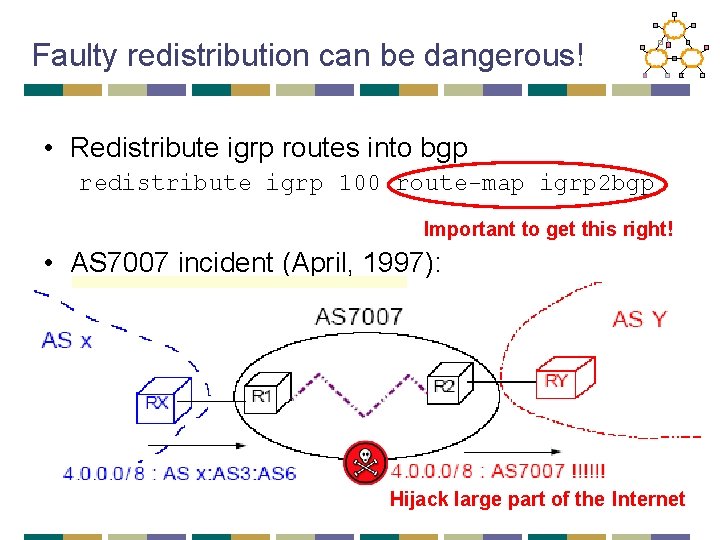
Faulty redistribution can be dangerous! • Redistribute igrp routes into bgp redistribute igrp 100 route-map igrp 2 bgp Important to get this right! • AS 7007 incident (April, 1997): Hijack large part of the Internet
Causes: Export Misconfigurations • Some causes common with those for origin misconfigurations, e. g. , old configuration, initialization bug, …, etc. • Causes with more significant impact • Prefix based config (8% / 22% ) • Violate export policy upon failures • Bad ACL or route map (34% / 4% ) • Incorrect access control lists (ACL) or route maps
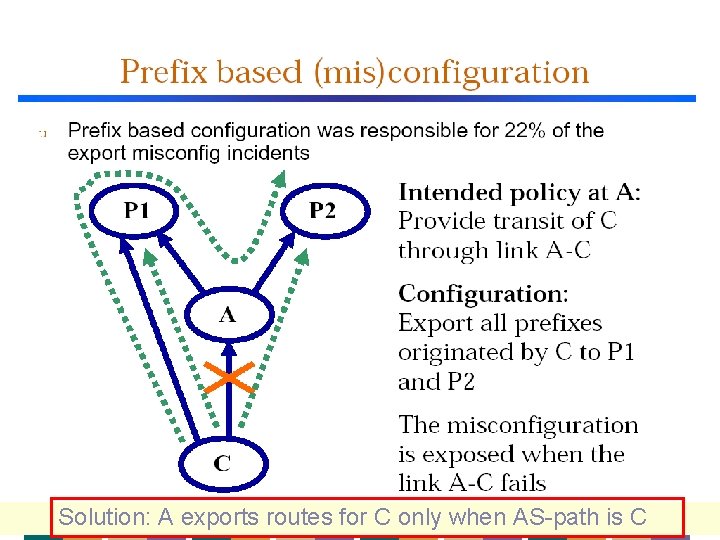
Solution: A exports routes for C only when AS-path is C
Avoiding BGP Misconfigurations • User interfaces • Basic principles need to be followed • High-Level languages and configuration checker • High-level configuration tools built for/into the routers • Consistent databases and updated registries • Protocol Extensions • Secure BGP (SBGP) • Inform customer of the misconfig, even though it’s silently filtered
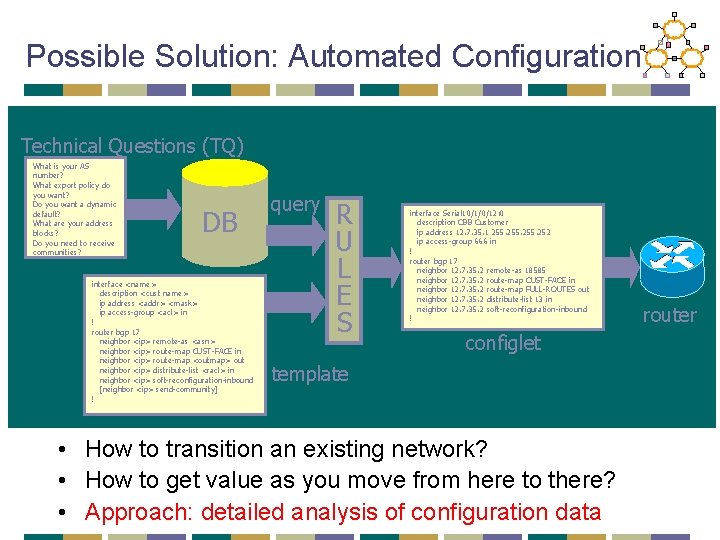
Possible Solution: Automated Configuration Technical Questions (TQ) What is your AS number? What export policy do you want? Do you want a dynamic default? What are your address blocks? Do you need to receive communities? DB interface <name> description <cust name> ip address <addr> <mask> ip access-group <acl> in ! router bgp 17 neighbor <ip> remote-as <asn> neighbor <ip> route-map CUST-FACE in neighbor <ip> route-map <outmap> out neighbor <ip> distribute-list <racl> in neighbor <ip> soft-reconfiguration-inbound [neighbor <ip> send-community] ! query R U L E S interface Serial 10/1/0/12: 0 description CBB Customer ip address 12. 7. 35. 1 255. 252 ip access-group 666 in ! router bgp 17 neighbor 12. 7. 35. 2 remote-as 18585 neighbor 12. 7. 35. 2 route-map CUST-FACE in neighbor 12. 7. 35. 2 route-map FULL-ROUTES out neighbor 12. 7. 35. 2 distribute-list 13 in neighbor 12. 7. 35. 2 soft-reconfiguration-inbound ! configlet template • How to transition an existing network? • How to get value as you move from here to there? • Approach: detailed analysis of configuration data router
Conclusions • Misconfigurations are commonplace (up to 1% of BGP table) • Connectivity is surprisingly robust to most misconfigurations but routing load can be significant • Causes of misconfigurations are diverse • Much needs to be done to improve the operational reliability of the Internet
![Next Lecture: Congestion Control • Assigned Reading • [Chiu & Jain] Analysis of Increase](http://slidetodoc.com/presentation_image_h/0a753957acccd6c15f115062a4cec366/image-53.jpg "Next Lecture: Congestion Control • Assigned Reading • [Chiu & Jain] Analysis of Increase")
Next Lecture: Congestion Control • Assigned Reading • [Chiu & Jain] Analysis of Increase and Decrease Algorithms for Congestion Avoidance in Computer Networks • [Jacobson and Karels] Congestion Avoidance and Control 57
- Slides: 53