
CS 267 Distributed Memory Machines and Programming James
CS 267: Distributed Memory Machines and Programming James Demmel www. cs. berkeley. edu/~demmel/cs 267_Spr 06 01/31/2006 CS 267 Lecture 5 1
Recap of Last Lecture • Shared memory multiprocessors • Caches in individual processors must be kept coherent -- multiple cached copies of same location must be kept equal. • Requires clever hardware (see CS 258, CS 252). • Distant memory much more expensive to access. • Shared memory programming • Starting, stopping threads. • Synchronization with barriers, locks. 10/3/2020 CS 267 Lecure 7 2
Outline • Distributed Memory Architectures • Properties of communication networks • Topologies • Performance models • Programming Distributed Memory Machines using Message Passing 10/3/2020 CS 267 Lecure 7 3
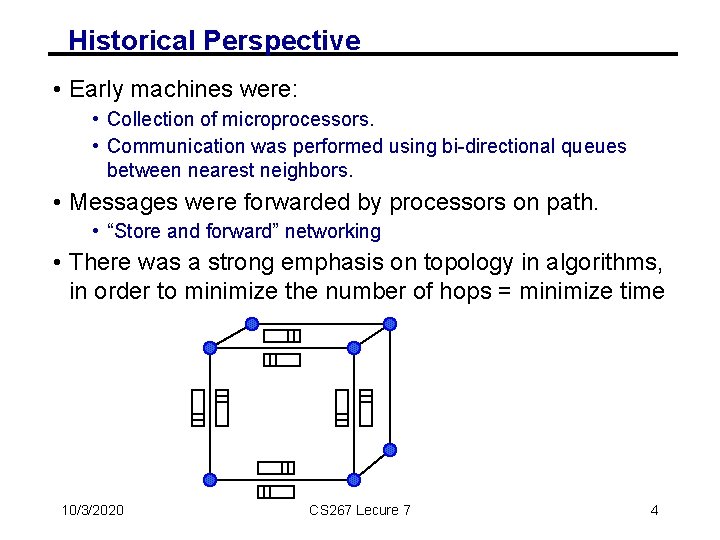
Historical Perspective • Early machines were: • Collection of microprocessors. • Communication was performed using bi-directional queues between nearest neighbors. • Messages were forwarded by processors on path. • “Store and forward” networking • There was a strong emphasis on topology in algorithms, in order to minimize the number of hops = minimize time 10/3/2020 CS 267 Lecure 7 4
Network Analogy • To have a large number of transfers occurring at once, you need a large number of distinct wires. • Networks are like streets: • Link = street. • Switch = intersection. • Distances (hops) = number of blocks traveled. • Routing algorithm = travel plan. • Properties: • Latency: how long to get between nodes in the network. • Bandwidth: how much data can be moved per unit time. 10/3/2020 • Bandwidth is limited by the number of wires and the rate at which each wire can accept data. CS 267 Lecure 7 5
Design Characteristics of a Network • Topology (how things are connected) • Crossbar, ring, 2 -D and 3 -D mesh or torus, hypercube, tree, butterfly, perfect shuffle. . • Routing algorithm: • Example in 2 D torus: all east-west then all north -south (avoids deadlock). • Switching strategy: • Circuit switching: full path reserved for entire message, like the telephone. • Packet switching: message broken into separatelyrouted packets, like the post office. • Flow control (what if there is congestion): • Stall, store data temporarily in buffers, re-route data to other nodes, tell source node to temporarily halt, discard, etc. 10/3/2020 CS 267 Lecure 7 6
Performance Properties of a Network: Latency • Diameter: the maximum (over all pairs of nodes) of the shortest path between a given pair of nodes. • Latency: delay between send and receive times • Latency tends to vary widely across architectures • Vendors often report hardware latencies (wire time) • Application programmers care about software latencies (user program to user program) • Observations: • Hardware/software latencies often differ by 1 -2 orders of magnitude • Maximum hardware latency varies with diameter, but the variation in software latency is usually negligible • Latency is important for programs with many small messages 10/3/2020 CS 267 Lecure 7 7
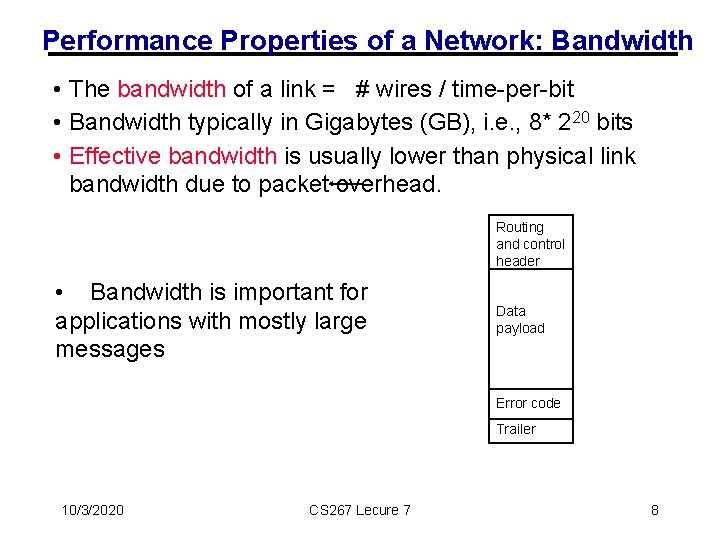
Performance Properties of a Network: Bandwidth • The bandwidth of a link = # wires / time-per-bit • Bandwidth typically in Gigabytes (GB), i. e. , 8* 220 bits • Effective bandwidth is usually lower than physical link bandwidth due to packet overhead. Routing and control header • Bandwidth is important for applications with mostly large messages Data payload Error code Trailer 10/3/2020 CS 267 Lecure 7 8
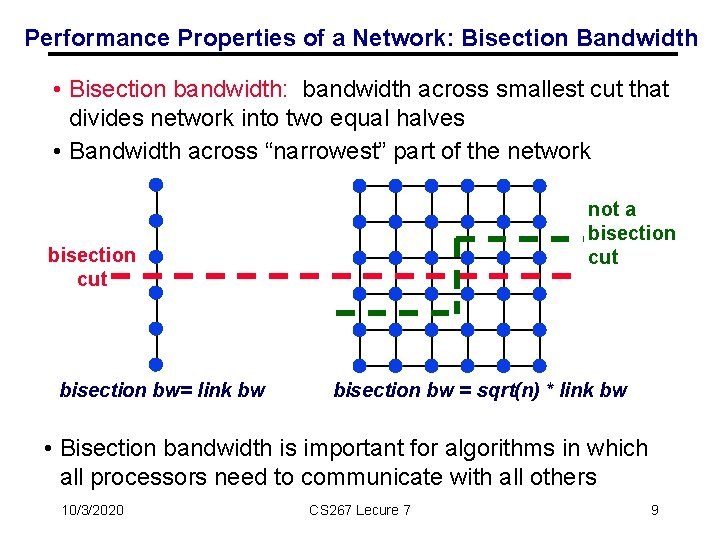
Performance Properties of a Network: Bisection Bandwidth • Bisection bandwidth: bandwidth across smallest cut that divides network into two equal halves • Bandwidth across “narrowest” part of the network not a bisection cut bisection bw= link bw bisection bw = sqrt(n) * link bw • Bisection bandwidth is important for algorithms in which all processors need to communicate with all others 10/3/2020 CS 267 Lecure 7 9
Network Topology • In the past, there was considerable research in network topology and in mapping algorithms to topology. • Key cost to be minimized: number of “hops” between nodes (e. g. “store and forward”) • Modern networks hide hop cost (i. e. , “wormhole routing”), so topology is no longer a major factor in algorithm performance. • Example: On IBM SP system, hardware latency varies from 0. 5 usec to 1. 5 usec, but user-level message passing latency is roughly 36 usec. • Need some background in network topology • Algorithms may have a communication topology • Topology affects bisection bandwidth. 10/3/2020 CS 267 Lecure 7 10
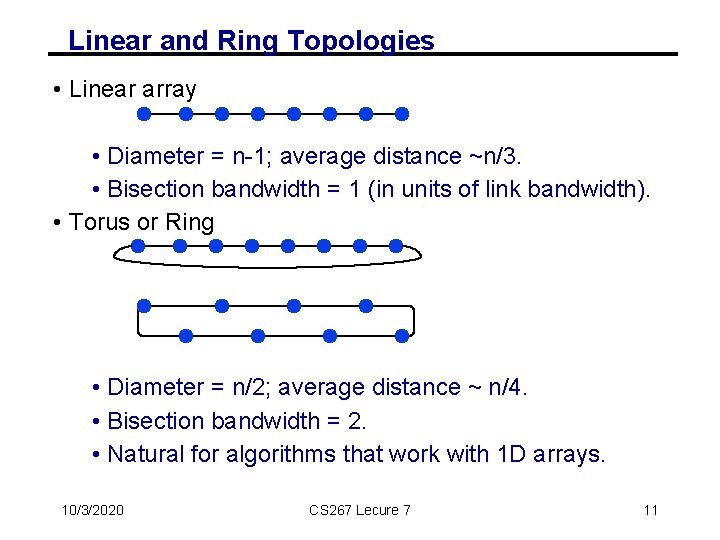
Linear and Ring Topologies • Linear array • Diameter = n-1; average distance ~n/3. • Bisection bandwidth = 1 (in units of link bandwidth). • Torus or Ring • Diameter = n/2; average distance ~ n/4. • Bisection bandwidth = 2. • Natural for algorithms that work with 1 D arrays. 10/3/2020 CS 267 Lecure 7 11
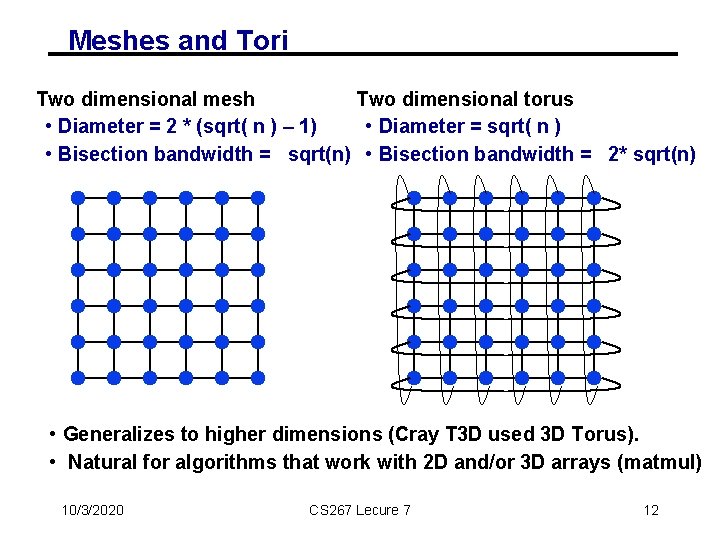
Meshes and Tori Two dimensional mesh Two dimensional torus • Diameter = 2 * (sqrt( n ) – 1) • Diameter = sqrt( n ) • Bisection bandwidth = sqrt(n) • Bisection bandwidth = 2* sqrt(n) • Generalizes to higher dimensions (Cray T 3 D used 3 D Torus). • Natural for algorithms that work with 2 D and/or 3 D arrays (matmul) 10/3/2020 CS 267 Lecure 7 12
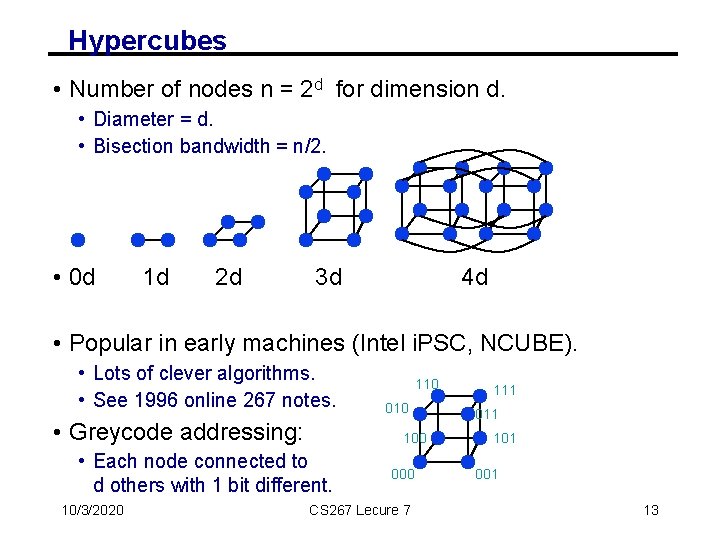
Hypercubes • Number of nodes n = 2 d for dimension d. • Diameter = d. • Bisection bandwidth = n/2. • 0 d 1 d 2 d 3 d 4 d • Popular in early machines (Intel i. PSC, NCUBE). • Lots of clever algorithms. • See 1996 online 267 notes. • Greycode addressing: 010 100 • Each node connected to d others with 1 bit different. 10/3/2020 110 000 CS 267 Lecure 7 111 011 101 001 13
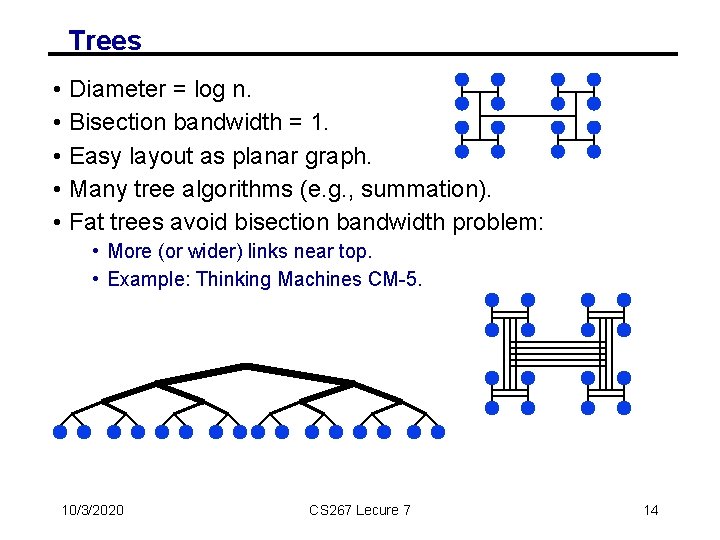
Trees • • • Diameter = log n. Bisection bandwidth = 1. Easy layout as planar graph. Many tree algorithms (e. g. , summation). Fat trees avoid bisection bandwidth problem: • More (or wider) links near top. • Example: Thinking Machines CM-5. 10/3/2020 CS 267 Lecure 7 14
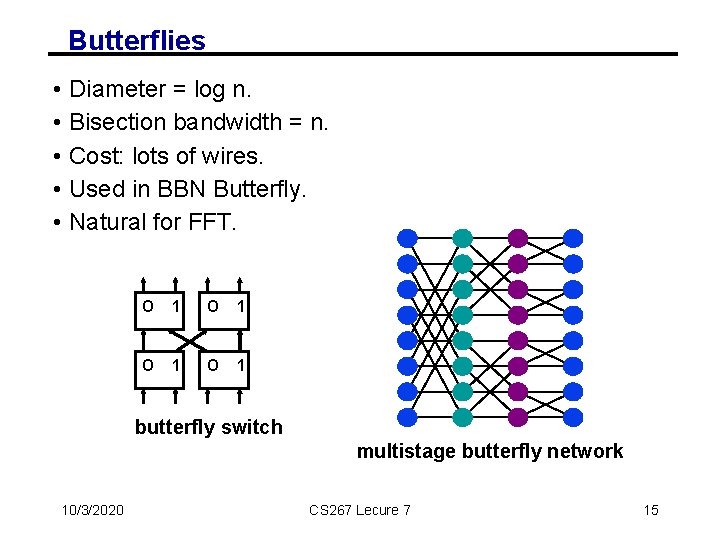
Butterflies • • • Diameter = log n. Bisection bandwidth = n. Cost: lots of wires. Used in BBN Butterfly. Natural for FFT. O 1 butterfly switch multistage butterfly network 10/3/2020 CS 267 Lecure 7 15
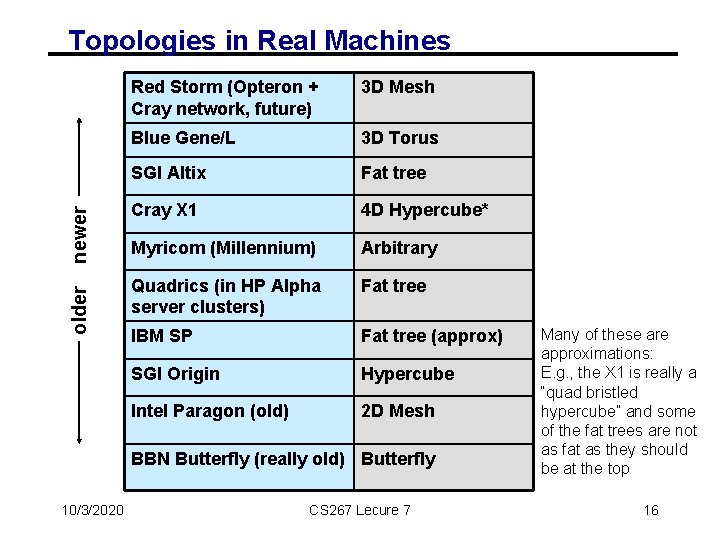
older newer Topologies in Real Machines Red Storm (Opteron + Cray network, future) 3 D Mesh Blue Gene/L 3 D Torus SGI Altix Fat tree Cray X 1 4 D Hypercube* Myricom (Millennium) Arbitrary Quadrics (in HP Alpha server clusters) Fat tree IBM SP Fat tree (approx) SGI Origin Hypercube Intel Paragon (old) 2 D Mesh BBN Butterfly (really old) Butterfly 10/3/2020 CS 267 Lecure 7 Many of these are approximations: E. g. , the X 1 is really a “quad bristled hypercube” and some of the fat trees are not as fat as they should be at the top 16
Evolution of Distributed Memory Machines • Special queue connections are being replaced by direct memory access (DMA): • Processor packs or copies messages. • Initiates transfer, goes on computing. • Wormhole routing in hardware: • Special message processors do not interrupt main processors along path. • Message sends are pipelined. • Processors don’t wait for complete message before forwarding • Message passing libraries provide store-and-forward abstraction: • Can send/receive between any pair of nodes, not just along one wire. • Time proportional to distance since each processor along path must participate. 10/3/2020 CS 267 Lecure 7 17
Performance Models 01/31/2006 CS 267 Lecture 5 18
PRAM – Simplest possible communication model • Parallel Random Access Memory. • All memory access operations complete in one clock period -- no concept of memory hierarchy (“too good to be true”). • OK for understanding whether an algorithm has enough parallelism at all (see CS 273). • Parallel algorithm design strategy: first do a PRAM algorithm, then worry about memory/communication time (sometimes works) • Slightly more realistic: Concurrent Read Exclusive Write (CREW) PRAM. 10/3/2020 CS 267 Lecure 7 19
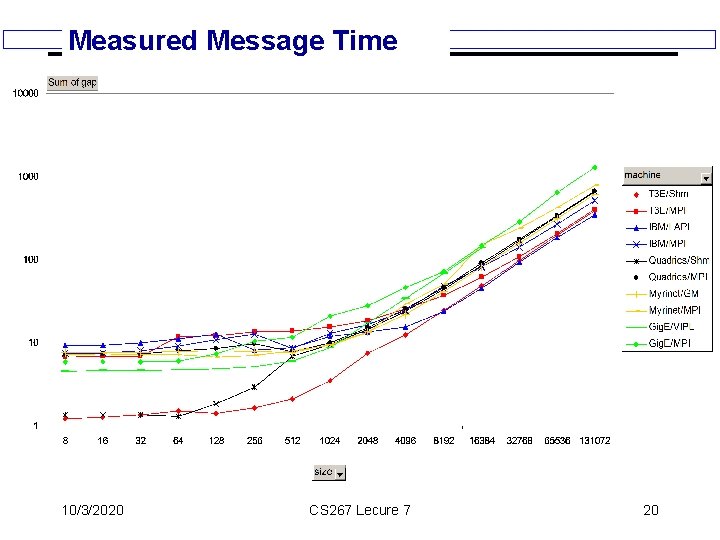
Measured Message Time 10/3/2020 CS 267 Lecure 7 20
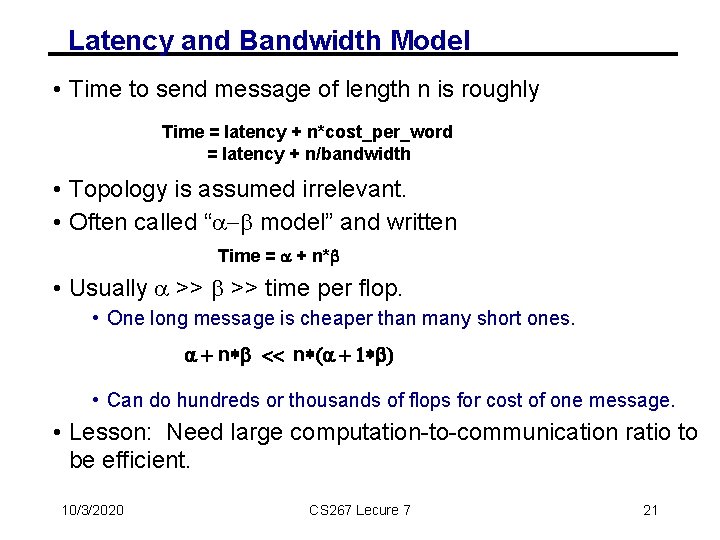
Latency and Bandwidth Model • Time to send message of length n is roughly Time = latency + n*cost_per_word = latency + n/bandwidth • Topology is assumed irrelevant. • Often called “a-b model” and written Time = a + n*b • Usually a >> b >> time per flop. • One long message is cheaper than many short ones. a + n*b << n*(a + 1*b) • Can do hundreds or thousands of flops for cost of one message. • Lesson: Need large computation-to-communication ratio to be efficient. 10/3/2020 CS 267 Lecure 7 21
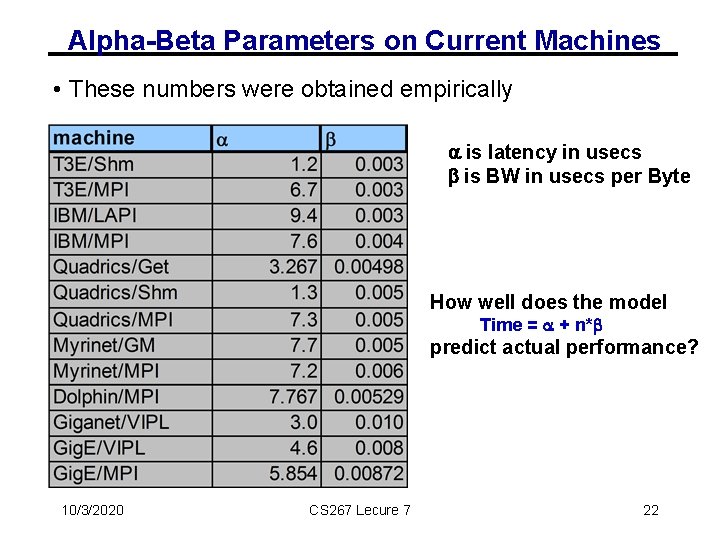
Alpha-Beta Parameters on Current Machines • These numbers were obtained empirically a is latency in usecs b is BW in usecs per Byte How well does the model Time = a + n*b predict actual performance? 10/3/2020 CS 267 Lecure 7 22
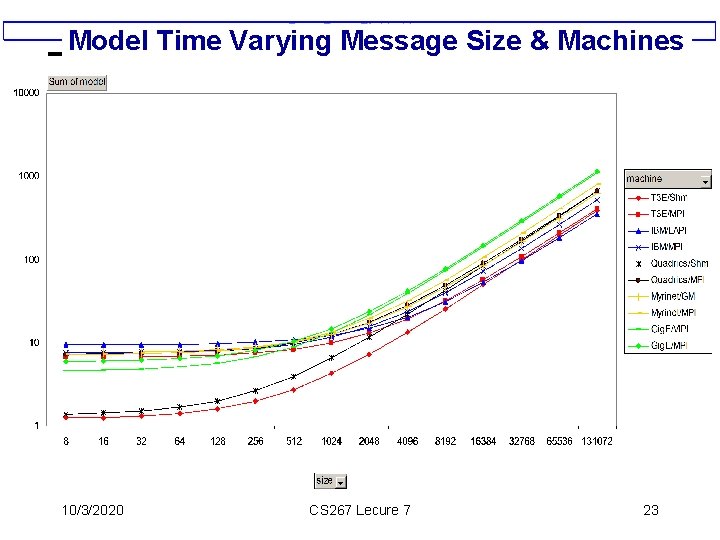
Model Time Varying Message Size & Machines 10/3/2020 CS 267 Lecure 7 23
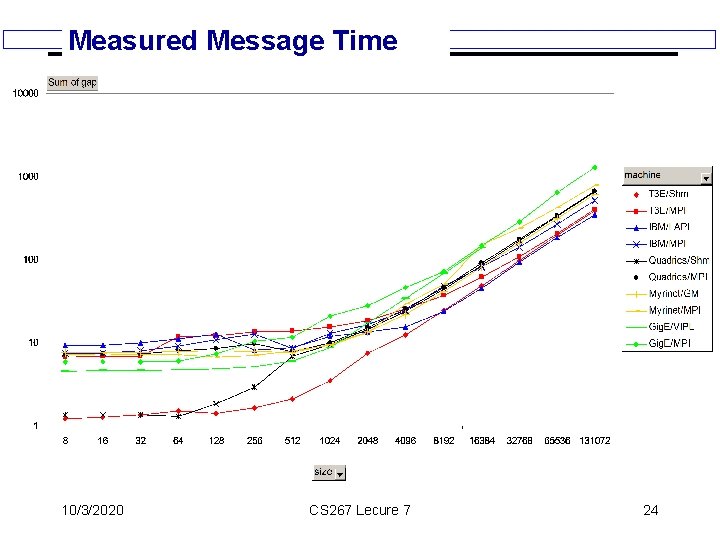
Measured Message Time 10/3/2020 CS 267 Lecure 7 24
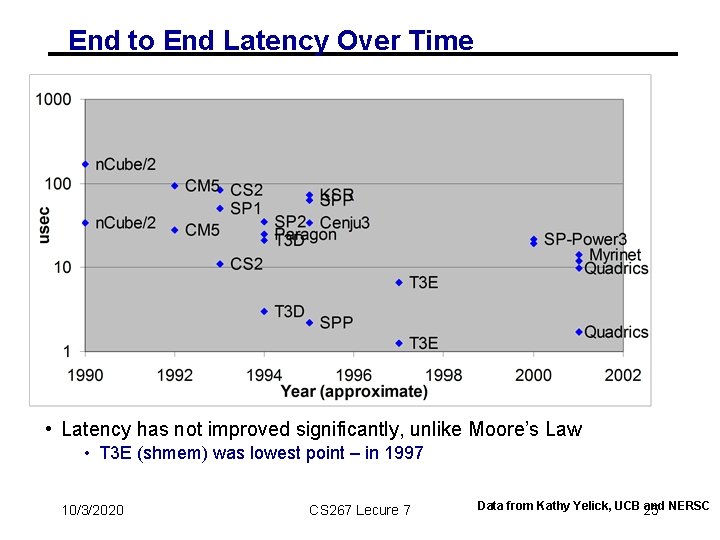
End to End Latency Over Time • Latency has not improved significantly, unlike Moore’s Law • T 3 E (shmem) was lowest point – in 1997 10/3/2020 CS 267 Lecure 7 Data from Kathy Yelick, UCB and NERSC 25
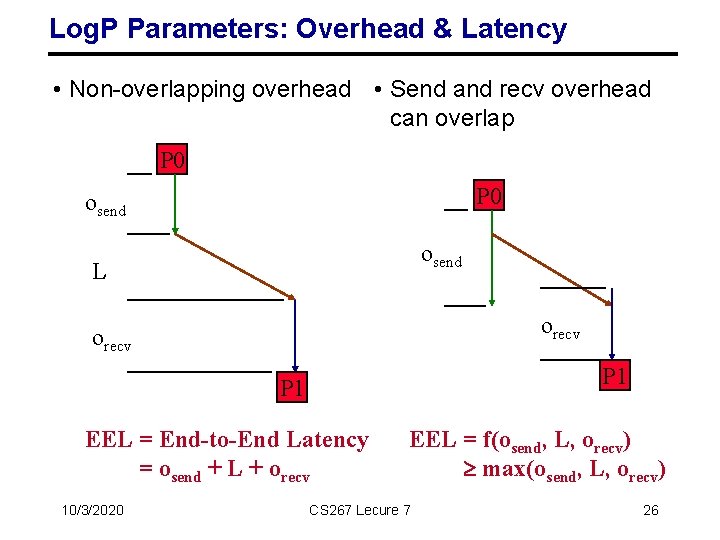
Log. P Parameters: Overhead & Latency • Non-overlapping overhead • Send and recv overhead can overlap P 0 osend L orecv P 1 EEL = End-to-End Latency = osend + L + orecv 10/3/2020 EEL = f(osend, L, orecv) max(osend, L, orecv) CS 267 Lecure 7 26
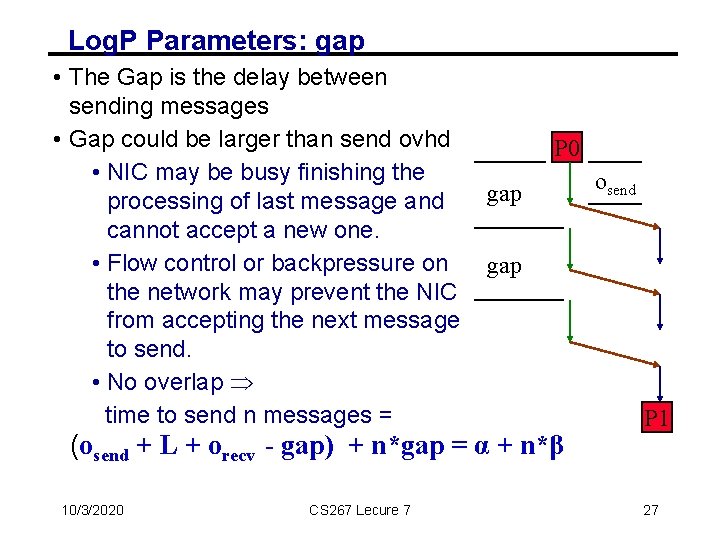
Log. P Parameters: gap • The Gap is the delay between sending messages • Gap could be larger than send ovhd • NIC may be busy finishing the processing of last message and cannot accept a new one. • Flow control or backpressure on the network may prevent the NIC from accepting the next message to send. • No overlap time to send n messages = P 0 gap (osend + L + orecv - gap) + n*gap = α + n*β 10/3/2020 CS 267 Lecure 7 osend P 1 27
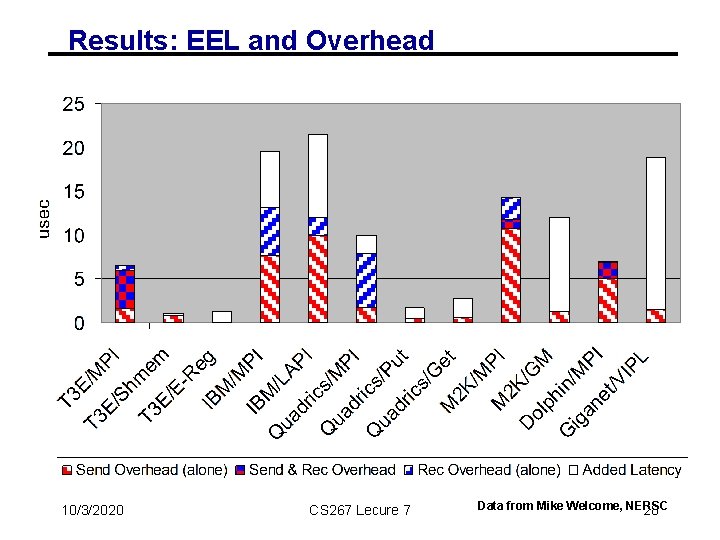
Results: EEL and Overhead 10/3/2020 CS 267 Lecure 7 Data from Mike Welcome, NERSC 28
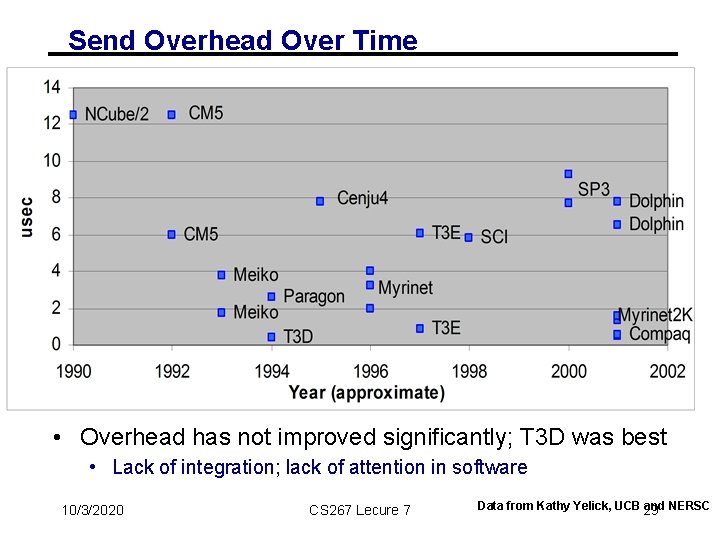
Send Overhead Over Time • Overhead has not improved significantly; T 3 D was best • Lack of integration; lack of attention in software 10/3/2020 CS 267 Lecure 7 Data from Kathy Yelick, UCB and NERSC 29
Limitations of the Log. P Model • The Log. P model has a fixed cost for each messages • This is useful in showing how to quickly broadcast a single word • Other examples also in the Log. P papers • For larger messages, there is a variation Log. GP • Two gap parameters, one for small and one for large message • The large message gap is the b in our previous model • No topology considerations (including no limits for bisection bandwidth) • Assumes a fully connected network • For some algorithms with nearest neighbor communication, but with “all-to-all” communication we need to refine this further • This is a flat model, i. e. , each processor is connected to the network • Clusters of SMPs are not accurately modeled 10/3/2020 CS 267 Lecure 7 30
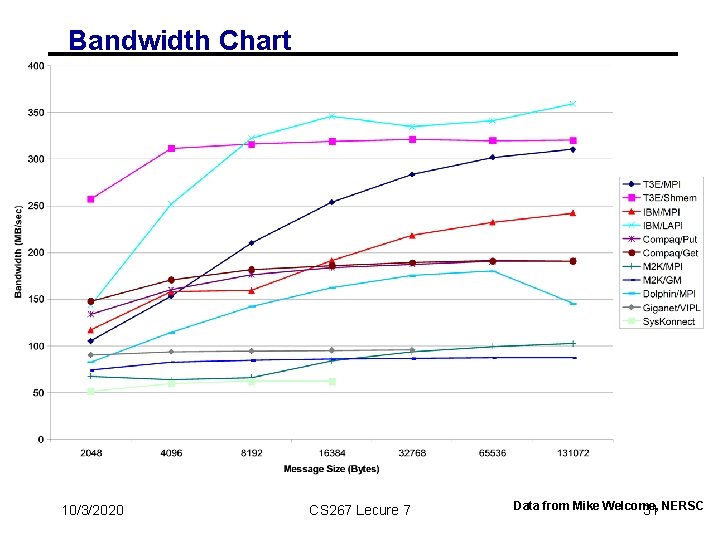
Bandwidth Chart 10/3/2020 CS 267 Lecure 7 Data from Mike Welcome, NERSC 31
Programming Distribute Memory Machines with Message Passing 01/31/2006 CS 267 Lecture 5 32
Message Passing Libraries (1) • Many “message passing libraries” were once available • • • Chameleon, from ANL. CMMD, from Thinking Machines. Express, commercial. MPL, native library on IBM SP-2. NX, native library on Intel Paragon. Zipcode, from LLL. PVM, Parallel Virtual Machine, public, from ORNL/UTK. Others. . . MPI, Message Passing Interface, now the industry standard. • Need standards to write portable code. • Rest of this discussion independent of which library. • MPI details later 10/3/2020 CS 267 Lecure 7 33
Message Passing Libraries (2) • All communication, synchronization require subroutine calls • No shared variables • Program run on a single processor just like any uniprocessor program, except for calls to message passing library • Subroutines for • Communication • Send and Receive, between pairs of processors – Post office style, or telephone style • • Broadcast, from one to many processors Scatter/gather • Synchronization • Barrier • Collectives • Sum, product, max, … of data on many processors • Enquiries • 10/3/2020 How many processes? Which one am I? Any messages waiting? CS 267 Lecure 7 34
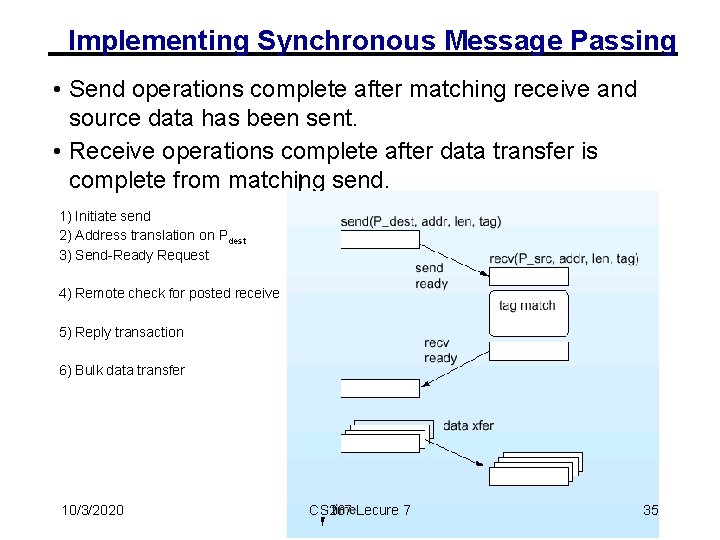
Implementing Synchronous Message Passing • Send operations complete after matching receive and source data has been sent. • Receive operations complete after data transfer is complete from matching send. 1) Initiate send 2) Address translation on Pdest 3) Send-Ready Request source destination send (Pdest, addr, length, tag) rcv(Psource, addr, length, tag) send-rdy-request 4) Remote check for posted receive tag match 5) Reply transaction receive-rdy-reply 6) Bulk data transfer data-xfer 10/3/2020 CS 267 Lecure 7 35
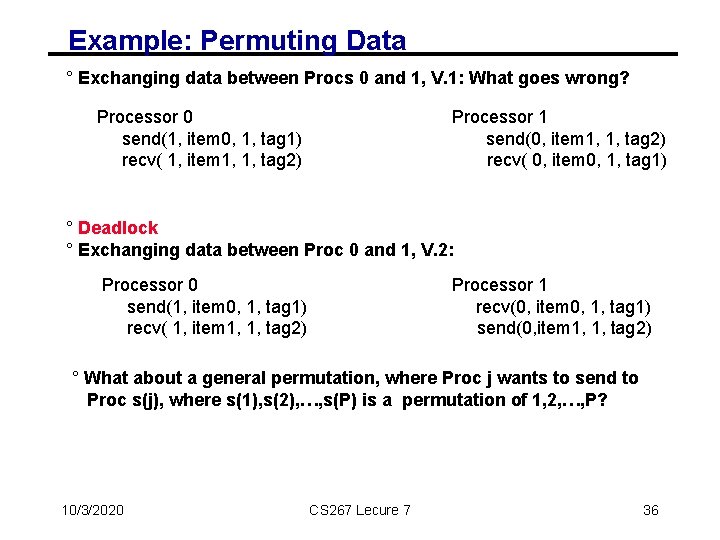
Example: Permuting Data ° Exchanging data between Procs 0 and 1, V. 1: What goes wrong? Processor 0 send(1, item 0, 1, tag 1) recv( 1, item 1, 1, tag 2) Processor 1 send(0, item 1, 1, tag 2) recv( 0, item 0, 1, tag 1) ° Deadlock ° Exchanging data between Proc 0 and 1, V. 2: Processor 0 send(1, item 0, 1, tag 1) recv( 1, item 1, 1, tag 2) Processor 1 recv(0, item 0, 1, tag 1) send(0, item 1, 1, tag 2) ° What about a general permutation, where Proc j wants to send to Proc s(j), where s(1), s(2), …, s(P) is a permutation of 1, 2, …, P? 10/3/2020 CS 267 Lecure 7 36
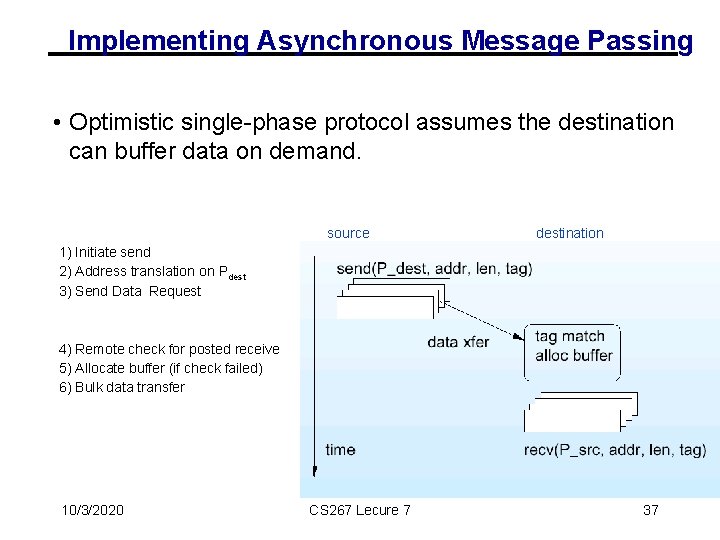
Implementing Asynchronous Message Passing • Optimistic single-phase protocol assumes the destination can buffer data on demand. 1) Initiate send 2) Address translation on Pdest 3) Send Data Request source send (Pdest, addr, length, tag) destination data-xfer-request tag match allocate 4) Remote check for posted receive 5) Allocate buffer (if check failed) 6) Bulk data transfer rcv(Psource, addr, length, tag) 10/3/2020 CS 267 Lecure 7 37
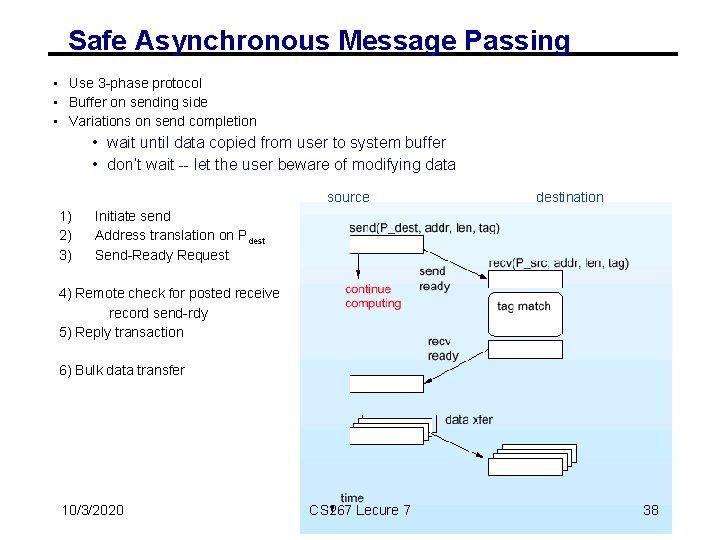
Safe Asynchronous Message Passing • Use 3 -phase protocol • Buffer on sending side • Variations on send completion • wait until data copied from user to system buffer • don’t wait -- let the user beware of modifying data source 1) 2) 3) Initiate send Address translation on Pdest Send-Ready Request 4) Remote check for posted receive record send-rdy 5) Reply transaction destination send-rdy-request return and continue computing tag match receive-rdy-reply 6) Bulk data transfer 10/3/2020 CS 267 Lecure 7 38
Example Revisited: Permuting Data ° Processor j sends item to Processor s(j), where s(1), …, s(P) is a permutation of 1, …, P Processor j send_asynch(s(j), item, 1, tag) recv_block( ANY, item, 1, tag) ° What could go wrong? ° Need to understand semantics of send and receive. ° Many flavors available. 10/3/2020 CS 267 Lecure 7 39
Other operations besides send/receive • “Collective Communication” (more than 2 procs) • Broadcast data from one processor to all others. • Barrier. • Reductions (sum, product, max, min, boolean and, #, …), where # is any “associative” operation. • Scatter/Gather. • Parallel prefix -- Proc j owns x(j) and computes y(j) = x(1) # x(2) # … # x(j). • Can apply to all other processors, or a user-define subset. • Cost = O(log P) using a tree. • Status operations • Enquire about/Wait for asynchronous send/receives to complete. • How many processors are there? • What is my processor number? 10/3/2020 CS 267 Lecure 7 40
Example: Sharks and Fish • N fish on P procs, N/P fish per processor • At each time step, compute forces on fish and move them • Need to compute gravitational interaction • In usual n^2 algorithm, every fish depends on every other fish. • Every fish needs to “visit” every processor, even if it “lives” on just one. • What is the cost? 10/3/2020 CS 267 Lecure 7 41
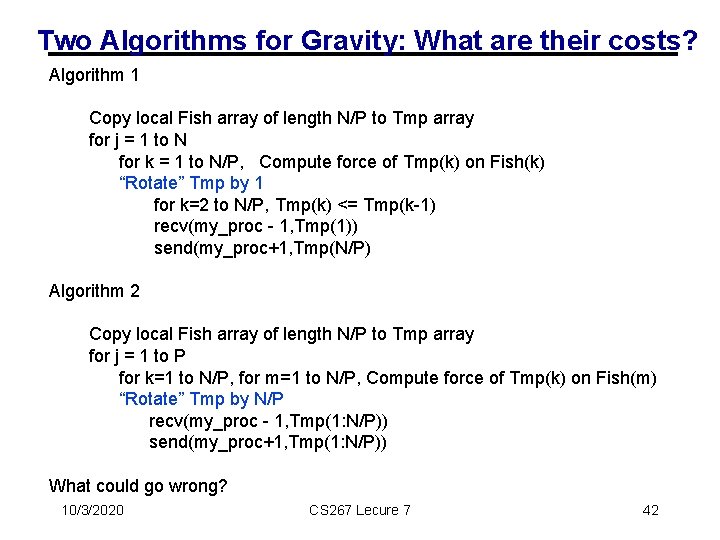
Two Algorithms for Gravity: What are their costs? Algorithm 1 Copy local Fish array of length N/P to Tmp array for j = 1 to N for k = 1 to N/P, Compute force of Tmp(k) on Fish(k) “Rotate” Tmp by 1 for k=2 to N/P, Tmp(k) <= Tmp(k-1) recv(my_proc - 1, Tmp(1)) send(my_proc+1, Tmp(N/P) Algorithm 2 Copy local Fish array of length N/P to Tmp array for j = 1 to P for k=1 to N/P, for m=1 to N/P, Compute force of Tmp(k) on Fish(m) “Rotate” Tmp by N/P recv(my_proc - 1, Tmp(1: N/P)) send(my_proc+1, Tmp(1: N/P)) What could go wrong? 10/3/2020 CS 267 Lecure 7 42
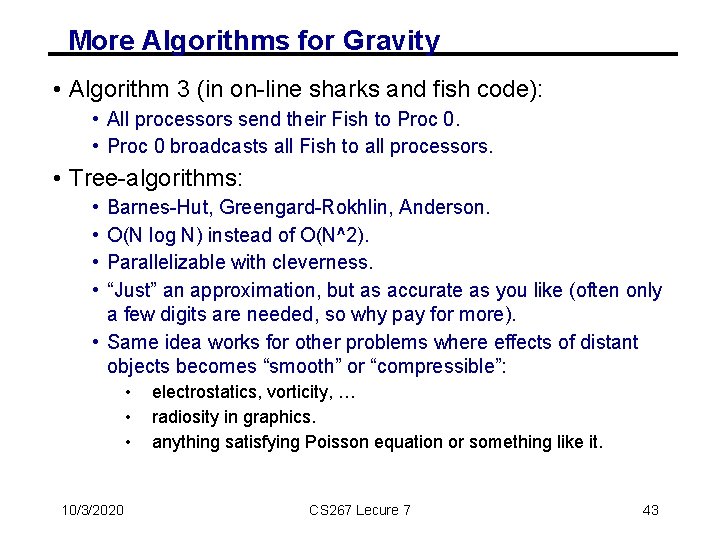
More Algorithms for Gravity • Algorithm 3 (in on-line sharks and fish code): • All processors send their Fish to Proc 0. • Proc 0 broadcasts all Fish to all processors. • Tree-algorithms: • • Barnes-Hut, Greengard-Rokhlin, Anderson. O(N log N) instead of O(N^2). Parallelizable with cleverness. “Just” an approximation, but as accurate as you like (often only a few digits are needed, so why pay for more). • Same idea works for other problems where effects of distant objects becomes “smooth” or “compressible”: • • • 10/3/2020 electrostatics, vorticity, … radiosity in graphics. anything satisfying Poisson equation or something like it. CS 267 Lecure 7 43
Extra Slides 01/31/2006 CS 267 Lecture 5 44
Trends in Real Machines 01/31/2006 CS 267 Lecture 5 45
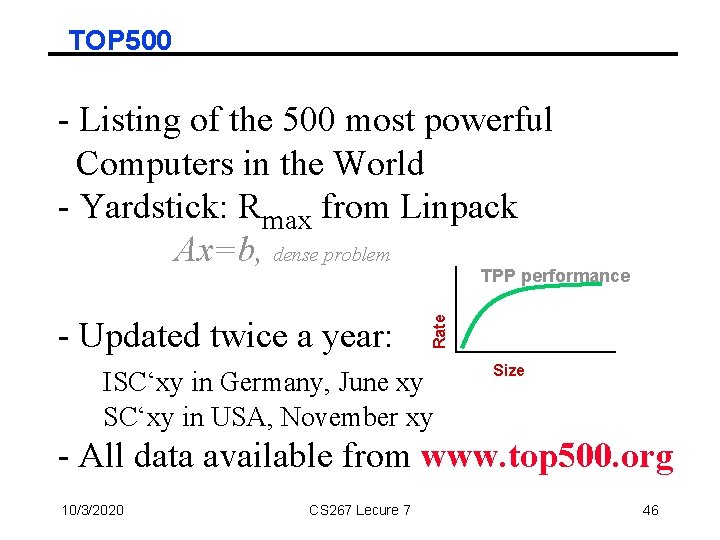
TOP 500 - Listing of the 500 most powerful Computers in the World - Yardstick: Rmax from Linpack Ax=b, dense problem - Updated twice a year: Rate TPP performance ISC‘xy in Germany, June xy SC‘xy in USA, November xy Size - All data available from www. top 500. org 10/3/2020 CS 267 Lecure 7 46
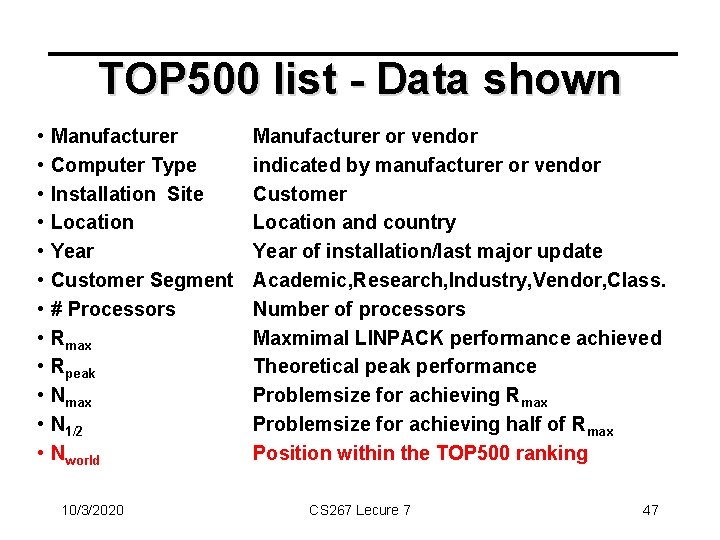
TOP 500 list - Data shown • • • Manufacturer Computer Type Installation Site Location Year Customer Segment # Processors Rmax Rpeak Nmax N 1/2 Nworld 10/3/2020 Manufacturer or vendor indicated by manufacturer or vendor Customer Location and country Year of installation/last major update Academic, Research, Industry, Vendor, Class. Number of processors Maxmimal LINPACK performance achieved Theoretical peak performance Problemsize for achieving Rmax Problemsize for achieving half of Rmax Position within the TOP 500 ranking CS 267 Lecure 7 47
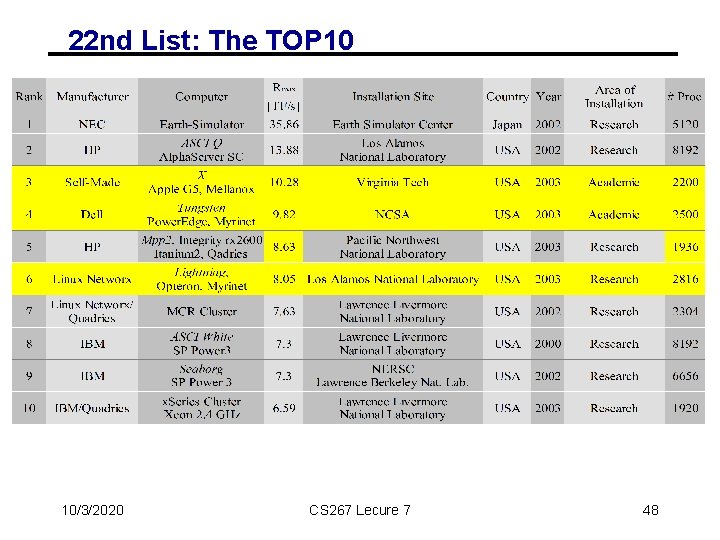
22 nd List: The TOP 10 10/3/2020 CS 267 Lecure 7 48
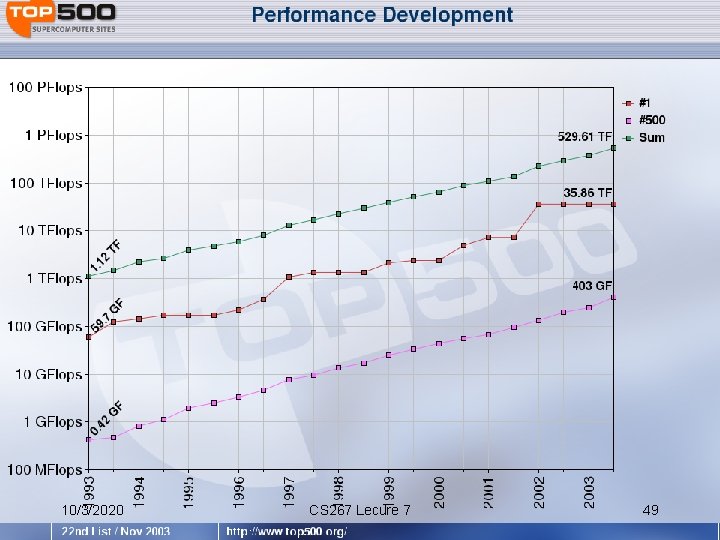
Continents Performance 10/3/2020 CS 267 Lecure 7 49
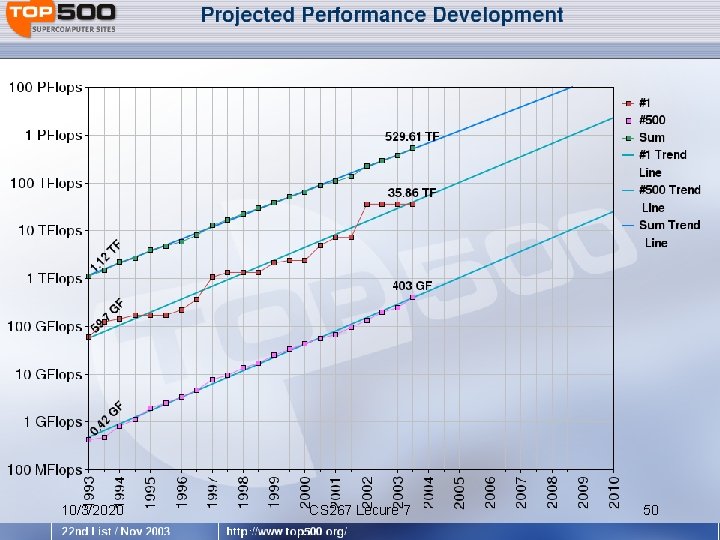
Continents Performance 10/3/2020 CS 267 Lecure 7 50
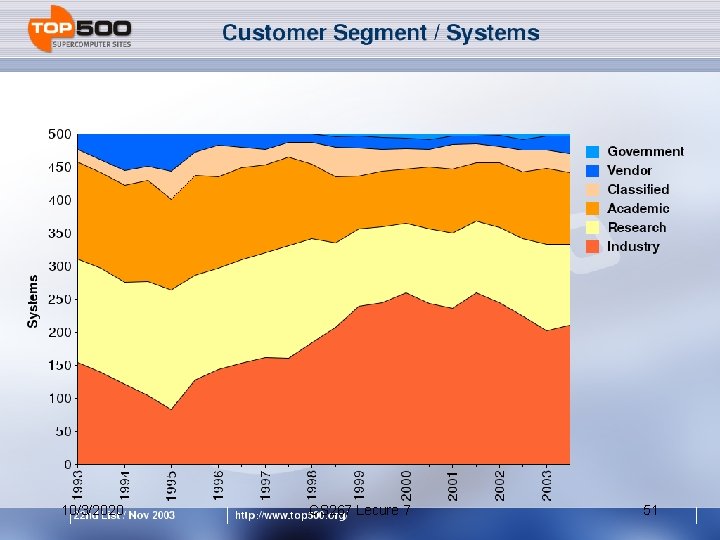
Customer Types 10/3/2020 CS 267 Lecure 7 51
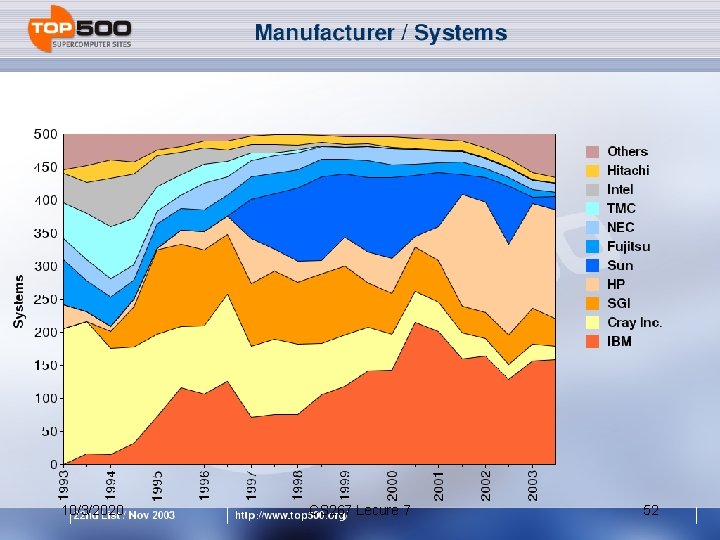
Manufacturers 10/3/2020 CS 267 Lecure 7 52
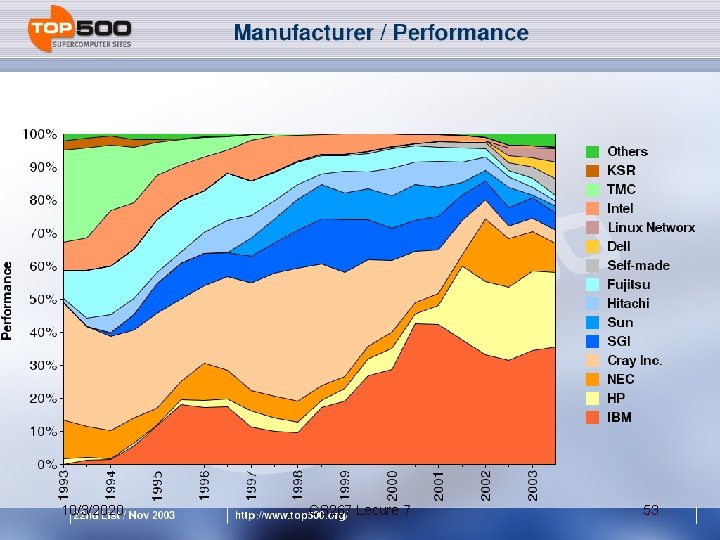
Manufacturers Performance 10/3/2020 CS 267 Lecure 7 53
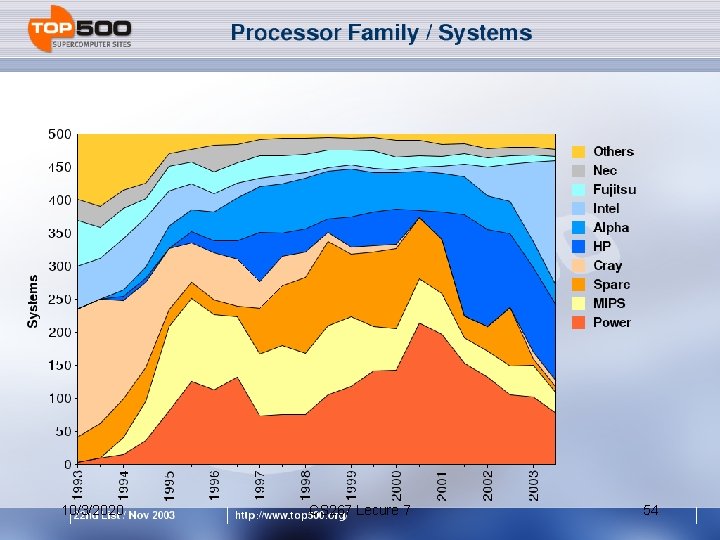
Processor Types 10/3/2020 CS 267 Lecure 7 54
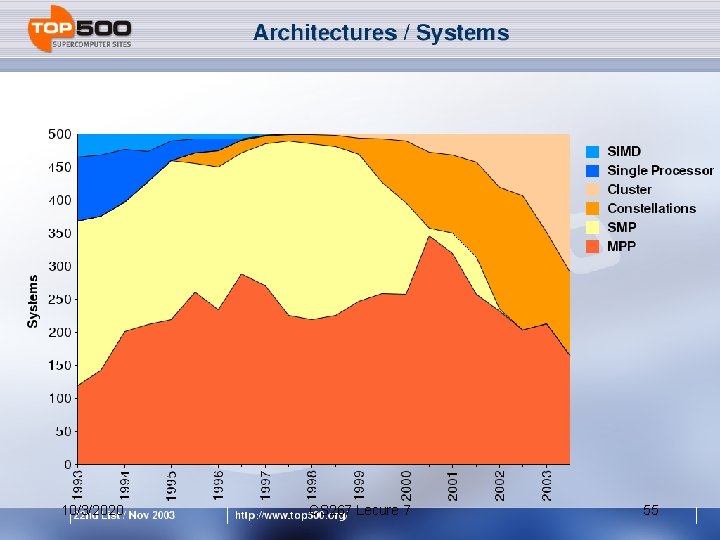
Architectures 10/3/2020 CS 267 Lecure 7 55
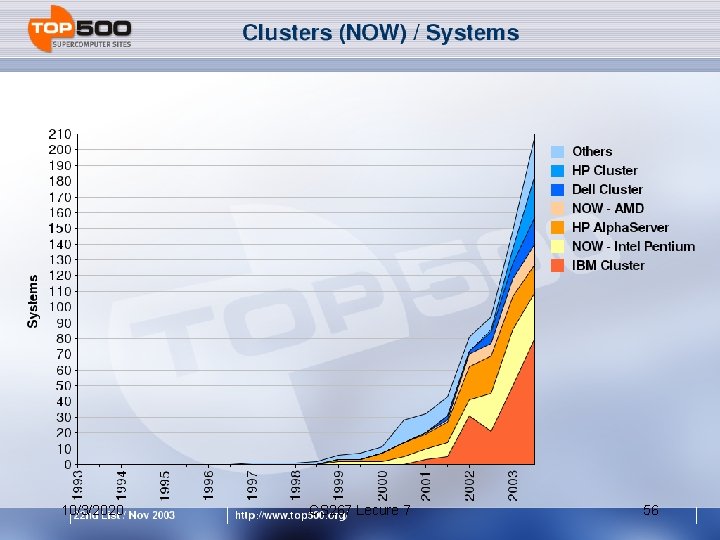
NOW – Clusters 10/3/2020 CS 267 Lecure 7 56
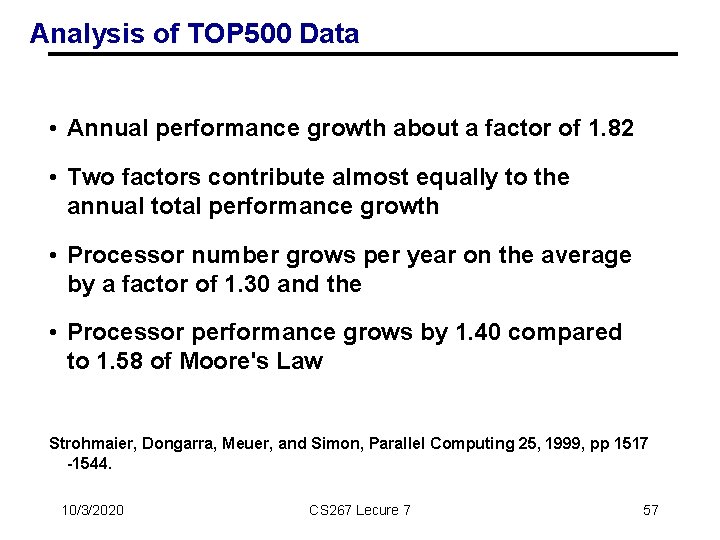
Analysis of TOP 500 Data • Annual performance growth about a factor of 1. 82 • Two factors contribute almost equally to the annual total performance growth • Processor number grows per year on the average by a factor of 1. 30 and the • Processor performance grows by 1. 40 compared to 1. 58 of Moore's Law Strohmaier, Dongarra, Meuer, and Simon, Parallel Computing 25, 1999, pp 1517 -1544. 10/3/2020 CS 267 Lecure 7 57
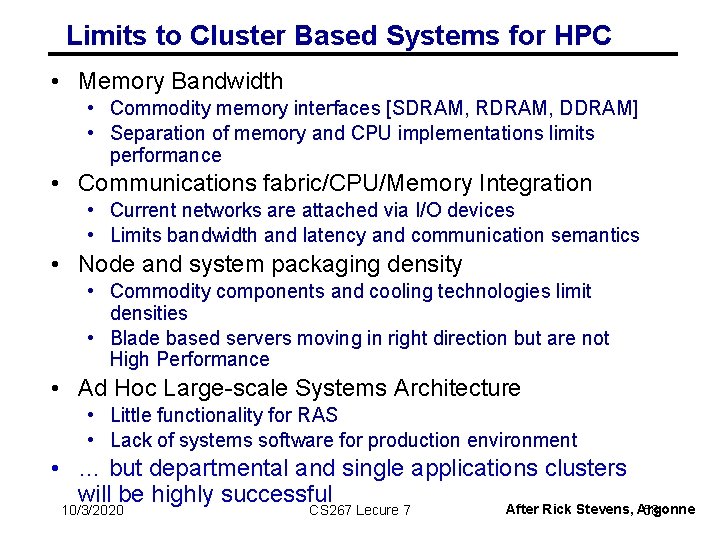
Limits to Cluster Based Systems for HPC • Memory Bandwidth • Commodity memory interfaces [SDRAM, RDRAM, DDRAM] • Separation of memory and CPU implementations limits performance • Communications fabric/CPU/Memory Integration • Current networks are attached via I/O devices • Limits bandwidth and latency and communication semantics • Node and system packaging density • Commodity components and cooling technologies limit densities • Blade based servers moving in right direction but are not High Performance • Ad Hoc Large-scale Systems Architecture • Little functionality for RAS • Lack of systems software for production environment • … but departmental and single applications clusters will be highly successful After Rick Stevens, Argonne 10/3/2020 CS 267 Lecure 7 58
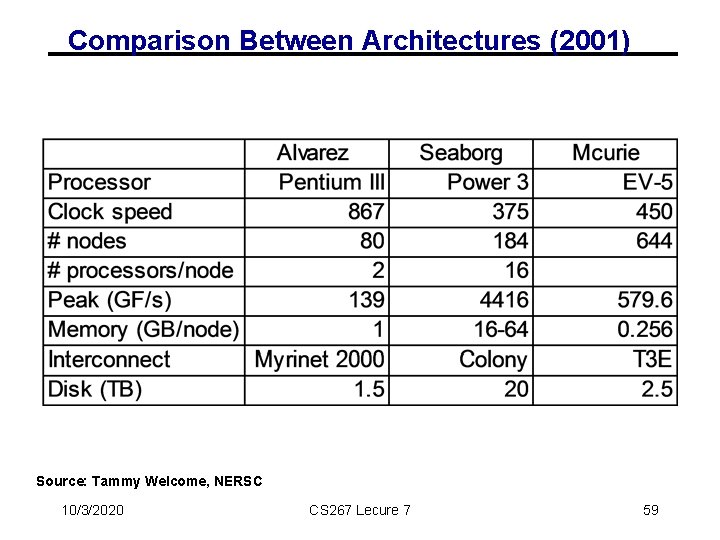
Comparison Between Architectures (2001) Source: Tammy Welcome, NERSC 10/3/2020 CS 267 Lecure 7 59
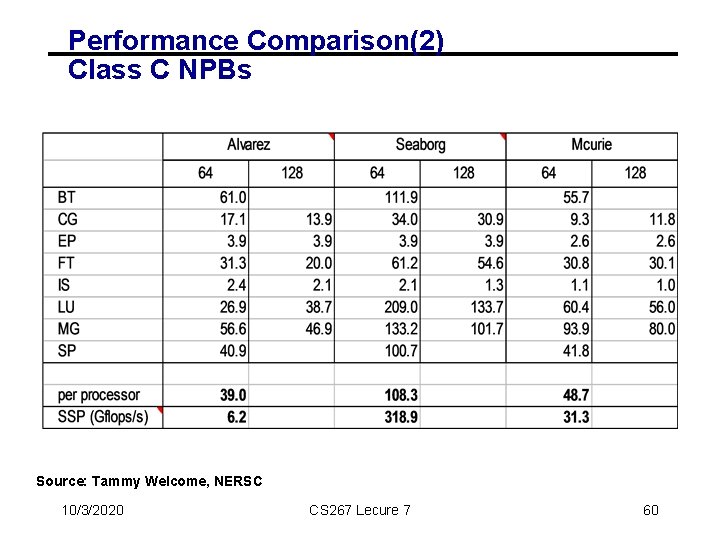
Performance Comparison(2) Class C NPBs Source: Tammy Welcome, NERSC 10/3/2020 CS 267 Lecure 7 60
Summary – Wrap-up • Network structure and concepts • Switching, routing, flow control • Topology, bandwidth, latency, bisection bandwidth, diameter • Performance models • PRAM, a - b, and Log. P • Workstation/PC clusters • Programming environment, hardware • Challenges • Message passing implementation 10/3/2020 CS 267 Lecure 7 61
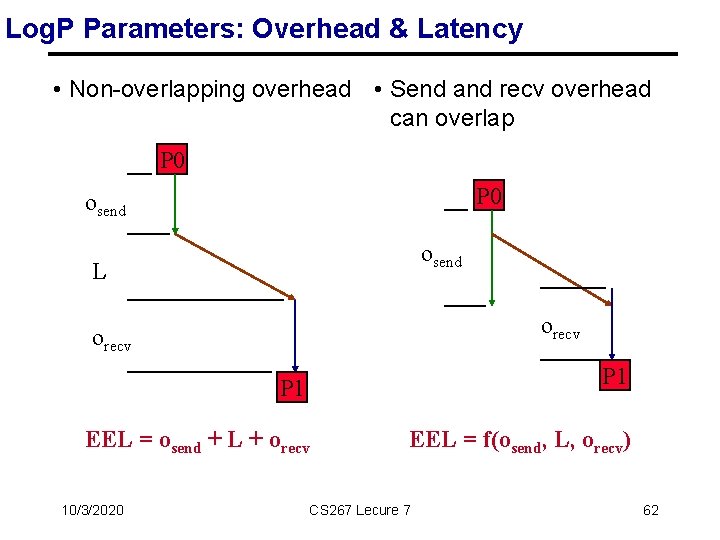
Log. P Parameters: Overhead & Latency • Non-overlapping overhead • Send and recv overhead can overlap P 0 osend L orecv P 1 EEL = osend + L + orecv EEL = f(osend, L, orecv) 10/3/2020 CS 267 Lecure 7 62
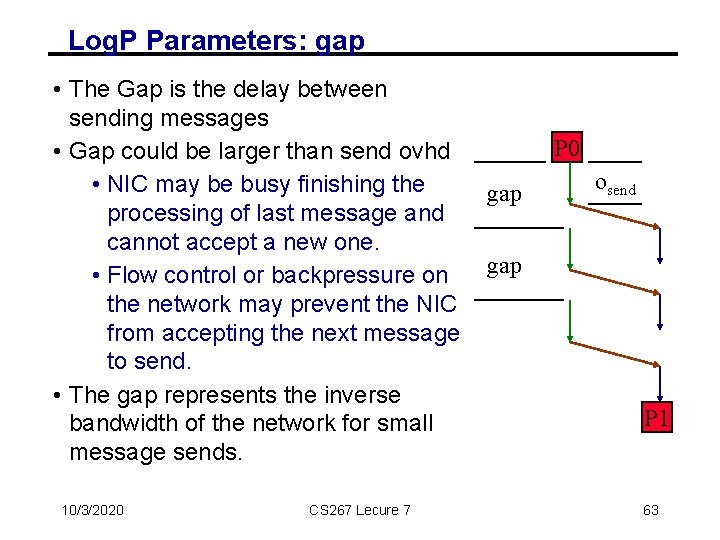
Log. P Parameters: gap • The Gap is the delay between sending messages • Gap could be larger than send ovhd • NIC may be busy finishing the processing of last message and cannot accept a new one. • Flow control or backpressure on the network may prevent the NIC from accepting the next message to send. • The gap represents the inverse bandwidth of the network for small message sends. 10/3/2020 CS 267 Lecure 7 P 0 gap osend gap P 1 63
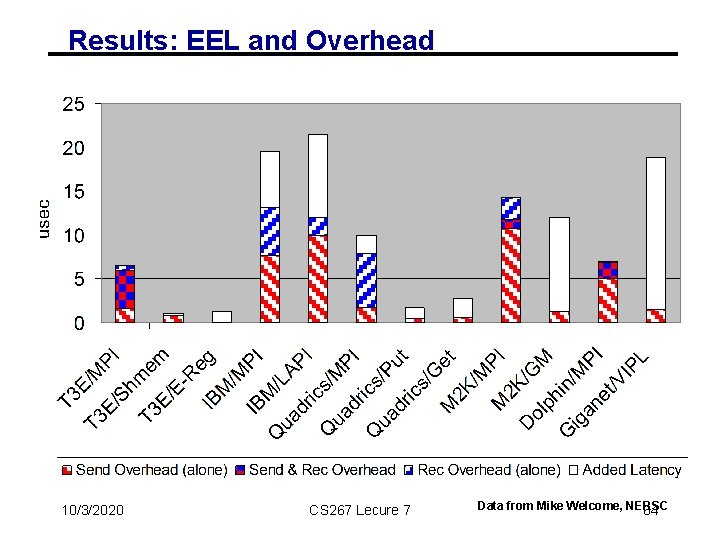
Results: EEL and Overhead 10/3/2020 CS 267 Lecure 7 Data from Mike Welcome, NERSC 64
Limitations of the Log. P Model • The Log. P model has a fixed cost for each messages • This is useful in showing how to quick broadcast a single word • Other examples also in the Log. P papers • For larger messages, there is a variation Log. GP • Two gap parameters, one for small and one for large message • The large message gap is the b in our previous model • No topology considerations (including no limits for bisection bandwidth) • Assumes a fully connected network • For some algorithms with nearest neighbor communication, but with “all-to-all” communication we need to refine this further • This is a flat model, i. e. , each processor is connected to the network • Clusters of SMPs are not accurately models 10/3/2020 CS 267 Lecure 7 65
Effectiveness of Commodity PC Clusters • Dollars/performance based on peak • SP and Alvarez are comparable $/TF • Get lower % of peak on Alvarez than SP • Based on SSP, 4. 5% versus 7. 2% for FP intensive applications • Based on sequential NPBs, 5 -13. 8% versus 6. 3 -21. 6% for FP intensive applications • x 86 known not to perform well on FP intensive applications • $/Performance and cost of ownership need to be examined much more closely • Above numbers do not take into account differences in system balance or configuration • SP was aggressively priced • Alvarez was vendor-integrated, not self-integrated 10/3/2020 CS 267 Lecure 7 Source: Tammy Welcome, NERSC 66
Workstation/PC Clusters • Reaction to commercial MPPs: • build parallel machines out of commodity components • Inexpensive workstations or PCs as computing nodes • Fast (gigabit) switched network between nodes • Benefits: • • • 10 x - 100 x cheaper for comparable performance Standard OS on each node Follow commodity tech trends Incrementally upgradable and scalable Fault tolerance • Trends: • • Berkeley NOW (1994): 100 Ultra. SPARCs, Myrinet ASCI RED (1997): 4510 dual Pentium II nodes, custom network Millennium (1999): 100+ dual/quad Pentium IIIs, Myrinet Google (2001): 8000+ node Linux cluster, ? ? ? network 10/3/2020 CS 267 Lecure 7 67
Example: Sharks and Fish • N fish on P procs, N/P fish per processor • At each time step, compute forces on fish and move them • Need to compute gravitational interaction • In usual n^2 algorithm, every fish depends on every other fish. • Every fish needs to “visit” every processor, even if it “lives” on just one. • What is the cost? 10/3/2020 CS 267 Lecure 7 68
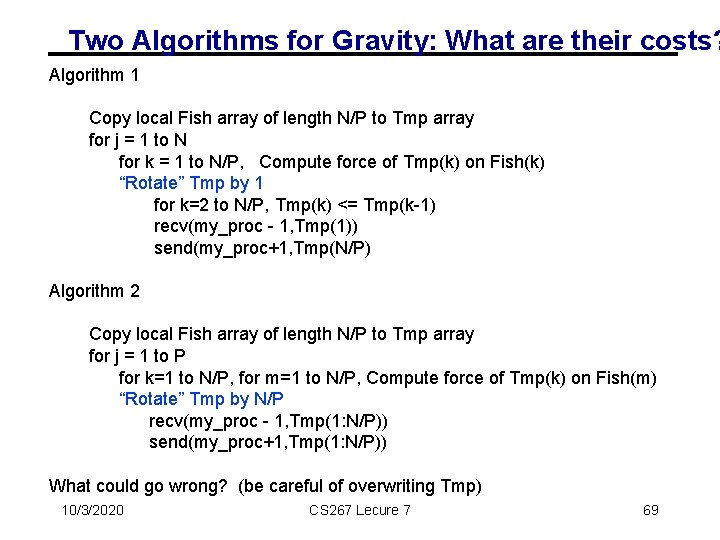
Two Algorithms for Gravity: What are their costs? Algorithm 1 Copy local Fish array of length N/P to Tmp array for j = 1 to N for k = 1 to N/P, Compute force of Tmp(k) on Fish(k) “Rotate” Tmp by 1 for k=2 to N/P, Tmp(k) <= Tmp(k-1) recv(my_proc - 1, Tmp(1)) send(my_proc+1, Tmp(N/P) Algorithm 2 Copy local Fish array of length N/P to Tmp array for j = 1 to P for k=1 to N/P, for m=1 to N/P, Compute force of Tmp(k) on Fish(m) “Rotate” Tmp by N/P recv(my_proc - 1, Tmp(1: N/P)) send(my_proc+1, Tmp(1: N/P)) What could go wrong? (be careful of overwriting Tmp) 10/3/2020 CS 267 Lecure 7 69
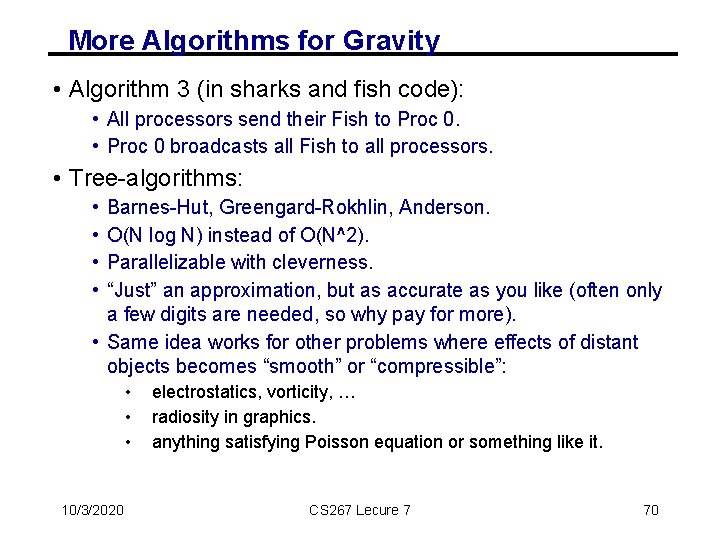
More Algorithms for Gravity • Algorithm 3 (in sharks and fish code): • All processors send their Fish to Proc 0. • Proc 0 broadcasts all Fish to all processors. • Tree-algorithms: • • Barnes-Hut, Greengard-Rokhlin, Anderson. O(N log N) instead of O(N^2). Parallelizable with cleverness. “Just” an approximation, but as accurate as you like (often only a few digits are needed, so why pay for more). • Same idea works for other problems where effects of distant objects becomes “smooth” or “compressible”: • • • 10/3/2020 electrostatics, vorticity, … radiosity in graphics. anything satisfying Poisson equation or something like it. CS 267 Lecure 7 70
Reading Assignment • Reading for today • Next week: Current high performance architectures • MPI • The following week • UPC 10/3/2020 CS 267 Lecure 7 71
- Slides: 71