
CS 263 Revision on Normalisation DB Introduction 1

CS 263: Revision on Normalisation DB- Introduction 1
LECTURE PLAN Þ Þ Þ Purpose of Normalisation Redundancy and Data Anomalies Repeating Groups Functional Dependency Transitive Dependency Stages of Normalisation DB- Introduction 2
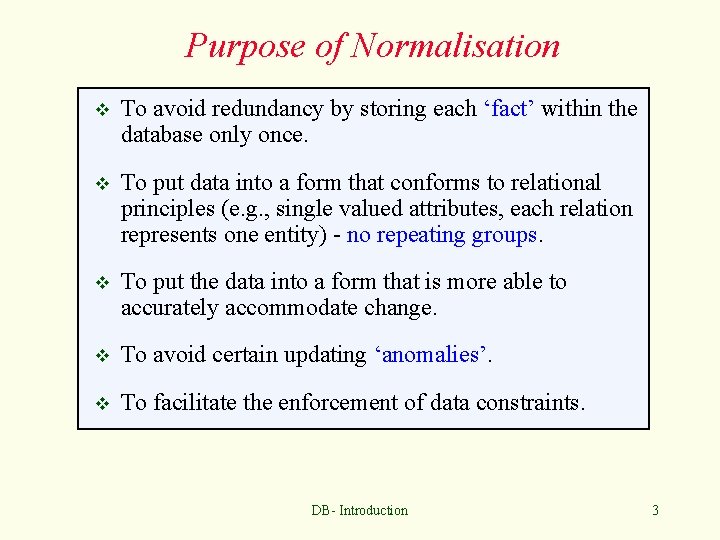
Purpose of Normalisation v To avoid redundancy by storing each ‘fact’ within the database only once. v To put data into a form that conforms to relational principles (e. g. , single valued attributes, each relation represents one entity) - no repeating groups. v To put the data into a form that is more able to accurately accommodate change. v To avoid certain updating ‘anomalies’. v To facilitate the enforcement of data constraints. DB- Introduction 3
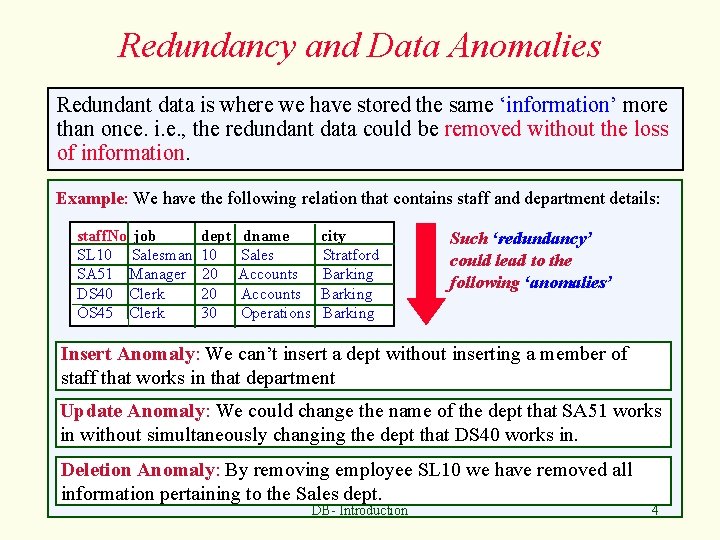
Redundancy and Data Anomalies Redundant data is where we have stored the same ‘information’ more than once. i. e. , the redundant data could be removed without the loss of information. Example: We have the following relation that contains staff and department details: staff. No job SL 10 Salesman SA 51 Manager DS 40 Clerk OS 45 Clerk dept 10 20 20 30 dname Sales Accounts Operations city Stratford Barking Such ‘redundancy’ could lead to the following ‘anomalies’ Insert Anomaly: We can’t insert a dept without inserting a member of staff that works in that department Update Anomaly: We could change the name of the dept that SA 51 works in without simultaneously changing the dept that DS 40 works in. Deletion Anomaly: By removing employee SL 10 we have removed all information pertaining to the Sales dept. DB- Introduction 4
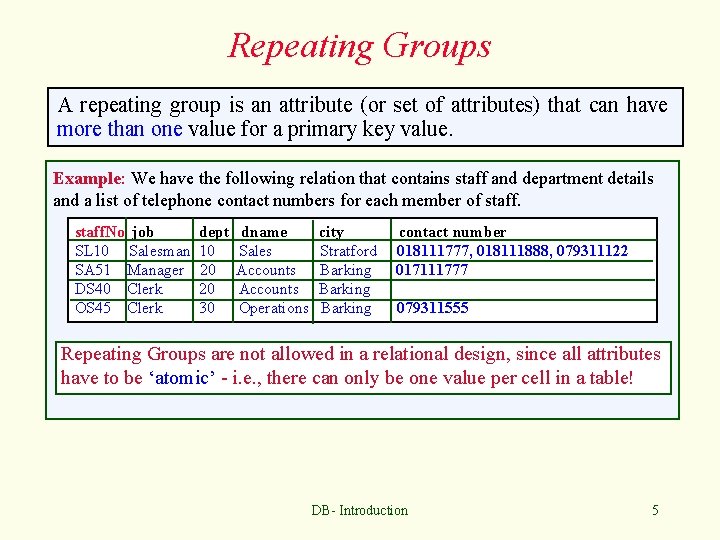
Repeating Groups A repeating group is an attribute (or set of attributes) that can have more than one value for a primary key value. Example: We have the following relation that contains staff and department details and a list of telephone contact numbers for each member of staff. No job SL 10 Salesman SA 51 Manager DS 40 Clerk OS 45 Clerk dept 10 20 20 30 dname Sales Accounts Operations city Stratford Barking contact number 018111777, 018111888, 079311122 017111777 079311555 Repeating Groups are not allowed in a relational design, since all attributes have to be ‘atomic’ - i. e. , there can only be one value per cell in a table! DB- Introduction 5
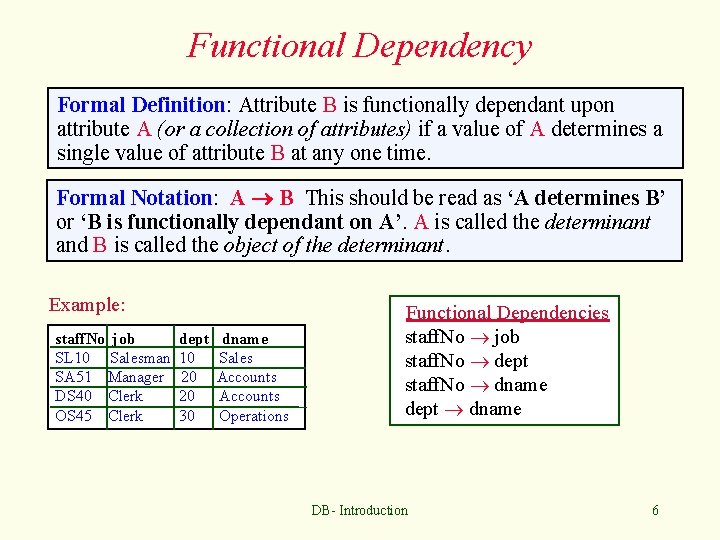
Functional Dependency Formal Definition: Attribute B is functionally dependant upon attribute A (or a collection of attributes) if a value of A determines a single value of attribute B at any one time. Formal Notation: A B This should be read as ‘A determines B’ or ‘B is functionally dependant on A’. A is called the determinant and B is called the object of the determinant. Example: staff. No job SL 10 Salesman SA 51 Manager DS 40 Clerk OS 45 Clerk dept 10 20 20 30 dname Sales Accounts Operations Functional Dependencies staff. No job staff. No dept staff. No dname dept dname DB- Introduction 6
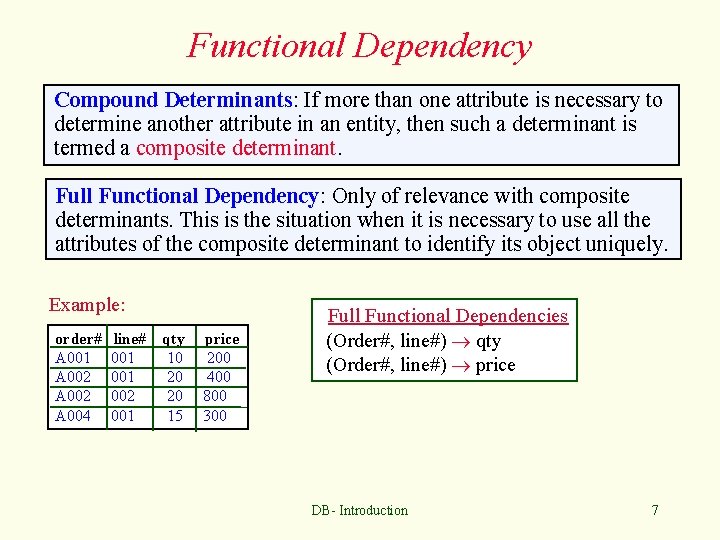
Functional Dependency Compound Determinants: If more than one attribute is necessary to determine another attribute in an entity, then such a determinant is termed a composite determinant. Full Functional Dependency: Only of relevance with composite determinants. This is the situation when it is necessary to use all the attributes of the composite determinant to identify its object uniquely. Example: order# A 001 A 002 A 004 line# 001 002 001 qty 10 20 20 15 price 200 400 800 300 Full Functional Dependencies (Order#, line#) qty (Order#, line#) price DB- Introduction 7
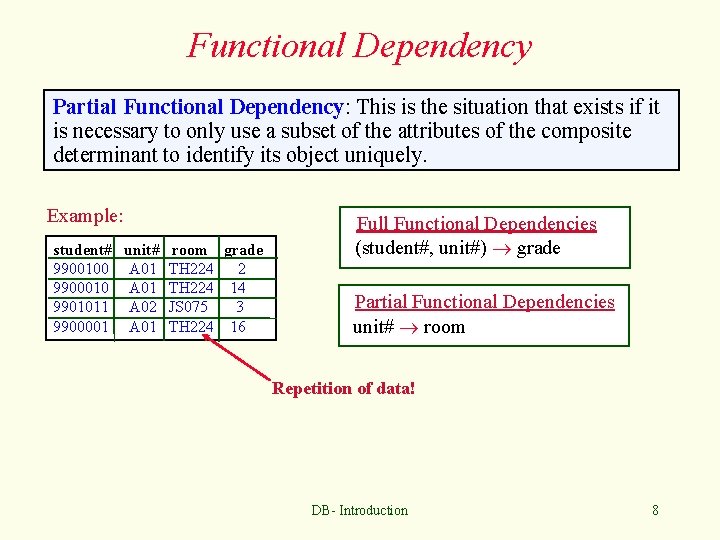
Functional Dependency Partial Functional Dependency: This is the situation that exists if it is necessary to only use a subset of the attributes of the composite determinant to identify its object uniquely. Example: student# unit# room grade 9900100 A 01 TH 224 2 9900010 A 01 TH 224 14 9901011 A 02 JS 075 3 9900001 A 01 TH 224 16 Full Functional Dependencies (student#, unit#) grade Partial Functional Dependencies unit# room Repetition of data! DB- Introduction 8
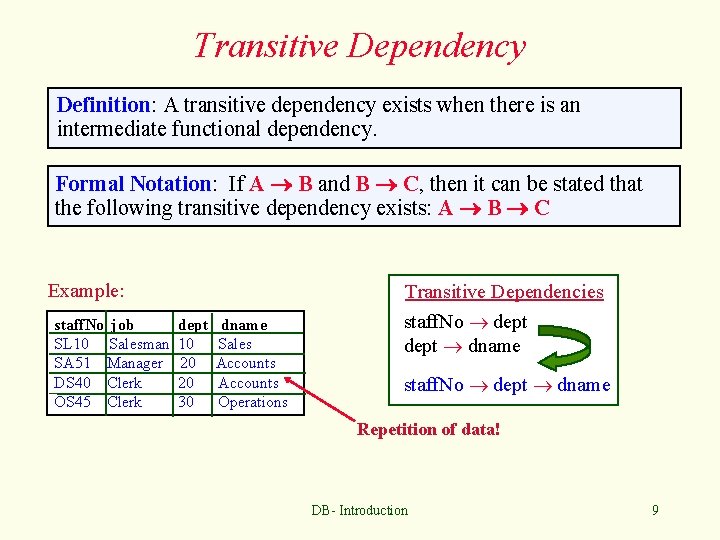
Transitive Dependency Definition: A transitive dependency exists when there is an intermediate functional dependency. Formal Notation: If A B and B C, then it can be stated that the following transitive dependency exists: A B C Example: staff. No job SL 10 Salesman SA 51 Manager DS 40 Clerk OS 45 Clerk Transitive Dependencies dept 10 20 20 30 dname Sales Accounts Operations staff. No dept dname Repetition of data! DB- Introduction 9
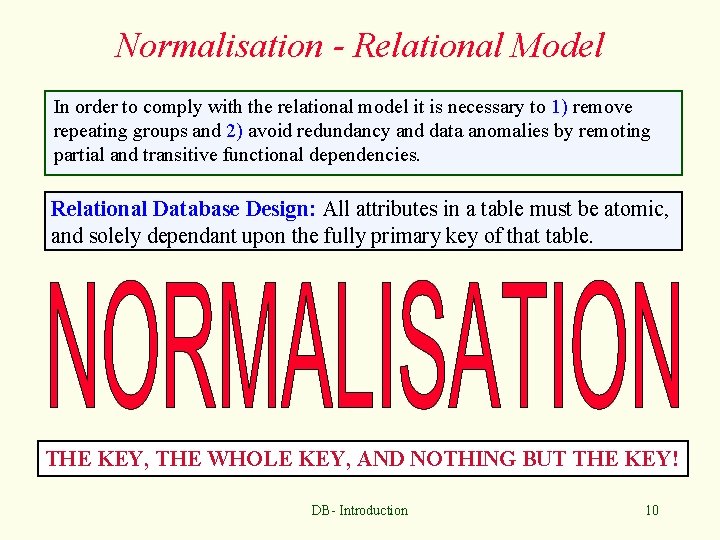
Normalisation - Relational Model In order to comply with the relational model it is necessary to 1) remove repeating groups and 2) avoid redundancy and data anomalies by remoting partial and transitive functional dependencies. Relational Database Design: All attributes in a table must be atomic, and solely dependant upon the fully primary key of that table. THE KEY, THE WHOLE KEY, AND NOTHING BUT THE KEY! DB- Introduction 10
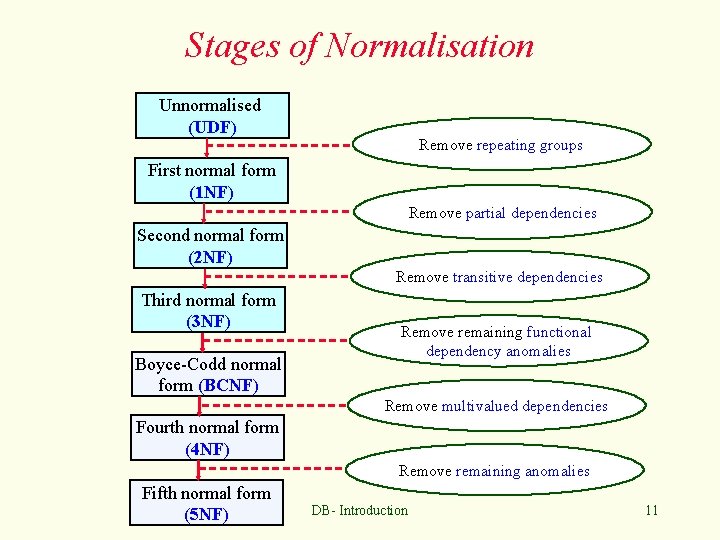
Stages of Normalisation Unnormalised (UDF) Remove repeating groups First normal form (1 NF) Remove partial dependencies Second normal form (2 NF) Remove transitive dependencies Third normal form (3 NF) Boyce-Codd normal form (BCNF) Remove remaining functional dependency anomalies Remove multivalued dependencies Fourth normal form (4 NF) Remove remaining anomalies Fifth normal form (5 NF) DB- Introduction 11
Unnormalised Normal Form (UNF) Definition: A relation is unnormalised when it has not had any normalisation rules applied to it, and it suffers from various anomalies. This only tends to occur where the relation has been designed using a ‘bottom-up approach’. i. e. , the capturing of attributes to a ‘Universal Relation’ from a screen layout, manual report, manual document, etc. . . DB- Introduction 12
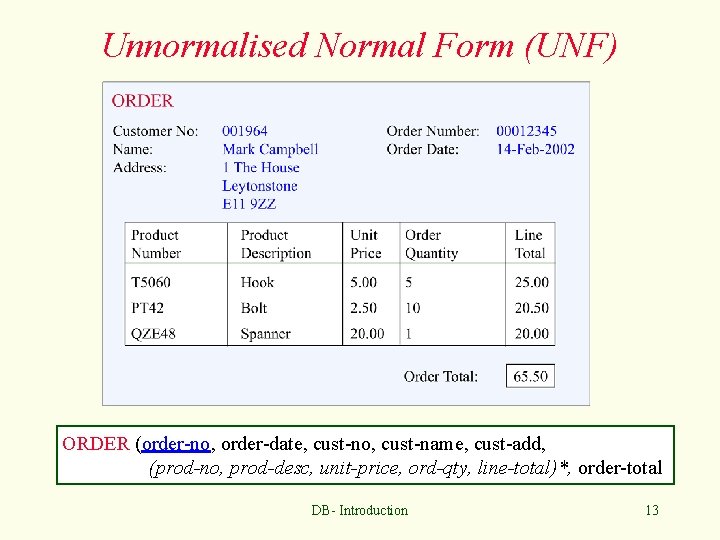
Unnormalised Normal Form (UNF) ORDER (order-no, order-date, cust-no, cust-name, cust-add, (prod-no, prod-desc, unit-price, ord-qty, line-total)*, order-total DB- Introduction 13
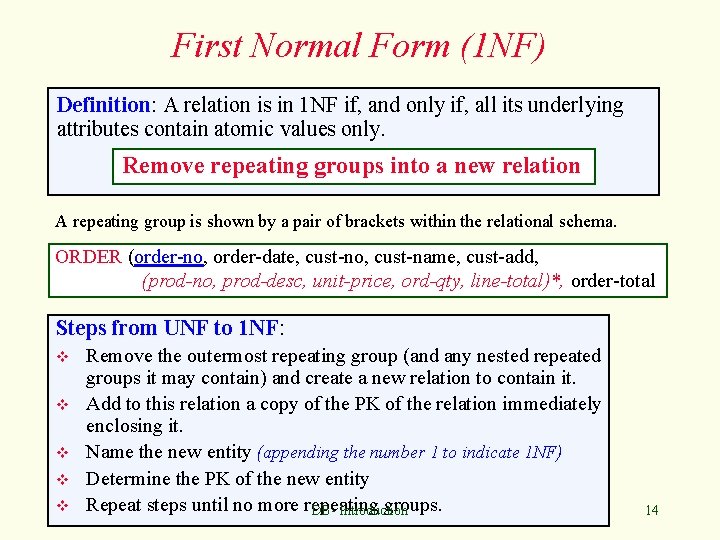
First Normal Form (1 NF) Definition: A relation is in 1 NF if, and only if, all its underlying attributes contain atomic values only. Remove repeating groups into a new relation A repeating group is shown by a pair of brackets within the relational schema. ORDER (order-no, order-date, cust-no, cust-name, cust-add, (prod-no, prod-desc, unit-price, ord-qty, line-total)*, order-total Steps from UNF to 1 NF: v v v Remove the outermost repeating group (and any nested repeated groups it may contain) and create a new relation to contain it. Add to this relation a copy of the PK of the relation immediately enclosing it. Name the new entity (appending the number 1 to indicate 1 NF) Determine the PK of the new entity Repeat steps until no more repeating groups. DB- Introduction 14
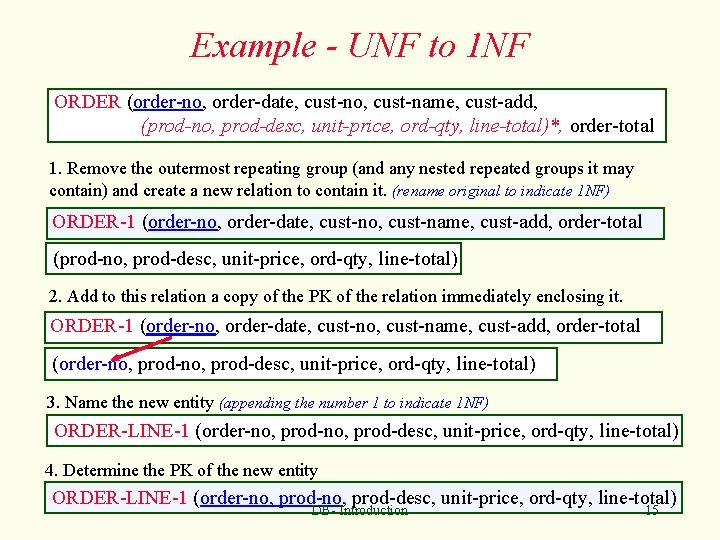
Example - UNF to 1 NF ORDER (order-no, order-date, cust-no, cust-name, cust-add, (prod-no, prod-desc, unit-price, ord-qty, line-total)*, order-total 1. Remove the outermost repeating group (and any nested repeated groups it may contain) and create a new relation to contain it. (rename original to indicate 1 NF) ORDER-1 (order-no, order-date, cust-no, cust-name, cust-add, order-total (prod-no, prod-desc, unit-price, ord-qty, line-total) 2. Add to this relation a copy of the PK of the relation immediately enclosing it. ORDER-1 (order-no, order-date, cust-no, cust-name, cust-add, order-total (order-no, prod-desc, unit-price, ord-qty, line-total) 3. Name the new entity (appending the number 1 to indicate 1 NF) ORDER-LINE-1 (order-no, prod-desc, unit-price, ord-qty, line-total) 4. Determine the PK of the new entity ORDER-LINE-1 (order-no, prod-desc, unit-price, ord-qty, line-total) DB- Introduction 15
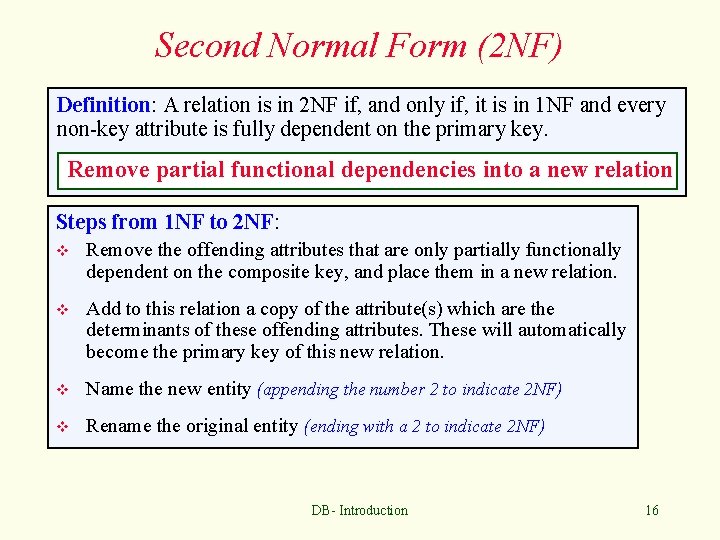
Second Normal Form (2 NF) Definition: A relation is in 2 NF if, and only if, it is in 1 NF and every non-key attribute is fully dependent on the primary key. Remove partial functional dependencies into a new relation Steps from 1 NF to 2 NF: v Remove the offending attributes that are only partially functionally dependent on the composite key, and place them in a new relation. v Add to this relation a copy of the attribute(s) which are the determinants of these offending attributes. These will automatically become the primary key of this new relation. v Name the new entity (appending the number 2 to indicate 2 NF) v Rename the original entity (ending with a 2 to indicate 2 NF) DB- Introduction 16
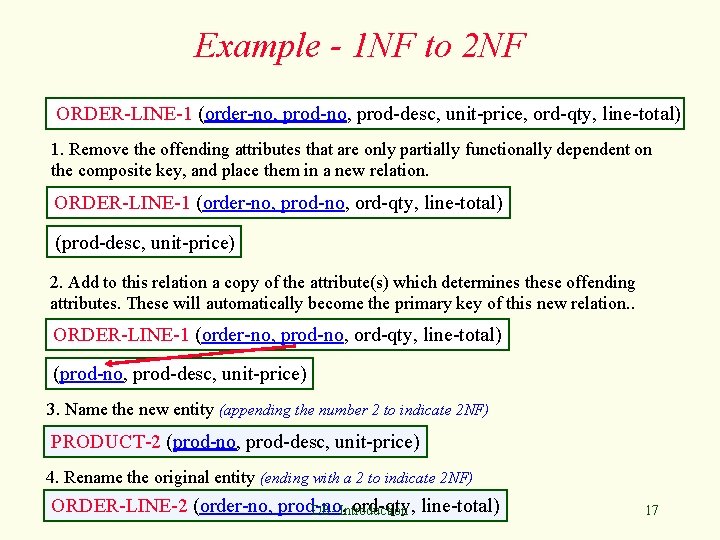
Example - 1 NF to 2 NF ORDER-LINE-1 (order-no, prod-desc, unit-price, ord-qty, line-total) 1. Remove the offending attributes that are only partially functionally dependent on the composite key, and place them in a new relation. ORDER-LINE-1 (order-no, prod-no, ord-qty, line-total) (prod-desc, unit-price) 2. Add to this relation a copy of the attribute(s) which determines these offending attributes. These will automatically become the primary key of this new relation. . ORDER-LINE-1 (order-no, prod-no, ord-qty, line-total) (prod-no, prod-desc, unit-price) 3. Name the new entity (appending the number 2 to indicate 2 NF) PRODUCT-2 (prod-no, prod-desc, unit-price) 4. Rename the original entity (ending with a 2 to indicate 2 NF) ORDER-LINE-2 (order-no, prod-no, ord-qty, line-total) DB- Introduction 17
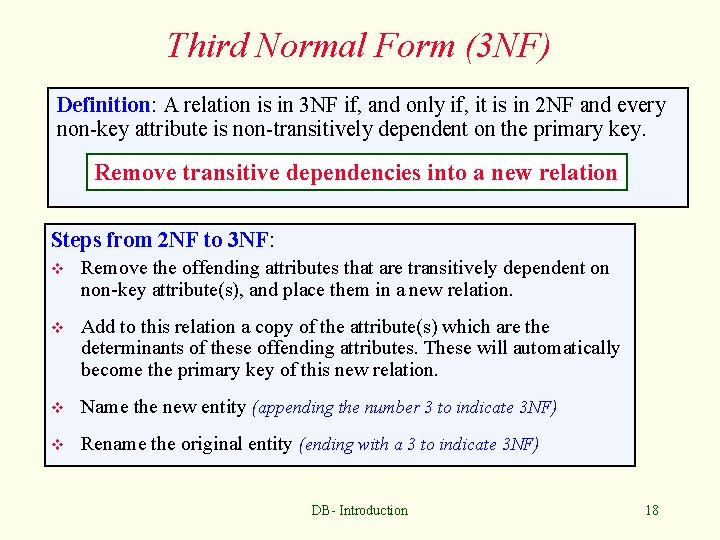
Third Normal Form (3 NF) Definition: A relation is in 3 NF if, and only if, it is in 2 NF and every non-key attribute is non-transitively dependent on the primary key. Remove transitive dependencies into a new relation Steps from 2 NF to 3 NF: v Remove the offending attributes that are transitively dependent on non-key attribute(s), and place them in a new relation. v Add to this relation a copy of the attribute(s) which are the determinants of these offending attributes. These will automatically become the primary key of this new relation. v Name the new entity (appending the number 3 to indicate 3 NF) v Rename the original entity (ending with a 3 to indicate 3 NF) DB- Introduction 18
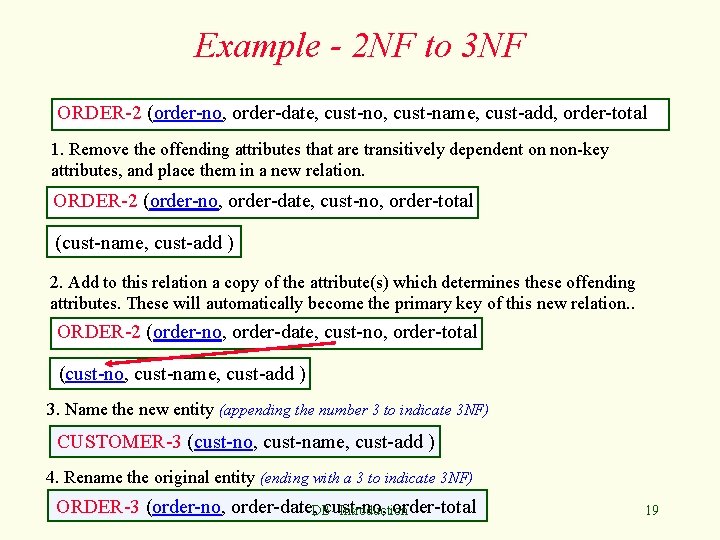
Example - 2 NF to 3 NF ORDER-2 (order-no, order-date, cust-no, cust-name, cust-add, order-total 1. Remove the offending attributes that are transitively dependent on non-key attributes, and place them in a new relation. ORDER-2 (order-no, order-date, cust-no, order-total (cust-name, cust-add ) 2. Add to this relation a copy of the attribute(s) which determines these offending attributes. These will automatically become the primary key of this new relation. . ORDER-2 (order-no, order-date, cust-no, order-total (cust-no, cust-name, cust-add ) 3. Name the new entity (appending the number 3 to indicate 3 NF) CUSTOMER-3 (cust-no, cust-name, cust-add ) 4. Rename the original entity (ending with a 3 to indicate 3 NF) ORDER-3 (order-no, order-date, DBcust-no, order-total Introduction 19
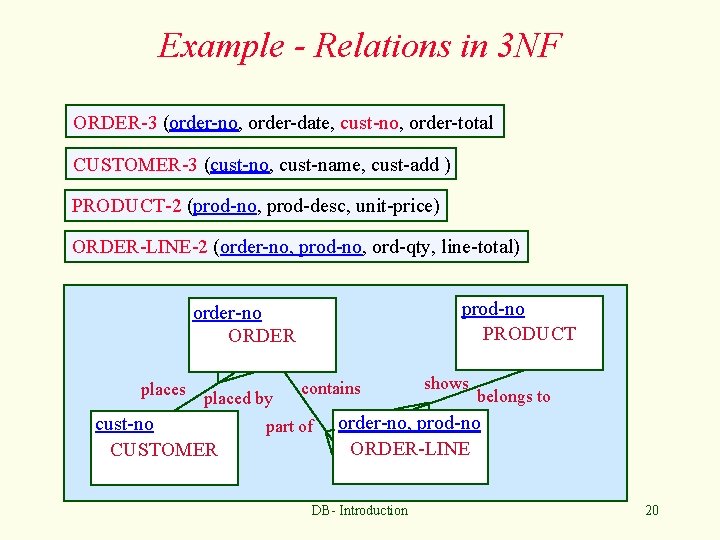
Example - Relations in 3 NF ORDER-3 (order-no, order-date, cust-no, order-total CUSTOMER-3 (cust-no, cust-name, cust-add ) PRODUCT-2 (prod-no, prod-desc, unit-price) ORDER-LINE-2 (order-no, prod-no, ord-qty, line-total) prod-no PRODUCT order-no ORDER places placed by cust-no CUSTOMER contains part of shows belongs to order-no, prod-no ORDER-LINE DB- Introduction 20
DB- Introduction 21
- Slides: 21