
CS 262 a Advanced Topics in Computer Systems











![In the author’s own words About applications: “Most [users] are engaged in applications such](https://slidetodoc.com/presentation_image_h2/fd38c4c579762e90f6eba072f6b1ec82/image-30.jpg "In the author’s own words About applications: “Most [users] are engaged in applications such")


- Slides: 32
CS 262 a: Advanced Topics in Computer Systems Spring 2018 (MW 9: 00 -10: 30, 320 Soda Hall) Ali Ghodsi and Ion Stoica (https: //ucbrise. github. io/cs 262 a-spring 2018/) 1
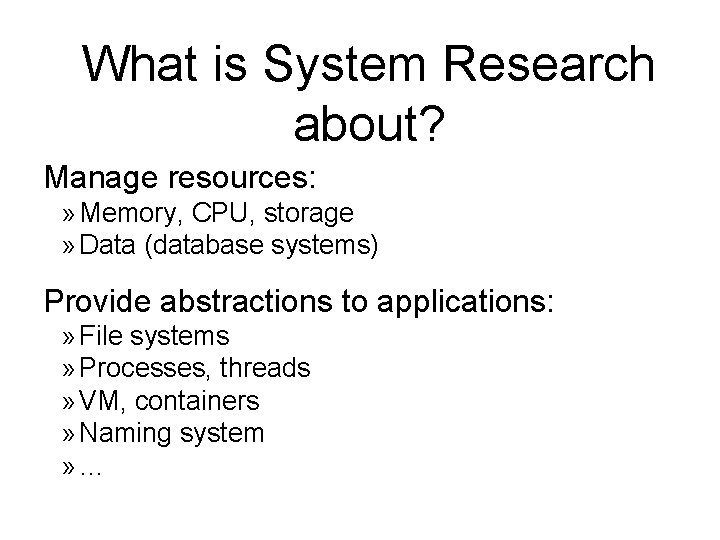
What is System Research about? Manage resources: » Memory, CPU, storage » Data (database systems) Provide abstractions to applications: » File systems » Processes, threads » VM, containers » Naming system » …
This Class Learn about systems research by » Reading several seminal papers » Doing it: work on an exciting project Hopefully start next generation of impactful systems
Appreciate what is Good Research Problem selection Solution & research methodology Presentation
What do you need to do? Research oriented class project » Groups of 2 -3 Paper reading » Submit answers to four questions for each paper before lecture » Discuss paper during class
Research Project Investigate new ideas and solutions in a class research project » Define the problem » Execute the research » Write up and present your research Ideally, best projects will become conference papers (e. g. , OSDI/SOSP, NSDI, Euro. Sys)
Research Project: Steps We’ll distribute a list of projects » You can either choose one or come up with your own Pick your partner(s) and submit a one page proposal describing: » The problem you are solving » Your plan of attack with milestones and dates » Any special resources you may need Poster session Submit project report
Paper Reading: Key Questions What is the problem? What is the solution’s main idea? Why did it succeed or failed? Does the paper (or do you) identify any fundamental/hard trade-offs? Submissions: Will send out a google form for every paper that you need to fill in (will close it 10 min before the class)
Distributed Shared Memory Countless papers in 1990 s: » Very compelling abstraction » Many hard challenges, so many researchers worked on it Today » Few systems using distributed shared memory, if any • Note: Comeback in the context of disaggregated memory? » Message passing (e. g. , MPI) or bulk synchronous processing (e. g. , Spark) prevalent 9
Why did it fail?
Virtual Machine Many papers in 1990 s: » Very compelling abstraction » Many hard challenges, so many researchers worked on it Today » VMs everywhere » Containers (e. g. , docker) take this concept to the next level
Why did it succeed?
What are Hard/Fundamental Tradeoffs? Brewer’s CAP conjecture: “Consistency, Availability, Partition-tolerance”, you can have only 2/3 in a distributed system Tradeoff between latency and throughput for arbitrary updates in distributed systems » Batch request to increase throughput, but hurts latency 13
Grading Project: 60% Paper blogs: 20% Class participation: 20% 14
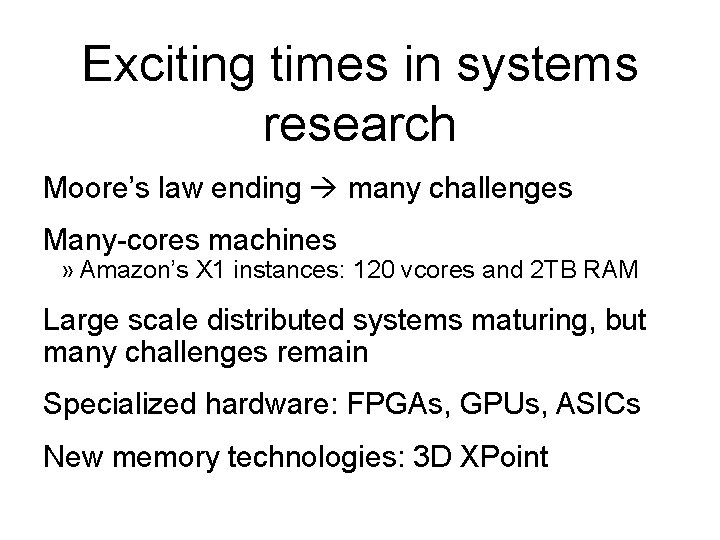
Exciting times in systems research Moore’s law ending many challenges Many-cores machines » Amazon’s X 1 instances: 120 vcores and 2 TB RAM Large scale distributed systems maturing, but many challenges remain Specialized hardware: FPGAs, GPUs, ASICs New memory technologies: 3 D XPoint
Increased complexity – Computation Software CPU + SGX GPU FPGA ASIC 16
Increased complexity – Memory 2020 2015 L 1/L 2 cache L 3 cache ~1 ns ~10 ns L 1/L 2 cache L 3 cache HBM Main memory ~100 ns / ~80 GB/s / ~100 GB Main memory NVM (3 D NAND SSD Fast HHD ~100 usec / ~10 GB/s / ~1 TB ~10 msec / ~100 MB/s / ~10 TB Xpoint) ~1 ns ~10 ns / ~1 TB/s / ~10 GB ~100 ns / ~80 GB/s / ~100 GB ~1 usec / ~10 GB/s / ~1 TB NAND SSD ~100 usec / ~10 GB/s / ~10 TB Fast HHD ~10 msec / ~100 MB/s / ~100 T
Increased complexity – more and more choices Basic tier: A 0, A 1, A 2, A 3, A 4 Optimized Compute : D 1, D 2, D 3, D 4, D 11, D 12, D 13 D 1 v 2, D 2 v 2, D 3 v 2, D 11 v 2, … Latest CPUs: G 1, G 2, G 3, … Network Optimized: A 8, A 9 Compute Intensive: A 10, A 11, … Microsoft AZURE t 2. nano, t 2. micro, t 2. small m 4. large, m 4. xlarge, m 4. 2 xlarge, m 4. 4 xlarge, m 3. medium, c 4. large, c 4. xlarge, c 4. 2 xlarge, c 3. 4 xlarge, r 3. 4 xlarge, i 2. 2 xlarge, i 2. 4 xlarge, d 2. xlarge d 2. 2 xlarge, d 2. 4 xlarge, … Amazon EC 2 n 1 -standard-1, ns 1 -standard-2, ns 1 -standard-4, ns 1 -standard-8, ns 1 -standard-16, ns 1 highmem 2, ns 1 -highmem-4, ns 1 -highmem -8, n 1 -highcpu-2, n 1 -highcpu-4, n 1 -highcpu-8, n 1 -highcpu-16, n 1 -highcpu-32, f 1 -micro, g 1 small… Google Cloud Engine 18
Increase complexity – more and more requirements Scale Latency Accuracy Cost Security 19
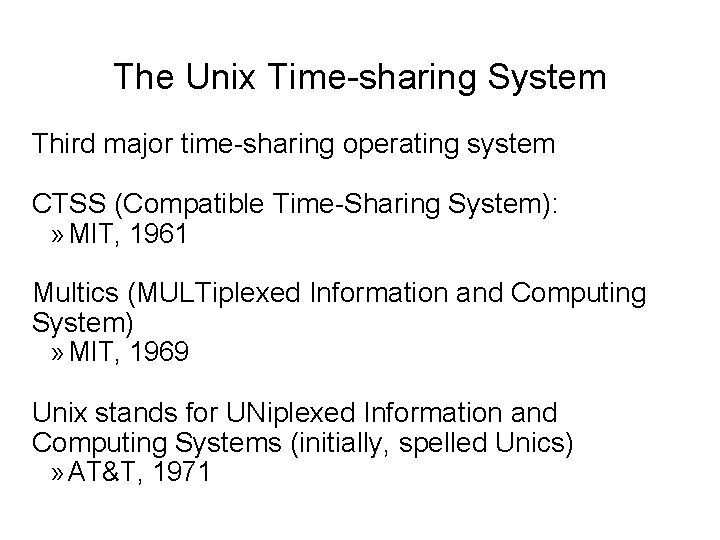
The Unix Time-sharing System Third major time-sharing operating system CTSS (Compatible Time-Sharing System): » MIT, 1961 Multics (MULTiplexed Information and Computing System) » MIT, 1969 Unix stands for UNiplexed Information and Computing Systems (initially, spelled Unics) » AT&T, 1971
Context Multics: 2 nd system syndrome (coined by Fred Brooks) » Following a successful system, designers become over-ambitious complex system “If your project is the second system for most of your designers, then it will probably fail outright. If it doesn't fail, it will be bloated, inefficient, and icky” Unix a reaction to Multics » Uniplexed vs. Multiplexed ; -) » Simple, small system
“Self-Supporting System” Use your own system, i. e. , “eating your own dog food” – a lesson more valuable than ever today Users are best developers of a system as they are in the best position to know requirements Dogfooding origin (unverified, but nice story!): » President of Kal Kan Pet Food would eat a can of his dog food at shareholders' meetings
Written in C At that time all Operating Systems were written in Assembly language, so why C? » Much easier to understand » Faster to develop » More portable (at that time there were many architectures) 33% increased in size deemed acceptable Unix played a big role in the rapid raise of C » Designed by Dennis Ritchie
Minimalist design No user-visible locks. Why? » No restrictions on number of users who can open a file, even though… “contents of a file [can] become scrambled when two users write on it simultaneously” » Deemed neither necessary nor sufficient Doesn’t enforce consistency on buffer cache. Why? Doesn’t charge users for storage allocated to their files. Why?
Simple abstractions Files store bytes, there is no concept of records. Why? No distinction between “random” and sequential I/O. Why? Files use fixed block allocation (i. e. , 512 B). Why? Simple way to implement multi-processing » Fork, wait, exit: trivial to share data and wait for a process (i. e. , child) to terminate
Unifying abstractions I/O devices treated like files: » File and device names have same syntax and meaning » A program can pass either a device or file » Use same protection mechanisms like regular files Directories special files, except » System control the content of directory
Unifying abstractions (cont’d) Pipes: unified with files » Can easily compose simple commands to provide complex functionality » E. g. , “grep ERROR log. txt | sort | less” Shell: just a program » Reads user commands, interpret, and execute them » Supports multitasking (backgrounding) » Support filters, pipes
Small code base < 50 k. B kernel » A few thousands Lo. C » High level language helped a lot Only 2 man-years to write Most successful projects start small! » Linux 1 st version: 12 Lo. C » Also, our own experience: • Mesos: 10 K Lo. C • Spark: 3 K Lo. C • Tachyon: 10 K Lo. C
In the author’s own words About UNIX’s qualities “most important characteristics of the system are its simplicity, elegance, and ease of use. ” About being small: “UNIX can run on hardware costing as little as $40, 000” ; -) About functionality: “The most important job of UNIX is to provide a file system. ”
In the author’s own words About applications: “Most [users] are engaged in applications such as the preparation and formatting of patent applications and other textual material, the collection and processing of trouble data from various switching machines within the Bell System, and recording and checking telephone service order. ”
Grading the paper What is the problem? » Simple, powerful system that users themselves can easily evolve What is the solution’s main idea? » Minimalist design, unified abstractions (avoid 2 nd system syndrome)
Grading the paper Why did it succeed (or failed)? » Powerful, time-sharing system » Addictive to use: interactive shell » Open-source » High level language made it easy to port to other architectures Does the paper (or do you) identify any fundamental/hard trade-offs? » Fixed block size not optimal for all apps but minimizes system overhead