
CS 252 Graduate Computer Architecture Lecture 26 Quantum
- Slides: 50
CS 252 Graduate Computer Architecture Lecture 26 Quantum Computing and Quantum CAD Design May 4 th, 2010 Prof John D. Kubiatowicz http: //www. cs. berkeley. edu/~kubitron/cs 252
Use Quantum Mechanics to Compute? • Weird but useful properties of quantum mechanics: – Quantization: Only certain values or orbits are good » Remember orbitals from chemistry? ? ? – Superposition: Schizophrenic physical elements don’t quite know whether they are one thing or another • All existing digital abstractions try to eliminate QM – Transistors/Gates designed with classical behavior – Binary abstraction: a “ 1” is a “ 1” and a “ 0” is a “ 0” • Quantum Computing: Use of Quantization and Superposition to compute. • Interesting results: – Shor’s algorithm: factors in polynomial time! – Grover’s algorithm: Finds items in unsorted database in time proportional to square-root of n. – Materials simulation: exponential classically, linear-time QM 5/4/2011 cs 252 -S 11, Lecture 26 2
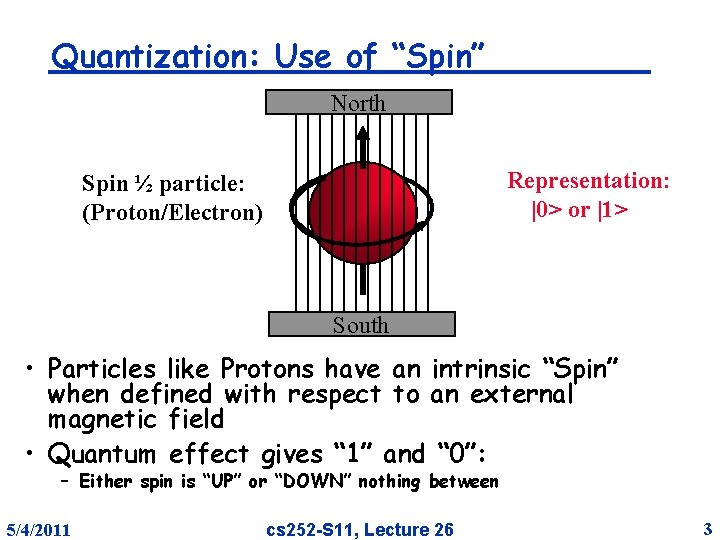
Quantization: Use of “Spin” North Representation: |0> or |1> Spin ½ particle: (Proton/Electron) South • Particles like Protons have an intrinsic “Spin” when defined with respect to an external magnetic field • Quantum effect gives “ 1” and “ 0”: – Either spin is “UP” or “DOWN” nothing between 5/4/2011 cs 252 -S 11, Lecture 26 3
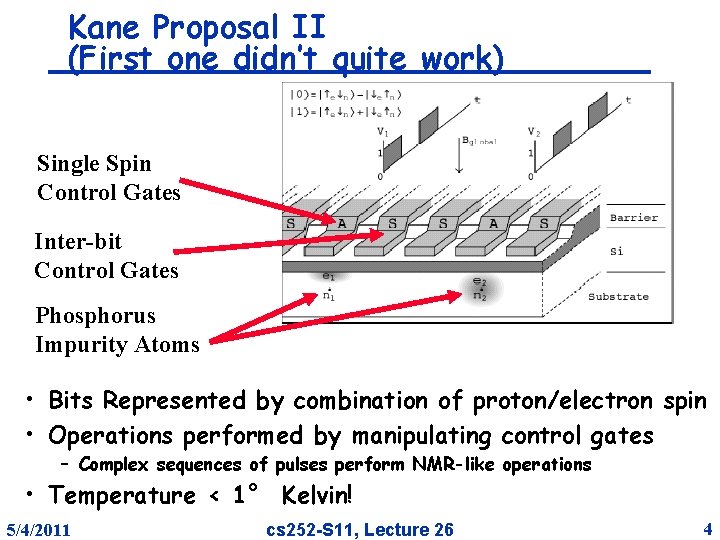
Kane Proposal II (First one didn’t quite work) Single Spin Control Gates Inter-bit Control Gates Phosphorus Impurity Atoms • Bits Represented by combination of proton/electron spin • Operations performed by manipulating control gates – Complex sequences of pulses perform NMR-like operations • Temperature < 1° Kelvin! 5/4/2011 cs 252 -S 11, Lecture 26 4
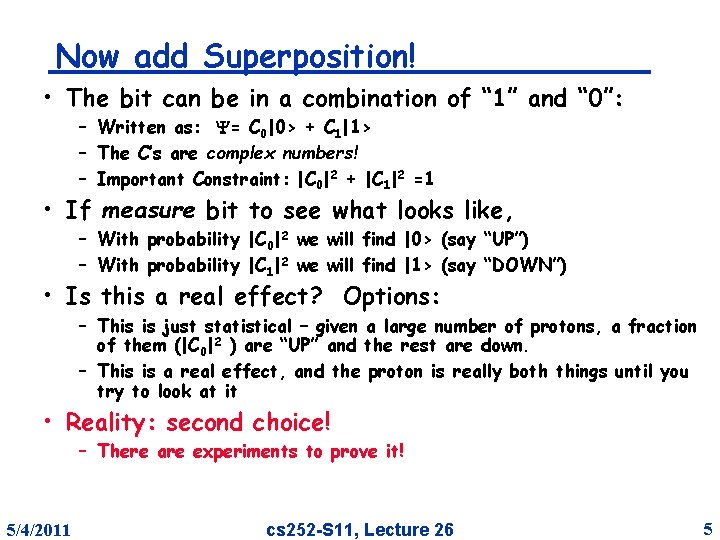
Now add Superposition! • The bit can be in a combination of “ 1” and “ 0”: – Written as: = C 0|0> + C 1|1> – The C’s are complex numbers! – Important Constraint: |C 0|2 + |C 1|2 =1 • If measure bit to see what looks like, – With probability |C 0|2 we will find |0> (say “UP”) – With probability |C 1|2 we will find |1> (say “DOWN”) • Is this a real effect? Options: – This is just statistical – given a large number of protons, a fraction of them (|C 0|2 ) are “UP” and the rest are down. – This is a real effect, and the proton is really both things until you try to look at it • Reality: second choice! – There are experiments to prove it! 5/4/2011 cs 252 -S 11, Lecture 26 5
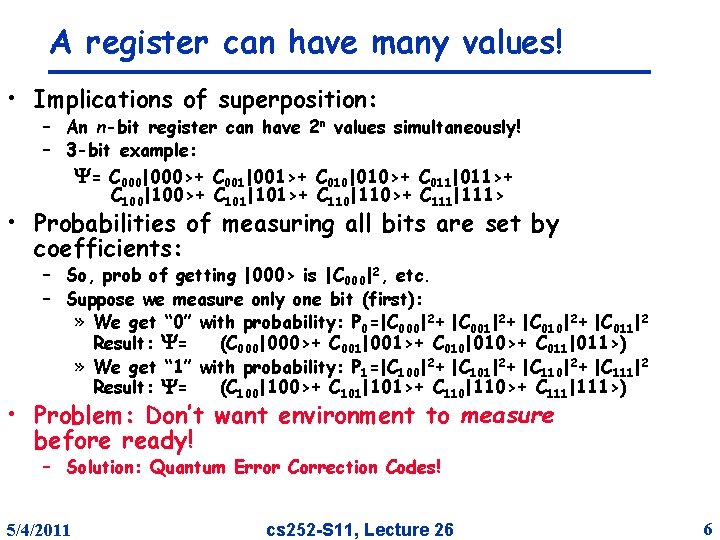
A register can have many values! • Implications of superposition: – An n-bit register can have 2 n values simultaneously! – 3 -bit example: = C 000|000>+ C 001|001>+ C 010|010>+ C 011|011>+ C 100|100>+ C 101|101>+ C 110|110>+ C 111|111> • Probabilities of measuring all bits are set by coefficients: – So, prob of getting |000> is |C 000|2, etc. – Suppose we measure only one bit (first): » We get “ 0” with probability: P 0=|C 000|2+ |C 001|2+ |C 010|2+ |C 011|2 Result: = (C 000|000>+ C 001|001>+ C 010|010>+ C 011|011>) » We get “ 1” with probability: P 1=|C 100|2+ |C 101|2+ |C 110|2+ |C 111|2 Result: = (C 100|100>+ C 101|101>+ C 110|110>+ C 111|111>) • Problem: Don’t want environment to measure before ready! – Solution: Quantum Error Correction Codes! 5/4/2011 cs 252 -S 11, Lecture 26 6
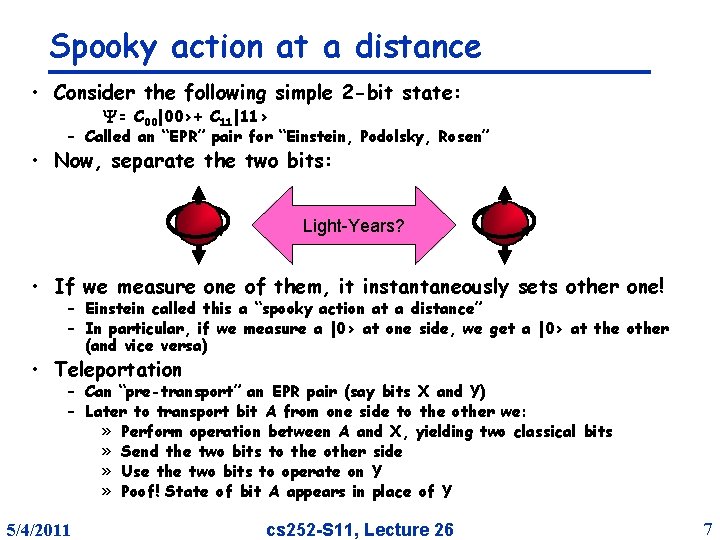
Spooky action at a distance • Consider the following simple 2 -bit state: = C 00|00>+ C 11|11> – Called an “EPR” pair for “Einstein, Podolsky, Rosen” • Now, separate the two bits: Light-Years? • If we measure one of them, it instantaneously sets other one! – Einstein called this a “spooky action at a distance” – In particular, if we measure a |0> at one side, we get a |0> at the other (and vice versa) • Teleportation – Can “pre-transport” an EPR pair (say bits X and Y) – Later to transport bit A from one side to the other we: » Perform operation between A and X, yielding two classical bits » Send the two bits to the other side » Use the two bits to operate on Y » Poof! State of bit A appears in place of Y 5/4/2011 cs 252 -S 11, Lecture 26 7
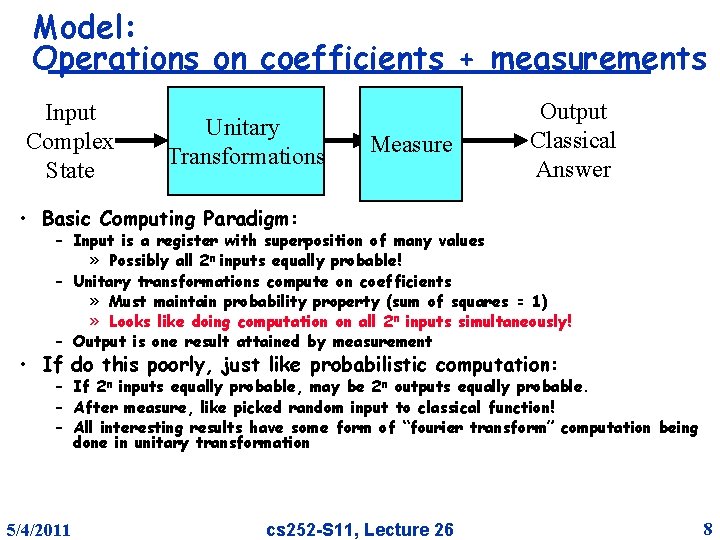
Model: Operations on coefficients + measurements Input Complex State Unitary Transformations Measure Output Classical Answer • Basic Computing Paradigm: – Input is a register with superposition of many values » Possibly all 2 n inputs equally probable! – Unitary transformations compute on coefficients » Must maintain probability property (sum of squares = 1) » Looks like doing computation on all 2 n inputs simultaneously! – Output is one result attained by measurement • If do this poorly, just like probabilistic computation: – If 2 n inputs equally probable, may be 2 n outputs equally probable. – After measure, like picked random input to classical function! – All interesting results have some form of “fourier transform” computation being done in unitary transformation 5/4/2011 cs 252 -S 11, Lecture 26 8
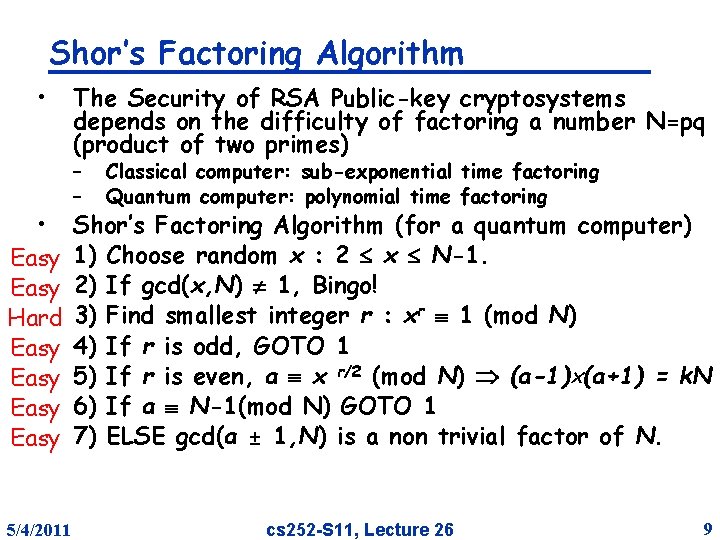
Shor’s Factoring Algorithm • • Easy Hard Easy 5/4/2011 The Security of RSA Public-key cryptosystems depends on the difficulty of factoring a number N=pq (product of two primes) – – Classical computer: sub-exponential time factoring Quantum computer: polynomial time factoring Shor’s Factoring Algorithm (for a quantum computer) 1) Choose random x : 2 x N-1. 2) If gcd(x, N) 1, Bingo! 3) Find smallest integer r : xr 1 (mod N) 4) If r is odd, GOTO 1 5) If r is even, a x r/2 (mod N) (a-1) (a+1) = k. N 6) If a N-1(mod N) GOTO 1 7) ELSE gcd(a ± 1, N) is a non trivial factor of N. cs 252 -S 11, Lecture 26 9
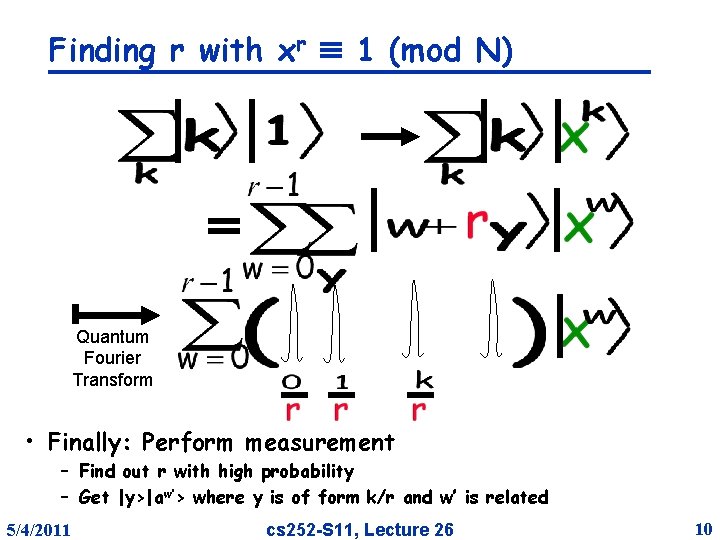
Finding r with xr 1 (mod N) Quantum Fourier Transform • Finally: Perform measurement – Find out r with high probability – Get |y>|aw’> where y is of form k/r and w’ is related 5/4/2011 cs 252 -S 11, Lecture 26 10
Quantum Computing Architectures • Why study quantum computing? – Interesting, says something about physics » Failure to build quantum mechanics wrong? – Mathematical Exercise (perfectly good reason) – Hope that it will be practical someday: » Shor’s factoring, Grover’s search, Design of Materials » Quantum Co-processor included in your Laptop? • To be practical, will need to hand quantum computer design off to classical designers – Baring Adiabatic algorithms, will probably need 100 s to 1000 s (millions? ) of working logical Qubits 1000 s to millions of physical Qubits working together – Current chips: ~1 billion transistors! • Large number of components is realm of architecture – What are optimized structures of quantum algorithms when they are mapped to a physical substrate? – Optimization not possible by hand 5/4/2011 » Abstraction of elements to design larger circuits » Lessons of last 30 years of VLSI design: USE CAD cs 252 -S 11, Lecture 26 11
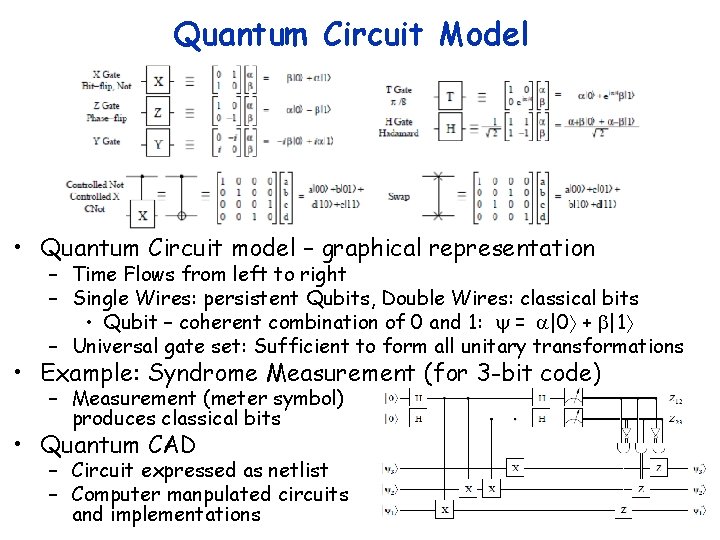
Quantum Circuit Model • Quantum Circuit model – graphical representation – Time Flows from left to right – Single Wires: persistent Qubits, Double Wires: classical bits • Qubit – coherent combination of 0 and 1: = |0 + |1 – Universal gate set: Sufficient to form all unitary transformations • Example: Syndrome Measurement (for 3 -bit code) – Measurement (meter symbol) produces classical bits • Quantum CAD – Circuit expressed as netlist – Computer manpulated circuits and implementations
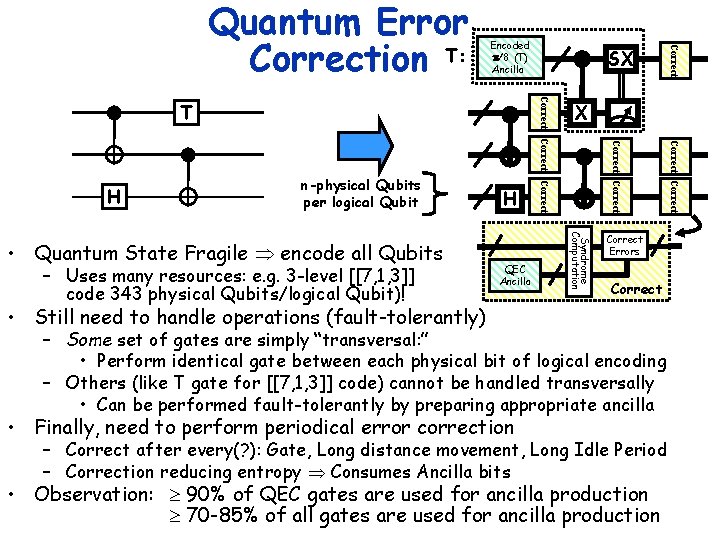
Encoded /8 (T)Not Ancilla – Uses many resources: e. g. 3 -level [[7, 1, 3]] code 343 physical Qubits/logical Qubit)! QEC Ancilla Syndrome Computation • Quantum State Fragile encode all Qubits H Correct Errors Correct • Still need to handle operations (fault-tolerantly) – Some set of gates are simply “transversal: ” • Perform identical gate between each physical bit of logical encoding – Others (like T gate for [[7, 1, 3]] code) cannot be handled transversally • Can be performed fault-tolerantly by preparing appropriate ancilla • Finally, need to perform periodical error correction – Correct after every(? ): Gate, Long distance movement, Long Idle Period – Correction reducing entropy Consumes Ancilla bits • Observation: 90% of QEC gates are used for ancilla production 70 -85% of all gates are used for ancilla production Correct n-physical Qubits per logical Qubit X T Correct H Correct T SX Transversal! Correct Quantum Error Correction T:
Outline • Quantum Computing • Ion Trap Quantum Computing • Quantum Computer Aided Design – Area-Delay to Correct Result (ADCR) metric – Comparison of error correction codes • Quantum Data Paths – QLA, CQLA, Qalypso – Ancilla factory and Teleportation Network Design • Error Correction Optimization (“Recorrection”) • Shor’s Factoring Circuit Layout and Design 5/4/2011 cs 252 -S 11, Lecture 26 14
MEMs-Based Ion Trap Devices • Ion Traps: One of the more promising quantum computer implementation technologies – Built on Silicon • Can bootstrap the vast infrastructure that currently exists in the microchip industry – Seems to be on a “Moore’s Law” like scaling curve • 12 bits exist, 30 promised soon, … • Many researchers working on this problem – Some optimistic researchers speculate about room temperature • Properties: – Has a long-distance Wire • So-called “ballistic movement” – Seems to have relatively long decoherence times – Seems to have relatively low error rates for: • Memory, Gates, Movement 5/4/2011 cs 252 -S 11, Lecture 26 15
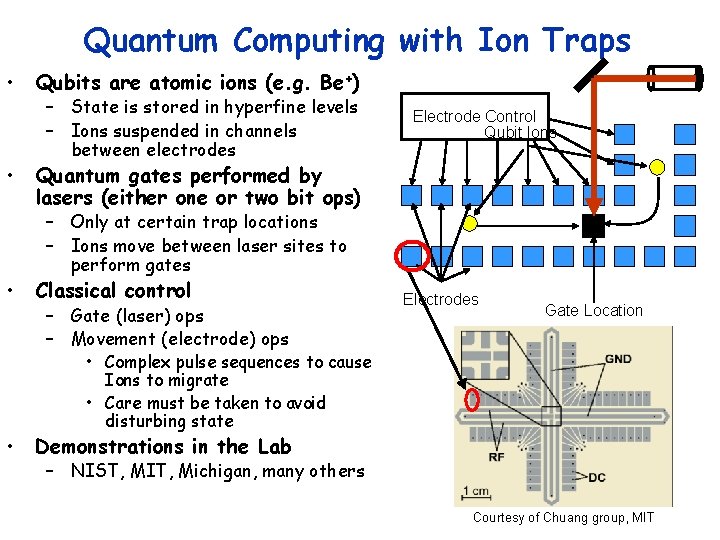
Quantum Computing with Ion Traps • • Qubits are atomic ions (e. g. Be+) – State is stored in hyperfine levels – Ions suspended in channels between electrodes Electrode Control Qubit Ions Quantum gates performed by lasers (either one or two bit ops) – Only at certain trap locations – Ions move between laser sites to perform gates Classical control – Gate (laser) ops – Movement (electrode) ops Electrodes Gate Location • Complex pulse sequences to cause Ions to migrate • Care must be taken to avoid disturbing state Demonstrations in the Lab – NIST, MIT, Michigan, many others Courtesy of Chuang group, MIT
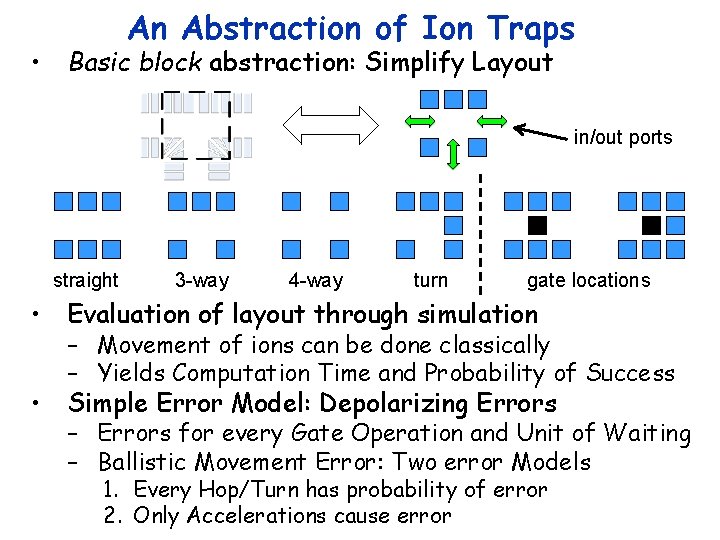
An Abstraction of Ion Traps • Basic block abstraction: Simplify Layout in/out ports straight 3 -way 4 -way turn gate locations • Evaluation of layout through simulation – Movement of ions can be done classically – Yields Computation Time and Probability of Success • Simple Error Model: Depolarizing Errors – Errors for every Gate Operation and Unit of Waiting – Ballistic Movement Error: Two error Models 1. Every Hop/Turn has probability of error 2. Only Accelerations cause error
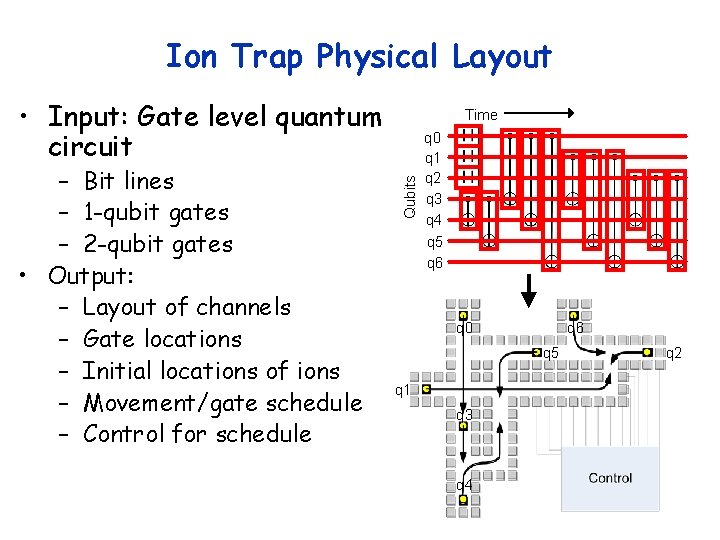
Ion Trap Physical Layout • Input: Gate level quantum circuit Qubits – Bit lines – 1 -qubit gates – 2 -qubit gates • Output: – Layout of channels – Gate locations – Initial locations of ions – Movement/gate schedule – Control for schedule Time q 0 q 1 q 2 q 3 q 4 q 5 q 6 q 0 q 6 q 5 q 1 q 3 q 4 q 2
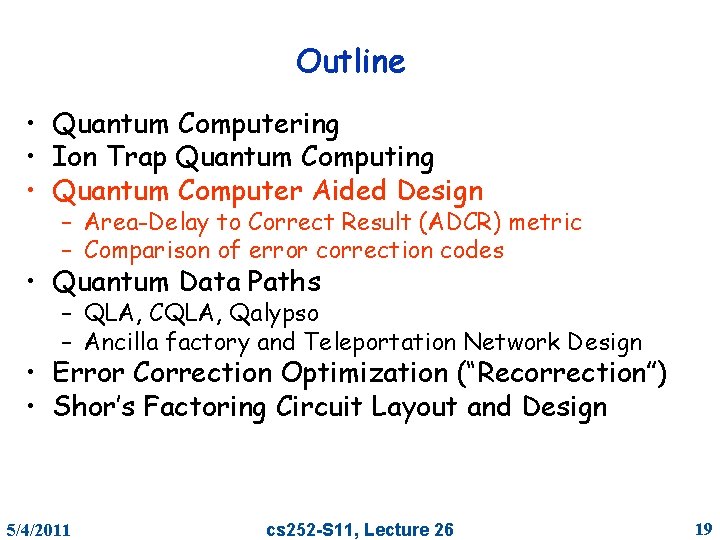
Outline • Quantum Computering • Ion Trap Quantum Computing • Quantum Computer Aided Design – Area-Delay to Correct Result (ADCR) metric – Comparison of error correction codes • Quantum Data Paths – QLA, CQLA, Qalypso – Ancilla factory and Teleportation Network Design • Error Correction Optimization (“Recorrection”) • Shor’s Factoring Circuit Layout and Design 5/4/2011 cs 252 -S 11, Lecture 26 19
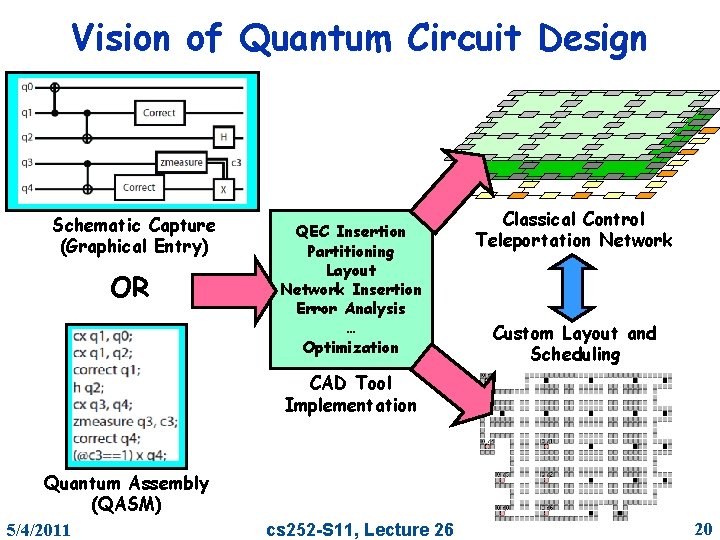
Vision of Quantum Circuit Design Schematic Capture (Graphical Entry) OR QEC Insertion Partitioning Layout Network Insertion Error Analysis … Optimization Classical Control Teleportation Network Custom Layout and Scheduling CAD Tool Implementation Quantum Assembly (QASM) 5/4/2011 cs 252 -S 11, Lecture 26 20
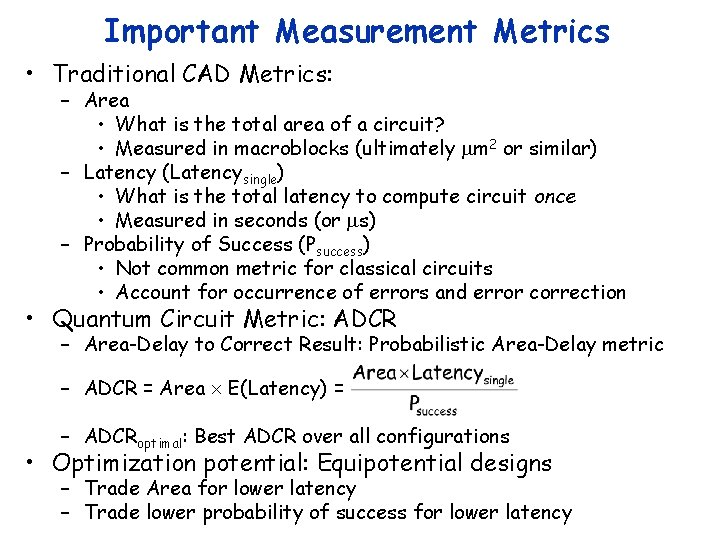
Important Measurement Metrics • Traditional CAD Metrics: – Area • What is the total area of a circuit? • Measured in macroblocks (ultimately m 2 or similar) – Latency (Latencysingle) • What is the total latency to compute circuit once • Measured in seconds (or s) – Probability of Success (Psuccess) • Not common metric for classical circuits • Account for occurrence of errors and error correction • Quantum Circuit Metric: ADCR – Area-Delay to Correct Result: Probabilistic Area-Delay metric – ADCR = Area E(Latency) = – ADCRoptimal: Best ADCR over all configurations • Optimization potential: Equipotential designs – Trade Area for lower latency – Trade lower probability of success for lower latency
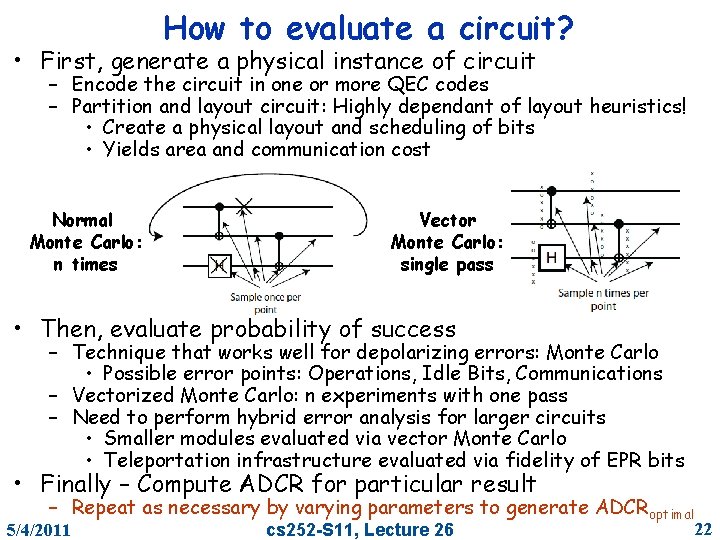
How to evaluate a circuit? • First, generate a physical instance of circuit – Encode the circuit in one or more QEC codes – Partition and layout circuit: Highly dependant of layout heuristics! • Create a physical layout and scheduling of bits • Yields area and communication cost Normal Monte Carlo: n times Vector Monte Carlo: single pass • Then, evaluate probability of success – Technique that works well for depolarizing errors: Monte Carlo • Possible error points: Operations, Idle Bits, Communications – Vectorized Monte Carlo: n experiments with one pass – Need to perform hybrid error analysis for larger circuits • Smaller modules evaluated via vector Monte Carlo • Teleportation infrastructure evaluated via fidelity of EPR bits • Finally – Compute ADCR for particular result – Repeat as necessary by varying parameters to generate ADCR optimal 5/4/2011 cs 252 -S 11, Lecture 26 22
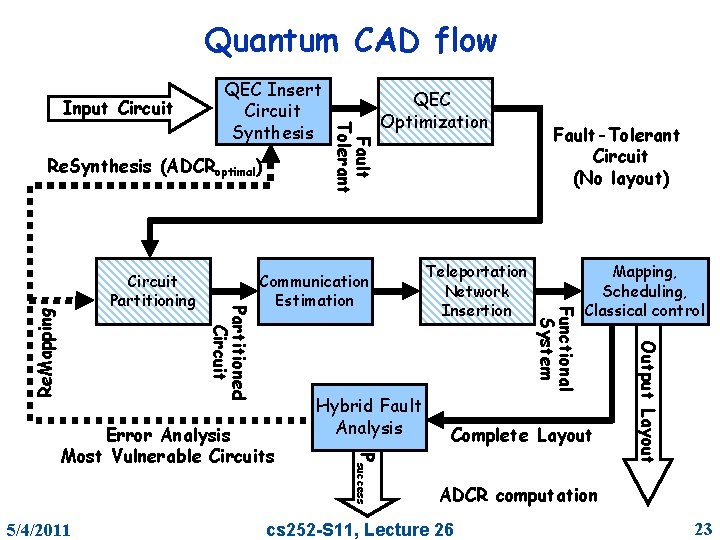
Quantum CAD flow Input Circuit Re. Synthesis (ADCRoptimal) Mapping, Scheduling, Classical control Hybrid Fault Analysis Complete Layout ADCR computation cs 252 -S 11, Lecture 26 Output Layout Re. Mapping Teleportation Network Insertion Fault-Tolerant Circuit (No layout) Functional System Communication Estimation Error Analysis Most Vulnerable Circuits 5/4/2011 QEC Optimization Psuccess Partitioned Circuit Partitioning Fault Tolerant QEC Insert Circuit Synthesis 23
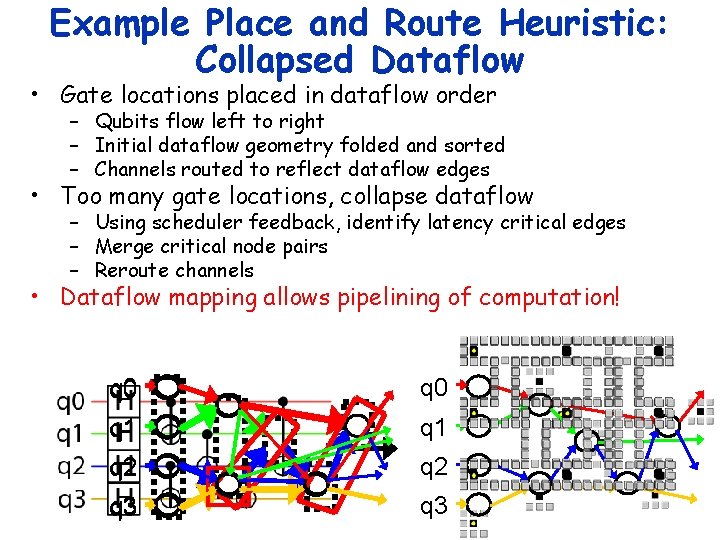
Example Place and Route Heuristic: Collapsed Dataflow • Gate locations placed in dataflow order – Qubits flow left to right – Initial dataflow geometry folded and sorted – Channels routed to reflect dataflow edges • Too many gate locations, collapse dataflow – Using scheduler feedback, identify latency critical edges – Merge critical node pairs – Reroute channels • Dataflow mapping allows pipelining of computation! q 0 q 1 q 2 q 3
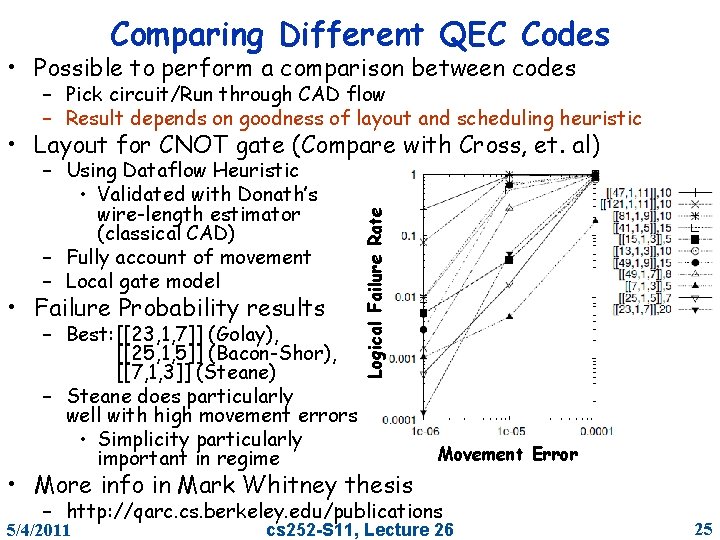
Comparing Different QEC Codes • Possible to perform a comparison between codes – Pick circuit/Run through CAD flow – Result depends on goodness of layout and scheduling heuristic – Using Dataflow Heuristic • Validated with Donath’s wire-length estimator (classical CAD) – Fully account of movement – Local gate model • Failure Probability results – Best: [[23, 1, 7]] (Golay), [[25, 1, 5]] (Bacon-Shor), [[7, 1, 3]] (Steane) – Steane does particularly well with high movement errors • Simplicity particularly important in regime Logical Failure Rate • Layout for CNOT gate (Compare with Cross, et. al) Movement Error • More info in Mark Whitney thesis – http: //qarc. cs. berkeley. edu/publications 5/4/2011 cs 252 -S 11, Lecture 26 25
Outline • Quantum Computing • Ion Trap Quantum Computing • Quantum Computer Aided Design – Area-Delay to Correct Result (ADCR) metric – Comparison of error correction codes • Quantum Data Paths – QLA, CQLA, Qalypso – Ancilla factory and Teleportation Network Design • Error Correction Optimization (“Recorrection”) • Shor’s Factoring Circuit Layout and Design 5/4/2011 cs 252 -S 11, Lecture 26 26
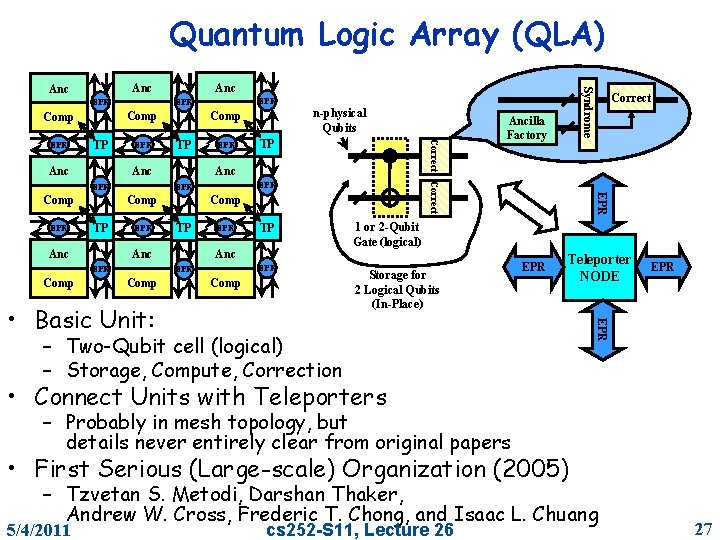
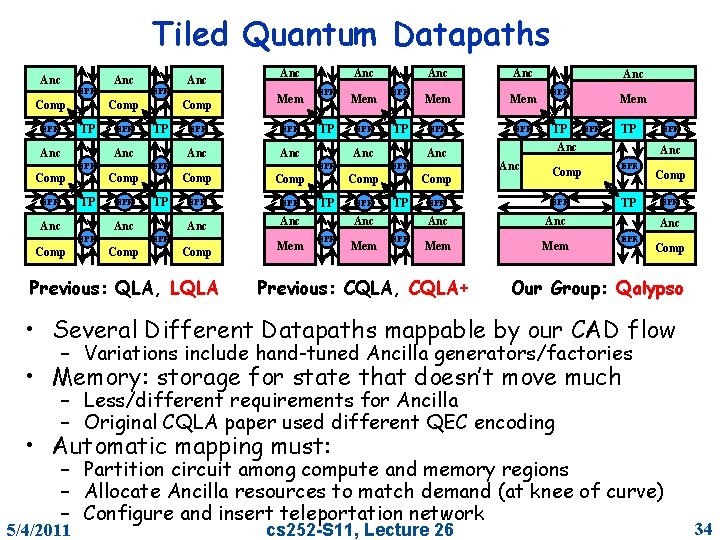
Quantum Logic Array (QLA) EPR Anc Comp TP Anc EPR Comp EPR EPR EPR Comp 1 or 2 -Qubit Gate (logical) Storage for 2 Logical Qubits (In-Place) EPR Teleporter NODE – Two-Qubit cell (logical) – Storage, Compute, Correction EPR • Basic Unit: TP Anc EPR Comp TP Anc Comp TP EPR Ancilla Factory Correct EPR TP Anc Comp n-physical Qubits Comp Correct TP EPR Comp EPR Anc Syndrome Anc • Connect Units with Teleporters – Probably in mesh topology, but details never entirely clear from original papers • First Serious (Large-scale) Organization (2005) – Tzvetan S. Metodi, Darshan Thaker, Andrew W. Cross, Frederic T. Chong, and Isaac L. Chuang 5/4/2011 cs 252 -S 11, Lecture 26 27
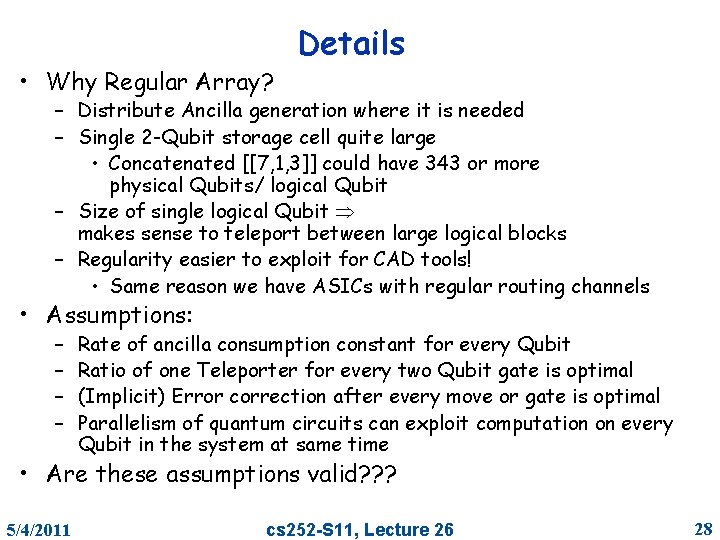
• Why Regular Array? Details – Distribute Ancilla generation where it is needed – Single 2 -Qubit storage cell quite large • Concatenated [[7, 1, 3]] could have 343 or more physical Qubits/ logical Qubit – Size of single logical Qubit makes sense to teleport between large logical blocks – Regularity easier to exploit for CAD tools! • Same reason we have ASICs with regular routing channels • Assumptions: – – Rate of ancilla consumption constant for every Qubit Ratio of one Teleporter for every two Qubit gate is optimal (Implicit) Error correction after every move or gate is optimal Parallelism of quantum circuits can exploit computation on every Qubit in the system at same time • Are these assumptions valid? ? ? 5/4/2011 cs 252 -S 11, Lecture 26 28
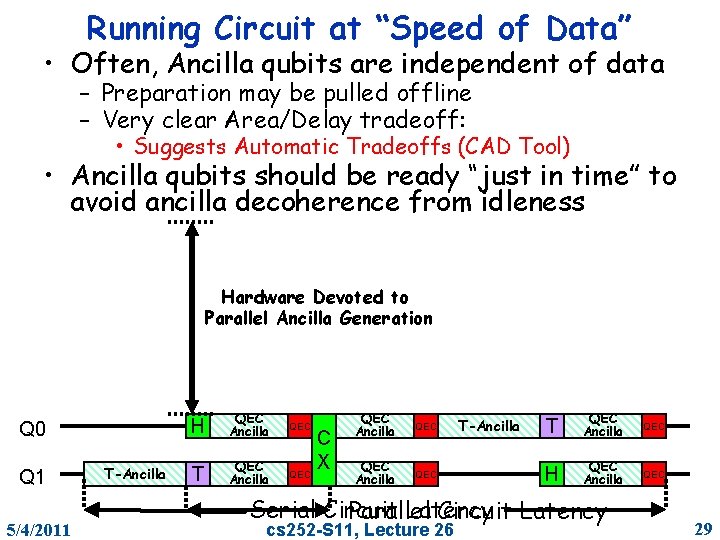
Running Circuit at “Speed of Data” • Often, Ancilla qubits are independent of data – Preparation may be pulled offline – Very clear Area/Delay tradeoff: • Suggests Automatic Tradeoffs (CAD Tool) • Ancilla qubits should be ready “just in time” to avoid ancilla decoherence from idleness Hardware Devoted to Parallel Ancilla Generation Q 0 Q 1 5/4/2011 T-Ancilla H QEC Ancilla T QEC Ancilla QEC C X QEC QEC Ancilla QEC T-Ancilla T QEC Ancilla QEC H QEC Ancilla QEC Serial Circuit Latency Parallel Circuit Latency cs 252 -S 11, Lecture 26 29
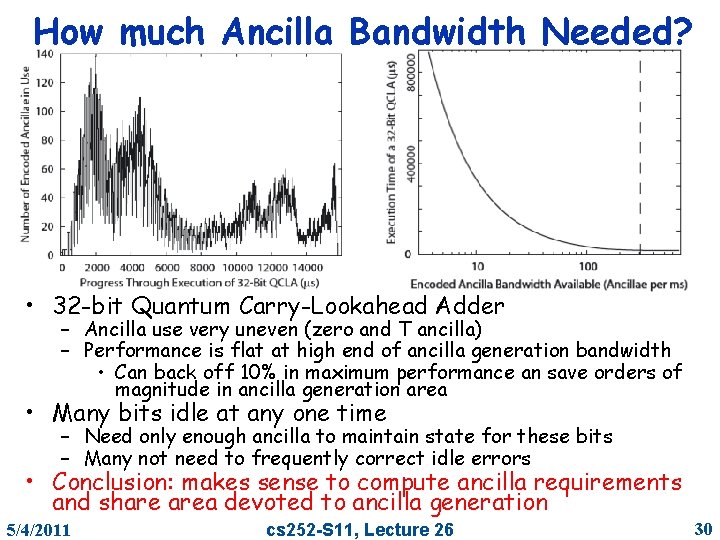
How much Ancilla Bandwidth Needed? • 32 -bit Quantum Carry-Lookahead Adder – Ancilla use very uneven (zero and T ancilla) – Performance is flat at high end of ancilla generation bandwidth • Can back off 10% in maximum performance an save orders of magnitude in ancilla generation area • Many bits idle at any one time – Need only enough ancilla to maintain state for these bits – Many not need to frequently correct idle errors • Conclusion: makes sense to compute ancilla requirements and share area devoted to ancilla generation 5/4/2011 cs 252 -S 11, Lecture 26 30
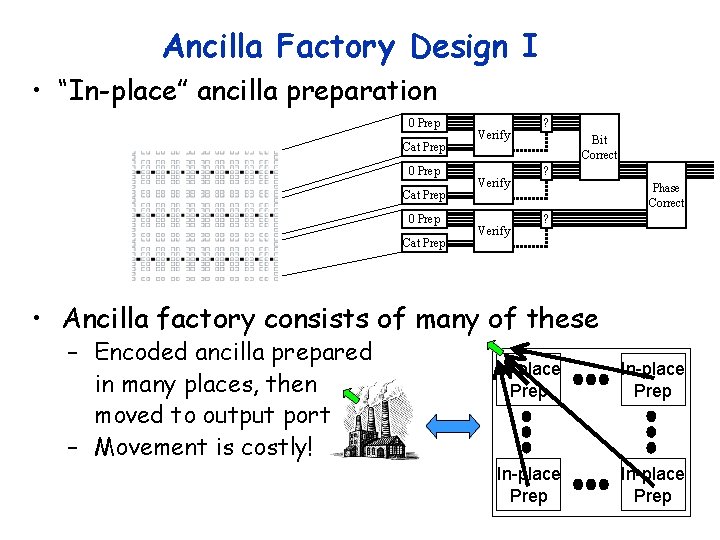
Ancilla Factory Design I • “In-place” ancilla preparation 0 Prep Cat Prep Encoded Ancilla Verify ? Bit Correct ? Phase Correct ? Verification Qubits • Ancilla factory consists of many of these – Encoded ancilla prepared in many places, then moved to output port – Movement is costly! In-place Prep
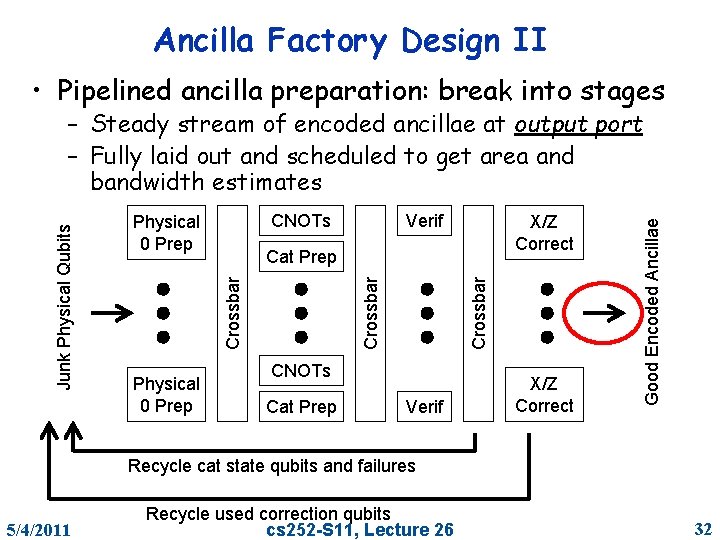
Ancilla Factory Design II • Pipelined ancilla preparation: break into stages Physical 0 Prep Verif X/Z Correct Crossbar Cat Prep CNOTs Cat Prep Verif X/Z Correct Good Encoded Ancillae CNOTs Physical 0 Prep Crossbar Junk Physical Qubits – Steady stream of encoded ancillae at output port – Fully laid out and scheduled to get area and bandwidth estimates Recycle cat state qubits and failures 5/4/2011 Recycle used correction qubits cs 252 -S 11, Lecture 26 32
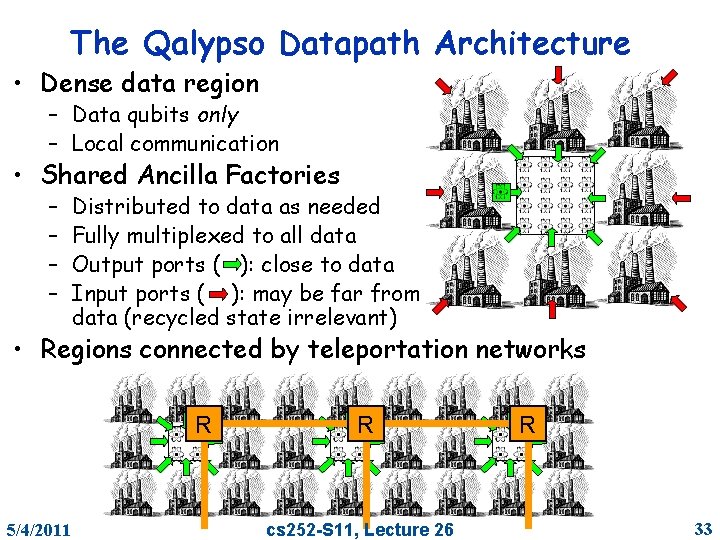
The Qalypso Datapath Architecture • Dense data region – Data qubits only – Local communication • Shared Ancilla Factories – – Distributed to data as needed Fully multiplexed to all data Output ports ( ): close to data Input ports ( ): may be far from data (recycled state irrelevant) • Regions connected by teleportation networks R 5/4/2011 R cs 252 -S 11, Lecture 26 R 33
Tiled Quantum Datapaths Anc EPR Comp TP EPR Anc EPR Comp TP Anc EPR Comp Anc EPR TP Anc EPR Comp Mem EPR Anc Comp EPR EPR Comp TP EPR Anc EPR TP Mem EPR Anc Comp Mem Previous: QLA, LQLA EPR TP Anc EPR Comp Anc Mem EPR EPR Comp TP Anc EPR Anc Comp TP Anc Mem EPR Anc EPR TP Anc EPR Comp EPR Anc Mem Previous: CQLA, CQLA+ Mem TP EPR Anc EPR TP Comp EPR Anc EPR Comp Our Group: Qalypso • Several Different Datapaths mappable by our CAD flow – Variations include hand-tuned Ancilla generators/factories • Memory: storage for state that doesn’t move much – Less/different requirements for Ancilla – Original CQLA paper used different QEC encoding • Automatic mapping must: – Partition circuit among compute and memory regions – Allocate Ancilla resources to match demand (at knee of curve) – Configure and insert teleportation network 5/4/2011 cs 252 -S 11, Lecture 26 34
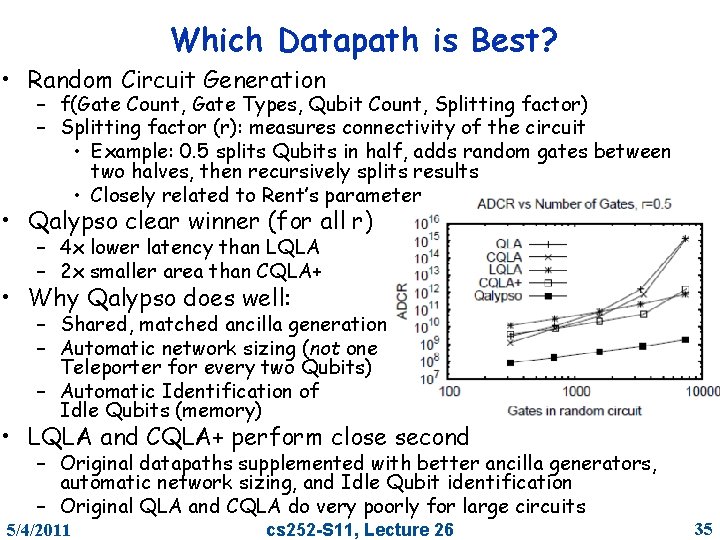
Which Datapath is Best? • Random Circuit Generation – f(Gate Count, Gate Types, Qubit Count, Splitting factor) – Splitting factor (r): measures connectivity of the circuit • Example: 0. 5 splits Qubits in half, adds random gates between two halves, then recursively splits results • Closely related to Rent’s parameter • Qalypso clear winner (for all r) – 4 x lower latency than LQLA – 2 x smaller area than CQLA+ • Why Qalypso does well: – Shared, matched ancilla generation – Automatic network sizing (not one Teleporter for every two Qubits) – Automatic Identification of Idle Qubits (memory) • LQLA and CQLA+ perform close second – Original datapaths supplemented with better ancilla generators, automatic network sizing, and Idle Qubit identification – Original QLA and CQLA do very poorly for large circuits 5/4/2011 cs 252 -S 11, Lecture 26 35
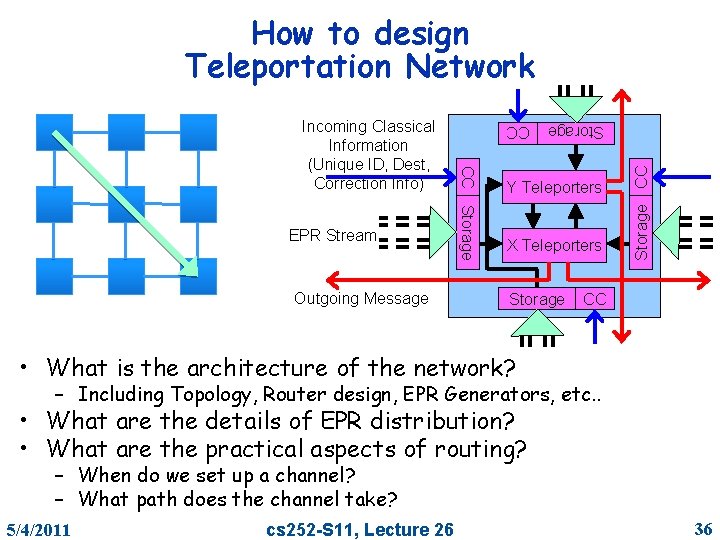
How to design Teleportation Network Y Teleporters X Teleporters Storage CC CC Outgoing Message Storage EPR Stream CC Storage Incoming Classical Information (Unique ID, Dest, Correction Info) CC • What is the architecture of the network? – Including Topology, Router design, EPR Generators, etc. . • What are the details of EPR distribution? • What are the practical aspects of routing? – When do we set up a channel? – What path does the channel take? 5/4/2011 cs 252 -S 11, Lecture 26 36
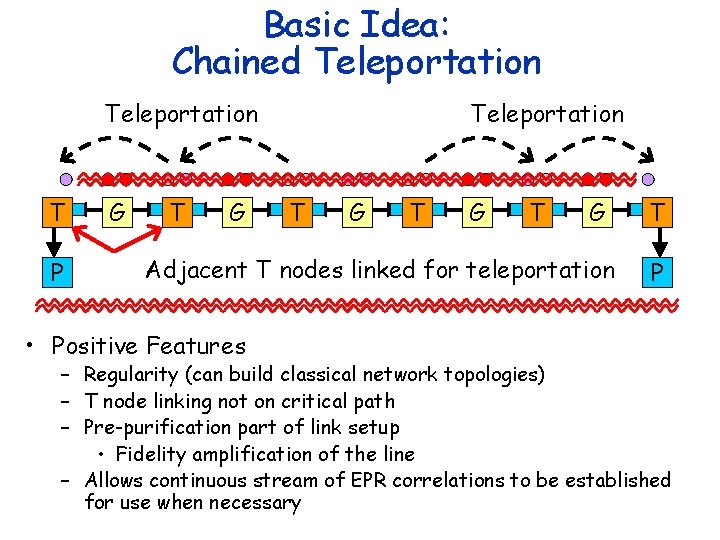
Basic Idea: Chained Teleportation T P G Teleportation T G T G Adjacent T nodes linked for teleportation • Positive Features T P – Regularity (can build classical network topologies) – T node linking not on critical path – Pre-purification part of link setup • Fidelity amplification of the line – Allows continuous stream of EPR correlations to be established for use when necessary
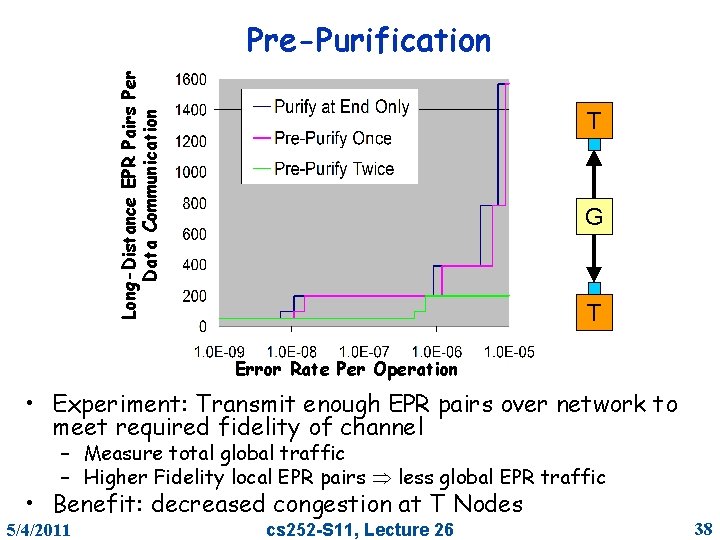
Long-Distance EPR Pairs Per Data Communication Pre-Purification T G T Error Rate Per Operation • Experiment: Transmit enough EPR pairs over network to meet required fidelity of channel – Measure total global traffic – Higher Fidelity local EPR pairs less global EPR traffic • Benefit: decreased congestion at T Nodes 5/4/2011 cs 252 -S 11, Lecture 26 38
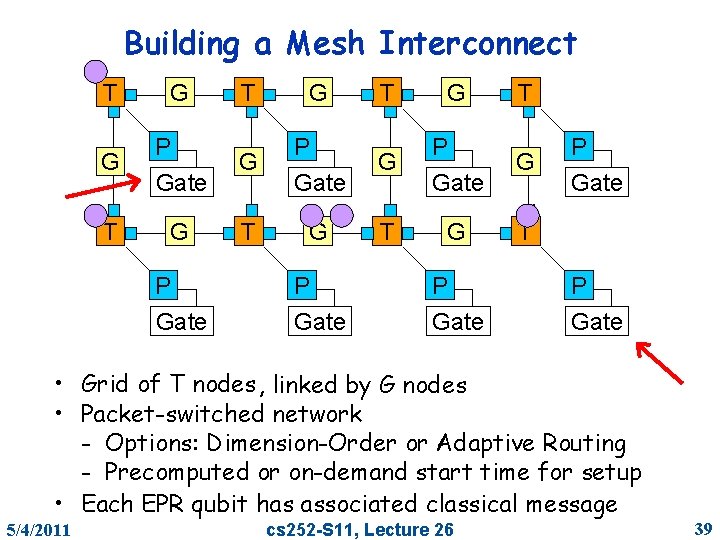
Building a Mesh Interconnect T G G P Gate G T G T P Gate • Grid of T nodes , linked by G nodes • Packet-switched network - Options: Dimension-Order or Adaptive Routing - Precomputed or on-demand start time for setup • Each EPR qubit has associated classical message 5/4/2011 cs 252 -S 11, Lecture 26 39
Outline • Quantum Computing • Ion Trap Quantum Computing • Quantum Computer Aided Design – Area-Delay to Correct Result (ADCR) metric – Comparison of error correction codes • Quantum Data Paths – QLA, CQLA, Qalypso – Ancilla factory and Teleportation Network Design • Error Correction Optimization (“Recorrection”) • Shor’s Factoring Circuit Layout and Design 5/4/2011 cs 252 -S 11, Lecture 26 40
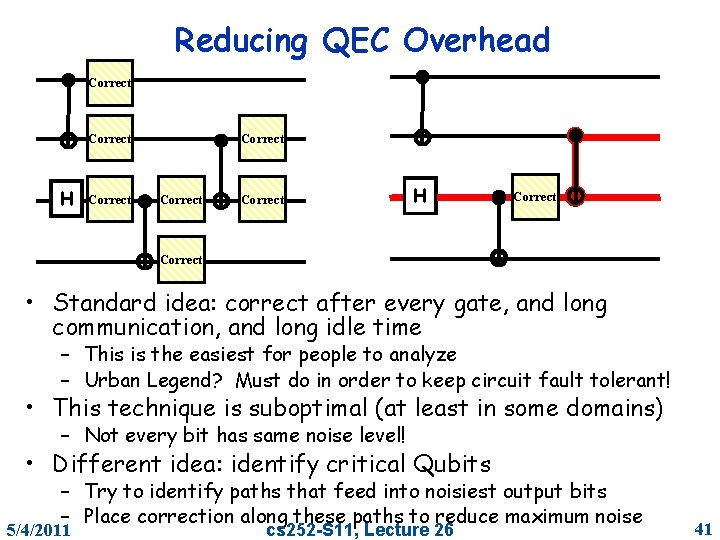
Reducing QEC Overhead Correct H Correct • Standard idea: correct after every gate, and long communication, and long idle time – This is the easiest for people to analyze – Urban Legend? Must do in order to keep circuit fault tolerant! • This technique is suboptimal (at least in some domains) – Not every bit has same noise level! • Different idea: identify critical Qubits – Try to identify paths that feed into noisiest output bits – Place correction along these paths to reduce maximum noise 5/4/2011 cs 252 -S 11, Lecture 26 41
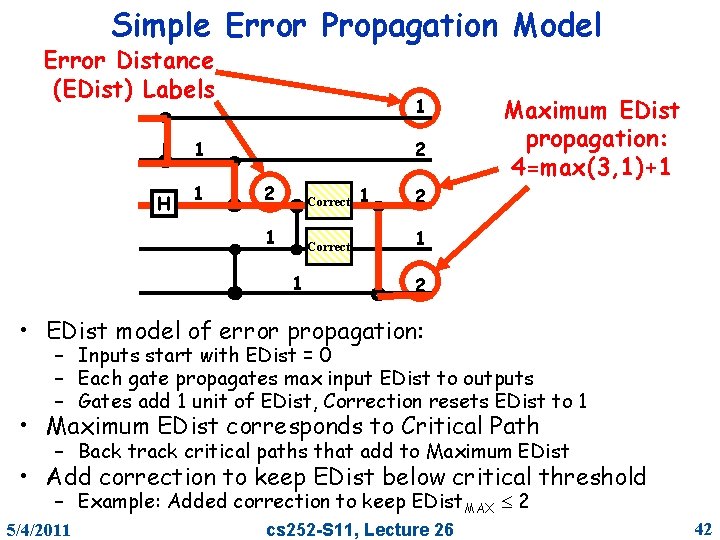
Simple Error Propagation Model Error Distance (EDist) Labels 1 1 H 1 2 2 3 Correct 1 Correct 3 1 1 4 2 Maximum EDist propagation: 4=max(3, 1)+1 3 1 4 2 • EDist model of error propagation: – Inputs start with EDist = 0 – Each gate propagates max input EDist to outputs – Gates add 1 unit of EDist, Correction resets EDist to 1 • Maximum EDist corresponds to Critical Path – Back track critical paths that add to Maximum EDist • Add correction to keep EDist below critical threshold – Example: Added correction to keep EDist. MAX 2 5/4/2011 cs 252 -S 11, Lecture 26 42
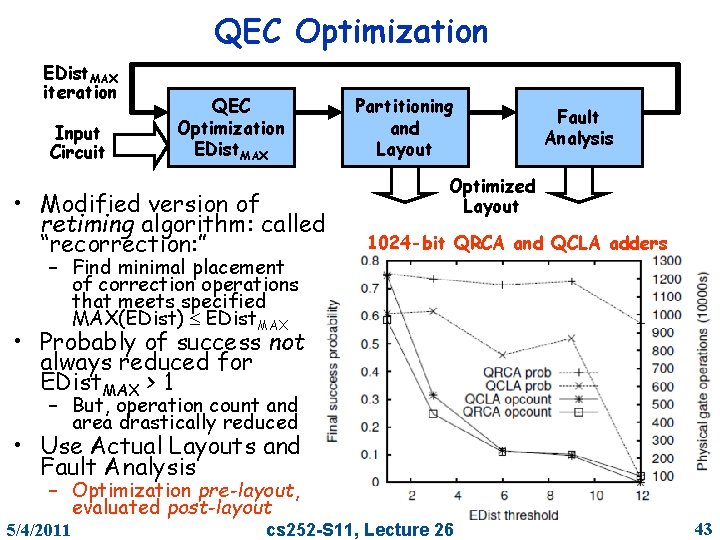
QEC Optimization EDist. MAX iteration Input Circuit QEC Optimization EDist. MAX • Modified version of retiming algorithm: called “recorrection: ” – Find minimal placement of correction operations that meets specified MAX(EDist) EDist. MAX Partitioning and Layout Fault Analysis Optimized Layout 1024 -bit QRCA and QCLA adders • Probably of success not always reduced for EDist. MAX > 1 – But, operation count and area drastically reduced • Use Actual Layouts and Fault Analysis – Optimization pre-layout, evaluated post-layout 5/4/2011 cs 252 -S 11, Lecture 26 43
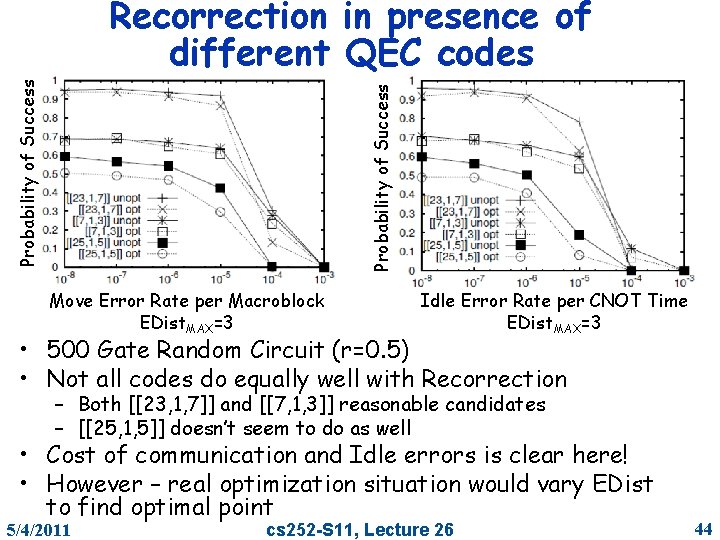
Probability of Success Recorrection in presence of different QEC codes Move Error Rate per Macroblock EDist. MAX=3 Idle Error Rate per CNOT Time EDist. MAX=3 • 500 Gate Random Circuit (r=0. 5) • Not all codes do equally well with Recorrection – Both [[23, 1, 7]] and [[7, 1, 3]] reasonable candidates – [[25, 1, 5]] doesn’t seem to do as well • Cost of communication and Idle errors is clear here! • However – real optimization situation would vary EDist to find optimal point 5/4/2011 cs 252 -S 11, Lecture 26 44
Outline • Quantum Computing • Ion Trap Quantum Computing • Quantum Computer Aided Design – Area-Delay to Correct Result (ADCR) metric – Comparison of error correction codes • Quantum Data Paths – QLA, CQLA, Qalypso – Ancilla factory and Teleportation Network Design • Error Correction Optimization (“Recorrection”) • Shor’s Factoring Circuit Layout and Design 5/4/2011 cs 252 -S 11, Lecture 26 45
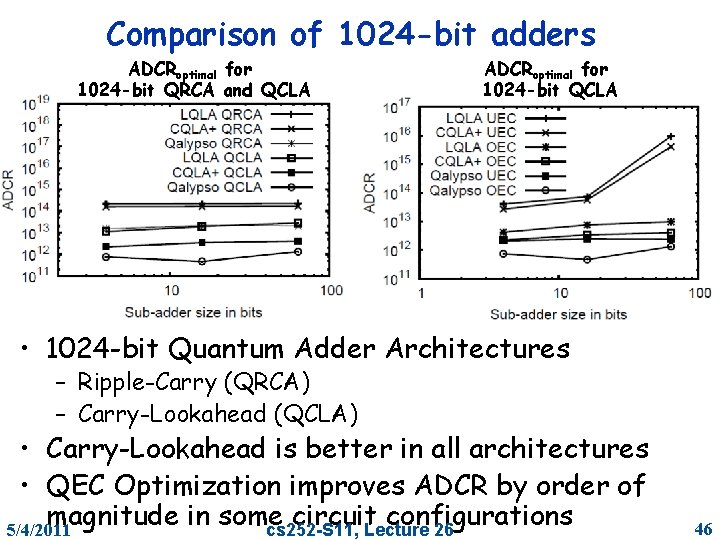
Comparison of 1024 -bit adders ADCRoptimal for 1024 -bit QRCA and QCLA ADCRoptimal for 1024 -bit QCLA • 1024 -bit Quantum Adder Architectures – Ripple-Carry (QRCA) – Carry-Lookahead (QCLA) • Carry-Lookahead is better in all architectures • QEC Optimization improves ADCR by order of magnitude in some circuit configurations 5/4/2011 cs 252 -S 11, Lecture 26 46
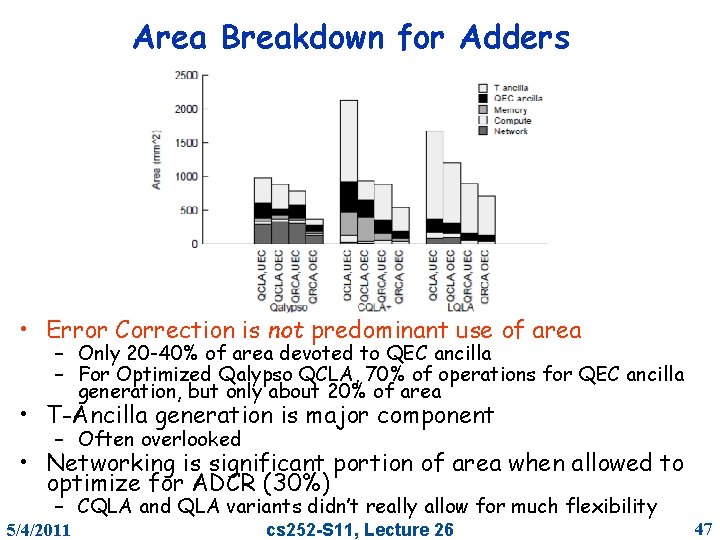
Area Breakdown for Adders • Error Correction is not predominant use of area – Only 20 -40% of area devoted to QEC ancilla – For Optimized Qalypso QCLA, 70% of operations for QEC ancilla generation, but only about 20% of area • T-Ancilla generation is major component – Often overlooked • Networking is significant portion of area when allowed to optimize for ADCR (30%) – CQLA and QLA variants didn’t really allow for much flexibility 5/4/2011 cs 252 -S 11, Lecture 26 47
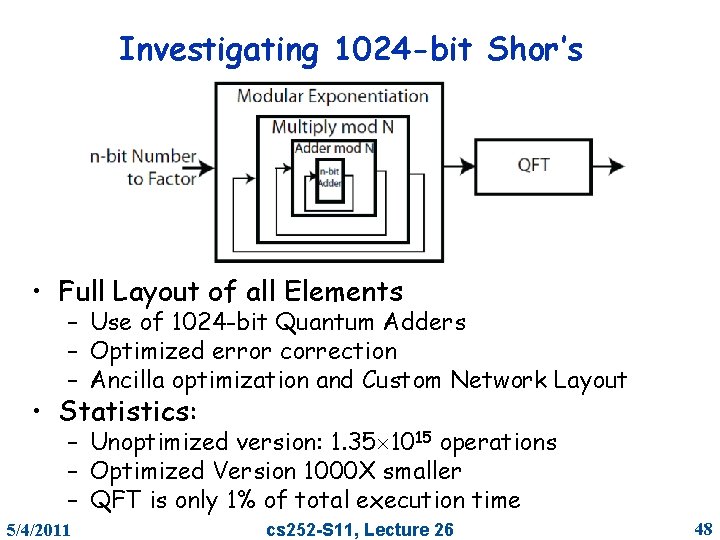
Investigating 1024 -bit Shor’s • Full Layout of all Elements – Use of 1024 -bit Quantum Adders – Optimized error correction – Ancilla optimization and Custom Network Layout • Statistics: – Unoptimized version: 1. 35 1015 operations – Optimized Version 1000 X smaller – QFT is only 1% of total execution time 5/4/2011 cs 252 -S 11, Lecture 26 48
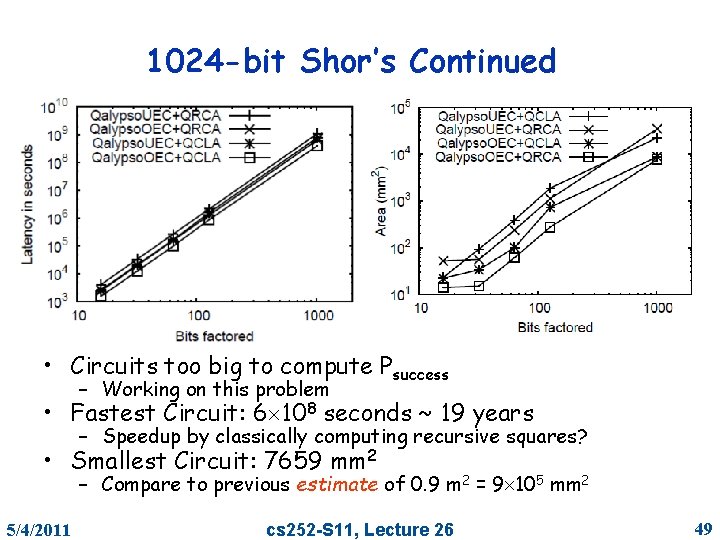
1024 -bit Shor’s Continued • Circuits too big to compute Psuccess – Working on this problem • Fastest Circuit: 6 108 seconds ~ 19 years – Speedup by classically computing recursive squares? • Smallest Circuit: 7659 mm 2 – Compare to previous estimate of 0. 9 m 2 = 9 105 mm 2 5/4/2011 cs 252 -S 11, Lecture 26 49
Conclusion • Quantum Computer Architecture: – Considering details of Quantum Computer systems at larger scale (1000 s or millions of components) – See http: //qarc. cs. berkeley. edu • Argued that CAD tools may have a place in Quantum Computing Research – Presented Some details of a Full CAD flow (Partitioning, Layout, Simulation, Error Analysis) – New Evaluation Metric: ADCR = Area E(Latency) – Full mapping and layout accounts for communication cost • “Recorrection” Optimization for QEC – Simplistic model (EDist) to place correction blocks – Validation with full layout – Can improve ADCR by factors of 10 or more • Improves latency and area significantly, can improve probability under some circumstances as well • Full analysis of Adder architectures and 1024 -bit Shor’s – Still too long (and too big), but smaller than previous estimates – Total circuit size still too big for our error analysis – but have this Lecture 26 5/4/2011 hope that we can improve cs 252 -S 11, 50