
CS 252 Graduate Computer Architecture Lecture 21 IO
- Slides: 48
CS 252 Graduate Computer Architecture Lecture 21 I/O Introduction Prof. John Kubiatowicz Computer Science 252 Fall 1998 11/10/99 CS 252/Kubiatowicz Lec 21. 1
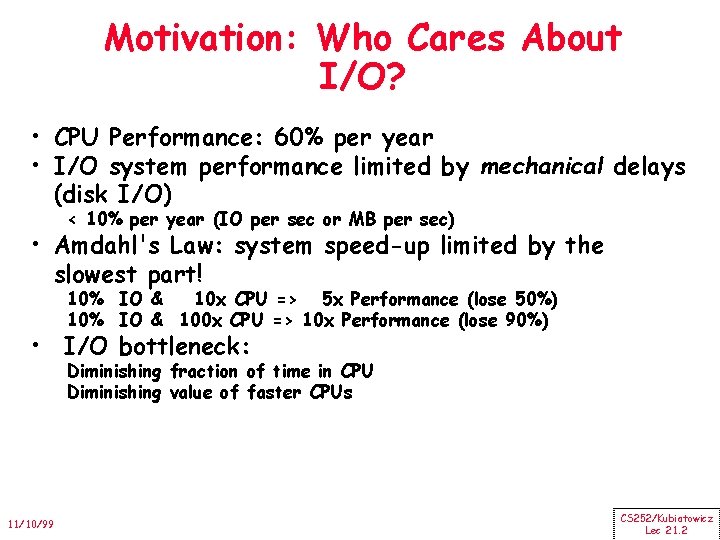
Motivation: Who Cares About I/O? • CPU Performance: 60% per year • I/O system performance limited by mechanical delays (disk I/O) < 10% per year (IO per sec or MB per sec) • Amdahl's Law: system speed-up limited by the slowest part! 10% IO & 10 x CPU => 5 x Performance (lose 50%) 10% IO & 100 x CPU => 10 x Performance (lose 90%) • I/O bottleneck: Diminishing fraction of time in CPU Diminishing value of faster CPUs 11/10/99 CS 252/Kubiatowicz Lec 21. 2
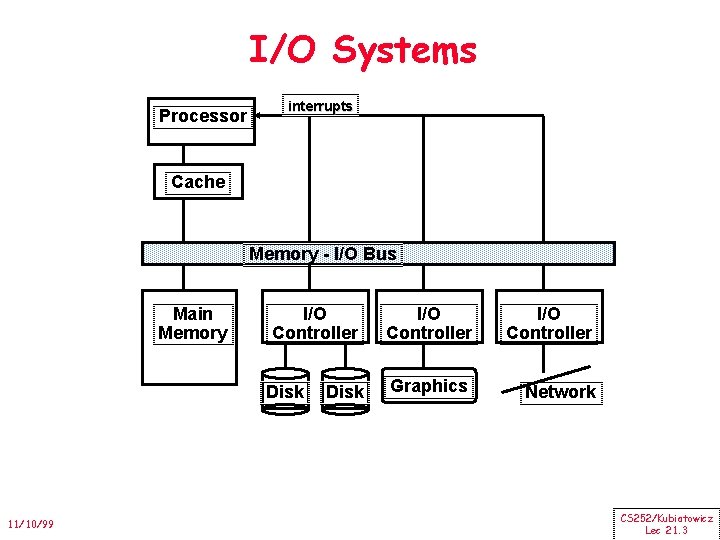
I/O Systems Processor interrupts Cache Memory - I/O Bus Main Memory I/O Controller Disk 11/10/99 Disk I/O Controller Graphics Network CS 252/Kubiatowicz Lec 21. 3
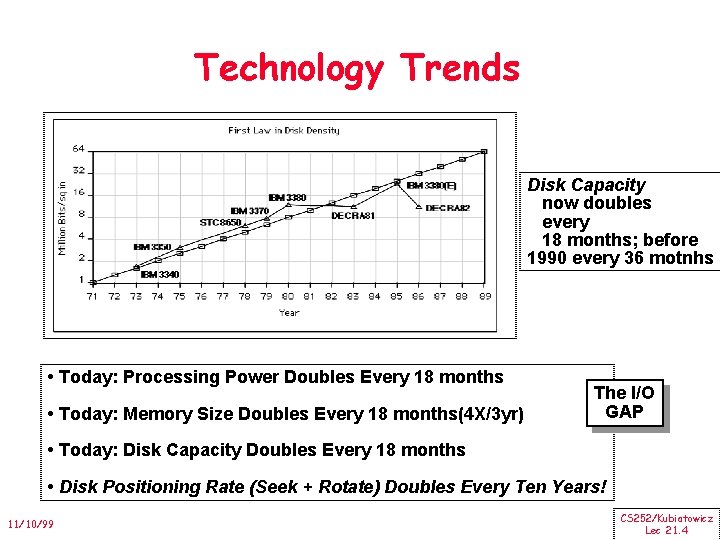
Technology Trends Disk Capacity now doubles every 18 months; before 1990 every 36 motnhs • Today: Processing Power Doubles Every 18 months • Today: Memory Size Doubles Every 18 months(4 X/3 yr) The I/O GAP • Today: Disk Capacity Doubles Every 18 months • Disk Positioning Rate (Seek + Rotate) Doubles Every Ten Years! 11/10/99 CS 252/Kubiatowicz Lec 21. 4
Storage Technology Drivers • Driven by the prevailing computing paradigm – 1950 s: migration from batch to on-line processing – 1990 s: migration to ubiquitous computing » computers in phones, books, cars, video cameras, … » nationwide fiber optical network with wireless tails • Effects on storage industry: – Embedded storage » smaller, cheaper, more reliable, lower power – Data utilities » high capacity, hierarchically managed storage 11/10/99 CS 252/Kubiatowicz Lec 21. 5
Historical Perspective • 1956 IBM Ramac — early 1970 s Winchester – Developed for mainframe computers, proprietary interfaces – Steady shrink in form factor: 27 in. to 14 in. • 1970 s developments – 5. 25 inch floppy disk formfactor (microcode into mainframe) – early emergence of industry standard disk interfaces » ST 506, SASI, SMD, ESDI • Early 1980 s – PCs and first generation workstations • Mid 1980 s – Client/server computing – Centralized storage on file server » accelerates disk downsizing: 8 inch to 5. 25 inch – Mass market disk drives become a reality » industry standards: SCSI, IPI, IDE » 5. 25 inch drives for standalone PCs, End of proprietary interfaces 11/10/99 CS 252/Kubiatowicz Lec 21. 6
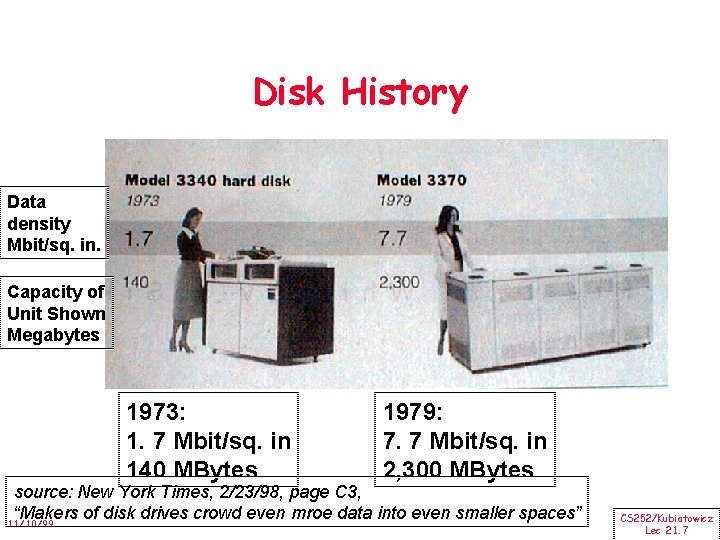
Disk History Data density Mbit/sq. in. Capacity of Unit Shown Megabytes 1973: 1. 7 Mbit/sq. in 140 MBytes 1979: 7. 7 Mbit/sq. in 2, 300 MBytes source: New York Times, 2/23/98, page C 3, “Makers of disk drives crowd even mroe data into even smaller spaces” 11/10/99 CS 252/Kubiatowicz Lec 21. 7
Historical Perspective • Late 1980 s/Early 1990 s: – Laptops, notebooks, (palmtops) – 3. 5 inch, 2. 5 inch, (1. 8 inch formfactors) – Formfactor plus capacity drives market, not so much performance » Recently Bandwidth improving at 40%/ year – Challenged by DRAM, flash RAM in PCMCIA cards » still expensive, Intel promises but doesn’t deliver » unattractive MBytes per cubic inch – Optical disk fails on performace (e. g. , NEXT) but finds niche (CD ROM) 11/10/99 CS 252/Kubiatowicz Lec 21. 8
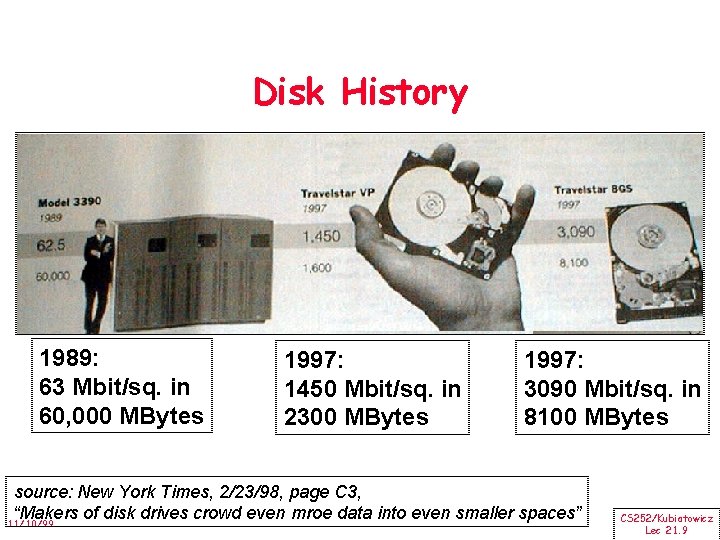
Disk History 1989: 63 Mbit/sq. in 60, 000 MBytes 1997: 1450 Mbit/sq. in 2300 MBytes 1997: 3090 Mbit/sq. in 8100 MBytes source: New York Times, 2/23/98, page C 3, “Makers of disk drives crowd even mroe data into even smaller spaces” 11/10/99 CS 252/Kubiatowicz Lec 21. 9
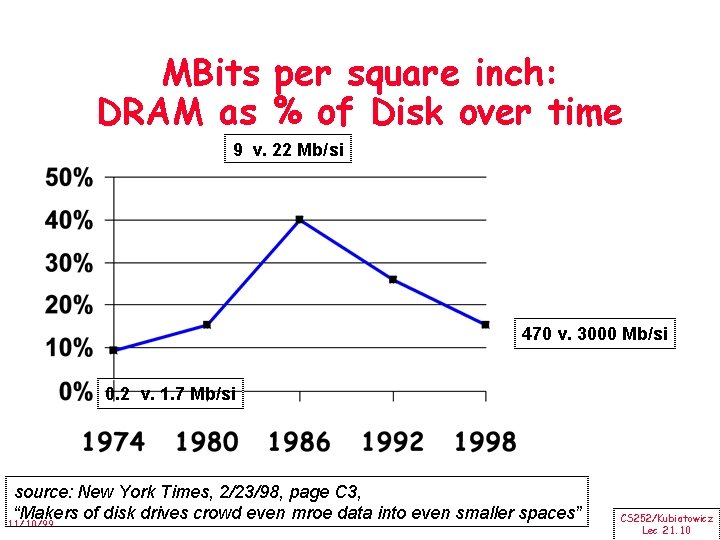
MBits per square inch: DRAM as % of Disk over time 9 v. 22 Mb/si 470 v. 3000 Mb/si 0. 2 v. 1. 7 Mb/si source: New York Times, 2/23/98, page C 3, “Makers of disk drives crowd even mroe data into even smaller spaces” 11/10/99 CS 252/Kubiatowicz Lec 21. 10
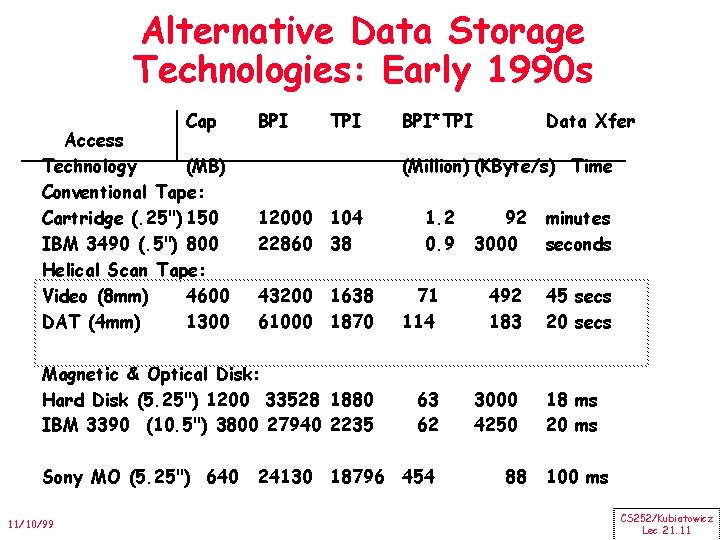
Alternative Data Storage Technologies: Early 1990 s Cap Access Technology (MB) Conventional Tape: Cartridge (. 25") 150 IBM 3490 (. 5") 800 Helical Scan Tape: Video (8 mm) 4600 DAT (4 mm) 1300 BPI TPI BPI*TPI Data Xfer (Million) (KByte/s) Time 12000 104 22860 38 1. 2 0. 9 92 3000 minutes seconds 45 secs 20 secs 43200 1638 61000 1870 71 114 492 183 Magnetic & Optical Disk: Hard Disk (5. 25") 1200 33528 1880 IBM 3390 (10. 5") 3800 27940 2235 63 62 3000 4250 Sony MO (5. 25") 640 11/10/99 24130 18796 454 88 18 ms 20 ms 100 ms CS 252/Kubiatowicz Lec 21. 11
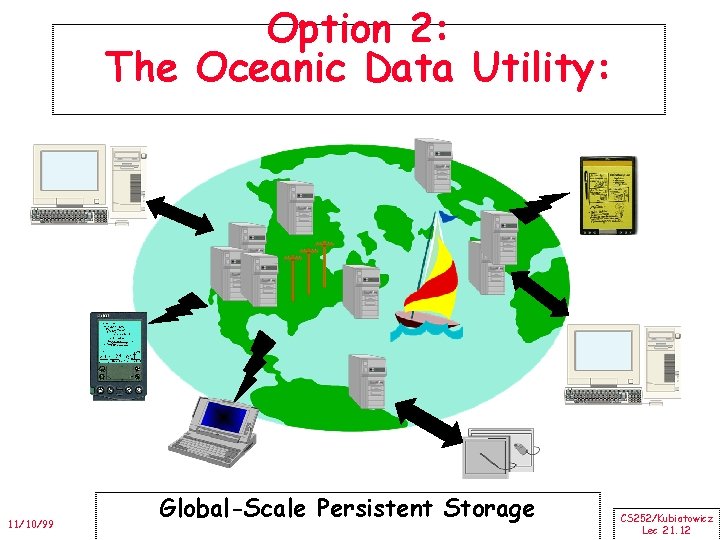
Option 2: The Oceanic Data Utility: 11/10/99 Global-Scale Persistent Storage CS 252/Kubiatowicz Lec 21. 12
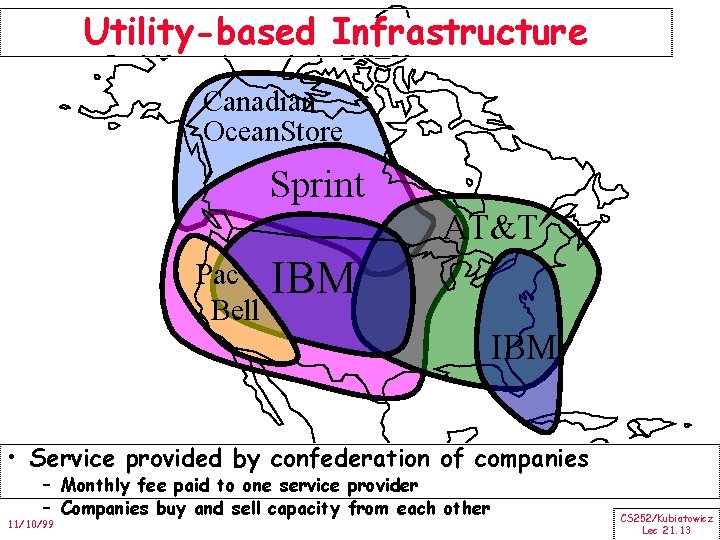
Utility-based Infrastructure Canadian Ocean. Store Sprint AT&T Pac Bell IBM • Service provided by confederation of companies – Monthly fee paid to one service provider – Companies buy and sell capacity from each other 11/10/99 CS 252/Kubiatowicz Lec 21. 13
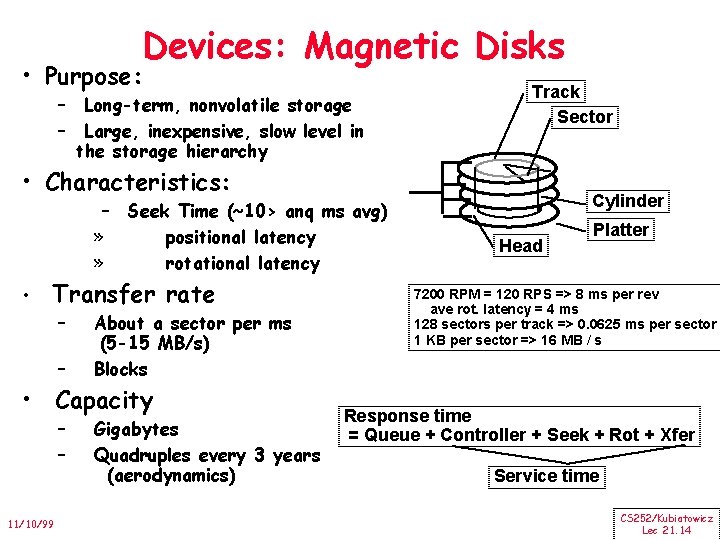
Devices: Magnetic Disks • Purpose: – Long-term, nonvolatile storage – Large, inexpensive, slow level in the storage hierarchy Track Sector • Characteristics: – Seek Time (~10> anq ms avg) » positional latency » rotational latency • Transfer rate – – About a sector per ms (5 -15 MB/s) Blocks • Capacity – – 11/10/99 Gigabytes Quadruples every 3 years (aerodynamics) Cylinder Head Platter 7200 RPM = 120 RPS => 8 ms per rev ave rot. latency = 4 ms 128 sectors per track => 0. 0625 ms per sector 1 KB per sector => 16 MB / s Response time = Queue + Controller + Seek + Rot + Xfer Service time CS 252/Kubiatowicz Lec 21. 14
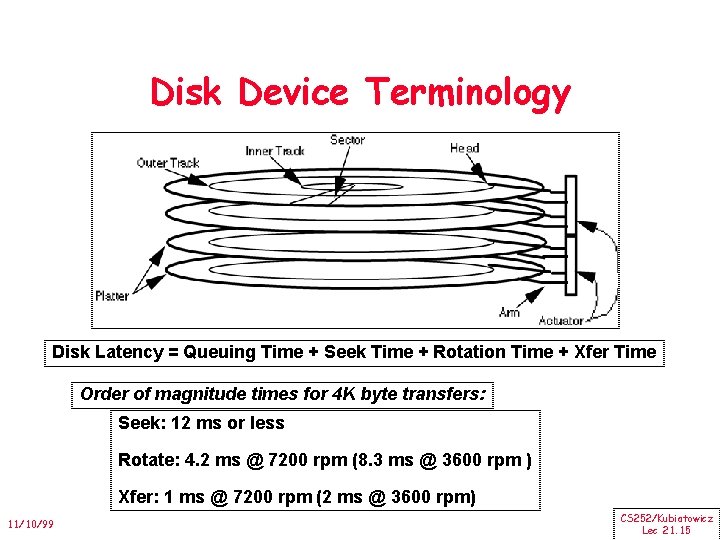
Disk Device Terminology Disk Latency = Queuing Time + Seek Time + Rotation Time + Xfer Time Order of magnitude times for 4 K byte transfers: Seek: 12 ms or less Rotate: 4. 2 ms @ 7200 rpm (8. 3 ms @ 3600 rpm ) Xfer: 1 ms @ 7200 rpm (2 ms @ 3600 rpm) 11/10/99 CS 252/Kubiatowicz Lec 21. 15
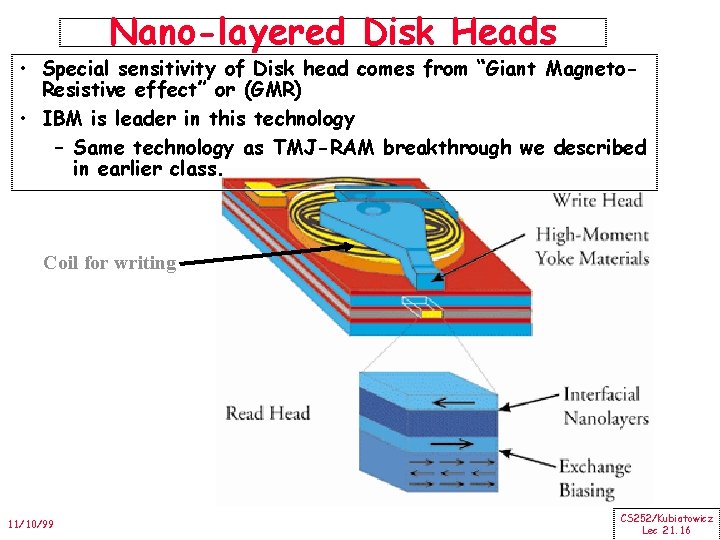
Nano-layered Disk Heads • Special sensitivity of Disk head comes from “Giant Magneto. Resistive effect” or (GMR) • IBM is leader in this technology – Same technology as TMJ-RAM breakthrough we described in earlier class. Coil for writing 11/10/99 CS 252/Kubiatowicz Lec 21. 16
CS 252 Administrivia • Upcoming schedule of project events in CS 252 – – Friday Nov 12: finish I/O? Start multiprocessing/networking Remaining 3 lectures before Thanksgiving: multiprocessing Wednesday Dec 1: Midterm I Friday Dec 3: Esoteric computation. » Quantum/DNA/Nano computing – Next week: Midproject meetings. Tuesday? (Sharad? ) – Tue/Wed Dec 7/8 for oral reports? – Friday Dec 10: project reports due. Get moving!!! 11/10/99 CS 252/Kubiatowicz Lec 21. 17
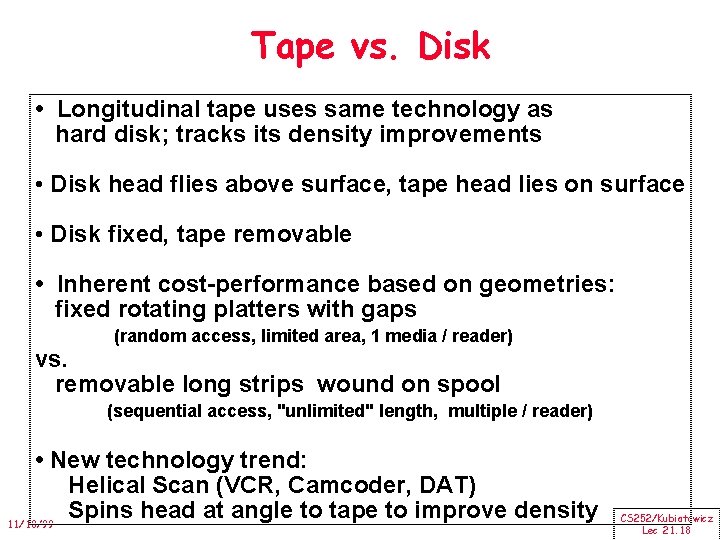
Tape vs. Disk • Longitudinal tape uses same technology as hard disk; tracks its density improvements • Disk head flies above surface, tape head lies on surface • Disk fixed, tape removable • Inherent cost-performance based on geometries: fixed rotating platters with gaps (random access, limited area, 1 media / reader) vs. removable long strips wound on spool (sequential access, "unlimited" length, multiple / reader) • New technology trend: Helical Scan (VCR, Camcoder, DAT) Spins head at angle to tape to improve density 11/10/99 CS 252/Kubiatowicz Lec 21. 18
Current Drawbacks to Tape • Tape wear out: – Helical 100 s of passes to 1000 s for longitudinal • Head wear out: – 2000 hours for helical • Both must be accounted for in economic / reliability model • Long rewind, eject, load, spin-up times; not inherent, just no need in marketplace (so far) • Designed for archival 11/10/99 CS 252/Kubiatowicz Lec 21. 19
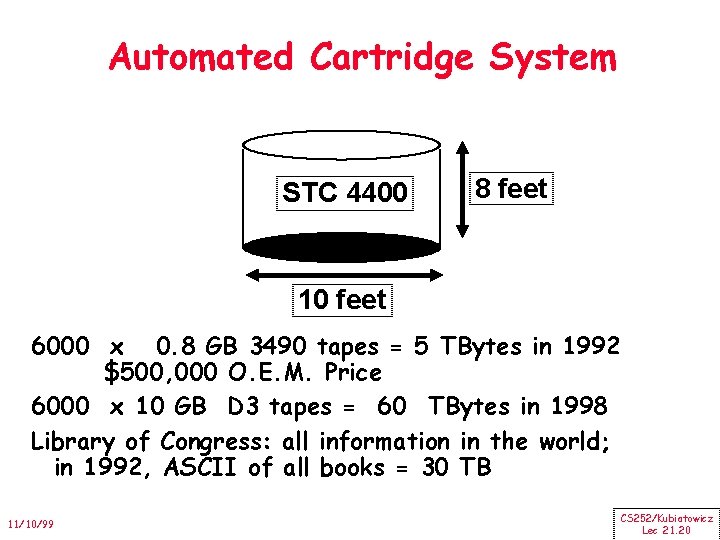
Automated Cartridge System STC 4400 8 feet 10 feet 6000 x 0. 8 GB 3490 tapes = 5 TBytes in 1992 $500, 000 O. E. M. Price 6000 x 10 GB D 3 tapes = 60 TBytes in 1998 Library of Congress: all information in the world; in 1992, ASCII of all books = 30 TB 11/10/99 CS 252/Kubiatowicz Lec 21. 20
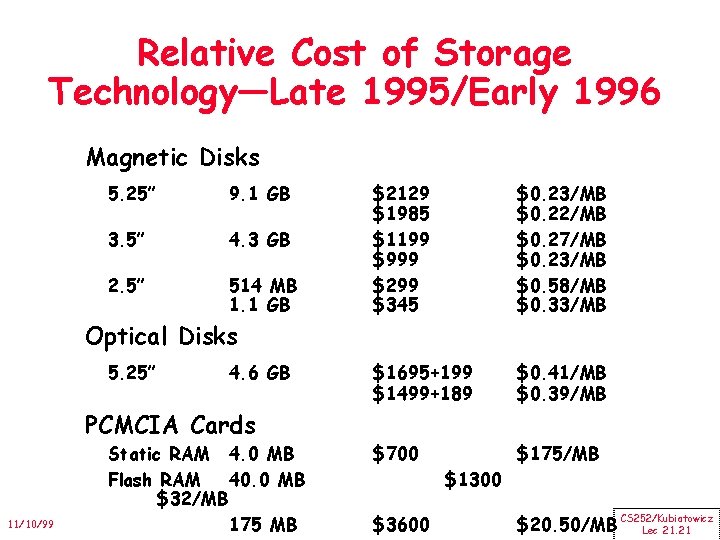
Relative Cost of Storage Technology—Late 1995/Early 1996 Magnetic Disks 5. 25” 9. 1 GB 3. 5” 4. 3 GB 2. 5” 514 MB 1. 1 GB $2129 $1985 $1199 $999 $299 $345 $0. 23/MB $0. 22/MB $0. 27/MB $0. 23/MB $0. 58/MB $0. 33/MB $1695+199 $1499+189 $0. 41/MB $0. 39/MB $700 $175/MB Optical Disks 5. 25” 4. 6 GB PCMCIA Cards 11/10/99 Static RAM 4. 0 MB Flash RAM 40. 0 MB $32/MB 175 MB $1300 $3600 $20. 50/MB CS 252/Kubiatowicz Lec 21. 21
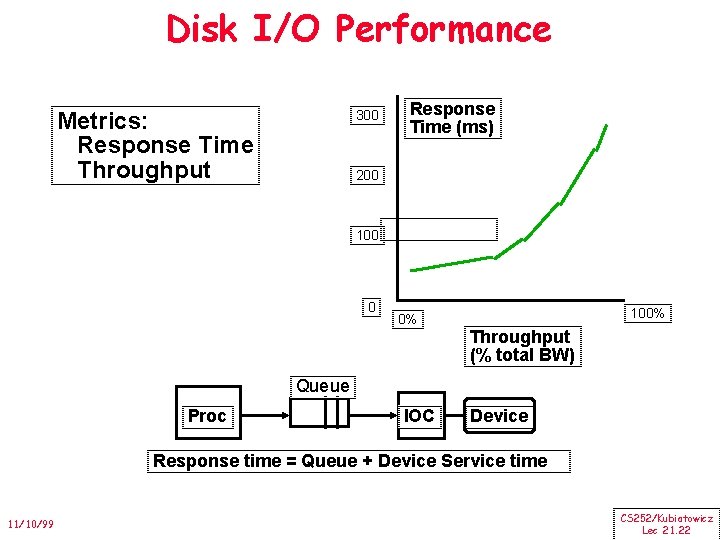
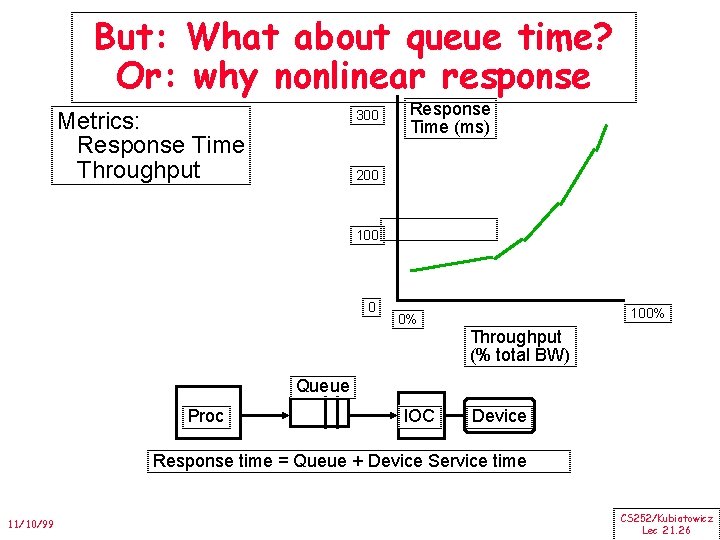
Disk I/O Performance Metrics: Response Time Throughput 300 Response Time (ms) 200 100 0 0% 100% Throughput (% total BW) Queue Proc IOC Device Response time = Queue + Device Service time 11/10/99 CS 252/Kubiatowicz Lec 21. 22
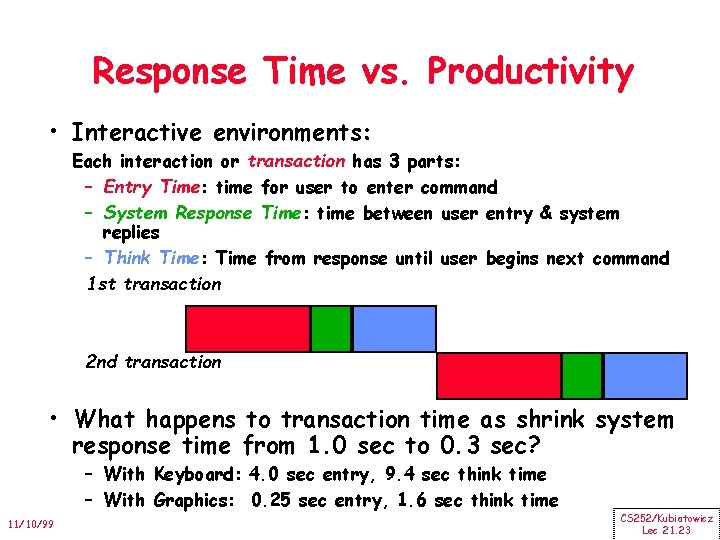
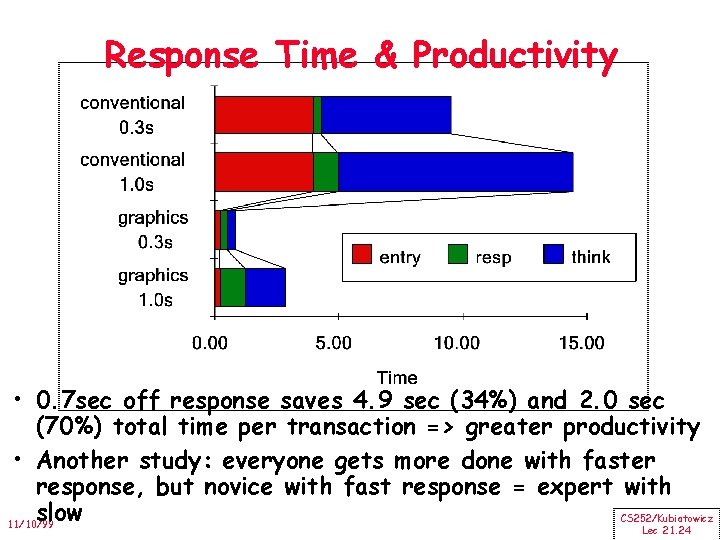
Response Time vs. Productivity • Interactive environments: Each interaction or transaction has 3 parts: – Entry Time: time for user to enter command – System Response Time: time between user entry & system replies – Think Time: Time from response until user begins next command 1 st transaction 2 nd transaction • What happens to transaction time as shrink system response time from 1. 0 sec to 0. 3 sec? – With Keyboard: 4. 0 sec entry, 9. 4 sec think time – With Graphics: 0. 25 sec entry, 1. 6 sec think time 11/10/99 CS 252/Kubiatowicz Lec 21. 23
Response Time & Productivity • 0. 7 sec off response saves 4. 9 sec (34%) and 2. 0 sec (70%) total time per transaction => greater productivity • Another study: everyone gets more done with faster response, but novice with fast response = expert with slow CS 252/Kubiatowicz 11/10/99 Lec 21. 24
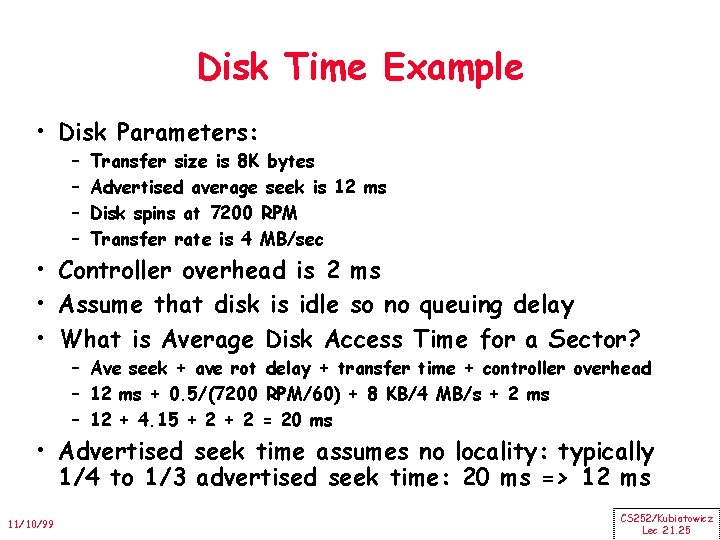
Disk Time Example • Disk Parameters: – – Transfer size is 8 K bytes Advertised average seek is 12 ms Disk spins at 7200 RPM Transfer rate is 4 MB/sec • Controller overhead is 2 ms • Assume that disk is idle so no queuing delay • What is Average Disk Access Time for a Sector? – Ave seek + ave rot delay + transfer time + controller overhead – 12 ms + 0. 5/(7200 RPM/60) + 8 KB/4 MB/s + 2 ms – 12 + 4. 15 + 2 = 20 ms • Advertised seek time assumes no locality: typically 1/4 to 1/3 advertised seek time: 20 ms => 12 ms 11/10/99 CS 252/Kubiatowicz Lec 21. 25
But: What about queue time? Or: why nonlinear response Metrics: Response Time Throughput 300 Response Time (ms) 200 100 0 0% 100% Throughput (% total BW) Queue Proc IOC Device Response time = Queue + Device Service time 11/10/99 CS 252/Kubiatowicz Lec 21. 26
Departure to discuss queueing theory (On board) 11/10/99 CS 252/Kubiatowicz Lec 21. 27
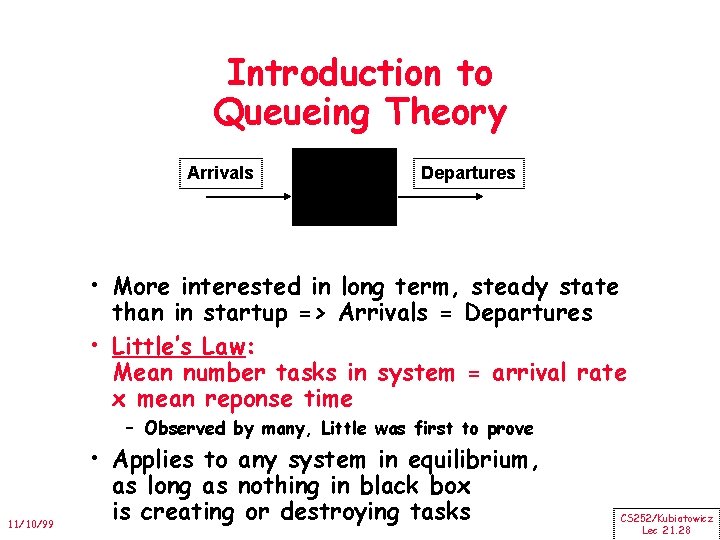
Introduction to Queueing Theory Arrivals Departures • More interested in long term, steady state than in startup => Arrivals = Departures • Little’s Law: Mean number tasks in system = arrival rate x mean reponse time – Observed by many, Little was first to prove 11/10/99 • Applies to any system in equilibrium, as long as nothing in black box is creating or destroying tasks CS 252/Kubiatowicz Lec 21. 28
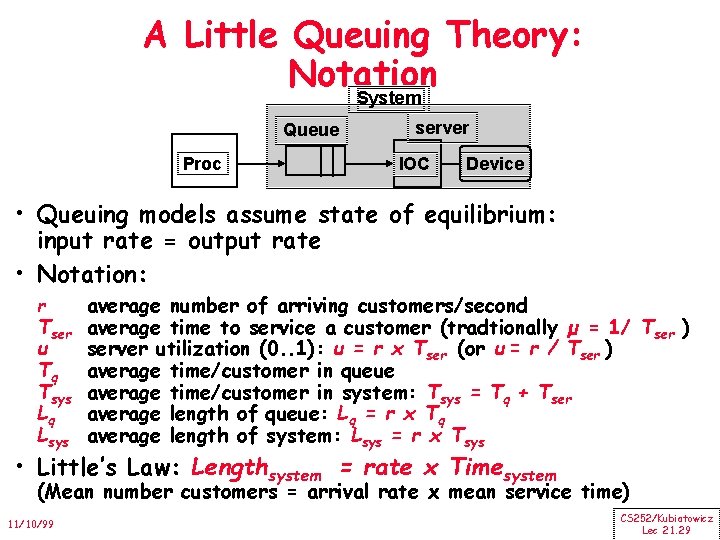
A Little Queuing Theory: Notation System Queue Proc server IOC Device • Queuing models assume state of equilibrium: input rate = output rate • Notation: r Tser u Tq Tsys Lq Lsys average number of arriving customers/second average time to service a customer (tradtionally µ = 1/ Tser ) server utilization (0. . 1): u = r x Tser (or u = r / Tser ) average time/customer in queue average time/customer in system: Tsys = Tq + Tser average length of queue: Lq = r x Tq average length of system: Lsys = r x Tsys • Little’s Law: Lengthsystem = rate x Timesystem (Mean number customers = arrival rate x mean service time) 11/10/99 CS 252/Kubiatowicz Lec 21. 29
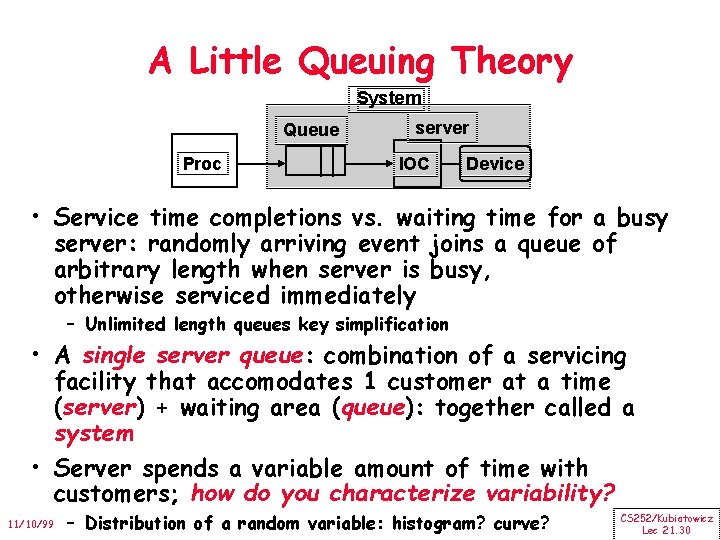
A Little Queuing Theory System Queue Proc server IOC Device • Service time completions vs. waiting time for a busy server: randomly arriving event joins a queue of arbitrary length when server is busy, otherwise serviced immediately – Unlimited length queues key simplification • A single server queue: combination of a servicing facility that accomodates 1 customer at a time (server) + waiting area (queue): together called a system • Server spends a variable amount of time with customers; how do you characterize variability? 11/10/99 – Distribution of a random variable: histogram? curve? CS 252/Kubiatowicz Lec 21. 30
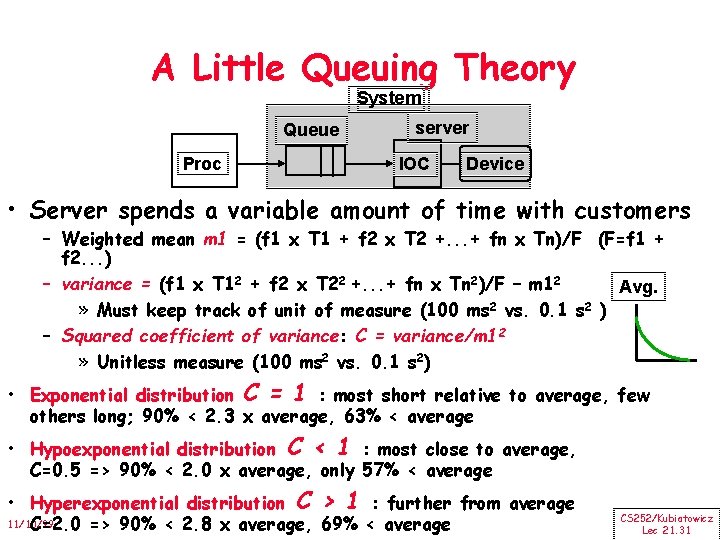
A Little Queuing Theory System Queue Proc server IOC Device • Server spends a variable amount of time with customers – Weighted mean m 1 = (f 1 x T 1 + f 2 x T 2 +. . . + fn x Tn)/F (F=f 1 + f 2. . . ) – variance = (f 1 x T 12 + f 2 x T 22 +. . . + fn x Tn 2)/F – m 12 Avg. » Must keep track of unit of measure (100 ms 2 vs. 0. 1 s 2 ) – Squared coefficient of variance: C = variance/m 12 » Unitless measure (100 ms 2 vs. 0. 1 s 2) • Exponential distribution C = 1 : most short relative to average, few others long; 90% < 2. 3 x average, 63% < average • Hypoexponential distribution C < 1 : most close to average, C=0. 5 => 90% < 2. 0 x average, only 57% < average • Hyperexponential distribution C > 1 : further from average 11/10/99 C=2. 0 => 90% < 2. 8 x average, 69% < average CS 252/Kubiatowicz Lec 21. 31
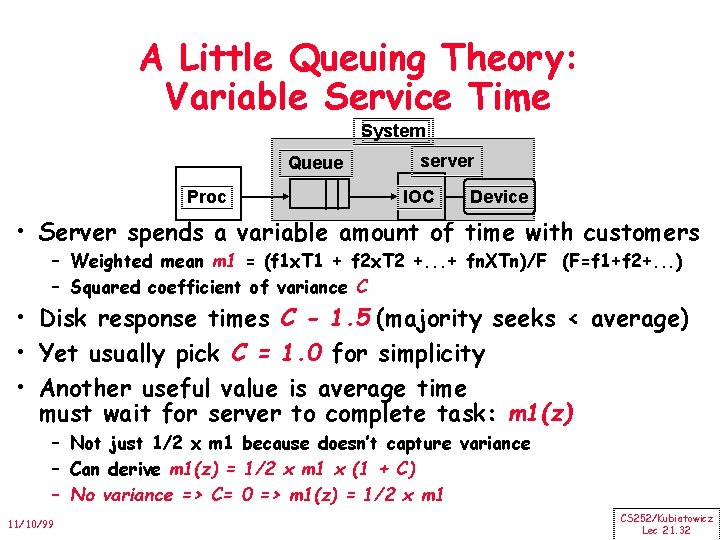
A Little Queuing Theory: Variable Service Time System Queue Proc server IOC Device • Server spends a variable amount of time with customers – Weighted mean m 1 = (f 1 x. T 1 + f 2 x. T 2 +. . . + fn. XTn)/F (F=f 1+f 2+. . . ) – Squared coefficient of variance C • Disk response times C 1. 5 (majority seeks < average) • Yet usually pick C = 1. 0 for simplicity • Another useful value is average time must wait for server to complete task: m 1(z) – Not just 1/2 x m 1 because doesn’t capture variance – Can derive m 1(z) = 1/2 x m 1 x (1 + C) – No variance => C= 0 => m 1(z) = 1/2 x m 1 11/10/99 CS 252/Kubiatowicz Lec 21. 32
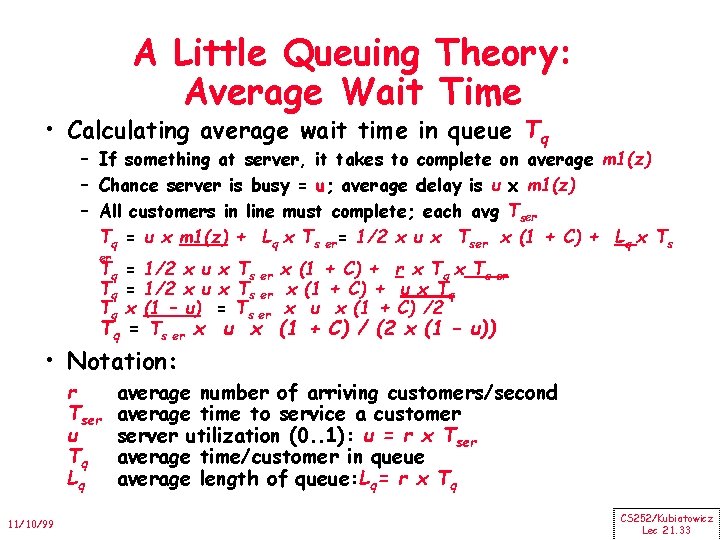
A Little Queuing Theory: Average Wait Time • Calculating average wait time in queue Tq – If something at server, it takes to complete on average m 1(z) – Chance server is busy = u; average delay is u x m 1(z) – All customers in line must complete; each avg Tser Tq = u x m 1(z) + Lq x Ts er= 1/2 x u x Tser x (1 + C) + Lq x Ts er Tq = 1/2 x u Tq x (1 – u) Tq = Ts er x x Ts er x (1 + C) + r x Tq x Ts er x (1 + C) + u x Tq = Ts er x u x (1 + C) /2 u x (1 + C) / (2 x (1 – u)) • Notation: r Tser u Tq Lq 11/10/99 average number of arriving customers/second average time to service a customer server utilization (0. . 1): u = r x Tser average time/customer in queue average length of queue: Lq= r x Tq CS 252/Kubiatowicz Lec 21. 33
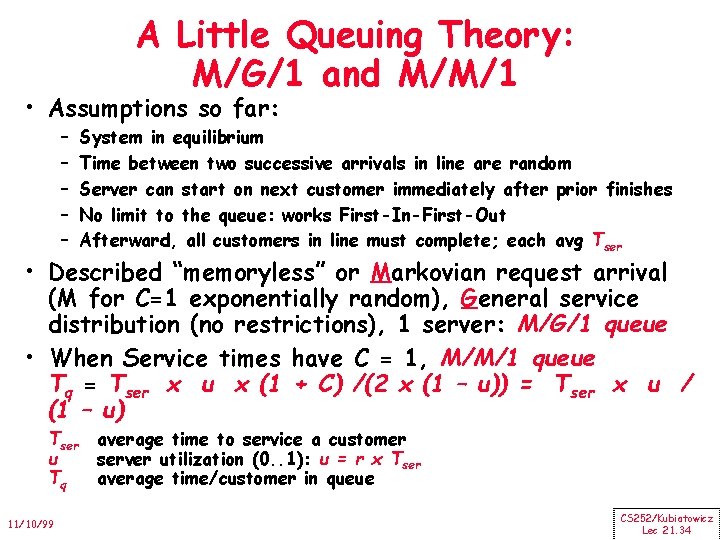
A Little Queuing Theory: M/G/1 and M/M/1 • Assumptions so far: – – – System in equilibrium Time between two successive arrivals in line are random Server can start on next customer immediately after prior finishes No limit to the queue: works First-In-First-Out Afterward, all customers in line must complete; each avg Tser • Described “memoryless” or Markovian request arrival (M for C=1 exponentially random), General service distribution (no restrictions), 1 server: M/G/1 queue • When Service times have C = 1, M/M/1 queue Tq = Tser x u x (1 + C) /(2 x (1 – u)) = Tser x u / (1 – u) Tser u Tq 11/10/99 average time to service a customer server utilization (0. . 1): u = r x Tser average time/customer in queue CS 252/Kubiatowicz Lec 21. 34
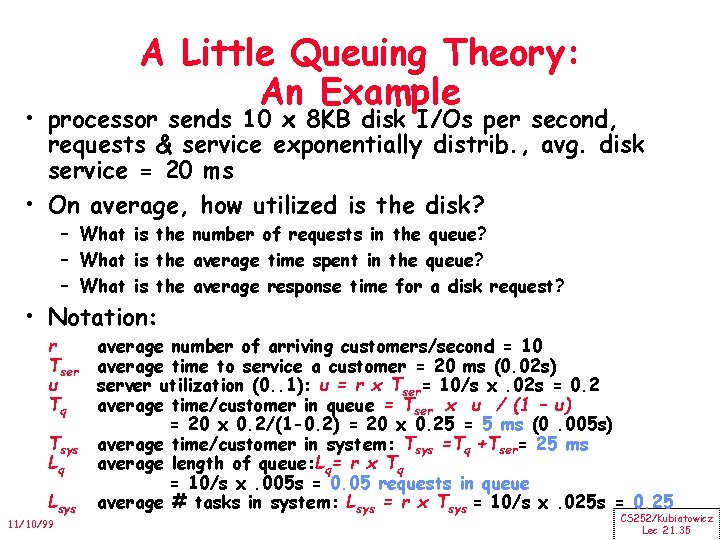
A Little Queuing Theory: An Example • processor sends 10 x 8 KB disk I/Os per second, requests & service exponentially distrib. , avg. disk service = 20 ms • On average, how utilized is the disk? – What is the number of requests in the queue? – What is the average time spent in the queue? – What is the average response time for a disk request? • Notation: r Tser u Tq Tsys Lq Lsys 11/10/99 average number of arriving customers/second = 10 average time to service a customer = 20 ms (0. 02 s) server utilization (0. . 1): u = r x Tser= 10/s x. 02 s = 0. 2 average time/customer in queue = Tser x u / (1 – u) = 20 x 0. 2/(1 -0. 2) = 20 x 0. 25 = 5 ms (0. 005 s) average time/customer in system: Tsys =Tq +Tser= 25 ms average length of queue: Lq= r x Tq = 10/s x. 005 s = 0. 05 requests in queue average # tasks in system: Lsys = r x Tsys = 10/s x. 025 s = 0. 25 CS 252/Kubiatowicz Lec 21. 35
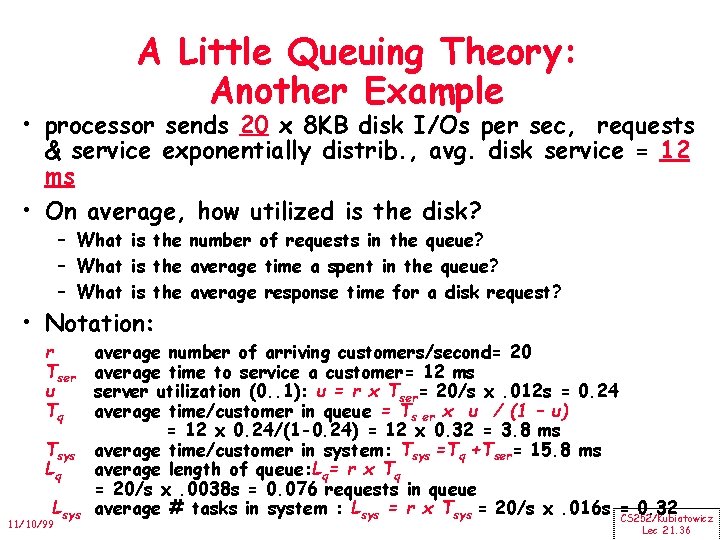
A Little Queuing Theory: Another Example • processor sends 20 x 8 KB disk I/Os per sec, requests & service exponentially distrib. , avg. disk service = 12 ms • On average, how utilized is the disk? – What is the number of requests in the queue? – What is the average time a spent in the queue? – What is the average response time for a disk request? • Notation: r Tser u Tq Tsys Lq Lsys 11/10/99 average number of arriving customers/second= 20 average time to service a customer= 12 ms server utilization (0. . 1): u = r x Tser= 20/s x. 012 s = 0. 24 average time/customer in queue = Ts er x u / (1 – u) = 12 x 0. 24/(1 -0. 24) = 12 x 0. 32 = 3. 8 ms average time/customer in system: Tsys =Tq +Tser= 15. 8 ms average length of queue: Lq= r x Tq = 20/s x. 0038 s = 0. 076 requests in queue average # tasks in system : Lsys = r x Tsys = 20/s x. 016 s =CS 252/Kubiatowicz 0. 32 Lec 21. 36
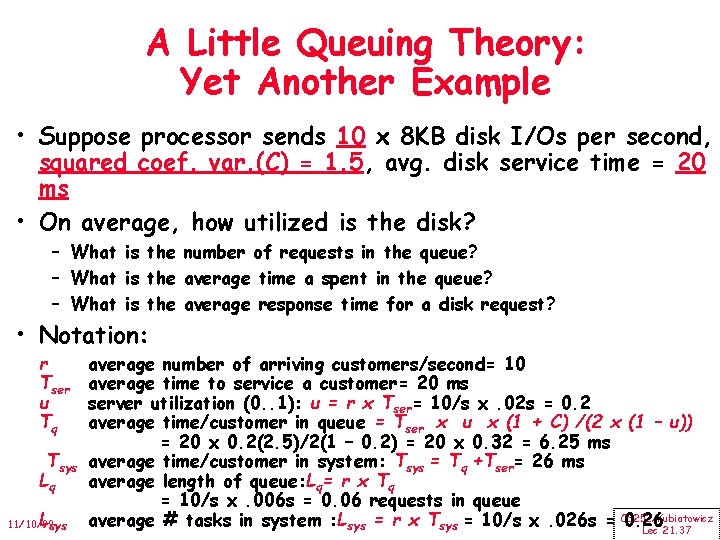
A Little Queuing Theory: Yet Another Example • Suppose processor sends 10 x 8 KB disk I/Os per second, squared coef. var. (C) = 1. 5, avg. disk service time = 20 ms • On average, how utilized is the disk? – What is the number of requests in the queue? – What is the average time a spent in the queue? – What is the average response time for a disk request? • Notation: r Tser u Tq Tsys Lq L 11/10/99 sys average number of arriving customers/second= 10 average time to service a customer= 20 ms server utilization (0. . 1): u = r x Tser= 10/s x. 02 s = 0. 2 average time/customer in queue = Tser x u x (1 + C) /(2 x (1 – u)) = 20 x 0. 2(2. 5)/2(1 – 0. 2) = 20 x 0. 32 = 6. 25 ms average time/customer in system: Tsys = Tq +Tser= 26 ms average length of queue: Lq= r x Tq = 10/s x. 006 s = 0. 06 requests in queue average # tasks in system : Lsys = r x Tsys = 10/s x. 026 s = CS 252/Kubiatowicz 0. 26 Lec 21. 37
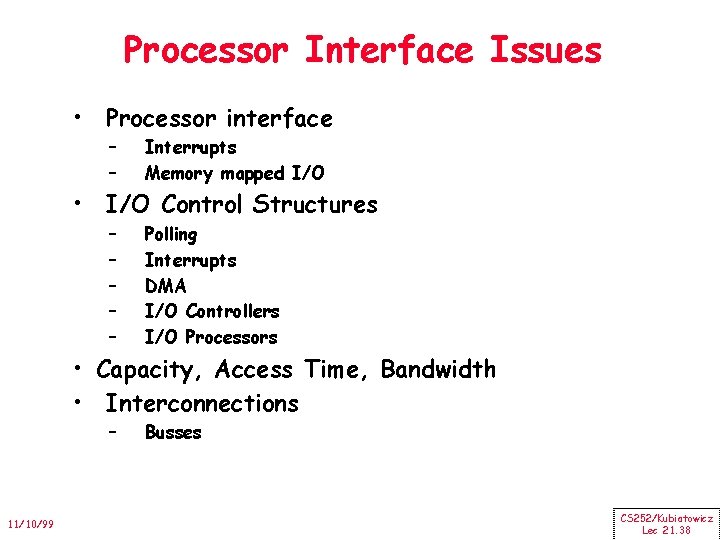
Processor Interface Issues • Processor interface – – Interrupts Memory mapped I/O • I/O Control Structures – – – Polling Interrupts DMA I/O Controllers I/O Processors • Capacity, Access Time, Bandwidth • Interconnections – 11/10/99 Busses CS 252/Kubiatowicz Lec 21. 38
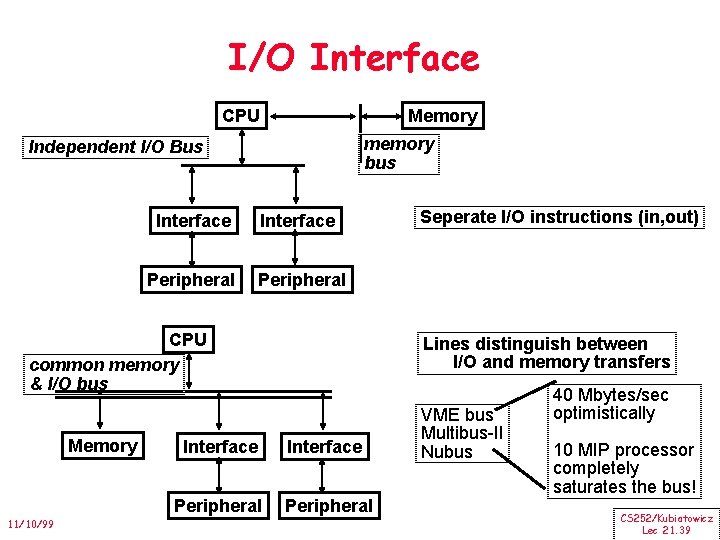
I/O Interface CPU Memory memory bus Independent I/O Bus Interface Peripheral CPU common memory & I/O bus Memory 11/10/99 Seperate I/O instructions (in, out) Lines distinguish between I/O and memory transfers Interface Peripheral VME bus Multibus-II Nubus 40 Mbytes/sec optimistically 10 MIP processor completely saturates the bus! CS 252/Kubiatowicz Lec 21. 39
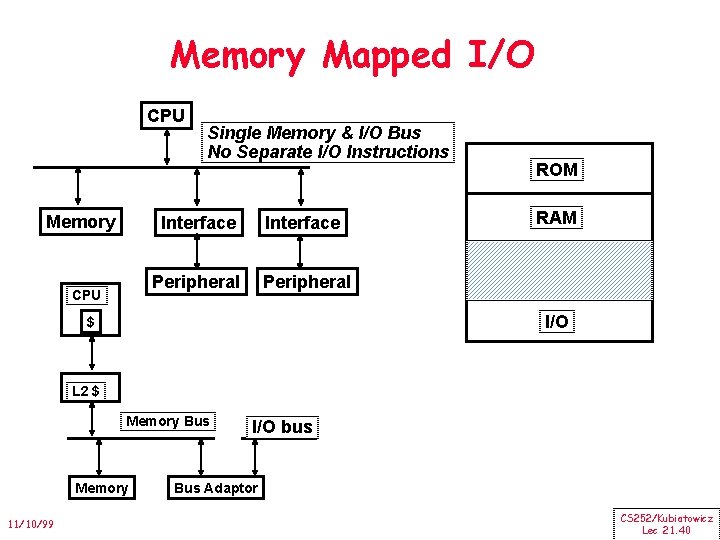
Memory Mapped I/O CPU Memory CPU Single Memory & I/O Bus No Separate I/O Instructions Interface Peripheral ROM RAM I/O $ L 2 $ Memory Bus Memory 11/10/99 I/O bus Bus Adaptor CS 252/Kubiatowicz Lec 21. 40
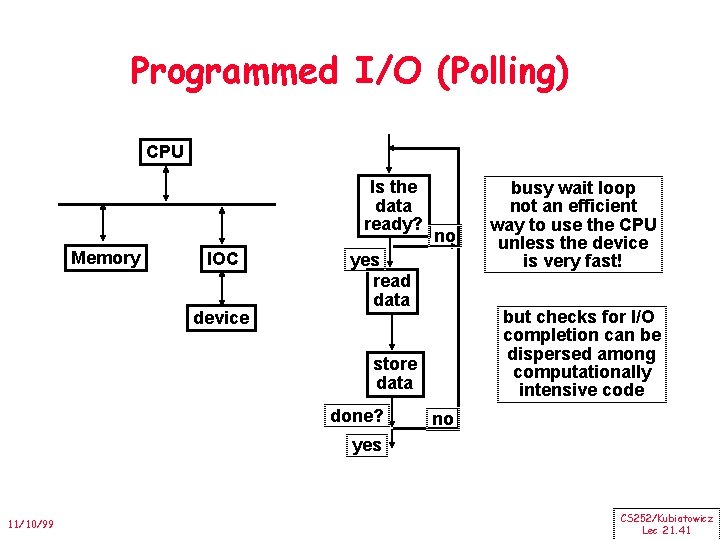
Programmed I/O (Polling) CPU Is the data ready? Memory IOC device no yes read data but checks for I/O completion can be dispersed among computationally intensive code store data done? busy wait loop not an efficient way to use the CPU unless the device is very fast! no yes 11/10/99 CS 252/Kubiatowicz Lec 21. 41
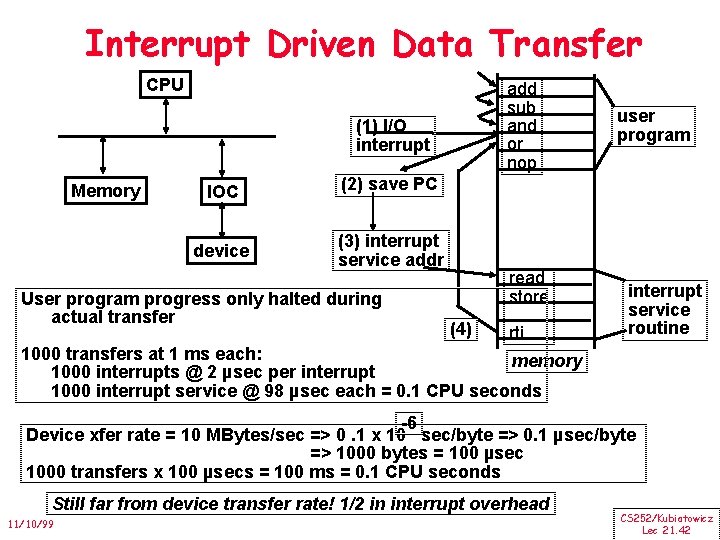
Interrupt Driven Data Transfer CPU add sub and or nop (1) I/O interrupt Memory IOC (2) save PC device (3) interrupt service addr User program progress only halted during actual transfer (4) read store. . . rti user program interrupt service routine 1000 transfers at 1 ms each: memory 1000 interrupts @ 2 µsec per interrupt 1000 interrupt service @ 98 µsec each = 0. 1 CPU seconds -6 Device xfer rate = 10 MBytes/sec => 0. 1 x 10 sec/byte => 0. 1 µsec/byte => 1000 bytes = 100 µsec 1000 transfers x 100 µsecs = 100 ms = 0. 1 CPU seconds Still far from device transfer rate! 1/2 in interrupt overhead 11/10/99 CS 252/Kubiatowicz Lec 21. 42
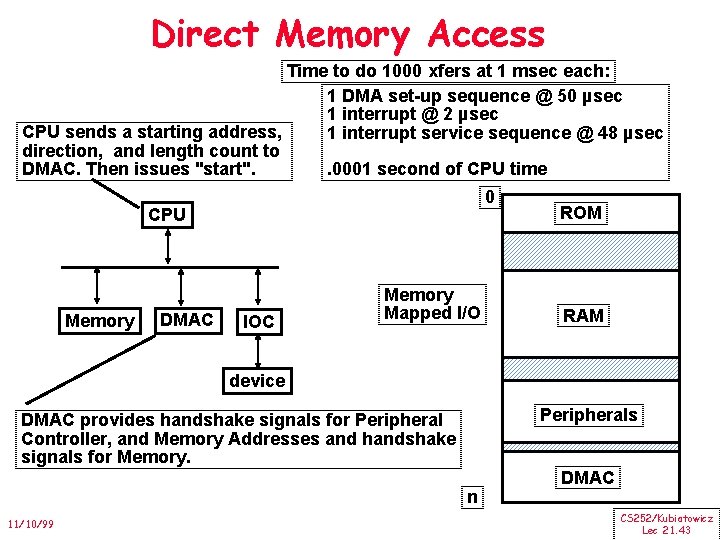
Direct Memory Access Time to do 1000 xfers at 1 msec each: 1 DMA set-up sequence @ 50 µsec 1 interrupt @ 2 µsec CPU sends a starting address, 1 interrupt service sequence @ 48 µsec direction, and length count to DMAC. Then issues "start". . 0001 second of CPU time 0 CPU Memory DMAC IOC Memory Mapped I/O ROM RAM device Peripherals DMAC provides handshake signals for Peripheral Controller, and Memory Addresses and handshake signals for Memory. n 11/10/99 DMAC CS 252/Kubiatowicz Lec 21. 43
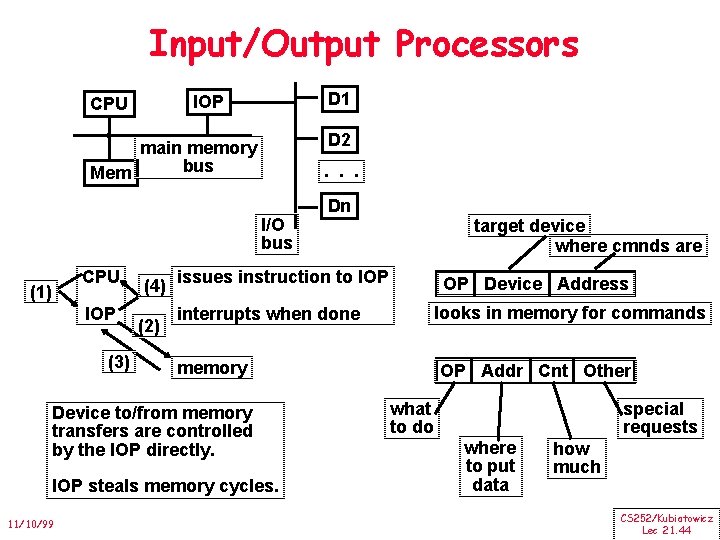
Input/Output Processors D 1 IOP CPU D 2 main memory bus Mem . . . I/O bus CPU (1) IOP (3) target device where cmnds are (4) issues instruction to IOP (2) OP Device Address looks in memory for commands interrupts when done memory Device to/from memory transfers are controlled by the IOP directly. IOP steals memory cycles. 11/10/99 Dn OP Addr Cnt Other what to do special requests where to put data how much CS 252/Kubiatowicz Lec 21. 44
Relationship to Processor Architecture • I/O instructions have largely disappeared • Interrupt vectors have been replaced by jump tables PC <- M [ IVA + interrupt number ] PC <- IVA + interrupt number • Interrupts: – Stack replaced by shadow registers – Handler saves registers and re-enables higher priority int's – Interrupt types reduced in number; handler must query interrupt controller 11/10/99 CS 252/Kubiatowicz Lec 21. 45
Relationship to Processor Architecture • Caches required for processor performance cause problems for I/O – Flushing is expensive, I/O polutes cache – Solution is borrowed from shared memory multiprocessors "snooping" • Virtual memory frustrates DMA • Load/store architecture at odds with atomic operations – load locked, store conditional • Stateful processors hard to context switch 11/10/99 CS 252/Kubiatowicz Lec 21. 46
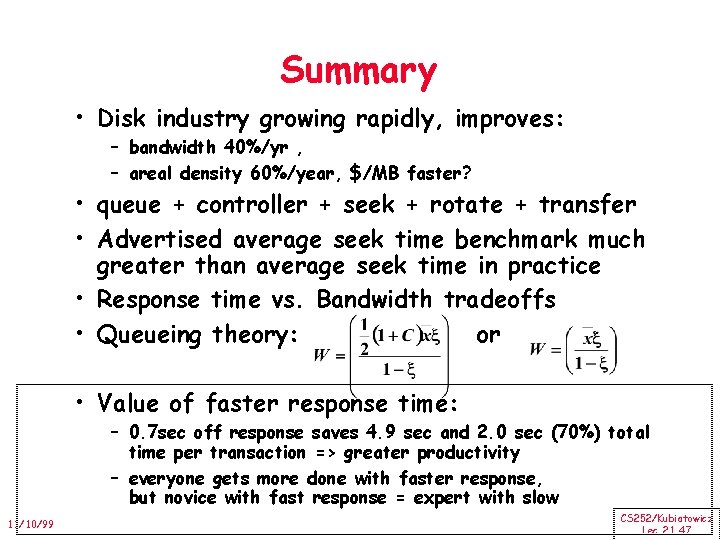
Summary • Disk industry growing rapidly, improves: – bandwidth 40%/yr , – areal density 60%/year, $/MB faster? • queue + controller + seek + rotate + transfer • Advertised average seek time benchmark much greater than average seek time in practice • Response time vs. Bandwidth tradeoffs • Queueing theory: or • Value of faster response time: – 0. 7 sec off response saves 4. 9 sec and 2. 0 sec (70%) total time per transaction => greater productivity – everyone gets more done with faster response, but novice with fast response = expert with slow 11/10/99 CS 252/Kubiatowicz Lec 21. 47
Summary: Relationship to Processor Architecture • I/O instructions have disappeared • Interrupt vectors have been replaced by jump tables • Interrupt stack replaced by shadow registers • Interrupt types reduced in number • Caches required for processor performance cause problems for I/O • Virtual memory frustrates DMA • Load/store architecture at odds with atomic operations • Stateful processors hard to context switch 11/10/99 CS 252/Kubiatowicz Lec 21. 48