
CS 252 Graduate Computer Architecture Lecture 15 Multiprocessor
- Slides: 60
CS 252 Graduate Computer Architecture Lecture 15 Multiprocessor Networks (con’t) March 15 th, 2010 John Kubiatowicz Electrical Engineering and Computer Sciences University of California, Berkeley http: //www. eecs. berkeley. edu/~kubitron/cs 252
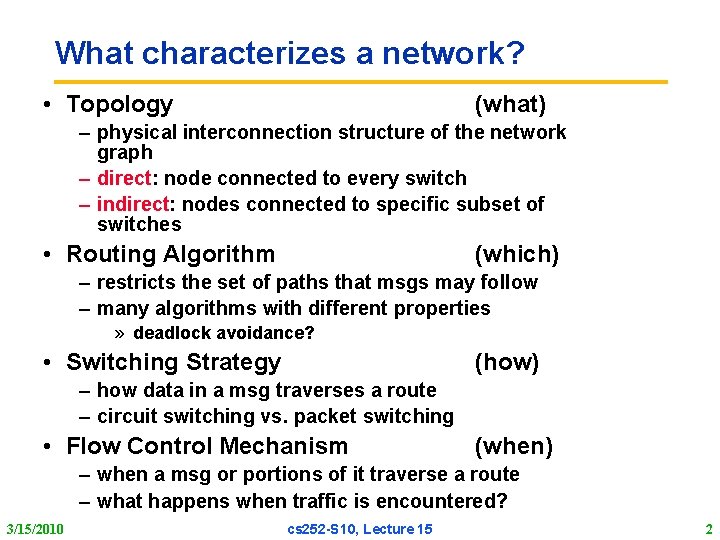
What characterizes a network? • Topology (what) – physical interconnection structure of the network graph – direct: node connected to every switch – indirect: nodes connected to specific subset of switches • Routing Algorithm (which) – restricts the set of paths that msgs may follow – many algorithms with different properties » deadlock avoidance? • Switching Strategy (how) – how data in a msg traverses a route – circuit switching vs. packet switching • Flow Control Mechanism (when) – when a msg or portions of it traverse a route – what happens when traffic is encountered? 3/15/2010 cs 252 -S 10, Lecture 15 2
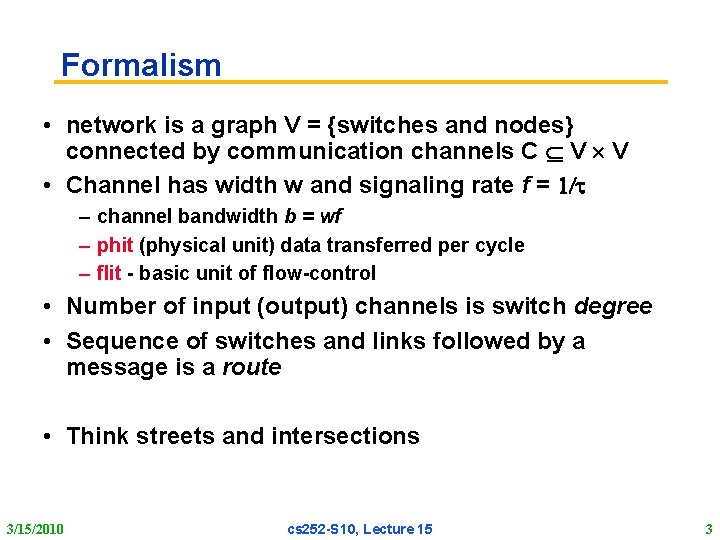
Formalism • network is a graph V = {switches and nodes} connected by communication channels C Í V ´ V • Channel has width w and signaling rate f = 1/ – channel bandwidth b = wf – phit (physical unit) data transferred per cycle – flit - basic unit of flow-control • Number of input (output) channels is switch degree • Sequence of switches and links followed by a message is a route • Think streets and intersections 3/15/2010 cs 252 -S 10, Lecture 15 3
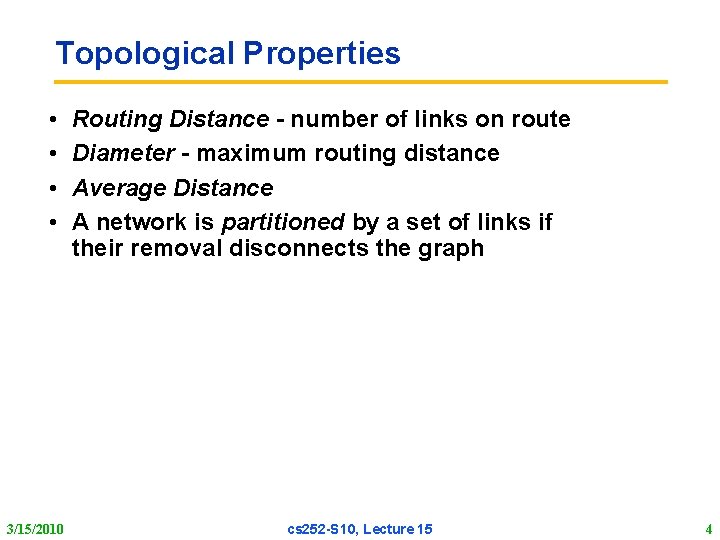
Topological Properties • • 3/15/2010 Routing Distance - number of links on route Diameter - maximum routing distance Average Distance A network is partitioned by a set of links if their removal disconnects the graph cs 252 -S 10, Lecture 15 4
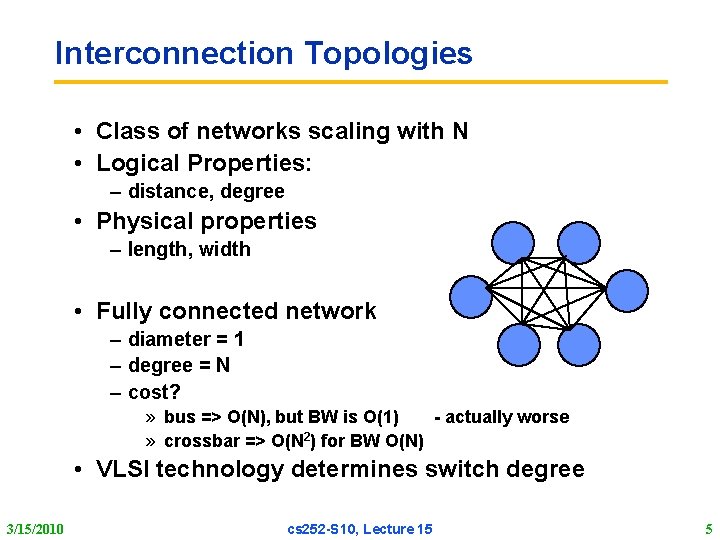
Interconnection Topologies • Class of networks scaling with N • Logical Properties: – distance, degree • Physical properties – length, width • Fully connected network – diameter = 1 – degree = N – cost? » bus => O(N), but BW is O(1) - actually worse » crossbar => O(N 2) for BW O(N) • VLSI technology determines switch degree 3/15/2010 cs 252 -S 10, Lecture 15 5
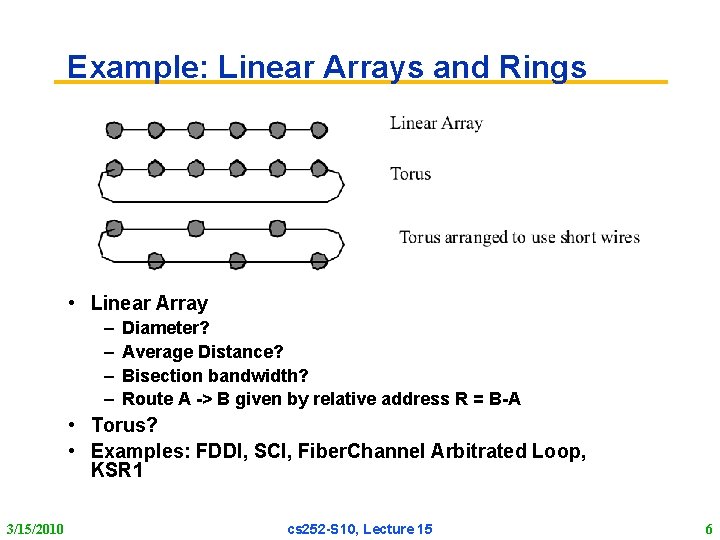
Example: Linear Arrays and Rings • Linear Array – – Diameter? Average Distance? Bisection bandwidth? Route A -> B given by relative address R = B-A • Torus? • Examples: FDDI, SCI, Fiber. Channel Arbitrated Loop, KSR 1 3/15/2010 cs 252 -S 10, Lecture 15 6
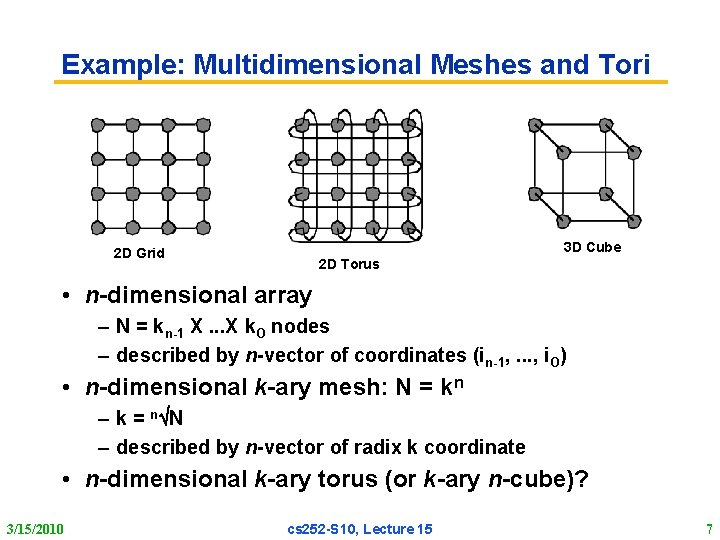
Example: Multidimensional Meshes and Tori 3 D Cube 2 D Grid 2 D Torus • n-dimensional array – N = kn-1 X. . . X k. O nodes – described by n-vector of coordinates (in-1, . . . , i. O) • n-dimensional k-ary mesh: N = kn – k = nÖN – described by n-vector of radix k coordinate • n-dimensional k-ary torus (or k-ary n-cube)? 3/15/2010 cs 252 -S 10, Lecture 15 7
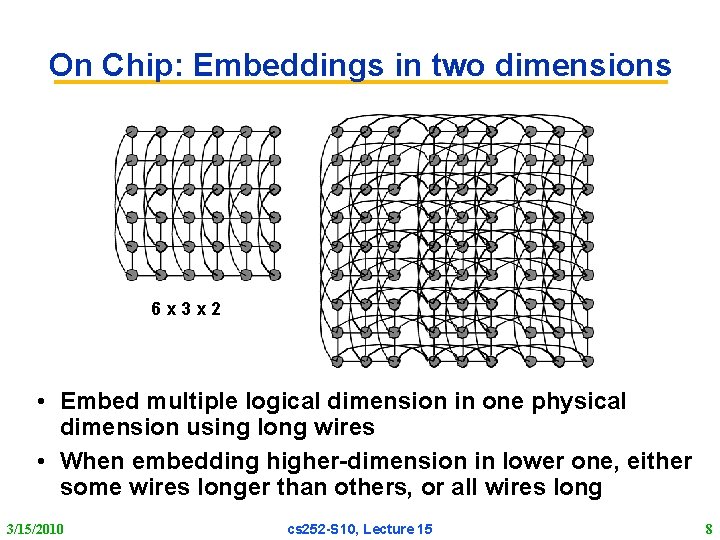
On Chip: Embeddings in two dimensions 6 x 3 x 2 • Embed multiple logical dimension in one physical dimension using long wires • When embedding higher-dimension in lower one, either some wires longer than others, or all wires long 3/15/2010 cs 252 -S 10, Lecture 15 8
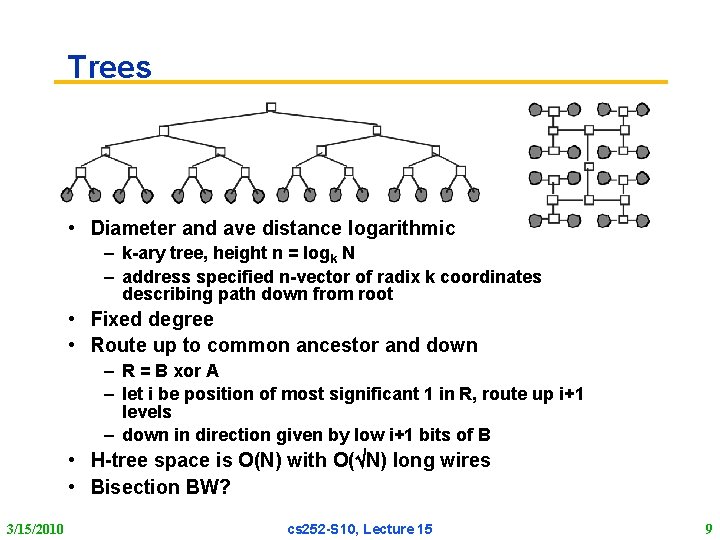
Trees • Diameter and ave distance logarithmic – k-ary tree, height n = logk N – address specified n-vector of radix k coordinates describing path down from root • Fixed degree • Route up to common ancestor and down – R = B xor A – let i be position of most significant 1 in R, route up i+1 levels – down in direction given by low i+1 bits of B • H-tree space is O(N) with O(ÖN) long wires • Bisection BW? 3/15/2010 cs 252 -S 10, Lecture 15 9
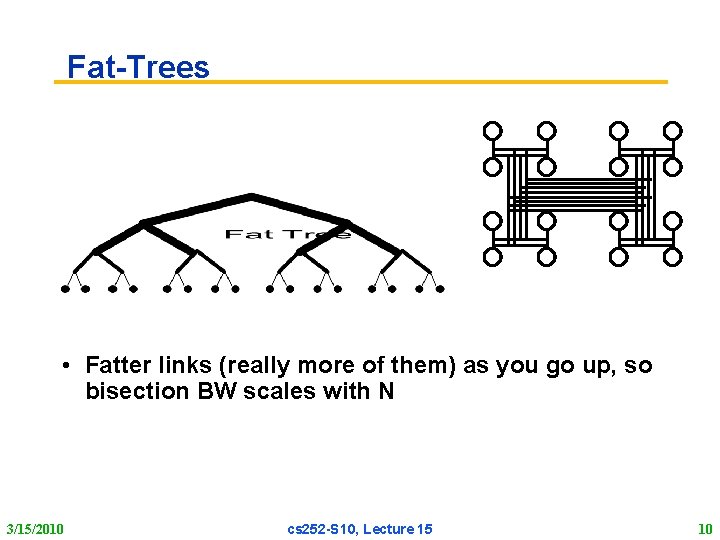
Fat-Trees • Fatter links (really more of them) as you go up, so bisection BW scales with N 3/15/2010 cs 252 -S 10, Lecture 15 10
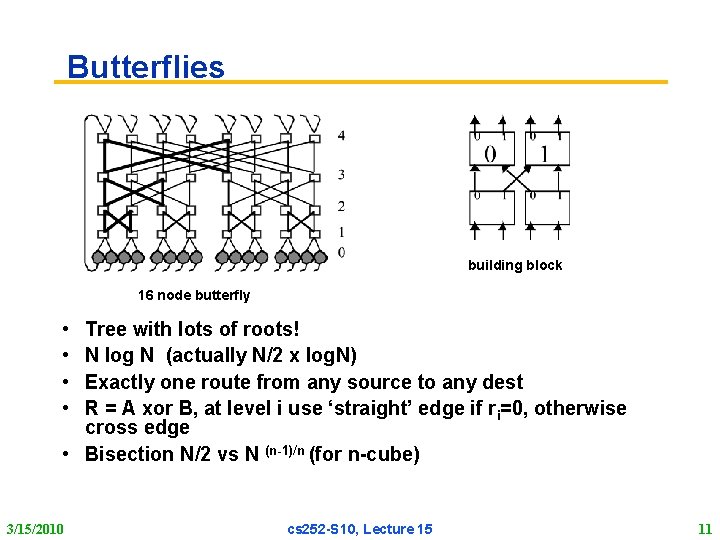
Butterflies building block 16 node butterfly • • Tree with lots of roots! N log N (actually N/2 x log. N) Exactly one route from any source to any dest R = A xor B, at level i use ‘straight’ edge if ri=0, otherwise cross edge • Bisection N/2 vs N (n-1)/n (for n-cube) 3/15/2010 cs 252 -S 10, Lecture 15 11
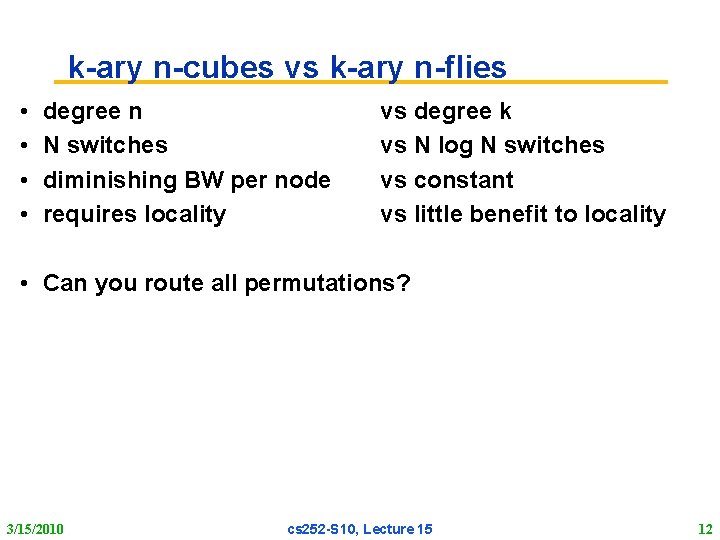
k-ary n-cubes vs k-ary n-flies • • degree n N switches diminishing BW per node requires locality vs degree k vs N log N switches vs constant vs little benefit to locality • Can you route all permutations? 3/15/2010 cs 252 -S 10, Lecture 15 12
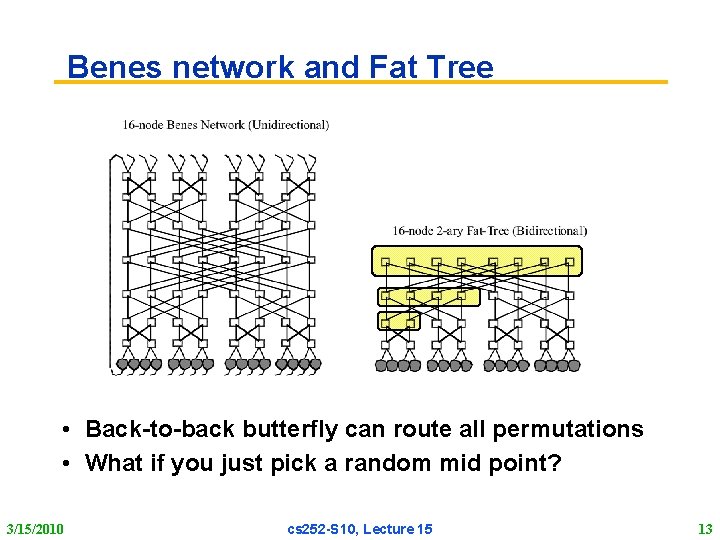
Benes network and Fat Tree • Back-to-back butterfly can route all permutations • What if you just pick a random mid point? 3/15/2010 cs 252 -S 10, Lecture 15 13
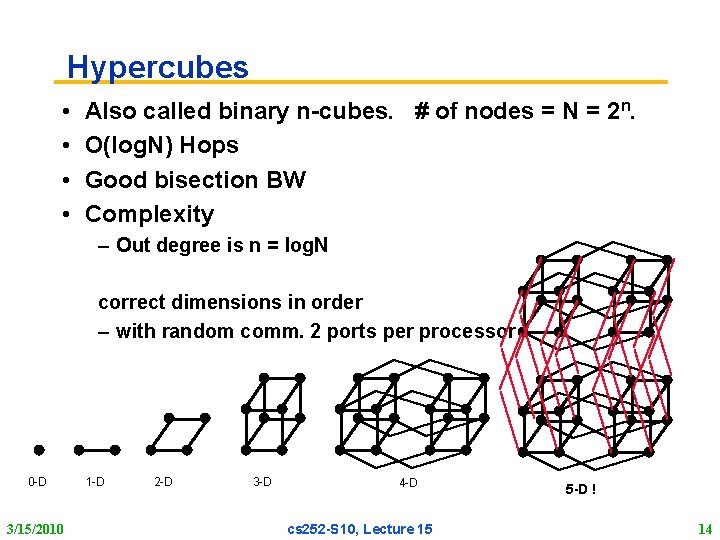
Hypercubes • • Also called binary n-cubes. # of nodes = N = 2 n. O(log. N) Hops Good bisection BW Complexity – Out degree is n = log. N correct dimensions in order – with random comm. 2 ports per processor 0 -D 3/15/2010 1 -D 2 -D 3 -D 4 -D cs 252 -S 10, Lecture 15 5 -D ! 14
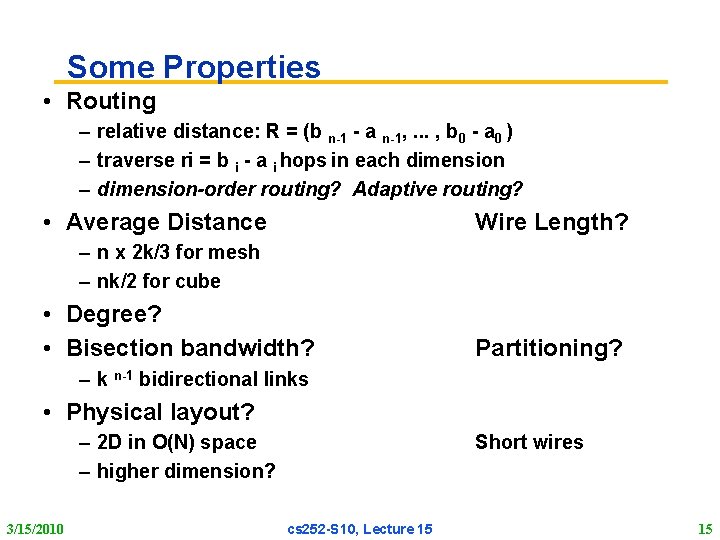
Some Properties • Routing – relative distance: R = (b n-1 - a n-1, . . . , b 0 - a 0 ) – traverse ri = b i - a i hops in each dimension – dimension-order routing? Adaptive routing? • Average Distance Wire Length? – n x 2 k/3 for mesh – nk/2 for cube • Degree? • Bisection bandwidth? Partitioning? – k n-1 bidirectional links • Physical layout? – 2 D in O(N) space – higher dimension? 3/15/2010 Short wires cs 252 -S 10, Lecture 15 15
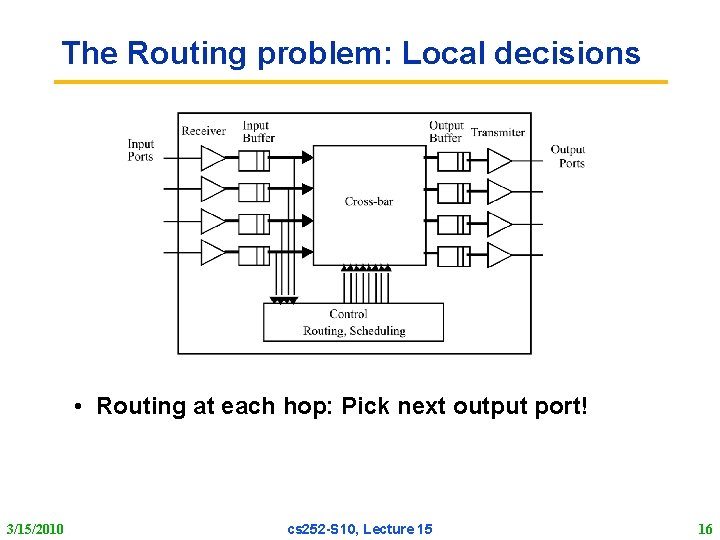
The Routing problem: Local decisions • Routing at each hop: Pick next output port! 3/15/2010 cs 252 -S 10, Lecture 15 16
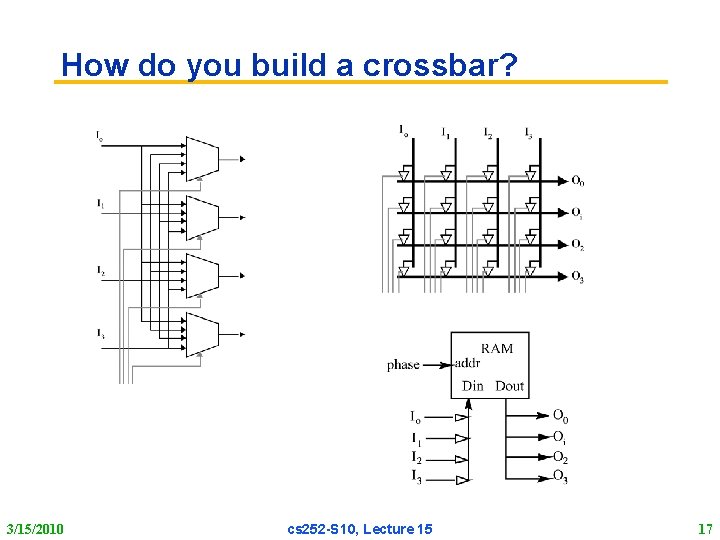
How do you build a crossbar? 3/15/2010 cs 252 -S 10, Lecture 15 17
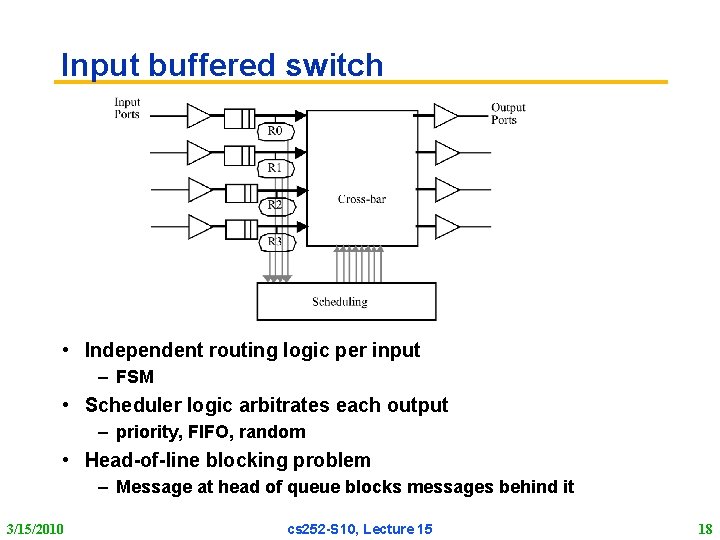
Input buffered switch • Independent routing logic per input – FSM • Scheduler logic arbitrates each output – priority, FIFO, random • Head-of-line blocking problem – Message at head of queue blocks messages behind it 3/15/2010 cs 252 -S 10, Lecture 15 18
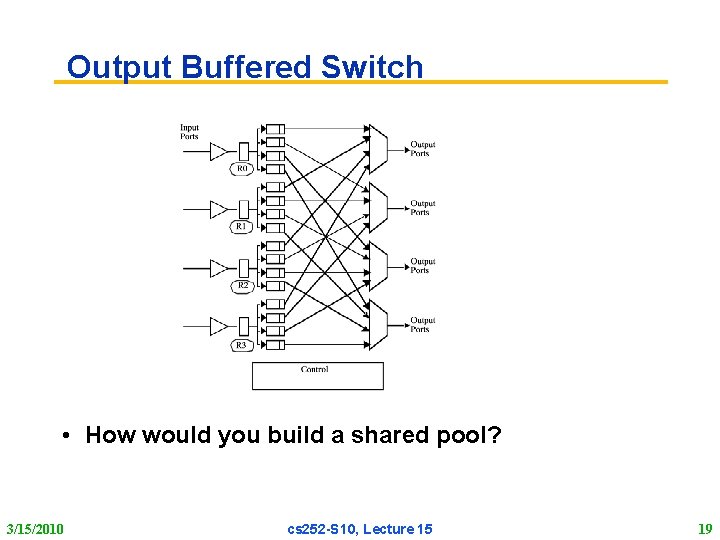
Output Buffered Switch • How would you build a shared pool? 3/15/2010 cs 252 -S 10, Lecture 15 19
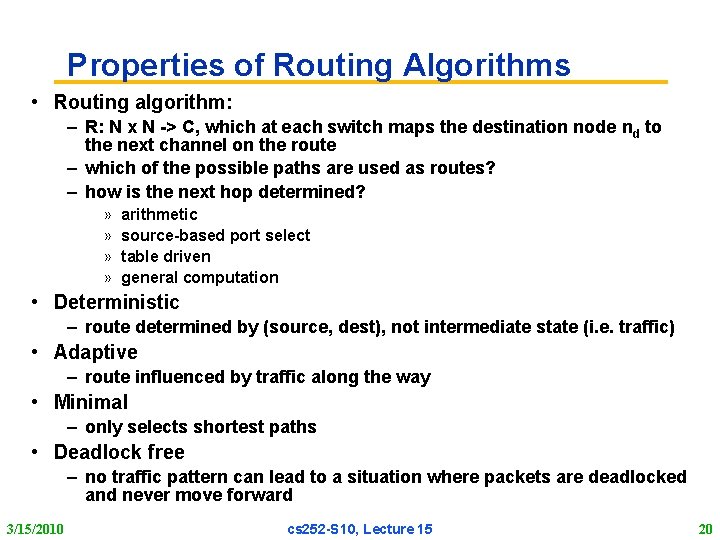
Properties of Routing Algorithms • Routing algorithm: – R: N x N -> C, which at each switch maps the destination node nd to the next channel on the route – which of the possible paths are used as routes? – how is the next hop determined? » » arithmetic source-based port select table driven general computation • Deterministic – route determined by (source, dest), not intermediate state (i. e. traffic) • Adaptive – route influenced by traffic along the way • Minimal – only selects shortest paths • Deadlock free – no traffic pattern can lead to a situation where packets are deadlocked and never move forward 3/15/2010 cs 252 -S 10, Lecture 15 20
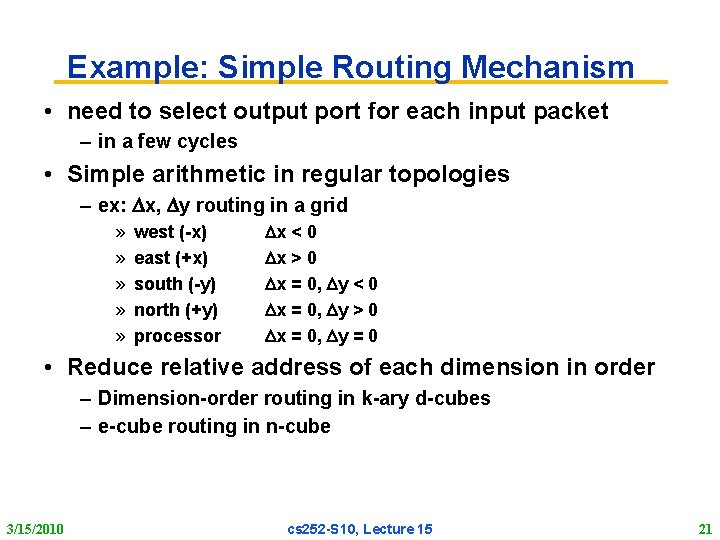
Example: Simple Routing Mechanism • need to select output port for each input packet – in a few cycles • Simple arithmetic in regular topologies – ex: x, y routing in a grid » » » west (-x) east (+x) south (-y) north (+y) processor x < 0 x > 0 x = 0, y < 0 x = 0, y > 0 x = 0, y = 0 • Reduce relative address of each dimension in order – Dimension-order routing in k-ary d-cubes – e-cube routing in n-cube 3/15/2010 cs 252 -S 10, Lecture 15 21
Administrative • Exam: This Wednesday (3/17) Location: 310 Soda TIME: 6: 00 -9: 00 – This info is on the Lecture page (has been) – Get on 8 ½ by 11 sheet of notes (both sides) – Meet at La. Val’s afterwards for Pizza and Beverages • Assume that major papers we have discussed may show up on exam 3/15/2010 cs 252 -S 10, Lecture 15 22
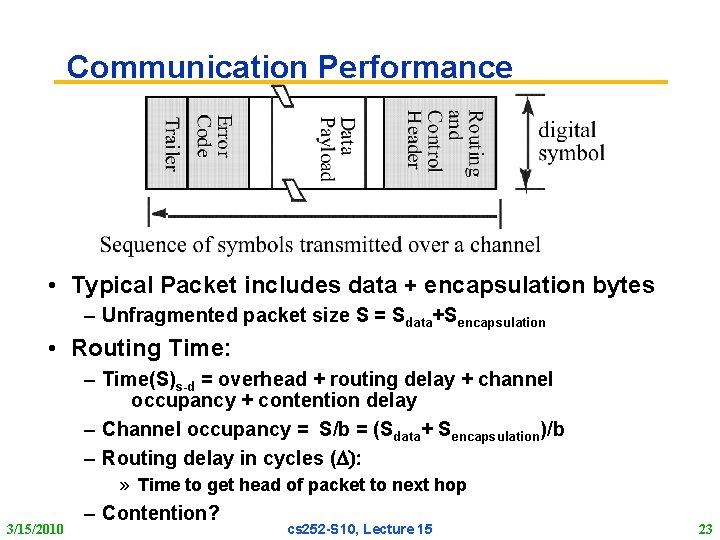
Communication Performance • Typical Packet includes data + encapsulation bytes – Unfragmented packet size S = Sdata+Sencapsulation • Routing Time: – Time(S)s-d = overhead + routing delay + channel occupancy + contention delay – Channel occupancy = S/b = (Sdata+ Sencapsulation)/b – Routing delay in cycles ( ): » Time to get head of packet to next hop 3/15/2010 – Contention? cs 252 -S 10, Lecture 15 23
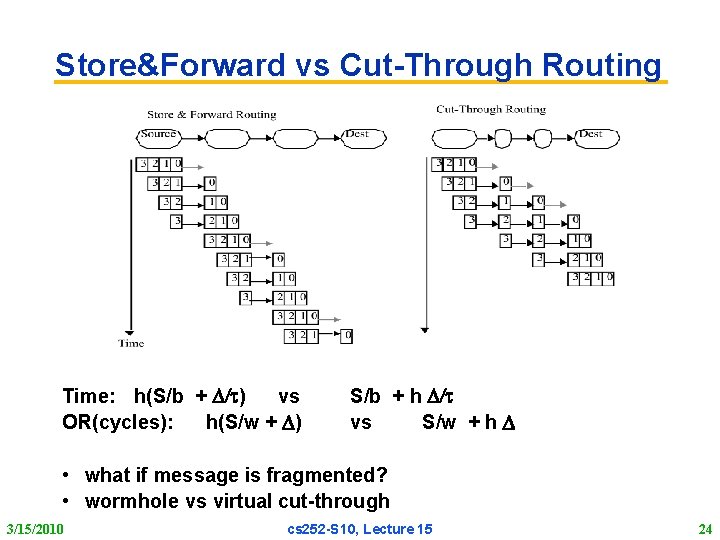
Store&Forward vs Cut-Through Routing Time: h(S/b + / ) vs OR(cycles): h(S/w + ) S/b + h / vs S/w + h • what if message is fragmented? • wormhole vs virtual cut-through 3/15/2010 cs 252 -S 10, Lecture 15 24
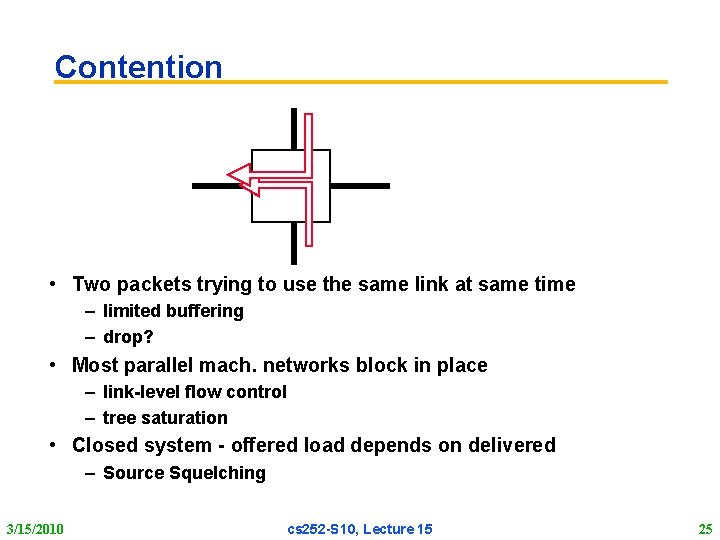
Contention • Two packets trying to use the same link at same time – limited buffering – drop? • Most parallel mach. networks block in place – link-level flow control – tree saturation • Closed system - offered load depends on delivered – Source Squelching 3/15/2010 cs 252 -S 10, Lecture 15 25
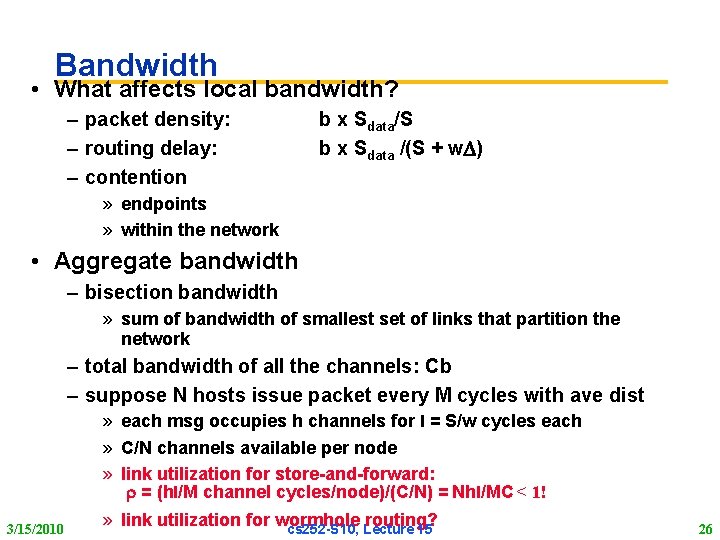
Bandwidth • What affects local bandwidth? – packet density: – routing delay: – contention b x Sdata/S b x Sdata /(S + w ) » endpoints » within the network • Aggregate bandwidth – bisection bandwidth » sum of bandwidth of smallest set of links that partition the network – total bandwidth of all the channels: Cb – suppose N hosts issue packet every M cycles with ave dist 3/15/2010 » each msg occupies h channels for l = S/w cycles each » C/N channels available per node » link utilization for store-and-forward: r = (hl/M channel cycles/node)/(C/N) = Nhl/MC < 1! » link utilization for wormhole routing? cs 252 -S 10, Lecture 15 26
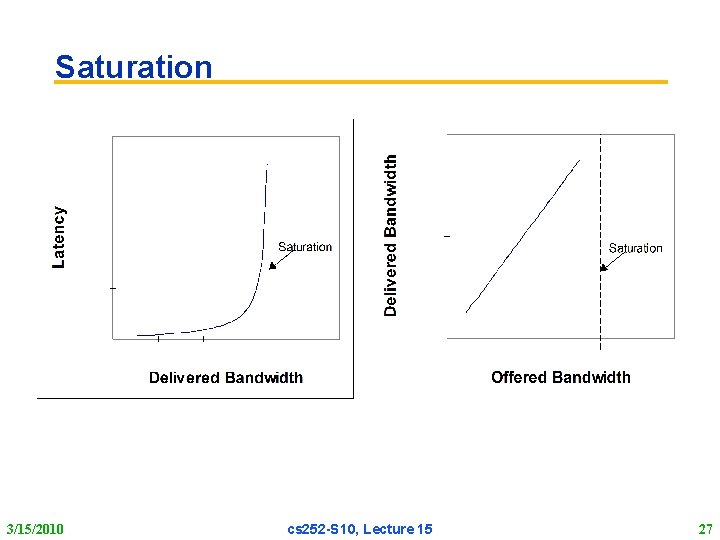
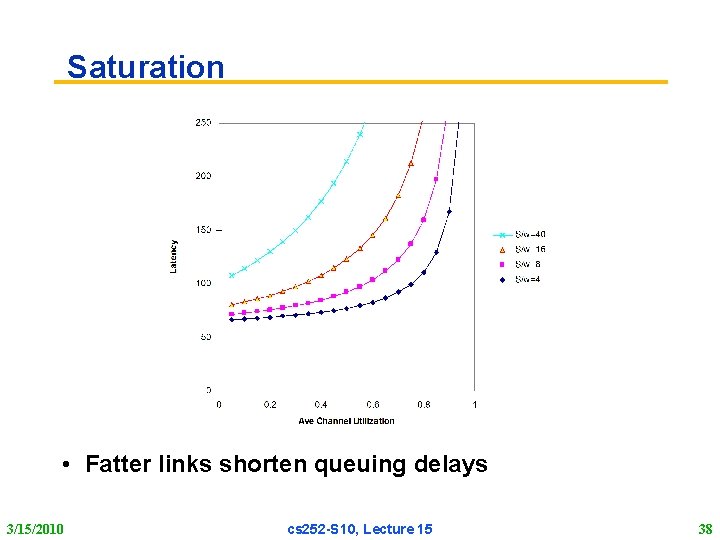
Saturation 3/15/2010 cs 252 -S 10, Lecture 15 27
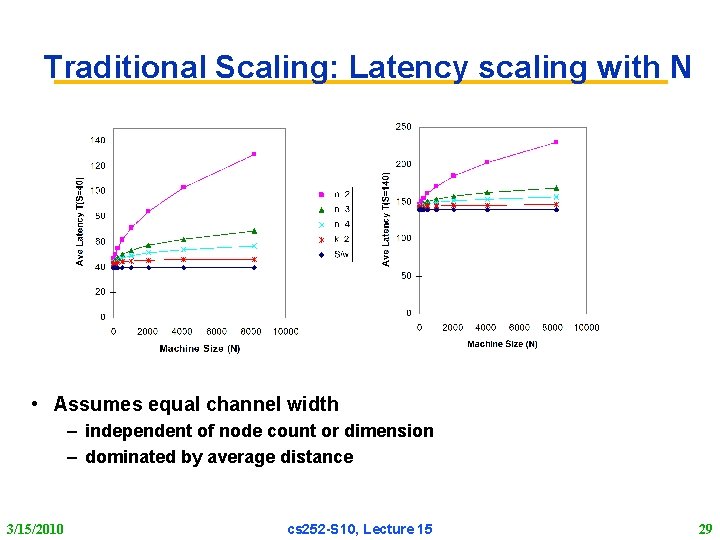
How Many Dimensions? • n = 2 or n = 3 – Short wires, easy to build – Many hops, low bisection bandwidth – Requires traffic locality • n >= 4 – Harder to build, more wires, longer average length – Fewer hops, better bisection bandwidth – Can handle non-local traffic • k-ary n-cubes provide a consistent framework for comparison – N = kn – scale dimension (n) or nodes per dimension (k) – assume cut-through 3/15/2010 cs 252 -S 10, Lecture 15 28
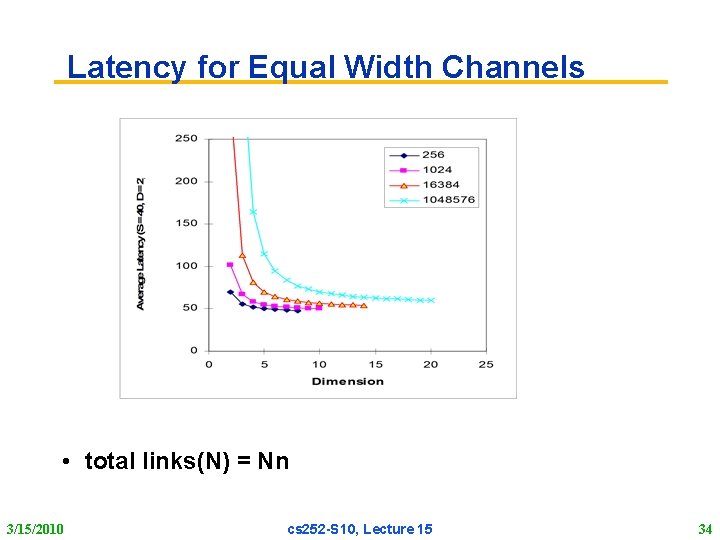
Traditional Scaling: Latency scaling with N • Assumes equal channel width – independent of node count or dimension – dominated by average distance 3/15/2010 cs 252 -S 10, Lecture 15 29
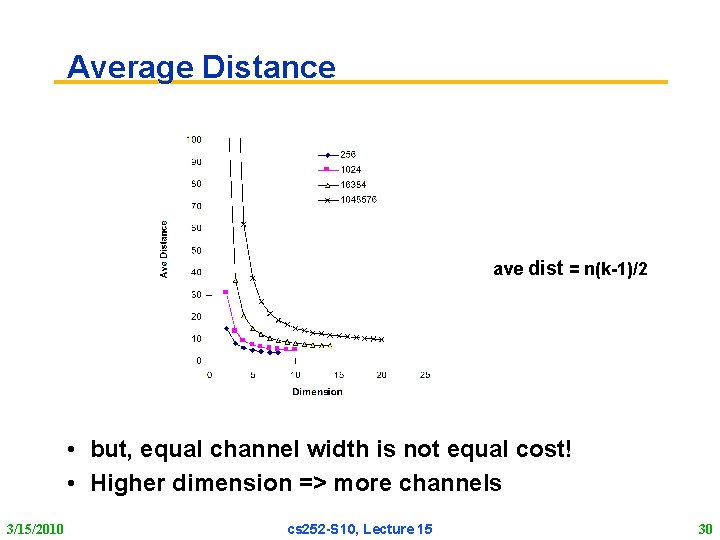
Average Distance ave dist = n(k-1)/2 • but, equal channel width is not equal cost! • Higher dimension => more channels 3/15/2010 cs 252 -S 10, Lecture 15 30
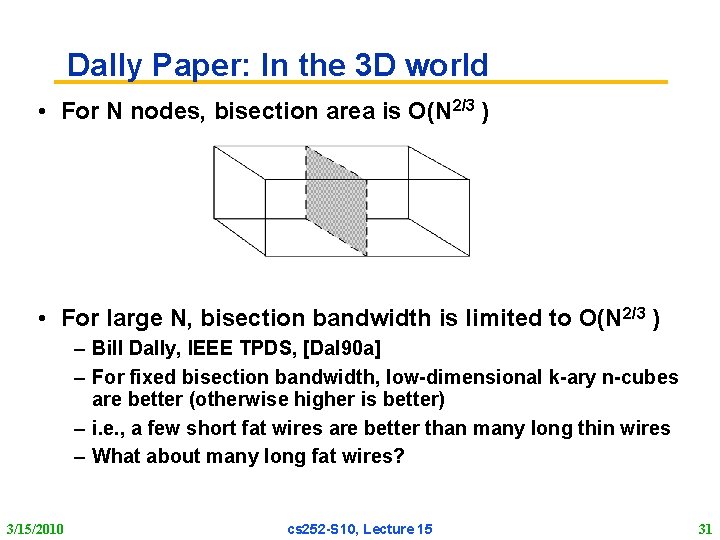
Dally Paper: In the 3 D world • For N nodes, bisection area is O(N 2/3 ) • For large N, bisection bandwidth is limited to O(N 2/3 ) – Bill Dally, IEEE TPDS, [Dal 90 a] – For fixed bisection bandwidth, low-dimensional k-ary n-cubes are better (otherwise higher is better) – i. e. , a few short fat wires are better than many long thin wires – What about many long fat wires? 3/15/2010 cs 252 -S 10, Lecture 15 31
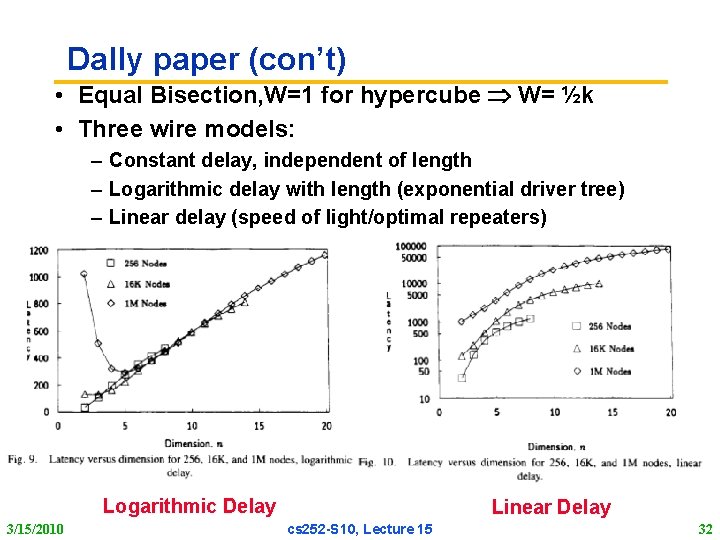
Dally paper (con’t) • Equal Bisection, W=1 for hypercube W= ½k • Three wire models: – Constant delay, independent of length – Logarithmic delay with length (exponential driver tree) – Linear delay (speed of light/optimal repeaters) Logarithmic Delay 3/15/2010 Linear Delay cs 252 -S 10, Lecture 15 32
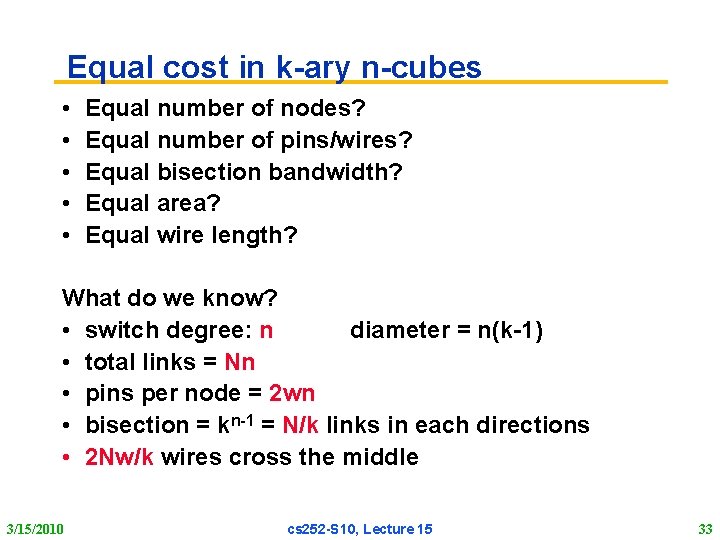
Equal cost in k-ary n-cubes • • • Equal number of nodes? Equal number of pins/wires? Equal bisection bandwidth? Equal area? Equal wire length? What do we know? • switch degree: n diameter = n(k-1) • total links = Nn • pins per node = 2 wn • bisection = kn-1 = N/k links in each directions • 2 Nw/k wires cross the middle 3/15/2010 cs 252 -S 10, Lecture 15 33
Latency for Equal Width Channels • total links(N) = Nn 3/15/2010 cs 252 -S 10, Lecture 15 34
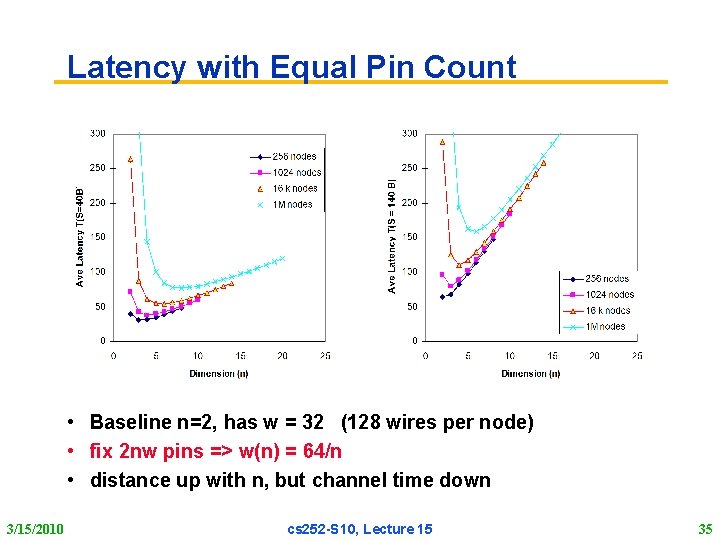
Latency with Equal Pin Count • Baseline n=2, has w = 32 (128 wires per node) • fix 2 nw pins => w(n) = 64/n • distance up with n, but channel time down 3/15/2010 cs 252 -S 10, Lecture 15 35
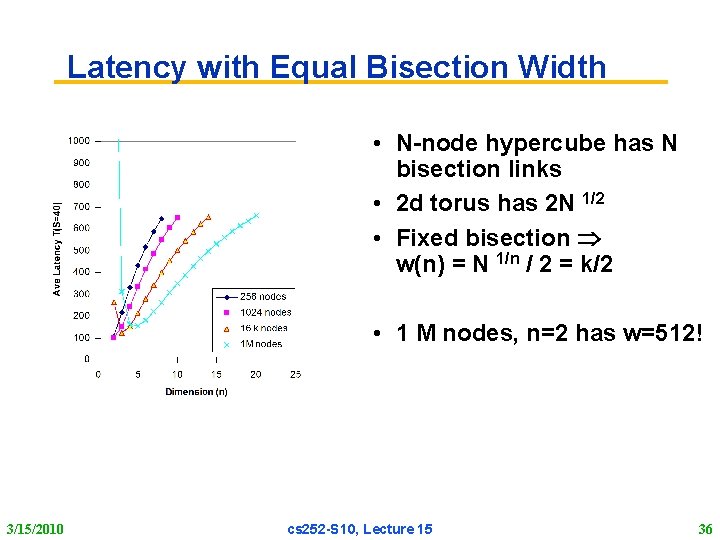
Latency with Equal Bisection Width • N-node hypercube has N bisection links • 2 d torus has 2 N 1/2 • Fixed bisection w(n) = N 1/n / 2 = k/2 • 1 M nodes, n=2 has w=512! 3/15/2010 cs 252 -S 10, Lecture 15 36
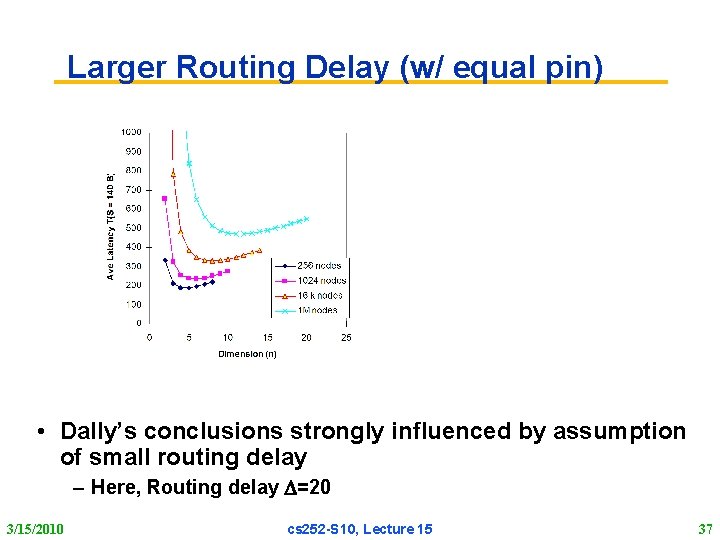
Larger Routing Delay (w/ equal pin) • Dally’s conclusions strongly influenced by assumption of small routing delay – Here, Routing delay =20 3/15/2010 cs 252 -S 10, Lecture 15 37
Saturation • Fatter links shorten queuing delays 3/15/2010 cs 252 -S 10, Lecture 15 38
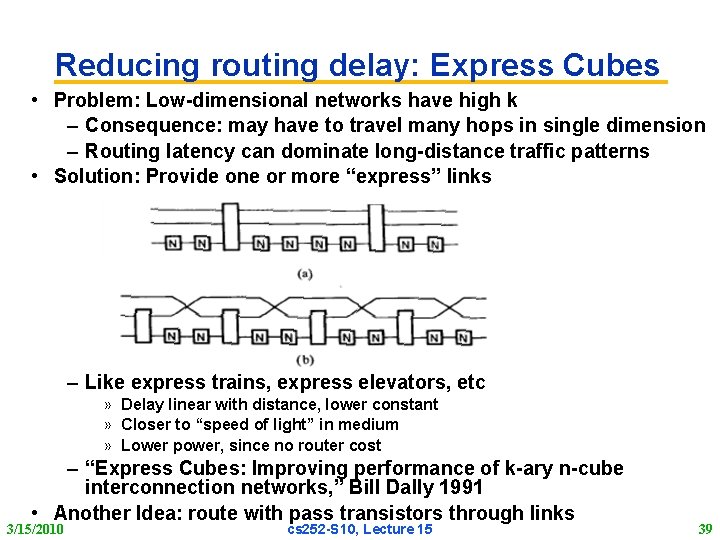
Reducing routing delay: Express Cubes • Problem: Low-dimensional networks have high k – Consequence: may have to travel many hops in single dimension – Routing latency can dominate long-distance traffic patterns • Solution: Provide one or more “express” links – Like express trains, express elevators, etc » Delay linear with distance, lower constant » Closer to “speed of light” in medium » Lower power, since no router cost – “Express Cubes: Improving performance of k-ary n-cube interconnection networks, ” Bill Dally 1991 • Another Idea: route with pass transistors through links 3/15/2010 cs 252 -S 10, Lecture 15 39
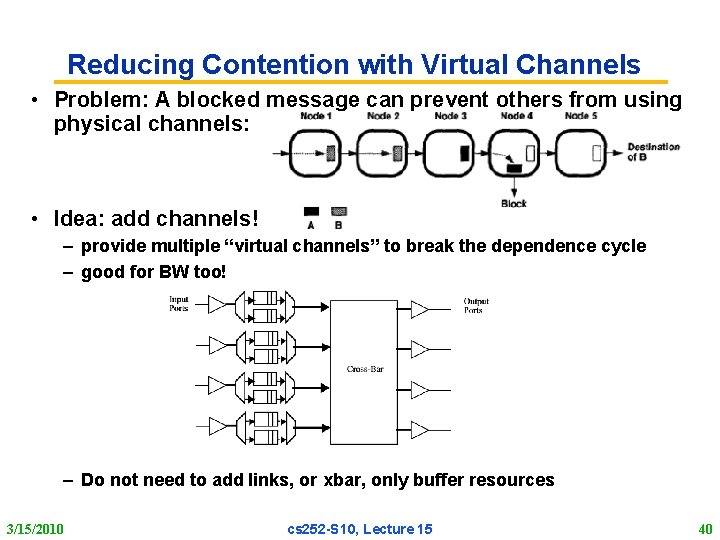
Reducing Contention with Virtual Channels • Problem: A blocked message can prevent others from using physical channels: • Idea: add channels! – provide multiple “virtual channels” to break the dependence cycle – good for BW too! – Do not need to add links, or xbar, only buffer resources 3/15/2010 cs 252 -S 10, Lecture 15 40
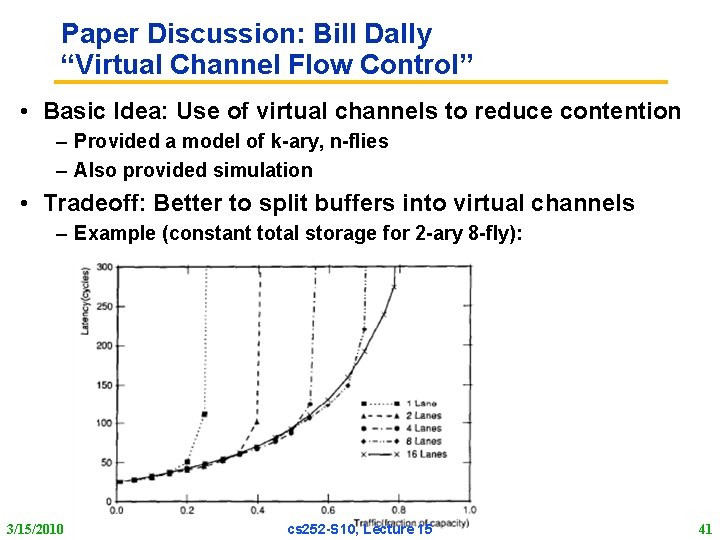
Paper Discussion: Bill Dally “Virtual Channel Flow Control” • Basic Idea: Use of virtual channels to reduce contention – Provided a model of k-ary, n-flies – Also provided simulation • Tradeoff: Better to split buffers into virtual channels – Example (constant total storage for 2 -ary 8 -fly): 3/15/2010 cs 252 -S 10, Lecture 15 41
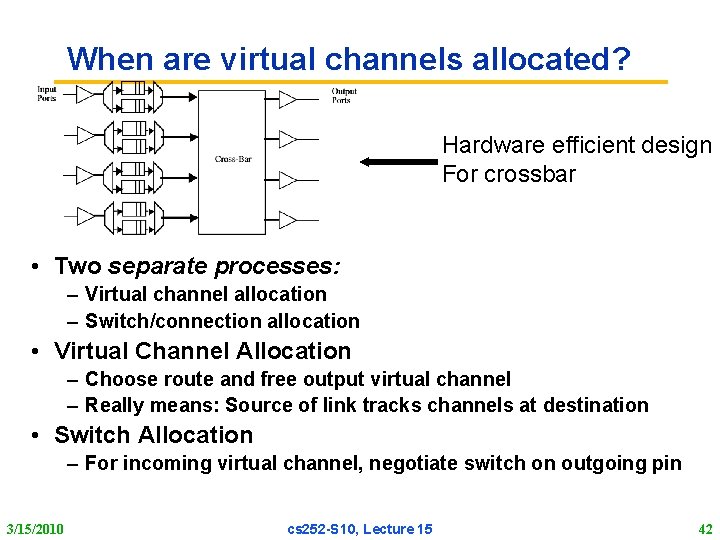
When are virtual channels allocated? Hardware efficient design For crossbar • Two separate processes: – Virtual channel allocation – Switch/connection allocation • Virtual Channel Allocation – Choose route and free output virtual channel – Really means: Source of link tracks channels at destination • Switch Allocation – For incoming virtual channel, negotiate switch on outgoing pin 3/15/2010 cs 252 -S 10, Lecture 15 42
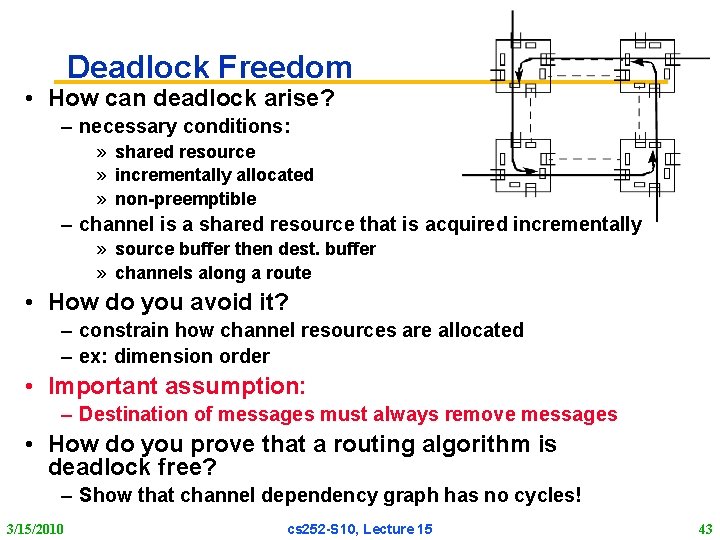
Deadlock Freedom • How can deadlock arise? – necessary conditions: » shared resource » incrementally allocated » non-preemptible – channel is a shared resource that is acquired incrementally » source buffer then dest. buffer » channels along a route • How do you avoid it? – constrain how channel resources are allocated – ex: dimension order • Important assumption: – Destination of messages must always remove messages • How do you prove that a routing algorithm is deadlock free? – Show that channel dependency graph has no cycles! 3/15/2010 cs 252 -S 10, Lecture 15 43
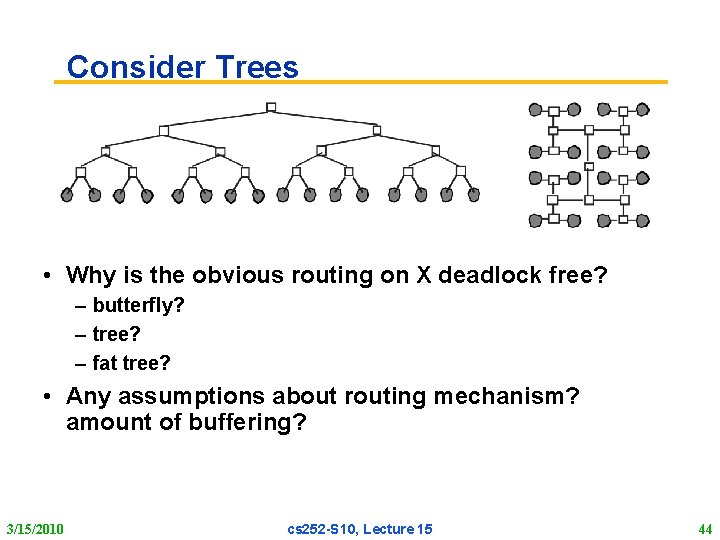
Consider Trees • Why is the obvious routing on X deadlock free? – butterfly? – tree? – fat tree? • Any assumptions about routing mechanism? amount of buffering? 3/15/2010 cs 252 -S 10, Lecture 15 44
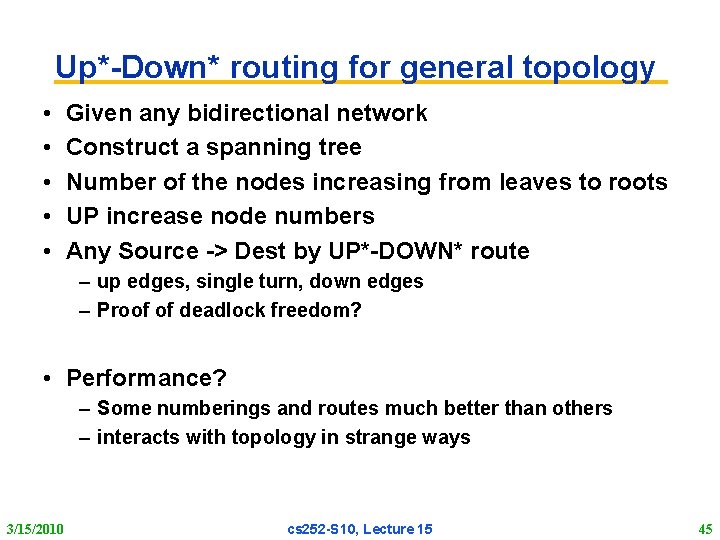
Up*-Down* routing for general topology • • • Given any bidirectional network Construct a spanning tree Number of the nodes increasing from leaves to roots UP increase node numbers Any Source -> Dest by UP*-DOWN* route – up edges, single turn, down edges – Proof of deadlock freedom? • Performance? – Some numberings and routes much better than others – interacts with topology in strange ways 3/15/2010 cs 252 -S 10, Lecture 15 45
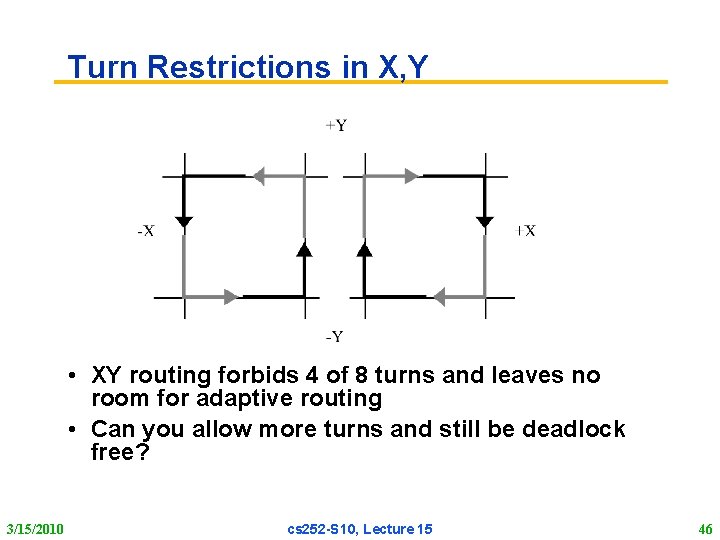
Turn Restrictions in X, Y • XY routing forbids 4 of 8 turns and leaves no room for adaptive routing • Can you allow more turns and still be deadlock free? 3/15/2010 cs 252 -S 10, Lecture 15 46
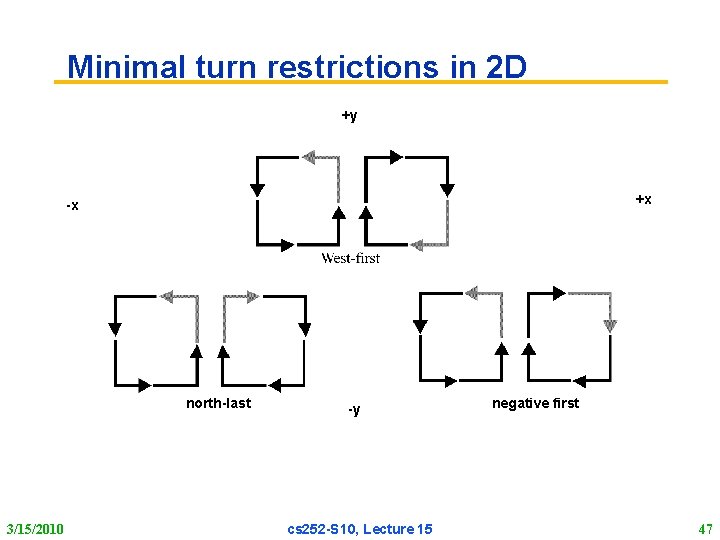
Minimal turn restrictions in 2 D +y +x -x north-last 3/15/2010 -y cs 252 -S 10, Lecture 15 negative first 47
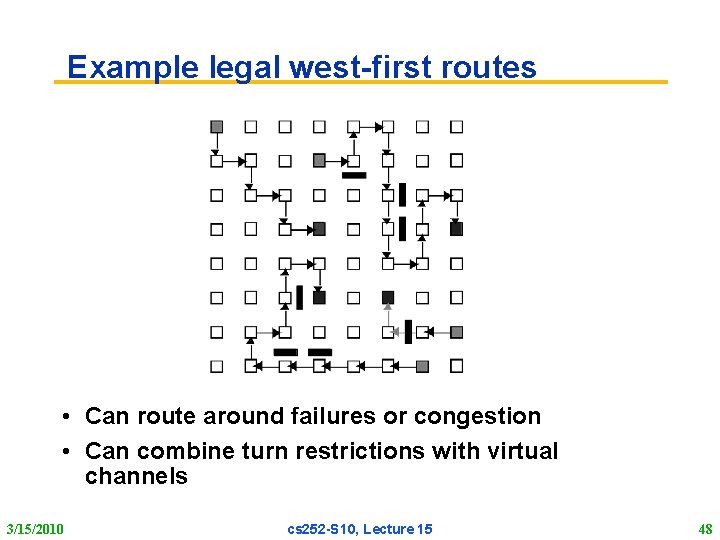
Example legal west-first routes • Can route around failures or congestion • Can combine turn restrictions with virtual channels 3/15/2010 cs 252 -S 10, Lecture 15 48
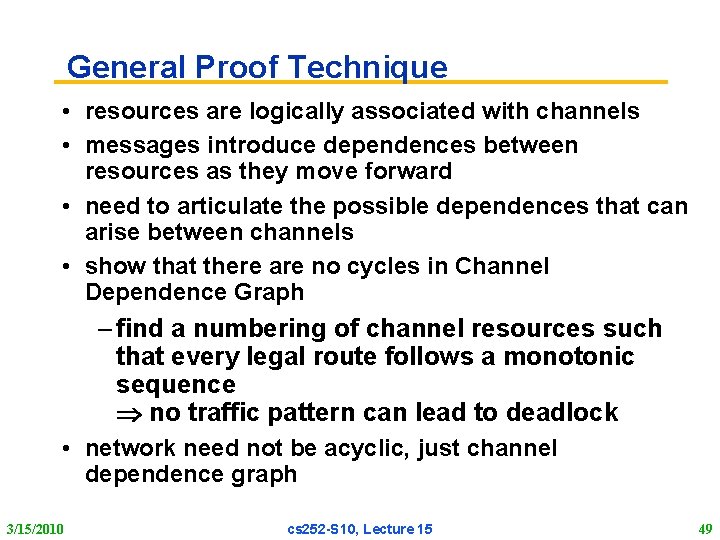
General Proof Technique • resources are logically associated with channels • messages introduce dependences between resources as they move forward • need to articulate the possible dependences that can arise between channels • show that there are no cycles in Channel Dependence Graph – find a numbering of channel resources such that every legal route follows a monotonic sequence no traffic pattern can lead to deadlock • network need not be acyclic, just channel dependence graph 3/15/2010 cs 252 -S 10, Lecture 15 49
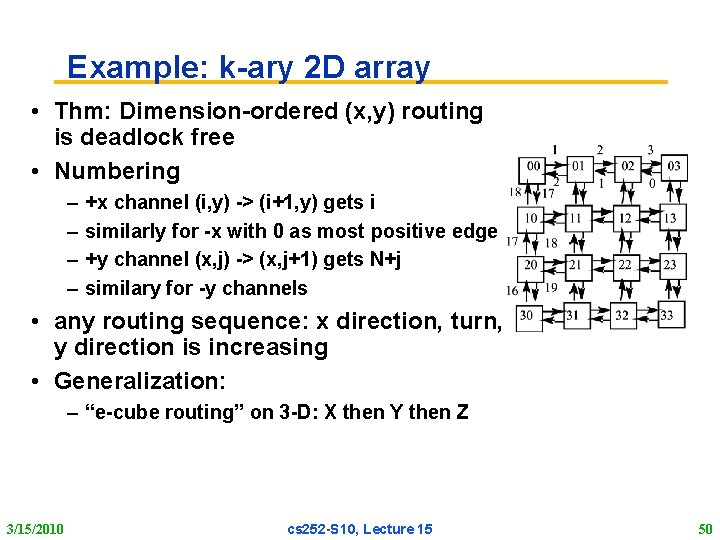
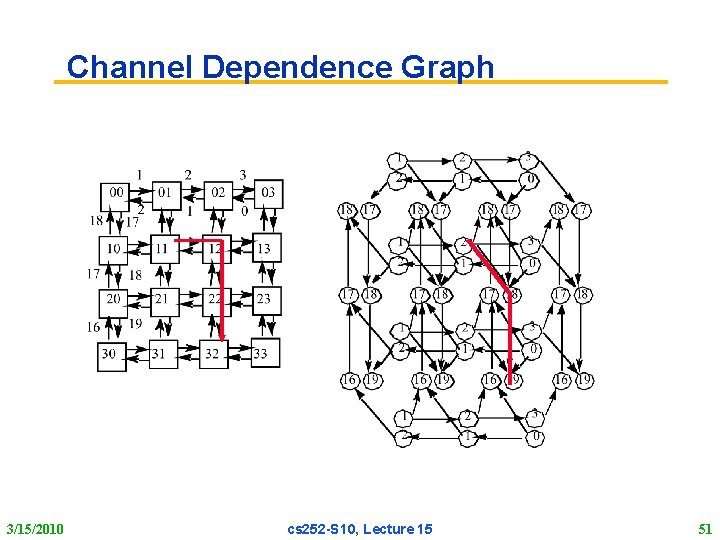
Example: k-ary 2 D array • Thm: Dimension-ordered (x, y) routing is deadlock free • Numbering – – +x channel (i, y) -> (i+1, y) gets i similarly for -x with 0 as most positive edge +y channel (x, j) -> (x, j+1) gets N+j similary for -y channels • any routing sequence: x direction, turn, y direction is increasing • Generalization: – “e-cube routing” on 3 -D: X then Y then Z 3/15/2010 cs 252 -S 10, Lecture 15 50
Channel Dependence Graph 3/15/2010 cs 252 -S 10, Lecture 15 51
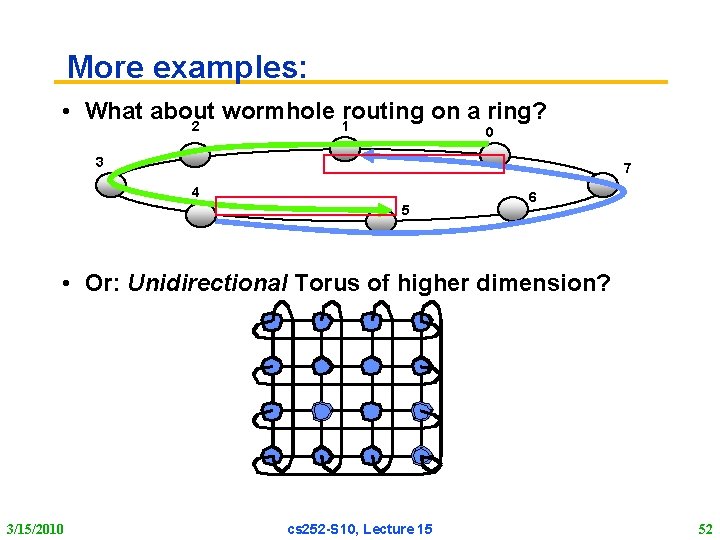
More examples: • What about wormhole routing on a ring? 2 1 0 3 7 4 5 6 • Or: Unidirectional Torus of higher dimension? 3/15/2010 cs 252 -S 10, Lecture 15 52
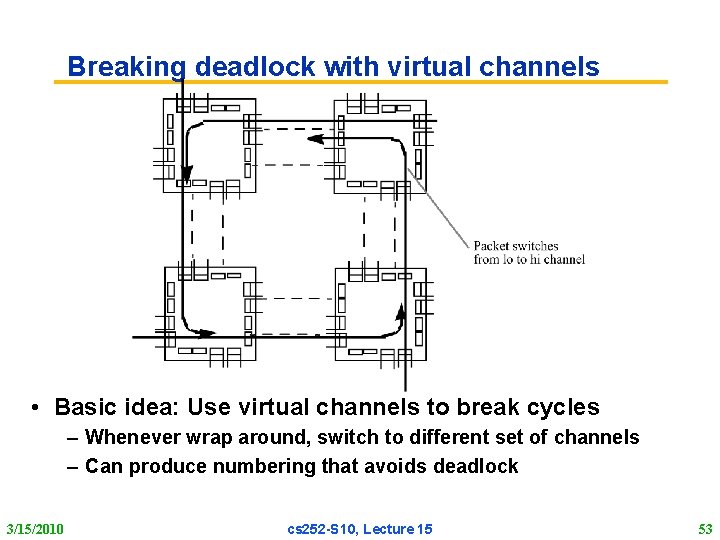
Breaking deadlock with virtual channels • Basic idea: Use virtual channels to break cycles – Whenever wrap around, switch to different set of channels – Can produce numbering that avoids deadlock 3/15/2010 cs 252 -S 10, Lecture 15 53
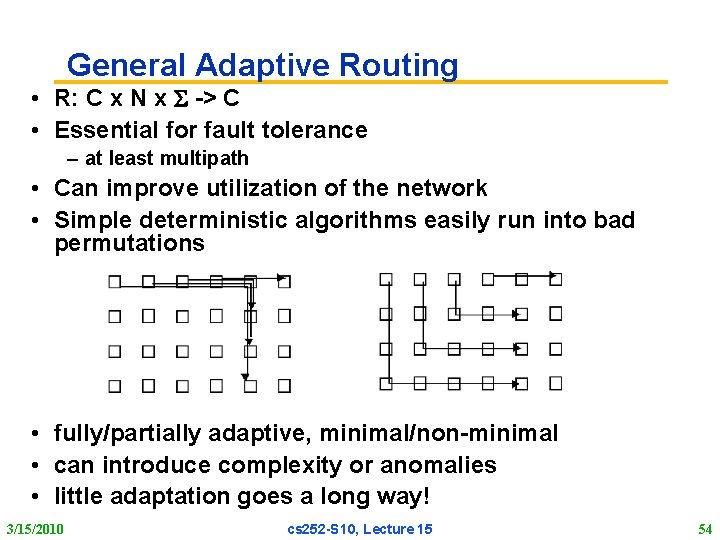
General Adaptive Routing • R: C x N x S -> C • Essential for fault tolerance – at least multipath • Can improve utilization of the network • Simple deterministic algorithms easily run into bad permutations • fully/partially adaptive, minimal/non-minimal • can introduce complexity or anomalies • little adaptation goes a long way! 3/15/2010 cs 252 -S 10, Lecture 15 54
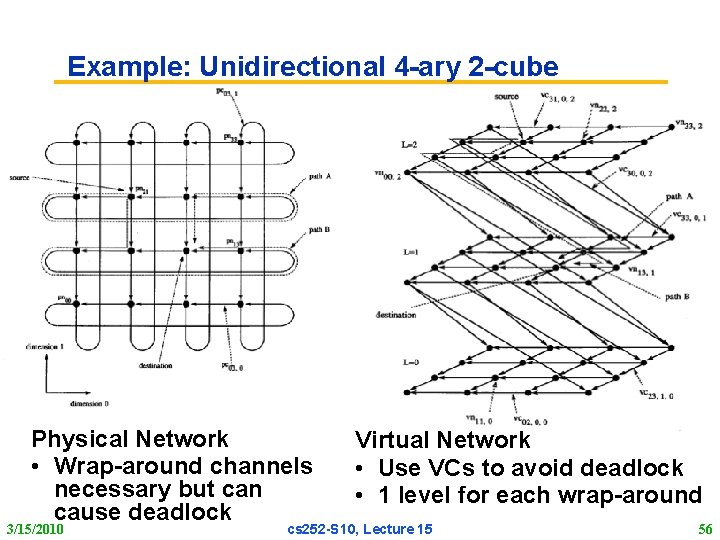
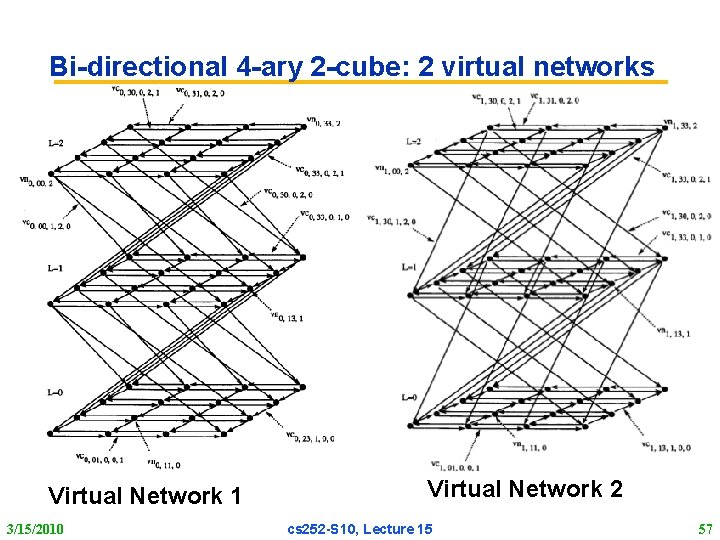
Paper Discusion: Linder and Harden “An Adaptive and Fault Tolerant Wormhole” • General virtual-channel scheme for k-ary n-cubes – With wrap-around paths • Properties of result for uni-directional k-ary n-cube: – 1 virtual interconnection network – n+1 levels • Properties of result for bi-directional k-ary n-cube: – 2 n-1 virtual interconnection networks – n+1 levels per network 3/15/2010 cs 252 -S 10, Lecture 15 55
Example: Unidirectional 4 -ary 2 -cube Physical Network • Wrap-around channels necessary but can cause deadlock 3/15/2010 Virtual Network • Use VCs to avoid deadlock • 1 level for each wrap-around cs 252 -S 10, Lecture 15 56
Bi-directional 4 -ary 2 -cube: 2 virtual networks Virtual Network 1 3/15/2010 Virtual Network 2 cs 252 -S 10, Lecture 15 57
Use of virtual channels for adaptation • Want to route around hotspots/faults while avoiding deadlock • Linder and Harden, 1991 – General technique for k-ary n-cubes » Requires: 2 n-1 virtual channels/lane!!! • Alternative: Planar adaptive routing – Chien and Kim, 1995 – Divide dimensions into “planes”, » i. e. in 3 -cube, use X-Y and Y-Z – Route planes adaptively in order: first X-Y, then Y-Z » Never go back to plane once have left it » Can’t leave plane until have routed lowest coordinate – Use Linder-Harden technique for series of 2 -dim planes » Now, need only 3 number of planes virtual channels • Alternative: two phase routing – Provide set of virtual channels that can be used arbitrarily for routing – When blocked, use unrelated virtual channels for dimension-order (deterministic) routing – Never progress from deterministic routing back to adaptive routing 3/15/2010 cs 252 -S 10, Lecture 15 58
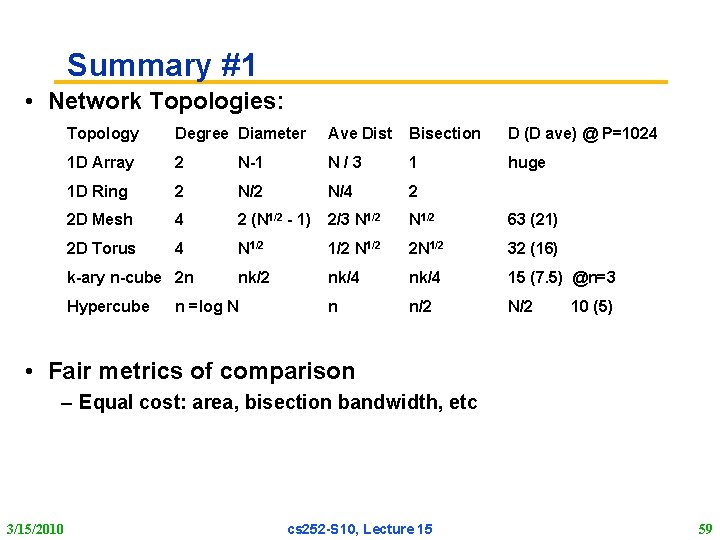
Summary #1 • Network Topologies: Topology Degree Diameter Ave Dist Bisection D (D ave) @ P=1024 1 D Array 2 N-1 N/3 1 huge 1 D Ring 2 N/4 2 2 D Mesh 4 2 (N 1/2 - 1) 2/3 N 1/2 63 (21) 2 D Torus 4 N 1/2 2 N 1/2 32 (16) nk/2 nk/4 15 (7. 5) @n=3 n n/2 N/2 k-ary n-cube 2 n Hypercube n =log N 10 (5) • Fair metrics of comparison – Equal cost: area, bisection bandwidth, etc 3/15/2010 cs 252 -S 10, Lecture 15 59
Summary #2 • Routing Algorithms restrict the set of routes within the topology – simple mechanism selects turn at each hop – arithmetic, selection, lookup • Virtual Channels – Adds complexity to router – Can be used for performance – Can be used for deadlock avoidance • Deadlock-free if channel dependence graph is acyclic – limit turns to eliminate dependences – add separate channel resources to break dependences – combination of topology, algorithm, and switch design • Deterministic vs adaptive routing 3/15/2010 cs 252 -S 10, Lecture 15 60