
CS 2501 Data Structures and Algorithms II Mark

- Slides: 44
CS 2501 – Data Structures and Algorithms II Mark Floryan mfloryan@cs. virginia. edu � Course Mechanics � Course content � Topics from earlier classes � Course learning objectives � What’s 1 the course all about? A quick tour
Course introduction 2
General Info � See syllabus on course website for general information � Pre-requisites: DSA 1 (with C- or better) � Math topics: proof by induction, proof by contradiction, exponents, logarithms, limits, simple differentiations (covered in APMA 1090 or MATH 1210 or MATH 1310) � � Teaching � Graduates (? ): � � Locations and hours TBA Also, we’ll use Piazza for questions � 3 Annie, Cassie, Daniel, and George (Probably 1 or 2 more this time) Both will hold office hours, which will start next week � � TBD Undergraduates (5 or 6) � � Assistants Post all questions about HW, topics, etc to Piazza NOT email to instructors!
Expectations � For a given week/unit, I will post: � The slides for that unit (all slides already on course website but will be updated throughout semester) � Any proofs that we are doing in class so you can review them � This will allow us to: � Have more interesting class sessions than just lecturing � A more successful educational experience (better grades) � Let’s 4 all live up to our expectations (the high ones)!
Expectations � Of you: � When asked, prepare for things in advance � Participate in class activities when asked � Act mature, professional. � Plan ahead. � Don’t take advantage. Follow the Honor Code. (See the BOCM. ) � Of me: � Be fair, open, and considerate. � Seek and listen to your feedback. � Not to waste your time. � Be effective in letting you know how you’re doing 5
General Info � Recommended � Introduction � Other (not required) Textbook: to Algorithms, 3 rd edition, by Cormen, et. al. references: � Your DSA 1 material (will be VERY useful here) � Discrete Math textbook / references � Other � We’ll 6 readings may be assigned see…
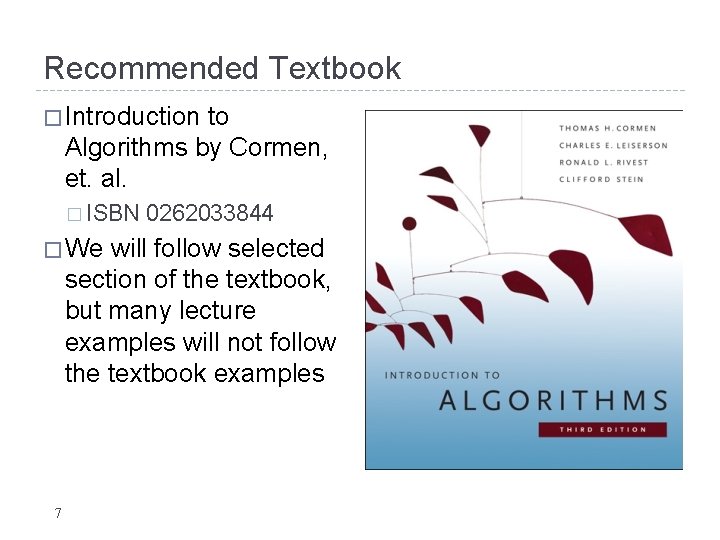
Recommended Textbook � Introduction to Algorithms by Cormen, et. al. � ISBN � We 0262033844 will follow selected section of the textbook, but many lecture examples will not follow the textbook examples 7
Modules (Yes, we have modules again) � 10 Topic Modules: � Graphs (2)* � Find-Union Data Structure � Greedy Algorithms (2)* � Divide and Conquer Algorithms (2)* � Dynamic Programming (2)* � Reductions Between Problems � *These each have a basic and advanced module (for hw and quizzes and such) but only one slide-deck which covers both 8
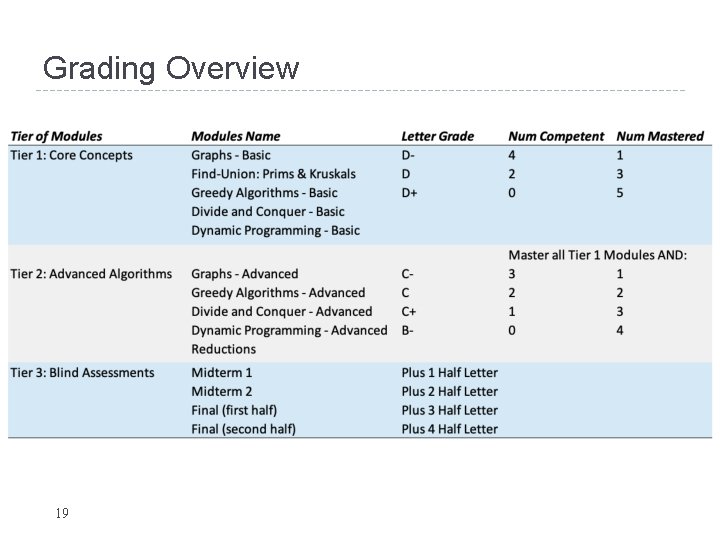
Modules (Yes, we have modules again) � 4 Blind Assessment (Exam) Modules: � Midterm Exam 1 � Midterm Exam 2 � Final Exam (2 parts: First Half and Second Half) � More detail on this when we discuss grading. Short version is they are required if you want an A, but won’t destroy your letter grade if you fail them. 9
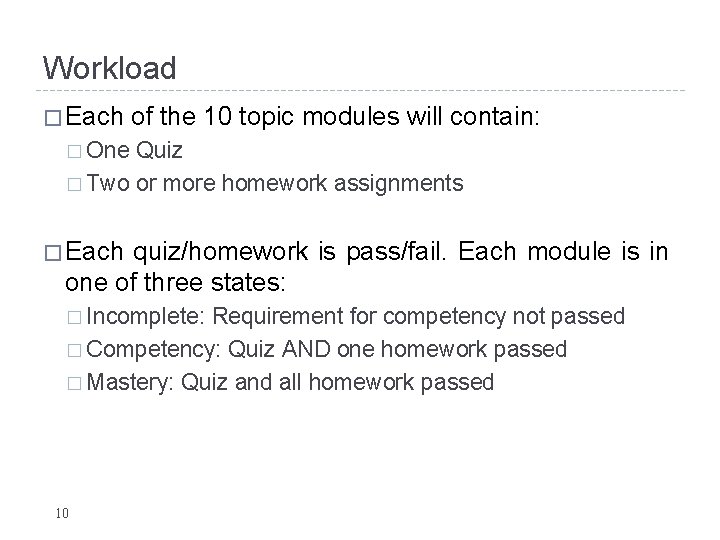
Workload � Each of the 10 topic modules will contain: � One Quiz � Two or more homework assignments � Each quiz/homework is pass/fail. Each module is in one of three states: � Incomplete: Requirement for competency not passed � Competency: Quiz AND one homework passed � Mastery: Quiz and all homework passed 10
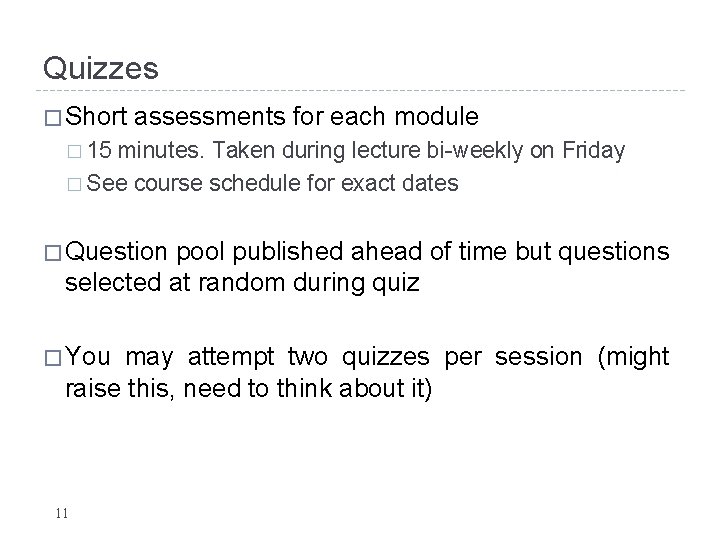
Quizzes � Short assessments for each module � 15 minutes. Taken during lecture bi-weekly on Friday � See course schedule for exact dates � Question pool published ahead of time but questions selected at random during quiz � You may attempt two quizzes per session (might raise this, need to think about it) 11
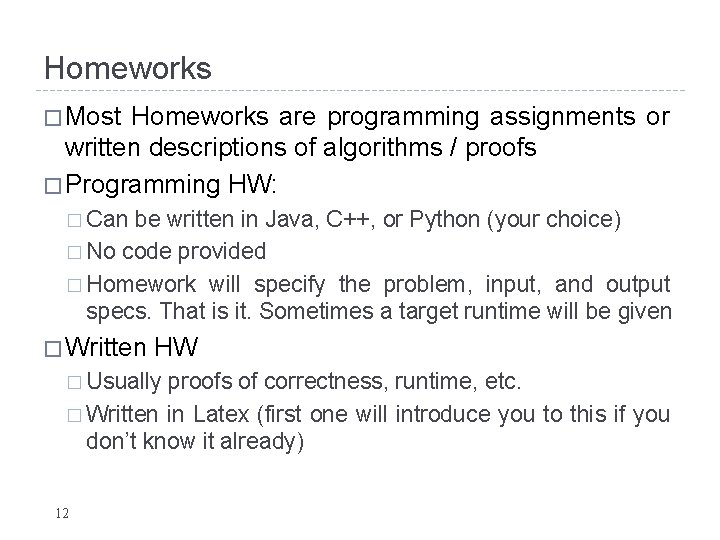
Homeworks � Most Homeworks are programming assignments or written descriptions of algorithms / proofs � Programming HW: � Can be written in Java, C++, or Python (your choice) � No code provided � Homework will specify the problem, input, and output specs. That is it. Sometimes a target runtime will be given � Written HW � Usually proofs of correctness, runtime, etc. � Written in Latex (first one will introduce you to this if you don’t know it already) 12
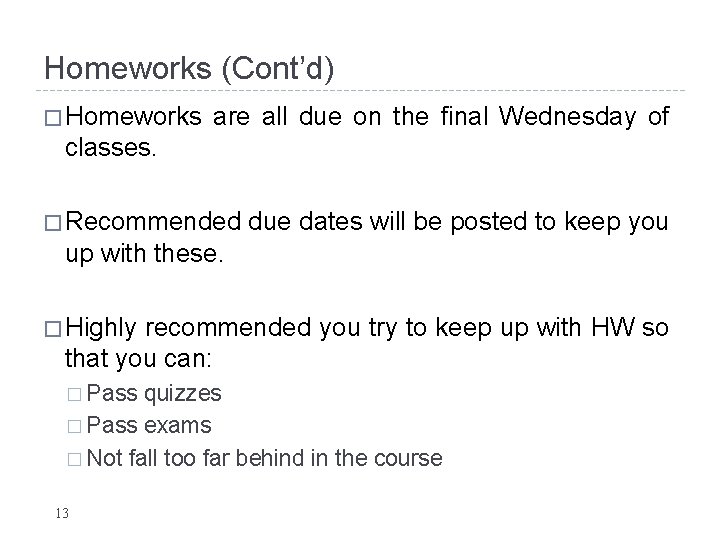
Homeworks (Cont’d) � Homeworks are all due on the final Wednesday of classes. � Recommended due dates will be posted to keep you up with these. � Highly recommended you try to keep up with HW so that you can: � Pass quizzes � Pass exams � Not fall too far behind in the course 13
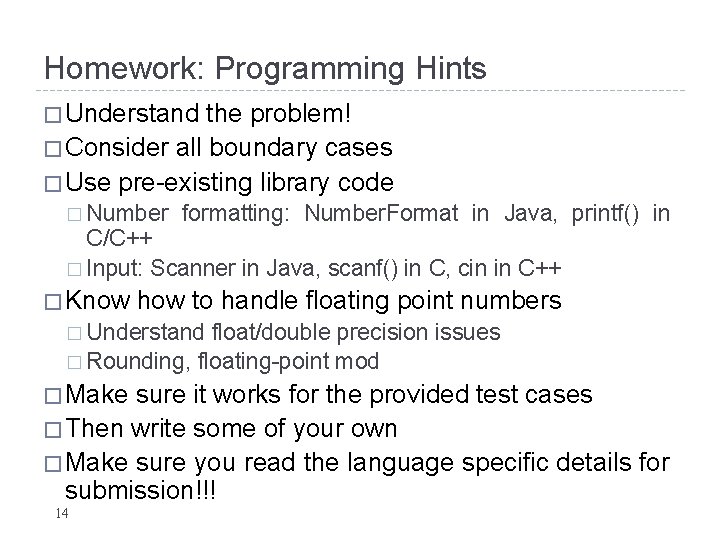
Homework: Programming Hints � Understand the problem! � Consider all boundary cases � Use pre-existing library code � Number formatting: Number. Format in Java, printf() in C/C++ � Input: Scanner in Java, scanf() in C, cin in C++ � Know how to handle floating point numbers � Understand float/double precision issues � Rounding, floating-point mod � Make sure it works for the provided test cases � Then write some of your own � Make sure you read the language specific details for submission!!! 14
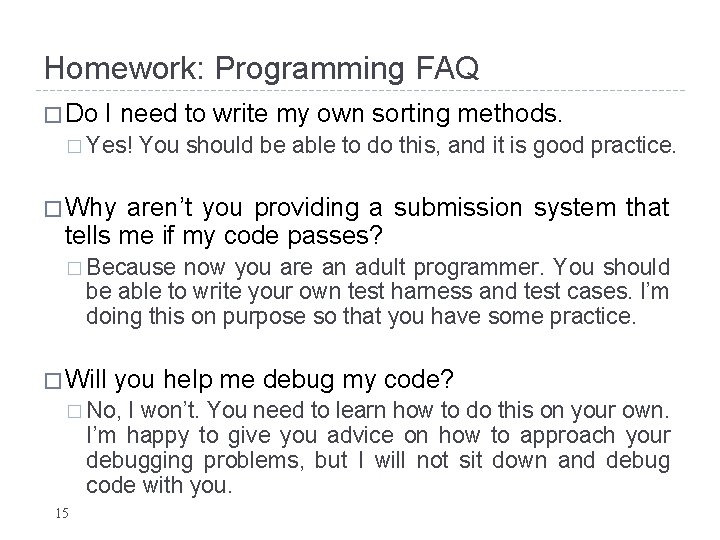
Homework: Programming FAQ � Do I need to write my own sorting methods. � Yes! You should be able to do this, and it is good practice. � Why aren’t you providing a submission system that tells me if my code passes? � Because now you are an adult programmer. You should be able to write your own test harness and test cases. I’m doing this on purpose so that you have some practice. � Will you help me debug my code? � No, I won’t. You need to learn how to do this on your own. I’m happy to give you advice on how to approach your debugging problems, but I will not sit down and debug code with you. 15
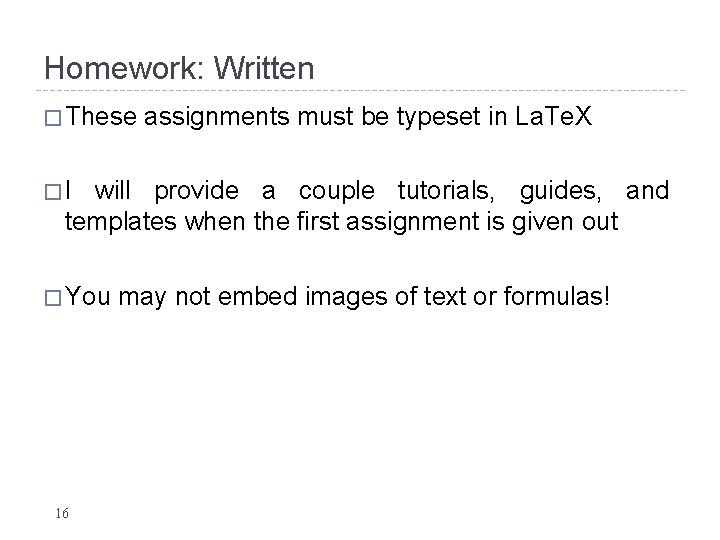
Homework: Written � These assignments must be typeset in La. Te. X �I will provide a couple tutorials, guides, and templates when the first assignment is given out � You 16 may not embed images of text or formulas!
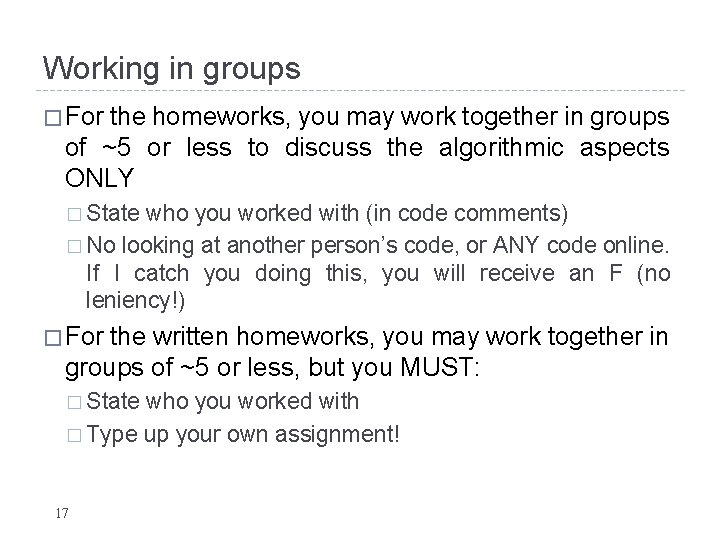
Working in groups � For the homeworks, you may work together in groups of ~5 or less to discuss the algorithmic aspects ONLY � State who you worked with (in code comments) � No looking at another person’s code, or ANY code online. If I catch you doing this, you will receive an F (no leniency!) � For the written homeworks, you may work together in groups of ~5 or less, but you MUST: � State who you worked with � Type up your own assignment! 17
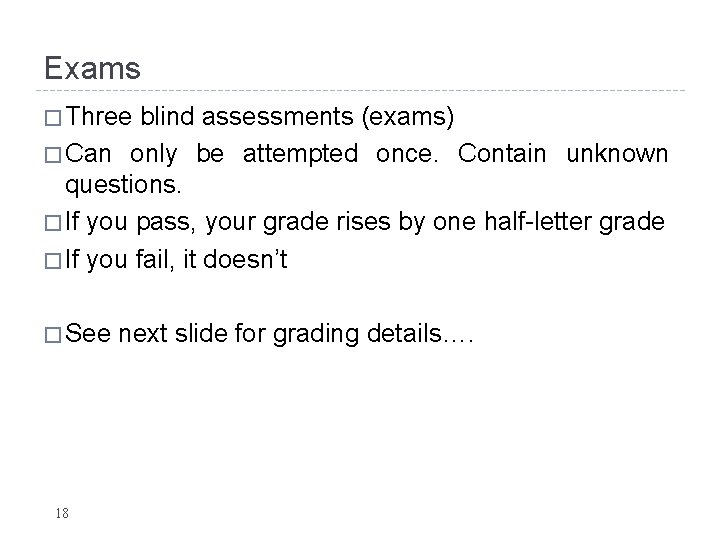
Exams � Three blind assessments (exams) � Can only be attempted once. Contain unknown questions. � If you pass, your grade rises by one half-letter grade � If you fail, it doesn’t � See 18 next slide for grading details….
Grading Overview 19
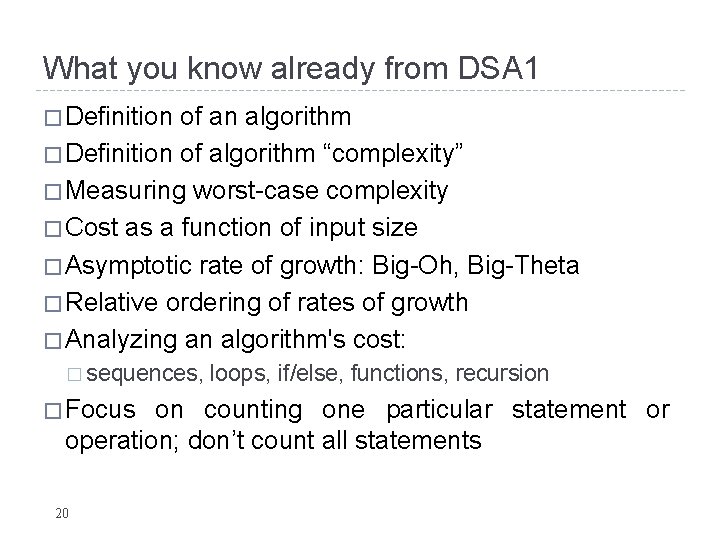
What you know already from DSA 1 � Definition of an algorithm � Definition of algorithm “complexity” � Measuring worst-case complexity � Cost as a function of input size � Asymptotic rate of growth: Big-Oh, Big-Theta � Relative ordering of rates of growth � Analyzing an algorithm's cost: � sequences, � Focus loops, if/else, functions, recursion on counting one particular statement or operation; don’t count all statements 20
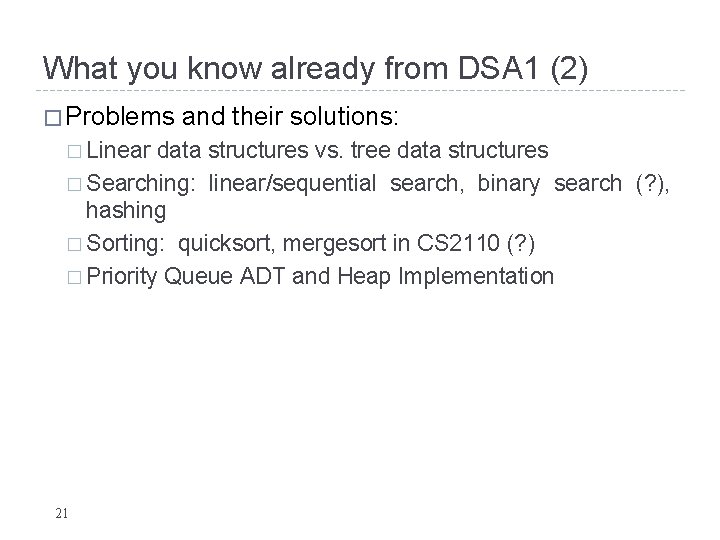
What you know already from DSA 1 (2) � Problems � Linear and their solutions: data structures vs. tree data structures � Searching: linear/sequential search, binary search (? ), hashing � Sorting: quicksort, mergesort in CS 2110 (? ) � Priority Queue ADT and Heap Implementation 21
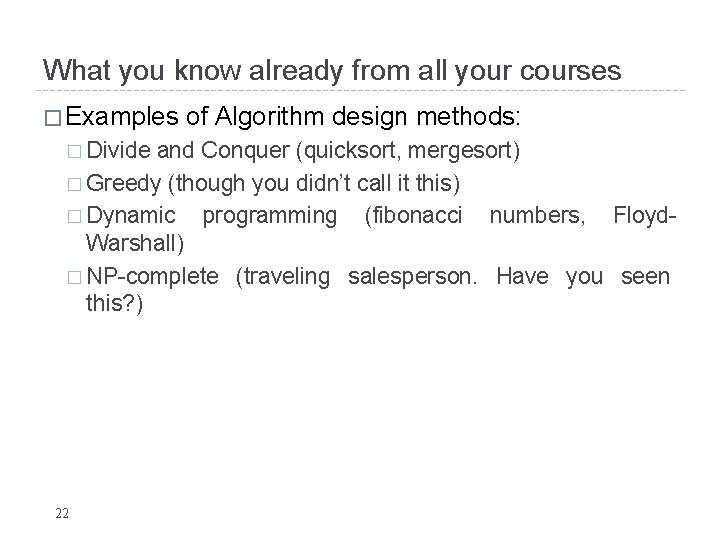
What you know already from all your courses � Examples � Divide of Algorithm design methods: and Conquer (quicksort, mergesort) � Greedy (though you didn’t call it this) � Dynamic programming (fibonacci numbers, Floyd. Warshall) � NP-complete (traveling salesperson. Have you seen this? ) 22
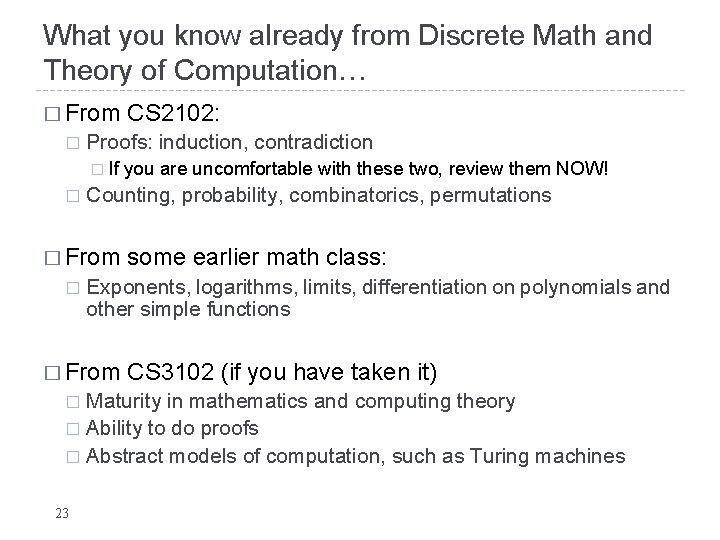
What you know already from Discrete Math and Theory of Computation… � From � Proofs: induction, contradiction � If � you are uncomfortable with these two, review them NOW! Counting, probability, combinatorics, permutations � From � CS 2102: some earlier math class: Exponents, logarithms, limits, differentiation on polynomials and other simple functions � From CS 3102 (if you have taken it) Maturity in mathematics and computing theory � Ability to do proofs � Abstract models of computation, such as Turing machines � 23
Questions? Concerns? Wrath to vent? 24
A first algorithm: making change 25
OK… But What’s It Really All About? � Let’s illustrate some ideas you’ll see throughout the course � Using one example � Concepts: � Describing an algorithm � Measuring algorithm efficiency � Families or types of problems � Algorithm design strategies � Alternative � Lower strategies bounds and optimal algorithms � Problems that seem very hard 26
Everyone Already Knows Many Algorithms! � Worked retail? You know how to make change! � Example: � My item costs $4. 37. I give you a five dollar bill. What do you give me in change? � Answer: two quarters, a dime, three pennies � Why? How do we figure that out? 27
Making Change � The problem: � Give back the right amount of change, and… � Return the fewest number of coins! � Inputs: the dollar-amount to return � Also, the set of possible coins. (Do we have half-dollars? That affects the answer we give. ) � Output: � Note a set of coins this problem transformation statement is � Given simply input, generate output with certain properties � No statement about how to do it. � Can 28 you describe the algorithm you use? a
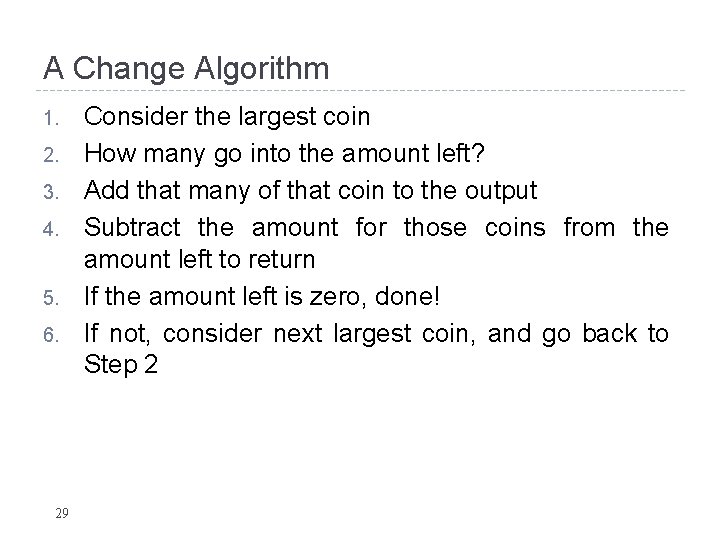
A Change Algorithm 1. 2. 3. 4. 5. 6. 29 Consider the largest coin How many go into the amount left? Add that many of that coin to the output Subtract the amount for those coins from the amount left to return If the amount left is zero, done! If not, consider next largest coin, and go back to Step 2
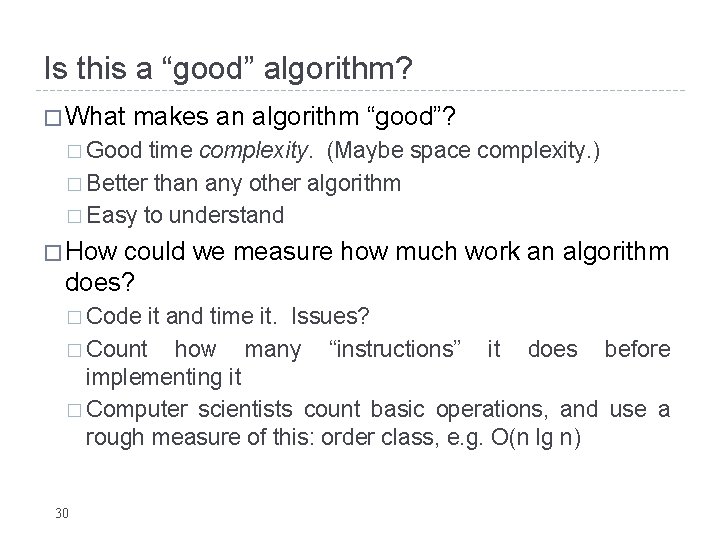
Is this a “good” algorithm? � What makes an algorithm “good”? � Good time complexity. (Maybe space complexity. ) � Better than any other algorithm � Easy to understand � How could we measure how much work an algorithm does? � Code it and time it. Issues? � Count how many “instructions” it does before implementing it � Computer scientists count basic operations, and use a rough measure of this: order class, e. g. O(n lg n) 30
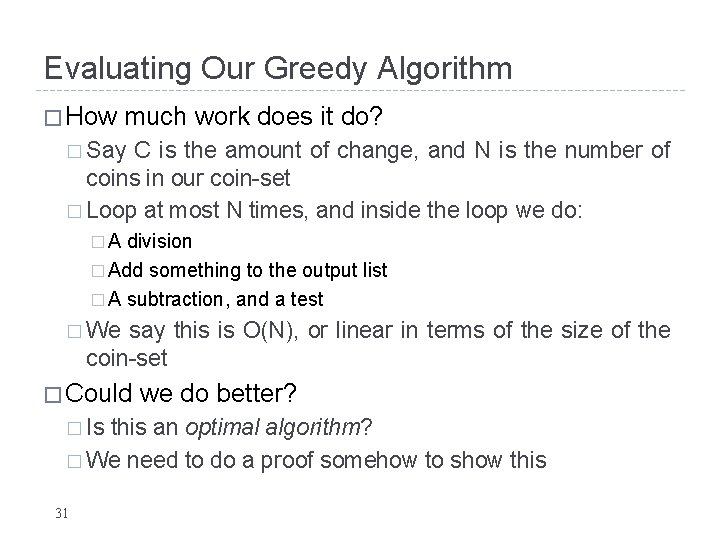
Evaluating Our Greedy Algorithm � How much work does it do? � Say C is the amount of change, and N is the number of coins in our coin-set � Loop at most N times, and inside the loop we do: �A division � Add something to the output list � A subtraction, and a test � We say this is O(N), or linear in terms of the size of the coin-set � Could � Is we do better? this an optimal algorithm? � We need to do a proof somehow to show this 31
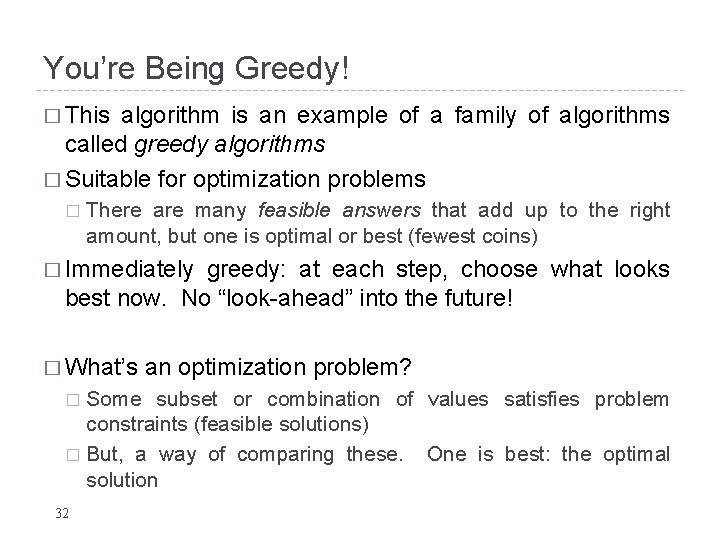
You’re Being Greedy! � This algorithm is an example of a family of algorithms called greedy algorithms � Suitable for optimization problems � There are many feasible answers that add up to the right amount, but one is optimal or best (fewest coins) � Immediately greedy: at each step, choose what looks best now. No “look-ahead” into the future! � What’s an optimization problem? Some subset or combination of values satisfies problem constraints (feasible solutions) � But, a way of comparing these. One is best: the optimal solution � 32
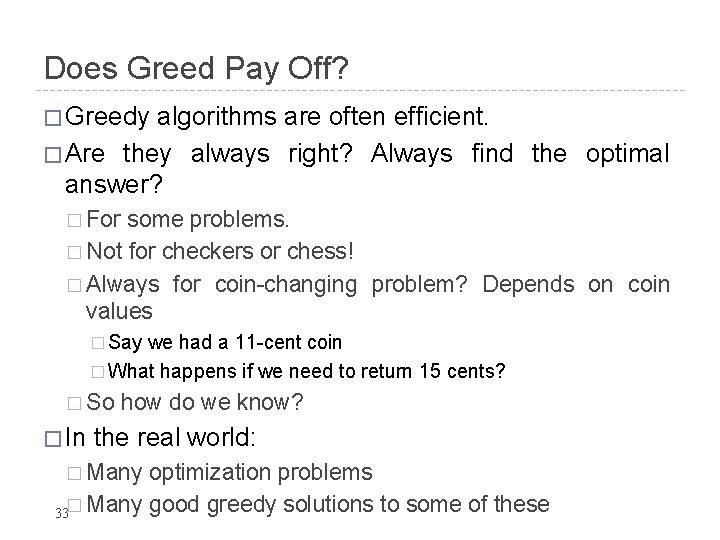
Does Greed Pay Off? � Greedy algorithms are often efficient. � Are they always right? Always find the optimal answer? � For some problems. � Not for checkers or chess! � Always for coin-changing problem? Depends on coin values � Say we had a 11 -cent coin � What happens if we need to return 15 cents? � So � In how do we know? the real world: � Many optimization problems 33� Many good greedy solutions to some of these
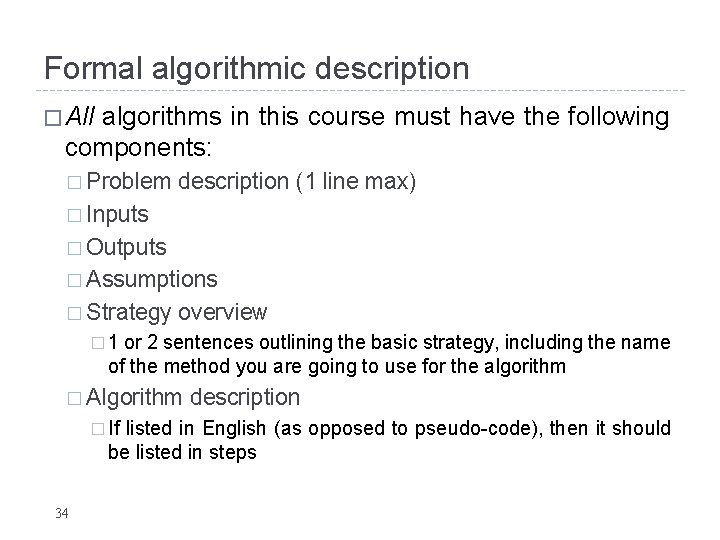
Formal algorithmic description � All algorithms in this course must have the following components: � Problem description (1 line max) � Inputs � Outputs � Assumptions � Strategy overview � 1 or 2 sentences outlining the basic strategy, including the name of the method you are going to use for the algorithm � Algorithm � If description listed in English (as opposed to pseudo-code), then it should be listed in steps 34
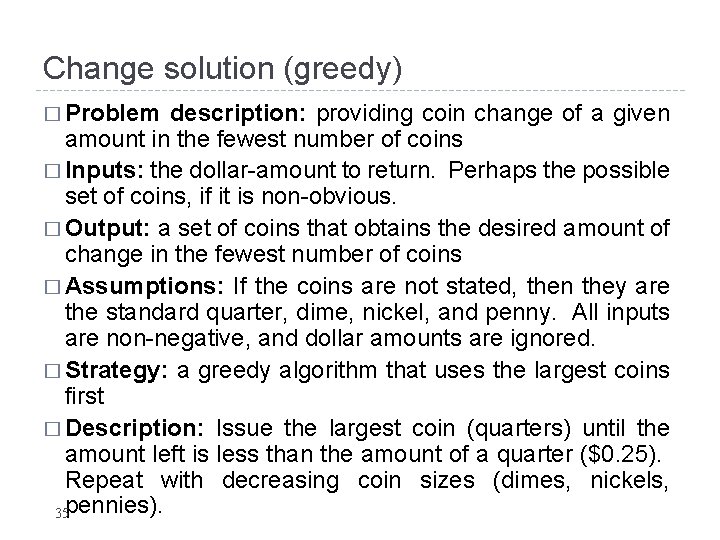
Change solution (greedy) � Problem description: providing coin change of a given amount in the fewest number of coins � Inputs: the dollar-amount to return. Perhaps the possible set of coins, if it is non-obvious. � Output: a set of coins that obtains the desired amount of change in the fewest number of coins � Assumptions: If the coins are not stated, then they are the standard quarter, dime, nickel, and penny. All inputs are non-negative, and dollar amounts are ignored. � Strategy: a greedy algorithm that uses the largest coins first � Description: Issue the largest coin (quarters) until the amount left is less than the amount of a quarter ($0. 25). Repeat with decreasing coin sizes (dimes, nickels, 35 pennies).
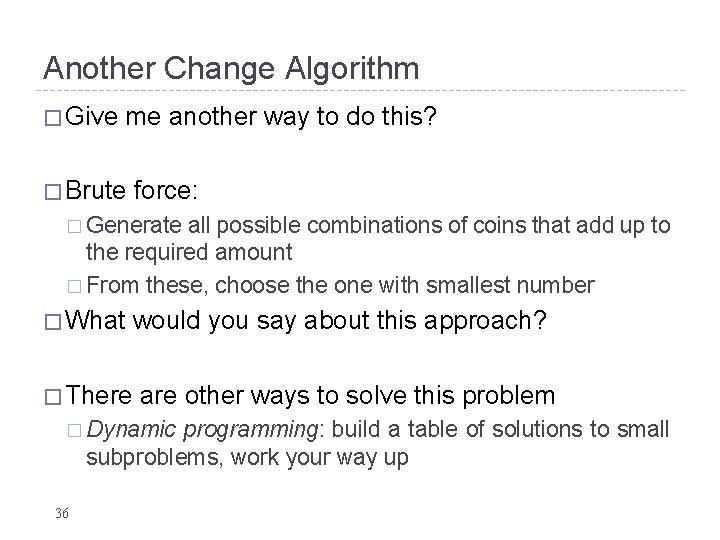
Another Change Algorithm � Give me another way to do this? � Brute force: � Generate all possible combinations of coins that add up to the required amount � From these, choose the one with smallest number � What would you say about this approach? � There are other ways to solve this problem � Dynamic programming: build a table of solutions to small subproblems, work your way up 36
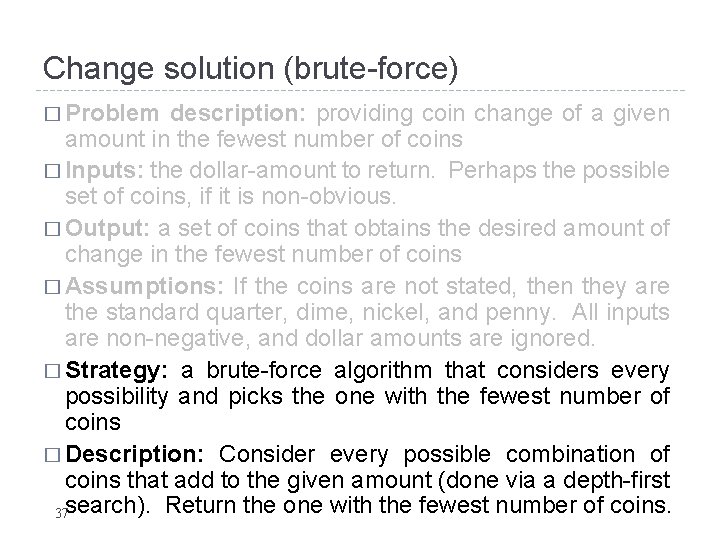
Change solution (brute-force) � Problem description: providing coin change of a given amount in the fewest number of coins � Inputs: the dollar-amount to return. Perhaps the possible set of coins, if it is non-obvious. � Output: a set of coins that obtains the desired amount of change in the fewest number of coins � Assumptions: If the coins are not stated, then they are the standard quarter, dime, nickel, and penny. All inputs are non-negative, and dollar amounts are ignored. � Strategy: a brute-force algorithm that considers every possibility and picks the one with the fewest number of coins � Description: Consider every possible combination of coins that add to the given amount (done via a depth-first 37 search). Return the one with the fewest number of coins.
Motivating problems 38
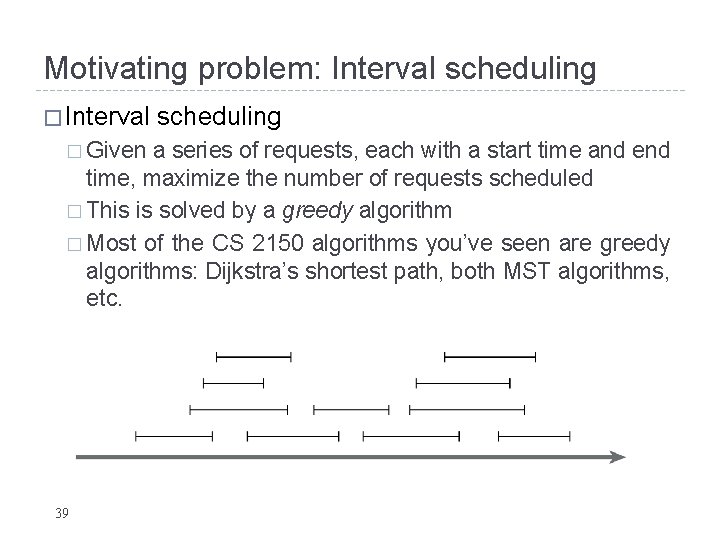
Motivating problem: Interval scheduling � Interval � Given scheduling a series of requests, each with a start time and end time, maximize the number of requests scheduled � This is solved by a greedy algorithm � Most of the CS 2150 algorithms you’ve seen are greedy algorithms: Dijkstra’s shortest path, both MST algorithms, etc. 39
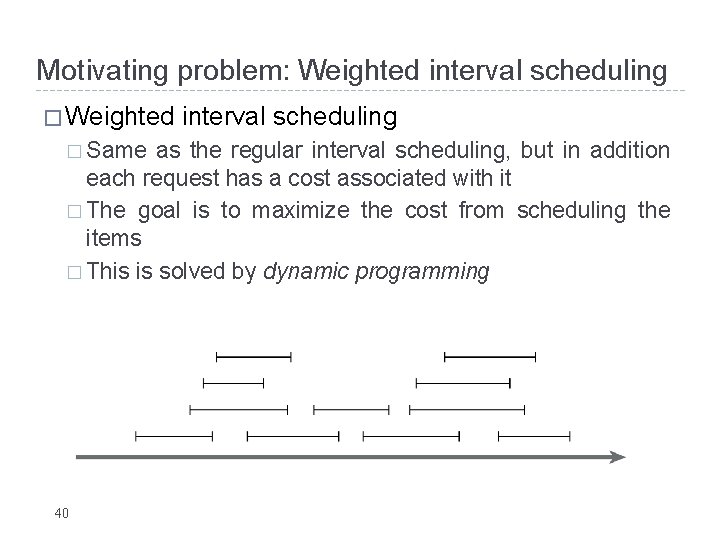
Motivating problem: Weighted interval scheduling � Weighted � Same interval scheduling as the regular interval scheduling, but in addition each request has a cost associated with it � The goal is to maximize the cost from scheduling the items � This is solved by dynamic programming 40
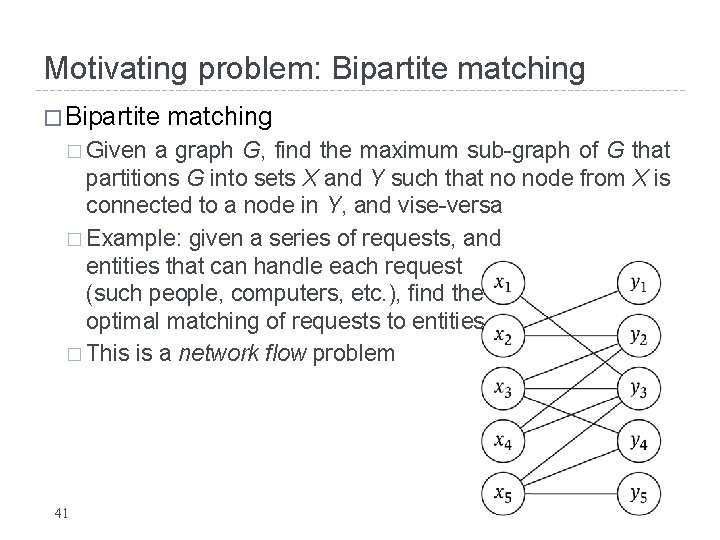
Motivating problem: Bipartite matching � Bipartite � Given matching a graph G, find the maximum sub-graph of G that partitions G into sets X and Y such that no node from X is connected to a node in Y, and vise-versa � Example: given a series of requests, and entities that can handle each request (such people, computers, etc. ), find the optimal matching of requests to entities � This is a network flow problem 41
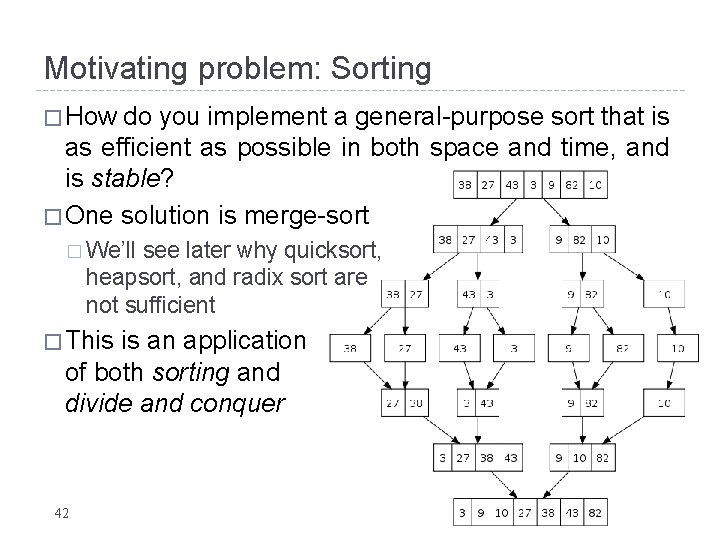
Motivating problem: Sorting � How do you implement a general-purpose sort that is as efficient as possible in both space and time, and is stable? � One solution is merge-sort � We’ll see later why quicksort, heapsort, and radix sort are not sufficient � This is an application of both sorting and divide and conquer 42
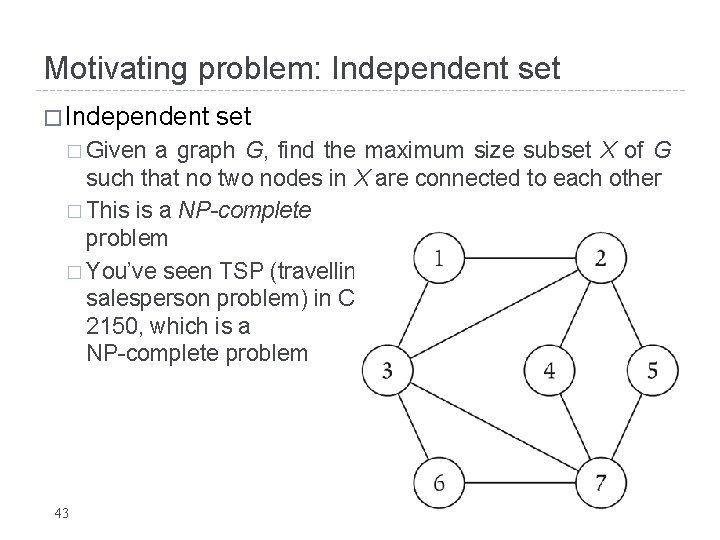
Motivating problem: Independent set � Independent � Given set a graph G, find the maximum size subset X of G such that no two nodes in X are connected to each other � This is a NP-complete problem � You’ve seen TSP (travelling salesperson problem) in CS 2150, which is a NP-complete problem 43
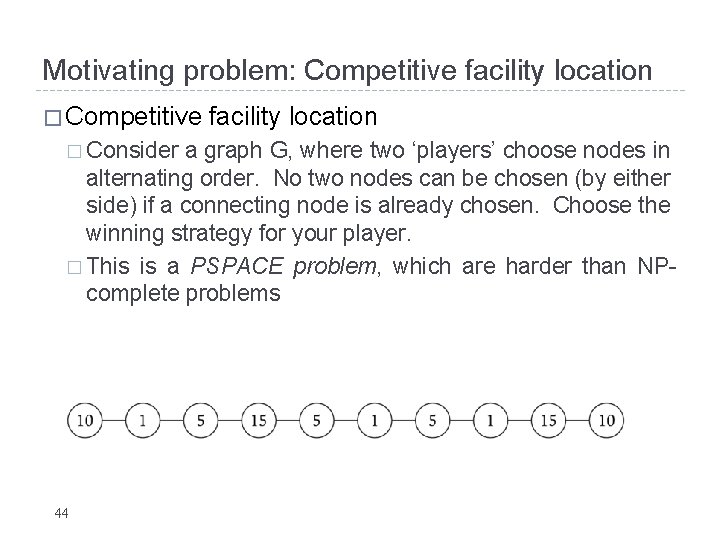
Motivating problem: Competitive facility location � Competitive � Consider facility location a graph G, where two ‘players’ choose nodes in alternating order. No two nodes can be chosen (by either side) if a connecting node is already chosen. Choose the winning strategy for your player. � This is a PSPACE problem, which are harder than NPcomplete problems 44