
CS 249 Neural Language Model 2 Professor Junghoo

- Slides: 25
CS 249: Neural Language Model (2) Professor Junghoo “John” Cho
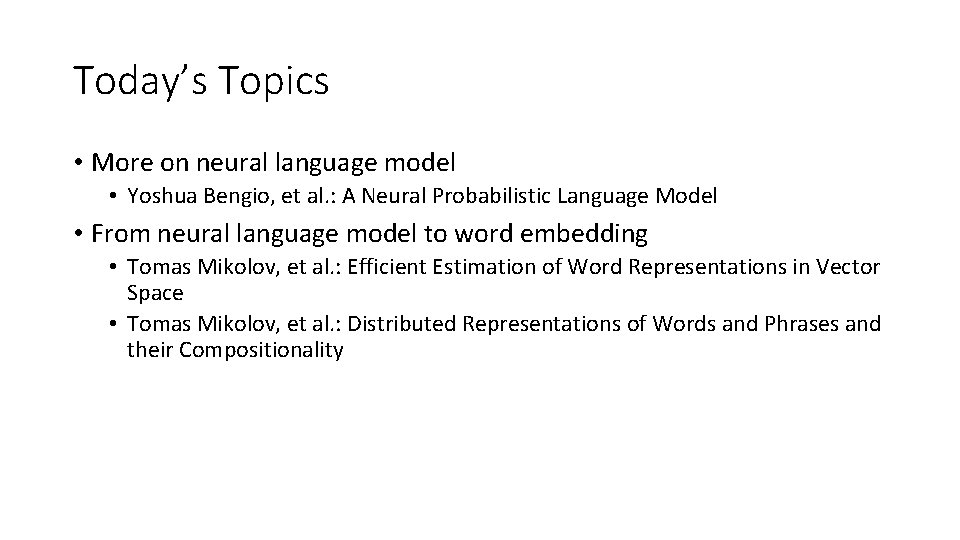
Today’s Topics • More on neural language model • Yoshua Bengio, et al. : A Neural Probabilistic Language Model • From neural language model to word embedding • Tomas Mikolov, et al. : Efficient Estimation of Word Representations in Vector Space • Tomas Mikolov, et al. : Distributed Representations of Words and Phrases and their Compositionality
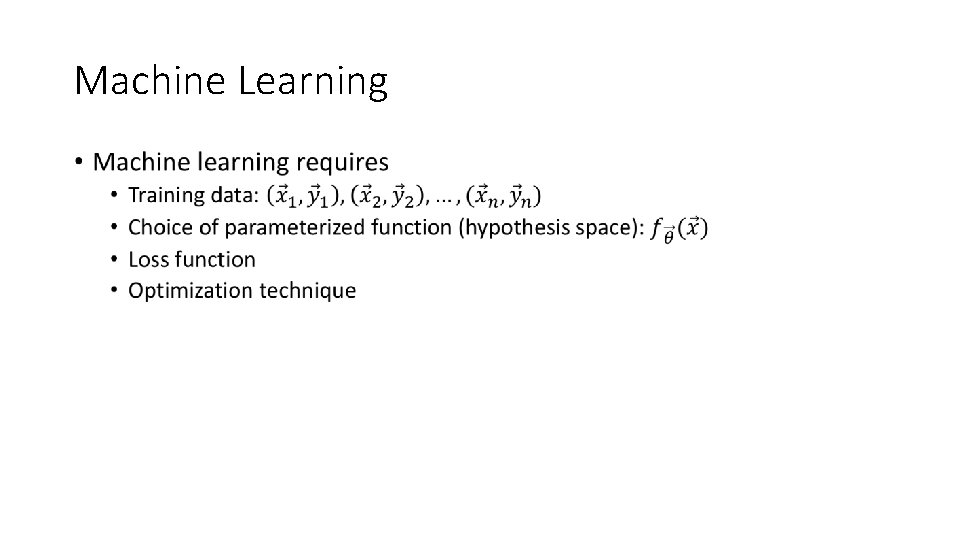
Machine Learning •
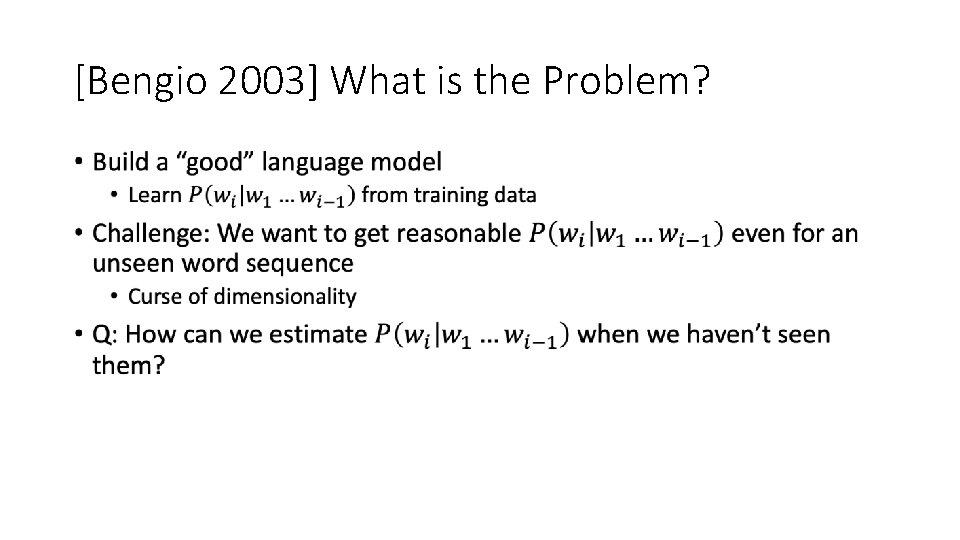
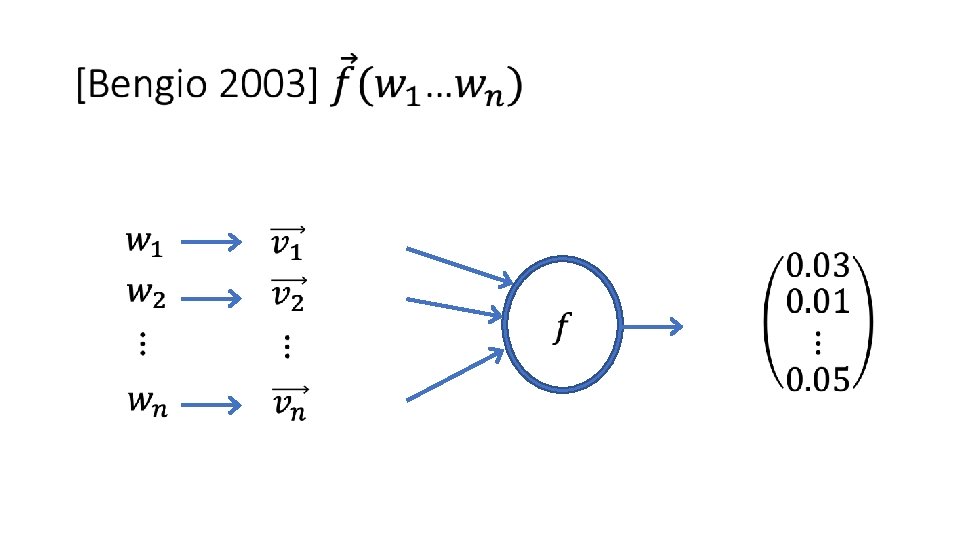
[Bengio 2003] What is the Problem? •
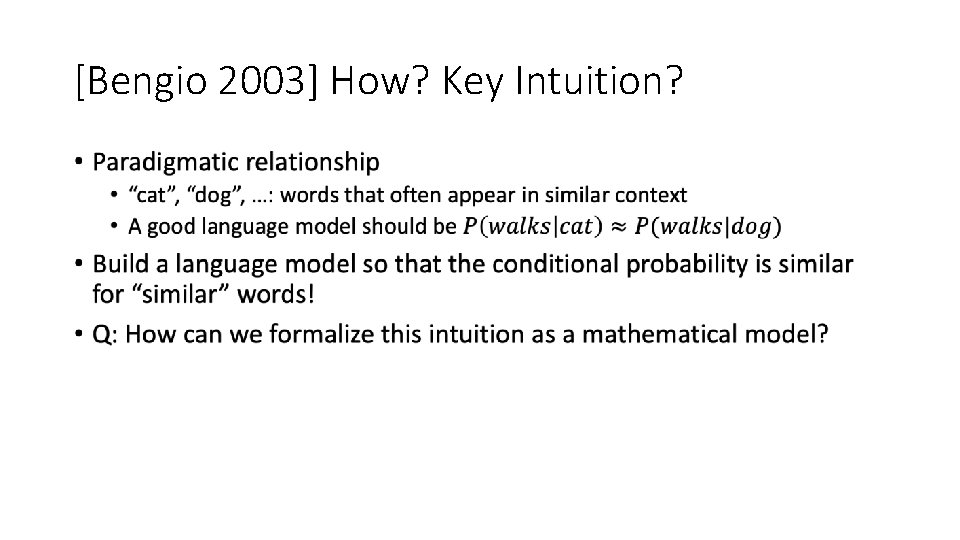
[Bengio 2003] How? Key Intuition? •
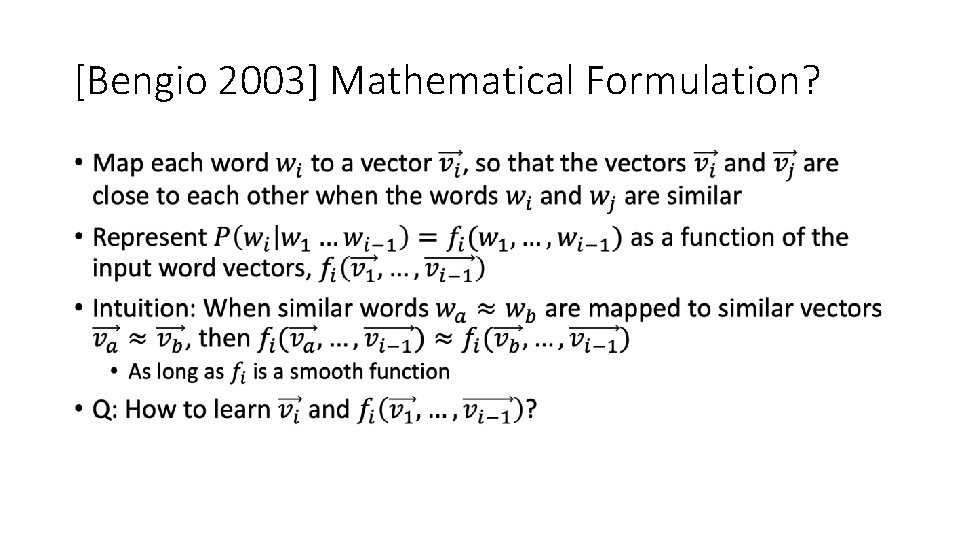
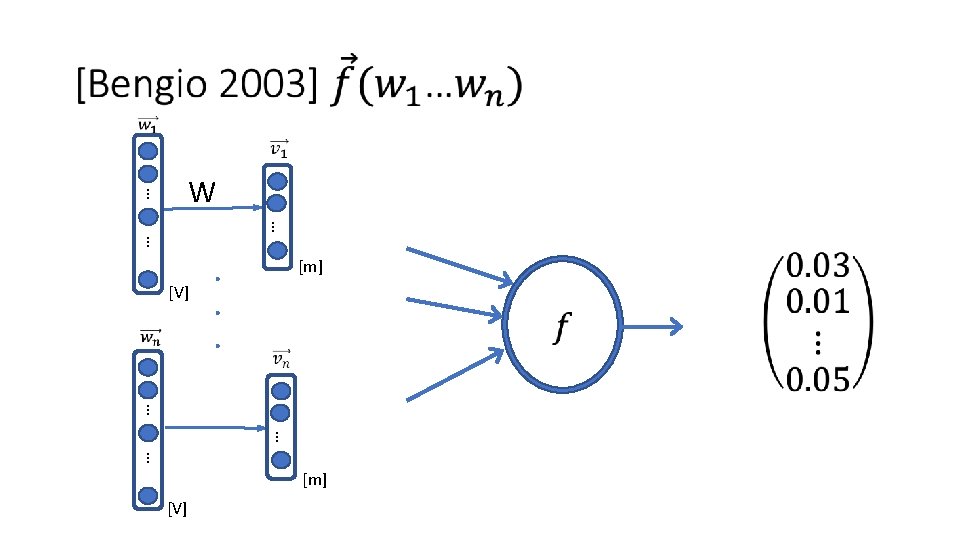
[Bengio 2003] Mathematical Formulation? •
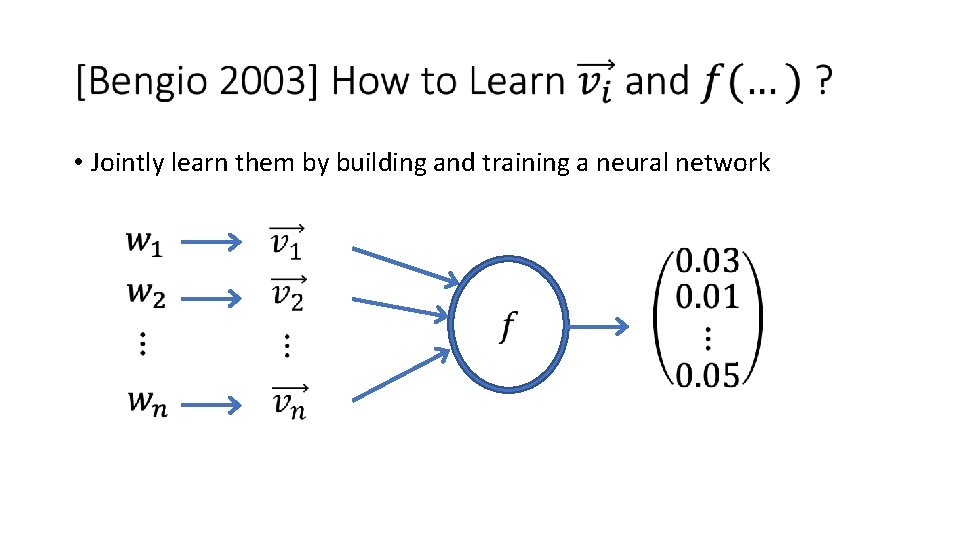
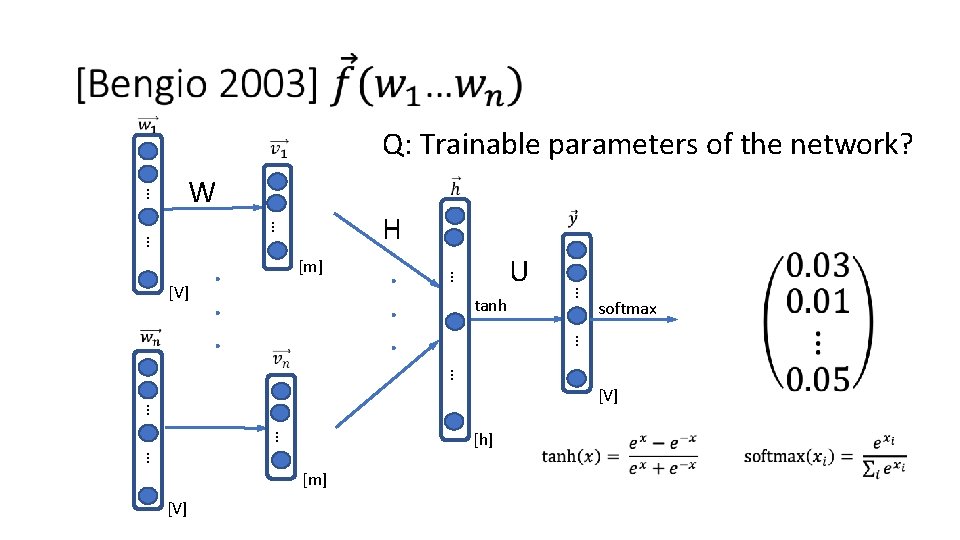
• Jointly learn them by building and training a neural network
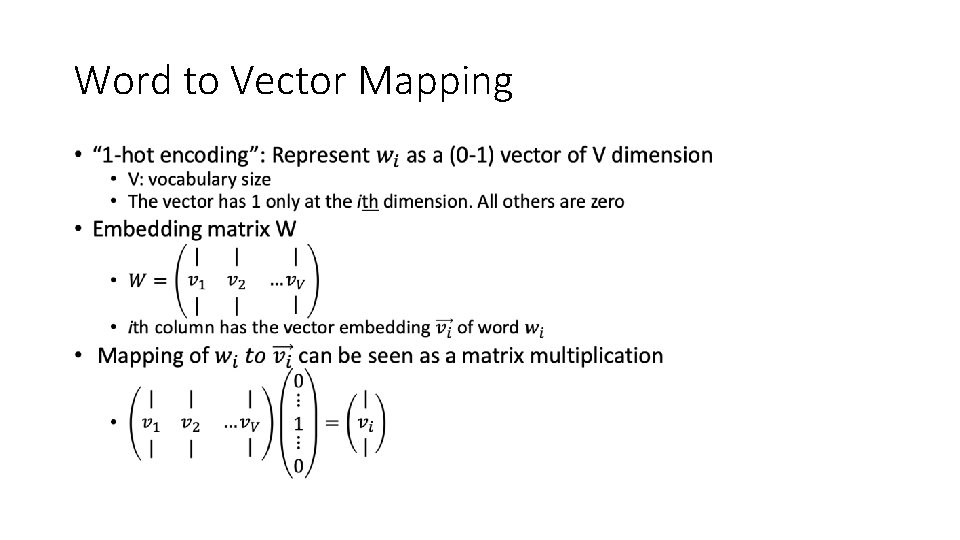
Word to Vector Mapping •
Q: Trainable parameters of the network? … W … H … U tanh softmax … . . . … [m] … [V] . . . … … [V] … [h] … [m] [V]
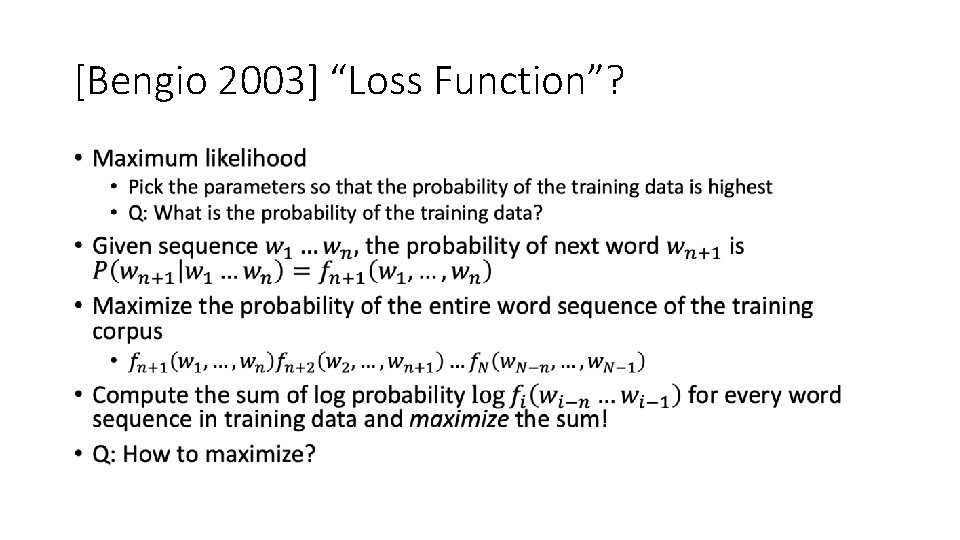
[Bengio 2003] “Loss Function”? •
[Bengio 2003] Optimization Technique? • Q: What technique is used to solve the optimization problem? • A: 1. Use back-propagation algorithm with SGD to maximize the log-likelihood of the training data 2. Some discussion on parallel implementation of the back-propagation algorithm to speed up the learning process, but this is not very relevant today due to the use of GPU-based optimizations
[Bengio 2003]: Result • Trained and evaluated the result on Brown and AP News corpus using perplexity metric (geometric mean of probabilities) • Obtained state-of-the-art result on 15 million word input data in terms of perplexity • 10 -20% better than smoothed trigram model
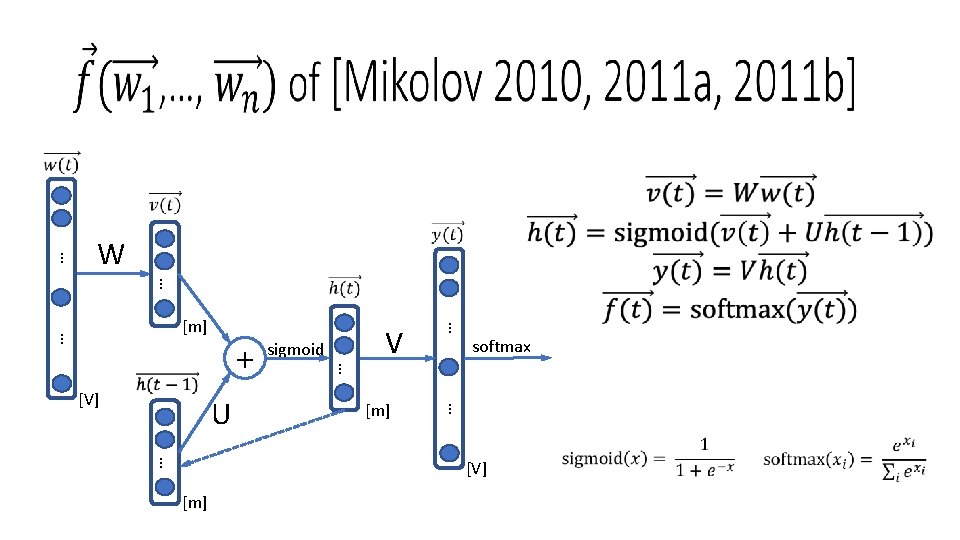
Neural Language Model of [Mikolov 2010, 2011 a, 2011 b] •
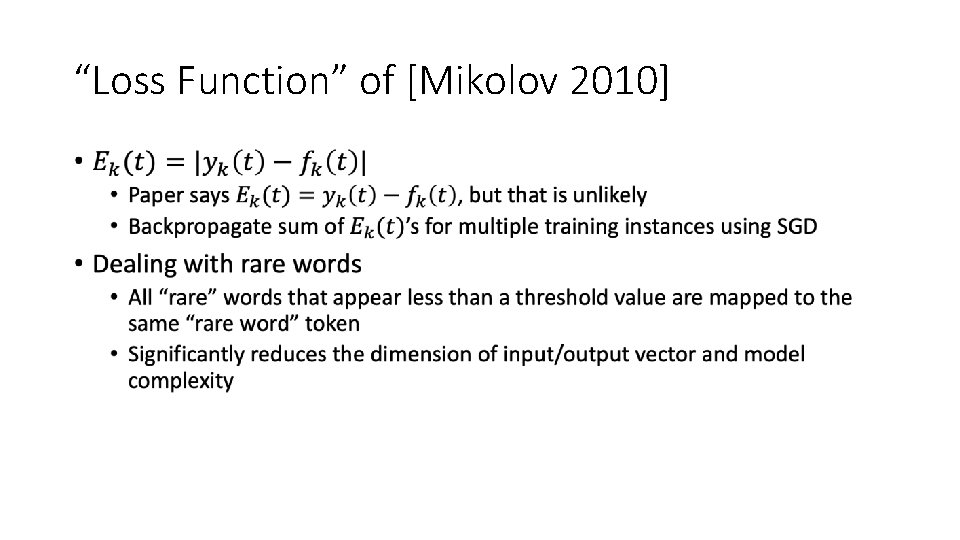
“Loss Function” of [Mikolov 2010] •
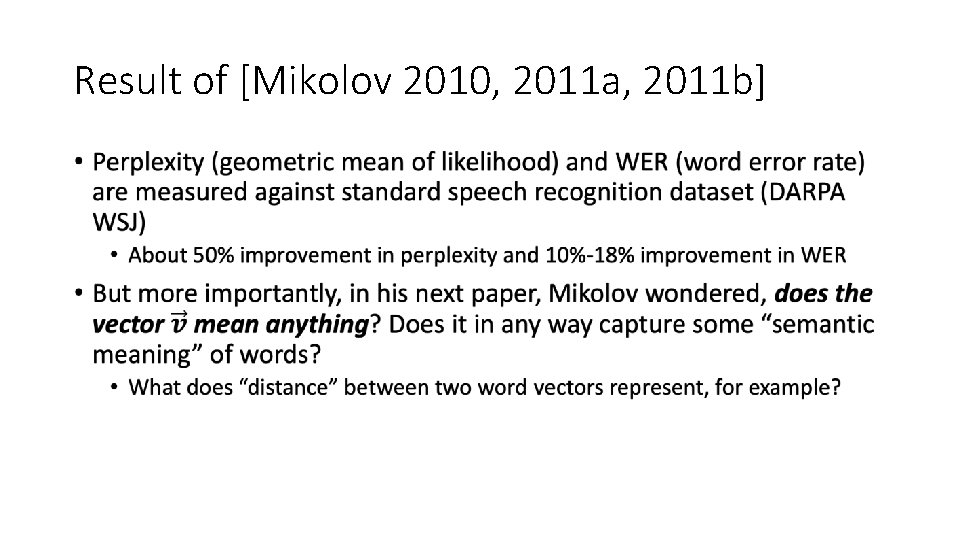
Result of [Mikolov 2010, 2011 a, 2011 b] •
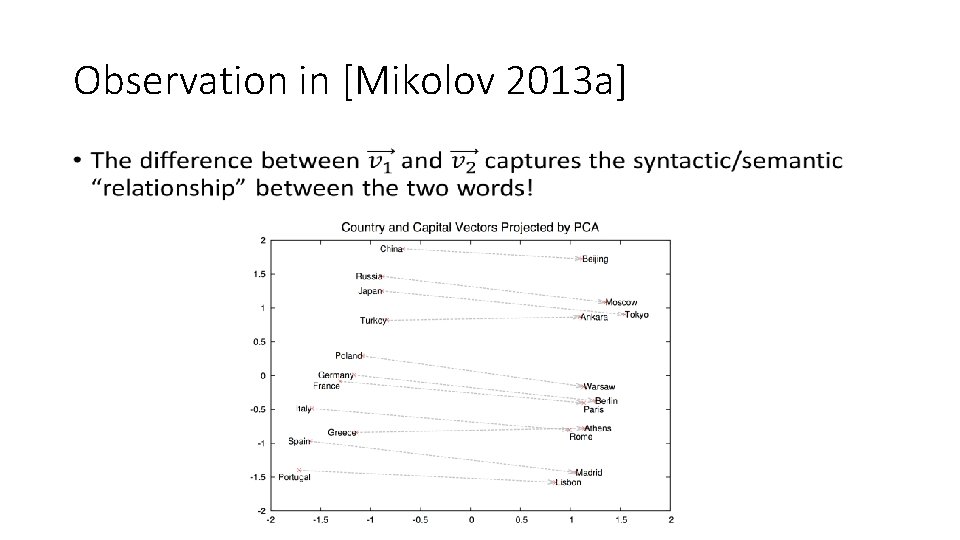
Observation in [Mikolov 2013 a] •
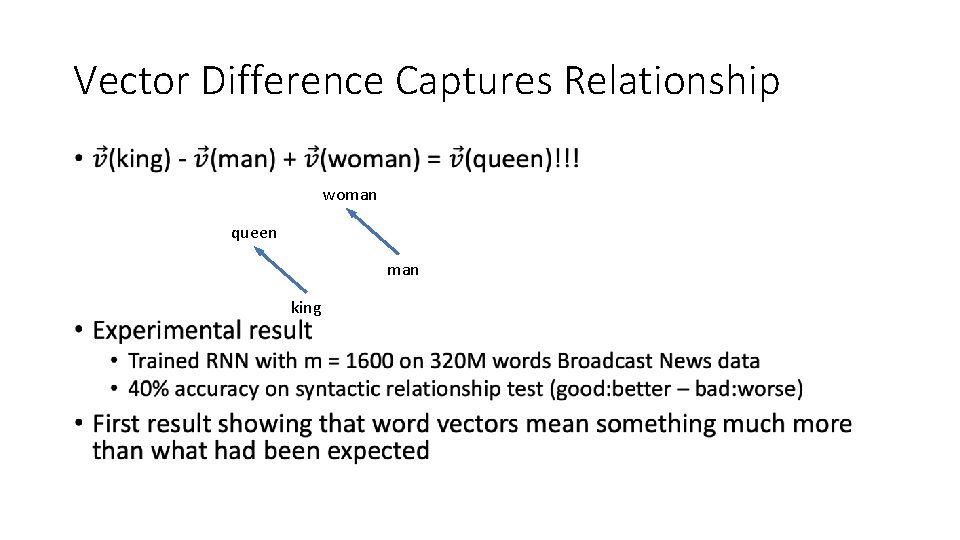
Vector Difference Captures Relationship • woman queen man king
Many Questions… • Why does it work? ? Why do these vectors capture semantics? • Is the result due to the particular choice of the neural network, RNN? • Shall we get better results if much larger dataset is used?
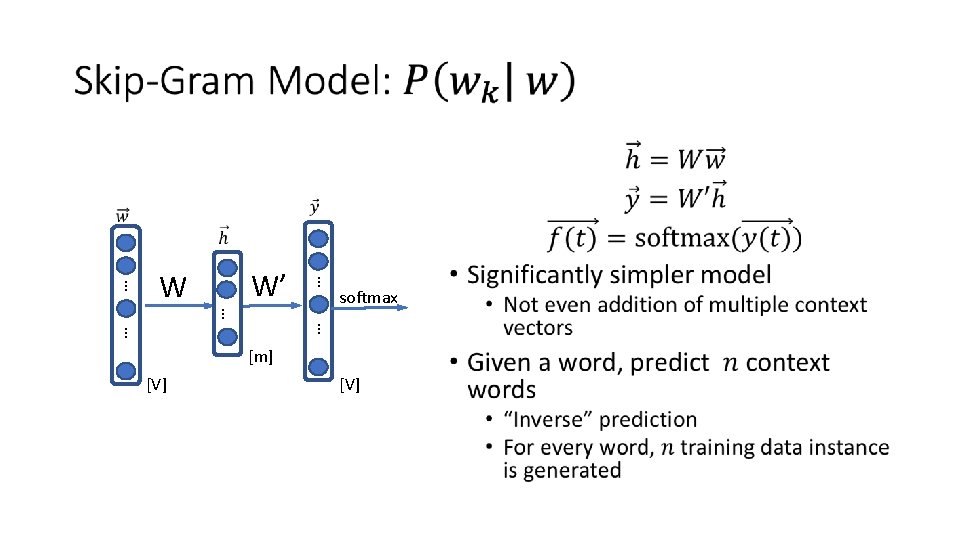
Follow Up: [Mikolov 2013 b] • Questions • Is the result due to the particular choice of the neural network, RNN? • Shall we get better results if much larger dataset is used? • Q: How should we investigate these questions? • [Mikolov 2013 b] • Trained word vectors using significantly simplified neural network models • Continuous Bag Of Words (CBOW) model • Continuous Skip-Gram model • Simpler models allowed significant reduction in training time. • Allows training on much larger dataset
Result of [Mikolov 2013 b] • In general, Skip-Gram model performs best • Much better than his earlier model • Better than CBOW on average • The same “vector-difference relationship” holds • What does it mean? • The vector-difference result was not because of the particular choice of the neural network and/or loss function • Using more data makes things better • Probably the reason why Skip-Gram performs better than CBOW • But still, why does it work in the first place? What is the reason behind this magical result?