
CS 242 The Java Programming Language John Mitchell
![Classification of Java types Reference Types Object[ ] Shape Circle Throwable Shape[ ] Square](https://slidetodoc.com/presentation_image_h2/d5cce5b54c03bd889652df1471f08380/image-24.jpg "Classification of Java types Reference Types Object[ ] Shape Circle Throwable Shape[ ] Square")
![Array types u. Automatically defined • Array type T[ ] exists for each class,](https://slidetodoc.com/presentation_image_h2/d5cce5b54c03bd889652df1471f08380/image-29.jpg "Array types u. Automatically defined • Array type T[ ] exists for each class,")
![Array subtyping u. Covariance • if S <: T then S[ ] <: T[](https://slidetodoc.com/presentation_image_h2/d5cce5b54c03bd889652df1471f08380/image-30.jpg "Array subtyping u. Covariance • if S <: T then S[ ] <: T[")
![Generics are not co/contra-variant u. Array example (review) Integer[] ints = new Integer[] {1,](https://slidetodoc.com/presentation_image_h2/d5cce5b54c03bd889652df1471f08380/image-50.jpg "Generics are not co/contra-variant u. Array example (review) Integer[] ints = new Integer[] {1,")

- Slides: 54
CS 242 The Java Programming Language John Mitchell Reading: Chapter 13 + Gilad Bracha, Generics in the Java Programming Language, Sun Microsystems, 2004 (see web site).
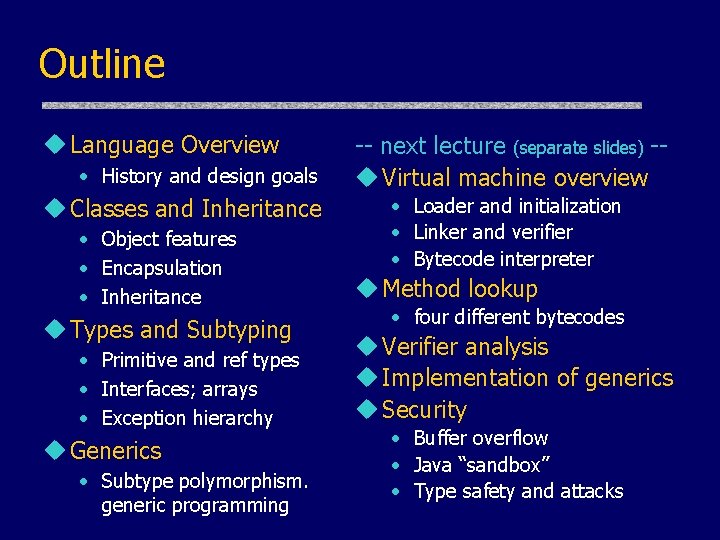
Outline u Language Overview • History and design goals u Classes and Inheritance • Object features • Encapsulation • Inheritance u Types and Subtyping • Primitive and ref types • Interfaces; arrays • Exception hierarchy u Generics • Subtype polymorphism. generic programming -- next lecture (separate slides) -u Virtual machine overview • Loader and initialization • Linker and verifier • Bytecode interpreter u Method lookup • four different bytecodes u Verifier analysis u Implementation of generics u Security • Buffer overflow • Java “sandbox” • Type safety and attacks
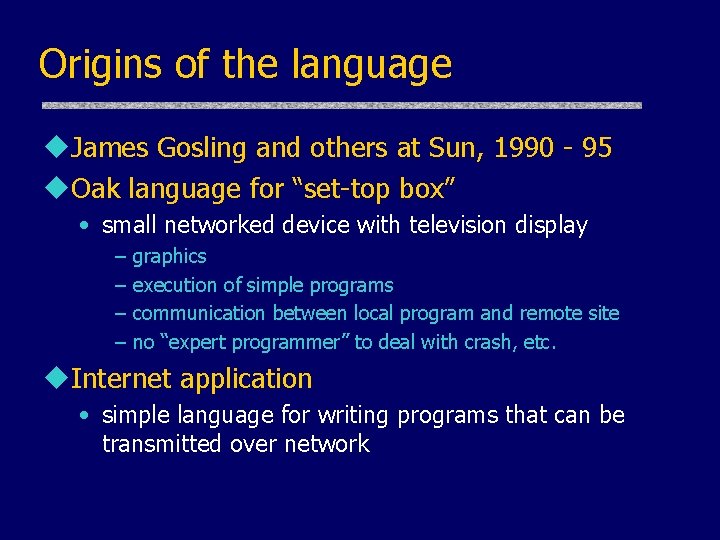
Origins of the language u. James Gosling and others at Sun, 1990 - 95 u. Oak language for “set-top box” • small networked device with television display – – graphics execution of simple programs communication between local program and remote site no “expert programmer” to deal with crash, etc. u. Internet application • simple language for writing programs that can be transmitted over network
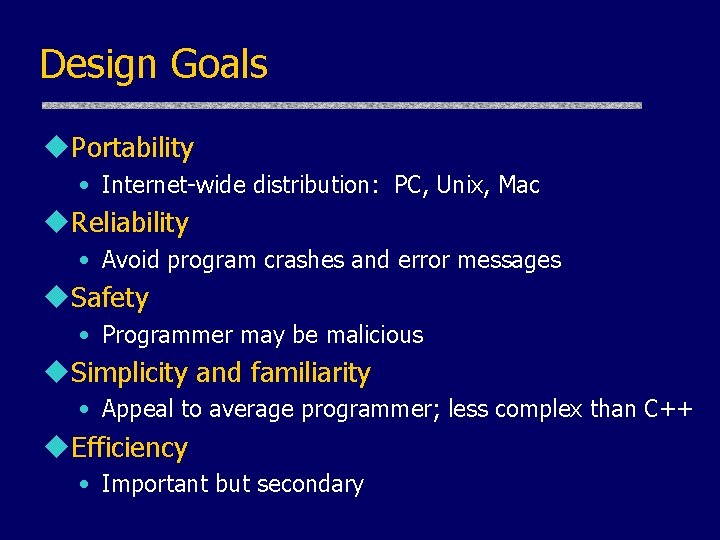
Design Goals u. Portability • Internet-wide distribution: PC, Unix, Mac u. Reliability • Avoid program crashes and error messages u. Safety • Programmer may be malicious u. Simplicity and familiarity • Appeal to average programmer; less complex than C++ u. Efficiency • Important but secondary
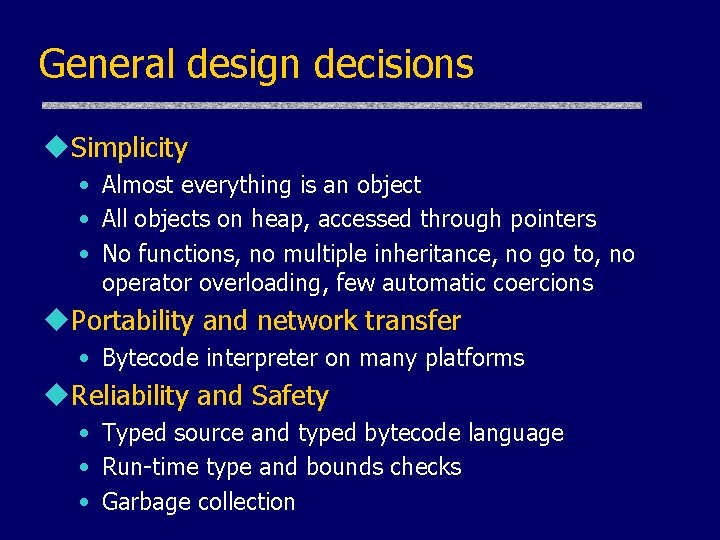
General design decisions u. Simplicity • Almost everything is an object • All objects on heap, accessed through pointers • No functions, no multiple inheritance, no go to, no operator overloading, few automatic coercions u. Portability and network transfer • Bytecode interpreter on many platforms u. Reliability and Safety • Typed source and typed bytecode language • Run-time type and bounds checks • Garbage collection
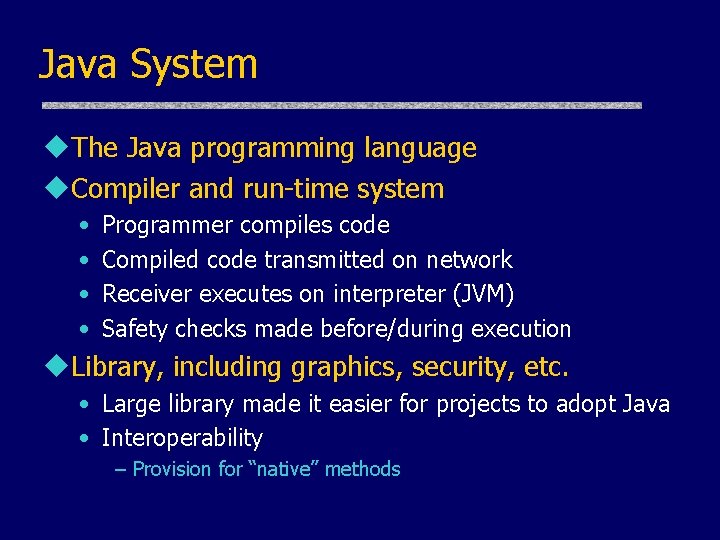
Java System u. The Java programming language u. Compiler and run-time system • • Programmer compiles code Compiled code transmitted on network Receiver executes on interpreter (JVM) Safety checks made before/during execution u. Library, including graphics, security, etc. • Large library made it easier for projects to adopt Java • Interoperability – Provision for “native” methods
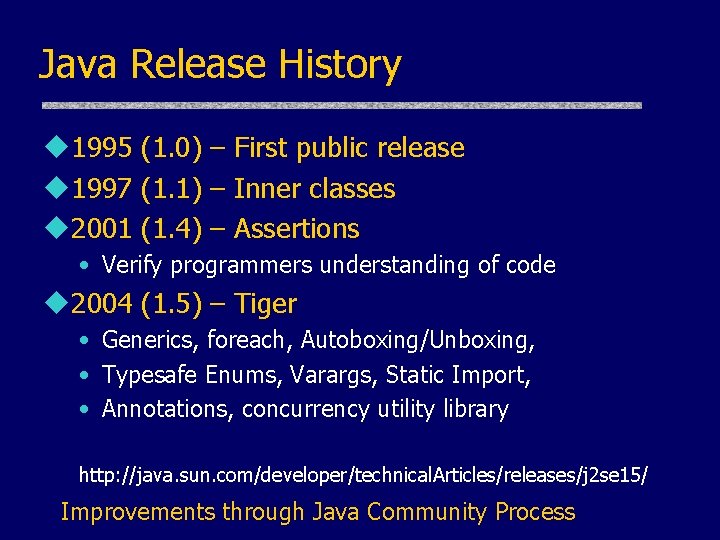
Java Release History u 1995 (1. 0) – First public release u 1997 (1. 1) – Inner classes u 2001 (1. 4) – Assertions • Verify programmers understanding of code u 2004 (1. 5) – Tiger • Generics, foreach, Autoboxing/Unboxing, • Typesafe Enums, Varargs, Static Import, • Annotations, concurrency utility library http: //java. sun. com/developer/technical. Articles/releases/j 2 se 15/ Improvements through Java Community Process
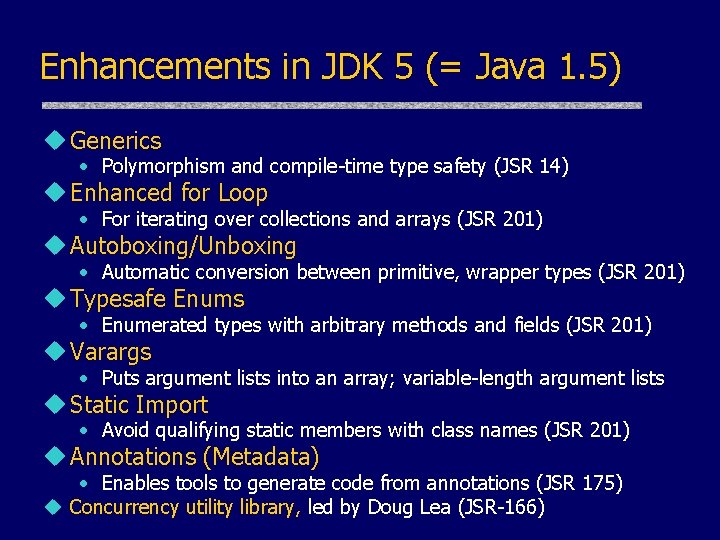
Enhancements in JDK 5 (= Java 1. 5) u Generics • Polymorphism and compile-time type safety (JSR 14) u Enhanced for Loop • For iterating over collections and arrays (JSR 201) u Autoboxing/Unboxing • Automatic conversion between primitive, wrapper types (JSR 201) u Typesafe Enums • Enumerated types with arbitrary methods and fields (JSR 201) u Varargs • Puts argument lists into an array; variable-length argument lists u Static Import • Avoid qualifying static members with class names (JSR 201) u Annotations (Metadata) • Enables tools to generate code from annotations (JSR 175) u Concurrency utility library, led by Doug Lea (JSR-166)
Outline u. Objects in Java • Classes, encapsulation, inheritance u. Type system • Primitive types, interfaces, arrays, exceptions u. Generics (added in Java 1. 5) • Basics, wildcards, … u. Virtual machine • Loader, verifier, linker, interpreter • Bytecodes for method lookup u. Security issues
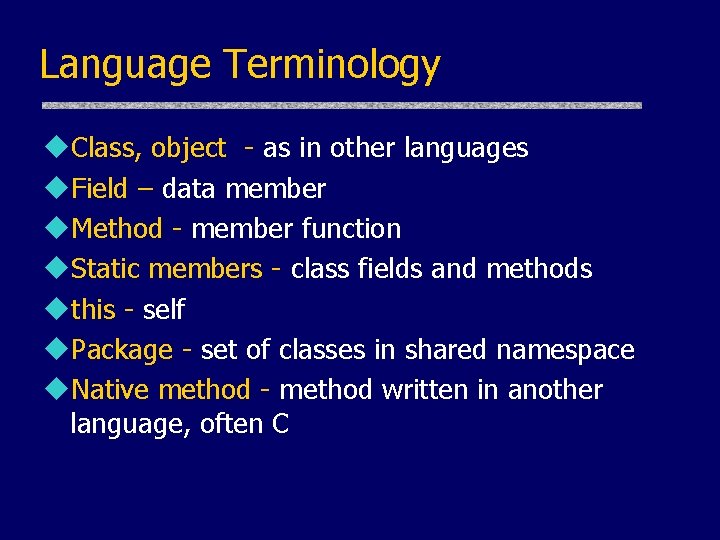
Language Terminology u. Class, object - as in other languages u. Field – data member u. Method - member function u. Static members - class fields and methods uthis - self u. Package - set of classes in shared namespace u. Native method - method written in another language, often C
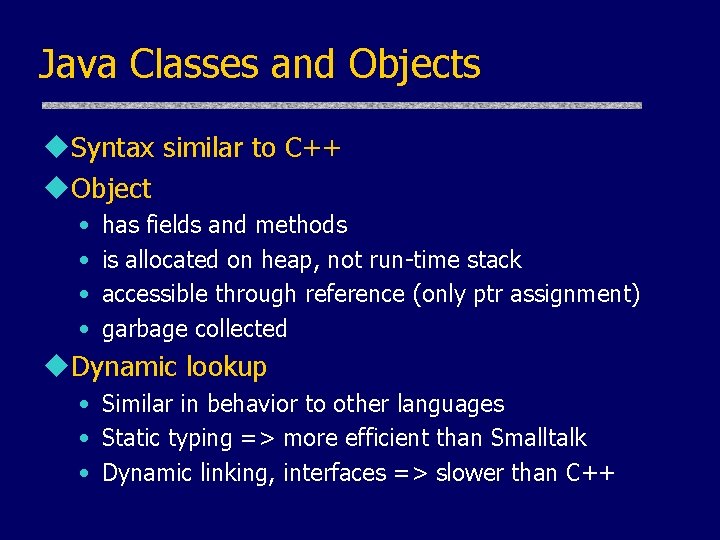
Java Classes and Objects u. Syntax similar to C++ u. Object • • has fields and methods is allocated on heap, not run-time stack accessible through reference (only ptr assignment) garbage collected u. Dynamic lookup • Similar in behavior to other languages • Static typing => more efficient than Smalltalk • Dynamic linking, interfaces => slower than C++
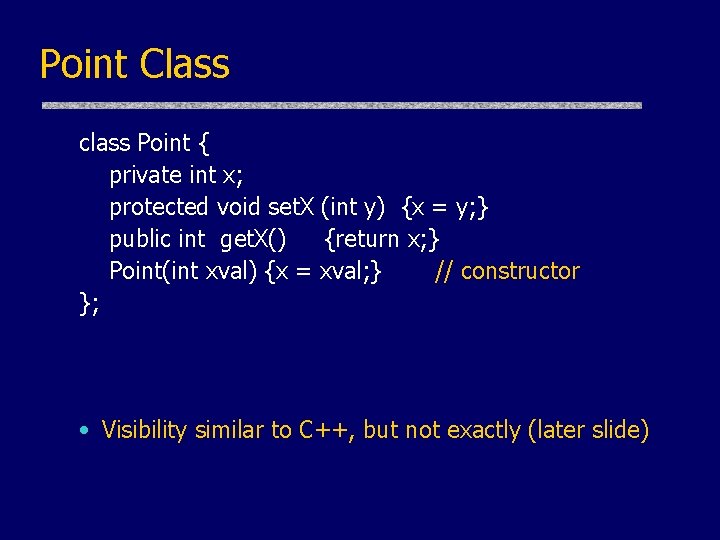
Point Class class Point { private int x; protected void set. X (int y) {x = y; } public int get. X() {return x; } Point(int xval) {x = xval; } // constructor }; • Visibility similar to C++, but not exactly (later slide)
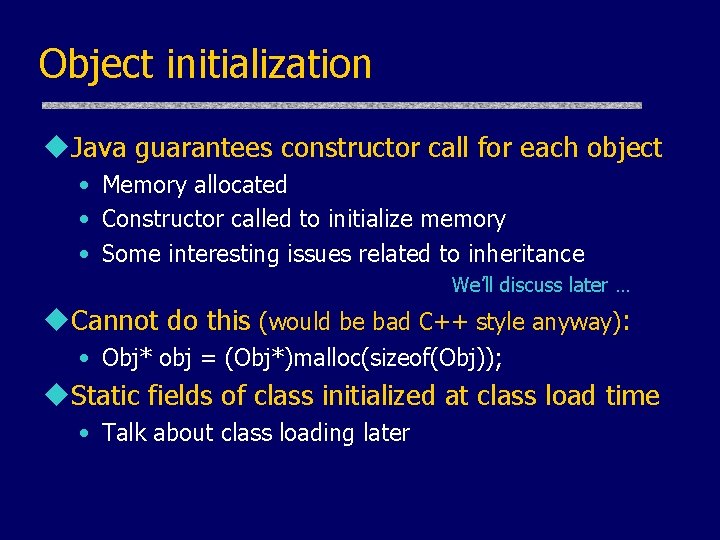
Object initialization u. Java guarantees constructor call for each object • Memory allocated • Constructor called to initialize memory • Some interesting issues related to inheritance We’ll discuss later … u. Cannot do this (would be bad C++ style anyway): • Obj* obj = (Obj*)malloc(sizeof(Obj)); u. Static fields of class initialized at class load time • Talk about class loading later
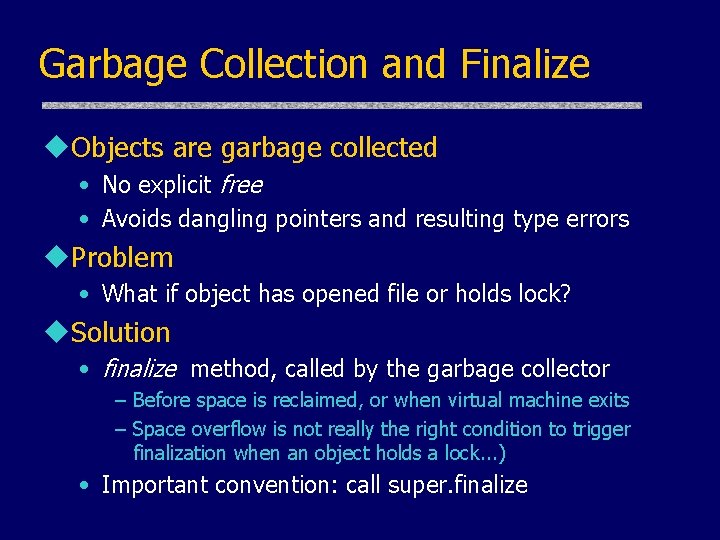
Garbage Collection and Finalize u. Objects are garbage collected • No explicit free • Avoids dangling pointers and resulting type errors u. Problem • What if object has opened file or holds lock? u. Solution • finalize method, called by the garbage collector – Before space is reclaimed, or when virtual machine exits – Space overflow is not really the right condition to trigger finalization when an object holds a lock. . . ) • Important convention: call super. finalize
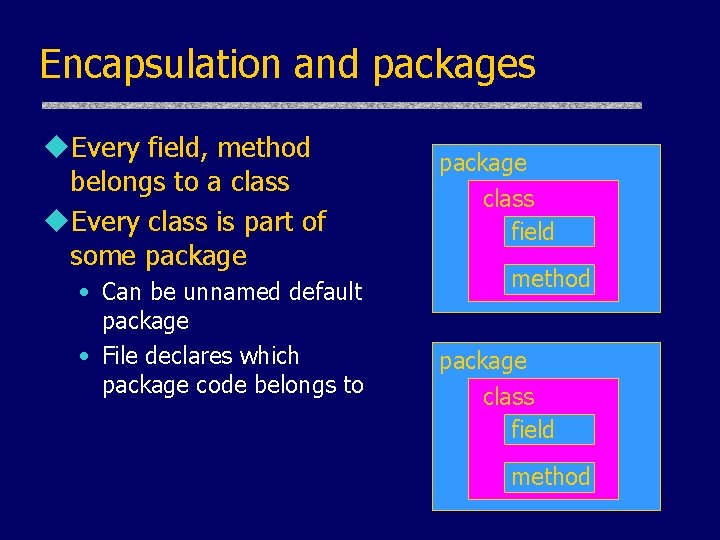
Encapsulation and packages u. Every field, method belongs to a class u. Every class is part of some package • Can be unnamed default package • File declares which package code belongs to package class field method
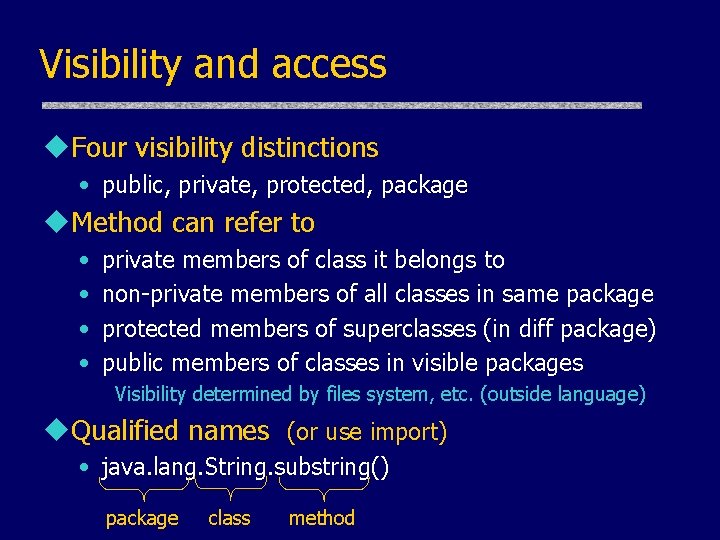
Visibility and access u. Four visibility distinctions • public, private, protected, package u. Method can refer to • • private members of class it belongs to non-private members of all classes in same package protected members of superclasses (in diff package) public members of classes in visible packages Visibility determined by files system, etc. (outside language) u. Qualified names (or use import) • java. lang. String. substring() package class method
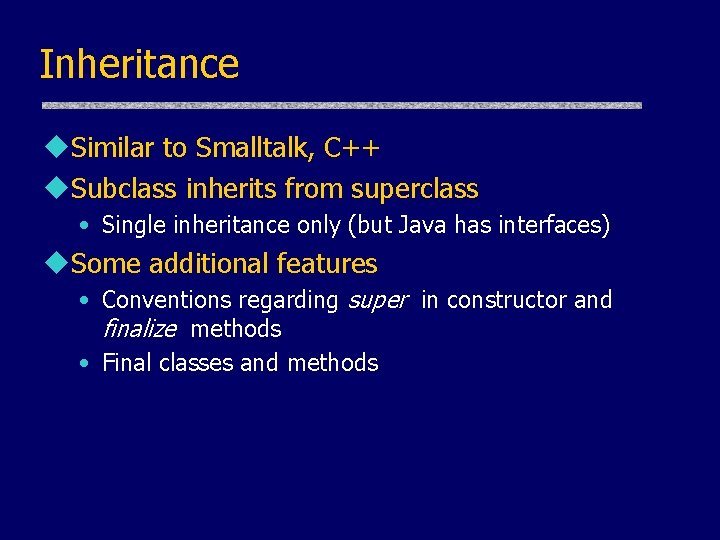
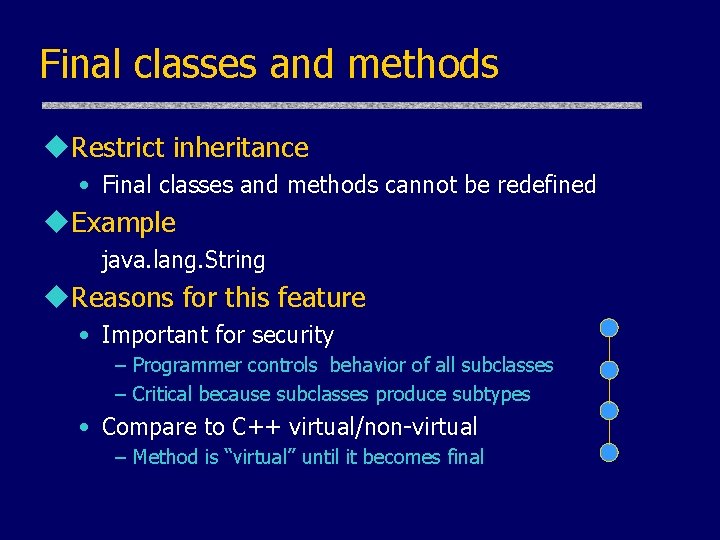
Inheritance u. Similar to Smalltalk, C++ u. Subclass inherits from superclass • Single inheritance only (but Java has interfaces) u. Some additional features • Conventions regarding super in constructor and finalize methods • Final classes and methods
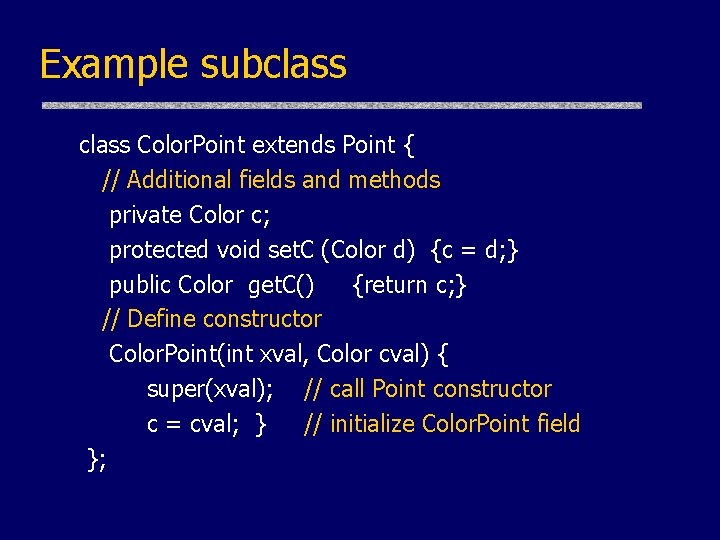
Example subclass Color. Point extends Point { // Additional fields and methods private Color c; protected void set. C (Color d) {c = d; } public Color get. C() {return c; } // Define constructor Color. Point(int xval, Color cval) { super(xval); // call Point constructor c = cval; } // initialize Color. Point field };
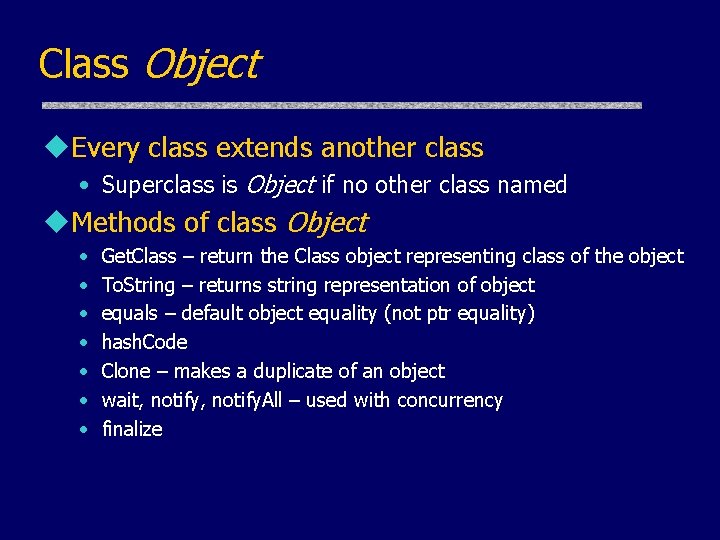
Class Object u. Every class extends another class • Superclass is Object if no other class named u. Methods of class Object • • Get. Class – return the Class object representing class of the object To. String – returns string representation of object equals – default object equality (not ptr equality) hash. Code Clone – makes a duplicate of an object wait, notify. All – used with concurrency finalize
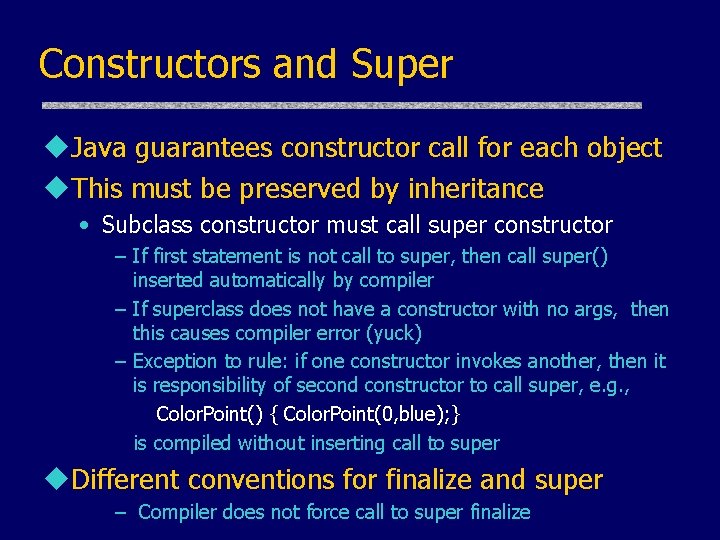
Constructors and Super u. Java guarantees constructor call for each object u. This must be preserved by inheritance • Subclass constructor must call super constructor – If first statement is not call to super, then call super() inserted automatically by compiler – If superclass does not have a constructor with no args, then this causes compiler error (yuck) – Exception to rule: if one constructor invokes another, then it is responsibility of second constructor to call super, e. g. , Color. Point() { Color. Point(0, blue); } is compiled without inserting call to super u. Different conventions for finalize and super – Compiler does not force call to super finalize
Final classes and methods u. Restrict inheritance • Final classes and methods cannot be redefined u. Example java. lang. String u. Reasons for this feature • Important for security – Programmer controls behavior of all subclasses – Critical because subclasses produce subtypes • Compare to C++ virtual/non-virtual – Method is “virtual” until it becomes final
Outline u. Objects in Java • Classes, encapsulation, inheritance u. Type system • Primitive types, interfaces, arrays, exceptions u. Generics (added in Java 1. 5) • Basics, wildcards, … u. Virtual machine • Loader, verifier, linker, interpreter • Bytecodes for method lookup u. Security issues
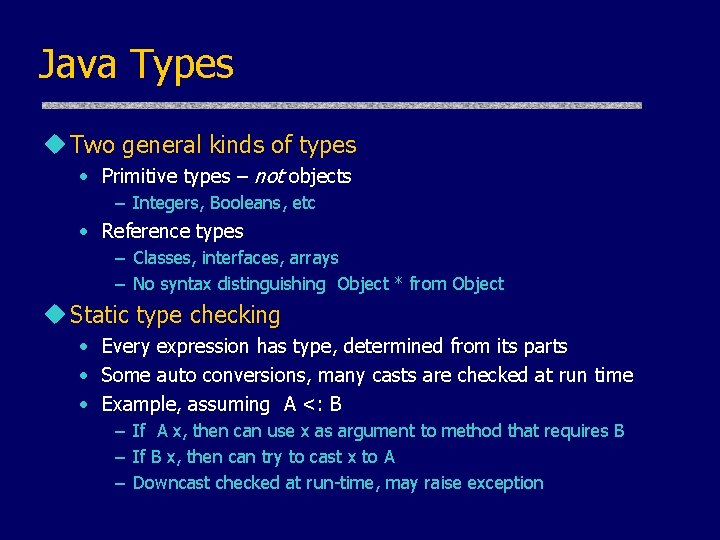
Java Types u Two general kinds of types • Primitive types – not objects – Integers, Booleans, etc • Reference types – Classes, interfaces, arrays – No syntax distinguishing Object * from Object u Static type checking • Every expression has type, determined from its parts • Some auto conversions, many casts are checked at run time • Example, assuming A <: B – If A x, then can use x as argument to method that requires B – If B x, then can try to cast x to A – Downcast checked at run-time, may raise exception
Classification of Java types Reference Types Object[ ] Shape Circle Throwable Shape[ ] Square Circle[ ] user-defined Exception types Square[ ] arrays Primitive Types boolean int byte … float long
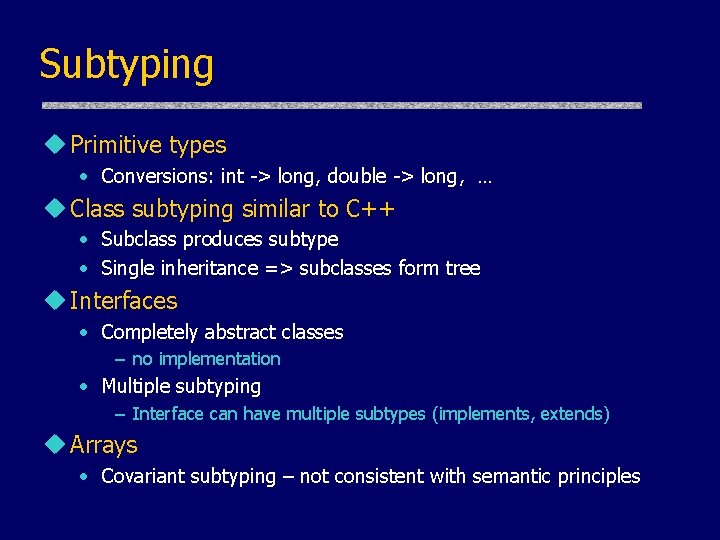
Subtyping u Primitive types • Conversions: int -> long, double -> long, … u Class subtyping similar to C++ • Subclass produces subtype • Single inheritance => subclasses form tree u Interfaces • Completely abstract classes – no implementation • Multiple subtyping – Interface can have multiple subtypes (implements, extends) u Arrays • Covariant subtyping – not consistent with semantic principles
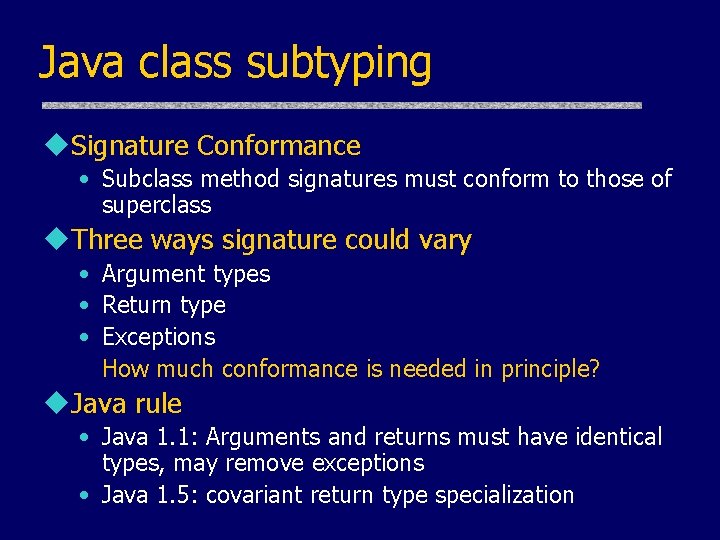
Java class subtyping u. Signature Conformance • Subclass method signatures must conform to those of superclass u. Three ways signature could vary • Argument types • Return type • Exceptions How much conformance is needed in principle? u. Java rule • Java 1. 1: Arguments and returns must have identical types, may remove exceptions • Java 1. 5: covariant return type specialization
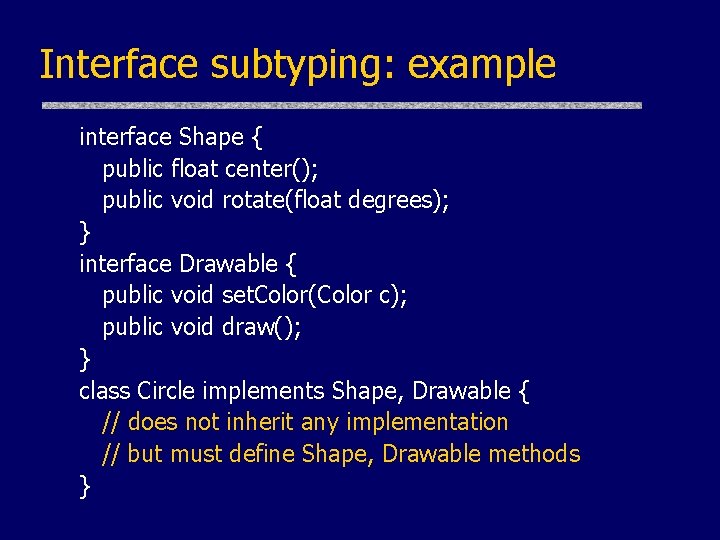
Interface subtyping: example interface Shape { public float center(); public void rotate(float degrees); } interface Drawable { public void set. Color(Color c); public void draw(); } class Circle implements Shape, Drawable { // does not inherit any implementation // but must define Shape, Drawable methods }
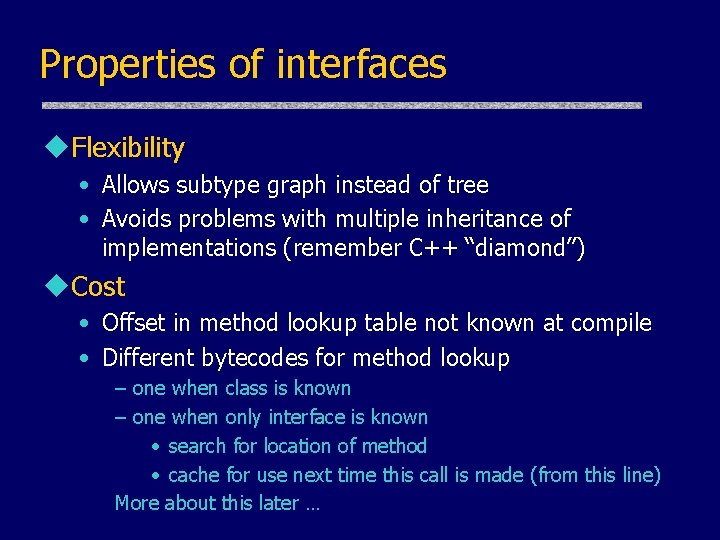
Properties of interfaces u. Flexibility • Allows subtype graph instead of tree • Avoids problems with multiple inheritance of implementations (remember C++ “diamond”) u. Cost • Offset in method lookup table not known at compile • Different bytecodes for method lookup – one when class is known – one when only interface is known • search for location of method • cache for use next time this call is made (from this line) More about this later …
Array types u. Automatically defined • Array type T[ ] exists for each class, interface type T • Cannot extended array types (array types are final) • Multi-dimensional arrays are arrays of arrays: T[ ] u. Treated as reference type • An array variable is a pointer to an array, can be null • Example: Circle[] x = new Circle[array_size] • Anonymous array expression: new int[] {1, 2, 3, . . . 10} u. Every array type is a subtype of Object[ ], Object • Length of array is not part of its static type
Array subtyping u. Covariance • if S <: T then S[ ] <: T[ ] u. Standard type error class A {…} class B extends A {…} B[ ] b. Array = new B[10] A[ ] a. Array = b. Array // considered OK since B[] <: A[] a. Array[0] = new A() // compiles, but run-time error // raises Array. Store. Exception
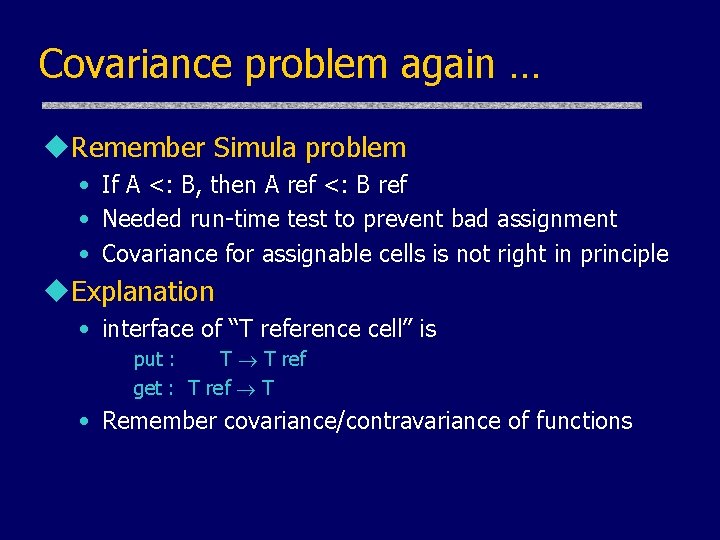
Covariance problem again … u. Remember Simula problem • If A <: B, then A ref <: B ref • Needed run-time test to prevent bad assignment • Covariance for assignable cells is not right in principle u. Explanation • interface of “T reference cell” is put : T T ref get : T ref T • Remember covariance/contravariance of functions
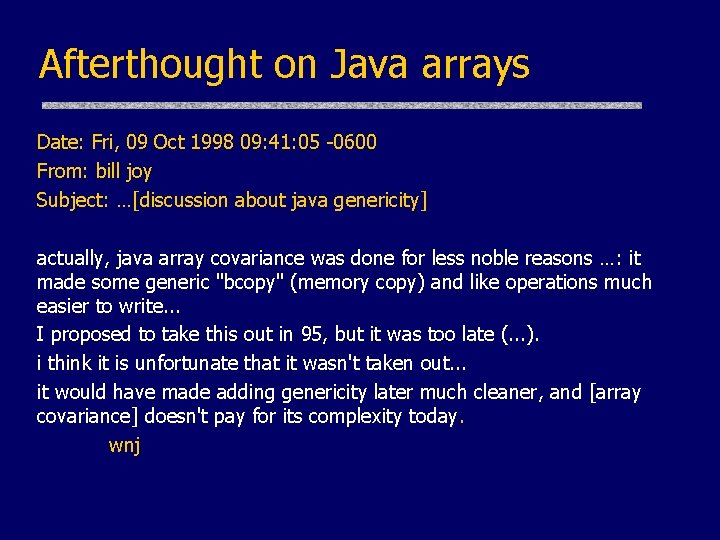
Afterthought on Java arrays Date: Fri, 09 Oct 1998 09: 41: 05 -0600 From: bill joy Subject: …[discussion about java genericity] actually, java array covariance was done for less noble reasons …: it made some generic "bcopy" (memory copy) and like operations much easier to write. . . I proposed to take this out in 95, but it was too late (. . . ). i think it is unfortunate that it wasn't taken out. . . it would have made adding genericity later much cleaner, and [array covariance] doesn't pay for its complexity today. wnj
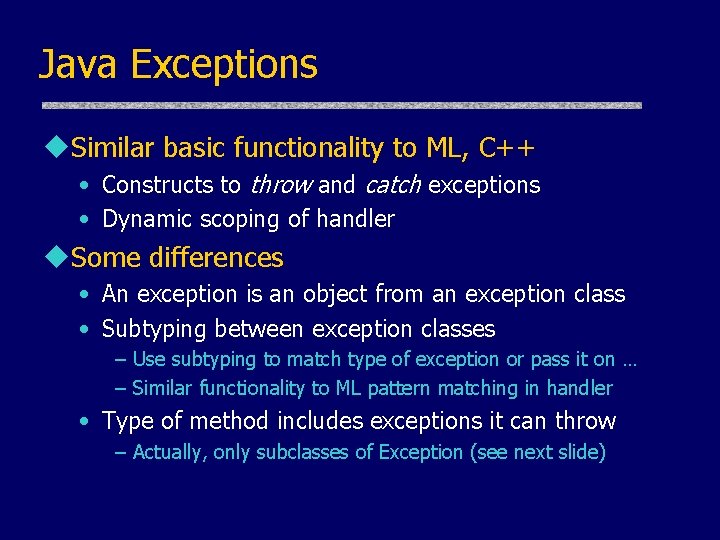
Java Exceptions u. Similar basic functionality to ML, C++ • Constructs to throw and catch exceptions • Dynamic scoping of handler u. Some differences • An exception is an object from an exception class • Subtyping between exception classes – Use subtyping to match type of exception or pass it on … – Similar functionality to ML pattern matching in handler • Type of method includes exceptions it can throw – Actually, only subclasses of Exception (see next slide)
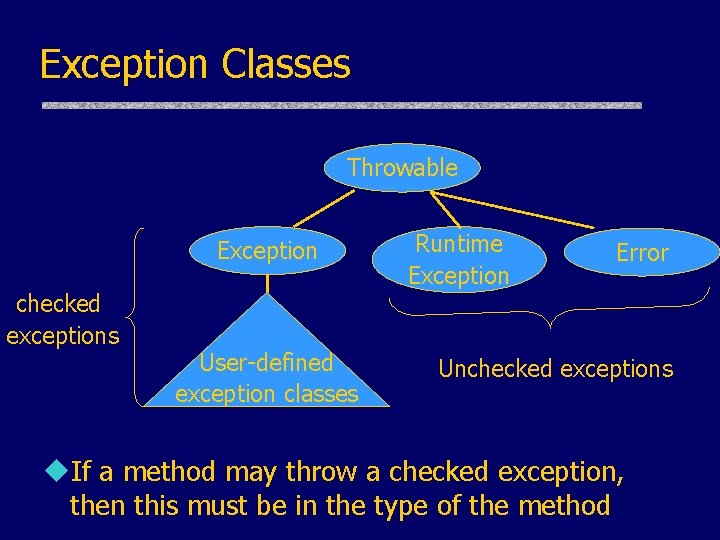
Exception Classes Throwable Exception checked exceptions User-defined exception classes Runtime Exception Error Unchecked exceptions u. If a method may throw a checked exception, then this must be in the type of the method
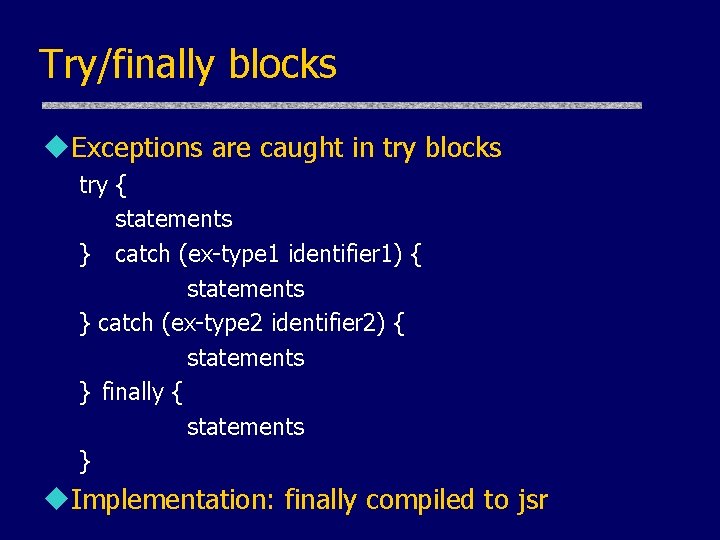
Try/finally blocks u. Exceptions are caught in try blocks try { statements } catch (ex-type 1 identifier 1) { statements } catch (ex-type 2 identifier 2) { statements } finally { statements } u. Implementation: finally compiled to jsr
Why define new exception types? u. Exception may contain data • Class Throwable includes a string field so that cause of exception can be described • Pass other data by declaring additional fields or methods u. Subtype hierarchy used to catch exceptions catch <exception-type> <identifier> { … } will catch any exception from any subtype of exception-type and bind object to identifier
Outline u. Objects in Java • Classes, encapsulation, inheritance u. Type system • Primitive types, interfaces, arrays, exceptions u. Generics (added in Java 1. 5) • Basics, wildcards, … u. Virtual machine • Loader, verifier, linker, interpreter • Bytecodes for method lookup u. Security issues
Java Generic Programming u. Java has class Object • Supertype of all object types • This allows “subtype polymorphism” – Can apply operation on class T to any subclass S <: T u. Java 1. 0 – 1. 4 did not have generics • No parametric polymorphism • Many considered this the biggest deficiency of Java u. Java type system does not let you “cheat” • Can cast from supertype to subtype • Cast is checked at run time
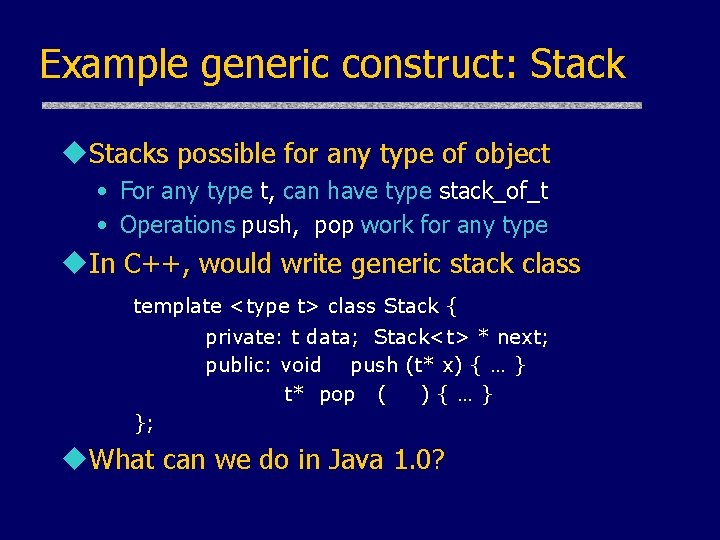
Example generic construct: Stack u. Stacks possible for any type of object • For any type t, can have type stack_of_t • Operations push, pop work for any type u. In C++, would write generic stack class template <type t> class Stack { private: t data; Stack<t> * next; public: void push (t* x) { … } t* pop ( ){…} }; u. What can we do in Java 1. 0?
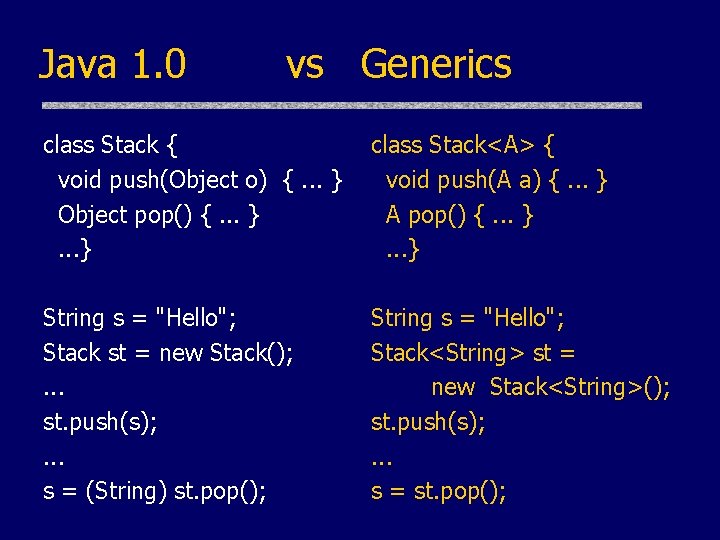
Java 1. 0 vs Generics class Stack { void push(Object o) {. . . } Object pop() {. . . } class Stack<A> { void push(A a) {. . . } A pop() {. . . } String s = "Hello"; Stack st = new Stack(); . . . st. push(s); . . . s = (String) st. pop(); String s = "Hello"; Stack<String> st = new Stack<String>(); st. push(s); . . . s = st. pop();
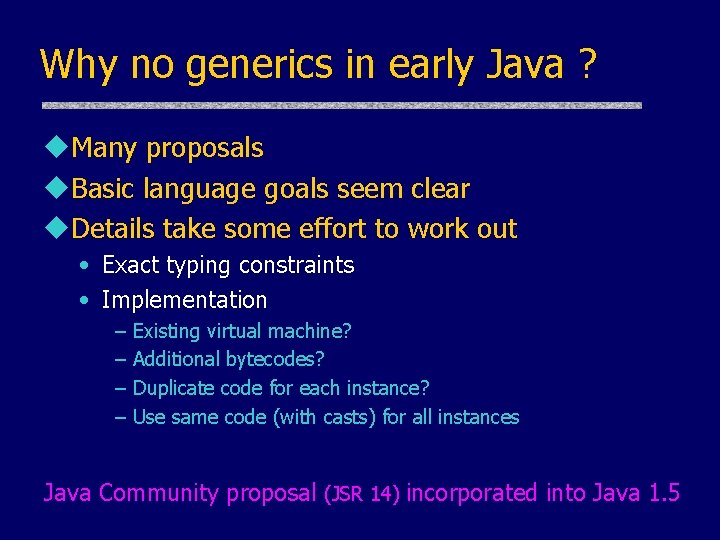
Why no generics in early Java ? u. Many proposals u. Basic language goals seem clear u. Details take some effort to work out • Exact typing constraints • Implementation – – Existing virtual machine? Additional bytecodes? Duplicate code for each instance? Use same code (with casts) for all instances Java Community proposal (JSR 14) incorporated into Java 1. 5
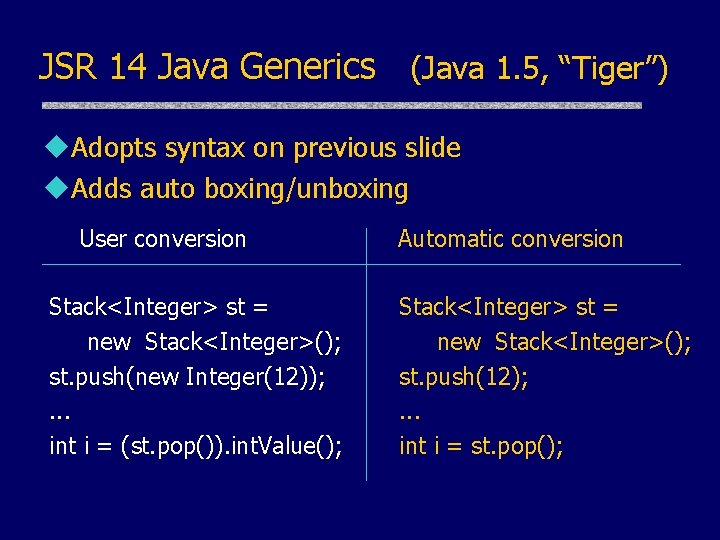
JSR 14 Java Generics (Java 1. 5, “Tiger”) u. Adopts syntax on previous slide u. Adds auto boxing/unboxing User conversion Stack<Integer> st = new Stack<Integer>(); st. push(new Integer(12)); . . . int i = (st. pop()). int. Value(); Automatic conversion Stack<Integer> st = new Stack<Integer>(); st. push(12); . . . int i = st. pop();
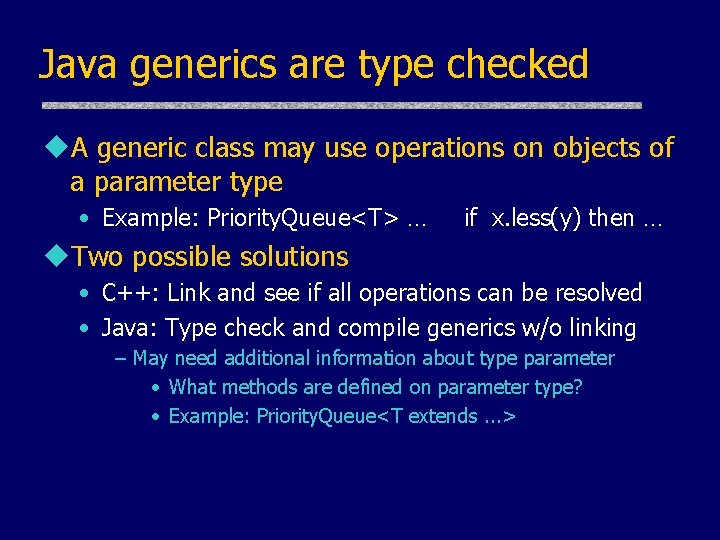
Java generics are type checked u. A generic class may use operations on objects of a parameter type • Example: Priority. Queue<T> … if x. less(y) then … u. Two possible solutions • C++: Link and see if all operations can be resolved • Java: Type check and compile generics w/o linking – May need additional information about type parameter • What methods are defined on parameter type? • Example: Priority. Queue<T extends. . . >
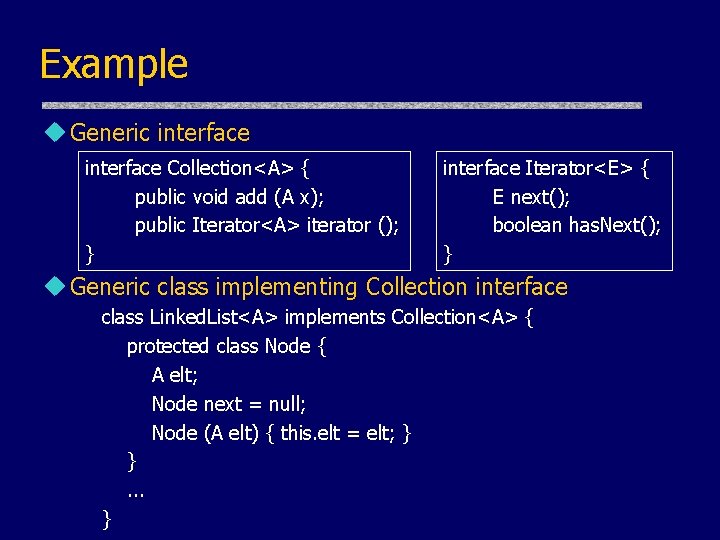
Example u Generic interface Collection<A> { public void add (A x); public Iterator<A> iterator (); } interface Iterator<E> { E next(); boolean has. Next(); } u Generic class implementing Collection interface class Linked. List<A> implements Collection<A> { protected class Node { A elt; Node next = null; Node (A elt) { this. elt = elt; } }. . . }
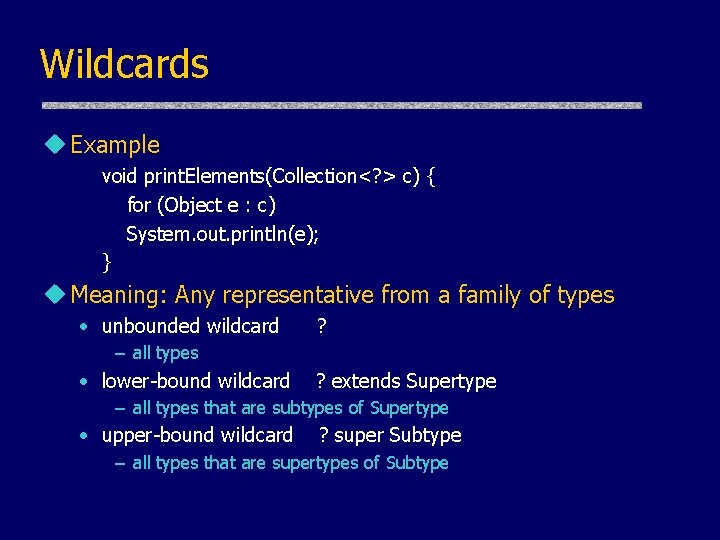
Wildcards u Example void print. Elements(Collection<? > c) { for (Object e : c) System. out. println(e); } u Meaning: Any representative from a family of types • unbounded wildcard ? – all types • lower-bound wildcard ? extends Supertype – all types that are subtypes of Supertype • upper-bound wildcard ? super Subtype – all types that are supertypes of Subtype
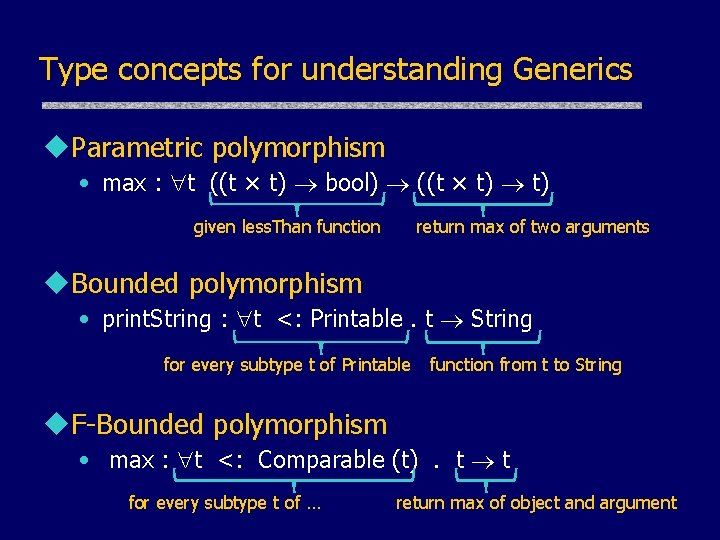
Type concepts for understanding Generics u. Parametric polymorphism • max : t ((t × t) bool) ((t × t) given less. Than function return max of two arguments u. Bounded polymorphism • print. String : t <: Printable. t String for every subtype t of Printable function from t to String u. F-Bounded polymorphism • max : t <: Comparable (t). t t for every subtype t of … return max of object and argument
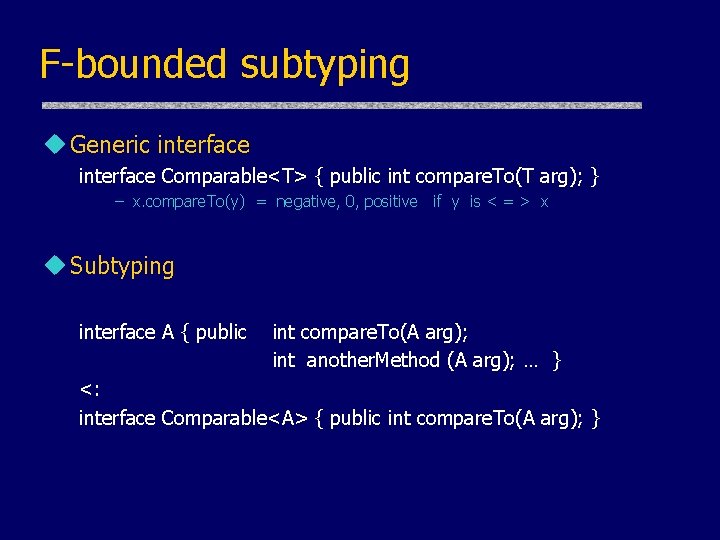
F-bounded subtyping u Generic interface Comparable<T> { public int compare. To(T arg); } – x. compare. To(y) = negative, 0, positive if y is < = > x u Subtyping interface A { public int compare. To(A arg); int another. Method (A arg); … } <: interface Comparable<A> { public int compare. To(A arg); }
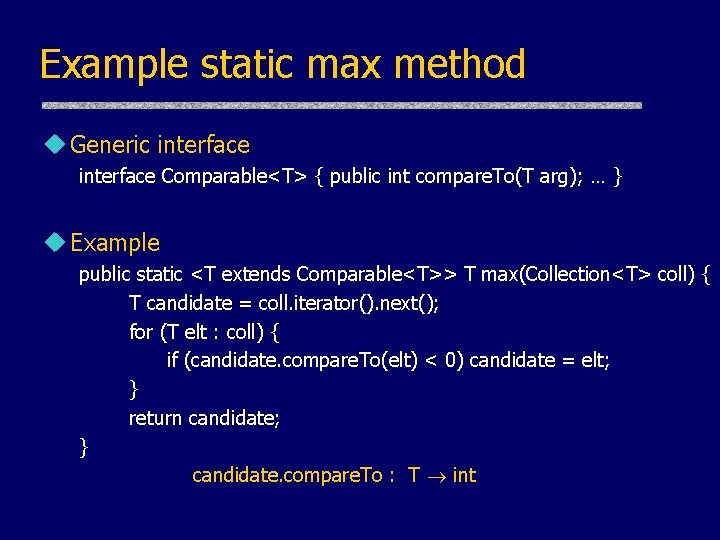
Example static max method u Generic interface Comparable<T> { public int compare. To(T arg); … } u Example public static <T extends Comparable<T>> T max(Collection<T> coll) { T candidate = coll. iterator(). next(); for (T elt : coll) { if (candidate. compare. To(elt) < 0) candidate = elt; } return candidate; } candidate. compare. To : T int
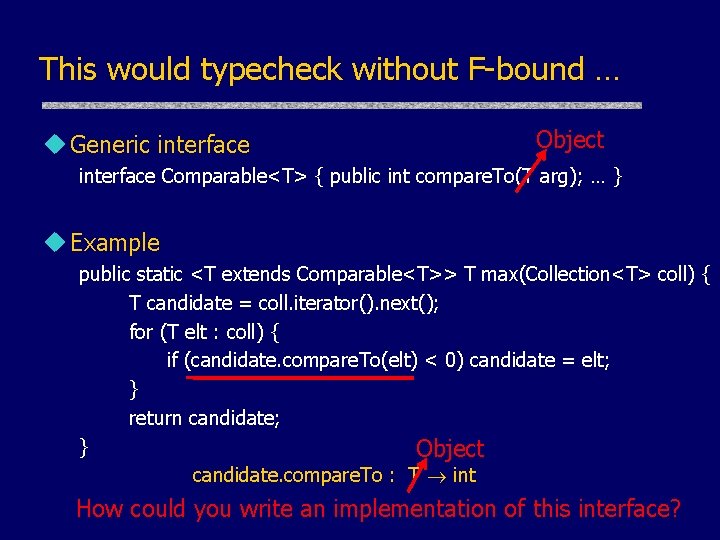
This would typecheck without F-bound … u Generic interface Object interface Comparable<T> { public int compare. To(T arg); … } u Example public static <T extends Comparable<T>> T max(Collection<T> coll) { T candidate = coll. iterator(). next(); for (T elt : coll) { if (candidate. compare. To(elt) < 0) candidate = elt; } return candidate; } Object candidate. compare. To : T int How could you write an implementation of this interface?
Generics are not co/contra-variant u. Array example (review) Integer[] ints = new Integer[] {1, 2, 3}; Number[] nums = ints; nums[2] = 3. 14; // array store -> exception at run time u. List example List<Integer> ints = Arrays. as. List(1, 2, 3); List<Number> nums = ints; // compile-time error • Second does not compile because List<Integer> <: List<Number>
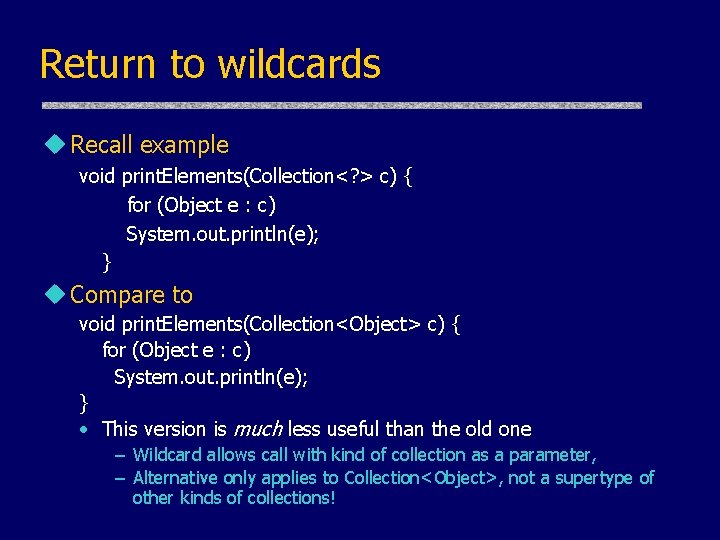
Return to wildcards u Recall example void print. Elements(Collection<? > c) { for (Object e : c) System. out. println(e); } u Compare to void print. Elements(Collection<Object> c) { for (Object e : c) System. out. println(e); } • This version is much less useful than the old one – Wildcard allows call with kind of collection as a parameter, – Alternative only applies to Collection<Object>, not a supertype of other kinds of collections!
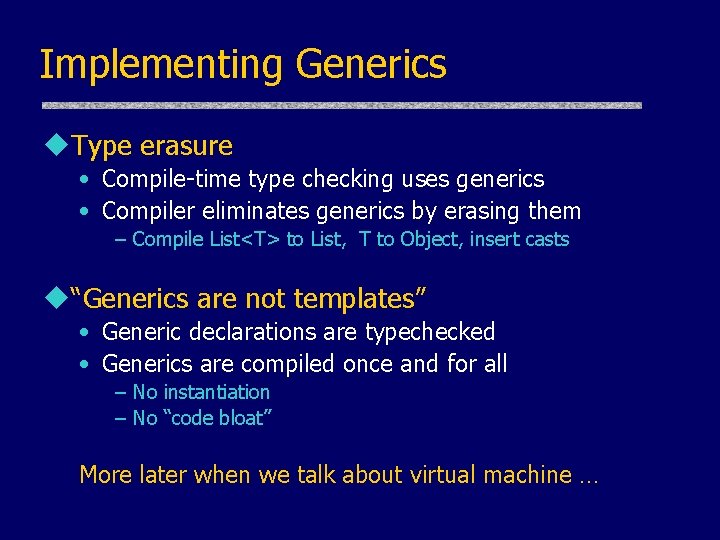
Implementing Generics u. Type erasure • Compile-time type checking uses generics • Compiler eliminates generics by erasing them – Compile List<T> to List, T to Object, insert casts u“Generics are not templates” • Generic declarations are typechecked • Generics are compiled once and for all – No instantiation – No “code bloat” More later when we talk about virtual machine …
Additional links for material not in book u. Enhancements in JDK 5 • http: //java. sun. com/j 2 se/1. 5. 0/docs/guide/language/i ndex. html u. J 2 SE 5. 0 in a Nutshell • http: //java. sun. com/developer/technical. Articles/relea ses/j 2 se 15/ u. Generics • http: //www. langer. camelot. de/Resources/Links/Java Generics. htm