
CS 242 Programming Languages John Mitchell Course web
CS 242 Programming Languages John Mitchell Course web site: http: //www. stanford. edu/class/cs 242/
Some Course Goals u Programming Language Concepts • A language is a “conceptual universe” (Perlis) – Framework for problem-solving – Useful concepts and programming methods • Understand the languages you use, by comparison • Appreciate history, diversity of ideas in programming • Be prepared for new programming methods, paradigms, tools u Critical thought • Identify properties of language, not syntax or sales pitch u Language and implementation • Every convenience has its cost – Recognize the cost of presenting an abstract view of machine – Understand trade-offs in programming language design
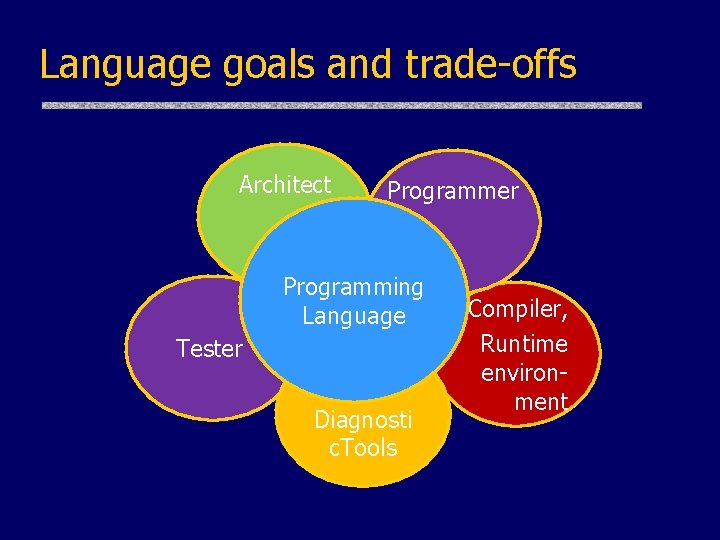
Language goals and trade-offs Architect Programmer Programming Language Tester Diagnosti c. Tools Compiler, Runtime environment
Value of Language Concepts u Parable • I started programming in 1970’s – Dominant language was Fortran; no recursive functions • My algorithms and data structure instructor said: – Recursion is a good idea even though inefficient – You can use idea in Fortran by storing stack in array • Today: recursive functions everywhere u Moral • Futuristic ideas may be useful problem-solving methods now, and may be part of languages you use in the future u Current examples • Function passing: pass functions in C by building your own closures, as in STL “function objects” • Continuations: used in web languages for workflow processing • Monads: programming technique from functional programming • Concurrency
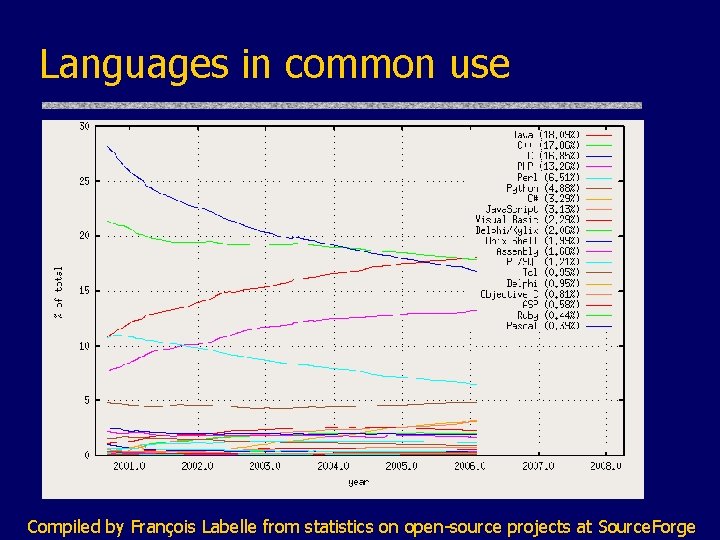
Languages in common use Compiled by François Labelle from statistics on open-source projects at Source. Forge
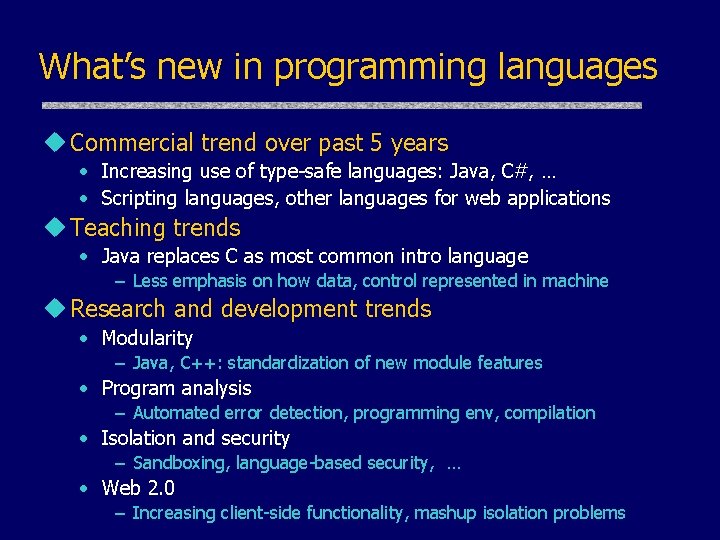
What’s new in programming languages u Commercial trend over past 5 years • Increasing use of type-safe languages: Java, C#, … • Scripting languages, other languages for web applications u Teaching trends • Java replaces C as most common intro language – Less emphasis on how data, control represented in machine u Research and development trends • Modularity – Java, C++: standardization of new module features • Program analysis – Automated error detection, programming env, compilation • Isolation and security – Sandboxing, language-based security, … • Web 2. 0 – Increasing client-side functionality, mashup isolation problems
What’s worth studying? u. Dominant languages and paradigms • C, C++, Java • Imperative and Object-oriented languages • Explosion of programming technologies for the web u. Important implementation ideas u. Performance challenges • Concurrency u. Design tradeoffs u. Concepts that research community is exploring for new programming languages and tools
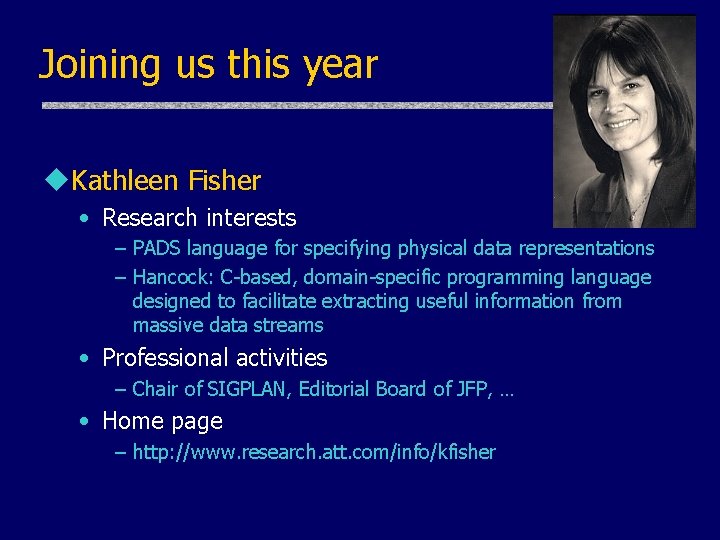
Joining us this year u. Kathleen Fisher • Research interests – PADS language for specifying physical data representations – Hancock: C-based, domain-specific programming language designed to facilitate extracting useful information from massive data streams • Professional activities – Chair of SIGPLAN, Editorial Board of JFP, … • Home page – http: //www. research. att. com/info/kfisher
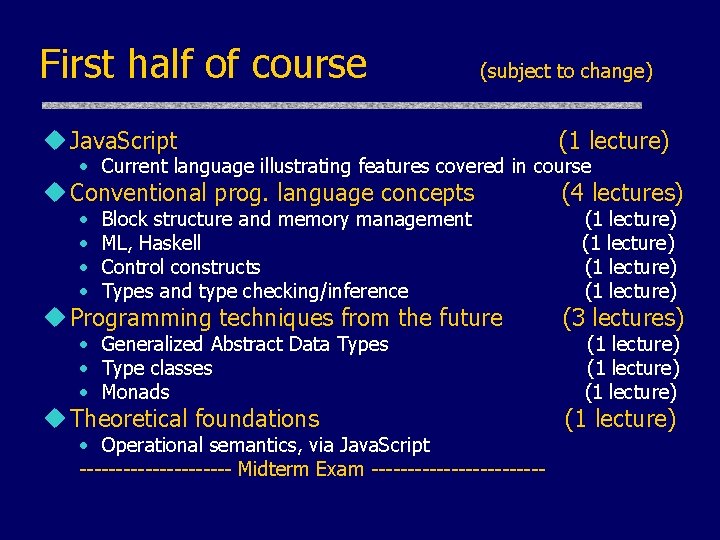
First half of course (subject to change) u Java. Script (1 lecture) u Conventional prog. language concepts (4 lectures) u Programming techniques from the future (3 lectures) u Theoretical foundations (1 lecture) • Current language illustrating features covered in course • • Block structure and memory management ML, Haskell Control constructs Types and type checking/inference • Generalized Abstract Data Types • Type classes • Monads • Operational semantics, via Java. Script ----------- Midterm Exam ------------ (1 lecture) (1 lecture)
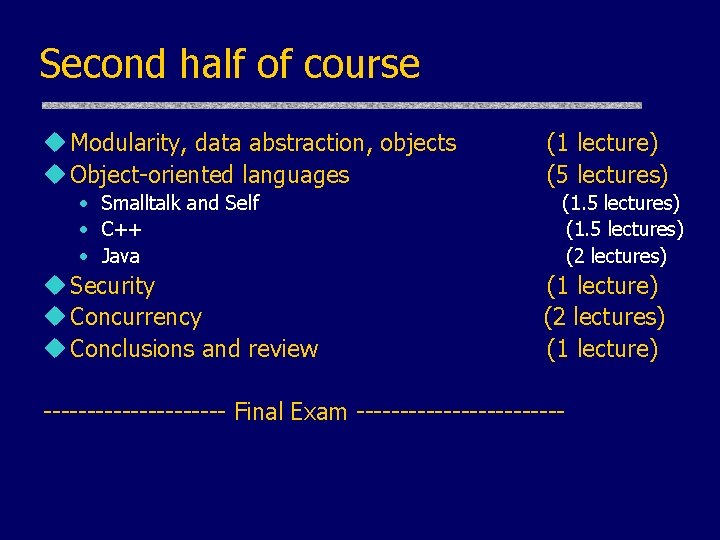
Second half of course u Modularity, data abstraction, objects u Object-oriented languages • Smalltalk and Self • C++ • Java u Security u Concurrency u Conclusions and review (1 lecture) (5 lectures) (1. 5 lectures) (2 lectures) (1 lecture) ----------- Final Exam ------------
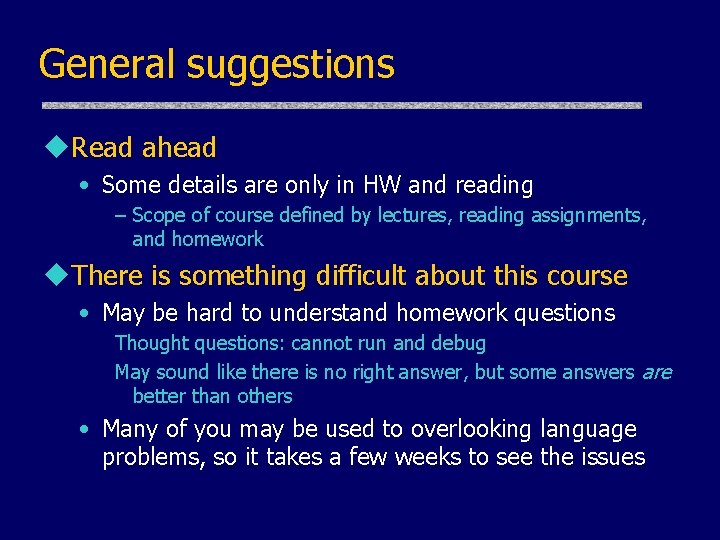
General suggestions u. Read ahead • Some details are only in HW and reading – Scope of course defined by lectures, reading assignments, and homework u. There is something difficult about this course • May be hard to understand homework questions Thought questions: cannot run and debug May sound like there is no right answer, but some answers are better than others • Many of you may be used to overlooking language problems, so it takes a few weeks to see the issues
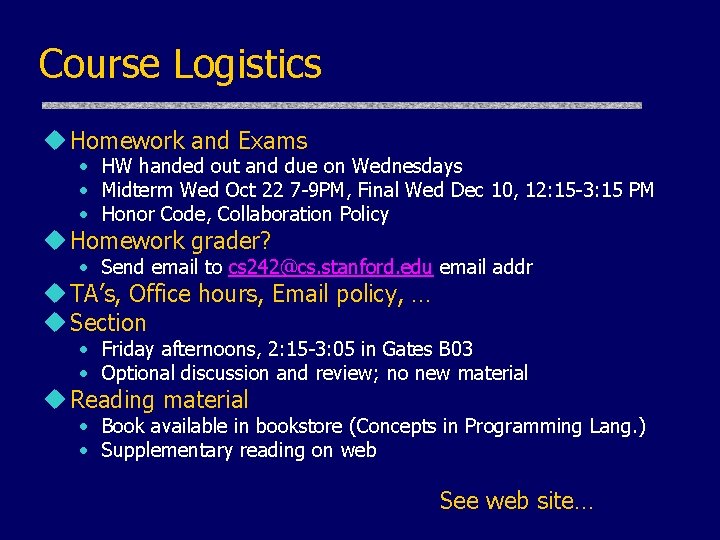
Course Logistics u Homework and Exams • HW handed out and due on Wednesdays • Midterm Wed Oct 22 7 -9 PM, Final Wed Dec 10, 12: 15 -3: 15 PM • Honor Code, Collaboration Policy u Homework grader? • Send email to cs 242@cs. stanford. edu email addr u TA’s, Office hours, Email policy, … u Section • Friday afternoons, 2: 15 -3: 05 in Gates B 03 • Optional discussion and review; no new material u Reading material • Book available in bookstore (Concepts in Programming Lang. ) • Supplementary reading on web See web site…
Questions?
- Slides: 13