
CS 2403 Programming Languages Implementing Subprograms ChungTa King
CS 2403 Programming Languages Implementing Subprograms Chung-Ta King Department of Computer Science National Tsing Hua University (Slides are adopted from Concepts of Programming Languages, R. W. Sebesta)
Semantics of Calls and Returns t General semantics of subprogram calls l Pass parameters l Allocate storage of local variables and bind them l Save the execution status of calling subprogram l Transfer of control and arrange for the return t General semantics of subprogram returns: l Return values of out- and inout-mode parameters to the corresponding actual parameters l Deallocate storage of local variables l Restore the execution status l Return control to the caller 1
Outline t t t Semantics of Calls and Returns (Sec. 10. 1) Implementing “Simple” Subprograms (Sec. 10. 2) Implementing Subprograms with Stack-Dynamic Local Variables (Sec. 10. 3) Nested Subprograms (Sec. 10. 4) Blocks (Sec. 10. 5) Implementing Dynamic Scoping (Sec. 10. 6) 2
Implementing “Simple” Subprograms t “Simple” subprograms: l Subprograms cannot be nested l All local variables are static t Required storage for calls and returns: l Status information of caller, parameters, return address, return value for functions t A “simple subprogarm” consists of two parts: l Subprogram code l Non-code part (local variables and above data for calls and returns) 3
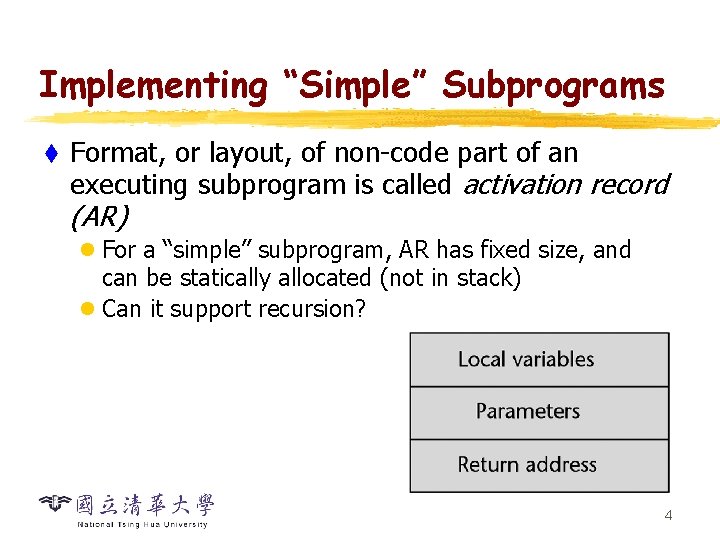
Implementing “Simple” Subprograms t Format, or layout, of non-code part of an executing subprogram is called activation record (AR) l For a “simple” subprogram, AR has fixed size, and can be statically allocated (not in stack) l Can it support recursion? 4

Example Layout Code and activation records of a program with three “simple” subprograms: A, B, C t These parts may be separately compiled and put together by t linker 5
Outline t t t Semantics of Calls and Returns (Sec. 10. 1) Implementing “Simple” Subprograms (Sec. 10. 2) Implementing Subprograms with Stack-Dynamic Local Variables (Sec. 10. 3) Nested Subprograms (Sec. 10. 4) Blocks (Sec. 10. 5) Implementing Dynamic Scoping (Sec. 10. 6) 6
Stack-Dynamic Local Variables t Allocate local variables on the run-time stack l Main advantage: support recursion l Why? t More complex storage management: l Compiler must generate code for implicit allocation and deallocation of local variables on the stack l Recursion adds possibility of multiple simultaneous activations of a subprogram multiple instances of activation records 7
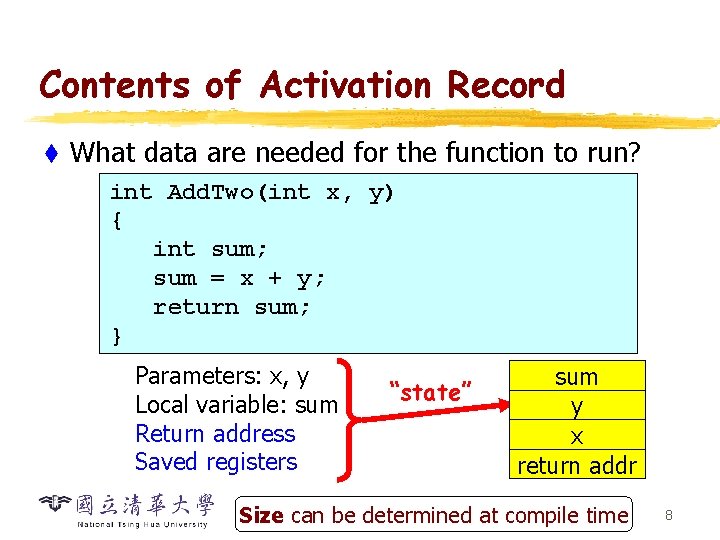
Contents of Activation Record t What data are needed for the function to run? int Add. Two(int x, y) { int sum; sum = x + y; return sum; } Parameters: x, y Local variable: sum Return address Saved registers “state” sum y x return addr Size can be determined at compile time 8
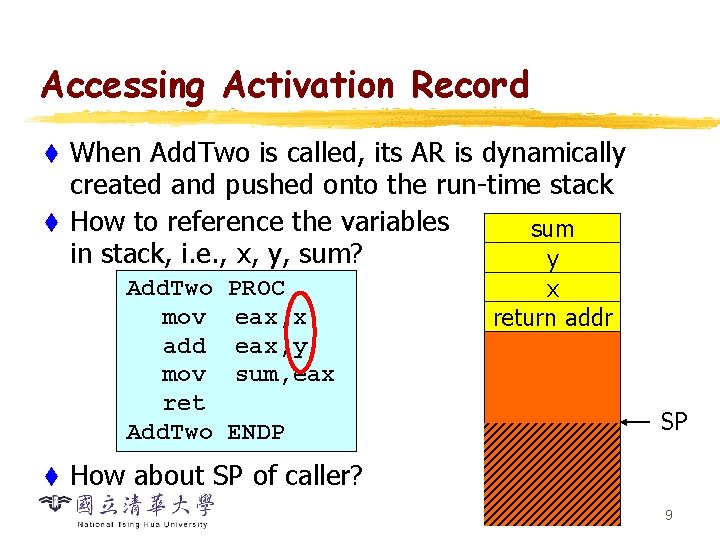
Accessing Activation Record When Add. Two is called, its AR is dynamically created and pushed onto the run-time stack t How to reference the variables sum in stack, i. e. , x, y, sum? y t Add. Two mov add mov ret Add. Two t PROC eax, x eax, y sum, eax ENDP x return addr SP How about SP of caller? 9
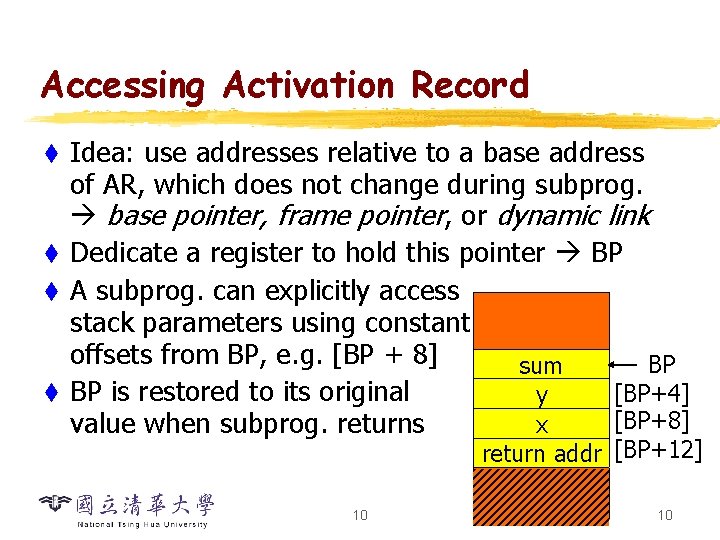
Accessing Activation Record Idea: use addresses relative to a base address of AR, which does not change during subprog. base pointer, frame pointer, or dynamic link t Dedicate a register to hold this pointer BP t A subprog. can explicitly access stack parameters using constant offsets from BP, e. g. [BP + 8] BP sum t BP is restored to its original [BP+4] y [BP+8] value when subprog. returns x t return addr [BP+12] 10 10
Activation Record for Stack-Dyna t Base pointer (BP): l Always points at the base of the activation record instance of the currently executing program unit l When a subprogram is called, the current BP is saved in the new AR instance and the BP is set to point at the base of the new AR instance l Upon return from the subprogram, BP is restored from the AR instance of the callee 11
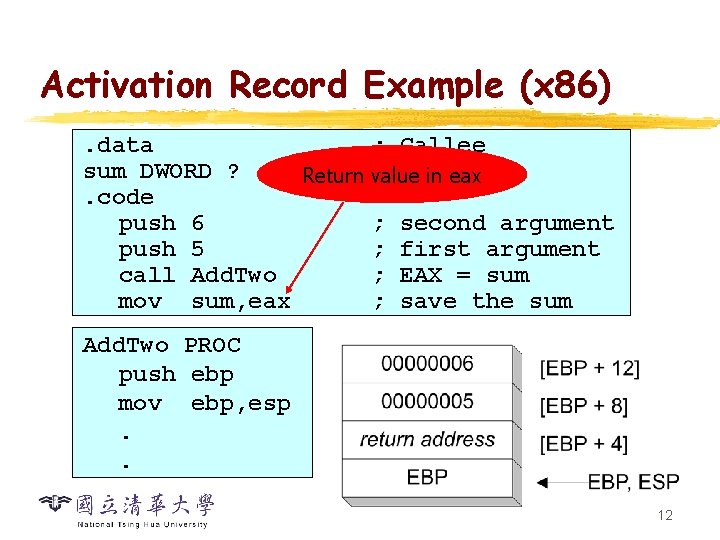
Activation Record Example (x 86). data ; Callee sum DWORD ? Return value in eax. code push 6 ; second argument push 5 ; first argument call Add. Two ; EAX = sum mov sum, eax ; save the sum Add. Two PROC push ebp mov ebp, esp. . 12
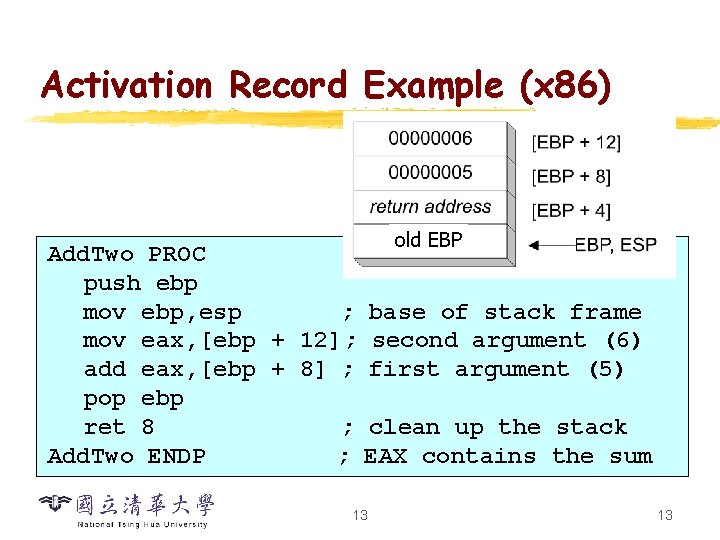
Activation Record Example (x 86) old EBP Add. Two PROC push ebp mov ebp, esp ; base of stack frame mov eax, [ebp + 12]; second argument (6) add eax, [ebp + 8] ; first argument (5) pop ebp ret 8 ; clean up the stack Add. Two ENDP ; EAX contains the sum 13 13
![Activation Record: Local Array void sub(float total, int part) { int list[5]; float sum;](http://slidetodoc.com/presentation_image_h2/ef9fef35f44e13862104084686c03c2b/image-15.jpg "Activation Record: Local Array void sub(float total, int part) { int list[5]; float sum;")
Activation Record: Local Array void sub(float total, int part) { int list[5]; float sum; … } 14
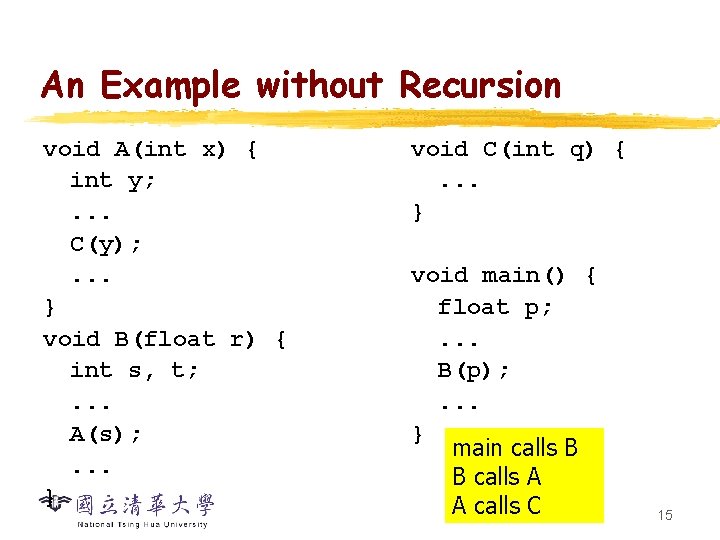
An Example without Recursion void A(int x) { int y; . . . C(y); . . . } void B(float r) { int s, t; . . . A(s); . . . } void C(int q) {. . . } void main() { float p; . . . B(p); . . . } main calls B B calls A A calls C 15
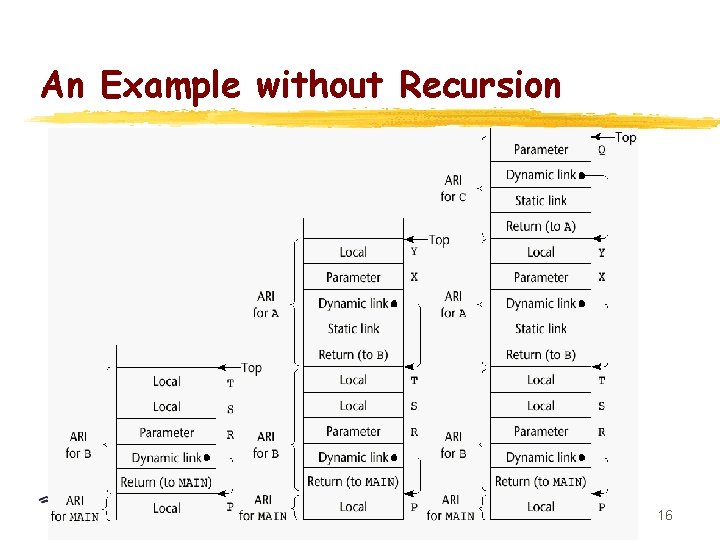
An Example without Recursion 16
Dynamic Chain and Local Offset t The collection of dynamic links in the stack at a given time is called the dynamic chain, or call chain Local variables can be accessed by their offset from the beginning of the activation record, whose address is in the BP. This offset is called the local_offset t The local offset of a local variable can be determined by the compiler at compile time t 17
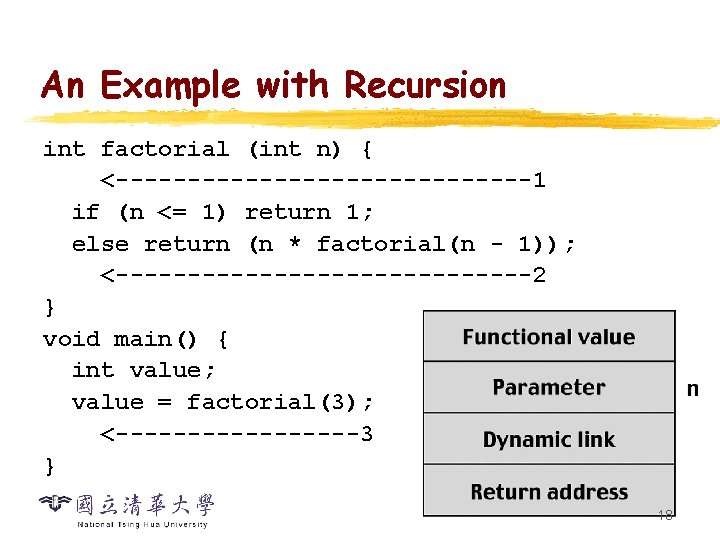
An Example with Recursion int factorial (int n) { <---------------1 if (n <= 1) return 1; else return (n * factorial(n - 1)); <---------------2 } void main() { int value; value = factorial(3); <---------3 } 18
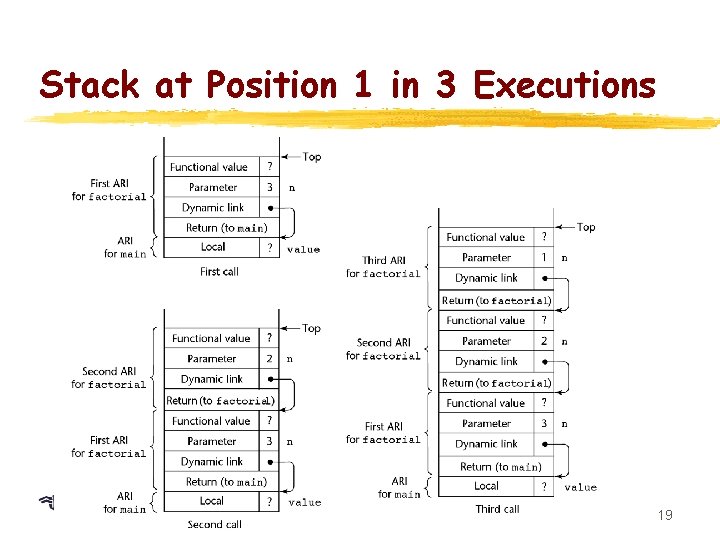
Stack at Position 1 in 3 Executions 19
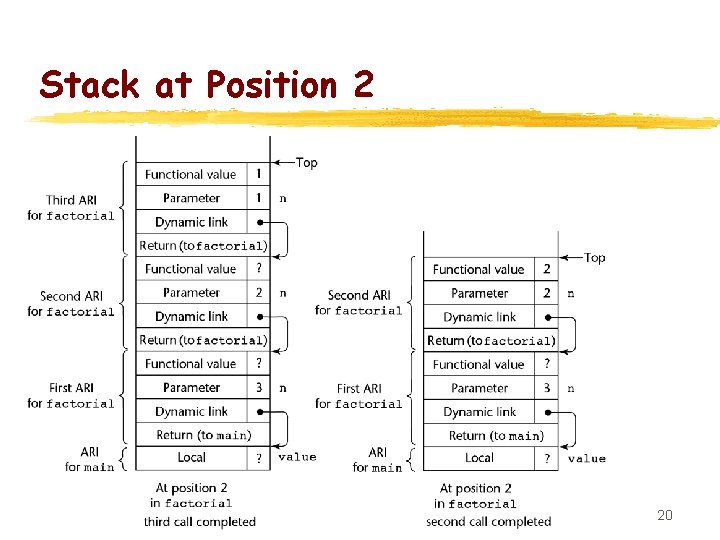
Stack at Position 2 20
Outline t t t Semantics of Calls and Returns (Sec. 10. 1) Implementing “Simple” Subprograms (Sec. 10. 2) Implementing Subprograms with Stack-Dynamic Local Variables (Sec. 10. 3) Nested Subprograms (Sec. 10. 4) Blocks (Sec. 10. 5) Implementing Dynamic Scoping (Sec. 10. 6) 21
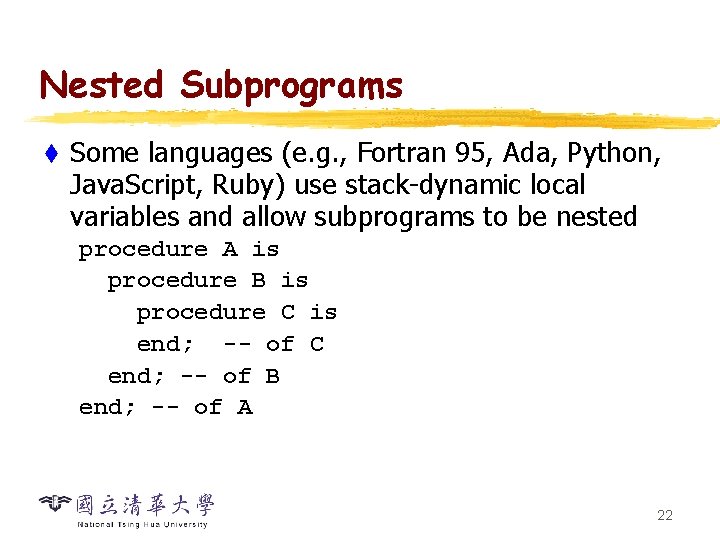
Nested Subprograms t Some languages (e. g. , Fortran 95, Ada, Python, Java. Script, Ruby) use stack-dynamic local variables and allow subprograms to be nested procedure A is procedure B is procedure C is end; -- of C end; -- of B end; -- of A 22
Nested Subprograms t How to access variables that are non-local but are defined in outer subprograms? l These variables must reside in some AR instances deep in the stack t The process of locating a non-local reference: l Find the correct activation record instance down in the stack: hard l Determine the correct offset within that activation record instance: easy 23
Finding Correct AR Instance t Static scope semantics: l Only variables that are declared in static ancestor scope are visible and can be accessed l All non-local variables that can be referenced have been allocated in some AR instance on the stack when the reference is made t Idea: chain AR instances of static ancestors 24
Static Chain t Static link in an AR instance points to bottom of AR instance of the static parent t Static chain connects all static ancestors of an executing subprogram, static parent first t Can find correct AR instance following the chain l But, can be even easier, because nesting of scopes is known at compile time and thus the length of static chain to follow 25
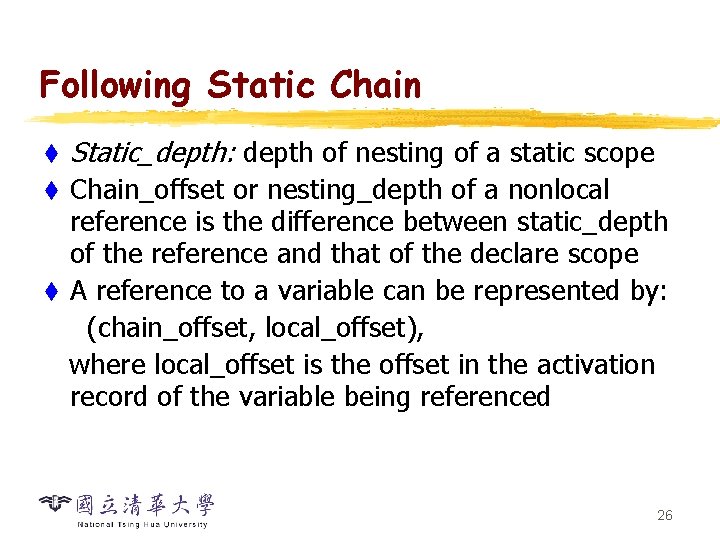
Following Static Chain t Static_depth: depth of nesting of a static scope Chain_offset or nesting_depth of a nonlocal reference is the difference between static_depth of the reference and that of the declare scope t A reference to a variable can be represented by: (chain_offset, local_offset), where local_offset is the offset in the activation record of the variable being referenced t 26
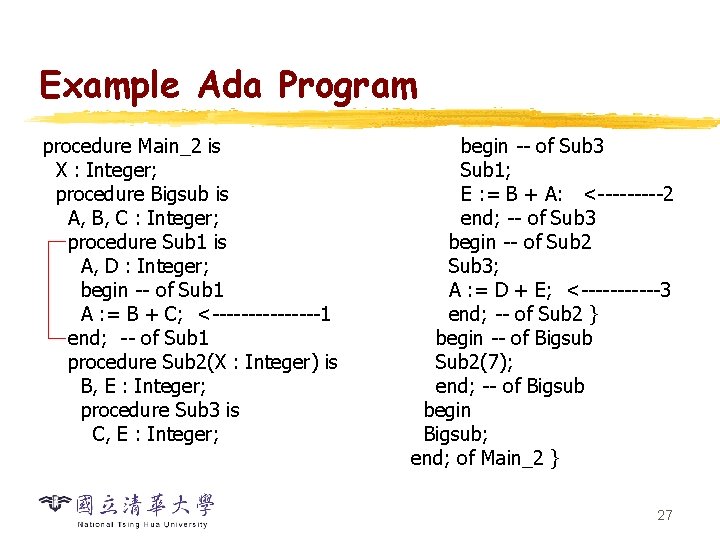
Example Ada Program procedure Main_2 is X : Integer; procedure Bigsub is A, B, C : Integer; procedure Sub 1 is A, D : Integer; begin -- of Sub 1 A : = B + C; <--------1 end; -- of Sub 1 procedure Sub 2(X : Integer) is B, E : Integer; procedure Sub 3 is C, E : Integer; begin -- of Sub 3 Sub 1; E : = B + A: <-----2 end; -- of Sub 3 begin -- of Sub 2 Sub 3; A : = D + E; <------3 end; -- of Sub 2 } begin -- of Bigsub Sub 2(7); end; -- of Bigsub begin Bigsub; end; of Main_2 } 27
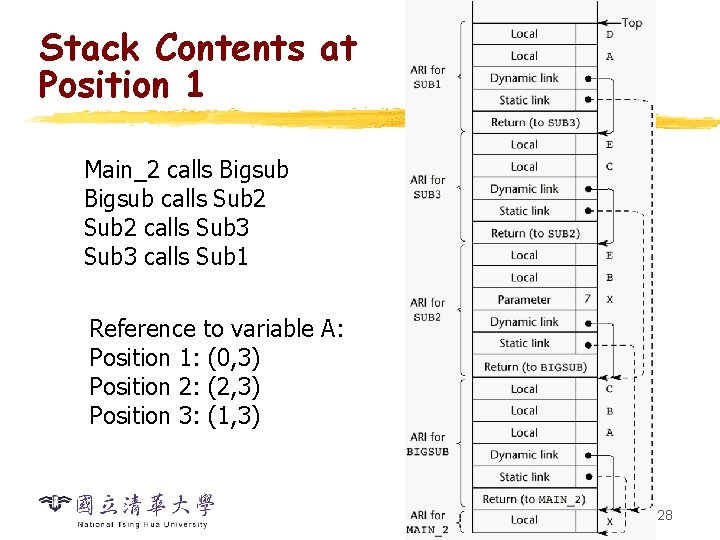
Stack Contents at Position 1 Main_2 calls Bigsub calls Sub 2 calls Sub 3 calls Sub 1 Reference to variable A: Position 1: (0, 3) Position 2: (2, 3) Position 3: (1, 3) 28
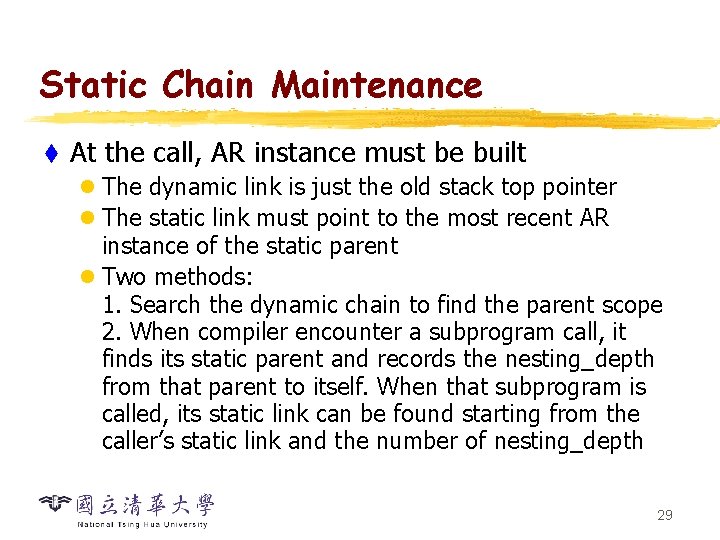
Static Chain Maintenance t At the call, AR instance must be built l The dynamic link is just the old stack top pointer l The static link must point to the most recent AR instance of the static parent l Two methods: 1. Search the dynamic chain to find the parent scope 2. When compiler encounter a subprogram call, it finds its static parent and records the nesting_depth from that parent to itself. When that subprogram is called, its static link can be found starting from the caller’s static link and the number of nesting_depth 29
Evaluation of Static Chains Problems: t A nonlocal reference is slow if the nesting depth is large t Time-critical code is difficult: l Costs of nonlocal references are difficult to determine l Code changes can change the nesting depth, and therefore the cost 30
Displays An alternative to static chains that solves the problems with that approach t Static links are stored in a single array called a t display t The contents of the display at any given time is a list of addresses of the accessible activation record instances 31
Outline t t t Semantics of Calls and Returns (Sec. 10. 1) Implementing “Simple” Subprograms (Sec. 10. 2) Implementing Subprograms with Stack-Dynamic Local Variables (Sec. 10. 3) Nested Subprograms (Sec. 10. 4) Blocks (Sec. 10. 5) Implementing Dynamic Scoping (Sec. 10. 6) 32
![Blocks t User-specified local scopes for variables {int temp; temp = list [upper]; list](http://slidetodoc.com/presentation_image_h2/ef9fef35f44e13862104084686c03c2b/image-34.jpg "Blocks t User-specified local scopes for variables {int temp; temp = list [upper]; list")
Blocks t User-specified local scopes for variables {int temp; temp = list [upper]; list [upper] = list [lower]; list [lower] = temp } l The lifetime of temp in the above example begins when control enters the block t An advantage of using a local variable like temp is that it cannot interfere with any other variable with the same name 33
Two Methods Implementing Blocks t Treat blocks as parameter-less subprograms that are always called from the same location l Every block has an activation record; an instance is created every time the block is executed t Put locals of a block in the same AR of the containing subprogram l Since the maximum storage required for a block can be statically determined, this amount of space can be allocated after the local variables in the activation record 34
Summary Subprogram linkage semantics requires many action by the implementation t Stack-dynamic languages are more complex and often have two components t l Actual code l Activation record: AR instances contain formal parameters and local variables among other things t Static chains are main method of implementing accesses to non-local variables in static-scoped languages with nested subprograms 35
- Slides: 36