
CS 228 Deep Learning Unsupervised Feature Learning Andrew
- Slides: 9
CS 228: Deep Learning & Unsupervised Feature Learning Andrew Ng
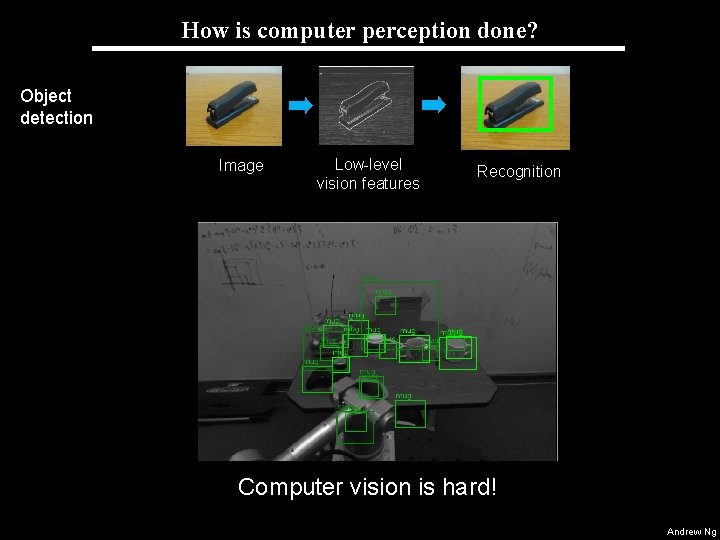
How is computer perception done? Object detection Image Low-level vision features Recognition Computer vision is hard! Andrew Ng
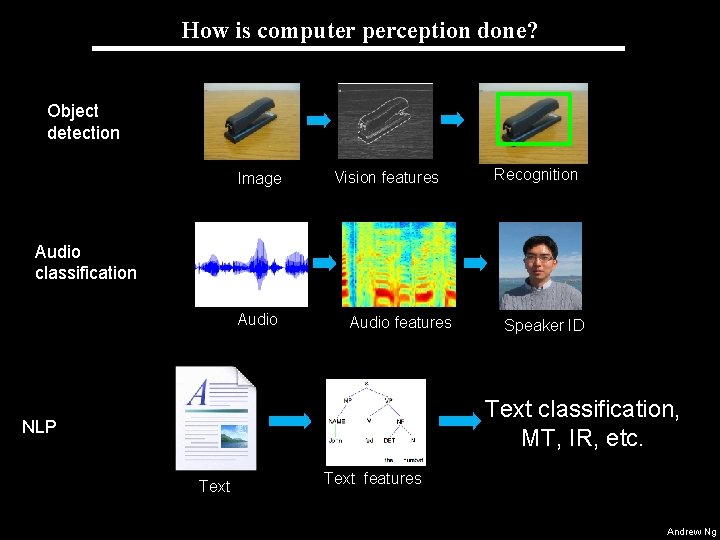
How is computer perception done? Object detection Image Vision features Recognition Audio classification Audio features Speaker ID Text classification, MT, IR, etc. NLP Text features Andrew Ng
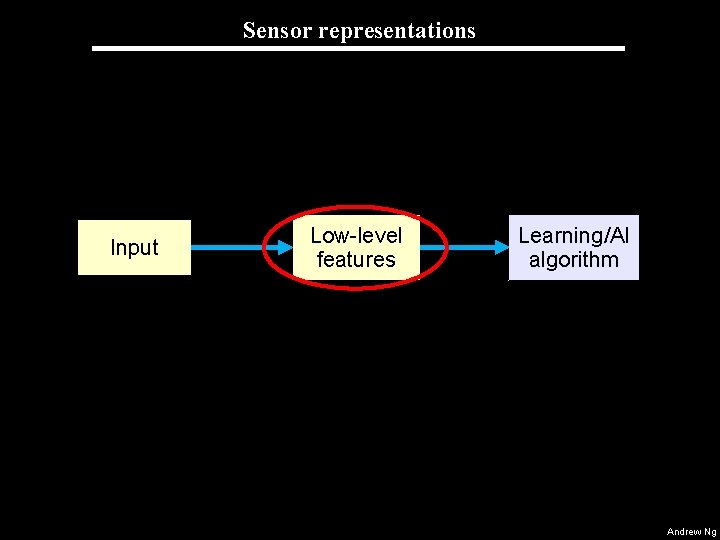
Sensor representations Input Low-level features Learning/AI algorithm Andrew Ng
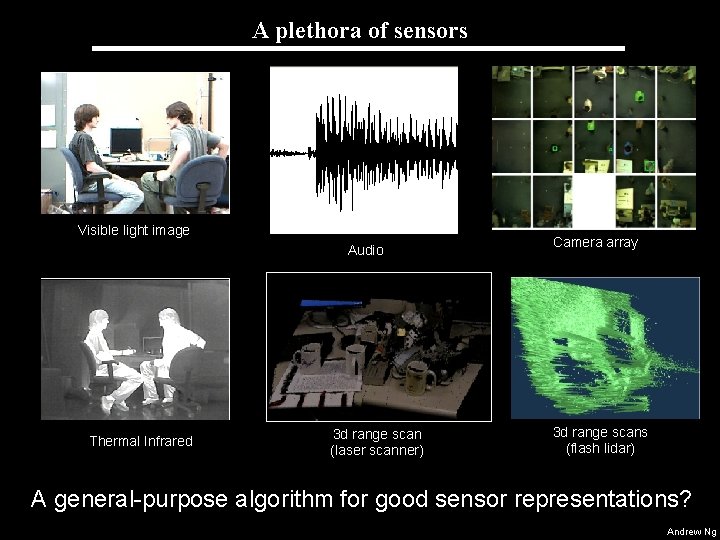
A plethora of sensors Visible light image Audio Thermal Infrared 3 d range scan (laser scanner) Camera array 3 d range scans (flash lidar) A general-purpose algorithm for good sensor representations? Andrew Ng
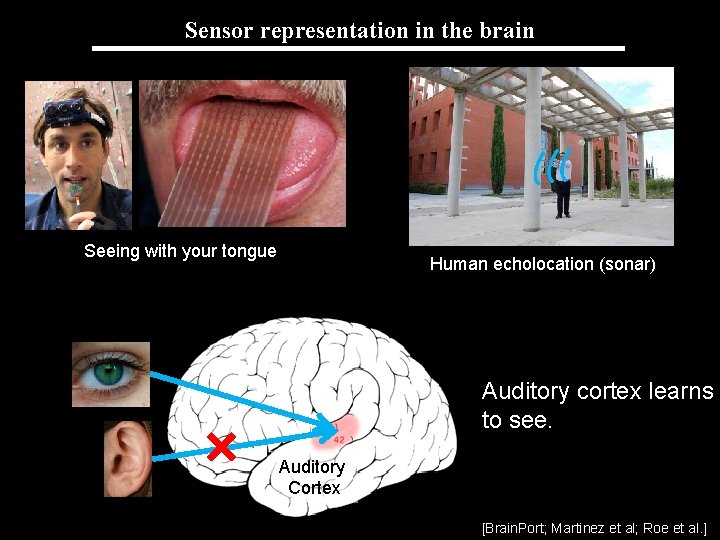
Sensor representation in the brain Seeing with your tongue Human echolocation (sonar) Auditory cortex learns to see. Auditory Cortex [Brain. Port; Martinez et al; Roe. Andrew et al. ]Ng
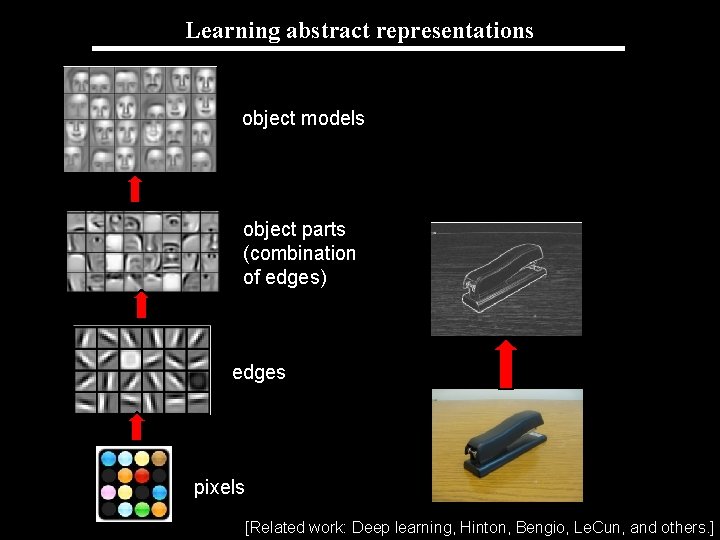
Learning abstract representations object models object parts (combination of edges) edges pixels [Related work: Deep learning, Hinton, Bengio, Le. Cun, and others. ] Andrew Ng
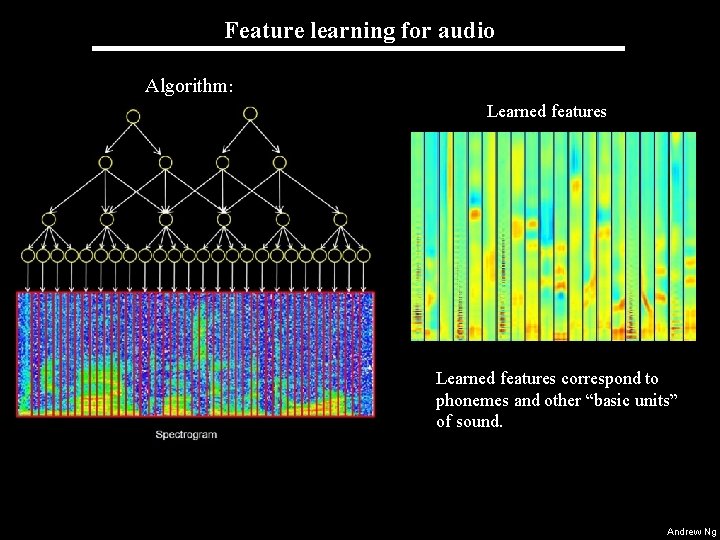
Feature learning for audio Algorithm: Learned features correspond to phonemes and other “basic units” of sound. Andrew Ng
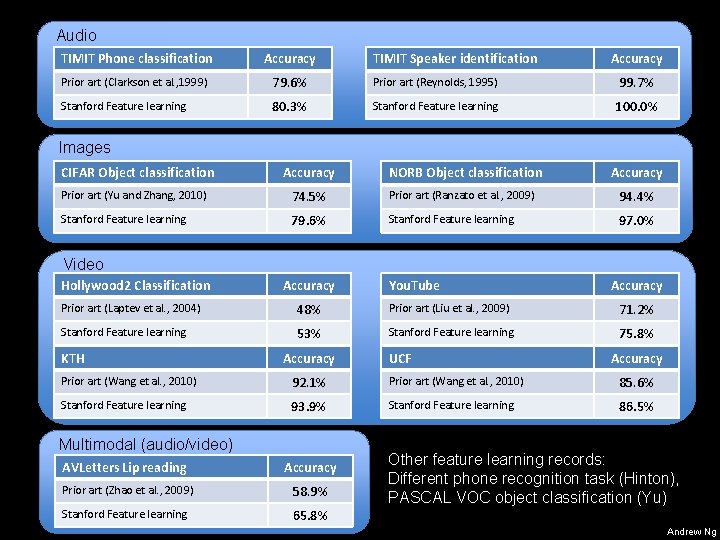
Audio TIMIT Phone classification Accuracy Prior art (Clarkson et al. , 1999) 79. 6% Prior art (Reynolds, 1995) 99. 7% Stanford Feature learning 80. 3% Stanford Feature learning 100. 0% TIMIT Speaker identification Accuracy Images CIFAR Object classification Accuracy NORB Object classification Accuracy Prior art (Yu and Zhang, 2010) 74. 5% Prior art (Ranzato et al. , 2009) 94. 4% Stanford Feature learning 79. 6% Stanford Feature learning 97. 0% Galaxy Video Hollywood 2 Classification Accuracy You. Tube Accuracy Prior art (Laptev et al. , 2004) 48% Prior art (Liu et al. , 2009) 71. 2% Stanford Feature learning 53% Stanford Feature learning 75. 8% KTH Accuracy UCF Accuracy Prior art (Wang et al. , 2010) 92. 1% Prior art (Wang et al. , 2010) 85. 6% Stanford Feature learning 93. 9% Stanford Feature learning 86. 5% Multimodal (audio/video) AVLetters Lip reading Accuracy Prior art (Zhao et al. , 2009) 58. 9% Stanford Feature learning 65. 8% Other feature learning records: Different phone recognition task (Hinton), PASCAL VOC object classification (Yu) Andrew Ng