
CS 221 May 10 Course objectives Assemble computer
CS 221 – May 10 • Course objectives – Assemble computer cluster – Linux and C – Practice basic parallelizing technique • Stay tuned: I will provide some useful files for you on http: //cs. furman. edu/~chealy/cs 221 • Please read chapter 1 in book.

Motivation • Stove? • Raspberry Pi is a very inexpensive, fully functional computer. – Similar power to a Pentium 2 (Vintage 1998 PC) but costs about $50. – I did an experiment yesterday to compare a pi with my research server. The pi was 28 times slower, but cost 140 times less. – So, more bang for the buck!
First steps • We can’t do any parallel programming yet until we – Have multiple machines hooked up – Understand how to use the operating system. – Can write a simple program in C • Why C? – Most compiler research is done for this language. – Small, efficient language; similar to Java. • Today’s priority – Get one Raspberry pi up and running.
Cast of characters • A cluster will consist of – – – – n Raspberry Pi units Some way to encase the bare boards n SD cards to store OS, other software, and user files n power cords n power adapters n network (Ethernet) cords 1 keyboard, monitor and mouse • We’ll use the setup checklist from the University of Southampton. Set up 1 machine first! That takes about 2 hours.
CS 221 – May 11 • Operating system: Linux – What is an OS? – Where does Linux come from? • C language – Begin looking at the overview – Tomorrow we’ll study this subject in earnest. • Handouts – Lab on Linux activities – Overview of C
CS 221 – May 15 • Review chapter 1 • Lab – Show me your C programs – Black spaghetti – connect remaining machines – Be able to ping, ssh, and transfer files among nodes • For tomorrow, please read sections 2. 4, 3. 1 and 3. 2 to get ready to write real parallel programs! – Chapter 3 contains nuts and bolts – Chapter 2 has background material
Chapter 1 ideas • Why is parallel computing necessary in the long run? – Moore’s law – Speed of light size of chip • It’s a problem of HW as well as SW: how? • How can we tell if a problem could benefit well from a parallelized solution?
Problem solving • Generally, we begin by writing an ordinary “serial” program. – Benefits? • Then, think of ways to redo the program to take advantage of parallelism – There is no automatic tool like a compiler to do all the work for us! – Often, the data needs to be partitioned among the individual processors. – Need some background software (e. g. MPI) to handle lowlevel communication details.
Simple example • Suppose we wanted to sum a large set of values. – You are an investment firm, and your fund owns shares in 10, 000 securities. What is today’s total asset value? – Serial solution is straightforward, but a bit slow. • Suppose we have 5 computers working on this task at once – Design 1 program that can shared among all 5 machines. – What information is passed to each machine? – What happens when they are finished?
Delegate data collection • It’s tempting to just have the “master” node add up all the data. • If you have many cores, this is not efficient – Suppose you have 1 million securities to look up and 1, 000 cores sharing the workload. Then, the master node is receiving messages from 999 nodes (in series!), and must add up the 1, 000 values. – As much as possible, we want results to be communicated simultaneously. – Let’s work out a simple scenario with 8 cores. Each contains a number that needs to be added. How would you do it? How would the pseudocode look?

Major principles • A good parallel solution pays close attention to 3 concepts. What do they mean? What could go wrong? • Communication • Load balancing • Synchronization – each core is working at its own pace, for example reading input…
CS 221 – May 16 • Overview of 2. 4, 3. 1, 3. 2 • Lab – Do all of your machines work? – Let’s work through simple examples in book
Parallel software • Not much software today is currently done with parallelism in mind. Basically limited to: – Operating system (!) – Databases: allowing you to modify 1 record or table, while someone else can print out some other table – Web browser: multimedia doesn’t cause machine to hang; multiple tabs
Flynn’s taxonomy • A computer system can be classified based on how many instruction and data streams it can handle simultaneously. – SISD (basic computing model) – SIMD: the same program is used on a wide stream of data, such as a vector processor – MIMD : several cores or processors running independently at the same time. Can run same program, but not executing identical statements in lockstep.
MIMD flavors • Shared memory model – You can write a Java program with multiple threads – The OS tries to put a new thread on another core. – If not enough cores, OS performs multitasking by default. • Distributed memory model – Writing a program that will be run on many computers at once, each with its own memory system, architecture and OS! – For convenience we have chosen to have a cluster with the same architecture & OS on each.
SPMD • Not to confuse with SISD, SIMD, MIMD… • Single program multiple data: this is the way we will write our parallel programs – If-statement condition asks which machine we are on • A program needs to: – Divide computational work evenly – Arrange for processes to synchronize (wait until done) – Communicate parameters and results. • How? By passing messages between the processes! – We’ll use MPI software (Chapter 3)
MPI • Message Passing Interface is a library of functions to help us write parallel C programs. • Once you have written your parallel program, compile and run it. – (p. 85) mpicc –g –Wall –o mpi_hello. c – (p. 86) mpiexec –n 8. /mpi_hello assuming you have 8 machines. You can even give it a larger number, since it’s the number of processes you want. (multitasking)
Code features • In lab I’d like you to type in programs in sections 3. 1 and 3. 2. Pay attention to details we’re seeing for first time. • What’s new? – mpi. h – MPI_Init() at beginning and MPI_Finalize() at end (allocate & deallocate resources needed) – MPI_Comm_size() – how many processes are running? – MPI_Comm_rank() – which process am I? By convention 0 is the master, and the rest are 1, 2, … n – 1. – MPI_Send() and MPI_Recv()
Lab • Purpose: to be able to use basic MPI functions for the first time. • Section 3. 1 – Type in mpi_hello. c program – Compile & run • Section 3. 2 – integral. c given on pages 98 -99. Note that you also need include files and a function to integrate. • Answer questions 3. 1 – 3. 3 on page 140.
CS 221 – May 22 • Warning about possibly overwriting your source code if you call mpicc incorrectly • What would you do if the size of an array is not a multiple of the # of processes? • Reminder on programming assignments • Section 3. 5: derived data types
CS 221 – May 24 Timing (sections 2. 6 and 3. 6) • Speedup • Amdahl’s law – What happens if you can’t parallelize everything • Complexity • Commands to put in your program to measure time
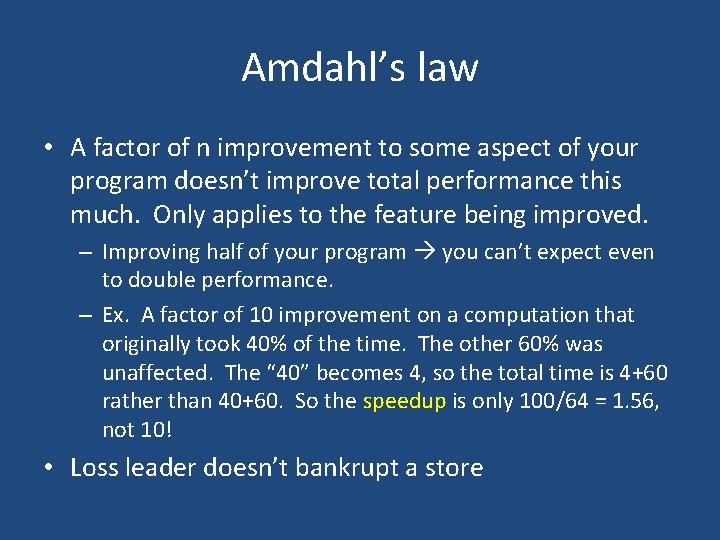
Amdahl’s law • A factor of n improvement to some aspect of your program doesn’t improve total performance this much. Only applies to the feature being improved. – Improving half of your program you can’t expect even to double performance. – Ex. A factor of 10 improvement on a computation that originally took 40% of the time. The other 60% was unaffected. The “ 40” becomes 4, so the total time is 4+60 rather than 40+60. So the speedup is only 100/64 = 1. 56, not 10! • Loss leader doesn’t bankrupt a store
Complexity • You have 8 processors working for you. This means up to an 8 x speedup • What works against you? Algorithm complexity • Nested loops – If the problem/input size is n, we must perform n 2 steps – Or even n 3 steps if we have 3 nested loops. – What does this mean if we double or quadruple the input size? • Square matrix operations: add and multiply
2 -D as 1 -D • To help with the process communication, it helps to represent our 2 -D arrays as 1 -D. • Much easier to dynamically allocate 1 -D array. • In our example, we’ll assume the matrix is square, so size = # rows = # columns. • If you want to refer to the element at row i, column j, then say a[i * size + j].
Timing your code • Insert a call to MPI_Wtime() – Returns a double, representing current time in seconds • But we actually want elapsed time – – Early in program: start = MPI_Wtime() End of program: finish = MPI_Wtime() – start Any other place also: milestone = MPI_Wtime() – start At end, print values of all timings (from each process) • Where should we insert these timing probes? • Re-run your program with: – 1 or multiple processes on 1 processor – Multiple processes on multiple processors
CS 221 – May 25 • Sorting in parallel (section 3. 7) • Special algorithm: parallel version of bubble sort. • Lab: – Please implement a serial version of this algorithm. – Save the parallelizing of it until tomorrow

Sort • Arrange elements of an array in order • Let’s assume we have an array of integers, to sort in ascending order • At some point, sorting requires some elements to be swapped – It would be nice if these elements are “near” each other. Why? – Bubble sort sounds like a good starting point. – But pure bubble sort only looks at adjacent elements. Need a way to look “a little” farther away
Parallel sorting • We’ll play with a special version of bubble sort that is specially designed to be parallelizable. • We’ll treat the 1 -D array as if it’s 2 -D – Ability to compare to neighbor on right and below • It’s most convenient for the number of entries to be an even perfect square. – Eventually, we’d want each process to get an even # of rows. – Thus, we’ll assume the size of the array is of the form (2 pk)2, where k = 1, 2, 3, … (even perfect square) – For parallelizing, p = # processes. So, if p = 8, it would be good to try 162, 322, 482, etc.
Overview • Handout example assumes 16 entries, so we can arrange as 2 -D array (4 x 4). • We’ll perform several passes over the array. – Odd number pass: Sort the rows. Even rows ascending; odd rows descending – Even number pass: Sort the columns. All columns sorted in descending order. – After each pass, see if array completely sorted. If so, quit. – You only need about n passes, where n = # rows.
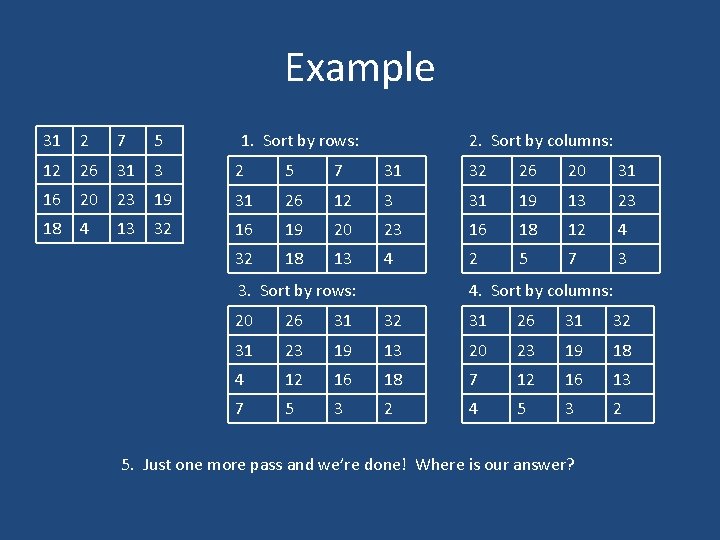
Example 31 2 7 5 12 26 31 3 2 5 7 31 32 26 20 31 16 20 23 19 31 26 12 3 31 19 13 23 18 4 13 32 16 19 20 23 16 18 12 4 32 18 13 4 2 5 7 3 1. Sort by rows: 2. Sort by columns: 3. Sort by rows: 4. Sort by columns: 20 26 31 32 31 23 19 13 20 23 19 18 4 12 16 18 7 12 16 13 7 5 3 2 4 5 3 2 5. Just one more pass and we’re done! Where is our answer?
Handing each row & col • The “inner” part of the algorithm looks at individual rows and columns • Odd number pass: look at rows only – – Compare elements [0] with [1]; [2] with [3]; [4] with [5]… Compare elements [1] with [2]; [3] with [4] This corresponds to handout: people looking to their right Careful: alternating sense • Even number pass: look at columns only – As with rows, look at [0] and [1], [2] with [3] etc. – And then look at [1] with [2], [3] with [4], etc.
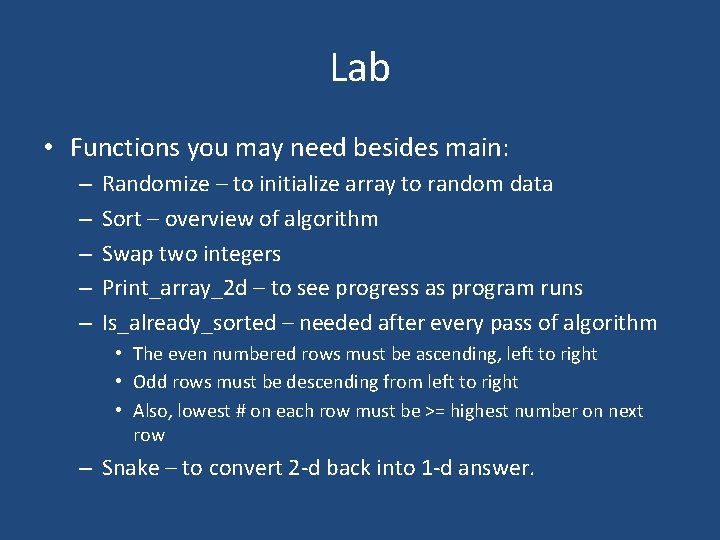
Lab • Functions you may need besides main: – – – Randomize – to initialize array to random data Sort – overview of algorithm Swap two integers Print_array_2 d – to see progress as program runs Is_already_sorted – needed after every pass of algorithm • The even numbered rows must be ascending, left to right • Odd rows must be descending from left to right • Also, lowest # on each row must be >= highest number on next row – Snake – to convert 2 -d back into 1 -d answer.
CS 221 – May 26 • What is it good for? – Many trials or iterations needed for maximum precision – Large input – Intractable problems • Please note: – H 2 due 5 pm today – Q 2 at start of Tuesday – H 3 due next Wednesday
Redistricting • Redraw congressional district boundaries every 10 years. • The 2010 census showed 4, 625, 364 people in SC. State is entitled to 7 congressional districts. But they must be (nearly) identical in population. • 660, 766 per district • Precision of census is the block. • Ex. Start in one corner of state, and add up blocks until you reach target. Continue with next district. • (Another stipulation: Voting Rights Act)
Intractable problems • Problems with no known efficient solution • See Ron Graham video, excerpt 23: 45 -33, 47: 55 -51 • Subset sum problem: Given a list of numbers, is there some subset that adds up to a target value? • Partition problem is similar: can the list be split into 2 parts that add up to the same total?
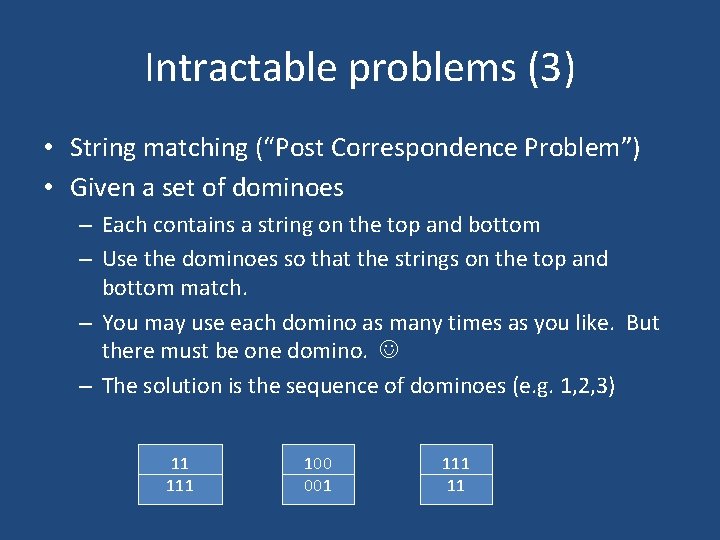
Intractable problems (3) • String matching (“Post Correspondence Problem”) • Given a set of dominoes – Each contains a string on the top and bottom – Use the dominoes so that the strings on the top and bottom match. – You may use each domino as many times as you like. But there must be one domino. – The solution is the sequence of dominoes (e. g. 1, 2, 3) 11 100 001 11
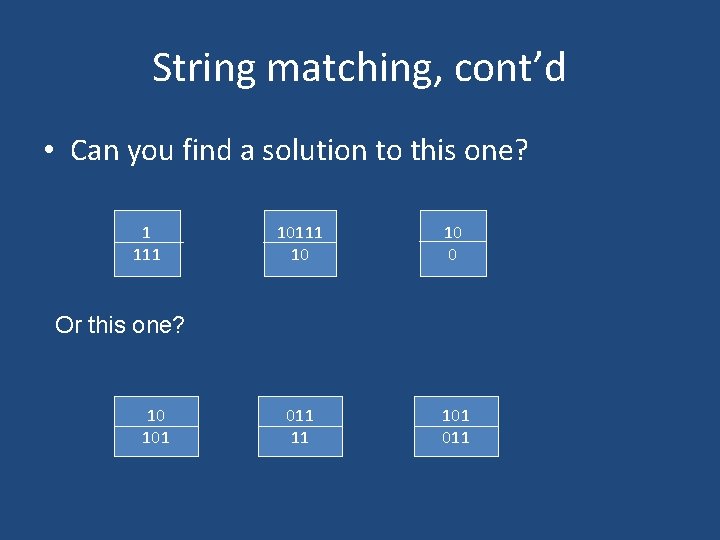
String matching, cont’d • Can you find a solution to this one? 1 111 10 10 0 011 11 101 011 Or this one? 10 101
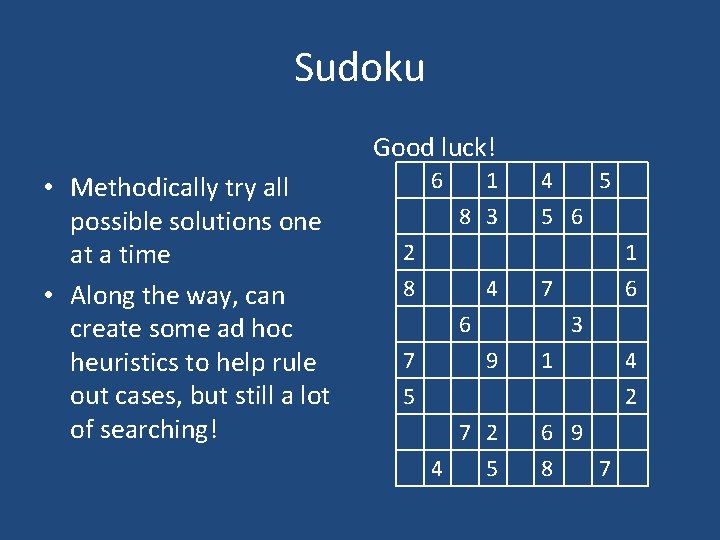
Sudoku Good luck! • Methodically try all possible solutions one at a time • Along the way, can create some ad hoc heuristics to help rule out cases, but still a lot of searching! 6 1 8 3 2 8 4 4 5 5 6 7 5 1 6 3 9 7 2 4 5 1 6 9 8 7 4 2
- Slides: 38