
CS 220 Discrete Structures and their Applications Strong
- Slides: 12
CS 220: Discrete Structures and their Applications Strong induction, Recursive algorithms and induction 6. 8 in zybooks
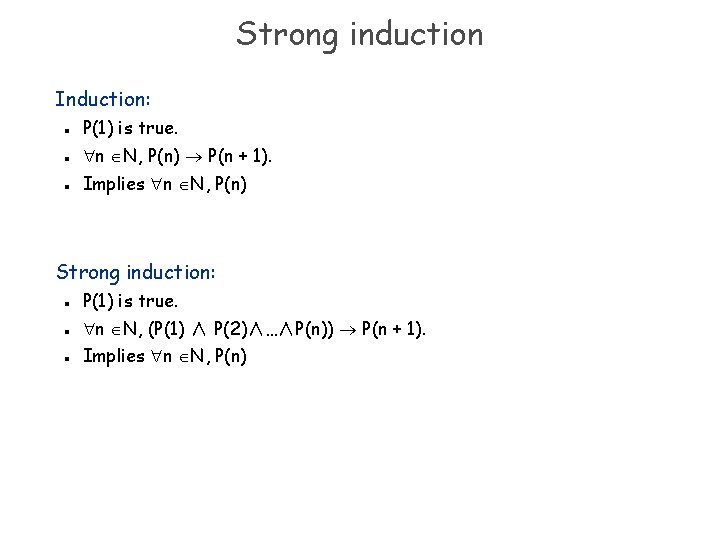
Strong induction Induction: n n n P(1) is true. n N, P(n) P(n + 1). Implies n N, P(n) Strong induction: n n n P(1) is true. n N, (P(1) ∧ P(2)∧…∧P(n)) P(n + 1). Implies n N, P(n)
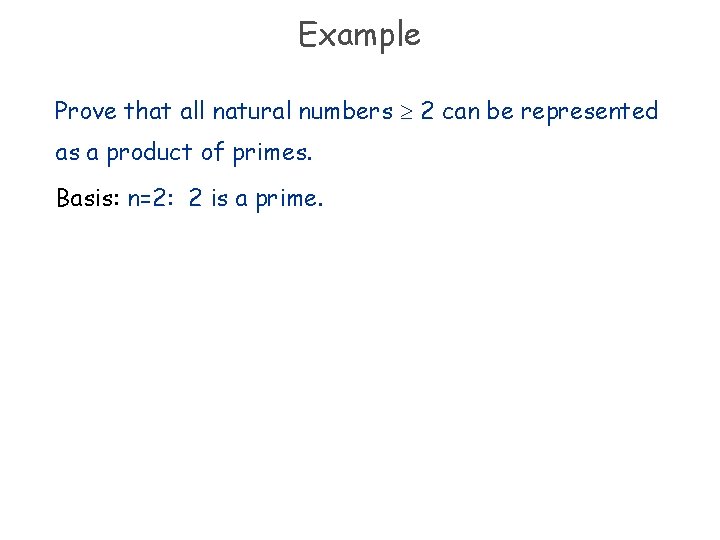
Example Prove that all natural numbers 2 can be represented as a product of primes. Basis: n=2: 2 is a prime.
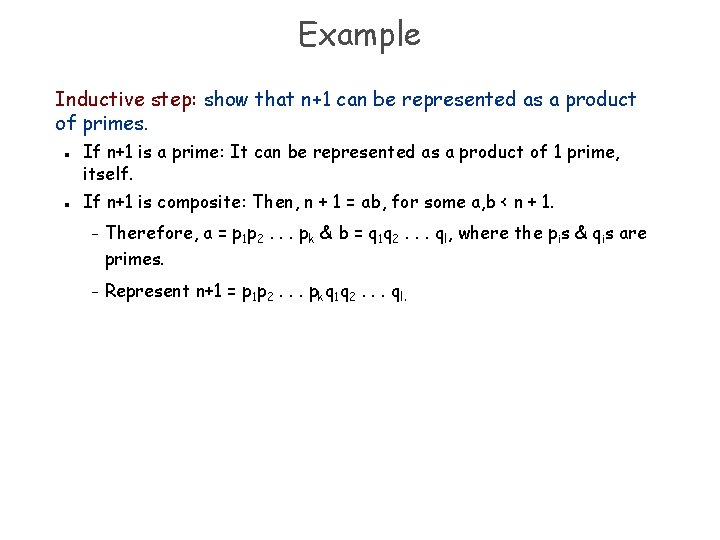
Example Inductive step: show that n+1 can be represented as a product of primes. n n If n+1 is a prime: It can be represented as a product of 1 prime, itself. If n+1 is composite: Then, n + 1 = ab, for some a, b < n + 1. – Therefore, a = p 1 p 2. . . pk & b = q 1 q 2. . . ql, where the pis & qis are primes. – Represent n+1 = p 1 p 2. . . pkq 1 q 2. . . ql.
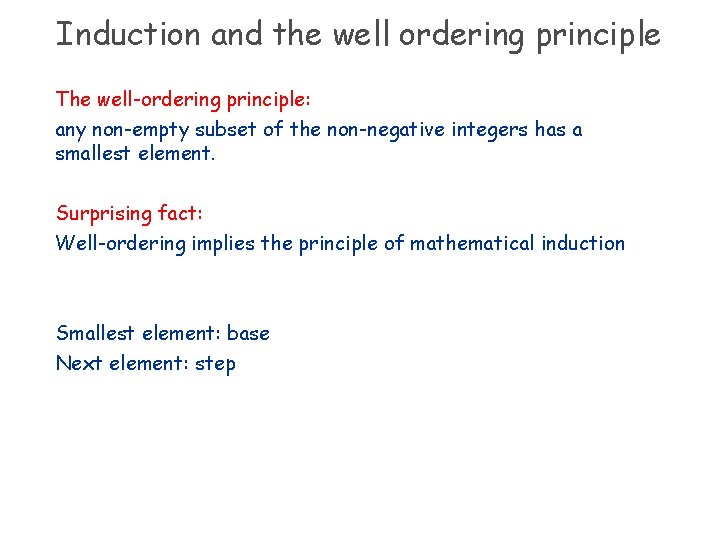
Induction and the well ordering principle The well-ordering principle: any non-empty subset of the non-negative integers has a smallest element. Surprising fact: Well-ordering implies the principle of mathematical induction Smallest element: base Next element: step
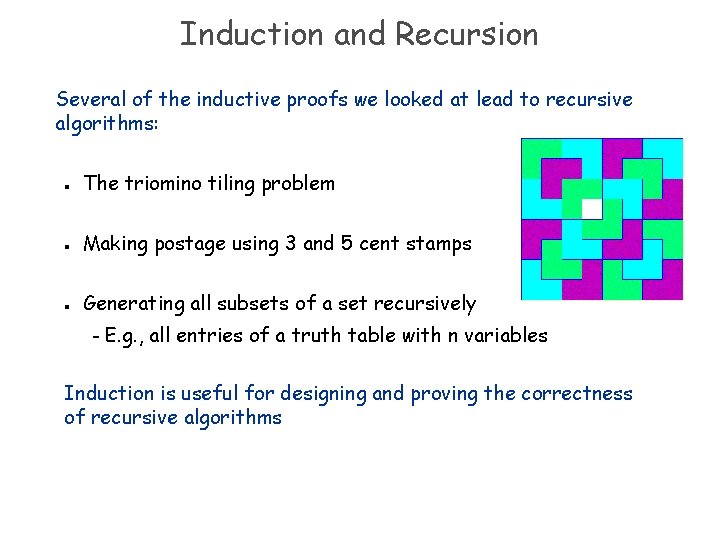
Induction and Recursion Several of the inductive proofs we looked at lead to recursive algorithms: n n n The triomino tiling problem Making postage using 3 and 5 cent stamps Generating all subsets of a set recursively – E. g. , all entries of a truth table with n variables Induction is useful for designing and proving the correctness of recursive algorithms
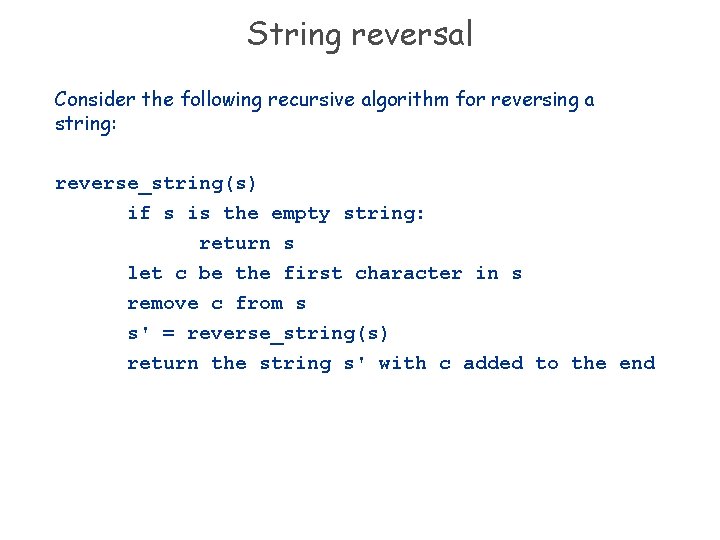
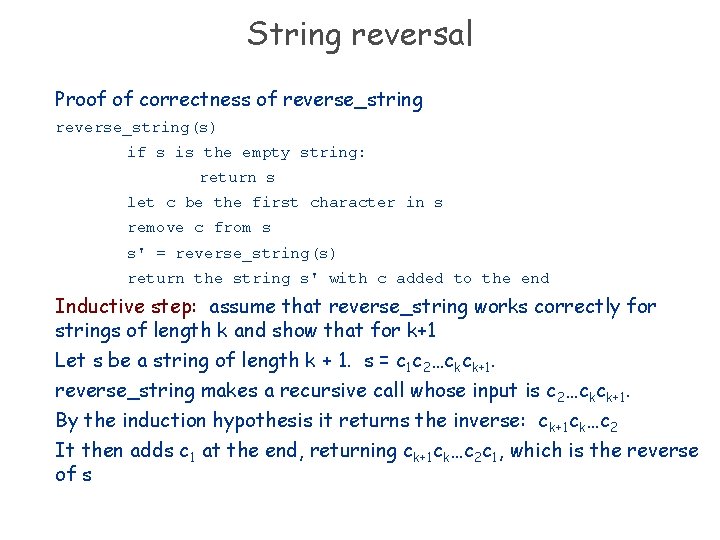
String reversal Consider the following recursive algorithm for reversing a string: reverse_string(s) if s is the empty string: return s let c be the first character in s remove c from s s' = reverse_string(s) return the string s' with c added to the end
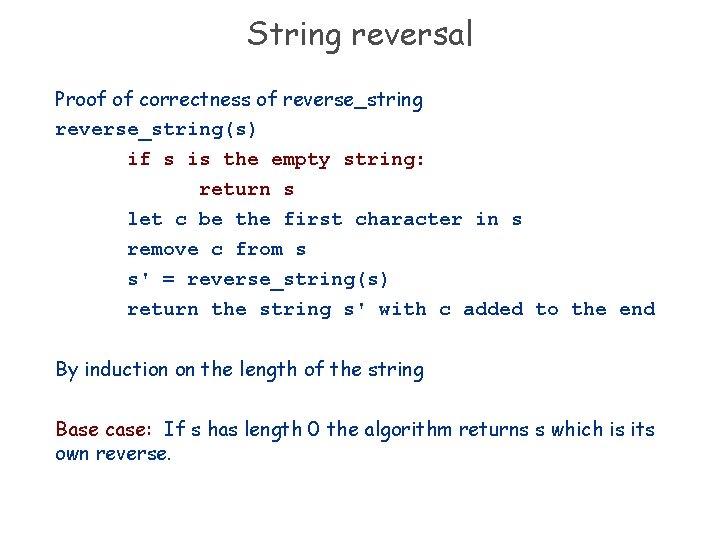
String reversal Proof of correctness of reverse_string(s) if s is the empty string: return s let c be the first character in s remove c from s s' = reverse_string(s) return the string s' with c added to the end By induction on the length of the string Base case: If s has length 0 the algorithm returns s which is its own reverse.
String reversal Proof of correctness of reverse_string(s) if s is the empty string: return s let c be the first character in s remove c from s s' = reverse_string(s) return the string s' with c added to the end Inductive step: assume that reverse_string works correctly for strings of length k and show that for k+1 Let s be a string of length k + 1. s = c 1 c 2…ckck+1. reverse_string makes a recursive call whose input is c 2…ckck+1. By the induction hypothesis it returns the inverse: c k+1 ck…c 2 It then adds c 1 at the end, returning ck+1 ck…c 2 c 1, which is the reverse of s
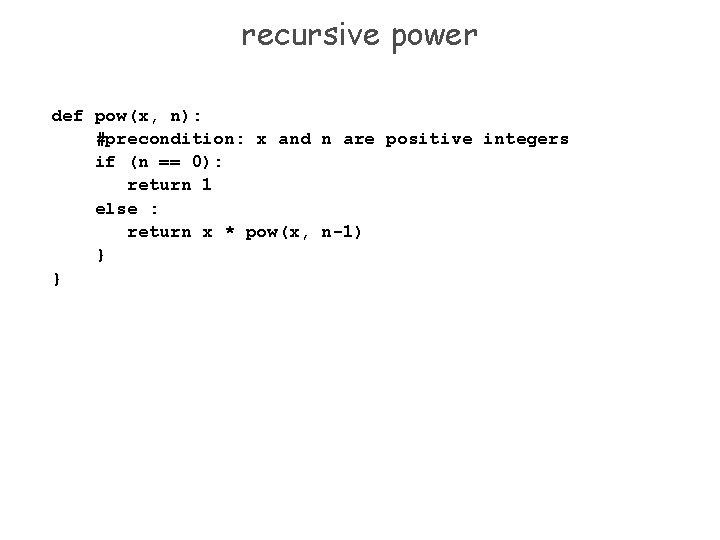
recursive power def pow(x, n): #precondition: x and n are positive integers if (n == 0): return 1 else : return x * pow(x, n-1) } }
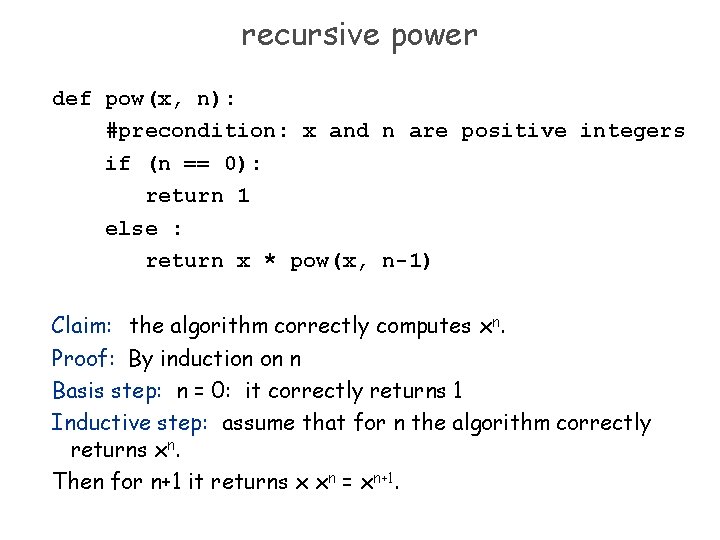
recursive power def pow(x, n): #precondition: x and n are positive integers if (n == 0): return 1 else : return x * pow(x, n-1) Claim: the algorithm correctly computes xn. Proof: By induction on n Basis step: n = 0: it correctly returns 1 Inductive step: assume that for n the algorithm correctly returns xn. Then for n+1 it returns x xn = xn+1.
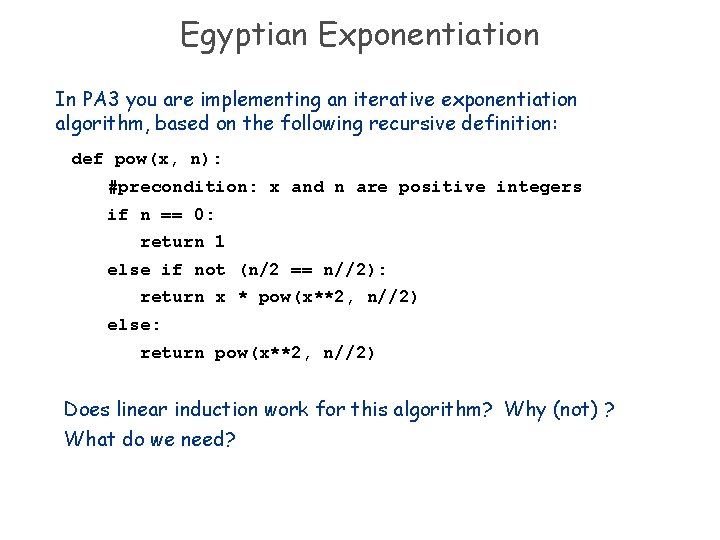
Egyptian Exponentiation In PA 3 you are implementing an iterative exponentiation algorithm, based on the following recursive definition: def pow(x, n): #precondition: x and n are positive integers if n == 0: return 1 else if not (n/2 == n//2): return x * pow(x**2, n//2) else: return pow(x**2, n//2) Does linear induction work for this algorithm? Why (not) ? What do we need?