
CS 213 Introduction to Computer Systems Course Organization

- Slides: 13
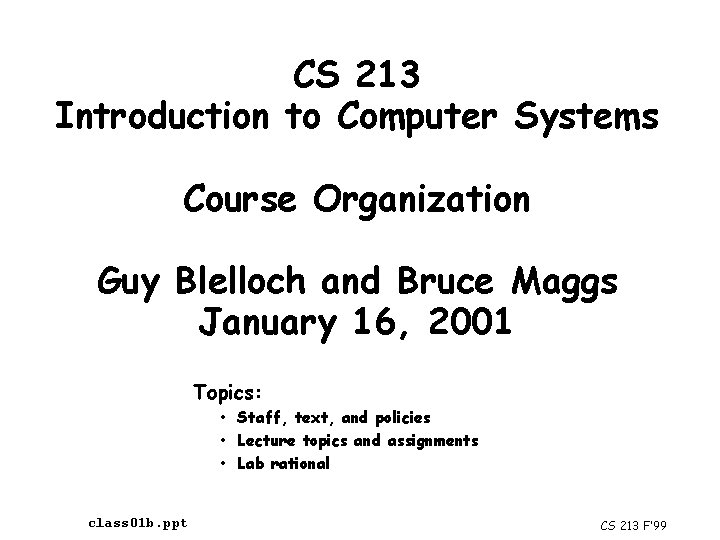
CS 213 Introduction to Computer Systems Course Organization Guy Blelloch and Bruce Maggs January 16, 2001 Topics: • Staff, text, and policies • Lecture topics and assignments • Lab rational class 01 b. ppt CS 213 F’ 99
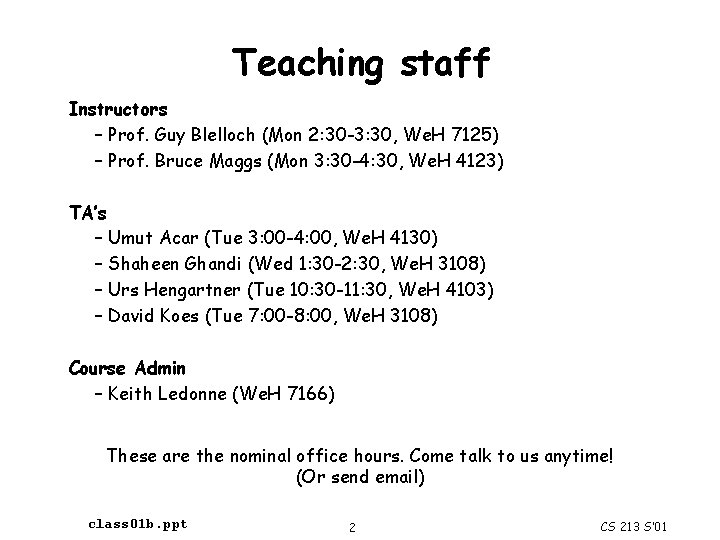
Teaching staff Instructors – Prof. Guy Blelloch (Mon 2: 30 -3: 30, We. H 7125) – Prof. Bruce Maggs (Mon 3: 30 -4: 30, We. H 4123) TA’s – Umut Acar (Tue 3: 00 -4: 00, We. H 4130) – Shaheen Ghandi (Wed 1: 30 -2: 30, We. H 3108) – Urs Hengartner (Tue 10: 30 -11: 30, We. H 4103) – David Koes (Tue 7: 00 -8: 00, We. H 3108) Course Admin – Keith Ledonne (We. H 7166) These are the nominal office hours. Come talk to us anytime! (Or send email) class 01 b. ppt 2 CS 213 S’ 01
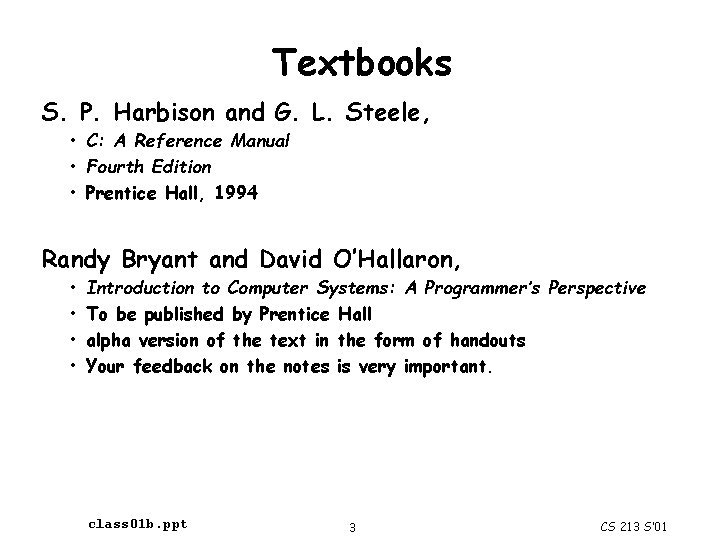
Textbooks S. P. Harbison and G. L. Steele, • C: A Reference Manual • Fourth Edition • Prentice Hall, 1994 Randy Bryant and David O’Hallaron, • • Introduction to Computer Systems: A Programmer’s Perspective To be published by Prentice Hall alpha version of the text in the form of handouts Your feedback on the notes is very important. class 01 b. ppt 3 CS 213 S’ 01
Course Components Lectures • higher level concepts Recitations • applied concepts, important tools and skills for labs, clarification of lectures, exam coverage Homeworks • 1 week (individual) • solving a series of smaller problems, some programming • drills to provide practice for exams. Labs • multi-week (usually 2 weeks) • groups of up to 2 people • provide in-depth understanding of an aspect of systems • programming and measurement Some unavoidable overlap of labs and homeworks early in the course. class 01 b. ppt 4 CS 213 S’ 01
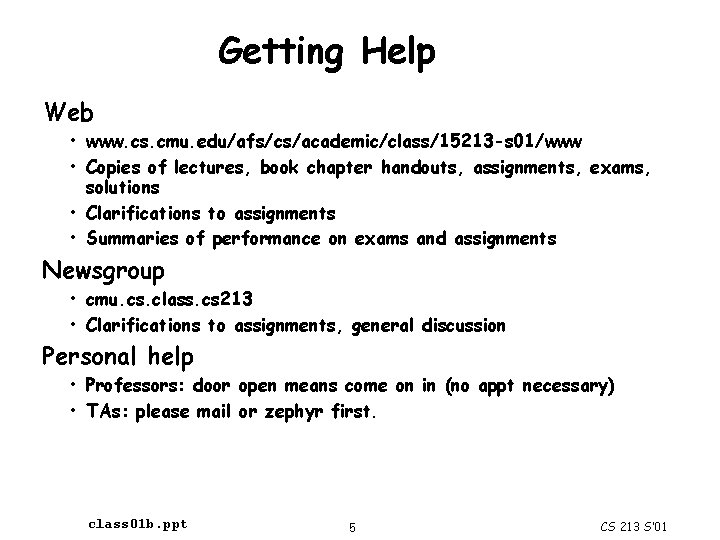
Getting Help Web • www. cs. cmu. edu/afs/cs/academic/class/15213 -s 01/www • Copies of lectures, book chapter handouts, assignments, exams, solutions • Clarifications to assignments • Summaries of performance on exams and assignments Newsgroup • cmu. cs. class. cs 213 • Clarifications to assignments, general discussion Personal help • Professors: door open means come on in (no appt necessary) • TAs: please mail or zephyr first. class 01 b. ppt 5 CS 213 S’ 01
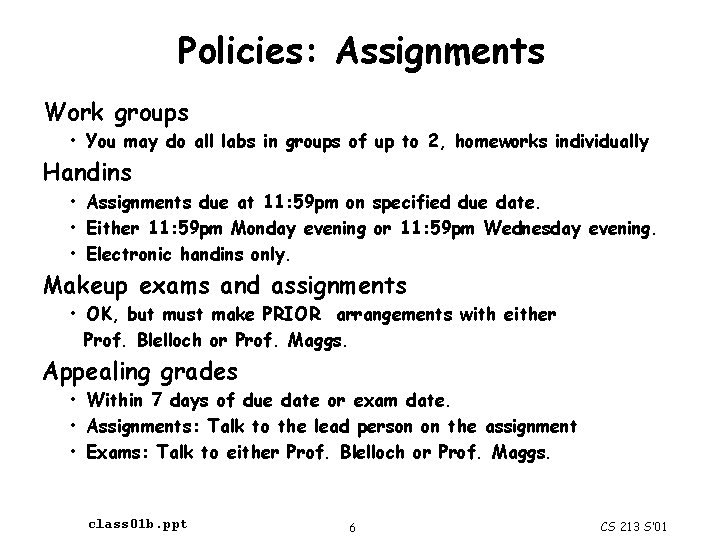
Policies: Assignments Work groups • You may do all labs in groups of up to 2, homeworks individually Handins • Assignments due at 11: 59 pm on specified due date. • Either 11: 59 pm Monday evening or 11: 59 pm Wednesday evening. • Electronic handins only. Makeup exams and assignments • OK, but must make PRIOR arrangements with either Prof. Blelloch or Prof. Maggs. Appealing grades • Within 7 days of due date or exam date. • Assignments: Talk to the lead person on the assignment • Exams: Talk to either Prof. Blelloch or Prof. Maggs. class 01 b. ppt 6 CS 213 S’ 01
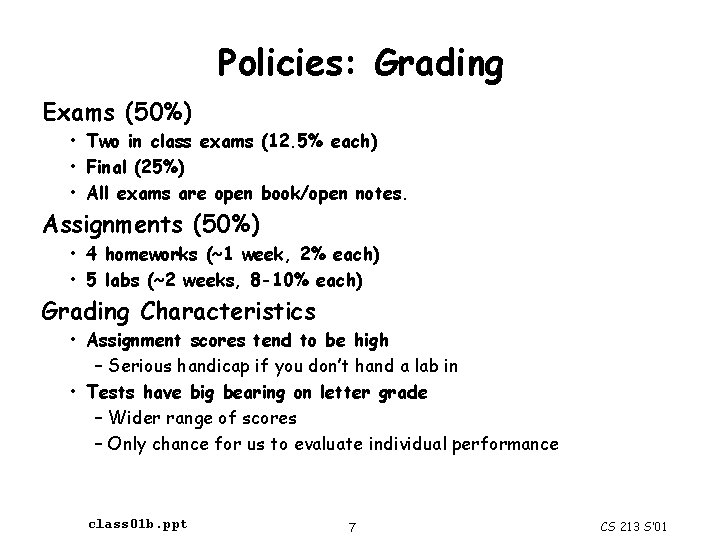
Policies: Grading Exams (50%) • Two in class exams (12. 5% each) • Final (25%) • All exams are open book/open notes. Assignments (50%) • 4 homeworks (~1 week, 2% each) • 5 labs (~2 weeks, 8 -10% each) Grading Characteristics • Assignment scores tend to be high – Serious handicap if you don’t hand a lab in • Tests have big bearing on letter grade – Wider range of scores – Only chance for us to evaluate individual performance class 01 b. ppt 7 CS 213 S’ 01
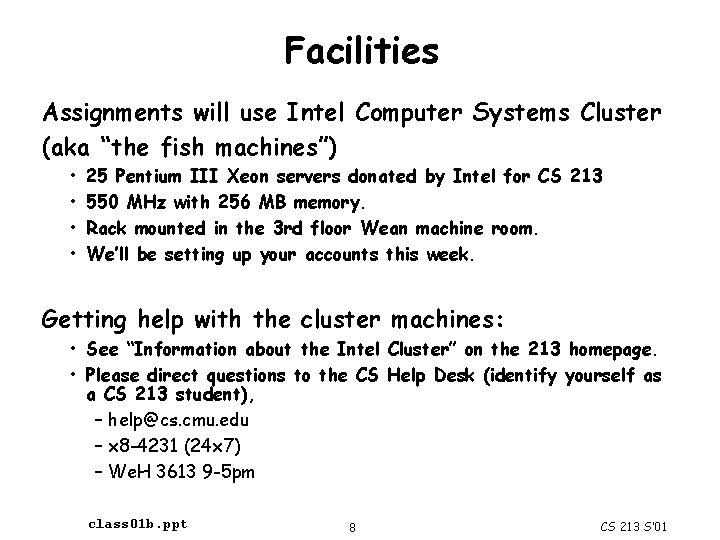
Facilities Assignments will use Intel Computer Systems Cluster (aka “the fish machines”) • • 25 Pentium III Xeon servers donated by Intel for CS 213 550 MHz with 256 MB memory. Rack mounted in the 3 rd floor Wean machine room. We’ll be setting up your accounts this week. Getting help with the cluster machines: • See “Information about the Intel Cluster” on the 213 homepage. • Please direct questions to the CS Help Desk (identify yourself as a CS 213 student), – help@cs. cmu. edu – x 8 -4231 (24 x 7) – We. H 3613 9 -5 pm class 01 b. ppt 8 CS 213 S’ 01
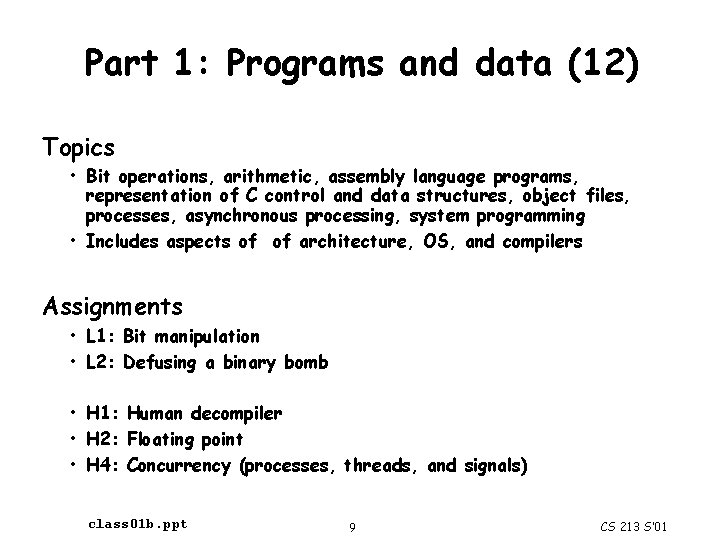
Part 1: Programs and data (12) Topics • Bit operations, arithmetic, assembly language programs, representation of C control and data structures, object files, processes, asynchronous processing, system programming • Includes aspects of of architecture, OS, and compilers Assignments • L 1: Bit manipulation • L 2: Defusing a binary bomb • H 1: Human decompiler • H 2: Floating point • H 4: Concurrency (processes, threads, and signals) class 01 b. ppt 9 CS 213 S’ 01
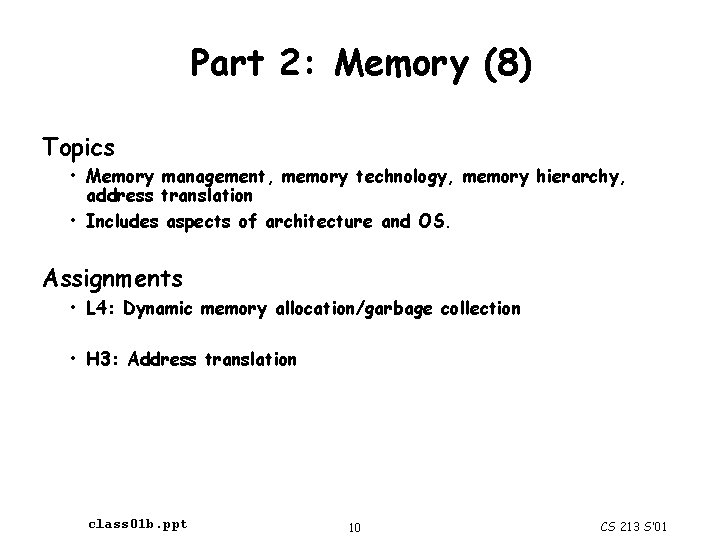
Part 2: Memory (8) Topics • Memory management, memory technology, memory hierarchy, address translation • Includes aspects of architecture and OS. Assignments • L 4: Dynamic memory allocation/garbage collection • H 3: Address translation class 01 b. ppt 10 CS 213 S’ 01
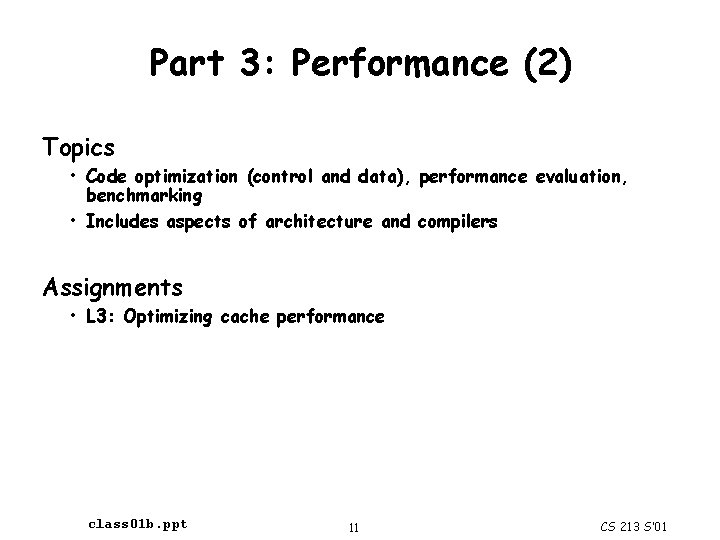
Part 3: Performance (2) Topics • Code optimization (control and data), performance evaluation, benchmarking • Includes aspects of architecture and compilers Assignments • L 3: Optimizing cache performance class 01 b. ppt 11 CS 213 S’ 01
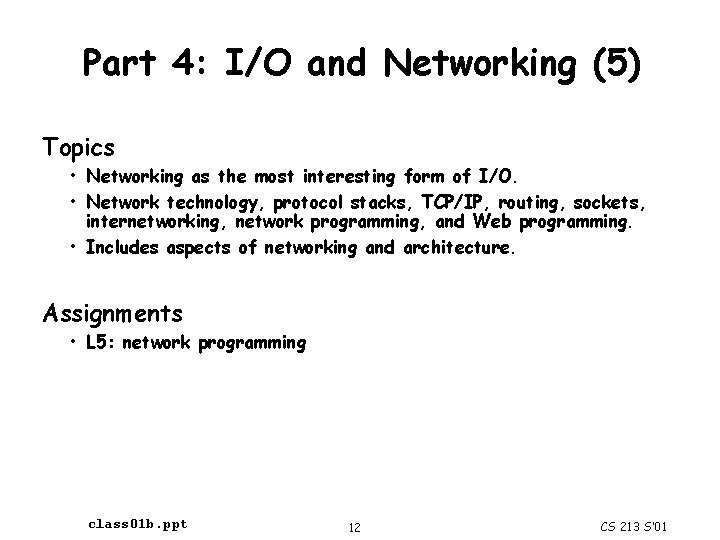
Part 4: I/O and Networking (5) Topics • Networking as the most interesting form of I/O. • Network technology, protocol stacks, TCP/IP, routing, sockets, internetworking, network programming, and Web programming. • Includes aspects of networking and architecture. Assignments • L 5: network programming class 01 b. ppt 12 CS 213 S’ 01
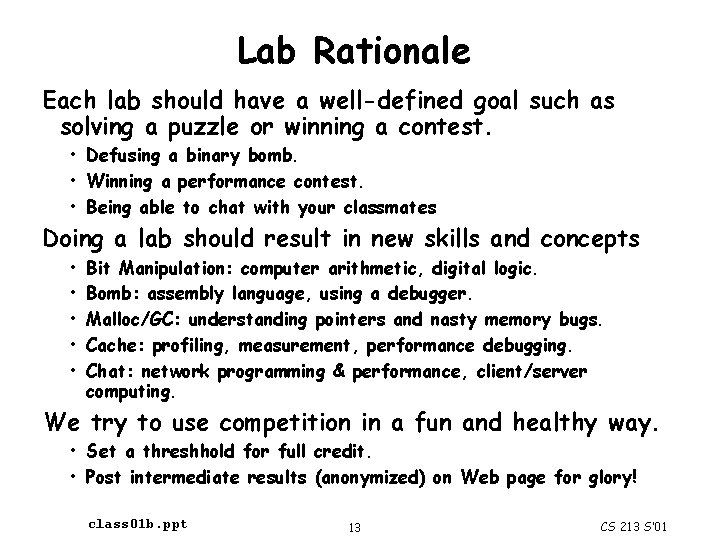
Lab Rationale Each lab should have a well-defined goal such as solving a puzzle or winning a contest. • Defusing a binary bomb. • Winning a performance contest. • Being able to chat with your classmates Doing a lab should result in new skills and concepts • • • Bit Manipulation: computer arithmetic, digital logic. Bomb: assembly language, using a debugger. Malloc/GC: understanding pointers and nasty memory bugs. Cache: profiling, measurement, performance debugging. Chat: network programming & performance, client/server computing. We try to use competition in a fun and healthy way. • Set a threshhold for full credit. • Post intermediate results (anonymized) on Web page for glory! class 01 b. ppt 13 CS 213 S’ 01