
CS 2104 Prog Lang Concepts Logic Programming II



- Slides: 32
CS 2104 – Prog. Lang. Concepts Logic Programming - II Dr. Abhik Roychoudhury School of Computing
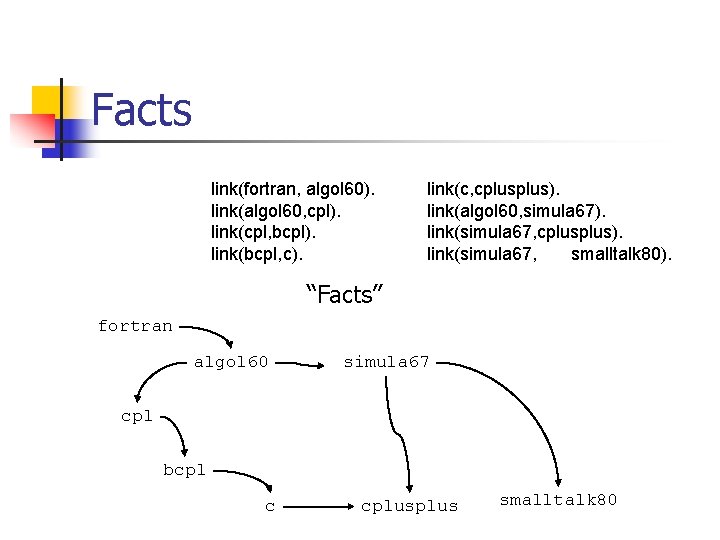
Facts link(fortran, algol 60). link(algol 60, cpl). link(cpl, bcpl). link(bcpl, c). link(c, cplus). link(algol 60, simula 67). link(simula 67, cplus). link(simula 67, smalltalk 80). “Facts” fortran algol 60 simula 67 cpl bcpl c cplus smalltalk 80
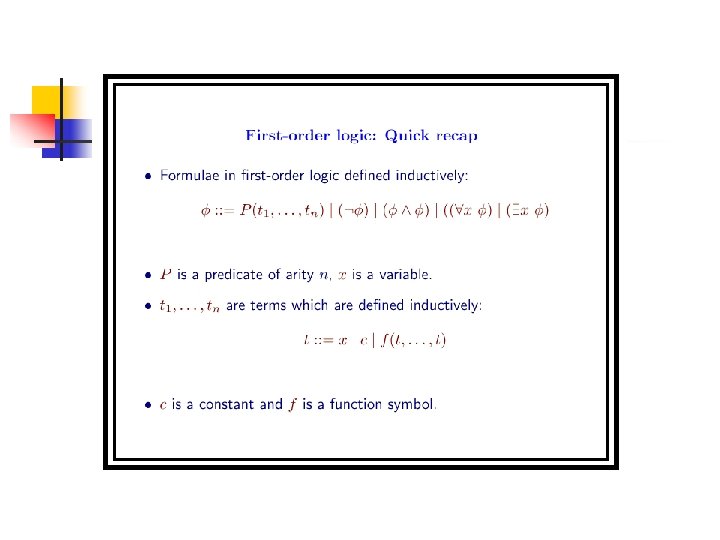
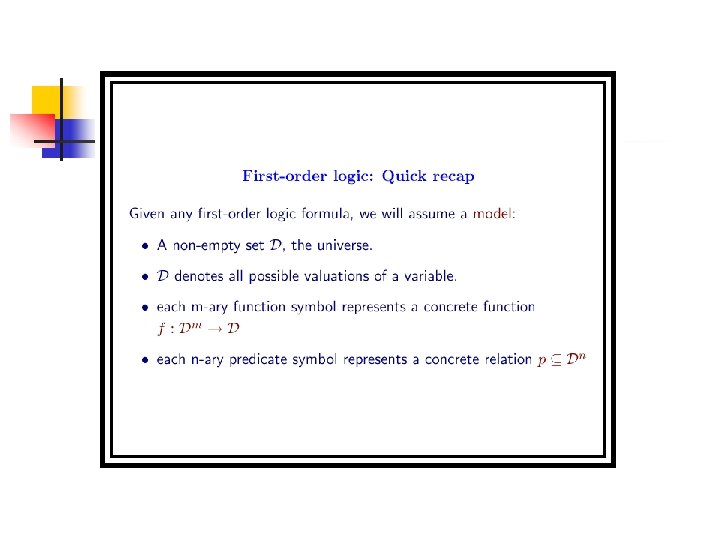
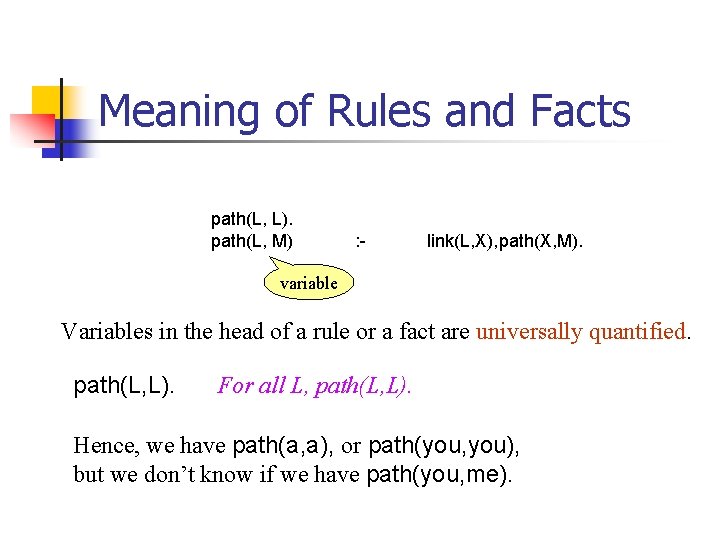
Meaning of Rules and Facts path(L, L). path(L, M) : - link(L, X), path(X, M). variable Variables in the head of a rule or a fact are universally quantified. path(L, L). For all L, path(L, L). Hence, we have path(a, a), or path(you, you), but we don’t know if we have path(you, me).
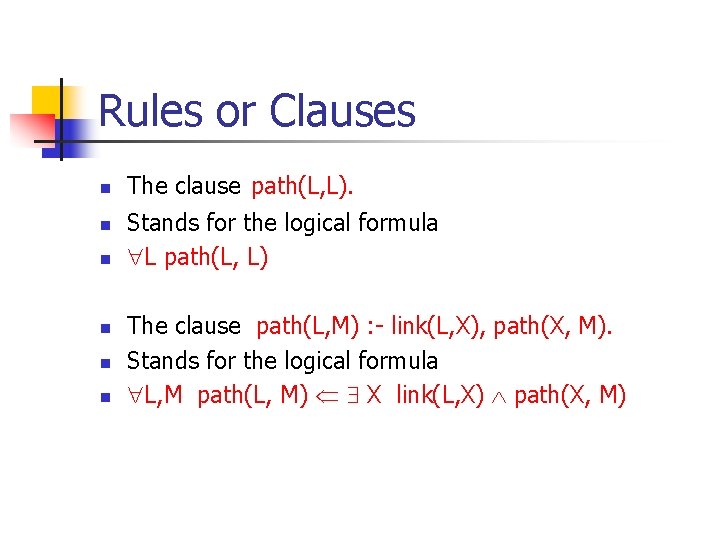
Rules or Clauses n n n The clause path(L, L). Stands for the logical formula L path(L, L) The clause path(L, M) : - link(L, X), path(X, M). Stands for the logical formula L, M path(L, M) X link(L, X) path(X, M)
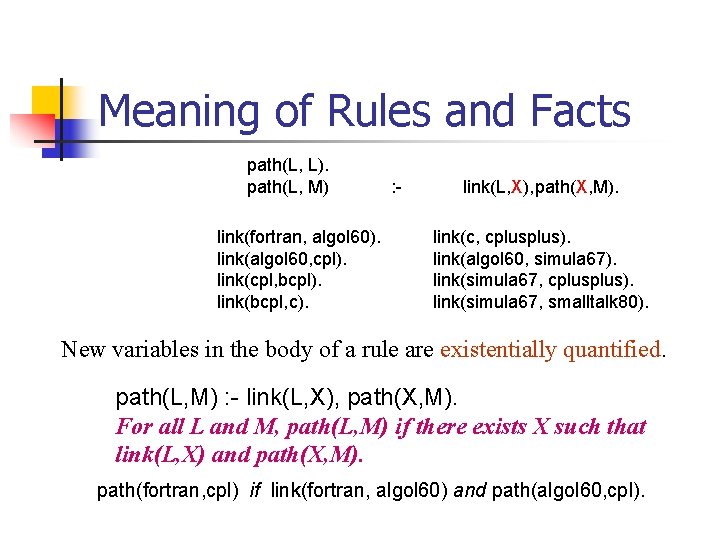
Meaning of Rules and Facts path(L, L). path(L, M) link(fortran, algol 60). link(algol 60, cpl). link(cpl, bcpl). link(bcpl, c). : - link(L, X), path(X, M). link(c, cplus). link(algol 60, simula 67). link(simula 67, cplus). link(simula 67, smalltalk 80). New variables in the body of a rule are existentially quantified. path(L, M) : - link(L, X), path(X, M). For all L and M, path(L, M) if there exists X such that link(L, X) and path(X, M). path(fortran, cpl) if link(fortran, algol 60) and path(algol 60, cpl).
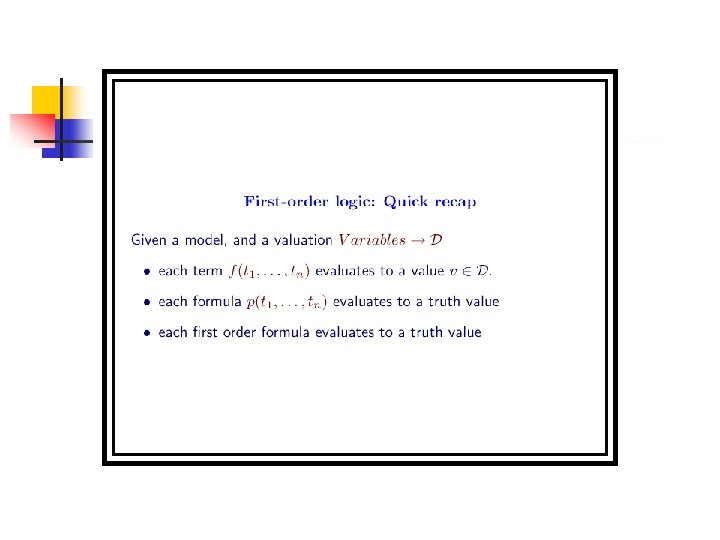
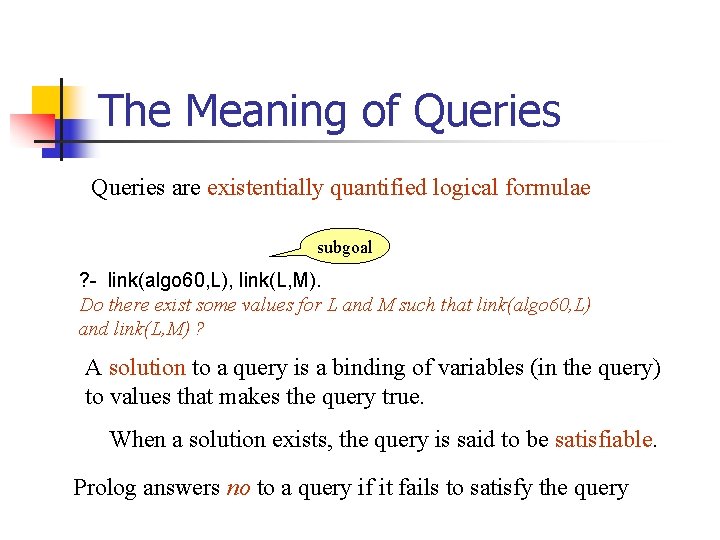
The Meaning of Queries are existentially quantified logical formulae subgoal ? - link(algo 60, L), link(L, M). Do there exist some values for L and M such that link(algo 60, L) and link(L, M) ? A solution to a query is a binding of variables (in the query) to values that makes the query true. When a solution exists, the query is said to be satisfiable. Prolog answers no to a query if it fails to satisfy the query
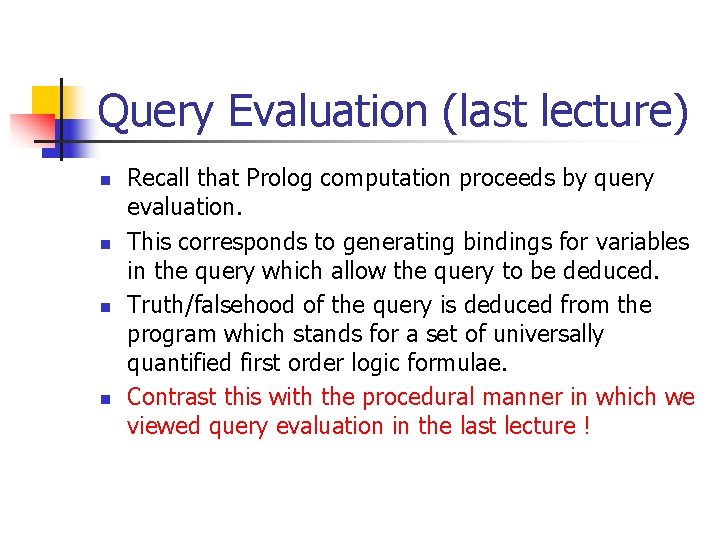
Query Evaluation (last lecture) n n Recall that Prolog computation proceeds by query evaluation. This corresponds to generating bindings for variables in the query which allow the query to be deduced. Truth/falsehood of the query is deduced from the program which stands for a set of universally quantified first order logic formulae. Contrast this with the procedural manner in which we viewed query evaluation in the last lecture !
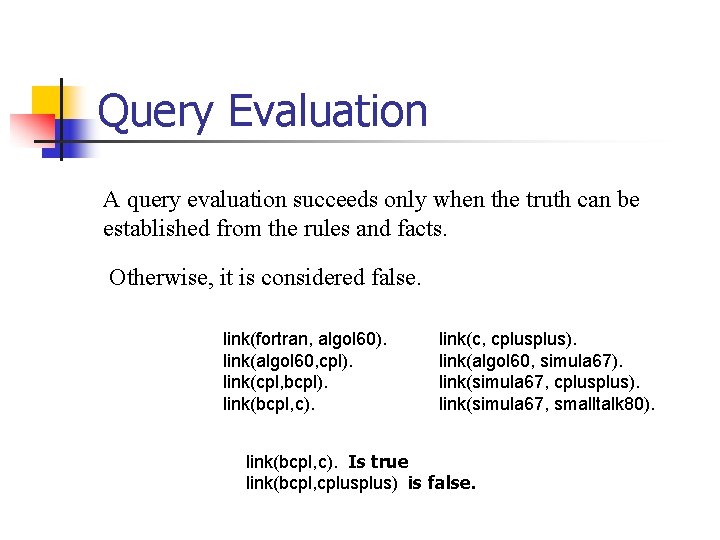
Query Evaluation A query evaluation succeeds only when the truth can be established from the rules and facts. Otherwise, it is considered false. link(fortran, algol 60). link(algol 60, cpl). link(cpl, bcpl). link(bcpl, c). link(c, cplus). link(algol 60, simula 67). link(simula 67, cplus). link(simula 67, smalltalk 80). link(bcpl, c). Is true link(bcpl, cplus) is false.
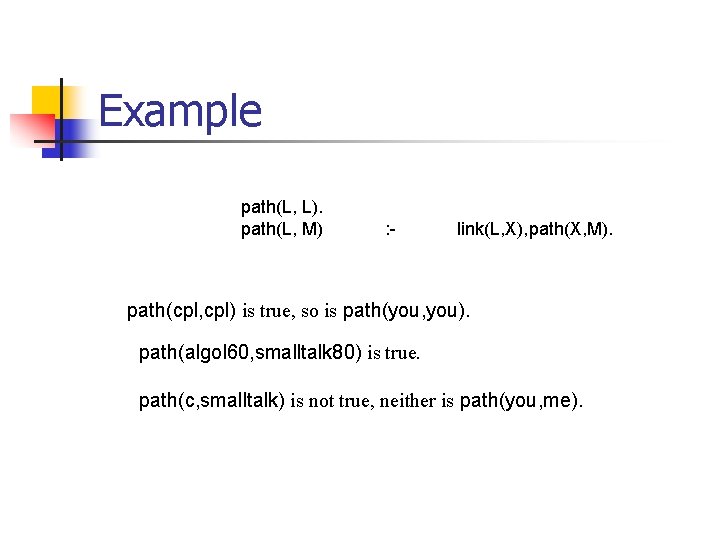
Example path(L, L). path(L, M) : - link(L, X), path(X, M). path(cpl, cpl) is true, so is path(you, you). path(algol 60, smalltalk 80) is true. path(c, smalltalk) is not true, neither is path(you, me).
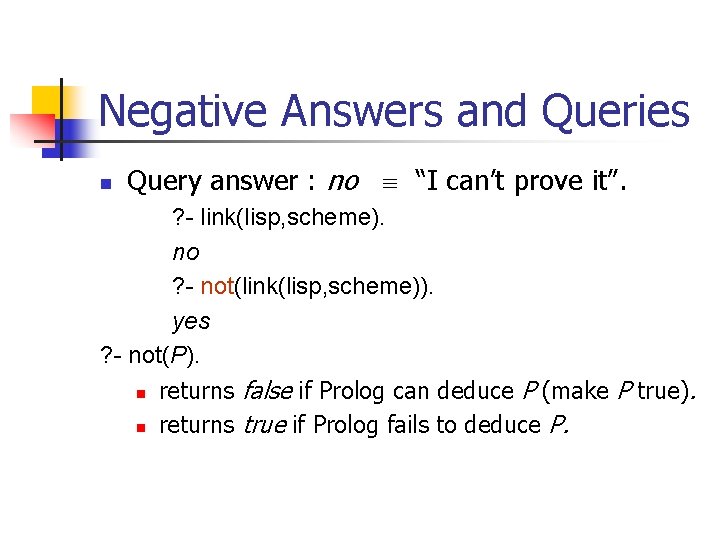
Negative Answers and Queries n Query answer : no “I can’t prove it”. ? - link(lisp, scheme). no ? - not(link(lisp, scheme)). yes ? - not(P). n returns false if Prolog can deduce P (make P true). n returns true if Prolog fails to deduce P.
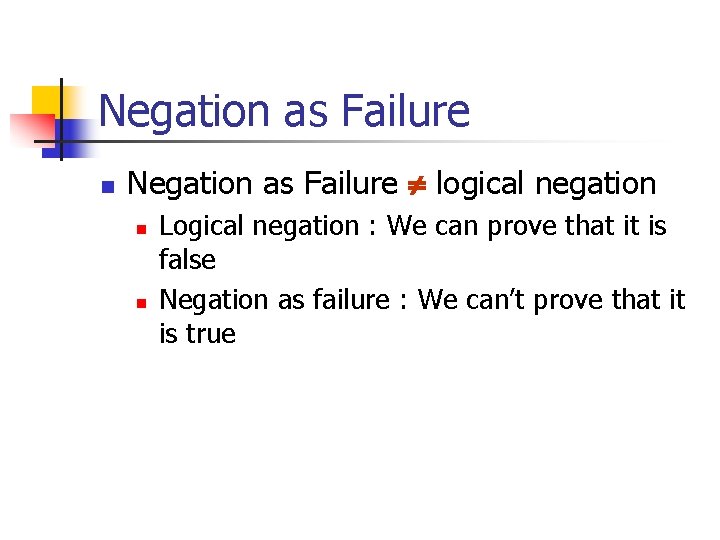
Negation as Failure n Negation as Failure logical negation n n Logical negation : We can prove that it is false Negation as failure : We can’t prove that it is true
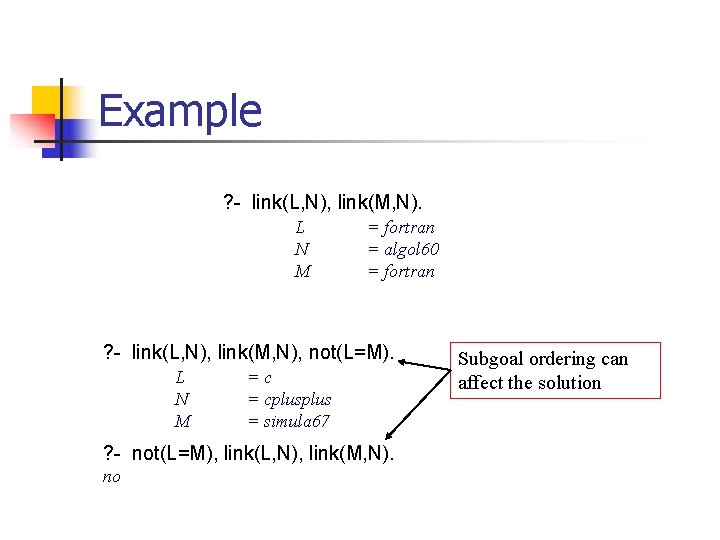
Example ? - link(L, N), link(M, N). L N M = fortran = algol 60 = fortran ? - link(L, N), link(M, N), not(L=M). L N M =c = cplus = simula 67 ? - not(L=M), link(L, N), link(M, N). no Subgoal ordering can affect the solution
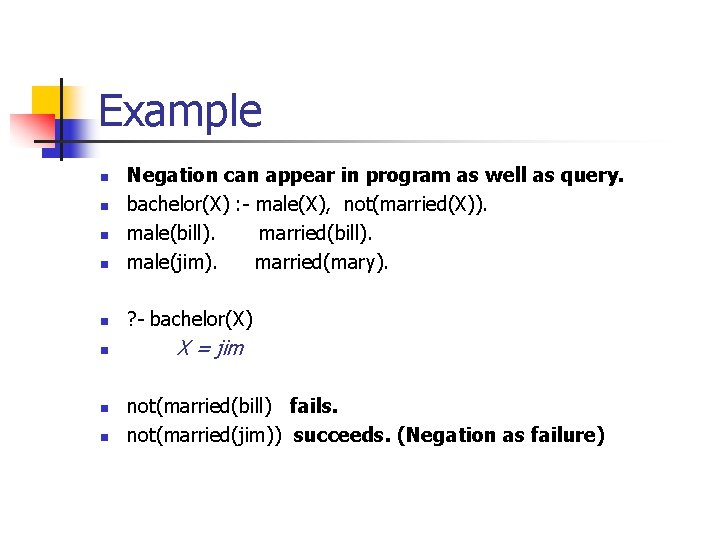
Example n Negation can appear in program as well as query. bachelor(X) : - male(X), not(married(X)). male(bill). married(bill). male(jim). married(mary). n ? - bachelor(X) n n n X = jim not(married(bill) fails. not(married(jim)) succeeds. (Negation as failure)
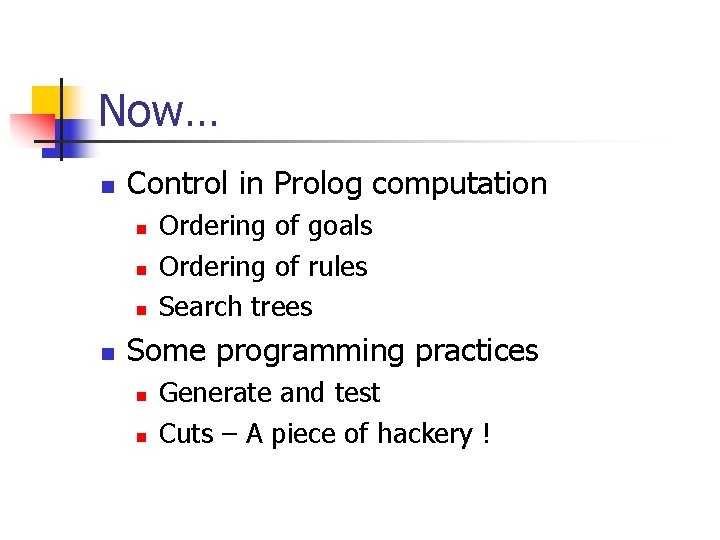
Now… n Control in Prolog computation n n Ordering of goals Ordering of rules Search trees Some programming practices n n Generate and test Cuts – A piece of hackery !
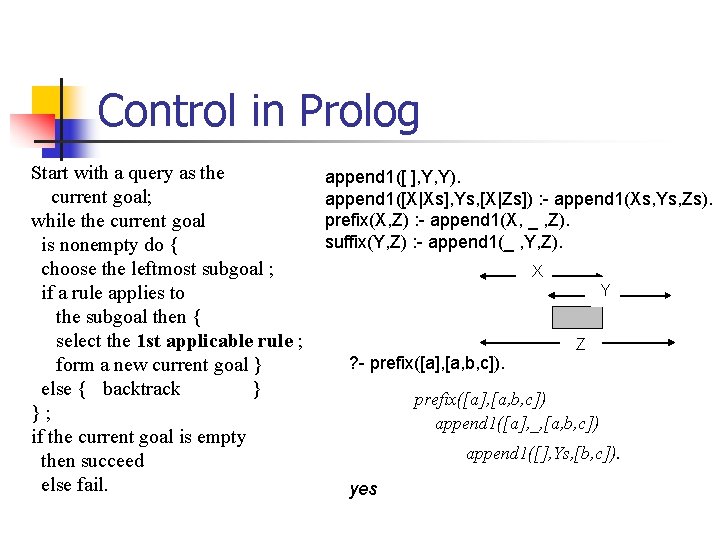
Control in Prolog Start with a query as the current goal; while the current goal is nonempty do { choose the leftmost subgoal ; if a rule applies to the subgoal then { select the 1 st applicable rule ; form a new current goal } else { backtrack } }; if the current goal is empty then succeed else fail. append 1([ ], Y, Y). append 1([X|Xs], Ys, [X|Zs]) : - append 1(Xs, Ys, Zs). prefix(X, Z) : - append 1(X, _ , Z). suffix(Y, Z) : - append 1(_ , Y, Z). X Y ? - prefix([a], [a, b, c]). Z prefix([a], [a, b, c]) append 1([a], _, [a, b, c]) append 1([], Ys, [b, c]). yes
Ordering of Subgoals Start with a query as the current goal; while the current goal is nonempty do { choose the leftmost subgoal ; if a rule applies to the subgoal then { select the 1 st applicable rule ; form a new current goal } else { backtrack } }; if the current goal is empty then succeed else fail. append 1([ ], Y, Y). append 1([X|Xs], Ys, [X|Zs]) : - append 1(Xs, Ys, Zs). prefix(X, Z) : - append 1(X, _ , Z). suffix(Y, Z) : - append 1(_ , Y, Z). X Y Z ? - prefix(X, [a, b, c]), suffix([e], X). no ? - suffix([e], X), prefix(X, [a, b, c]). <infinite computation>
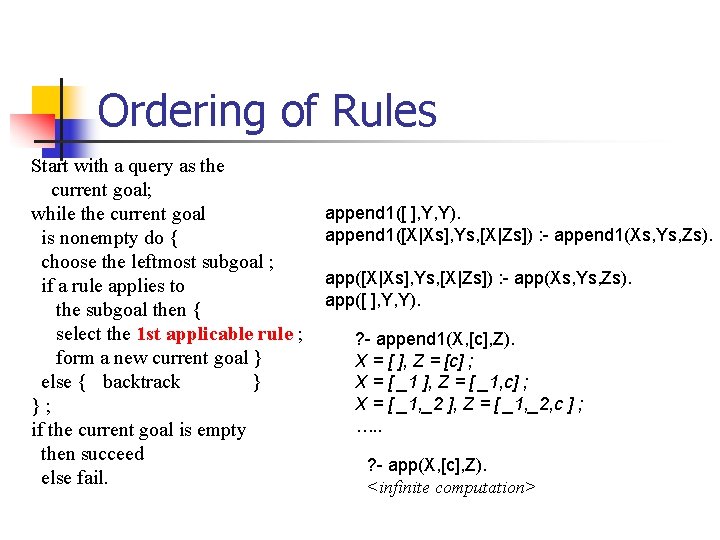
Ordering of Rules Start with a query as the current goal; while the current goal is nonempty do { choose the leftmost subgoal ; if a rule applies to the subgoal then { select the 1 st applicable rule ; form a new current goal } else { backtrack } }; if the current goal is empty then succeed else fail. append 1([ ], Y, Y). append 1([X|Xs], Ys, [X|Zs]) : - append 1(Xs, Ys, Zs). app([X|Xs], Ys, [X|Zs]) : - app(Xs, Ys, Zs). app([ ], Y, Y). ? - append 1(X, [c], Z). X = [ ], Z = [c] ; X = [ _1 ], Z = [ _1, c] ; X = [ _1, _2 ], Z = [ _1, _2, c ] ; …. . ? - app(X, [c], Z). <infinite computation>
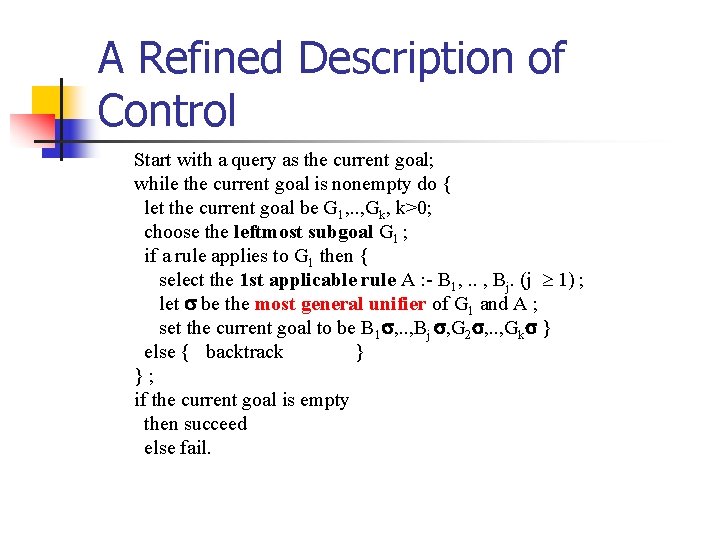
A Refined Description of Control Start with a query as the current goal; while the current goal is nonempty do { let the current goal be G 1, . . , Gk, k>0; choose the leftmost subgoal G 1 ; if a rule applies to G 1 then { select the 1 st applicable rule A : - B 1, . . , Bj. (j 1) ; let be the most general unifier of G 1 and A ; set the current goal to be B 1 , . . , Bj , G 2 , . . , Gk } else { backtrack } }; if the current goal is empty then succeed else fail.
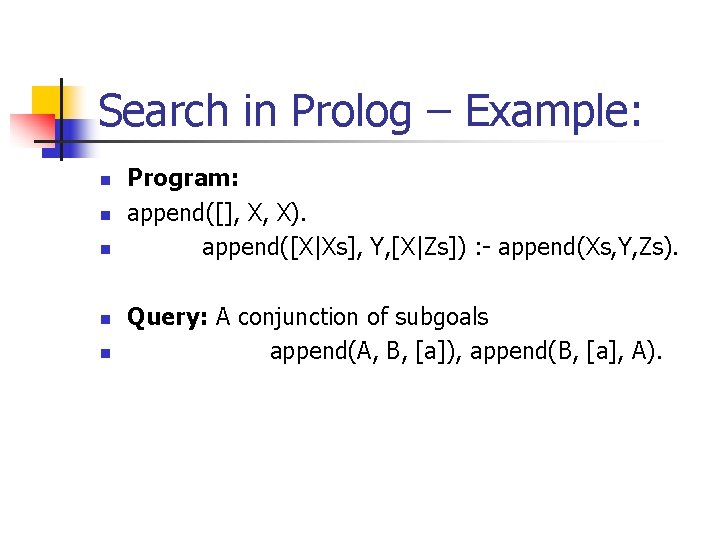
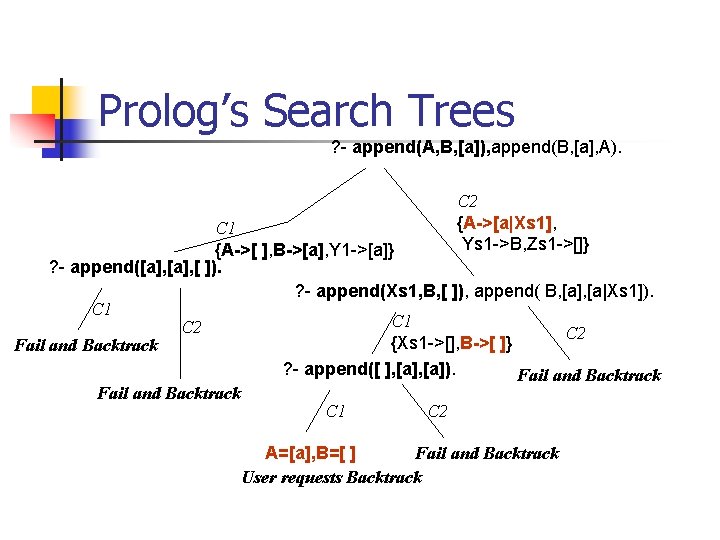
Search in Prolog – Example: n n n Program: append([], X, X). append([X|Xs], Y, [X|Zs]) : - append(Xs, Y, Zs). Query: A conjunction of subgoals append(A, B, [a]), append(B, [a], A).
Prolog’s Search Trees ? - append(A, B, [a]), append(B, [a], A). C 2 {A->[a|Xs 1], Ys 1 ->B, Zs 1 ->[]} C 1 {A->[ ], B->[a], Y 1 ->[a]} ? - append([a], [ ]). ? - append(Xs 1, B, [ ]), append( B, [a], [a|Xs 1]). C 1 C 2 {Xs 1 ->[], B->[ ]} Fail and Backtrack ? - append([ ], [a]). Fail and Backtrack C 1 C 2 A=[a], B=[ ] Fail and Backtrack User requests Backtrack
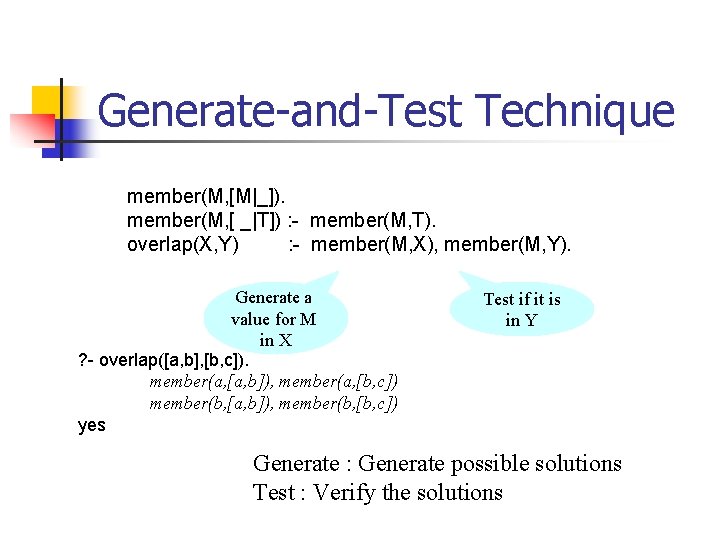
Generate-and-Test Technique member(M, [M|_]). member(M, [ _|T]) : - member(M, T). overlap(X, Y) : - member(M, X), member(M, Y). Generate a value for M in X ? - overlap([a, b], [b, c]). member(a, [a, b]), member(a, [b, c]) member(b, [a, b]), member(b, [b, c]) yes Test if it is in Y Generate : Generate possible solutions Test : Verify the solutions
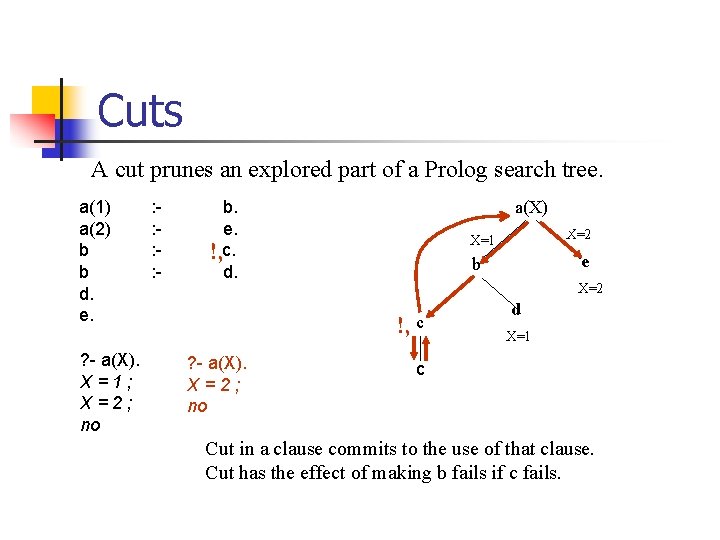
Cuts A cut prunes an explored part of a Prolog search tree. a(1) a(2) b b d. e. ? - a(X). X=1; X=2; no : : - b. e. !, c. d. a(X) e b X=2 !, c ? - a(X). X=2; no X=2 X=1 d X=1 c Cut in a clause commits to the use of that clause. Cut has the effect of making b fails if c fails.
a(X) : -b(X). a(X) : -f(X). b(X) : -g(X), !, v(X). b(X) : -X = 4, v(X). g(1). g(2). g(3). v(1). v(X) : - f(X). f(5). v(1) ? - a(Z). Z=1; Z=5; no Z=1 a(Z) b(Z) g(Z), !, v(Z) !, v(1) v(2) f(1) backtrack f(2) f(Z) Z=4, v(4) f(5) v(3) f(4) backtrack f(3) backtrack Z=5
Green Cuts, Red Cuts n Green Cut n a cut the prunes part of a Prolog search tree that cannot possibly reach a solution n n used mainly for efficiency sake. Red Cut n a cut that alters the set of possible solutions reachable. n n Powerful tool, yet fatal and can be confusing Handle with care
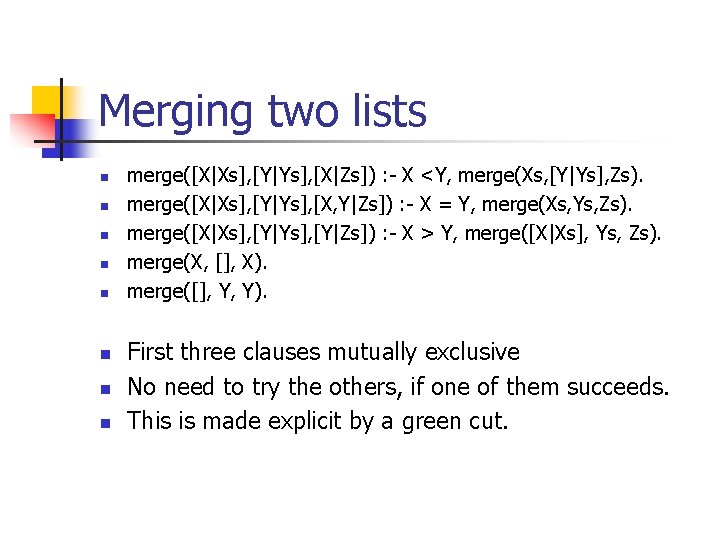
Merging two lists n n n n merge([X|Xs], [Y|Ys], [X|Zs]) : - X <Y, merge(Xs, [Y|Ys], Zs). merge([X|Xs], [Y|Ys], [X, Y|Zs]) : - X = Y, merge(Xs, Ys, Zs). merge([X|Xs], [Y|Ys], [Y|Zs]) : - X > Y, merge([X|Xs], Ys, Zs). merge(X, [], X). merge([], Y, Y). First three clauses mutually exclusive No need to try the others, if one of them succeeds. This is made explicit by a green cut.
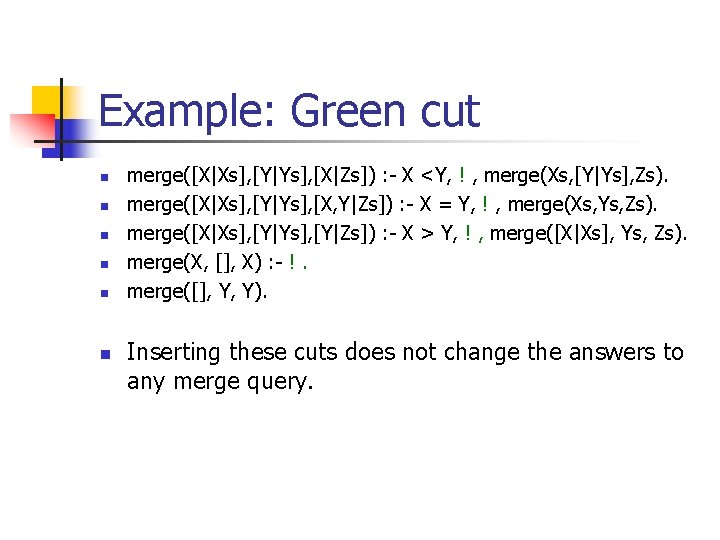
Example: Green cut n n n merge([X|Xs], [Y|Ys], [X|Zs]) : - X <Y, ! , merge(Xs, [Y|Ys], Zs). merge([X|Xs], [Y|Ys], [X, Y|Zs]) : - X = Y, ! , merge(Xs, Ys, Zs). merge([X|Xs], [Y|Ys], [Y|Zs]) : - X > Y, ! , merge([X|Xs], Ys, Zs). merge(X, [], X) : - !. merge([], Y, Y). Inserting these cuts does not change the answers to any merge query.
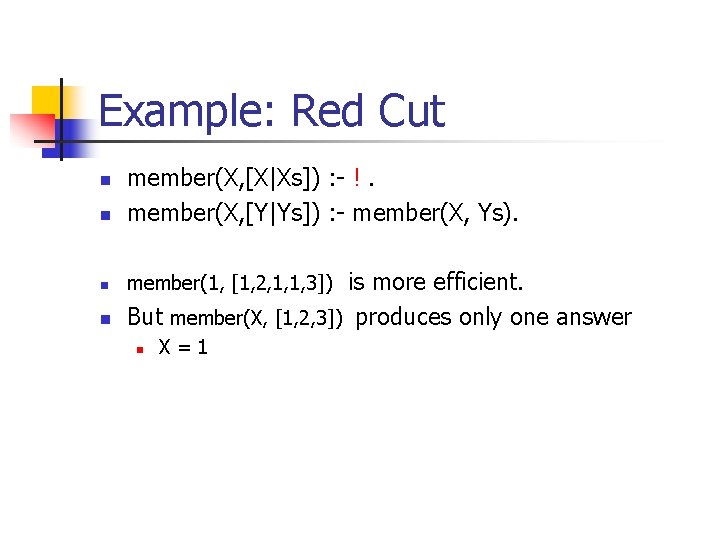
Example: Red Cut n member(X, [X|Xs]) : - !. member(X, [Y|Ys]) : - member(X, Ys). n member(1, [1, 2, 1, 1, 3]) n n is more efficient. But member(X, [1, 2, 3]) produces only one answer n X=1
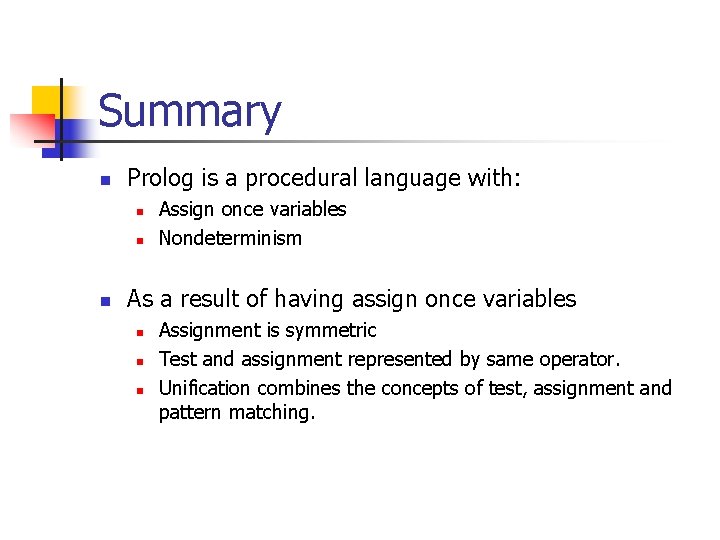
Summary n Prolog is a procedural language with: n n n Assign once variables Nondeterminism As a result of having assign once variables n n n Assignment is symmetric Test and assignment represented by same operator. Unification combines the concepts of test, assignment and pattern matching.
Summary n As a result of having nondeterminism n n Control issues for the search Cuts (allows the programmer explcit control) Meaning of Prolog program given by queries that can be evaluated to true. Applications of Prolog (in next lecture) n n Database query language Grammar Processing