
CS 203 Advanced Computer Architecture Cache Memory Hierarchy




- Slides: 38
CS 203 – Advanced Computer Architecture Cache
Memory Hierarchy Design Memory hierarchy design becomes more crucial with recent multi-core processors: Aggregate peak bandwidth grows with # cores: Intel Core i 7 can generate two references per core per clock Four cores and 3. 2 GHz clock 25. 6 billion 64 -bit data references/second + 12. 8 billion 128 -bit instruction references = 409. 6 GB/s! DRAM bandwidth is only 6% of this (25 GB/s) 2
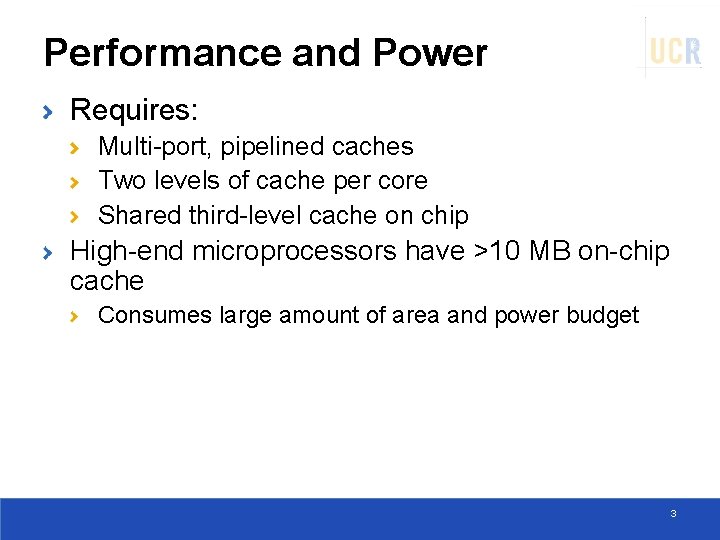
Performance and Power Requires: Multi-port, pipelined caches Two levels of cache per core Shared third-level cache on chip High-end microprocessors have >10 MB on-chip cache Consumes large amount of area and power budget 3
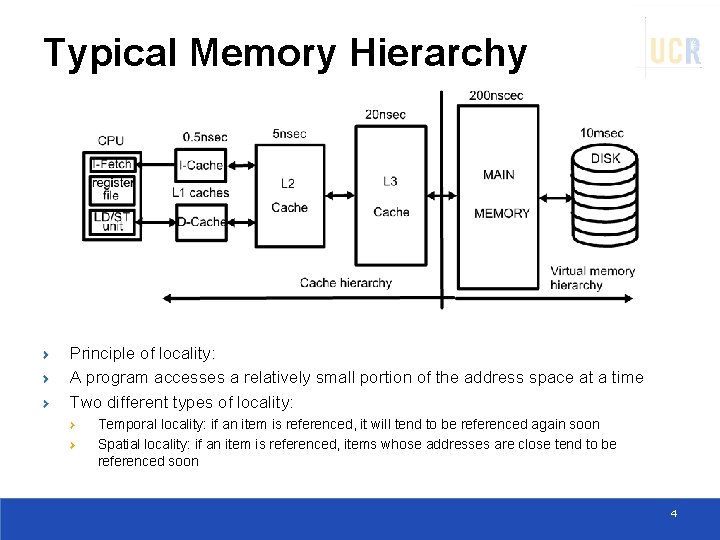
Typical Memory Hierarchy Principle of locality: A program accesses a relatively small portion of the address space at a time Two different types of locality: Temporal locality: if an item is referenced, it will tend to be referenced again soon Spatial locality: if an item is referenced, items whose addresses are close tend to be referenced soon 4
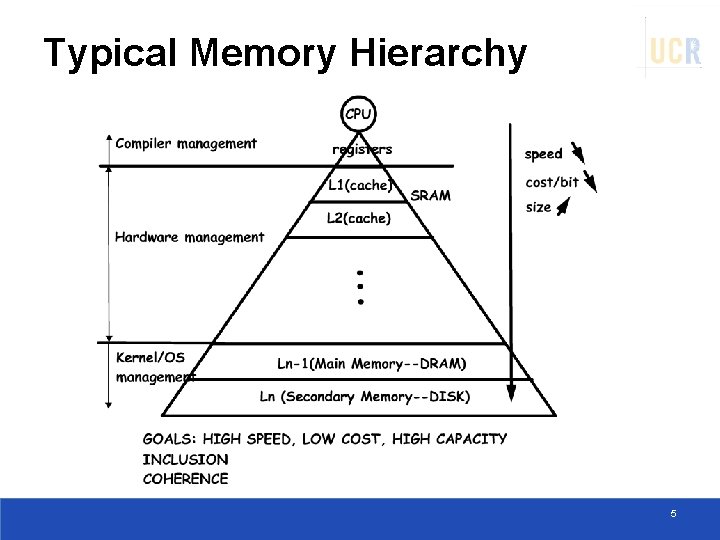
Typical Memory Hierarchy 5
CACHE BASICS 6
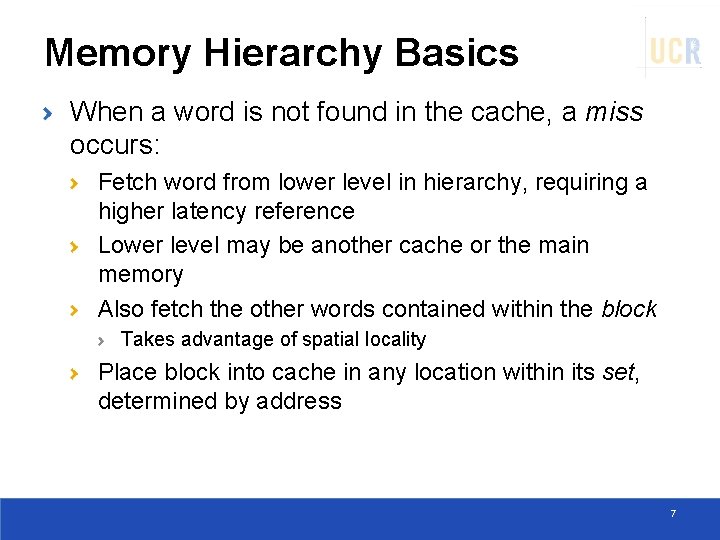
Memory Hierarchy Basics When a word is not found in the cache, a miss occurs: Fetch word from lower level in hierarchy, requiring a higher latency reference Lower level may be another cache or the main memory Also fetch the other words contained within the block Takes advantage of spatial locality Place block into cache in any location within its set, determined by address 7
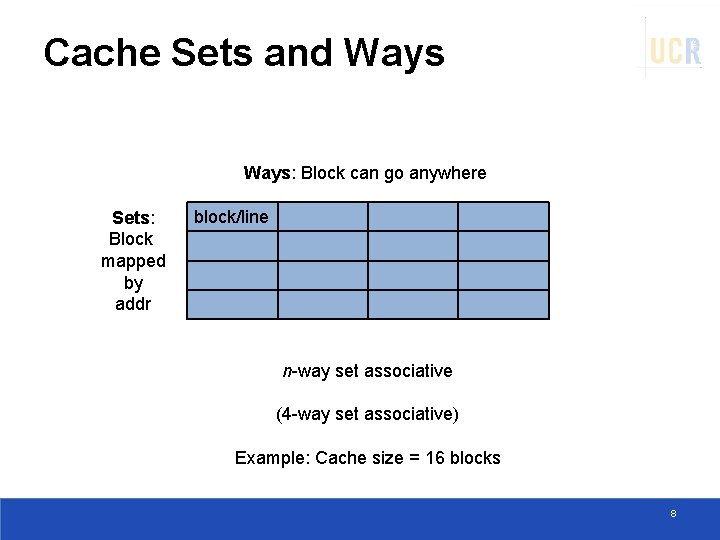
Cache Sets and Ways: Block can go anywhere Sets: Block mapped by addr block/line n-way set associative (4 -way set associative) Example: Cache size = 16 blocks 8
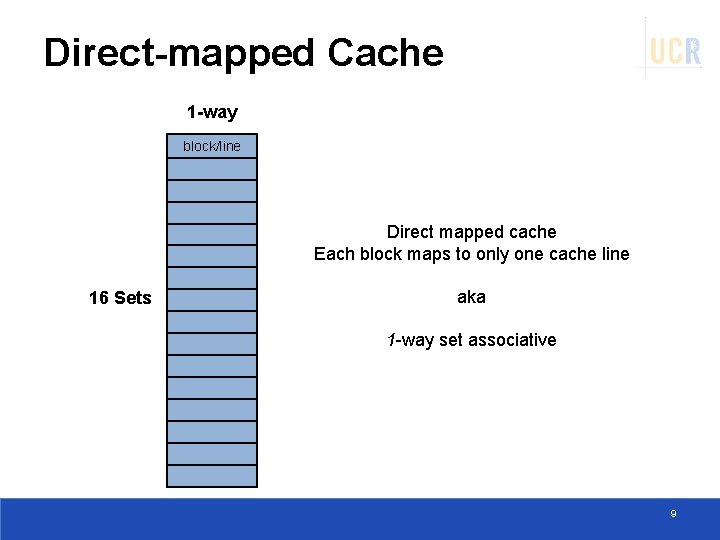
Direct-mapped Cache 1 -way block/line Direct mapped cache Each block maps to only one cache line 16 Sets aka 1 -way set associative 9
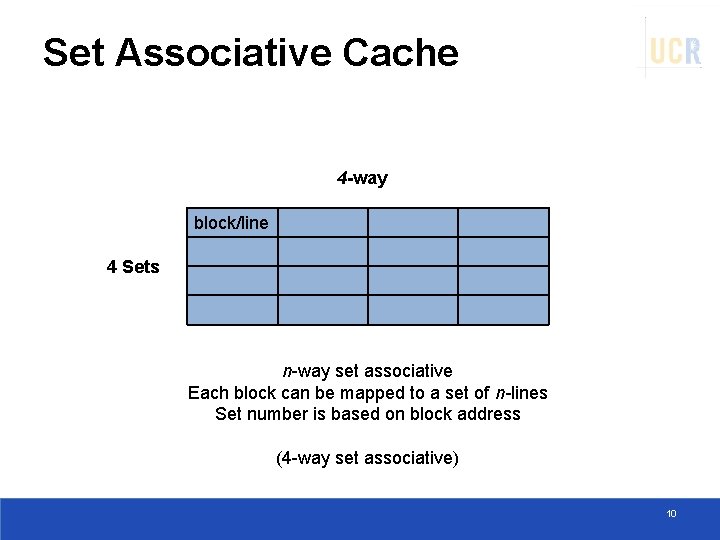
Set Associative Cache 4 -way block/line 4 Sets n-way set associative Each block can be mapped to a set of n-lines Set number is based on block address (4 -way set associative) 10
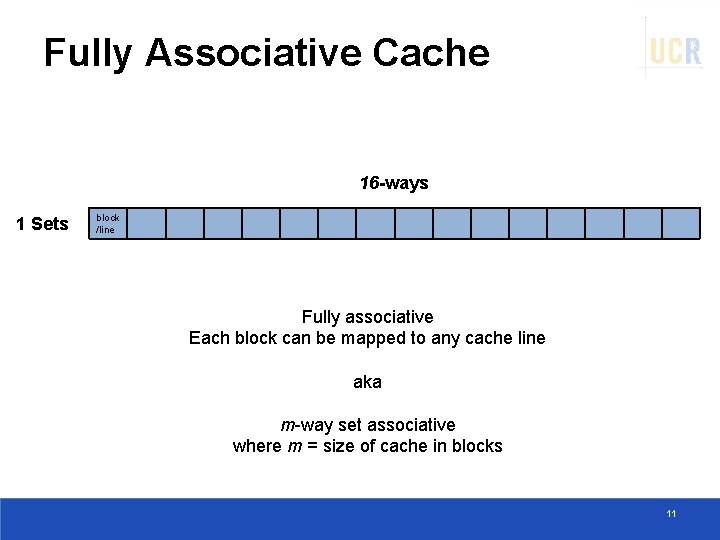
Fully Associative Cache 16 -ways 1 Sets block /line Fully associative Each block can be mapped to any cache line aka m-way set associative where m = size of cache in blocks 11
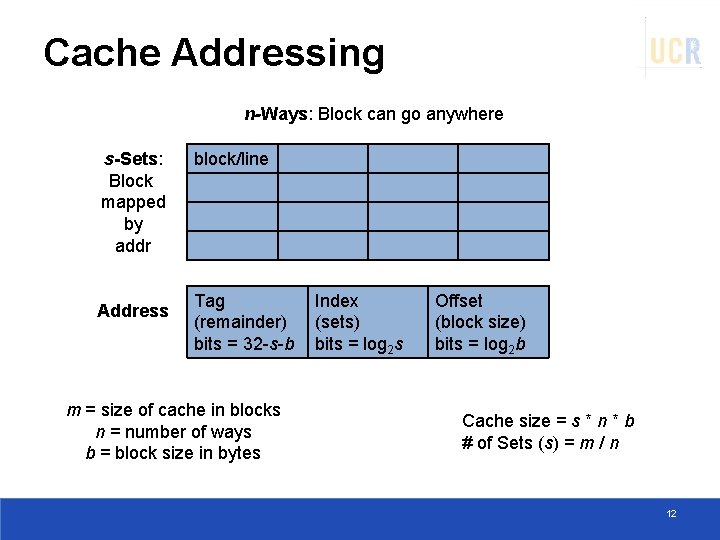
Cache Addressing n-Ways: Block can go anywhere s-Sets: Block mapped by addr Address block/line Tag (remainder) bits = 32 -s-b m = size of cache in blocks n = number of ways b = block size in bytes Index (sets) bits = log 2 s Offset (block size) bits = log 2 b Cache size = s * n * b # of Sets (s) = m / n 12
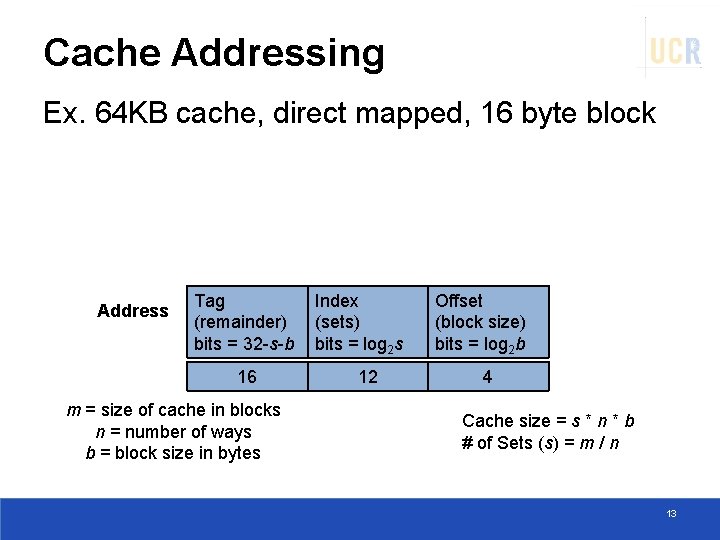
Cache Addressing Ex. 64 KB cache, direct mapped, 16 byte block Address Tag (remainder) bits = 32 -s-b 16 m = size of cache in blocks n = number of ways b = block size in bytes Index (sets) bits = log 2 s 12 Offset (block size) bits = log 2 b 4 Cache size = s * n * b # of Sets (s) = m / n 13
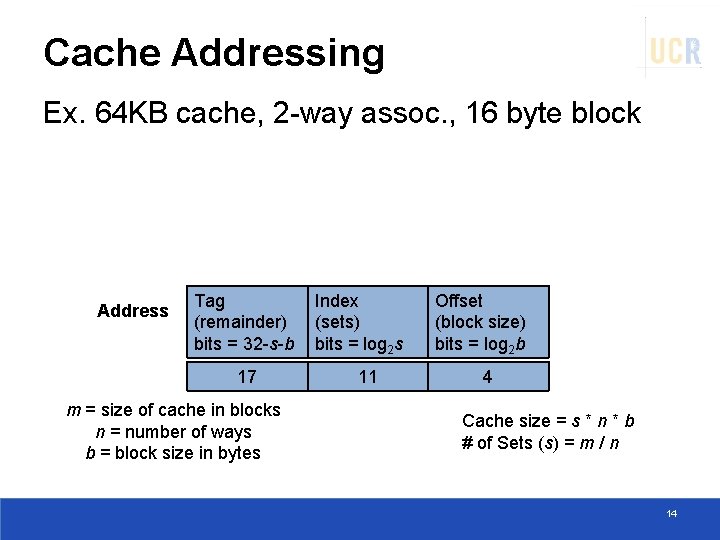
Cache Addressing Ex. 64 KB cache, 2 -way assoc. , 16 byte block Address Tag (remainder) bits = 32 -s-b 17 m = size of cache in blocks n = number of ways b = block size in bytes Index (sets) bits = log 2 s 11 Offset (block size) bits = log 2 b 4 Cache size = s * n * b # of Sets (s) = m / n 14
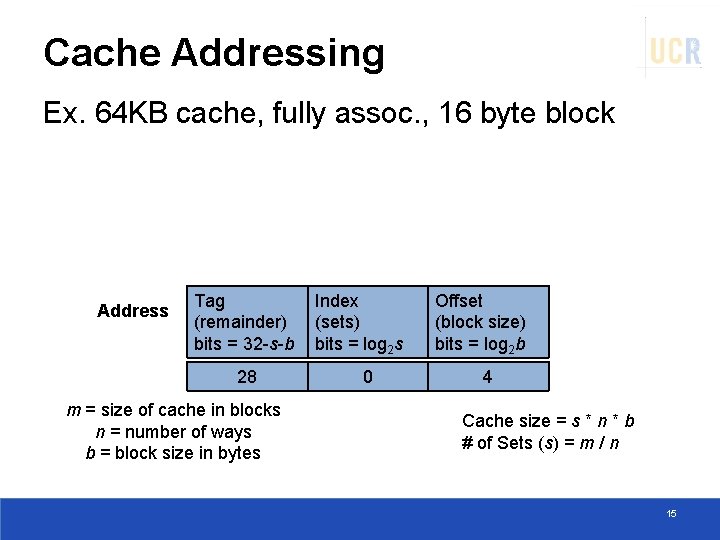
Cache Addressing Ex. 64 KB cache, fully assoc. , 16 byte block Address Tag (remainder) bits = 32 -s-b 28 m = size of cache in blocks n = number of ways b = block size in bytes Index (sets) bits = log 2 s 0 Offset (block size) bits = log 2 b 4 Cache size = s * n * b # of Sets (s) = m / n 15
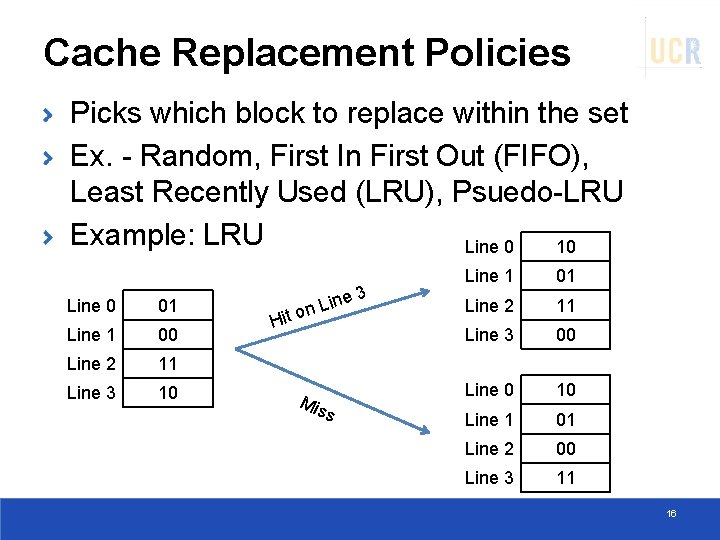
Cache Replacement Policies Picks which block to replace within the set Ex. - Random, First In First Out (FIFO), Least Recently Used (LRU), Psuedo-LRU Example: LRU Line 0 10 Line 0 01 Line 1 00 Line 2 11 Line 3 10 3 ine on L Hit Mis s Line 1 01 Line 2 11 Line 3 00 Line 0 10 Line 1 01 Line 2 00 Line 3 11 16
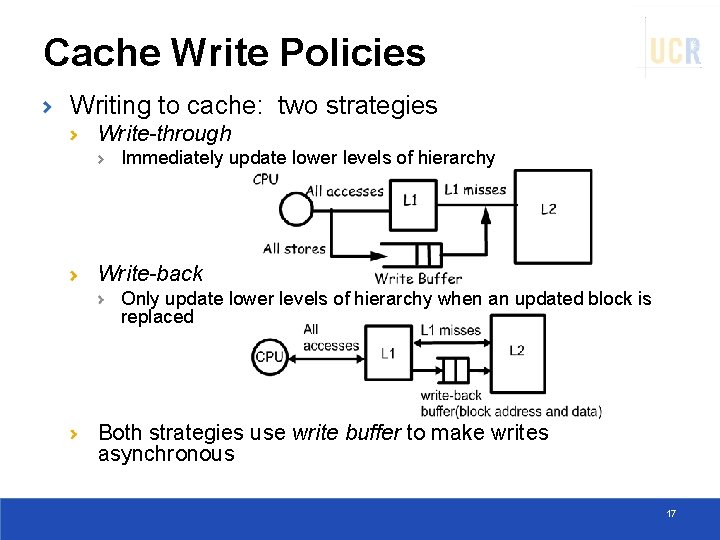
Cache Write Policies Writing to cache: two strategies Write-through Immediately update lower levels of hierarchy Write-back Only update lower levels of hierarchy when an updated block is replaced Both strategies use write buffer to make writes asynchronous 17
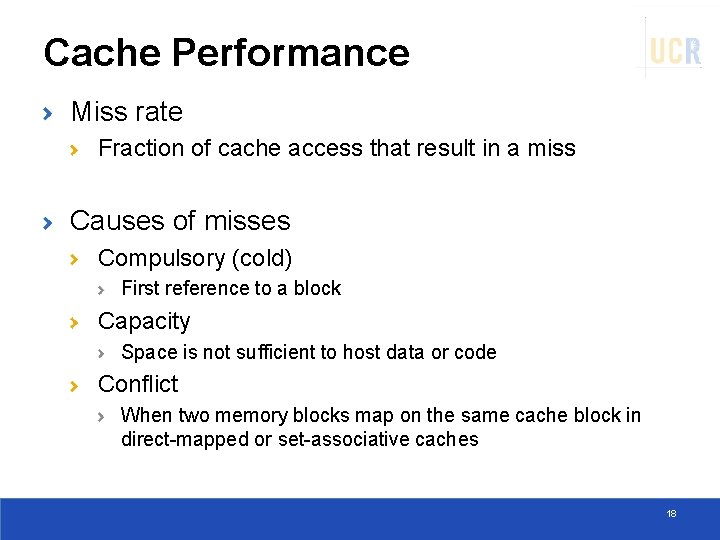
Cache Performance Miss rate Fraction of cache access that result in a miss Causes of misses Compulsory (cold) First reference to a block Capacity Space is not sufficient to host data or code Conflict When two memory blocks map on the same cache block in direct-mapped or set-associative caches 18
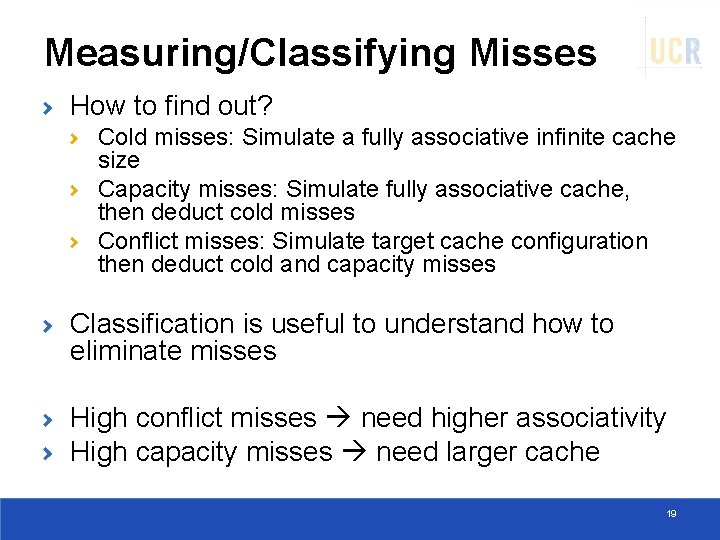
Measuring/Classifying Misses How to find out? Cold misses: Simulate a fully associative infinite cache size Capacity misses: Simulate fully associative cache, then deduct cold misses Conflict misses: Simulate target cache configuration then deduct cold and capacity misses Classification is useful to understand how to eliminate misses High conflict misses need higher associativity High capacity misses need larger cache 19
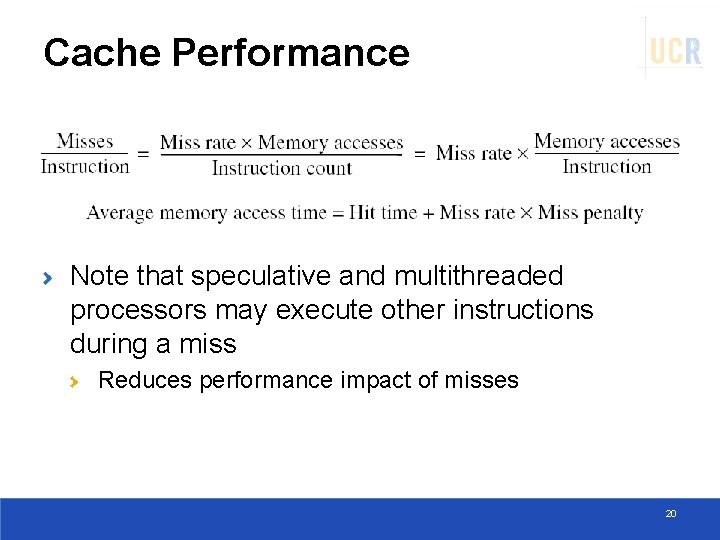
Cache Performance Note that speculative and multithreaded processors may execute other instructions during a miss Reduces performance impact of misses 20
CACHE OPTIMIZATIONS 21
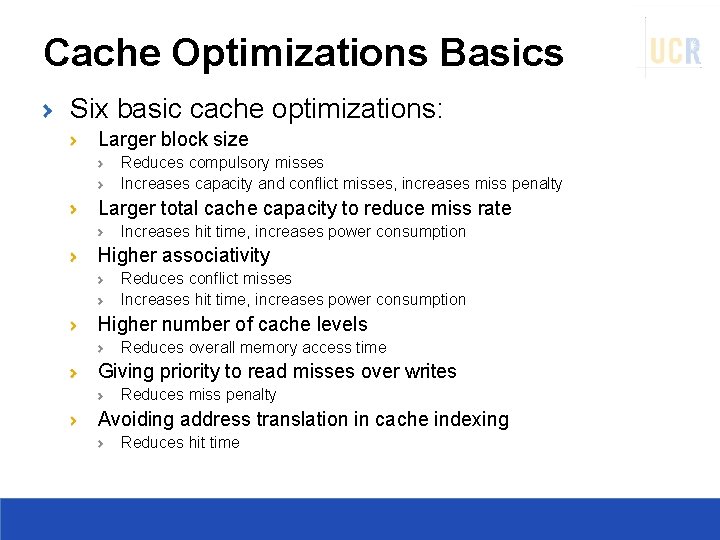
Cache Optimizations Basics Six basic cache optimizations: Larger block size Reduces compulsory misses Increases capacity and conflict misses, increases miss penalty Larger total cache capacity to reduce miss rate Increases hit time, increases power consumption Higher associativity Reduces conflict misses Increases hit time, increases power consumption Higher number of cache levels Reduces overall memory access time Giving priority to read misses over writes Reduces miss penalty Avoiding address translation in cache indexing Reduces hit time
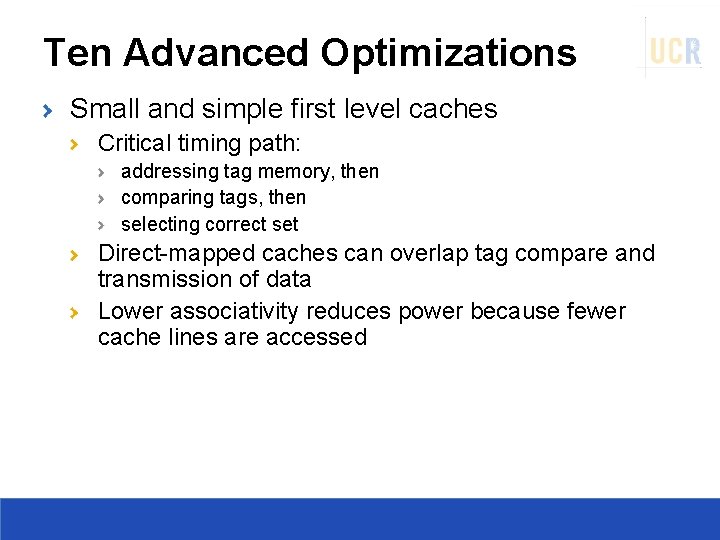
Ten Advanced Optimizations Small and simple first level caches Critical timing path: addressing tag memory, then comparing tags, then selecting correct set Direct-mapped caches can overlap tag compare and transmission of data Lower associativity reduces power because fewer cache lines are accessed
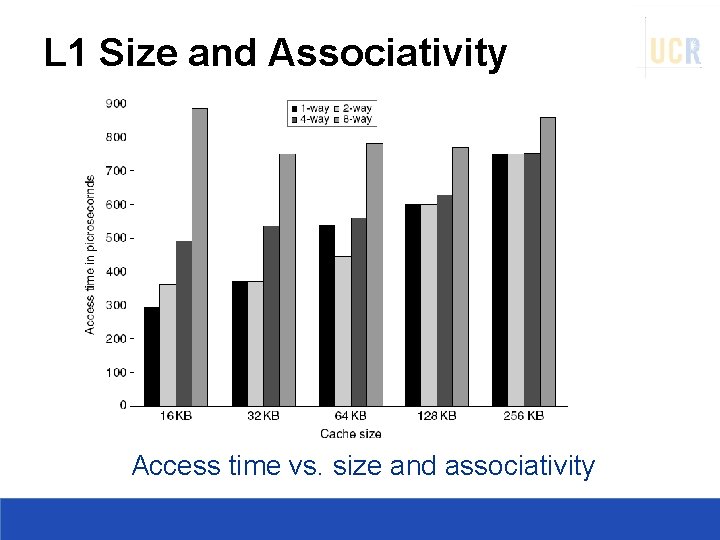
L 1 Size and Associativity Access time vs. size and associativity
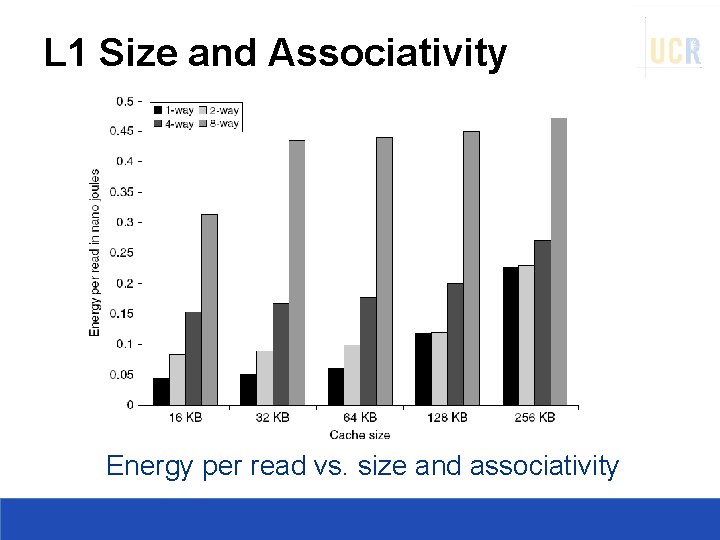
L 1 Size and Associativity Energy per read vs. size and associativity
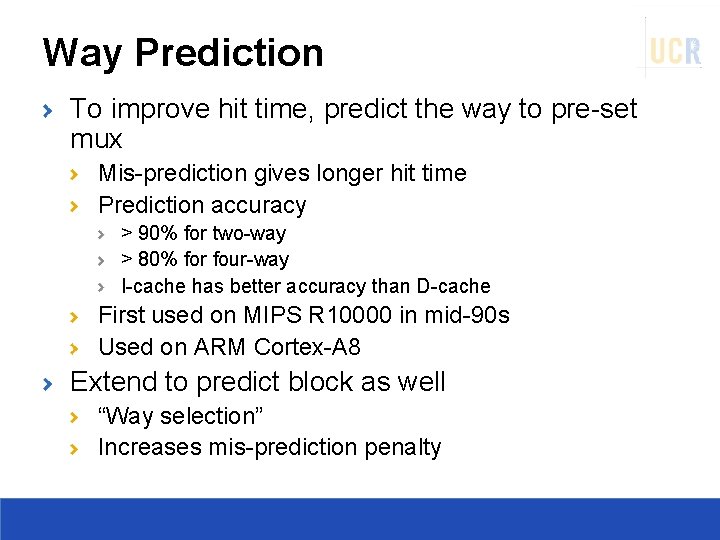
Way Prediction To improve hit time, predict the way to pre-set mux Mis-prediction gives longer hit time Prediction accuracy > 90% for two-way > 80% for four-way I-cache has better accuracy than D-cache First used on MIPS R 10000 in mid-90 s Used on ARM Cortex-A 8 Extend to predict block as well “Way selection” Increases mis-prediction penalty
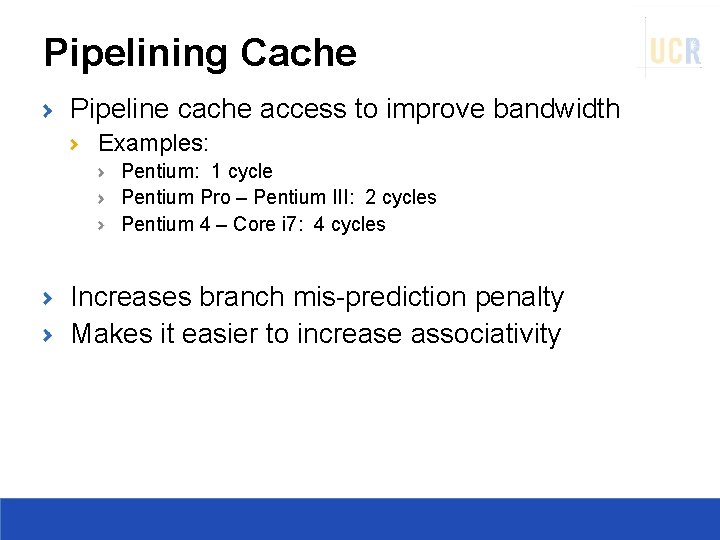
Pipelining Cache Pipeline cache access to improve bandwidth Examples: Pentium: 1 cycle Pentium Pro – Pentium III: 2 cycles Pentium 4 – Core i 7: 4 cycles Increases branch mis-prediction penalty Makes it easier to increase associativity
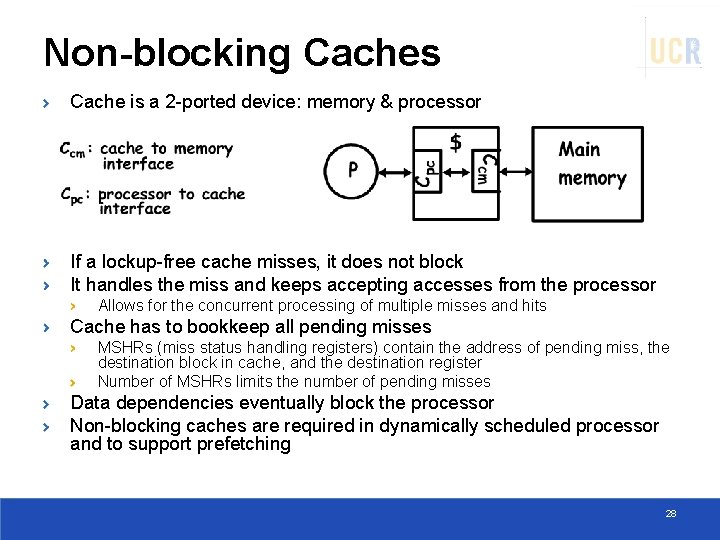
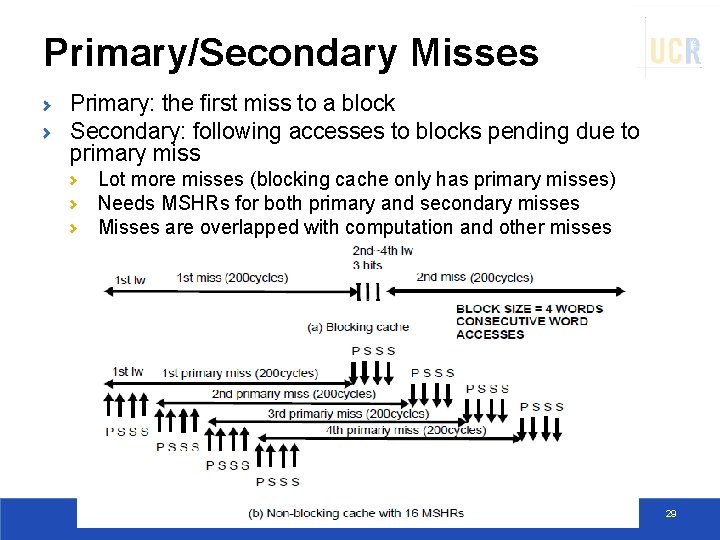
Non-blocking Caches Cache is a 2 -ported device: memory & processor If a lockup-free cache misses, it does not block It handles the miss and keeps accepting accesses from the processor Allows for the concurrent processing of multiple misses and hits Cache has to bookkeep all pending misses MSHRs (miss status handling registers) contain the address of pending miss, the destination block in cache, and the destination register Number of MSHRs limits the number of pending misses Data dependencies eventually block the processor Non-blocking caches are required in dynamically scheduled processor and to support prefetching 28
Primary/Secondary Misses Primary: the first miss to a block Secondary: following accesses to blocks pending due to primary miss Lot more misses (blocking cache only has primary misses) Needs MSHRs for both primary and secondary misses Misses are overlapped with computation and other misses 29
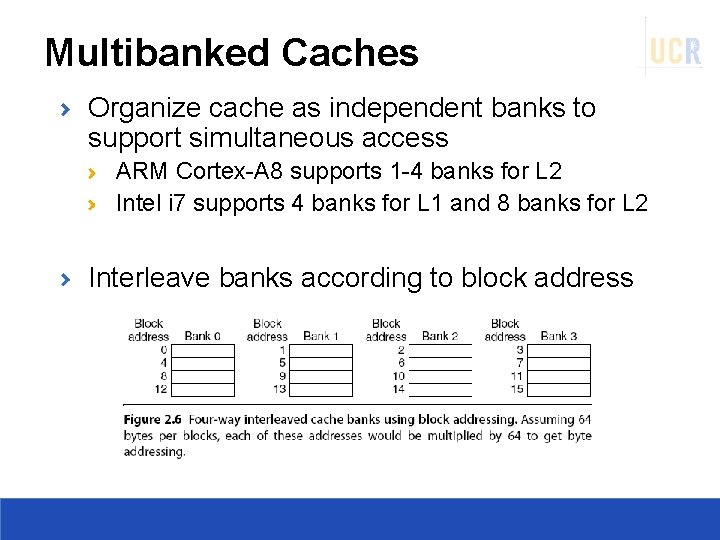
Multibanked Caches Organize cache as independent banks to support simultaneous access ARM Cortex-A 8 supports 1 -4 banks for L 2 Intel i 7 supports 4 banks for L 1 and 8 banks for L 2 Interleave banks according to block address
Critical Word First, Early Restart Critical word first Request missed word from memory first Send it to the processor as soon as it arrives Early restart Request words in normal order Send missed word to the processor as soon as it arrives Effectiveness of these strategies depends on block size and likelihood of another access to the portion of the block that has not yet been fetched
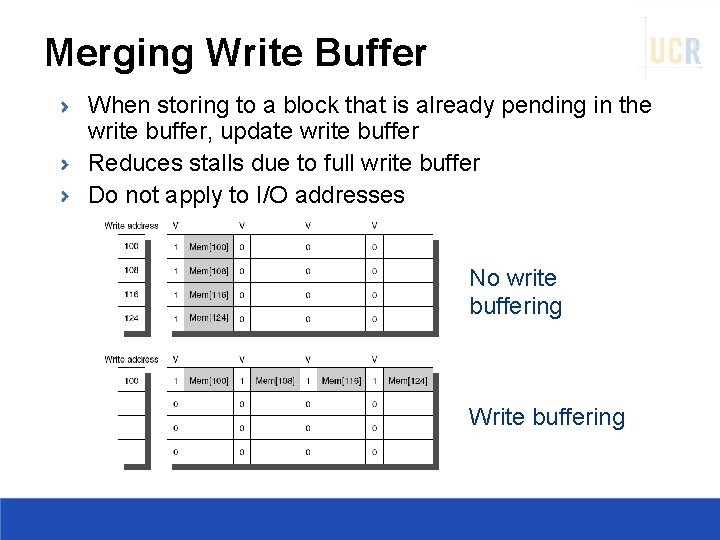
Merging Write Buffer When storing to a block that is already pending in the write buffer, update write buffer Reduces stalls due to full write buffer Do not apply to I/O addresses No write buffering Write buffering
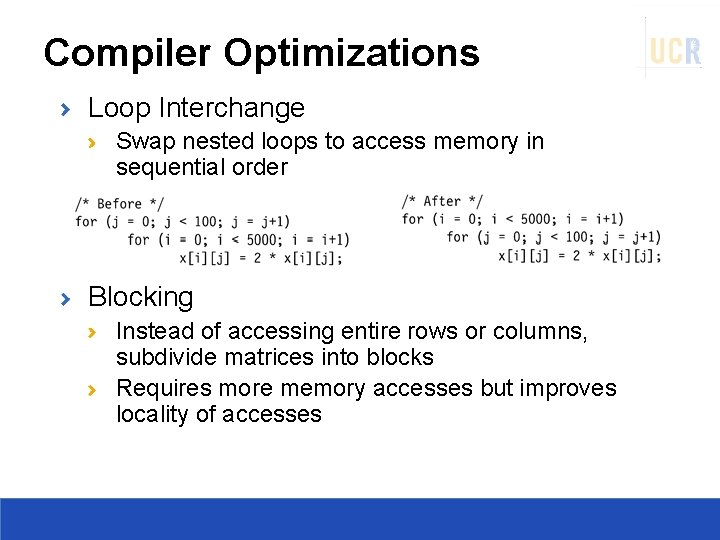
Compiler Optimizations Loop Interchange Swap nested loops to access memory in sequential order Blocking Instead of accessing entire rows or columns, subdivide matrices into blocks Requires more memory accesses but improves locality of accesses
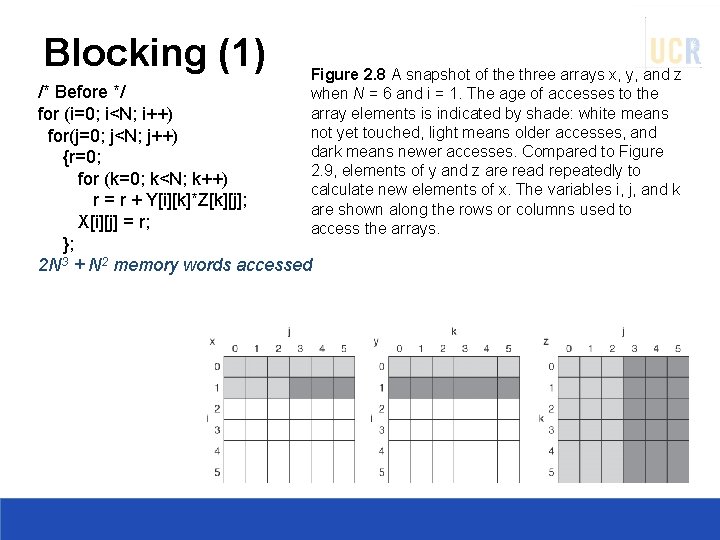
Blocking (1) Figure 2. 8 A snapshot of the three arrays x, y, and z when N = 6 and i = 1. The age of accesses to the array elements is indicated by shade: white means not yet touched, light means older accesses, and dark means newer accesses. Compared to Figure 2. 9, elements of y and z are read repeatedly to calculate new elements of x. The variables i, j, and k are shown along the rows or columns used to access the arrays. /* Before */ for (i=0; i<N; i++) for(j=0; j<N; j++) {r=0; for (k=0; k<N; k++) r = r + Y[i][k]*Z[k][j]; X[i][j] = r; }; 2 N 3 + N 2 memory words accessed
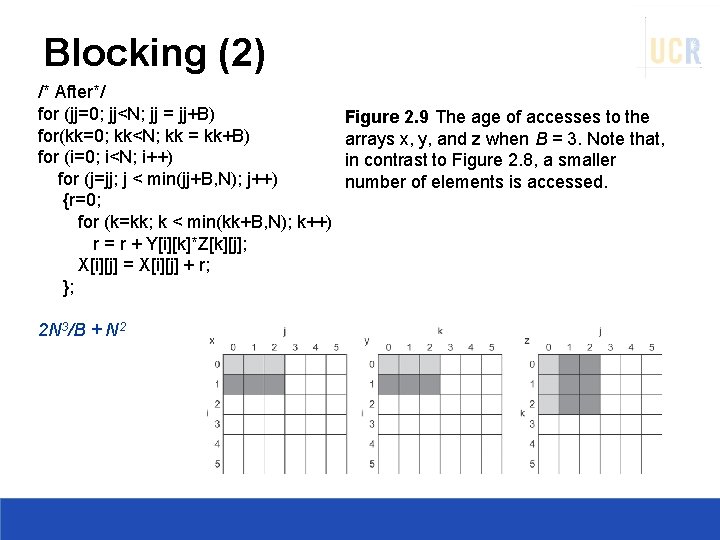
Blocking (2) /* After*/ for (jj=0; jj<N; jj = jj+B) for(kk=0; kk<N; kk = kk+B) for (i=0; i<N; i++) for (j=jj; j < min(jj+B, N); j++) {r=0; for (k=kk; k < min(kk+B, N); k++) r = r + Y[i][k]*Z[k][j]; X[i][j] = X[i][j] + r; }; 2 N 3/B + N 2 Figure 2. 9 The age of accesses to the arrays x, y, and z when B = 3. Note that, in contrast to Figure 2. 8, a smaller number of elements is accessed.
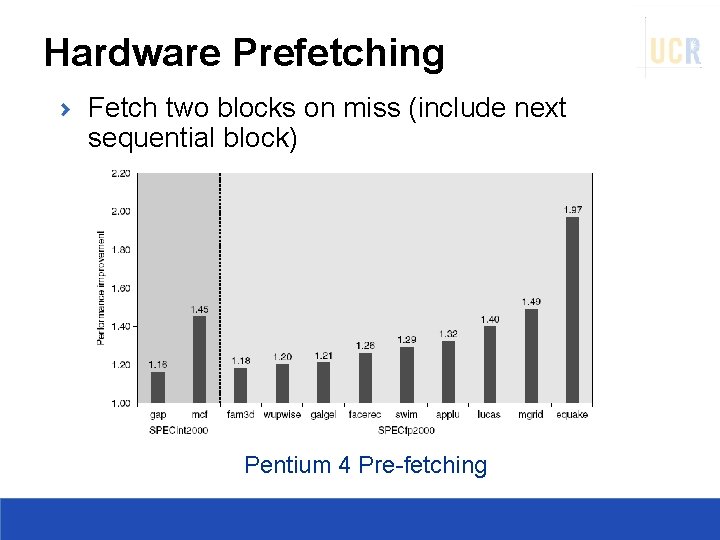
Hardware Prefetching Fetch two blocks on miss (include next sequential block) Pentium 4 Pre-fetching
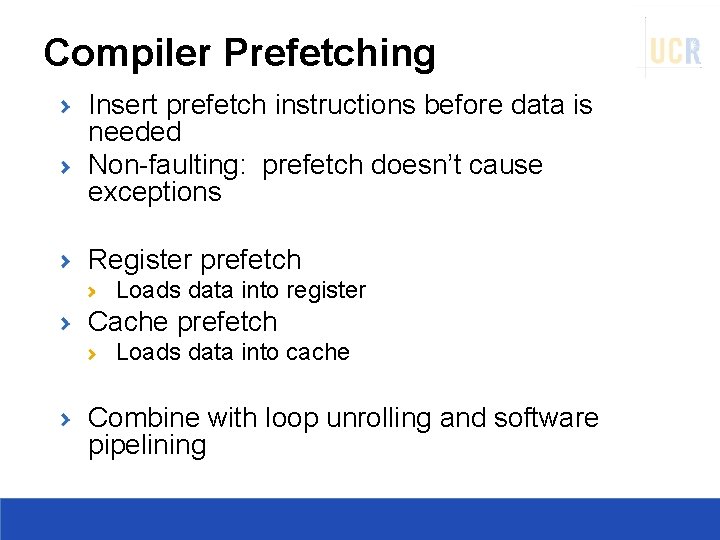
Compiler Prefetching Insert prefetch instructions before data is needed Non-faulting: prefetch doesn’t cause exceptions Register prefetch Loads data into register Cache prefetch Loads data into cache Combine with loop unrolling and software pipelining
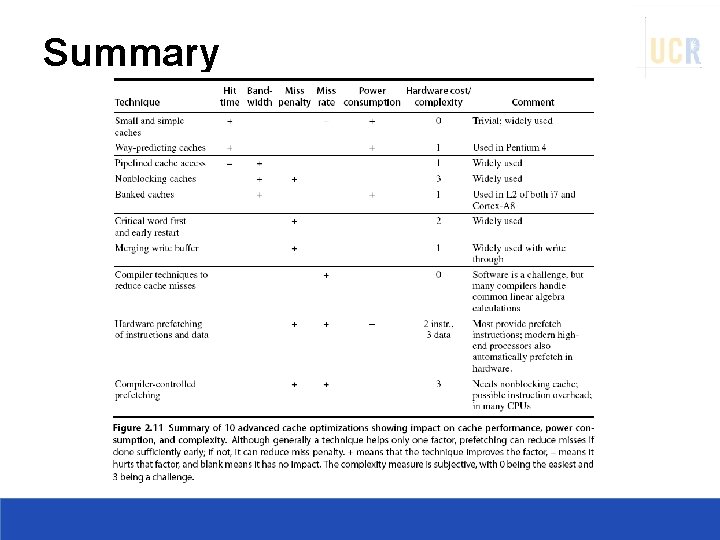
Summary