
CS 202 Java Object Oriented Programming Review of
CS 202 Java Object Oriented Programming Review of Language Basics Chengyu Sun University of California, Santa Barbara
Overview Programming environments Basic program structure Variables and types Operators Methods and recursion Arrays
Netbeans www. netbeans. org File system and directories Welcome. java Options Projects
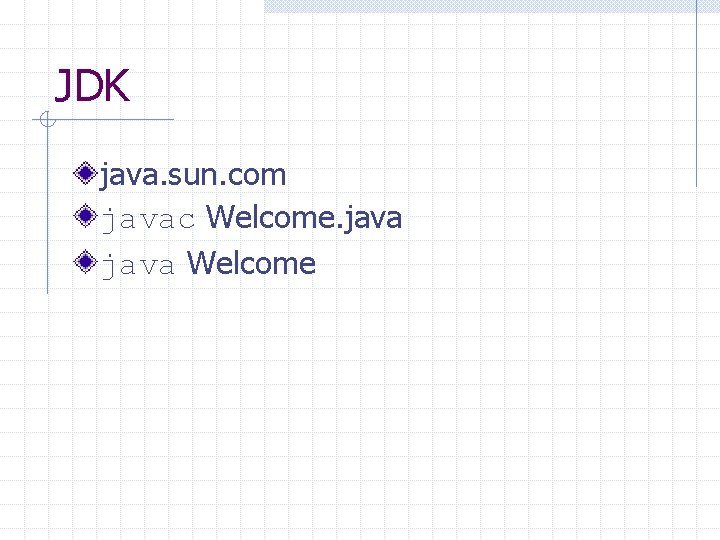
JDK java. sun. com javac Welcome. java Welcome
Example: Grades. java Input n A set of grades Output n n n Highest grade Lowest grade Average grade
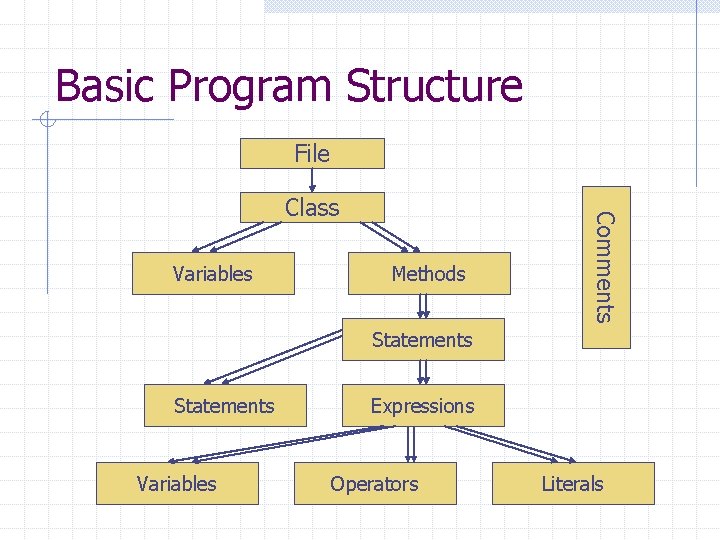
Basic Program Structure File Variables Methods Comments Class Statements Variables Expressions Operators Literals
Code Conventions http: //java. sun. com/docs/codeconv/html/Code. Conv. TOC. doc. html Required n n Naming conventions (2. 1, 9) Comments (5) w Information not readily available in code itself n Indentation of if-else (7. 4) Recommended n n n Line length (4. 1, 4. 2) Programming practice (10) Statements (7)
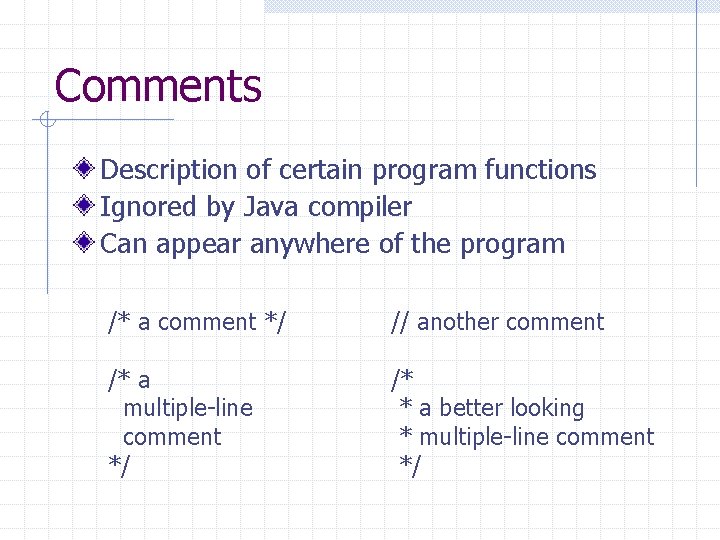
Comments Description of certain program functions Ignored by Java compiler Can appear anywhere of the program /* a comment */ // another comment /* a multiple-line comment */ /* * a better looking * multiple-line comment */
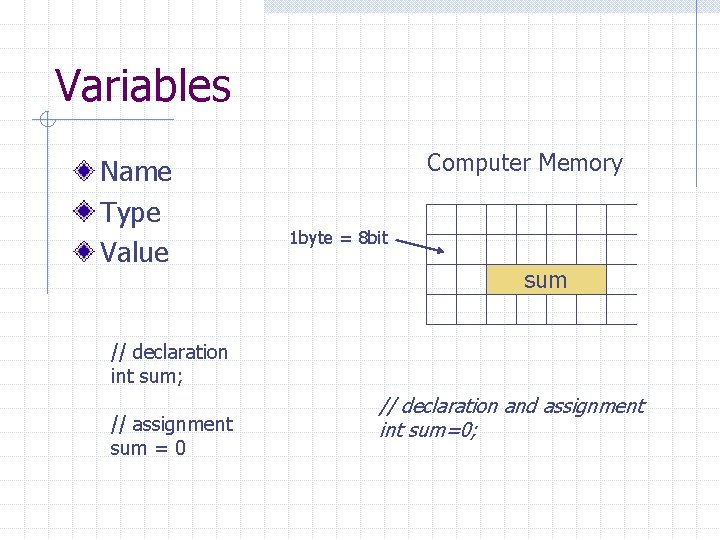
Variables Name Type Value Computer Memory 1 byte = 8 bit sum // declaration int sum; // assignment sum = 0 // declaration and assignment int sum=0;
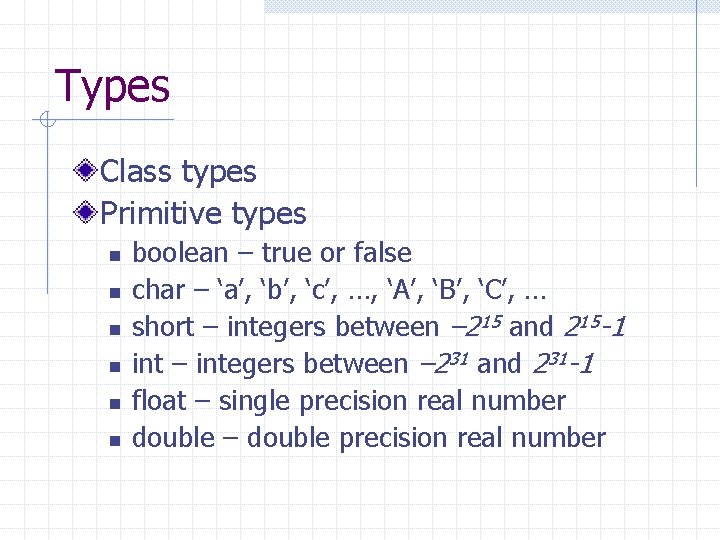
Types Class types Primitive types n n n boolean – true or false char – ‘a’, ‘b’, ‘c’, …, ‘A’, ‘B’, ‘C’, … short – integers between – 215 and 215 -1 int – integers between – 231 and 231 -1 float – single precision real number double – double precision real number
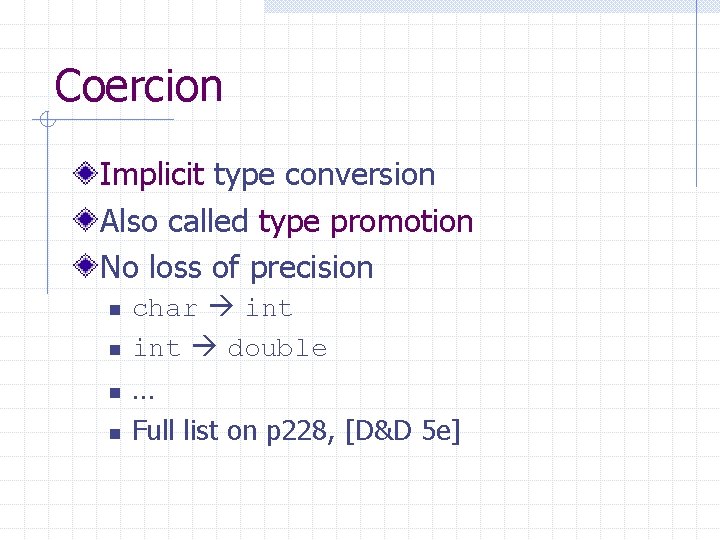
Coercion Implicit type conversion Also called type promotion No loss of precision n n char int double … Full list on p 228, [D&D 5 e]
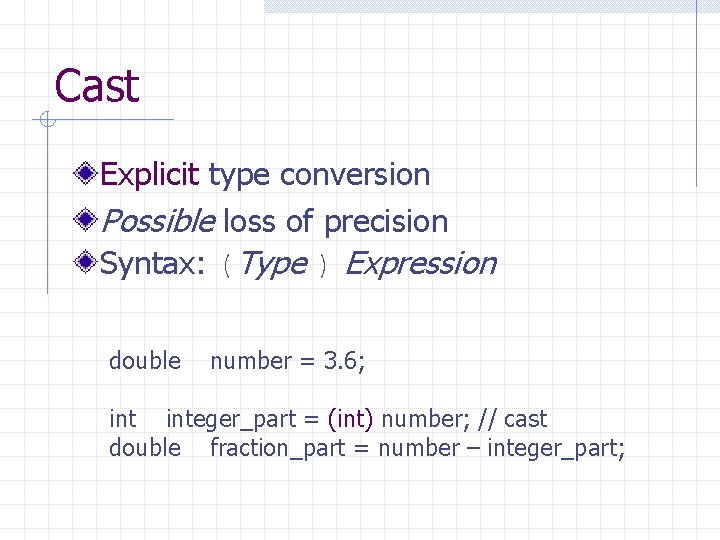
Cast Explicit type conversion Possible loss of precision Syntax: (Type ) Expression double number = 3. 6; integer_part = (int) number; // cast double fraction_part = number – integer_part;
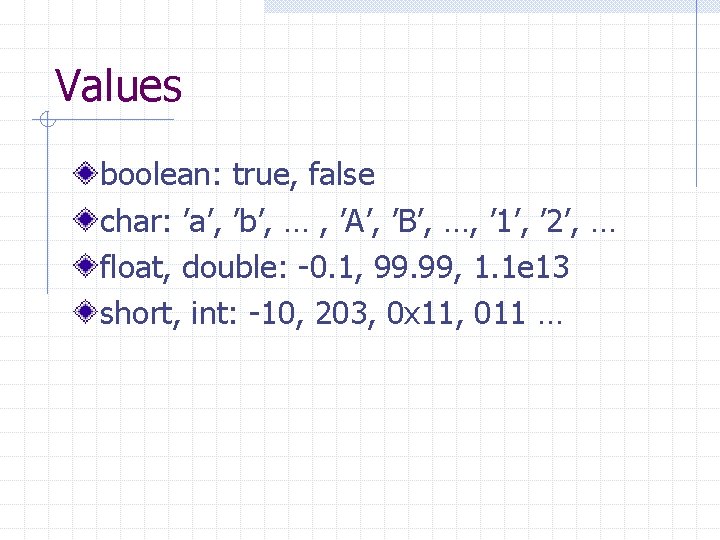
Values boolean: true, false char: ’a’, ’b’, … , ’A’, ’B’, …, ’ 1’, ’ 2’, … float, double: -0. 1, 99. 99, 1. 1 e 13 short, int: -10, 203, 0 x 11, 011 …
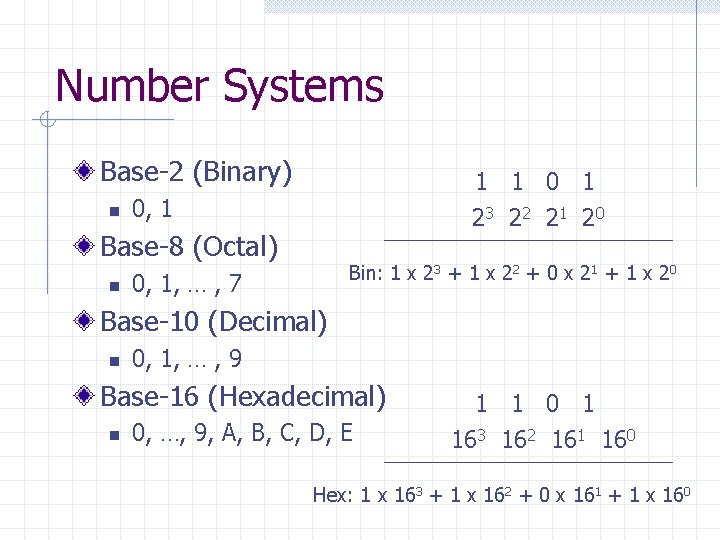
Number Systems Base-2 (Binary) n 1 1 0 1 23 2 2 2 1 2 0 0, 1 Base-8 (Octal) n Bin: 1 x 23 + 1 x 22 + 0 x 21 + 1 x 20 0, 1, … , 7 Base-10 (Decimal) n 0, 1, … , 9 Base-16 (Hexadecimal) n 0, …, 9, A, B, C, D, E 1 1 0 1 163 162 161 160 Hex: 1 x 163 + 1 x 162 + 0 x 161 + 1 x 160
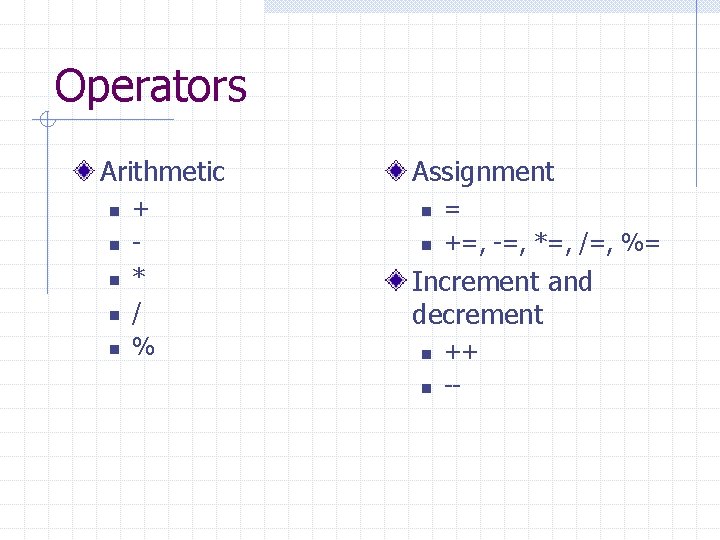
Operators Arithmetic n n n + * / % Assignment n n = +=, -=, *=, /=, %= Increment and decrement n n ++ --
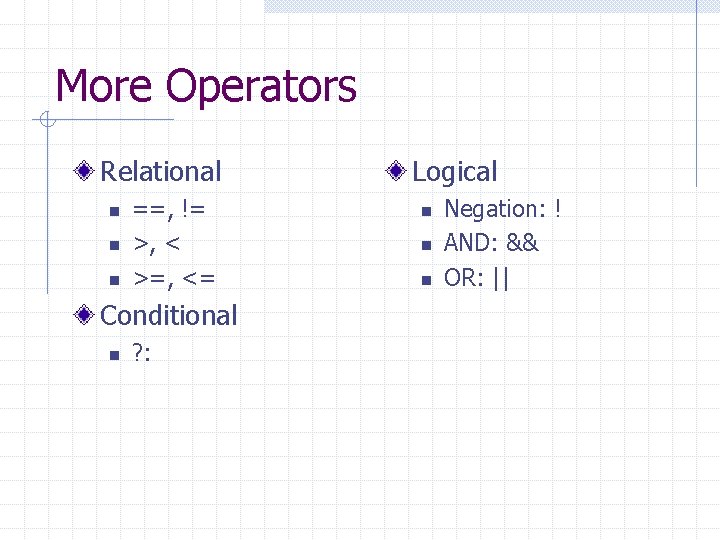
More Operators Relational n n n ==, != >, < >=, <= Conditional n ? : Logical n n n Negation: ! AND: && OR: ||
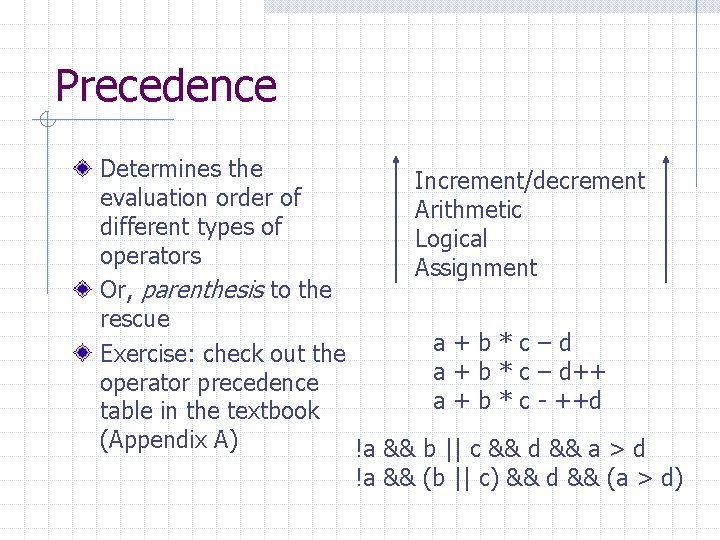
Precedence Determines the Increment/decrement evaluation order of Arithmetic different types of Logical operators Assignment Or, parenthesis to the rescue a+b*c–d Exercise: check out the a + b * c – d++ operator precedence a + b * c - ++d table in the textbook (Appendix A) !a && b || c && d && a > d !a && (b || c) && d && (a > d)
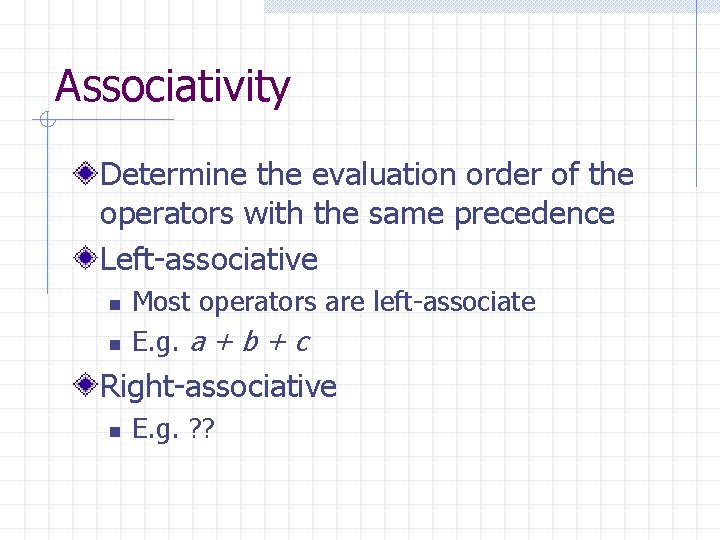
Associativity Determine the evaluation order of the operators with the same precedence Left-associative n n Most operators are left-associate E. g. a + b + c Right-associative n E. g. ? ?
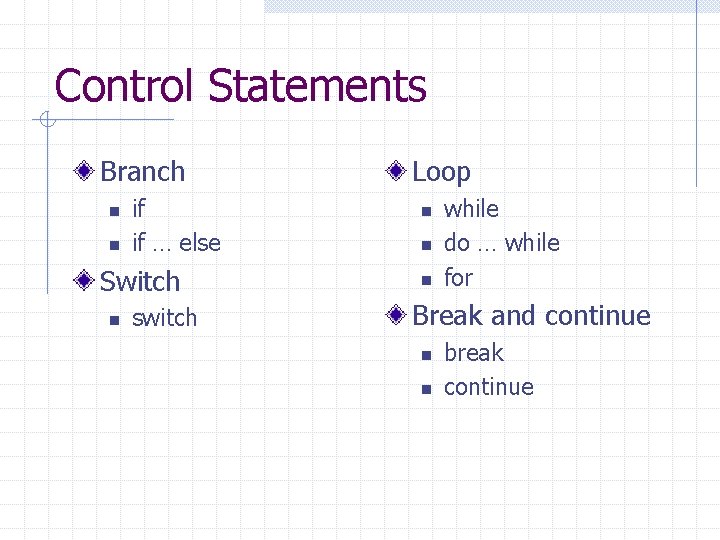
Control Statements Branch n n if if … else Switch n switch Loop n n n while do … while for Break and continue n n break continue
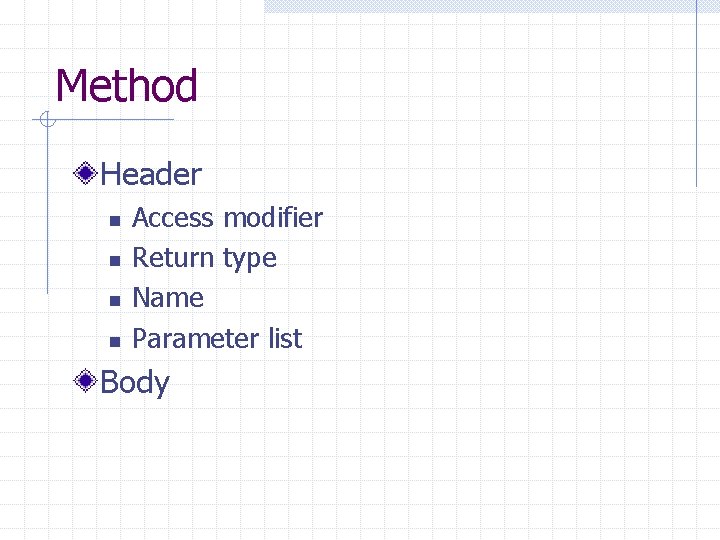
Method Header n n Access modifier Return type Name Parameter list Body
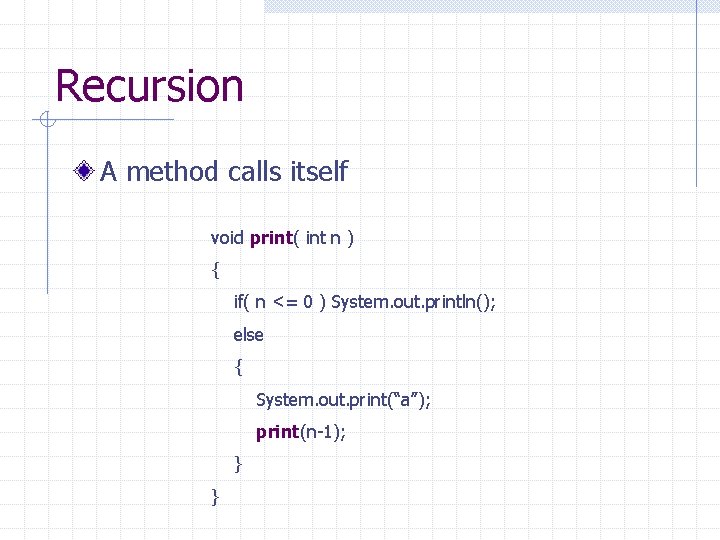
Recursion A method calls itself void print( int n ) { if( n <= 0 ) System. out. println(); else { System. out. print(“a”); print(n-1); } }
Ending Condition When the recursion should stop To avoid infinite recursion, make sure the ending condition n Exists Reachable Comes before the recursive call
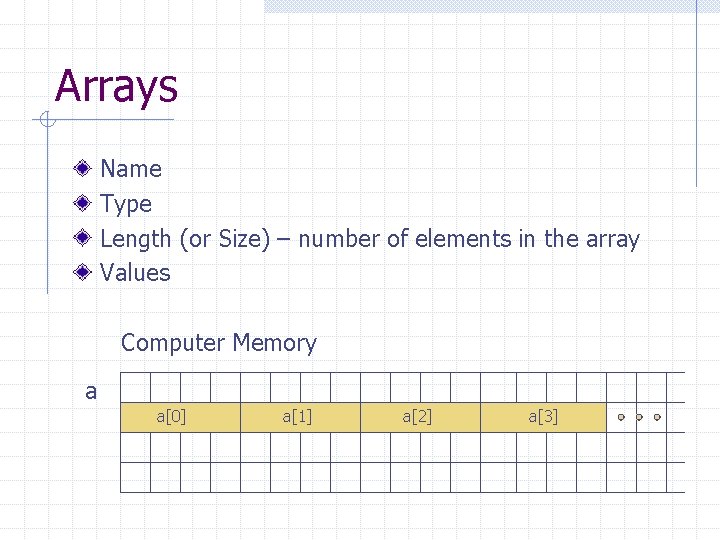
Arrays Name Type Length (or Size) – number of elements in the array Values Computer Memory a a[0] a[1] a[2] a[3]
![Access Array Elements arrayname. length Index is from 0 to (arrayname. length-1) int a[];](http://slidetodoc.com/presentation_image_h2/f807f59acb58e37fcd2a27d7d95390d7/image-24.jpg "Access Array Elements arrayname. length Index is from 0 to (arrayname. length-1) int a[];")
Access Array Elements arrayname. length Index is from 0 to (arrayname. length-1) int a[]; a = new int[10]; a[5] = 3; index // assign 3 to the 6 th element // prints out all elements for( int i=0 ; i < a. length ; ++i ) System. out. println( a[i] );
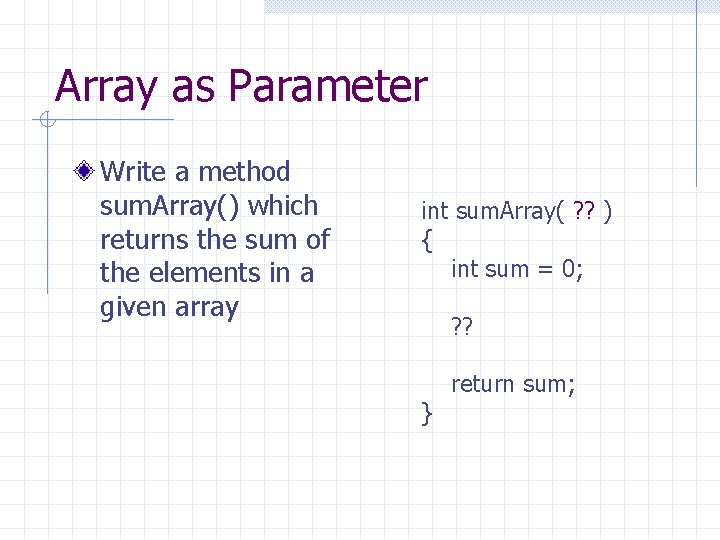
Array as Parameter Write a method sum. Array() which returns the sum of the elements in a given array int sum. Array( ? ? ) { int sum = 0; ? ? } return sum;
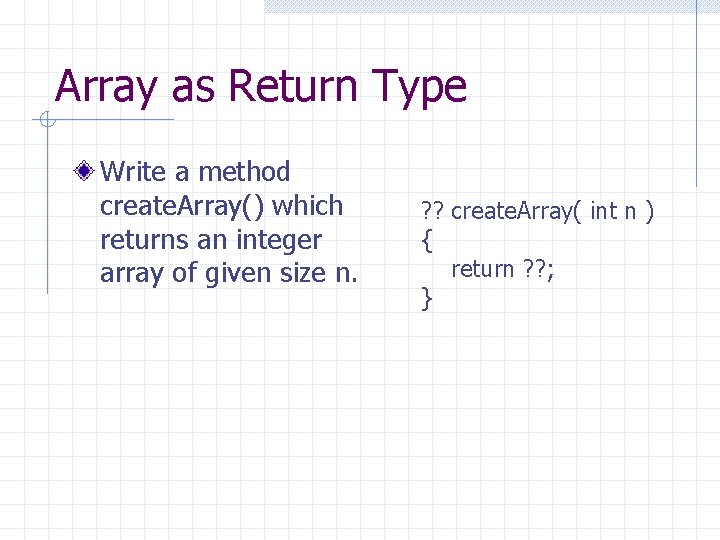
Array as Return Type Write a method create. Array() which returns an integer array of given size n. ? ? create. Array( int n ) { return ? ? ; }
Working with More Than One Classes Console. Reader. java Console. Reader. Test. java
- Slides: 27