
CS 2011 Introduction to Programming I Math Functions



- Slides: 18
CS 2011 Introduction to Programming I Math Functions and Characters Chengyu Sun California State University, Los Angeles
Math Is Fun
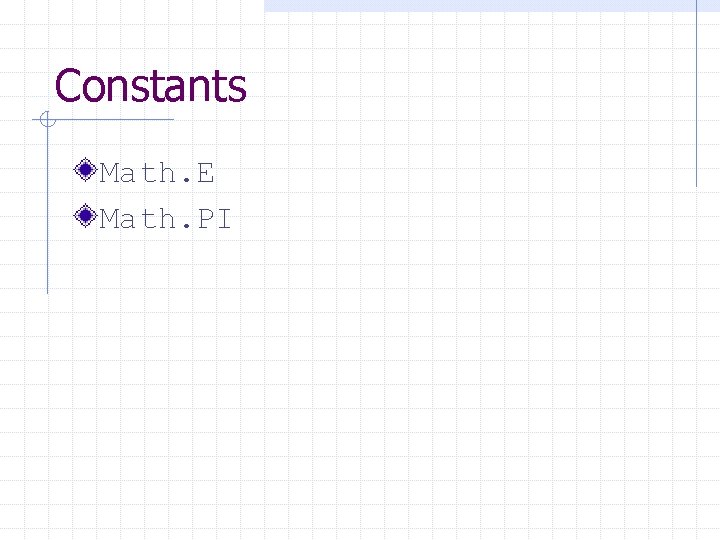
Constants Math. E Math. PI
Trigonometric Methods Method Description sin(radians) Returns the trigonometric sine of an angle in radians. cos(radians) Returns the trigonometric cosine of an angle in radians. tan(radians) Returns the trigonometric tangent of an angle in radians. asin(a) Returns the angle in radians for the inverse of sine. acos(a) Returns the angle in radians for the inverse of cosine. atan(a) Returns the angle in radians for the inverse of tangent. to. Radians(degree) Returns the angle in radians for the angle in degrees. to. Degrees(radians) Returns the angle in degrees for the angle in radians.
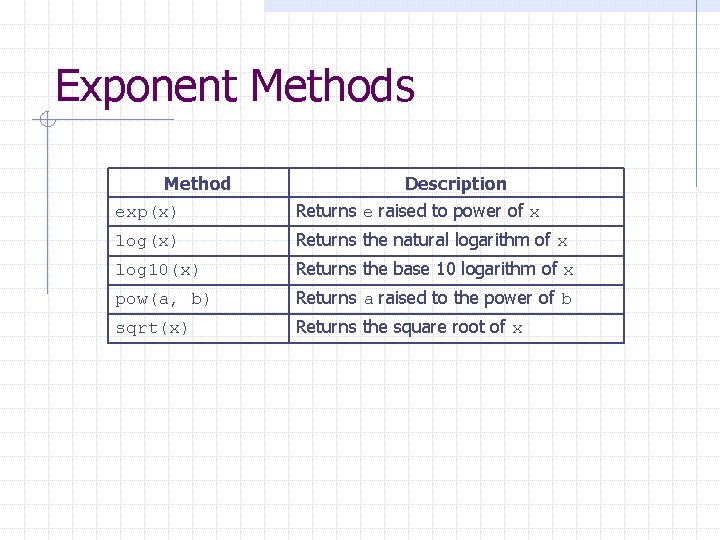
Exponent Methods Method Description exp(x) Returns e raised to power of x log(x) Returns the natural logarithm of x log 10(x) Returns the base 10 logarithm of x pow(a, b) Returns a raised to the power of b sqrt(x) Returns the square root of x
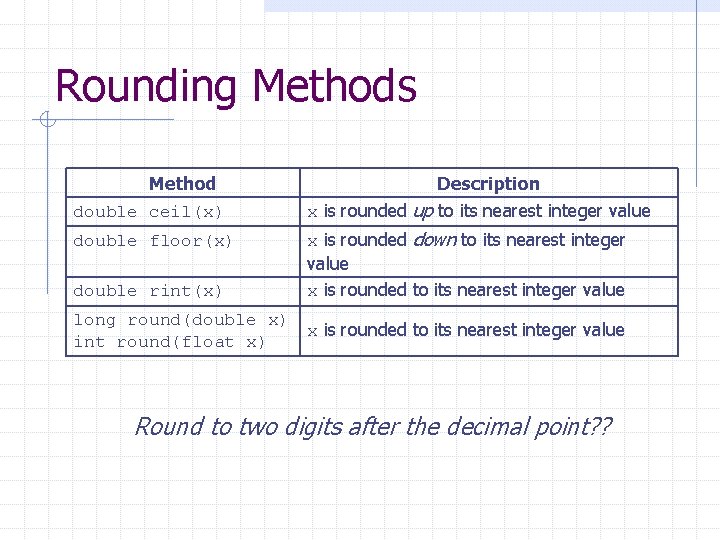
Rounding Methods Method Description double ceil(x) x is rounded up to its nearest integer value double floor(x) x is rounded down to its nearest integer value x is rounded to its nearest integer value double rint(x) long round(double x) x is rounded to its nearest integer value int round(float x) Round to two digits after the decimal point? ?
Other Methods Math. min( x, y ) Math. max( x, y ) Math. abs( x ) Math. random()
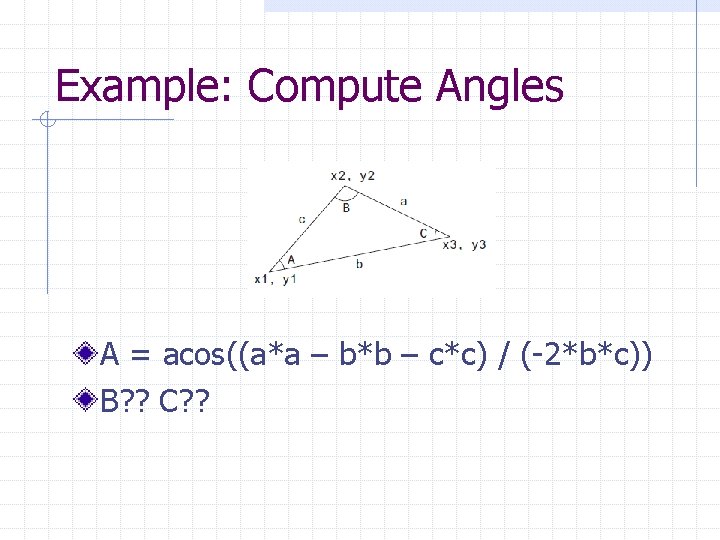
Example: Compute Angles A = acos((a*a – b*b – c*c) / (-2*b*c)) B? ? C? ?
The char Data Type Represent a single character char literals: 'A', '4' n Vs. String? ?
Operations on char can often be treated like an integer type. For example: a = 'A'; ++a; b = 'A' * 2; c = 'A' + 'B'; d = 'B' > 'A'; e = (char) 65. 12; But why? (and why you should be careful treating char as a number)
Encoding Remember that computers use binary numbers internally A character is stored as a sequence of 0 s and 1 s There are different ways to map characters to binary sequences, known as encoding schemes
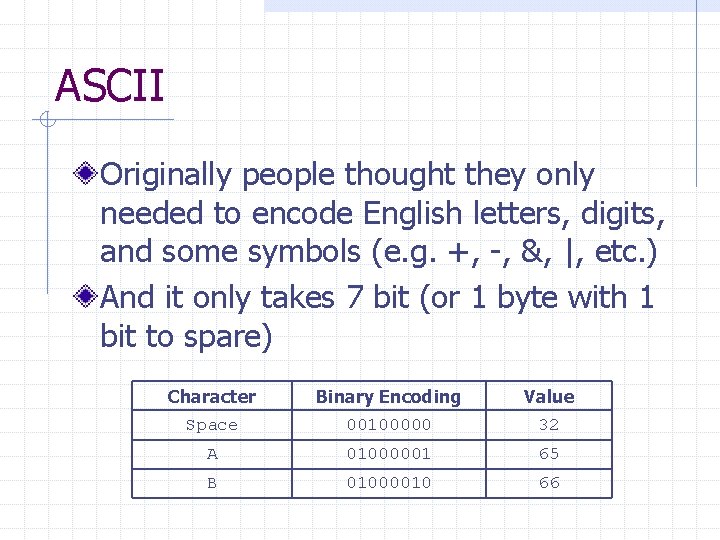
ASCII Originally people thought they only needed to encode English letters, digits, and some symbols (e. g. +, -, &, |, etc. ) And it only takes 7 bit (or 1 byte with 1 bit to spare) Character Binary Encoding Value Space 00100000 32 A 01000001 65 B 01000010 66
Unicode is a character set (not an encoding!) that tries to include all the characters used by all the languages I the world Currently (i. e. Unicode Version 11) includes 137, 374 characters Allow up to 1, 112, 064 characters
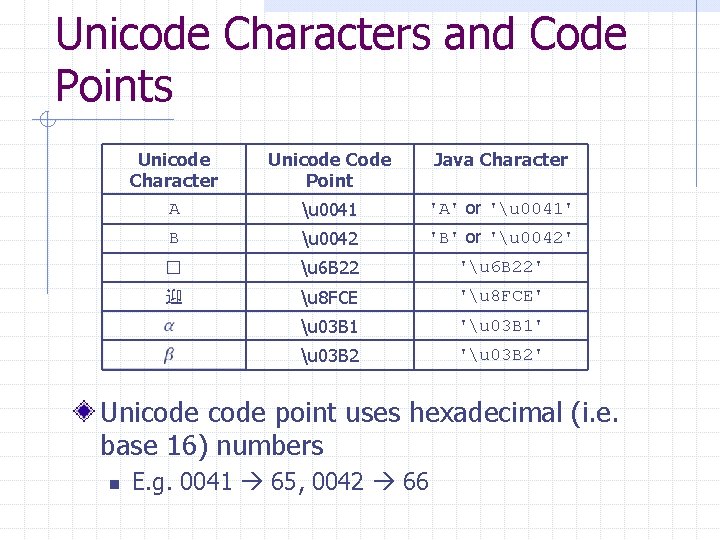
Unicode Characters and Code Points Unicode Character A Unicode Code Point Java Character u 0041 'A' or 'u 0041' B u 0042 'B' or 'u 0042' � u 6 B 22 'u 6 B 22' 迎 u 8 FCE 'u 8 FCE' u 03 B 1 'u 03 B 1' u 03 B 2 'u 03 B 2' Unicode point uses hexadecimal (i. e. base 16) numbers n E. g. 0041 65, 0042 66
Unicode Encoding There are multiple way to encode Unicode characters The most commonly used Unicode encoding these days is UTF-8 Java internally use UTF-16 n n Most characters take two bytes (i. e. 16 bits) Some characters (the so-called supplementary characters) take more than two bytes
Additional Reading on Character Set and Encoding The Absolute Minimum Every Software Developer Absolutely, Positively Must Know About Unicode and Character Sets (No Excuses!) by Joel Spolsky
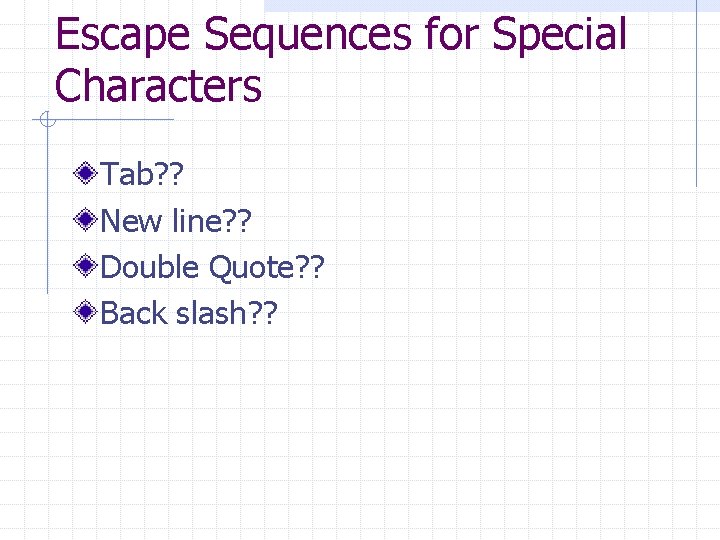
Escape Sequences for Special Characters Tab? ? New line? ? Double Quote? ? Back slash? ?
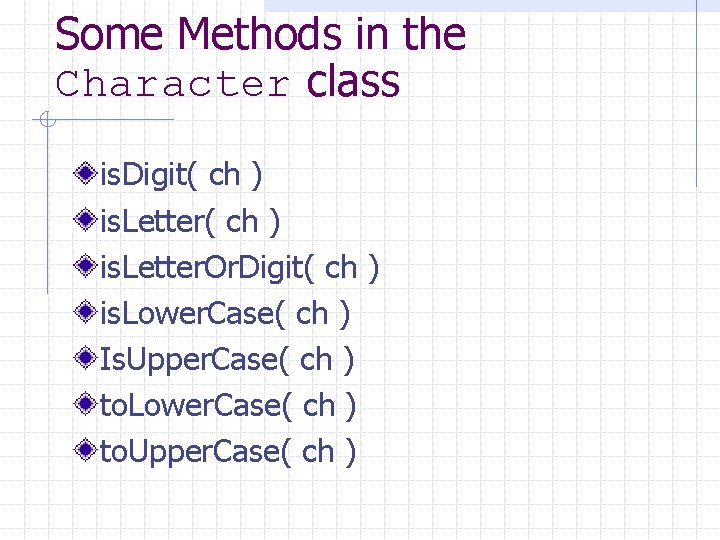
Some Methods in the Character class is. Digit( ch ) is. Letter. Or. Digit( ch ) is. Lower. Case( ch ) Is. Upper. Case( ch ) to. Lower. Case( ch ) to. Upper. Case( ch )