
CS 201 Data Structures and Discrete Mathematics I
![Merge Sort Algorithm Merge. Sort(A[i. . j]) if (i < j) { mid =](https://slidetodoc.com/presentation_image_h/210732038445912f0418890afa6e13a5/image-22.jpg "Merge Sort Algorithm Merge. Sort(A[i. . j]) if (i < j) { mid =")
![How to merge two subarrays? T[0. . 5] 3/3/2021 A[0. . 2] A[3. .](https://slidetodoc.com/presentation_image_h/210732038445912f0418890afa6e13a5/image-24.jpg "How to merge two subarrays? T[0. . 5] 3/3/2021 A[0. . 2] A[3. .")
![Merge Algorithm Merge(A[i. . mid], A[mid+1. . j]) 1. While both subarrays are not](https://slidetodoc.com/presentation_image_h/210732038445912f0418890afa6e13a5/image-25.jpg "Merge Algorithm Merge(A[i. . mid], A[mid+1. . j]) 1. While both subarrays are not")
- Slides: 33
CS 201: Data Structures and Discrete Mathematics I Recursion CS 201
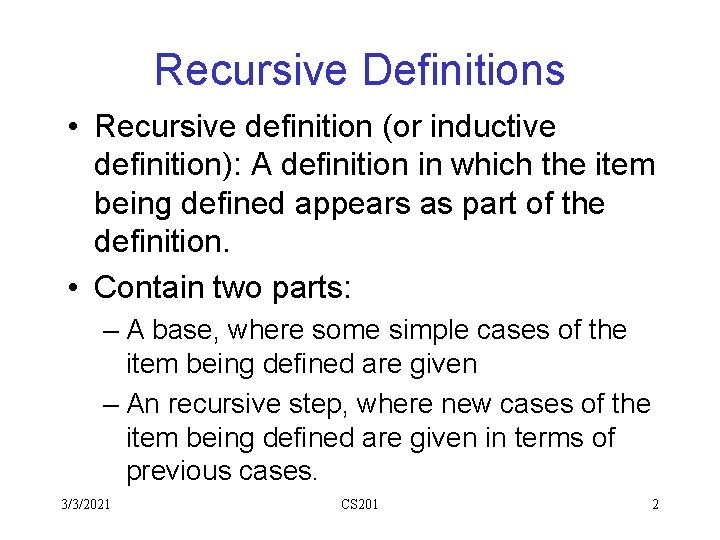
Recursive Definitions • Recursive definition (or inductive definition): A definition in which the item being defined appears as part of the definition. • Contain two parts: – A base, where some simple cases of the item being defined are given – An recursive step, where new cases of the item being defined are given in terms of previous cases. 3/3/2021 CS 201 2
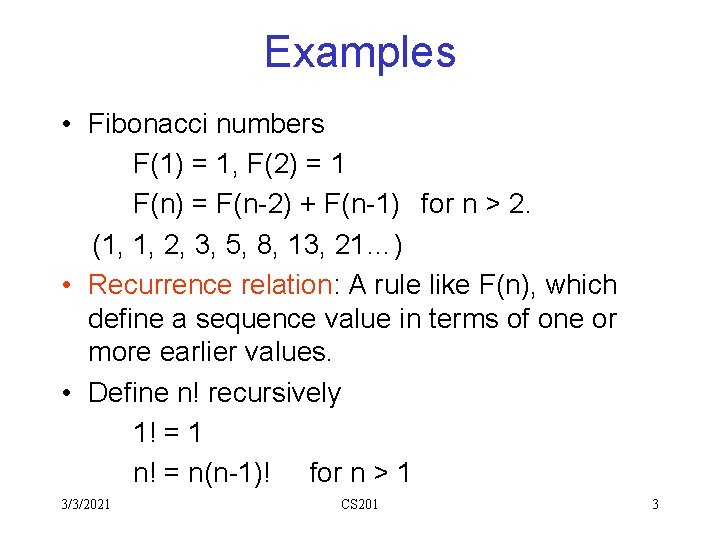
Examples • Fibonacci numbers F(1) = 1, F(2) = 1 F(n) = F(n-2) + F(n-1) for n > 2. (1, 1, 2, 3, 5, 8, 13, 21…) • Recurrence relation: A rule like F(n), which define a sequence value in terms of one or more earlier values. • Define n! recursively 1! = 1 n! = n(n-1)! for n > 1 3/3/2021 CS 201 3
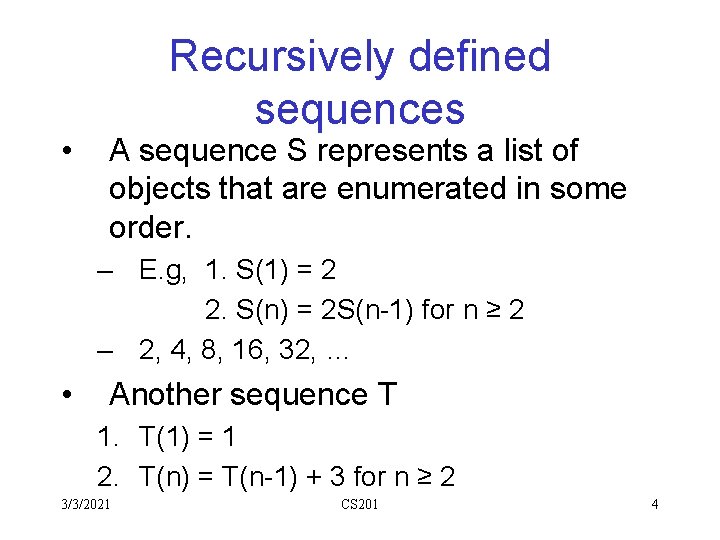
• Recursively defined sequences A sequence S represents a list of objects that are enumerated in some order. – E. g, 1. S(1) = 2 2. S(n) = 2 S(n-1) for n ≥ 2 – 2, 4, 8, 16, 32, … • Another sequence T 1. T(1) = 1 2. T(n) = T(n-1) + 3 for n ≥ 2 3/3/2021 CS 201 4
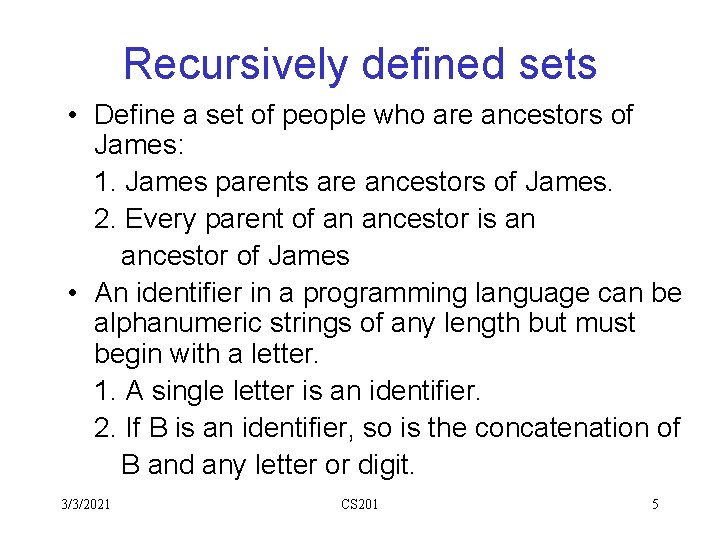
Recursively defined sets • Define a set of people who are ancestors of James: 1. James parents are ancestors of James. 2. Every parent of an ancestor is an ancestor of James • An identifier in a programming language can be alphanumeric strings of any length but must begin with a letter. 1. A single letter is an identifier. 2. If B is an identifier, so is the concatenation of B and any letter or digit. 3/3/2021 CS 201 5
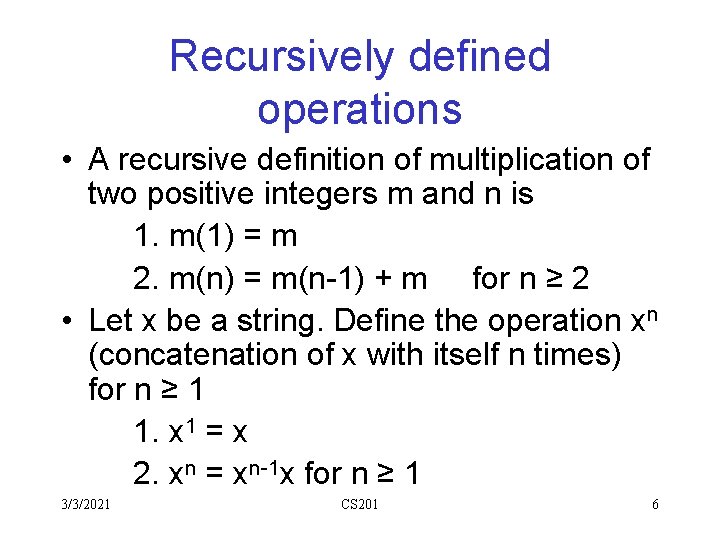
Recursively defined operations • A recursive definition of multiplication of two positive integers m and n is 1. m(1) = m 2. m(n) = m(n-1) + m for n ≥ 2 • Let x be a string. Define the operation xn (concatenation of x with itself n times) for n ≥ 1 1. x 1 = x 2. xn = xn-1 x for n ≥ 1 3/3/2021 CS 201 6
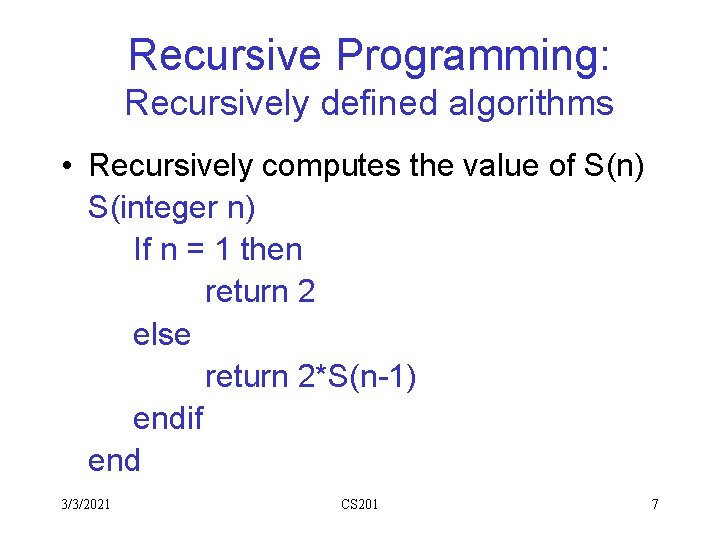
Recursive Programming: Recursively defined algorithms • Recursively computes the value of S(n) S(integer n) If n = 1 then return 2 else return 2*S(n-1) endif end 3/3/2021 CS 201 7
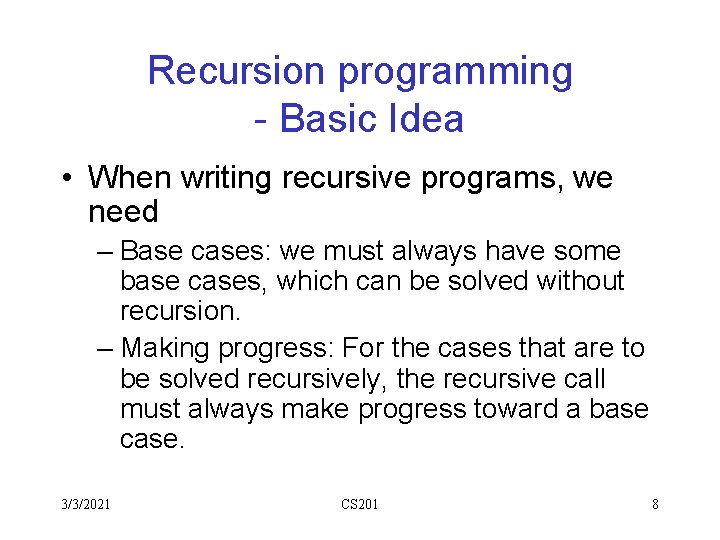
Recursion programming - Basic Idea • When writing recursive programs, we need – Base cases: we must always have some base cases, which can be solved without recursion. – Making progress: For the cases that are to be solved recursively, the recursive call must always make progress toward a base case. 3/3/2021 CS 201 8
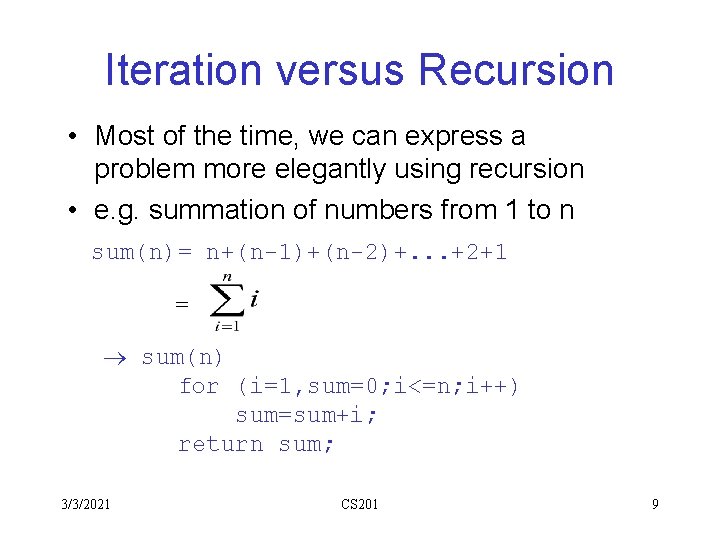
Iteration versus Recursion • Most of the time, we can express a problem more elegantly using recursion • e. g. summation of numbers from 1 to n sum(n)= n+(n-1)+(n-2)+. . . +2+1 = sum(n) for (i=1, sum=0; i<=n; i++) sum=sum+i; return sum; 3/3/2021 CS 201 9
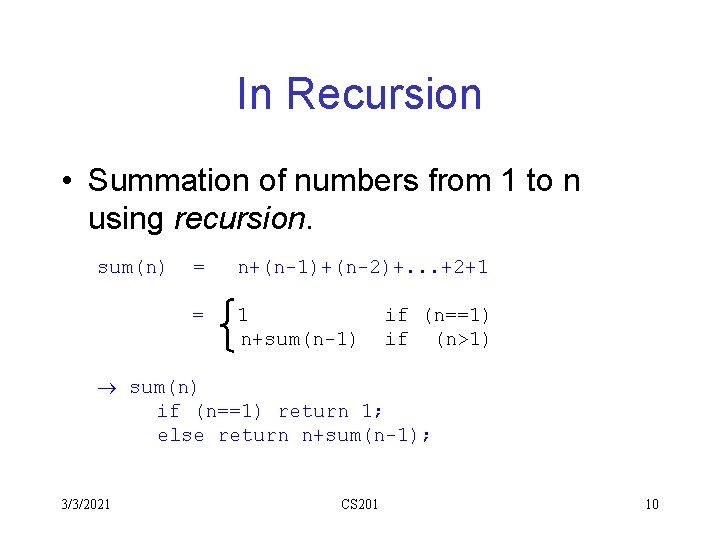
In Recursion • Summation of numbers from 1 to n using recursion. sum(n) = n+(n-1)+(n-2)+. . . +2+1 = 1 n+sum(n-1) if (n==1) if (n>1) sum(n) if (n==1) return 1; else return n+sum(n-1); 3/3/2021 CS 201 10
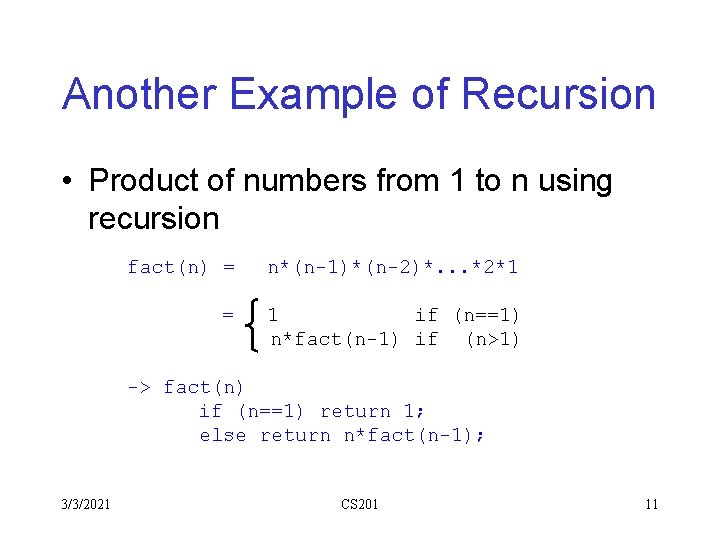
Another Example of Recursion • Product of numbers from 1 to n using recursion fact(n) = n*(n-1)*(n-2)*. . . *2*1 = 1 if (n==1) n*fact(n-1) if (n>1) -> fact(n) if (n==1) return 1; else return n*fact(n-1); 3/3/2021 CS 201 11
Visualizing Recursive Execution • With nonrecursive programs, it is natural to visualize execution by imagining control stepping through the source code – This can be confusing for programs containing recursion – Instead, useful to imagine each call of a function generating a copy of the function, so that if the same function is called several times, several copies are present. 3/3/2021 CS 201 12
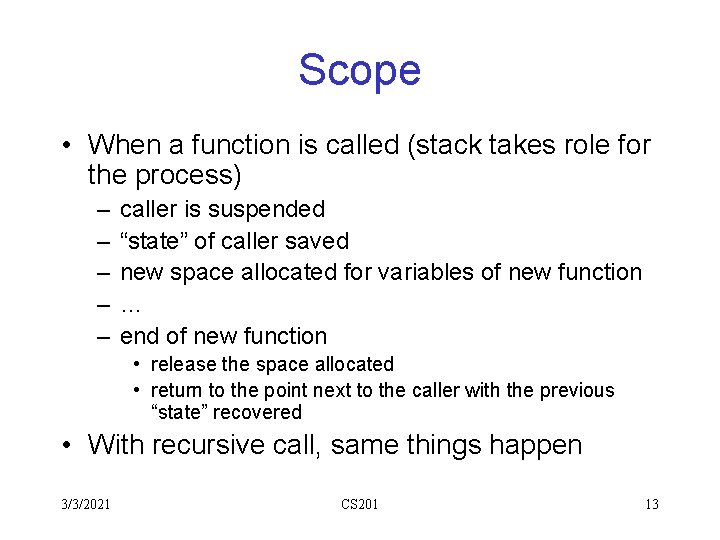
Scope • When a function is called (stack takes role for the process) – – – caller is suspended “state” of caller saved new space allocated for variables of new function … end of new function • release the space allocated • return to the point next to the caller with the previous “state” recovered • With recursive call, same things happen 3/3/2021 CS 201 13
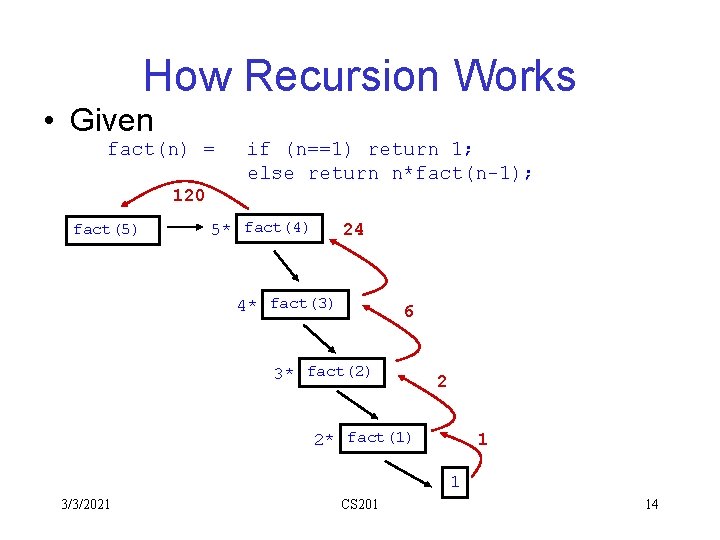
How Recursion Works • Given fact(n) = if (n==1) return 1; else return n*fact(n-1); 120 fact(5) 5* fact(4) 24 4* fact(3) 6 3* fact(2) 2 2* fact(1) 1 1 3/3/2021 CS 201 14
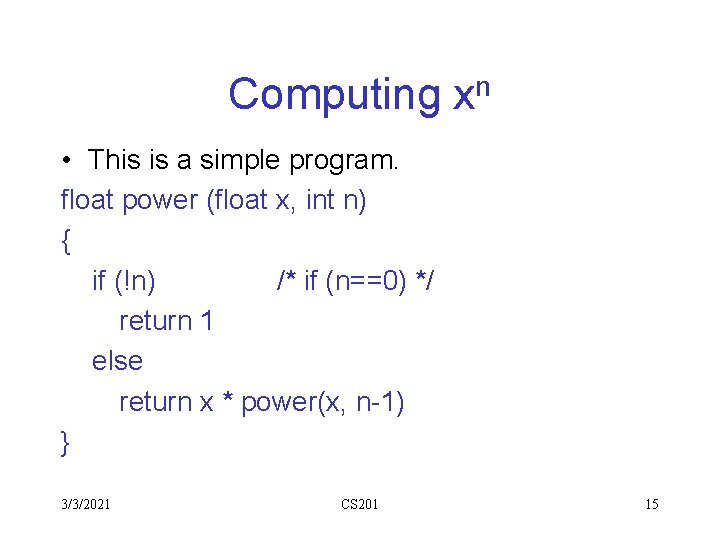
Computing xn • This is a simple program. float power (float x, int n) { if (!n) /* if (n==0) */ return 1 else return x * power(x, n-1) } 3/3/2021 CS 201 15
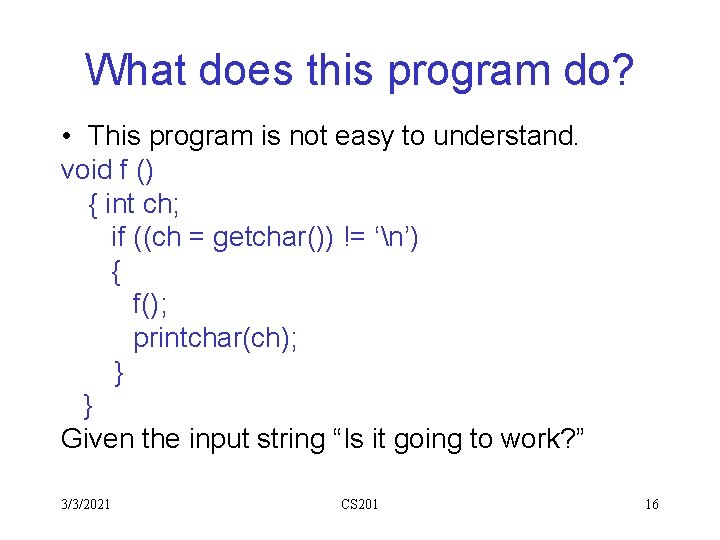
What does this program do? • This program is not easy to understand. void f () { int ch; if ((ch = getchar()) != ‘n’) { f(); printchar(ch); } } Given the input string “Is it going to work? ” 3/3/2021 CS 201 16
Recursion - how to Ask the following – How can you solve the problem using the solution of a “simpler” instance of the problem? – Can you be sure to have a “simplest” input? (If so, include separate treatment of this case. ) – Can you be sure to reach the “simplest” input? 3/3/2021 CS 201 17
Another Example: Merge Sort • We now use another complex example to show the working of a recursive program. • Sorting is the process of rearranging data in either ascending or descending order. – (2, 4, 1, 6, 5, 9, 2) => (1, 2, 2, 4, 5, 6, 9) • We need sorting because – The data in sorted order is required – It is the initialization step of many algorithms. 3/3/2021 CS 201 18
Merge Sort: one sorting algorithm • A nice example of a recursive algorithm. • It is a divide-and-conquer algorithm • Divide-and-conquer is an important technique in Computer Science. It solves problem in three steps: – Divide Step: divide the large problem into two or more smaller problems. – Recursively solve the smaller problems – Conquer Step: based on the results of the smaller problems, produce the result of the large problem. 3/3/2021 CS 201 19
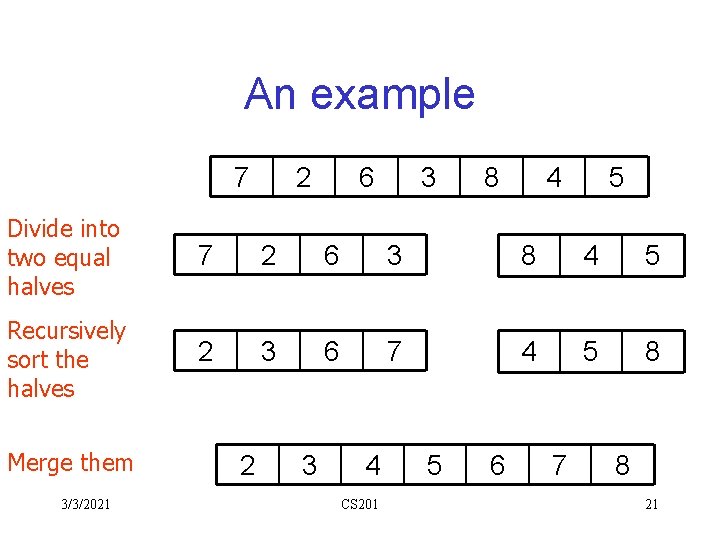
Merge Sort Idea • Divide Step: Divide the array into two equal halves • Recursively sort the two halves • Conquer Step: Merge the two halves to form a sorted array 3/3/2021 CS 201 20
An example 7 2 6 3 8 4 5 Divide into two equal halves 7 2 6 3 8 4 5 Recursively sort the halves 2 3 6 7 4 5 8 Merge them 3/3/2021 2 3 4 CS 201 5 6 7 8 21
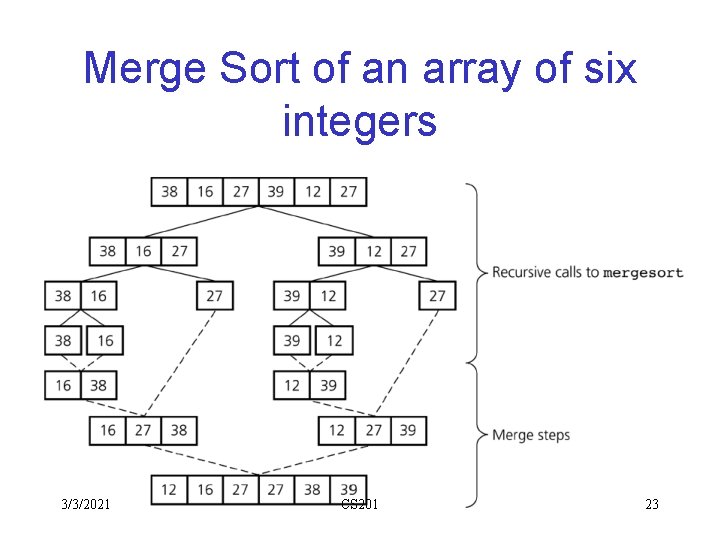
Merge Sort Algorithm Merge. Sort(A[i. . j]) if (i < j) { mid = (i+j)/2 Merge. Sort(A[i. . mid]); Merge. Sort(A[mid+1. . j]); Merge(A[i. . mid], A[mid+1. . j]); } 3/3/2021 CS 201 22
Merge Sort of an array of six integers 3/3/2021 CS 201 23
How to merge two subarrays? T[0. . 5] 3/3/2021 A[0. . 2] A[3. . 5] 245 37 8 2 245 378 2 3 4 5 7 8 245 378 CS 201 24
Merge Algorithm Merge(A[i. . mid], A[mid+1. . j]) 1. While both subarrays are not empty, – Between the first entries of both subarrays, copy the smaller item into the first available entry in the temporary array T[]. 2. When one subarray is empty, – finish off the nonempty subarray 3. Copy the result in T[] back to A[i. . j] 3/3/2021 CS 201 25
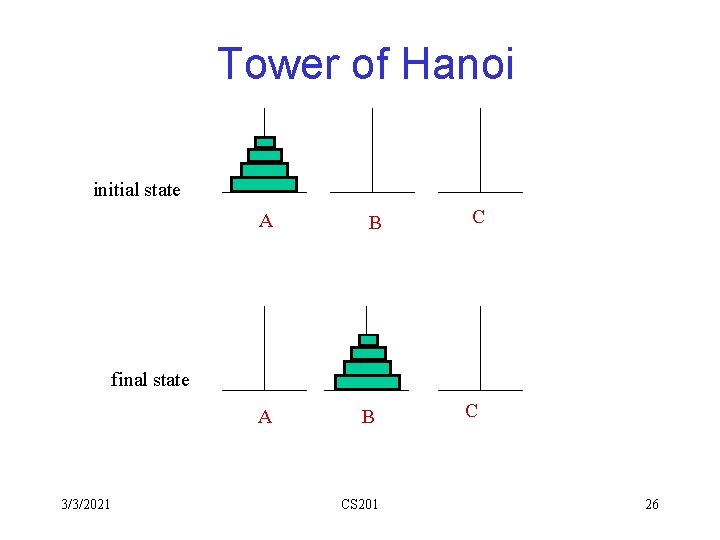
Tower of Hanoi initial state A B C final state A 3/3/2021 B CS 201 C 26
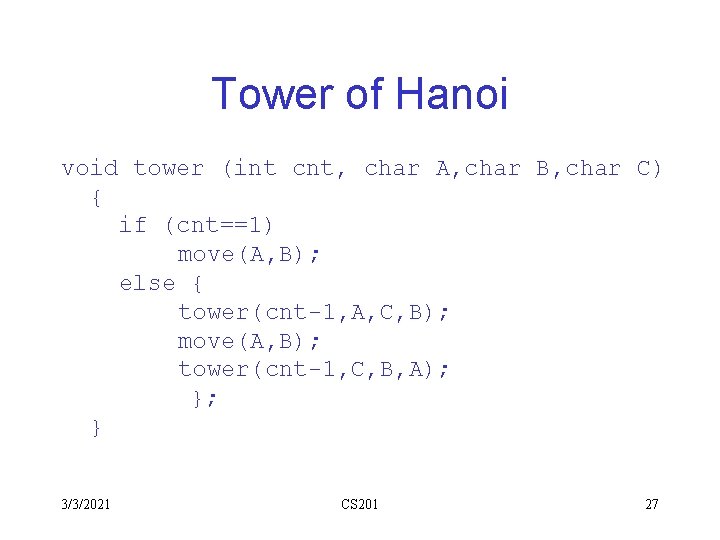
Tower of Hanoi void tower (int cnt, char A, char B, char C) { if (cnt==1) move(A, B); else { tower(cnt-1, A, C, B); move(A, B); tower(cnt-1, C, B, A); }; } 3/3/2021 CS 201 27
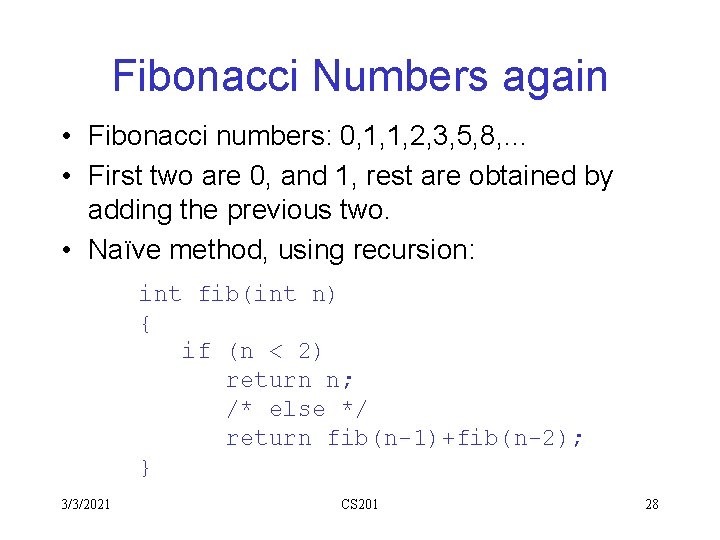
Fibonacci Numbers again • Fibonacci numbers: 0, 1, 1, 2, 3, 5, 8, … • First two are 0, and 1, rest are obtained by adding the previous two. • Naïve method, using recursion: int fib(int n) { if (n < 2) return n; /* else */ return fib(n-1)+fib(n-2); } 3/3/2021 CS 201 28
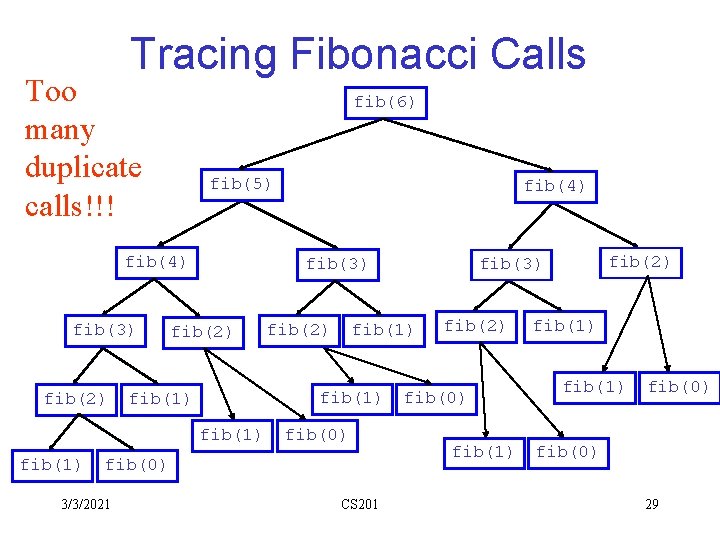
Tracing Fibonacci Calls Too many duplicate calls!!! fib(6) fib(5) fib(4) fib(3) fib(2) fib(0) 3/3/2021 CS 201 fib(2) fib(3) fib(1) fib(1) fib(4) fib(2) fib(0) fib(1) fib(0) 29
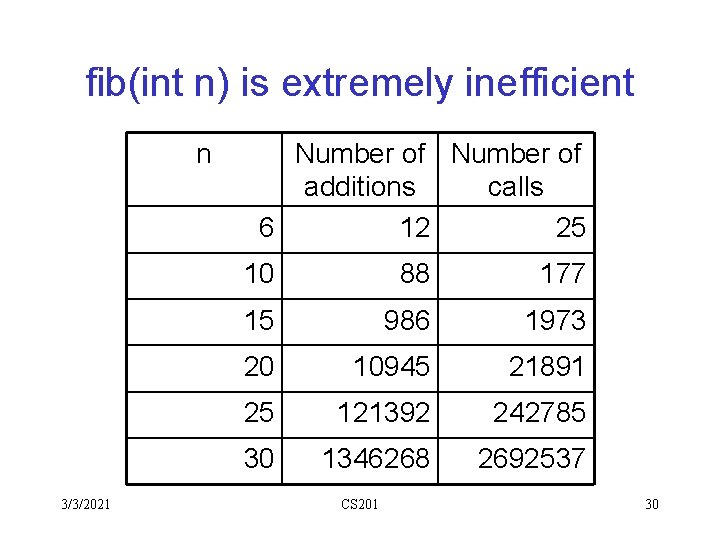
fib(int n) is extremely inefficient n 3/3/2021 Number of additions calls 6 12 25 10 88 177 15 986 1973 20 10945 21891 25 121392 242785 30 1346268 2692537 CS 201 30
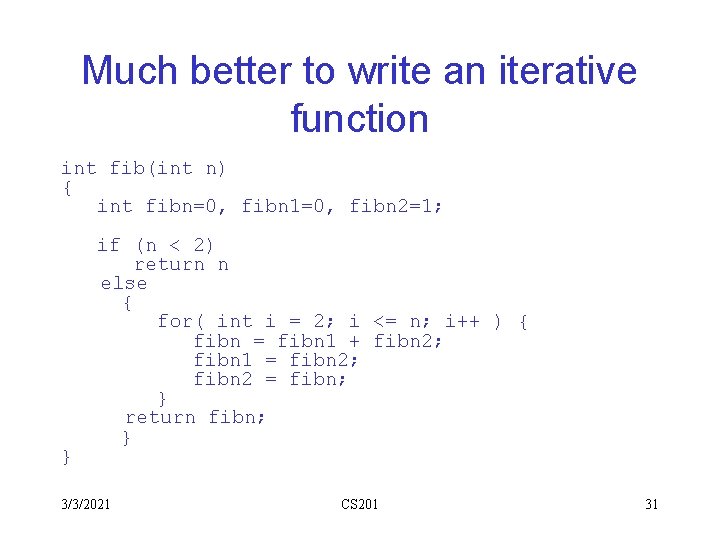
Much better to write an iterative function int fib(int n) { int fibn=0, fibn 1=0, fibn 2=1; } if (n < 2) return n else { for( int i = 2; i <= n; i++ ) { fibn = fibn 1 + fibn 2; fibn 1 = fibn 2; fibn 2 = fibn; } return fibn; } 3/3/2021 CS 201 31
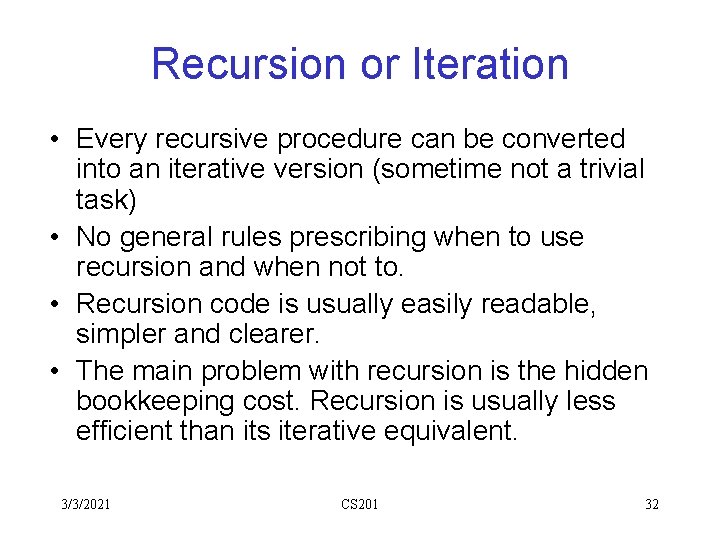
Recursion or Iteration • Every recursive procedure can be converted into an iterative version (sometime not a trivial task) • No general rules prescribing when to use recursion and when not to. • Recursion code is usually easily readable, simpler and clearer. • The main problem with recursion is the hidden bookkeeping cost. Recursion is usually less efficient than its iterative equivalent. 3/3/2021 CS 201 32
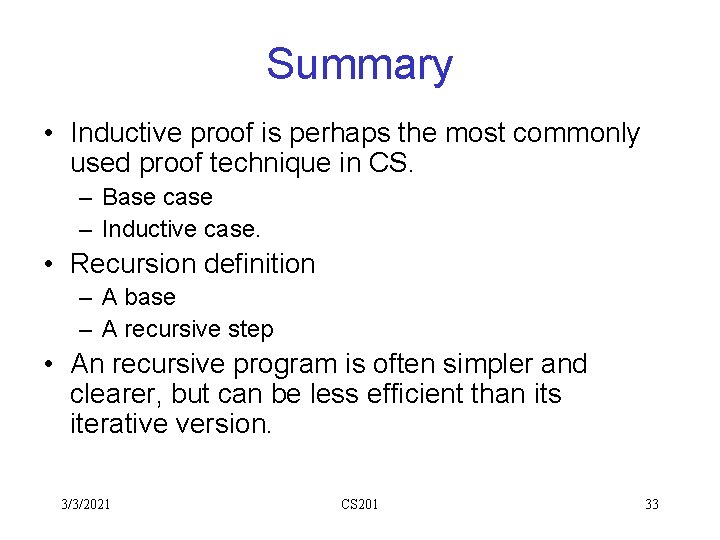
Summary • Inductive proof is perhaps the most commonly used proof technique in CS. – Base case – Inductive case. • Recursion definition – A base – A recursive step • An recursive program is often simpler and clearer, but can be less efficient than its iterative version. 3/3/2021 CS 201 33