
CS 201 Data Structures and Discrete Mathematics I

- Slides: 30
CS 201: Data Structures and Discrete Mathematics I Propositional Logic CS 201
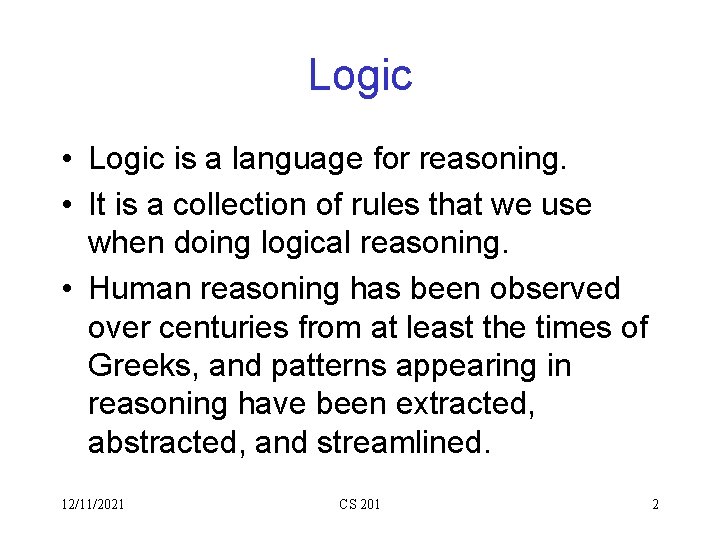
Logic • Logic is a language for reasoning. • It is a collection of rules that we use when doing logical reasoning. • Human reasoning has been observed over centuries from at least the times of Greeks, and patterns appearing in reasoning have been extracted, abstracted, and streamlined. 12/11/2021 CS 201 2
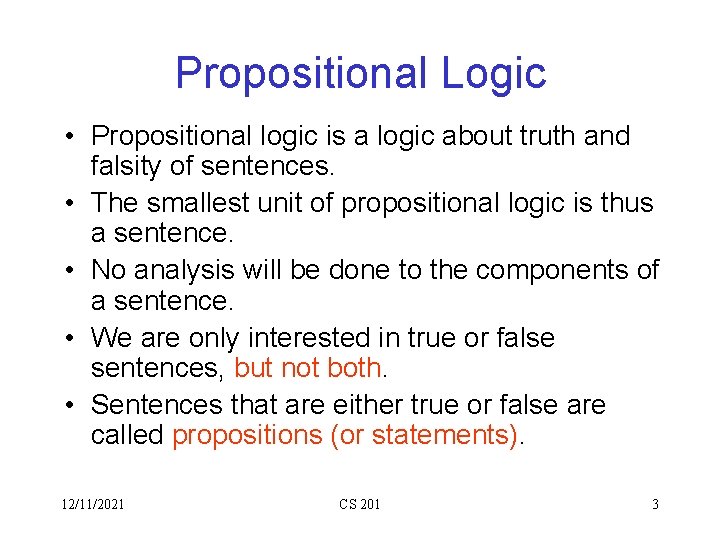
Propositional Logic • Propositional logic is a logic about truth and falsity of sentences. • The smallest unit of propositional logic is thus a sentence. • No analysis will be done to the components of a sentence. • We are only interested in true or false sentences, but not both. • Sentences that are either true or false are called propositions (or statements). 12/11/2021 CS 201 3
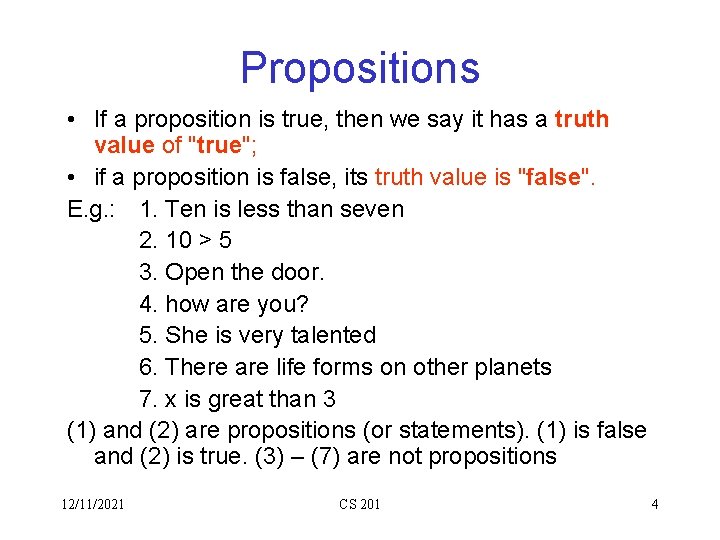
Propositions • If a proposition is true, then we say it has a truth value of "true"; • if a proposition is false, its truth value is "false". E. g. : 1. Ten is less than seven 2. 10 > 5 3. Open the door. 4. how are you? 5. She is very talented 6. There are life forms on other planets 7. x is great than 3 (1) and (2) are propositions (or statements). (1) is false and (2) is true. (3) – (7) are not propositions 12/11/2021 CS 201 4
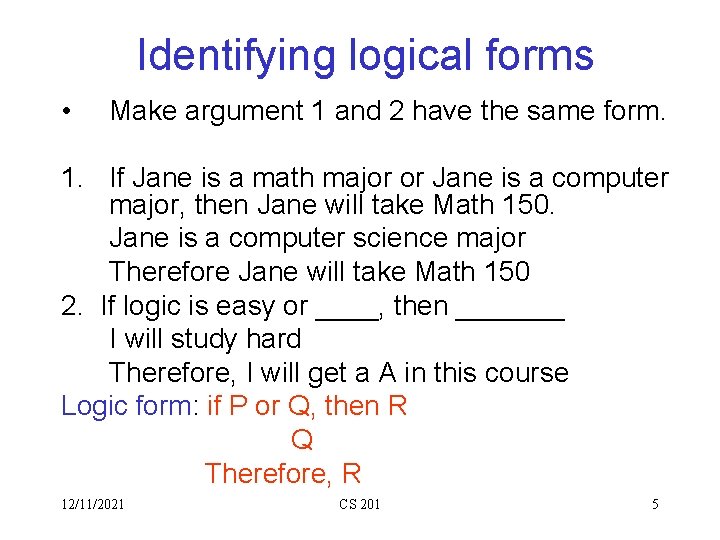
Identifying logical forms • Make argument 1 and 2 have the same form. 1. If Jane is a math major or Jane is a computer major, then Jane will take Math 150. Jane is a computer science major Therefore Jane will take Math 150 2. If logic is easy or ____, then _______ I will study hard Therefore, I will get a A in this course Logic form: if P or Q, then R Q Therefore, R 12/11/2021 CS 201 5
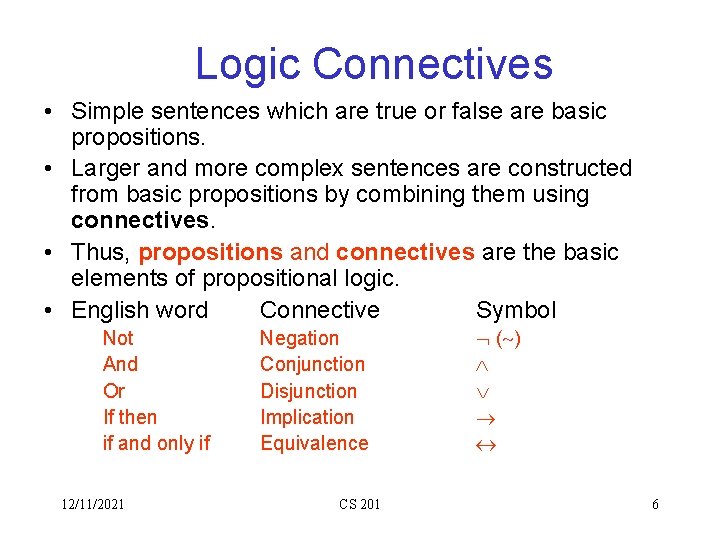
Logic Connectives • Simple sentences which are true or false are basic propositions. • Larger and more complex sentences are constructed from basic propositions by combining them using connectives. • Thus, propositions and connectives are the basic elements of propositional logic. • English word Connective Symbol Not And Or If then if and only if 12/11/2021 Negation Conjunction Disjunction Implication Equivalence CS 201 ( ) 6
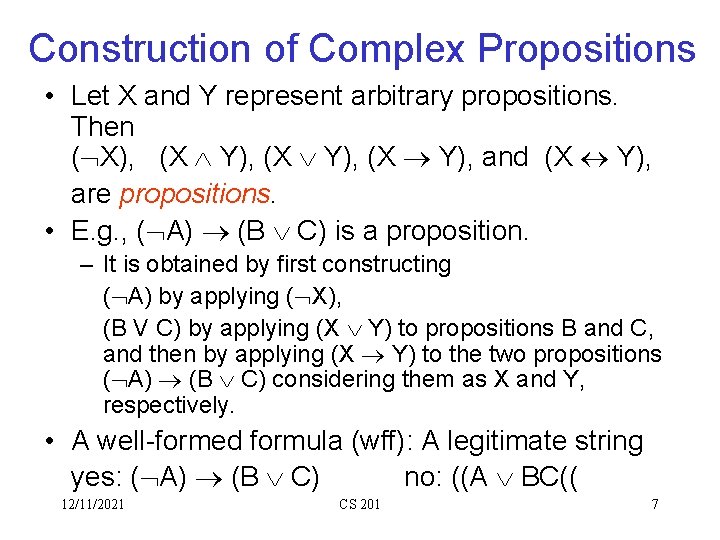
Construction of Complex Propositions • Let X and Y represent arbitrary propositions. Then ( X), (X Y), and (X Y), are propositions. • E. g. , ( A) (B C) is a proposition. – It is obtained by first constructing ( A) by applying ( X), (B V C) by applying (X Y) to propositions B and C, and then by applying (X Y) to the two propositions ( A) (B C) considering them as X and Y, respectively. • A well-formed formula (wff): A legitimate string yes: ( A) (B C) no: ((A BC(( 12/11/2021 CS 201 7
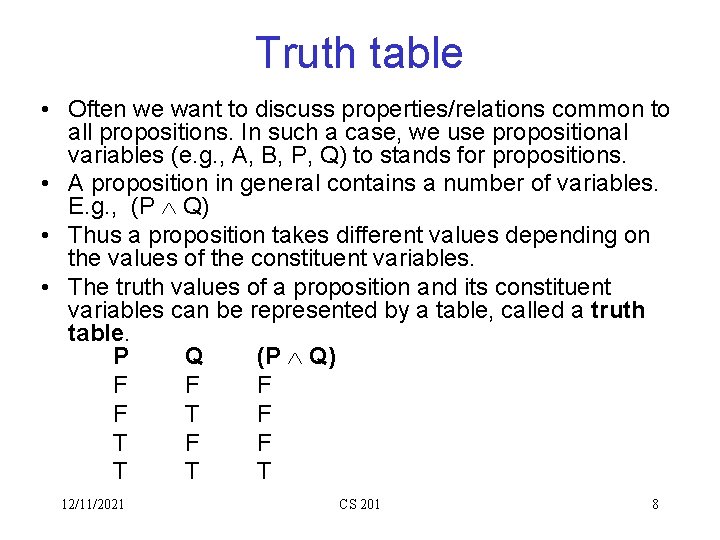
Truth table • Often we want to discuss properties/relations common to all propositions. In such a case, we use propositional variables (e. g. , A, B, P, Q) to stands for propositions. • A proposition in general contains a number of variables. E. g. , (P Q) • Thus a proposition takes different values depending on the values of the constituent variables. • The truth values of a proposition and its constituent variables can be represented by a table, called a truth table. P Q (P Q) F F T T T 12/11/2021 CS 201 8
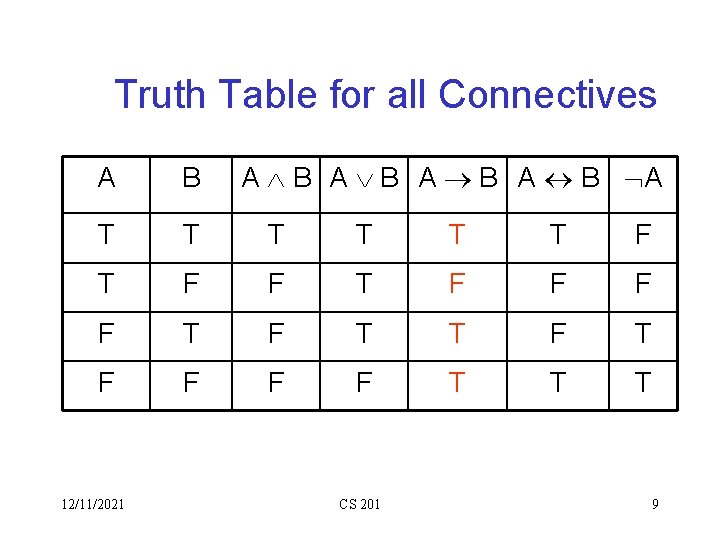
Truth Table for all Connectives A B A A B T T T F T F F F F T T T 12/11/2021 CS 201 9
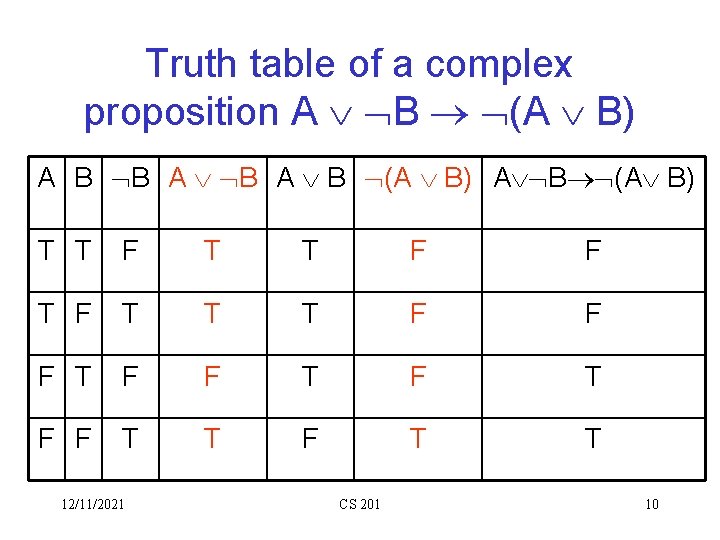
Truth table of a complex proposition A B (A B) A B B A B (A B) A B (A B) T T F F T T T F F F T F T F F T T 12/11/2021 CS 201 10
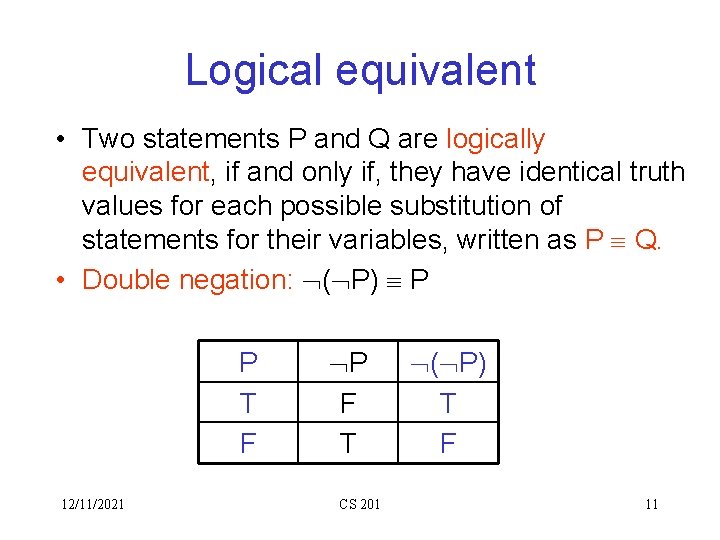
Logical equivalent • Two statements P and Q are logically equivalent, if and only if, they have identical truth values for each possible substitution of statements for their variables, written as P Q. • Double negation: ( P) P P T F 12/11/2021 P F T CS 201 ( P) T F 11
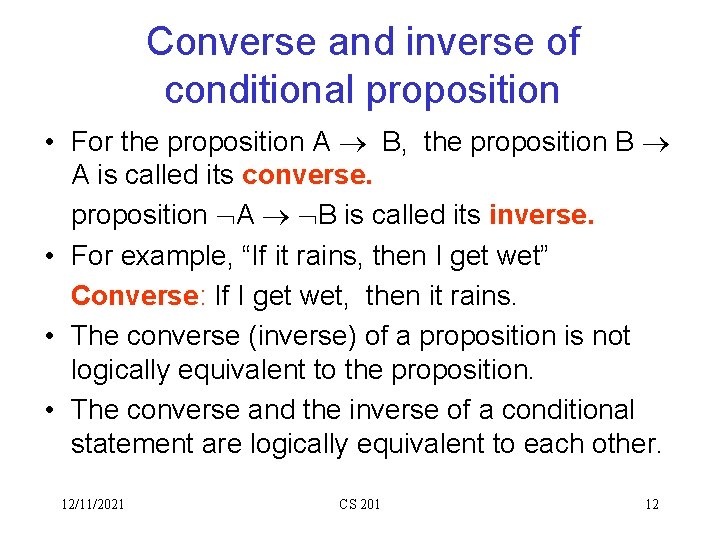
Converse and inverse of conditional proposition • For the proposition A B, the proposition B A is called its converse. proposition A B is called its inverse. • For example, “If it rains, then I get wet” Converse: If I get wet, then it rains. • The converse (inverse) of a proposition is not logically equivalent to the proposition. • The converse and the inverse of a conditional statement are logically equivalent to each other. 12/11/2021 CS 201 12
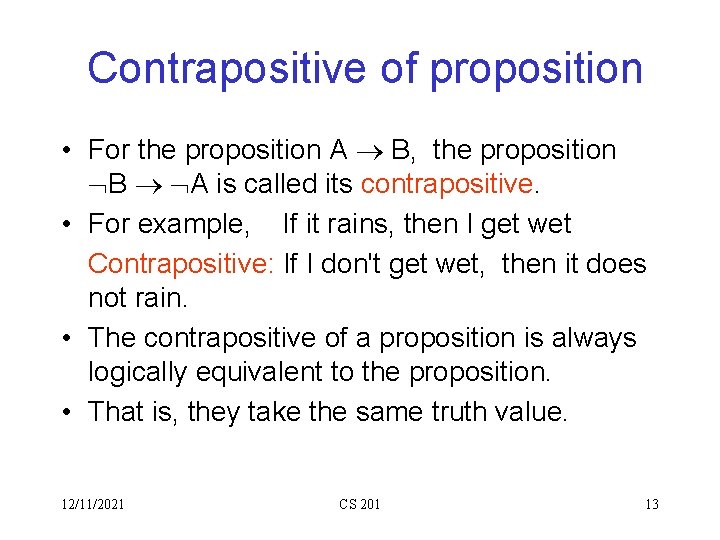
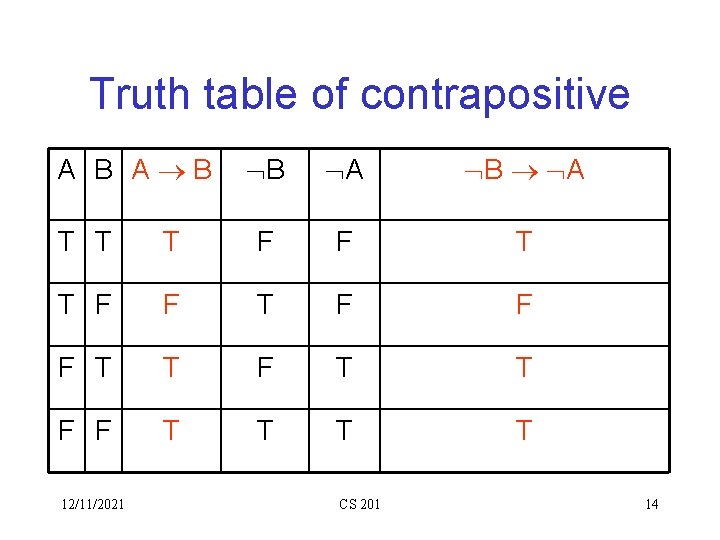
Contrapositive of proposition • For the proposition A B, the proposition B A is called its contrapositive. • For example, If it rains, then I get wet Contrapositive: If I don't get wet, then it does not rain. • The contrapositive of a proposition is always logically equivalent to the proposition. • That is, they take the same truth value. 12/11/2021 CS 201 13
Truth table of contrapositive A B B A T T T F F F T T F F T T 12/11/2021 CS 201 14
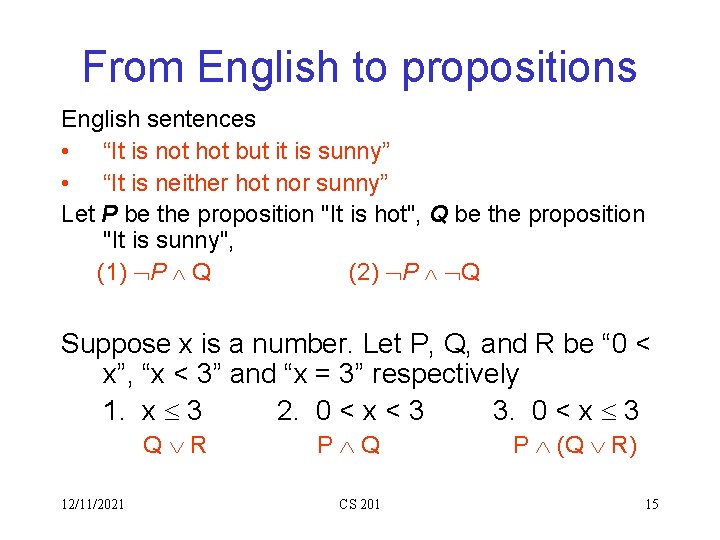
From English to propositions English sentences • “It is not hot but it is sunny” • “It is neither hot nor sunny” Let P be the proposition "It is hot", Q be the proposition "It is sunny", (1) P Q (2) P Q Suppose x is a number. Let P, Q, and R be “ 0 < x”, “x < 3” and “x = 3” respectively 1. x 3 2. 0 < x < 3 3. 0 < x 3 Q R 12/11/2021 P Q CS 201 P (Q R) 15
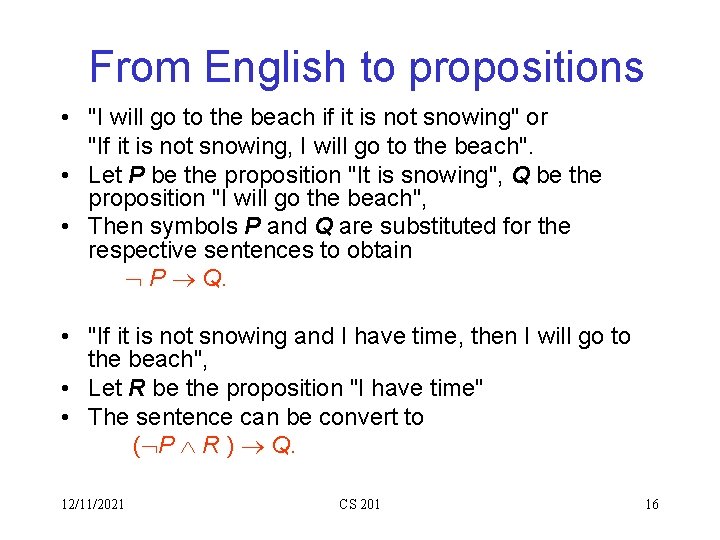
From English to propositions • "I will go to the beach if it is not snowing" or "If it is not snowing, I will go to the beach". • Let P be the proposition "It is snowing", Q be the proposition "I will go the beach", • Then symbols P and Q are substituted for the respective sentences to obtain P Q. • "If it is not snowing and I have time, then I will go to the beach", • Let R be the proposition "I have time" • The sentence can be convert to ( P R ) Q. 12/11/2021 CS 201 16
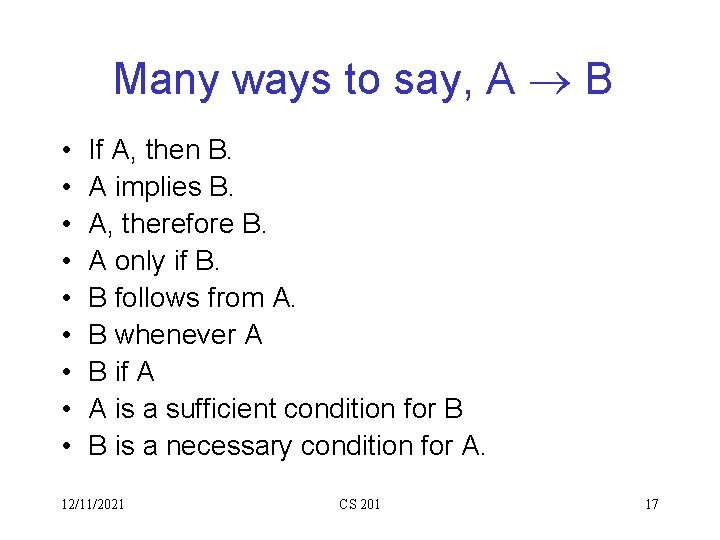
Many ways to say, A B • • • If A, then B. A implies B. A, therefore B. A only if B. B follows from A. B whenever A B if A A is a sufficient condition for B B is a necessary condition for A. 12/11/2021 CS 201 17
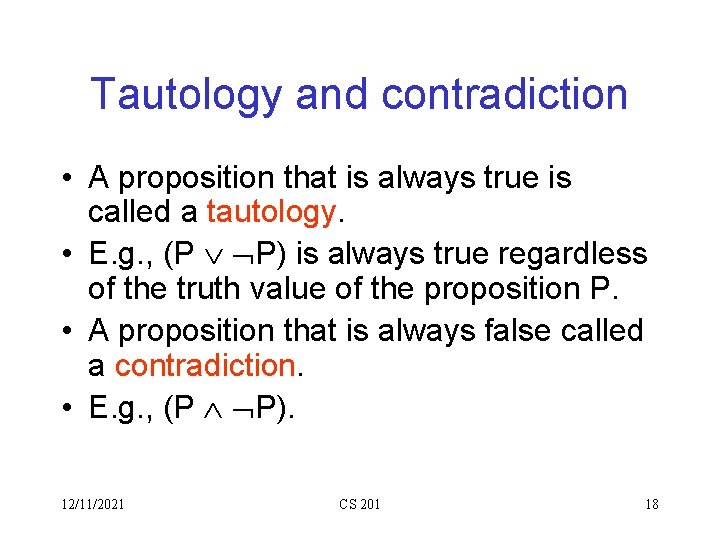
Tautology and contradiction • A proposition that is always true is called a tautology. • E. g. , (P P) is always true regardless of the truth value of the proposition P. • A proposition that is always false called a contradiction. • E. g. , (P P). 12/11/2021 CS 201 18
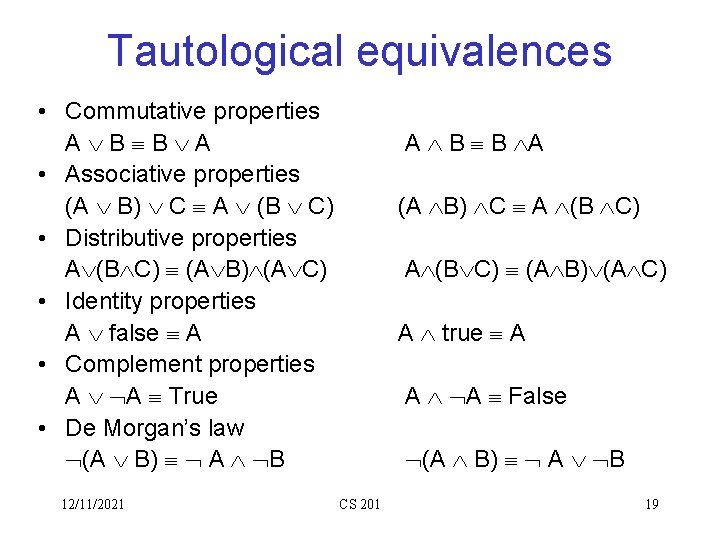
Tautological equivalences • Commutative properties A B B A • Associative properties (A B) C A (B C) • Distributive properties A (B C) (A B) (A C) • Identity properties A false A • Complement properties A A True • De Morgan’s law (A B) A B 12/11/2021 A B B A (A B) C A (B C) (A B) (A C) A true A A A False (A B) A B CS 201 19
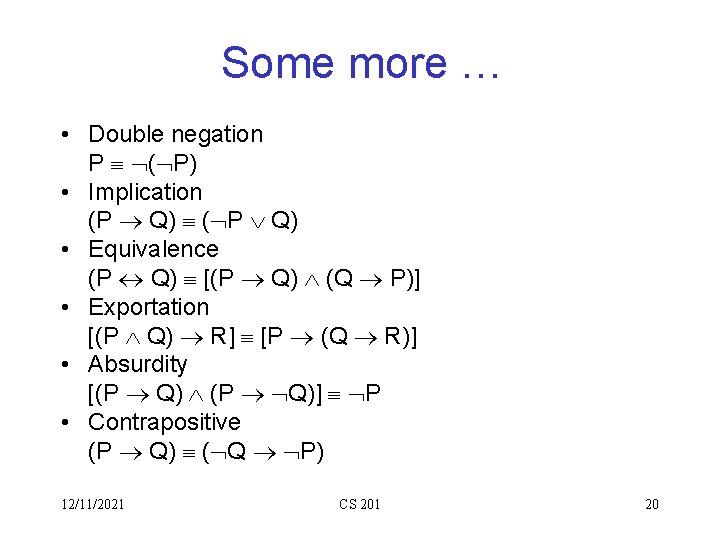
Some more … • Double negation P ( P) • Implication (P Q) ( P Q) • Equivalence (P Q) [(P Q) (Q P)] • Exportation [(P Q) R] [P (Q R)] • Absurdity [(P Q) (P Q)] P • Contrapositive (P Q) ( Q P) 12/11/2021 CS 201 20
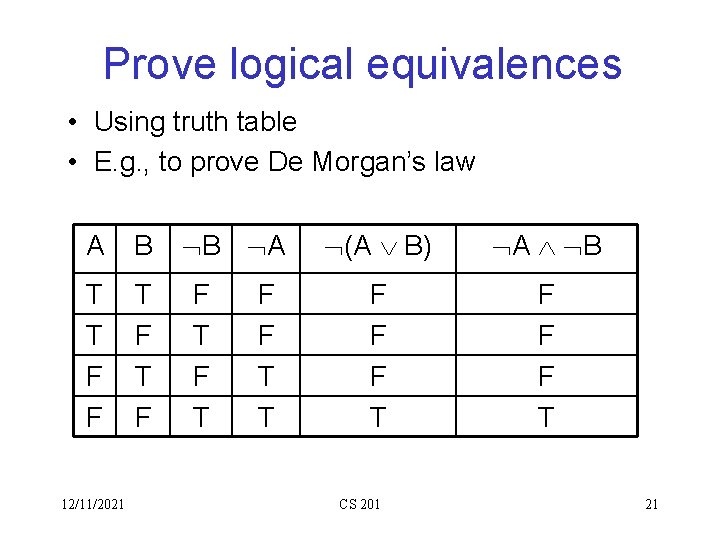
Prove logical equivalences • Using truth table • E. g. , to prove De Morgan’s law A B T T F F T F 12/11/2021 B A F T F F T T (A B) A B F F F T CS 201 21
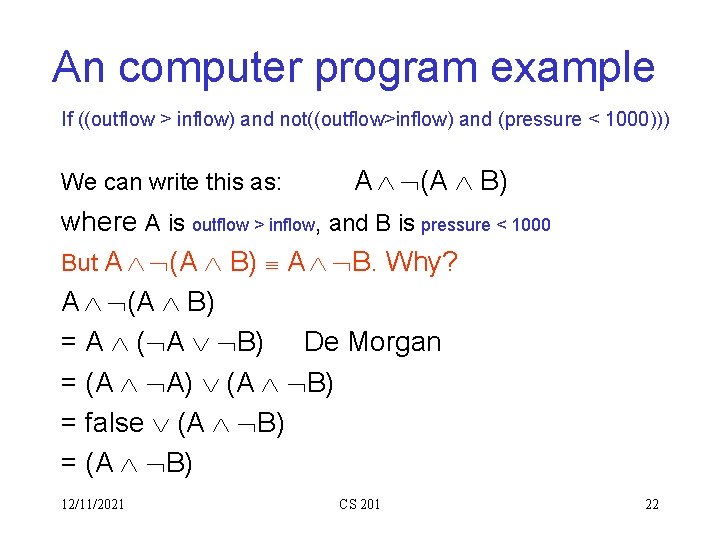
An computer program example If ((outflow > inflow) and not((outflow>inflow) and (pressure < 1000))) We can write this as: A (A B) where A is outflow > inflow, and B is pressure < 1000 But A (A B) A B. Why? A (A B) = A ( A B) De Morgan = (A A) (A B) = false (A B) = (A B) 12/11/2021 CS 201 22
Logical Reasoning • Logical reasoning is the process of drawing conclusions from premises using rules of inference • These inference rules are results of observations of human reasoning over centuries. • They have contributed significantly to the scientific and engineering progress of the mankind. • Today they are universally accepted as the rules of logical reasoning and they should be followed in our reasoning. 12/11/2021 CS 201 23
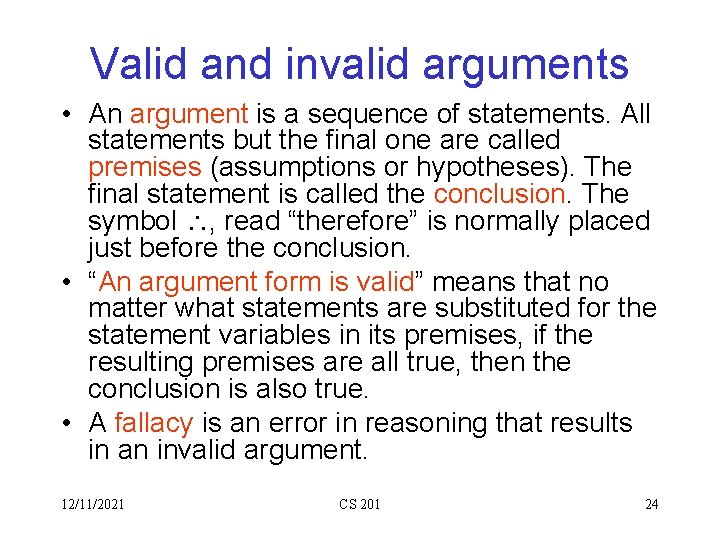
Valid and invalid arguments • An argument is a sequence of statements. All statements but the final one are called premises (assumptions or hypotheses). The final statement is called the conclusion. The symbol , read “therefore” is normally placed just before the conclusion. • “An argument form is valid” means that no matter what statements are substituted for the statement variables in its premises, if the resulting premises are all true, then the conclusion is also true. • A fallacy is an error in reasoning that results in an invalid argument. 12/11/2021 CS 201 24
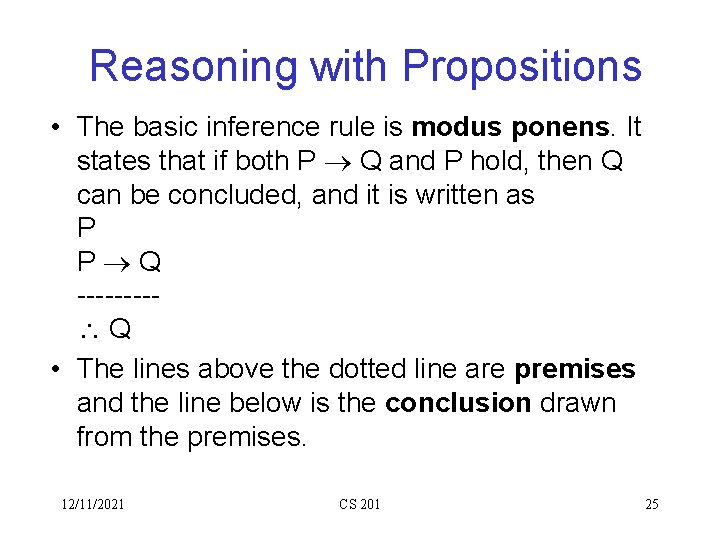
Reasoning with Propositions • The basic inference rule is modus ponens. It states that if both P Q and P hold, then Q can be concluded, and it is written as P P Q ---- Q • The lines above the dotted line are premises and the line below is the conclusion drawn from the premises. 12/11/2021 CS 201 25
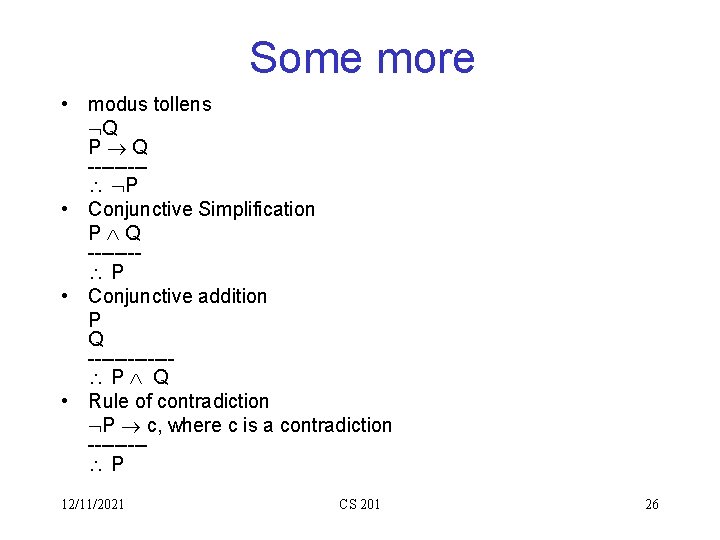
Some more • modus tollens Q P Q ---- P • Conjunctive Simplification P Q ------- P • Conjunctive addition P Q ------ P Q • Rule of contradiction P c, where c is a contradiction ---- P 12/11/2021 CS 201 26
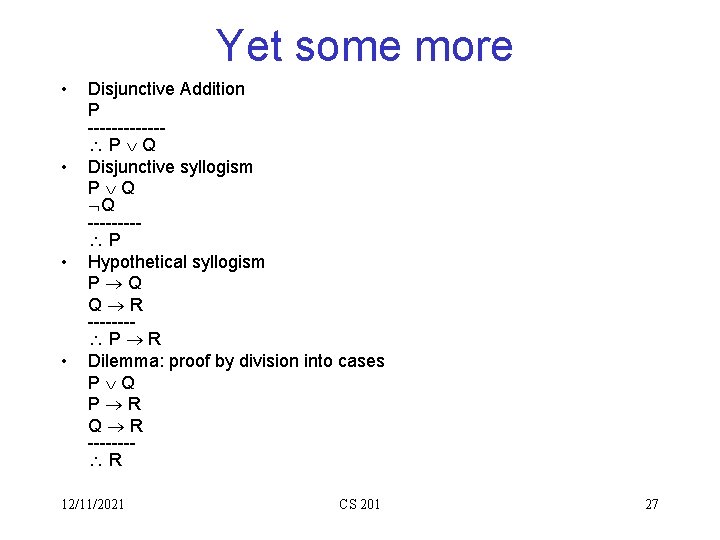
Yet some more • • Disjunctive Addition P ------ P Q Disjunctive syllogism P Q Q ---- P Hypothetical syllogism P Q Q R ------- P R Dilemma: proof by division into cases P Q P R Q R ------- R 12/11/2021 CS 201 27
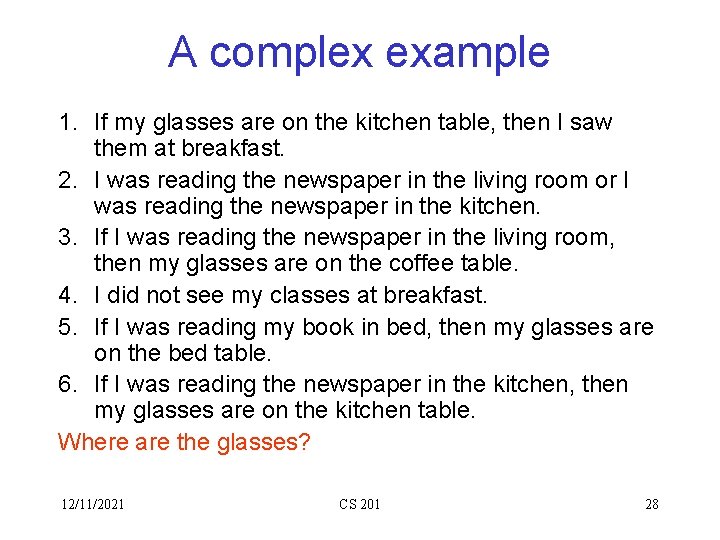
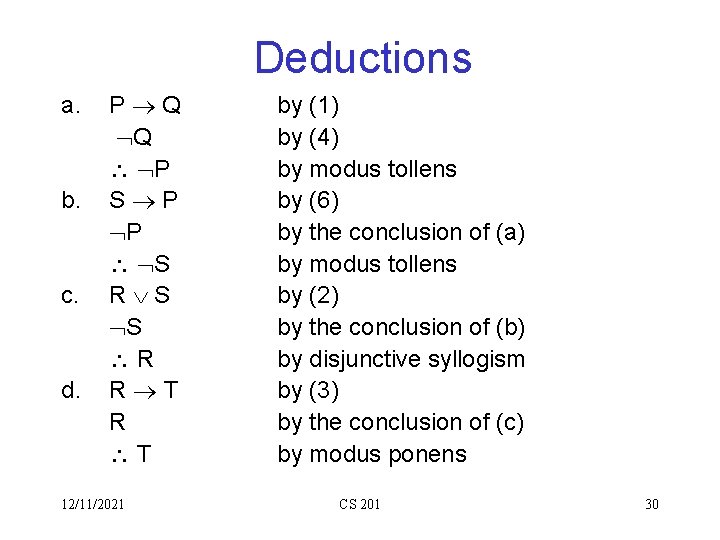
A complex example 1. If my glasses are on the kitchen table, then I saw them at breakfast. 2. I was reading the newspaper in the living room or I was reading the newspaper in the kitchen. 3. If I was reading the newspaper in the living room, then my glasses are on the coffee table. 4. I did not see my classes at breakfast. 5. If I was reading my book in bed, then my glasses are on the bed table. 6. If I was reading the newspaper in the kitchen, then my glasses are on the kitchen table. Where are the glasses? 12/11/2021 CS 201 28
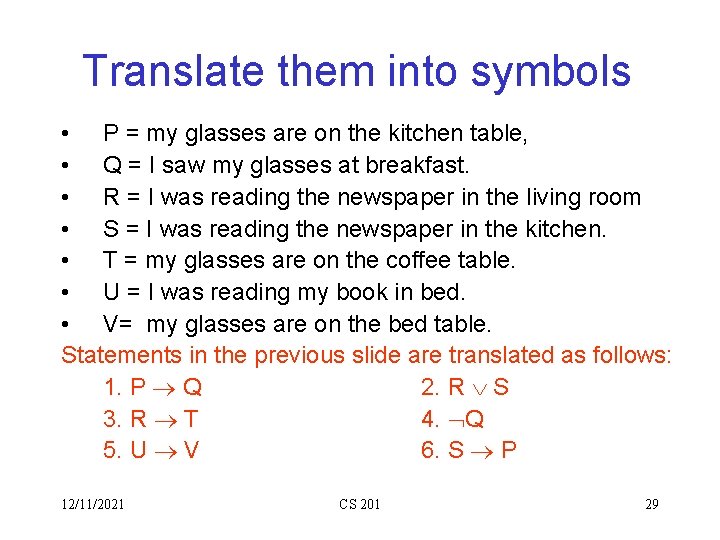
Translate them into symbols • P = my glasses are on the kitchen table, • Q = I saw my glasses at breakfast. • R = I was reading the newspaper in the living room • S = I was reading the newspaper in the kitchen. • T = my glasses are on the coffee table. • U = I was reading my book in bed. • V= my glasses are on the bed table. Statements in the previous slide are translated as follows: 1. P Q 2. R S 3. R T 4. Q 5. U V 6. S P 12/11/2021 CS 201 29
Deductions a. b. c. d. P Q Q P S P P S R S S R R T 12/11/2021 by (1) by (4) by modus tollens by (6) by the conclusion of (a) by modus tollens by (2) by the conclusion of (b) by disjunctive syllogism by (3) by the conclusion of (c) by modus ponens CS 201 30