
CS 194 24 Advanced Operating Systems Structures and

- Slides: 45
CS 194 -24 Advanced Operating Systems Structures and Implementation Lecture 4 OS Structure (Con’t) Modern Architecture February 6 th, 2013 Prof. John Kubiatowicz http: //inst. eecs. berkeley. edu/~cs 194 -24
Goals for Today • OS Structure (Con’t): The Linux Kernel • Modern Computer Architecture Interactive is important! Ask Questions! Note: Some slides and/or pictures in the following are adapted from slides © 2013 2/6/13 Kubiatowicz CS 194 -24 ©UCB Fall 2013 Lec 4. 2
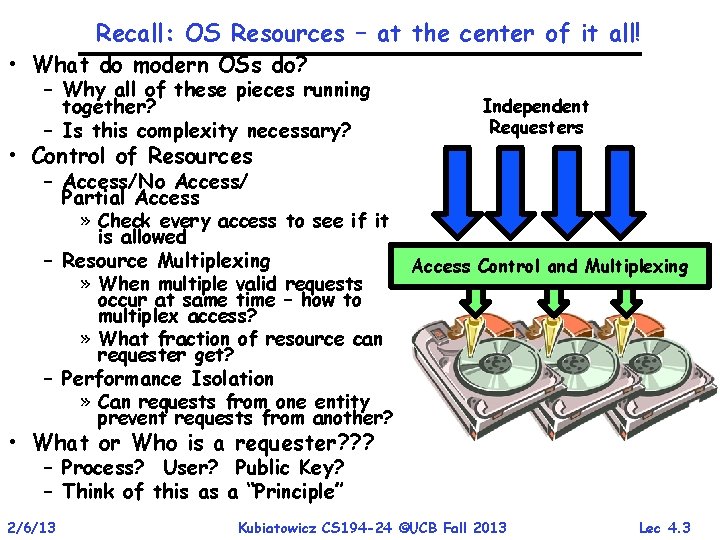
Recall: OS Resources – at the center of it all! • What do modern OSs do? – Why all of these pieces running together? – Is this complexity necessary? • Control of Resources Independent Requesters – Access/No Access/ Partial Access » Check every access to see if it is allowed – Resource Multiplexing » When multiple valid requests Access Control and Multiplexing occur at same time – how to multiplex access? » What fraction of resource can requester get? – Performance Isolation » Can requests from one entity prevent requests from another? • What or Who is a requester? ? ? – Process? User? Public Key? – Think of this as a “Principle” 2/6/13 Kubiatowicz CS 194 -24 ©UCB Fall 2013 Lec 4. 3
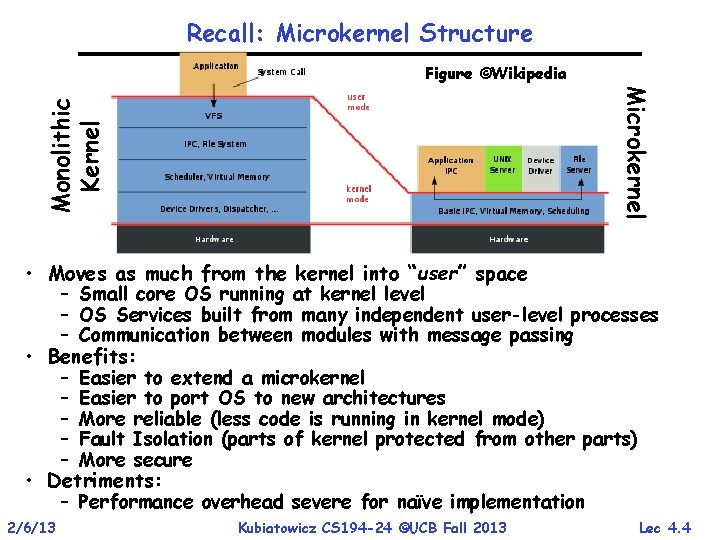
Recall: Microkernel Structure Figure ©Wikipedia Monolithic Kernel Microkernel • Moves as much from the kernel into “user” space – Small core OS running at kernel level – OS Services built from many independent user-level processes – Communication between modules with message passing • Benefits: – Easier to extend a microkernel – Easier to port OS to new architectures – More reliable (less code is running in kernel mode) – Fault Isolation (parts of kernel protected from other parts) – More secure • Detriments: – Performance overhead severe for naïve implementation 2/6/13 Kubiatowicz CS 194 -24 ©UCB Fall 2013 Lec 4. 4
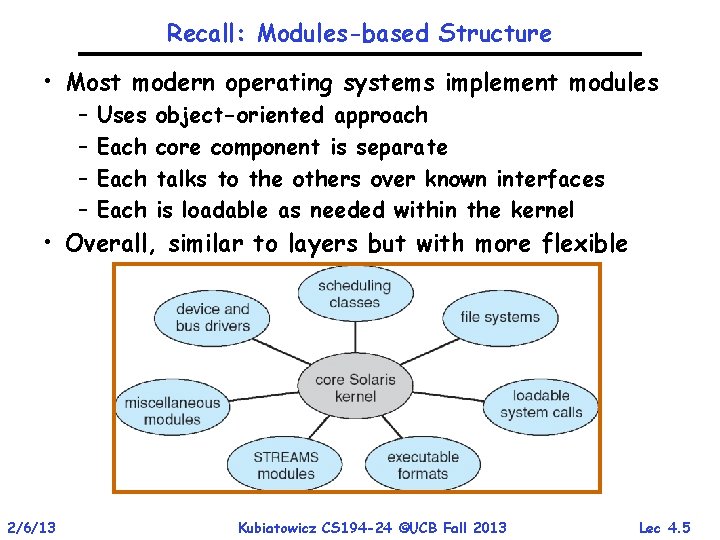
Recall: Modules-based Structure • Most modern operating systems implement modules – – Uses Each object-oriented approach core component is separate talks to the others over known interfaces is loadable as needed within the kernel • Overall, similar to layers but with more flexible 2/6/13 Kubiatowicz CS 194 -24 ©UCB Fall 2013 Lec 4. 5
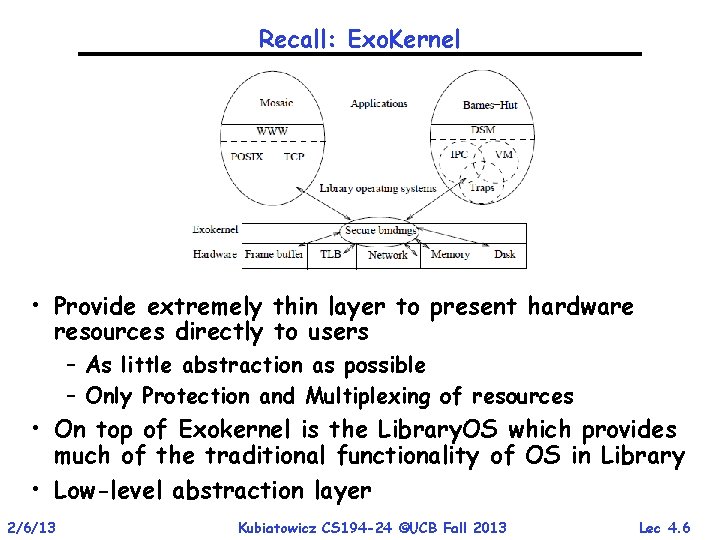
Recall: Exo. Kernel • Provide extremely thin layer to present hardware resources directly to users – As little abstraction as possible – Only Protection and Multiplexing of resources • On top of Exokernel is the Library. OS which provides much of the traditional functionality of OS in Library • Low-level abstraction layer 2/6/13 Kubiatowicz CS 194 -24 ©UCB Fall 2013 Lec 4. 6
Concurrency • “Thread” of execution – Independent Fetch/Decode/Execute loop – Operating in some Address space • Uniprogramming: one thread at a time – – MS/DOS, early Macintosh, Batch processing Easier for operating system builder Get rid concurrency by defining it away Does this make sense for personal computers? • Multiprogramming: more than one thread at a time – Multics, UNIX/Linux, OS/2, Windows NT/2000/XP, Mac OS X – Often called “multitasking”, but multitasking has other meanings (talk about this later) • Many. Core Multiprogramming, right? 2/6/13 Kubiatowicz CS 194 -24 ©UCB Fall 2013 Lec 4. 7
The Basic Problem of Concurrency • The basic problem of concurrency involves resources: – Hardware: single CPU, single DRAM, single I/O devices – Multiprogramming API: users think they have exclusive access to shared resources • OS Has to coordinate all activity – Multiple users, I/O interrupts, … – How can it keep all these things straight? • Basic Idea: Use Virtual Machine abstraction – Decompose hard problem into simpler ones – Abstract the notion of an executing program – Then, worry about multiplexing these abstract machines • Dijkstra did this for the “THE system” – Few thousand lines vs 1 million lines in OS 360 (1 K bugs) 2/6/13 Kubiatowicz CS 194 -24 ©UCB Fall 2013 Lec 4. 8
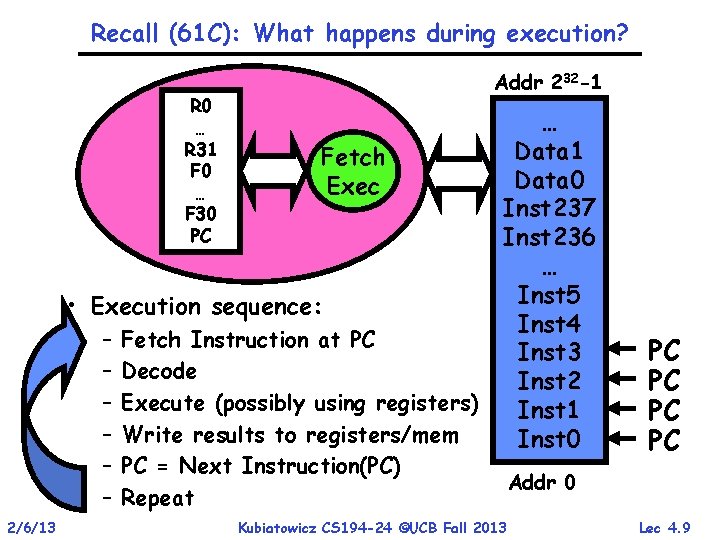
Recall (61 C): What happens during execution? R 0 … R 31 F 0 … F 30 PC Addr 232 -1 Fetch Exec • Execution sequence: – – – 2/6/13 Fetch Instruction at PC Decode Execute (possibly using registers) Write results to registers/mem PC = Next Instruction(PC) Repeat … Data 1 Data 0 Inst 237 Inst 236 … Inst 5 Inst 4 Inst 3 Inst 2 Inst 1 Inst 0 Kubiatowicz CS 194 -24 ©UCB Fall 2013 PC PC Addr 0 Lec 4. 9
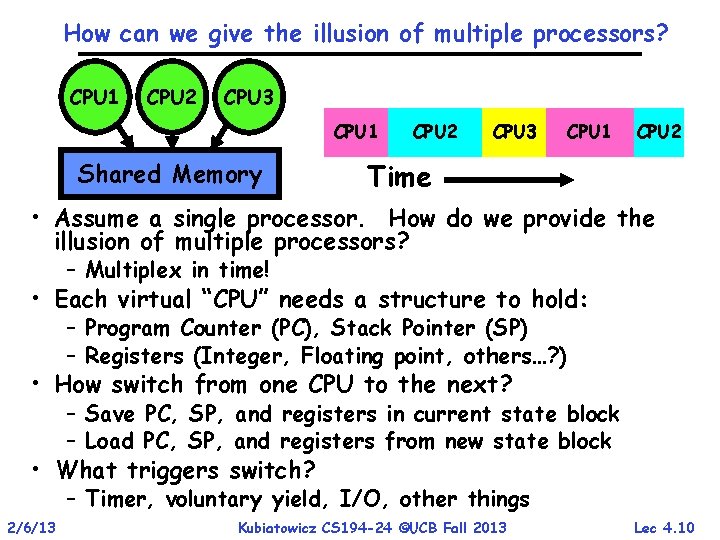
How can we give the illusion of multiple processors? CPU 1 CPU 2 CPU 3 CPU 1 Shared Memory CPU 2 CPU 3 CPU 1 CPU 2 Time • Assume a single processor. How do we provide the illusion of multiple processors? – Multiplex in time! • Each virtual “CPU” needs a structure to hold: – Program Counter (PC), Stack Pointer (SP) – Registers (Integer, Floating point, others…? ) • How switch from one CPU to the next? – Save PC, SP, and registers in current state block – Load PC, SP, and registers from new state block • What triggers switch? – Timer, voluntary yield, I/O, other things 2/6/13 Kubiatowicz CS 194 -24 ©UCB Fall 2013 Lec 4. 10
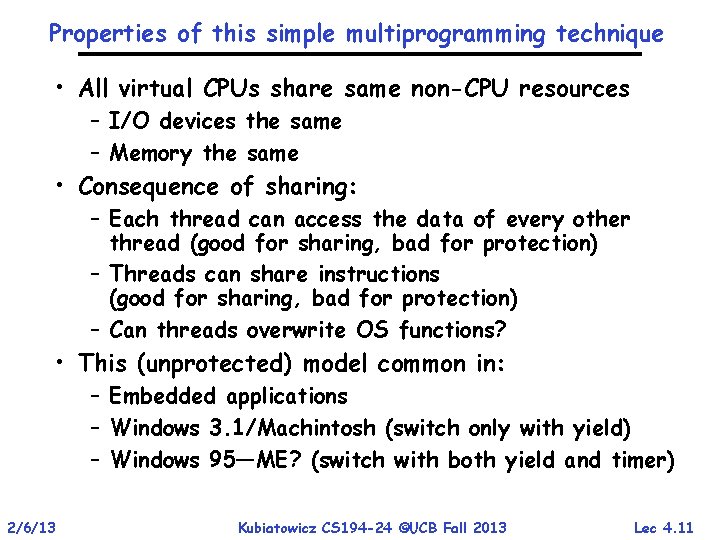
Properties of this simple multiprogramming technique • All virtual CPUs share same non-CPU resources – I/O devices the same – Memory the same • Consequence of sharing: – Each thread can access the data of every other thread (good for sharing, bad for protection) – Threads can share instructions (good for sharing, bad for protection) – Can threads overwrite OS functions? • This (unprotected) model common in: – Embedded applications – Windows 3. 1/Machintosh (switch only with yield) – Windows 95—ME? (switch with both yield and timer) 2/6/13 Kubiatowicz CS 194 -24 ©UCB Fall 2013 Lec 4. 11
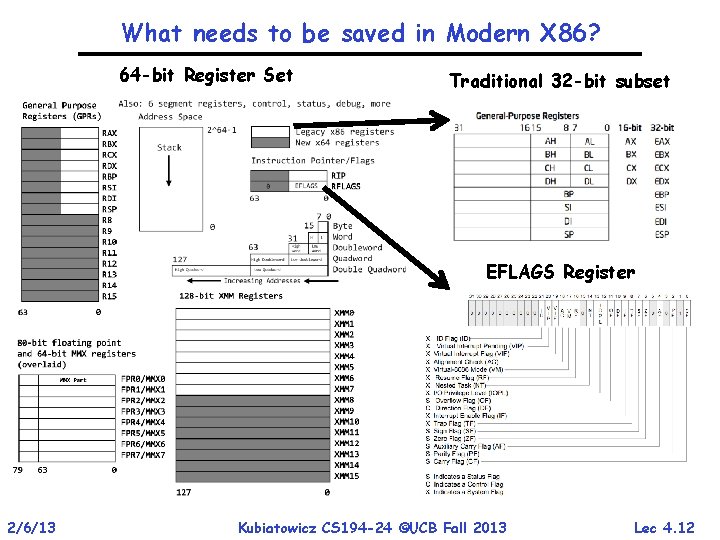
What needs to be saved in Modern X 86? 64 -bit Register Set Traditional 32 -bit subset EFLAGS Register 2/6/13 Kubiatowicz CS 194 -24 ©UCB Fall 2013 Lec 4. 12
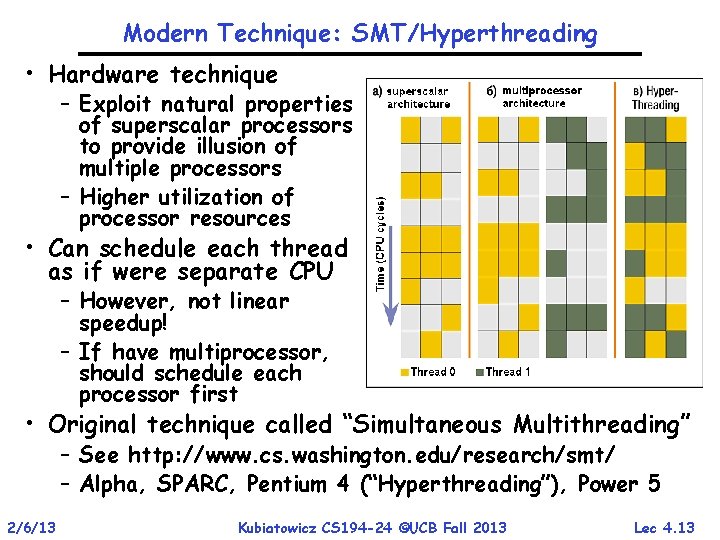
Modern Technique: SMT/Hyperthreading • Hardware technique – Exploit natural properties of superscalar processors to provide illusion of multiple processors – Higher utilization of processor resources • Can schedule each thread as if were separate CPU – However, not linear speedup! – If have multiprocessor, should schedule each processor first • Original technique called “Simultaneous Multithreading” – See http: //www. cs. washington. edu/research/smt/ – Alpha, SPARC, Pentium 4 (“Hyperthreading”), Power 5 2/6/13 Kubiatowicz CS 194 -24 ©UCB Fall 2013 Lec 4. 13
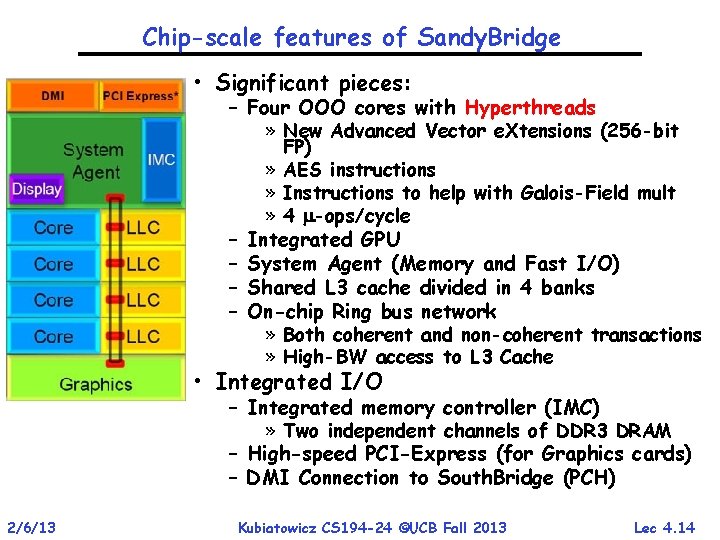
Chip-scale features of Sandy. Bridge • Significant pieces: – Four OOO cores with Hyperthreads » New Advanced Vector e. Xtensions (256 -bit – – FP) » AES instructions » Instructions to help with Galois-Field mult » 4 -ops/cycle Integrated GPU System Agent (Memory and Fast I/O) Shared L 3 cache divided in 4 banks On-chip Ring bus network » Both coherent and non-coherent transactions » High-BW access to L 3 Cache • Integrated I/O – Integrated memory controller (IMC) » Two independent channels of DDR 3 DRAM – High-speed PCI-Express (for Graphics cards) – DMI Connection to South. Bridge (PCH) 2/6/13 Kubiatowicz CS 194 -24 ©UCB Fall 2013 Lec 4. 14
How to protect threads from one another? • Need three important things: 1. Protection of memory » Every task does not have access to all memory 2. Protection of I/O devices » Every task does not have access to every device 3. Protection of Access to Processor: Preemptive switching from task to task » Use of timer » Must not be possible to disable timer from usercode 2/6/13 Kubiatowicz CS 194 -24 ©UCB Fall 2013 Lec 4. 15
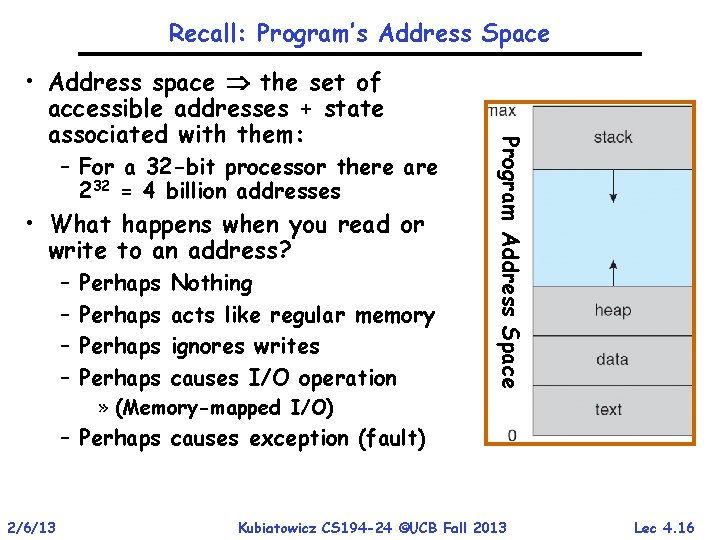
Recall: Program’s Address Space – For a 32 -bit processor there are 232 = 4 billion addresses • What happens when you read or write to an address? – – Perhaps Nothing acts like regular memory ignores writes causes I/O operation Program Address Space • Address space the set of accessible addresses + state associated with them: » (Memory-mapped I/O) – Perhaps causes exception (fault) 2/6/13 Kubiatowicz CS 194 -24 ©UCB Fall 2013 Lec 4. 16
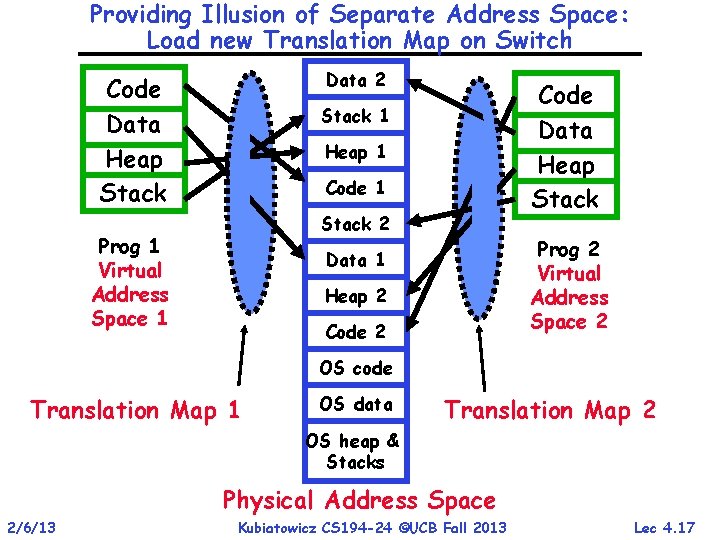
Providing Illusion of Separate Address Space: Load new Translation Map on Switch Data 2 Code Data Heap Stack 1 Heap 1 Code 1 Stack 2 Prog 1 Virtual Address Space 1 Prog 2 Virtual Address Space 2 Data 1 Heap 2 Code 2 OS code Translation Map 1 OS data Translation Map 2 OS heap & Stacks Physical Address Space 2/6/13 Kubiatowicz CS 194 -24 ©UCB Fall 2013 Lec 4. 17
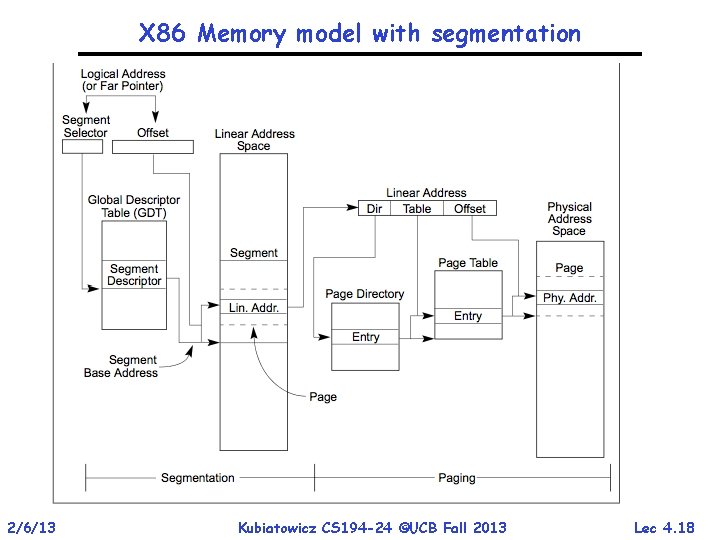
X 86 Memory model with segmentation 2/6/13 Kubiatowicz CS 194 -24 ©UCB Fall 2013 Lec 4. 18
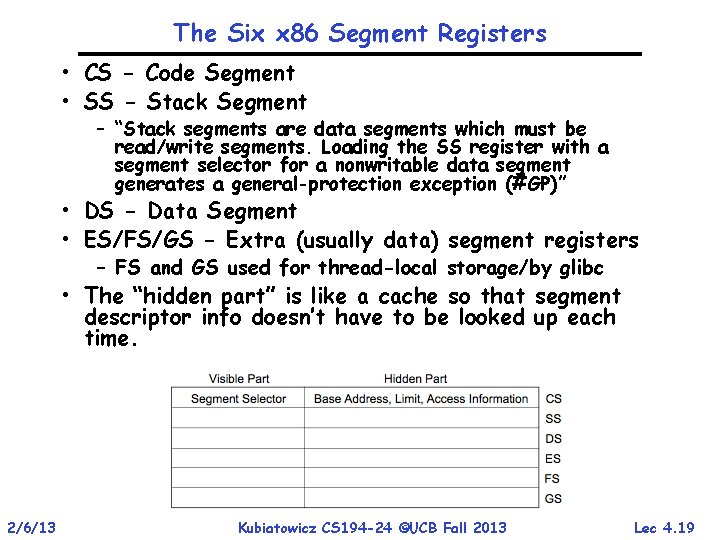
The Six x 86 Segment Registers • CS - Code Segment • SS - Stack Segment – “Stack segments are data segments which must be read/write segments. Loading the SS register with a segment selector for a nonwritable data segment generates a general-protection exception (#GP)” • DS - Data Segment • ES/FS/GS - Extra (usually data) segment registers – FS and GS used for thread-local storage/by glibc • The “hidden part” is like a cache so that segment descriptor info doesn’t have to be looked up each time. 19 2/6/13 Kubiatowicz CS 194 -24 ©UCB Fall 2013 Lec 4. 19
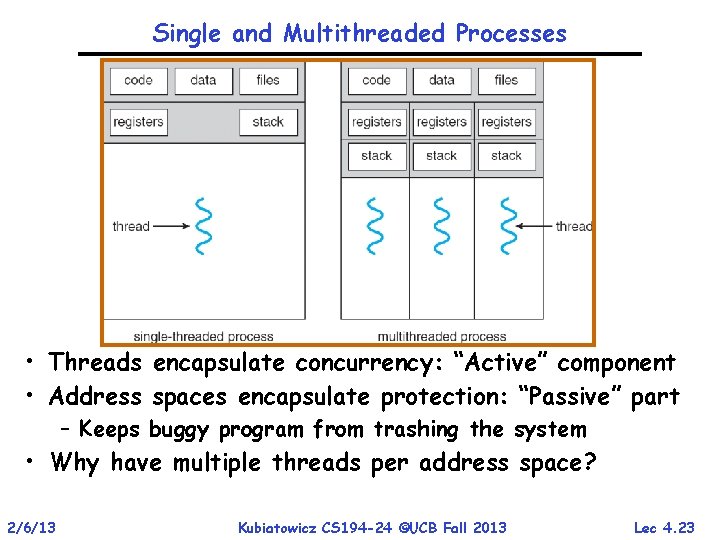
UNIX Process • Process: Operating system abstraction to represent what is needed to run a single program – Originally: a single, sequential stream of execution in its own address space – Modern Process: multiple threads in same address space! • Two parts: – Sequential Program Execution Streams » Code executed as one or more sequential stream of execution (threads) » Each thread includes its own state of CPU registers » Threads either multiplexed in software (OS) or hardware (simultaneous multithrading/hyperthreading) – Protected Resources: » Main Memory State (contents of Address Space) » I/O state (i. e. file descriptors) • This is a virtual machine abstraction – Some might say that the only point of an OS is to support a clean Process abstraction 2/6/13 Kubiatowicz CS 194 -24 ©UCB Fall 2013 Lec 4. 20
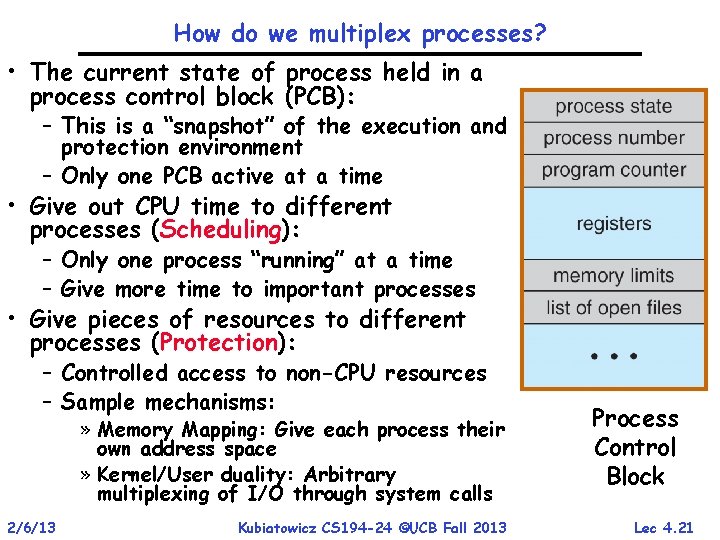
How do we multiplex processes? • The current state of process held in a process control block (PCB): – This is a “snapshot” of the execution and protection environment – Only one PCB active at a time • Give out CPU time to different processes (Scheduling): – Only one process “running” at a time – Give more time to important processes • Give pieces of resources to different processes (Protection): – Controlled access to non-CPU resources – Sample mechanisms: » Memory Mapping: Give each process their own address space » Kernel/User duality: Arbitrary multiplexing of I/O through system calls 2/6/13 Kubiatowicz CS 194 -24 ©UCB Fall 2013 Process Control Block Lec 4. 21
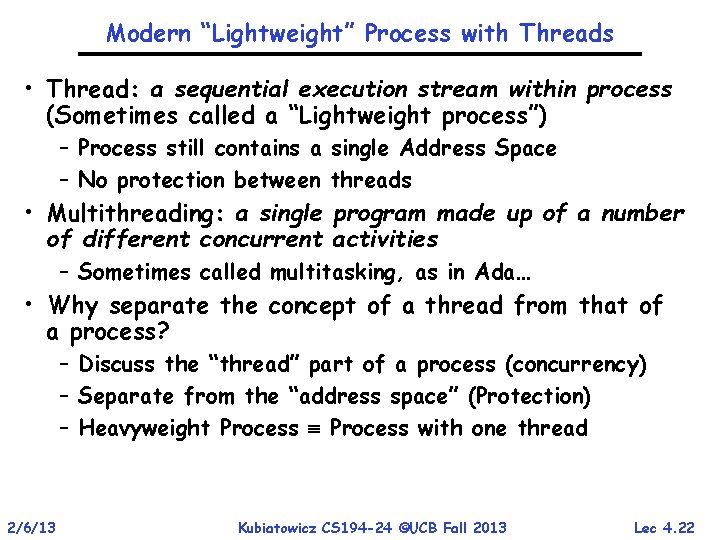
Modern “Lightweight” Process with Threads • Thread: a sequential execution stream within process (Sometimes called a “Lightweight process”) – Process still contains a single Address Space – No protection between threads • Multithreading: a single program made up of a number of different concurrent activities – Sometimes called multitasking, as in Ada… • Why separate the concept of a thread from that of a process? – Discuss the “thread” part of a process (concurrency) – Separate from the “address space” (Protection) – Heavyweight Process with one thread 2/6/13 Kubiatowicz CS 194 -24 ©UCB Fall 2013 Lec 4. 22
Single and Multithreaded Processes • Threads encapsulate concurrency: “Active” component • Address spaces encapsulate protection: “Passive” part – Keeps buggy program from trashing the system • Why have multiple threads per address space? 2/6/13 Kubiatowicz CS 194 -24 ©UCB Fall 2013 Lec 4. 23
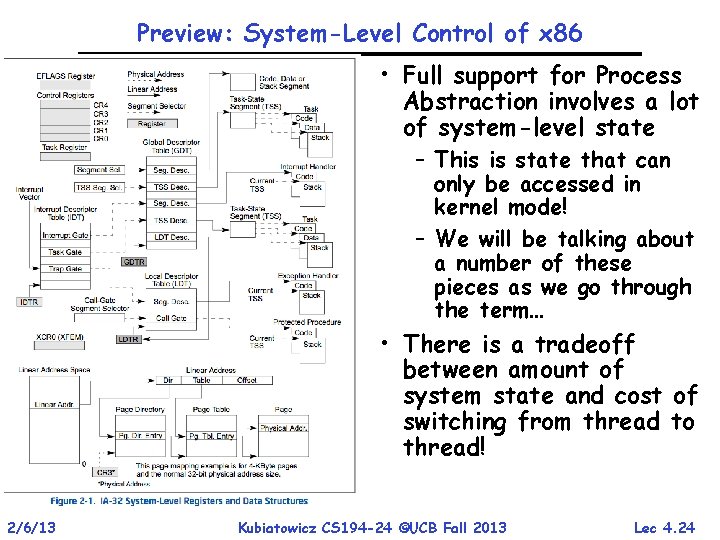
Preview: System-Level Control of x 86 • Full support for Process Abstraction involves a lot of system-level state – This is state that can only be accessed in kernel mode! – We will be talking about a number of these pieces as we go through the term… • There is a tradeoff between amount of system state and cost of switching from thread to thread! 2/6/13 Kubiatowicz CS 194 -24 ©UCB Fall 2013 Lec 4. 24
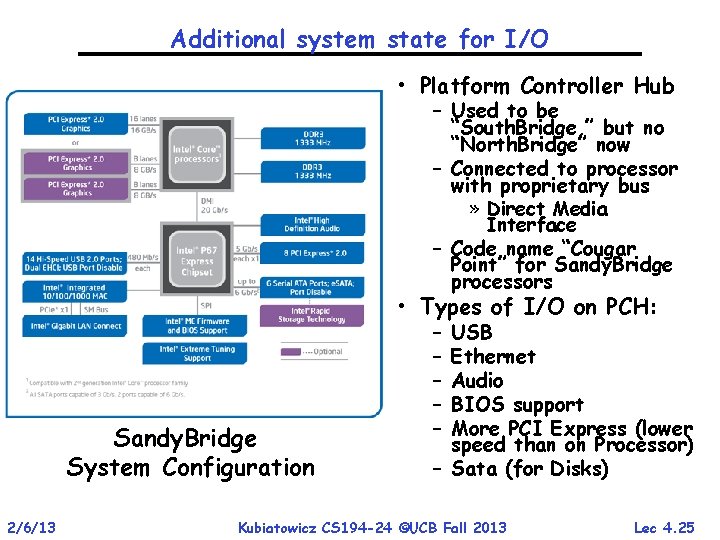
Additional system state for I/O • Platform Controller Hub – Used to be “South. Bridge, ” but no “North. Bridge” now – Connected to processor with proprietary bus » Direct Media Interface – Code name “Cougar Point” for Sandy. Bridge processors • Types of I/O on PCH: Sandy. Bridge System Configuration 2/6/13 – – – USB Ethernet Audio BIOS support More PCI Express (lower speed than on Processor) – Sata (for Disks) Kubiatowicz CS 194 -24 ©UCB Fall 2013 Lec 4. 25
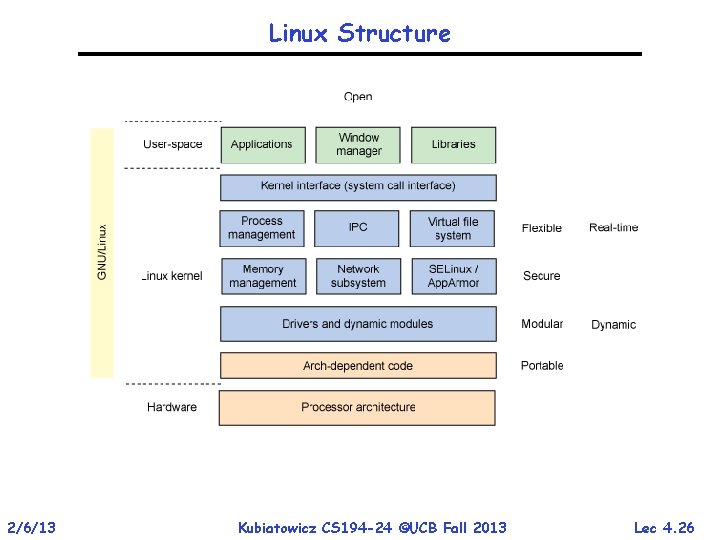
Linux Structure 2/6/13 Kubiatowicz CS 194 -24 ©UCB Fall 2013 Lec 4. 26
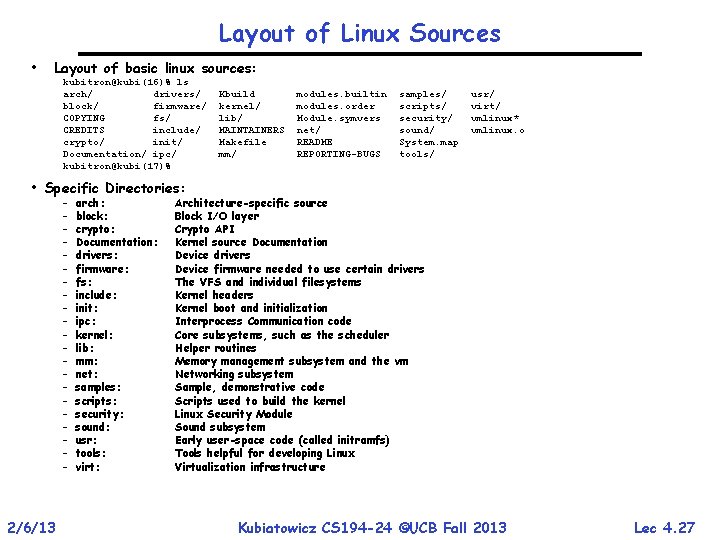
Layout of Linux Sources • Layout of basic linux sources: kubitron@kubi(16)% ls arch/ drivers/ block/ firmware/ COPYING fs/ CREDITS include/ crypto/ init/ Documentation/ ipc/ kubitron@kubi(17)% Kbuild kernel/ lib/ MAINTAINERS Makefile mm/ modules. builtin modules. order Module. symvers net/ README REPORTING-BUGS samples/ scripts/ security/ sound/ System. map tools/ usr/ virt/ vmlinux* vmlinux. o • Specific Directories: – – – – – – 2/6/13 arch: block: crypto: Documentation: drivers: firmware: fs: include: init: ipc: kernel: lib: mm: net: samples: scripts: security: sound: usr: tools: virt: Architecture-specific source Block I/O layer Crypto API Kernel source Documentation Device drivers Device firmware needed to use certain drivers The VFS and individual filesystems Kernel headers Kernel boot and initialization Interprocess Communication code Core subsystems, such as the scheduler Helper routines Memory management subsystem and the vm Networking subsystem Sample, demonstrative code Scripts used to build the kernel Linux Security Module Sound subsystem Early user-space code (called initramfs) Tools helpful for developing Linux Virtualization infrastructure Kubiatowicz CS 194 -24 ©UCB Fall 2013 Lec 4. 27
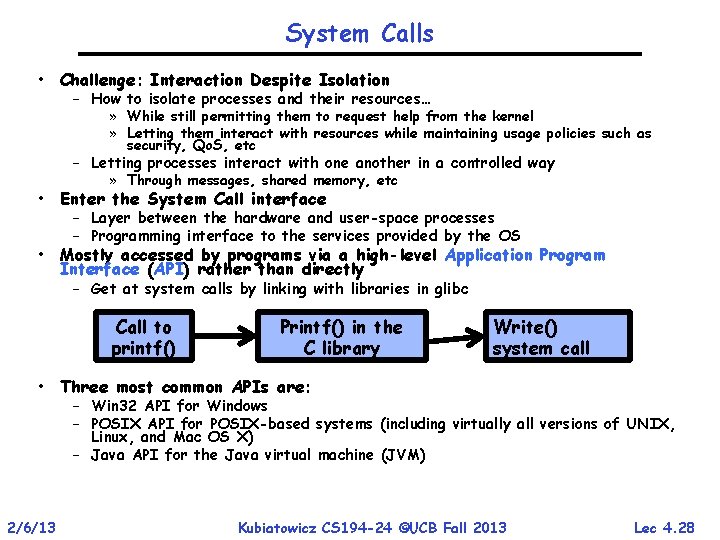
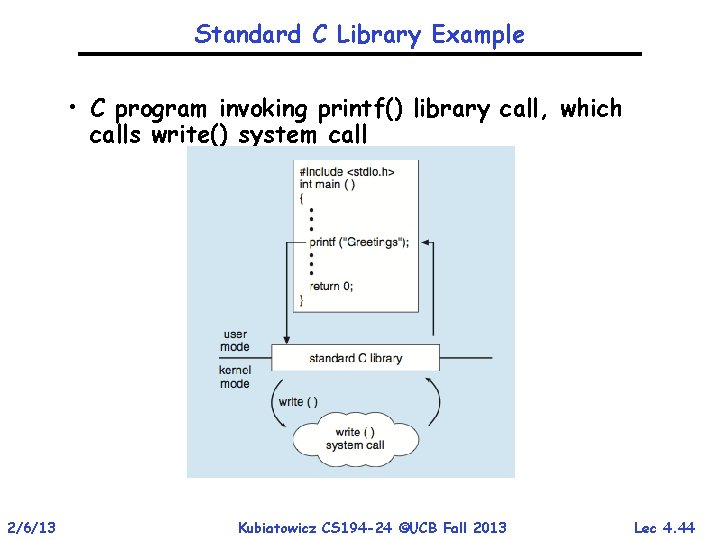
System Calls • Challenge: Interaction Despite Isolation – How to isolate processes and their resources… » While still permitting them to request help from the kernel » Letting them interact with resources while maintaining usage policies such as security, Qo. S, etc – Letting processes interact with one another in a controlled way » Through messages, shared memory, etc • Enter the System Call interface – Layer between the hardware and user-space processes – Programming interface to the services provided by the OS • Mostly accessed by programs via a high-level Application Program Interface (API) rather than directly – Get at system calls by linking with libraries in glibc Call to printf() Printf() in the C library Write() system call • Three most common APIs are: – Win 32 API for Windows – POSIX API for POSIX-based systems (including virtually all versions of UNIX, Linux, and Mac OS X) – Java API for the Java virtual machine (JVM) 2/6/13 Kubiatowicz CS 194 -24 ©UCB Fall 2013 Lec 4. 28
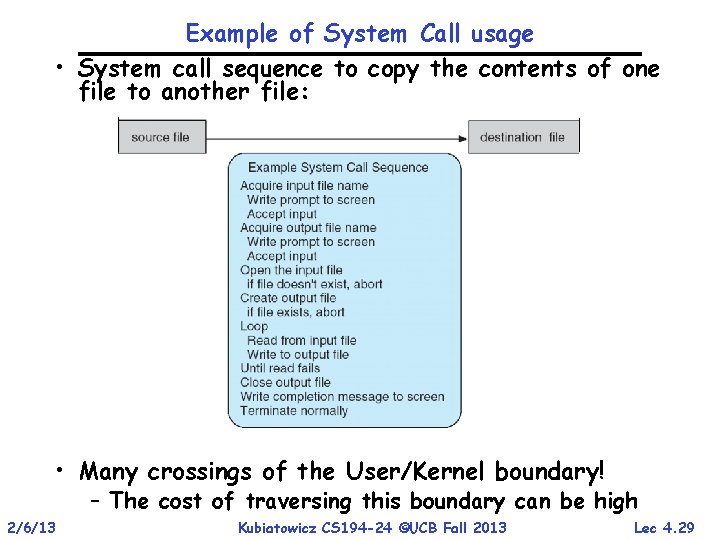
Example of System Call usage • System call sequence to copy the contents of one file to another file: • Many crossings of the User/Kernel boundary! – The cost of traversing this boundary can be high 2/6/13 Kubiatowicz CS 194 -24 ©UCB Fall 2013 Lec 4. 29
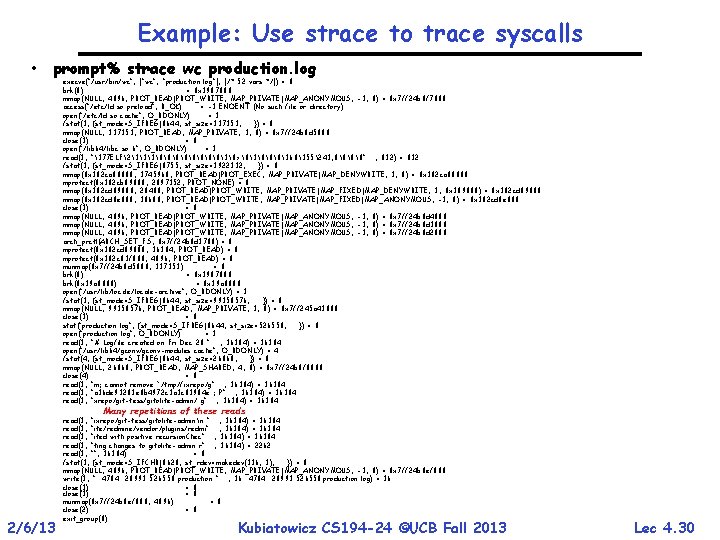
Example: Use strace to trace syscalls • prompt% strace wc production. log execve("/usr/bin/wc", ["wc", "production. log"], [/* 52 vars */]) = 0 brk(0) = 0 x 1987000 mmap(NULL, 4096, PROT_READ|PROT_WRITE, MAP_PRIVATE|MAP_ANONYMOUS, -1, 0) = 0 x 7 ff 24 b 8 f 7000 access("/etc/ld. so. preload", R_OK) = -1 ENOENT (No such file or directory) open("/etc/ld. so. cache", O_RDONLY) = 3 fstat(3, {st_mode=S_IFREG|0644, st_size=137151, . . . }) = 0 mmap(NULL, 137151, PROT_READ, MAP_PRIVATE, 3, 0) = 0 x 7 ff 24 b 8 d 5000 close(3) = 0 open("/lib 64/libc. so. 6", O_RDONLY) = 3 read(3, "177 ELF21133>1360355241, 0". . . , 832) = 832 fstat(3, {st_mode=S_IFREG|0755, st_size=1922112, . . . }) = 0 mmap(0 x 302 ca 00000, 3745960, PROT_READ|PROT_EXEC, MAP_PRIVATE|MAP_DENYWRITE, 3, 0) = 0 x 302 ca 00000 mprotect(0 x 302 cb 89000, 2097152, PROT_NONE) = 0 mmap(0 x 302 cd 89000, 20480, PROT_READ|PROT_WRITE, MAP_PRIVATE|MAP_FIXED|MAP_DENYWRITE, 3, 0 x 189000) = 0 x 302 cd 89000 mmap(0 x 302 cd 8 e 000, 18600, PROT_READ|PROT_WRITE, MAP_PRIVATE|MAP_FIXED|MAP_ANONYMOUS, -1, 0) = 0 x 302 cd 8 e 000 close(3) = 0 mmap(NULL, 4096, PROT_READ|PROT_WRITE, MAP_PRIVATE|MAP_ANONYMOUS, -1, 0) = 0 x 7 ff 24 b 8 d 4000 mmap(NULL, 4096, PROT_READ|PROT_WRITE, MAP_PRIVATE|MAP_ANONYMOUS, -1, 0) = 0 x 7 ff 24 b 8 d 3000 mmap(NULL, 4096, PROT_READ|PROT_WRITE, MAP_PRIVATE|MAP_ANONYMOUS, -1, 0) = 0 x 7 ff 24 b 8 d 2000 arch_prctl(ARCH_SET_FS, 0 x 7 ff 24 b 8 d 3700) = 0 mprotect(0 x 302 cd 89000, 16384, PROT_READ) = 0 mprotect(0 x 302 c 81 f 000, 4096, PROT_READ) = 0 munmap(0 x 7 ff 24 b 8 d 5000, 137151) = 0 brk(0) = 0 x 1987000 brk(0 x 19 a 8000) = 0 x 19 a 8000 open("/usr/lib/locale-archive", O_RDONLY) = 3 fstat(3, {st_mode=S_IFREG|0644, st_size=99158576, . . . }) = 0 mmap(NULL, 99158576, PROT_READ, MAP_PRIVATE, 3, 0) = 0 x 7 ff 245 a 41000 close(3) = 0 stat("production. log", {st_mode=S_IFREG|0644, st_size=526550, . . . }) = 0 open("production. log", O_RDONLY) = 3 read(3, "# Logfile created on Fri Dec 28 ". . . , 16384) = 16384 open("/usr/lib 64/gconv-modules. cache", O_RDONLY) = 4 fstat(4, {st_mode=S_IFREG|0644, st_size=26060, . . . }) = 0 mmap(NULL, 26060, PROT_READ, MAP_SHARED, 4, 0) = 0 x 7 ff 24 b 8 f 0000 close(4) = 0 read(3, "m: cannot remove `/tmp/fixrepo/g". . . , 16384) = 16384 read(3, "a 36 de 93203 e 0 b 4972 c 1 a 3 c 81904 e': P". . . , 16384) = 16384 read(3, "xrepo/git-tess/gitolite-admin/. g". . . , 16384) = 16384 Many repetitions of these reads 2/6/13 read(3, "ixrepo/git-tess/gitolite-adminn ". . . , 16384) = 16384 read(3, "ite/redmine/vendor/plugins/redmi". . . , 16384) = 16384 read(3, "ited with positive recursion. Chec". . . , 16384) = 16384 read(3, "ting changes to gitolite-admin r". . . , 16384) = 2262 read(3, "", 16384) = 0 fstat(1, {st_mode=S_IFCHR|0620, st_rdev=makedev(136, 3), . . . }) = 0 mmap(NULL, 4096, PROT_READ|PROT_WRITE, MAP_PRIVATE|MAP_ANONYMOUS, -1, 0) = 0 x 7 ff 24 b 8 ef 000 write(1, " 4704 28993 526550 production. ". . . , 36 4704 28993 526550 production. log) = 36 close(3) = 0 close(1) = 0 munmap(0 x 7 ff 24 b 8 ef 000, 4096) = 0 close(2) = 0 exit_group(0) Kubiatowicz CS 194 -24 ©UCB Fall 2013 Lec 4. 30
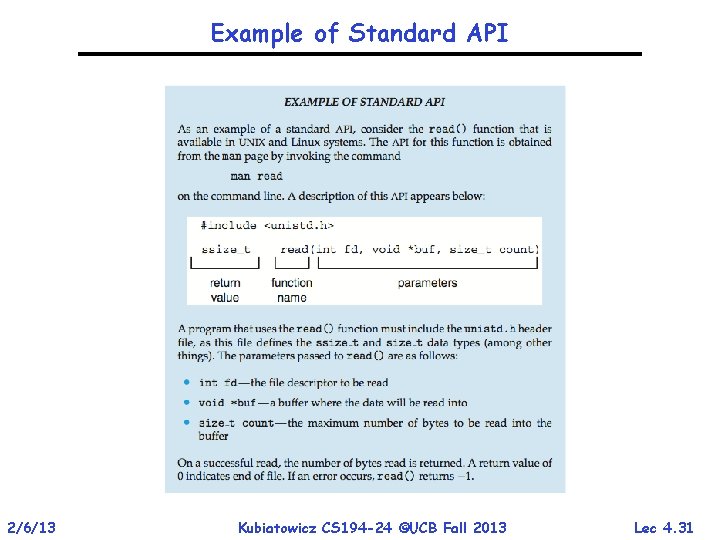
Example of Standard API 2/6/13 Kubiatowicz CS 194 -24 ©UCB Fall 2013 Lec 4. 31
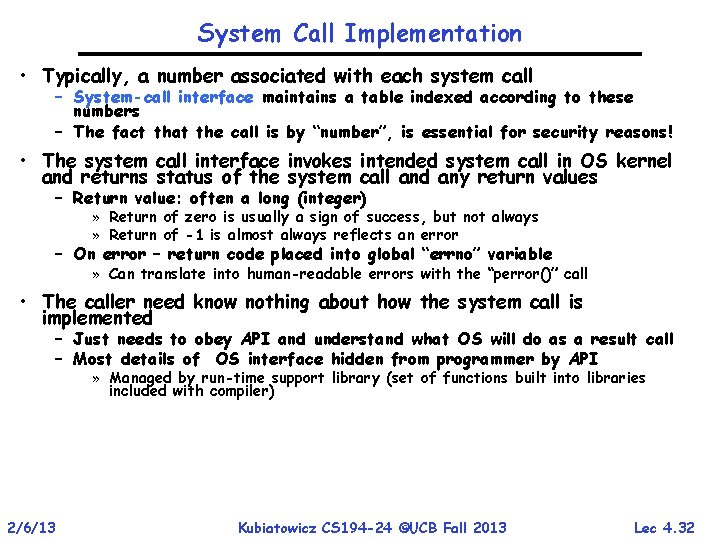
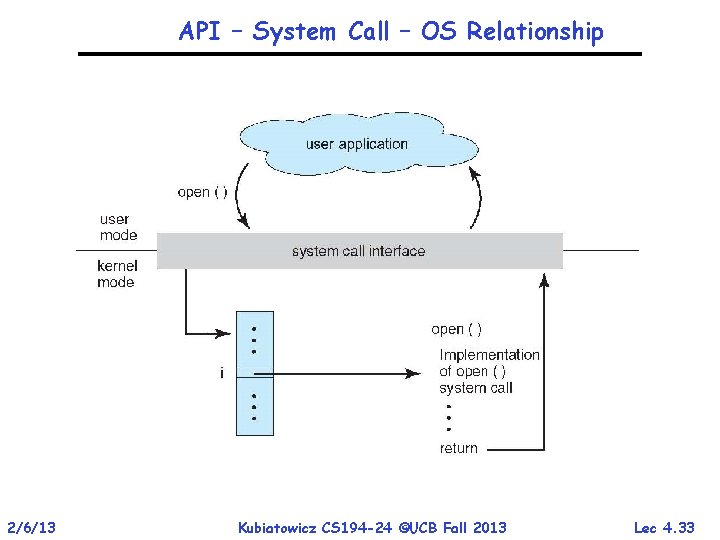
System Call Implementation • Typically, a number associated with each system call – System-call interface maintains a table indexed according to these numbers – The fact that the call is by “number”, is essential for security reasons! • The system call interface invokes intended system call in OS kernel and returns status of the system call and any return values – Return value: often a long (integer) » Return of zero is usually a sign of success, but not always » Return of -1 is almost always reflects an error – On error – return code placed into global “errno” variable » Can translate into human-readable errors with the “perror()” call • The caller need know nothing about how the system call is implemented – Just needs to obey API and understand what OS will do as a result call – Most details of OS interface hidden from programmer by API » Managed by run-time support library (set of functions built into libraries included with compiler) 2/6/13 Kubiatowicz CS 194 -24 ©UCB Fall 2013 Lec 4. 32
API – System Call – OS Relationship 2/6/13 Kubiatowicz CS 194 -24 ©UCB Fall 2013 Lec 4. 33
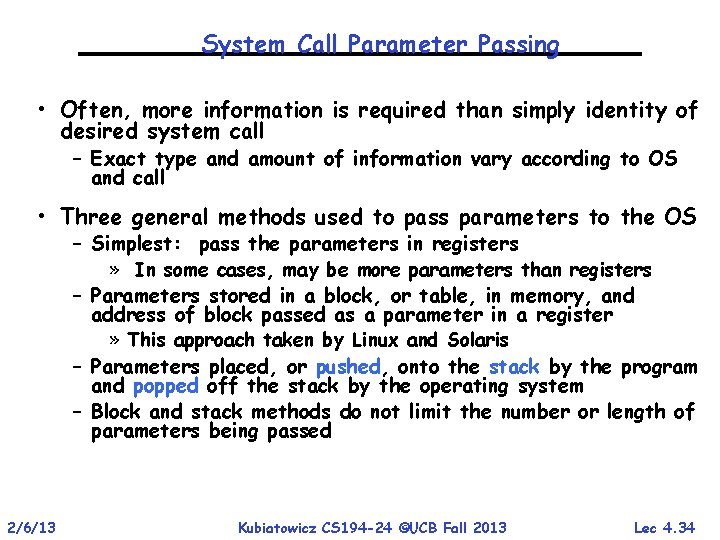
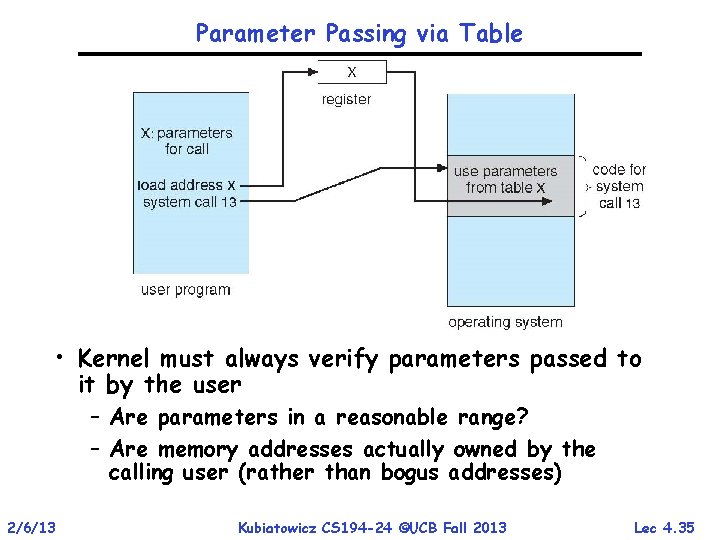
System Call Parameter Passing • Often, more information is required than simply identity of desired system call – Exact type and amount of information vary according to OS and call • Three general methods used to pass parameters to the OS – Simplest: pass the parameters in registers » In some cases, may be more parameters than registers – Parameters stored in a block, or table, in memory, and address of block passed as a parameter in a register » This approach taken by Linux and Solaris – Parameters placed, or pushed, onto the stack by the program and popped off the stack by the operating system – Block and stack methods do not limit the number or length of parameters being passed 2/6/13 Kubiatowicz CS 194 -24 ©UCB Fall 2013 Lec 4. 34
Parameter Passing via Table • Kernel must always verify parameters passed to it by the user – Are parameters in a reasonable range? – Are memory addresses actually owned by the calling user (rather than bogus addresses) 2/6/13 Kubiatowicz CS 194 -24 ©UCB Fall 2013 Lec 4. 35
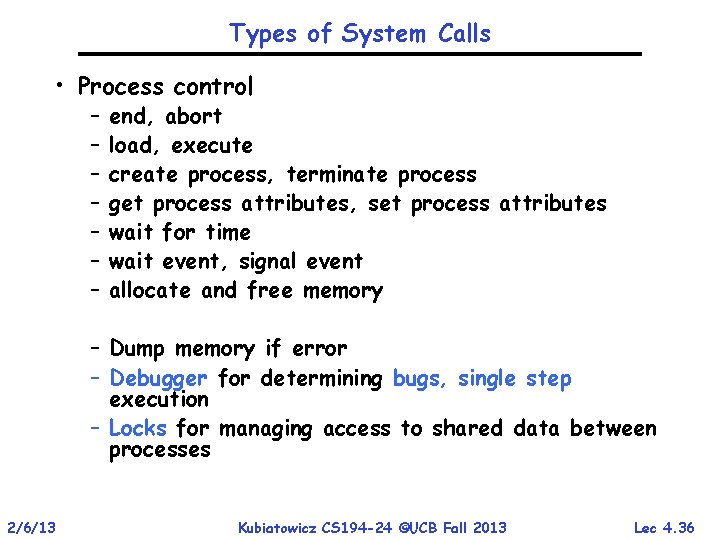
Types of System Calls • Process control – – – – end, abort load, execute create process, terminate process get process attributes, set process attributes wait for time wait event, signal event allocate and free memory – Dump memory if error – Debugger for determining bugs, single step execution – Locks for managing access to shared data between processes 2/6/13 Kubiatowicz CS 194 -24 ©UCB Fall 2013 Lec 4. 36
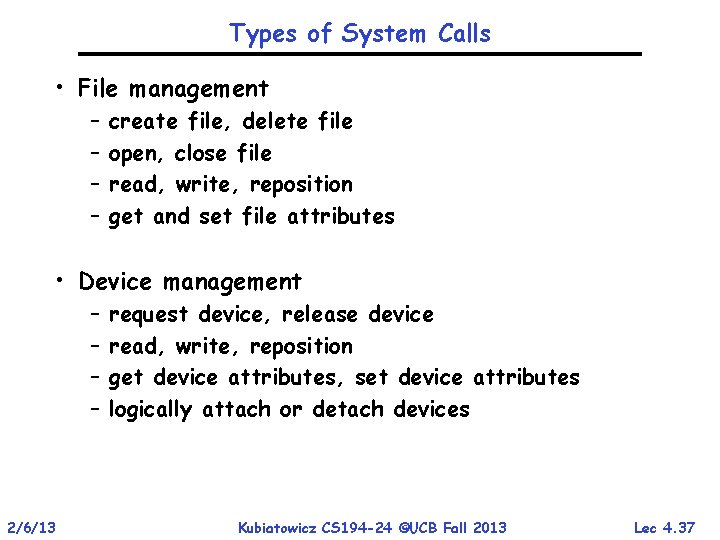
Types of System Calls • File management – – create file, delete file open, close file read, write, reposition get and set file attributes • Device management – – 2/6/13 request device, release device read, write, reposition get device attributes, set device attributes logically attach or detach devices Kubiatowicz CS 194 -24 ©UCB Fall 2013 Lec 4. 37
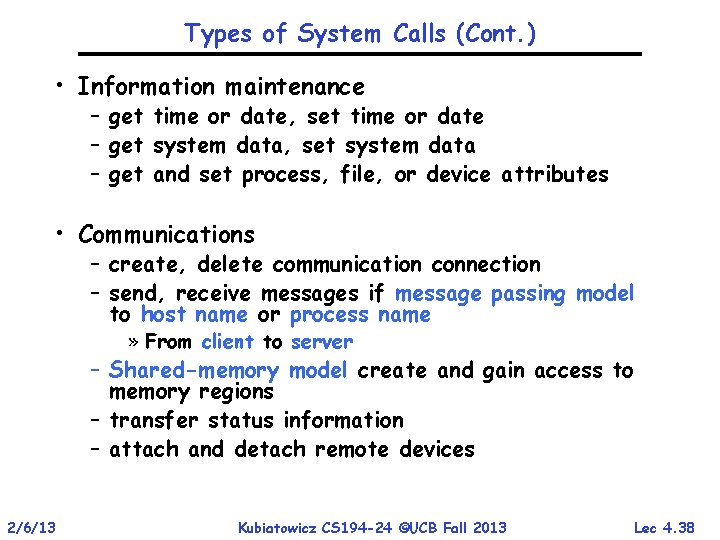
Types of System Calls (Cont. ) • Information maintenance – get time or date, set time or date – get system data, set system data – get and set process, file, or device attributes • Communications – create, delete communication connection – send, receive messages if message passing model to host name or process name » From client to server – Shared-memory model create and gain access to memory regions – transfer status information – attach and detach remote devices 2/6/13 Kubiatowicz CS 194 -24 ©UCB Fall 2013 Lec 4. 38
Types of System Calls (Cont. ) • Protection – Control access to resources – Get and set permissions – Allow and deny user access 2/6/13 Kubiatowicz CS 194 -24 ©UCB Fall 2013 Lec 4. 39
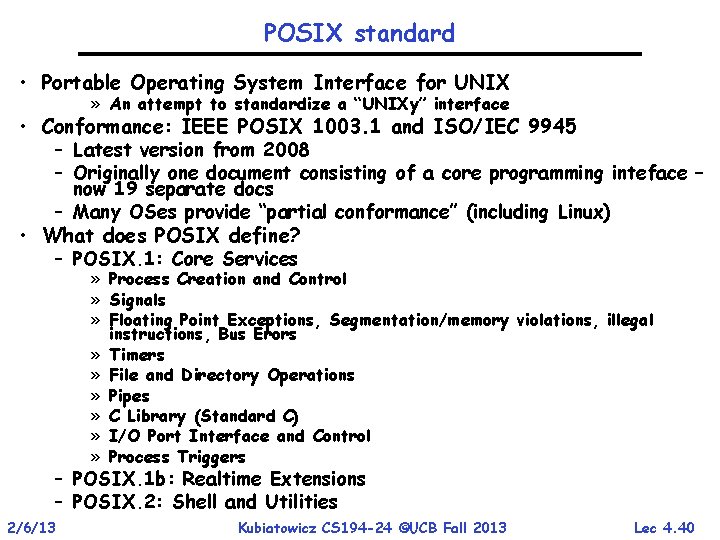
POSIX standard • Portable Operating System Interface for UNIX » An attempt to standardize a “UNIXy” interface • Conformance: IEEE POSIX 1003. 1 and ISO/IEC 9945 – Latest version from 2008 – Originally one document consisting of a core programming inteface – now 19 separate docs – Many OSes provide “partial conformance” (including Linux) • What does POSIX define? – POSIX. 1: Core Services » Process Creation and Control » Signals » Floating Point Exceptions, Segmentation/memory violations, illegal instructions, Bus Erors » Timers » File and Directory Operations » Pipes » C Library (Standard C) » I/O Port Interface and Control » Process Triggers – POSIX. 1 b: Realtime Extensions – POSIX. 2: Shell and Utilities 2/6/13 Kubiatowicz CS 194 -24 ©UCB Fall 2013 Lec 4. 40
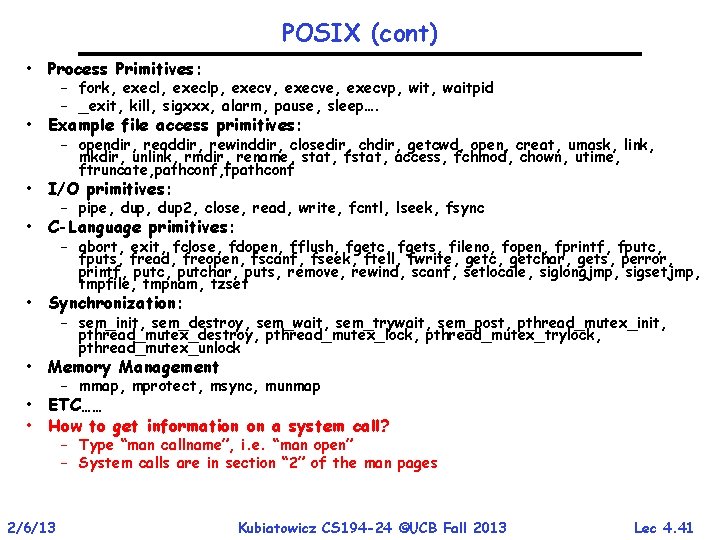
POSIX (cont) • Process Primitives: – fork, execlp, execve, execvp, wit, waitpid – _exit, kill, sigxxx, alarm, pause, sleep…. • Example file access primitives: – opendir, readdir, rewinddir, closedir, chdir, getcwd, open, creat, umask, link, mkdir, unlink, rmdir, rename, stat, fstat, access, fchmod, chown, utime, ftruncate, pathconf, fpathconf • I/O primitives: – pipe, dup 2, close, read, write, fcntl, lseek, fsync • C-Language primitives: – abort, exit, fclose, fdopen, fflush, fgetc, fgets, fileno, fopen, fprintf, fputc, fputs, fread, freopen, fscanf, fseek, ftell, fwrite, getchar, gets, perror, printf, putchar, puts, remove, rewind, scanf, setlocale, siglongjmp, sigsetjmp, tmpfile, tmpnam, tzset • Synchronization: – sem_init, sem_destroy, sem_wait, sem_trywait, sem_post, pthread_mutex_init, pthread_mutex_destroy, pthread_mutex_lock, pthread_mutex_trylock, pthread_mutex_unlock • Memory Management – mmap, mprotect, msync, munmap • ETC…… • How to get information on a system call? – Type “man callname”, i. e. “man open” – System calls are in section “ 2” of the man pages 2/6/13 Kubiatowicz CS 194 -24 ©UCB Fall 2013 Lec 4. 41
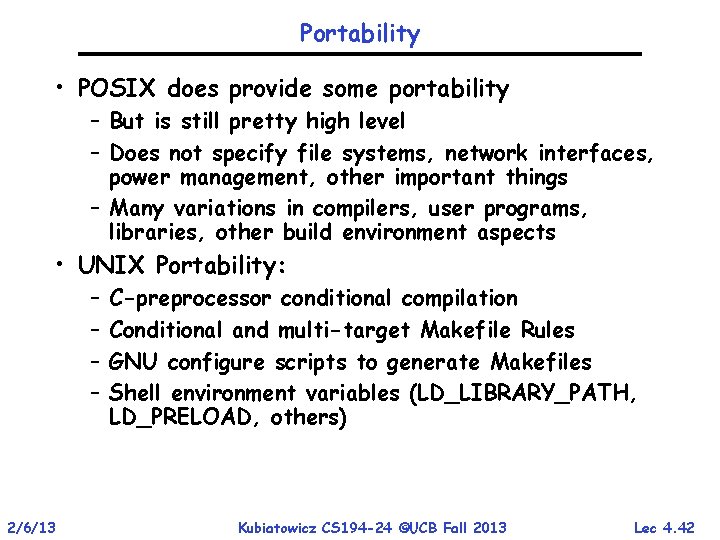
Portability • POSIX does provide some portability – But is still pretty high level – Does not specify file systems, network interfaces, power management, other important things – Many variations in compilers, user programs, libraries, other build environment aspects • UNIX Portability: – – 2/6/13 C-preprocessor conditional compilation Conditional and multi-target Makefile Rules GNU configure scripts to generate Makefiles Shell environment variables (LD_LIBRARY_PATH, LD_PRELOAD, others) Kubiatowicz CS 194 -24 ©UCB Fall 2013 Lec 4. 42
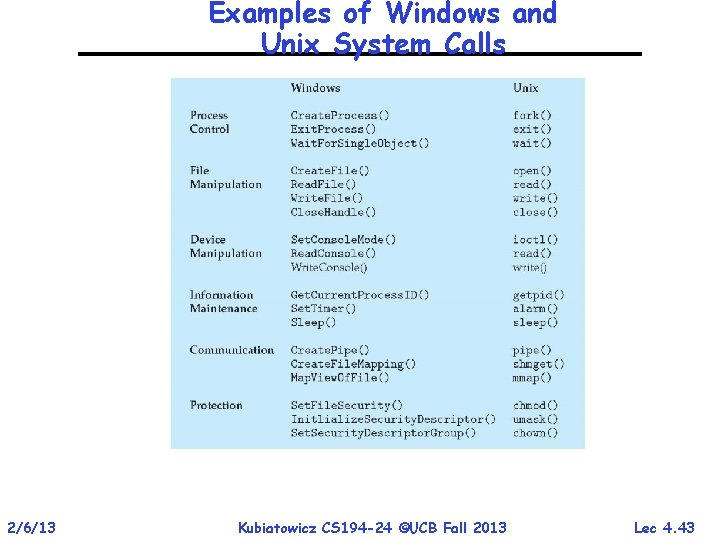
Examples of Windows and Unix System Calls 2/6/13 Kubiatowicz CS 194 -24 ©UCB Fall 2013 Lec 4. 43
Standard C Library Example • C program invoking printf() library call, which calls write() system call 2/6/13 Kubiatowicz CS 194 -24 ©UCB Fall 2013 Lec 4. 44
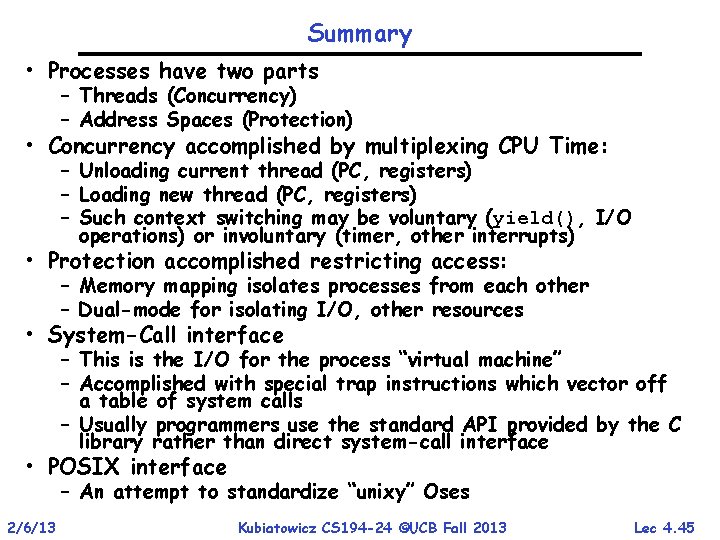
Summary • Processes have two parts – Threads (Concurrency) – Address Spaces (Protection) • Concurrency accomplished by multiplexing CPU Time: – Unloading current thread (PC, registers) – Loading new thread (PC, registers) – Such context switching may be voluntary (yield(), I/O operations) or involuntary (timer, other interrupts) • Protection accomplished restricting access: – Memory mapping isolates processes from each other – Dual-mode for isolating I/O, other resources • System-Call interface – This is the I/O for the process “virtual machine” – Accomplished with special trap instructions which vector off a table of system calls – Usually programmers use the standard API provided by the C library rather than direct system-call interface • POSIX interface – An attempt to standardize “unixy” Oses 2/6/13 Kubiatowicz CS 194 -24 ©UCB Fall 2013 Lec 4. 45