
CS 188 Artificial Intelligence Spring 2006 Lecture 7

- Slides: 43
CS 188: Artificial Intelligence Spring 2006 Lecture 7: CSPs II 2/7/2006 Dan Klein – UC Berkeley Many slides from either Stuart Russell or Andrew Moore
Today § More CSPs § Applications § Tree Algorithms § Cutset Conditioning § Local Search
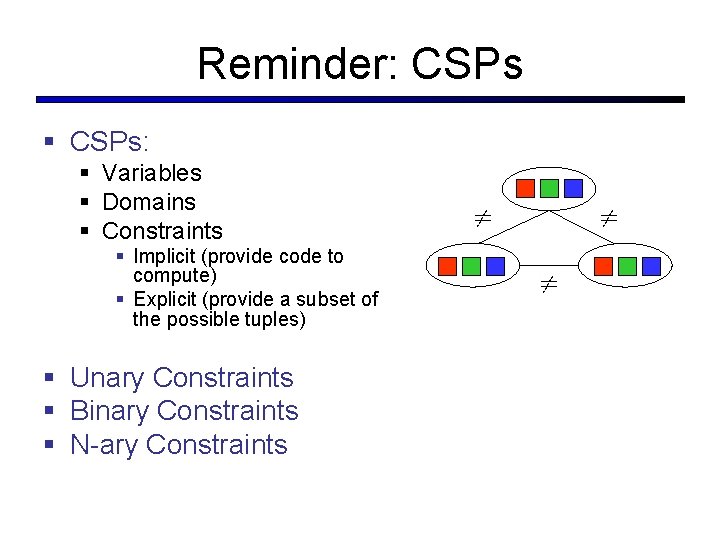
Reminder: CSPs § CSPs: § Variables § Domains § Constraints § Implicit (provide code to compute) § Explicit (provide a subset of the possible tuples) § Unary Constraints § Binary Constraints § N-ary Constraints
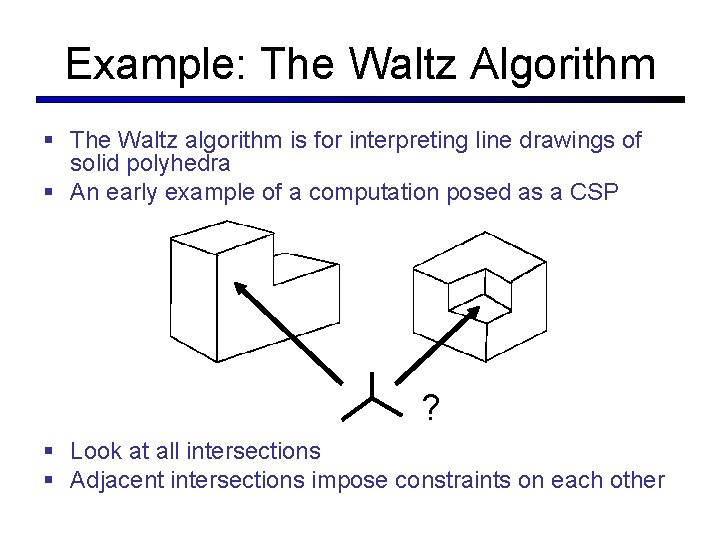
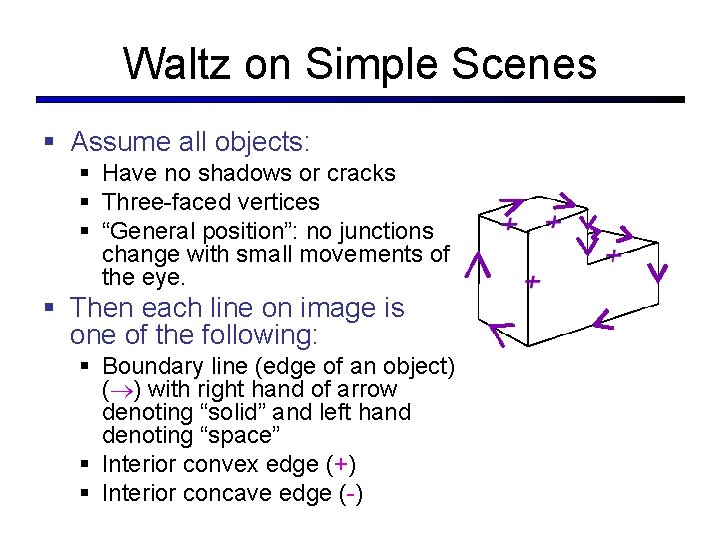
Example: The Waltz Algorithm § The Waltz algorithm is for interpreting line drawings of solid polyhedra § An early example of a computation posed as a CSP ? § Look at all intersections § Adjacent intersections impose constraints on each other
Waltz on Simple Scenes § Assume all objects: § Have no shadows or cracks § Three-faced vertices § “General position”: no junctions change with small movements of the eye. § Then each line on image is one of the following: § Boundary line (edge of an object) ( ) with right hand of arrow denoting “solid” and left hand denoting “space” § Interior convex edge (+) § Interior concave edge (-)
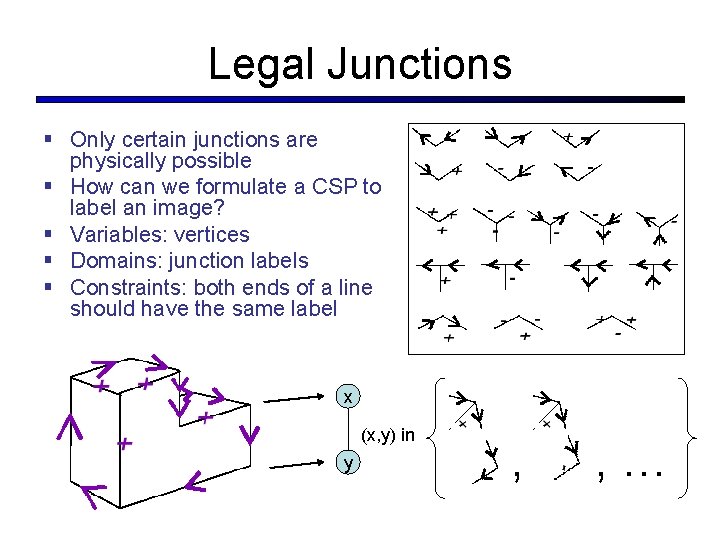
Legal Junctions § Only certain junctions are physically possible § How can we formulate a CSP to label an image? § Variables: vertices § Domains: junction labels § Constraints: both ends of a line should have the same label x (x, y) in y , , …
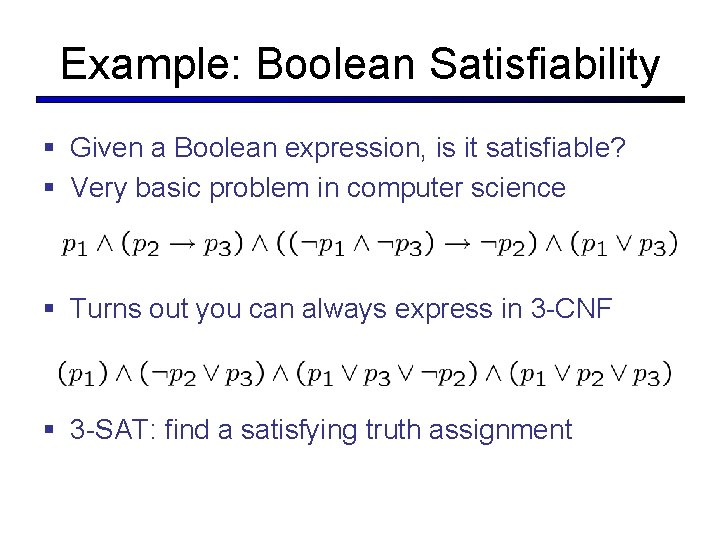
Example: Boolean Satisfiability § Given a Boolean expression, is it satisfiable? § Very basic problem in computer science § Turns out you can always express in 3 -CNF § 3 -SAT: find a satisfying truth assignment
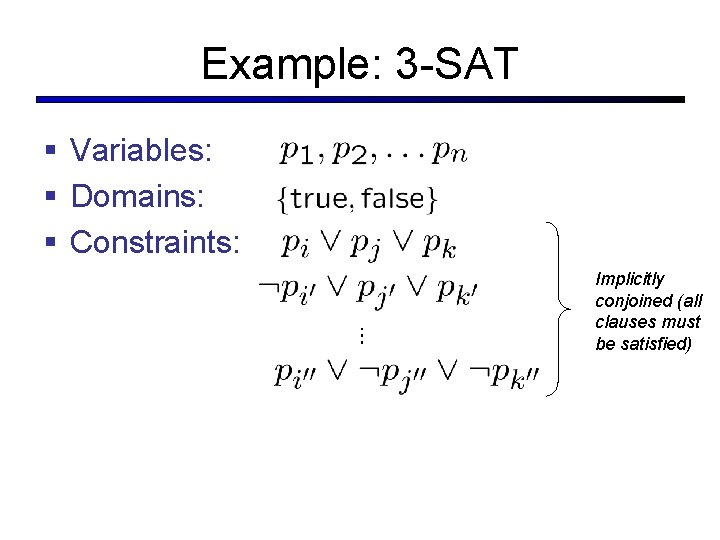
Example: 3 -SAT § Variables: § Domains: § Constraints: Implicitly conjoined (all clauses must be satisfied)
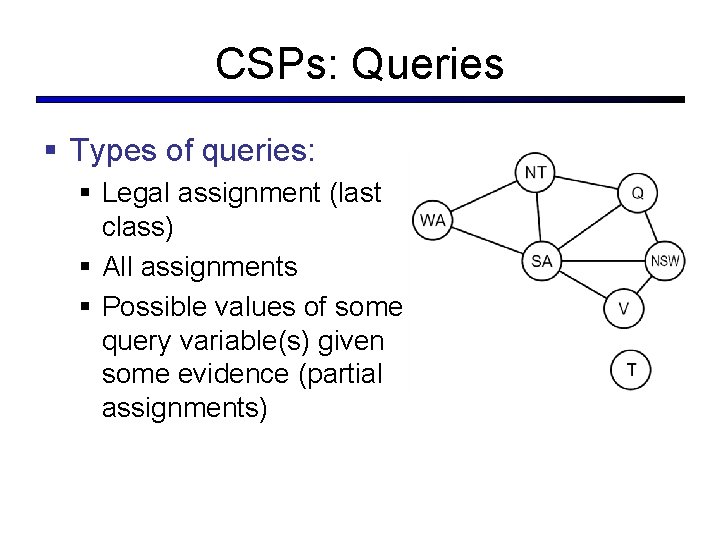
CSPs: Queries § Types of queries: § Legal assignment (last class) § All assignments § Possible values of some query variable(s) given some evidence (partial assignments)
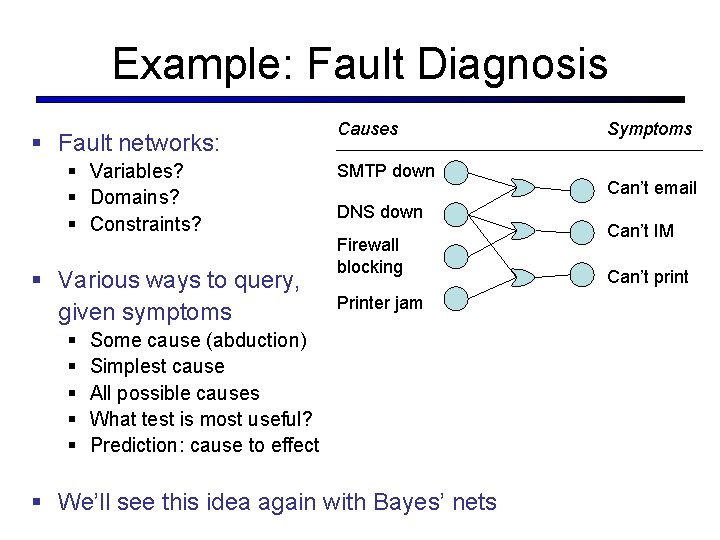
Example: Fault Diagnosis § Fault networks: § Variables? § Domains? § Constraints? § Various ways to query, given symptoms § § § Causes SMTP down DNS down Firewall blocking Printer jam Some cause (abduction) Simplest cause All possible causes What test is most useful? Prediction: cause to effect § We’ll see this idea again with Bayes’ nets Symptoms Can’t email Can’t IM Can’t print
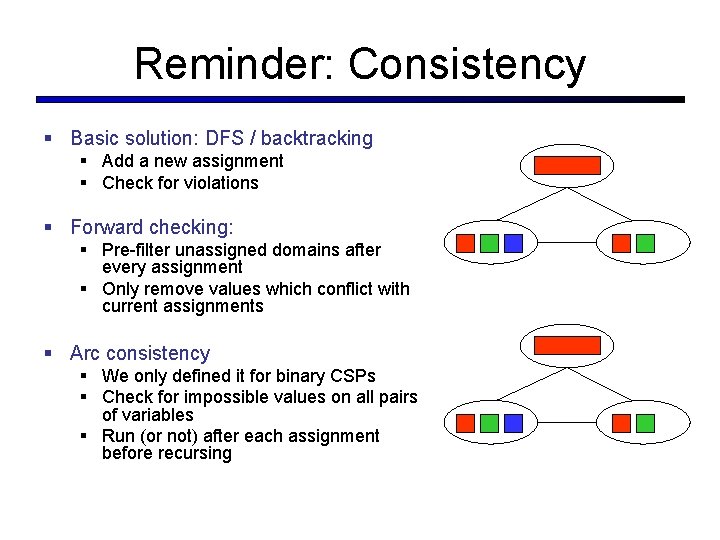
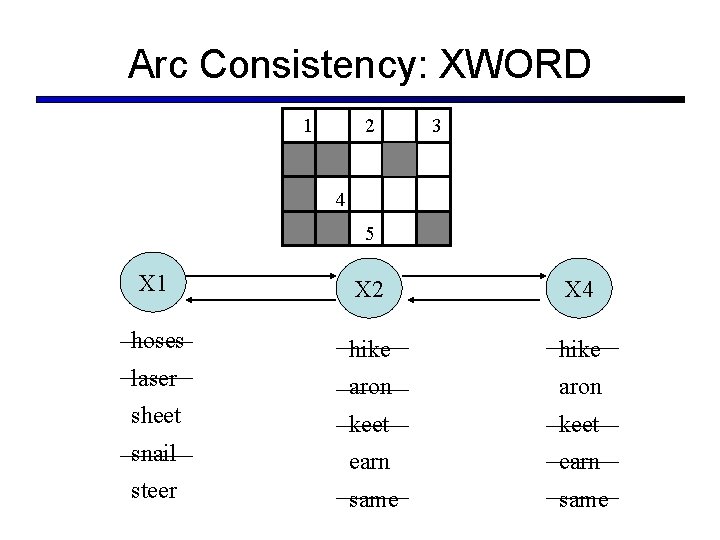
Reminder: Consistency § Basic solution: DFS / backtracking § Add a new assignment § Check for violations § Forward checking: § Pre-filter unassigned domains after every assignment § Only remove values which conflict with current assignments § Arc consistency § We only defined it for binary CSPs § Check for impossible values on all pairs of variables § Run (or not) after each assignment before recursing
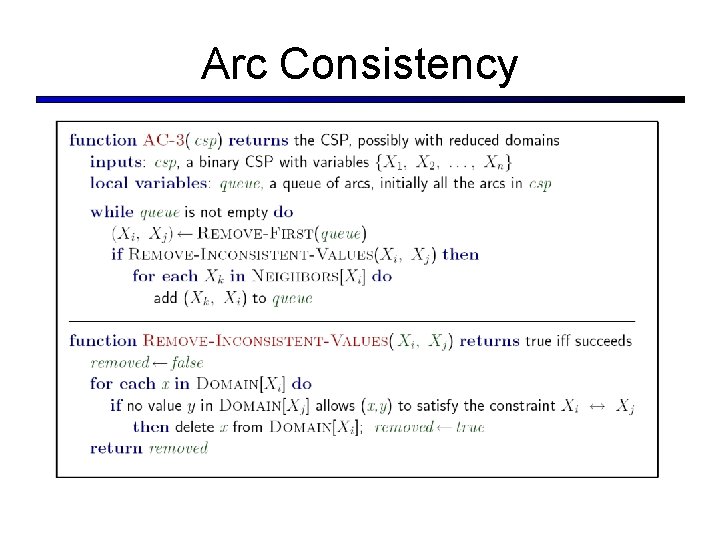
Arc Consistency
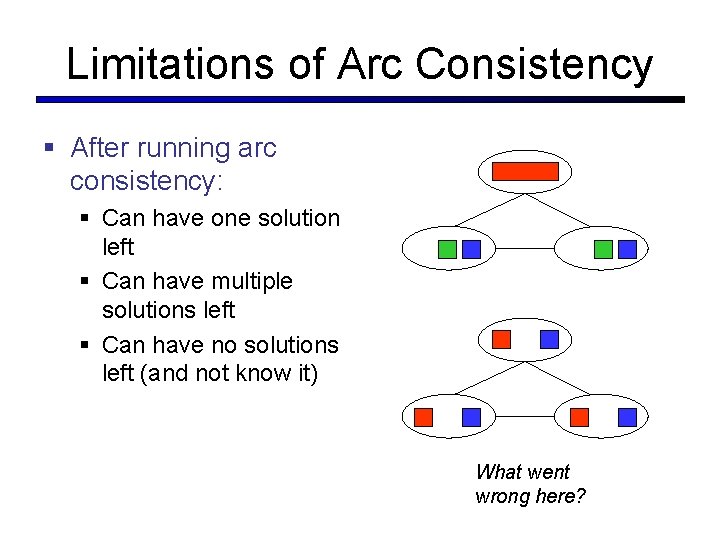
Limitations of Arc Consistency § After running arc consistency: § Can have one solution left § Can have multiple solutions left § Can have no solutions left (and not know it) What went wrong here?
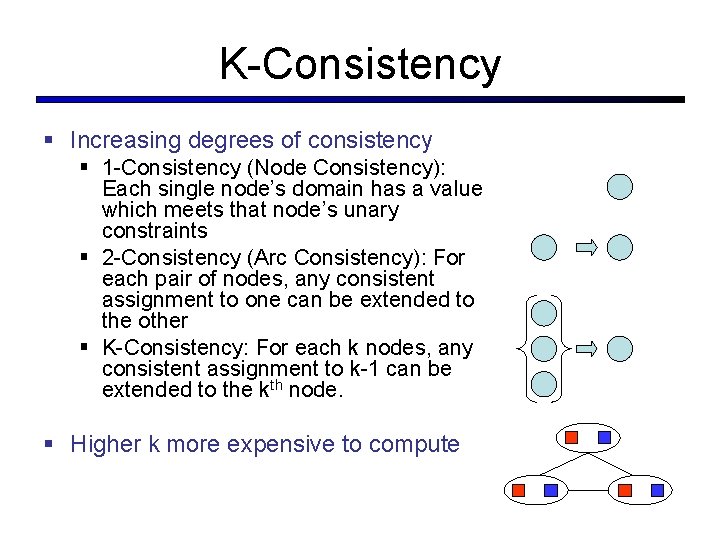
K-Consistency § Increasing degrees of consistency § 1 -Consistency (Node Consistency): Each single node’s domain has a value which meets that node’s unary constraints § 2 -Consistency (Arc Consistency): For each pair of nodes, any consistent assignment to one can be extended to the other § K-Consistency: For each k nodes, any consistent assignment to k-1 can be extended to the kth node. § Higher k more expensive to compute
Strong K-Consistency § Strong k-consistency: also k-1, k-2, … 1 consistent § Claim: strong n-consistency means we can solve without backtracking! § Why? § § § Choose any assignment to any variable Choose a new variable By 2 -consistency, there is a choice consistent with the first Choose a new variable By 3 -consistency, there is a choice consistent with the first 2 … § Lots of middle ground between arc consistency and nconsistency! (e. g. path consistency)
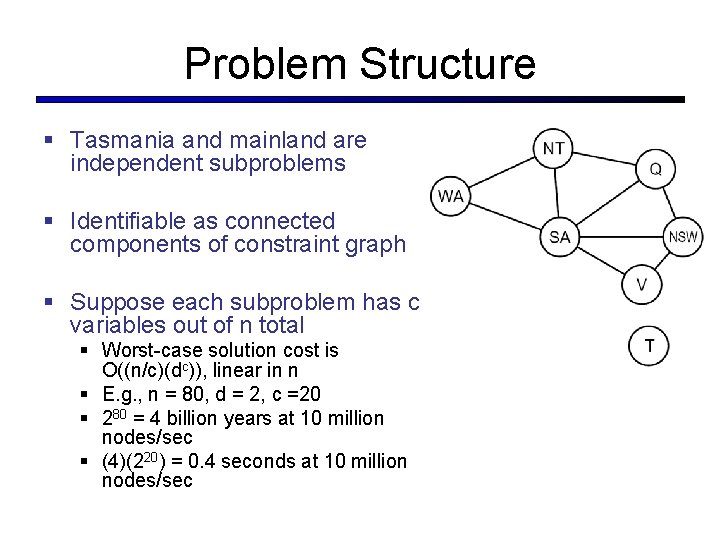
Problem Structure § Tasmania and mainland are independent subproblems § Identifiable as connected components of constraint graph § Suppose each subproblem has c variables out of n total § Worst-case solution cost is O((n/c)(dc)), linear in n § E. g. , n = 80, d = 2, c =20 § 280 = 4 billion years at 10 million nodes/sec § (4)(220) = 0. 4 seconds at 10 million nodes/sec
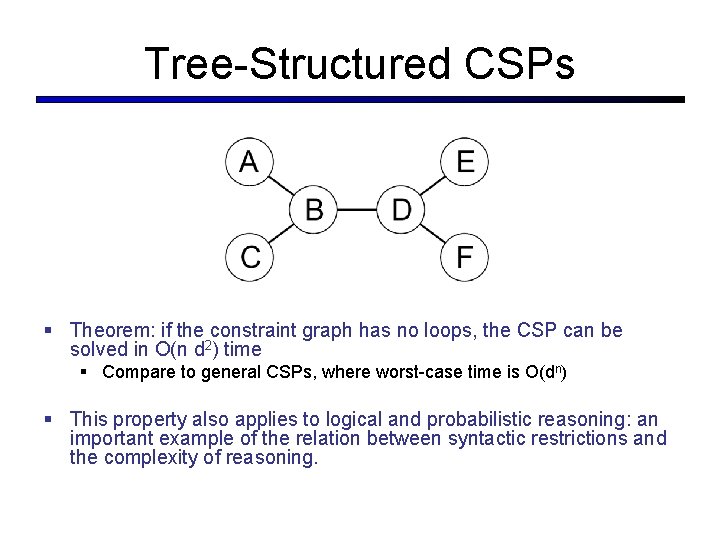
Tree-Structured CSPs § Theorem: if the constraint graph has no loops, the CSP can be solved in O(n d 2) time § Compare to general CSPs, where worst-case time is O(dn) § This property also applies to logical and probabilistic reasoning: an important example of the relation between syntactic restrictions and the complexity of reasoning.
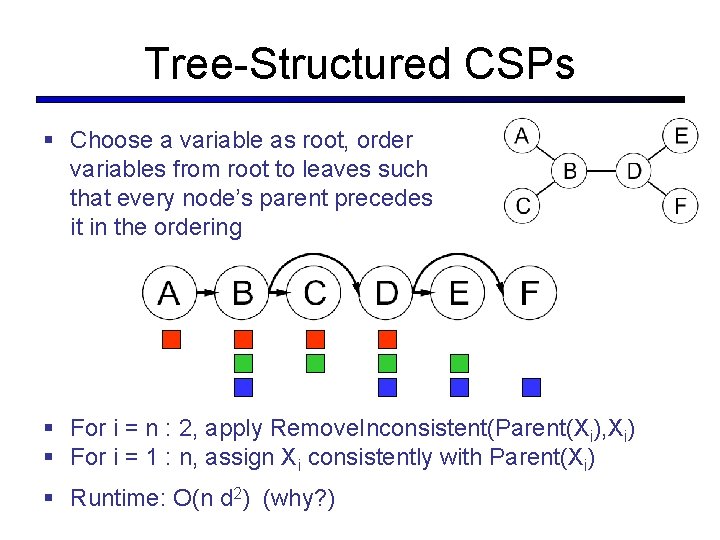
Tree-Structured CSPs § Choose a variable as root, order variables from root to leaves such that every node’s parent precedes it in the ordering § For i = n : 2, apply Remove. Inconsistent(Parent(Xi), Xi) § For i = 1 : n, assign Xi consistently with Parent(Xi) § Runtime: O(n d 2) (why? )
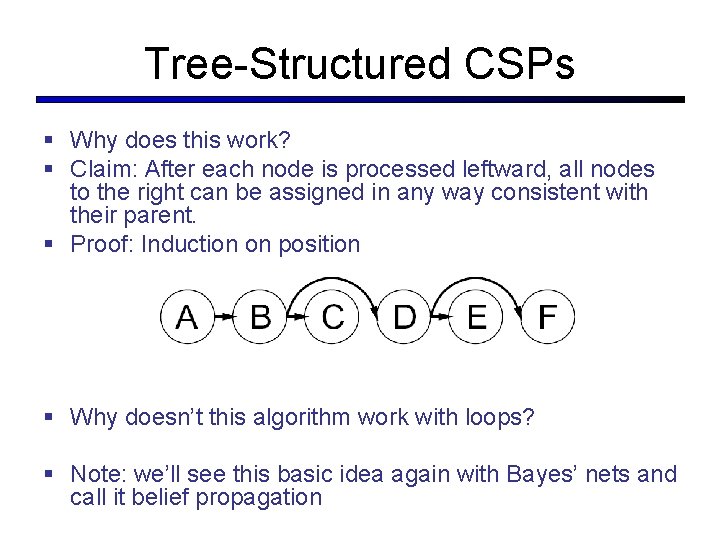
Tree-Structured CSPs § Why does this work? § Claim: After each node is processed leftward, all nodes to the right can be assigned in any way consistent with their parent. § Proof: Induction on position § Why doesn’t this algorithm work with loops? § Note: we’ll see this basic idea again with Bayes’ nets and call it belief propagation
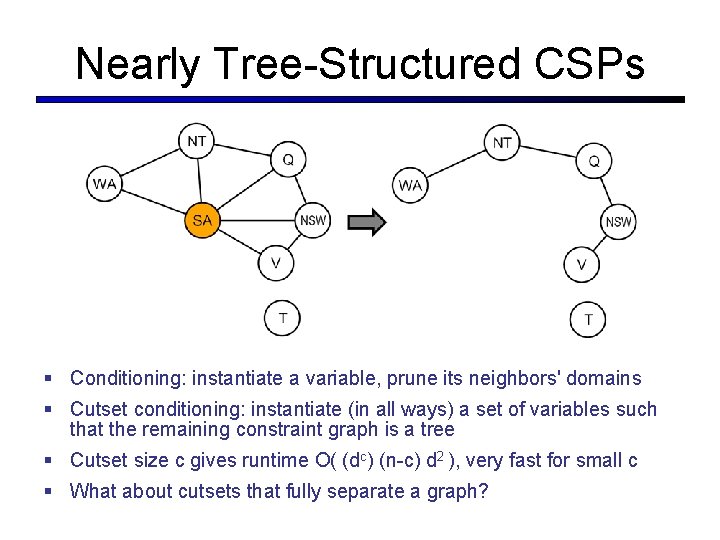
Nearly Tree-Structured CSPs § Conditioning: instantiate a variable, prune its neighbors' domains § Cutset conditioning: instantiate (in all ways) a set of variables such that the remaining constraint graph is a tree § Cutset size c gives runtime O( (dc) (n-c) d 2 ), very fast for small c § What about cutsets that fully separate a graph?
Iterative Algorithms for CSPs § Hill-climbing, simulated annealing typically work with “complete” states, i. e. , all variables assigned § To apply to CSPs: § Allow states with unsatisfied constraints § Operators reassign variable values § Variable selection: randomly select any conflicted variable § Value selection by min-conflicts heuristic: § Choose value that violates the fewest constraints § I. e. , hillclimb with h(n) = total number of violated constraints
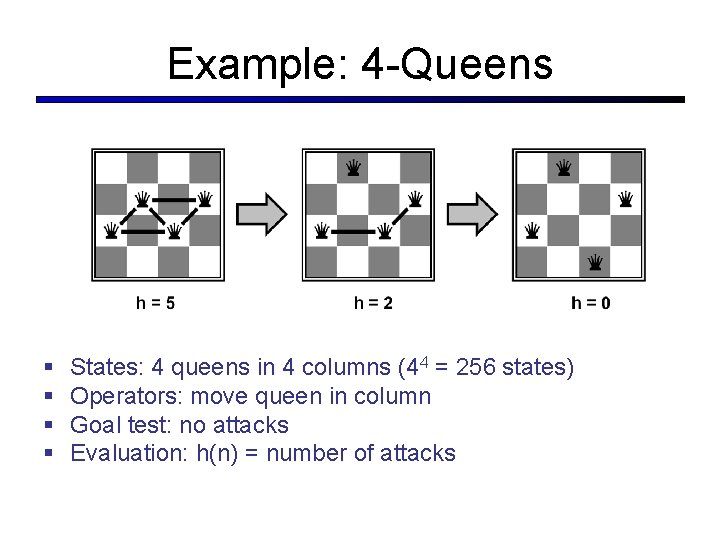
Example: 4 -Queens § § States: 4 queens in 4 columns (44 = 256 states) Operators: move queen in column Goal test: no attacks Evaluation: h(n) = number of attacks
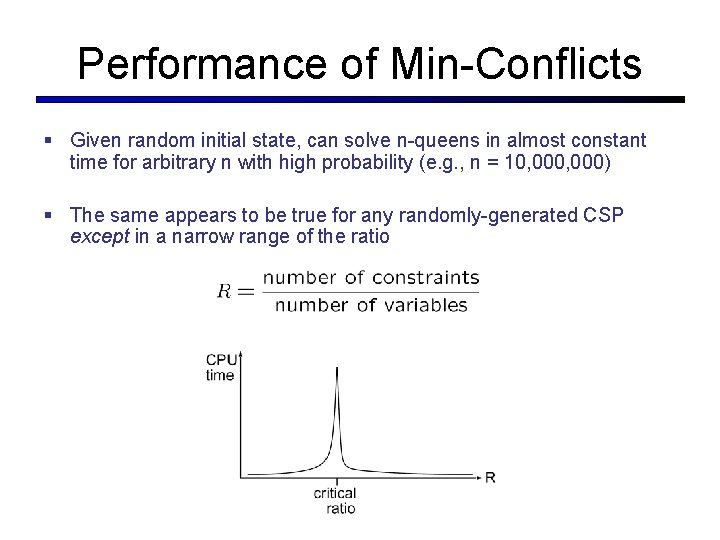
Performance of Min-Conflicts § Given random initial state, can solve n-queens in almost constant time for arbitrary n with high probability (e. g. , n = 10, 000) § The same appears to be true for any randomly-generated CSP except in a narrow range of the ratio
Summary § CSPs are a special kind of search problem: § States defined by values of a fixed set of variables § Goal test defined by constraints on variable values § Backtracking = depth-first search with one legal variable assigned per node § Variable ordering and value selection heuristics help significantly § Forward checking prevents assignments that guarantee later failure § Constraint propagation (e. g. , arc consistency) does additional work to constrain values and detect inconsistencies § The constraint graph representation allows analysis of problem structure § Tree-structured CSPs can be solved in linear time § Iterative min-conflicts is usually effective in practice
Local Search Methods § Queue-based algorithms keep fallback options (backtracking) § Local search: improve what you have until you can’t make it better § Generally much more efficient (but incomplete)
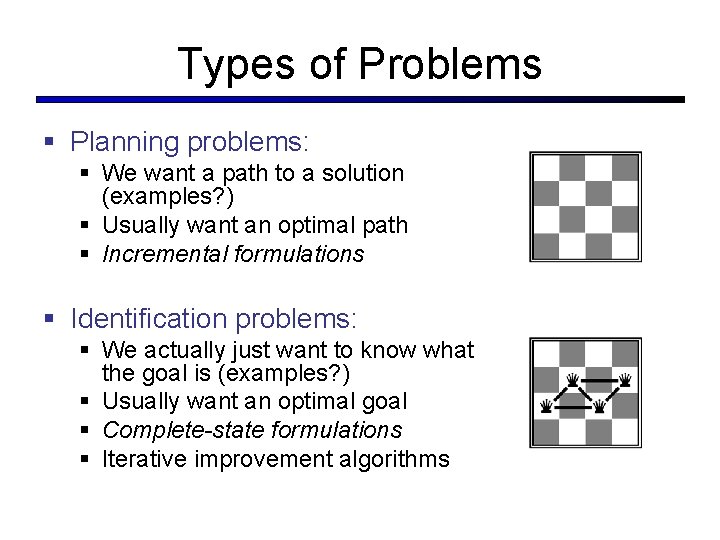
Types of Problems § Planning problems: § We want a path to a solution (examples? ) § Usually want an optimal path § Incremental formulations § Identification problems: § We actually just want to know what the goal is (examples? ) § Usually want an optimal goal § Complete-state formulations § Iterative improvement algorithms
Hill Climbing § Simple, general idea: § Start wherever § Always choose the best neighbor § If no neighbors have better scores than current, quit § Why can this be a terrible idea? § Complete? § Optimal? § What’s good about it?
Hill Climbing Diagram § Random restarts? § Random sideways steps?
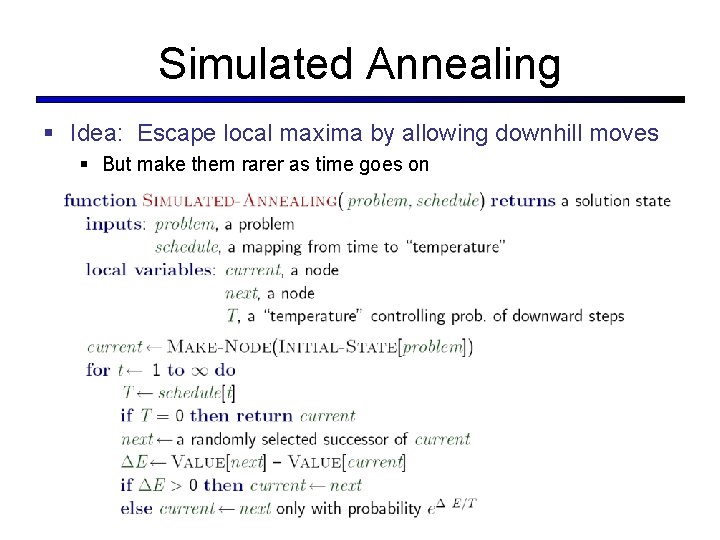
Simulated Annealing § Idea: Escape local maxima by allowing downhill moves § But make them rarer as time goes on
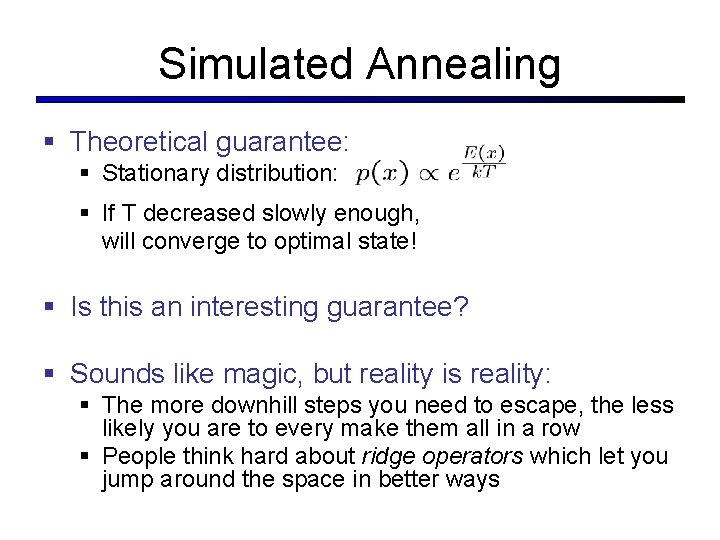
Simulated Annealing § Theoretical guarantee: § Stationary distribution: § If T decreased slowly enough, will converge to optimal state! § Is this an interesting guarantee? § Sounds like magic, but reality is reality: § The more downhill steps you need to escape, the less likely you are to every make them all in a row § People think hard about ridge operators which let you jump around the space in better ways
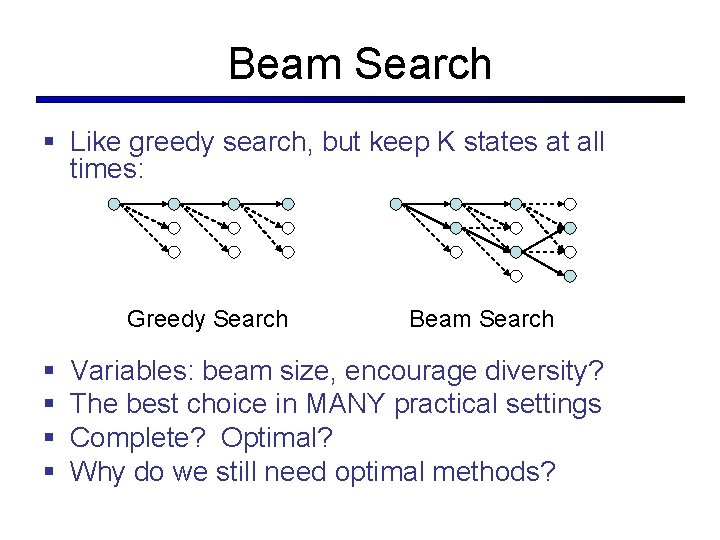
Beam Search § Like greedy search, but keep K states at all times: Greedy Search § § Beam Search Variables: beam size, encourage diversity? The best choice in MANY practical settings Complete? Optimal? Why do we still need optimal methods?
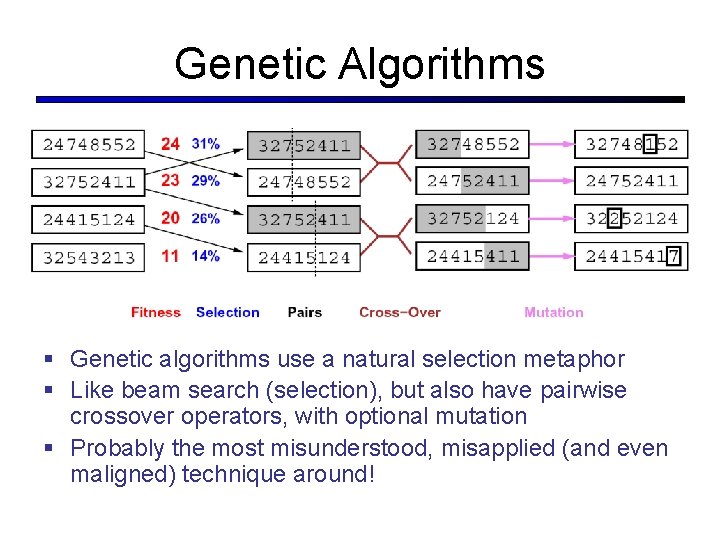
Genetic Algorithms § Genetic algorithms use a natural selection metaphor § Like beam search (selection), but also have pairwise crossover operators, with optional mutation § Probably the most misunderstood, misapplied (and even maligned) technique around!
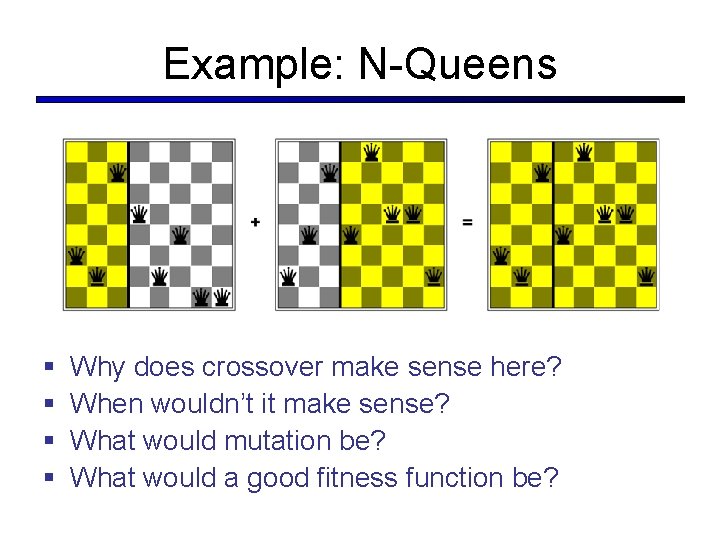
Example: N-Queens § § Why does crossover make sense here? When wouldn’t it make sense? What would mutation be? What would a good fitness function be?
Continuous Problems § Placing airports in Romania § States: (x 1, y 1, x 2, y 2, x 3, y 3) § Cost: sum of squared distances to closest city
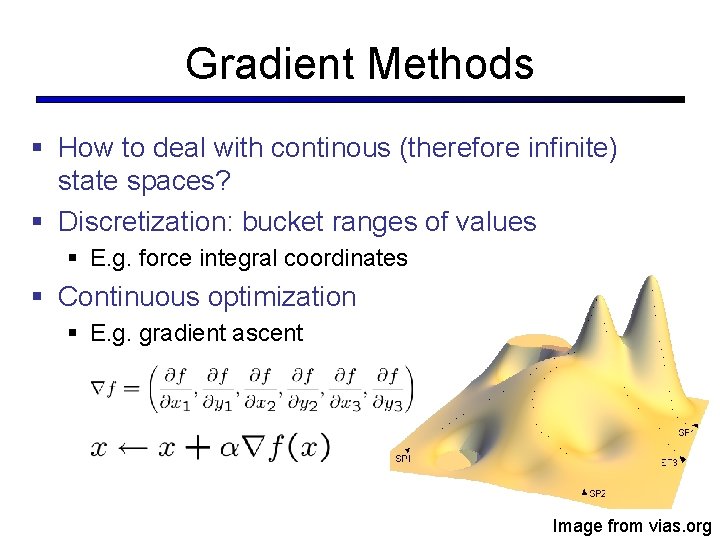
Gradient Methods § How to deal with continous (therefore infinite) state spaces? § Discretization: bucket ranges of values § E. g. force integral coordinates § Continuous optimization § E. g. gradient ascent Image from vias. org
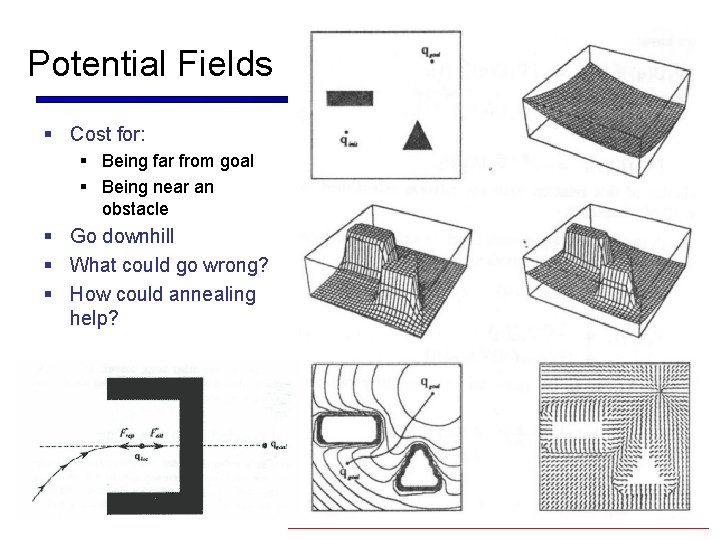
Potential Fields § Cost for: § Being far from goal § Being near an obstacle § Go downhill § What could go wrong? § How could annealing help?
Potential Field Methods SIMPLE MOTION PLANNER: Gradient descent on u
Next Time § Probabilities (chapter 13) § Basis of most of the rest of the course § You might want to read up in advance!
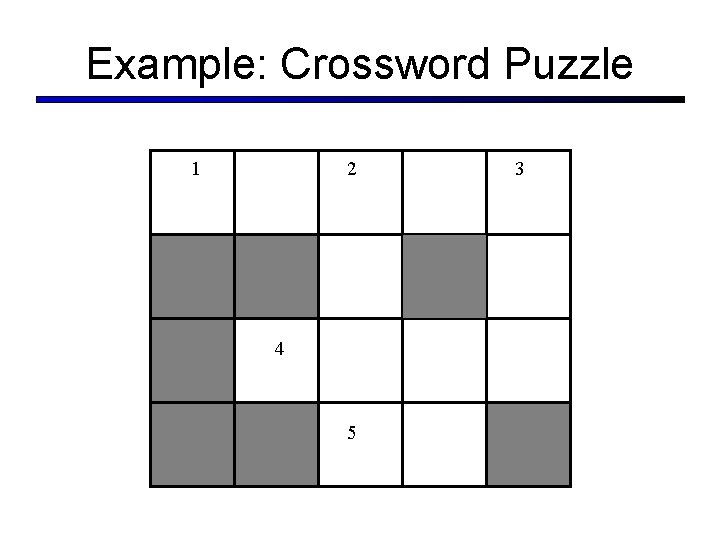
Example: Crossword Puzzle 1 2 4 5 3
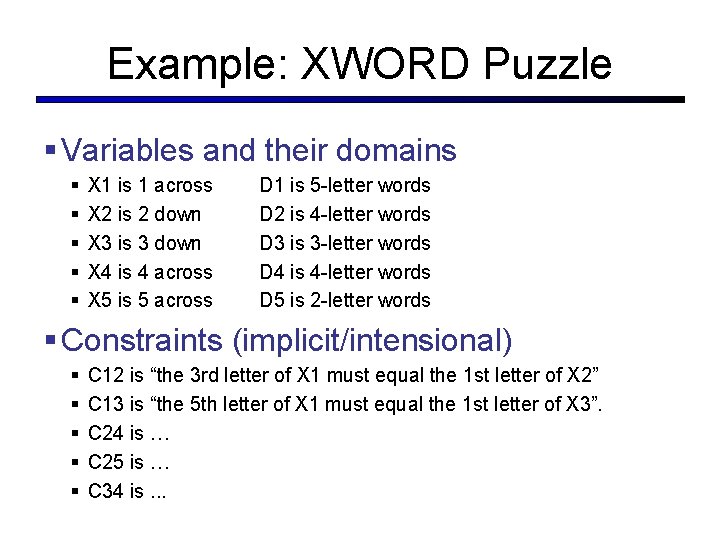
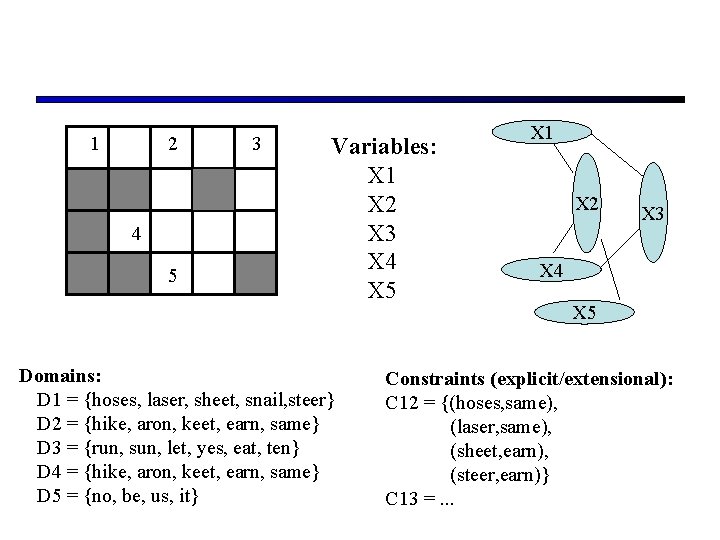
Example: XWORD Puzzle § Variables and their domains § § § X 1 is 1 across X 2 is 2 down X 3 is 3 down X 4 is 4 across X 5 is 5 across D 1 is 5 -letter words D 2 is 4 -letter words D 3 is 3 -letter words D 4 is 4 -letter words D 5 is 2 -letter words § Constraints (implicit/intensional) § § § C 12 is “the 3 rd letter of X 1 must equal the 1 st letter of X 2” C 13 is “the 5 th letter of X 1 must equal the 1 st letter of X 3”. C 24 is … C 25 is … C 34 is. . .
1 2 4 5 3 Variables: X 1 X 2 X 3 X 4 X 5 Domains: D 1 = {hoses, laser, sheet, snail, steer} D 2 = {hike, aron, keet, earn, same} D 3 = {run, sun, let, yes, eat, ten} D 4 = {hike, aron, keet, earn, same} D 5 = {no, be, us, it} X 1 X 2 X 3 X 4 X 5 Constraints (explicit/extensional): C 12 = {(hoses, same), (laser, same), (sheet, earn), (steer, earn)} C 13 =. . .
Arc Consistency: XWORD 1 2 3 4 5 X 1 X 2 X 4 hoses hike laser aron sheet keet snail earn steer same