
CS 162 Operating Systems and Systems Programming Lecture




![Optimize I/O Performance Queue [OS Paths] Controller User Thread 300 Response Time (ms) I/O](https://slidetodoc.com/presentation_image_h2/55753ab81a184d7972e6035bed11b62f/image-47.jpg "Optimize I/O Performance Queue [OS Paths] Controller User Thread 300 Response Time (ms) I/O")
- Slides: 48
CS 162 Operating Systems and Systems Programming Lecture 17 Performance Storage Devices, Queueing Theory October 24, 2018 Prof. Ion Stoica http: //cs 162. eecs. Berkeley. edu
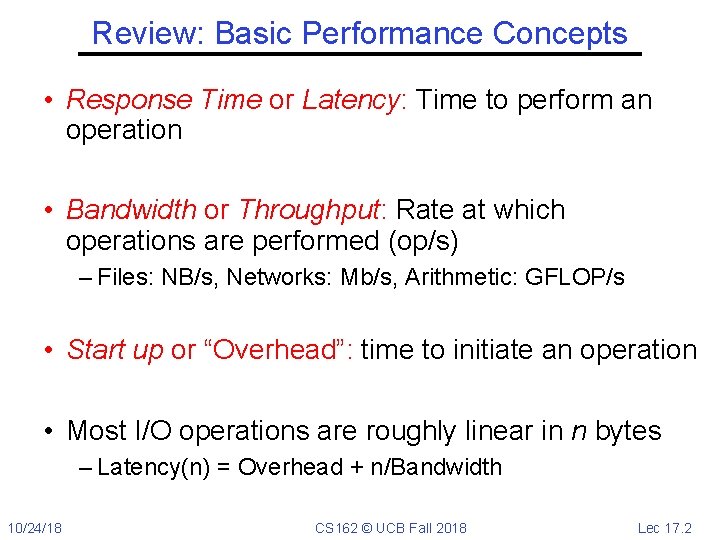
Review: Basic Performance Concepts • Response Time or Latency: Time to perform an operation • Bandwidth or Throughput: Rate at which operations are performed (op/s) – Files: NB/s, Networks: Mb/s, Arithmetic: GFLOP/s • Start up or “Overhead”: time to initiate an operation • Most I/O operations are roughly linear in n bytes – Latency(n) = Overhead + n/Bandwidth 10/24/18 CS 162 © UCB Fall 2018 Lec 17. 2
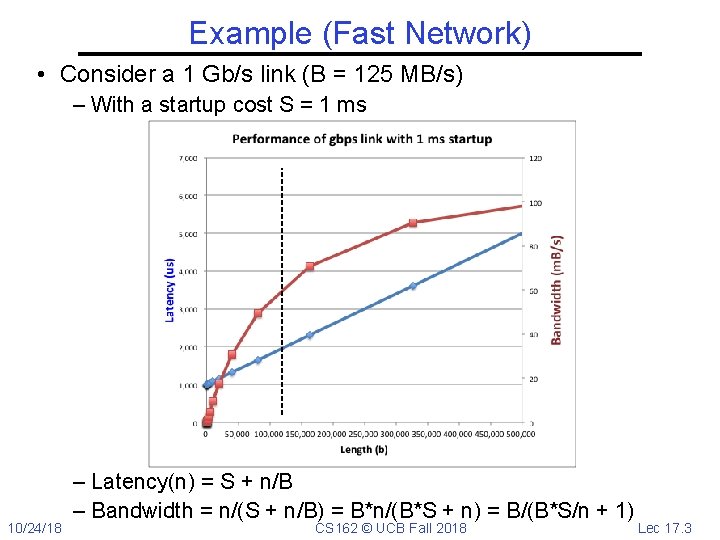
Example (Fast Network) • Consider a 1 Gb/s link (B = 125 MB/s) – With a startup cost S = 1 ms 10/24/18 – Latency(n) = S + n/B – Bandwidth = n/(S + n/B) = B*n/(B*S + n) = B/(B*S/n + 1) CS 162 © UCB Fall 2018 Lec 17. 3
Example (Fast Network) • Consider a 1 Gb/s link (B = 125 MB/s) – With a startup cost S = 1 ms 10/24/18 – Bandwidth = B/(B*S/n + 1) – half-power point occurs at n=S*B Bandwidth = B/2 CS 162 © UCB Fall 2018 Lec 17. 4
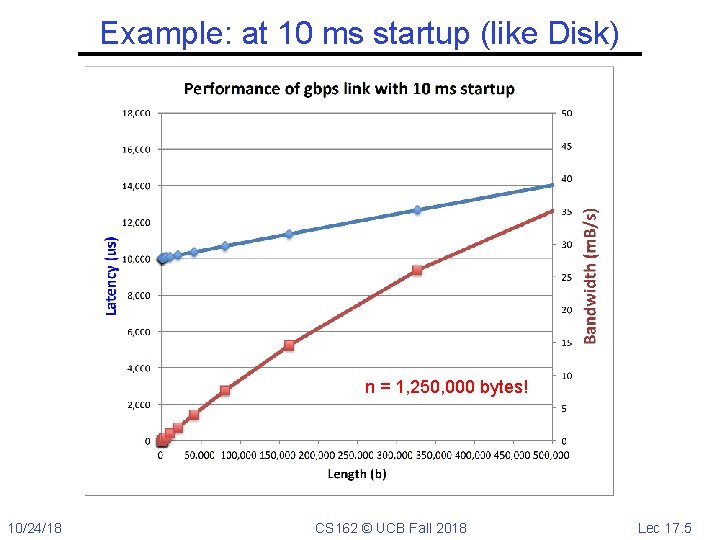
Example: at 10 ms startup (like Disk) n = 1, 250, 000 bytes! 10/24/18 CS 162 © UCB Fall 2018 Lec 17. 5
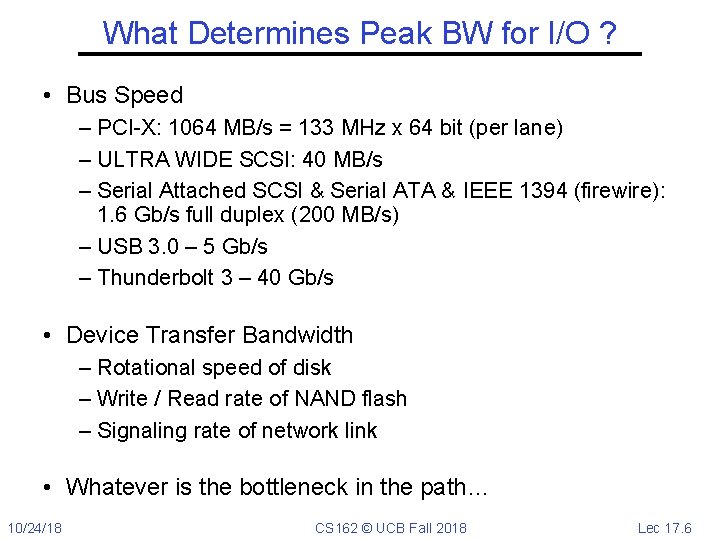
What Determines Peak BW for I/O ? • Bus Speed – PCI-X: 1064 MB/s = 133 MHz x 64 bit (per lane) – ULTRA WIDE SCSI: 40 MB/s – Serial Attached SCSI & Serial ATA & IEEE 1394 (firewire): 1. 6 Gb/s full duplex (200 MB/s) – USB 3. 0 – 5 Gb/s – Thunderbolt 3 – 40 Gb/s • Device Transfer Bandwidth – Rotational speed of disk – Write / Read rate of NAND flash – Signaling rate of network link • Whatever is the bottleneck in the path… 10/24/18 CS 162 © UCB Fall 2018 Lec 17. 6
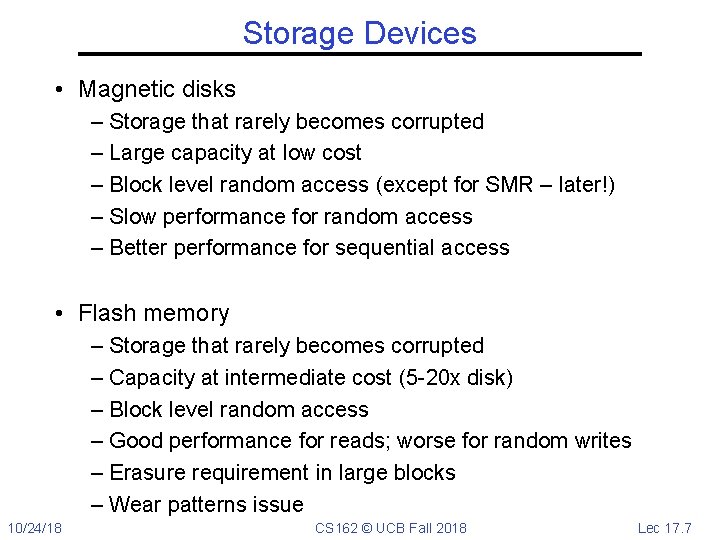
Storage Devices • Magnetic disks – Storage that rarely becomes corrupted – Large capacity at low cost – Block level random access (except for SMR – later!) – Slow performance for random access – Better performance for sequential access • Flash memory – Storage that rarely becomes corrupted – Capacity at intermediate cost (5 -20 x disk) – Block level random access – Good performance for reads; worse for random writes – Erasure requirement in large blocks – Wear patterns issue 10/24/18 CS 162 © UCB Fall 2018 Lec 17. 7
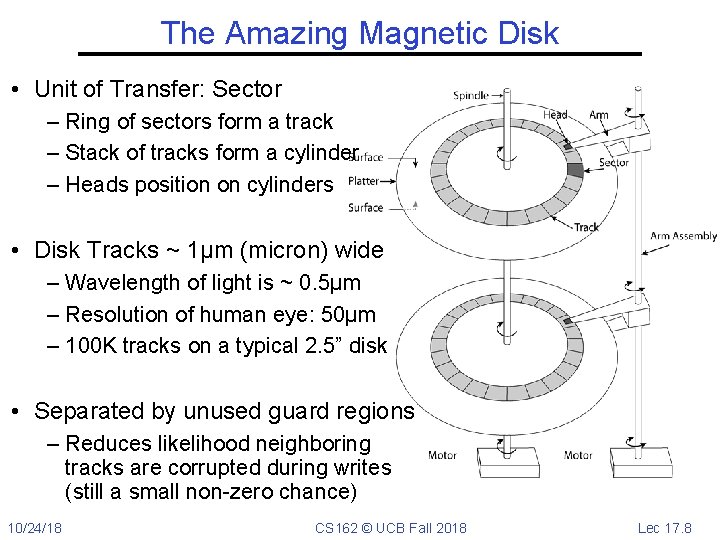
The Amazing Magnetic Disk • Unit of Transfer: Sector – Ring of sectors form a track – Stack of tracks form a cylinder – Heads position on cylinders • Disk Tracks ~ 1µm (micron) wide – Wavelength of light is ~ 0. 5µm – Resolution of human eye: 50µm – 100 K tracks on a typical 2. 5” disk • Separated by unused guard regions – Reduces likelihood neighboring tracks are corrupted during writes (still a small non-zero chance) 10/24/18 CS 162 © UCB Fall 2018 Lec 17. 8
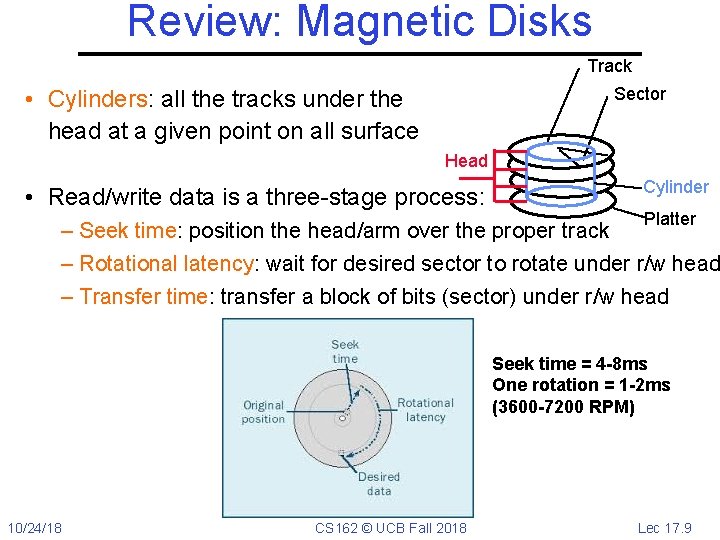
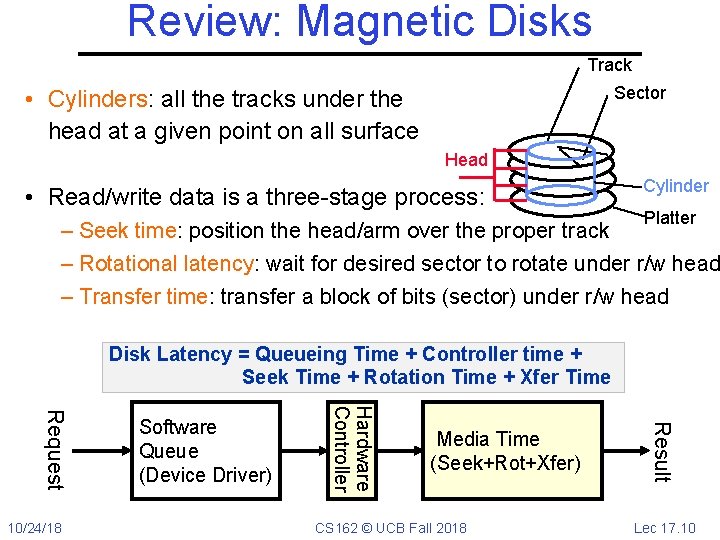
Review: Magnetic Disks Track Sector • Cylinders: all the tracks under the head at a given point on all surface Head • Read/write data is a three-stage process: Cylinder Platter – Seek time: position the head/arm over the proper track – Rotational latency: wait for desired sector to rotate under r/w head – Transfer time: transfer a block of bits (sector) under r/w head Seek time = 4 -8 ms One rotation = 1 -2 ms (3600 -7200 RPM) 10/24/18 CS 162 © UCB Fall 2018 Lec 17. 9
Review: Magnetic Disks Track Sector • Cylinders: all the tracks under the head at a given point on all surface Head • Read/write data is a three-stage process: Cylinder Platter – Seek time: position the head/arm over the proper track – Rotational latency: wait for desired sector to rotate under r/w head – Transfer time: transfer a block of bits (sector) under r/w head Disk Latency = Queueing Time + Controller time + Seek Time + Rotation Time + Xfer Time Media Time (Seek+Rot+Xfer) CS 162 © UCB Fall 2018 Result Hardware Controller Request 10/24/18 Software Queue (Device Driver) Lec 17. 10
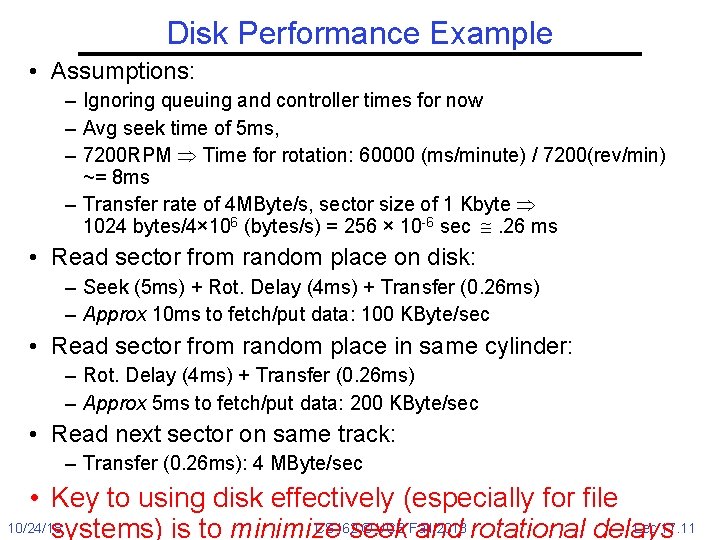
Disk Performance Example • Assumptions: – Ignoring queuing and controller times for now – Avg seek time of 5 ms, – 7200 RPM Time for rotation: 60000 (ms/minute) / 7200(rev/min) ~= 8 ms – Transfer rate of 4 MByte/s, sector size of 1 Kbyte 1024 bytes/4× 106 (bytes/s) = 256 × 10 -6 sec . 26 ms • Read sector from random place on disk: – Seek (5 ms) + Rot. Delay (4 ms) + Transfer (0. 26 ms) – Approx 10 ms to fetch/put data: 100 KByte/sec • Read sector from random place in same cylinder: – Rot. Delay (4 ms) + Transfer (0. 26 ms) – Approx 5 ms to fetch/put data: 200 KByte/sec • Read next sector on same track: – Transfer (0. 26 ms): 4 MByte/sec • Key to using disk effectively (especially for file 10/24/18 CS 162 © UCB Fall 2018 rotational delays Lec 17. 11 systems) is to minimize seek and
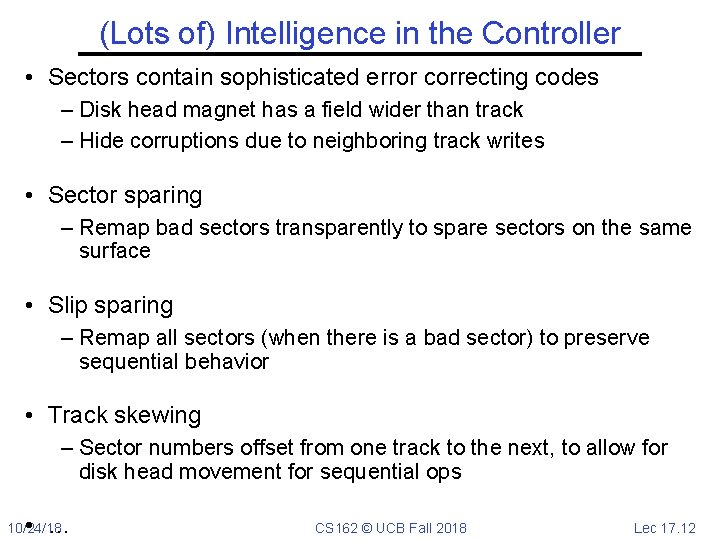
(Lots of) Intelligence in the Controller • Sectors contain sophisticated error correcting codes – Disk head magnet has a field wider than track – Hide corruptions due to neighboring track writes • Sector sparing – Remap bad sectors transparently to spare sectors on the same surface • Slip sparing – Remap all sectors (when there is a bad sector) to preserve sequential behavior • Track skewing – Sector numbers offset from one track to the next, to allow for disk head movement for sequential ops • … 10/24/18 CS 162 © UCB Fall 2018 Lec 17. 12
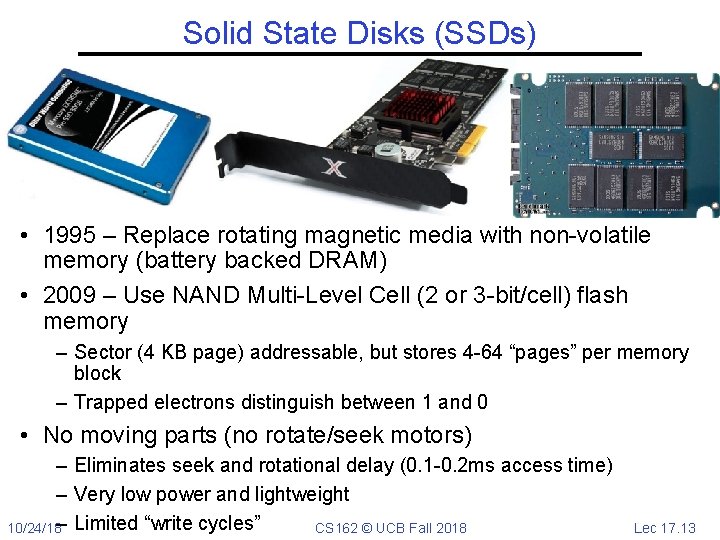
Solid State Disks (SSDs) • 1995 – Replace rotating magnetic media with non-volatile memory (battery backed DRAM) • 2009 – Use NAND Multi-Level Cell (2 or 3 -bit/cell) flash memory – Sector (4 KB page) addressable, but stores 4 -64 “pages” per memory block – Trapped electrons distinguish between 1 and 0 • No moving parts (no rotate/seek motors) – Eliminates seek and rotational delay (0. 1 -0. 2 ms access time) – Very low power and lightweight 10/24/18– Limited “write cycles” CS 162 © UCB Fall 2018 Lec 17. 13
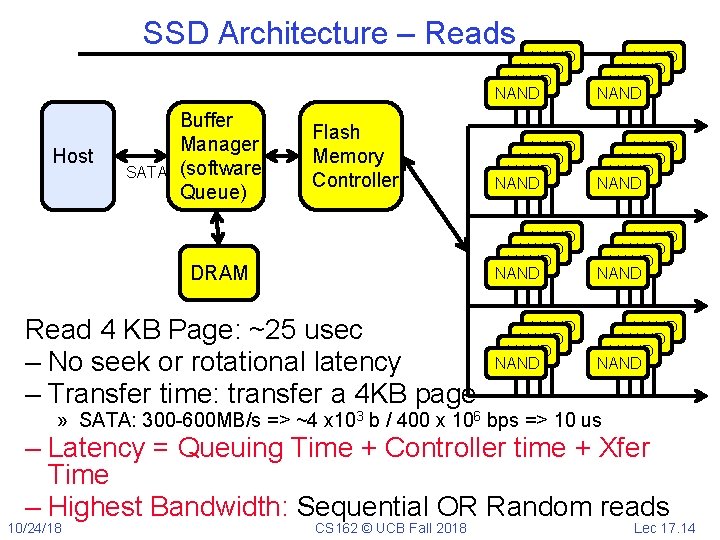
SSD Architecture – Reads Host SATA Buffer Manager (software Queue) Flash Memory Controller DRAM Read 4 KB Page: ~25 usec – No seek or rotational latency – Transfer time: transfer a 4 KB page NAND NAND NAND NAND NAND NAND NAND NAND » SATA: 300 -600 MB/s => ~4 x 10³ b / 400 x 106 bps => 10 us – Latency = Queuing Time + Controller time + Xfer Time – Highest Bandwidth: Sequential OR Random reads 10/24/18 CS 162 © UCB Fall 2018 Lec 17. 14
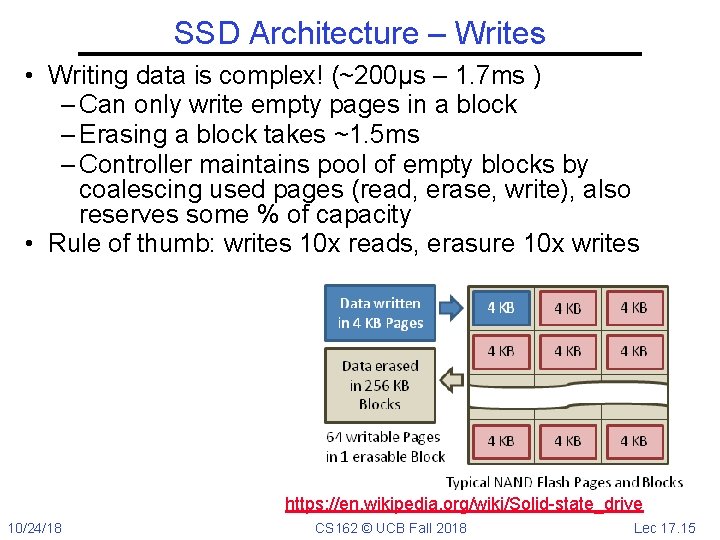
SSD Architecture – Writes • Writing data is complex! (~200μs – 1. 7 ms ) – Can only write empty pages in a block – Erasing a block takes ~1. 5 ms – Controller maintains pool of empty blocks by coalescing used pages (read, erase, write), also reserves some % of capacity • Rule of thumb: writes 10 x reads, erasure 10 x writes https: //en. wikipedia. org/wiki/Solid-state_drive 10/24/18 CS 162 © UCB Fall 2018 Lec 17. 15
Amusing calculation: is a full Kindle heavier than an empty one? • Actually, “Yes”, but not by much • Flash works by trapping electrons: – So, erased state lower energy than written state • Assuming that: – Kindle has 4 GB flash – ½ of all bits in full Kindle are in high-energy state – High-energy state about 10 -15 joules higher – Then: Full Kindle is 1 attogram (10 -18 gram) heavier (Using E = mc 2) • Of course, this is less than most sensitive scale can measure (it can measure 10 -9 grams) • Of course, this weight difference overwhelmed by battery discharge, weight from getting warm, …. • According to John Kubiatowicz (New York Times, Oct 24, 10/24/18 CS 162 © UCB Fall 2018 Lec 17. 16
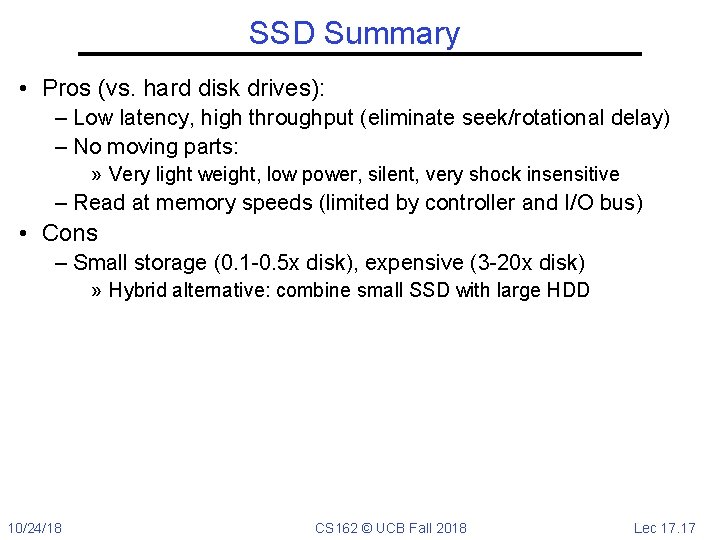
SSD Summary • Pros (vs. hard disk drives): – Low latency, high throughput (eliminate seek/rotational delay) – No moving parts: » Very light weight, low power, silent, very shock insensitive – Read at memory speeds (limited by controller and I/O bus) • Cons – Small storage (0. 1 -0. 5 x disk), expensive (3 -20 x disk) » Hybrid alternative: combine small SSD with large HDD 10/24/18 CS 162 © UCB Fall 2018 Lec 17. 17
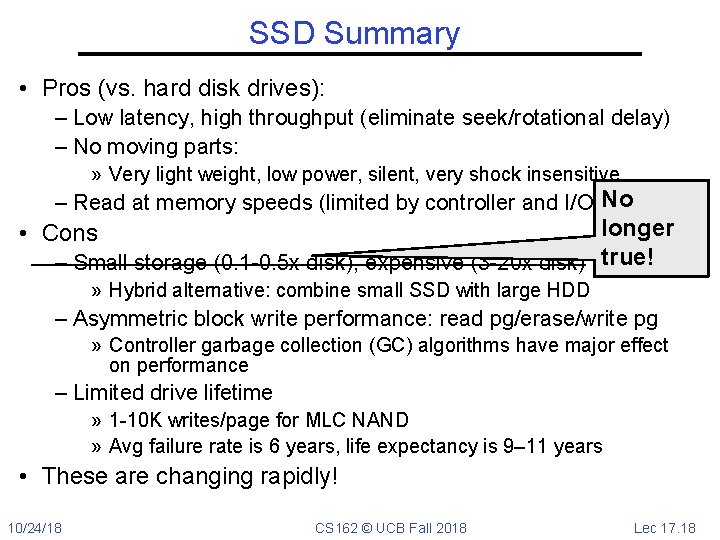
SSD Summary • Pros (vs. hard disk drives): – Low latency, high throughput (eliminate seek/rotational delay) – No moving parts: » Very light weight, low power, silent, very shock insensitive No – Read at memory speeds (limited by controller and I/O bus) longer – Small storage (0. 1 -0. 5 x disk), expensive (3 -20 x disk) true! • Cons » Hybrid alternative: combine small SSD with large HDD – Asymmetric block write performance: read pg/erase/write pg » Controller garbage collection (GC) algorithms have major effect on performance – Limited drive lifetime » 1 -10 K writes/page for MLC NAND » Avg failure rate is 6 years, life expectancy is 9– 11 years • These are changing rapidly! 10/24/18 CS 162 © UCB Fall 2018 Lec 17. 18
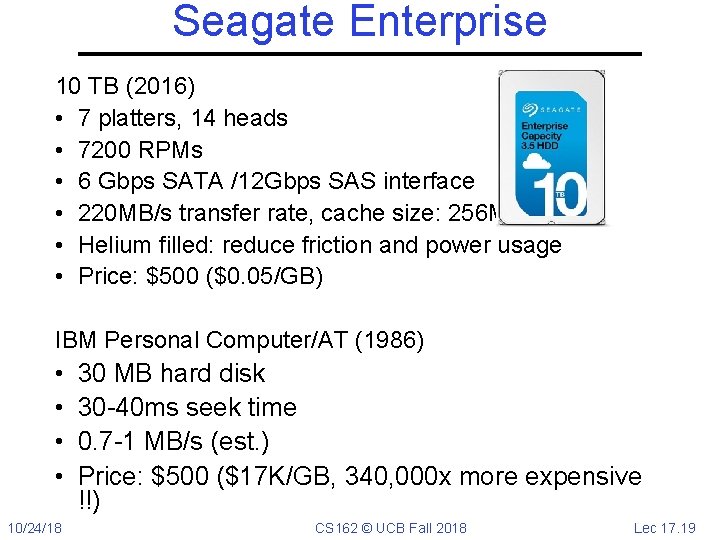
Seagate Enterprise 10 TB (2016) • 7 platters, 14 heads • 7200 RPMs • 6 Gbps SATA /12 Gbps SAS interface • 220 MB/s transfer rate, cache size: 256 MB • Helium filled: reduce friction and power usage • Price: $500 ($0. 05/GB) IBM Personal Computer/AT (1986) • • 10/24/18 30 MB hard disk 30 -40 ms seek time 0. 7 -1 MB/s (est. ) Price: $500 ($17 K/GB, 340, 000 x more expensive !!) CS 162 © UCB Fall 2018 Lec 17. 19
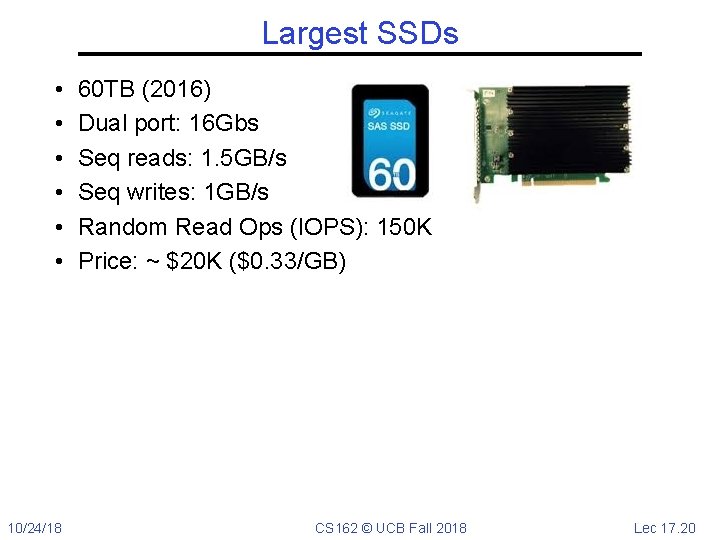
Largest SSDs • • • 10/24/18 60 TB (2016) Dual port: 16 Gbs Seq reads: 1. 5 GB/s Seq writes: 1 GB/s Random Read Ops (IOPS): 150 K Price: ~ $20 K ($0. 33/GB) CS 162 © UCB Fall 2018 Lec 17. 20
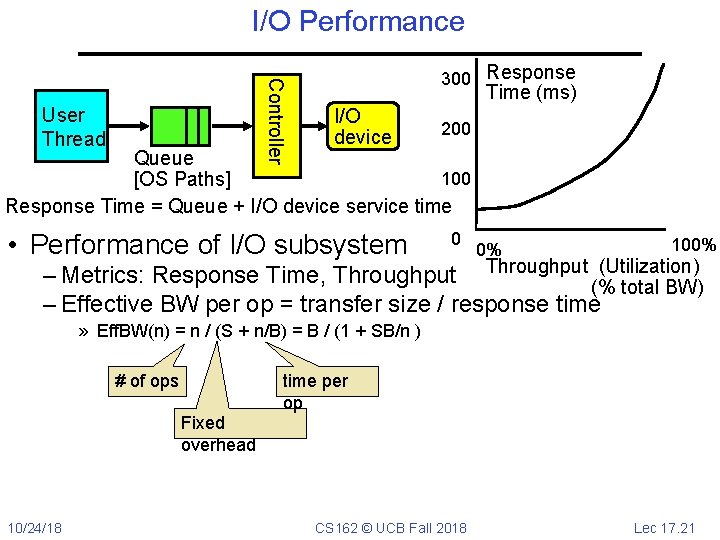
I/O Performance Controller User Thread 300 Response Time (ms) I/O device 200 Queue 100 [OS Paths] Response Time = Queue + I/O device service time • Performance of I/O subsystem 0 0% 100% (Utilization) – Metrics: Response Time, Throughput (% total BW) – Effective BW per op = transfer size / response time » Eff. BW(n) = n / (S + n/B) = B / (1 + SB/n ) # of ops time per op Fixed overhead 10/24/18 CS 162 © UCB Fall 2018 Lec 17. 21
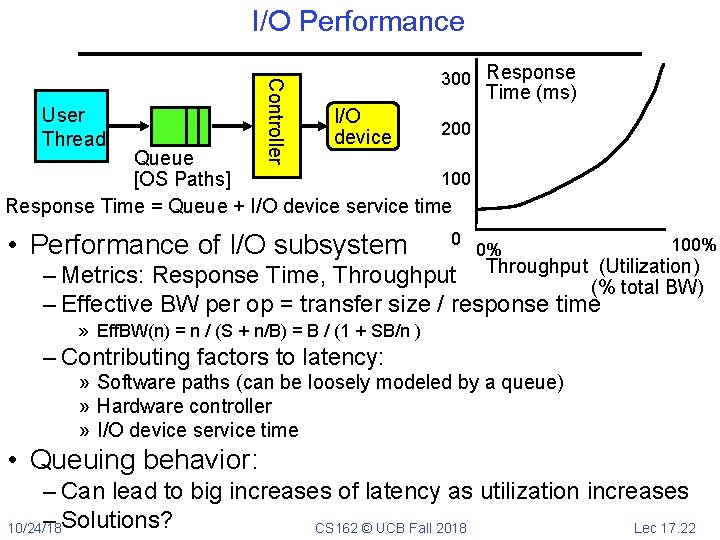
I/O Performance Controller User Thread 300 Response Time (ms) I/O device 200 Queue 100 [OS Paths] Response Time = Queue + I/O device service time • Performance of I/O subsystem 0 0% 100% (Utilization) – Metrics: Response Time, Throughput (% total BW) – Effective BW per op = transfer size / response time » Eff. BW(n) = n / (S + n/B) = B / (1 + SB/n ) – Contributing factors to latency: » Software paths (can be loosely modeled by a queue) » Hardware controller » I/O device service time • Queuing behavior: – Can lead to big increases of latency as utilization increases – Solutions? 10/24/18 CS 162 © UCB Fall 2018 Lec 17. 22
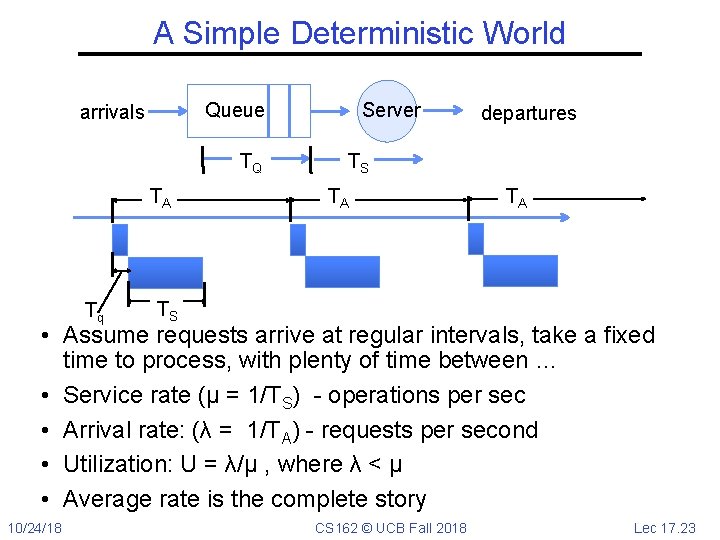
A Simple Deterministic World Queue arrivals TQ TA Tq Server departures TS TA TA TS • Assume requests arrive at regular intervals, take a fixed time to process, with plenty of time between … • Service rate (μ = 1/TS) - operations per sec • Arrival rate: (λ = 1/TA) - requests per second • Utilization: U = λ/μ , where λ < μ • Average rate is the complete story 10/24/18 CS 162 © UCB Fall 2018 Lec 17. 23
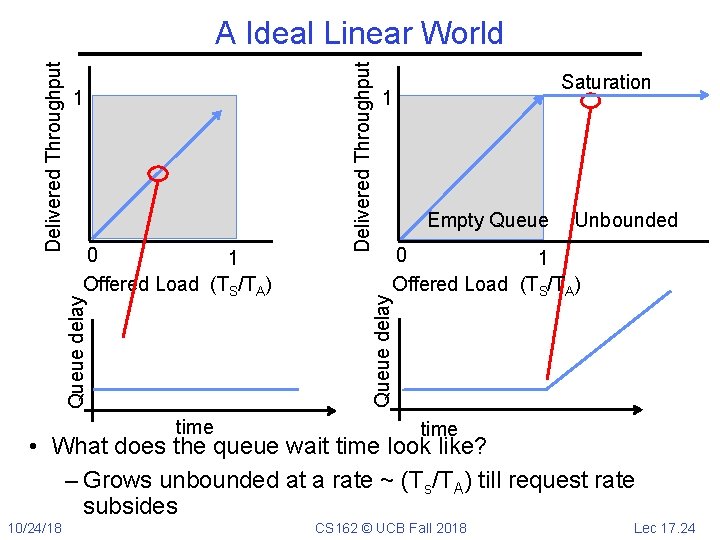
time Saturation 1 Empty Queue Unbounded 0 1 Offered Load (TS/TA) Queue delay 0 1 Offered Load (TS/TA) Delivered Throughput 1 Queue delay Delivered Throughput A Ideal Linear World time • What does the queue wait time look like? – Grows unbounded at a rate ~ (Ts/TA) till request rate subsides 10/24/18 CS 162 © UCB Fall 2018 Lec 17. 24
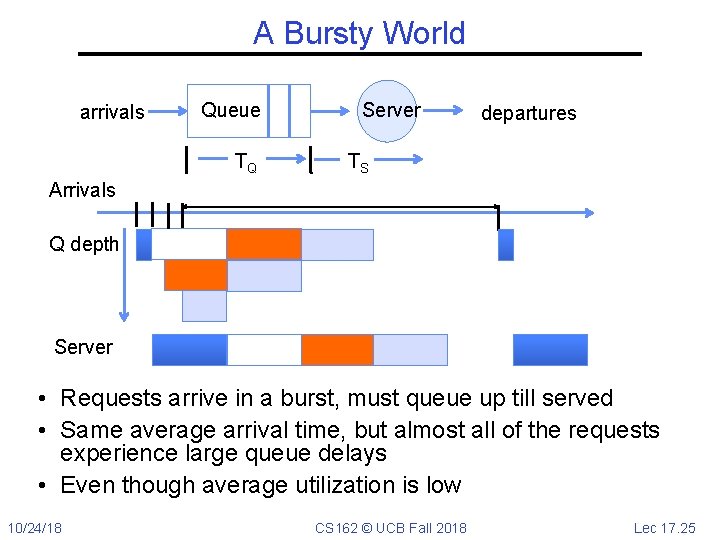
A Bursty World arrivals Queue TQ Server departures TS Arrivals Q depth Server • Requests arrive in a burst, must queue up till served • Same average arrival time, but almost all of the requests experience large queue delays • Even though average utilization is low 10/24/18 CS 162 © UCB Fall 2018 Lec 17. 25
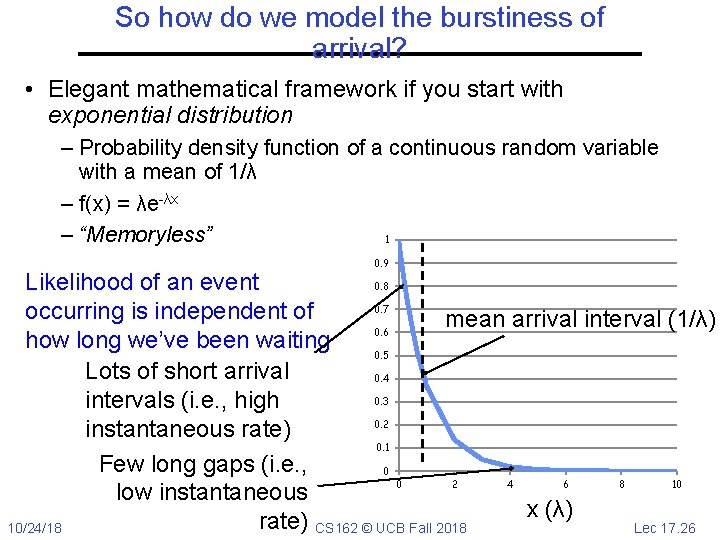
So how do we model the burstiness of arrival? • Elegant mathematical framework if you start with exponential distribution – Probability density function of a continuous random variable with a mean of 1/λ – f(x) = λe-λx – “Memoryless” 1 0. 9 0. 8 Likelihood of an event 0. 7 occurring is independent of mean arrival interval (1/λ) 0. 6 how long we’ve been waiting 0. 5 Lots of short arrival 0. 4 0. 3 intervals (i. e. , high 0. 2 instantaneous rate) 0. 1 Few long gaps (i. e. , 0 0 2 4 6 8 10 low instantaneous x (λ) rate) 10/24/18 CS 162 © UCB Fall 2018 Lec 17. 26
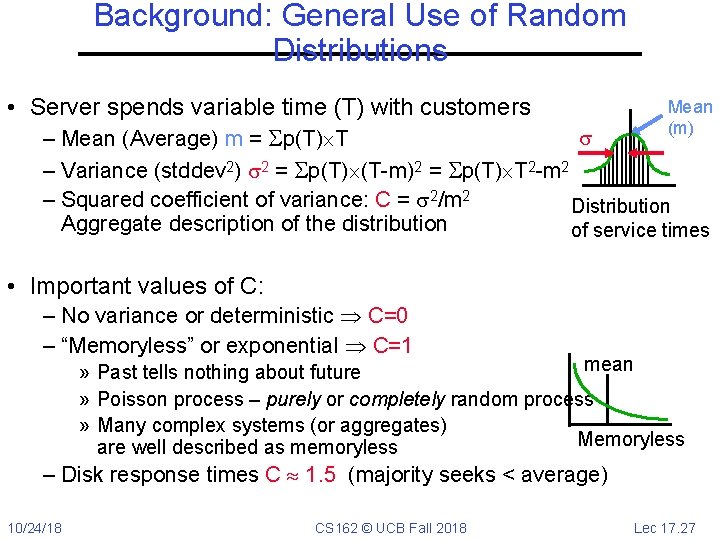
Background: General Use of Random Distributions • Server spends variable time (T) with customers – Mean (Average) m = p(T) T – Variance (stddev 2) 2 = p(T) (T-m)2 = p(T) T 2 -m 2 – Squared coefficient of variance: C = 2/m 2 Aggregate description of the distribution Mean (m) Distribution of service times • Important values of C: – No variance or deterministic C=0 – “Memoryless” or exponential C=1 mean » Past tells nothing about future » Poisson process – purely or completely random process » Many complex systems (or aggregates) Memoryless are well described as memoryless – Disk response times C 1. 5 (majority seeks < average) 10/24/18 CS 162 © UCB Fall 2018 Lec 17. 27
Administrivia • Midterm 2 coming up on Mon 10/29 5: 00 -6: 30 PM – All topics up to and including Lecture 17 » Focus will be on Lectures 11 – 17 and associated readings » Projects 1 and 2 » Homework 0 – 2 – Closed book – 2 pages hand-written notes both sides 10/24/18 CS 162 © UCB Fall 2018 Lec 17. 28
BREAK 10/24/18 CS 162 © UCB Fall 2018 Lec 17. 29
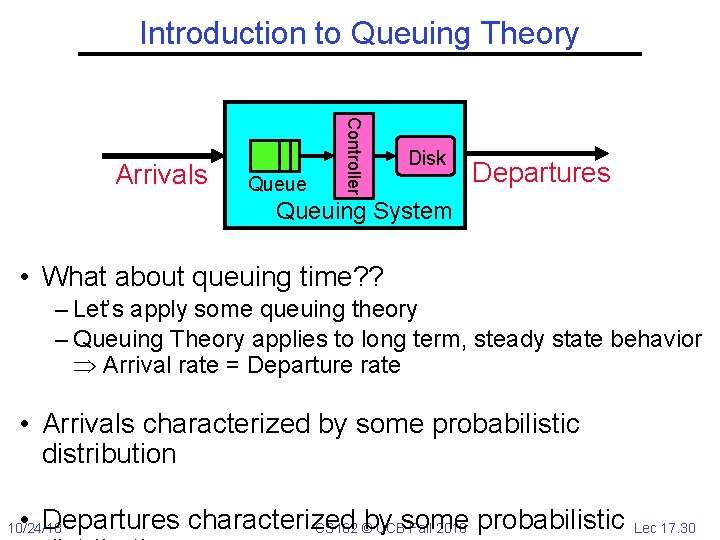
Introduction to Queuing Theory Queue Controller Arrivals Disk Departures Queuing System • What about queuing time? ? – Let’s apply some queuing theory – Queuing Theory applies to long term, steady state behavior Arrival rate = Departure rate • Arrivals characterized by some probabilistic distribution • Departures characterized by CS 162 © UCBsome Fall 2018 probabilistic 10/24/18 Lec 17. 30
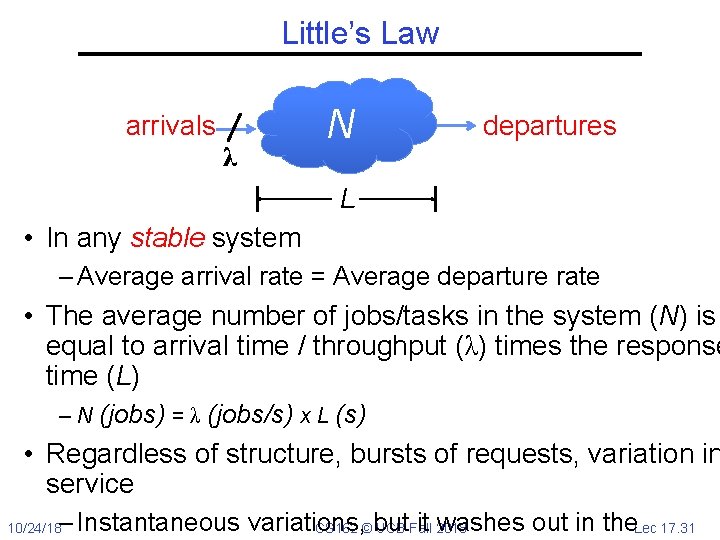
Little’s Law arrivals λ N departures L • In any stable system – Average arrival rate = Average departure rate • The average number of jobs/tasks in the system (N) is equal to arrival time / throughput (λ) times the response time (L) – N (jobs) = λ (jobs/s) x L (s) • Regardless of structure, bursts of requests, variation in service – Instantaneous variations, it 2018 washes out in the. Lec 17. 31 CS 162 © but UCB Fall 10/24/18
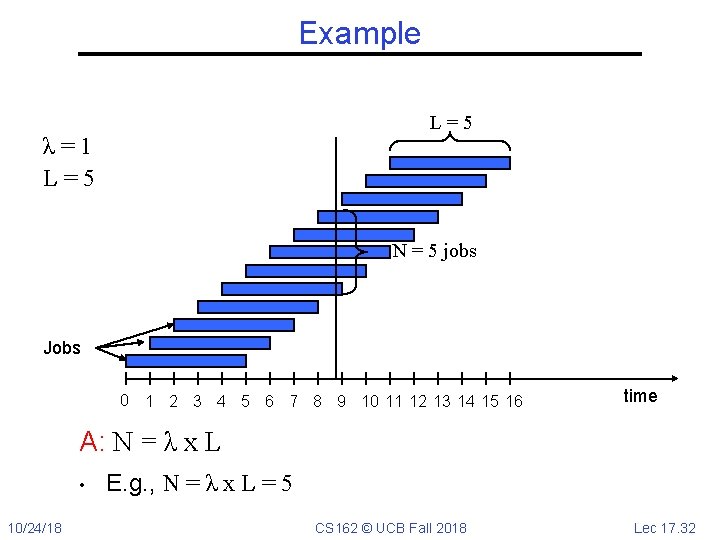
Example L=5 λ=1 L=5 N = 5 jobs Jobs 0 1 2 3 4 5 6 7 8 9 10 11 12 13 14 15 16 time A: N = λ x L • 10/24/18 E. g. , N = λ x L = 5 CS 162 © UCB Fall 2018 Lec 17. 32
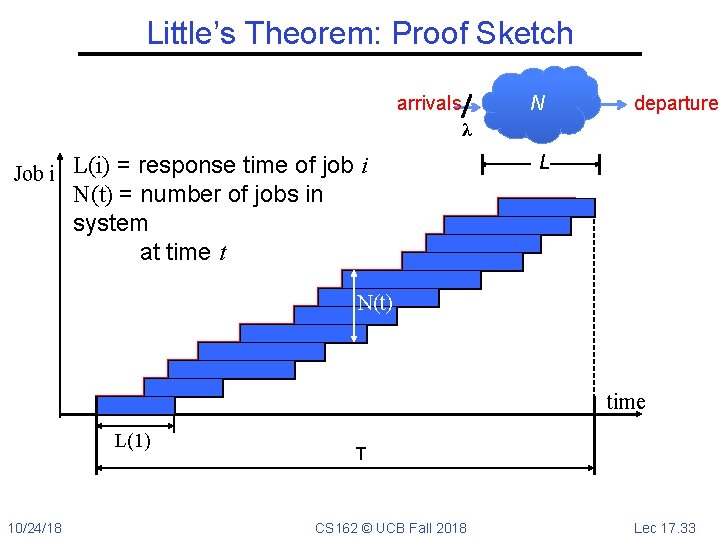
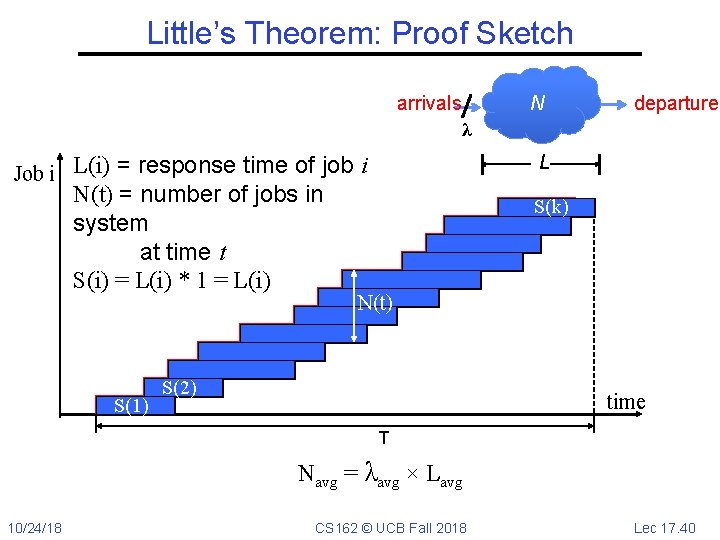
Little’s Theorem: Proof Sketch arrivals N departures λ Job i L(i) = response time of job i L N(t) = number of jobs in system at time t N(t) time L(1) 10/24/18 T CS 162 © UCB Fall 2018 Lec 17. 33
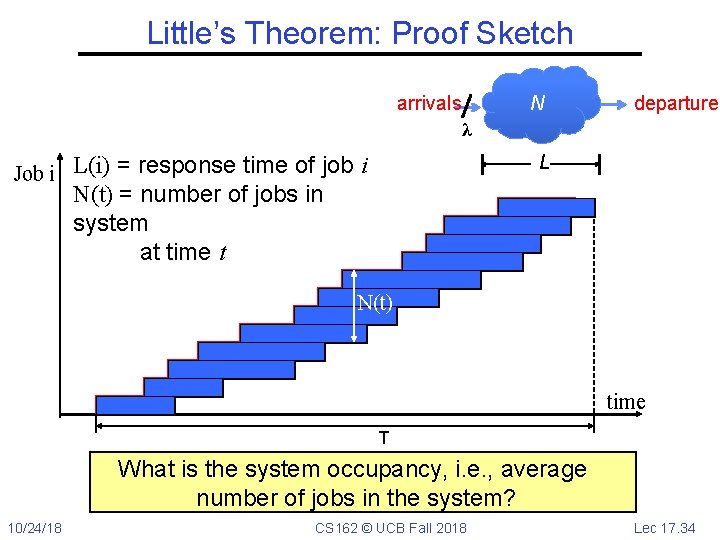
Little’s Theorem: Proof Sketch arrivals N departures λ L Job i L(i) = response time of job i N(t) = number of jobs in system at time t N(t) time T What is the system occupancy, i. e. , average number of jobs in the system? 10/24/18 CS 162 © UCB Fall 2018 Lec 17. 34
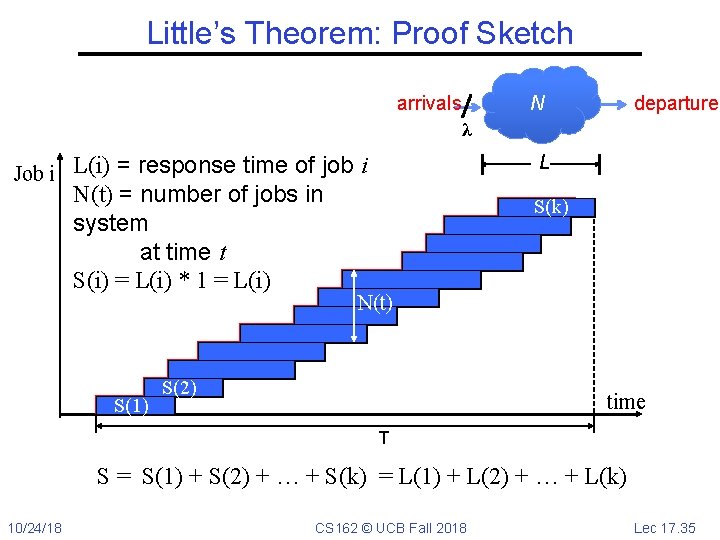
Little’s Theorem: Proof Sketch arrivals departures N λ L Job i L(i) = response time of job i N(t) = number of jobs in system at time t S(i) = L(i) * 1 = L(i) S(1) S(k) N(t) S(2) time T S = S(1) + S(2) + … + S(k) = L(1) + L(2) + … + L(k) 10/24/18 CS 162 © UCB Fall 2018 Lec 17. 35
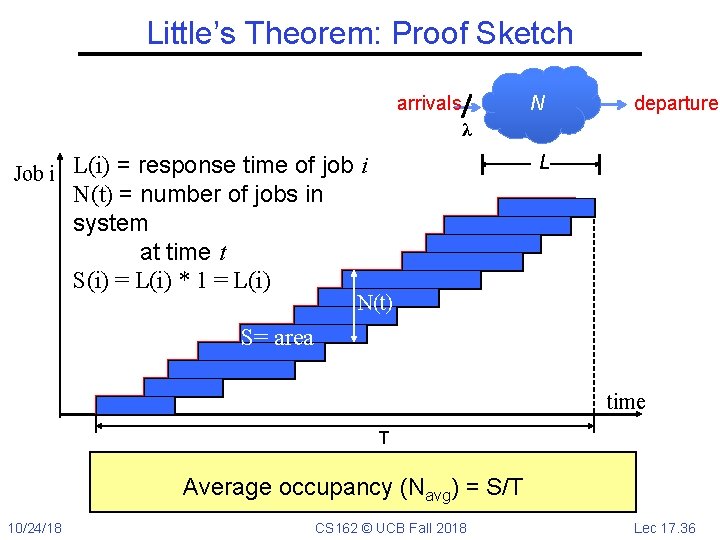
Little’s Theorem: Proof Sketch arrivals N departures λ L Job i L(i) = response time of job i N(t) = number of jobs in system at time t S(i) = L(i) * 1 = L(i) N(t) S= area time T Average occupancy (Navg) = S/T 10/24/18 CS 162 © UCB Fall 2018 Lec 17. 36
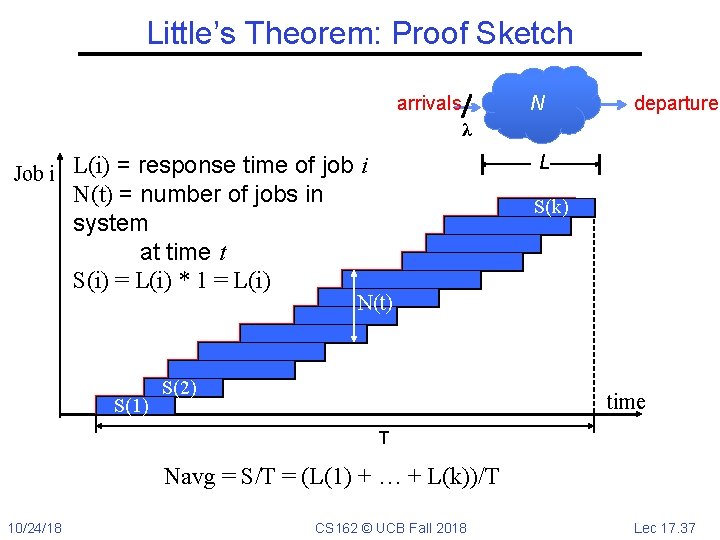
Little’s Theorem: Proof Sketch arrivals N departures λ L Job i L(i) = response time of job i N(t) = number of jobs in system at time t S(i) = L(i) * 1 = L(i) S(1) S(k) N(t) S(2) time T Navg = S/T = (L(1) + … + L(k))/T 10/24/18 CS 162 © UCB Fall 2018 Lec 17. 37
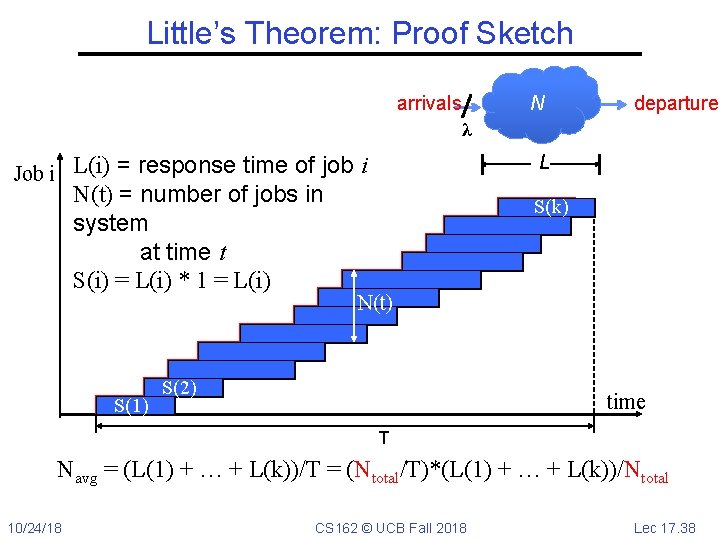
Little’s Theorem: Proof Sketch arrivals N departures λ L Job i L(i) = response time of job i N(t) = number of jobs in system at time t S(i) = L(i) * 1 = L(i) S(1) S(k) N(t) S(2) time T Navg = (L(1) + … + L(k))/T = (Ntotal/T)*(L(1) + … + L(k))/Ntotal 10/24/18 CS 162 © UCB Fall 2018 Lec 17. 38
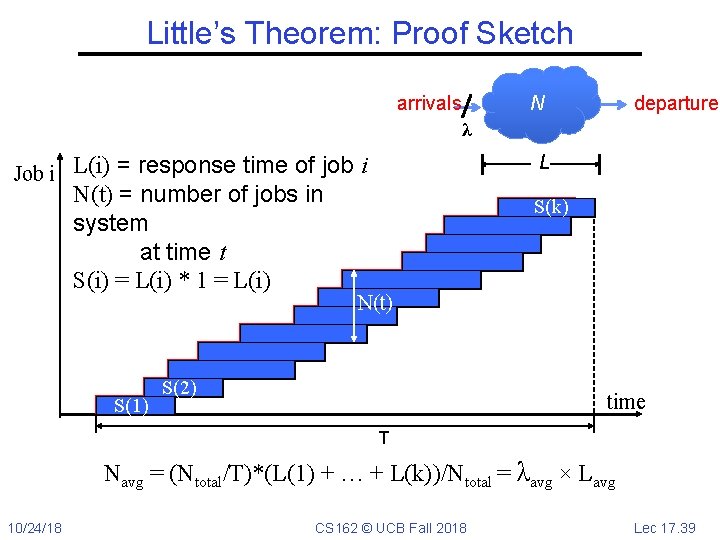
Little’s Theorem: Proof Sketch arrivals departures N λ L Job i L(i) = response time of job i N(t) = number of jobs in system at time t S(i) = L(i) * 1 = L(i) S(1) S(k) N(t) S(2) time T Navg = (Ntotal/T)*(L(1) + … + L(k))/Ntotal = λavg × Lavg 10/24/18 CS 162 © UCB Fall 2018 Lec 17. 39
Little’s Theorem: Proof Sketch arrivals N departures λ L Job i L(i) = response time of job i N(t) = number of jobs in system at time t S(i) = L(i) * 1 = L(i) S(1) S(k) N(t) S(2) time T Navg = λavg × Lavg 10/24/18 CS 162 © UCB Fall 2018 Lec 17. 40
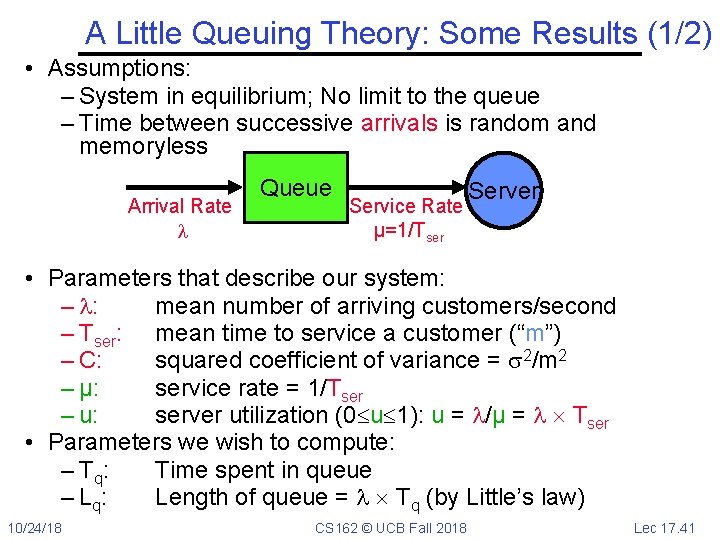
A Little Queuing Theory: Some Results (1/2) • Assumptions: – System in equilibrium; No limit to the queue – Time between successive arrivals is random and memoryless Arrival Rate Queue Service Rate μ=1/Tser Server • Parameters that describe our system: – : mean number of arriving customers/second – Tser: mean time to service a customer (“m”) – C: squared coefficient of variance = 2/m 2 – μ: service rate = 1/Tser – u: server utilization (0 u 1): u = /μ = Tser • Parameters we wish to compute: – T q: Time spent in queue – L q: Length of queue = Tq (by Little’s law) 10/24/18 CS 162 © UCB Fall 2018 Lec 17. 41
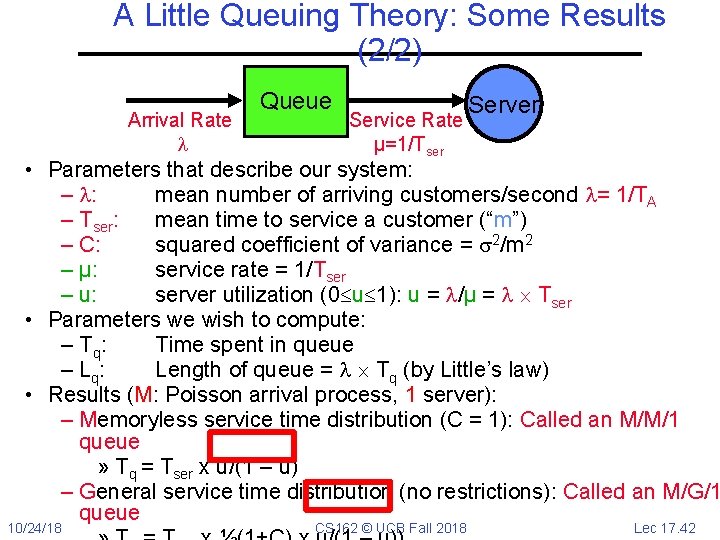
A Little Queuing Theory: Some Results (2/2) Arrival Rate Queue Service Rate μ=1/Tser Server • Parameters that describe our system: – : mean number of arriving customers/second = 1/TA – Tser: mean time to service a customer (“m”) – C: squared coefficient of variance = 2/m 2 – μ: service rate = 1/Tser – u: server utilization (0 u 1): u = /μ = Tser • Parameters we wish to compute: – T q: Time spent in queue – L q: Length of queue = Tq (by Little’s law) • Results (M: Poisson arrival process, 1 server): – Memoryless service time distribution (C = 1): Called an M/M/1 queue » Tq = Tser x u/(1 – u) – General service time distribution (no restrictions): Called an M/G/1 queue 10/24/18 CS 162 © UCB Fall 2018 Lec 17. 42
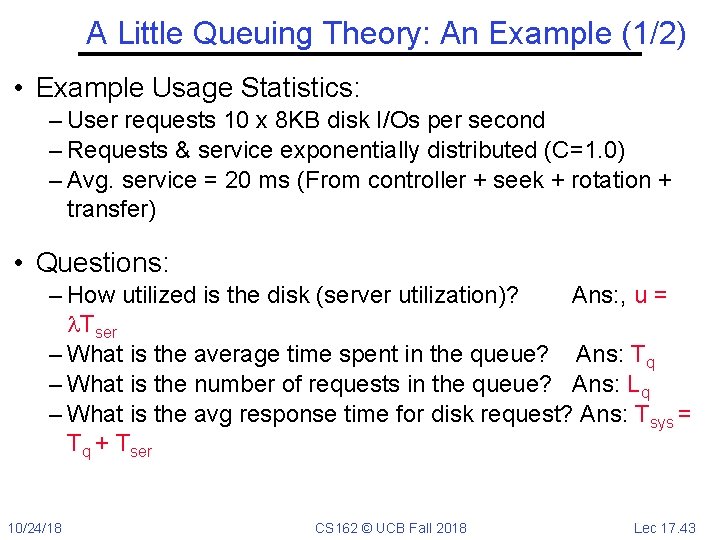
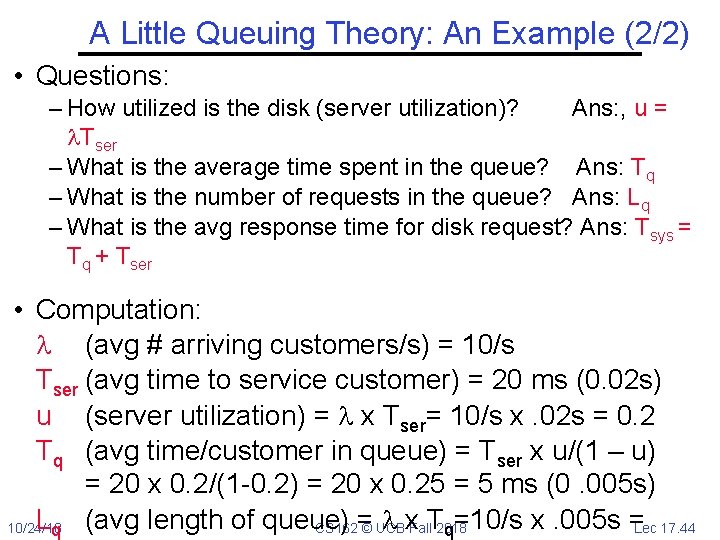
A Little Queuing Theory: An Example (1/2) • Example Usage Statistics: – User requests 10 x 8 KB disk I/Os per second – Requests & service exponentially distributed (C=1. 0) – Avg. service = 20 ms (From controller + seek + rotation + transfer) • Questions: – How utilized is the disk (server utilization)? Ans: , u = Tser – What is the average time spent in the queue? Ans: Tq – What is the number of requests in the queue? Ans: Lq – What is the avg response time for disk request? Ans: Tsys = Tq + Tser 10/24/18 CS 162 © UCB Fall 2018 Lec 17. 43
A Little Queuing Theory: An Example (2/2) • Questions: – How utilized is the disk (server utilization)? Ans: , u = Tser – What is the average time spent in the queue? Ans: Tq – What is the number of requests in the queue? Ans: Lq – What is the avg response time for disk request? Ans: Tsys = Tq + Tser • Computation: (avg # arriving customers/s) = 10/s Tser (avg time to service customer) = 20 ms (0. 02 s) u (server utilization) = x Tser= 10/s x. 02 s = 0. 2 Tq (avg time/customer in queue) = Tser x u/(1 – u) = 20 x 0. 2/(1 -0. 2) = 20 x 0. 25 = 5 ms (0. 005 s) Lq (avg length of queue) x. Fall. T 2018 10/24/18 CS 162= © UCB Lec 17. 44 q=10/s x. 005 s =
Queuing Theory Resources • Resources page contains Queueing Theory Resources (under Readings): – Scanned pages from Patterson and Hennessy book that gives further discussion and simple proof for general equation: https: //cs 162. eecs. berkeley. edu/static/readings/patterson _queue. pdf – A complete website full of resources: http: //web 2. uwindsor. ca/math/hlynka/qonline. html • Some previous midterms with queueing theory questions • Assume that Queueing Theory is fair game for Midterm III 10/24/18 CS 162 © UCB Fall 2018 Lec 17. 45
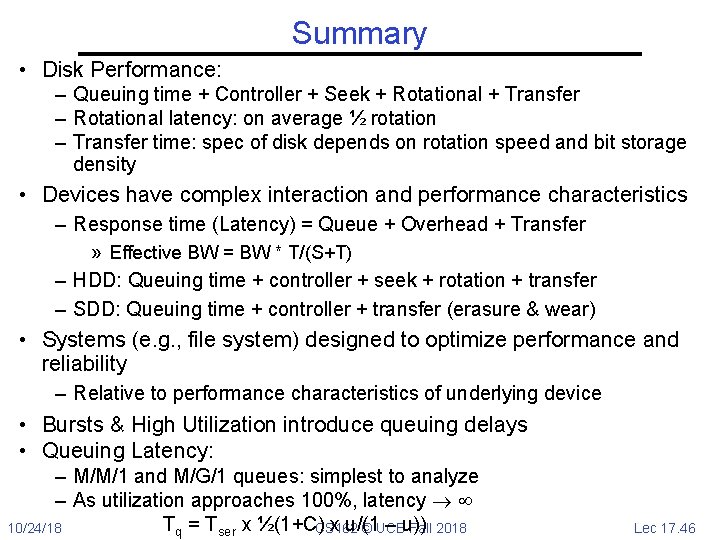
Summary • Disk Performance: – Queuing time + Controller + Seek + Rotational + Transfer – Rotational latency: on average ½ rotation – Transfer time: spec of disk depends on rotation speed and bit storage density • Devices have complex interaction and performance characteristics – Response time (Latency) = Queue + Overhead + Transfer » Effective BW = BW * T/(S+T) – HDD: Queuing time + controller + seek + rotation + transfer – SDD: Queuing time + controller + transfer (erasure & wear) • Systems (e. g. , file system) designed to optimize performance and reliability – Relative to performance characteristics of underlying device • Bursts & High Utilization introduce queuing delays • Queuing Latency: – M/M/1 and M/G/1 queues: simplest to analyze – As utilization approaches 100%, latency Tq = Tser x ½(1+C)CS 162 x u/(1 – u)) 10/24/18 © UCB Fall 2018 Lec 17. 46
Optimize I/O Performance Queue [OS Paths] Controller User Thread 300 Response Time (ms) I/O device 200 100 Response Time = Queue + I/O device service time • How to improve performance? 0 – Make everything faster – More decoupled (Parallelism) systems – Do other useful work while waiting 0% 100% Throughput (Utilization) (% total BW) » Multiple independent buses or controllers – Optimize the bottleneck to increase service rate » Use the queue to optimize the service • Queues absorb bursts and smooth the flow • Add admission control (finite queues) – Limits delays, but may introduce unfairness and livelock 10/24/18 CS 162 © UCB Fall 2018 Lec 17. 47
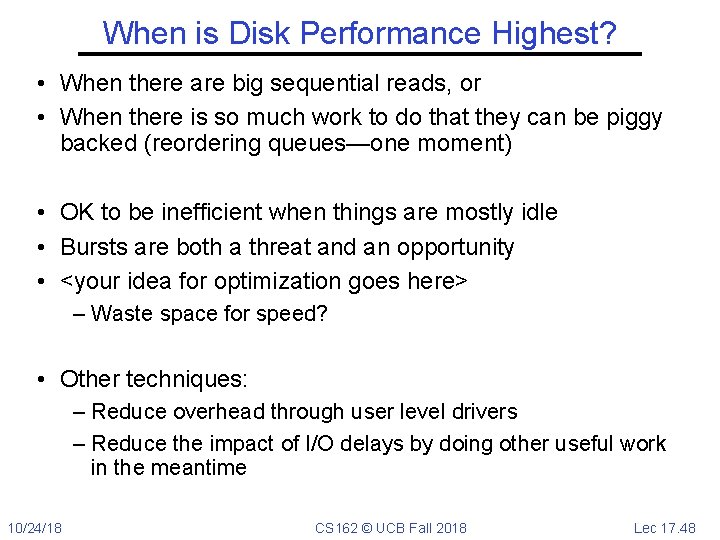
When is Disk Performance Highest? • When there are big sequential reads, or • When there is so much work to do that they can be piggy backed (reordering queues—one moment) • OK to be inefficient when things are mostly idle • Bursts are both a threat and an opportunity • <your idea for optimization goes here> – Waste space for speed? • Other techniques: – Reduce overhead through user level drivers – Reduce the impact of I/O delays by doing other useful work in the meantime 10/24/18 CS 162 © UCB Fall 2018 Lec 17. 48