
CS 162 Operating Systems and Systems Programming Lecture
- Slides: 45
CS 162 Operating Systems and Systems Programming Lecture 14 Caching (Finished), Demand Paging October 17 th, 2016 Prof. Anthony D. Joseph http: //cs 162. eecs. Berkeley. edu
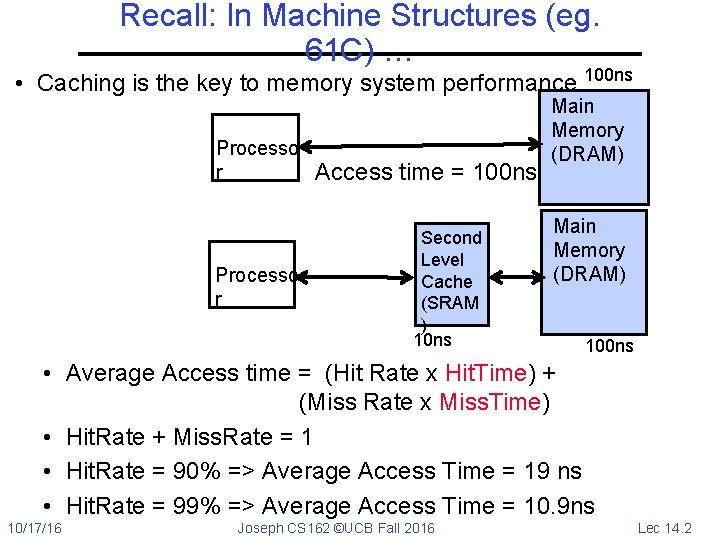
Recall: In Machine Structures (eg. 61 C) … • Caching is the key to memory system performance 100 ns Processo r Access time = 100 ns Second Level Cache (SRAM ) 10 ns Main Memory (DRAM) 100 ns • Average Access time = (Hit Rate x Hit. Time) + (Miss Rate x Miss. Time) • Hit. Rate + Miss. Rate = 1 • Hit. Rate = 90% => Average Access Time = 19 ns • Hit. Rate = 99% => Average Access Time = 10. 9 ns 10/17/16 Joseph CS 162 ©UCB Fall 2016 Lec 14. 2
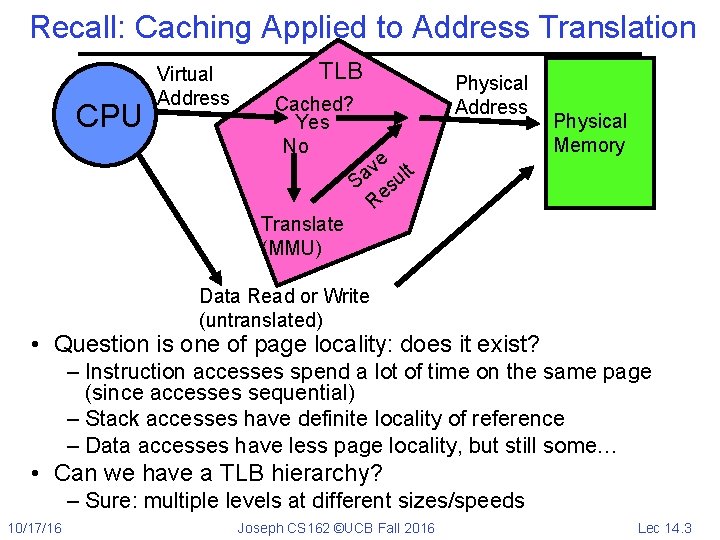
Recall: Caching Applied to Address Translation CPU Virtual Address TLB Cached? Yes No Translate (MMU) Physical Address e t v l Sa su Re Physical Memory Data Read or Write (untranslated) • Question is one of page locality: does it exist? – Instruction accesses spend a lot of time on the same page (since accesses sequential) – Stack accesses have definite locality of reference – Data accesses have less page locality, but still some… • Can we have a TLB hierarchy? – Sure: multiple levels at different sizes/speeds 10/17/16 Joseph CS 162 ©UCB Fall 2016 Lec 14. 3
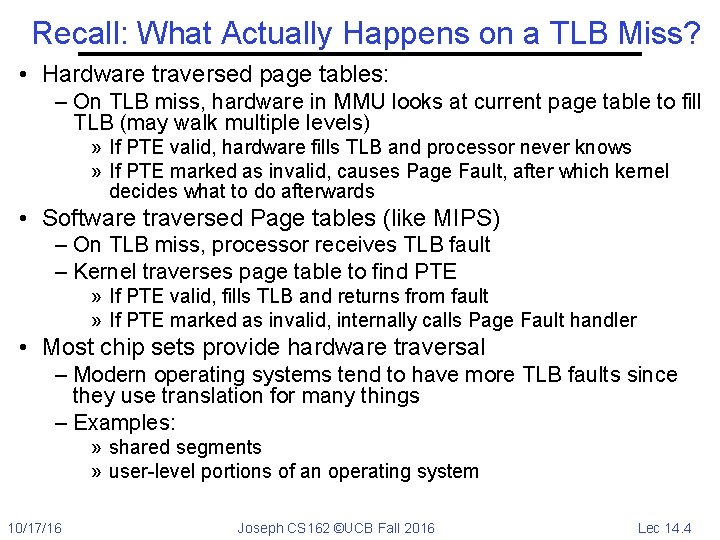
Recall: What Actually Happens on a TLB Miss? • Hardware traversed page tables: – On TLB miss, hardware in MMU looks at current page table to fill TLB (may walk multiple levels) » If PTE valid, hardware fills TLB and processor never knows » If PTE marked as invalid, causes Page Fault, after which kernel decides what to do afterwards • Software traversed Page tables (like MIPS) – On TLB miss, processor receives TLB fault – Kernel traverses page table to find PTE » If PTE valid, fills TLB and returns from fault » If PTE marked as invalid, internally calls Page Fault handler • Most chip sets provide hardware traversal – Modern operating systems tend to have more TLB faults since they use translation for many things – Examples: » shared segments » user-level portions of an operating system 10/17/16 Joseph CS 162 ©UCB Fall 2016 Lec 14. 4
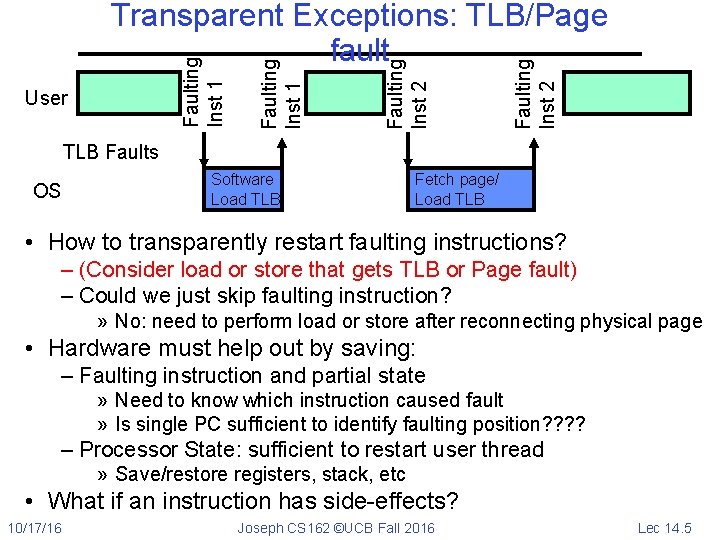
Faulting Inst 2 User Faulting Inst 1 Transparent Exceptions: TLB/Page fault TLB Faults OS Software Load TLB Fetch page/ Load TLB • How to transparently restart faulting instructions? – (Consider load or store that gets TLB or Page fault) – Could we just skip faulting instruction? » No: need to perform load or store after reconnecting physical page • Hardware must help out by saving: – Faulting instruction and partial state » Need to know which instruction caused fault » Is single PC sufficient to identify faulting position? ? – Processor State: sufficient to restart user thread » Save/restore registers, stack, etc • What if an instruction has side-effects? 10/17/16 Joseph CS 162 ©UCB Fall 2016 Lec 14. 5
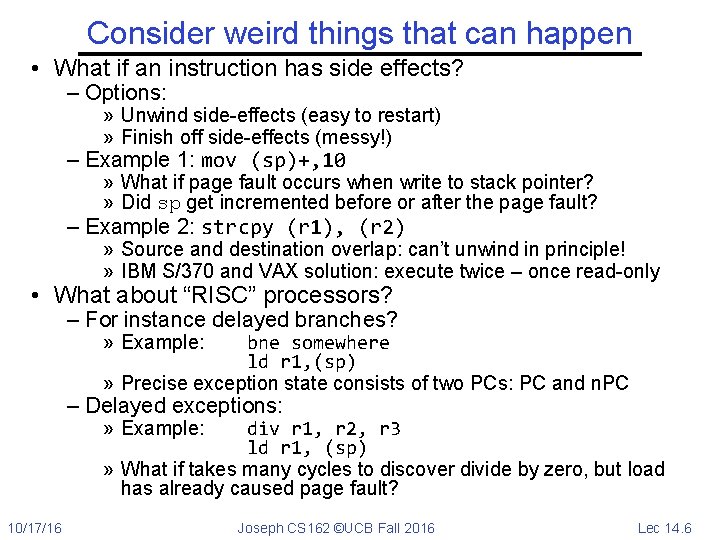
Consider weird things that can happen • What if an instruction has side effects? – Options: » Unwind side-effects (easy to restart) » Finish off side-effects (messy!) – Example 1: mov (sp)+, 10 » What if page fault occurs when write to stack pointer? » Did sp get incremented before or after the page fault? – Example 2: strcpy (r 1), (r 2) » Source and destination overlap: can’t unwind in principle! » IBM S/370 and VAX solution: execute twice – once read-only • What about “RISC” processors? – For instance delayed branches? » Example: bne somewhere ld r 1, (sp) » Precise exception state consists of two PCs: PC and n. PC – Delayed exceptions: » Example: div r 1, r 2, r 3 ld r 1, (sp) » What if takes many cycles to discover divide by zero, but load has already caused page fault? 10/17/16 Joseph CS 162 ©UCB Fall 2016 Lec 14. 6
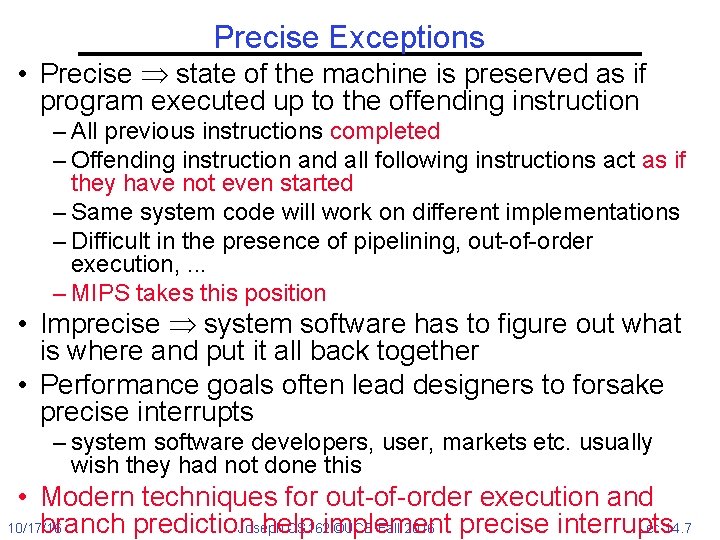
Precise Exceptions • Precise state of the machine is preserved as if program executed up to the offending instruction – All previous instructions completed – Offending instruction and all following instructions act as if they have not even started – Same system code will work on different implementations – Difficult in the presence of pipelining, out-of-order execution, . . . – MIPS takes this position • Imprecise system software has to figure out what is where and put it all back together • Performance goals often lead designers to forsake precise interrupts – system software developers, user, markets etc. usually wish they had not done this • Modern techniques for out-of-order execution and 10/17/16 Joseph CS 162 ©UCB Fall 2016 Lec 14. 7 branch prediction help implement precise interrupts
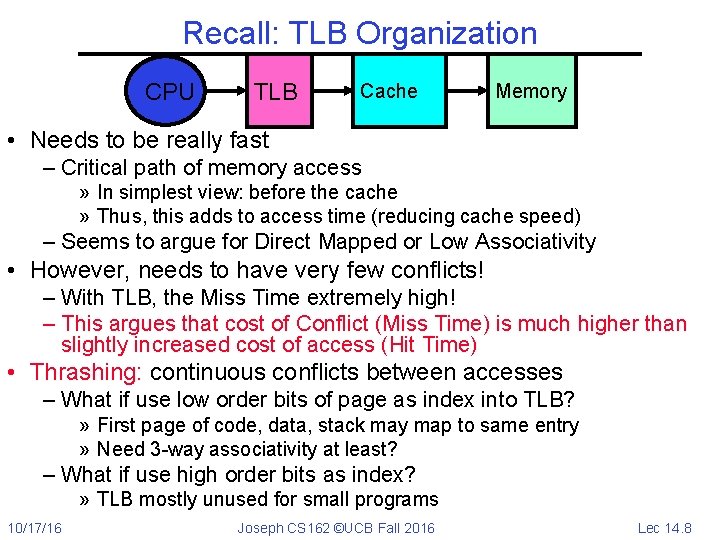
Recall: TLB Organization CPU TLB Cache Memory • Needs to be really fast – Critical path of memory access » In simplest view: before the cache » Thus, this adds to access time (reducing cache speed) – Seems to argue for Direct Mapped or Low Associativity • However, needs to have very few conflicts! – With TLB, the Miss Time extremely high! – This argues that cost of Conflict (Miss Time) is much higher than slightly increased cost of access (Hit Time) • Thrashing: continuous conflicts between accesses – What if use low order bits of page as index into TLB? » First page of code, data, stack may map to same entry » Need 3 -way associativity at least? – What if use high order bits as index? » TLB mostly unused for small programs 10/17/16 Joseph CS 162 ©UCB Fall 2016 Lec 14. 8
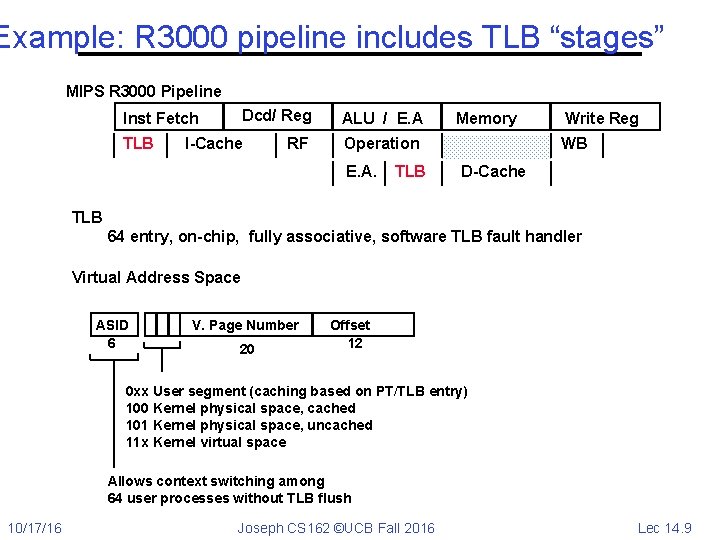
Example: R 3000 pipeline includes TLB “stages” MIPS R 3000 Pipeline Dcd/ Reg Inst Fetch TLB I-Cache RF ALU / E. A Memory Operation E. A. TLB Write Reg WB D-Cache TLB 64 entry, on-chip, fully associative, software TLB fault handler Virtual Address Space ASID 6 V. Page Number 20 Offset 12 0 xx User segment (caching based on PT/TLB entry) 100 Kernel physical space, cached 101 Kernel physical space, uncached 11 x Kernel virtual space Allows context switching among 64 user processes without TLB flush 10/17/16 Joseph CS 162 ©UCB Fall 2016 Lec 14. 9
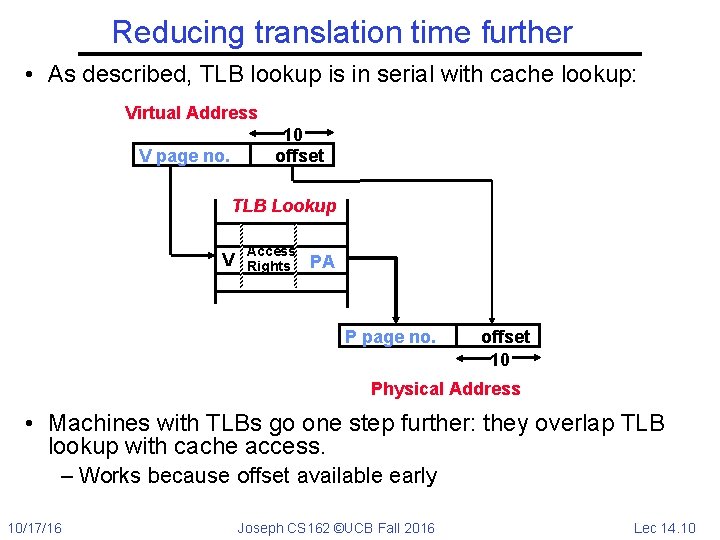
Reducing translation time further • As described, TLB lookup is in serial with cache lookup: Virtual Address 10 offset V page no. TLB Lookup V Access Rights PA P page no. offset 10 Physical Address • Machines with TLBs go one step further: they overlap TLB lookup with cache access. – Works because offset available early 10/17/16 Joseph CS 162 ©UCB Fall 2016 Lec 14. 10
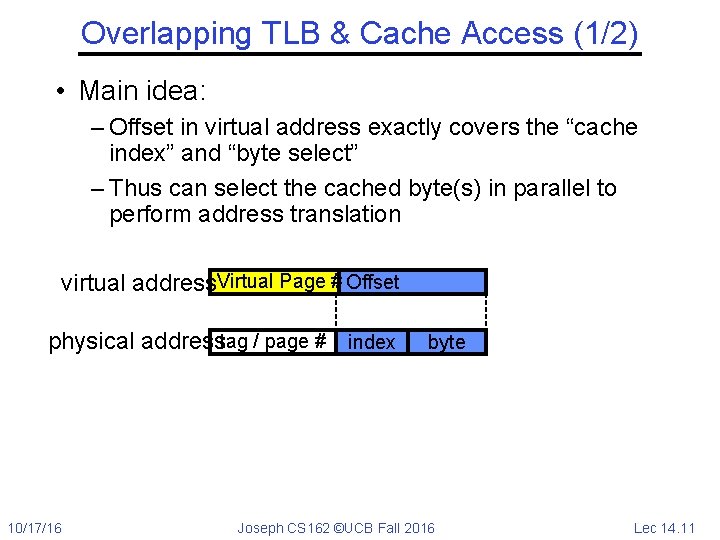
Overlapping TLB & Cache Access (1/2) • Main idea: – Offset in virtual address exactly covers the “cache index” and “byte select” – Thus can select the cached byte(s) in parallel to perform address translation virtual address. Virtual Page # Offset physical addresstag / page # index 10/17/16 byte Joseph CS 162 ©UCB Fall 2016 Lec 14. 11
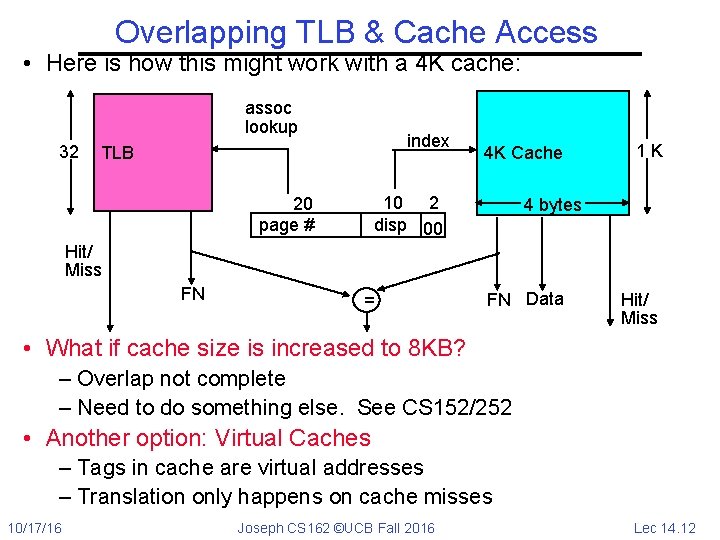
Overlapping TLB & Cache Access • Here is how this might work with a 4 K cache: assoc lookup 32 index TLB 4 K Cache 10 2 disp 00 20 page # 1 K 4 bytes Hit/ Miss FN = FN Data Hit/ Miss • What if cache size is increased to 8 KB? – Overlap not complete – Need to do something else. See CS 152/252 • Another option: Virtual Caches – Tags in cache are virtual addresses – Translation only happens on cache misses 10/17/16 Joseph CS 162 ©UCB Fall 2016 Lec 14. 12
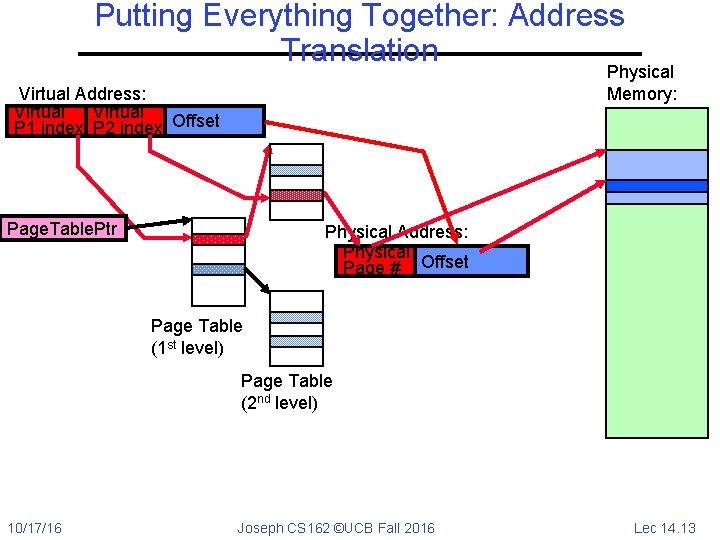
Putting Everything Together: Address Translation Physical Memory: Virtual Address: Virtual P 1 index P 2 index Offset Page. Table. Ptr Physical Address: Physical Page # Offset Page Table (1 st level) Page Table (2 nd level) 10/17/16 Joseph CS 162 ©UCB Fall 2016 Lec 14. 13
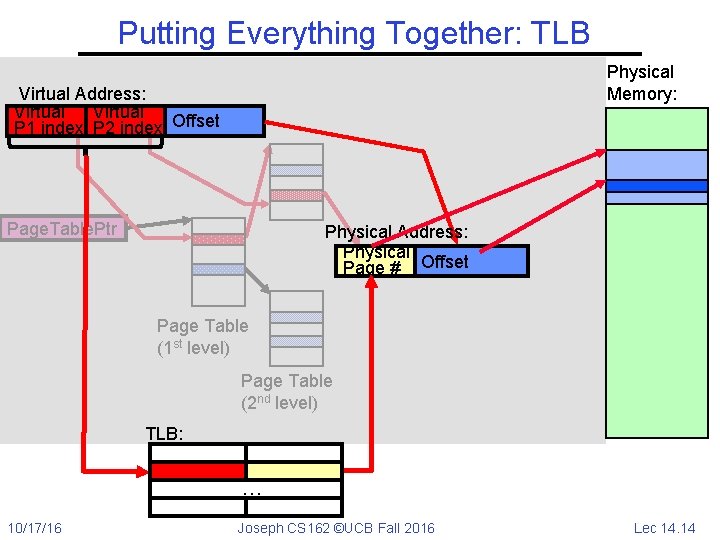
Putting Everything Together: TLB Physical Memory: Virtual Address: Virtual P 1 index P 2 index Offset Page. Table. Ptr Physical Address: Physical Page # Offset Page Table (1 st level) Page Table (2 nd level) TLB: … 10/17/16 Joseph CS 162 ©UCB Fall 2016 Lec 14. 14
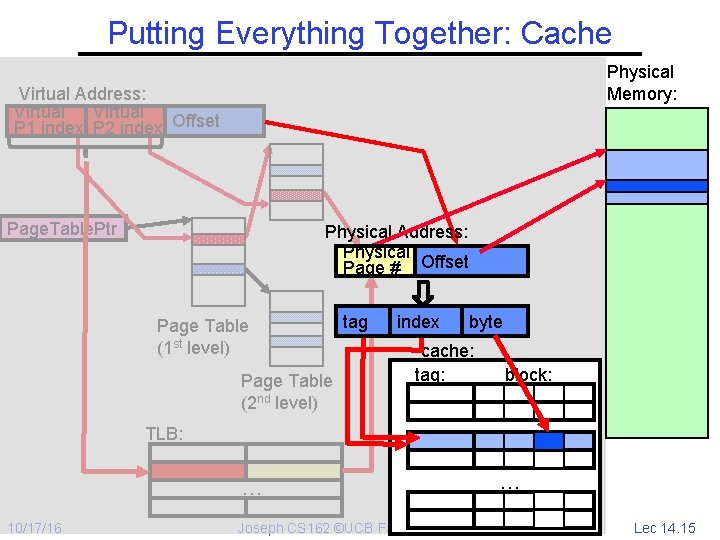
Putting Everything Together: Cache Physical Memory: Virtual Address: Virtual P 1 index P 2 index Offset Page. Table. Ptr Physical Address: Physical Page # Offset Page Table (1 st level) Page Table (2 nd level) tag index byte cache: tag: block: TLB: … 10/17/16 Joseph CS 162 ©UCB Fall 2016 … Lec 14. 15
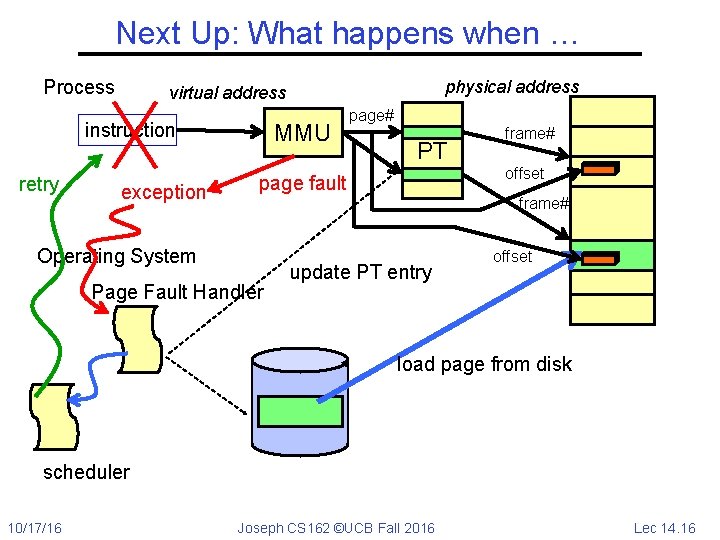
Next Up: What happens when … Process instruction retry physical address virtual address exception MMU page# PT frame# offset page fault frame# Operating System Page Fault Handler update PT entry offset load page from disk scheduler 10/17/16 Joseph CS 162 ©UCB Fall 2016 Lec 14. 16
Administrivia • Deadlines this week: – Project 2 design doc due Wed 10/19 – Peer review is *NOT* optional » Every person must fill out the project 1 peer review » Due Wed 10/19 - we will consider taking off points for missing reviews » The peer review is an important part of our evaluation of partner dynamics – please take is very seriously • No OH for Prof Joseph on Tuesday 10/18 • Midterm 2 next week on Tue 10/25 6: 30 -8 PM – All topics up to and including Lecture 15 » Focus will be on Lectures 9 – 15 and associated readings » Projects 1 & 2, Homework 0 – 2 – Closed book with 2 pages of hand-written notes both sides – Room assignments by last name: » 10 Evans (A – K), 1 Le. Conte (L – S), 60 Evans (T – Z) 10/17/16 Joseph CS 162 ©UCB Fall 2016 Lec 14. 17
BREAK 10/17/16 Joseph CS 162 ©UCB Fall 2016 Lec 14. 18
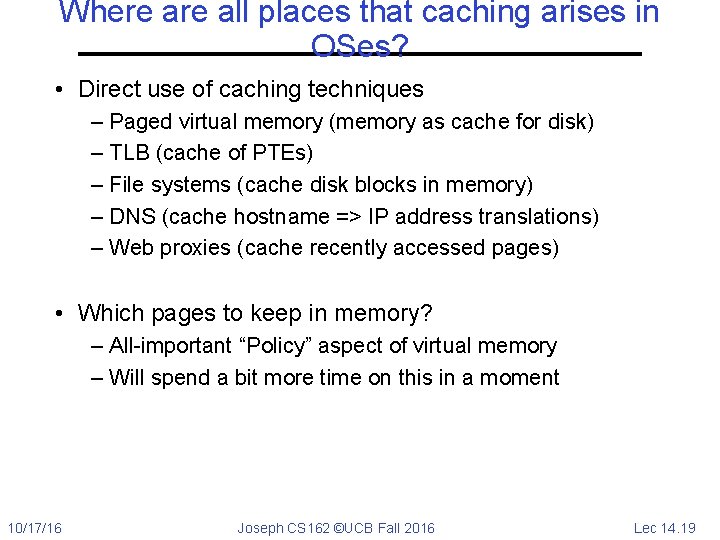
Where all places that caching arises in OSes? • Direct use of caching techniques – Paged virtual memory (memory as cache for disk) – TLB (cache of PTEs) – File systems (cache disk blocks in memory) – DNS (cache hostname => IP address translations) – Web proxies (cache recently accessed pages) • Which pages to keep in memory? – All-important “Policy” aspect of virtual memory – Will spend a bit more time on this in a moment 10/17/16 Joseph CS 162 ©UCB Fall 2016 Lec 14. 19
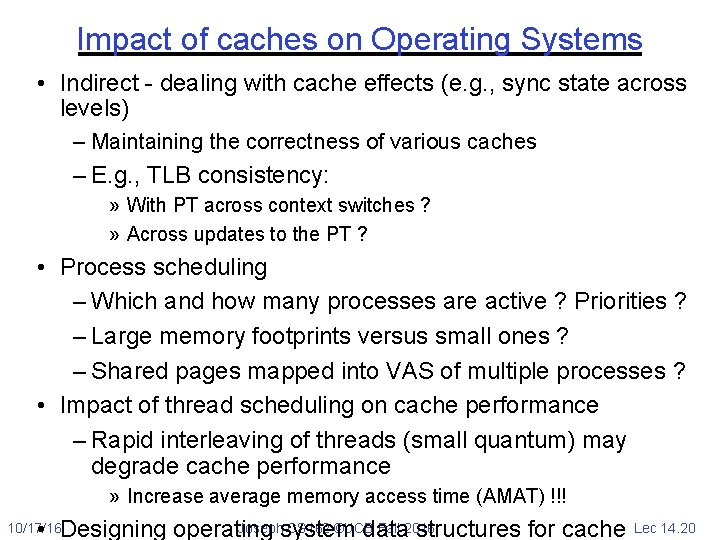
Impact of caches on Operating Systems • Indirect - dealing with cache effects (e. g. , sync state across levels) – Maintaining the correctness of various caches – E. g. , TLB consistency: » With PT across context switches ? » Across updates to the PT ? • Process scheduling – Which and how many processes are active ? Priorities ? – Large memory footprints versus small ones ? – Shared pages mapped into VAS of multiple processes ? • Impact of thread scheduling on cache performance – Rapid interleaving of threads (small quantum) may degrade cache performance » Increase average memory access time (AMAT) !!! Josephsystem CS 162 ©UCB Fall 2016 • Designing operating data structures for cache 10/17/16 Lec 14. 20
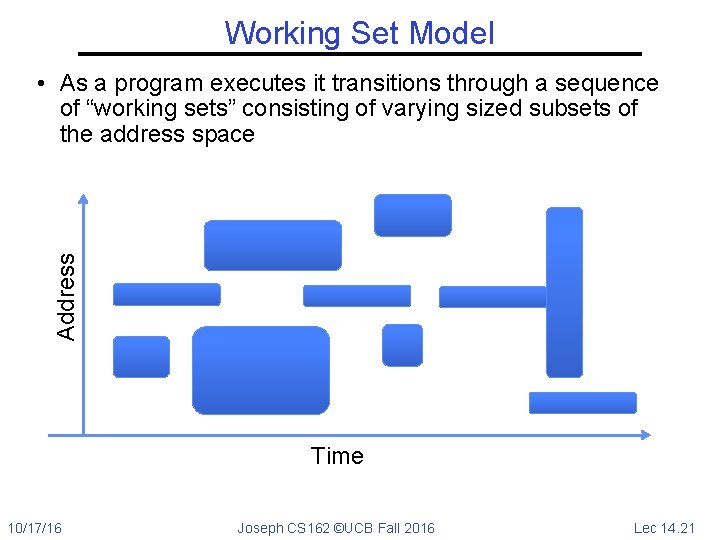
Working Set Model Address • As a program executes it transitions through a sequence of “working sets” consisting of varying sized subsets of the address space Time 10/17/16 Joseph CS 162 ©UCB Fall 2016 Lec 14. 21
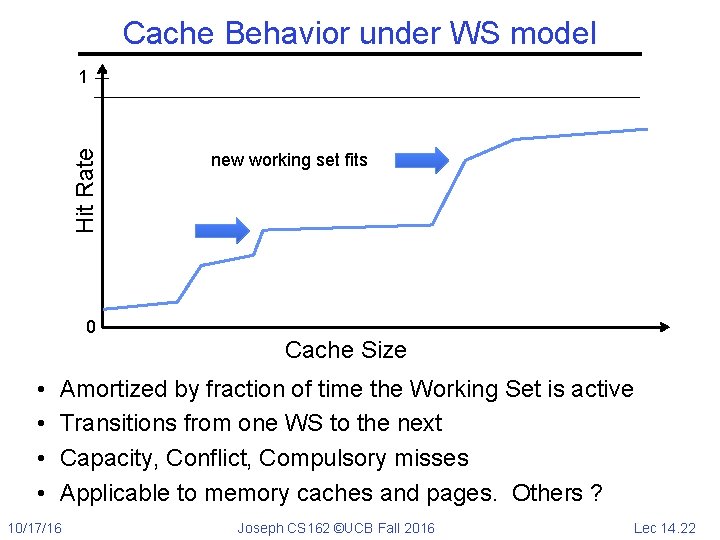
Cache Behavior under WS model Hit Rate 1 0 • • new working set fits Cache Size Amortized by fraction of time the Working Set is active Transitions from one WS to the next Capacity, Conflict, Compulsory misses Applicable to memory caches and pages. Others ? 10/17/16 Joseph CS 162 ©UCB Fall 2016 Lec 14. 22
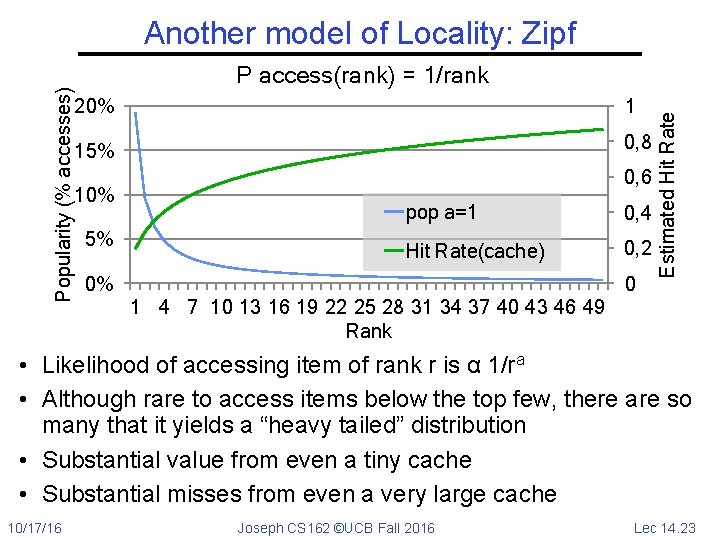
P access(rank) = 1/rank 20% 1 15% 0, 8 10% 5% 0, 6 pop a=1 0, 4 Hit Rate(cache) 0, 2 0% 0 Estimated Hit Rate Popularity (% accesses) Another model of Locality: Zipf 1 4 7 10 13 16 19 22 25 28 31 34 37 40 43 46 49 Rank • Likelihood of accessing item of rank r is α 1/ra • Although rare to access items below the top few, there are so many that it yields a “heavy tailed” distribution • Substantial value from even a tiny cache • Substantial misses from even a very large cache 10/17/16 Joseph CS 162 ©UCB Fall 2016 Lec 14. 23
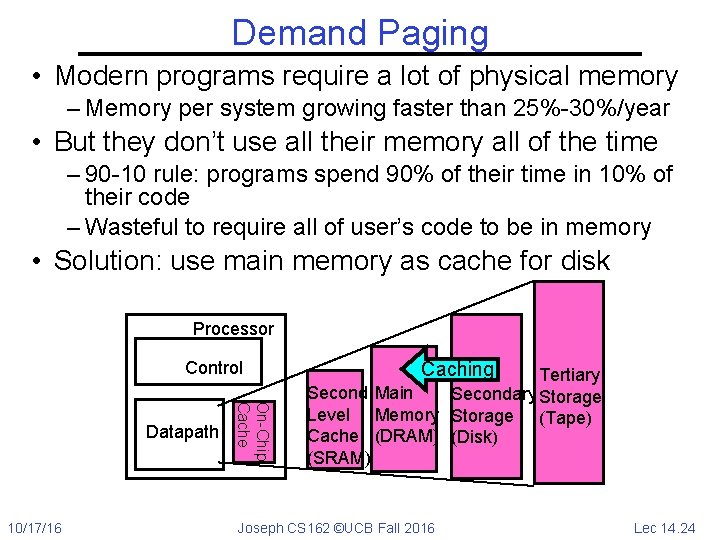
Demand Paging • Modern programs require a lot of physical memory – Memory per system growing faster than 25%-30%/year • But they don’t use all their memory all of the time – 90 -10 rule: programs spend 90% of their time in 10% of their code – Wasteful to require all of user’s code to be in memory • Solution: use main memory as cache for disk Processor Control 10/17/16 On-Chip Cache Datapath Caching Tertiary Second Main Secondary Storage Level Memory Storage (Tape) Cache (DRAM) (Disk) (SRAM) Joseph CS 162 ©UCB Fall 2016 Lec 14. 24
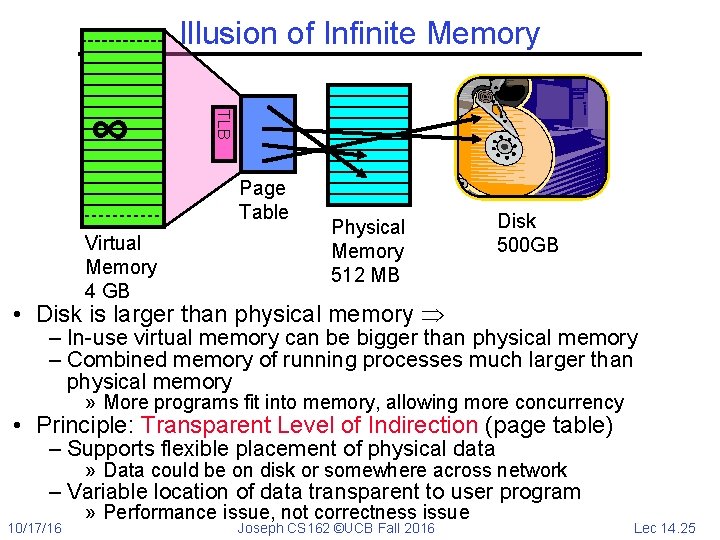
Illusion of Infinite Memory TLB ∞ Page Table Virtual Memory 4 GB Physical Memory 512 MB Disk 500 GB • Disk is larger than physical memory – In-use virtual memory can be bigger than physical memory – Combined memory of running processes much larger than physical memory » More programs fit into memory, allowing more concurrency • Principle: Transparent Level of Indirection (page table) – Supports flexible placement of physical data » Data could be on disk or somewhere across network – Variable location of data transparent to user program 10/17/16 » Performance issue, not correctness issue Joseph CS 162 ©UCB Fall 2016 Lec 14. 25
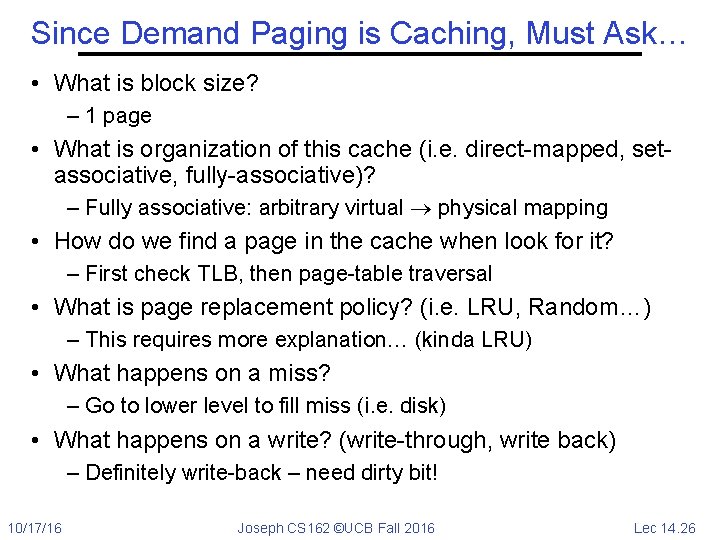
Since Demand Paging is Caching, Must Ask… • What is block size? – 1 page • What is organization of this cache (i. e. direct-mapped, setassociative, fully-associative)? – Fully associative: arbitrary virtual physical mapping • How do we find a page in the cache when look for it? – First check TLB, then page-table traversal • What is page replacement policy? (i. e. LRU, Random…) – This requires more explanation… (kinda LRU) • What happens on a miss? – Go to lower level to fill miss (i. e. disk) • What happens on a write? (write-through, write back) – Definitely write-back – need dirty bit! 10/17/16 Joseph CS 162 ©UCB Fall 2016 Lec 14. 26
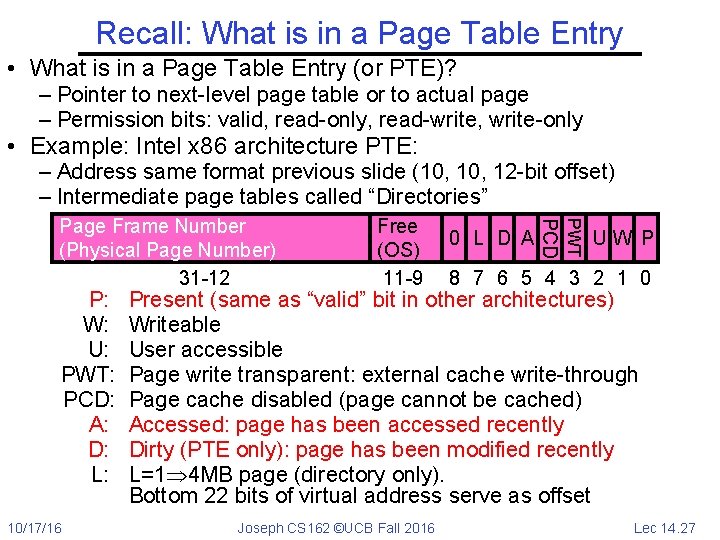
Recall: What is in a Page Table Entry • What is in a Page Table Entry (or PTE)? – Pointer to next-level page table or to actual page – Permission bits: valid, read-only, read-write, write-only • Example: Intel x 86 architecture PTE: – Address same format previous slide (10, 12 -bit offset) – Intermediate page tables called “Directories” 10/17/16 0 L D A PWT P: W: U: PWT: PCD: A: D: L: Free (OS) 11 -9 PCD Page Frame Number (Physical Page Number) 31 -12 UW P 8 7 6 5 4 3 2 1 0 Present (same as “valid” bit in other architectures) Writeable User accessible Page write transparent: external cache write-through Page cache disabled (page cannot be cached) Accessed: page has been accessed recently Dirty (PTE only): page has been modified recently L=1 4 MB page (directory only). Bottom 22 bits of virtual address serve as offset Joseph CS 162 ©UCB Fall 2016 Lec 14. 27
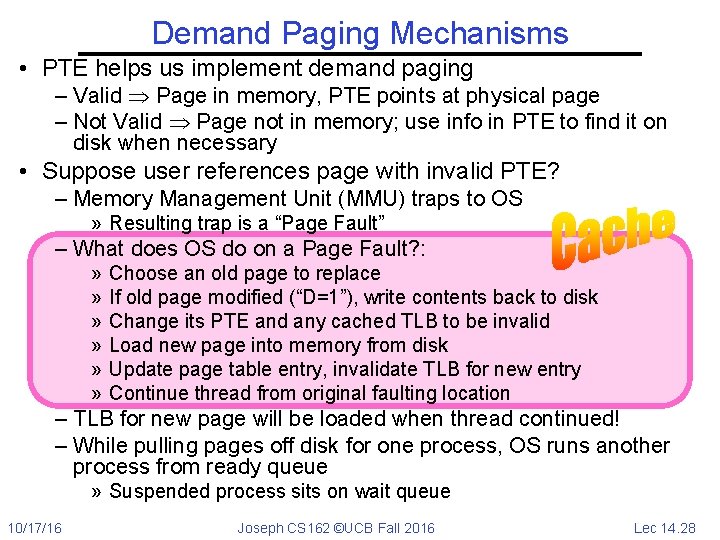
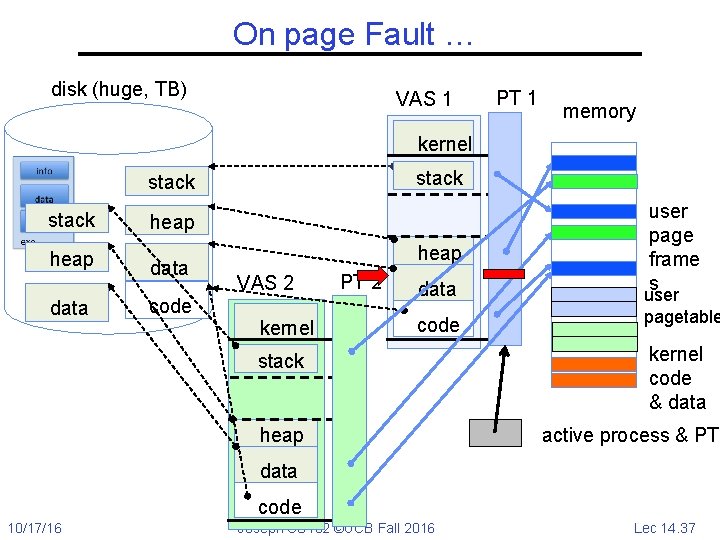
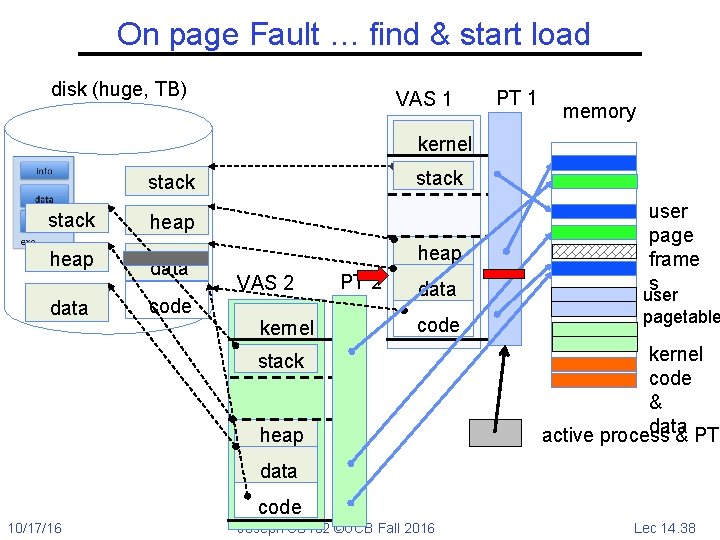
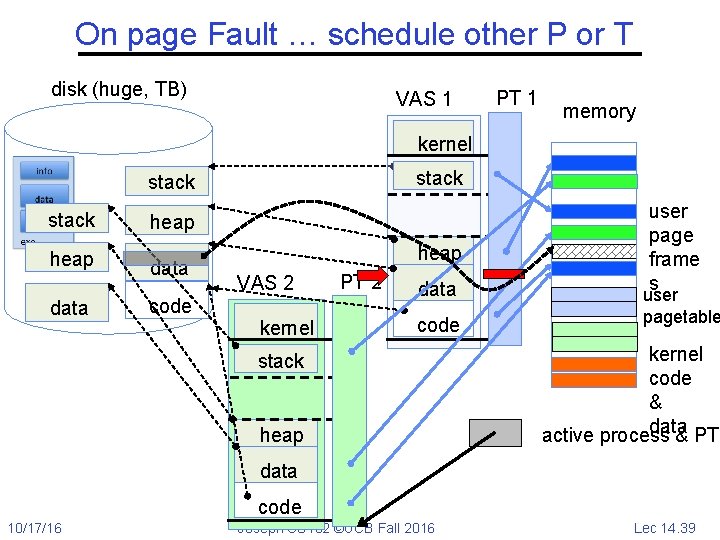
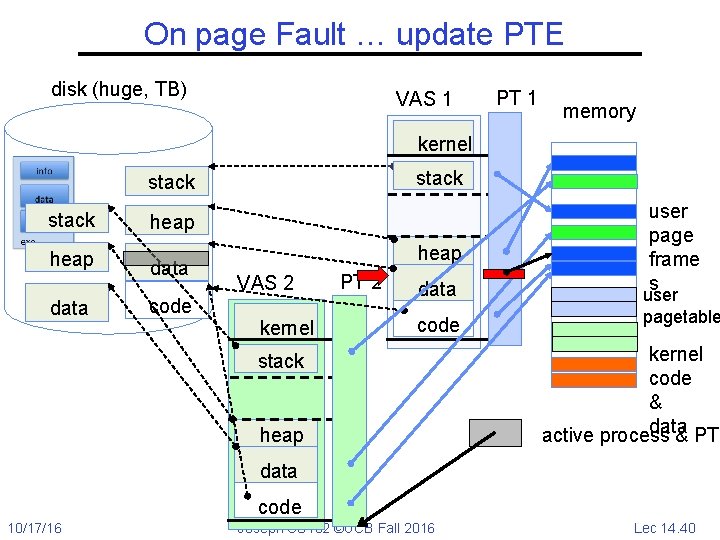
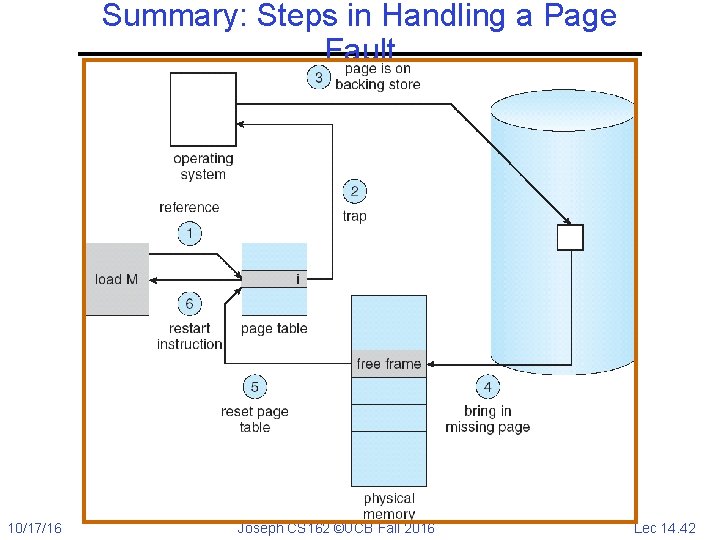
Demand Paging Mechanisms • PTE helps us implement demand paging – Valid Page in memory, PTE points at physical page – Not Valid Page not in memory; use info in PTE to find it on disk when necessary • Suppose user references page with invalid PTE? – Memory Management Unit (MMU) traps to OS » Resulting trap is a “Page Fault” – What does OS do on a Page Fault? : » » » Choose an old page to replace If old page modified (“D=1”), write contents back to disk Change its PTE and any cached TLB to be invalid Load new page into memory from disk Update page table entry, invalidate TLB for new entry Continue thread from original faulting location – TLB for new page will be loaded when thread continued! – While pulling pages off disk for one process, OS runs another process from ready queue » Suspended process sits on wait queue 10/17/16 Joseph CS 162 ©UCB Fall 2016 Lec 14. 28
BREAK 10/17/16 Joseph CS 162 ©UCB Fall 2016 Lec 14. 29
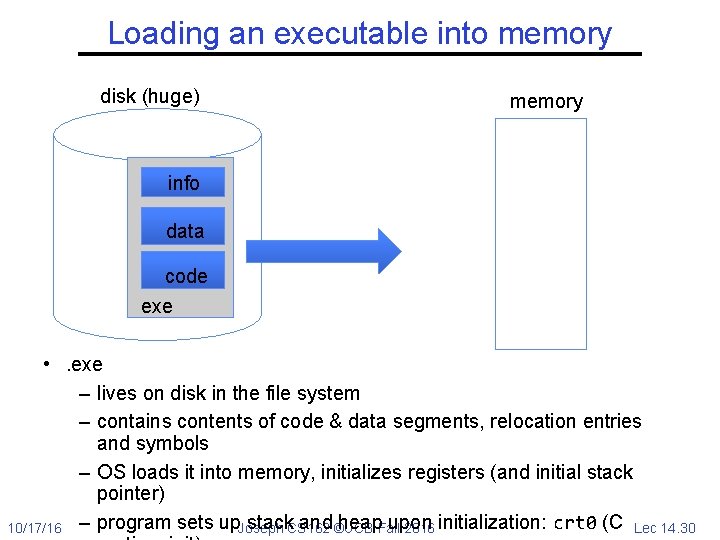
Loading an executable into memory disk (huge) memory info data code exe • . exe – lives on disk in the file system – contains contents of code & data segments, relocation entries and symbols – OS loads it into memory, initializes registers (and initial stack pointer) stack. CS 162 and ©UCB heap. Fall upon 10/17/16 – program sets up. Joseph 2016 initialization: crt 0 (C Lec 14. 30
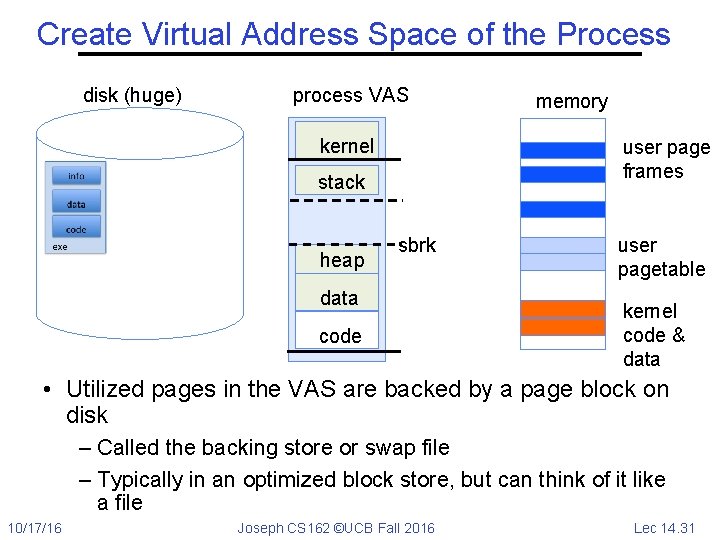
Create Virtual Address Space of the Process disk (huge) process VAS kernel user page frames stack heap memory sbrk data code user pagetable kernel code & data • Utilized pages in the VAS are backed by a page block on disk – Called the backing store or swap file – Typically in an optimized block store, but can think of it like a file 10/17/16 Joseph CS 162 ©UCB Fall 2016 Lec 14. 31
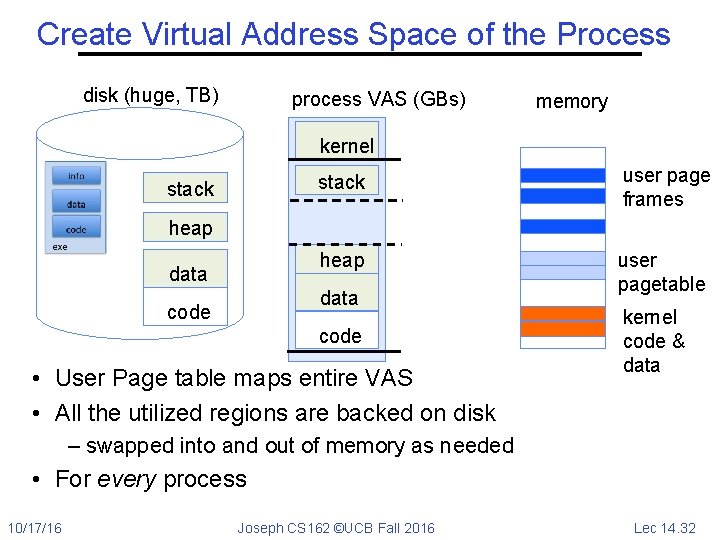
Create Virtual Address Space of the Process disk (huge, TB) process VAS (GBs) memory kernel stack user page frames heap user pagetable heap data code • User Page table maps entire VAS • All the utilized regions are backed on disk kernel code & data – swapped into and out of memory as needed • For every process 10/17/16 Joseph CS 162 ©UCB Fall 2016 Lec 14. 32
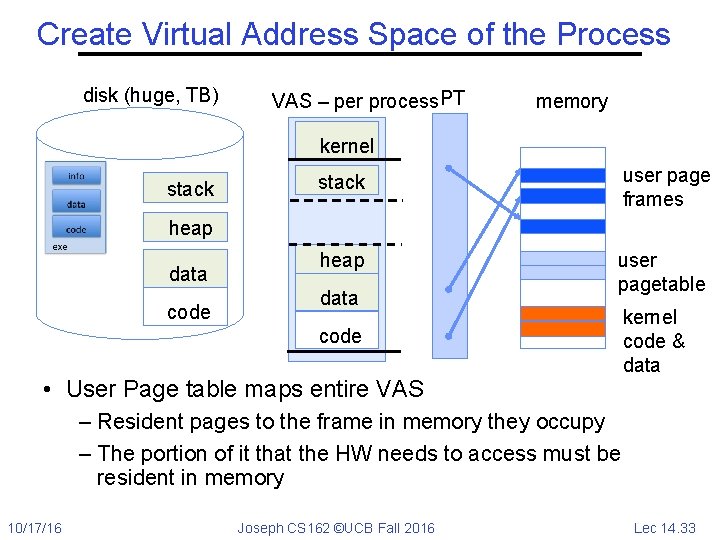
Create Virtual Address Space of the Process disk (huge, TB) VAS – per process PT memory kernel stack user page frames heap user pagetable heap data code • User Page table maps entire VAS kernel code & data – Resident pages to the frame in memory they occupy – The portion of it that the HW needs to access must be resident in memory 10/17/16 Joseph CS 162 ©UCB Fall 2016 Lec 14. 33
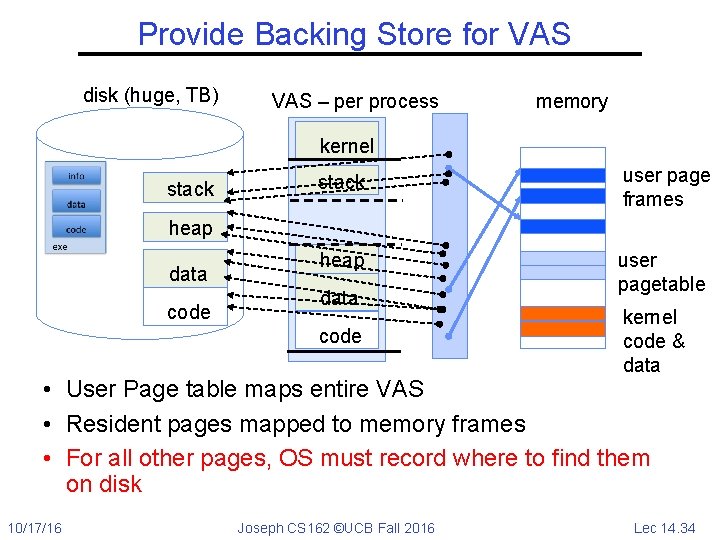
Provide Backing Store for VAS disk (huge, TB) VAS – per process memory kernel stack user page frames heap user pagetable heap data code kernel code & data • User Page table maps entire VAS • Resident pages mapped to memory frames • For all other pages, OS must record where to find them on disk 10/17/16 Joseph CS 162 ©UCB Fall 2016 Lec 14. 34
What Data Structure Maps Non-Resident Pages to Disk? • Find. Block(PID, page#) → disk_block – Some OSs utilize spare space in PTE for paged blocks – Like the PT, but purely software • Where to store it? – In memory – can be compact representation if swap storage is contiguous on disk – Could use hash table (like Inverted PT) • Usually want backing store for resident pages too • May map code segment directly to on-disk image – Saves a copy of code to swap file • May share code segment with multiple instances of the program 10/17/16 Joseph CS 162 ©UCB Fall 2016 Lec 14. 35
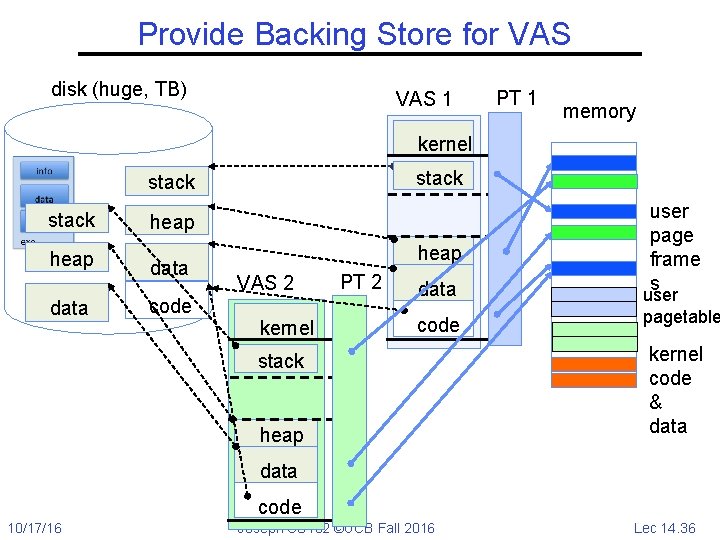
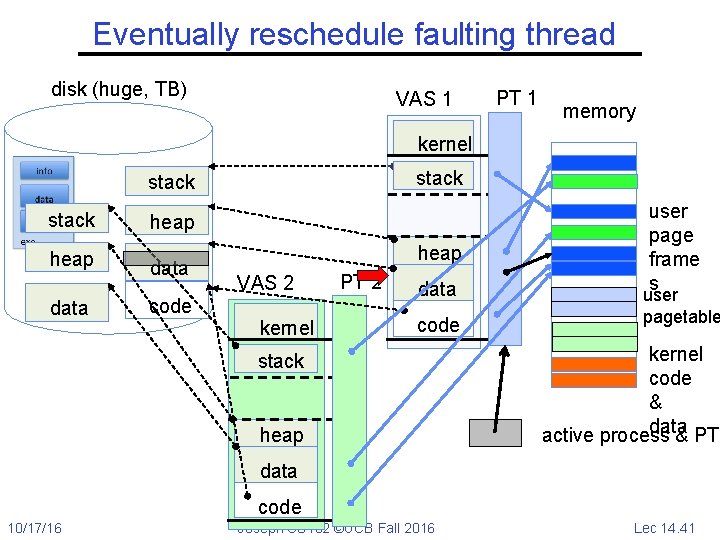
Provide Backing Store for VAS disk (huge, TB) VAS 1 PT 1 memory kernel stack heap data code heap VAS 2 kernel PT 2 data code stack heap user page frame s user pagetable kernel code & data code 10/17/16 Joseph CS 162 ©UCB Fall 2016 Lec 14. 36
On page Fault … disk (huge, TB) VAS 1 PT 1 memory kernel stack heap data code heap VAS 2 kernel PT 2 data code stack heap user page frame s user pagetable kernel code & data active process & PT data code 10/17/16 Joseph CS 162 ©UCB Fall 2016 Lec 14. 37
On page Fault … find & start load disk (huge, TB) VAS 1 PT 1 memory kernel stack heap data code heap VAS 2 kernel PT 2 data code stack heap user page frame s user pagetable kernel code & data active process & PT data code 10/17/16 Joseph CS 162 ©UCB Fall 2016 Lec 14. 38
On page Fault … schedule other P or T disk (huge, TB) VAS 1 PT 1 memory kernel stack heap data code heap VAS 2 kernel PT 2 data code stack heap user page frame s user pagetable kernel code & data active process & PT data code 10/17/16 Joseph CS 162 ©UCB Fall 2016 Lec 14. 39
On page Fault … update PTE disk (huge, TB) VAS 1 PT 1 memory kernel stack heap data code heap VAS 2 kernel PT 2 data code stack heap user page frame s user pagetable kernel code & data active process & PT data code 10/17/16 Joseph CS 162 ©UCB Fall 2016 Lec 14. 40
Eventually reschedule faulting thread disk (huge, TB) VAS 1 PT 1 memory kernel stack heap data code heap VAS 2 kernel PT 2 data code stack heap user page frame s user pagetable kernel code & data active process & PT data code 10/17/16 Joseph CS 162 ©UCB Fall 2016 Lec 14. 41
Summary: Steps in Handling a Page Fault 10/17/16 Joseph CS 162 ©UCB Fall 2016 Lec 14. 42
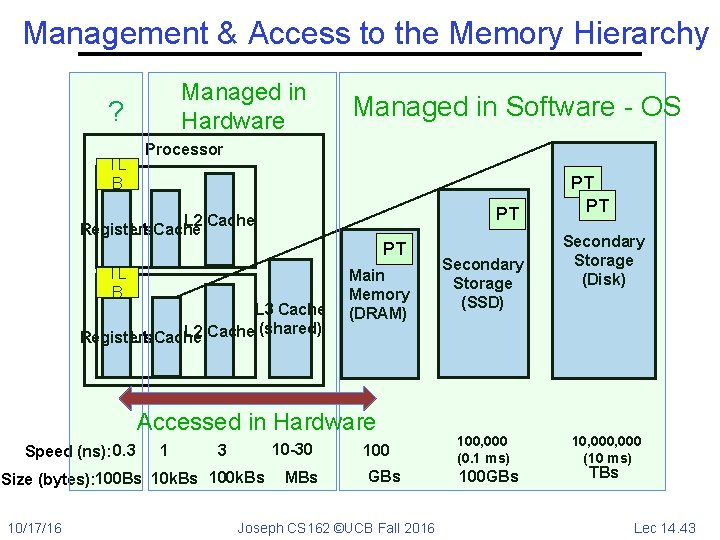
Management & Access to the Memory Hierarchy Managed in Hardware ? TL B Managed in Software - OS Processor PT L 2 Cache L 1 Cache Registers PT TL B L 3 Cache L 2 Cache (shared) L 1 Cache Registers Main Memory (DRAM) Accessed in Hardware Speed (ns): 0. 3 1 10 -30 3 Size (bytes): 100 Bs 10 k. Bs 10/17/16 MBs 100 GBs Joseph CS 162 ©UCB Fall 2016 Secondary Storage (SSD) 100, 000 (0. 1 ms) 100 GBs PT PT Secondary Storage (Disk) 10, 000 (10 ms) TBs Lec 14. 43
Some Related Questions • During a page fault, where does the OS get a free frame? – Keeps a free list – Unix runs a “reaper” if memory gets too full – As a last resort, evict a dirty page first • How can we organize these mechanisms? – Work on the replacement policy • How many page frames/process? – Like thread scheduling, need to “schedule” memory resources: » utilization? fairness? priority? – Allocation of disk paging bandwidth 10/17/16 Joseph CS 162 ©UCB Fall 2016 Lec 14. 44
Summary • A cache of translations called a “Translation Lookaside Buffer” (TLB) – Relatively small number of PTEs and optional process IDs (< 512) – Fully Associative (Since conflict misses expensive) – On TLB miss, page table must be traversed and if located PTE is invalid, cause Page Fault – On change in page table, TLB entries must be invalidated – TLB is logically in front of cache (need to overlap with cache access) • Precise Exception specifies a single instruction for which: – All previous instructions have completed (committed state) – No following instructions nor actual instruction have started • Can manage caches in hardware or software or both – Goal is highest hit rate, even if it means more complex cache management 10/17/16 Joseph CS 162 ©UCB Fall 2016 Lec 14. 45