
CS 162 Operating Systems and Systems Programming Lecture


![Deadlock Detection Algorithm Example [Request. T 1] = [1, 0]; Alloc. T 1 [Request.](https://slidetodoc.com/presentation_image_h2/e30cde3138a5da917c052aa13d6c3eed/image-24.jpg "Deadlock Detection Algorithm Example [Request. T 1] = [1, 0]; Alloc. T 1 [Request.")
![Deadlock Detection Algorithm Example [Request. T 1] = [1, 0]; Alloc. T 1 [Request.](https://slidetodoc.com/presentation_image_h2/e30cde3138a5da917c052aa13d6c3eed/image-25.jpg "Deadlock Detection Algorithm Example [Request. T 1] = [1, 0]; Alloc. T 1 [Request.")
![Deadlock Detection Algorithm Example [Request. T 1] = [1, 0]; Alloc. T 1 [Request.](https://slidetodoc.com/presentation_image_h2/e30cde3138a5da917c052aa13d6c3eed/image-26.jpg "Deadlock Detection Algorithm Example [Request. T 1] = [1, 0]; Alloc. T 1 [Request.")
![Deadlock Detection Algorithm Example [Request. T 1] = [1, 0]; Alloc. T 1 [Request.](https://slidetodoc.com/presentation_image_h2/e30cde3138a5da917c052aa13d6c3eed/image-27.jpg "Deadlock Detection Algorithm Example [Request. T 1] = [1, 0]; Alloc. T 1 [Request.")
![Deadlock Detection Algorithm Example [Request. T 1] = [1, 0]; Alloc. T 1 [Request.](https://slidetodoc.com/presentation_image_h2/e30cde3138a5da917c052aa13d6c3eed/image-28.jpg "Deadlock Detection Algorithm Example [Request. T 1] = [1, 0]; Alloc. T 1 [Request.")
![Deadlock Detection Algorithm Example [Request. T 1] = [1, 0]; Alloc. T 1 [Request.](https://slidetodoc.com/presentation_image_h2/e30cde3138a5da917c052aa13d6c3eed/image-29.jpg "Deadlock Detection Algorithm Example [Request. T 1] = [1, 0]; Alloc. T 1 [Request.")
![Deadlock Detection Algorithm Example [Request. T 1] = [1, 0]; Alloc. T 1 [Request.](https://slidetodoc.com/presentation_image_h2/e30cde3138a5da917c052aa13d6c3eed/image-30.jpg "Deadlock Detection Algorithm Example [Request. T 1] = [1, 0]; Alloc. T 1 [Request.")
![Deadlock Detection Algorithm Example [Request. T 1] = [1, 0]; Alloc. T 1 [Request.](https://slidetodoc.com/presentation_image_h2/e30cde3138a5da917c052aa13d6c3eed/image-31.jpg "Deadlock Detection Algorithm Example [Request. T 1] = [1, 0]; Alloc. T 1 [Request.")
![Deadlock Detection Algorithm Example [Request. T 1] = [1, 0]; Alloc. T 1 [Request.](https://slidetodoc.com/presentation_image_h2/e30cde3138a5da917c052aa13d6c3eed/image-32.jpg "Deadlock Detection Algorithm Example [Request. T 1] = [1, 0]; Alloc. T 1 [Request.")
![Deadlock Detection Algorithm Example [Request. T 1] = [1, 0]; Alloc. T 1 [Request.](https://slidetodoc.com/presentation_image_h2/e30cde3138a5da917c052aa13d6c3eed/image-33.jpg "Deadlock Detection Algorithm Example [Request. T 1] = [1, 0]; Alloc. T 1 [Request.")
![Deadlock Detection Algorithm Example [Request. T 1] = [1, 0]; Alloc. T 1 [Request.](https://slidetodoc.com/presentation_image_h2/e30cde3138a5da917c052aa13d6c3eed/image-34.jpg "Deadlock Detection Algorithm Example [Request. T 1] = [1, 0]; Alloc. T 1 [Request.")
![Deadlock Detection Algorithm Example [Request. T 1] = [1, 0]; Alloc. T 1 [Request.](https://slidetodoc.com/presentation_image_h2/e30cde3138a5da917c052aa13d6c3eed/image-35.jpg "Deadlock Detection Algorithm Example [Request. T 1] = [1, 0]; Alloc. T 1 [Request.")
![Deadlock Detection Algorithm Example [Request. T 1] = [1, 0]; Alloc. T 1 [Request.](https://slidetodoc.com/presentation_image_h2/e30cde3138a5da917c052aa13d6c3eed/image-36.jpg "Deadlock Detection Algorithm Example [Request. T 1] = [1, 0]; Alloc. T 1 [Request.")
![Deadlock Detection Algorithm Example [Request. T 1] = [1, 0]; Alloc. T 1 [Request.](https://slidetodoc.com/presentation_image_h2/e30cde3138a5da917c052aa13d6c3eed/image-37.jpg "Deadlock Detection Algorithm Example [Request. T 1] = [1, 0]; Alloc. T 1 [Request.")
![Deadlock Detection Algorithm Example [Request. T 1] = [1, 0]; [Request. T 2] =](https://slidetodoc.com/presentation_image_h2/e30cde3138a5da917c052aa13d6c3eed/image-38.jpg "Deadlock Detection Algorithm Example [Request. T 1] = [1, 0]; [Request. T 2] =")
![Deadlock Detection Algorithm Example [Request. T 1] = [1, 0]; [Request. T 2] =](https://slidetodoc.com/presentation_image_h2/e30cde3138a5da917c052aa13d6c3eed/image-39.jpg "Deadlock Detection Algorithm Example [Request. T 1] = [1, 0]; [Request. T 2] =")
![Deadlock Detection Algorithm Example [Request. T 1] = [1, 0]; [Request. T 2] =](https://slidetodoc.com/presentation_image_h2/e30cde3138a5da917c052aa13d6c3eed/image-40.jpg "Deadlock Detection Algorithm Example [Request. T 1] = [1, 0]; [Request. T 2] =")
![Deadlock Detection Algorithm Example [Request. T 1] = [1, 0]; [Request. T 2] =](https://slidetodoc.com/presentation_image_h2/e30cde3138a5da917c052aa13d6c3eed/image-41.jpg "Deadlock Detection Algorithm Example [Request. T 1] = [1, 0]; [Request. T 2] =")
![Deadlock Detection Algorithm Example [Request. T 1] = [1, 0]; [Request. T 2] =](https://slidetodoc.com/presentation_image_h2/e30cde3138a5da917c052aa13d6c3eed/image-42.jpg "Deadlock Detection Algorithm Example [Request. T 1] = [1, 0]; [Request. T 2] =")
![Deadlock Detection Algorithm Example [Request. T 1] = [1, 0]; [Request. T 2] =](https://slidetodoc.com/presentation_image_h2/e30cde3138a5da917c052aa13d6c3eed/image-43.jpg "Deadlock Detection Algorithm Example [Request. T 1] = [1, 0]; [Request. T 2] =")
![Deadlock Detection Algorithm Example [Request. T 1] = [1, 0]; [Request. T 2] =](https://slidetodoc.com/presentation_image_h2/e30cde3138a5da917c052aa13d6c3eed/image-44.jpg "Deadlock Detection Algorithm Example [Request. T 1] = [1, 0]; [Request. T 2] =")
![Deadlock Detection Algorithm Example [Request. T 1] = [1, 0]; [Request. T 2] =](https://slidetodoc.com/presentation_image_h2/e30cde3138a5da917c052aa13d6c3eed/image-45.jpg "Deadlock Detection Algorithm Example [Request. T 1] = [1, 0]; [Request. T 2] =")

- Slides: 52
CS 162 Operating Systems and Systems Programming Lecture 7 Semaphores, Conditional Variables, Deadlocks September 19, 2012 Ion Stoica http: //inst. eecs. berkeley. edu/~cs 162
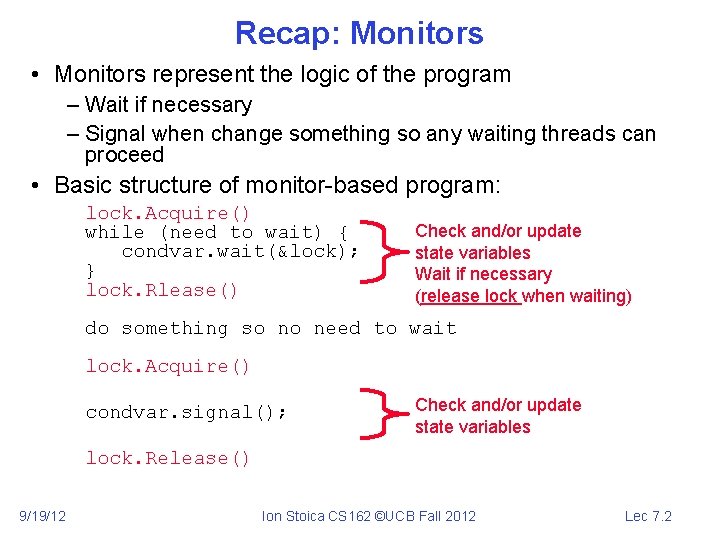
Recap: Monitors • Monitors represent the logic of the program – Wait if necessary – Signal when change something so any waiting threads can proceed • Basic structure of monitor-based program: lock. Acquire() while (need to wait) { condvar. wait(&lock); } lock. Rlease() Check and/or update state variables Wait if necessary (release lock when waiting) do something so no need to wait lock. Acquire() condvar. signal(); Check and/or update state variables lock. Release() 9/19/12 Ion Stoica CS 162 ©UCB Fall 2012 Lec 7. 2
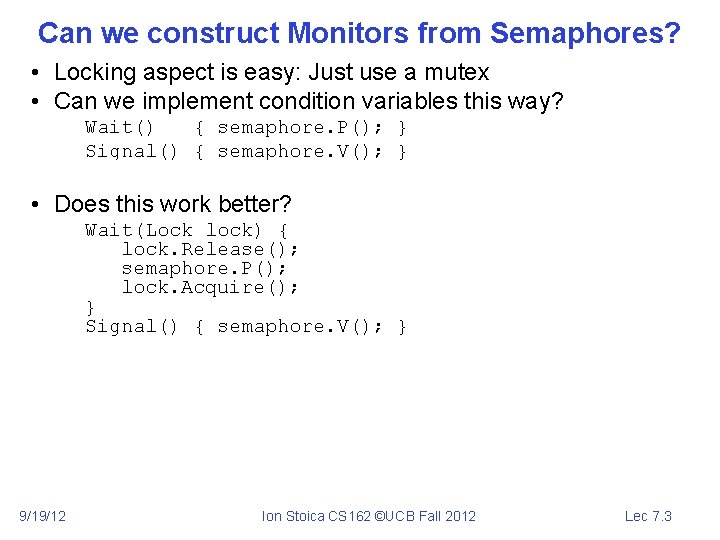
Can we construct Monitors from Semaphores? • Locking aspect is easy: Just use a mutex • Can we implement condition variables this way? Wait() { semaphore. P(); } Signal() { semaphore. V(); } – Doesn’t work: Wait() may sleep with lock held • Does this work better? Wait(Lock lock) { lock. Release(); semaphore. P(); lock. Acquire(); } Signal() { semaphore. V(); } – No: Condition vars have no history, semaphores have history: » » 9/19/12 What if thread signals and no one is waiting? NO-OP What if thread later waits? Thread Waits What if thread V’s and no one is waiting? Increment What if thread later does P? Decrement and continue Ion Stoica CS 162 ©UCB Fall 2012 Lec 7. 3
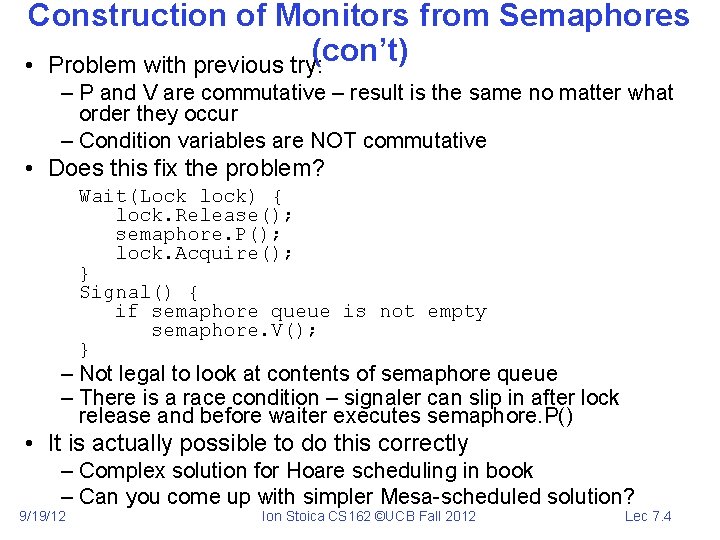
Construction of Monitors from Semaphores (con’t) • Problem with previous try: – P and V are commutative – result is the same no matter what order they occur – Condition variables are NOT commutative • Does this fix the problem? Wait(Lock lock) { lock. Release(); semaphore. P(); lock. Acquire(); } Signal() { if semaphore queue is not empty semaphore. V(); } – Not legal to look at contents of semaphore queue – There is a race condition – signaler can slip in after lock release and before waiter executes semaphore. P() • It is actually possible to do this correctly – Complex solution for Hoare scheduling in book – Can you come up with simpler Mesa-scheduled solution? 9/19/12 Ion Stoica CS 162 ©UCB Fall 2012 Lec 7. 4
C-Language Support for Synchronization • C language: Pretty straightforward synchronization – Just make sure you know all the code paths out of a critical section int Rtn() { lock. acquire(); … if (error) { lock. release(); return err. Return. Code; } … lock. release(); return OK; } 9/19/12 Ion Stoica CS 162 ©UCB Fall 2012 Lec 7. 5
C++ Language Support for Synchronization • Languages with exceptions like C++ – Languages that support exceptions are problematic (easy to make a non-local exit without releasing lock) – Consider: void Rtn() { lock. acquire(); … Do. Foo(); … lock. release(); } void Do. Foo() { … if (exception) throw err. Exception; … } – Notice that an exception in Do. Foo() will exit without releasing the lock 9/19/12 Ion Stoica CS 162 ©UCB Fall 2012 Lec 7. 6
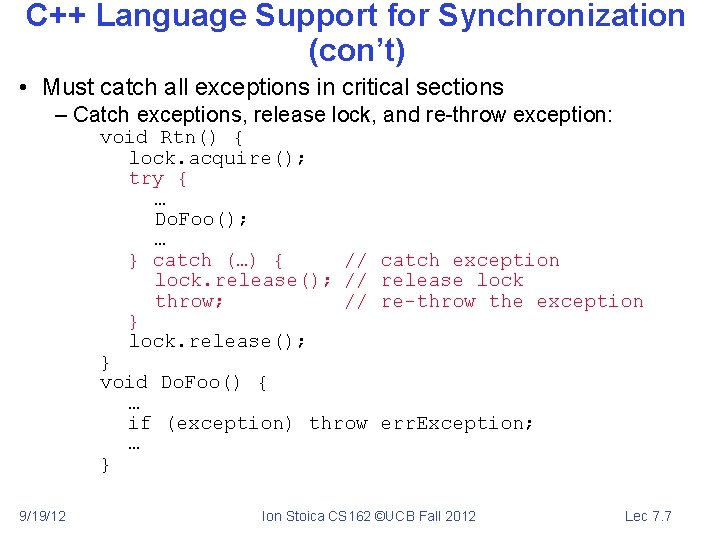
C++ Language Support for Synchronization (con’t) • Must catch all exceptions in critical sections – Catch exceptions, release lock, and re-throw exception: void Rtn() { lock. acquire(); try { … Do. Foo(); … } catch (…) { // lock. release(); // throw; // } lock. release(); } void Do. Foo() { … if (exception) throw … } 9/19/12 catch exception release lock re-throw the exception err. Exception; Ion Stoica CS 162 ©UCB Fall 2012 Lec 7. 7
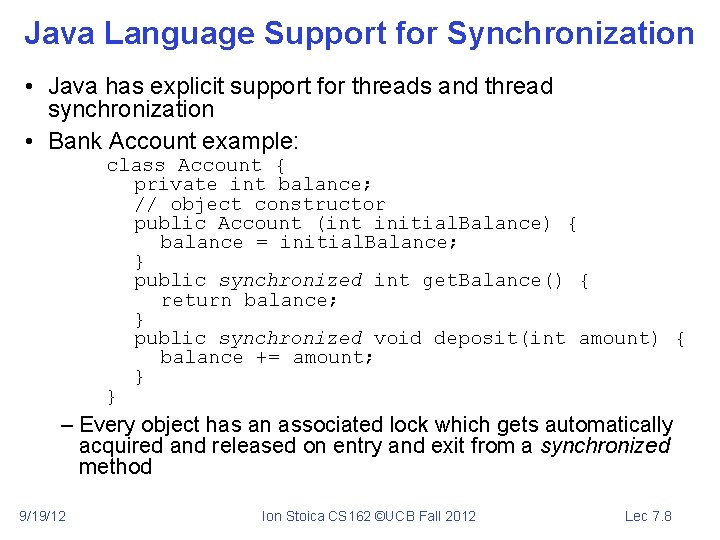
Java Language Support for Synchronization • Java has explicit support for threads and thread synchronization • Bank Account example: class Account { private int balance; // object constructor public Account (int initial. Balance) { balance = initial. Balance; } public synchronized int get. Balance() { return balance; } public synchronized void deposit(int amount) { balance += amount; } } – Every object has an associated lock which gets automatically acquired and released on entry and exit from a synchronized method 9/19/12 Ion Stoica CS 162 ©UCB Fall 2012 Lec 7. 8
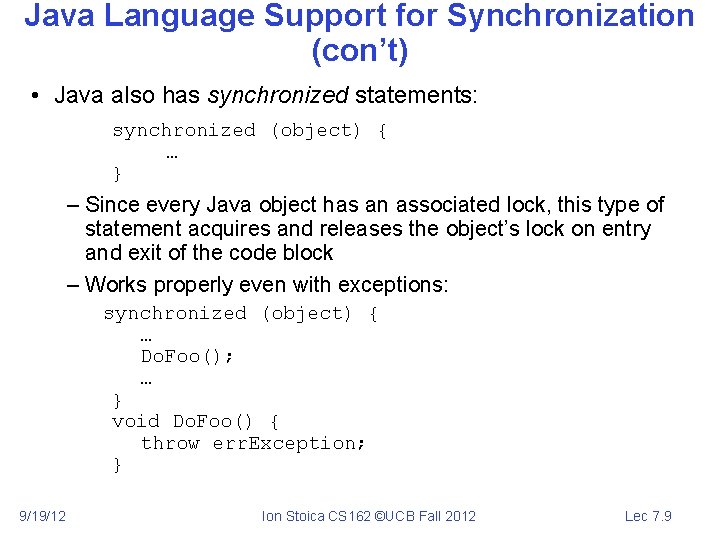
Java Language Support for Synchronization (con’t) • Java also has synchronized statements: synchronized (object) { … } – Since every Java object has an associated lock, this type of statement acquires and releases the object’s lock on entry and exit of the code block – Works properly even with exceptions: synchronized (object) { … Do. Foo(); … } void Do. Foo() { throw err. Exception; } 9/19/12 Ion Stoica CS 162 ©UCB Fall 2012 Lec 7. 9
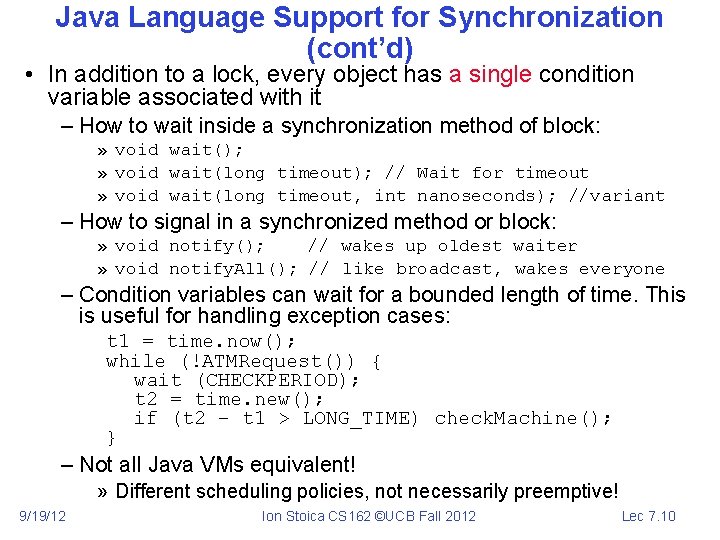
Java Language Support for Synchronization (cont’d) • In addition to a lock, every object has a single condition variable associated with it – How to wait inside a synchronization method of block: » void wait(); » void wait(long timeout); // Wait for timeout » void wait(long timeout, int nanoseconds); //variant – How to signal in a synchronized method or block: » void notify(); // wakes up oldest waiter » void notify. All(); // like broadcast, wakes everyone – Condition variables can wait for a bounded length of time. This is useful for handling exception cases: t 1 = time. now(); while (!ATMRequest()) { wait (CHECKPERIOD); t 2 = time. new(); if (t 2 – t 1 > LONG_TIME) check. Machine(); } – Not all Java VMs equivalent! » Different scheduling policies, not necessarily preemptive! 9/19/12 Ion Stoica CS 162 ©UCB Fall 2012 Lec 7. 10
9/19/12 Ion Stoica CS 162 ©UCB Fall 2012 Lec 7. 11
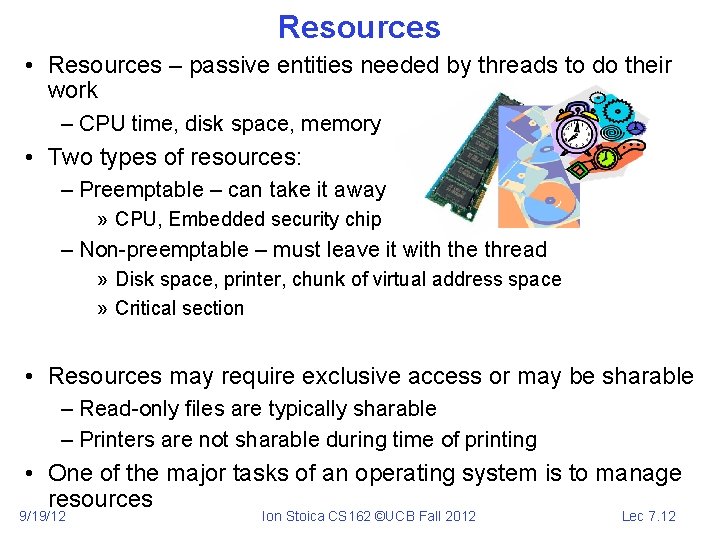
Resources • Resources – passive entities needed by threads to do their work – CPU time, disk space, memory • Two types of resources: – Preemptable – can take it away » CPU, Embedded security chip – Non-preemptable – must leave it with the thread » Disk space, printer, chunk of virtual address space » Critical section • Resources may require exclusive access or may be sharable – Read-only files are typically sharable – Printers are not sharable during time of printing • One of the major tasks of an operating system is to manage resources 9/19/12 Ion Stoica CS 162 ©UCB Fall 2012 Lec 7. 12
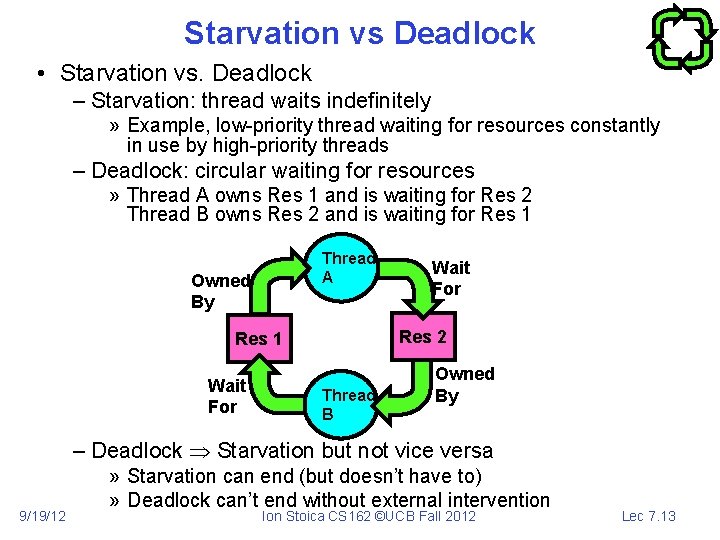
Starvation vs Deadlock • Starvation vs. Deadlock – Starvation: thread waits indefinitely » Example, low-priority thread waiting for resources constantly in use by high-priority threads – Deadlock: circular waiting for resources » Thread A owns Res 1 and is waiting for Res 2 Thread B owns Res 2 and is waiting for Res 1 Thread A Owned By Res 2 Res 1 Wait For Thread B Owned By – Deadlock Starvation but not vice versa 9/19/12 » Starvation can end (but doesn’t have to) » Deadlock can’t end without external intervention Ion Stoica CS 162 ©UCB Fall 2012 Lec 7. 13
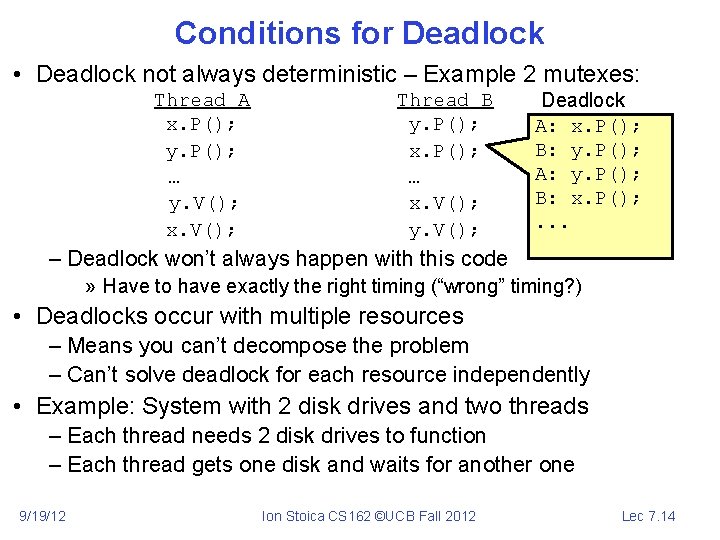
Conditions for Deadlock • Deadlock not always deterministic – Example 2 mutexes: Thread A x. P(); y. P(); … y. V(); x. V(); Thread B y. P(); x. P(); … x. V(); y. V(); Deadlock A: x. P(); B: y. P(); A: y. P(); B: x. P(); . . . – Deadlock won’t always happen with this code » Have to have exactly the right timing (“wrong” timing? ) • Deadlocks occur with multiple resources – Means you can’t decompose the problem – Can’t solve deadlock for each resource independently • Example: System with 2 disk drives and two threads – Each thread needs 2 disk drives to function – Each thread gets one disk and waits for another one 9/19/12 Ion Stoica CS 162 ©UCB Fall 2012 Lec 7. 14
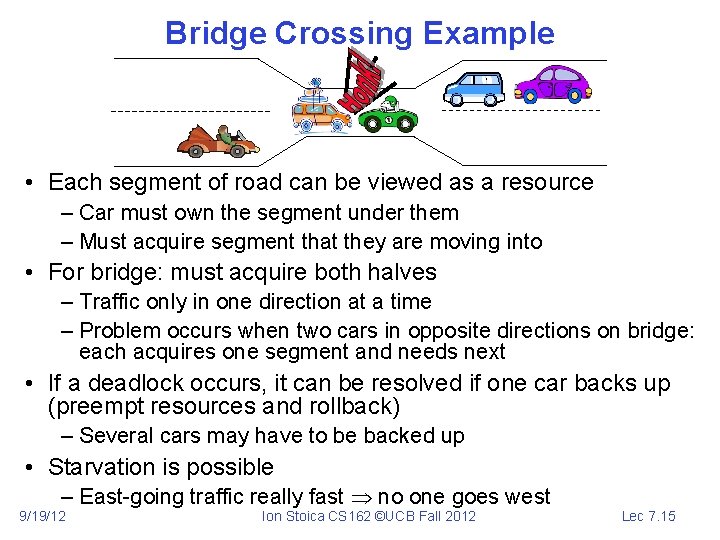
Bridge Crossing Example • Each segment of road can be viewed as a resource – Car must own the segment under them – Must acquire segment that they are moving into • For bridge: must acquire both halves – Traffic only in one direction at a time – Problem occurs when two cars in opposite directions on bridge: each acquires one segment and needs next • If a deadlock occurs, it can be resolved if one car backs up (preempt resources and rollback) – Several cars may have to be backed up • Starvation is possible – East-going traffic really fast no one goes west 9/19/12 Ion Stoica CS 162 ©UCB Fall 2012 Lec 7. 15
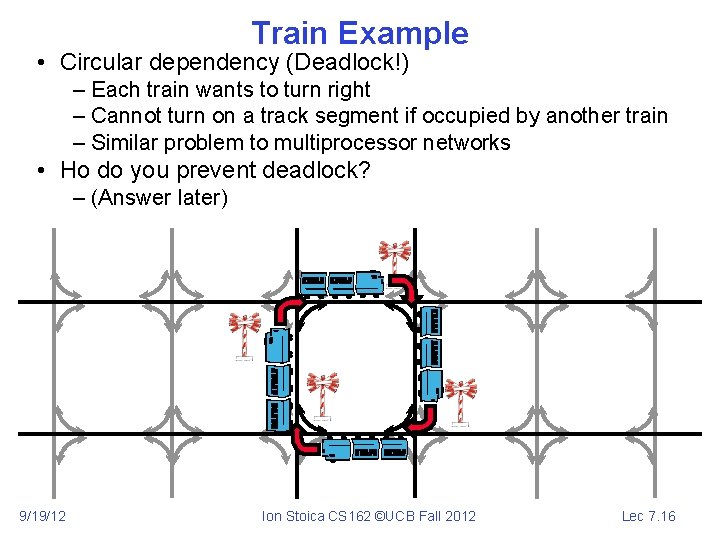
Train Example • Circular dependency (Deadlock!) – Each train wants to turn right – Cannot turn on a track segment if occupied by another train – Similar problem to multiprocessor networks • Ho do you prevent deadlock? – (Answer later) 9/19/12 Ion Stoica CS 162 ©UCB Fall 2012 Lec 7. 16
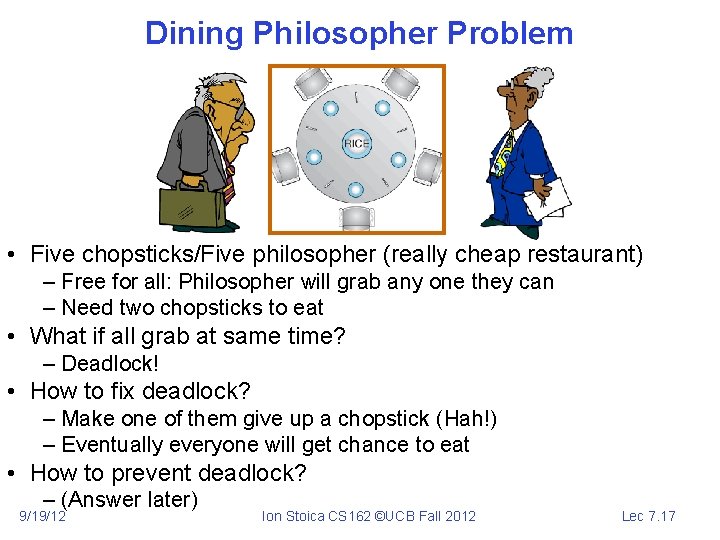
Dining Philosopher Problem • Five chopsticks/Five philosopher (really cheap restaurant) – Free for all: Philosopher will grab any one they can – Need two chopsticks to eat • What if all grab at same time? – Deadlock! • How to fix deadlock? – Make one of them give up a chopstick (Hah!) – Eventually everyone will get chance to eat • How to prevent deadlock? – (Answer later) 9/19/12 Ion Stoica CS 162 ©UCB Fall 2012 Lec 7. 17
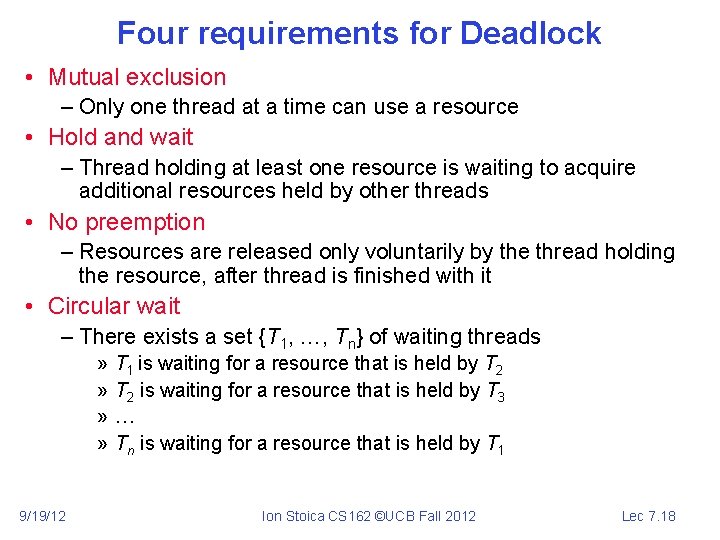
Four requirements for Deadlock • Mutual exclusion – Only one thread at a time can use a resource • Hold and wait – Thread holding at least one resource is waiting to acquire additional resources held by other threads • No preemption – Resources are released only voluntarily by the thread holding the resource, after thread is finished with it • Circular wait – There exists a set {T 1, …, Tn} of waiting threads » » 9/19/12 T 1 is waiting for a resource that is held by T 2 is waiting for a resource that is held by T 3 … Tn is waiting for a resource that is held by T 1 Ion Stoica CS 162 ©UCB Fall 2012 Lec 7. 18
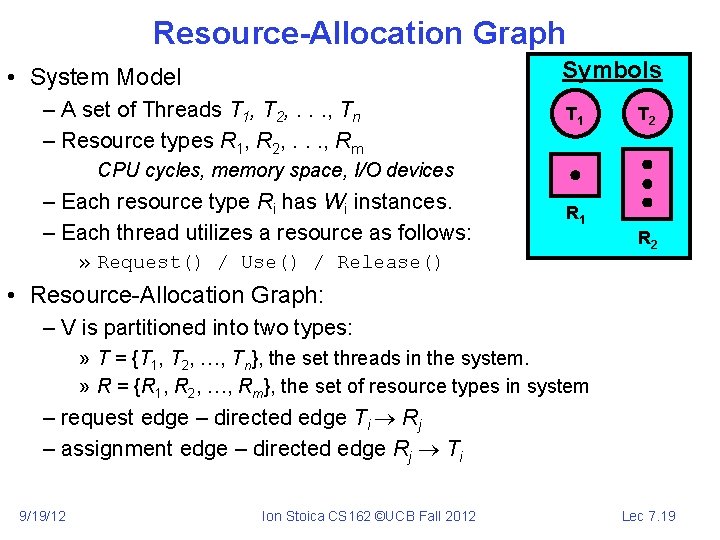
Resource-Allocation Graph Symbols • System Model – A set of Threads T 1, T 2, . . . , Tn – Resource types R 1, R 2, . . . , Rm T 1 T 2 CPU cycles, memory space, I/O devices – Each resource type Ri has Wi instances. – Each thread utilizes a resource as follows: R 1 » Request() / Use() / Release() R 2 • Resource-Allocation Graph: – V is partitioned into two types: » T = {T 1, T 2, …, Tn}, the set threads in the system. » R = {R 1, R 2, …, Rm}, the set of resource types in system – request edge – directed edge Ti Rj – assignment edge – directed edge Rj Ti 9/19/12 Ion Stoica CS 162 ©UCB Fall 2012 Lec 7. 19
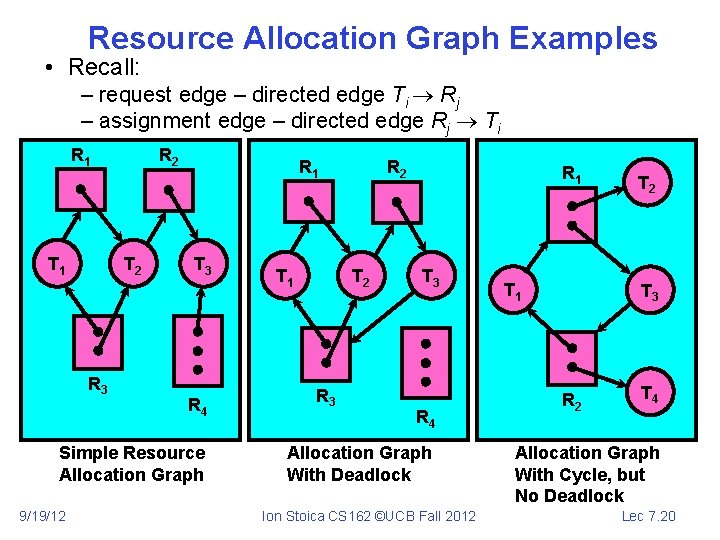
Resource Allocation Graph Examples • Recall: – request edge – directed edge Ti Rj – assignment edge – directed edge Rj Ti R 1 T 1 R 2 T 2 R 3 R 1 T 3 R 4 Simple Resource Allocation Graph 9/19/12 T 1 R 2 T 2 R 3 R 1 T 3 R 4 Allocation Graph With Deadlock Ion Stoica CS 162 ©UCB Fall 2012 T 1 T 2 T 3 R 2 T 4 Allocation Graph With Cycle, but No Deadlock Lec 7. 20
5 min Break 9/19/12 Ion Stoica CS 162 ©UCB Fall 2012 Lec 7. 21
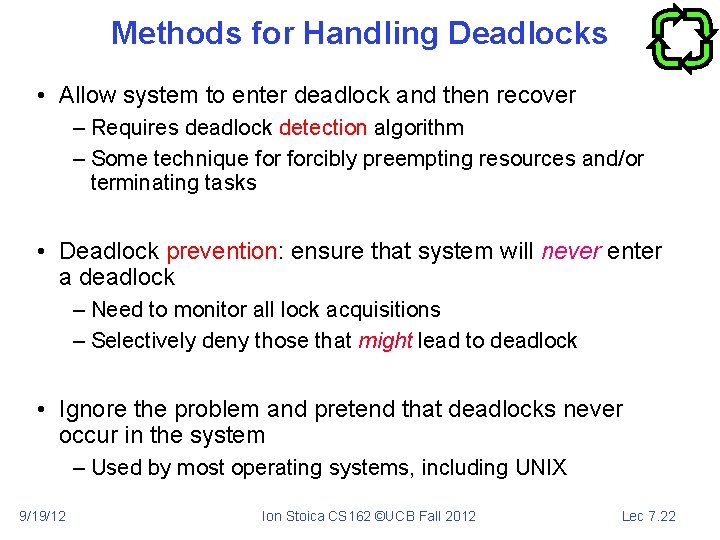
Methods for Handling Deadlocks • Allow system to enter deadlock and then recover – Requires deadlock detection algorithm – Some technique forcibly preempting resources and/or terminating tasks • Deadlock prevention: ensure that system will never enter a deadlock – Need to monitor all lock acquisitions – Selectively deny those that might lead to deadlock • Ignore the problem and pretend that deadlocks never occur in the system – Used by most operating systems, including UNIX 9/19/12 Ion Stoica CS 162 ©UCB Fall 2012 Lec 7. 22
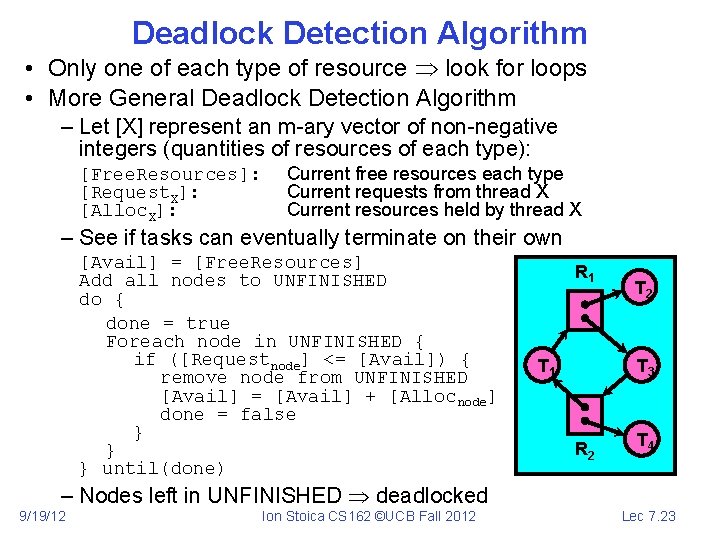
Deadlock Detection Algorithm • Only one of each type of resource look for loops • More General Deadlock Detection Algorithm – Let [X] represent an m-ary vector of non-negative integers (quantities of resources of each type): [Free. Resources]: [Request. X]: [Alloc. X]: Current free resources each type Current requests from thread X Current resources held by thread X – See if tasks can eventually terminate on their own [Avail] = [Free. Resources] Add all nodes to UNFINISHED do { done = true Foreach node in UNFINISHED { if ([Requestnode] <= [Avail]) { remove node from UNFINISHED [Avail] = [Avail] + [Allocnode] done = false } } } until(done) R 1 T 2 T 3 R 2 T 4 – Nodes left in UNFINISHED deadlocked 9/19/12 Ion Stoica CS 162 ©UCB Fall 2012 Lec 7. 23
Deadlock Detection Algorithm Example [Request. T 1] = [1, 0]; Alloc. T 1 [Request. T 2] = [0, 0]; Alloc. T 2 [Request. T 3] = [0, 1]; Alloc. T 3 [Request. T 4] = [0, 0]; Alloc. T 4 [Avail] = [0, 0] UNFINISHED = {T 1, T 2, T 3, T 4} = = [0, 1] [1, 0] [0, 1] do { done = true Foreach node in UNFINISHED { if ([Requestnode] <= [Avail]) { remove node from UNFINSHED [Avail] = [Avail] + [Allocnode] done = false } } } until(done) 9/19/12 Ion Stoica CS 162 ©UCB Fall 2012 R 1 T 2 T 1 T 3 R 2 T 4 Lec 7. 24
Deadlock Detection Algorithm Example [Request. T 1] = [1, 0]; Alloc. T 1 [Request. T 2] = [0, 0]; Alloc. T 2 [Request. T 3] = [0, 1]; Alloc. T 3 [Request. T 4] = [0, 0]; Alloc. T 4 [Avail] = [0, 0] UNFINISHED = {T 1, T 2, T 3, T 4} = = [0, 1] [1, 0] [0, 1] do { done = true False Foreach node in UNFINISHED { if ([Request. T 1] <= [Avail]) { remove node from UNFINSHED [Avail] = [Avail] + [Alloc. T 1] done = false } } } until(done) 9/19/12 Ion Stoica CS 162 ©UCB Fall 2012 R 1 T 2 T 1 T 3 R 2 T 4 Lec 7. 25
Deadlock Detection Algorithm Example [Request. T 1] = [1, 0]; Alloc. T 1 [Request. T 2] = [0, 0]; Alloc. T 2 [Request. T 3] = [0, 1]; Alloc. T 3 [Request. T 4] = [0, 0]; Alloc. T 4 [Avail] = [0, 0] UNFINISHED = {T 1, T 2, T 3, T 4} = = [0, 1] [1, 0] [0, 1] do { done = true Foreach node in UNFINISHED { if ([Request. T 2] <= [Avail]) { remove node from UNFINSHED [Avail] = [Avail] + [Alloc. T 2] done = false } } } until(done) 9/19/12 Ion Stoica CS 162 ©UCB Fall 2012 R 1 T 2 T 1 T 3 R 2 T 4 Lec 7. 26
Deadlock Detection Algorithm Example [Request. T 1] = [1, 0]; Alloc. T 1 [Request. T 2] = [0, 0]; Alloc. T 2 [Request. T 3] = [0, 1]; Alloc. T 3 [Request. T 4] = [0, 0]; Alloc. T 4 [Avail] = [0, 0] UNFINISHED = {T 1, T 3, T 4} = = [0, 1] [1, 0] [0, 1] do { done = true Foreach node in UNFINISHED { if ([Request. T 2] <= [Avail]) { remove node from UNFINSHED [Avail] = [Avail] + [Alloc. T 2] done = false } } } until(done) 9/19/12 Ion Stoica CS 162 ©UCB Fall 2012 R 1 T 2 T 1 T 3 R 2 T 4 Lec 7. 27
Deadlock Detection Algorithm Example [Request. T 1] = [1, 0]; Alloc. T 1 [Request. T 2] = [0, 0]; Alloc. T 2 [Request. T 3] = [0, 1]; Alloc. T 3 [Request. T 4] = [0, 0]; Alloc. T 4 [Avail] = [1, 0] UNFINISHED = {T 1, T 3, T 4} = = [0, 1] [1, 0] [0, 1] do { done = true Foreach node in UNFINISHED { if ([Request. T 2] <= [Avail]) { remove node from UNFINSHED [Avail] = [Avail] + [Alloc. T 2] done = false } } } until(done) 9/19/12 Ion Stoica CS 162 ©UCB Fall 2012 R 1 T 2 T 1 T 3 R 2 T 4 Lec 7. 28
Deadlock Detection Algorithm Example [Request. T 1] = [1, 0]; Alloc. T 1 [Request. T 2] = [0, 0]; Alloc. T 2 [Request. T 3] = [0, 1]; Alloc. T 3 [Request. T 4] = [0, 0]; Alloc. T 4 [Avail] = [1, 0] UNFINISHED = {T 1, T 3, T 4} = = [0, 1] [1, 0] [0, 1] do { done = true Foreach node in UNFINISHED { if ([Request. T 2] <= [Avail]) { remove node from UNFINSHED [Avail] = [Avail] + [Alloc. T 2] done = false } } } until(done) 9/19/12 Ion Stoica CS 162 ©UCB Fall 2012 R 1 T 2 T 1 T 3 R 2 T 4 Lec 7. 29
Deadlock Detection Algorithm Example [Request. T 1] = [1, 0]; Alloc. T 1 [Request. T 2] = [0, 0]; Alloc. T 2 [Request. T 3] = [0, 1]; Alloc. T 3 [Request. T 4] = [0, 0]; Alloc. T 4 [Avail] = [1, 0] UNFINISHED = {T 1, T 3, T 4} = = [0, 1] [1, 0] [0, 1] do { done = true Foreach node in UNFINISHED { if ([Request. T 3] <= [Avail]) { remove node from UNFINSHED [Avail] = [Avail] + [Alloc. T 3] done = false } } } until(done) 9/19/12 Ion Stoica CS 162 ©UCB Fall 2012 R 1 T 2 T 1 T 3 R 2 T 4 Lec 7. 30
Deadlock Detection Algorithm Example [Request. T 1] = [1, 0]; Alloc. T 1 [Request. T 2] = [0, 0]; Alloc. T 2 [Request. T 3] = [0, 1]; Alloc. T 3 [Request. T 4] = [0, 0]; Alloc. T 4 [Avail] = [1, 0] UNFINISHED = {T 1, T 3, T 4} = = [0, 1] [1, 0] [0, 1] do { done = true Foreach node in UNFINISHED { if ([Request. T 4] <= [Avail]) { remove node from UNFINSHED [Avail] = [Avail] + [Alloc. T 4] done = false } } } until(done) 9/19/12 Ion Stoica CS 162 ©UCB Fall 2012 R 1 T 2 T 1 T 3 R 2 T 4 Lec 7. 31
Deadlock Detection Algorithm Example [Request. T 1] = [1, 0]; Alloc. T 1 [Request. T 2] = [0, 0]; Alloc. T 2 [Request. T 3] = [0, 1]; Alloc. T 3 [Request. T 4] = [0, 0]; Alloc. T 4 [Avail] = [1, 0] UNFINISHED = {T 1, T 3} = = [0, 1] [1, 0] [0, 1] do { done = true Foreach node in UNFINISHED { if ([Request. T 4] <= [Avail]) { remove node from UNFINSHED [Avail] = [Avail] + [Alloc. T 4] done = false } } } until(done) 9/19/12 Ion Stoica CS 162 ©UCB Fall 2012 R 1 T 2 T 1 T 3 R 2 T 4 Lec 7. 32
Deadlock Detection Algorithm Example [Request. T 1] = [1, 0]; Alloc. T 1 [Request. T 2] = [0, 0]; Alloc. T 2 [Request. T 3] = [0, 1]; Alloc. T 3 [Request. T 4] = [0, 0]; Alloc. T 4 [Avail] = [1, 1] UNFINISHED = {T 1, T 3} = = [0, 1] [1, 0] [0, 1] do { done = true Foreach node in UNFINISHED { if ([Request. T 4] <= [Avail]) { remove node from UNFINSHED [Avail] = [Avail] + [Alloc. T 4] done = false } } } until(done) 9/19/12 Ion Stoica CS 162 ©UCB Fall 2012 R 1 T 2 T 1 T 3 R 2 T 4 Lec 7. 33
Deadlock Detection Algorithm Example [Request. T 1] = [1, 0]; Alloc. T 1 [Request. T 2] = [0, 0]; Alloc. T 2 [Request. T 3] = [0, 1]; Alloc. T 3 [Request. T 4] = [0, 0]; Alloc. T 4 [Avail] = [1, 1] UNFINISHED = {T 1, T 3} = = [0, 1] [1, 0] [0, 1] do { done = true Foreach node in UNFINISHED { if ([Request. T 4] <= [Avail]) { remove node from UNFINSHED [Avail] = [Avail] + [Alloc. T 4] done = false } } } until(done) 9/19/12 Ion Stoica CS 162 ©UCB Fall 2012 R 1 T 2 T 1 T 3 R 2 T 4 Lec 7. 34
Deadlock Detection Algorithm Example [Request. T 1] = [1, 0]; Alloc. T 1 [Request. T 2] = [0, 0]; Alloc. T 2 [Request. T 3] = [0, 1]; Alloc. T 3 [Request. T 4] = [0, 0]; Alloc. T 4 [Avail] = [1, 1] UNFINISHED = {T 1, T 3} = = [0, 1] [1, 0] [0, 1] do { done = true Foreach node in UNFINISHED { if ([Request. T 4] <= [Avail]) { remove node from UNFINSHED [Avail] = [Avail] + [Alloc. T 4] done = false } False } } until(done) 9/19/12 Ion Stoica CS 162 ©UCB Fall 2012 R 1 T 2 T 1 T 3 R 2 T 4 Lec 7. 35
Deadlock Detection Algorithm Example [Request. T 1] = [1, 0]; Alloc. T 1 [Request. T 2] = [0, 0]; Alloc. T 2 [Request. T 3] = [0, 1]; Alloc. T 3 [Request. T 4] = [0, 0]; Alloc. T 4 [Avail] = [1, 1] UNFINISHED = {T 1, T 3} = = [0, 1] [1, 0] [0, 1] do { done = true Foreach node in UNFINISHED { if ([Requestnode] <= [Avail]) { remove node from UNFINSHED [Avail] = [Avail] + [Allocnode] done = false } } } until(done) 9/19/12 Ion Stoica CS 162 ©UCB Fall 2012 R 1 T 2 T 1 T 3 R 2 T 4 Lec 7. 36
Deadlock Detection Algorithm Example [Request. T 1] = [1, 0]; Alloc. T 1 [Request. T 2] = [0, 0]; Alloc. T 2 [Request. T 3] = [0, 1]; Alloc. T 3 [Request. T 4] = [0, 0]; Alloc. T 4 [Avail] = [1, 1] UNFINISHED = {T 1, T 3} = = [0, 1] [1, 0] [0, 1] do { done = true Foreach node in UNFINISHED { if ([Request. T 1] <= [Avail]) { remove node from UNFINSHED [Avail] = [Avail] + [Alloc. T 1] done = false } } } until(done) 9/19/12 Ion Stoica CS 162 ©UCB Fall 2012 R 1 T 2 T 1 T 3 R 2 T 4 Lec 7. 37
Deadlock Detection Algorithm Example [Request. T 1] = [1, 0]; [Request. T 2] = [0, 0]; [Request. T 3] = [0, 1]; [Request. T 4] = [0, 0]; [Avail] = [1, 1] UNFINISHED = {T 3} Alloc. T 1 Alloc. T 2 Alloc. T 3 Alloc. T 4 = = [0, 1] [1, 0] [0, 1] do { done = true Foreach node in UNFINISHED { if ([Request. T 1] <= [Avail]) { remove node from UNFINSHED [Avail] = [Avail] + [Alloc. T 1] done = false } } } until(done) 9/19/12 Ion Stoica CS 162 ©UCB Fall 2012 R 1 T 2 T 1 T 3 R 2 T 4 Lec 7. 38
Deadlock Detection Algorithm Example [Request. T 1] = [1, 0]; [Request. T 2] = [0, 0]; [Request. T 3] = [0, 1]; [Request. T 4] = [0, 0]; [Avail] = [1, 2] UNFINISHED = {T 3} Alloc. T 1 Alloc. T 2 Alloc. T 3 Alloc. T 4 = = [0, 1] [1, 0] [0, 1] do { done = true Foreach node in UNFINISHED { if ([Request. T 1] <= [Avail]) { remove node from UNFINSHED [Avail] = [Avail] + [Alloc. T 1] done = false } } } until(done) 9/19/12 Ion Stoica CS 162 ©UCB Fall 2012 R 1 T 2 T 1 T 3 R 2 T 4 Lec 7. 39
Deadlock Detection Algorithm Example [Request. T 1] = [1, 0]; [Request. T 2] = [0, 0]; [Request. T 3] = [0, 1]; [Request. T 4] = [0, 0]; [Avail] = [1, 2] UNFINISHED = {T 3} Alloc. T 1 Alloc. T 2 Alloc. T 3 Alloc. T 4 = = [0, 1] [1, 0] [0, 1] do { done = true Foreach node in UNFINISHED { if ([Request. T 1] <= [Avail]) { remove node from UNFINSHED [Avail] = [Avail] + [Alloc. T 1] done = false } } } until(done) 9/19/12 Ion Stoica CS 162 ©UCB Fall 2012 R 1 T 2 T 1 T 3 R 2 T 4 Lec 7. 40
Deadlock Detection Algorithm Example [Request. T 1] = [1, 0]; [Request. T 2] = [0, 0]; [Request. T 3] = [0, 1]; [Request. T 4] = [0, 0]; [Avail] = [1, 2] UNFINISHED = {T 3} Alloc. T 1 Alloc. T 2 Alloc. T 3 Alloc. T 4 = = [0, 1] [1, 0] [0, 1] do { done = true Foreach node in UNFINISHED { if ([Request. T 3] <= [Avail]) { remove node from UNFINSHED [Avail] = [Avail] + [Alloc. T 3] done = false } } } until(done) 9/19/12 Ion Stoica CS 162 ©UCB Fall 2012 R 1 T 2 T 1 T 3 R 2 T 4 Lec 7. 41
Deadlock Detection Algorithm Example [Request. T 1] = [1, 0]; [Request. T 2] = [0, 0]; [Request. T 3] = [0, 1]; [Request. T 4] = [0, 0]; [Avail] = [1, 2] UNFINISHED = {} Alloc. T 1 Alloc. T 2 Alloc. T 3 Alloc. T 4 = = [0, 1] [1, 0] [0, 1] do { done = true Foreach node in UNFINISHED { if ([Request. T 3] <= [Avail]) { remove node from UNFINSHED [Avail] = [Avail] + [Alloc. T 3] done = false } } } until(done) 9/19/12 Ion Stoica CS 162 ©UCB Fall 2012 R 1 T 2 T 1 T 3 R 2 T 4 Lec 7. 42
Deadlock Detection Algorithm Example [Request. T 1] = [1, 0]; [Request. T 2] = [0, 0]; [Request. T 3] = [0, 1]; [Request. T 4] = [0, 0]; [Avail] = [2, 2] UNFINISHED = {} Alloc. T 1 Alloc. T 2 Alloc. T 3 Alloc. T 4 = = [0, 1] [1, 0] [0, 1] do { done = true Foreach node in UNFINISHED { if ([Request. T 3] <= [Avail]) { remove node from UNFINSHED [Avail] = [Avail] + [Alloc. T 3] done = false } } } until(done) 9/19/12 Ion Stoica CS 162 ©UCB Fall 2012 R 1 T 2 T 1 T 3 R 2 T 4 Lec 7. 43
Deadlock Detection Algorithm Example [Request. T 1] = [1, 0]; [Request. T 2] = [0, 0]; [Request. T 3] = [0, 1]; [Request. T 4] = [0, 0]; [Avail] = [2, 2] UNFINISHED = {} Alloc. T 1 Alloc. T 2 Alloc. T 3 Alloc. T 4 = = [0, 1] [1, 0] [0, 1] do { done = true Foreach node in UNFINISHED { if ([Request. T 3] <= [Avail]) { remove node from UNFINSHED [Avail] = [Avail] + [Alloc. T 3] done = false } } } until(done) 9/19/12 Ion Stoica CS 162 ©UCB Fall 2012 R 1 T 2 T 1 T 3 R 2 T 4 Lec 7. 44
Deadlock Detection Algorithm Example [Request. T 1] = [1, 0]; [Request. T 2] = [0, 0]; [Request. T 3] = [0, 1]; [Request. T 4] = [0, 0]; [Avail] = [2, 2] UNFINISHED = {} Alloc. T 1 Alloc. T 2 Alloc. T 3 Alloc. T 4 = = [0, 1] [1, 0] [0, 1] do { done = true Foreach node in UNFINISHED { if ([Request. T 3] <= [Avail]) { remove node from UNFINSHED [Avail] = [Avail] + [Alloc. T 3] done = false } } } until(done) R 1 T 2 T 1 T 3 R 2 T 4 DONE! 9/19/12 Ion Stoica CS 162 ©UCB Fall 2012 Lec 7. 45
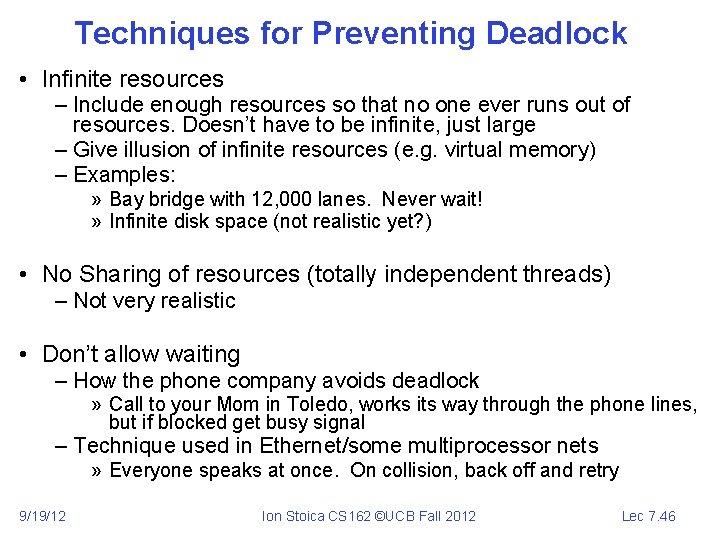
Techniques for Preventing Deadlock • Infinite resources – Include enough resources so that no one ever runs out of resources. Doesn’t have to be infinite, just large – Give illusion of infinite resources (e. g. virtual memory) – Examples: » Bay bridge with 12, 000 lanes. Never wait! » Infinite disk space (not realistic yet? ) • No Sharing of resources (totally independent threads) – Not very realistic • Don’t allow waiting – How the phone company avoids deadlock » Call to your Mom in Toledo, works its way through the phone lines, but if blocked get busy signal – Technique used in Ethernet/some multiprocessor nets » Everyone speaks at once. On collision, back off and retry 9/19/12 Ion Stoica CS 162 ©UCB Fall 2012 Lec 7. 46
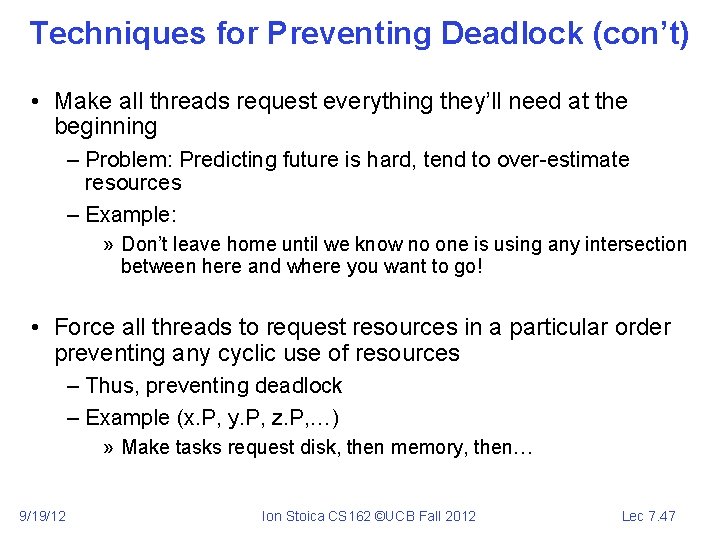
Techniques for Preventing Deadlock (con’t) • Make all threads request everything they’ll need at the beginning – Problem: Predicting future is hard, tend to over-estimate resources – Example: » Don’t leave home until we know no one is using any intersection between here and where you want to go! • Force all threads to request resources in a particular order preventing any cyclic use of resources – Thus, preventing deadlock – Example (x. P, y. P, z. P, …) » Make tasks request disk, then memory, then… 9/19/12 Ion Stoica CS 162 ©UCB Fall 2012 Lec 7. 47
Train Example (Wormhole-Routed Network) • Circular dependency (Deadlock!) – Each train wants to turn right – Cannot turn on a track segment if occupied by another train – Similar problem to multiprocessor networks • Fix? Imagine grid extends in all four directions – Force ordering of channels (tracks) » Protocol: Always go east-west (horizontally) first, then northsouth (vertically) – Called “dimension ordering” (X then Y) d we lo al le is Ru D By 9/19/12 Ion Stoica CS 162 ©UCB Fall 2012 Lec 7. 48
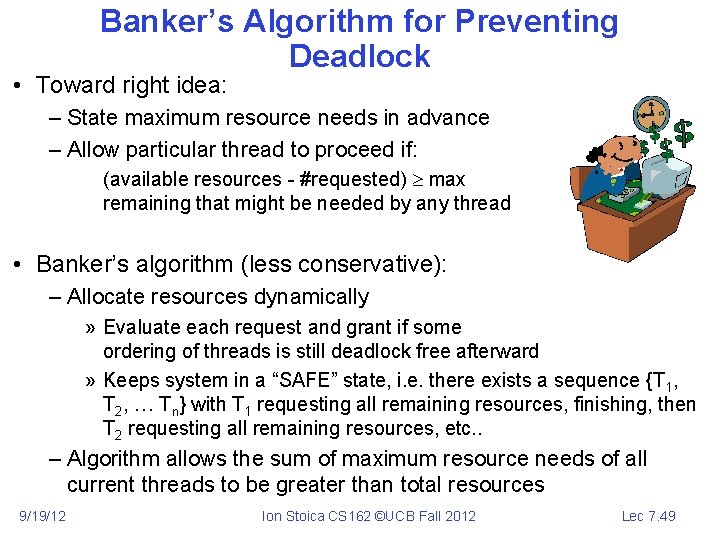
Banker’s Algorithm for Preventing Deadlock • Toward right idea: – State maximum resource needs in advance – Allow particular thread to proceed if: (available resources - #requested) max remaining that might be needed by any thread • Banker’s algorithm (less conservative): – Allocate resources dynamically » Evaluate each request and grant if some ordering of threads is still deadlock free afterward » Keeps system in a “SAFE” state, i. e. there exists a sequence {T 1, T 2, … Tn} with T 1 requesting all remaining resources, finishing, then T 2 requesting all remaining resources, etc. . – Algorithm allows the sum of maximum resource needs of all current threads to be greater than total resources 9/19/12 Ion Stoica CS 162 ©UCB Fall 2012 Lec 7. 49
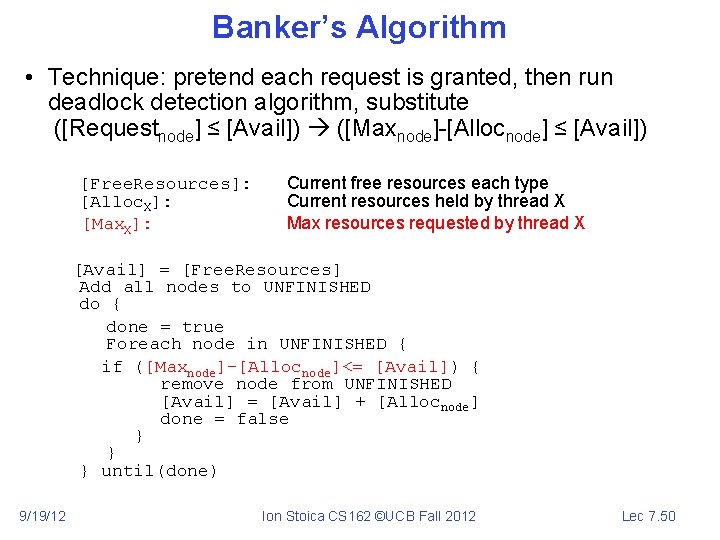
Banker’s Algorithm • Technique: pretend each request is granted, then run deadlock detection algorithm, substitute ([Requestnode] ≤ [Avail]) ([Maxnode]-[Allocnode] ≤ [Avail]) [Free. Resources]: [Alloc. X]: [Max. X]: Current free resources each type Current resources held by thread X Max resources requested by thread X [Avail] = [Free. Resources] Add all nodes to UNFINISHED do { done = true Foreach node in UNFINISHED { if ([Maxnode]–[Allocnode]<= [Avail]) { remove node from UNFINISHED [Avail] = [Avail] + [Allocnode] done = false } } } until(done) 9/19/12 Ion Stoica CS 162 ©UCB Fall 2012 Lec 7. 50
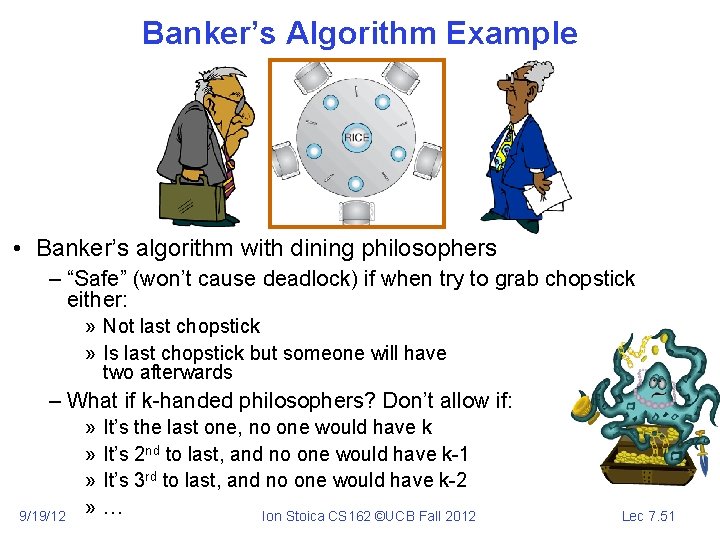
Banker’s Algorithm Example • Banker’s algorithm with dining philosophers – “Safe” (won’t cause deadlock) if when try to grab chopstick either: » Not last chopstick » Is last chopstick but someone will have two afterwards – What if k-handed philosophers? Don’t allow if: 9/19/12 » » It’s the last one, no one would have k It’s 2 nd to last, and no one would have k-1 It’s 3 rd to last, and no one would have k-2 … Ion Stoica CS 162 ©UCB Fall 2012 Lec 7. 51
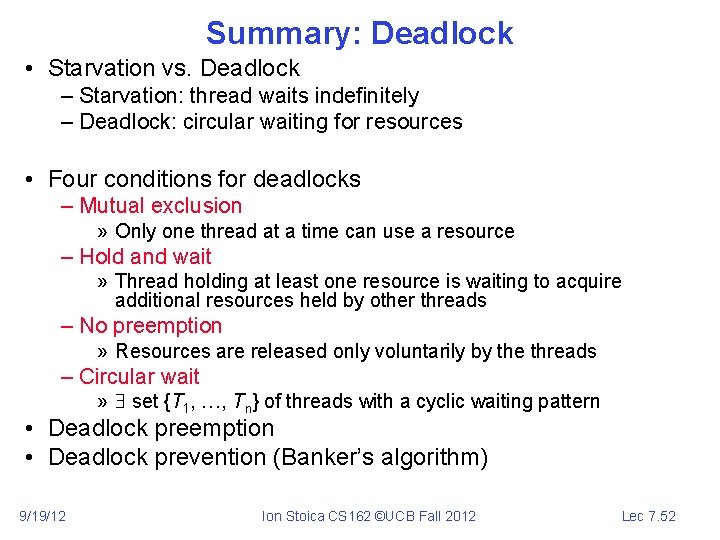
Summary: Deadlock • Starvation vs. Deadlock – Starvation: thread waits indefinitely – Deadlock: circular waiting for resources • Four conditions for deadlocks – Mutual exclusion » Only one thread at a time can use a resource – Hold and wait » Thread holding at least one resource is waiting to acquire additional resources held by other threads – No preemption » Resources are released only voluntarily by the threads – Circular wait » set {T 1, …, Tn} of threads with a cyclic waiting pattern • Deadlock preemption • Deadlock prevention (Banker’s algorithm) 9/19/12 Ion Stoica CS 162 ©UCB Fall 2012 Lec 7. 52