
CS 161 Introduction to Computer Science Topic 16
![Then, the Class Implementation string: : string() { str[0]=‘’; len = 0; } int](https://slidetodoc.com/presentation_image_h/21295f5d31628dbd40512dcb631e9ba3/image-11.jpg "Then, the Class Implementation string: : string() { str[0]=‘’; len = 0; } int")
- Slides: 19
CS 161 Introduction to Computer Science Topic #16 1
Today in CS 161 • Classes – What is a class – Why would we use them – How do we define classes – How do we define objects of a class – How do we pass objects to functions • What is next? CS 161 Topic #16 2
What is a Class • Remember, we used a structure to group different types of data together under a common name • With a class, we go the next step an actually define a new data type • With a class, we go beyond grouping data, and add functions that can work on that data CS 161 Topic #16 3
What is a Class • In reality, we can do the same things with structures and classes, although for style and compatibility it is not recommend • Syntactically, structures and classes are 100% the same except for the default conditions (and the keyword “struct” versus “class”) – Everything you can do with a class you can do with a structure! – However, we should develop a style for when it is best to use a class versus a struct CS 161 Topic #16 4
When do we use Classes? • I recommend using structures when you want to group different types of data together – and, to use a class when we are interested in building a new type of data into the language itself CS 161 Topic #16 5
What is a Class • First, let’s talk about some terminology – Think of a class as the same as a data type – a class is a data type together with the operations that can be used on that type of data – Think of an object as the same as a variable • An “object” is an instance of a class – Just like a “variable” is an instance of a specific data type • We can have zero or more variables (or objects) in our programs CS 161 Topic #16 6
But. . . what is a “data type”? • We’ve been working with fundamental data types this term, such as ints, floats, chars. . . • Whenever we define variables of these types, – memory is allocated to hold the data – a set of operations can now be performed on that data – different data types have different sets of operations that make sense (the mod operator doesn’t make sense for floats. . . ) CS 161 Topic #16 7
Defining a new “data type”? • Therefore, when we define a new data type with the class construct – we need to specify how much memory should be set aside for each variable (or object) of this type – and, we need to specify which operations make sense for this type of data (and then implement them!!) CS 161 Topic #16 8
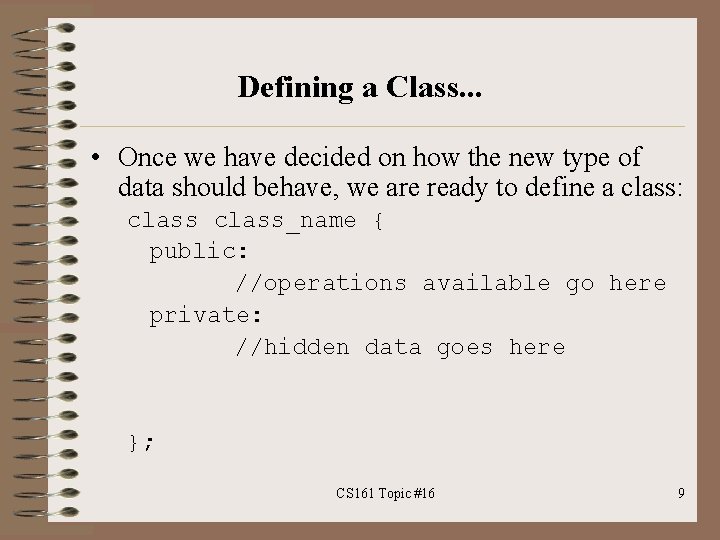
Defining a Class. . . • Once we have decided on how the new type of data should behave, we are ready to define a class: class_name { public: //operations available go here private: //hidden data goes here }; CS 161 Topic #16 9
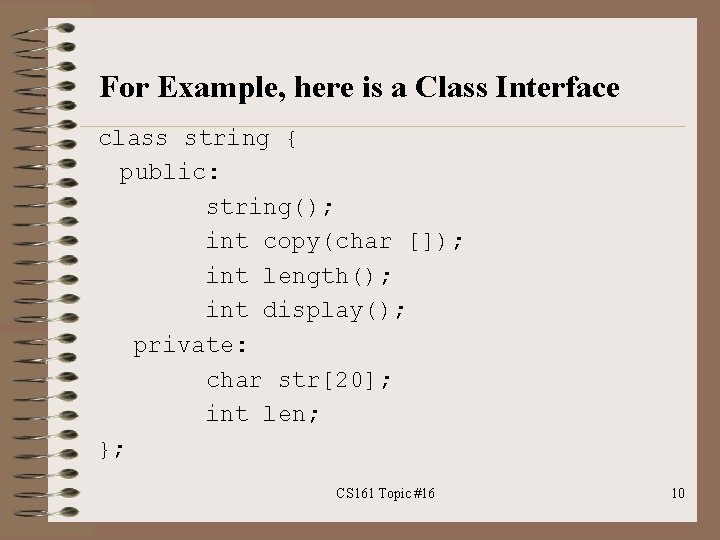
For Example, here is a Class Interface class string { public: string(); int copy(char []); int length(); int display(); private: char str[20]; int len; }; CS 161 Topic #16 10
Then, the Class Implementation string: : string() { str[0]=‘’; len = 0; } int string: : copy(char s []) { if (strlen(s) < 20) strcpy (str, s); else { for (int i = 0; i< 19; ++i) str[i] = s[i]; str[19]=‘’; len = strlen(str); return len; CS 161 Topic #16 } 11
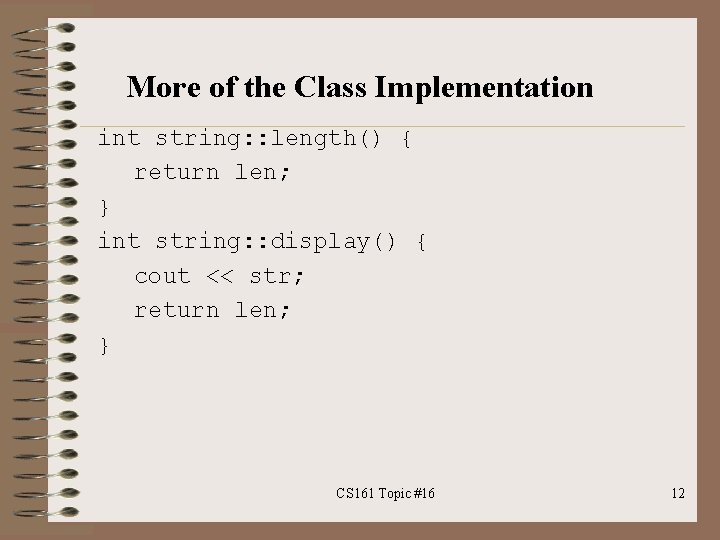
More of the Class Implementation int string: : length() { return len; } int string: : display() { cout << str; return len; } CS 161 Topic #16 12
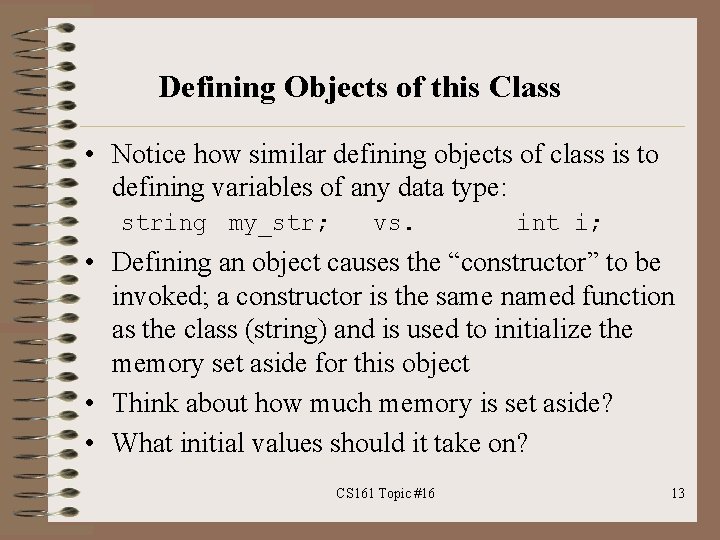
Defining Objects of this Class • Notice how similar defining objects of class is to defining variables of any data type: string my_str; vs. int i; • Defining an object causes the “constructor” to be invoked; a constructor is the same named function as the class (string) and is used to initialize the memory set aside for this object • Think about how much memory is set aside? • What initial values should it take on? CS 161 Topic #16 13
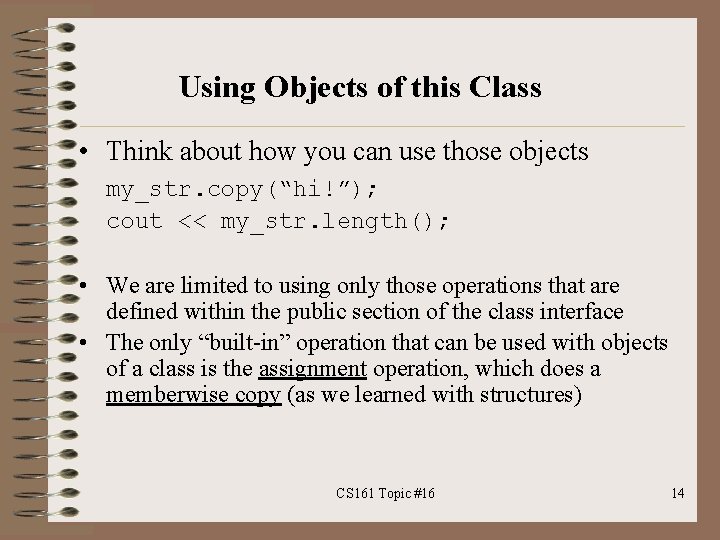
Using Objects of this Class • Think about how you can use those objects my_str. copy(“hi!”); cout << my_str. length(); • We are limited to using only those operations that are defined within the public section of the class interface • The only “built-in” operation that can be used with objects of a class is the assignment operation, which does a memberwise copy (as we learned with structures) CS 161 Topic #16 14
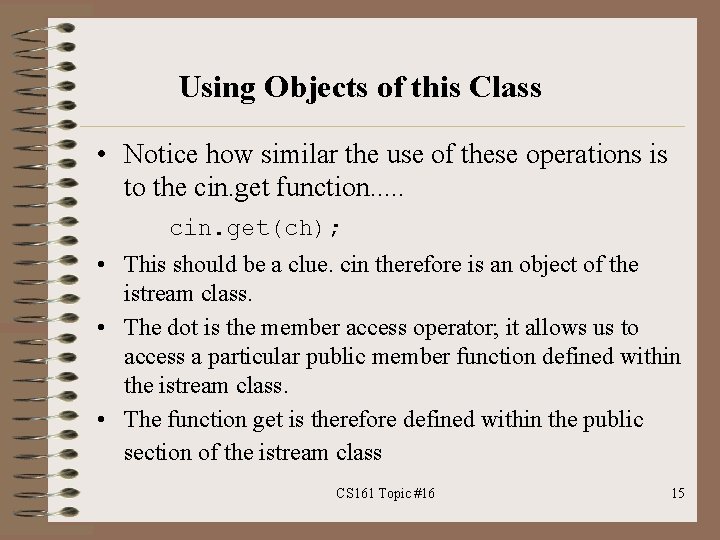
Using Objects of this Class • Notice how similar the use of these operations is to the cin. get function. . . cin. get(ch); • This should be a clue. cin therefore is an object of the istream class. • The dot is the member access operator; it allows us to access a particular public member function defined within the istream class. • The function get is therefore defined within the public section of the istream class CS 161 Topic #16 15
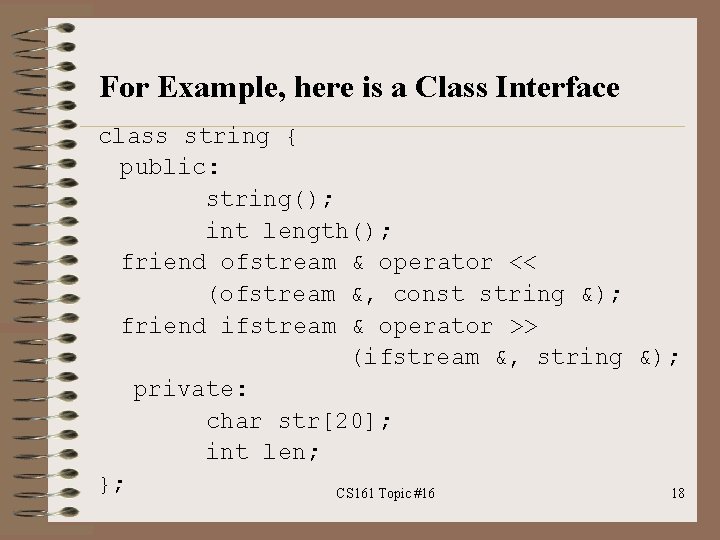
Limitations. . . • But, there are limitations! • If our goal is to really be able to use my string objects in a way consistent with the fundamental data types, – then I would expect to be able to read strings using the extraction operator – and to display strings by directly using the insertion operator – and to concatenate strings using + CS 161 Topic #16 16
Limitations. . . • With the class as it is defined, none of these things can be done. . . – the only operations that can be performed are those specified within the public section of the class interface, and a memberwise copy with the assignment operator – No other operations are known • Therefore, to be consistent, we must revise our class to use operator overloading CS 161 Topic #16 17
For Example, here is a Class Interface class string { public: string(); int length(); friend ofstream & operator << (ofstream &, const string &); friend ifstream & operator >> (ifstream &, string &); private: char str[20]; int len; }; CS 161 Topic #16 18
CS 161 Introduction to Computer Science What’s Next? CS 161 Topic #16 19