
CS 146 Data Structures and Algorithms July 28
- Slides: 39
CS 146: Data Structures and Algorithms July 28 Class Meeting Department of Computer Science San Jose State University Summer 2015 Instructor: Ron Mak www. cs. sjsu. edu/~mak
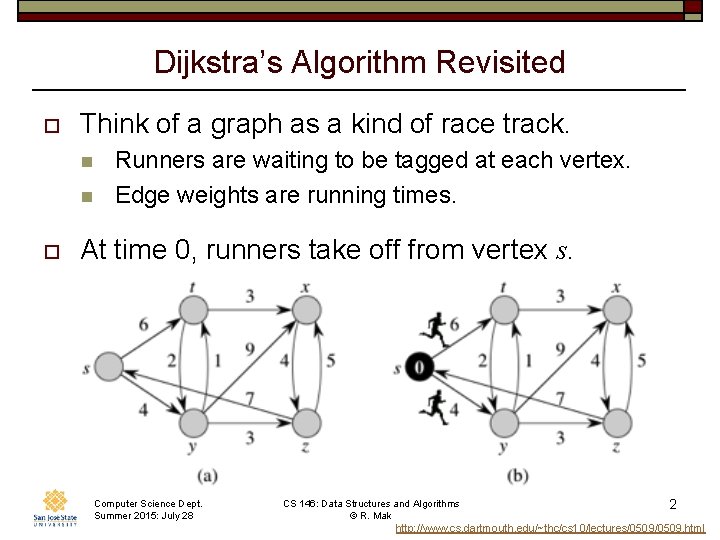
Dijkstra’s Algorithm Revisited o Think of a graph as a kind of race track. n n o Runners are waiting to be tagged at each vertex. Edge weights are running times. At time 0, runners take off from vertex s. Computer Science Dept. Summer 2015: July 28 CS 146: Data Structures and Algorithms © R. Mak 2 http: //www. cs. dartmouth. edu/~thc/cs 10/lectures/0509. html
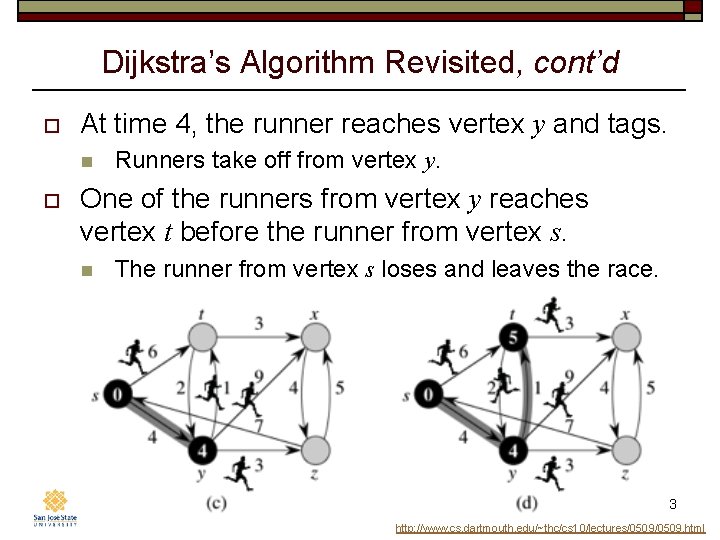
Dijkstra’s Algorithm Revisited, cont’d o At time 4, the runner reaches vertex y and tags. n o Runners take off from vertex y. One of the runners from vertex y reaches vertex t before the runner from vertex s. n The runner from vertex s loses and leaves the race. Computer Science Dept. Summer 2015: July 28 CS 146: Data Structures and Algorithms © R. Mak 3 http: //www. cs. dartmouth. edu/~thc/cs 10/lectures/0509. html
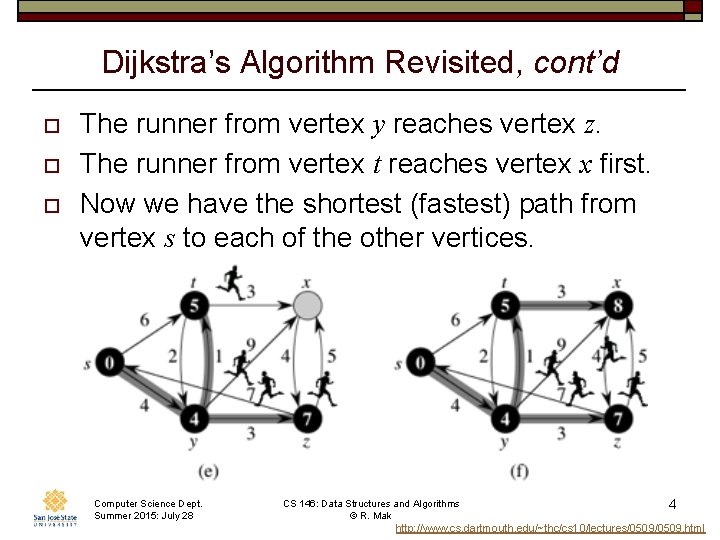
Dijkstra’s Algorithm Revisited, cont’d o o o The runner from vertex y reaches vertex z. The runner from vertex t reaches vertex x first. Now we have the shortest (fastest) path from vertex s to each of the other vertices. Computer Science Dept. Summer 2015: July 28 CS 146: Data Structures and Algorithms © R. Mak 4 http: //www. cs. dartmouth. edu/~thc/cs 10/lectures/0509. html
Greedy Algorithms o Proceed in stages. o At each stage, choose a local optimum. n n o Attempt to do what is best based on current information. “Take what you can get now. ” Hope this process leads to the global optimum. n Doesn’t always work. Computer Science Dept. Summer 2015: July 28 CS 146: Data Structures and Algorithms © R. Mak 5
Example Greedy Algorithms o o o Dijkstra’s algorithm for shortest weighted path. Prim’s algorithm for minimum spanning tree. Kruskal’s algorithm for minimum spanning tree. Computer Science Dept. Summer 2015: July 28 CS 146: Data Structures and Algorithms © R. Mak 6
Job Scheduling Algorithms o An operating system’s job scheduler picks jobs to run that are waiting in the job queue. n n o Each job has an expected run time. Once a job starts to run, let it run to completion (non-preemptive scheduling). Goal: Minimize average turnaround time for all the jobs. n Turnaround time = time spent in queue + time spent running Computer Science Dept. Summer 2015: July 28 CS 146: Data Structures and Algorithms © R. Mak 7
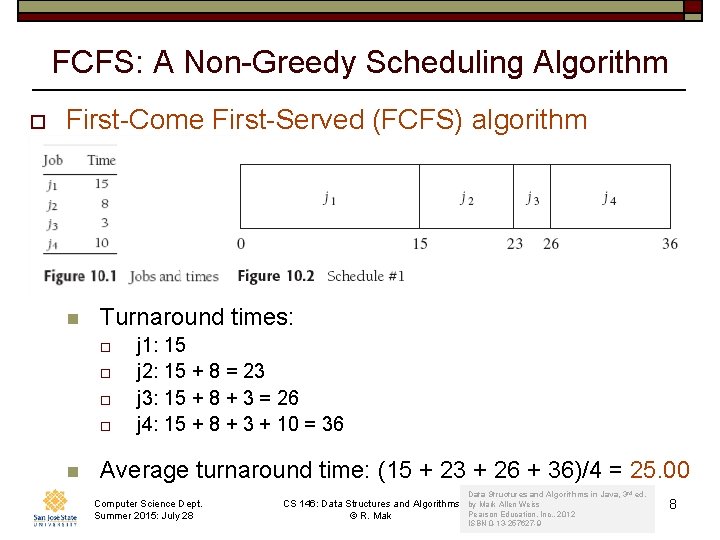
FCFS: A Non-Greedy Scheduling Algorithm o First-Come First-Served (FCFS) algorithm n Turnaround times: o o n j 1: 15 j 2: 15 + 8 = 23 j 3: 15 + 8 + 3 = 26 j 4: 15 + 8 + 3 + 10 = 36 Average turnaround time: (15 + 23 + 26 + 36)/4 = 25. 00 Computer Science Dept. Summer 2015: July 28 CS 146: Data Structures and Algorithms © R. Mak Data Structures and Algorithms in Java, 3 rd ed. by Mark Allen Weiss Pearson Education, Inc. , 2012 ISBN 0 -13 -257627 -9 8
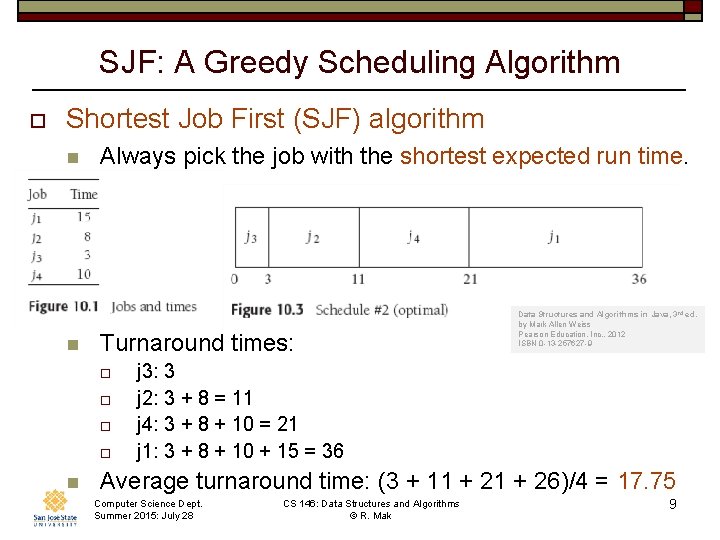
SJF: A Greedy Scheduling Algorithm o Shortest Job First (SJF) algorithm n n Always pick the job with the shortest expected run time. Turnaround times: o o n Data Structures and Algorithms in Java, 3 rd ed. by Mark Allen Weiss Pearson Education, Inc. , 2012 ISBN 0 -13 -257627 -9 j 3: 3 j 2: 3 + 8 = 11 j 4: 3 + 8 + 10 = 21 j 1: 3 + 8 + 10 + 15 = 36 Average turnaround time: (3 + 11 + 26)/4 = 17. 75 Computer Science Dept. Summer 2015: July 28 CS 146: Data Structures and Algorithms © R. Mak 9
Huffman’s Greedy Algorithm o Goal: Reduce the number of bits to transmit a message. n Invented by David A. Huffman in 1952. o Idea: Use fewer bits to encode message characters that appear more frequently. o Normally, each message character is encoded by a fixed number of bits. n Examples: 7 -bit ASCII code 8 -bit UTF-8 code Computer Science Dept. Summer 2015: July 28 CS 146: Data Structures and Algorithms © R. Mak 10
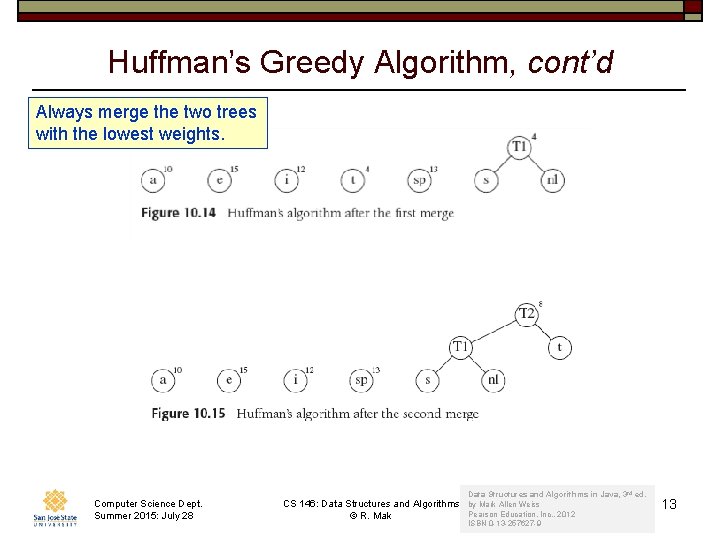
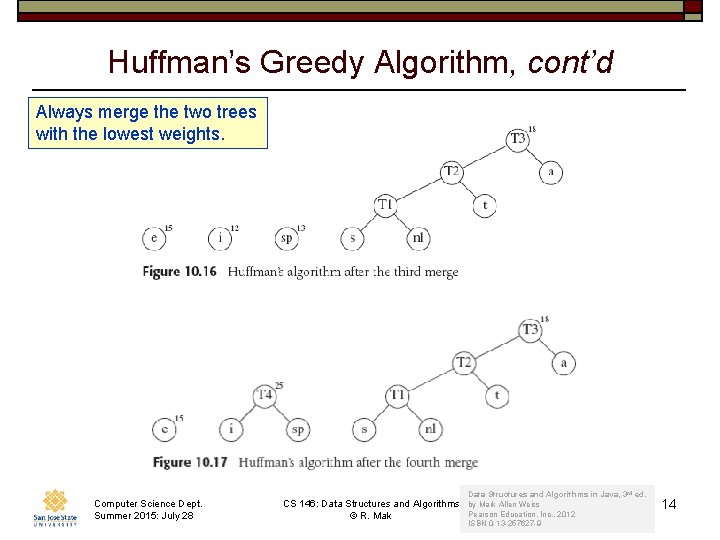
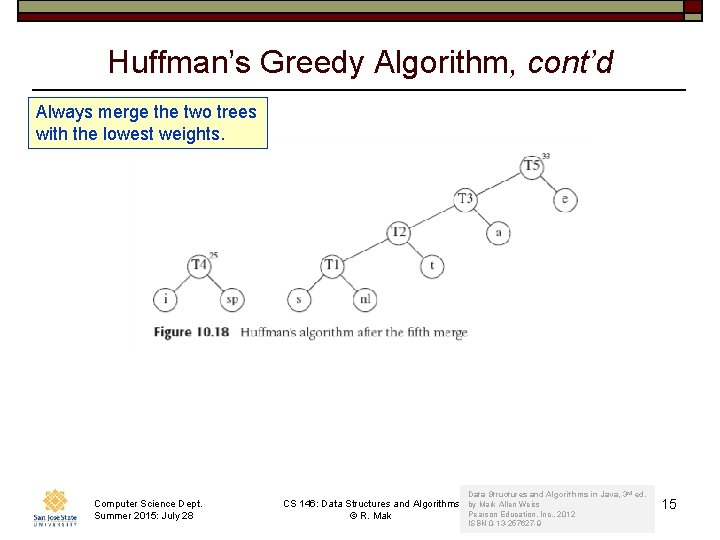
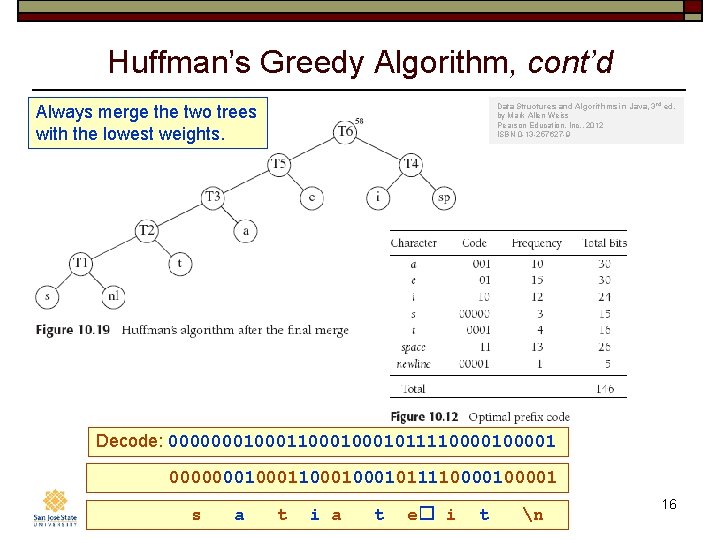
Huffman’s Greedy Algorithm, cont’d o Use a full binary tree to determine character encodings. n Each node is either a leaf or has two children. o Each character is a leaf node. o In the path from the root to a character: n n o Each left link is a 0 bit Each right link is a 1 bit No character code is a prefix of another character. Computer Science Dept. Summer 2015: July 28 CS 146: Data Structures and Algorithms © R. Mak 11
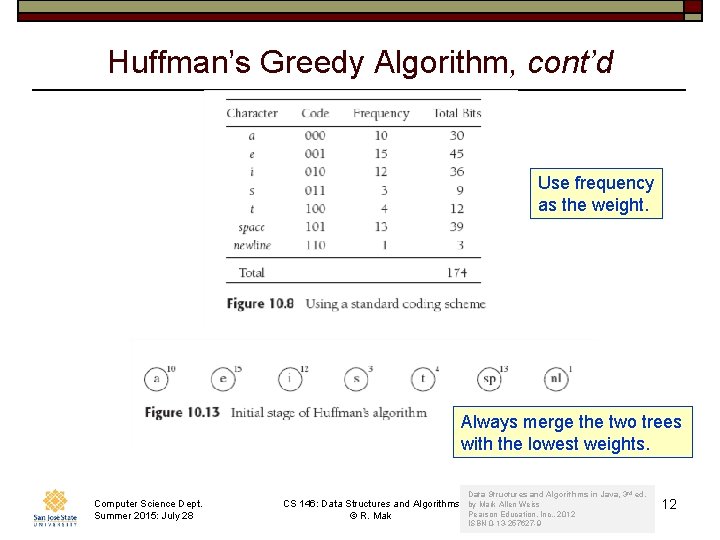
Huffman’s Greedy Algorithm, cont’d Use frequency as the weight. Always merge the two trees with the lowest weights. Computer Science Dept. Summer 2015: July 28 CS 146: Data Structures and Algorithms © R. Mak Data Structures and Algorithms in Java, 3 rd ed. by Mark Allen Weiss Pearson Education, Inc. , 2012 ISBN 0 -13 -257627 -9 12
Huffman’s Greedy Algorithm, cont’d Always merge the two trees with the lowest weights. Computer Science Dept. Summer 2015: July 28 CS 146: Data Structures and Algorithms © R. Mak Data Structures and Algorithms in Java, 3 rd ed. by Mark Allen Weiss Pearson Education, Inc. , 2012 ISBN 0 -13 -257627 -9 13
Huffman’s Greedy Algorithm, cont’d Always merge the two trees with the lowest weights. Computer Science Dept. Summer 2015: July 28 CS 146: Data Structures and Algorithms © R. Mak Data Structures and Algorithms in Java, 3 rd ed. by Mark Allen Weiss Pearson Education, Inc. , 2012 ISBN 0 -13 -257627 -9 14
Huffman’s Greedy Algorithm, cont’d Always merge the two trees with the lowest weights. Computer Science Dept. Summer 2015: July 28 CS 146: Data Structures and Algorithms © R. Mak Data Structures and Algorithms in Java, 3 rd ed. by Mark Allen Weiss Pearson Education, Inc. , 2012 ISBN 0 -13 -257627 -9 15
Huffman’s Greedy Algorithm, cont’d Data Structures and Algorithms in Java, 3 rd ed. by Mark Allen Weiss Pearson Education, Inc. , 2012 ISBN 0 -13 -257627 -9 Always merge the two trees with the lowest weights. Decode: 000000010001100010001011110000100001 Computer Science Dept. Summer 2015: July 28 s a CS 146: Data Structures and Algorithms © R. Mak t i a t e☐ i t n 16
Divide and Conquer Algorithms o Divide a problem into at least two smaller problems. n o The subproblems can (but not necessarily) be solved recursively. Conquer by forming the solution to the original problem from the solutions to the smaller problems. Computer Science Dept. Summer 2015: July 28 CS 146: Data Structures and Algorithms © R. Mak 17
Example Divide and Conquer Algorithms o o o Solution to the Towers of Hanoi puzzle. Mergesort Quicksort Computer Science Dept. Summer 2015: July 28 CS 146: Data Structures and Algorithms © R. Mak 18
Multiplying Two Large Integers o We want to multiply two large N-digit integers X and Y. o Done the usual way, it’s Θ(N 2). Computer Science Dept. Summer 2015: July 28 CS 146: Data Structures and Algorithms © R. Mak 19
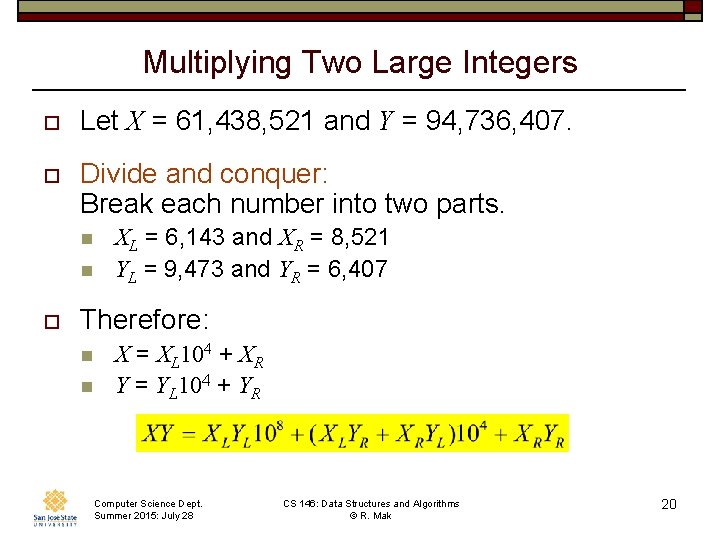
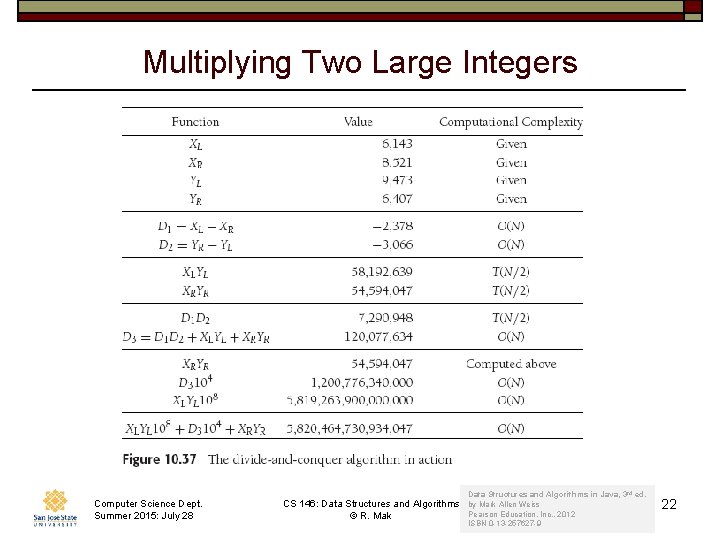
Multiplying Two Large Integers o Let X = 61, 438, 521 and Y = 94, 736, 407. o Divide and conquer: Break each number into two parts. n n o XL = 6, 143 and XR = 8, 521 YL = 9, 473 and YR = 6, 407 Therefore: n n X = XL 104 + XR Y = YL 104 + YR Computer Science Dept. Summer 2015: July 28 CS 146: Data Structures and Algorithms © R. Mak 20
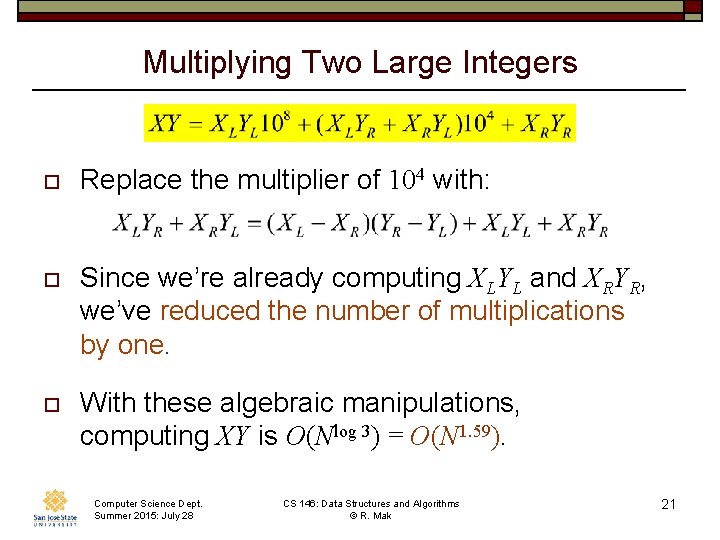
Multiplying Two Large Integers o Replace the multiplier of 104 with: o Since we’re already computing XLYL and XRYR, we’ve reduced the number of multiplications by one. o With these algebraic manipulations, computing XY is O(Nlog 3) = O(N 1. 59). Computer Science Dept. Summer 2015: July 28 CS 146: Data Structures and Algorithms © R. Mak 21
Multiplying Two Large Integers Computer Science Dept. Summer 2015: July 28 CS 146: Data Structures and Algorithms © R. Mak Data Structures and Algorithms in Java, 3 rd ed. by Mark Allen Weiss Pearson Education, Inc. , 2012 ISBN 0 -13 -257627 -9 22
Break Computer Science Dept. Summer 2015: July 28 CS 146: Data Structures and Algorithms © R. Mak 23
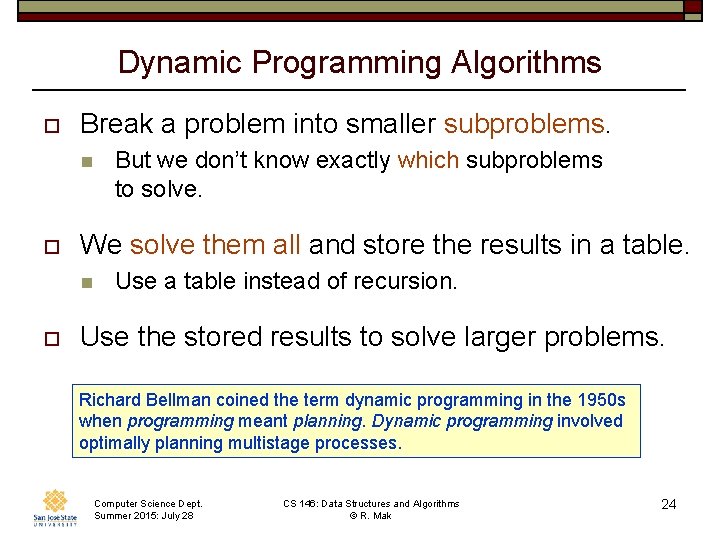
Dynamic Programming Algorithms o Break a problem into smaller subproblems. n o We solve them all and store the results in a table. n o But we don’t know exactly which subproblems to solve. Use a table instead of recursion. Use the stored results to solve larger problems. Richard Bellman coined the term dynamic programming in the 1950 s when programming meant planning. Dynamic programming involved optimally planning multistage processes. Computer Science Dept. Summer 2015: July 28 CS 146: Data Structures and Algorithms © R. Mak 24
Example Dynamic Programming Algorithm o Compute the fibonacci series. o The table consists of the last two computed numbers. o It’s extremely inefficient to use recursion to compute the series. Computer Science Dept. Summer 2015: July 28 CS 146: Data Structures and Algorithms © R. Mak 25
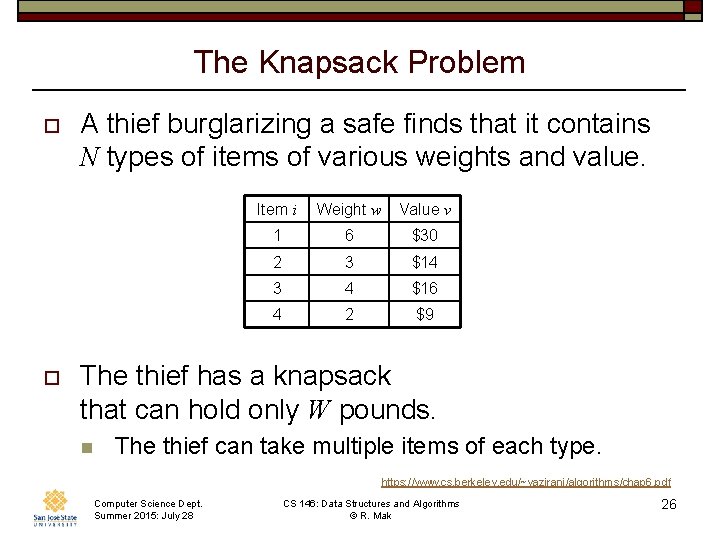
The Knapsack Problem o o A thief burglarizing a safe finds that it contains N types of items of various weights and value. Item i Weight w Value v 1 6 $30 2 3 $14 3 4 $16 4 2 $9 The thief has a knapsack that can hold only W pounds. n The thief can take multiple items of each type. https: //www. cs. berkeley. edu/~vazirani/algorithms/chap 6. pdf Computer Science Dept. Summer 2015: July 28 CS 146: Data Structures and Algorithms © R. Mak 26
The Knapsack Problem, cont’d o What is the optimum (most valuable) haul that the thief can carry away in the knapsack? o The solution will use dynamic programming. n o In other words, it will use a table. What are the subproblems? n n Consider smaller knapsacks that have a smaller capacities. Solve for each knapsack size. Computer Science Dept. Summer 2015: July 28 CS 146: Data Structures and Algorithms © R. Mak 27
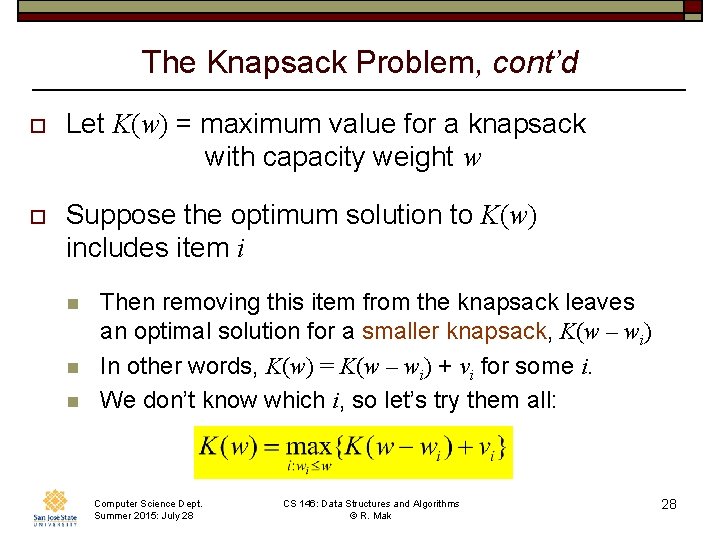
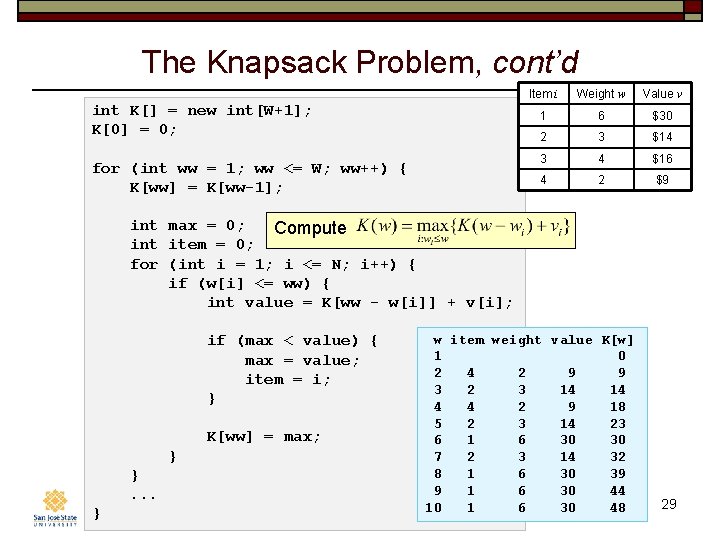
The Knapsack Problem, cont’d o Let K(w) = maximum value for a knapsack with capacity weight w o Suppose the optimum solution to K(w) includes item i n n n Then removing this item from the knapsack leaves an optimal solution for a smaller knapsack, K(w – wi) In other words, K(w) = K(w – wi) + vi for some i. We don’t know which i, so let’s try them all: Computer Science Dept. Summer 2015: July 28 CS 146: Data Structures and Algorithms © R. Mak 28
The Knapsack Problem, cont’d int K[] = new int[W+1]; K[0] = 0; for (int ww = 1; ww <= W; ww++) { K[ww] = K[ww-1]; Item i Weight w Value v 1 6 $30 2 3 $14 3 4 $16 4 2 $9 int max = 0; Compute int item = 0; for (int i = 1; i <= N; i++) { if (w[i] <= ww) { int value = K[ww - w[i]] + v[i]; w item weight value K[w] 1 0 2 4 2 9 9 3 2 3 14 14 4 4 2 9 18 5 2 3 14 23 K[ww] = max; 6 1 6 30 30 7 2 3 14 32 8 1 6 30 39 9 1 6 30 44 CS 146: Data Structures and Algorithms 10 1 6 30 48 © R. Mak if (max < value) { max = value; item = i; } } }. . . Computer Science Dept. }Summer 2015: July 28 29
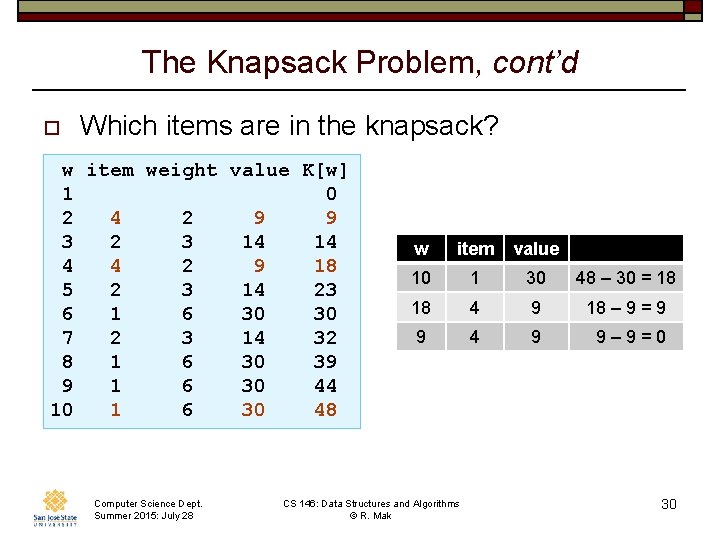
The Knapsack Problem, cont’d o Which items are in the knapsack? w item weight value K[w] 1 0 2 4 2 9 9 3 2 3 14 14 4 4 2 9 18 5 2 3 14 23 6 1 6 30 30 7 2 3 14 32 8 1 6 30 39 9 1 6 30 44 10 1 6 30 48 Computer Science Dept. Summer 2015: July 28 w item value 10 1 30 48 – 30 = 18 18 4 9 18 – 9 = 9 9 4 9 9– 9=0 CS 146: Data Structures and Algorithms © R. Mak 30
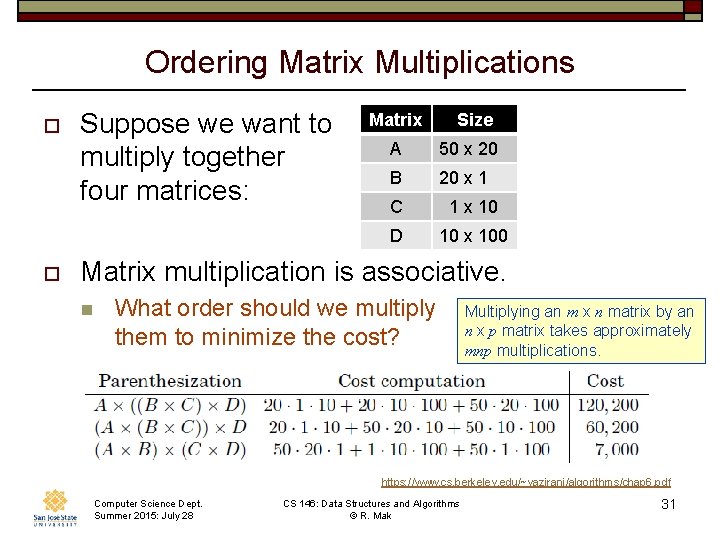
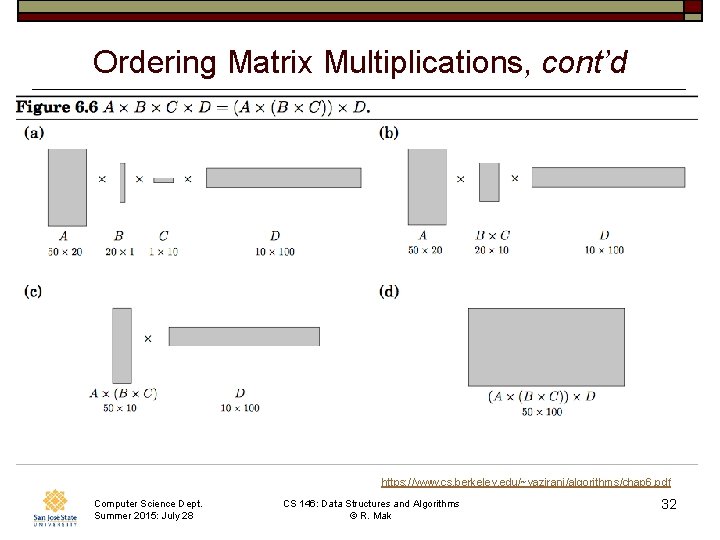
Ordering Matrix Multiplications o o Suppose we want to multiply together four matrices: Matrix Size A 50 x 20 B 20 x 1 C 1 x 10 D 10 x 100 Matrix multiplication is associative. n What order should we multiply them to minimize the cost? Multiplying an m x n matrix by an n x p matrix takes approximately mnp multiplications. https: //www. cs. berkeley. edu/~vazirani/algorithms/chap 6. pdf Computer Science Dept. Summer 2015: July 28 CS 146: Data Structures and Algorithms © R. Mak 31
Ordering Matrix Multiplications, cont’d https: //www. cs. berkeley. edu/~vazirani/algorithms/chap 6. pdf Computer Science Dept. Summer 2015: July 28 CS 146: Data Structures and Algorithms © R. Mak 32
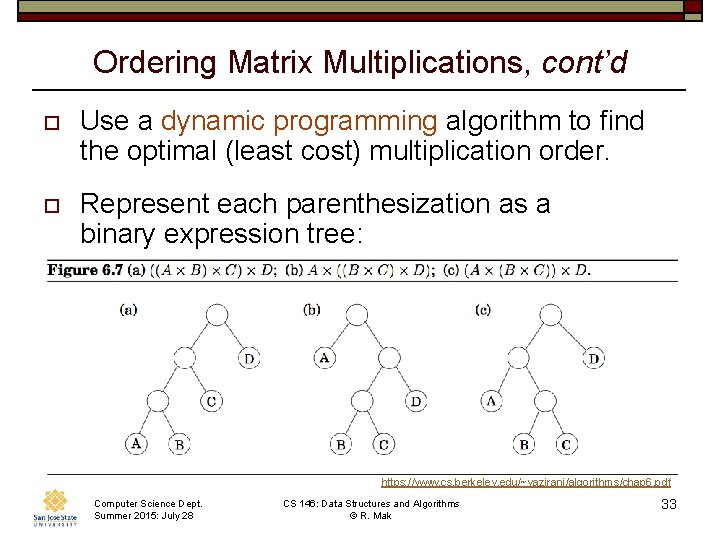
Ordering Matrix Multiplications, cont’d o Use a dynamic programming algorithm to find the optimal (least cost) multiplication order. o Represent each parenthesization as a binary expression tree: https: //www. cs. berkeley. edu/~vazirani/algorithms/chap 6. pdf Computer Science Dept. Summer 2015: July 28 CS 146: Data Structures and Algorithms © R. Mak 33
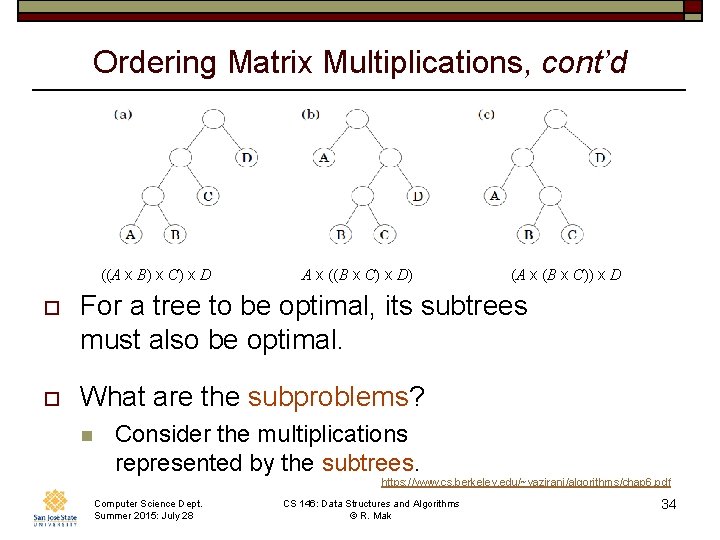
Ordering Matrix Multiplications, cont’d ((A x B) x C) x D A x ((B x C) x D) (A x (B x C)) x D o For a tree to be optimal, its subtrees must also be optimal. o What are the subproblems? n Consider the multiplications represented by the subtrees. https: //www. cs. berkeley. edu/~vazirani/algorithms/chap 6. pdf Computer Science Dept. Summer 2015: July 28 CS 146: Data Structures and Algorithms © R. Mak 34
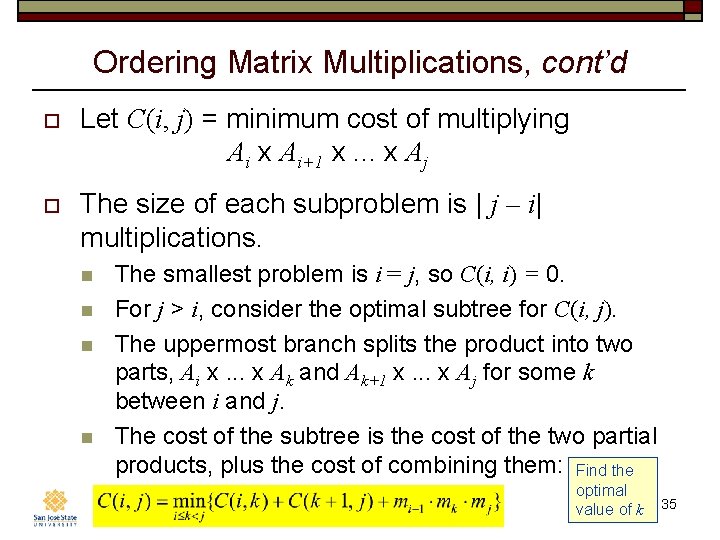
Ordering Matrix Multiplications, cont’d o Let C(i, j) = minimum cost of multiplying Ai x Ai+1 x. . . x Aj o The size of each subproblem is | j – i| multiplications. n n The smallest problem is i = j, so C(i, i) = 0. For j > i, consider the optimal subtree for C(i, j). The uppermost branch splits the product into two parts, Ai x. . . x Ak and Ak+1 x. . . x Aj for some k between i and j. The cost of the subtree is the cost of the two partial products, plus the cost of combining them: Find the Computer Science Dept. Summer 2015: July 28 CS 146: Data Structures and Algorithms © R. Mak optimal value of k 35
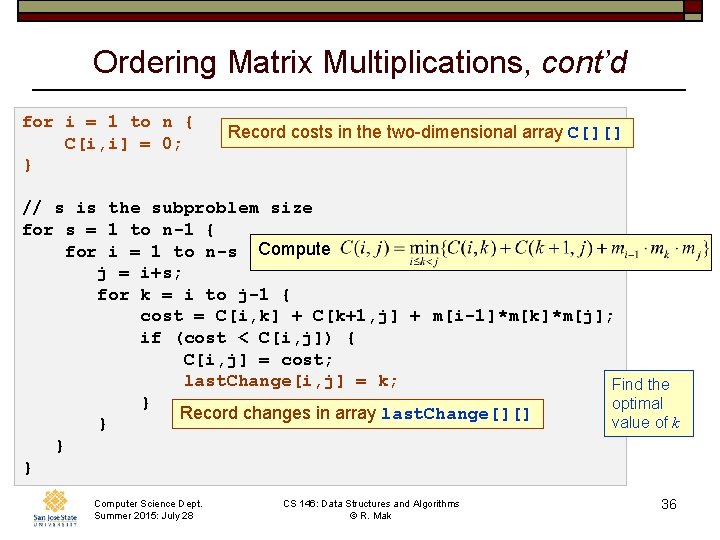
Ordering Matrix Multiplications, cont’d for i = 1 to n { C[i, i] = 0; } Record costs in the two-dimensional array C[][] // s is the subproblem size for s = 1 to n-1 { for i = 1 to n-s {Compute j = i+s; for k = i to j-1 { cost = C[i, k] + C[k+1, j] + m[i-1]*m[k]*m[j]; if (cost < C[i, j]) { C[i, j] = cost; last. Change[i, j] = k; Find the } optimal Record changes in array last. Change[][] value of k } } } Computer Science Dept. Summer 2015: July 28 CS 146: Data Structures and Algorithms © R. Mak 36
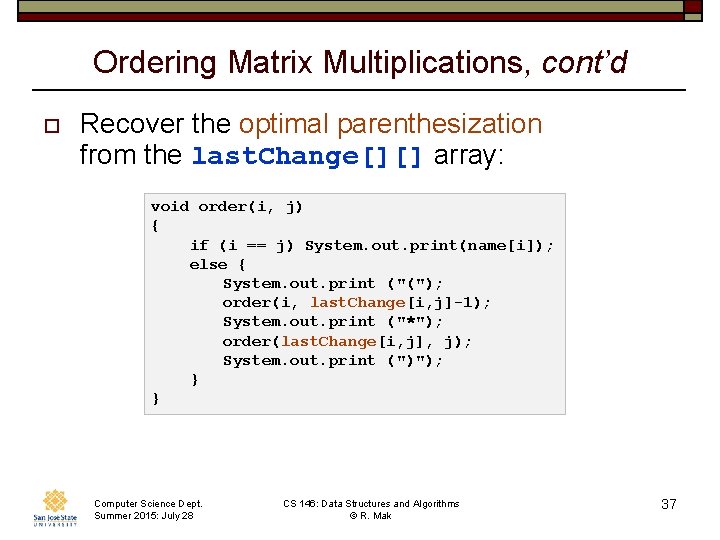
Ordering Matrix Multiplications, cont’d o Recover the optimal parenthesization from the last. Change[][] array: void order(i, j) { if (i == j) System. out. print(name[i]); else { System. out. print ("("); order(i, last. Change[i, j]-1); System. out. print ("*"); order(last. Change[i, j], j); System. out. print (")"); } } Computer Science Dept. Summer 2015: July 28 CS 146: Data Structures and Algorithms © R. Mak 37
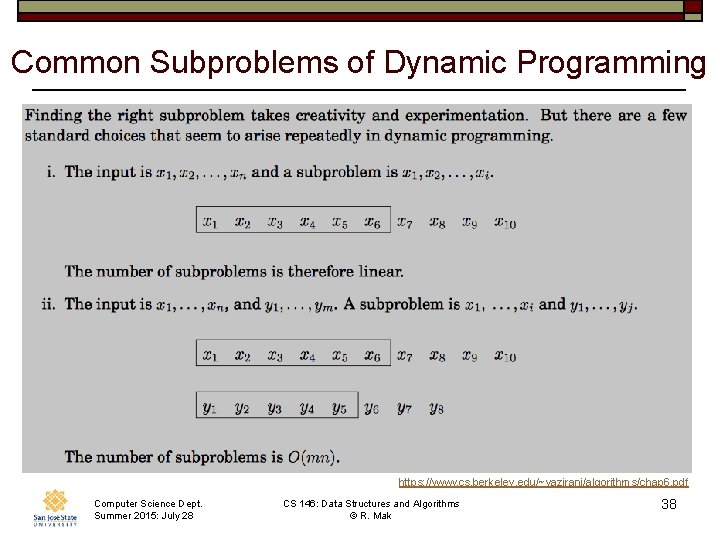
Common Subproblems of Dynamic Programming https: //www. cs. berkeley. edu/~vazirani/algorithms/chap 6. pdf Computer Science Dept. Summer 2015: July 28 CS 146: Data Structures and Algorithms © R. Mak 38
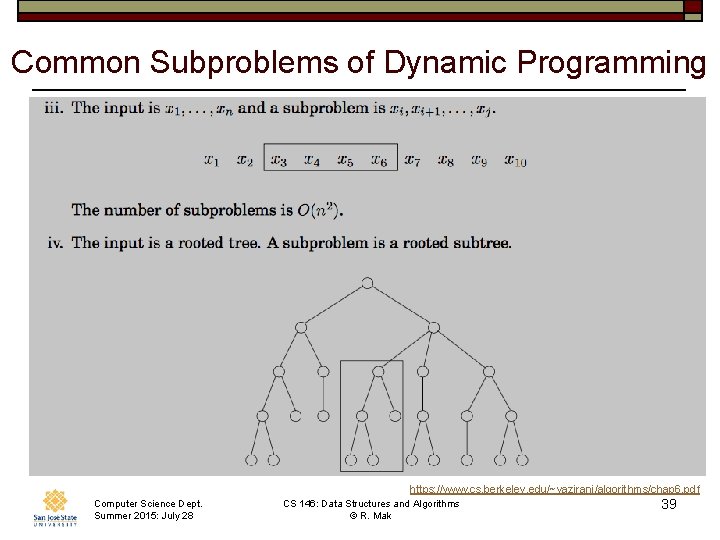
Common Subproblems of Dynamic Programming https: //www. cs. berkeley. edu/~vazirani/algorithms/chap 6. pdf Computer Science Dept. Summer 2015: July 28 CS 146: Data Structures and Algorithms © R. Mak 39