
CS 144 An Introduction to Computer Networks Abstractions
CS 144 An Introduction to Computer Networks Abstractions and Virtualization Tags, Tunnels and Translation Nick Mc. Keown Professor of Electrical Engineering and Computer Science, Stanford University
The term “Virtual” is (over) used a lot… • • Virtual LANs (VLAN) Virtual Private Network (VPN) Network Virtualization (used by cloud providers) Network Function Virtualization (NFV) 2
Learning goals of this class • To learn how tags, tunnels and translation can be used to provide new abstractions in a network. • To learn about the match + action abstraction • To learn about three examples: Virtual LANs (VLANs), VPNs, and NATs. • To learn what network virtualization is. • To learn how overlay network virtualization works. • To learn what network function virtualization (NFV) is. 3
What do we mean by an abstraction?

Example: IP datagram delivery B A
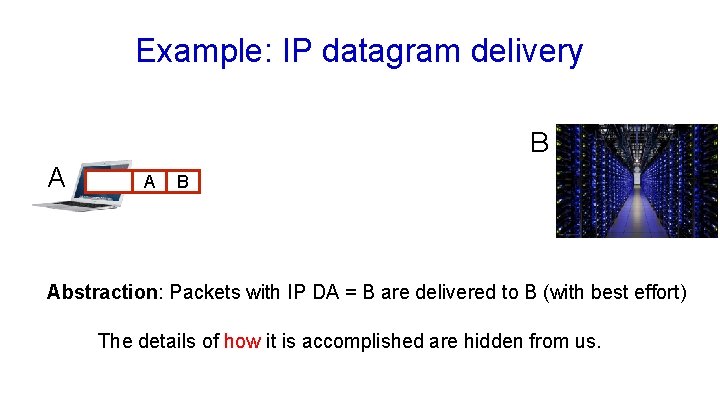
Example: IP datagram delivery B A A B Abstraction: Packets with IP DA = B are delivered to B (with best effort) The details of how it is accomplished are hidden from us.
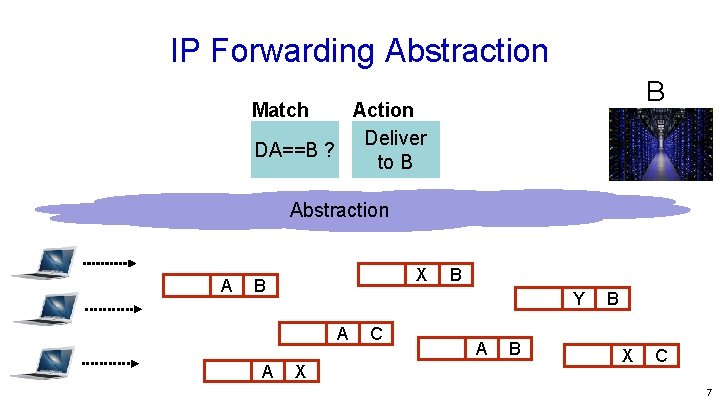
IP Forwarding Abstraction B Match Action Deliver DA==B ? to B Abstraction A X B Y A A B X C A B B X C 7
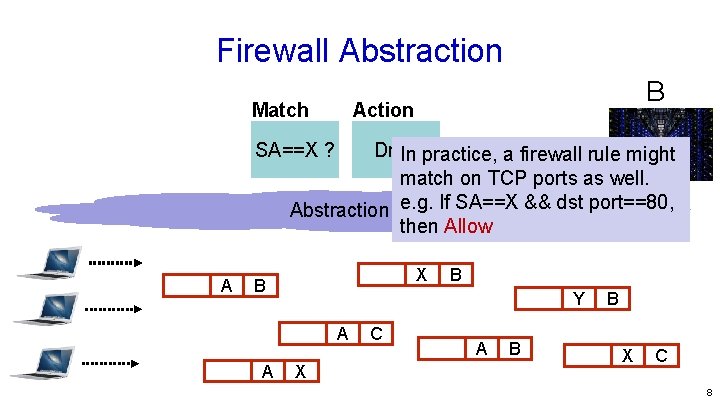
Firewall Abstraction Match B Action SA==X ? Drop In practice, a firewall rule might match on TCP ports as well. Abstraction e. g. If SA==X && dst port==80, then Allow A X B Y A A B X C A B B X C 8
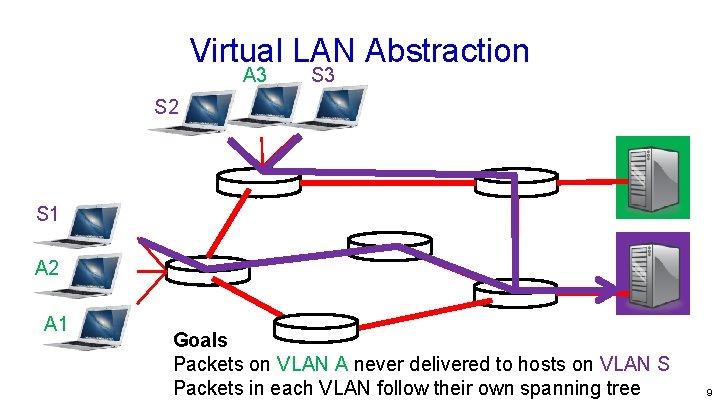
Virtual LAN Abstraction A 3 S 2 S 1 A 2 A 1 Goals Packets on VLAN A never delivered to hosts on VLAN S Packets in each VLAN follow their own spanning tree 9
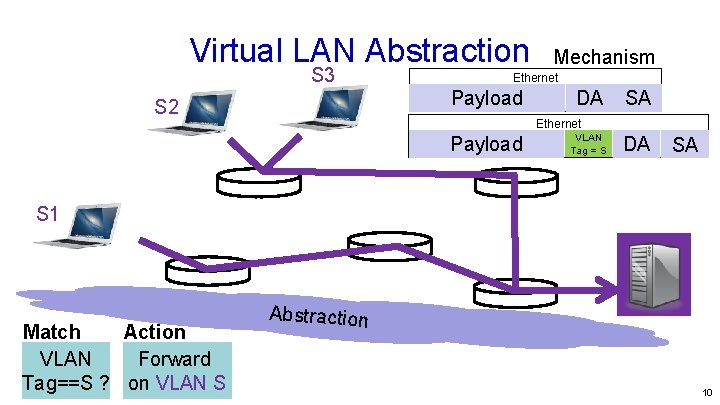
Virtual LAN Abstraction S 3 Ethernet Payload S 2 Mechanism DA SA Ethernet Payload VLAN Tag = S DA SA S 1 Match Action VLAN Forward Tag==S ? on VLAN S Abstraction 10
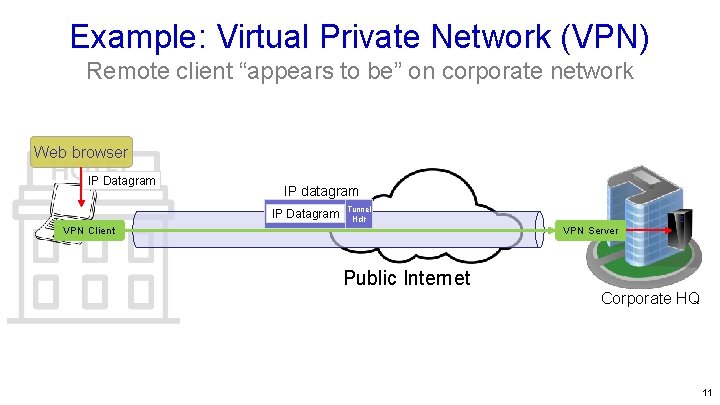
Example: Virtual Private Network (VPN) Remote client “appears to be” on corporate network Web browser IP Datagram IP datagram IP Datagram Tunnel Hdr VPN Client VPN Server Public Internet Corporate HQ 11
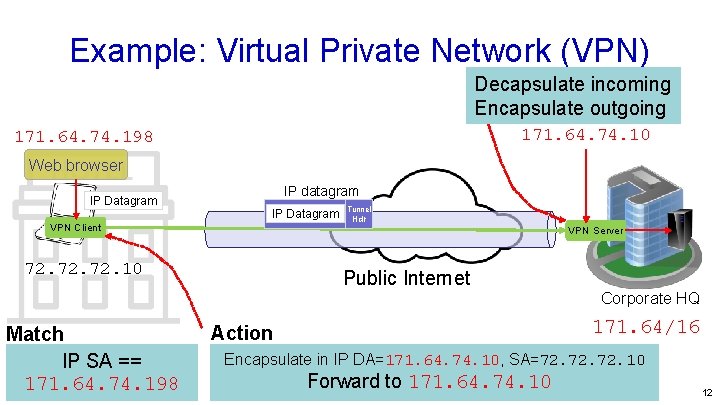
Example: Virtual Private Network (VPN) Decapsulate incoming Encapsulate outgoing 171. 64. 74. 10 171. 64. 74. 198 Web browser IP Datagram IP datagram IP Datagram VPN Client Tunnel Hdr VPN Server 72. 72. 10 Public Internet Corporate HQ Match IP SA == 171. 64. 74. 198 171. 64/16 Action Encapsulate in IP DA=171. 64. 74. 10, SA=72. 72. 10 Forward to 171. 64. 74. 10 12
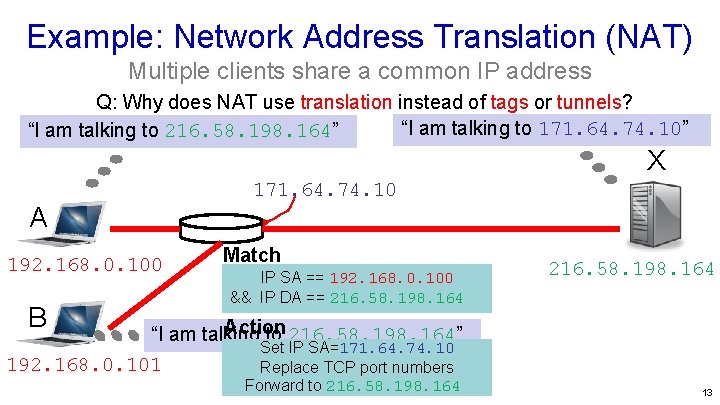
Example: Network Address Translation (NAT) Multiple clients share a common IP address Q: Why does NAT use translation instead of tags or tunnels? “I am talking to 171. 64. 74. 10” “I am talking to 216. 58. 198. 164” X 171. 64. 74. 10 A 192. 168. 0. 100 B Match IP SA == 192. 168. 0. 100 && IP DA == 216. 58. 198. 164 Action “I am talking to 216. 58. 198. 164” Set IP SA=171. 64. 74. 10 192. 168. 0. 101 Replace TCP port numbers Forward to 216. 58. 198. 164 13
“Modularity based on abstraction is the way things are done!” Barbara Liskov (MIT) Turing Award Lecture 2009
Learning goals of this class • To learn how tags, tunnels and translation can be used to provide new abstractions in a network. • To learn about the match + action abstraction • To learn about three examples: Virtual LANs (VLANs), VPNs, and NATs. • To learn what network virtualization is. • To learn how overlay network virtualization works. • To learn what network function virtualization (NFV) is. 15
Network Virtualization
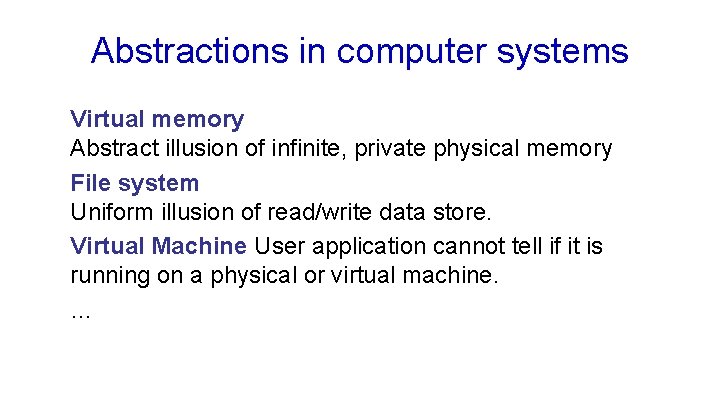
Abstractions in computer systems Virtual memory Abstract illusion of infinite, private physical memory File system Uniform illusion of read/write data store. Virtual Machine User application cannot tell if it is running on a physical or virtual machine. …
Virtual Network: The abstraction (or illusion) of a physical network: The user, application (and possibly the network administrator too) cannot tell if the network is physical or virtual. 18
Virtual Network: The abstraction A set of VMs operating as if connected to the same physical network. 1. Typically belonging to the same tenant. 2. VMs communicate with each other using their own address space. 3. Virtual networks are isolated from each other: They cannot communicate, except through a gateway. 4. VMs can migrate to a different server without changing IP address. 5. A virtual network has a SLO expressed as a desired quality of service (e. g. data rate, reliability, latency) 6. A VM can operate as if on the tenant’s home network. 7. Used for containers too 19
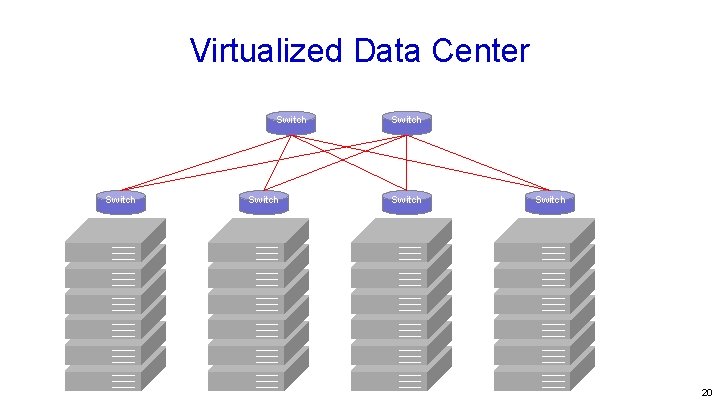
Virtualized Data Center Switch Switch 20
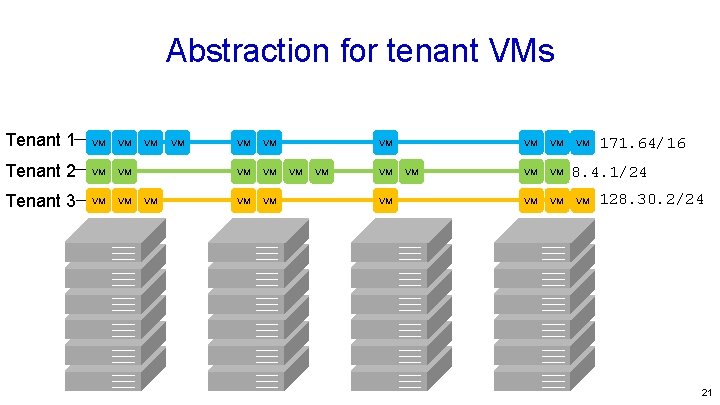
Abstraction for tenant VMs Tenant 1 VM VM Tenant 2 VM VM Tenant 3 VM VM VM VM VM VM 171. 64/16 8. 4. 1/24 VM 128. 30. 2/24 21
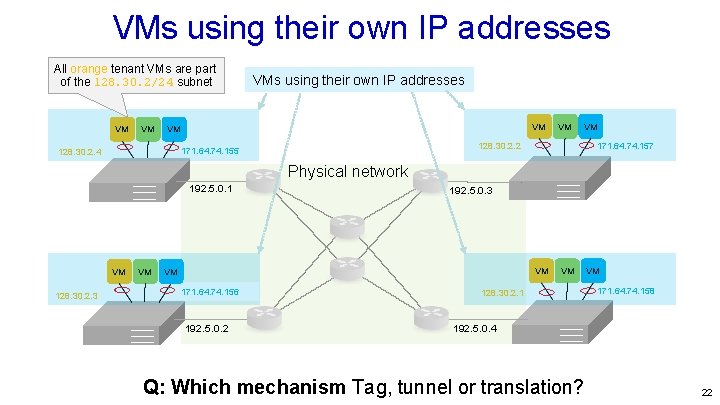
VMs using their own IP addresses All orange tenant VMs are part of the 128. 30. 2/24 subnet VM VM VMs using their own IP addresses VM VM VM 171. 64. 74. 157 128. 30. 2. 2 171. 64. 74. 155 128. 30. 2. 4 VM Physical network 192. 5. 0. 1 VM 128. 30. 2. 3 VM 192. 5. 0. 3 VM VM 171. 64. 74. 156 192. 5. 0. 2 VM 128. 30. 2. 1 VM 171. 64. 74. 158 192. 5. 0. 4 Q: Which mechanism Tag, tunnel or translation? 22
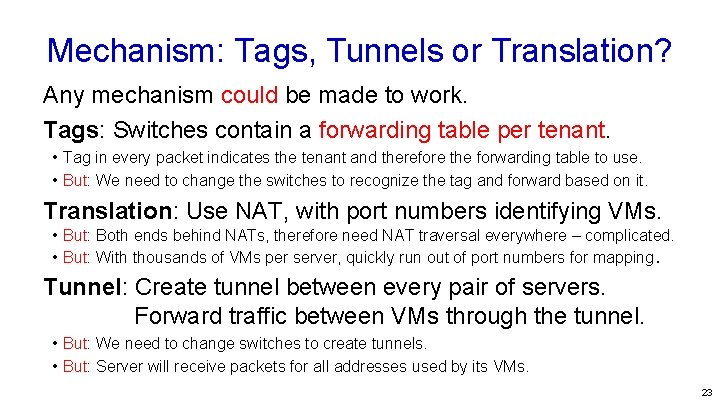
Mechanism: Tags, Tunnels or Translation? Any mechanism could be made to work. Tags: Switches contain a forwarding table per tenant. • Tag in every packet indicates the tenant and therefore the forwarding table to use. • But: We need to change the switches to recognize the tag and forward based on it. Translation: Use NAT, with port numbers identifying VMs. • But: Both ends behind NATs, therefore need NAT traversal everywhere – complicated. • But: With thousands of VMs per server, quickly run out of port numbers for mapping. Tunnel: Create tunnel between every pair of servers. Forward traffic between VMs through the tunnel. • But: We need to change switches to create tunnels. • But: Server will receive packets for all addresses used by its VMs. 23
How it is done in virtualized data centers
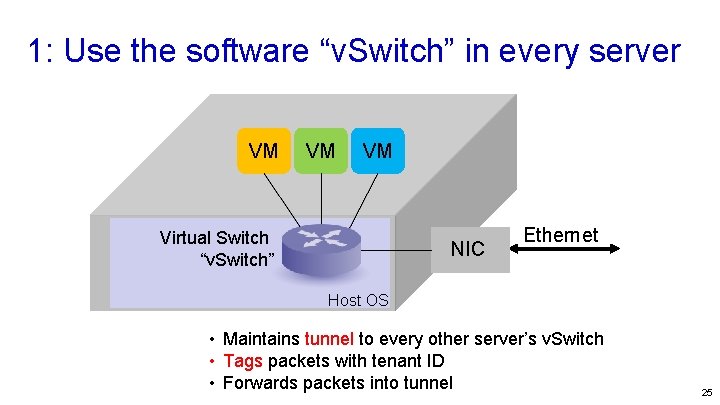
1: Use the software “v. Switch” in every server VM VM VM Virtual Switch “v. Switch” NIC Ethernet Host OS • Maintains tunnel to every other server’s v. Switch • Tags packets with tenant ID • Forwards packets into tunnel 25
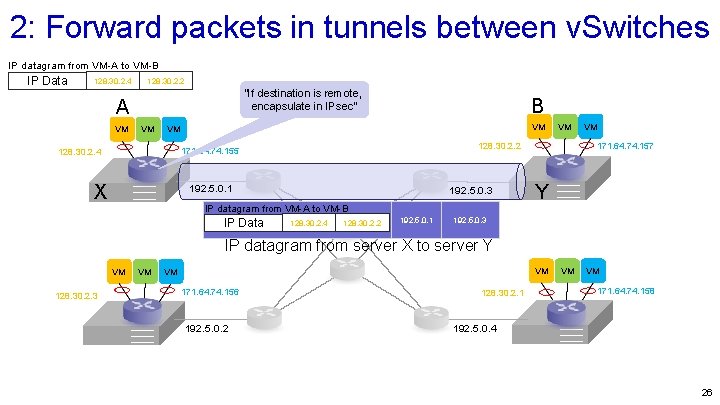
2: Forward packets in tunnels between v. Switches IP datagram from VM-A to VM-B IP Data 128. 30. 2. 4 128. 30. 2. 2 “If destination is remote, encapsulate in IPsec” A VM VM B VM VM X 192. 5. 0. 1 192. 5. 0. 3 VM 171. 64. 74. 157 128. 30. 2. 2 171. 64. 74. 155 128. 30. 2. 4 VM Y IP datagram from VM-A to VM-B IP Data 128. 30. 2. 4 128. 30. 2. 2 192. 5. 0. 1 192. 5. 0. 3 IP datagram from server X to server Y VM 128. 30. 2. 3 VM VM VM 171. 64. 74. 156 192. 5. 0. 2 128. 30. 2. 1 VM VM 171. 64. 74. 158 192. 5. 0. 4 26
Learning goals of this class • To learn how tags, tunnels and translation can be used to provide new abstractions in a network. • To learn about the match + action abstraction • To learn about three examples: Virtual LANs (VLANs), VPNs, and NATs. • To learn what network virtualization is. • To learn how overlay network virtualization works. • To learn what network function virtualization (NFV) is. 27
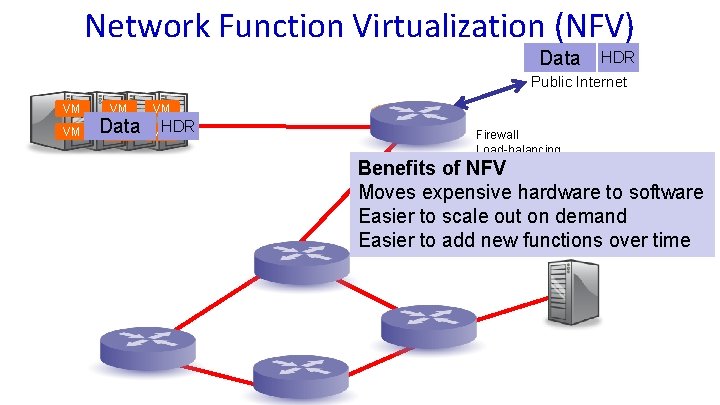
Network Function Virtualization (NFV) Data HDR Public Internet VM VM VM Data VM VM HDR VM Middlebox Firewall Load-balancing NAT Deep Packet Inspection DDo. S Mitigation Benefits of NFV Moves expensive hardware to software Easier to scale out on demand Easier to add new functions over time
Learning goals of this class • To learn how tags, tunnels and translation can be used to provide new abstractions in a network. • To learn about the match + action abstraction • To learn about three examples: Virtual LANs (VLANs), VPNs, and NATs. • To learn what network virtualization is. • To learn how overlay network virtualization works. • To learn what network function virtualization (NFV) is. 29
Thank you!
- Slides: 30