
CS 136 Advanced Architecture Limits to ILP Simultaneous







- Slides: 49
CS 136, Advanced Architecture Limits to ILP Simultaneous Multithreading CS 136
Outline • • Limits to ILP (another perspective) Thread Level Parallelism Multithreading Simultaneous Multithreading Power 4 vs. Power 5 Head to Head: VLIW vs. Superscalar vs. SMT Commentary Conclusion CS 136 2
Limits to ILP • Conflicting studies of amount – Benchmarks (vectorized Fortran FP vs. integer C programs) – Hardware sophistication – Compiler sophistication • How much ILP is available using existing mechanisms with increasing HW budgets? • Do we need to invent new HW/SW mechanisms to keep on processor performance curve? – – CS 136 Intel MMX, SSE (Streaming SIMD Extensions): 64 bit ints Intel SSE 2: 128 bit, including 2 64 -bit Fl. Pt. per clock Motorola Alti. Vec: 128 bit ints and FPs Supersparc Multimedia ops, etc. 3
Overcoming Limits • Advances in compiler technology + significantly new and different hardware techniques may be able to overcome limitations assumed in studies • However, unlikely such advances when coupled with realistic hardware will overcome these limits in near future CS 136 4
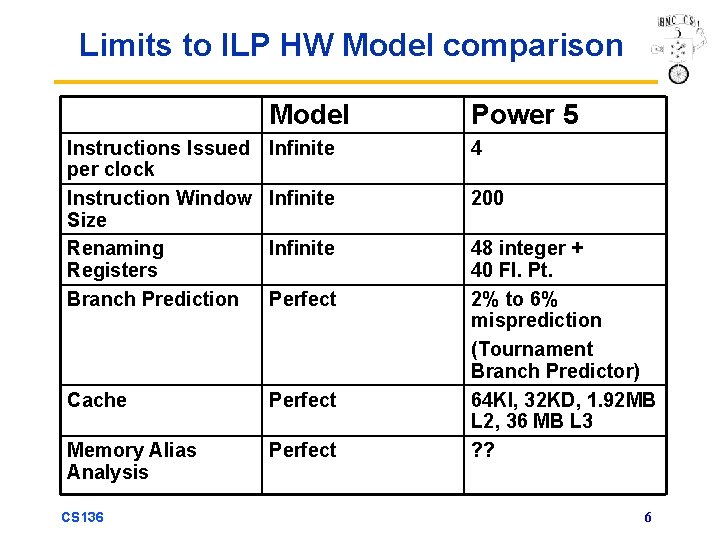
Limits to ILP Initial HW Model here; MIPS compilers. Assumptions for ideal/perfect machine to start: 1. Register renaming – infinite virtual registers => all register WAW & WAR hazards are avoided 2. Branch prediction – perfect; no mispredictions 3. Jump prediction – all jumps perfectly predicted (returns, case statements) 2 & 3 no control dependencies; perfect speculation & an unbounded buffer of instructions available 4. Memory-address alias analysis – addresses known & a load can be moved before a store provided addresses not equal; 1&4 eliminates all but RAW Also: perfect caches; 1 cycle latency for all instructions (FP *, /); unlimited instructions issued/clock cycle CS 136 5
Limits to ILP HW Model comparison Model Power 5 Instructions Issued per clock Instruction Window Size Renaming Registers Branch Prediction Infinite 4 Infinite 200 Infinite Cache Perfect Memory Alias Analysis Perfect 48 integer + 40 Fl. Pt. 2% to 6% misprediction (Tournament Branch Predictor) 64 KI, 32 KD, 1. 92 MB L 2, 36 MB L 3 ? ? CS 136 Perfect 6
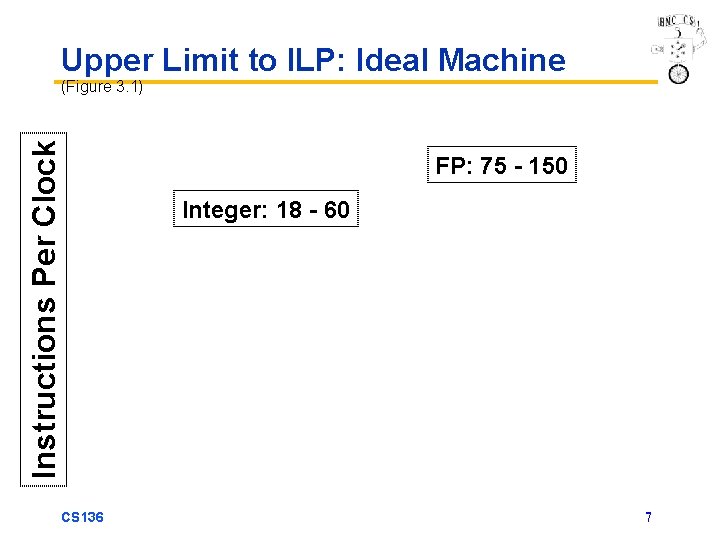
Upper Limit to ILP: Ideal Machine Instructions Per Clock (Figure 3. 1) CS 136 FP: 75 - 150 Integer: 18 - 60 7
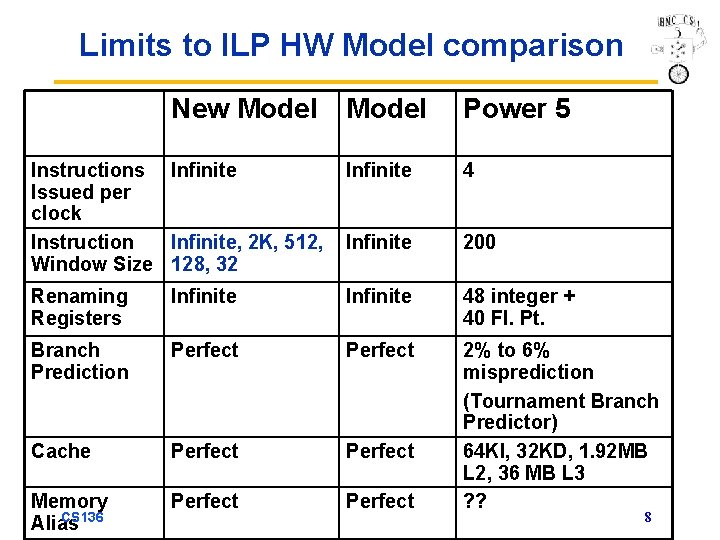
Limits to ILP HW Model comparison New Model Power 5 Instructions Infinite Issued per clock Instruction Infinite, 2 K, 512, Window Size 128, 32 Infinite 4 Infinite 200 Renaming Registers Infinite 48 integer + 40 Fl. Pt. Branch Prediction Perfect Cache Perfect Memory CS 136 Alias Perfect 2% to 6% misprediction (Tournament Branch Predictor) 64 KI, 32 KD, 1. 92 MB L 2, 36 MB L 3 ? ? 8
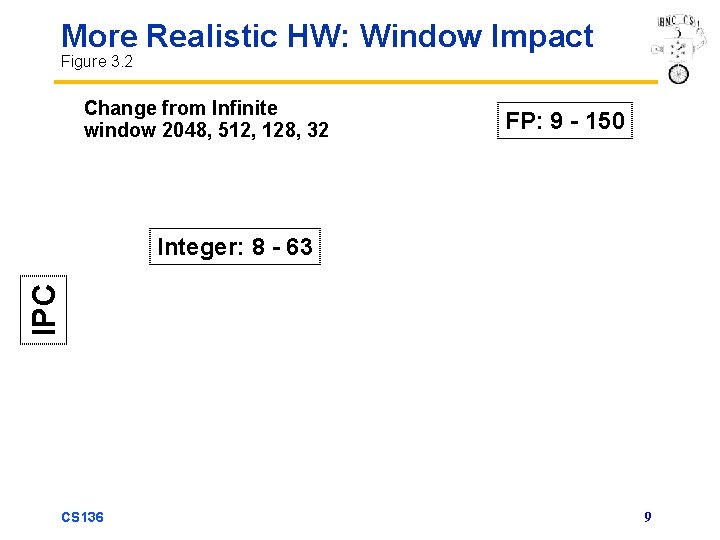
More Realistic HW: Window Impact Figure 3. 2 Change from Infinite window 2048, 512, 128, 32 FP: 9 - 150 IPC Integer: 8 - 63 CS 136 9
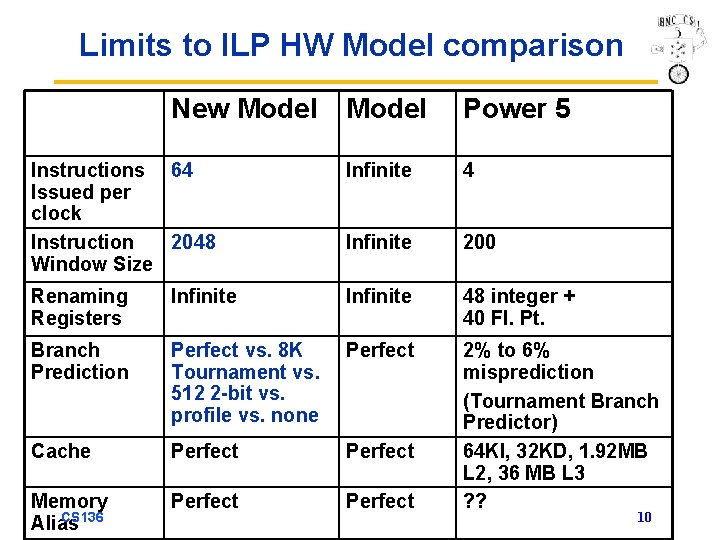
Limits to ILP HW Model comparison New Model Power 5 Instructions 64 Issued per clock Instruction 2048 Window Size Infinite 4 Infinite 200 Renaming Registers Infinite 48 integer + 40 Fl. Pt. Branch Prediction Perfect vs. 8 K Tournament vs. 512 2 -bit vs. profile vs. none Perfect Cache Perfect Memory CS 136 Alias Perfect 2% to 6% misprediction (Tournament Branch Predictor) 64 KI, 32 KD, 1. 92 MB L 2, 36 MB L 3 ? ? 10
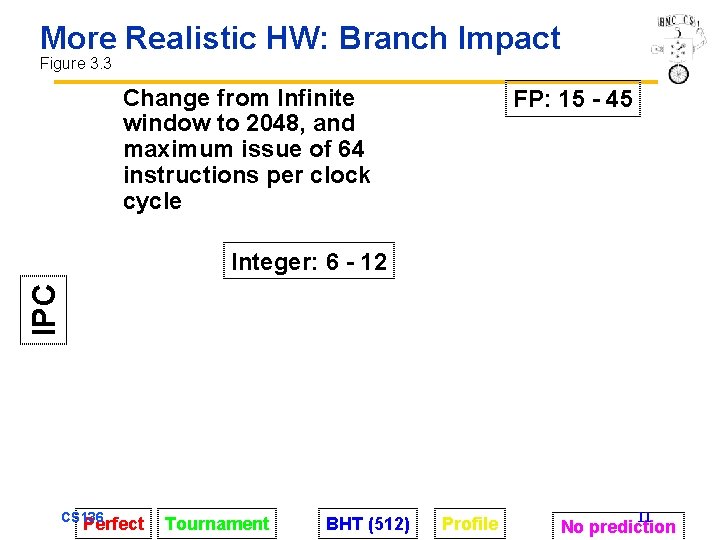
More Realistic HW: Branch Impact Figure 3. 3 Change from Infinite window to 2048, and maximum issue of 64 instructions per clock cycle FP: 15 - 45 IPC Integer: 6 - 12 CS 136 Perfect Tournament BHT (512) Profile 11 No prediction
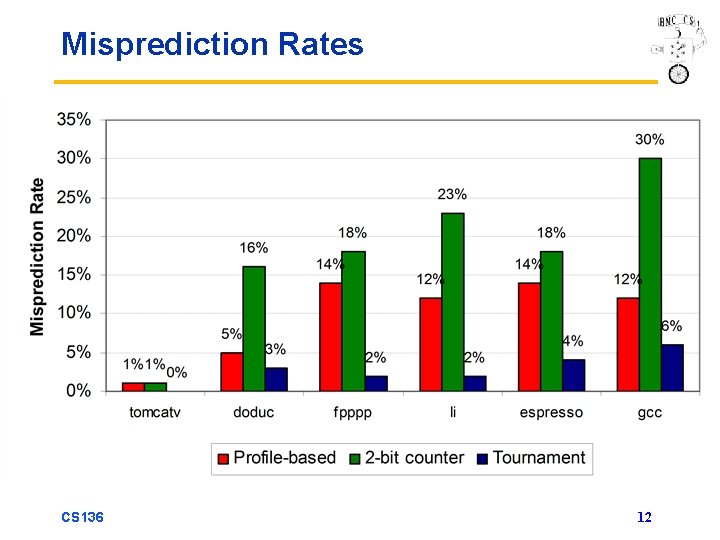
Misprediction Rates CS 136 12
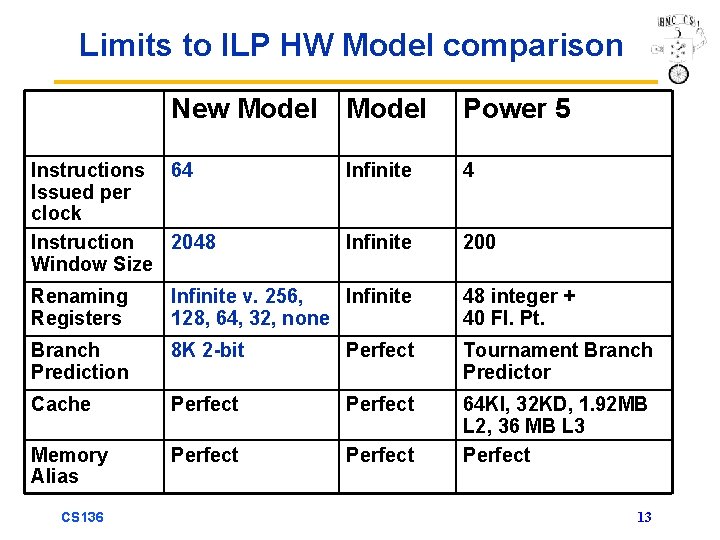
Limits to ILP HW Model comparison New Model Instructions 64 Issued per clock Instruction 2048 Window Size Model Power 5 Infinite 4 Infinite 200 Renaming Registers Infinite v. 256, Infinite 128, 64, 32, none 48 integer + 40 Fl. Pt. Branch Prediction 8 K 2 -bit Perfect Tournament Branch Predictor Cache Perfect Memory Alias Perfect 64 KI, 32 KD, 1. 92 MB L 2, 36 MB L 3 Perfect CS 136 13
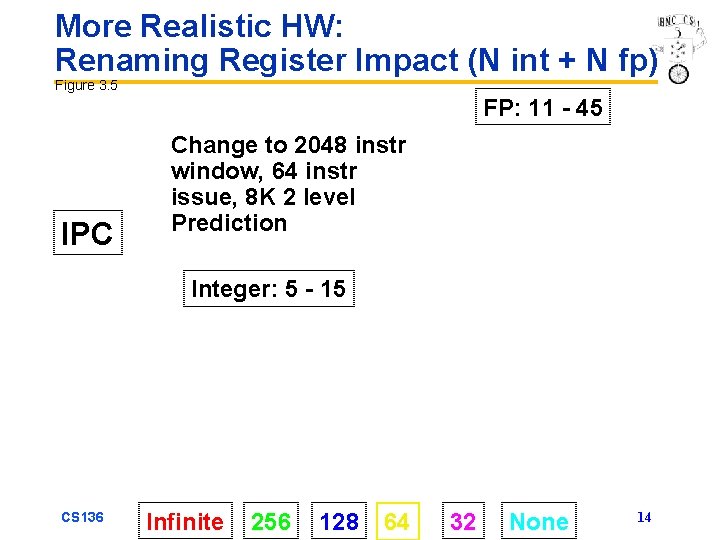
More Realistic HW: Renaming Register Impact (N int + N fp) Figure 3. 5 FP: 11 - 45 IPC Change to 2048 instr window, 64 instr issue, 8 K 2 level Prediction Integer: 5 - 15 CS 136 Infinite 256 128 64 32 None 14
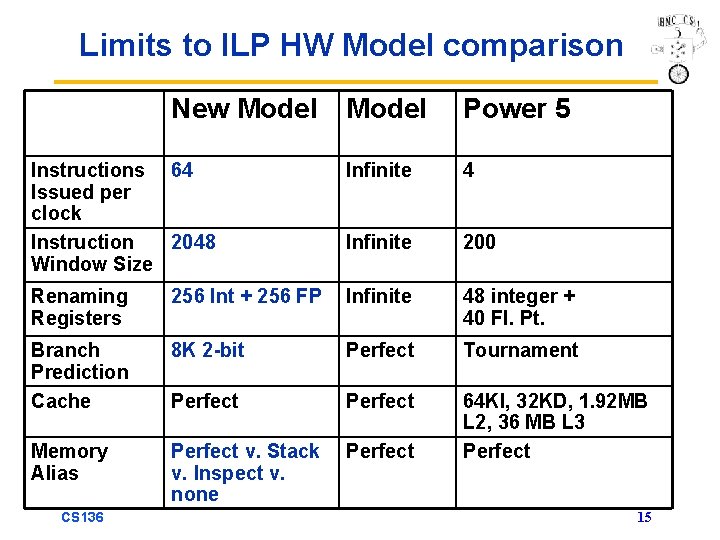
Limits to ILP HW Model comparison New Model Power 5 Instructions 64 Issued per clock Instruction 2048 Window Size Infinite 4 Infinite 200 Renaming Registers 256 Int + 256 FP Infinite 48 integer + 40 Fl. Pt. Branch Prediction Cache 8 K 2 -bit Perfect Tournament Perfect Memory Alias Perfect v. Stack v. Inspect v. none Perfect 64 KI, 32 KD, 1. 92 MB L 2, 36 MB L 3 Perfect CS 136 15
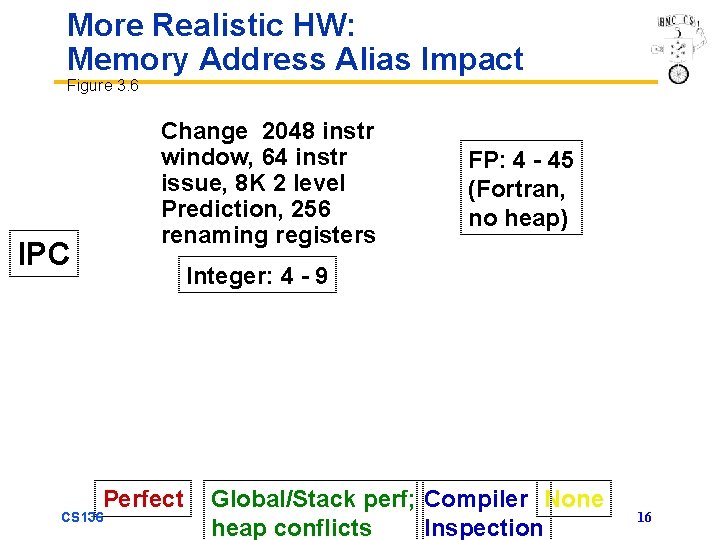
More Realistic HW: Memory Address Alias Impact Figure 3. 6 Change 2048 instr window, 64 instr issue, 8 K 2 level Prediction, 256 renaming registers IPC FP: 4 - 45 (Fortran, no heap) Integer: 4 - 9 Perfect CS 136 Global/Stack perf; Compiler None heap conflicts Inspection 16
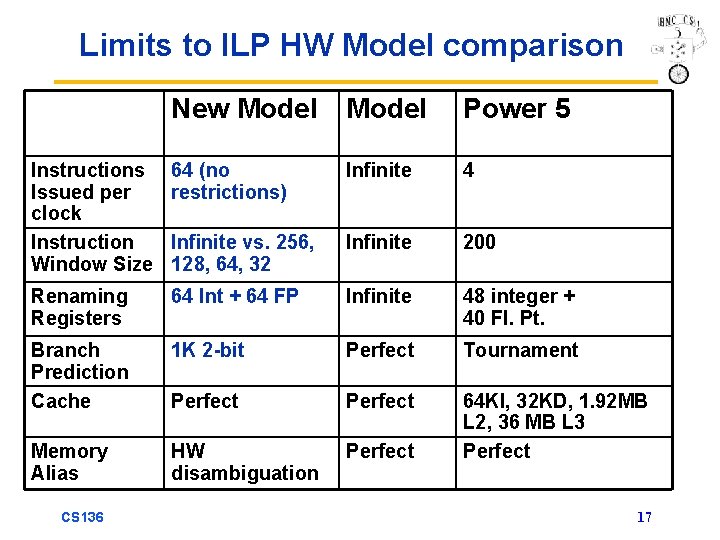
Limits to ILP HW Model comparison New Model Power 5 Instructions Issued per clock Instruction Window Size 64 (no restrictions) Infinite 4 Infinite vs. 256, 128, 64, 32 Infinite 200 Renaming Registers 64 Int + 64 FP Infinite 48 integer + 40 Fl. Pt. Branch Prediction Cache 1 K 2 -bit Perfect Tournament Perfect Memory Alias HW disambiguation Perfect 64 KI, 32 KD, 1. 92 MB L 2, 36 MB L 3 Perfect CS 136 17
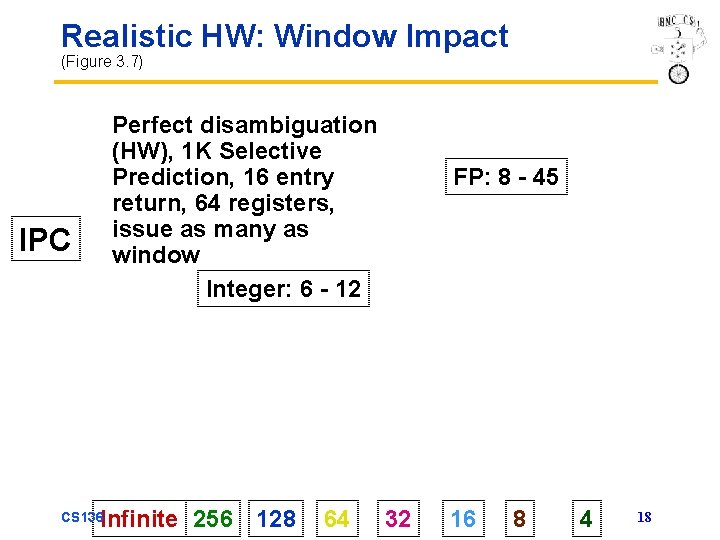
Realistic HW: Window Impact (Figure 3. 7) Perfect disambiguation (HW), 1 K Selective Prediction, 16 entry return, 64 registers, issue as many as window Integer: 6 - 12 IPC Infinite 256 128 CS 136 64 FP: 8 - 45 32 16 8 4 18
Outline • • Limits to ILP (another perspective) Thread Level Parallelism Multithreading Simultaneous Multithreading Power 4 vs. Power 5 Head to Head: VLIW vs. Superscalar vs. SMT Commentary Conclusion CS 136 19
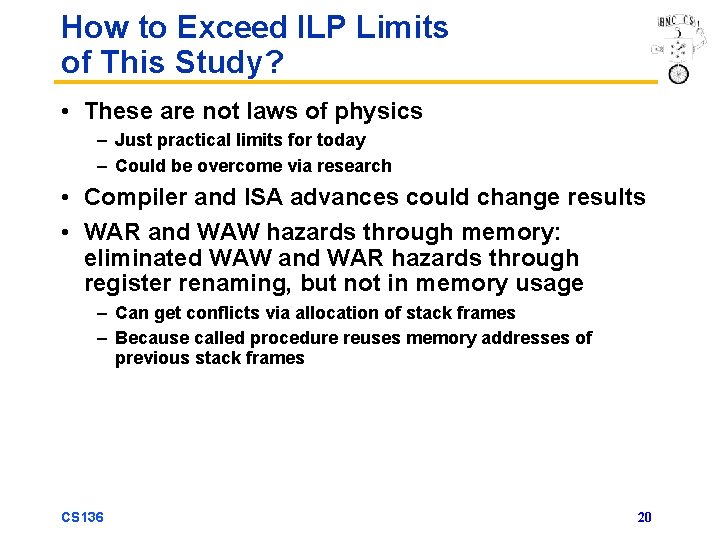
How to Exceed ILP Limits of This Study? • These are not laws of physics – Just practical limits for today – Could be overcome via research • Compiler and ISA advances could change results • WAR and WAW hazards through memory: eliminated WAW and WAR hazards through register renaming, but not in memory usage – Can get conflicts via allocation of stack frames – Because called procedure reuses memory addresses of previous stack frames CS 136 20
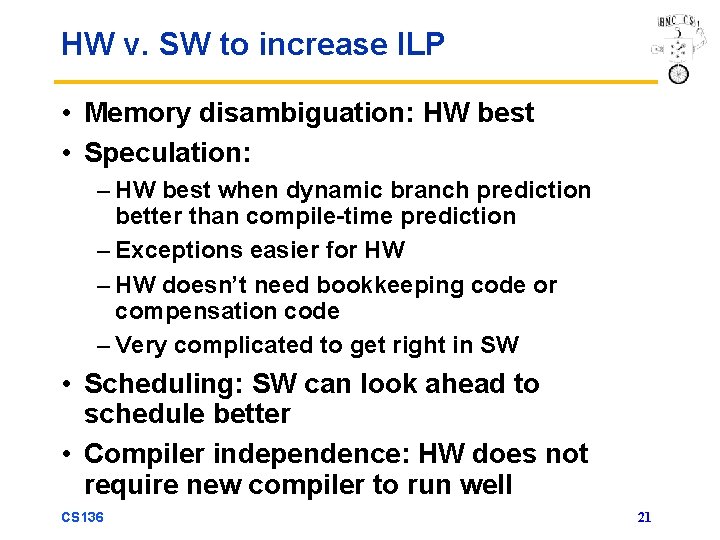
HW v. SW to increase ILP • Memory disambiguation: HW best • Speculation: – HW best when dynamic branch prediction better than compile-time prediction – Exceptions easier for HW – HW doesn’t need bookkeeping code or compensation code – Very complicated to get right in SW • Scheduling: SW can look ahead to schedule better • Compiler independence: HW does not require new compiler to run well CS 136 21
Performance Beyond Single-Thread ILP • Much higher natural parallelism in some applications – Database or scientific codes • Explicit thread-level or data-level parallelism • Thread: has own instructions and data – May be part of parallel program or independent program – Each thread has all state (instructions, data, PC, register state, and so on) needed to execute • Data-level parallelism: Perform identical operations on lots of data CS 136 22
Thread Level Parallelism (TLP) • ILP exploits implicit parallel operations within loop or straight-line code segment • TLP explicitly represented by multiple threads of execution that are inherently parallel • Goal: Use multiple instruction streams to improve – Throughput of computers that run many programs – Execution time of multi-threaded programs • TLP could be more cost-effective to exploit than ILP CS 136 23
Do Both ILP and TLP? • TLP and ILP exploit two different kinds of parallel structure in a program • Could a processor oriented to ILP still exploit TLP? – Functional units are often idle in data path designed for ILP because of either stalls or dependencies in the code • Could TLP be used as source of independent instructions that might keep the processor busy during stalls? • Could TLP be used to employ functional units that would otherwise lie idle when insufficient ILP exists? CS 136 24
New Approach: Multithreaded Execution • Multithreading: multiple threads share functional units of 1 processor via overlapping – Processor must duplicate independent state of each thread » Separate copy of register file, PC » Separate page table if different process – Memory sharing via virtual memory mechanisms » Already supports multiple processes – HW for fast thread switch » Must be much faster than full process switch (which is 100 s to 1000 s of clocks) • When to switch? – Alternate instruction per thread (fine grain)—round robin – When thread is stalled (coarse grain) » E. g. , cache miss CS 136 25
Fine-Grained Multithreading • Switches between threads on each instruction, interleaving execution of multiple threads • Usually done round-robin, skipping stalled threads • CPU must be able to switch threads every clock • Advantage: can hide both short and long stalls – Instructions from other threads always available to execute – Easy to insert on short stalls • Disadvantage: slows individual threads – Thready to execute without stalls will be delayed by instructions from other threads • Used on Sun’s Niagara (will see later) CS 136 26
Course-Grained Multithreading • Switches threads only on costly stalls – E. g. , L 2 cache misses • Advantages – Relieves need to have very fast thread switching – Doesn’t slow thread » Other threads only issue instructions when main one would stall (for long time) anyway • Disadvantage: pipeline startup costs make it hard to hide throughput losses from shorter stalls – Pipeline must be emptied or frozen on stall, since CPU issues instructions from only one thread – New thread must fill pipe before instructions can complete – Thus, better for reducing penalty of high-cost stalls where pipeline refill << stall time • Used in IBM AS/400 CS 136 27
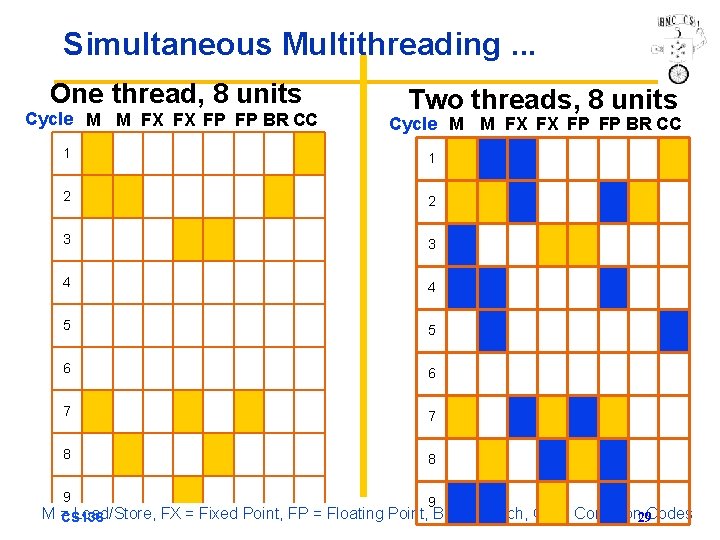
Simultaneous Multithreading (SMT) • Simultaneous multithreading (SMT): insight that dynamically scheduled processor already has many HW mechanisms to support multithreading – Large set of virtual registers that can be used to hold register sets for independent threads – Register renaming provides unique register identifiers » Instructions from multiple threads can be mixed in data path » Without confusing sources and destinations across threads! – Out-of-order completion allows the threads to execute out of order, and get better utilization of the HW • Just add per-thread renaming table and keep separate PCs – Independent commitment can be supported via separate reorder buffer for each thread Source: Micrprocessor Report, December 6, 1999 “Compaq Chooses SMT for Alpha” CS 136 28
Simultaneous Multithreading. . . One thread, 8 units Cycle M M FX FX FP FP BR CC Two threads, 8 units Cycle M M FX FX FP FP BR CC 1 1 2 2 3 3 4 4 5 5 6 6 7 7 8 8 9 9 M =CS 136 Load/Store, FX = Fixed Point, FP = Floating Point, BR = Branch, CC = Condition 29 Codes
Time (processor cycle) Multithreaded Categories Superscalar Fine-Gr. Thread 1 Thread 2 CS 136 Coarse-Gr. Multiprocessing Thread 3 Thread 4 SMT Thread 5 Idle slot 30
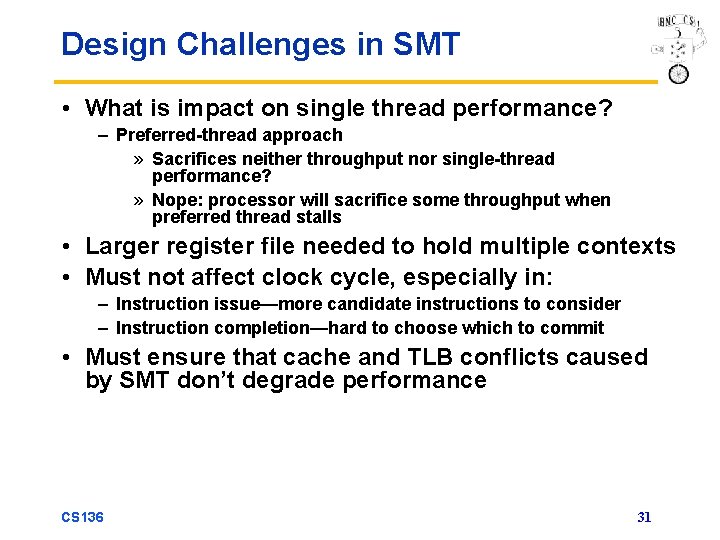
Design Challenges in SMT • What is impact on single thread performance? – Preferred-thread approach » Sacrifices neither throughput nor single-thread performance? » Nope: processor will sacrifice some throughput when preferred thread stalls • Larger register file needed to hold multiple contexts • Must not affect clock cycle, especially in: – Instruction issue—more candidate instructions to consider – Instruction completion—hard to choose which to commit • Must ensure that cache and TLB conflicts caused by SMT don’t degrade performance CS 136 31
Digression: Covert Channels • Imagine you’re spy with account on Knuth – Want to communicate a secret to Geoff – Secret is reasonably small – FBI is watching your account and your e-mail • Solution: process spawning – Once a second, Geoff spawns process » Records own PID, waits 10 ms, forks & records child PID – Once a second, you send one bit of information » If bit is zero, you do nothing » If bit is one, you spawn processes as fast as possible – If Geoff sees big PID gap, he records “ 1”, else “ 0” • Many variations on this basic idea CS 136 32
Covert-Channel Attacks on Crypto • Most (not all) crypto code behaves differently on “ 1” bit in key vs. “ 0” bit – – Runs longer or shorter Uses more or less power Accesses different memory Etc. • Usually called “information leakage” • Has been successfully used in lab to crack strong crypto – Even recovering some bits makes brute-force attack practical for getting remainder – Some modern implementations try to fight by doing wasted work on shorter path of “if”, etc. CS 136 33
SMT Attack on SSH • On SMT machine, lower-priority thread’s execution rate depends on higher-priority one’s instructions – More stalls in top thread mean more speed in bottom one – Stalls vary depending on what crypto code is doing » Operates at very low level » Thus much harder to defend against • Successful attack on ssh keys has been demonstrated in lab • Best known defense: don’t do SMT – Careful coding of crypto could probably also work – Note that this also applies to things like cache and TLB – Lots of ways to leak information unintentionally! CS 136 34
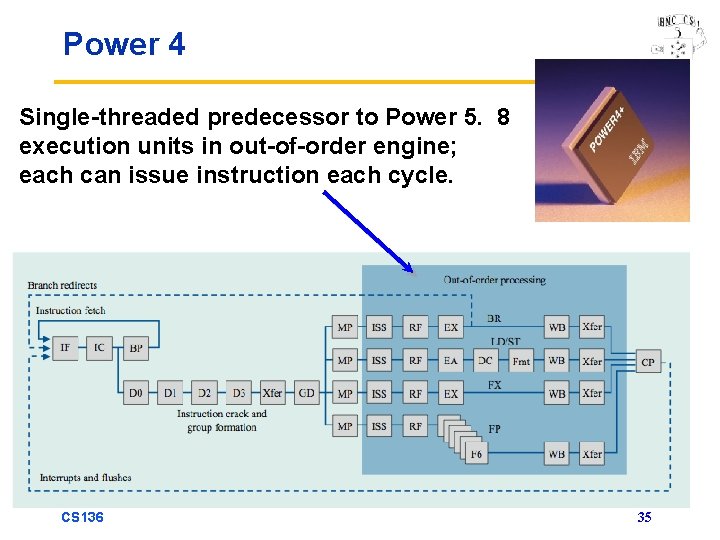
Power 4 Single-threaded predecessor to Power 5. 8 execution units in out-of-order engine; each can issue instruction each cycle. CS 136 35
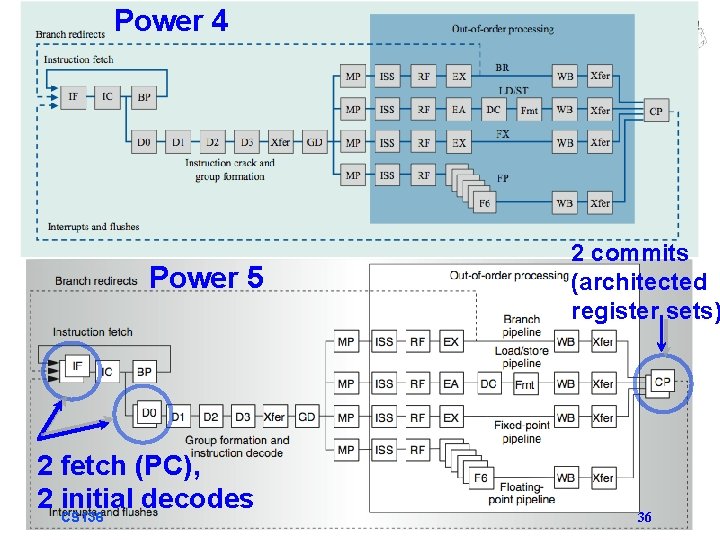
Power 4 Power 5 2 fetch (PC), 2 initial decodes CS 136 2 commits (architected register sets) 36
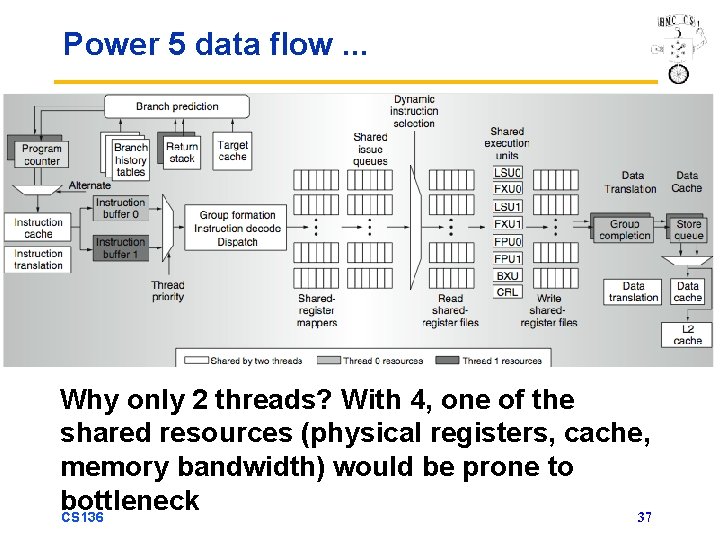
Power 5 data flow. . . Why only 2 threads? With 4, one of the shared resources (physical registers, cache, memory bandwidth) would be prone to bottleneck 37 CS 136
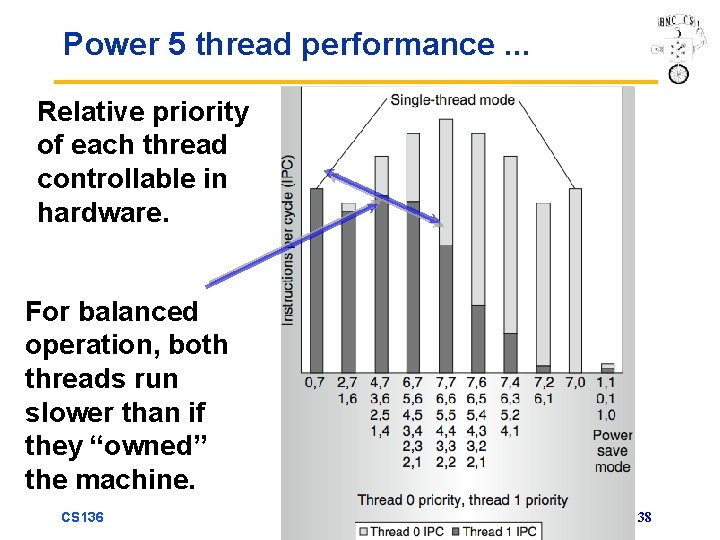
Power 5 thread performance. . . Relative priority of each thread controllable in hardware. For balanced operation, both threads run slower than if they “owned” the machine. CS 136 38
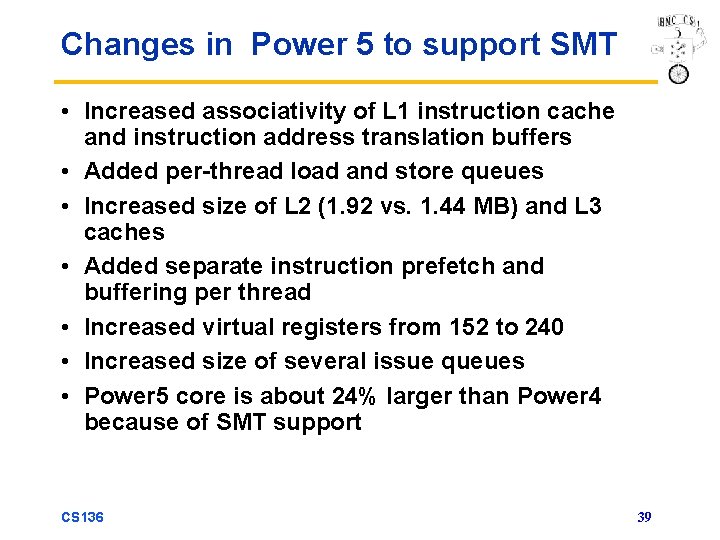
Changes in Power 5 to support SMT • Increased associativity of L 1 instruction cache and instruction address translation buffers • Added per-thread load and store queues • Increased size of L 2 (1. 92 vs. 1. 44 MB) and L 3 caches • Added separate instruction prefetch and buffering per thread • Increased virtual registers from 152 to 240 • Increased size of several issue queues • Power 5 core is about 24% larger than Power 4 because of SMT support CS 136 39
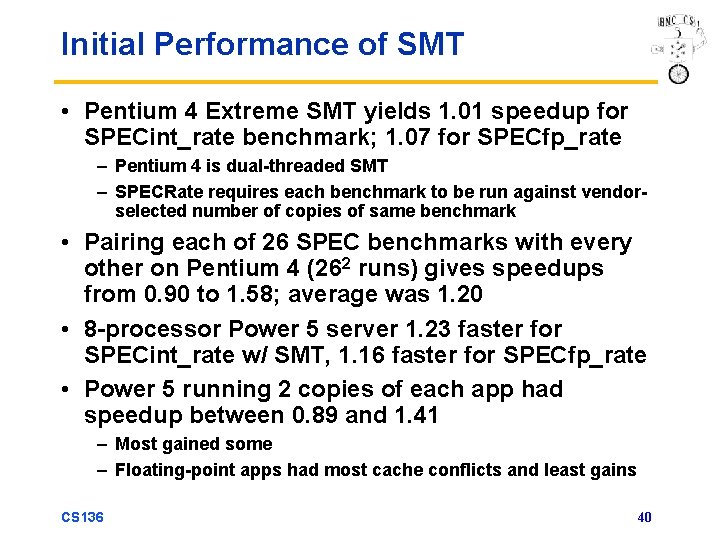
Initial Performance of SMT • Pentium 4 Extreme SMT yields 1. 01 speedup for SPECint_rate benchmark; 1. 07 for SPECfp_rate – Pentium 4 is dual-threaded SMT – SPECRate requires each benchmark to be run against vendorselected number of copies of same benchmark • Pairing each of 26 SPEC benchmarks with every other on Pentium 4 (262 runs) gives speedups from 0. 90 to 1. 58; average was 1. 20 • 8 -processor Power 5 server 1. 23 faster for SPECint_rate w/ SMT, 1. 16 faster for SPECfp_rate • Power 5 running 2 copies of each app had speedup between 0. 89 and 1. 41 – Most gained some – Floating-point apps had most cache conflicts and least gains CS 136 40
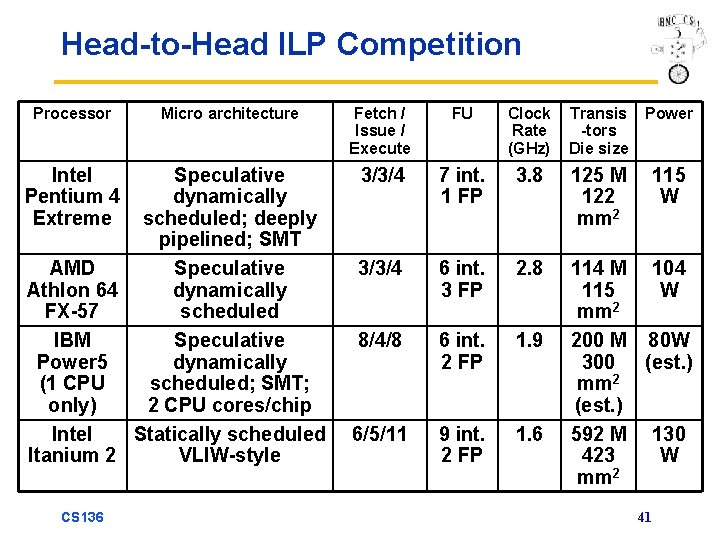
Head-to-Head ILP Competition Processor Intel Pentium 4 Extreme Micro architecture Speculative dynamically scheduled; deeply pipelined; SMT AMD Speculative Athlon 64 dynamically FX-57 scheduled IBM Speculative Power 5 dynamically (1 CPU scheduled; SMT; only) 2 CPU cores/chip Intel Statically scheduled Itanium 2 VLIW-style CS 136 Fetch / Issue / Execute FU Clock Rate (GHz) Transis -tors Die size Power 3/3/4 7 int. 1 FP 3. 8 125 M 122 mm 2 115 W 3/3/4 6 int. 3 FP 2. 8 8/4/8 6 int. 2 FP 1. 9 6/5/11 9 int. 2 FP 1. 6 114 M 104 115 W mm 2 200 M 80 W 300 (est. ) mm 2 (est. ) 592 M 130 423 W mm 2 41
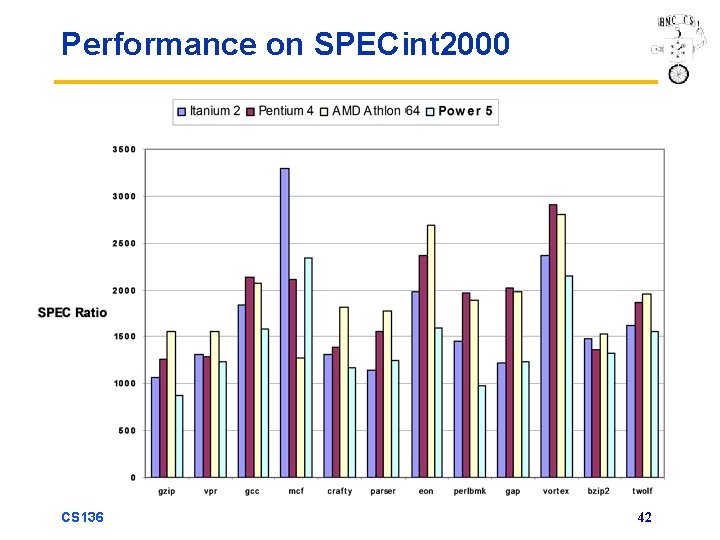
Performance on SPECint 2000 CS 136 42
Performance on SPECfp 2000 CS 136 43
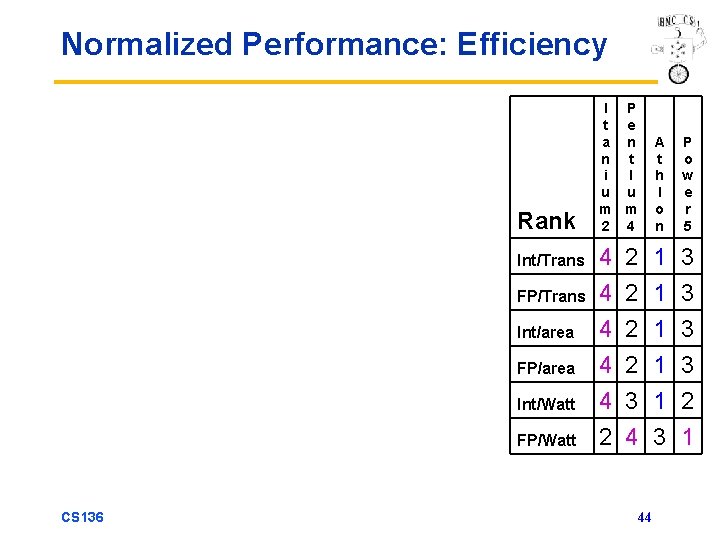
Normalized Performance: Efficiency Rank Int/Trans FP/Trans Int/area FP/area Int/Watt FP/Watt CS 136 I P t e a n n t i I u u m m 2 4 A t h l o n P o w e r 5 4 4 4 2 1 1 1 3 3 3 2 1 2 2 3 4 44
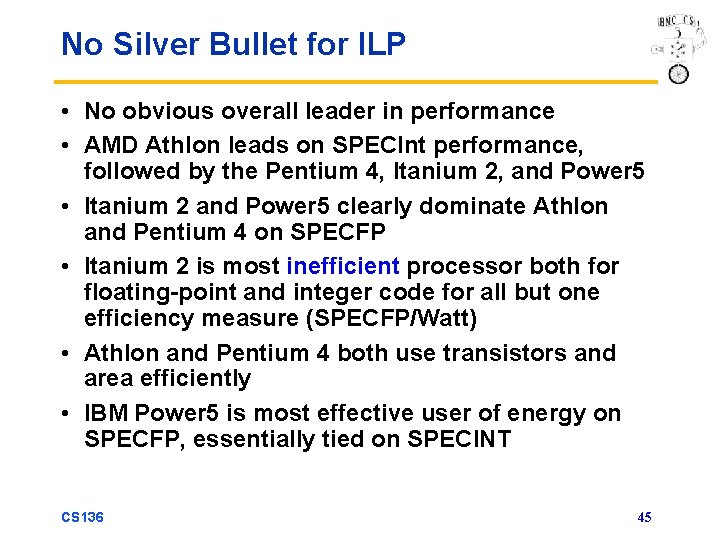
No Silver Bullet for ILP • No obvious overall leader in performance • AMD Athlon leads on SPECInt performance, followed by the Pentium 4, Itanium 2, and Power 5 • Itanium 2 and Power 5 clearly dominate Athlon and Pentium 4 on SPECFP • Itanium 2 is most inefficient processor both for floating-point and integer code for all but one efficiency measure (SPECFP/Watt) • Athlon and Pentium 4 both use transistors and area efficiently • IBM Power 5 is most effective user of energy on SPECFP, essentially tied on SPECINT CS 136 45
Limits to ILP • Doubling issue rates above today’s 3 -6 instructions per clock probably requires processor to: – – Issue 3 -4 data-memory accesses per cycle, Resolve 2 -3 branches per cycle, Rename and access over 20 registers per cycle, and Fetch 12 -24 instructions per cycle. • Complexity of implementing these capabilities is likely to mean sacrifices in maximum clock rate – E. g, widest-issue processor is Itanium 2 – It also has slowest clock rate – Despite consuming the most power! CS 136 46
Limits to ILP (cont’d) • Most ways to increase performance also boost power consumption • Key question is energy efficiency: does a method increase power consumption faster than it boosts performance? • Multiple-issue techniques are energy inefficient: – Incurs logic overhead that grows faster than issue rate – Growing gap between peak issue rates and sustained performance • Number of transistors switching = f(peak issue rate); performance = f(sustained rate); growing gap between peak and sustained performance Increasing energy per unit of performance CS 136 47
Commentary • Itanium is not significant breakthrough in scaling ILP or in avoiding problems of complexity and power consumption • Instead of pursuing more ILP, architects turning to TLP usingle-chip multiprocessors • In 2000, IBM announced Power 4, 1 st commercial single-chip, general-purpose multiprocessor: has two Power 3 processors and integrated L 2 cache – Sun Microsystems, AMD, and Intel have also switched focus from aggressive uniprocessors to single-chip multiprocessors • Right balance of ILP and TLP is unclear today – Maybe desktops (mostly single-threaded? ) need different design than servers (can do lots of TLP) CS 136 48
And in conclusion … • Limits to ILP (power efficiency, compilers, dependencies …) seem to limit to 3 to 6 issue for practical options • Explicitly parallel (Data level parallelism or Thread level parallelism) is next step to performance • Coarse grain vs. Fine grained multihreading – Only on big stall vs. every clock cycle • Simultaneous Multithreading if fine grained multithreading based on OOO superscalar microarchitecture – Instead of replicating registers, reuse rename registers • Itanium/EPIC/VLIW is not a breakthrough in ILP • Balance of ILP and TLP decided in marketplace CS 136 49