
CS 128 Introduction to C Lecture 7 Functions
- Slides: 73
CS 128 Introduction to C++ Lecture 7 Functions Sampath Jayarathna Cal Poly Pomona Based on slides created by Bjarne Stroustrup & Tony Gaddis 1
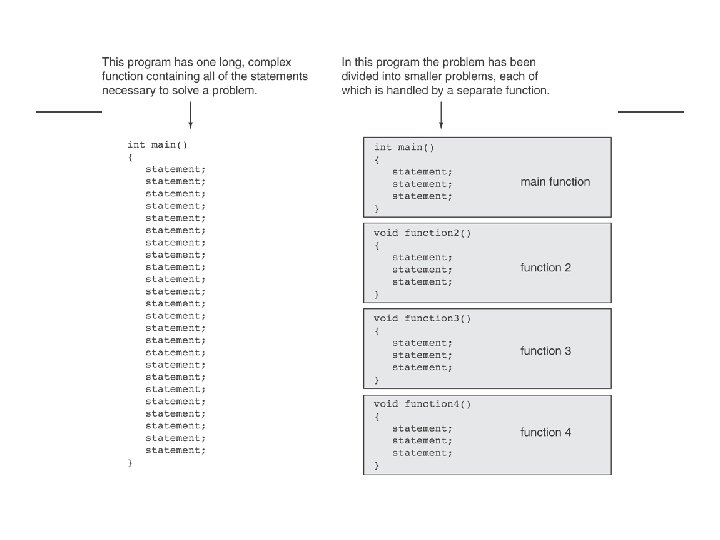
Modular Programming • Modular programming: breaking a program up into smaller, manageable functions or modules • Function: a collection of statements to perform a task • Motivation for modular programming: • Improves maintainability of programs • Simplifies the process of writing programs
Defining and Calling Functions • Function call: statement causes a function to execute • Function definition: statements that make up a function
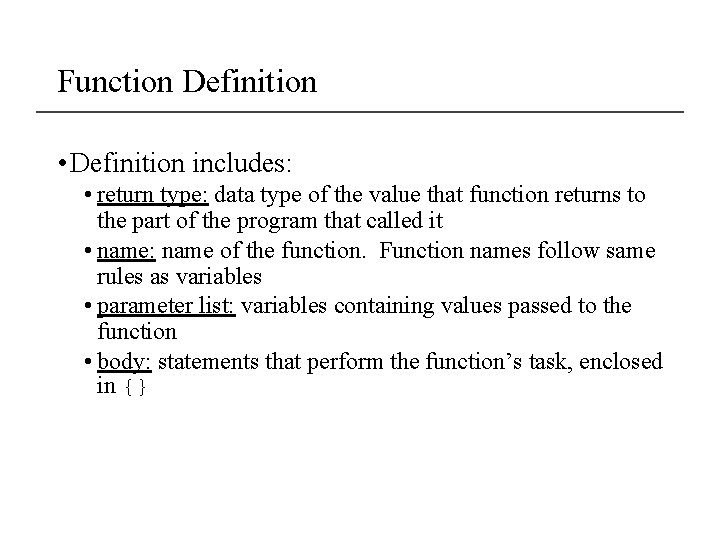
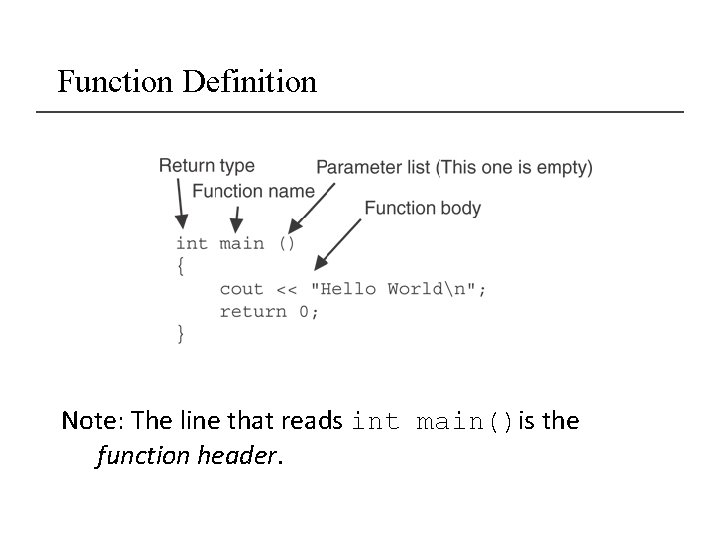
Function Definition • Definition includes: • return type: data type of the value that function returns to the part of the program that called it • name: name of the function. Function names follow same rules as variables • parameter list: variables containing values passed to the function • body: statements that perform the function’s task, enclosed in {}
Function Definition Note: The line that reads int main()is the function header.
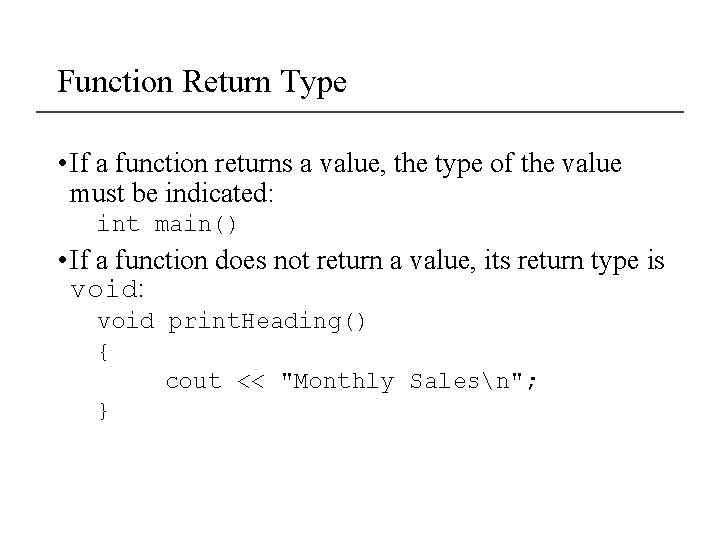
Function Return Type • If a function returns a value, the type of the value must be indicated: int main() • If a function does not return a value, its return type is void: void print. Heading() { cout << "Monthly Salesn"; }
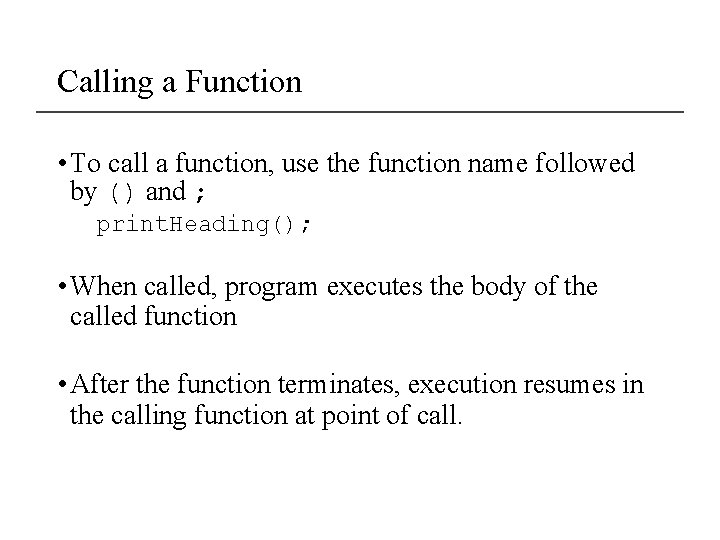
Calling a Function • To call a function, use the function name followed by () and ; print. Heading(); • When called, program executes the body of the called function • After the function terminates, execution resumes in the calling function at point of call.
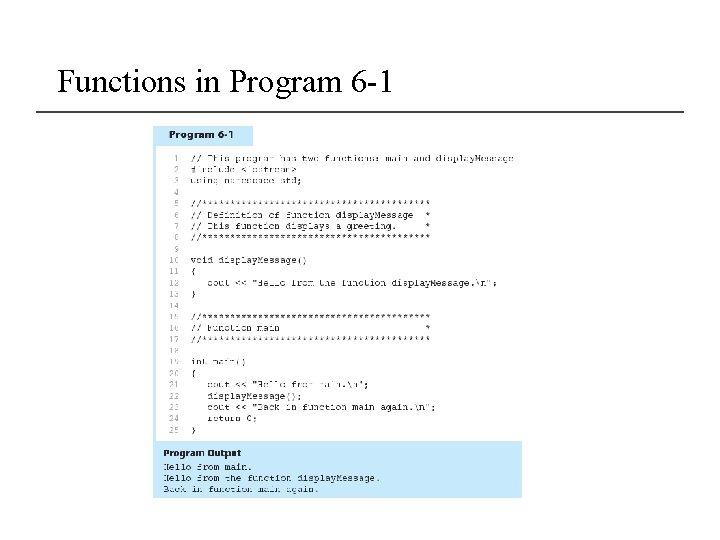
Functions in Program 6 -1
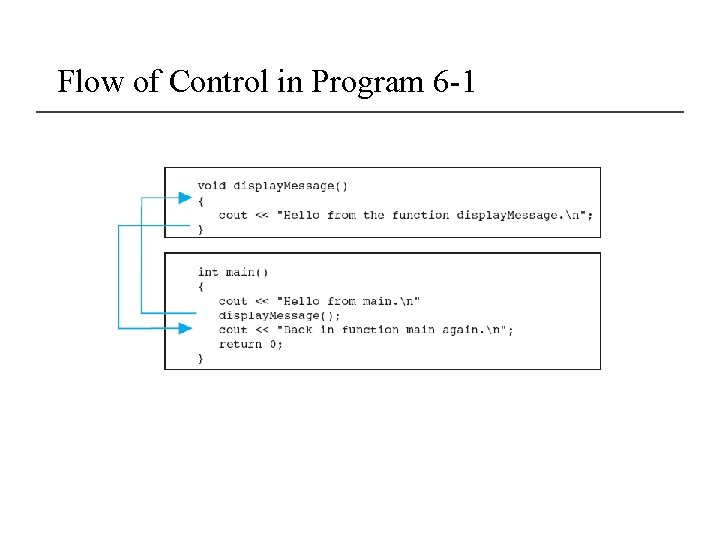
Flow of Control in Program 6 -1
Calling Functions • main call any number of functions • Functions can call other functions • Compiler must know the following about a function before it is called: • • name return type number of parameters data type of each parameter
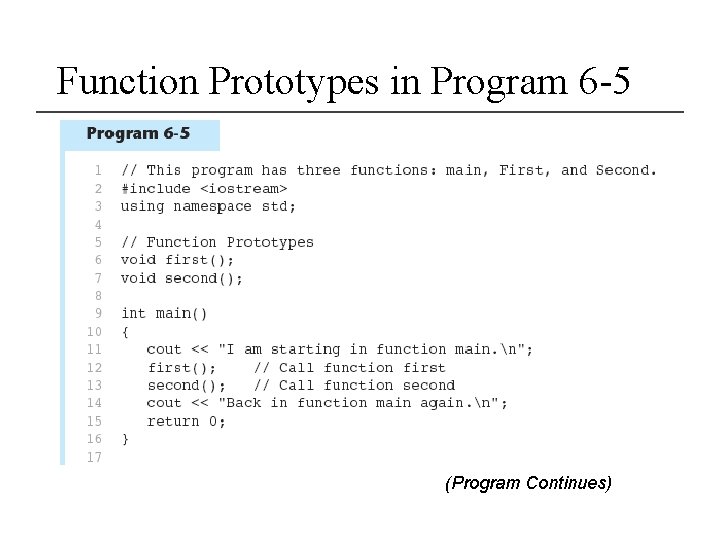
Function Prototypes • Ways to notify the compiler about a function before a call to the function: • Place function definition before calling function’s definition • Use a function prototype (function declaration) – like the function definition without the body • Header: void print. Heading() • Prototype: void print. Heading();
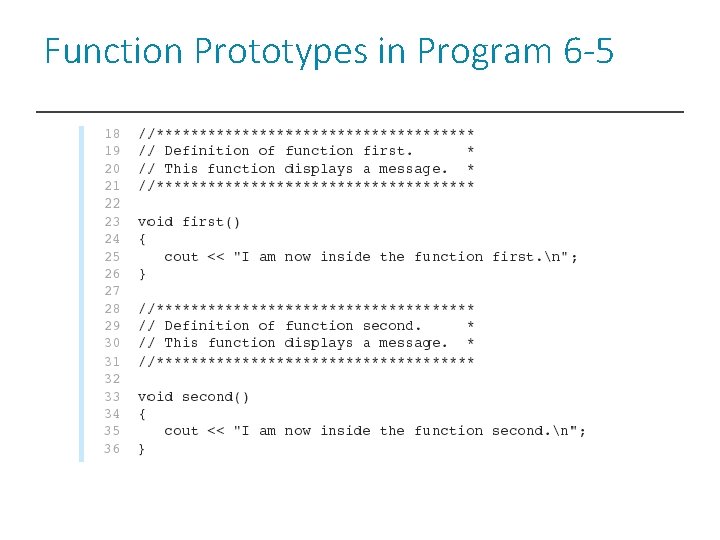
Function Prototypes in Program 6 -5 (Program Continues)
Function Prototypes in Program 6 -5
Prototype Notes • Place prototypes near top of program • Program must include either prototype or full function definition before any call to the function – compiler error otherwise • When using prototypes, can place function definitions in any order in source file
Activity 16 • Create a function called display. My. Record() • Create the prototype for function. • In this method, display the following information • Your name • Your Age • Your City • Your favorite movie, TV show, singer/song • Call above method from your main() method
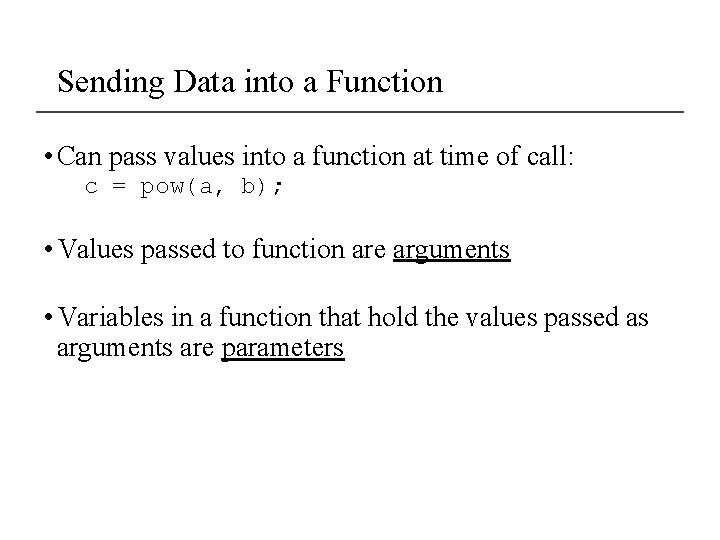
Sending Data into a Function • Can pass values into a function at time of call: c = pow(a, b); • Values passed to function are arguments • Variables in a function that hold the values passed as arguments are parameters
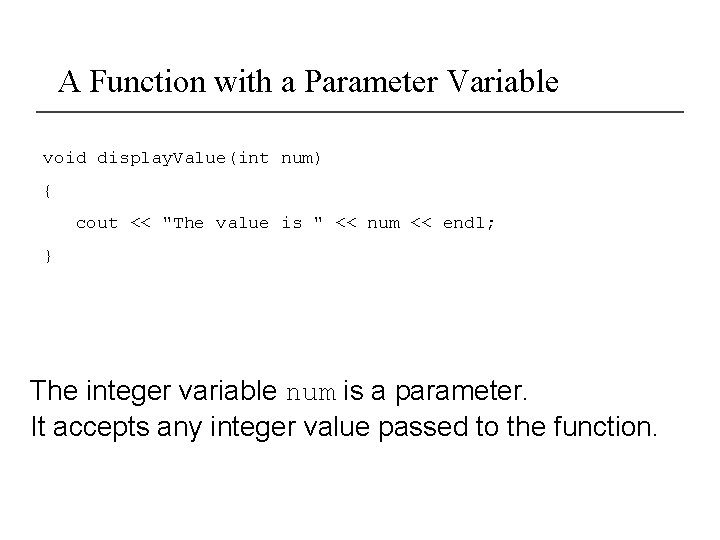
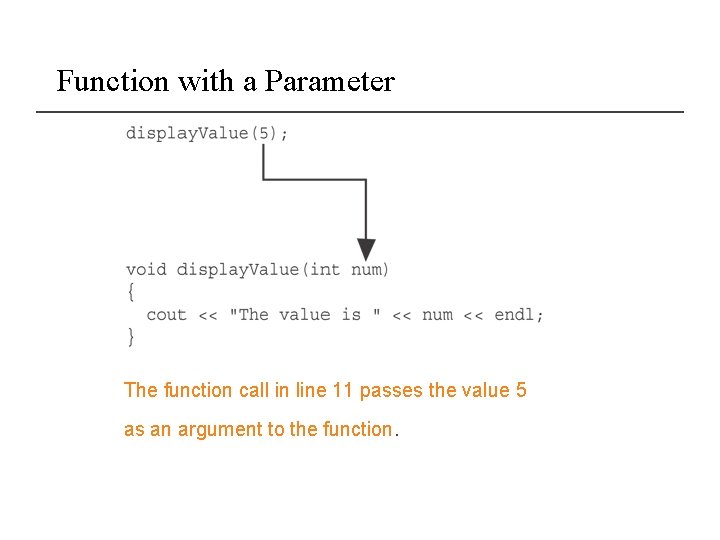
A Function with a Parameter Variable void display. Value(int num) { cout << "The value is " << num << endl; } The integer variable num is a parameter. It accepts any integer value passed to the function.
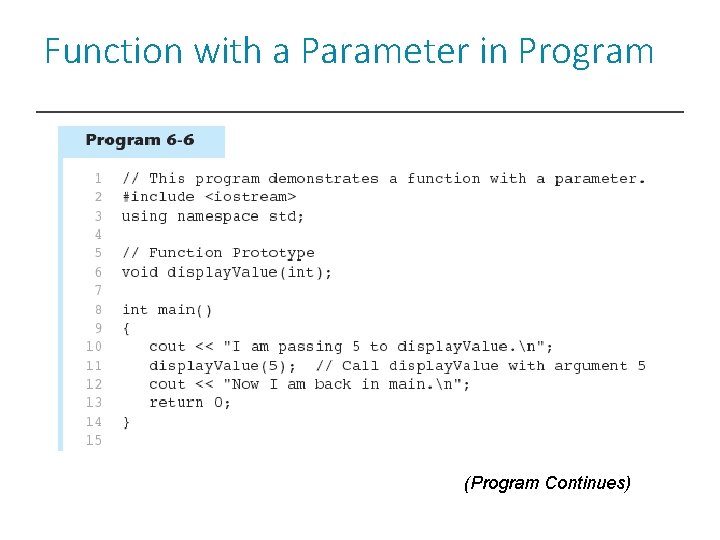
Function with a Parameter in Program (Program Continues)
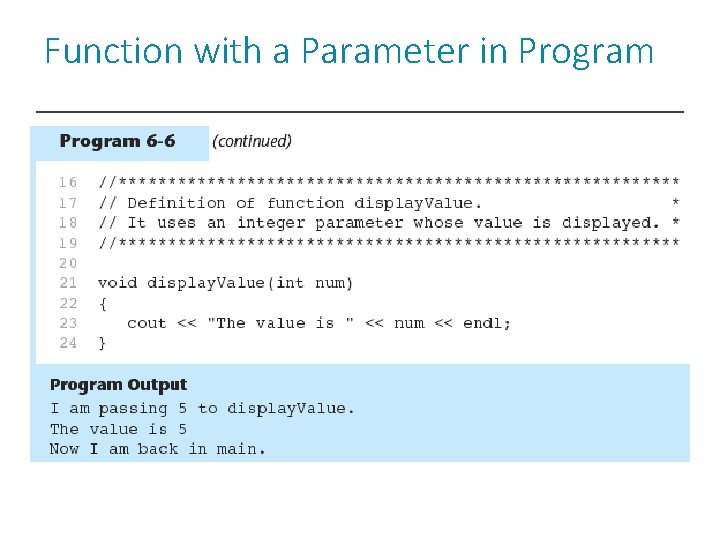
Function with a Parameter in Program
Function with a Parameter The function call in line 11 passes the value 5 as an argument to the function.
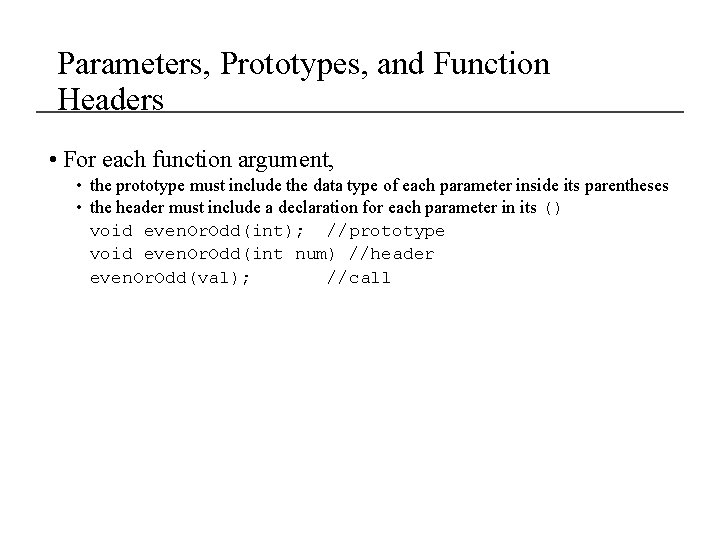
Parameters, Prototypes, and Function Headers • For each function argument, • the prototype must include the data type of each parameter inside its parentheses • the header must include a declaration for each parameter in its () void even. Or. Odd(int); //prototype void even. Or. Odd(int num) //header even. Or. Odd(val); //call
Function Call Notes • Value of argument is copied into parameter when the function is called • A parameter’s scope is the function which uses it • Function can have multiple parameters • There must be a data type listed in the prototype () and an argument declaration in the function header () for each parameter • Arguments will be promoted/demoted as necessary to match parameters
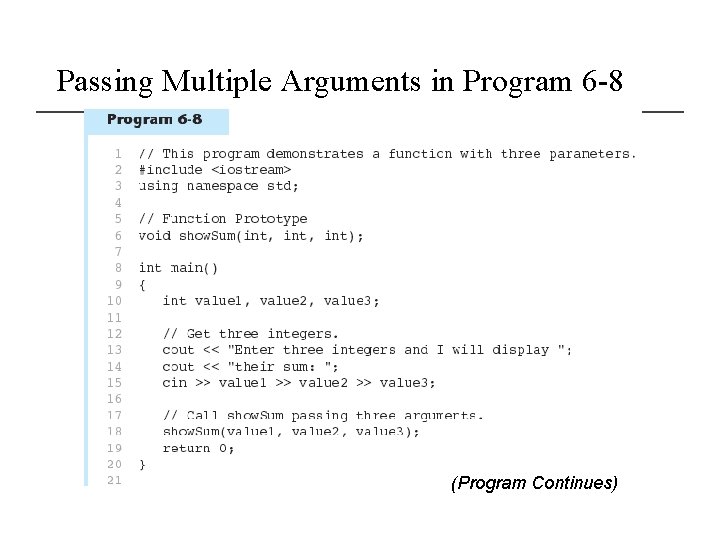
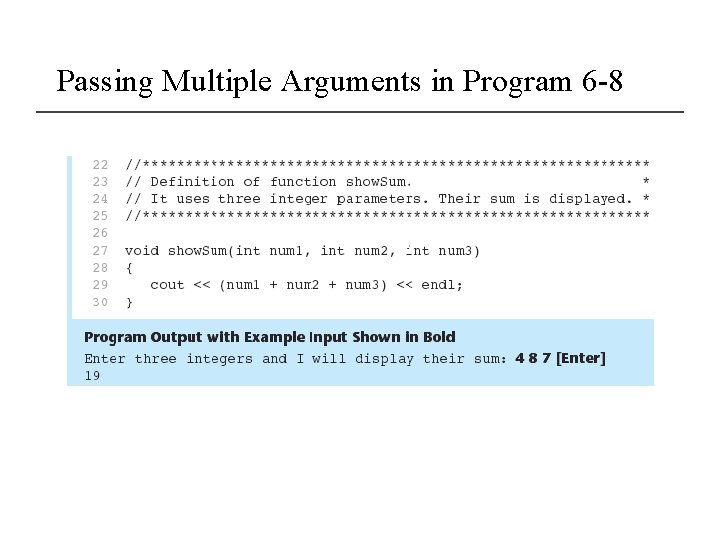
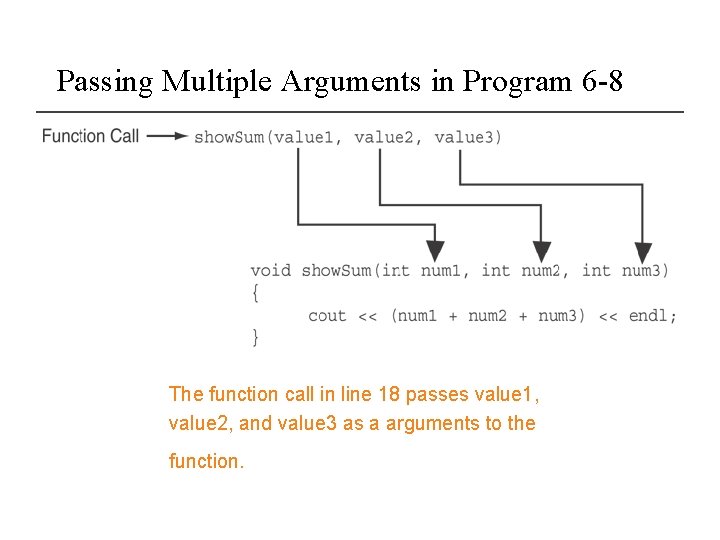
Passing Multiple Arguments When calling a function and passing multiple arguments: • the number of arguments in the call must match the prototype and definition • the first argument will be used to initialize the first parameter, the second argument to initialize the second parameter, etc.
Passing Multiple Arguments in Program 6 -8 (Program Continues)
Passing Multiple Arguments in Program 6 -8
Passing Multiple Arguments in Program 6 -8 The function call in line 18 passes value 1, value 2, and value 3 as a arguments to the function.
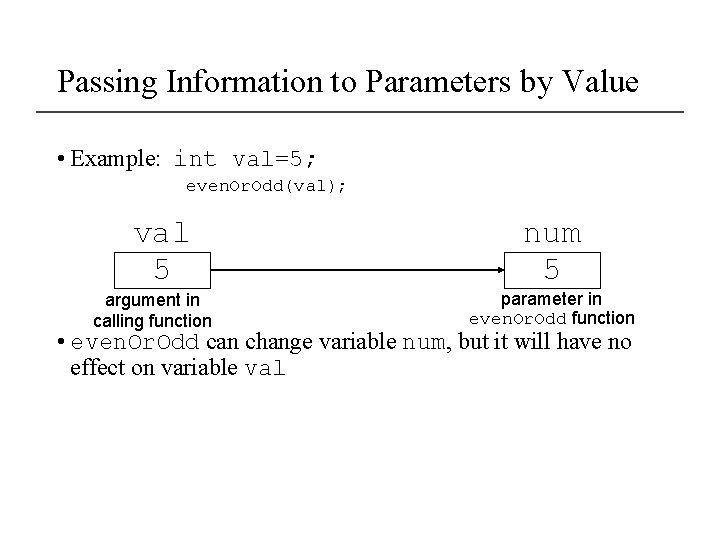
Passing Data by Value • Pass by value: when an argument is passed to a function, its value is copied into the parameter. • Changes to the parameter in the function do not affect the value of the argument
Passing Information to Parameters by Value • Example: int val=5; even. Or. Odd(val); val 5 argument in calling function num 5 parameter in even. Or. Odd function • even. Or. Odd can change variable num, but it will have no effect on variable val
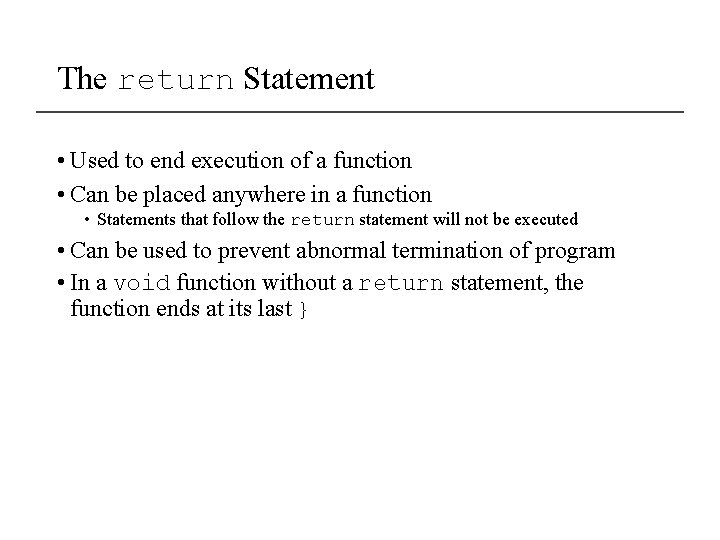
The return Statement • Used to end execution of a function • Can be placed anywhere in a function • Statements that follow the return statement will not be executed • Can be used to prevent abnormal termination of program • In a void function without a return statement, the function ends at its last }
Activity 17 • Update the method display. My. Record() to pass all the information (name, age, city, movie, tvshow, singer, song) below as parameters • In this method, display the following information • Your name • Your Age • Your City • Your favorite movie, TV show, singer/song • Call above method from your main() method passing the required parameter values.
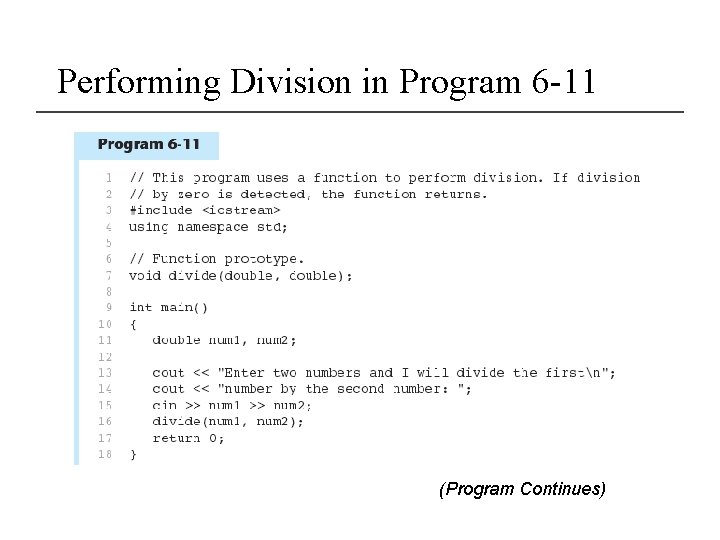
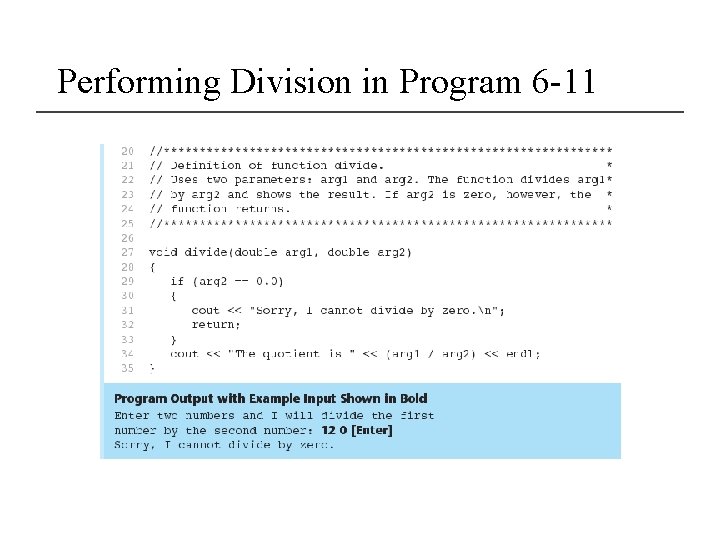
Performing Division in Program 6 -11 (Program Continues)
Performing Division in Program 6 -11
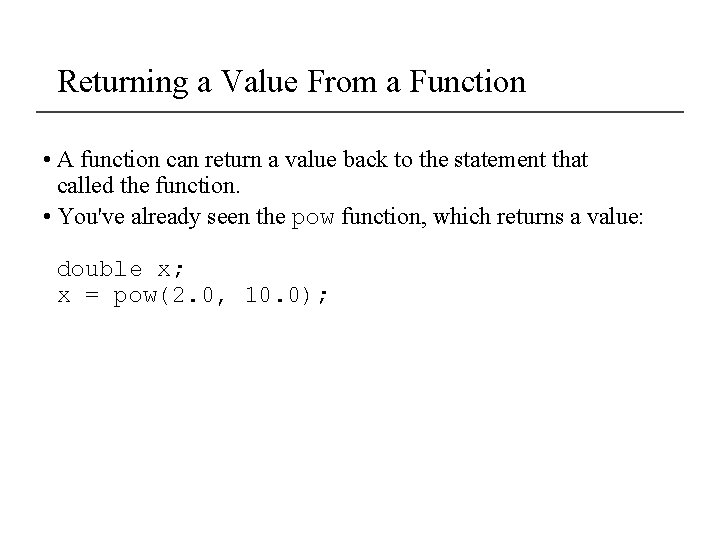
Returning a Value From a Function • A function can return a value back to the statement that called the function. • You've already seen the pow function, which returns a value: double x; x = pow(2. 0, 10. 0);
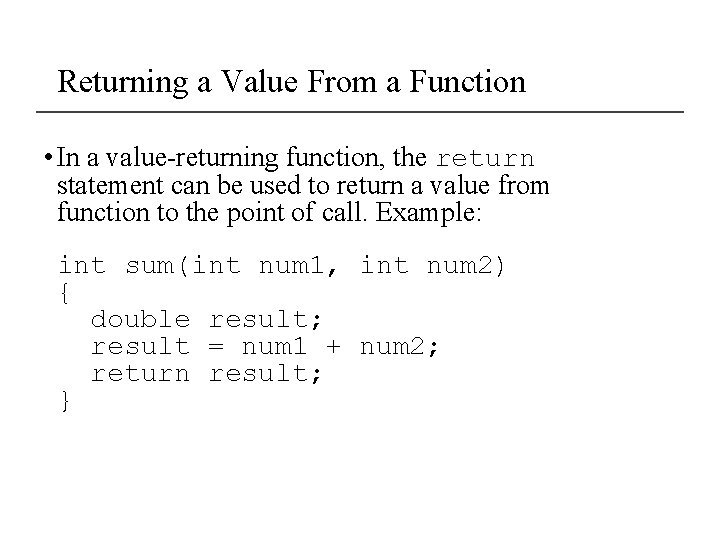
Returning a Value From a Function • In a value-returning function, the return statement can be used to return a value from function to the point of call. Example: int sum(int num 1, int num 2) { double result; result = num 1 + num 2; return result; }
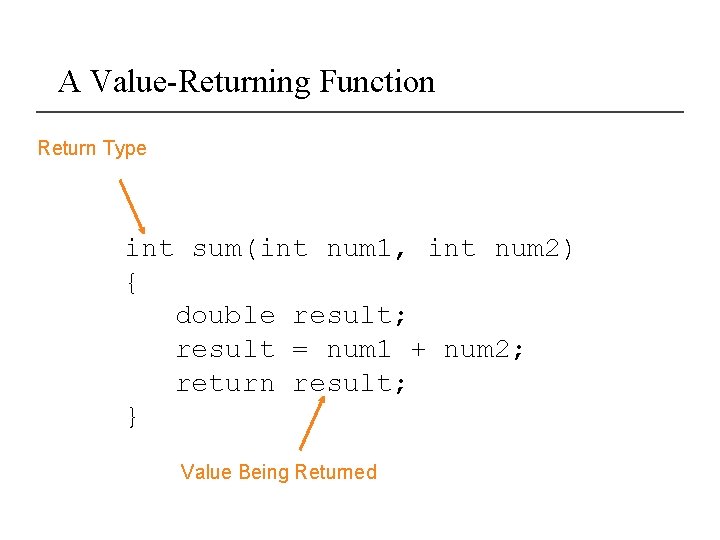
A Value-Returning Function Return Type int sum(int num 1, int num 2) { double result; result = num 1 + num 2; return result; } Value Being Returned
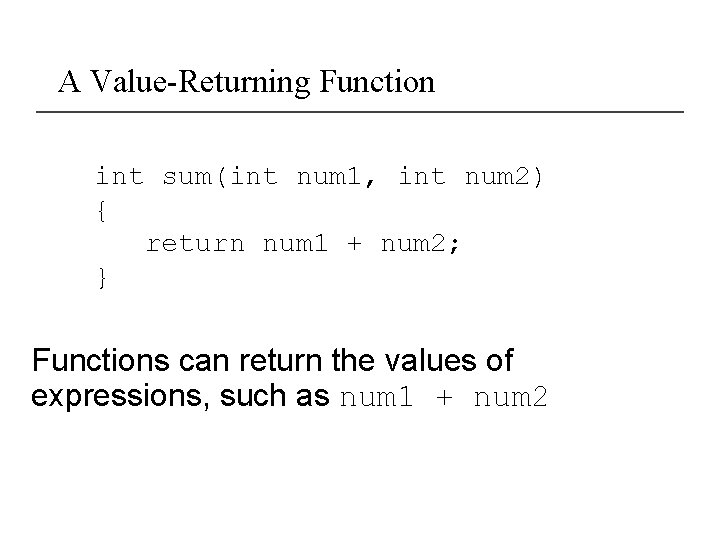
A Value-Returning Function int sum(int num 1, int num 2) { return num 1 + num 2; } Functions can return the values of expressions, such as num 1 + num 2
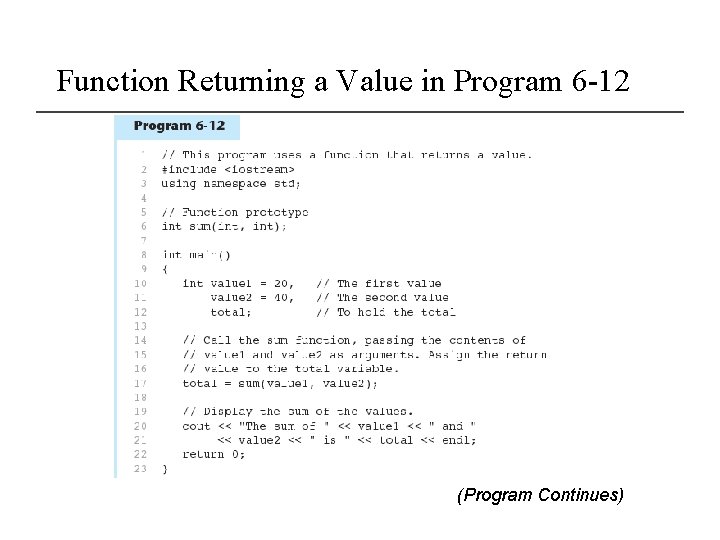
Function Returning a Value in Program 6 -12 (Program Continues)
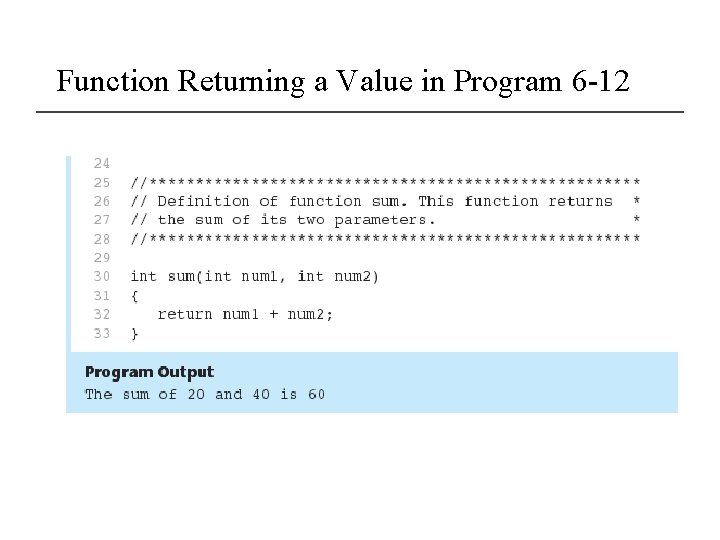
Function Returning a Value in Program 6 -12
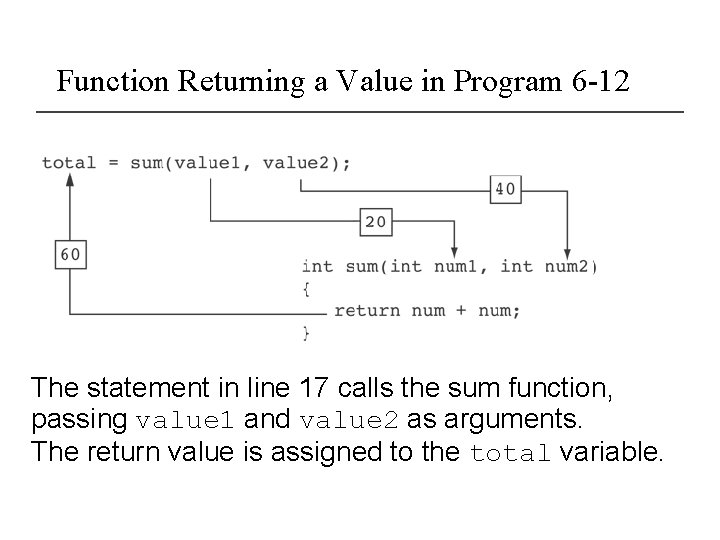
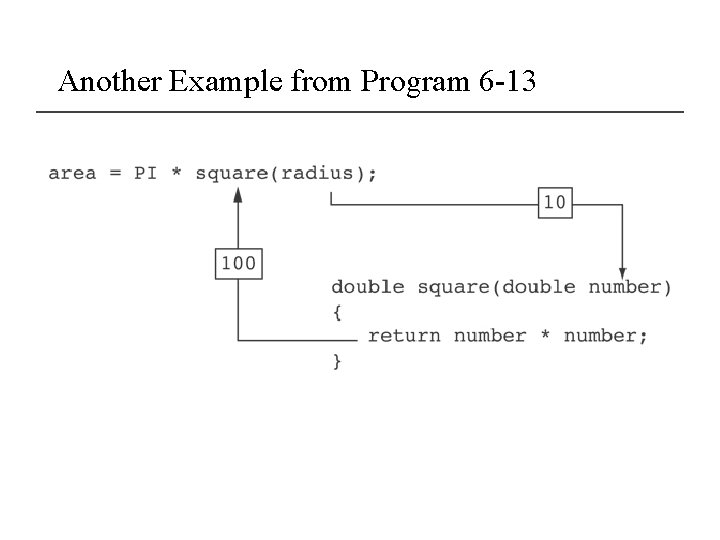
Function Returning a Value in Program 6 -12 The statement in line 17 calls the sum function, passing value 1 and value 2 as arguments. The return value is assigned to the total variable.
Another Example from Program 6 -13
Returning a Value From a Function • The prototype and the definition must indicate the data type of return value (not void) • Calling function should use return value: • assign it to a variable • send it to cout • use it in an expression
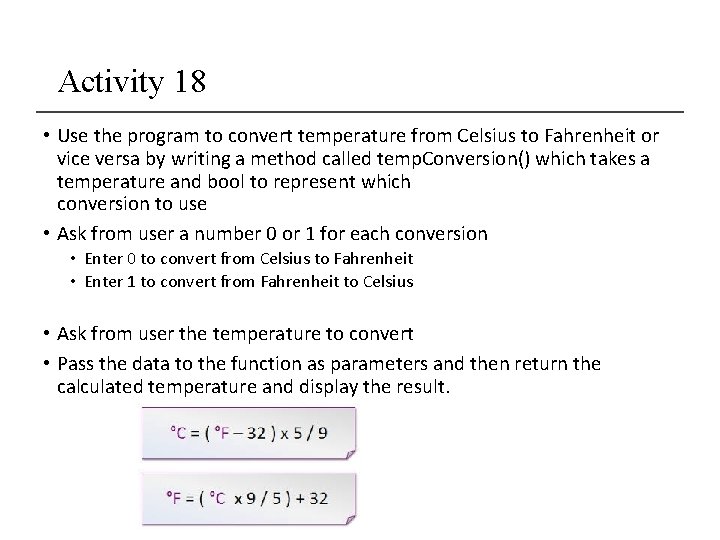
Activity 18 • Use the program to convert temperature from Celsius to Fahrenheit or vice versa by writing a method called temp. Conversion() which takes a temperature and bool to represent which conversion to use • Ask from user a number 0 or 1 for each conversion • Enter 0 to convert from Celsius to Fahrenheit • Enter 1 to convert from Fahrenheit to Celsius • Ask from user the temperature to convert • Pass the data to the function as parameters and then return the calculated temperature and display the result.
Returning a Boolean Value • Function can return true or false • Declare return type in function prototype and heading as bool • Function body must contain return statement(s) that return true or false • Calling function can use return value in a relational expression
Local and Global Variables • Variables defined inside a function are local to that function. They are hidden from the statements in other functions, which normally cannot access them. • Because the variables defined in a function are hidden, other functions may have separate, distinct variables with the same name.
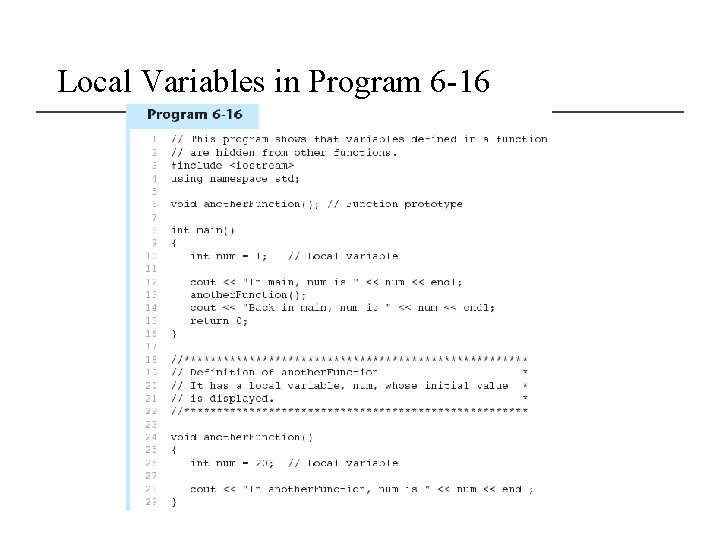
Local Variables in Program 6 -16
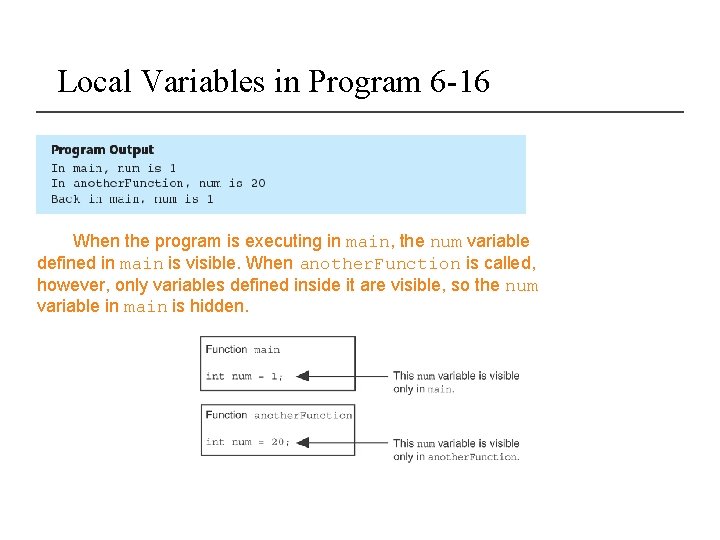
Local Variables in Program 6 -16 When the program is executing in main, the num variable defined in main is visible. When another. Function is called, however, only variables defined inside it are visible, so the num variable in main is hidden.
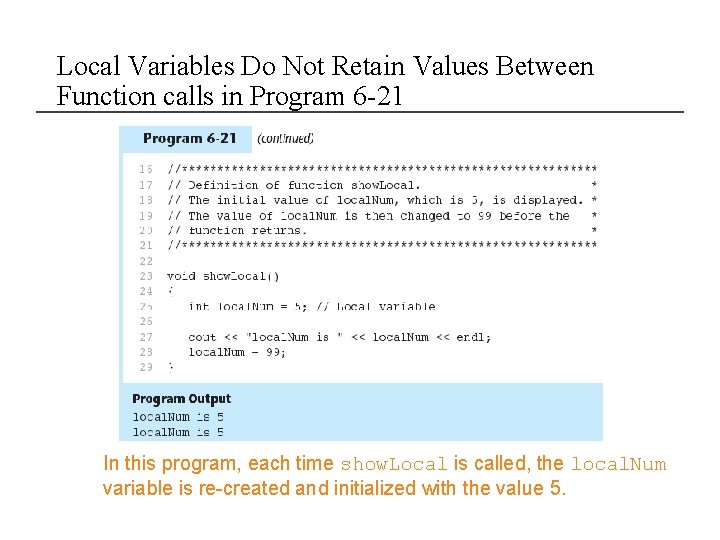
Local Variable Lifetime • A function’s local variables exist only while the function is executing. This is known as the lifetime of a local variable. • When the function begins, its local variables and its parameter variables are created in memory, and when the function ends, the local variables and parameter variables are destroyed. • This means that any value stored in a local variable is lost between calls to the function in which the variable is declared.
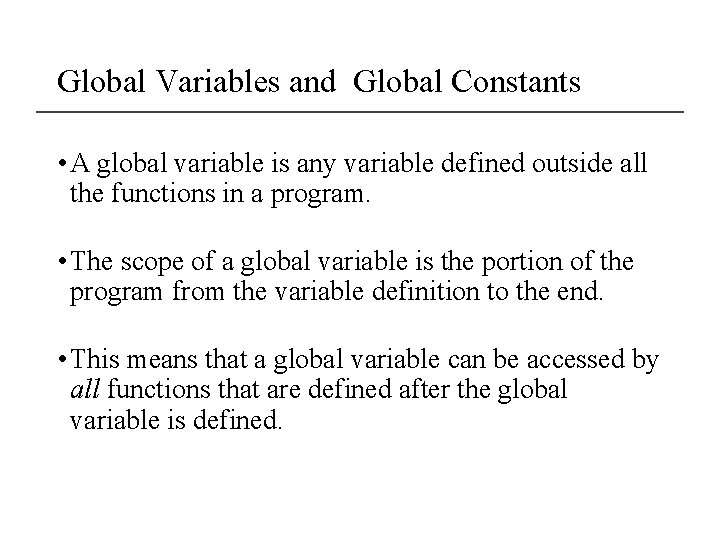
Global Variables and Global Constants • A global variable is any variable defined outside all the functions in a program. • The scope of a global variable is the portion of the program from the variable definition to the end. • This means that a global variable can be accessed by all functions that are defined after the global variable is defined.
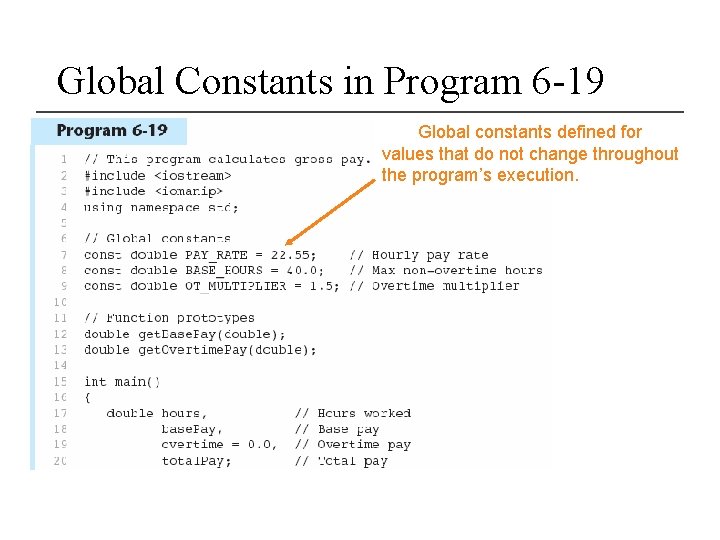
Global Constants in Program 6 -19 Global constants defined for values that do not change throughout the program’s execution.
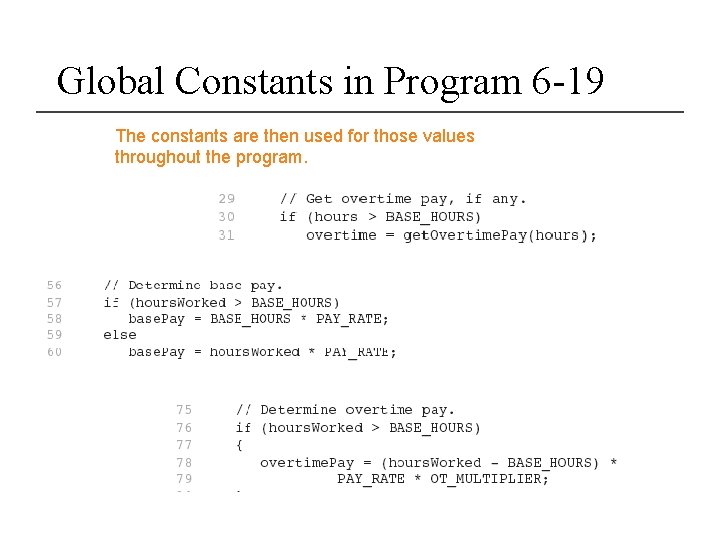
Global Constants in Program 6 -19 The constants are then used for those values throughout the program.
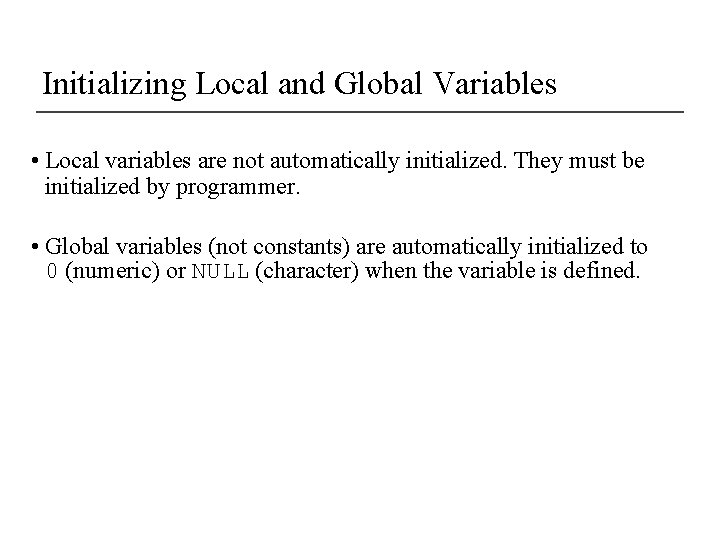
Initializing Local and Global Variables • Local variables are not automatically initialized. They must be initialized by programmer. • Global variables (not constants) are automatically initialized to 0 (numeric) or NULL (character) when the variable is defined.
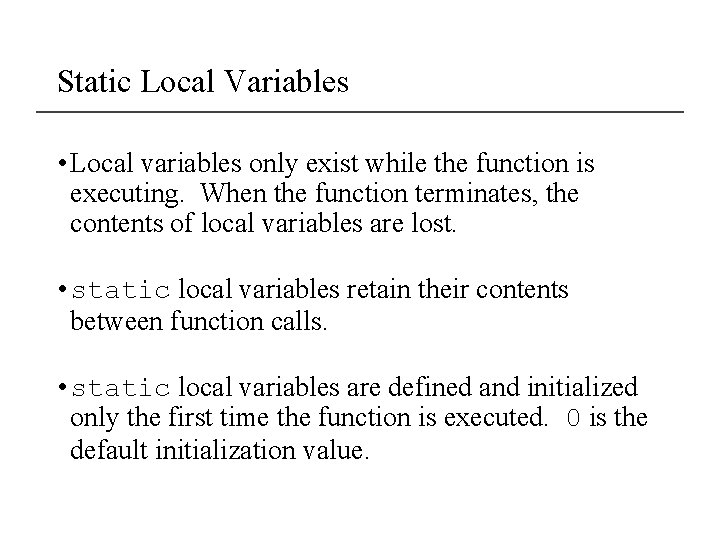
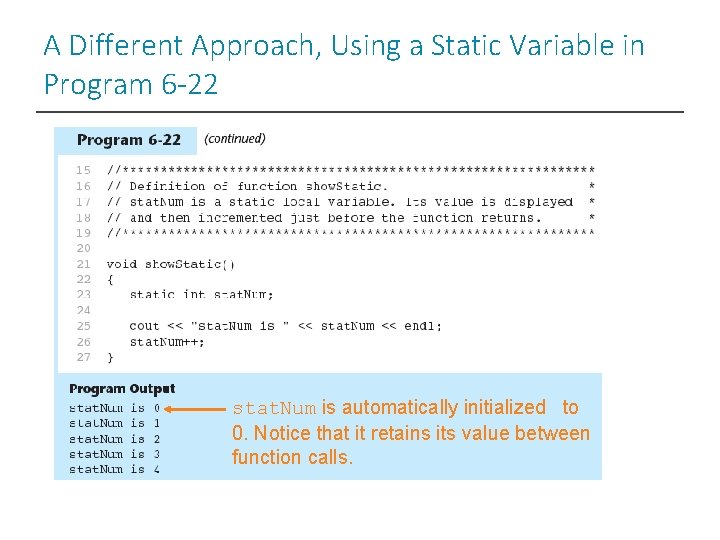
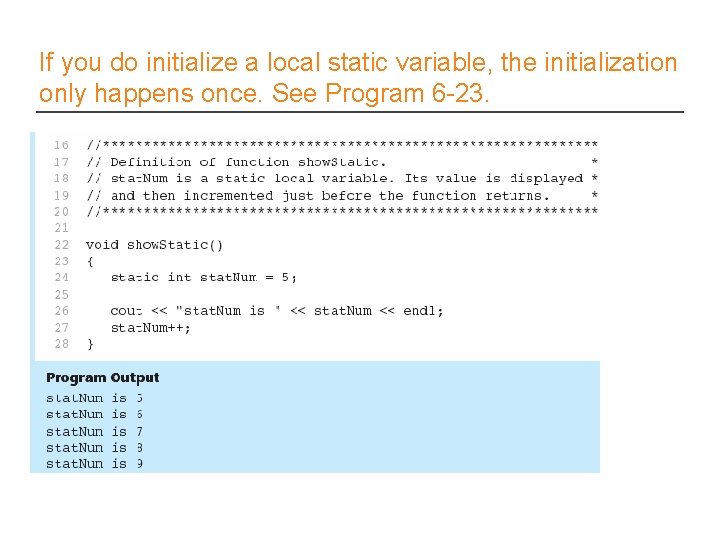
Static Local Variables • Local variables only exist while the function is executing. When the function terminates, the contents of local variables are lost. • static local variables retain their contents between function calls. • static local variables are defined and initialized only the first time the function is executed. 0 is the default initialization value.
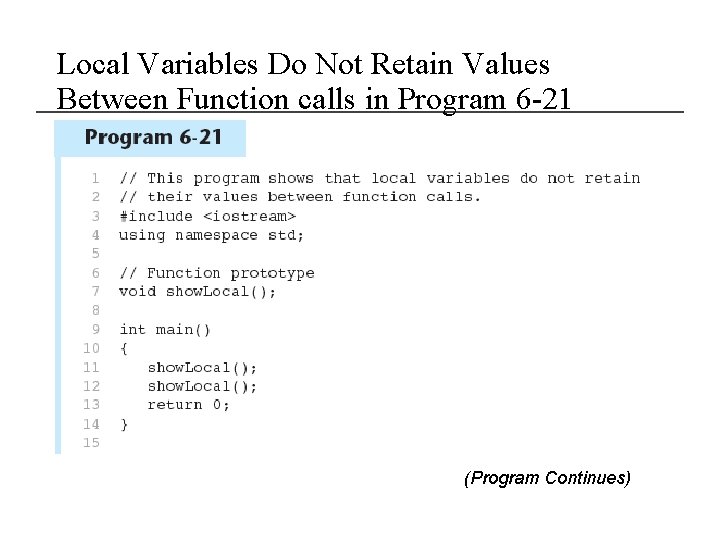
Local Variables Do Not Retain Values Between Function calls in Program 6 -21 (Program Continues)
Local Variables Do Not Retain Values Between Function calls in Program 6 -21 In this program, each time show. Local is called, the local. Num variable is re-created and initialized with the value 5.
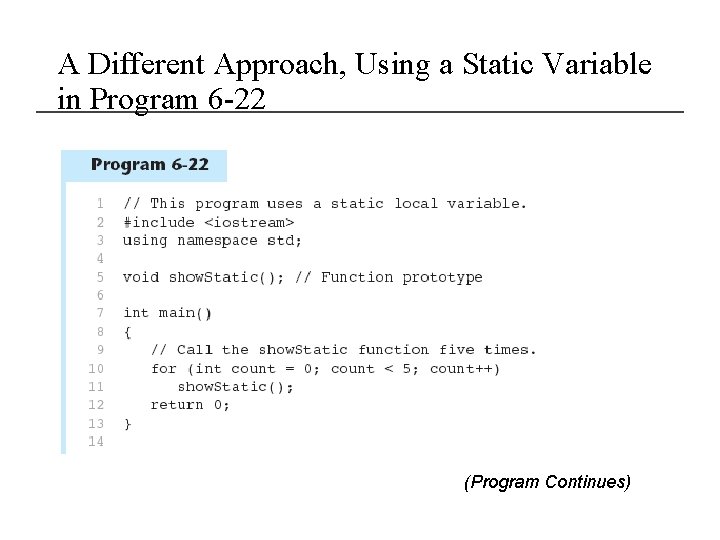
A Different Approach, Using a Static Variable in Program 6 -22 (Program Continues)
A Different Approach, Using a Static Variable in Program 6 -22 stat. Num is automatically initialized to 0. Notice that it retains its value between function calls.
If you do initialize a local static variable, the initialization only happens once. See Program 6 -23.
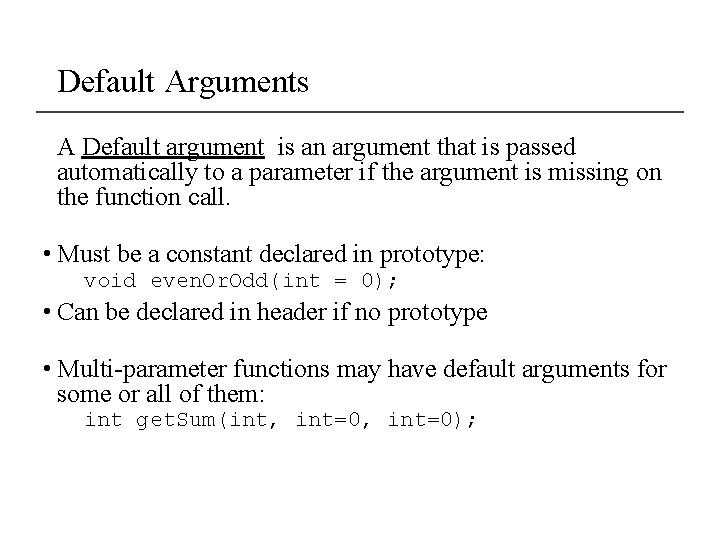
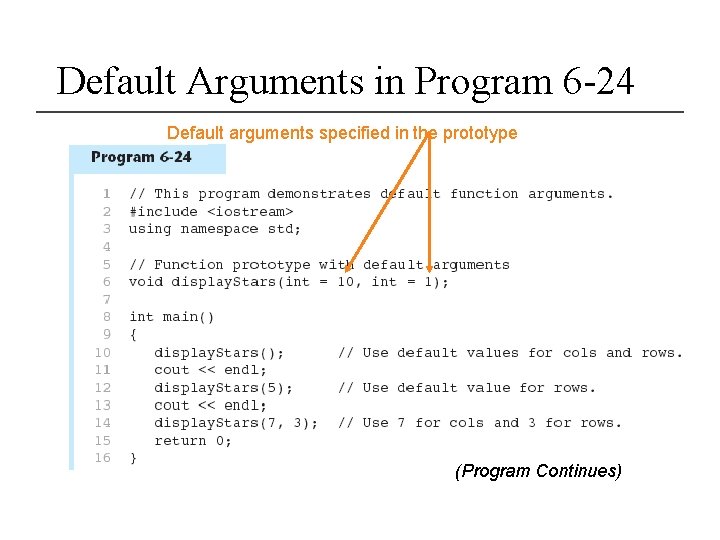
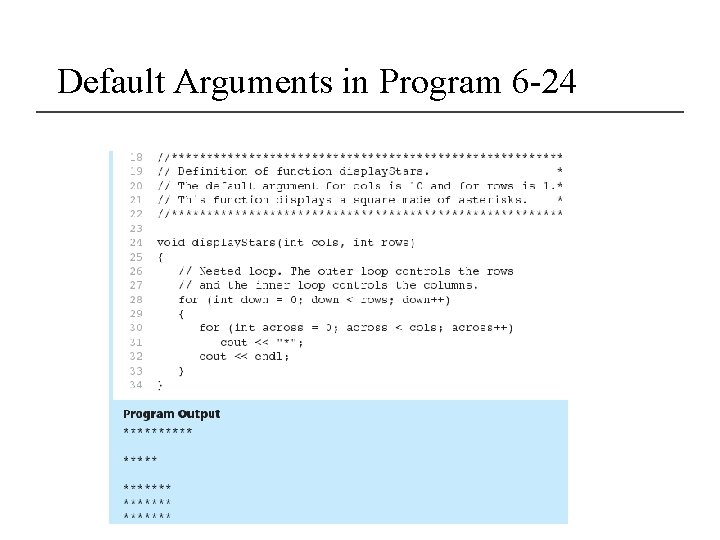
Default Arguments A Default argument is an argument that is passed automatically to a parameter if the argument is missing on the function call. • Must be a constant declared in prototype: void even. Or. Odd(int = 0); • Can be declared in header if no prototype • Multi-parameter functions may have default arguments for some or all of them: int get. Sum(int, int=0);
Default Arguments in Program 6 -24 Default arguments specified in the prototype (Program Continues)
Default Arguments in Program 6 -24
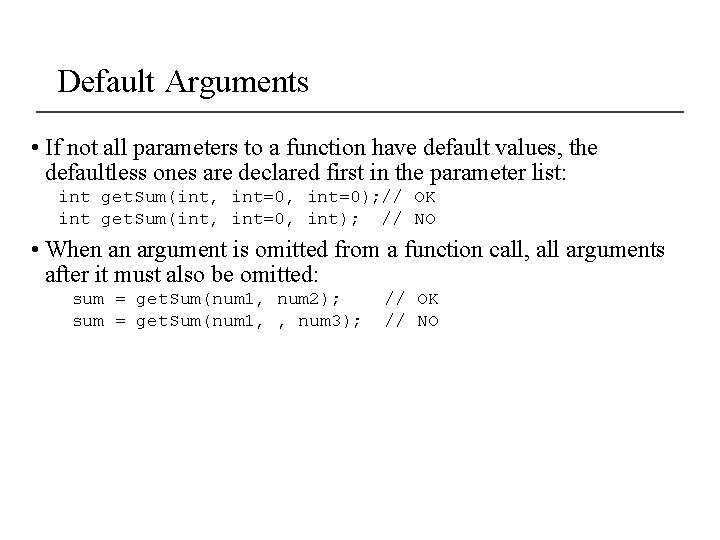
Default Arguments • If not all parameters to a function have default values, the defaultless ones are declared first in the parameter list: int get. Sum(int, int=0); // OK int get. Sum(int, int=0, int); // NO • When an argument is omitted from a function call, all arguments after it must also be omitted: sum = get. Sum(num 1, num 2); sum = get. Sum(num 1, , num 3); // OK // NO
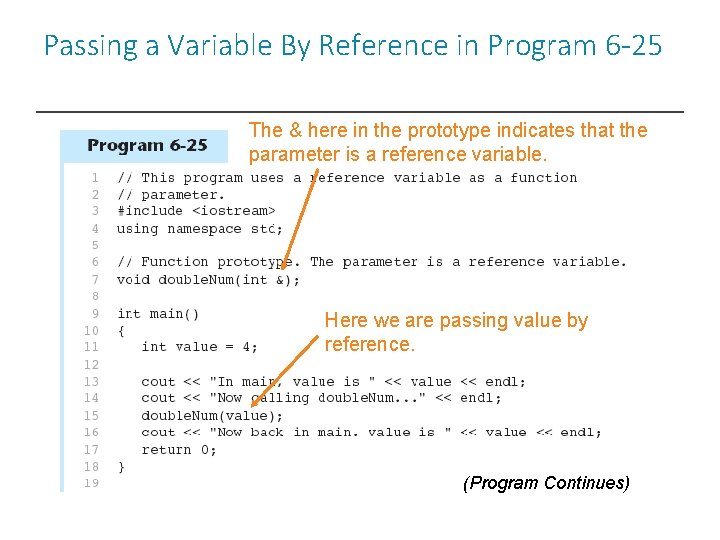
Using Reference Variables as Parameters • A mechanism that allows a function to work with the original argument from the function call, not a copy of the argument • Allows the function to modify values stored in the calling environment • Provides a way for the function to ‘return’ more than one value
Passing by Reference • A reference variable is an alias for another variable • Defined with an ampersand (&) void get. Dimensions(int&, int&); • Changes to a reference variable are made to the variable it refers to • Use reference variables to implement passing parameters by reference
Passing a Variable By Reference in Program 6 -25 The & here in the prototype indicates that the parameter is a reference variable. Here we are passing value by reference. (Program Continues)
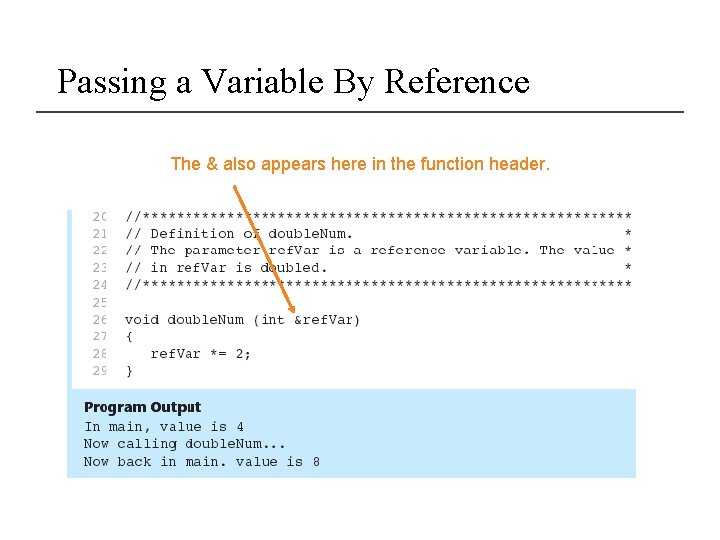
Passing a Variable By Reference The & also appears here in the function header.
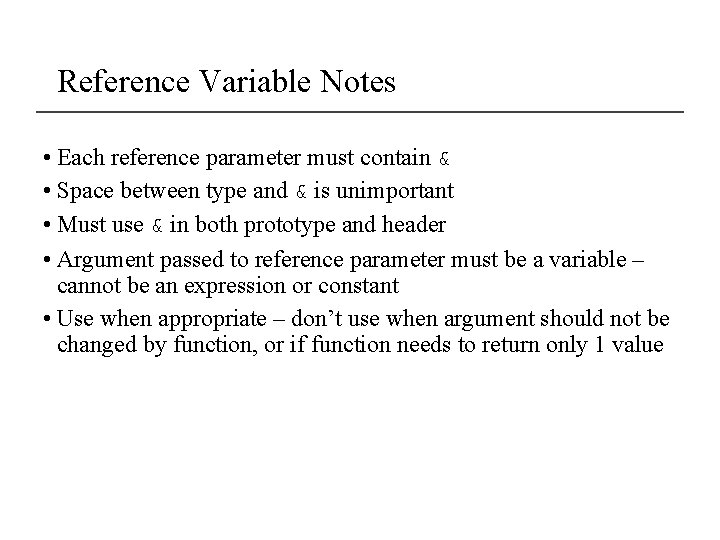
Reference Variable Notes • Each reference parameter must contain & • Space between type and & is unimportant • Must use & in both prototype and header • Argument passed to reference parameter must be a variable – cannot be an expression or constant • Use when appropriate – don’t use when argument should not be changed by function, or if function needs to return only 1 value
Activity 19 • Create a Program to calculate the net salary of an employee based on the bonus of 1. 1% of the salary added to the base and 2% tax withhold deducted after bonus. • Your salary parameter should be pass by reference so that when you display the net salary after the call at main should correctly display the updated salary.
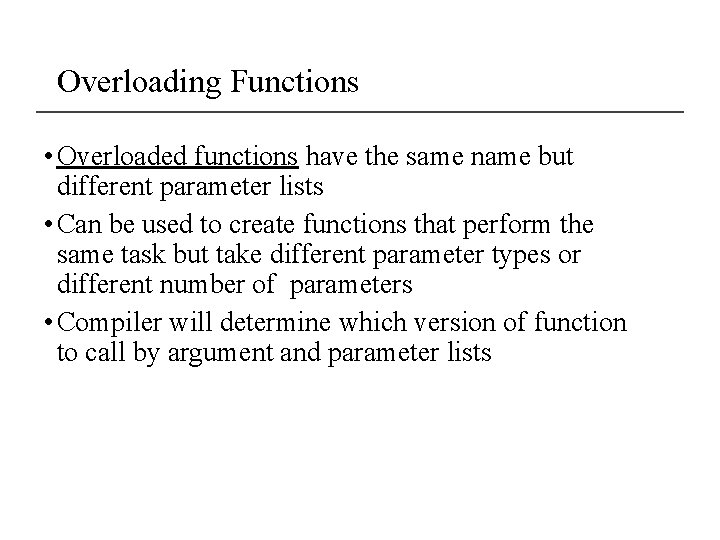
Overloading Functions • Overloaded functions have the same name but different parameter lists • Can be used to create functions that perform the same task but take different parameter types or different number of parameters • Compiler will determine which version of function to call by argument and parameter lists
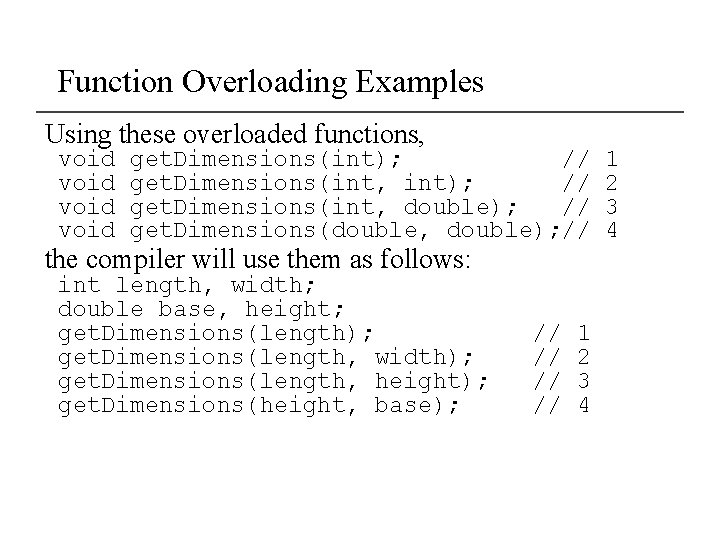
Function Overloading Examples Using these overloaded functions, void get. Dimensions(int); // get. Dimensions(int, double); // get. Dimensions(double, double); // the compiler will use them as follows: int length, width; double base, height; get. Dimensions(length); get. Dimensions(length, width); get. Dimensions(length, height); get. Dimensions(height, base); // // 1 2 3 4
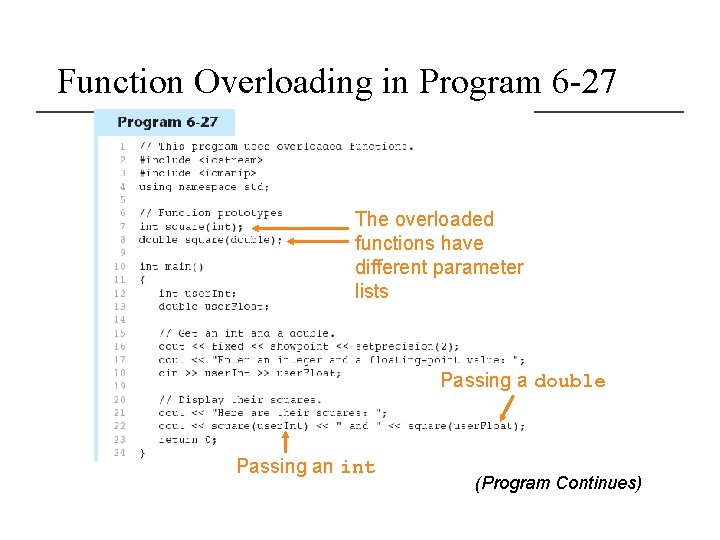
Function Overloading in Program 6 -27 The overloaded functions have different parameter lists Passing a double Passing an int (Program Continues)
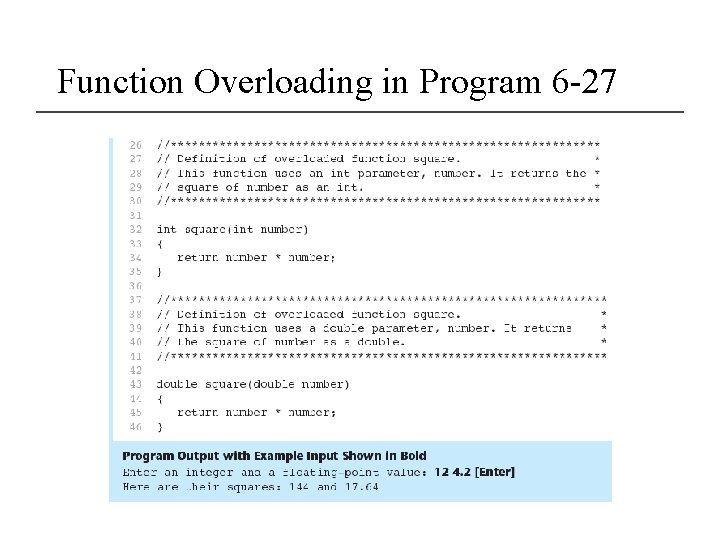
Function Overloading in Program 6 -27
Activity 20 • Create a Program to calculate the area of a Rectangle. You should have 2 overloaded functions called calculate. Area() • One without any parameters and using values inside the function, width = 1. 0 and length = 2. 0 • Another with double type parameters width and length. • Both should return double area and display the result at the main()